EP4263290B1 - Procédé de fonctionnement d'un système d'assistance lumineuse - Google Patents
Procédé de fonctionnement d'un système d'assistance lumineuse Download PDFInfo
- Publication number
- EP4263290B1 EP4263290B1 EP21794786.0A EP21794786A EP4263290B1 EP 4263290 B1 EP4263290 B1 EP 4263290B1 EP 21794786 A EP21794786 A EP 21794786A EP 4263290 B1 EP4263290 B1 EP 4263290B1
- Authority
- EP
- European Patent Office
- Prior art keywords
- urban environment
- vehicle
- camera
- assistance system
- urban
- Prior art date
- Legal status (The legal status is an assumption and is not a legal conclusion. Google has not performed a legal analysis and makes no representation as to the accuracy of the status listed.)
- Active
Links
Images
Classifications
-
- B—PERFORMING OPERATIONS; TRANSPORTING
- B60—VEHICLES IN GENERAL
- B60Q—ARRANGEMENT OF SIGNALLING OR LIGHTING DEVICES, THE MOUNTING OR SUPPORTING THEREOF OR CIRCUITS THEREFOR, FOR VEHICLES IN GENERAL
- B60Q11/00—Arrangement of monitoring devices for devices provided for in groups B60Q1/00 - B60Q9/00
- B60Q11/005—Arrangement of monitoring devices for devices provided for in groups B60Q1/00 - B60Q9/00 for lighting devices, e.g. indicating if lamps are burning or not
-
- B—PERFORMING OPERATIONS; TRANSPORTING
- B60—VEHICLES IN GENERAL
- B60Q—ARRANGEMENT OF SIGNALLING OR LIGHTING DEVICES, THE MOUNTING OR SUPPORTING THEREOF OR CIRCUITS THEREFOR, FOR VEHICLES IN GENERAL
- B60Q1/00—Arrangement of optical signalling or lighting devices, the mounting or supporting thereof or circuits therefor
- B60Q1/02—Arrangement of optical signalling or lighting devices, the mounting or supporting thereof or circuits therefor the devices being primarily intended to illuminate the way ahead or to illuminate other areas of way or environments
- B60Q1/04—Arrangement of optical signalling or lighting devices, the mounting or supporting thereof or circuits therefor the devices being primarily intended to illuminate the way ahead or to illuminate other areas of way or environments the devices being headlights
- B60Q1/14—Arrangement of optical signalling or lighting devices, the mounting or supporting thereof or circuits therefor the devices being primarily intended to illuminate the way ahead or to illuminate other areas of way or environments the devices being headlights having dimming means
- B60Q1/1415—Dimming circuits
- B60Q1/1423—Automatic dimming circuits, i.e. switching between high beam and low beam due to change of ambient light or light level in road traffic
- B60Q1/143—Automatic dimming circuits, i.e. switching between high beam and low beam due to change of ambient light or light level in road traffic combined with another condition, e.g. using vehicle recognition from camera images or activation of wipers
-
- B—PERFORMING OPERATIONS; TRANSPORTING
- B60—VEHICLES IN GENERAL
- B60Q—ARRANGEMENT OF SIGNALLING OR LIGHTING DEVICES, THE MOUNTING OR SUPPORTING THEREOF OR CIRCUITS THEREFOR, FOR VEHICLES IN GENERAL
- B60Q9/00—Arrangement or adaptation of signal devices not provided for in one of main groups B60Q1/00 - B60Q7/00, e.g. haptic signalling
-
- B—PERFORMING OPERATIONS; TRANSPORTING
- B60—VEHICLES IN GENERAL
- B60Q—ARRANGEMENT OF SIGNALLING OR LIGHTING DEVICES, THE MOUNTING OR SUPPORTING THEREOF OR CIRCUITS THEREFOR, FOR VEHICLES IN GENERAL
- B60Q2300/00—Indexing codes for automatically adjustable headlamps or automatically dimmable headlamps
- B60Q2300/10—Indexing codes relating to particular vehicle conditions
- B60Q2300/11—Linear movements of the vehicle
- B60Q2300/112—Vehicle speed
-
- B—PERFORMING OPERATIONS; TRANSPORTING
- B60—VEHICLES IN GENERAL
- B60Q—ARRANGEMENT OF SIGNALLING OR LIGHTING DEVICES, THE MOUNTING OR SUPPORTING THEREOF OR CIRCUITS THEREFOR, FOR VEHICLES IN GENERAL
- B60Q2300/00—Indexing codes for automatically adjustable headlamps or automatically dimmable headlamps
- B60Q2300/10—Indexing codes relating to particular vehicle conditions
- B60Q2300/14—Other vehicle conditions
- B60Q2300/146—Abnormalities, e.g. fail-safe
-
- B—PERFORMING OPERATIONS; TRANSPORTING
- B60—VEHICLES IN GENERAL
- B60Q—ARRANGEMENT OF SIGNALLING OR LIGHTING DEVICES, THE MOUNTING OR SUPPORTING THEREOF OR CIRCUITS THEREFOR, FOR VEHICLES IN GENERAL
- B60Q2300/00—Indexing codes for automatically adjustable headlamps or automatically dimmable headlamps
- B60Q2300/30—Indexing codes relating to the vehicle environment
- B60Q2300/33—Driving situation
- B60Q2300/332—Driving situation on city roads
- B60Q2300/3321—Detection of streetlights
-
- B—PERFORMING OPERATIONS; TRANSPORTING
- B60—VEHICLES IN GENERAL
- B60Q—ARRANGEMENT OF SIGNALLING OR LIGHTING DEVICES, THE MOUNTING OR SUPPORTING THEREOF OR CIRCUITS THEREFOR, FOR VEHICLES IN GENERAL
- B60Q2300/00—Indexing codes for automatically adjustable headlamps or automatically dimmable headlamps
- B60Q2300/40—Indexing codes relating to other road users or special conditions
- B60Q2300/41—Indexing codes relating to other road users or special conditions preceding vehicle
-
- B—PERFORMING OPERATIONS; TRANSPORTING
- B60—VEHICLES IN GENERAL
- B60Q—ARRANGEMENT OF SIGNALLING OR LIGHTING DEVICES, THE MOUNTING OR SUPPORTING THEREOF OR CIRCUITS THEREFOR, FOR VEHICLES IN GENERAL
- B60Q2300/00—Indexing codes for automatically adjustable headlamps or automatically dimmable headlamps
- B60Q2300/40—Indexing codes relating to other road users or special conditions
- B60Q2300/42—Indexing codes relating to other road users or special conditions oncoming vehicle
Definitions
- the invention relates to a method for operating a light assistance system for a vehicle according to the type defined in the preamble of claim 1.
- Light assistance systems for vehicles are known from the state of the art. They are sometimes also described under the English term Intelligent Headlight Control (IHC).
- IHC Intelligent Headlight Control
- such light assistance systems are typically operated in such a way that the high beam assistant is only used on country roads, motorways and the like, while it remains switched off in an urban environment, for example in city traffic, when driving through villages, settlements, industrial areas or the like.
- the DE 10 2009 028 342 A1 which describes a method and a device for activating the city light of a vehicle depending on the detected environment.
- This city light is in the context of the sense described above of dispensing with activating the high beam in the light assistant.
- the document mentioned Street lighting units are detected and based on the spatial distance between these street lighting units it is determined whether the vehicle is in an urban environment or not.
- Other methods for determining an urban environment for example based on the lighting level in the area or based on satellite navigation coordinates of the vehicle and a comparison with a corresponding map, are also known from the further prior art.
- a sensor failure can, for example, be a limited view of the camera, in particular due to dirt, heavy rainfall, fogging of a window through which the camera looks, or the like.
- this leads to an error message being generated which indicates to a person driving the vehicle that the light assistance system is temporarily not working, so that this person is accordingly informed of the temporary unavailability of their assistance system.
- a corresponding procedure in which an error message can also be temporarily suppressed is described in the WO 2004/076231 A2
- Other methods are available from DE 10 2009 038 919 A1 known.
- the object of the present invention is to provide an improved method for operating a light assistance system according to the preamble of claim 1, which reduces unnecessary display of error messages. According to the invention, this object is achieved by a method for operating a light assistance system with the features in claim 1, and here in particular in the characterizing part of claim 1. Advantageous embodiments and Further developments of the method according to the invention result from the subclaims dependent on this main claim.
- the procedure means that when driving in an urban environment, any error messages that may occur regarding the camera's limited view are suppressed.
- the light assistance system therefore knows that it is in an urban environment and that the high beam, for which the assistance system is responsible for raising and/or lowering the headlights and, if necessary, for glaring oncoming road users or road users ahead, is not necessary.
- the driver drives with the low beam on all the time.
- the method suppresses this error message regarding the restricted camera view, which has no effect on the practical use of the vehicle. This relieves the person driving the vehicle of unnecessary messages and allows them to concentrate better on the traffic than if a corresponding message such as "high beam assistant deactivated due to blocked camera view" or something similar were displayed in the instrument cluster.
- the method according to the invention therefore suppresses such an error message that the camera has restricted visibility in the situations already recorded in which no high beam is required.
- the method provides that when leaving the urban environment and the error message regarding the limited visibility of the camera is still present, this is displayed after a specified period of time from leaving the urban environment.
- the method according to the invention thus ensures that when leaving the urban area, the error message is displayed if it is still current, i.e. if, for example, the window is still fogged up, in order to inform the person driving the vehicle accordingly in this situation in which the high beam represents a useful support.
- a set period of time is waited before the error message is displayed, on the one hand to avoid "ambushing" the person driving the vehicle with the error message immediately at the edge of the urban area and, on the other hand, to ensure that the error message is not unnecessarily displayed when driving on the outskirts of the urban area if the vehicle drives back into the urban area within a very short period of time.
- a very advantageous embodiment of this idea provides that a person using the vehicle can actively change the set time period.
- the suppression of the warning message after leaving the urban area can therefore be influenced by a person using the vehicle in terms of the time period, for example by automatically configuring a preferred time period via a menu system or the like in order to adapt the vehicle and the potential display or suppression of such error messages to their individual needs.
- the method can be particularly useful if a camera arranged behind the windshield and looking in the direction of travel through the windshield is used for the light assistance system.
- the method can also be used for other cameras, such as cameras outside, whose visibility may be impaired by snow or ice or a large amount of moisture.
- the device for recognizing the urban environment can use, in particular, street lighting recognized by environmental sensors, brightness detected by a sensor, driving speed, and a position of the vehicle determined by satellite navigation in comparison to a map showing the urban environment to determine whether the vehicle is in an urban environment.
- these options can also be combined with one another in order to be able to recognize the urban environment as reliably as possible.
- the urban environment is determined on the basis of the street lighting, namely by counting the number of street lamps detected, and subsequently an urban environment is inferred on the basis of a predetermined number of street lamps, in particular a predetermined number of street lamps per unit of distance.
- street lamps are counted and evaluated as a total number or as a number per unit of distance. From a certain number onwards, it is assumed that an urban environment is present.
- this can be combined with a brightness sensor, for example, in order to recognize an urban environment or daylight at certain brightness values and to operate the light assistance system as such in urban environment mode or to deactivate it accordingly during the day.
- the position of the vehicle can also be determined, in particular to validate the results detected by the vehicle's sensors.
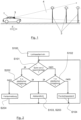
- a vehicle marked 1 can be seen, which is said to be equipped with an indicated multifunctional camera 2.
- This multifunctional camera is used on the one hand to record the surroundings of the vehicle 1 and on the other hand can also be used for a so-called light assistance system.
- the lighting assistance system is then limited to the so-called dipped beam; if there is no urban environment, the high beam is also used accordingly and the lighting assistance system turns it on and off as required, or road users driving ahead or coming towards you are actively blinded if, for example, pixel headlights or headlights with other suitable methods for influencing the light distribution are used, which enables targeted blinding of individual road users.
- the multifunction camera 2 is different from what is shown in the schematic representation of the Figure 1 is indicated, typically arranged behind the windshield of the vehicle 1 and faces forward in the direction of travel F. If the windshield is fogged up or is not completely cleared of ice and snow in the upper area where the multifunction camera 2 looks through it, then the view of the multifunction camera 2 may be impaired. If this is the case, then the systems according to the state of the art generate an error message, which may, however, only unnecessarily irritate a person driving the vehicle 1 and distract them from the traffic.
- step S101 a query is made in step S101 as to whether the view of the multifunction camera 2 is impaired. If this is not the case, then the conventional operation of the light assistance system will be used. To do this, as already mentioned at the beginning, it is necessary to recognize whether the vehicle 1 is in an urban environment. This is done here via the query in step S102. If the vehicle is in an urban environment, then in step S103 operation is implemented exclusively with the low beam and the method jumps back to the beginning and runs through the corresponding steps again and again. If the urban area is now left or the light assistance system is started outside the urban area, then instead of step S103, step S104 will take place, in which the high beam is activated, i.e.
- steps S102 - S104 are in principle the part that is implemented as in a conventional light assistance system, whereby query S102 is necessary in any case in order to distinguish whether operation should take place with low beam according to step S103 or with high beam according to step S104.
- step S101 in which the query in step S101 is answered with yes is answered, the query as to whether the vehicle 1 is in an urban environment is now also carried out.
- This step is designated S202 here and uses the data basis already available for step S102. If this is not the case, i.e. the vehicle is outside an urban environment, then in step S204 the known error message is generated, for example that the high beam assistant is not available due to impaired visibility of the camera 2, and is displayed, for example, on a multifunction display of the vehicle 1 for a person driving the vehicle 1.
- the vehicle 1 is often in an urban environment because vehicles 1 most likely start their journey in an urban environment and the problem of fogged-up windows typically occurs at the beginning of the journey.
- the system jumps directly to step S203, i.e. the operation with the low beam, which is sensible for the urban environment, is initiated.
- the error message is omitted or it is actively suppressed in the method according to the invention. This means that the person driving vehicle 1 is not burdened with unnecessary error messages in this situation and may be distracted from the traffic.
- step S101 jumps back to the query in step S101 in a similar way to step S204, so that the changing situation can be responded to both with regard to the impaired view of the camera in step S101 and, for example, to leaving the urban environment in one of the steps S102 or S202.
Landscapes
- Engineering & Computer Science (AREA)
- Mechanical Engineering (AREA)
- Human Computer Interaction (AREA)
- Lighting Device Outwards From Vehicle And Optical Signal (AREA)
- Circuit Arrangement For Electric Light Sources In General (AREA)
- Traffic Control Systems (AREA)
Claims (5)
- Procédé permettant de faire fonctionner un système d'assistance lumineuse pour un véhicule (1) qui est équipé d'une caméra (2) au moins pour la détection d'usagers de la route venant en sens inverse ou roulant devant et d'un dispositif pour la reconnaissance d'un environnement urbain, dans lequel l'enclenchement d'un feu de route est réprimé lors d'un trajet dans l'environnement urbain, dans lequel des messages d'erreur concernant la visibilité limitée de la caméra (2) apparaissant lors d'un trajet dans l'environnement urbain sont réprimés, caractérisé en ce que, lors d'un départ du véhicule (1) de l'environnement urbain et lorsque le message d'erreur concernant la visibilité limitée de la caméra (2) continue d'être présent, ledit message d'erreur est affiché après un laps de temps déterminé à partir du départ de l'environnement urbain.
- Procédé selon la revendication 1,
caractérisé en ce que
une personne utilisant le véhicule (1) peut modifier activement le laps de temps défini. - Procédé selon la revendication 1 ou 2,
caractérisé en ce que
une caméra (2) disposée derrière le pare-brise du véhicule (1), laquelle comporte une vue dans le sens de la marche (F) à travers le pare-brise, est utilisée pour le système d'assistance lumineuse. - Procédé selon l'une des revendications 1 à 3,
caractérisé en ce que
le dispositif pour la reconnaissance de l'environnement urbain évalue au moins l'éclairage des voies publiques, la luminosité, la vitesse de véhicule et/ou la position du véhicule (1) détectée par l'intermédiaire d'un système de navigation par satellite par rapport à une carte de l'environnement urbain ou une combinaison de celles-ci. - Procédé selon la revendication 4,
caractérisé en ce que
l'environnement urbain est déterminé à l'aide de l'éclairage des voies publiques en comptant le nombre de lampadaires (3) reconnus et, à partir d'un nombre absolu prédéfini de lampadaires (3) ou d'un nombre prédéfini de lampadaires (3), l'unité de distance est déduite d'un environnement urbain.
Applications Claiming Priority (2)
| Application Number | Priority Date | Filing Date | Title |
|---|---|---|---|
| DE102020007759.5A DE102020007759A1 (de) | 2020-12-18 | 2020-12-18 | Verfahren zum Betreiben eines Lichtassistenzsystems |
| PCT/EP2021/078574 WO2022128206A1 (fr) | 2020-12-18 | 2021-10-15 | Procédé de fonctionnement d'un système d'assistance lumineuse |
Publications (3)
| Publication Number | Publication Date |
|---|---|
| EP4263290A1 EP4263290A1 (fr) | 2023-10-25 |
| EP4263290C0 EP4263290C0 (fr) | 2024-12-04 |
| EP4263290B1 true EP4263290B1 (fr) | 2024-12-04 |
Family
ID=78302746
Family Applications (1)
| Application Number | Title | Priority Date | Filing Date |
|---|---|---|---|
| EP21794786.0A Active EP4263290B1 (fr) | 2020-12-18 | 2021-10-15 | Procédé de fonctionnement d'un système d'assistance lumineuse |
Country Status (7)
| Country | Link |
|---|---|
| US (1) | US20240109489A1 (fr) |
| EP (1) | EP4263290B1 (fr) |
| JP (1) | JP7629530B2 (fr) |
| KR (1) | KR102823123B1 (fr) |
| CN (1) | CN116761741B (fr) |
| DE (1) | DE102020007759A1 (fr) |
| WO (1) | WO2022128206A1 (fr) |
Citations (1)
| Publication number | Priority date | Publication date | Assignee | Title |
|---|---|---|---|---|
| DE102009038919A1 (de) * | 2009-08-26 | 2011-03-03 | Daimler Ag | Verfahren zum Betrieb eines Fahrerassistenzsystems eines Fahrzeugs |
Family Cites Families (22)
| Publication number | Priority date | Publication date | Assignee | Title |
|---|---|---|---|---|
| JPH09188206A (ja) * | 1996-01-08 | 1997-07-22 | Nissan Motor Co Ltd | 死角内障害物報知装置 |
| JP2002087111A (ja) * | 2000-09-13 | 2002-03-26 | Nissan Motor Co Ltd | 車両用情報提供装置 |
| DE10228703A1 (de) * | 2002-06-27 | 2004-01-15 | Robert Bosch Gmbh | Verfahren zum Betreiben von Fahrerinformationssystemen sowie Vorrichtung zur Durchführung des Verfahrens |
| US8045760B2 (en) | 2003-02-21 | 2011-10-25 | Gentex Corporation | Automatic vehicle exterior light control systems |
| CN100420592C (zh) * | 2003-02-21 | 2008-09-24 | 金泰克斯公司 | 自动汽车外部灯光控制系统 |
| DE10322458A1 (de) * | 2003-05-16 | 2004-12-02 | Daimlerchrysler Ag | Verfahren und Vorrichtung zur Beeinflussung der Beanspruchung eines Fahrers in einem Kraftfahrzeug |
| US8376595B2 (en) * | 2009-05-15 | 2013-02-19 | Magna Electronics, Inc. | Automatic headlamp control |
| DE102009028342A1 (de) | 2009-08-07 | 2011-02-17 | Robert Bosch Gmbh | Verfahren und Vorrichtung zur Aktivierung des Stadtlichts eines Fahrzeugs, abhängig von der Erkennung einer beleuchteten Gegend innerorts mittels einer Kamera |
| US9132773B2 (en) * | 2009-12-07 | 2015-09-15 | Cobra Electronics Corporation | Mobile communication system and method for analyzing alerts associated with vehicular travel |
| DE102010015214A1 (de) * | 2010-04-16 | 2011-10-20 | Conti Temic Microelectronic Gmbh | Verfahren und Vorrichtung zur Fahrerunterstützung beim Fahren eines Fahrzeugs durch Detektion von wetterbedingten Sichteinschränkungen |
| US9199574B2 (en) * | 2012-09-11 | 2015-12-01 | Gentex Corporation | System and method for detecting a blocked imager |
| CN103538519B (zh) * | 2013-09-24 | 2016-08-17 | 奇瑞汽车股份有限公司 | 一种汽车近红外夜视系统的控制方法 |
| JP6757586B2 (ja) | 2016-03-31 | 2020-09-23 | 株式会社Subaru | 異常報知装置 |
| JP6923310B2 (ja) | 2016-11-29 | 2021-08-18 | 株式会社小糸製作所 | 車両用ランプの点灯制御装置 |
| US10155523B2 (en) * | 2017-03-30 | 2018-12-18 | Ford Global Technologies, Llc | Adaptive occupancy conversational awareness system |
| WO2019035108A1 (fr) * | 2017-08-17 | 2019-02-21 | Mohan Lalit | Système de commande de faisceau de phare d'un véhicule et procédé associé |
| KR20190047243A (ko) * | 2017-10-27 | 2019-05-08 | 현대자동차주식회사 | 카메라 렌즈 오염 경고 장치 및 방법 |
| CN109987025B (zh) * | 2018-01-03 | 2023-02-21 | 奥迪股份公司 | 用于夜晚环境的车辆驾驶辅助系统及方法 |
| CN108638956A (zh) * | 2018-05-14 | 2018-10-12 | 佛山市洁宇信息科技有限公司 | 一种车辆灯光控制系统及控制方法 |
| DE102018220114A1 (de) | 2018-11-23 | 2020-05-28 | Zf Friedrichshafen Ag | Vorrichtung und Verfahren zum Erkennen einer Sensorblockade eines Umgebungssensors |
| DE102018220113A1 (de) | 2018-11-23 | 2020-05-28 | Zf Friedrichshafen Ag | Vorrichtung und Verfahren zum Erkennen einer Sensorblockade eines Umgebungssensors |
| US10791417B1 (en) * | 2019-03-28 | 2020-09-29 | Lenovo (Singapore) Pte. Ltd. | Low-fuel indicator enablement based on fuel station locations |
-
2020
- 2020-12-18 DE DE102020007759.5A patent/DE102020007759A1/de active Pending
-
2021
- 2021-10-15 JP JP2023537171A patent/JP7629530B2/ja active Active
- 2021-10-15 US US18/267,834 patent/US20240109489A1/en active Pending
- 2021-10-15 WO PCT/EP2021/078574 patent/WO2022128206A1/fr not_active Ceased
- 2021-10-15 CN CN202180084313.8A patent/CN116761741B/zh active Active
- 2021-10-15 EP EP21794786.0A patent/EP4263290B1/fr active Active
- 2021-10-15 KR KR1020237018630A patent/KR102823123B1/ko active Active
Patent Citations (1)
| Publication number | Priority date | Publication date | Assignee | Title |
|---|---|---|---|---|
| DE102009038919A1 (de) * | 2009-08-26 | 2011-03-03 | Daimler Ag | Verfahren zum Betrieb eines Fahrerassistenzsystems eines Fahrzeugs |
Also Published As
| Publication number | Publication date |
|---|---|
| CN116761741A (zh) | 2023-09-15 |
| EP4263290C0 (fr) | 2024-12-04 |
| JP7629530B2 (ja) | 2025-02-13 |
| CN116761741B (zh) | 2026-04-10 |
| KR102823123B1 (ko) | 2025-06-30 |
| JP2024502739A (ja) | 2024-01-23 |
| DE102020007759A1 (de) | 2022-06-23 |
| EP4263290A1 (fr) | 2023-10-25 |
| KR20230101860A (ko) | 2023-07-06 |
| US20240109489A1 (en) | 2024-04-04 |
| WO2022128206A1 (fr) | 2022-06-23 |
Similar Documents
| Publication | Publication Date | Title |
|---|---|---|
| EP2691263B1 (fr) | Procédé et appareil de commande pour éclairer les feux de route d'un véhicule | |
| DE102015011231B4 (de) | Verfahren zum Betrieb einer in einem Kraftfahrzeug angeordneten Laserheckleuchte, Laserheckleuchte und Kraftfahrzeug | |
| DE102011081367A1 (de) | Verfahren zur Steuerung einer Lichtaussendung eines Scheinwerfers eines Fahrzeugs | |
| EP3548337B1 (fr) | Commande d'un phare de véhicule automobile | |
| DE102010034853A1 (de) | Kraftfahrzeug mit Digitalprojektoren | |
| DE102014203138A1 (de) | Fahrerassistenzsystem für ein Kraftfahrzeug und Verfahren zur Assistenz eines Kraftfahrzeug-Fahrers | |
| DE102017103282A1 (de) | Anzeigesteuerung für ein fahrzeug | |
| DE102011083265B4 (de) | Verfahren und Fahrerassistenzvorrichtung zur Ermittlung des Vorhandenseins einer baulichen Trennung zwischen zwei Fahrbahnen | |
| DE102015207543A1 (de) | Vorrichtung und Verfahren zum Steuern eines Fahrzeugscheinwerfers eines Kraftfahrzeuges | |
| EP3717954A1 (fr) | Procédé d'affichage du déroulement d'une trajectoire devant un véhicule ou un objet pourvu d'une unité d'affichage, dispositif de mise en oeuvre du procédé | |
| EP3592604A1 (fr) | Véhicule automobile comprenant un module d'éclairage servant à générer un symbole | |
| DE102019005674A1 (de) | Verfahren zum Steuern einer variablen Lichtverteilung | |
| DE102017210219A1 (de) | Verfahren zum Unterstützen eines Benutzers eines Kraftfahrzeugs beim Ausweichen eines Hindernisses, Fahrerassistenzeinrichtung, und Kraftfahrzeug | |
| EP2384932A2 (fr) | Procédé de commande prédictive d'un phare de virage adaptatif et véhicule automobile | |
| DE102017217745B4 (de) | Verfahren zum Erzeugen eines Signals eines Fahrzeugs für einen Verkehrsteilnehmer | |
| DE102008054005A1 (de) | Verfahren und Vorrichtung zum Einstellen von Kurvenlichtscheinwerfern, insbesondere bei der Durchfahrt von Kreuzungen oder Einmündungen | |
| DE102009041698A1 (de) | Verfahren zur prädiktiven Ansteuerung eines adaptiven Kurvenlichts und Kraftfahrzeug | |
| DE102019001889A1 (de) | Verfahren zur automatischen Steuerung von Lichtfunktionen | |
| EP4263290B1 (fr) | Procédé de fonctionnement d'un système d'assistance lumineuse | |
| DE102018215666A1 (de) | Verfahren zum Betrieb eines Scheinwerfers eines Fahrzeugs sowie Fernlicht-Assistenzsystem | |
| EP1898381A1 (fr) | Dispositif et prodédé pour informer un conducteur | |
| DE102012020412B4 (de) | Verfahren zur Erkennung einer nächtlichen Ortsfahrt eines Fahrzeugs | |
| DE102017119776A1 (de) | Verfahren zur Ansteuerung mindestens eines Hauptscheinwerfers, Beleuchtungseinheit, Computerprogrammprodukt und computerlesbares Medium | |
| DE102017119759A1 (de) | Verfahren zur Ansteuerung mindestens eines Hauptscheinwerfers einer Beleuchtungseinheit eines Fahrzeugs, Beleuchtungseinheit, Computerprogrammprodukt und computerlesbares Medium | |
| WO2018086728A1 (fr) | Système d'assistance aux feux de route |
Legal Events
| Date | Code | Title | Description |
|---|---|---|---|
| STAA | Information on the status of an ep patent application or granted ep patent |
Free format text: STATUS: UNKNOWN |
|
| STAA | Information on the status of an ep patent application or granted ep patent |
Free format text: STATUS: THE INTERNATIONAL PUBLICATION HAS BEEN MADE |
|
| PUAI | Public reference made under article 153(3) epc to a published international application that has entered the european phase |
Free format text: ORIGINAL CODE: 0009012 |
|
| STAA | Information on the status of an ep patent application or granted ep patent |
Free format text: STATUS: REQUEST FOR EXAMINATION WAS MADE |
|
| 17P | Request for examination filed |
Effective date: 20230530 |
|
| AK | Designated contracting states |
Kind code of ref document: A1 Designated state(s): AL AT BE BG CH CY CZ DE DK EE ES FI FR GB GR HR HU IE IS IT LI LT LU LV MC MK MT NL NO PL PT RO RS SE SI SK SM TR |
|
| DAV | Request for validation of the european patent (deleted) | ||
| DAX | Request for extension of the european patent (deleted) | ||
| GRAP | Despatch of communication of intention to grant a patent |
Free format text: ORIGINAL CODE: EPIDOSNIGR1 |
|
| STAA | Information on the status of an ep patent application or granted ep patent |
Free format text: STATUS: GRANT OF PATENT IS INTENDED |
|
| INTG | Intention to grant announced |
Effective date: 20240705 |
|
| GRAS | Grant fee paid |
Free format text: ORIGINAL CODE: EPIDOSNIGR3 |
|
| GRAA | (expected) grant |
Free format text: ORIGINAL CODE: 0009210 |
|
| STAA | Information on the status of an ep patent application or granted ep patent |
Free format text: STATUS: THE PATENT HAS BEEN GRANTED |
|
| AK | Designated contracting states |
Kind code of ref document: B1 Designated state(s): AL AT BE BG CH CY CZ DE DK EE ES FI FR GB GR HR HU IE IS IT LI LT LU LV MC MK MT NL NO PL PT RO RS SE SI SK SM TR |
|
| REG | Reference to a national code |
Ref country code: CH Ref legal event code: EP |
|
| REG | Reference to a national code |
Ref country code: DE Ref legal event code: R096 Ref document number: 502021006029 Country of ref document: DE |
|
| REG | Reference to a national code |
Ref country code: IE Ref legal event code: FG4D Free format text: LANGUAGE OF EP DOCUMENT: GERMAN |
|
| U01 | Request for unitary effect filed |
Effective date: 20241220 |
|
| U07 | Unitary effect registered |
Designated state(s): AT BE BG DE DK EE FI FR IT LT LU LV MT NL PT RO SE SI Effective date: 20250113 |
|
| PG25 | Lapsed in a contracting state [announced via postgrant information from national office to epo] |
Ref country code: HR Free format text: LAPSE BECAUSE OF FAILURE TO SUBMIT A TRANSLATION OF THE DESCRIPTION OR TO PAY THE FEE WITHIN THE PRESCRIBED TIME-LIMIT Effective date: 20241204 |
|
| PG25 | Lapsed in a contracting state [announced via postgrant information from national office to epo] |
Ref country code: ES Free format text: LAPSE BECAUSE OF FAILURE TO SUBMIT A TRANSLATION OF THE DESCRIPTION OR TO PAY THE FEE WITHIN THE PRESCRIBED TIME-LIMIT Effective date: 20241204 |
|
| PG25 | Lapsed in a contracting state [announced via postgrant information from national office to epo] |
Ref country code: NO Free format text: LAPSE BECAUSE OF FAILURE TO SUBMIT A TRANSLATION OF THE DESCRIPTION OR TO PAY THE FEE WITHIN THE PRESCRIBED TIME-LIMIT Effective date: 20250304 |
|
| PG25 | Lapsed in a contracting state [announced via postgrant information from national office to epo] |
Ref country code: GR Free format text: LAPSE BECAUSE OF FAILURE TO SUBMIT A TRANSLATION OF THE DESCRIPTION OR TO PAY THE FEE WITHIN THE PRESCRIBED TIME-LIMIT Effective date: 20250305 |
|
| PG25 | Lapsed in a contracting state [announced via postgrant information from national office to epo] |
Ref country code: RS Free format text: LAPSE BECAUSE OF FAILURE TO SUBMIT A TRANSLATION OF THE DESCRIPTION OR TO PAY THE FEE WITHIN THE PRESCRIBED TIME-LIMIT Effective date: 20250304 |
|
| PG25 | Lapsed in a contracting state [announced via postgrant information from national office to epo] |
Ref country code: SM Free format text: LAPSE BECAUSE OF FAILURE TO SUBMIT A TRANSLATION OF THE DESCRIPTION OR TO PAY THE FEE WITHIN THE PRESCRIBED TIME-LIMIT Effective date: 20241204 |
|
| PG25 | Lapsed in a contracting state [announced via postgrant information from national office to epo] |
Ref country code: PL Free format text: LAPSE BECAUSE OF FAILURE TO SUBMIT A TRANSLATION OF THE DESCRIPTION OR TO PAY THE FEE WITHIN THE PRESCRIBED TIME-LIMIT Effective date: 20241204 |
|
| PG25 | Lapsed in a contracting state [announced via postgrant information from national office to epo] |
Ref country code: IS Free format text: LAPSE BECAUSE OF FAILURE TO SUBMIT A TRANSLATION OF THE DESCRIPTION OR TO PAY THE FEE WITHIN THE PRESCRIBED TIME-LIMIT Effective date: 20250404 |
|
| PG25 | Lapsed in a contracting state [announced via postgrant information from national office to epo] |
Ref country code: SK Free format text: LAPSE BECAUSE OF FAILURE TO SUBMIT A TRANSLATION OF THE DESCRIPTION OR TO PAY THE FEE WITHIN THE PRESCRIBED TIME-LIMIT Effective date: 20241204 |
|
| PG25 | Lapsed in a contracting state [announced via postgrant information from national office to epo] |
Ref country code: CZ Free format text: LAPSE BECAUSE OF FAILURE TO SUBMIT A TRANSLATION OF THE DESCRIPTION OR TO PAY THE FEE WITHIN THE PRESCRIBED TIME-LIMIT Effective date: 20241204 |
|
| PLBE | No opposition filed within time limit |
Free format text: ORIGINAL CODE: 0009261 |
|
| STAA | Information on the status of an ep patent application or granted ep patent |
Free format text: STATUS: NO OPPOSITION FILED WITHIN TIME LIMIT |
|
| 26N | No opposition filed |
Effective date: 20250905 |
|
| U20 | Renewal fee for the european patent with unitary effect paid |
Year of fee payment: 5 Effective date: 20251027 |