EP4263749B1 - Dérivés de dibenzofurane et de dibenzothiophène - Google Patents
Dérivés de dibenzofurane et de dibenzothiophène Download PDFInfo
- Publication number
- EP4263749B1 EP4263749B1 EP21823937.4A EP21823937A EP4263749B1 EP 4263749 B1 EP4263749 B1 EP 4263749B1 EP 21823937 A EP21823937 A EP 21823937A EP 4263749 B1 EP4263749 B1 EP 4263749B1
- Authority
- EP
- European Patent Office
- Prior art keywords
- denotes
- atoms
- ocf
- compounds
- difluoro
- Prior art date
- Legal status (The legal status is an assumption and is not a legal conclusion. Google has not performed a legal analysis and makes no representation as to the accuracy of the status listed.)
- Active
Links
Classifications
-
- C—CHEMISTRY; METALLURGY
- C09—DYES; PAINTS; POLISHES; NATURAL RESINS; ADHESIVES; COMPOSITIONS NOT OTHERWISE PROVIDED FOR; APPLICATIONS OF MATERIALS NOT OTHERWISE PROVIDED FOR
- C09K—MATERIALS FOR MISCELLANEOUS APPLICATIONS, NOT PROVIDED FOR ELSEWHERE
- C09K19/00—Liquid crystal materials
- C09K19/04—Liquid crystal materials characterised by the chemical structure of the liquid crystal components, e.g. by a specific unit
- C09K19/06—Non-steroidal liquid crystal compounds
- C09K19/34—Non-steroidal liquid crystal compounds containing at least one heterocyclic ring
- C09K19/3491—Non-steroidal liquid crystal compounds containing at least one heterocyclic ring having sulfur as hetero atom
-
- C—CHEMISTRY; METALLURGY
- C09—DYES; PAINTS; POLISHES; NATURAL RESINS; ADHESIVES; COMPOSITIONS NOT OTHERWISE PROVIDED FOR; APPLICATIONS OF MATERIALS NOT OTHERWISE PROVIDED FOR
- C09K—MATERIALS FOR MISCELLANEOUS APPLICATIONS, NOT PROVIDED FOR ELSEWHERE
- C09K19/00—Liquid crystal materials
- C09K19/04—Liquid crystal materials characterised by the chemical structure of the liquid crystal components, e.g. by a specific unit
- C09K2019/0444—Liquid crystal materials characterised by the chemical structure of the liquid crystal components, e.g. by a specific unit characterized by a linking chain between rings or ring systems, a bridging chain between extensive mesogenic moieties or an end chain group
- C09K2019/0466—Liquid crystal materials characterised by the chemical structure of the liquid crystal components, e.g. by a specific unit characterized by a linking chain between rings or ring systems, a bridging chain between extensive mesogenic moieties or an end chain group the linking chain being a -CF2O- chain
-
- C—CHEMISTRY; METALLURGY
- C09—DYES; PAINTS; POLISHES; NATURAL RESINS; ADHESIVES; COMPOSITIONS NOT OTHERWISE PROVIDED FOR; APPLICATIONS OF MATERIALS NOT OTHERWISE PROVIDED FOR
- C09K—MATERIALS FOR MISCELLANEOUS APPLICATIONS, NOT PROVIDED FOR ELSEWHERE
- C09K19/00—Liquid crystal materials
- C09K19/04—Liquid crystal materials characterised by the chemical structure of the liquid crystal components, e.g. by a specific unit
- C09K19/06—Non-steroidal liquid crystal compounds
- C09K19/08—Non-steroidal liquid crystal compounds containing at least two non-condensed rings
- C09K19/10—Non-steroidal liquid crystal compounds containing at least two non-condensed rings containing at least two benzene rings
- C09K19/12—Non-steroidal liquid crystal compounds containing at least two non-condensed rings containing at least two benzene rings at least two benzene rings directly linked, e.g. biphenyls
- C09K2019/121—Compounds containing phenylene-1,4-diyl (-Ph-)
- C09K2019/122—Ph-Ph
-
- C—CHEMISTRY; METALLURGY
- C09—DYES; PAINTS; POLISHES; NATURAL RESINS; ADHESIVES; COMPOSITIONS NOT OTHERWISE PROVIDED FOR; APPLICATIONS OF MATERIALS NOT OTHERWISE PROVIDED FOR
- C09K—MATERIALS FOR MISCELLANEOUS APPLICATIONS, NOT PROVIDED FOR ELSEWHERE
- C09K19/00—Liquid crystal materials
- C09K19/04—Liquid crystal materials characterised by the chemical structure of the liquid crystal components, e.g. by a specific unit
- C09K19/06—Non-steroidal liquid crystal compounds
- C09K19/08—Non-steroidal liquid crystal compounds containing at least two non-condensed rings
- C09K19/30—Non-steroidal liquid crystal compounds containing at least two non-condensed rings containing saturated or unsaturated non-aromatic rings, e.g. cyclohexane rings
- C09K19/3001—Cyclohexane rings
- C09K19/3003—Compounds containing at least two rings in which the different rings are directly linked (covalent bond)
- C09K2019/3004—Cy-Cy
-
- C—CHEMISTRY; METALLURGY
- C09—DYES; PAINTS; POLISHES; NATURAL RESINS; ADHESIVES; COMPOSITIONS NOT OTHERWISE PROVIDED FOR; APPLICATIONS OF MATERIALS NOT OTHERWISE PROVIDED FOR
- C09K—MATERIALS FOR MISCELLANEOUS APPLICATIONS, NOT PROVIDED FOR ELSEWHERE
- C09K19/00—Liquid crystal materials
- C09K19/04—Liquid crystal materials characterised by the chemical structure of the liquid crystal components, e.g. by a specific unit
- C09K19/06—Non-steroidal liquid crystal compounds
- C09K19/08—Non-steroidal liquid crystal compounds containing at least two non-condensed rings
- C09K19/30—Non-steroidal liquid crystal compounds containing at least two non-condensed rings containing saturated or unsaturated non-aromatic rings, e.g. cyclohexane rings
- C09K19/3001—Cyclohexane rings
- C09K19/3003—Compounds containing at least two rings in which the different rings are directly linked (covalent bond)
- C09K2019/301—Cy-Cy-Ph
-
- C—CHEMISTRY; METALLURGY
- C09—DYES; PAINTS; POLISHES; NATURAL RESINS; ADHESIVES; COMPOSITIONS NOT OTHERWISE PROVIDED FOR; APPLICATIONS OF MATERIALS NOT OTHERWISE PROVIDED FOR
- C09K—MATERIALS FOR MISCELLANEOUS APPLICATIONS, NOT PROVIDED FOR ELSEWHERE
- C09K19/00—Liquid crystal materials
- C09K19/04—Liquid crystal materials characterised by the chemical structure of the liquid crystal components, e.g. by a specific unit
- C09K19/06—Non-steroidal liquid crystal compounds
- C09K19/08—Non-steroidal liquid crystal compounds containing at least two non-condensed rings
- C09K19/30—Non-steroidal liquid crystal compounds containing at least two non-condensed rings containing saturated or unsaturated non-aromatic rings, e.g. cyclohexane rings
- C09K19/3001—Cyclohexane rings
- C09K19/3003—Compounds containing at least two rings in which the different rings are directly linked (covalent bond)
- C09K2019/3025—Cy-Ph-Ph-Ph
-
- C—CHEMISTRY; METALLURGY
- C09—DYES; PAINTS; POLISHES; NATURAL RESINS; ADHESIVES; COMPOSITIONS NOT OTHERWISE PROVIDED FOR; APPLICATIONS OF MATERIALS NOT OTHERWISE PROVIDED FOR
- C09K—MATERIALS FOR MISCELLANEOUS APPLICATIONS, NOT PROVIDED FOR ELSEWHERE
- C09K19/00—Liquid crystal materials
- C09K19/04—Liquid crystal materials characterised by the chemical structure of the liquid crystal components, e.g. by a specific unit
- C09K19/06—Non-steroidal liquid crystal compounds
- C09K19/34—Non-steroidal liquid crystal compounds containing at least one heterocyclic ring
- C09K19/3402—Non-steroidal liquid crystal compounds containing at least one heterocyclic ring having oxygen as hetero atom
- C09K19/3405—Non-steroidal liquid crystal compounds containing at least one heterocyclic ring having oxygen as hetero atom the heterocyclic ring being a five-membered ring
- C09K2019/3408—Five-membered ring with oxygen(s) in fused, bridged or spiro ring systems
Definitions
- the present invention relates to dibenzofuran and dibenzothiophene derivatives, to the use thereof in liquid crystalline media and to liquid crystalline media comprising the dibenzofuran and dibenzothiophene derivatives.
- Liquid crystals have found widespread use since the first commercially usable liquid-crystalline compounds were found about 40 years ago.
- Known areas of application are, in particular, displays for watches and pocket calculators, and large display panels as used in railway stations, airports and sports arenas. Further areas of application are displays of portable computers and navigation systems and video applications. For the last-mentioned applications in particular, high demands are made of the response times and contrast of the images.
- the spatial arrangement of the molecules in a liquid crystal has the effect that many of its properties are direction-dependent.
- optical, dielectric and elasto-mechanical anisotropies are the optical, dielectric and elasto-mechanical anisotropies.
- the dielectric constant ⁇ of the liquid-crystalline medium has different values for the two orientations.
- Substances whose dielectric constant is larger when the longitudinal axes of the molecules are oriented perpendicular to the capacitor plates than when they are oriented parallel are known as being dielectrically positive.
- Most liquid crystals used in earlier displays fall into this group.
- the dipole moment oriented along the longitudinal axis of the molecules is larger than the dipole moment oriented perpendicular to the longitudinal axis of the molecules.
- the orientation of the larger dipole moment along the longitudinal axis of the molecule also determines the orientation of the molecule in a liquid-crystal display in the field-free state.
- TN twisted nematic
- a liquid-crystalline layer with a thickness of only from about 5 to 10 ⁇ m is arranged between two flat glass plates, onto each of which an electrically conductive, transparent layer of tin oxide or indium tin oxide has been vapour-deposited as electrode.
- a likewise transparent alignment layer is located between these films and the liquid-crystalline layer.
- This alignment layer serves to bring the longitudinal axes of the adjacent crystalline molecules into a preferential direction through surface forces in such a way that, in the voltage-free state, they lie uniformly on the inside of the display surface with the same alignment in a flat manner or with the same small tilt angle.
- Two additional polarisation films which only enable linear-polarised light to enter and escape are adhesively bonded to the outside of the display in a certain arrangement.
- IPS in-plane switching
- FFS farnesoid-field switching
- FFS displays have a low viewing-angle dependence of the contrast.
- FFS displays usually contain an LC medium with positive dielectric anisotropy, and an alignment layer, usually of polyimide, which provides planar alignment to the molecules of the LC medium.
- the compounds are hardly suitable for the application according to the present invention mostly due to the different substitution by fluorine atoms.
- An object of the present invention was to provide more diverse compounds having advantageous properties for use in liquid-crystalline media.
- a further object of the present invention is to provide liquid-crystalline media, in particular for use in TN, IPS or FFS displays.
- the compounds of formula I are distinguished by high clearing points and a surprisingly large positive dielectric constant perpendicular to the field director ( ⁇ ⁇ ) and are therefore suitable, in particular, for use in TN-TFT displays, and in IPS- and FFS displays.
- the compounds have a comparatively low melting point and they exhibit very good compatibility with the conventional substances used in liquid-crystal mixtures for displays.
- the compounds according to the invention preferably have a ⁇ in the positive region, preferably ⁇ > 0.5, more preferably ⁇ > 1.
- group R is an alkyl radical and/or an alkoxy radical
- this can be straight-chain or branched. It is preferably straight-chain, has 2, 3, 4, 5, 6 or 7 carbon atoms and accordingly is preferably ethyl, propyl, butyl, pentyl, hexyl, heptyl, ethoxy, propoxy, butoxy, pentoxy, hexoxy or heptoxy, furthermore methyl, octyl, nonyl, decyl, undecyl, dodecyl, tridecyl, tetradecyl, pentadecyl, methoxy, octoxy, nonoxy, decoxy, undecoxy, dodecoxy, tridecoxy or tetradecoxy.
- R may each, independently of one another, be an alkenyl radical having from 2 to 15 carbon atoms, which may be straight-chain or branched. It is preferably straight-chain and has from 2 to 7 carbon atoms. Accordingly, it is preferably vinyl, prop-1- or -2-enyl, but-1-, -2- or -3-enyl, pent-1-, -2-, -3- or -4-enyl, hex-1-, -2-, -3-, -4- or -5-enyl, or hept-1-, -2-, -3-, -4-, -5- or -6-enyl.
- R may each, independently of one another, be an alkyl radical having from 1 to 15 carbon atoms in which one CH 2 group has been replaced by -O- and one has been replaced by -CO-, where these are preferably adjacent. This thus contains an acyloxy group -CO-O- or an oxycarbonyl group -O-CO-. This is preferably straight-chain and has from 2 to 6 carbon atoms.
- R may each, independently of one another, be an alkyl radical having from 1 to 15 carbon atoms or alkenyl radical having from 2 to 15 carbon atoms, each of which is monosubstituted by -CN or -CF 3 and is preferably straight-chain. The substitution by -CN or -CF 3 is possible in any desired position.
- R may each, independently of one another, be an alkyl radical in which two or more CH 2 groups have been replaced by -O- and/or -CO-O-, where this may be straight-chain or branched. It is preferably branched and has from 3 to 12 carbon atoms.
- R may each, independently of one another, be an alkyl radical having from 1 to 15 carbon atoms or an alkenyl radical having from 2 to 15 carbon atoms, each of which is at least monosubstituted by halogen, where these radicals are preferably straight-chain and halogen is preferably -F or -Cl. In the case of polysubstitution, halogen is preferably -F.
- the resultant radicals also include perfluorinated radicals, such as -CF 3 .
- the fluorine or chlorine substituent can be in any desired position, but is preferably in the ⁇ -position.
- fluorinated alkyl radical preferably encompasses mono- or polyfluorinated radicals. Perfluorinated radicals are included. Particular preference is given to CF 3 , CH 2 CF 3 , CH 2 CHF 2 , CHF 2 , CH 2 F, CHFCF 3 and CF 2 CHFCF 3 .
- fluorinated alkoxy radical preferably encompasses mono- or polyfluorinated radicals. Perfluorinated radicals are included. Particular preference is given to OCF 3 .
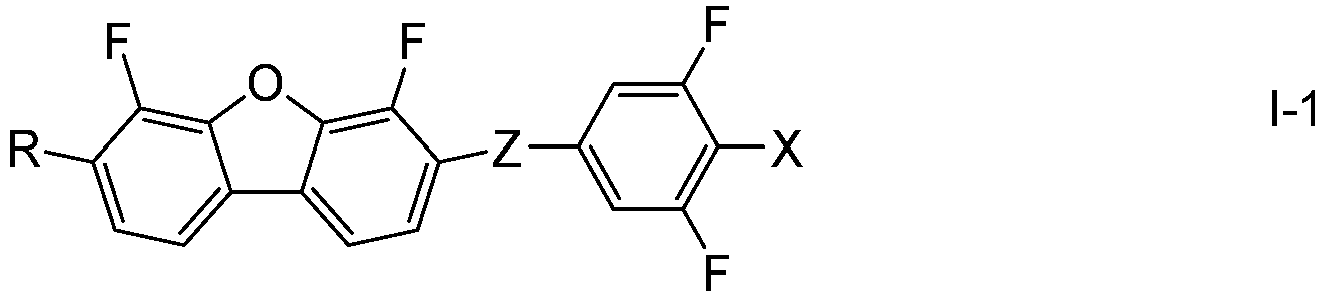
- the compounds of formula I are selected from the compounds of the formulae I-1 to I-6: in which the occurring groups have the meanings given above for formula I, and independently:
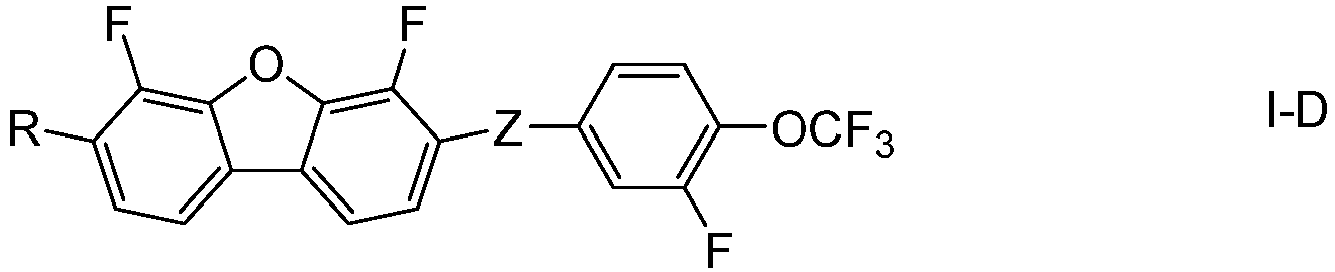
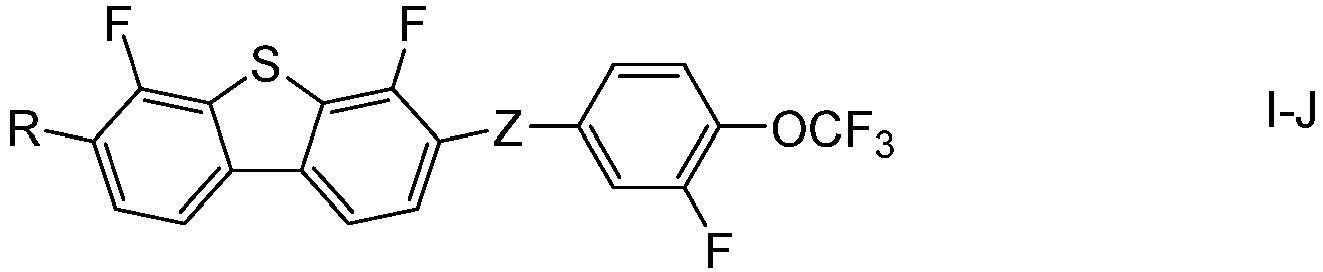
- the compounds of formula I are preferably selected from the compounds of the formulae I-A to I-J: and more preferably from the group of formulae I-A, I-B, I-F and I-G, wherein R and Z are as defined as for formula I above or have any of the preferred definitions made above.
- R denotes alkyl having 1 to 7 C atoms, in particular ethyl, propyl, buty, pentyl, cyclopropyl, cyclopropylmethyl, cyclobutyl, cyclobutylmethyl, cyclopentyl, cyclopentylmethyl or 3-methylcyclopentyl-methyl, where n-propyl, n-butyl and n-pentyl are most preferred.
- the substituents L 1 and L 2 are preferably both H or one of L 1 and L 2 is H and the other is methyl.
- the structure I is preferably any of the following structures:
- L 1 and L 2 are H.
- the compounds of the general formula I are prepared by methods known per se, as described in the literature (for example in the standard works, such as Houben-Weyl, Methoden der organischen Chemie [Methods of Organic Chemistry], Georg-Thieme-Verlag, Stuttgart), to be precise under reaction conditions which are known and are suitable for the said reactions. Use can be made here of variants which are known per se, but are not mentioned here in greater detail.
- the starting materials can also be formed in situ by not isolating them from the reaction mixture, but instead immediately converting them further into the compounds of the general formula I.
- dibenzofuran derivatives i.e. the compounds of formula I wherein W denotes O (formula I') are preferably synthesized as shown in Scheme 1 and are obtainable by intramolecular substitution of fluorine by nucleophilic attack of a phenolate by treatment of the phenol P with a base.
- dibenzothiophene derivatives i.e. the compounds of formula I wherein W denotes S (formula I′′′) are preferably synthesized as shown in scheme 3.
- the starting material in Scheme 3 is obtainable from the phenols in Scheme 1 via the corresponding triflate according to Itoh, Takahiro and Mase, Toshiaki, Organic Letters, 6(24), 4587-4590; 2004 .
- Treatment of the compounds with a strong, non-nucleophilic base, preferably potassium tert.-butanoate yields compounds of formula I" (cf. Jepsen, Tue Heesgaard et al., European Journal of Organic Chemistry, (1), 53-57, S53/1-S53/65; 2011 ).
- the group R x is preferably built into the final substituent -Z-A-X after the formation of the dibenzofuran or dibenzothiophen ring. This is accomplished by known reactions established for the chemistry of each of the groups involved. In the case R x is a hadrogen, the position can be functionalized by deprotonation and addition to an electrophile. Details are provided in the examples.
- the compounds of the general formula I can be used in liquid-crystalline media.
- the present invention therefore also relates to a liquid-crystalline medium comprising two or more liquid-crystalline compounds, comprising one or more compounds of the general formula I.
- the present invention also relates to liquid-crystalline media comprising 2 to 40, preferably 4 to 30, components as further constituents besides one or more compounds of the formula I according to the invention. These media particularly preferably comprise 7 to 25 components besides one or more compounds according to the invention.
- the media according to the invention preferably comprise 1 to 20%, particularly preferably 2 to 10%, of the compounds of the formula I according to the invention.
- the media preferably comprise one, two, three, four or five compounds of the formula I according to the invention.
- the invention furthermore relates to a process for the preparation of a liquid-crystalline medium according to the invention by mixing one or more compounds of formula I or their preferred subformulae with one or more low-molecular-weight liquid-crystalline compounds, or a liquid-crystal mixture and optionally with further liquid-crystalline compounds and/or additives.
- the present invention also relates to electro-optical liquid-crystal display elements containing a liquid-crystalline medium according to the invention.
- the media according to the invention are prepared in a manner conventional per se.
- the components are dissolved in one another, advantageously at elevated temperature.
- the liquid-crystalline phases of the present invention can be modified in such a way that they can be used in all types of liquid-crystal display elements that have been disclosed hitherto.
- Additives of this type are known to the person skilled in the art and are described in detail in the literature ( H. Kelker/R. Hatz, Handbook of Liquid Crystals, Verlag Chemie, Weinheim, 1980 ).
- pleochroic dyes can be used for the preparation of coloured guest-host systems or substances can be added in order to modify the dielectric anisotropy, the viscosity and/or the alignment of the nematic phases.
- the acronyms are composed of the codes for the ring elements with optional linking groups, followed by a first hyphen and the codes for the left-hand end group, and a second hyphen and the codes for the right-hand end group.
- Table D shows illustrative structures of compounds together with their respective abbreviations.
- mixtures according to the invention preferably comprise one or more compounds of the compounds shown in Table D below.
- n, m, k and I are, independently of one another, each an integer, preferably 1 to 9 preferably 1 to 7, k and I possibly may be also 0 and preferably are 0 to 4, more preferably 0 or 2 and most preferably 2, n preferably is 1, 2, 3, 4 or 5, in the combination "-nO-” it preferably is 1, 2, 3 or 4, preferably 2 or 4, m preferably is 1, 2, 3, 4 or 5, in the combination "-Om” it preferably is 1, 2, 3 or 4, more preferably 2 or 4.
- the combination "-IVm” preferably is "2V1".
- Table D Exemplary, preferred dielectrically positive compounds that can be used in combination with compounds of formula I
- Table E shows chiral dopants which are optionally employed in the mixtures according to the invention.
- Table E C 15 CB 15 CM 21 R S-811 / S-811 CM 44 CM 45 CM 47 CN R-1011 / S-1011 R-2011 / S-2011 R-3011 / S-3011 R-4011 / S-4011 R-5011 / S-5011
- the media according to the invention comprise one or more compounds selected from the group of the compounds from Table E.
- Table F shows stabilisers which can preferably be employed in the mixtures according to the invention in addition to the compounds of formula B.
- the parameter n here denotes an integer in the range from 1 to 12.
- the phenol derivatives shown can be employed as additional stabilisers since they act as antioxidants.
- the media according to the invention comprise one or more compounds selected from the group of the compounds from Table F.
- ⁇ n denotes the optical anisotropy (589 nm, 20°C) and ⁇ denotes the dielectric anisotropy (1 kHz, 20°C).
- the ⁇ and ⁇ n values of the compounds according to the invention are obtained by extrapolation from liquid-crystalline mixtures consisting of 10% of the respective compound according to the invention and 90% of the commercially available liquid-crystal mixture ZLI-4792 (Merck KGaA, Darmstadt). In cases of limited solubility, the compound is measured in a mixture comprising only 5% of the compound.
- Step 1.2 4,6-Difluoro-7-propyl-dibenzofuran-3-carbonyl chloride
- Step 1.3 3-(5,6-Dihydro-4 H -1,3-dithiin-1-ium-2-yl)-4,6-difluoro-7-propyl-dibenzofuran trifluoromethanesulfonate
- 1,3-Propanedithiol (15.0 mL, 0.15 mol) is slowly added to a solution of 4,6-difluoro-7-propyl-dibenzofuran-3-carbonyl chloride (3) (41.0 g, 0.13 mol) in dichloromethane (300 mL) at 0°C under nitrogen atmosphere, and the mixture is stirred for 10 min at 10°C.
- Trifluoromethanesulfonic acid (19.0 mL, 0.22 mol) is slowly added at -5°C, and the reaction mixture is stirred for 30 min at -5°C.
- Step 1.4 3-[Difluoro-(3,4,5-trifluorophenoxy)methyl]-4,6-difluoro-7-propyl-dibenzofuran
- Compound (6) has the following phase characteristics: K 109°C I.
- Step 2.1 7-Ethoxy-4,6-difluoro-dibenzothiophene-3-carboxylic acid
- Step 2.2 7-Ethoxy-4,6-difluoro-dibenzothiophene-3-carbonyl chloride
- Step 2.3 3-(5,6-Dihydro-4 H -1,3-dithiin-1-ium-2-yl)-7-ethoxy-4,6-difluoro-dibenzothiophene-trifluoromethanesulfonate
- 1,3-Propanedithiol (17.0 mL, 0.17 mol) is slowly added to a solution of 7-ethoxy-4,6-difluoro-dibenzothiophene-3-carbonyl chloride (3) (53.6 g, 0.16 mol) in DCM (650 mL) at 0°C under nitrogen atmosphere. The solution is stirred for 10 min at 10°C. Trifluoromethanesulfonic acid (22.0 mL, 0.25 mol) is slowly added at -5°C, and the mixture is stirred for 30 min at this temperature. Then it is treated carefully with acetic anhydride (55.0 mL, 0.58 mol) at 0°C.
- Step 2.4 3-[Difluoro-(3,4,5-trifluorophenoxy)methyl]-7-ethoxy-4,6-difluoro-dibenzothiophene
- Compound (6) has the following phase characteristics: K 126°C SmA 130°C I.
- Step 3.5 3-Butoxy-7-(5,6-dihydro-4 H -1,3-dithiin-1-ium-2-yl)-4,6-difluoro-dibenzothiophene-trifluoromethanesulfonate
- 1,3-Propanedithiol (7.5 mL, 75 mmol) is slowly added to a solution of 7-butoxy-4,6-difluoro-dibenzothiophene-3-carbonyl chloride (5) (26.2 g, 74 mmol) in DCM (300 mL) at 0°C under nitrogen atmosphere. The solution is stirred for 10 min at 10°C. It is treated with trifluoromethanesulfonic acid (9.8 mL, 0.11 mol) at -10°C, and the reaction mixture is stirred for 30 min at -5°C. Then acetic anhydride (24.5 mL, 0.26 mol) is slowly added at 0°C.
- Step 3.6 3-Butoxy-7-[difluoro-(3,4,5-trifluorophenoxy)methyl]-4,6-difluoro-dibenzothiophene
- Triethylamine trihydrofluoride (3.0 mL, 18 mmol) is added at -70°C, and after 1 h a solution of bromine (1.3 mL, 25 mmol) in DCM (10 mL) is added to the reaction mixture. It is stirred for 30 min at -70°C. At last morpholine (1.6 mL, 18 mmol) is added at -20°C, and the mixture is stirred additional 30 min at 0°C.
- the reaction mixture is poured into a mixture of ice/water and potassium hydroxide. The aqueous phase is separated and extracted with DCM. The combined organic phases are washed with sodium bicarbonate, dried (sodium sulphate) and concentrated in vacuo.
- Compound (8) has the following phase characteristics: K 112°C SmA 124°C I.
- Step 4.1 (4,6-Difluorodibenzothiophen-3-yl) trifluoromethanesulfonate
- Trifluoromethanesulfonic anhydride 35 mL, 0.21 mol is added to a solution of 4,6-difluorodibenzothiophen-3-ol (2, see step 3.1) (44.8 g, 0.19 mol), TEA (40.0 mL, 0.29 mol) and DMAP (1.0 g, 8 mmol) in DCM (400 mL) at 5°C.
- the reaction mixture is stirred at room temperature overnight. It is purified by silica gel filtration (solvent 1-chlorobutane) to give white crystals of (4,6-difluorodibenzothiophen-3-yl) trifluoromethanesulfonate (3).
- [1,1'-Bis(diphenylphosphino)ferrocene]palladium(II)dichloride (4.0 g, 5.5 mmol) is added to a solution of (4,6-difluorodibenzothiophen-3-yl) trifluoromethanesulfonate (3) (69.7 g, 0.19 mol) in THF (700 mL) at room temperature. Then propylzinc bromide solution (400 mL, 0.5 M in THF, 0.20 mol) is added at 50°C. The reaction mixture is stirred at reflux temperature overnight. Then it is cooled to room temperature and diluted with MTB ether and dist. water.
- the aqueous phase is separated and extracted with MTB ether.
- the combined organic phases are washed with dist. water and brine, dried (sodium sulphate) and concentrated in vacuo.
- the residue is purified by silica gel chromatography (solvent heptane) to give yellow crystals of 4,6-difluoro-3-propyl-dibenzothiophene (4).
- Step 4.4 4,6-Difluoro-7-propyl-dibenzothiophene-3-carbonyl chloride
- 4,6-Difluoro-7-propyl-dibenzothiophene-3-carboxylic acid (5) (48.2 g, 0.15 mol) is treated with thionyl chloride (25 mL, 0.35 mol) and DMF (1.0 mL, 13 mmol), followed by addition of a second portion of thionyl chloride (50 mL). The suspension is heated at reflux temperature overnight. Then thionyl chloride (50 mL) is added again, and the reaction mixture is heated at reflux temperature overnight. It is allowed to cool to room temperature and concentrated in vacuo to give 4,6-difluoro-7-propyl-dibenzofuran-3-carbonyl chloride (6) as a yellow solid.
- Step 4.5 3-(5,6-Dihydro-4 H -1,3-dithiin-1-ium-2-yl)-4,6-difluoro-7-propyl-dibenzothiophene trifluoromethanesulfonate
- 1,3-Propanedithiol (17 mL, 0.17 mol) is slowly added to a solution of 4,6-difluoro-7-propyl-dibenzothiophene-3-carbonyl chloride (6) (52.6 g, 0.16 mol) in DCM (500 mL) at 0°C under nitrogen atmosphere. The solution is stirred for 10 min at 10°C. Trifluoromethanesulfonic acid (22 mL, 0.25 mol) is slowly added at -10°C, and the reaction mixture is stirred for 30 min at -5°C. Then acetic anhydride (54 mL, 0.57 mol) is slowly added at 0°C.
- reaction mixture is diluted with diethyl ether (250 mL) and stirred for 1 h at 10°C. At last it is cooled down to -40°C and stirred for 30 min.
- the precipitate is quickly filtered in vacuo under nitrogen atmosphere, washed with cold diethyl ether and dried (desiccator) to give red crystals of 3-(5,6-dihydro-4H-1,3-dithiin-1-ium-2-yl)-4,6-difluoro-7-propyl-dibenzothiophene trifluoromethanesulfonate (7).
- Step 4.6 3-[Difluoro-(3,4,5-trifluorophenoxy)methyl]-4,6-difluoro-7-propyl-dibenzothiophene
- reaction mixture is stirred for 1 h at -70°C and then treated with triethylamine trihydrofluoride (7.6 mL, 46 mmol).
- a solution of bromine (3.0 mL, 59 mmol) in DCM (15 mL) is added, and the reaction mixture is stirred for 30 min at -70°C.
- morpholine 4.0 mL, 46 mmol
- Compound (9) has the following phase characteristics:
- Step 5.1 3-[[3,5-Difluoro-4-(trifluoromethoxy)phenoxy]-difluoromethyl]-4,6-difluoro-7-propyl-dibenzothiophene
- Compound (9) has the following phase characteristics:
- Step 6.1 3-[[3,5-Difluoro-4-(trifluoromethyl)phenoxy]-difluoromethyl]-4,6-difluoro-7-propyl-dibenzothiophene
- Compound (9) has the following phase characteristics: K 128°C I.
- Step 7.1 3-Ethoxy-4,6-difluoro-7-[(3,4,5-trifluorophenyl)methoxy]dibenzofuran
- Diisopropyl azodicarboxylate (3.4 mL, 17 mmol) is added dropwise to a mixture of 7-ethoxy-4,6-difluoro-dibenzofuran-3-ol (1, CAS 2254195-97-4 ) (4.0 g, 14 mmol), (3,4,5-trifluorophenyl)methanol (2) (2.8 g, 17 mmol) and TPP (4.5 g, 17 mmol) in THF (50 mL) under argon atmosphere at room temperature. The reaction mixture is stirred at room temperature overnight. Then it is concentrated in vacuo.
- Compound (3) has the following phase characteristics: K 177°C I.
- Step 8.1 3-Ethoxy-4,6-difluoro-7-[(3,4,5-trifluorophenyl)methoxy]-dibenzothiophene
- Diisopropyl azodicarboxylate (3.4 mL, 17 mmol) is added dropwise to a mixture of 7-ethoxy-4,6-difluoro-dibenzothiophen-3-ol ( 1 , CAS 1820028-80-5 ) (4.0 g, 14 mmol), (3,4,5-trifluorophenyl)methanol ( 2 ) (2.8 g, 17 mmol) and TPP (4.5 g, 17 mmol) in THF (50 mL) under argon atmosphere at room temperature. The reaction mixture is stirred at room temperature overnight. Then it is concentrated in vacuo.
- Compound ( 3 ) has the following phase characteristics: K 169°C I.
- Liquid crystalline media using the compounds according to the invention as a component are prepared in the following. Unless indicated otherwise, percentages are % by weight. Stabilizers according to table F are optionally added to the mixtures presented below.
- a nematic liquid-crystal mixture N-1 having the composition and properties as indicated in the following table is used as the basis (host mixture) for preparation of several of the exemplary mixtures.
- the host mixture N-1 is optionally stabilized with 0.05 % of one of the compounds of Table F above.
- a nematic liquid-crystal medium M-1 consisting of 97.5% of the medium N-1 and 2.5% of the compound B(S)QU-2O-F of Synthesis Example 2 has the following properties: Host mixture N-1 97.5 % Clearing point [°C]: 79 B(S)QU-2O-F 2.5 % ⁇ n [589 nm, 20°C]: 0.102 ⁇ 100.0 % n e [589 nm, 20°C]: 1.590 n o [589 nm, 20°C]: 1.487 ⁇ [1 kHz, 20°C]: 6.3 ⁇ ⁇ [1 kHz, 20°C]: 9.5 ⁇ ⁇ [1 kHz, 20°C]: 3.2 ⁇ 1 [mPa s, 20°C]: 68 K 1 [pN, 20°C]: 13.5 K 3 [pN, 20°C]: 15.4
- the compound B(S)QU-2O-F is well soluble in the medium N-1 and increases ⁇ ⁇ and the resulting transmission.
- a nematic liquid-crystal medium M-2 consisting of 97.5% of the medium N-1 and 2.5% of the compound B(S)QU-4O-F of Synthesis Example 3 has the following properties: Host mixture N-1 97.5 % Clearing point [°C]: 79 B(S)QU-4O-F 2.5 % ⁇ n [589 nm, 20°C]: 0.102 ⁇ 100.0 % n e [589 nm, 20°C]: 1.590 n o [589 nm, 20°C]: 1.487 ⁇ [1 kHz, 20°C]: 6.3 ⁇ ⁇ [1 kHz, 20°C]: 9.5 ⁇ ⁇ [1 kHz, 20°C]: 3.2 ⁇ 1 [mPa s, 20°C]: K 1 [pN, 20°C]: 13.6 K 3 [pN, 20°C]: 15.1
- the compound is well soluble in the medium N-1.
- the mixture has an increased value of ⁇ ⁇ an advantageously high clearing point.
- a nematic liquid-crystal medium M-3 consisting of 95% of the medium N-1 and 5% of the compound B(S)QU-3-F of Synthesis Example 4 has the following properties: Host mixture N-1 95.0 % Clearing point [°C]: 77.5 B(S)QU-3-F 5.0 % ⁇ n [589 nm, 20°C]: 0.104 ⁇ 100.0 % n e [589 nm, 20°C]: 1.592 n o [589 nm, 20°C]: 1.488 ⁇ [1 kHz, 20°C]: 6.5 ⁇ ⁇ [1 kHz, 20°C]: 9.8 ⁇ ⁇ [1 kHz, 20°C]: 3.3 ⁇ 1 [mPa s, 20°C]: K 1 [pN, 20°C]: 13.6 K 3 [pN, 20°C]: 15.1 V 0 [V, 20 °C] 1.50
- the compound B(S)QU-3-F is well soluble in the medium N-1 and increases ⁇ ⁇ and the resulting transmission.
- a nematic liquid-crystal medium M-4 consisting of 97.5% of the medium N-1 and 2.5% of the compound B(S)QU-3-OT of Synthesis Example 5 has the following properties: MDA-14-2434 97.5 % Clearing point [°C]: 78 B(S)QU-3-OT 2.5 % ⁇ n [589 nm, 20°C]: 0.102 ⁇ 100.0 % n e [589 nm, 20°C]: 1.589 n o [589 nm, 20°C]: 1.487 ⁇ [1 kHz, 20°C]: 6.3 ⁇ ⁇ [1 kHz, 20°C]: 9.4 ⁇ ⁇ [1 kHz, 20°C]: 3.2 ⁇ 1 [mPa s, 20°C]: K 1 [pN, 20°C]: 13.3 K 3 [pN, 20°C]: 15.1 V 0 [V, 20 °C] 1.54
- the compound B(S)QU-3-OT is well soluble in the medium N-1 and increases ⁇ ⁇ and the resulting transmission.
Landscapes
- Chemical & Material Sciences (AREA)
- Crystallography & Structural Chemistry (AREA)
- Engineering & Computer Science (AREA)
- Materials Engineering (AREA)
- Organic Chemistry (AREA)
- Liquid Crystal Substances (AREA)
- Organic Low-Molecular-Weight Compounds And Preparation Thereof (AREA)
Claims (14)
- Composé de formule I
 W désigne O ou SR désigne H, un radical alkyle ayant de 1 à 15 atomes de C, où un ou plusieurs groupements CH2 dans ces radicaux peuvent chacun être remplacés, indépendamment les uns des autres, par -C≡C-, -CF2O-, -OCF2-, -CH=CH-,
 A lorsque W est O, A désigne 1,4-phénylène où un ou plusieurs atomes de H peuvent être remplacés par F ou CH3, lorsque W est S, A désigne
 Z désigne -CF2O-, -C(O)O-, -OC(O)-, -CH2O- ou -OCH2-, etX désigne F, Cl, CN, NCS, alkyle fluoré, alcoxy fluoré, alcényle fluoré ou alcényloxy fluoré, ayant chacun jusqu'à 5 atomes de C, etL1, L2 désignent indépendamment H ou -CH3.
 - Composé selon la revendication 1, dans lequel X désigne F, CF3, OCF3, CHF2 ou OCHF2.
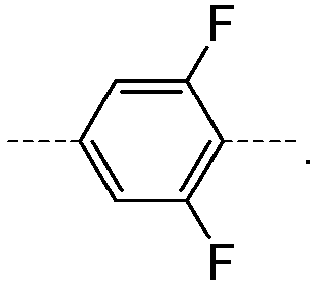
- Composé selon la revendication 1 ou 2, dans lequel le cycle A désigne

- Composé selon l'une ou plusieurs parmi les revendications 1 à 3, dans lequel W désigne O.
- Composé selon l'une ou plusieurs parmi les revendications 1 à 3, dans lequel W désigne S.
- Composé selon l'une ou plusieurs parmi les revendications 1 à 5, choisi parmi les sous-formules suivantes :


- Composé selon l'une ou plusieurs parmi les revendications 1 à 6, choisi parmi les formules I-A à I-K suivantes





- Composé selon l'une ou plusieurs parmi les revendications 1 à 7, dans lequel Z désigne -CF2O-, -C(O)O- ou -CH2O-.
- Composé selon l'une ou plusieurs parmi les revendications 1 à 8, dans lequel le cycle A désigne
- Utilisation d'un composé selon l'une ou plusieurs parmi les revendications 1 à 9, dans des milieux cristallins liquides ou pour des affichages à faible consommation d'énergie.
- Milieu cristallin liquide comprenant un ou plusieurs composés de formule I selon l'une ou plusieurs parmi les revendications 1 à 9.
- Milieu cristallin liquide selon la revendication 11, comprenant un ou plusieurs composés choisis dans le groupe constitué par les composés de formules II et III :

 R2 désigne alkyle, alcoxy, alkyle fluoré ou alcoxy fluoré ayant de 1 à 7 atomes de C, alcényle, alcényloxy, alcoxyalkyle, ou alcényle fluoré ayant de 2 à 7 atomes de C et préférablement alkyle ou alcényle, où un ou plusieurs groupements CH2 dans ces radicaux peuvent chacun être remplacés, indépendamment les uns des autres, par
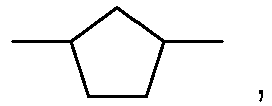


 L21 et L22 désignent H ou F,X2 désigne halogène, alkyle ou alcoxy halogéné ayant de 1 à 3 atomes de C ou alcényle ou alcényloxy halogéné ayant 2 ou 3 atomes de C,m vaut 0, 1, 2 ou 3,R3 désigne alkyle, alcoxy, alkyle fluoré ou alcoxy fluoré ayant de 1 à 7 atomes de C, alcényle, alcényloxy, alcoxyalkyle, ou alcényle fluoré ayant de 2 à 7 atomes de C, où un ou plusieurs groupements CH2 dans ces radicaux peuvent chacun être remplacés, indépendamment les uns des autres, par
 L31 et L32 indépendamment l'un de l'autre, désignent H ou F,X3 désigne halogène, alkyle ou alcoxy halogéné ayant de 1 à 3 atomes de C ou alcényle ou alcényloxy halogéné ayant 2 ou 3 atomes de C,Z3 désigne -CH2CH2-, -CF2CF2-, -COO-, trans-CH=CH-, trans-CF=CF-, -CH2O- ou une liaison simple, etn vaut 0, 1, 2 ou 3.
 - Procédé de préparation d'un milieu cristallin liquide, par le mélange d'un ou plusieurs composés de formule I selon l'une ou plusieurs parmi les revendications 1 à 9 avec un ou plusieurs composés cristallins liquides de bas poids moléculaire ou un mélange cristallin liquide et éventuellement avec d'autres composés cristallins liquides et/ou additifs.
- Elément d'affichage électro-optique contenant un milieu cristallin liquide selon la revendication 11 ou 12.
Applications Claiming Priority (2)
| Application Number | Priority Date | Filing Date | Title |
|---|---|---|---|
| EP20214049 | 2020-12-15 | ||
| PCT/EP2021/085374 WO2022128847A1 (fr) | 2020-12-15 | 2021-12-13 | Dérivés de dibenzofurane et de dibenzothiophène |
Publications (2)
| Publication Number | Publication Date |
|---|---|
| EP4263749A1 EP4263749A1 (fr) | 2023-10-25 |
| EP4263749B1 true EP4263749B1 (fr) | 2025-06-18 |
Family
ID=73838934
Family Applications (1)
| Application Number | Title | Priority Date | Filing Date |
|---|---|---|---|
| EP21823937.4A Active EP4263749B1 (fr) | 2020-12-15 | 2021-12-13 | Dérivés de dibenzofurane et de dibenzothiophène |
Country Status (4)
| Country | Link |
|---|---|
| EP (1) | EP4263749B1 (fr) |
| CN (1) | CN116670255B (fr) |
| TW (1) | TWI910288B (fr) |
| WO (1) | WO2022128847A1 (fr) |
Family Cites Families (10)
| Publication number | Priority date | Publication date | Assignee | Title |
|---|---|---|---|---|
| JP4824015B2 (ja) | 2004-04-14 | 2011-11-24 | メルク パテント ゲゼルシャフト ミット ベシュレンクテル ハフツング | ベンゾフラン誘導体、ジベンゾチオフェン誘導体、およびフルオレン誘導体 |
| EP2937342B1 (fr) * | 2014-04-22 | 2016-11-30 | Merck Patent GmbH | Dérivés de 4,6-difluoro-dibenzothiophène |
| TWI744458B (zh) * | 2017-02-27 | 2021-11-01 | 日商捷恩智股份有限公司 | 具有二苯并呋喃環的化合物、液晶組成物及液晶顯示元件 |
| CN108018048B (zh) * | 2017-12-15 | 2021-11-05 | 石家庄诚志永华显示材料有限公司 | 一种负介电各项异性液晶组合物 |
| CN108531196B (zh) * | 2018-05-25 | 2020-11-06 | 石家庄晶奥量新材料有限公司 | 一种含有二苯并呋喃环的液晶化合物及其制备方法和应用 |
| CN108865178A (zh) * | 2018-08-13 | 2018-11-23 | 晶美晟光电材料(南京)有限公司 | 一种具有高介电常数的液晶组合物及其应用 |
| JP2020079215A (ja) * | 2018-11-13 | 2020-05-28 | Dic株式会社 | 液晶化合物 |
| EP3898891A1 (fr) * | 2018-12-19 | 2021-10-27 | Merck Patent GmbH | Milieu cristallin liquide et afficheur à cristaux liquides comprenant celui-ci et composés |
| CN111592890B (zh) * | 2019-02-20 | 2021-09-28 | 北京八亿时空液晶科技股份有限公司 | 一种液晶化合物及其制备方法与应用 |
| CN113528151B (zh) * | 2020-04-21 | 2023-07-28 | 江苏和成新材料有限公司 | 液晶化合物及其液晶组合物和液晶显示器件 |
-
2021
- 2021-12-13 CN CN202180083746.1A patent/CN116670255B/zh active Active
- 2021-12-13 WO PCT/EP2021/085374 patent/WO2022128847A1/fr not_active Ceased
- 2021-12-13 EP EP21823937.4A patent/EP4263749B1/fr active Active
- 2021-12-14 TW TW110146707A patent/TWI910288B/zh active
Also Published As
| Publication number | Publication date |
|---|---|
| TWI910288B (zh) | 2026-01-01 |
| WO2022128847A1 (fr) | 2022-06-23 |
| TW202235590A (zh) | 2022-09-16 |
| CN116670255A (zh) | 2023-08-29 |
| CN116670255B (zh) | 2025-10-10 |
| EP4263749A1 (fr) | 2023-10-25 |
Similar Documents
| Publication | Publication Date | Title |
|---|---|---|
| KR101675175B1 (ko) | 티오펜 유도체 및 이를 함유하는 액정 매질 | |
| KR101592052B1 (ko) | 티오펜 유도체 및 이를 함유하는 lc 매질 | |
| CN102325761B (zh) | 用于液晶介质的噻吩化合物 | |
| KR101868648B1 (ko) | 티오펜 유도체를 함유하는 액정 매질 | |
| KR101840069B1 (ko) | 안정화제를 포함하는 액정 매질 | |
| CN112996883B (zh) | 二苯并呋喃及二苯并噻吩衍生物 | |
| KR20050086861A (ko) | 액정 화합물 | |
| JP2003176251A (ja) | 液晶化合物 | |
| JP2007535506A (ja) | ベンゾフラン誘導体、ジベンゾチオフェン誘導体、およびフルオレン誘導体 | |
| WO2022084168A1 (fr) | Dérivés de 4,6-difluorodibenzothiophène et milieu de cristaux liquides les contenant | |
| KR20120108010A (ko) | 액정 매질 | |
| JP2003511390A (ja) | 液晶フェノールエステル | |
| CN116670255B (zh) | 二苯并呋喃及二苯并噻吩衍生物 | |
| EP4189036B1 (fr) | Dérivés de dibenzofurane et de dibenzothiophène |
Legal Events
| Date | Code | Title | Description |
|---|---|---|---|
| STAA | Information on the status of an ep patent application or granted ep patent |
Free format text: STATUS: UNKNOWN |
|
| STAA | Information on the status of an ep patent application or granted ep patent |
Free format text: STATUS: THE INTERNATIONAL PUBLICATION HAS BEEN MADE |
|
| PUAI | Public reference made under article 153(3) epc to a published international application that has entered the european phase |
Free format text: ORIGINAL CODE: 0009012 |
|
| STAA | Information on the status of an ep patent application or granted ep patent |
Free format text: STATUS: REQUEST FOR EXAMINATION WAS MADE |
|
| 17P | Request for examination filed |
Effective date: 20230612 |
|
| AK | Designated contracting states |
Kind code of ref document: A1 Designated state(s): AL AT BE BG CH CY CZ DE DK EE ES FI FR GB GR HR HU IE IS IT LI LT LU LV MC MK MT NL NO PL PT RO RS SE SI SK SM TR |
|
| DAV | Request for validation of the european patent (deleted) | ||
| DAX | Request for extension of the european patent (deleted) | ||
| GRAP | Despatch of communication of intention to grant a patent |
Free format text: ORIGINAL CODE: EPIDOSNIGR1 |
|
| STAA | Information on the status of an ep patent application or granted ep patent |
Free format text: STATUS: GRANT OF PATENT IS INTENDED |
|
| INTG | Intention to grant announced |
Effective date: 20250219 |
|
| GRAS | Grant fee paid |
Free format text: ORIGINAL CODE: EPIDOSNIGR3 |
|
| GRAA | (expected) grant |
Free format text: ORIGINAL CODE: 0009210 |
|
| STAA | Information on the status of an ep patent application or granted ep patent |
Free format text: STATUS: THE PATENT HAS BEEN GRANTED |
|
| AK | Designated contracting states |
Kind code of ref document: B1 Designated state(s): AL AT BE BG CH CY CZ DE DK EE ES FI FR GB GR HR HU IE IS IT LI LT LU LV MC MK MT NL NO PL PT RO RS SE SI SK SM TR |
|
| REG | Reference to a national code |
Ref country code: GB Ref legal event code: FG4D |
|
| REG | Reference to a national code |
Ref country code: CH Ref legal event code: EP |
|
| REG | Reference to a national code |
Ref country code: DE Ref legal event code: R096 Ref document number: 602021032559 Country of ref document: DE |
|
| REG | Reference to a national code |
Ref country code: CH Ref legal event code: EP |
|
| REG | Reference to a national code |
Ref country code: IE Ref legal event code: FG4D |
|
| P01 | Opt-out of the competence of the unified patent court (upc) registered |
Free format text: CASE NUMBER: UPC_APP_0711_4263749/2025 Effective date: 20250722 |
|
| PG25 | Lapsed in a contracting state [announced via postgrant information from national office to epo] |
Ref country code: FI Free format text: LAPSE BECAUSE OF FAILURE TO SUBMIT A TRANSLATION OF THE DESCRIPTION OR TO PAY THE FEE WITHIN THE PRESCRIBED TIME-LIMIT Effective date: 20250618 |
|
| REG | Reference to a national code |
Ref country code: LT Ref legal event code: MG9D |
|
| PG25 | Lapsed in a contracting state [announced via postgrant information from national office to epo] |
Ref country code: GR Free format text: LAPSE BECAUSE OF FAILURE TO SUBMIT A TRANSLATION OF THE DESCRIPTION OR TO PAY THE FEE WITHIN THE PRESCRIBED TIME-LIMIT Effective date: 20250919 Ref country code: NO Free format text: LAPSE BECAUSE OF FAILURE TO SUBMIT A TRANSLATION OF THE DESCRIPTION OR TO PAY THE FEE WITHIN THE PRESCRIBED TIME-LIMIT Effective date: 20250918 |
|
| PG25 | Lapsed in a contracting state [announced via postgrant information from national office to epo] |
Ref country code: BG Free format text: LAPSE BECAUSE OF FAILURE TO SUBMIT A TRANSLATION OF THE DESCRIPTION OR TO PAY THE FEE WITHIN THE PRESCRIBED TIME-LIMIT Effective date: 20250618 |
|
| PG25 | Lapsed in a contracting state [announced via postgrant information from national office to epo] |
Ref country code: HR Free format text: LAPSE BECAUSE OF FAILURE TO SUBMIT A TRANSLATION OF THE DESCRIPTION OR TO PAY THE FEE WITHIN THE PRESCRIBED TIME-LIMIT Effective date: 20250618 |
|
| PG25 | Lapsed in a contracting state [announced via postgrant information from national office to epo] |
Ref country code: RS Free format text: LAPSE BECAUSE OF FAILURE TO SUBMIT A TRANSLATION OF THE DESCRIPTION OR TO PAY THE FEE WITHIN THE PRESCRIBED TIME-LIMIT Effective date: 20250918 |
|
| REG | Reference to a national code |
Ref country code: NL Ref legal event code: MP Effective date: 20250618 |
|
| PG25 | Lapsed in a contracting state [announced via postgrant information from national office to epo] |
Ref country code: LV Free format text: LAPSE BECAUSE OF FAILURE TO SUBMIT A TRANSLATION OF THE DESCRIPTION OR TO PAY THE FEE WITHIN THE PRESCRIBED TIME-LIMIT Effective date: 20250618 |
|
| PG25 | Lapsed in a contracting state [announced via postgrant information from national office to epo] |
Ref country code: NL Free format text: LAPSE BECAUSE OF FAILURE TO SUBMIT A TRANSLATION OF THE DESCRIPTION OR TO PAY THE FEE WITHIN THE PRESCRIBED TIME-LIMIT Effective date: 20250618 |
|
| PG25 | Lapsed in a contracting state [announced via postgrant information from national office to epo] |
Ref country code: PT Free format text: LAPSE BECAUSE OF FAILURE TO SUBMIT A TRANSLATION OF THE DESCRIPTION OR TO PAY THE FEE WITHIN THE PRESCRIBED TIME-LIMIT Effective date: 20251020 |
|
| REG | Reference to a national code |
Ref country code: AT Ref legal event code: MK05 Ref document number: 1804191 Country of ref document: AT Kind code of ref document: T Effective date: 20250618 |
|
| PG25 | Lapsed in a contracting state [announced via postgrant information from national office to epo] |
Ref country code: IS Free format text: LAPSE BECAUSE OF FAILURE TO SUBMIT A TRANSLATION OF THE DESCRIPTION OR TO PAY THE FEE WITHIN THE PRESCRIBED TIME-LIMIT Effective date: 20251018 |
|
| PGFP | Annual fee paid to national office [announced via postgrant information from national office to epo] |
Ref country code: DE Payment date: 20251126 Year of fee payment: 5 |
|
| PG25 | Lapsed in a contracting state [announced via postgrant information from national office to epo] |
Ref country code: AT Free format text: LAPSE BECAUSE OF FAILURE TO SUBMIT A TRANSLATION OF THE DESCRIPTION OR TO PAY THE FEE WITHIN THE PRESCRIBED TIME-LIMIT Effective date: 20250618 Ref country code: SM Free format text: LAPSE BECAUSE OF FAILURE TO SUBMIT A TRANSLATION OF THE DESCRIPTION OR TO PAY THE FEE WITHIN THE PRESCRIBED TIME-LIMIT Effective date: 20250618 |
|
| PG25 | Lapsed in a contracting state [announced via postgrant information from national office to epo] |
Ref country code: CZ Free format text: LAPSE BECAUSE OF FAILURE TO SUBMIT A TRANSLATION OF THE DESCRIPTION OR TO PAY THE FEE WITHIN THE PRESCRIBED TIME-LIMIT Effective date: 20250618 |
|
| PG25 | Lapsed in a contracting state [announced via postgrant information from national office to epo] |
Ref country code: PL Free format text: LAPSE BECAUSE OF FAILURE TO SUBMIT A TRANSLATION OF THE DESCRIPTION OR TO PAY THE FEE WITHIN THE PRESCRIBED TIME-LIMIT Effective date: 20250618 |
|
| PG25 | Lapsed in a contracting state [announced via postgrant information from national office to epo] |
Ref country code: EE Free format text: LAPSE BECAUSE OF FAILURE TO SUBMIT A TRANSLATION OF THE DESCRIPTION OR TO PAY THE FEE WITHIN THE PRESCRIBED TIME-LIMIT Effective date: 20250618 |
|
| PG25 | Lapsed in a contracting state [announced via postgrant information from national office to epo] |
Ref country code: SK Free format text: LAPSE BECAUSE OF FAILURE TO SUBMIT A TRANSLATION OF THE DESCRIPTION OR TO PAY THE FEE WITHIN THE PRESCRIBED TIME-LIMIT Effective date: 20250618 |
|
| PG25 | Lapsed in a contracting state [announced via postgrant information from national office to epo] |
Ref country code: ES Free format text: LAPSE BECAUSE OF FAILURE TO SUBMIT A TRANSLATION OF THE DESCRIPTION OR TO PAY THE FEE WITHIN THE PRESCRIBED TIME-LIMIT Effective date: 20250618 |
|
| PG25 | Lapsed in a contracting state [announced via postgrant information from national office to epo] |
Ref country code: RO Free format text: LAPSE BECAUSE OF FAILURE TO SUBMIT A TRANSLATION OF THE DESCRIPTION OR TO PAY THE FEE WITHIN THE PRESCRIBED TIME-LIMIT Effective date: 20250618 |
|
| REG | Reference to a national code |
Ref country code: DE Ref legal event code: R097 Ref document number: 602021032559 Country of ref document: DE |
|
| PG25 | Lapsed in a contracting state [announced via postgrant information from national office to epo] |
Ref country code: DK Free format text: LAPSE BECAUSE OF FAILURE TO SUBMIT A TRANSLATION OF THE DESCRIPTION OR TO PAY THE FEE WITHIN THE PRESCRIBED TIME-LIMIT Effective date: 20250618 |
|
| PG25 | Lapsed in a contracting state [announced via postgrant information from national office to epo] |
Ref country code: IT Free format text: LAPSE BECAUSE OF FAILURE TO SUBMIT A TRANSLATION OF THE DESCRIPTION OR TO PAY THE FEE WITHIN THE PRESCRIBED TIME-LIMIT Effective date: 20250618 |
|
| PLBE | No opposition filed within time limit |
Free format text: ORIGINAL CODE: 0009261 |
|
| STAA | Information on the status of an ep patent application or granted ep patent |
Free format text: STATUS: NO OPPOSITION FILED WITHIN TIME LIMIT |
|
| REG | Reference to a national code |
Ref country code: CH Ref legal event code: L10 Free format text: ST27 STATUS EVENT CODE: U-0-0-L10-L00 (AS PROVIDED BY THE NATIONAL OFFICE) Effective date: 20260430 |