EP4263982B1 - Kupplungsanordnung für eine verriegelungsvorrichtung und verriegelungsvorrichtung - Google Patents
Kupplungsanordnung für eine verriegelungsvorrichtung und verriegelungsvorrichtung Download PDFInfo
- Publication number
- EP4263982B1 EP4263982B1 EP21835965.1A EP21835965A EP4263982B1 EP 4263982 B1 EP4263982 B1 EP 4263982B1 EP 21835965 A EP21835965 A EP 21835965A EP 4263982 B1 EP4263982 B1 EP 4263982B1
- Authority
- EP
- European Patent Office
- Prior art keywords
- coupling
- actuating
- engaging member
- engaging
- rotation axis
- Prior art date
- Legal status (The legal status is an assumption and is not a legal conclusion. Google has not performed a legal analysis and makes no representation as to the accuracy of the status listed.)
- Active
Links
Images



Classifications
-
- E—FIXED CONSTRUCTIONS
- E05—LOCKS; KEYS; WINDOW OR DOOR FITTINGS; SAFES
- E05B—LOCKS; ACCESSORIES THEREFOR; HANDCUFFS
- E05B17/00—Accessories in connection with locks
- E05B17/04—Devices for coupling the turning cylinder of a single or a double cylinder lock with the bolt operating member
- E05B17/044—Clutches, disengageable couplings
-
- E—FIXED CONSTRUCTIONS
- E05—LOCKS; KEYS; WINDOW OR DOOR FITTINGS; SAFES
- E05B—LOCKS; ACCESSORIES THEREFOR; HANDCUFFS
- E05B13/00—Devices preventing the key or the handle or both from being used
- E05B13/005—Disconnecting the handle
-
- E—FIXED CONSTRUCTIONS
- E05—LOCKS; KEYS; WINDOW OR DOOR FITTINGS; SAFES
- E05B—LOCKS; ACCESSORIES THEREFOR; HANDCUFFS
- E05B47/00—Operating or controlling locks or other fastening devices by electric or magnetic means
- E05B47/0001—Operating or controlling locks or other fastening devices by electric or magnetic means with electric actuators; Constructional features thereof
- E05B47/0012—Operating or controlling locks or other fastening devices by electric or magnetic means with electric actuators; Constructional features thereof with rotary electromotors
-
- E—FIXED CONSTRUCTIONS
- E05—LOCKS; KEYS; WINDOW OR DOOR FITTINGS; SAFES
- E05B—LOCKS; ACCESSORIES THEREFOR; HANDCUFFS
- E05B47/00—Operating or controlling locks or other fastening devices by electric or magnetic means
- E05B47/06—Controlling mechanically-operated bolts by electro-magnetically-operated detents
- E05B47/0611—Cylinder locks with electromagnetic control
-
- E—FIXED CONSTRUCTIONS
- E05—LOCKS; KEYS; WINDOW OR DOOR FITTINGS; SAFES
- E05B—LOCKS; ACCESSORIES THEREFOR; HANDCUFFS
- E05B47/00—Operating or controlling locks or other fastening devices by electric or magnetic means
- E05B47/06—Controlling mechanically-operated bolts by electro-magnetically-operated detents
- E05B47/0611—Cylinder locks with electromagnetic control
- E05B47/0615—Cylinder locks with electromagnetic control operated by handles, e.g. by knobs
-
- E—FIXED CONSTRUCTIONS
- E05—LOCKS; KEYS; WINDOW OR DOOR FITTINGS; SAFES
- E05B—LOCKS; ACCESSORIES THEREFOR; HANDCUFFS
- E05B47/00—Operating or controlling locks or other fastening devices by electric or magnetic means
- E05B47/06—Controlling mechanically-operated bolts by electro-magnetically-operated detents
- E05B47/0611—Cylinder locks with electromagnetic control
- E05B47/0638—Cylinder locks with electromagnetic control by disconnecting the rotor
- E05B47/0642—Cylinder locks with electromagnetic control by disconnecting the rotor axially, i.e. with an axially disengaging coupling element
-
- E—FIXED CONSTRUCTIONS
- E05—LOCKS; KEYS; WINDOW OR DOOR FITTINGS; SAFES
- E05B—LOCKS; ACCESSORIES THEREFOR; HANDCUFFS
- E05B47/00—Operating or controlling locks or other fastening devices by electric or magnetic means
- E05B47/06—Controlling mechanically-operated bolts by electro-magnetically-operated detents
- E05B47/0676—Controlling mechanically-operated bolts by electro-magnetically-operated detents by disconnecting the handle
- E05B47/068—Controlling mechanically-operated bolts by electro-magnetically-operated detents by disconnecting the handle axially, i.e. with an axially disengaging coupling element
-
- E—FIXED CONSTRUCTIONS
- E05—LOCKS; KEYS; WINDOW OR DOOR FITTINGS; SAFES
- E05B—LOCKS; ACCESSORIES THEREFOR; HANDCUFFS
- E05B47/00—Operating or controlling locks or other fastening devices by electric or magnetic means
- E05B47/0001—Operating or controlling locks or other fastening devices by electric or magnetic means with electric actuators; Constructional features thereof
- E05B2047/0014—Constructional features of actuators or power transmissions therefor
- E05B2047/0015—Output elements of actuators
- E05B2047/0017—Output elements of actuators with rotary motion
-
- E—FIXED CONSTRUCTIONS
- E05—LOCKS; KEYS; WINDOW OR DOOR FITTINGS; SAFES
- E05B—LOCKS; ACCESSORIES THEREFOR; HANDCUFFS
- E05B47/00—Operating or controlling locks or other fastening devices by electric or magnetic means
- E05B47/0001—Operating or controlling locks or other fastening devices by electric or magnetic means with electric actuators; Constructional features thereof
- E05B2047/0014—Constructional features of actuators or power transmissions therefor
- E05B2047/0018—Details of actuator transmissions
- E05B2047/0023—Nuts or nut-like elements moving along a driven threaded axle
-
- E—FIXED CONSTRUCTIONS
- E05—LOCKS; KEYS; WINDOW OR DOOR FITTINGS; SAFES
- E05B—LOCKS; ACCESSORIES THEREFOR; HANDCUFFS
- E05B47/00—Operating or controlling locks or other fastening devices by electric or magnetic means
- E05B47/0001—Operating or controlling locks or other fastening devices by electric or magnetic means with electric actuators; Constructional features thereof
- E05B2047/0014—Constructional features of actuators or power transmissions therefor
- E05B2047/0018—Details of actuator transmissions
- E05B2047/0026—Clutches, couplings or braking arrangements
- E05B2047/0028—Clutches, couplings or braking arrangements using electromagnetic means
-
- F—MECHANICAL ENGINEERING; LIGHTING; HEATING; WEAPONS; BLASTING
- F16—ENGINEERING ELEMENTS AND UNITS; GENERAL MEASURES FOR PRODUCING AND MAINTAINING EFFECTIVE FUNCTIONING OF MACHINES OR INSTALLATIONS; THERMAL INSULATION IN GENERAL
- F16D—COUPLINGS FOR TRANSMITTING ROTATION; CLUTCHES; BRAKES
- F16D11/00—Clutches in which the members have interengaging parts
-
- G—PHYSICS
- G07—CHECKING-DEVICES
- G07C—TIME OR ATTENDANCE REGISTERS; REGISTERING OR INDICATING THE WORKING OF MACHINES; GENERATING RANDOM NUMBERS; VOTING OR LOTTERY APPARATUS; ARRANGEMENTS, SYSTEMS OR APPARATUS FOR CHECKING NOT PROVIDED FOR ELSEWHERE
- G07C9/00—Individual registration on entry or exit
- G07C9/00174—Electronically operated locks; Circuits therefor; Nonmechanical keys therefor, e.g. passive or active electrical keys or other data carriers without mechanical keys
- G07C2009/00634—Power supply for the lock
Definitions
- the present invention generally relates to a coupling arrangement for a lock device.
- a coupling arrangement for a lock device which coupling arrangement comprises an input element, an output element and a coupling member, and a lock device comprising such coupling arrangement, are provided.
- Some lock devices comprise a cylinder housing, an output element rotatable relative to the cylinder housing about a rotation axis, a knob rotatable about the rotation axis, and an electromechanical coupling arrangement for selectively coupling the knob with the output element.
- the coupling arrangement couples the knob and the output element and the lock device can be opened by turning the knob.
- Such lock device may be referred to as a digital lock cylinder.
- the coupling arrangement comprises an electric motor, and an engaging member, such as a pin, driven by the electric motor linearly in parallel with the rotation axis between a decoupled position and a coupled position.
- the arrangement of the electric motor in parallel with the rotation axis and the movement of the engaging member in parallel with the rotation axis however add size to the lock device in the axial direction, i.e. along the rotation axis.
- the lock device may therefore protrude from a door face and may thereby require an escutcheon or rosette to hide the protrusion.
- WO 9964704 A1 discloses an electrically controlled lock including a first disc, a spindle received within the first disc, a second disc including a hub, an actuating member movable between a first position and a second position, and electrical actuating means controlling the actuating member.
- the discs are rotatable about a common axis of rotation. When the actuating member is in the first position, the rotation of the first disc causes the first disc to be separated from the second disc so that rotation of the first disc cannot cause rotation of the second disc.
- the actuating member is removed from a recess between the discs, the second disc can be rotated by rotation of the first disc so that a latchbolt can be retracted.
- EP 2204518 A1 discloses a wirelessly controlled electric lock, comprising a lock body, a key cylinder, a turn spindle rotatable by a handle element internal of the door, an opening spindle rotatable by an opening element external of the door, a drive link mechanism enabling the turn spindle and the opening spindle to be coupled with each other for a drive link engagement, such that turning of the opening spindle translates also into a turning motion of the turn spindle.
- the lock also comprises electrically controlled coupling elements including a piezoelectric actuator which, in a mode activated by an electrical control transmitted wirelessly to the electrical lock, is adapted to fixedly lock a bolt or plunger which, in its fixedly locked condition, activates said drive link engagement as the opening spindle is turned.
- electrically controlled coupling elements including a piezoelectric actuator which, in a mode activated by an electrical control transmitted wirelessly to the electrical lock, is adapted to fixedly lock a bolt or plunger which, in its fixedly locked condition, activates said drive link engagement as the opening spindle is turned.
- US 2006254328 A1 discloses a locking mechanism with an electronic solenoid opening and a mechanical reset. After being placed in the unlocked position, the locking mechanism remains unlocked until a mechanical reset is activated by a person turning a handle of the mechanism.
- DE 202008006082 U1 discloses a locking device with a divided rotor device comprising an upper rotor and a lower rotor.
- the rotors are rotatably mounted in a stator and held in an axially fixed manner by fastening means.
- the lower rotor at the lower end is connected for transmitting torque to a bolt.
- Means are provided for the torque-transmitting coupling or uncoupling of the upper rotor with the lower rotor.
- EP 1046770 A1 discloses a locking system for the locking/unlocking of locks comprising a cylindrical body, a front panel, a rear panel, a key for cooperating with a cam to enable the locking/unlocking of the lock, connection means for connecting said cam to said key, a second key connected to a cylindrical member apted to cooperate with said cam to enable the locking/unlocking of the lock, and actuator means for said connection means.
- a still further object of the present invention is to provide a coupling arrangement for a lock device, which coupling arrangement has a low power consumption.
- a still further object of the present invention is to provide a coupling arrangement for a lock device, which coupling arrangement is secure.
- a still further object of the present invention is to provide a coupling arrangement for a lock device, which coupling arrangement solves several or all of the foregoing objects in combination.
- a still further object of the present invention is to provide a lock device comprising a coupling arrangement, which lock device solves one, several or all of the foregoing objects.
- the coupling arrangement comprises an input element rotatable about a rotation axis; an output element rotatable about the rotation axis; an engaging member movable between a first position and a second position; an electric motor arranged to affect movement of the engaging member between the first position and the second position; a coupling member rotationally locked to the input element with respect to the rotation axis and axially movable relative to the input element along the rotation axis between a decoupled position, where a rotation of the input element is not transmitted by the coupling member to a rotation of the output element, and a coupled position, where a rotation of the input element is transmitted by the coupling member to a rotation of the output element; and a transmission mechanism arranged to transmit a rotation of the coupling member to a movement of the coupling member from the decoupled position to the coupled position when the engaging member adopts the second position.
- the output element of the lock device can be rotated by rotating the input element.
- the lock device in the coupled position of the coupling member, the lock device can be locked or unlocked by rotating the input element.
- the coupling member adopts the decoupled position
- a rotation of the input element is not transmitted to a rotation of the output element.
- the input element and the coupling member may be freely rotatable around the rotation axis relative to the output element.
- the lock device cannot be locked or unlocked by rotating the input element.
- the coupling member is arranged to not transmit a rotation of the input element to a rotation of the output element in the decoupled position, and to transmit a rotation of the input element to a rotation of the output element in the coupled position.
- the coupling member thereby functions as a clutch.
- the engaging member In the second position, the engaging member may engage the coupling member. In the first position, the engaging member may be disengaged from the coupling member.
- the engaging member may be arranged to adopt any of the first position and the second position when the coupling member is in the decoupled position.
- the coupling member may comprise one or more recesses. The engaging member may engage one recess in the second position and may be disengaged from each recess in the first position.
- the coupling arrangement Since a rotation of the coupling member is transmitted by the transmission mechanism to a movement of the coupling member from the decoupled position to the coupled position when the engaging member adopts the second position, the coupling arrangement enables the engaging member to move between the first position and the second position in a direction perpendicular to the rotation axis. This in turn enables the coupling arrangement to be made more compact and smaller along the rotation axis, in comparison with a prior art coupling arrangement where an engaging member moves in parallel with the rotation axis between a decoupled position and a coupled position engaging the output element. In this way, also the overall lock device can be made more compact and smaller.
- the input element may be fixed to, or constituted by, a manually maneuverable actuating element, such as a knob. Since a rotation of the input element is transmitted to a movement of the coupling member from the decoupled position to the coupled position when the engaging member adopts the second position, the coupling member is moved from the decoupled position to the coupled position by manual force, and not by the electric motor.
- the position of the engaging member (which is controlled by the electric motor) is however decisive of whether or not the coupling member will be moved from the decoupled position to the coupled position when the input element is rotated by manual force.
- the electric motor therefore indirectly contributes to movement of the coupling member from the decoupled position to the coupled position.
- the transmission mechanism may take various forms in order to mechanically transmit a rotation of the coupling member to a movement of the coupling member along the rotation axis from the decoupled position to the coupled position when the engaging member adopts the second position.
- the transmission mechanism is formed by the coupling member, or by the engaging member and the coupling member.
- the transmission mechanism may however optionally comprise further components in addition to the engaging member and the coupling member.
- the input element may be configured to rotate continuously about the rotation axis. Thereby, a seamless access can be provided.
- the coupling member may move in a forward direction when moving from the decoupled position to the coupled position. Conversely, the coupling member may move in a rearward direction when moving from the coupled position to the decoupled position.
- the output element may be arranged forward of the coupling member.
- the coupling member may be slidable along the input element between the decoupled position and the coupled position.
- the coupling member may thus be a sliding member.
- the coupling member may enclose the input element.
- the coupling member may be concentric with the rotation axis.
- the input element may comprise one or more input shafts.
- the output element may comprise one or more output shafts.
- the output element may comprise a locking member, such as a tailpiece.
- the output element may be arranged to drive a bolt in a lock case between an engaged position where the bolt engages a strike plate, and a disengaged position where the bolt is retracted from the strike plate.
- the second position may lie radially inward of the first position with respect to the rotation axis.
- the coupling member may be have a generally cylindrical shape, or cylindrical shape.
- the electric motor may be a linear motor for affecting movement of the engaging member between the first position and the second position.
- the electric motor may be powered by a battery. Alternatively, or in addition, the electric motor may be powered by means of energy harvesting.
- the electric motor may be arranged to affect movement of the engaging member between the first position and the second position linearly in an actuating direction.
- the electric motor may be elongated. In this case, the electric motor may be concentric with the actuating direction.
- the actuating direction and the rotation axis may be non-parallel.
- the actuating direction may for example be angled 45 degrees to 135 degrees, such as 80 degrees to 100 degrees, to the rotation axis.
- the actuating direction may be angled approximately 90 degrees, such as 90 degrees, to the rotation axis.
- the coupling arrangement may further comprise an actuating member arranged to be driven by the electric motor, and an engaging spring arranged to force the engaging member relative to the actuating member from the first position towards the second position.
- the actuating member, the engaging spring and the engaging member may form a spring loaded assembly for selectively engaging the coupling member.
- the engaging spring may be arranged between the actuating member and the engaging member.
- the electric motor may comprise a threaded and rotatable motor shaft.
- the actuating member may threadingly engage the motor shaft such that a rotation of the motor shaft causes a linear movement of the actuating member.
- the actuating member may be movable between a first actuating position and a second actuating position.
- the engaging spring may be arranged to force the engaging member from the first position to the second position when the actuating member adopts the second actuating position.
- the engaging member when the electric motor is not actuated such that the actuating member is in the first actuating position, the engaging member is held in the first position by the engaging spring.
- the electric motor When the electric motor is actuated such that the actuating member moves from the first actuating position to the second actuating position and the engaging member is not aligned with a recess in the coupling member, the actuation of the electric motor causes the engaging spring to be compressed.
- the coupling member is rotated such that the engaging member becomes aligned with a recess in the engaging member, the engaging spring forces the engaging member relative to the actuating member from the first position and into the second position where the engaging member enters the recess.
- the engaging member may thus be arranged to adopt the second position only when the actuating member is in the second actuating position and when one recess of the coupling member is rotationally aligned with the engaging member with respect to the rotation axis.
- the transmission mechanism may comprise at least one cam profile.
- the engaging member may be arranged to engage one of the at least one cam profile in the second position.
- Each cam profile may be provided on the coupling member, e.g. on a radially outer circumference thereof.
- Each cam profile may comprise one or more surfaces at an angle to the rotation axis, e.g. angled 40 degrees to 80 degrees relative to the rotation axis.
- Each cam profile may be an edge of a recess in the coupling member.
- the coupling member comprises a circular track.
- the engaging member is arranged to engage the track.
- the track may partly or entirely surround the coupling member.
- the track may lie in a plane perpendicular to the rotation axis.
- the electric motor is arranged to affect movement of the engaging member from the second position to a third position.
- the second position lies between the first position and the third position, and the engaging member is arranged to engage the track when the engaging member adopts the third position and the coupling member adopts the coupled position.
- the engaging member may engage the coupling member. The movement of the engaging member from the first position to the second position, and the subsequent movement of the engaging member from the second position to the third position, provide a two step engagement of the coupling member by the engaging member.
- the third position may lie radially inward of the second position with respect to the rotation axis.
- the second position may lie radially between the first position and the third position with respect to the rotation axis.
- the engaging member may be arranged to adopt any of the first position and the second position when the coupling member adopts the decoupled position along the rotation axis.
- the engaging member may be arranged to adopt the third position when the coupling member adopts the coupled position along the rotation axis.
- the coupling member may be closer to the output element in the coupled position than in the decoupled position.
- the engaging member may engage the track while the engaging member is in the second position. For example, an angular distance between two recesses in the coupling member may be utilized to rotate the output element by means of the input element when the coupling member adopts the coupled position.
- the engaging spring may be arranged to force the engaging member from the second position to the third position when the actuating member adopts the second actuating position.
- a distance moved by the actuating member from the first actuating position to the second actuating position may be equal to or larger than a distance moved by the engaging member from the first position to the third position.
- the coupling arrangement may further comprise a coupling arranged to transmit a rotation of the coupling member to a rotation of the output element when the coupling member adopts the coupled position.
- the coupling may comprise a first coupling part and a second coupling part. The first coupling part may be provided on the coupling member and/or the second coupling part may be provided on the output element.
- the coupling may be a Hirth coupling.
- a Hirth coupling provides a self-centering effect and thereby prevents jamming of the coupling arrangement.
- the Hirth coupling may comprise tapered teeth on each of the first coupling part and the second coupling part that mesh together when the coupling member adopts the coupled position.
- the coupling may alternatively be a dog clutch.
- the coupling arrangement may further comprise a coupling force device arranged to force the coupling member towards the decoupled position.
- the coupling force device may be a spring, such as a compression coil spring.
- a lock device comprising a coupling arrangement according to the present disclosure.
- the lock device may for example be a lock cylinder.
- the lock device may constitute a digital lock cylinder or an electromechanical lock cylinder.
- the lock device can replace various lock cylinders, for example a door lock, a padlock or a bike lock.
- the lock device may further comprise a cylinder housing.
- the electric motor, the engaging member and the coupling member may be arranged inside the cylinder housing. In this way, resistance against tampering or sabotage can be further prevented.
- the lock device may further comprise a manually maneuverable actuating element.
- the actuating element may for example be a lever handle, a knob or a thumbturn.
- the actuating element may be configured to be contacted and moved by a hand of a user.
- the actuating element may be be rigidly connected to, or integrally formed with, the input element. When the user turns the actuating element, the input element and the coupling member rotate in common about the rotation axis.
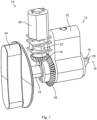
- Fig. 1 schematically represents a perspective view of a lock device 10.
- the lock device 10 comprises a coupling arrangement 12.
- the coupling arrangement 12 comprises an input element 14 rotatable about a rotation axis 16, and an output element 18 rotatable about the rotation axis 16.
- the output element 18 of this example comprises a tailpiece 20.
- the tailpiece 20 is one example of a locking member according to the present disclosure.
- the lock device 10 of this example further comprises a cylinder housing 22.
- a part of the coupling arrangement 12 is arranged inside the cylinder housing 22.
- the input element 14 protrudes from one side of the cylinder housing 22 and the tailpiece 20 is positioned on an opposite side of the cylinder housing 22.
- the lock device 10 of this example further comprises a knob 24.
- the knob 24 is one example of an actuating element according to the present disclosure.
- the knob 24 can be rotated by hand about the rotation axis 16.
- the input element 14 is fixed to the knob 24 and rotates in common with the knob 24.
- the knob 24 and the input element 14 can rotate continuously around the rotation axis 16.
- the lock device 10 of this example further comprises an electric generator 26.
- the electric generator 26 may for example be fixed to a door leaf (not shown).
- the knob 24 may in this case be rotatable relative to the door leaf.
- the electric generator 26 can be driven to generate electric energy by rotation of the input element 14.
- the lock device 10 of this example comprises a crown wheel 28, a pinion 30 and a gearbox 32.
- the crown wheel 28 is fixed to the input element 14 and rotates about the rotation axis 16.
- the pinion 30 meshes with the crown wheel 28 and rotates about an axis perpendicular to the rotation axis 16.
- the crown wheel 28 and the pinion 30 here form a bevel gear.
- the gearbox 32 may be a gear transmission comprising one or more intermediate gear wheels. Rotation of the pinion 30 is transmitted via the gearbox 32 to a rotation of a rotor (not shown) of the electric generator 26 to thereby generate electric energy.
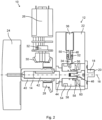
- Fig. 2 schematically represents a cross-sectional side view of the lock device 10.
- the lock device 10 further comprises an engaging member 34, an electric motor 36 and a coupling member 38.
- the input element 14 of this specific example comprises an input axle 40, a square axle 42, a plug 44 and a shoulder screw 46.
- Each of the input axle 40, the square axle 42, the plug 44 and the shoulder screw 46 is concentric with, and rotatable around, the rotation axis 16.
- the input axle 40 is fixed to the knob 24.
- the square axle 42 is fixed to the input axle 40 by being received in the input axle 40.
- the plug 44 is fixed to the square axle 42.
- the shoulder screw 46 is fixed to the plug 44. As shown in Fig. 2 , the plug 44 and the shoulder screw 46 are arranged inside the cylinder housing 22.
- the crown wheel 28 is fixed to the input axle 40.
- the engaging member 34 is arranged inside the cylinder housing 22.
- the engaging member 34 of this example comprises a cylindrical pin.
- the electric motor 36 is in this example arranged to be electrically powered by the electric generator 26.
- the lock device 10 of this example is thus electrically powered by means of energy harvesting.
- the electric motor 36 may alternatively be electrically powered by a battery.
- the electric motor 36 comprises a threaded motor shaft 48 and an actuating member 50 threadingly engaging the motor shaft 48.
- the actuating member 50 can be moved in a direction perpendicular to the rotation axis 16.
- the electric motor 36 has an elongated shape and is oriented perpendicular to the rotation axis 16.
- the coupling arrangement 12 does not protrude as much from the door leaf as if the electric motor 36 would be parallel with the rotation axis 16.
- the lock device 10 is thereby made more compact.
- the cylinder housing 22 may for example be only 13 mm long while containing the electric motor 36.
- the cylinder housing 22 will thereby fit entirely into most holes bored for cylinder housings without protruding from the door face.
- the door face may be positioned between the electric generator 26 and the cylinder housing 22.
- the coupling arrangement 12 further comprises an engaging spring 52.
- the engaging spring 52 is arranged between the actuating member 50 and the engaging member 34.
- the engaging spring 52 is here designed as a compression coil spring encircling the motor shaft 48.
- the coupling member 38 is rotationally fixed to the input element 14, here fixed to and surrounding the plug 44. Thus, when the input element 14 rotates around the rotation axis 16, also the coupling member 38 rotates around the rotation axis 16. However, the coupling member 38 is arranged to slide relative to the input element 14 along the rotation axis 16.
- the coupling member 38 of this example comprises a track 54 and a cam profile 56.
- the cam profile 56 is one example of a transmission mechanism according to the present disclosure.
- the engaging member 34 can engage the cam profile 56 and the track 54, as described below.
- the coupling member 38 further comprises a first coupling part 58.
- the cam profile 56 is here arranged between the track 54 and the first coupling part 58 along the rotation axis 16.
- the coupling member 38 is arranged inside the cylinder housing 22.
- the output element 18 of this example further comprises a second coupling part 60.
- the second coupling part 60 is fixed to the tailpiece 20.
- the second coupling part 60 is freely rotatable relative to the shoulder screw 46. To this end, a play is provided between the shoulder screw 46 and the second coupling part 60.
- the second coupling part 60 is provided inside the cylinder housing 22 and the tailpiece 20 is provided outside the cylinder housing 22.
- the coupling arrangement 12 of this example further comprises a coupling spring 62.
- the coupling spring 62 is one example of a coupling force device according to the present disclosure.
- the coupling spring 62 acts between the the coupling member 38 and the output element 18.
- the coupling spring 62 is here exemplified as a compression coil spring encircling the plug 44.
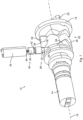
- Fig. 3 schematically represents a partial perspective view of the lock device 10.
- the coupling member 38 comprises a plurality of recesses 64.
- the coupling member 38 comprises three recesses 64 evenly distributed around the rotation axis 16.
- the track 54 is deeper than each recess 64.
- the track 54 is provided around the entire circumference of the coupling member 38 and lies in a plane perpendicular to the rotation axis 16. In this example, an edge of each recess 64 defines one of the cam profiles 56.
- Each cam profile 56 comprises two surfaces. Each such surface is here inclined approximately 60 degrees relative to the rotation axis 16.
- Each of the first coupling part 58 and the second coupling part 60 has a circular circumference and is centered with respect to the rotation axis 16.
- the first coupling part 58 and the second coupling part 60 form one example of a coupling according to the present disclosure.
- Each of the first coupling part 58 and the second coupling part 60 comprises a plurality of tapered teeth for being brought into meshing engagement.
- the coupling of this example is a Hirth coupling.
- the electric generator 26 can convert mechanical energy from a manual rotation of the knob 24 to electric energy. Electric energy harvested by manually rotating the knob 24 can thereby be used to authorize a user, to command the electric motor 36 to move the actuating member 50 from a first actuating position to a second actuating position, and to command the electric motor 36 to move the actuating member 50 from the second actuating position back to the first actuating position after some time.
- the electric generator 26 may function as a primary energy source for the coupling device.
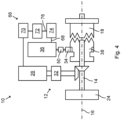
- Fig. 4 schematically represents a block diagram of one of many implementations of the lock device 10.
- the lock device 10 further comprises electronics, generally indicated by reference numeral 66.
- the electronics 66 is arranged to be electrically powered by the electric generator 26.
- the electronics 66 is further configured to produce an authorization signal 68 upon authorization of a user.
- the electric motor 36 drives the actuating member 50 from the first actuating position to the second actuating position.
- the electronics 66 electrically connects the electric generator 26 to the electric motor 36.
- the electronics 66 of the example in Fig. 4 comprises power management electronics 70, reading electronics 72 and credential evaluation electronics 74.
- the electric generator 26, the power management electronics 70, the reading electronics 72, the credential evaluation electronics 74 and the electric motor 36 are connected by electric conductors, as shown in Fig. 4 .
- the electric motor 36 is thereby arranged to be electrically powered by the electric generator 26.
- the power management electronics 70 of this example comprises energy harvesting electronics, such as diodes (not shown) and a capacitor (not shown).
- the reading electronics 72 of this example comprises an antenna (not shown) for receiving an input signal, and a reading unit (not shown).
- the electric generator 26 harvests electric energy from the rotation.
- an authorization process is initiated.
- the reading electronics 72 is powered by the power management electronics 70 and can for example communicate wirelessly with an external device, such as with a mobile phone via BLE (Bluetooth Low Energy).
- the reading electronics 72 receives a credential from the external device and sends an access signal 76, based on the credential, to the credential evaluation electronics 74.
- the credential evaluation electronics 74 determines whether or not access should be granted based on the access signal 76. If the authorization request is denied, the electric motor 36 is not actuated, i.e. the actuating member 50 remains in the first actuating position. If the authorization request is granted, e.g. if a valid credential is presented, the credential evaluation electronics 74 issues an authorization signal 68 to the electric motor 36. When sufficient electric energy has been harvested by the further continuous rotation of the knob 24, the electric motor 36 is actuated to drive the actuating member 50 from the first actuating position to the second actuating position.
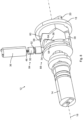
- Fig. 5 schematically represents a perspective view of the coupling arrangement 12 where the actuating member 50 is in the first actuating position 78, the engaging member 34 is in a first position 80, and the coupling member 38 is in a decoupled position 82.
- the decoupled position 82 of the coupling member 38 the first coupling part 58 is spaced from the second coupling part 60 along the rotation axis 16.
- a rotation of the input element 14 is thereby not transmitted to a rotation of the output element 18.
- the lock device 10 therefore cannot be unlocked (or locked) by rotation of the knob 24 when the coupling member 38 is in the decoupled position 82.
- the engaging member 34 When the actuating member 50 is in the first actuating position 78, the engaging member 34 is held in the first position 80 by the engaging spring 52. In the first position 80, the engaging member 34 does not engage the coupling member 38. The coupling member 38 is thereby forced to the decoupled position 82 (to the left in Fig. 5 ) by means of the coupling spring 62.
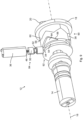
- Fig. 6 schematically represents a perspective view of the coupling arrangement 12 when the actuating member 50 has been driven by the electric motor 36 from the first actuating position 78 to the second actuating position 84, e.g. in response to a granted authorization request.
- the engaging member 34 is not aligned with any of the recesses 64.
- the movement of the actuating member 50 from the first actuating position 78 to the second actuating position 84 causes the engaging spring 52 to be compressed.
- the engaging member 34 is now forced against an exterior surface of the coupling member 38, radially outside the recesses 64 with respect to the rotation axis 16.
- Fig. 6 further shows that the movement of the actuating member 50 from the first actuating position 78 to the second actuating position 84 occurs in an actuating direction 86 perpendicular to the rotation axis 16.
- the actuating direction 86 is here angled 90 degrees to the rotation axis 16.
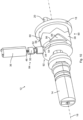
- Fig. 7 schematically represents a perspective view of the coupling arrangement 12 when the engaging member 34 is in a second position 88.
- the engaging member 34 By manually rotating the knob 24 when the actuating member 50 is in the second actuating position 84, the engaging member 34 eventually becomes aligned with one of the recesses 64 in the coupling member 38.
- the engaging spring 52 then forces the engaging member 34 to move radially inwards (with respect to the rotation axis 16) from the first position 80 to the second position 88 to engage the coupling member 38.
- a distance moved by the engaging member 34 from the first position 80 to the second position 88 is rather short and substantially corresponds to the depth of the recess 64.
- the electric motor 36 is said to be arranged to affect movement of the engaging member 34 from the first position 80 to the second position 88. Note that the coupling member 38 remains in the decoupled position 82 immediately after the engaging member 34 has entered the recess 64.
- Fig. 8 schematically represents a perspective view of the coupling arrangement 12 when the input element 14 is rotated further by rotation of the knob 24.
- the engaging member 34 is in the second position 88 and the coupling member 38 is rotated, the engagement between the engaging member 34 and the cam profile 56 causes the coupling member 38 to be pushed forward (to the right in Fig. 8 ) against the force of the coupling spring 62.
- the coupling member 38 thereby slides forward over the input element 14 by the manual force rotating the knob 24, and not by the force from the electric motor 36.
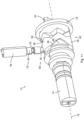
- Fig. 9 schematically represents a perspective view of the coupling arrangement 12 when the input element 14 is rotated further.
- further rotation of the coupling member 38 has caused the coupling member 38 to be moved further along the rotation axis 16 and into a coupled position 90.
- the input element 14 becomes aligned with the track 54.
- the engaging spring 52 thereby forces the engaging member 34 to move radially inwards (with respect to the rotation axis 16) from the second position 88 to a third position 92 engaging the track 54.
- a distance moved by the engaging member 34 from the second position 88 to the third position 92 is rather short and substantially corresponds to a radial distance (with respect to the rotation axis 16) between a bottom of the track 54 and a bottom of the recess 64.
- the transmission mechanism is arranged to transmit a rotation of the coupling member 38 about the rotation axis 16 to a movement of the coupling member 38 along the rotation axis 16 from the decoupled position 82 to the coupled position 90 when the engaging member 34 is in the second position 88.
- the coupling member 38 When the coupling member 38 is in the coupled position 90, the input element 14 and the output element 18 rotate in common by the engagement between the first coupling part 58 and the second coupling part 60.
- the coupling member 38 is held in the coupled position 90 (by the engaging member 34 being in the third position 92) as long as the actuating member 50 is in the second actuating position 84. Since the positioning of the actuating member 50 in the second actuating position 84 is a prerequisite for the engaging member 34 to move from the second position 88 to the third position 92, the electric motor 36 is said to be arranged to affect movement of the engaging member 34 from the second position 88 to the third position 92.
- Fig. 10 schematically represents a perspective view of the coupling arrangement 12 when the output element 18 is rotated by rotation of the input element 14.
- the rotation of the tailpiece 20 causes unlocking of the lock device 10, for example by driving a bolt in a lock case (not shown).
- the knob 24 can be continuously rotated about the rotation axis 16 during the authorization procedure. Electric energy harvested by manually rotating the knob 24 can thereby be used to authorize a user and to actuate the electric motor 36 to drive the actuating member 50 from the first actuating position 78 to the second actuating position 84.
- the user can rotate the knob 24 continuously during the authorization process, the subsequent switching process of the actuating member 50, and the subsequent rotation of the tailpiece 20. Thereby, a seamless access is provided.
- Fig. 11 schematically represents a perspective view of the coupling arrangement 12 when the actuating member 50 has returned to the first actuating position 78.
- the engaging spring 52 pulls the engaging member 34 from the third position 92 out from the track 54 and back to the first position 80.
- the coupling spring 62 then pushes the coupling member 38 from the coupled position 90 back to the decoupled position 82.
Landscapes
- Physics & Mathematics (AREA)
- Electromagnetism (AREA)
- Lock And Its Accessories (AREA)
Claims (13)
- Kopplungsanordnung (12) für eine Verriegelungsvorrichtung (10), wobei die Kopplungsanordnung (12) umfasst:- ein um eine Drehachse (16) drehbares Eingangselement (14);- ein um die Drehachse (16) drehbares Ausgangselement (18);- ein zwischen einer ersten Position (80) und einer zweiten Position (88) bewegliches Eingriffselement (34);- einen Elektromotor (36), der angeordnet ist, um eine Bewegung des Eingriffselements (34) zwischen der ersten Position (80) und der zweiten Position (88) zu beeinflussen;- ein Kopplungselement (38), das in Bezug auf die Drehachse (16) mit dem Eingangselement (14) drehschlüssig ist und in Bezug auf das Eingangselement (14) entlang der Drehachse (16) zwischen einer entkoppelten Position (82), in der eine Drehung des Eingangselements (14) durch das Kopplungselement (38) nicht auf eine Drehung des Ausgangselements (18) übertragen wird, und einer gekoppelten Position (90), in der eine Drehung des Eingangselements (14) durch das Kopplungselement (38) auf eine Drehung des Ausgangselements (18) übertragen wird, axial beweglich ist; und- einen Getriebemechanismus (56), der angeordnet ist, um eine Drehung des Kopplungselements (38) in eine Bewegung des Kopplungselements (38) von der entkoppelten Position (82) in die gekoppelte Position (90) zu übertragen, wenn das Eingriffselement (34) die zweite Position (88) einnimmt,wobei das Kopplungselement (38) eine kreisförmige Bahn (54) umfasst; undwobei das Eingriffselement (34) angeordnet ist, um in die Bahn (54) einzugreifen;dadurch gekennzeichnet, dass der Elektromotor (36) angeordnet ist, um eine Bewegung des Eingriffselements (34) von der zweiten Position (88) in eine dritte Position (92) zu bewirken;wobei die zweite Position (88) zwischen der ersten Position (80) und der dritten Position (92) liegt; undwobei das Eingriffselement (34) angeordnet ist, um in die Bahn (54) einzugreifen, wenn das Eingriffselement (34) die dritte Position (92) einnimmt und das Kopplungselement (38) die gekoppelte Position (90) einnimmt.
- Kopplungsanordnung (12) nach Anspruch 1, wobei der Elektromotor (36) angeordnet ist, um eine Bewegung des Eingriffselements (34) zwischen der ersten Position (80) und der zweiten Position (88) linear in einer Betätigungsrichtung (86) zu bewirken.
- Kopplungsanordnung (12) nach Anspruch 2, wobei die Betätigungsrichtung (86) und die Drehachse (16) nicht parallel sind.
- Kopplungsanordnung (12) nach Anspruch 2 oder 3, wobei die Betätigungsrichtung (86) annähernd 90 Grad zur Drehachse (16) abgewinkelt ist.
- Kopplungsanordnung (12) nach einem der vorstehenden Ansprüche, die weiter ein Betätigungselement (50) umfasst, das angeordnet ist, um durch den Elektromotor (36) angetrieben zu werden, und eine Eingriffsfeder (52), die angeordnet ist, um das Eingriffselement (34) in Bezug zum Betätigungselement (50) aus der ersten Position (80) in Richtung der zweiten Position (88) zu zwingen.
- Kopplungsanordnung (12) nach Anspruch 5, wobei das Betätigungselement (50) zwischen einer ersten Betätigungsposition (78) und einer zweiten Betätigungsposition (84) beweglich ist, und wobei die Eingriffsfeder (52) angeordnet ist, um das Eingriffselement (34) aus der ersten Position (80) in die zweite Position (88) zu zwingen, wenn das Betätigungselement (50) die zweite Betätigungsposition (84) einnimmt.
- Kopplungsanordnung (12) nach einem der vorstehenden Ansprüche, wobei der Getriebemechanismus (56) mindestens ein Nockenprofil (56) umfasst und wobei das Eingriffselement (34) angeordnet ist, um in der zweiten Position (88) in eines von dem mindestens einen Nockenprofil (56) einzugreifen.
- Kopplungsanordnung (12) nach Anspruch 6 oder den Ansprüchen 6 und 7, wobei die Eingriffsfeder (52) angeordnet ist, um das Eingriffselement (34) aus der zweiten Position (88) in die dritte Position (92) zu zwingen, wenn das Betätigungselement (50) die zweite Betätigungsposition (84) einnimmt.
- Kopplungsanordnung (12) nach einem der vorstehenden Ansprüche, die weiter eine Kopplung (58, 60) umfasst, die angeordnet ist, um eine Drehung des Kopplungselements (38) in eine Drehung des Ausgangselements (18) zu übertragen, wenn das Kopplungselement (38) die gekoppelte Position (90) einnimmt.
- Kopplungsanordnung (12) nach Anspruch 9, wobei die Kopplung (58, 60) eine Hirth-Kopplung ist.
- Kopplungsanordnung (12) nach einem der vorstehenden Ansprüche, die weiter eine Kopplungskraftvorrichtung (62) umfasst, die angeordnet ist, um das Kopplungselement (38) in Richtung der entkoppelten Position (82) zu zwingen.
- Verriegelungsvorrichtung (10), die eine Kopplungsanordnung (12) nach einem der vorstehenden Ansprüche umfasst.
- Verriegelungsvorrichtung (10) nach Anspruch 12, die weiter ein Zylindergehäuse (22) umfasst, wobei der Elektromotor (36), das Eingriffselement (34) und das Kopplungselement (38) innerhalb des Zylindergehäuses (22) angeordnet sind.
Applications Claiming Priority (2)
| Application Number | Priority Date | Filing Date | Title |
|---|---|---|---|
| SE2051507A SE546037C2 (en) | 2020-12-18 | 2020-12-18 | Coupling arrangement for lock device, and lock device |
| PCT/EP2021/083806 WO2022128480A1 (en) | 2020-12-18 | 2021-12-01 | Coupling arrangement for lock device, and lock device |
Publications (2)
| Publication Number | Publication Date |
|---|---|
| EP4263982A1 EP4263982A1 (de) | 2023-10-25 |
| EP4263982B1 true EP4263982B1 (de) | 2024-12-25 |
Family
ID=79230884
Family Applications (1)
| Application Number | Title | Priority Date | Filing Date |
|---|---|---|---|
| EP21835965.1A Active EP4263982B1 (de) | 2020-12-18 | 2021-12-01 | Kupplungsanordnung für eine verriegelungsvorrichtung und verriegelungsvorrichtung |
Country Status (7)
| Country | Link |
|---|---|
| US (1) | US12416184B2 (de) |
| EP (1) | EP4263982B1 (de) |
| CN (1) | CN116601366A (de) |
| ES (1) | ES3008014T3 (de) |
| FI (1) | FI4263982T3 (de) |
| SE (1) | SE546037C2 (de) |
| WO (1) | WO2022128480A1 (de) |
Families Citing this family (1)
| Publication number | Priority date | Publication date | Assignee | Title |
|---|---|---|---|---|
| US11674335B2 (en) * | 2020-05-05 | 2023-06-13 | Schlage Lock Company Llc | Axial clutch mechanism |
Family Cites Families (14)
| Publication number | Priority date | Publication date | Assignee | Title |
|---|---|---|---|---|
| AUPP400798A0 (en) * | 1998-06-11 | 1998-07-02 | Lockwood Security Products Pty Limited | Electrically controlled lock |
| EP1046770A1 (de) | 1999-04-20 | 2000-10-25 | Yale Security Products S.p.A | Verriegelungsvorrichtung für Türen, Fenster oder dergleichen |
| SE524285C2 (sv) * | 2002-05-30 | 2004-07-20 | Rco Security Ab | Anordning för att mekaniskt koppla ihop eller separera två handtag |
| US7007526B2 (en) * | 2003-09-08 | 2006-03-07 | Harrow Products, Inc. | Electronic clutch assembly for a lock system |
| US20060254328A1 (en) | 2005-05-11 | 2006-11-16 | Pearson Rune S | Locking mechanism with electronic solenoid opening and mechanical reset |
| CN101324163B (zh) * | 2007-06-11 | 2013-03-27 | 上海伙伴科技发展有限公司 | 一种转舌锁 |
| JP5173529B2 (ja) * | 2008-03-31 | 2013-04-03 | 美和ロック株式会社 | 電気錠のクラッチ機構 |
| DE202008006082U1 (de) | 2008-05-02 | 2008-07-24 | Burg F.W. Lüling KG | Verriegelungsvorrichtung |
| DE102008028800B4 (de) * | 2008-06-17 | 2010-08-26 | Assa Abloy Sicherheitstechnik Gmbh | Baugruppe für ein Türschloss, die zum Sperren oder Freigeben des Türschlosses vorgesehen ist |
| FI20095694A7 (fi) | 2009-01-05 | 2010-07-06 | Megalock Oy | Langattomasti ohjattava sähkölukko |
| JP4843738B1 (ja) * | 2011-03-17 | 2011-12-21 | 株式会社アテック | 電子錠 |
| US10711486B2 (en) * | 2016-04-20 | 2020-07-14 | Scyan Electronics LLC | Lock clutches and methods of making and using thereof |
| KR102558852B1 (ko) * | 2018-12-24 | 2023-07-25 | 아사아블로이코리아 주식회사 | 도어락의 클러치 구동 조립체 |
| DE102019113666B4 (de) | 2019-05-22 | 2022-09-29 | ASTRA Gesellschaft für Asset Management mbH & Co. KG | Elektrischer Schließzylinder für ein Schloss |
-
2020
- 2020-12-18 SE SE2051507A patent/SE546037C2/en unknown
-
2021
- 2021-12-01 ES ES21835965T patent/ES3008014T3/es active Active
- 2021-12-01 US US18/257,949 patent/US12416184B2/en active Active
- 2021-12-01 CN CN202180084803.8A patent/CN116601366A/zh active Pending
- 2021-12-01 EP EP21835965.1A patent/EP4263982B1/de active Active
- 2021-12-01 WO PCT/EP2021/083806 patent/WO2022128480A1/en not_active Ceased
- 2021-12-01 FI FIEP21835965.1T patent/FI4263982T3/fi active
Also Published As
| Publication number | Publication date |
|---|---|
| CN116601366A (zh) | 2023-08-15 |
| SE546037C2 (en) | 2024-04-23 |
| WO2022128480A1 (en) | 2022-06-23 |
| FI4263982T3 (fi) | 2025-01-28 |
| ES3008014T3 (en) | 2025-03-21 |
| US20240018803A1 (en) | 2024-01-18 |
| EP4263982A1 (de) | 2023-10-25 |
| SE2051507A1 (en) | 2022-06-19 |
| US12416184B2 (en) | 2025-09-16 |
Similar Documents
| Publication | Publication Date | Title |
|---|---|---|
| US6286347B1 (en) | Clutch mechanism with moveable injector retainer wall for door lock system | |
| US9850686B2 (en) | Handle device | |
| EP0848779B1 (de) | Kupplungsmechanismus für türschliesssystem | |
| EP2994586B1 (de) | Elektromechanisches zylinderschloss mit schlüsselfreilauf | |
| US9051761B2 (en) | Manually driven electronic deadbolt assembly with fixed turnpiece | |
| CN103732844B (zh) | 带有自由转动座圈的手动驱动式电子插销锁组件 | |
| US9273489B2 (en) | Lock assembly having motor inside interior operator handle | |
| US20160258189A1 (en) | Electronic Control for Lock Assembly and Conversion Method | |
| US10927569B2 (en) | Door handle and drive support for an electromagnetic door lock | |
| US8495899B2 (en) | Electromechanical lock | |
| JPH0452363Y2 (de) | ||
| EP2746497A2 (de) | Verriegelungsanordnung | |
| WO2008029391A2 (en) | Electronic cylinder internal key apparatus and method | |
| EP3927919B1 (de) | Verfahren zum entriegeln eines schlosses | |
| GB2492829A (en) | Double lock cylinder with key cylinder, thumbturn, and mis-alignment clutch | |
| EP4263982B1 (de) | Kupplungsanordnung für eine verriegelungsvorrichtung und verriegelungsvorrichtung | |
| US20010010166A1 (en) | Override mechanism for unlatching an electronic door lock | |
| US11739563B2 (en) | Low profile deadbolt | |
| WO2015065944A1 (en) | Electromechanical lock cylinder | |
| US20240218704A1 (en) | Clutch for a lock | |
| CN104251082A (zh) | 一种无钥匙智能锁 | |
| EP4204650B1 (de) | Anordnung für eine schlossvorrichtung und schlossvorrichtung mit anordnung | |
| EP4019719B1 (de) | Sperrvorrichtung | |
| DE19726010A1 (de) | Mechatronischer Sperrknauf | |
| EP3772562B1 (de) | Türschloss und tür mit solch einem türschloss |
Legal Events
| Date | Code | Title | Description |
|---|---|---|---|
| STAA | Information on the status of an ep patent application or granted ep patent |
Free format text: STATUS: UNKNOWN |
|
| STAA | Information on the status of an ep patent application or granted ep patent |
Free format text: STATUS: THE INTERNATIONAL PUBLICATION HAS BEEN MADE |
|
| PUAI | Public reference made under article 153(3) epc to a published international application that has entered the european phase |
Free format text: ORIGINAL CODE: 0009012 |
|
| STAA | Information on the status of an ep patent application or granted ep patent |
Free format text: STATUS: REQUEST FOR EXAMINATION WAS MADE |
|
| 17P | Request for examination filed |
Effective date: 20230609 |
|
| AK | Designated contracting states |
Kind code of ref document: A1 Designated state(s): AL AT BE BG CH CY CZ DE DK EE ES FI FR GB GR HR HU IE IS IT LI LT LU LV MC MK MT NL NO PL PT RO RS SE SI SK SM TR |
|
| DAV | Request for validation of the european patent (deleted) | ||
| DAX | Request for extension of the european patent (deleted) | ||
| GRAP | Despatch of communication of intention to grant a patent |
Free format text: ORIGINAL CODE: EPIDOSNIGR1 |
|
| STAA | Information on the status of an ep patent application or granted ep patent |
Free format text: STATUS: GRANT OF PATENT IS INTENDED |
|
| INTG | Intention to grant announced |
Effective date: 20240905 |
|
| GRAS | Grant fee paid |
Free format text: ORIGINAL CODE: EPIDOSNIGR3 |
|
| GRAA | (expected) grant |
Free format text: ORIGINAL CODE: 0009210 |
|
| STAA | Information on the status of an ep patent application or granted ep patent |
Free format text: STATUS: THE PATENT HAS BEEN GRANTED |
|
| RIN1 | Information on inventor provided before grant (corrected) |
Inventor name: NIEGMANN, KAJ |
|
| AK | Designated contracting states |
Kind code of ref document: B1 Designated state(s): AL AT BE BG CH CY CZ DE DK EE ES FI FR GB GR HR HU IE IS IT LI LT LU LV MC MK MT NL NO PL PT RO RS SE SI SK SM TR |
|
| REG | Reference to a national code |
Ref country code: GB Ref legal event code: FG4D |
|
| REG | Reference to a national code |
Ref country code: CH Ref legal event code: EP |
|
| REG | Reference to a national code |
Ref country code: DE Ref legal event code: R096 Ref document number: 602021024011 Country of ref document: DE |
|
| REG | Reference to a national code |
Ref country code: IE Ref legal event code: FG4D |
|
| REG | Reference to a national code |
Ref country code: FI Ref legal event code: FGE |
|
| REG | Reference to a national code |
Ref country code: ES Ref legal event code: FG2A Ref document number: 3008014 Country of ref document: ES Kind code of ref document: T3 Effective date: 20250321 |
|
| REG | Reference to a national code |
Ref country code: LT Ref legal event code: MG9D |
|
| PG25 | Lapsed in a contracting state [announced via postgrant information from national office to epo] |
Ref country code: HR Free format text: LAPSE BECAUSE OF FAILURE TO SUBMIT A TRANSLATION OF THE DESCRIPTION OR TO PAY THE FEE WITHIN THE PRESCRIBED TIME-LIMIT Effective date: 20241225 |
|
| PG25 | Lapsed in a contracting state [announced via postgrant information from national office to epo] |
Ref country code: BG Free format text: LAPSE BECAUSE OF FAILURE TO SUBMIT A TRANSLATION OF THE DESCRIPTION OR TO PAY THE FEE WITHIN THE PRESCRIBED TIME-LIMIT Effective date: 20241225 |
|
| PG25 | Lapsed in a contracting state [announced via postgrant information from national office to epo] |
Ref country code: NO Free format text: LAPSE BECAUSE OF FAILURE TO SUBMIT A TRANSLATION OF THE DESCRIPTION OR TO PAY THE FEE WITHIN THE PRESCRIBED TIME-LIMIT Effective date: 20250325 |
|
| PG25 | Lapsed in a contracting state [announced via postgrant information from national office to epo] |
Ref country code: LV Free format text: LAPSE BECAUSE OF FAILURE TO SUBMIT A TRANSLATION OF THE DESCRIPTION OR TO PAY THE FEE WITHIN THE PRESCRIBED TIME-LIMIT Effective date: 20241225 Ref country code: GR Free format text: LAPSE BECAUSE OF FAILURE TO SUBMIT A TRANSLATION OF THE DESCRIPTION OR TO PAY THE FEE WITHIN THE PRESCRIBED TIME-LIMIT Effective date: 20250326 |
|
| PG25 | Lapsed in a contracting state [announced via postgrant information from national office to epo] |
Ref country code: RS Free format text: LAPSE BECAUSE OF FAILURE TO SUBMIT A TRANSLATION OF THE DESCRIPTION OR TO PAY THE FEE WITHIN THE PRESCRIBED TIME-LIMIT Effective date: 20250325 |
|
| REG | Reference to a national code |
Ref country code: NL Ref legal event code: MP Effective date: 20241225 |
|
| PG25 | Lapsed in a contracting state [announced via postgrant information from national office to epo] |
Ref country code: NL Free format text: LAPSE BECAUSE OF FAILURE TO SUBMIT A TRANSLATION OF THE DESCRIPTION OR TO PAY THE FEE WITHIN THE PRESCRIBED TIME-LIMIT Effective date: 20241225 |
|
| REG | Reference to a national code |
Ref country code: AT Ref legal event code: MK05 Ref document number: 1754286 Country of ref document: AT Kind code of ref document: T Effective date: 20241225 |
|
| PG25 | Lapsed in a contracting state [announced via postgrant information from national office to epo] |
Ref country code: SM Free format text: LAPSE BECAUSE OF FAILURE TO SUBMIT A TRANSLATION OF THE DESCRIPTION OR TO PAY THE FEE WITHIN THE PRESCRIBED TIME-LIMIT Effective date: 20241225 |
|
| PG25 | Lapsed in a contracting state [announced via postgrant information from national office to epo] |
Ref country code: PL Free format text: LAPSE BECAUSE OF FAILURE TO SUBMIT A TRANSLATION OF THE DESCRIPTION OR TO PAY THE FEE WITHIN THE PRESCRIBED TIME-LIMIT Effective date: 20241225 |
|
| PG25 | Lapsed in a contracting state [announced via postgrant information from national office to epo] |
Ref country code: IS Free format text: LAPSE BECAUSE OF FAILURE TO SUBMIT A TRANSLATION OF THE DESCRIPTION OR TO PAY THE FEE WITHIN THE PRESCRIBED TIME-LIMIT Effective date: 20250425 |
|
| PG25 | Lapsed in a contracting state [announced via postgrant information from national office to epo] |
Ref country code: PT Free format text: LAPSE BECAUSE OF FAILURE TO SUBMIT A TRANSLATION OF THE DESCRIPTION OR TO PAY THE FEE WITHIN THE PRESCRIBED TIME-LIMIT Effective date: 20250428 |
|
| PG25 | Lapsed in a contracting state [announced via postgrant information from national office to epo] |
Ref country code: EE Free format text: LAPSE BECAUSE OF FAILURE TO SUBMIT A TRANSLATION OF THE DESCRIPTION OR TO PAY THE FEE WITHIN THE PRESCRIBED TIME-LIMIT Effective date: 20241225 |
|
| PG25 | Lapsed in a contracting state [announced via postgrant information from national office to epo] |
Ref country code: AT Free format text: LAPSE BECAUSE OF FAILURE TO SUBMIT A TRANSLATION OF THE DESCRIPTION OR TO PAY THE FEE WITHIN THE PRESCRIBED TIME-LIMIT Effective date: 20241225 Ref country code: RO Free format text: LAPSE BECAUSE OF FAILURE TO SUBMIT A TRANSLATION OF THE DESCRIPTION OR TO PAY THE FEE WITHIN THE PRESCRIBED TIME-LIMIT Effective date: 20241225 |
|
| PG25 | Lapsed in a contracting state [announced via postgrant information from national office to epo] |
Ref country code: SK Free format text: LAPSE BECAUSE OF FAILURE TO SUBMIT A TRANSLATION OF THE DESCRIPTION OR TO PAY THE FEE WITHIN THE PRESCRIBED TIME-LIMIT Effective date: 20241225 |
|
| PG25 | Lapsed in a contracting state [announced via postgrant information from national office to epo] |
Ref country code: CZ Free format text: LAPSE BECAUSE OF FAILURE TO SUBMIT A TRANSLATION OF THE DESCRIPTION OR TO PAY THE FEE WITHIN THE PRESCRIBED TIME-LIMIT Effective date: 20241225 |
|
| PG25 | Lapsed in a contracting state [announced via postgrant information from national office to epo] |
Ref country code: IT Free format text: LAPSE BECAUSE OF FAILURE TO SUBMIT A TRANSLATION OF THE DESCRIPTION OR TO PAY THE FEE WITHIN THE PRESCRIBED TIME-LIMIT Effective date: 20241225 |
|
| PG25 | Lapsed in a contracting state [announced via postgrant information from national office to epo] |
Ref country code: SE Free format text: LAPSE BECAUSE OF FAILURE TO SUBMIT A TRANSLATION OF THE DESCRIPTION OR TO PAY THE FEE WITHIN THE PRESCRIBED TIME-LIMIT Effective date: 20241225 |
|
| REG | Reference to a national code |
Ref country code: DE Ref legal event code: R097 Ref document number: 602021024011 Country of ref document: DE |
|
| PG25 | Lapsed in a contracting state [announced via postgrant information from national office to epo] |
Ref country code: DK Free format text: LAPSE BECAUSE OF FAILURE TO SUBMIT A TRANSLATION OF THE DESCRIPTION OR TO PAY THE FEE WITHIN THE PRESCRIBED TIME-LIMIT Effective date: 20241225 |
|
| PLBE | No opposition filed within time limit |
Free format text: ORIGINAL CODE: 0009261 |
|
| STAA | Information on the status of an ep patent application or granted ep patent |
Free format text: STATUS: NO OPPOSITION FILED WITHIN TIME LIMIT |
|
| 26N | No opposition filed |
Effective date: 20250926 |
|
| PGFP | Annual fee paid to national office [announced via postgrant information from national office to epo] |
Ref country code: DE Payment date: 20251111 Year of fee payment: 5 |
|
| PGFP | Annual fee paid to national office [announced via postgrant information from national office to epo] |
Ref country code: GB Payment date: 20251113 Year of fee payment: 5 |
|
| PGFP | Annual fee paid to national office [announced via postgrant information from national office to epo] |
Ref country code: FI Payment date: 20251211 Year of fee payment: 5 |
|
| PGFP | Annual fee paid to national office [announced via postgrant information from national office to epo] |
Ref country code: ES Payment date: 20260115 Year of fee payment: 5 |