EP4264242B1 - Verfahren zur messung von stoffmengen in einem stoffgemisch - Google Patents
Verfahren zur messung von stoffmengen in einem stoffgemisch Download PDFInfo
- Publication number
- EP4264242B1 EP4264242B1 EP21839024.3A EP21839024A EP4264242B1 EP 4264242 B1 EP4264242 B1 EP 4264242B1 EP 21839024 A EP21839024 A EP 21839024A EP 4264242 B1 EP4264242 B1 EP 4264242B1
- Authority
- EP
- European Patent Office
- Prior art keywords
- substance
- moisture
- substances
- mixture
- values
- Prior art date
- Legal status (The legal status is an assumption and is not a legal conclusion. Google has not performed a legal analysis and makes no representation as to the accuracy of the status listed.)
- Active
Links
Images



Classifications
-
- G—PHYSICS
- G01—MEASURING; TESTING
- G01N—INVESTIGATING OR ANALYSING MATERIALS BY DETERMINING THEIR CHEMICAL OR PHYSICAL PROPERTIES
- G01N22/00—Investigating or analysing materials by the use of microwaves or radio waves, i.e. electromagnetic waves with a wavelength of one millimetre or more
-
- G—PHYSICS
- G01—MEASURING; TESTING
- G01N—INVESTIGATING OR ANALYSING MATERIALS BY DETERMINING THEIR CHEMICAL OR PHYSICAL PROPERTIES
- G01N22/00—Investigating or analysing materials by the use of microwaves or radio waves, i.e. electromagnetic waves with a wavelength of one millimetre or more
- G01N22/04—Investigating moisture content
Definitions
- the present invention relates to a method for measuring amounts of substances in a mixture of two substances using a microwave resonator.
- the present invention makes it possible to measure the amounts of two non-dispersive or weakly dispersive substances in a mixture of substances using the microwave resonance method.
- the measurement of the amounts of substances is fundamentally under-determined when using a two-parameter method.
- the moisture cannot therefore be determined independently of fluctuating proportions of substances in the mixture.
- the influence of the constant proportion of substances can then usually be eliminated from the measured values, for example via an offset.
- the state of the art is DE 10 2011 006 416 which concerns the determination of the moisture and material composition of a mixture of substances in a cigarette filter rod using a microwave measuring device.
- the present invention is intended to address the measurement problem that relatively strongly fluctuating proportions of the two substances are present in the mixture of substances, but at the same time the moisture either only fluctuates relatively weakly or not at all, or the moisture of the individual substances is measured in advance.
- a simple plausibility consideration shows that, based on two measured values from the microwave resonator, the measurement task of determining two amounts of substance in the mixture of substances is not underdetermined.
- the invention is based on the object of providing a method using a microwave resonator for measuring amounts of substances in a mixture of two substances.
- the method according to the invention provides two amounts of substance for a mixture of substances.
- the substances do not have to be chemically pure substances, but substances and their amounts of substance in the mixture of substances are determined. Since the method according to the invention is not restricted to pure substances, the amounts of substance of two groups of substances can also be differentiated from one another in a mixture of substances with more than two substances.
- the method according to the invention initially starts with determining a first moisture value for a first of the two substances and a second moisture value for the second of the two substances.
- the moisture value for a substance is a common value in microwave measurement technology, which is determined, for example, from the quotient of the two measured values of the microwave resonator.
- two measured values are determined for the mixture of substances using the microwave resonator.
- the measured values determined here are the shift in the resonance frequency and the broadening of the resonance curve.
- the moisture vectors are vectors that indicate the direction of a straight line of equal moisture for a substance in a plane of the measured values using the first and second moisture values.
- the moisture vectors therefore indicate the direction in the plane of the measured values in which the moisture value is constant for each substance.
- the amounts of substance are determined from the two scalar factors.
- the last step shows that the measurement problem is not underdetermined.
- the accuracy that can be achieved with the measuring method according to the invention depends largely on how little the moisture content of the two material components fluctuates or how well the moisture content of the two material components is known. Analytical calculations by the inventors have shown that very different moisture values for the two materials also have a positive effect on the measurement accuracy. The accuracy achieved in determining the amount of substance is surprising insofar as the mixture of materials is measured with the microwave resonator.
- the amounts of substance are determined depending on the scalar factors and a temperature for the mixture of substances. Tests have shown that the temperature of the mixture of substances is, in addition to the scalar factors, a determining factor that is easily accessible in practical application and contributes to increasing the measurement accuracy.
- the amount of substance of the first substance depends on the scalar factor of the moisture value for the first substance and the amount of substance of the second substance depends on the scalar factor of the moisture value of the second substance.
- This independence of the two substances in the mixture of substances facilitates the determination of the scalar factors.
- a calibration step must be carried out in advance for the two substances. This calibration step is then used to determine the moisture values for the two substances in the mixture as accurately as possible.
- the method according to the invention can then also be used for mixtures of substances in which the moisture values of the substances forming the mixture fluctuate greatly. With the precise recording of the moisture values for the individual substances, the fluctuations in the measured values resulting from the measurement on the mixture of substances can be clearly calculated back to the changes in the amount of substance. It has proven advantageous here to take into account the fact that two or more measuring systems are used by re-scaling the moisture values of the other measuring system(s). The scaling factors can be determined in advance in a calibration step.
- the measurement variable A describes the change in the resonance frequency in the form of a shift in the resonance frequency.
- the second measurement variable B describes the change in the width of the resonance curve.
- the physical basis for the measurement variable A is the shortening of the wavelength due to the dielectric properties of the material to be measured.
- the second effect which leads to the measurement variable B, describes the absorption of the microwaves in the sample to be measured.
- the polarization P of a dielectric material under an electric field E is determined according to its susceptibility ⁇ e and the permittivity of the vacuum ⁇ 0 .
- P ⁇ ⁇ e ⁇ ⁇ 0 ⁇ E ⁇ .
- the electrical susceptibility is a complex number whose real part is denoted by ⁇ e ' and whose imaginary part is denoted by ⁇ e ".
- ⁇ e ⁇ e ′ ⁇ i ⁇ ⁇ e " .
- the susceptibility results that the measured quantity A is proportional to ⁇ e ' and the measured quantity B is proportional to ⁇ e ".
- A-value of a mixture is the sum of the A-values of the individual substances in the mixture.
- B-value is the sum of the individual B-values of the substances in the mixture.
- mixtures of substances consisting of two substances are considered.
- mixtures of substances with more than two substances can also be analyzed and then some substances can be combined and considered together as one substance.
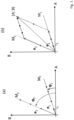
- Figure 1 shows the plane spanned by the measured values A, B.
- the lines of equal moisture are drawn for the substances M 1 and M 2 .
- the slope of the straight line of equal moisture is designated by the moisture value ⁇ 1 , ⁇ 2 .
- the addition of the values expressed in the above equations for the A and B values of the mixture leads, graphically represented as in Figure 1b, to a vectorial addition of the two quantities.
- the measured values A and B for the mixture can be determined as the vectorial addition of the moisture values of the substances M 1 and M 2 .
- Each point on the line with constant moisture can thus be represented by the scalar factor ⁇ multiplied by the moisture unit vector.
- a i B i ⁇ i ⁇ e i
- the index i in the above equation stands for substances 1 and 2.
- the scalar factors ⁇ 1 , ⁇ 2 can be calculated from the A and B values measured in the mixture using the moisture values ⁇ 1 , ⁇ 2 .
- the above formula also makes it clear that either the moisture values ⁇ 1 , ⁇ 2 are assumed to be constant or to fluctuate little during the process. In this case, the ⁇ 1 and ⁇ 2 values can be determined in advance and used for the evaluation.
- the parameters ⁇ , ⁇ indicate the relationship between the scalar factor and the amount of substance.
- FIG. 2 The measuring arrangement shown in Figure 2 shows a schematic view of a material flow 10 to the material M 1 .
- the moisture content of the material flow M 1 is measured with a schematically shown measuring device 12.
- the moisture value ⁇ 2 is measured for the material flow 14 of the material M 2 with a measuring device 16.
- Both materials M 1 , M 2 are fed to a feed 18, where they become a mixture 20 downstream of the feed of the second material 14.
- the mixture 20 is measured in a measuring arrangement 22.
- the A and B values determined in this way can then be converted into the scalar factors ⁇ 1 and ⁇ 2 . Due to the The scalar factors can be converted directly using the always current humidity values ⁇ 1 , ⁇ 2 .
- tan ⁇ 1 a 1 ⁇ tan ⁇ ′ 1 + b 1
- tan ⁇ 2 a 2 ⁇ tan ⁇ ′ 2 + b 2
- the moisture angles shown are the moisture angles of the individual devices 12, 16 before mixing.
- the parameters ai, bi are calibrated in a known manner.
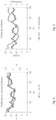
- FIG. 4 the A and B values of a diaper core are shown along its profile, with the cellulose fleece in the diaper core being sprinkled with SAP. Using the slope of the regression line, the measured A and B values can be converted into the scalar factors ⁇ 1 and ⁇ 2.
- Fig. 5 shows the same profile, but this time plotted for the scalar factors ⁇ 1, ⁇ 2.
- the cellulose differs more clearly from the ⁇ values for SAP.
- the measured A and B values can be converted directly into a surface mass by converting them into the ⁇ values.
- the Fig. 7 shown curve for the basis weight of SAP and cellulose. It can be clearly seen that the basis weight for SAP extends essentially evenly over the profile, while the cellulose has a significantly lower basis weight in the range of 10 to 22.
- the profile of the A and B values in Fig. 4 or to the classical microwave humidity value ⁇ in Fig. 8 is not a suitable measure for measuring the two material components independently of each other.
- the characteristic lower cellulose content in one section is the filter profile in Fig. 4 and Fig. 8 cannot be removed.
Landscapes
- Physics & Mathematics (AREA)
- Biochemistry (AREA)
- Health & Medical Sciences (AREA)
- Life Sciences & Earth Sciences (AREA)
- Chemical & Material Sciences (AREA)
- Analytical Chemistry (AREA)
- Electromagnetism (AREA)
- General Health & Medical Sciences (AREA)
- General Physics & Mathematics (AREA)
- Immunology (AREA)
- Pathology (AREA)
- Investigating Or Analysing Materials By Optical Means (AREA)
- Investigating Or Analyzing Materials By The Use Of Electric Means (AREA)
Description
- Die vorliegende Erfindung betrifft ein Verfahren zur Messung von Stoffmengen in einem Stoffgemisch mit zwei Stoffen unter Verwendung eines Mikrowellenresonators.
- Die vorliegende Erfindung schafft die Möglichkeit zur Messung von Stoffmengen zweier nicht- oder schwach-dispersiver Stoffe in einem Stoffgemisch mit Hilfe der Mikrowellen-Resonanzmethode. Bei einer Mischung von zwei feuchten Stoffen ist grundsätzlich das Messen von Stoffmengen bei Anwendung eines Zwei-Parameter-Verfahrens unterbestimmt. Die Feuchte kann also nicht unabhängig von schwankenden Stoffanteilen in dem Gemisch bestimmt werden. Bei einer Messung mit einem Mikrowellenresonator in einem Stoffgemisch ist es also erforderlich, dass einer der Stoffanteile konstant bleibt, beispielsweise der Probenbehälter oder ein Substrat für den zweiten Stoff. Der Einfluss des konstanten Stoffanteils kann dann in der Regel aus den Messwerten beispielsweise über ein Offset eliminiert werden.
- Aus dem Stand der Technik ist
DE 10 2011 006 416 bekannt, das die Bestimmung der Feuchtigkeit und Materialzusammensetzung eines Stoffgemisches in einem Zigarettenfilterstrang mit Hilfe einer Mikrowellenmesseinrichtung betrifft. - Mit der vorliegenden Erfindung soll das Messproblem adressiert werden, dass relativ stark schwankende Anteile der beiden Stoffe in dem Stoffgemisch vorliegen, gleichzeitig aber die Feuchte entweder nur relativ schwach bzw. nicht schwankt oder die Feuchte der einzelnen Stoffe vorab gemessen wird. Ein einfache Plausibilitätsüberlegung zeigt, dass, ausgehend von zwei Messwerten des Mikrowellenresonators, die Messaufgabe zwei Stoffmengen in dem Stoffgemisch zu bestimmen, nicht unterbestimmt ist.
- Der Erfindung liegt die Aufgabe zugrunde, zur Messung von Stoffmengen in einem Stoffgemisch mit zwei Stoffen, ein Verfahren unter Verwendung eines Mikrowellenresonators bereitzustellen.
- Erfindungsgemäß wird die Aufgabe durch ein Verfahren mit den Merkmalen aus Anspruch 1 gelöst. Vorteilhafte Ausgestaltung bilden die Gegenstände der Unteransprüche.
- Das erfindungsgemäße Verfahren liefert zwei Stoffmengen für ein Stoffgemisch. Bei den Stoffen muss es sich nicht um chemisch reine Stoffe handeln, sondern es werden Stoffe und ihre Stoffmengen in dem Stoffgemisch bestimmt. Indem das erfindungsgemäße Verfahren nicht auf reine Stoffe beschränkt ist, können auch in einem Stoffgemisch mit mehr als zwei Stoffen die Stoffmengen von zwei Stoffgruppen voneinander unterschieden werden.
- Das erfindungsgemäße Verfahren geht zunächst von dem Bestimmen eines ersten Feuchtewerts für einen ersten der zwei Stoffe und einem zweiten Feuchtewert für den zweiten der beiden Stoffe aus. Der Feuchtewert für einen Stoff ist in der Mikrowellenmesstechnik eine gebräuchliche Größe, die beispielsweise aus dem Quotienten der beiden Messgrößen des Mikrowellenresonators bestimmt wird. In einem nachfolgenden Schritt werden zwei Messwerte für das Stoffgemisch mit dem Mikrowellenresonator bestimmt. Hierbei werden als Messgrößen die Verschiebung der Resonanzfrequenz und die Verbreiterung der Resonanzkurve bestimmt.
- Unter Verwendung des ersten und des zweiten Feuchtewerts werden zwei Skalarfaktoren für zwei Feuchtevektoren aus den beiden Messwerten für das Stoffgemisch berechnet. Die Feuchtevektoren sind dabei Vektoren, die in einer Ebene der Messwerte unter Verwendung des ersten und des zweiten Feuchtewerts jeweils die Richtung einer Geraden gleicher Feuchte für einen Stoff angeben. Die Feuchtevektoren bezeichnen also jeweils für einen Stoff die Richtung in der Ebene der Messwerte, in der der Feuchtewert konstant ist.
- In einem weiteren Schritt werden die Stoffmengen aus den beiden Skalarfaktoren bestimmt. Der letzte Schritt zeigt, dass das Messproblem nicht unterbestimmt ist. Die Genauigkeit, die mit dem erfindungsgemäßen Messverfahren erzielt werden kann, hängt wesentlich davon ab, wie schwach die Feuchte der beiden Stoffanteile schwanken oder wie gut die Feuchte der beiden Stoffanteile bekannt ist. Analytische Rechnungen der Erfinder haben gezeigt, dass stark unterschiedliche Feuchtewerte für die beiden Stoffe sich zudem positiv auf die Messgenauigkeit auswirken. Die erzielte Genauigkeit bei der Bestimmung der Stoffmenge ist überraschend insofern, als mit dem Mikrowellenresonator das Stoffgemisch gemessen wird.
- In einer bevorzugten Ausgestaltung erfolgt das Bestimmen der Stoffmengen abhängig von den Skalarfaktoren und einer Temperatur für das Stoffgemisch. Versuche haben gezeigt, dass die Temperatur des Stoffgemischs zusätzlich zu den Skalarfaktoren eine Bestimmungsgröße ist, die in der praktischen Anwendung leicht zugänglich ist und einen Beitrag zur Erhöhung der Messgenauigkeit liefert.
- Für eine Bestimmung des Zusammenhangs der Stoffmengen mit den Skalarfaktoren, wird auf eine Vielzahl von Messungen zurückgegriffen, die dann entsprechend ausgewertet werden.
- In einer bevorzugten Ausgestaltung des erfindungsgemäßen Verfahrens hat es sich gezeigt, dass für den Zusammenhang zwischen den Stoffmengen und den Skalarfaktoren angenommen werden kann, dass die Stoffmenge des ersten Stoffs von dem Skalarfaktor des Feuchtewerts für den ersten Stoff und die Stoffmenge des zweiten Stoffs abhängig von dem Skalarfaktor des Feuchtewerts des zweiten Stoffs abhängt. Diese Unabhängigkeit der beiden Stoffe in dem Stoffgemisch erleichtert die Bestimmung der Skalarfaktoren. Im Hinblick auf die Feuchtewerte für die beiden Stoffe kann, insbesondere bei konstanter oder wenig schwankender Feuchte für die beiden Stoffe, vorab ein Kalibrationsschritt durchgeführt werden. Mit diesem Kalibrationsschritt werden dann die Feuchtewerte für die beiden Stoffe in dem Stoffgemisch möglichst genau bestimmt.
- Alternativ oder zusätzlich zu dem Kalibrationsschritt für die Feuchtewerte ist es auch möglich, mindestens ein weiteres Messsystem vorzusehen, das den Feuchtewert für einen Stoff vor der Mischung mit dem anderen Stoff misst. Auf diese Weise liegt dann einer der Feuchtewerte bei dem Messverfahren exakt vor. In einer bevorzugten Ausgestaltung können zwei weitere Messsysteme vorgesehen sein, die jeweils einen Feuchtewert für einen Stoff messen. Bei dieser Ausgestaltung kann das erfindungsgemäße Verfahren dann auch bei Stoffgemischen angewendet werden, bei denen die Feuchtewerte der das Stoffgemisch bildenden Stoffe stark schwanken. Mit der präzisen Erfassung der Feuchtewerte für die einzelnen Stoffe, können die aus der Messung an dem Stoffgemisch sich ergebenden Schwankungen der Messwerte eindeutig auf die Änderungen in der Stoffmenge zurückgerechnet werden. Als vorteilhaft hierbei hat es sich herausgestellt, dem Umstand, dass zwei oder mehr Messsysteme eingesetzt werden, dadurch Rechnung zu tragen, dass die Feuchtewerte des oder der weiteren Messsysteme umskaliert werden. Die Skalierungsfaktoren können dabei vorab in einem Kalibrationsschritt bestimmt werden.
- Eine bevorzugte Ausgestaltung der Erfindung wird nachfolgend an einem Ausführungsbeispiel näher erläutert. Es zeigen:
- Fig. 1a, b
- die Darstellung der Messwerte in einer A-B-Ebene und die zugehörigen Feuchtevektoren,
- Fig. 2
- eine Messanordnung zur vorherigen Messung der Feuchtewert,
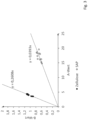
- Fig. 3
- ein A-B-Diagramm für die Mittelwerte von 12 Proben mit einem Zellulosevlies sowie mit einer SAP-Schicht,
- Fig. 4
- ein beispielhaftes Profil der A-, B-Werte,
- Fig. 5
- das Profil der A-,B-Werte aufgeteilt in θ-Werte,
- Fig. 6
- die Kalibration der Flächenmasse,
- Fig. 7
- ein Längsprofil für SAP und Zellulose mit der Flächenmasse, und
- Fig. 8
- eine alternative Darstellung des Profils mit A- und ϕ- Werten.
- Für ein besseres Verständnis der Erfindung ist es hilfreich, einen kurzen Blick auf die physikalischen Grundlagen zu werfen. Bei der Verwendung von Mikrowellenresonatoren im Bereich der Feuchtemesstechnik fallen zwei Messgrößen A und B an. Die Messgröße A bezeichnet hierbei die Veränderung der Resonanzfrequenz in Form einer Verschiebung der Resonanzfrequenz. Die zweite Messgröße B beschreibt die Veränderung der Breite der Resonanzkurve. Physikalische Grundlage für die Messgröße A bildet die Verkürzung der Wellenlänge durch die dielektrischen Eigenschaften des zu messenden Stoffs. Der zweite Effekt, der zur Messgröße B führt, beschreibt die Absorption der Mikrowellen in der zu vermessenden Probe.
- Die Polarisation P eines dielektrischen Messguts ergibt sich bei einem elektrischen Feld E entsprechend seiner Suszeptibilität χ e und der Permittivität des Vakuums ε 0.

- Die elektrische Suszeptibilität ist eine komplexe Zahl, deren Realteil mit χe' und deren Imaginärteil mit χe" bezeichnet sei.

- Für den Zusammenhang mit den Messgrößen A und B des Mikrowellenresonators ergibt sich die Suszeptibilität, dass die Messgröße A proportional χe' und die Messgröße B proportional zu χe" ist.

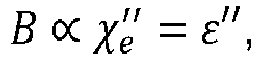
- Für die Materialmischung von mehreren Materialien M1 bis MN ergibt sich die elektrische Suszeptibilität als Summe der elektrischen Suszeptibilitäten der Materialien:

- Dieses Verhalten der elektrischen Suszeptibilität für das Stoffgemisch führt dazu, dass sich die Mikrowellenmesswerte additiv zueinander verhalten. Dies bedeutet, der A-Wert eines Gemischs ist die Summe der A-Werte der einzelnen Stoffe in dem Gemisch. Ebenso ist der B-Wert die Summe der einzelnen B-Werte der Stoffe in dem Gemisch.


- Im weiteren Verlauf werden Stoffgemische, bestehend aus zwei Stoffen betrachtet. Grundsätzlich können auch Stoffgemische mit mehr als zwei Stoffen analysiert und dann einige Stoffe zusammengefasst werden und gemeinsam als ein Stoff betrachtet werden.
-
Figur 1 zeigt die von den Messwerten A, B aufgespannte Ebene. Die Linien gleicher Feuchte sind für die Stoffe M1 und M2 eingezeichnet. Die Steigung der Geraden gleicher Feuchte wird durch den Feuchtewert ϕ1, ϕ2 bezeichnet. Die in den vorstehenden Gleichungen für die A- und B-Werte der Mischung ausgedrückte Addition der Werte führt, grafisch dargestellt wie in Figur 1b, zu einer vektoriellen Addition der beiden Größen. Dies bedeutet, die Messwerte A und B für das Gemisch können als vektorielle Addition der Feuchtewerte der Stoffe M1 und M2 bestimmt werden. Um diese Überlagerung in dem Stoffgemisch besser analysieren zu können, ist es vorteilhaft, die Feuchtevektoren Vektor e1, Vektor e2 einzuführen. Jeder Punkt auf der Linie mit konstanter Feuchte kann damit durch den Skalarfaktor θ multipliziert mit dem Feuchteeinheitsvektor dargestellt werden.
- Der Index i in vorstehender Gleichung steht dabei für die Stoffe 1 und 2.
- Der vorstehende Zusammenhang gilt selbstverständlich nicht für Wasser oder für andere stark dispersive Materialien, wie beispielsweise Glycerin. Für solche stark dispersiven Stoffe liegen die Werte konstanter Feuchte nicht auf einer Geraden.
- Gehen wir dahin zurück, dass für das Gemisch der A-Wert sich als Summe der A-Werte der Stoffe ergibt und der B-Wert sich als Summe der B-Werte der Stoffe ergibt, so kann dieser Zusammenhang in vektorieller Schreibweise wie folgt dargestellt werden:

- Verzichtet man auf eine Normierung der Feuchtevektoren, so besitzen diese jeweils die Koordinatendarstellung.
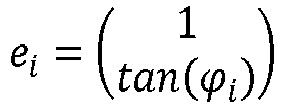
- Hiervon ausgehend können nun die Messwerte A, B für das Stoffgemisch kompakt geschrieben werden:

- Unter der Bedingung, dass ϕ1 ungleich ϕ2 ist, kann das vorliegende Gleichungssystem invertiert werden. In seiner invertierten Form ergibt sich folgender Zusammenhang:

- Die vorstehende Gleichung bildet einen zentralen Aspekt des erfindungsgemäßen Messverfahrens.
- Aus den in dem Gemisch gemessenen A-, B-Werten können unter Verwendung der Feuchtewerte ϕ1, ϕ2 die Skalarfaktoren θ1, θ2 berechnet werden. Die vorstehende Formel macht auch deutlich, dass entweder die Feuchtewerte ϕ1, ϕ2 während des Vorgangs als konstant oder wenig schwankend angenommen werden. In diesem Fall können die ϕ1- und ϕ2-Werte im Vorfeld bestimmt und für die Auswertung verwendet werden.
- Sollten bei einer Messanwendung dagegen stark schwankende Feuchtewerte für die Stoffe vorliegen, so können diese fortlaufend gemessen werden. Der Vorteil des vorstehenden Zusammenhangs zwischen den Skalarfaktoren und den Messungen am Gemisch ist, dass dieser Ausdruck als analytischer Ausdruck es zulässt, dass die gemessenen Feuchtewerte ϕ1 und ϕ2 direkt eingesetzt und so ausgewertet werden. Die bestimmten Skalarfaktoren erlauben es nun, zuverlässig die Stoffmengen m1, m2 zu bestimmen. Vernachlässigen wir zunächst die Temperaturabhängigkeit, so kann hier ein linearer Ansatz gewählt werden:

- Hierbei bezeichnen die Parameter α, β den Zusammenhang zwischen dem Skalarfaktor und der Stoffmenge. Grundsätzlich können die Parameter α, β temperaturabhängig gewählt werden. Es hat sich herausgestellt, dass die Temperaturabhängigkeit auch direkt linear berücksichtigt werden kann. Damit ergibt sich folgender Zusammenhang:

- Auswertungen von Messungen an Stoffgemischen, wie beispielsweise die Messung von Zellulose- und Superabsorbergehalt in Windelkernen. Die Bestimmung des Mischungsverhältnisses von Garnen mit Kunst- und Naturfasern, ebenso wie die Bestimmung von Aktivkohle und anderen Granulaten in Zigarettenfiltern haben gezeigt, dass die Bestimmung der Stoffmenge über die Skalarfaktoren ein hochgenaues Verfahren darstellt. Qualitativ kann dies plausibel gemacht werden, wenn man berücksichtigt, dass der Feuchtewert ϕ dichteunabhängig ist. Dieser dichteunabhängige Wert geht in den Feuchtevektor e ein, sodass die dichteabhängigen Einflüsse auf die Messgrößen A, B sich verstärkt in den Skalarfaktoren ausdrücken. Auf diese Weise ist die Bestimmung der Skalarfaktoren aus den gemessenen A-, B-Werten für das Gemisch ein zuverlässiger Anteil, der eine Bestimmung der Stoffmengen erlaubt. Trotz dieser qualitativen Überlegung ist die erzielte Genauigkeit bei der Bestimmung überraschend.
- In Messsituationen, in denen die Feuchtewerte ϕ1, ϕ2 für die Stoffe nicht genau im Vorfeld bestimmt werden können oder aufgrund der Messsituation schwanken, kann die in
Figur 2 dargestellte Messanordnung eingesetzt werden. Die Messanordnung inFigur 2 zeigt in einer schematischen Ansicht einen Materialstrom 10 zu dem Material M1. Die Feuchte zu dem Materialstrom M1 wird mit einer schematisch dargestellten Messeinrichtung 12 gemessen. Ebenso wird für den Materialstrom 14 des Materials M2 mit einer Messeinrichtung 16 der Feuchtewert ϕ2 gemessen. Beide Materialien M1, M2 werden einer Zuführung 18 zugeführt, wo sie stromabwärts der Zufuhr des zweiten Materials 14 zu einem Gemisch 20 werden. Das Gemisch 20 wird in einer Messanordnung 22 gemessen. Die so bestimmten A- und B-Werte können dann in die Skalarfaktoren θ1 und θ2 umgerechnet werden. Aufgrund der stets aktuell vorliegenden Feuchtewerte ϕ1, ϕ2 können die Skalarfaktoren direkt umgerechnet werden. - Wenn die Feuchtewinkel mit separaten Messeinrichtungen 12, 16 bestimmt werden, hat es sich als vorteilhaft erwiesen, die entsprechenden Feuchtewerte vor einer Verarbeitung noch umzurechnen.


- Dabei sind die gestrichenen Feuchtewinkel die Feuchtewinkel der einzelnen Geräte 12, 16 vor der Mischung. Die Parameter ai, bi werden in an sich bekannter Weise kalibriert.
- Die vorstehende Analyse wird nachfolgend an einem konkreten Beispiel mit 12 Proben eines Zellulosevlieses sowie für 12 Proben einer SAP-Schicht (Schicht mit Superabsorberpulver) wiederholt. In der A-,B-Ebene sind die Mittelwerte der Messung eingetragen, wobei die A- und B-Werte, wie oben erläutert, eine Verschiebung der Resonanzfrequenz und die Veränderung der Breite beschreiben. Die in
Fig. 3 eingetragenen Regressionsgeraden zeigen für SAP eine Wert tan(ϕ1) = 0,388, während der Wert für tan(ϕ2) für Zellulose 0,2636 beträgt. - In
Fig. 4 sind die A- und B-Werte eines Windelkerns entlang seinem Profil dargestellt, wobei in dem Windelkern das Zellulosevlies mit SAP bestreut ist. Mit Hilfe der Steigung der Regressionsgeraden können die jeweils gemessenen A-, B-Werte in die Skalarfaktoren θ1 und θ2 umgerechnet werden. -
Fig. 5 zeigt das gleiche Profil, diesmal jedoch für die Skalarfaktoren θ1, θ2 aufgetragen. Im Vergleich zu den A-, B-Werten ist bereits zu erkennen, dass insbesondere in dem Abschnitt von 10 bis 22 die Zellulose sich deutlicher von den θ-Werten für SAP unterscheidet. -
Fig. 6 zeigt die Kalibration des Flächenmaßes, wobei hier eine temperaturunabhängige Kalibration vorgenommen wurde. Bei der Kalibration wird dem gewonnenen θ-Wert mit einem linearen Ansatz eine Flächenmasse in Milligramm pro cm2 zugeordnet. Für die Gleichung
-

-

- Mit Hilfe der so bestimmten Werte können die gemessenen A-, B-Werte über eine Umrechnung in die θ-Werte direkt in eine Flächenmasse umgerechnet werden. Für das dargestellte Profil ergibt sich der in
Fig. 7 gezeigte Verlauf für die Flächenmasse von SAP und Zellulose. Deutlich zu erkennen ist, dass die Flächenmasse für SAP sich im Wesentlichen gleichmäßig über das Profil erstreckt, während die Zellulose im Bereich von 10 bis 22 eine deutlich niedrigere Flächenmasse besitzt. - Zum Vergleich sei auf das Profil der A- und B-Werte in
Fig. 4 verwiesen oder auf den klassischen Mikrowellen-Feuchtewert ϕ inFig. 8 . Wie unschwer zu erkennen, ist der Feuchtewert ϕ kein geeignetes Maß, um die beiden Stoffanteile unabhängig voneinander zu messen. Insbesondere der charakteristische niedrigere Zellulose-Anteil in einem Abschnitt ist dem Filterprofil inFig. 4 undFig. 8 nicht zu entnehmen.
Claims (9)
- Verfahren zur Messung von Stoffmengen (m 1, m 2) in einem Stoffgemisch mit zwei Stoffen (M 1, M 2):∘ Bestimmen eines ersten Feuchtewerts (ϕ 1) für einen ersten der zwei Stoffe (M 1) und Bestimmen eines zweiten Feuchtewerts (ϕ 2) für den zweiten der zwei Stoffe (M 2) unter Verwendung eines Mikrowellenresonators,∘ Messen von zwei Messwerten (A, B) für das Stoffgemisch unter Verwendung eines Mikrowellenresonators, wobei einer der zwei Messwerte (A) für eine Resonanzfrequenzverschiebung und ein anderer Messwert (B) für eine Resonanzkurvenbreitenveränderung steht,∘ Berechnen von zwei Skalarfaktoren (θ 1, θ 2) für zwei Feuchtevektoren (
e1 ,e2 ) aus den zwei Messwerten (A, B) für das Stoffgemisch, wobei die Feuchtevektoren (e 1 ,e 2 ) in einer Ebene der Messwerte (A, B) unter Verwendung von dem ersten und zweiten Feuchtewert (ϕ 1, ϕ 2) jeweils die Richtung einer Geraden gleicher Feuchte für den ersten und den zweiten Stoff (M 1, M 2) angeben,∘ Bestimmen der Stoffmengen (m 1, m 2) in dem Stoffgemisch aus den Skalarfaktoren (θ 1, θ 2). - Verfahren nach Anspruch 1, dadurch gekennzeichnet, dass das Bestimmen der Stoffmengen (m 1, m 2) abhängig von den Skalarfaktoren (θ 1, θ 2) und einer Temperatur (T) des Stoffgemischs erfolgt.
- Verfahren nach Anspruch 1 oder 2, dadurch gekennzeichnet, dass ein Zusammenhang der Stoffmengen (m 1, m 2) mit den Skalarfaktoren (θ 1, θ 2) aus einer Vielzahl an Messungen für das Stoffgemisch bestimmt wird.
- Verfahren nach Anspruch 3, dadurch gekennzeichnet, dass der Zusammenhang der Stoffmengen (m 1, m 2) mit den Skalarfaktoren (θ 1, θ 2) dahingehend besteht, dass die Stoffmenge des ersten Stoffs abhängt von dem Skalarfaktor (θ 1) des Feuchtewerts des ersten Stoffs (M 1) und die Stoffmenge des zweiten Stoffs abhängig von dem Skalarfaktor (θ 2) des Feuchtewerts des zweiten Stoffs (M 2).
- Verfahren nach einem der Ansprüche 1 bis 4, dadurch gekennzeichnet, dass die Skalarfaktoren (θ 1, θ 2) aus einer Vielzahl von Einzelmessungen der jeweiligen Stoffe bestimmt werden.
- Verfahren nach einem der Ansprüche 1 bis 5, dadurch gekennzeichnet, dass das Bestimmen der Feuchtewerte (ϕ 1, ϕ 2) für die beiden Stoffe (M 1, M 2) erfolgt vorab in einem Kalibrationsschritt.
- Verfahren nach einem der Ansprüche 1 bis 6, dadurch gekennzeichnet, dass mindestens ein weiteres Messsystem vorgesehen ist, das einen Stoff vor der Vermischung mit dem anderen Stoff misst.
- Verfahren nach Anspruch 7, dadurch gekennzeichnet, dass zwei weitere Messsysteme (12, 16) vorgesehen sind, die jeweils einen Feuchtewert für einen Stoff messen.
- Verfahren nach Anspruch 7 oder 8, dadurch gekennzeichnet, dass der oder die Feuchtewerte des weiteren Messsystems umskaliert werden, wobei Parameter für die Umskalierung kalibriert werden.
Applications Claiming Priority (2)
| Application Number | Priority Date | Filing Date | Title |
|---|---|---|---|
| DE102020134372.8A DE102020134372A1 (de) | 2020-12-21 | 2020-12-21 | Verfahren zur Messung von Stoffmengen in einem Stoffgemisch |
| PCT/EP2021/084803 WO2022135936A1 (de) | 2020-12-21 | 2021-12-08 | Verfahren zur messung von stoffmengen in einem stoffgemisch |
Publications (2)
| Publication Number | Publication Date |
|---|---|
| EP4264242A1 EP4264242A1 (de) | 2023-10-25 |
| EP4264242B1 true EP4264242B1 (de) | 2025-01-08 |
Family
ID=79269904
Family Applications (1)
| Application Number | Title | Priority Date | Filing Date |
|---|---|---|---|
| EP21839024.3A Active EP4264242B1 (de) | 2020-12-21 | 2021-12-08 | Verfahren zur messung von stoffmengen in einem stoffgemisch |
Country Status (8)
| Country | Link |
|---|---|
| US (1) | US12429433B2 (de) |
| EP (1) | EP4264242B1 (de) |
| JP (1) | JP7685596B2 (de) |
| KR (1) | KR102908168B1 (de) |
| CN (1) | CN116802484A (de) |
| DE (1) | DE102020134372A1 (de) |
| ES (1) | ES3012858T3 (de) |
| WO (1) | WO2022135936A1 (de) |
Family Cites Families (12)
| Publication number | Priority date | Publication date | Assignee | Title |
|---|---|---|---|---|
| ES2281740T3 (es) * | 2004-12-08 | 2007-10-01 | Tews Elektronik Dipl.-Ing. Manfred Tews | Procedimiento y dispositivo para la medicion de la masa y/o de la humedad del contenido de capsulas. |
| DE102009004457A1 (de) * | 2009-01-13 | 2010-07-22 | Tews Elektronik Gmbh & Co. Kg | Verfahren und Vorrichtung zur Messung von Masse und Dichte und/oder zur Messung der Feuchte von portionierten Einheiten |
| CA2779950A1 (en) | 2009-11-13 | 2011-05-19 | Capsugel Belgium Nv | Method of inspection of sealed capsules with a process of determination of the quality of the seal and related equipment for in-line inspection |
| KR20110122538A (ko) * | 2010-05-04 | 2011-11-10 | 동국대학교 산학협력단 | 동적 유변학적 또는 열적 특성을 이용한 벌꿀의 분석방법 |
| DE102011006416B4 (de) | 2011-03-30 | 2020-08-13 | Hauni Maschinenbau Gmbh | Verfahren und System zum Herstellen eines Filterstrangs |
| US20150355110A1 (en) | 2014-06-06 | 2015-12-10 | Filter Sensing Technologies, Inc. | Radio Frequency State Variable Measurement System And Method |
| US11125866B2 (en) * | 2015-06-04 | 2021-09-21 | Chikayoshi Sumi | Measurement and imaging instruments and beamforming method |
| DE102016114286B3 (de) | 2016-08-02 | 2018-01-18 | Tews Elektronik Gmbh & Co. Kg | Verfahren zur Messung von absorbierenden Hygieneartikeln |
| JP6986260B2 (ja) | 2017-12-05 | 2021-12-22 | 国立研究開発法人産業技術総合研究所 | 電磁波を用いた物質の同定装置、同定方法 |
| US10564201B1 (en) * | 2018-12-31 | 2020-02-18 | Quantum Valley Ideas Laboratories | Testing antenna systems |
| US10648841B1 (en) * | 2019-03-08 | 2020-05-12 | Saudi Arabian Oil Company | Multiphase flow meter combining extended throat venturi with microwave resonators |
| US11947648B2 (en) * | 2020-12-23 | 2024-04-02 | Proprius Technolgies S.A.R.L | Electronic device related to user identification, authentication, liveliness, encryption using biometrics technology and methods for operation thereof |
-
2020
- 2020-12-21 DE DE102020134372.8A patent/DE102020134372A1/de active Pending
-
2021
- 2021-12-08 EP EP21839024.3A patent/EP4264242B1/de active Active
- 2021-12-08 US US18/268,696 patent/US12429433B2/en active Active
- 2021-12-08 WO PCT/EP2021/084803 patent/WO2022135936A1/de not_active Ceased
- 2021-12-08 CN CN202180086603.6A patent/CN116802484A/zh active Pending
- 2021-12-08 ES ES21839024T patent/ES3012858T3/es active Active
- 2021-12-08 JP JP2023536186A patent/JP7685596B2/ja active Active
- 2021-12-08 KR KR1020237022532A patent/KR102908168B1/ko active Active
Also Published As
| Publication number | Publication date |
|---|---|
| ES3012858T3 (en) | 2025-04-10 |
| US12429433B2 (en) | 2025-09-30 |
| EP4264242A1 (de) | 2023-10-25 |
| DE102020134372A1 (de) | 2022-06-23 |
| KR20230123990A (ko) | 2023-08-24 |
| US20240044809A1 (en) | 2024-02-08 |
| JP7685596B2 (ja) | 2025-05-29 |
| JP2024505122A (ja) | 2024-02-05 |
| CN116802484A (zh) | 2023-09-22 |
| KR102908168B1 (ko) | 2026-01-06 |
| WO2022135936A1 (de) | 2022-06-30 |
Similar Documents
| Publication | Publication Date | Title |
|---|---|---|
| DE69502189T2 (de) | Verfahren zum quantifizieren von qualitätserhöhenden chemikalien in pulpe und papier | |
| DE102007041429B4 (de) | Verfahren und Vorrichtung zur Messung eines Feuchtewertes von dielektrischen Stoffen | |
| DE60003695T2 (de) | Röntgenfluoreszenzanalyse von mehrschichtigen proben | |
| DE3490211T1 (de) | Verfahren und Vorrichtung für die Kohleanalyse und die Durchflussmessung | |
| DE102015208449A1 (de) | Dynamische Dichtemessung unter Verwendung von Terahertz-Strahlung mit Echtzeit-Dickemessung zur Prozesssteuerung | |
| AT509275B1 (de) | Verfahren zur bestimmung von bodenproben | |
| EP1221608A1 (de) | Verfahren zum Prüfen eines Produktionsmaterials in einem Mikrowellenfeld | |
| AT513863B1 (de) | Verfahren und Vorrichtung zur Bestimmung einer Konzentration einer fluoreszierenden Substanz in einem Medium | |
| DE2910673A1 (de) | Verfahren zum messen des gehaltes eines stoffes in einer die form eines duennen filmes aufweisenden mischung mehrerer stoffe (material), z.b. zum messen des gehaltes von wasser in papier | |
| DE69715030T2 (de) | Infrarotmessgerät | |
| DE2654155A1 (de) | Konzentrations-bestimmungsmethode | |
| DE102020116094B4 (de) | Mehrzahl an baugleichen Spektrometern und Verfahren zu deren Kalibrierung | |
| EP2873334B2 (de) | Verfahren und Vorrichtung zur Erkennung von Stranginhomogenitäten eines Materialstrangs der Tabak verarbeitenden Industrie | |
| DE1962864C2 (de) | Verfahren zur Bestimmung der Zusammensetzung von Stoffgemischen bezüglich deren Bestandteile | |
| EP4264242B1 (de) | Verfahren zur messung von stoffmengen in einem stoffgemisch | |
| DE3819101A1 (de) | Verfahren und vorrichtung zur messwertverarbeitung | |
| DE10200802A1 (de) | Verfahren zur Identifizierung von Stoffen, die mit deuteriertem Wasser markiert sind | |
| DE60037235T2 (de) | Verfahren zur ermittlung eines wahren spektrums aus einem gemessenen spektrum | |
| DE102008039836A1 (de) | Vorrichtung und Verfahren zur Bestimmung des Säuregehalts | |
| DE69839390T2 (de) | Referenzlose phasenanalyse mit einem diffraktometer | |
| EP3969291B1 (de) | Prüfung der koerzitivfeldstärke von magnetpigmenten | |
| DE1498813A1 (de) | Messanordnung | |
| DE2820097A1 (de) | Verfahren zur bestimmung der haeufigkeit von garnfehlern | |
| CH695710A5 (it) | Verfahren und Einrichtung zur optischen Konzentrationsmessung von Feinstaub in einem Medium. | |
| DE102022124459A1 (de) | Verfahren zur Messung von Polypropylenglykolderivaten in einem Papierfilter |
Legal Events
| Date | Code | Title | Description |
|---|---|---|---|
| STAA | Information on the status of an ep patent application or granted ep patent |
Free format text: STATUS: UNKNOWN |
|
| STAA | Information on the status of an ep patent application or granted ep patent |
Free format text: STATUS: THE INTERNATIONAL PUBLICATION HAS BEEN MADE |
|
| PUAI | Public reference made under article 153(3) epc to a published international application that has entered the european phase |
Free format text: ORIGINAL CODE: 0009012 |
|
| STAA | Information on the status of an ep patent application or granted ep patent |
Free format text: STATUS: REQUEST FOR EXAMINATION WAS MADE |
|
| 17P | Request for examination filed |
Effective date: 20230717 |
|
| AK | Designated contracting states |
Kind code of ref document: A1 Designated state(s): AL AT BE BG CH CY CZ DE DK EE ES FI FR GB GR HR HU IE IS IT LI LT LU LV MC MK MT NL NO PL PT RO RS SE SI SK SM TR |
|
| DAV | Request for validation of the european patent (deleted) | ||
| DAX | Request for extension of the european patent (deleted) | ||
| RIN1 | Information on inventor provided before grant (corrected) |
Inventor name: SCHLEMM, UDO Inventor name: RICHTER, HENDRIK |
|
| GRAP | Despatch of communication of intention to grant a patent |
Free format text: ORIGINAL CODE: EPIDOSNIGR1 |
|
| STAA | Information on the status of an ep patent application or granted ep patent |
Free format text: STATUS: GRANT OF PATENT IS INTENDED |
|
| INTG | Intention to grant announced |
Effective date: 20240927 |
|
| GRAS | Grant fee paid |
Free format text: ORIGINAL CODE: EPIDOSNIGR3 |
|
| GRAA | (expected) grant |
Free format text: ORIGINAL CODE: 0009210 |
|
| STAA | Information on the status of an ep patent application or granted ep patent |
Free format text: STATUS: THE PATENT HAS BEEN GRANTED |
|
| AK | Designated contracting states |
Kind code of ref document: B1 Designated state(s): AL AT BE BG CH CY CZ DE DK EE ES FI FR GB GR HR HU IE IS IT LI LT LU LV MC MK MT NL NO PL PT RO RS SE SI SK SM TR |
|
| REG | Reference to a national code |
Ref country code: GB Ref legal event code: FG4D Free format text: NOT ENGLISH |
|
| REG | Reference to a national code |
Ref country code: CH Ref legal event code: EP |
|
| REG | Reference to a national code |
Ref country code: DE Ref legal event code: R096 Ref document number: 502021006402 Country of ref document: DE |
|
| REG | Reference to a national code |
Ref country code: IE Ref legal event code: FG4D Free format text: LANGUAGE OF EP DOCUMENT: GERMAN |
|
| P01 | Opt-out of the competence of the unified patent court (upc) registered |
Free format text: CASE NUMBER: APP_3349/2025 Effective date: 20250121 |
|
| REG | Reference to a national code |
Ref country code: NL Ref legal event code: FP |
|
| REG | Reference to a national code |
Ref country code: ES Ref legal event code: FG2A Ref document number: 3012858 Country of ref document: ES Kind code of ref document: T3 Effective date: 20250410 |
|
| REG | Reference to a national code |
Ref country code: LT Ref legal event code: MG9D |
|
| PG25 | Lapsed in a contracting state [announced via postgrant information from national office to epo] |
Ref country code: RS Free format text: LAPSE BECAUSE OF FAILURE TO SUBMIT A TRANSLATION OF THE DESCRIPTION OR TO PAY THE FEE WITHIN THE PRESCRIBED TIME-LIMIT Effective date: 20250408 |
|
| PG25 | Lapsed in a contracting state [announced via postgrant information from national office to epo] |
Ref country code: FI Free format text: LAPSE BECAUSE OF FAILURE TO SUBMIT A TRANSLATION OF THE DESCRIPTION OR TO PAY THE FEE WITHIN THE PRESCRIBED TIME-LIMIT Effective date: 20250108 |
|
| PG25 | Lapsed in a contracting state [announced via postgrant information from national office to epo] |
Ref country code: PL Free format text: LAPSE BECAUSE OF FAILURE TO SUBMIT A TRANSLATION OF THE DESCRIPTION OR TO PAY THE FEE WITHIN THE PRESCRIBED TIME-LIMIT Effective date: 20250108 |
|
| PG25 | Lapsed in a contracting state [announced via postgrant information from national office to epo] |
Ref country code: IS Free format text: LAPSE BECAUSE OF FAILURE TO SUBMIT A TRANSLATION OF THE DESCRIPTION OR TO PAY THE FEE WITHIN THE PRESCRIBED TIME-LIMIT Effective date: 20250508 Ref country code: NO Free format text: LAPSE BECAUSE OF FAILURE TO SUBMIT A TRANSLATION OF THE DESCRIPTION OR TO PAY THE FEE WITHIN THE PRESCRIBED TIME-LIMIT Effective date: 20250408 |
|
| PG25 | Lapsed in a contracting state [announced via postgrant information from national office to epo] |
Ref country code: HR Free format text: LAPSE BECAUSE OF FAILURE TO SUBMIT A TRANSLATION OF THE DESCRIPTION OR TO PAY THE FEE WITHIN THE PRESCRIBED TIME-LIMIT Effective date: 20250108 |
|
| PG25 | Lapsed in a contracting state [announced via postgrant information from national office to epo] |
Ref country code: PT Free format text: LAPSE BECAUSE OF FAILURE TO SUBMIT A TRANSLATION OF THE DESCRIPTION OR TO PAY THE FEE WITHIN THE PRESCRIBED TIME-LIMIT Effective date: 20250508 Ref country code: LV Free format text: LAPSE BECAUSE OF FAILURE TO SUBMIT A TRANSLATION OF THE DESCRIPTION OR TO PAY THE FEE WITHIN THE PRESCRIBED TIME-LIMIT Effective date: 20250108 |
|
| PG25 | Lapsed in a contracting state [announced via postgrant information from national office to epo] |
Ref country code: BG Free format text: LAPSE BECAUSE OF FAILURE TO SUBMIT A TRANSLATION OF THE DESCRIPTION OR TO PAY THE FEE WITHIN THE PRESCRIBED TIME-LIMIT Effective date: 20250108 Ref country code: GR Free format text: LAPSE BECAUSE OF FAILURE TO SUBMIT A TRANSLATION OF THE DESCRIPTION OR TO PAY THE FEE WITHIN THE PRESCRIBED TIME-LIMIT Effective date: 20250409 |
|
| PG25 | Lapsed in a contracting state [announced via postgrant information from national office to epo] |
Ref country code: SE Free format text: LAPSE BECAUSE OF FAILURE TO SUBMIT A TRANSLATION OF THE DESCRIPTION OR TO PAY THE FEE WITHIN THE PRESCRIBED TIME-LIMIT Effective date: 20250108 |
|
| PG25 | Lapsed in a contracting state [announced via postgrant information from national office to epo] |
Ref country code: SM Free format text: LAPSE BECAUSE OF FAILURE TO SUBMIT A TRANSLATION OF THE DESCRIPTION OR TO PAY THE FEE WITHIN THE PRESCRIBED TIME-LIMIT Effective date: 20250108 |
|
| REG | Reference to a national code |
Ref country code: DE Ref legal event code: R097 Ref document number: 502021006402 Country of ref document: DE |
|
| PG25 | Lapsed in a contracting state [announced via postgrant information from national office to epo] |
Ref country code: DK Free format text: LAPSE BECAUSE OF FAILURE TO SUBMIT A TRANSLATION OF THE DESCRIPTION OR TO PAY THE FEE WITHIN THE PRESCRIBED TIME-LIMIT Effective date: 20250108 |
|
| PG25 | Lapsed in a contracting state [announced via postgrant information from national office to epo] |
Ref country code: CZ Free format text: LAPSE BECAUSE OF FAILURE TO SUBMIT A TRANSLATION OF THE DESCRIPTION OR TO PAY THE FEE WITHIN THE PRESCRIBED TIME-LIMIT Effective date: 20250108 Ref country code: EE Free format text: LAPSE BECAUSE OF FAILURE TO SUBMIT A TRANSLATION OF THE DESCRIPTION OR TO PAY THE FEE WITHIN THE PRESCRIBED TIME-LIMIT Effective date: 20250108 |
|
| PG25 | Lapsed in a contracting state [announced via postgrant information from national office to epo] |
Ref country code: RO Free format text: LAPSE BECAUSE OF FAILURE TO SUBMIT A TRANSLATION OF THE DESCRIPTION OR TO PAY THE FEE WITHIN THE PRESCRIBED TIME-LIMIT Effective date: 20250108 |
|
| PG25 | Lapsed in a contracting state [announced via postgrant information from national office to epo] |
Ref country code: SK Free format text: LAPSE BECAUSE OF FAILURE TO SUBMIT A TRANSLATION OF THE DESCRIPTION OR TO PAY THE FEE WITHIN THE PRESCRIBED TIME-LIMIT Effective date: 20250108 |
|
| PLBE | No opposition filed within time limit |
Free format text: ORIGINAL CODE: 0009261 |
|
| STAA | Information on the status of an ep patent application or granted ep patent |
Free format text: STATUS: NO OPPOSITION FILED WITHIN TIME LIMIT |
|
| 26N | No opposition filed |
Effective date: 20251009 |
|
| PGFP | Annual fee paid to national office [announced via postgrant information from national office to epo] |
Ref country code: GB Payment date: 20251216 Year of fee payment: 5 |
|
| PGFP | Annual fee paid to national office [announced via postgrant information from national office to epo] |
Ref country code: AT Payment date: 20260113 Year of fee payment: 5 |
|
| PGFP | Annual fee paid to national office [announced via postgrant information from national office to epo] |
Ref country code: IT Payment date: 20251219 Year of fee payment: 5 |
|
| PGFP | Annual fee paid to national office [announced via postgrant information from national office to epo] |
Ref country code: NL Payment date: 20251217 Year of fee payment: 5 Ref country code: FR Payment date: 20251219 Year of fee payment: 5 |
|
| PGFP | Annual fee paid to national office [announced via postgrant information from national office to epo] |
Ref country code: ES Payment date: 20260119 Year of fee payment: 5 |
|
| PGFP | Annual fee paid to national office [announced via postgrant information from national office to epo] |
Ref country code: DE Payment date: 20260212 Year of fee payment: 5 |