EP4265433A2 - Schreibtafel-set und sichtschutzsystem - Google Patents
Schreibtafel-set und sichtschutzsystem Download PDFInfo
- Publication number
- EP4265433A2 EP4265433A2 EP23165443.5A EP23165443A EP4265433A2 EP 4265433 A2 EP4265433 A2 EP 4265433A2 EP 23165443 A EP23165443 A EP 23165443A EP 4265433 A2 EP4265433 A2 EP 4265433A2
- Authority
- EP
- European Patent Office
- Prior art keywords
- writing board
- layer
- light
- polarizing layer
- diffuse reflection
- Prior art date
- Legal status (The legal status is an assumption and is not a legal conclusion. Google has not performed a legal analysis and makes no representation as to the accuracy of the status listed.)
- Withdrawn
Links
Images





Classifications
-
- B—PERFORMING OPERATIONS; TRANSPORTING
- B43—WRITING OR DRAWING IMPLEMENTS; BUREAU ACCESSORIES
- B43L—ARTICLES FOR WRITING OR DRAWING UPON; WRITING OR DRAWING AIDS; ACCESSORIES FOR WRITING OR DRAWING
- B43L1/00—Repeatedly-usable boards or tablets for writing or drawing
- B43L1/04—Blackboards
- B43L1/10—Writing surfaces thereof
-
- B—PERFORMING OPERATIONS; TRANSPORTING
- B32—LAYERED PRODUCTS
- B32B—LAYERED PRODUCTS, i.e. PRODUCTS BUILT-UP OF STRATA OF FLAT OR NON-FLAT, e.g. CELLULAR OR HONEYCOMB, FORM
- B32B18/00—Layered products essentially comprising ceramics, e.g. refractory products
-
- B—PERFORMING OPERATIONS; TRANSPORTING
- B32—LAYERED PRODUCTS
- B32B—LAYERED PRODUCTS, i.e. PRODUCTS BUILT-UP OF STRATA OF FLAT OR NON-FLAT, e.g. CELLULAR OR HONEYCOMB, FORM
- B32B33/00—Layered products characterised by particular properties or particular surface features, e.g. particular surface coatings; Layered products designed for particular purposes not covered by another single class
-
- B—PERFORMING OPERATIONS; TRANSPORTING
- B32—LAYERED PRODUCTS
- B32B—LAYERED PRODUCTS, i.e. PRODUCTS BUILT-UP OF STRATA OF FLAT OR NON-FLAT, e.g. CELLULAR OR HONEYCOMB, FORM
- B32B7/00—Layered products characterised by the relation between layers; Layered products characterised by the relative orientation of features between layers, or by the relative values of a measurable parameter between layers, i.e. products comprising layers having different physical, chemical or physicochemical properties; Layered products characterised by the interconnection of layers
- B32B7/02—Physical, chemical or physicochemical properties
- B32B7/023—Optical properties
-
- B—PERFORMING OPERATIONS; TRANSPORTING
- B43—WRITING OR DRAWING IMPLEMENTS; BUREAU ACCESSORIES
- B43L—ARTICLES FOR WRITING OR DRAWING UPON; WRITING OR DRAWING AIDS; ACCESSORIES FOR WRITING OR DRAWING
- B43L1/00—Repeatedly-usable boards or tablets for writing or drawing
-
- B—PERFORMING OPERATIONS; TRANSPORTING
- B43—WRITING OR DRAWING IMPLEMENTS; BUREAU ACCESSORIES
- B43L—ARTICLES FOR WRITING OR DRAWING UPON; WRITING OR DRAWING AIDS; ACCESSORIES FOR WRITING OR DRAWING
- B43L1/00—Repeatedly-usable boards or tablets for writing or drawing
- B43L1/002—Repeatedly-usable boards or tablets for writing or drawing chemical details
-
- E—FIXED CONSTRUCTIONS
- E06—DOORS, WINDOWS, SHUTTERS, OR ROLLER BLINDS IN GENERAL; LADDERS
- E06B—FIXED OR MOVABLE CLOSURES FOR OPENINGS IN BUILDINGS, VEHICLES, FENCES OR LIKE ENCLOSURES IN GENERAL, e.g. DOORS, WINDOWS, BLINDS, GATES
- E06B9/00—Screening or protective devices for wall or similar openings, with or without operating or securing mechanisms; Closures of similar construction
- E06B9/24—Screens or other constructions affording protection against light, especially against sunshine; Similar screens for privacy or appearance; Slat blinds
-
- G—PHYSICS
- G02—OPTICS
- G02B—OPTICAL ELEMENTS, SYSTEMS OR APPARATUS
- G02B5/00—Optical elements other than lenses
- G02B5/02—Diffusing elements; Afocal elements
-
- G—PHYSICS
- G02—OPTICS
- G02B—OPTICAL ELEMENTS, SYSTEMS OR APPARATUS
- G02B5/00—Optical elements other than lenses
- G02B5/02—Diffusing elements; Afocal elements
- G02B5/0205—Diffusing elements; Afocal elements characterised by the diffusing properties
- G02B5/021—Diffusing elements; Afocal elements characterised by the diffusing properties the diffusion taking place at the element's surface, e.g. by means of surface roughening or microprismatic structures
- G02B5/0226—Diffusing elements; Afocal elements characterised by the diffusing properties the diffusion taking place at the element's surface, e.g. by means of surface roughening or microprismatic structures having particles on the surface
-
- G—PHYSICS
- G02—OPTICS
- G02B—OPTICAL ELEMENTS, SYSTEMS OR APPARATUS
- G02B5/00—Optical elements other than lenses
- G02B5/02—Diffusing elements; Afocal elements
- G02B5/0273—Diffusing elements; Afocal elements characterized by the use
- G02B5/0284—Diffusing elements; Afocal elements characterized by the use used in reflection
-
- G—PHYSICS
- G02—OPTICS
- G02B—OPTICAL ELEMENTS, SYSTEMS OR APPARATUS
- G02B5/00—Optical elements other than lenses
- G02B5/30—Polarising elements
-
- G—PHYSICS
- G02—OPTICS
- G02B—OPTICAL ELEMENTS, SYSTEMS OR APPARATUS
- G02B5/00—Optical elements other than lenses
- G02B5/30—Polarising elements
- G02B5/3083—Birefringent or phase retarding elements
-
- B—PERFORMING OPERATIONS; TRANSPORTING
- B32—LAYERED PRODUCTS
- B32B—LAYERED PRODUCTS, i.e. PRODUCTS BUILT-UP OF STRATA OF FLAT OR NON-FLAT, e.g. CELLULAR OR HONEYCOMB, FORM
- B32B2307/00—Properties of the layers or laminate
- B32B2307/40—Properties of the layers or laminate having particular optical properties
- B32B2307/416—Reflective
-
- B—PERFORMING OPERATIONS; TRANSPORTING
- B32—LAYERED PRODUCTS
- B32B—LAYERED PRODUCTS, i.e. PRODUCTS BUILT-UP OF STRATA OF FLAT OR NON-FLAT, e.g. CELLULAR OR HONEYCOMB, FORM
- B32B2307/00—Properties of the layers or laminate
- B32B2307/40—Properties of the layers or laminate having particular optical properties
- B32B2307/42—Polarizing, birefringent, filtering
-
- B—PERFORMING OPERATIONS; TRANSPORTING
- B32—LAYERED PRODUCTS
- B32B—LAYERED PRODUCTS, i.e. PRODUCTS BUILT-UP OF STRATA OF FLAT OR NON-FLAT, e.g. CELLULAR OR HONEYCOMB, FORM
- B32B2551/00—Optical elements
-
- B—PERFORMING OPERATIONS; TRANSPORTING
- B43—WRITING OR DRAWING IMPLEMENTS; BUREAU ACCESSORIES
- B43K—IMPLEMENTS FOR WRITING OR DRAWING
- B43K5/00—Pens with ink reservoirs in holders, e.g. fountain-pens
- B43K5/02—Ink reservoirs
Definitions
- the present invention relates to a writing board set and a peeking prevention system.
- the walls (or partitions) of a conference room may be made of glass panels (or acrylic panels) to provide a sense of openness because of their transparency. While transparency of the walls of the conference room provides a sense of openness, it can be a problem if an outside stranger peeks at the information (e.g., text characters or drawings) that is drawn on a whiteboard in the conference room.
- information e.g., text characters or drawings
- Patent Document 1 discloses a peeking prevention system that includes a space, an information screen disposed in the space, and a window to delimit the space from the surroundings.
- the "information screen” displays information by reflecting and/or emitting polarized light that is parallel to a first direction, thereby presenting the displayed information within the space.
- an information screen that includes a whiteboard and a polarizer attached onto the surface of the whiteboard is described.
- the window includes a transparent substrate and a polarizer that absorbs light polarized in parallel to the first direction. While allowing the inside of the space to be seen through the transparent window from outside of the space, the information displayed on the information screen can be made invisible.
- the present invention has been made in order to solve the above problems, and an objective thereof is to provide a peeking prevention system and a writing board set that are able to sufficiently restrain information that is displayed with an ink on the surface of a writing board from being visible from outside of the space.
- a "writing board” means any board that allows information to be displayed on its surface, e.g., text characters, symbols, diagrams, or drawings drawn with an ink, and includes what is commonly referred to as a whiteboard or a blackboard, for example.
- a writing board set comprising:
- a writing board set comprising:
- a writing board set comprising:
- a writing board set comprising:
- a peeking prevention system comprising:
- a peeking prevention system and a writing board set that are able to sufficiently restrain information that is displayed with an ink on the surface of a writing board from being visible from outside of the space can be provided.
- a writing board set includes a writing board and a writing utensil containing ink.
- the writing board When unpolarized light is incident on a surface of the writing board at the viewer's side, the writing board reflects back polarized light which is parallel to the first direction and which has a degree of polarization of 950 or more.
- the writing board includes a polarizing layer (first polarizing layer) having a transmission axis that is parallel to the first direction, for example.
- the writing board may be a whiteboard or a blackboard, for example.
- the writing board included in a writing board set according to an embodiment of the present invention is not limited to those which appear white or black.
- the writing board may include: a reflective polarizing layer having a transmission axis which is orthogonal to the first direction; and a light absorbing layer or a light absorbing plate to absorb visible light, the light absorbing layer or light absorbing plate being disposed on an opposite side of the reflective polarizing layer from the viewer's side.
- the configuration of the writing board will be described in detail later.
- a peeking prevention system includes: a writing board set; and a partition to delimit from the surroundings a space in which information displayed on the writing board of the writing board set is presented, the partition having a light-transmitting portion through which the inside of the space is viewable.
- the light-transmitting portion includes: a transparent substrate; and a polarizing layer having a transmission axis which is orthogonal to the first direction.
- the inventors have found that, when the writing board and the ink of the writing utensil satisfy a predetermined relationship, information that is displayed with the ink on the surface of the writing board can be sufficiently restrained from being visible from outside of the space.
- FIG. 1A and FIG. 2 With reference to FIG. 1A and FIG. 2 , a writing board set and a peeking prevention system according to an embodiment of the present invention will be described.
- FIG. 1A shows a schematic cross-sectional view of a writing board 100 included in a writing board set according to an embodiment of the present invention.
- the writing board 100 may be a whiteboard.
- the writing board 100 further includes: a diffuse reflection layer 40 to diffuse-reflect visible light, the diffuse reflection layer 40 being disposed on the opposite side of the absorptive polarizing layer 20 from the viewer's side; and a reflective polarizing layer 10 disposed between the diffuse reflection layer 40 and the absorptive polarizing layer 20.
- the transmission axis of the reflective polarizing layer 10 is disposed substantially parallel to the transmission axis of the absorptive polarizing layer 20, i.e., substantially parallel to the first direction.
- the reflective polarizing layer 10 transmits polarized light that is parallel to the transmission axis, and reflects polarized light that is orthogonal to the transmission axis.
- the transmission axis of the absorptive polarizing layer 20 and the transmission axis of the reflective polarizing layer 10 are substantially parallel, this is meant to encompass the case where the angle made by the transmission axis of the absorptive polarizing layer 20 and the transmission axis of the reflective polarizing layer 10 has a margin of error within ⁇ 5° of 0°.
- the diffuse reflection layer 40 is supported by the base 90.
- the writing board 100 is referred to as a "whiteboard", it is not limited to only those whose surface 100s at the viewer's side appears white; rather, the surface 100s of the writing board 100 at the viewer's side may be gray, for example. While the diffuse reflection layer 40 itself may be white, because the writing board 100 also includes the absorptive polarizing layer 20 and the reflective polarizing layer 10 on the viewer's side, the surface 100s of the writing board 100 at the viewer's side may appear gray.
- the writing board set 160 ( FIG. 2 ) includes the writing board 100 and a writing utensil (e.g., a marker) 150 ( FIG. 2 ) containing ink.
- the surface 100s of the writing board 100 at the viewer's side has a configuration such that text characters, symbols, diagrams, drawings, etc., can be drawn thereon with the ink of the writing utensil 150.
- an ink layer(s) IN that is formed by the ink of the writing utensil 150 ( FIG. 2 )
- information such as text characters, symbols, diagrams, drawings, etc., is displayed on the surface 100s of the writing board 100 at the viewer's side.
- the shape(s) of the ink layer(s) IN as viewed from the normal direction of the surface 100s of the writing board 100 corresponds to the text character(s), symbol(s), diagram(s), drawing(s), etc.
- the ink of the writing utensil 150 contains a pigment or dyestuff.
- the surface 100s of the writing board 100 at the viewer's side has a configuration such that text characters or the like drawn with the ink of the writing utensil 150 are erasable.
- a protection layer e.g., glass
- an anti-soiling layer made of an acrylate-containing resin, a urethane-containing resin, a fluorine-containing resin, or a silicone-containing resin may further be provided.
- an ink that is appropriately adjusted with a solvent, a resin, a release agent, or the like, text characters or the like drawn on the surface 100s can be easily erased through physical rubbing with an eraser (i.e., thus being capable of being written or erased).
- the surface 100s of the writing board 100 may be just flat enough to allow text characters or the like to be written or erased.
- the surface 100s of the writing board 100 is the surface 20a of the absorptive polarizing layer 20; in the case where the aforementioned protection layer or anti-soiling layer is provided, the surface 100s of the writing board 100 is the surface of the protection layer or anti-soiling layer.
- the diffuse reflection layer 40 is supported by the base 90.
- the remainder of the writing board 100 other than the base 90 may be referred to as a writing board film (or a whiteboard film).
- the writing board film 99 includes: an absorptive polarizing layer 20 having a transmission axis that is parallel to the first direction; a diffuse reflection layer 40 to diffuse-reflect visible light, the diffuse reflection layer 40 being disposed on the opposite side of the absorptive polarizing layer 20 from the viewer's side; and a reflective polarizing layer 10 disposed between the diffuse reflection layer 40 and the absorptive polarizing layer 20.
- the writing board film 99 may constitute the writing board 100.
- the method for attaching the writing board film 99 onto the base 90 is not particularly limited; for example, it may be bonded by using an adhesive, or attached by using a magnet.
- An "adhesive” is inclusive of a tackiness agent (also called “pressure-sensitive adhesive”).
- the writing board film 99 may be fixed on, or removably attached to, the base 90.
- the base 90 supports the writing board film 99 so that the surface 100s of the writing board 100 is essentially parallel to the vertical direction, for example.
- FIG. 1B shows a schematic cross-sectional view of writing board 100a as a modified example of the writing board 100.
- the writing board 100a differs from the writing board 100 in that the writing board 100a includes a diffuse reflection plate 40a to diffuse-reflect visible light instead of the diffuse reflection layer 40 and the base 90 included in the writing board 100.
- the writing board 100a can be used without being supported on a base.
- a diffuse reflection plate refers to that which requires no supporting base
- a “diffuse reflection layer” refers to that which is commonly used in a state of being supported on a base, or that which cannot exist without a supporting base.
- a diffuse reflection layer and a base supporting the diffuse reflection layer may together be referred to as a diffuse reflection plate.
- the diffuse reflection layer and the base may monolithically (i.e., without a clear boundary existing between the diffuse reflection layer and the base) compose the diffuse reflection plate.
- this is not to exclude implementations where a diffuse reflection plate is being supported on a base.
- the writing board 100 will be described as an example, similar effects to those attained by the writing board 100 can also be obtained by using the writing board 100a instead of the writing board 100, unless otherwise specified.
- FIG. 2 is a diagram schematically showing a peeking prevention system 1000 that includes the writing board set 160, as viewed from above.
- the peeking prevention system 1000 includes: the writing board set 160, which includes the writing board 100 and the writing utensil 150; and a partition 300 to delimit from the surroundings a space 500 in which information displayed on the writing board 100 is to be presented, the partition 300 having a light-transmitting portion 200 through which the inside of the space 500 is viewable.
- the light-transmitting portion 200 includes: a transparent substrate 220; and a polarizing layer (absorptive polarizing layer) 240 having a transmission axis which is orthogonal to the first direction.
- Information that is displayed on the writing board 100 e.g., information such as text characters, symbols, diagrams, drawings, etc., drawn with black ink on the surface 100s of the writing board 100 at the viewer's side, is presented to a viewer Pi in the space 500 in the following manner.
- any polarized light which is parallel to the transmission axis of the absorptive polarizing layer 20 and the transmission axis of the reflective polarizing layer 10 i.e., polarized light which is parallel to the first direction
- is transmitted through the absorptive polarizing layer 20 and the reflective polarizing layer 10 and diffuse-reflected at the surface and/or the interior of the diffuse reflection layer 40.
- any polarized light which is parallel to the transmission axis of the absorptive polarizing layer 20 and the transmission axis of the reflective polarizing layer 10 is consecutively transmitted through the reflective polarizing layer 10 and the absorptive polarizing layer 20, so as to reach the viewer.
- the places where nothing is drawn on the surface 100s i.e., places where no ink layers IN exist
- appear in the color of the surface 100s of the writing board 100 e.g., white).
- any place where a text character or the like is drawn on the surface 100s with black ink i.e., any place where an ink layer IN exists
- black ink i.e., any place where an ink layer IN exists
- all wavelength components of external light or illumination light (unpolarized light) that is incident on the ink layer IN are absorbed by the pigment or dyestuff contained in the ink.
- the viewer Pi in the space 500 is able to recognize the outer contour of the ink layer(s) IN , whereby information of the text character(s) or the like drawn with ink is presented to the viewer Pi in the space 500.
- a person Po who is outside the space 500 cannot see the information of the text characters, symbols, diagrams, drawings, etc., that are drawn with black ink on the surface 100s of the writing board 100 at the viewer's side. Any polarized light emitted from the surface 100s of the writing board 100 that is parallel to the first direction cannot be transmitted through the polarizing layer 240 having a transmission axis which is orthogonal to the first direction; therefore, the surface 100s of the writing board 100 appears black to the person Po who is outside the space 500.
- the hue of the surface 100s of the writing board 100 is identical to the hue of the ink layer (s) IN , so that the person Po who is outside the space 500 is basically blinded from the displayed information.
- the angle between the transmission axis of the absorptive polarizing layer 20 and the transmission axis of the polarizing layer 420 is not 90°, while the margin of error from 90° is within ⁇ 10°, it is possible to obtain an effect of blinding the person Po who is outside the space 500 from the information displayed on the writing board 100 as the person Po views the writing board 100 through the polarizing layer 420 of the light-transmitting portion 200.
- an ink of a non-black color e.g., green, blue, or red
- a non-black color e.g., green, blue, or red
- a specific wavelength component(s) of external light or illumination light (unpolarized light) that is incident on the ink layer (s) IN is absorbed by the pigment or dyestuff contained in the ink, while the wavelength components of the light that were not absorbed by the pigment or dyestuff in the ink are reflected.
- each ink layer IN exhibits the color of its own ink, whereby information of the text characters or the like drawn on the surface 100s of the writing board 100 is presented to the viewer Pi in the space 500.
- the ink layer IN of each color unpolarized light
- only the polarized light which is parallel to the transmission axis of the polarizing layer 240 is presented to the person Po who is outside the space 500. It has been found that, information displayed on the writing board 100 may still remain visible to the person Po who is outside the space 500 depending on the combination of the color of the ink and the color of the surface 100s of the writing board 100.
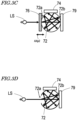
- FIG. 3A, FIG. 3B , FIG. 3C, and FIG. 3D are schematic diagrams for describing a manner of determining the color difference ⁇ E* ab as defined by eq. (1), each being a cross-sectional view as viewed from a lateral direction.
- (1) are values of L*, a*, and b* as obtained by irradiating the surface 100s of the writing board 100 at the viewer's side with light that has been transmitted through a polarizing layer (second polarizing layer) 76 having a transmission axis AXp2 which is parallel to a second direction that is orthogonal to the first direction, and measuring total reflectance through spectrophotometry.
- the writing board 100 includes the absorptive polarizing layer 20 and the reflective polarizing layer 10 having a transmission axis AXp1 that is parallel to the first direction.
- the polarizing layer (absorptive polarizing layer) 76 is placed at an opening 72a of an integrating sphere 72.
- a light source LS Within unpolarized light emitted from a light source LS, light that is transmitted through the polarizing layer 76 is radiated onto the surface 100s of the writing board 100 at the viewer's side, this writing board 100 being placed at an opening 72b of the integrating sphere 72. Then, light that has been reflected in all directions is integrated and received by a detector 74.
- the angle that the optical axis of light that is emitted from the light source LS makes with the normal direction of the surface 100s of the writing board 100 at the viewer's side i.e., the incident angle
- the polarizing layer 76 is disposed so that the normal direction of the polarizing layer 76 is parallel to the optical axis of light being emitted from the light source LS.
- L*, a*, and b* were determined by measuring total reflectance.
- the polarizing layer (absorptive polarizing layer) 76 was placed at the opening 72a of the integrating sphere 72, and a ratio (relative reflectance) against the amount of light to be reflected by a reference sample 79, which was a white reflectance standard (barium sulfate), was determined.
- Total reflectance measurement for the reference sample 79 was taken by, as shown in FIG.
- the total reflectance measurements were taken at intervals of 5 nm across the wavelength range from 380 nm to 780 nm, and the resultant measurements were multiplied by a weighting coefficient that was obtained from a C light source spectrum and a wavelength distribution of luminosity factor values in a 2-degree field of view, and arithmetic mean of them was taken, whereby a total reflectance (Y value) was determined.
- L i *, a i *, and b i * in eq. (1) are, as is schematically illustrated by FIG. 3B , values of L*, a*, and b* as obtained by introducing ink onto the surface of the glass panel 77 (manufactured by Matsunami Glass Ind., Ltd., product number S9111, microscope slide (crown glass), thickness 1 mm) to form an ink layer IN, irradiating the ink layer IN with unpolarized light from the light source LS, and measuring total reflectance with a spectrophotometer by a method similar to the method described with reference to FIG. 3A .
- a ratio (relative reflectance) against the amount of light to be reflected by a reference sample 79 which was a white reflectance standard (barium sulfate), was determined.
- Total reflectance measurement for the reference sample 79 was taken by, as shown in FIG. 3D , without placing any polarizing layer at the opening 72a of the integrating sphere 72, unlike in the method described with reference to FIG. 3C .
- the ink layer IN was formed by painting an essentially quadrangular shape having an area of about 50 cm 2 to 100 cm 2 on the surface of the glass panel 77 with the ink of the writing utensil. In order to ensure equal conditions, no double coating (overlaying) was performed.
- a colorless and transparent glass panel can be used.
- a microscope slide made of crown glass may be used.
- a glass panel made of less bluish glass e.g., borosilicate glass
- crown glass or high-transmission glass may be used as the glass panel 77.
- the thickness of the glass panel 77 is not particularly limited, it may be e.g. 0.5 mm to 2 mm.
- the inventors have confirmed that no significant differences existed between these glass panels.
- total reflectance and L i *, a i *, and b i * of the glass panel having the ink layer IN formed on its surface was measured, whereby it was confirmed that no major discrepancies existed among them depending on the type or thickness of the glass panel.
- the total reflectance on the surface of each glass panel without any ink introduced thereon there was no major discrepancies among the three glass panels.
- L d *, a d *, and b d * were used as indices representing the reflectance hue of the surface 100s of the writing board 100 at the viewer's side, as observed from outside of the space 500 through the polarizing layer 240 of the light-transmitting portion 200.
- a reflectance hue that results when light transmitted through a polarizing layer having a transmission axis that is orthogonal to the first direction i.e., a direction that is parallel to the transmission axis AXp1 of the absorptive polarizing layer 20 and the reflective polarizing layer 10 of the writing board 100
- a cross-reflectance hue may be referred to as a "cross-reflectance hue".
- L i *, a i *, and b i * were used as indices representing the reflectance hue of the ink.
- L d *, a d *, and b d *, and L i *, a i *, and b i * the inventors have attempted evaluating a color difference between the cross-reflectance hue of the writing board 100 and the reflectance hue of the ink.
- the color difference ⁇ E* ab as defined by eq. (1) is equal to or less than a predetermined value (or specifically, 19 or less).
- FIG. 3E is a schematic diagram for describing a manner of determining the color difference ⁇ E* ab as defined by eq. (2), being a cross-sectional view as viewed from a lateral direction. As is schematically shown in FIG. 3E , L c *, a d *, and b c * as defined by eq.
- (2) are values of L*, a*, and b* as obtained by forming an ink layer IN by introducing ink onto the surface 100s of the writing board 100 at the viewer's side, irradiating the surface 100s having the ink layer IN thereon with light that has been transmitted through a polarizing layer (second polarizing layer) 76 having a transmission axis AXp2 which is parallel to a second direction that is orthogonal to the first direction, and measuring total reflectance through spectrophotometry by a method similar to the method described with reference to FIG. 3A .
- the polarizing layer (absorptive polarizing layer) 76 was placed at the opening 72a of the integrating sphere 72, and a ratio (relative reflectance) against the amount of light to be reflected by a reference sample 79, which was a white reflectance standard (barium sulfate), was determined.
- Total reflectance measurements for the reference sample 79 was taken by, as has been described with reference to FIG. 3C , placing the polarizing layer (absorptive polarizing layer) 76 at the opening 72a of the integrating sphere 72, and placing the reference sample 79 at the opening 72b of the integrating sphere 72.
- the evaluations made by using the color difference ⁇ E* ab as defined by eq. (1) and the evaluations made by using the color difference ⁇ E* ab as defined by eq. (2) also matched subjective evaluations that were made by visual inspection.
- the degree to which the ink layer IN was visible was evaluated in four steps from 0 to 3 below. Note that the surface 100s of the writing board 100 at the viewer's side and a principal face of the polarizing layer 76 were placed substantially parallel.
- L i *, a i *, and b i * preferably satisfy one of ranges as defined by (a), (b), (c), and (d) below.
- a writing board may be used that includes: a first polarizing layer having a transmission axis that is parallel to the first direction; and a diffuse reflection layer or a diffuse reflection plate to diffuse-reflect visible light, the diffuse reflection layer or diffuse reflection plate being disposed on the opposite side of the first polarizing layer from the viewer's side.
- a total reflectance value obtained by irradiating the surface of the writing board at the viewer's side with light that has been transmitted through a second polarizing layer having a transmission axis which is orthogonal to the first direction, and measured through spectrophotometry is 4.80 or less, for example.
- the total reflectance (as has been described with reference to FIG. 3A and FIG.
- the polarizing layer (absorptive polarizing layer) 76 was placed at the opening 72a of the integrating sphere 72, and a ratio (relative reflectance) against the amount of light to be reflected by a reference sample 79, which was a white reflectance standard (barium sulfate), was determined.
- the writing board 100 includes the reflective polarizing layer 10 between the diffuse reflection layer 40 and the absorptive polarizing layer 20, the efficiency of light utilization can be improved, as will be described below. Because of the improved efficiency of light utilization, the writing board 100 allows for improving the visibility of the displayed information.
- the polarized light that is orthogonal to the transmission axis of the reflective polarizing layer 10 is reflected by the reflective polarizing layer 10, so as to be again incident on and diffuse-reflected by the diffuse reflection layer 40, whereby its degree of polarization is lowered (depolarized).
- the polarized light which is parallel to the transmission axis of the absorptive polarizing layer 20 and the transmission axis of the reflective polarizing layer 10 is transmitted through the reflective polarizing layer 10 and the absorptive polarizing layer 20, while the polarized light which is orthogonal to the transmission axis of the reflective polarizing layer 10 is reflected by the reflective polarizing layer 10 so as to be again incident on and diffuse-reflected by the diffuse reflection layer 40, and this process is repeated; as a result, an improved efficiency of light utilization is provided. Because the writing board 100 can provide an improved luminance, the visibility of displayed information can be improved.
- the writing board 100 includes the absorptive polarizing layer 20 at the front surface (i.e., the viewer's side), there is an advantage in that influences of reflection of external light can be reduced.
- the degree of polarization of the reflective polarizing layer 10 is lower than the degree of polarization of the absorptive polarizing layer 20; therefore, inclusion of the absorptive polarizing layer 20 in addition to the reflective polarizing layer 10 provides better obscuring of the information displayed on the writing board 100 for the person Po who is outside the space 500 (blinding).
- the Applicant's International Publication No. 2021/200722 discloses a peeking prevention system that can prevent peeking from oblique directions.
- the entire disclosure of International Publication No. 2021/200722 is incorporated herein by reference.
- the writing board 100 may include adhesion layers, each between the diffuse reflection layer 40 and the reflective polarizing layer 10 and between the reflective polarizing layer 10 and the absorptive polarizing layer 20 independently.
- FIG. 4A shows a schematic cross-sectional view of a writing board 101 according to another embodiment of the present invention.
- the writing board 101 differs from the writing board 100 in that a low-refractive index layer 30 disposed between the diffuse reflection layer 40 and the reflective polarizing layer 10 is further provided. Differences from the writing board 100 will mainly be described.
- the low-refractive index layer 30 has a smaller refractive index than that of the diffuse reflection layer 40.
- the low-refractive index layer 30, which is transparent with respect to visible light, is made of a light-transmitting material.
- the refractive index of the low-refractive index layer 30 is preferably 1.30 or less, for example.
- the low-refractive index layer 30 may be an air layer. Alternatively, the low-refractive index layer 30 may be a porous layer described later.
- the low-refractive index layer 30 may be made of an adhesive (e.g., an adhesive having a refractive index of not less than 1.4 and not more than 1.6) .
- the writing board 101 allows the utilization efficiency of light that is diffuse-reflected inside the diffuse reflection layer 40 to be improved; as a result, a further improved efficiency of light utilization is provided over the writing board 100.
- the refractive index of the low-refractive index layer 30 is smaller than the refractive index of the diffuse reflection layer 40, within the light that is diffuse-reflected inside the diffuse reflection layer 40, light which is incident on the low-refractive index layer 30 at an angle which is equal to the critical angle or greater undergoes total reflection (total internal reflection) at the interface between the diffuse reflection layer 40 and the low-refractive index layer 30. A portion of light having an incident angle ⁇ i which is smaller than the critical angle enters the low-refractive index layer 30. Within the light that enters the low-refractive index layer 30, light having a large outgoing angle ⁇ from the diffuse reflection layer 40 to the low-refractive index layer 30, e.g., as shown in FIG.
- the critical angle is preferably small; therefore, a ratio nl/nr of the refractive index nl of the low-refractive index layer 30 to the refractive index nr of the diffuse reflection layer 40 is preferably small.
- the low-refractive index layer 30 is directly formed on the surface of the reflective polarizing layer 10; that is, the low-refractive index layer 30 is directly in contact with the reflective polarizing layer 10.
- a writing board according to an embodiment of the present invention may include a further layer that is transparent with respect to visible light (e.g., an acrylic resin or PET film) between the low-refractive index layer 30 and the reflective polarizing layer 10.
- the writing board 101 provides an improved efficiency of light utilization.
- the writing board 101 allows the visibility of displayed information to be improved.
- FIG. 4B shows a schematic cross-sectional view of a writing board 101a included in a writing board set according to another embodiment of the present invention.
- the writing board 101a differs from the writing board 101 in that, instead of the diffuse reflection layer 40 and the base 90 included in the writing board 101, a diffuse reflection plate 40a to diffuse-reflect visible light is included.
- the writing board 101a can be used without being supported on a base.
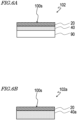
- FIG. 6A shows a schematic cross-sectional view of a writing board 102 included in a writing board set according to another embodiment of the present invention.
- the writing board 102 differs from the writing board 100 in that the reflective polarizing layer 10 is not included. From the standpoint of the efficiency of light utilization, the writing board 102 may be inferior to the writing board 100, which includes the reflective polarizing layer 10. However, also when the writing board 100 of the peeking prevention system 1000 is replaced by the writing board 102, by using an ink that satisfies eq. (1), information displayed on the writing board 102 can be sufficiently restrained from being visible from outside of the space 500.
- FIG. 6B shows a schematic cross-sectional view of a writing board 102a included in a writing board set according to another embodiment of the present invention.
- the writing board 102a differs from the writing board 102 in that, instead of the diffuse reflection layer 40 and the base 90 included in the writing board 102, a diffuse reflection plate 40a to diffuse-reflect visible light is included.
- the writing board 102a can be used without being supported on a base.
- FIG. 7A shows a schematic cross-sectional view of a writing board 103 included in a writing board set according to another embodiment of the present invention.
- the writing board 103 includes: a reflective polarizing layer 11 having a transmission axis which is orthogonal to the first direction; a light absorbing layer 60 to absorb visible light, the light absorbing layer 60 being disposed on an opposite side of the reflective polarizing layer 11 from the viewer's side; and a light diffusing layer 50 to scatter visible light, the light diffusing layer 50 being disposed on the viewer's side of the reflective polarizing layer 11.
- a reflective polarizing layer 11 having a transmission axis which is orthogonal to the first direction
- a light absorbing layer 60 to absorb visible light
- the light absorbing layer 60 being disposed on an opposite side of the reflective polarizing layer 11 from the viewer's side
- a light diffusing layer 50 to scatter visible light, the light diffusing layer 50 being disposed on the viewer's side of the reflective polarizing layer 11.
- the degree of polarization of the polarized light which is parallel to the first direction is preferably 950 or more.
- the light diffusing layer 50 has a surface with bump/dent features to diffuse-reflect visible light, for example.
- the light diffusing layer 50 may be made of a resin composition containing microparticles such as zirconium oxide microparticles or silica microparticles dispersed in a resin.
- the light diffusing layer 50 is light-transmissive.
- the light diffusing layer 50 diffuse-reflects external light or illumination light that is incident on the writing board 103. Moreover, the light diffusing layer 50 diffuse-reflects light that has not been transmitted through but reflected from the reflective polarizing layer 11.
- black materials can be widely used, for example. While the light absorbing layer 60 itself may appear black, because the writing board 103 includes the reflective polarizing layer 11 and the light diffusing layer 50 on the viewer's side of the light absorbing layer 60, the surface 100s of the writing board 103 at the viewer's side may not necessarily appear black, but may appear gray, for example. On the surface 100s of the writing board 103 at the viewer's side, information may be displayed with black ink, for example.
- FIG. 7B shows a schematic cross-sectional view of a writing board 103a included in a writing board set according to another embodiment of the present invention.
- the writing board 103a differs from the writing board 103 in that the writing board 103a includes, instead of the light absorbing layer 60 and the base 90 included in the writing board 103, a light absorbing plate 60a to absorb visible light.
- the writing board 103a can be used without being supported on a base.
- the light absorbing plate 60a can be made of the same material as the light absorbing layer 60.
- the writing boards 103 and 103a includes the reflective polarizing layer 11 having a transmission axis which is orthogonal to the first direction. Therefore, when determining the color difference ⁇ E* ab as defined by eq. (1) for the writing board 103 or 103a by using the method described with reference to FIG. 3A , the transmission axis of the reflective polarizing layer 11 and the transmission axis AXp2 of the second polarizing layer 76 are disposed so as to be parallel. The same is also true when determining the color difference ⁇ E* ab as defined by eq. (2) by the method described with reference to FIG. 3E .
- an ink may be used whose L i * is 28 or more, a i * is -14 or more, and b i * is -4 or more, for example.
- Such an ink may be a green ink, for example.
- the absorptive polarizing layer (which hereinafter may simply be referred to as a polarizer) is, typically, a resin film having a dichroic substance (e.g., iodine) adsorbed thereon and being given an orientation.
- the absorptive polarizing layer may be a single-layered resin film, or a stack of two or more layers of resin film.
- absorptive polarizing layers composed of a single-layered resin film include: a hydrophilic polymer film, e.g., a polyvinyl alcohol (PVA)-based film, a partially formalated PVA-based film, or an ethylene vinyl acetate copolymer-based partially saponified film, such hydrophilic polymer films having been subjected to dyeing treatment with iodine, dichroic dyes, or other dichroic substances as well as drawing; polyene-based oriented films, e.g., dehydrated PVA and dechlorinated polyvinyl chloride; and so on.
- an absorptive polarizing layer which is obtained by dyeing a PVA-based film with iodine and uniaxially drawing it is used because of its superior optical characteristics.
- the aforementioned dyeing with iodine is performed, for example, by immersing the PVA-based film in an aqueous solution of iodine.
- the stretching ratio of the aforementioned uniaxial drawing is preferably not less than 3 times and not more than 7 times. Drawing may be done after dyeing treatment or while dyeing. Alternatively, dyeing may take place after drawing.
- PVA-based films are subjected to swelling treatment, cross-linking treatment, washing treatment, drying treatment, and the like.
- the PVA-based film may be immersed in water and rinsed to clean the PVA-based film surface of dirt and any blocking inhibitor, and also to allow the PVA-based film to swell in order to prevent uneven dyeing and the like.
- an absorptive polarizing layer obtained by using a stack are absorptive polarizing layers obtained by using a stack of a resin base and a PVA-based resin layer (PVA-based resin film) that is layered on the resin base, or a stack of a resin base and a PVA-based resin layer applied on the resin base.
- absorptive polarizing layers obtained by using a stack of a resin base and a PVA-based resin layer (PVA-based resin film) that is layered on the resin base or a stack of a resin base and a PVA-based resin layer applied on the resin base.
- An absorptive polarizing layer that is obtained by using a stack of a resin base and a PVA-based resin layer applied on the resin base can be formed by, for example: applying a PVA-based resin solution on a resin base, and drying it to form a PVA-based resin layer on the resin base, thereby obtaining a stack consisting of the resin base and the PVA-based resin layer; and drawing and dyeing the stack so that the PVA-based resin layer becomes a polarizer.
- drawing involves immersing a stack in an aqueous boric acid solution and drawing it.
- drawing may further involve drawing a stack in air at a high temperature (e.g., 95°C or above) before drawing it in the aqueous boric acid solution.
- the resultant resin base/polarizer stack may be used as it is (i.e., the resin base may be used as a protection layer for the polarizer), or the resin base may be peeled off the resin base/polarizer stack, and any appropriate protection layer suited for the purpose may be layered on the peeled surface. Details of such a method of producing a polarizer are described in Japanese Laid-Open Patent Publication No. 2012-73580 , for example. The entire disclosure of this publication is incorporated herein by reference.
- the absorptive polarizing layer preferably exhibits an absorption dichroism at a wavelength from 380 nm to 780 nm.
- the absorptive polarizing layer has a single transmittance of preferably not less than 42.0% and not more than 46.0%, and more preferably not less than 42.5% and not more than 45.0%.
- the absorptive polarizing layer has a degree of polarization of preferably 97.0% or more, more preferably 99.0% or more, and even more preferably 99.9% or more.
- the absorptive polarizing layer may have a thickness of e.g. not less than 1 um and not more than 80 um.
- the thickness of the absorptive polarizing layer is preferably not less than 1 um and not more than 30 ⁇ m, more preferably not less than 3 um and not more than 20 ⁇ m, and even more preferably not less than 5 um and not more than 18 ⁇ m.
- the reflective polarizing layer includes a reflective polarizer that functions to transmit polarized light in a direction that is parallel to the transmission axis and to reflect polarized light that is orthogonal to the transmission axis.
- the reflective polarizer may be of a linear polarization separation type, or of a circular polarization separation type.
- a reflective polarizer of a linear polarization separation type will be briefly described. Note that a reflective polarizer of a circular polarization separation type may be exemplified by a stack of a film on which cholesteric liquid crystal is immobilized and a ⁇ /4 plate.
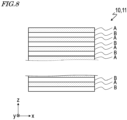
- FIG. 8 is a cross-sectional view schematically showing an example structure of the reflective polarizing layers 10 and 11.
- the reflective polarizing layers 10 and 11 include a reflective polarizer, as a multilayer stack in which layers A having birefringence and layers B having substantially no birefringence are alternately layered along the z axis direction.
- the total number of layers in such a multilayer stack may be not less than 50 and not more than 1000, for example.
- an A layer has a refractive index nx along the x axis direction that is greater than a refractive index ny along the y axis direction
- a B layer has a refractive index nx along the x axis direction and a refractive index ny along the y axis direction that are substantially equal. Therefore, the difference in refractive index between an A layer and a B layer is large along the x axis direction, but substantially zero along the y axis direction.
- the x axis direction serves as a reflection axis (which is perpendicular to the transmission axis)
- the y axis direction serves as a transmission axis.
- the difference in refractive index between an A layer and a B layer along the x axis direction is preferably not less than 0.2 and not more than 0.3.
- the x axis direction corresponds to the drawing direction of a reflective polarizer in the production method for the reflective polarizer.
- the A layers are preferably made of a material that exhibits birefringence after being drawn.
- Representative examples of such materials include naphthalene dicarboxylic acid polyesters (e.g., polyethylene naphthalate), polycarbonates, and acrylic resins (e.g., polymethyl methacrylate). Polyethylene naphthalate is preferable.
- the B layers are preferably made of a material that substantially does not exhibit birefringence even when drawn.
- a representative example of such a material is a copolyester of naphthalene dicarboxylic acid and terephthalic acid.
- the reflective polarizer those described in Japanese National Phase PCT Laid-Open Publication No. H09-507308 may be used, for example.
- commercially available products may be used as they are, or commercially available products may be used after being subjected to secondary processing (e.g., drawing).
- Commercially available products include, for example, a product named DBEF (DBEF is a registered trademark) manufactured by 3M Co. and a product named APF manufactured by 3M Co.
- the diffuse reflectance (i.e., a sum of surface diffuse reflectance and internal diffuse reflectance) of the diffuse reflection layer or diffuse reflection plate is preferably 800 or more, and more preferably 90% or more, for example.
- a specular reflection component in the total reflected light when visible light is incident on the diffuse reflection layer or diffuse reflection plate is preferably 50% or less (that is, there is a diffuse reflection component of 500 or more), for example.
- the diffuse reflection layer or diffuse reflection plate has a surface with bump/dent features for diffuse-reflecting visible light, for example. Disposing the reflective polarizing layer on the surface of a diffuse reflection layer or diffuse reflection plate having bump/dent features makes it easy to form an air layer (low-refractive index layer) between the diffuse reflection layer or diffuse reflection plate and the reflective polarizing layer, and, even if an air layer is formed, Newton's rings are restrained from occurring.
- the diffuse reflection layer or diffuse reflection plate may be made of a porous material of resin (porous resin) including a multitude of minute air voids formed inside a thermoplastic resin.
- the diffuse reflection layer or diffuse reflection plate may be made of a resin composition containing microparticles such as titanium oxide or silica microparticles dispersed in a resin, for example. In this case, however, Newton's rings may occur if an air layer is provided so as to be in contact with the diffuse reflection layer or diffuse reflection plate; therefore, when an air layer is provided as a low-refractive index layer, the diffuse reflection layer or diffuse reflection plate to be used preferably has a surface with bump/dent features to diffuse-reflect visible light.
- the diffuse reflection layer or diffuse reflection plate does not have a surface with bump/dent features; for example, the diffuse reflection layer or diffuse reflection plate is preferably made of a resin composition containing microparticles such as titanium oxide or silica microparticles dispersed in a resin.
- the low-refractive index layer is attached to the diffuse reflection layer or diffuse reflection plate typically via an adhesive layer.
- white matte PET films e.g., Lumirror E20, E6SR, E22, E6DY, which are polyester films manufactured by Toray Industries, Inc.
- Lumirror is a registered trademark
- printing paper for printers white
- screen sheets for projectors coating on a steel partition that is painted white (resin film containing pigments), etc.
- white matte acrylic resin plates e.g., COMOGLAS M (bone white) and COMOGLAS DFA2 (both-side matted) white M, manufactured by Kuraray Co., LTD.; Sumipex M067 white matte and Sumipex 068 white, manufactured by Sumitomo Bakelite Co., Ltd.
- PMMA white matte acrylic resin plates
- COMOGLAS M bone white
- COMOGLAS DFA2 both-side matted white M, manufactured by Kuraray Co., LTD.
- Sumipex M067 white matte and Sumipex 068 white manufactured by Sumitomo Bakelite Co., Ltd.
- a base supporting the diffuse reflection layer for example, an iron plate or a stainless steel plate (SUS plate) can be used.
- SUS plate stainless steel plate
- a screen sheet for use with projectors that has a magnet thereon it can be directly attached onto a magnetic plate (e.g., SUS403).
- a diffuse reflection layer may be bonded to the base by using an adhesive.
- the low-refractive index layer may have a porous structure.
- the low-refractive index layer may be made of a porous layer.
- Porous layers suitably used as the low-refractive index layer include silica particles, silica particles with micropores, essentially spherical particles such as silica hollow nanoparticles, fibrous particles such as cellulose nanofibers, alumina nanofibers, silica nanofibers, and flat-plate particles such as nanoclay composed of bentonite.
- the porous layer is a porous material composed of particles (e.g., micropored particles) that are chemically bonded directly to one another.
- the particles composing the porous layer may be at least partially bonded to one another via a small amount (e.g., less than the mass of the particles) of a binder component.
- the porosity and refractive index of the porous layer can be adjusted based on the particle size, particle size distribution, and the like of the particles composing the porous layer.
- Examples of methods of obtaining a porous layer include a method of forming a low-refractive index layer described in International Publication No. 2019/146628 , and methods described in Japanese Laid-Open Patent Publication No. 2010-189212 , Japanese Laid-Open Patent Publication No. 2008-040171 , Japanese Laid-Open Patent Publication No. 2006-011175 , International Publication No. 2004/113966 , Japanese Laid-Open Patent Publication No. 2017-054111 , Japanese Laid-Open Patent Publication No. 2018-123233 , and Japanese Laid-Open Patent Publication No. 2018-123299 , as well as the references mentioned therein. The entire disclosure of these publications is incorporated herein by reference.
- porous silica can be suitably used as the porous layer.
- Porous silica can be produced by the following method, for example: a method involving hydrolyzing and polycondensing at least one of silicon compounds, hydrolyzable silanes and/or silsesquioxanes, and their partial hydrolysates and dehydration-condensation products; a method that uses porous particles and/or hollow microparticles; and a method that generates an aerogel layer using the springback phenomenon, a method of pulverizing a gelatinous silicon compound obtained by sol-gel processing and using a pulverized gel in which micropored particles as the resultant pulverized body are chemically bonded to one another with a catalyst or the like; and so on.
- the porous layer is not limited to porous silica, and the production method is not limited to the exemplified production methods; any production method may be used for production.
- Silsesquioxane is a silicon compound with (RSiO 1.5 ; where R is a hydrocarbon group) as the basic structural unit.
- R is a hydrocarbon group
- silsesquioxane is not exactly the same as silica, whose basic structural unit is SiO 2 , it has a network structure cross-linked by siloxane bonds, similarly to silica. Therefore, any porous material that contains silsesquioxane as its basic structural unit is also referred to as porous silica or silica-based porous material.
- Porous silica may be composed of micropored particles of a gelatinous silicon compound that are bonded to one another.
- An example of micropored particles of a gelatinous silicon compound is a pulverized body of the gelatinous silicon compound.
- Porous silica may be formed by coating a base with a coating solution that contains a pulverized body of a gelatinous silicon compound, for example.
- the pulverized body of the gelatinous silicon compound may be chemically bonded (e.g., siloxane bonded) through catalytic action, light irradiation, heating, or the like, for example.
- the lower limit value of the thickness of the porous layer may be any value that is greater than the wavelength of light used, for example. Specifically, the lower limit value may be e.g. 0.3 um or more.
- the upper limit value of the thickness of the porous layer is not particularly limited, it may be e.g. 5 ⁇ m or less, and more preferably 3 ⁇ m or less. So long as the thickness of the porous layer is within the above range, the bumps and dents of the surface will not be so large as to affect layering, and therefore it can be easily made into a composite or layered with another member.
- the refractive index of the porous layer is preferably 1.30 or less, for example. This makes total internal reflection likely to occur at the interface with the porous layer, i.e., makes the critical angle small.
- the refractive index of the porous layer is more preferably 1.25 or less, even more preferably 1.18 or less, and particularly preferably 1.15 or less.
- the lower limit of the refractive index of the porous layer is not particularly limited, it is 1.05 or more from the standpoint of mechanical strength.
- the lower limit value of the porosity of the porous layer is e.g. 40% or more, preferably 50% or more, more preferably 55% or more, and still more preferably 70% or more.
- the upper limit value of the porosity of the porous layer is e.g. 90% or less, and more preferably 85% or less.
- the porosity can be calculated from the refractive index value measured with an ellipsometer, Lorentz-Lorenz's formula, for example.
- the film density of the porous layer is e.g. 1 g/cm 3 or more, preferably 10 g/cm 3 or more, and more preferably 15 g/cm 3 or more.
- the film density is e.g. 50 g/cm 3 or less, preferably 40 g/cm 3 or less, more preferably 30 g/cm 3 or less, and even more preferably 2.1 g/cm 3 or less.
- the range of film density is e.g.
- Writing board sets (combinations of a writing board and a writing utensil (marker)) according to Examples 1 to 24 and Comparative Examples 1 to 9 are shown in Table 1A, Table 1B, Table 1C, and Table 2, and details of each writing board and each marker are shown in Table 3 and Table 4.
- markers commercially-available markers for use with whiteboards shown in Table 4 were used: (whiteboard marker marketed by PILOT Corporation, Sakura Craypas Corporation, PENTEL CO., LTD., KOKUYO Co., Ltd., and PLUS Corporation's JOINTEX COMPANY) were used.
- total reflectance corresponds to a brightness obtained when the writing board is viewed from the inside of the space 500.
- cross reflectance corresponds to a total reflectance measured through spectrophotometry when the surface of the writing board at the viewer's side is irradiated with light that has been transmitted through a second polarizing layer having a transmission axis which is orthogonal to the first direction, the measurements being taken by a method similar to the method described with reference to FIG. 3A .
- cross reflectance corresponds to a brightness obtained when the writing board is viewed from outside of the space 500.
- the "degree of polarization" shown in Table 3 was measured in the following manner.
- single transmittance Ts, parallel transmittance Tp, orthogonal transmittance Tc were measured by using UV-Vis spectrophotometer ("LPF200" manufactured by Otsuka Electronics Co., Ltd.), which are respectively termed Ts, Tp, and Tc of the polarizer.
- LPF200 UV-Vis spectrophotometer
- Ts, Tp, and Tc values are Y values obtained by taking measurements based on the 2-degree field of view (C light source) under JIS Z8701 and subjecting them to luminosity factor correction.
- absorptive polarizing layer 1-1. absorptive polarizing layer
- a long roll of polyvinyl alcohol (PVA)-based resin film having a thickness of 75 um was uniaxially drawn in the longitudinal direction by a roll drawing machine to become 5.9 times as large along the longitudinal direction while simultaneously undergoing swelling, dyeing, cross-linking, and washing treatment, and finally received drying treatment, whereby a polarizer having a thickness of 28 um (single transmittance: 43.5%) was obtained.
- PVA polyvinyl alcohol
- the dyeing treatment was carried out in an aqueous solution at 30°C containing iodine and potassium iodide at a mass ratio of 1:7, the iodine concentration being adjusted so that the resulting polarizer had a single transmittance of 43.5%, thus effecting a 1.4 times stretch.
- two stages of cross-linking treatment were adopted for the cross-linking treatment.
- the first stage of cross-linking treatment was performed in an aqueous solution at 40°C in which boric acid and potassium iodide had been dissolved, for a 1.2 times stretch.
- the boric acid content in the aqueous solution in the first stage of cross-linking treatment was 5.0 mass% and the potassium iodide content was 3.0 mass%.
- the second stage of cross-linking treatment was performed in an aqueous solution at 65°C in which boric acid and potassium iodide had been dissolved, for a 1.6 times stretch.
- the boric acid content in the aqueous solution in the second stage of cross-linking treatment was 4.3 mass% and the potassium iodide content was 5.0 mass%.
- the washing treatment was performed with an aqueous solution of potassium iodide at 20°C.
- the potassium iodide content in the aqueous solution for the washing treatment was 2.6 mass%.
- the drying treatment was performed at 70°C for 5 minutes, whereby a polarizer was provided. Protection films (TAC film; thickness: 40 um) were attached to both sides of the resulting polarizer, whereby an absorptive polarizing layer was obtained.
- TAC film thickness: 40 um
- a white acrylic resin extrusion plate manufactured by Kuraray Co., LTD.; product name: "COMOGLAS” M (bone white) #3; thickness: 5 mm; refractive index: 1.49) was provided.
- a reflective polarizing layer manufactured by 3M Co.; product name: APF
- the absorptive polarizing layer obtained as above were attached in this order, whereby a writing board of Configuration 2 was obtained.
- a transparent tackiness agent manufactured by Nitto Denko Corporation; product name: LUCIACS CS9862UA; refractive index: 1.49(LUCIACS is a registered trademark) was used.
- the writing board of Configuration 1 was obtained in a similar manner to the writing board of Configuration 2.
- the porous layer was produced by the procedure according to [Manufacturing Example 1] to [Manufacturing Example 3] below.
- DMSO dimethyl sulfoxide
- MTMS methyltrimethoxysilane
- Mixture C containing the gelatinous silicon compound as prepared above, was incubated as it was at 40°C for 20 hours, thereby effecting an aging process.
- the gelatinous silicon compound that had undergone the aging process as described above was crushed into granules of several millimeters to several centimeters in size, using a spatula.
- 40 g of isopropyl alcohol (IPA) was added to Mixture C, and this was stirred lightly and allowed to stand at room temperature for 6 hours, thereby decanting the solvent and catalyst in the gel. The same decantation process was performed three times to replace the solvent, whereby Mixture D was obtained.
- the gelatinous silicon compound in Mixture D was subjected to a pulverization process (high-pressure media-less pulverization).
- a homogenizer manufactured by S.M.T.; product name: "UH-50" was used.
- a homogenizer manufactured by S.M.T.; product name: "UH-50" was used.
- Into a 5-cc screw bottle 1.85 g of the gelatinous compound in Mixture D and 1.15 g of IPA were weighed, after which pulverization was performed at 50 W, 20 kHz for 2 minutes.
- This pulverization process pulverized the gelatinous silicon compound in the above Mixture D, and thus Mixture D' resulted which was a sol solution of the pulverized material.
- the volume-averaged particle size which indicates the grain size variation of the pulverized material in Mixture D', was confirmed using a dynamic light scattering Nanotrac particle size analyzer (manufactured by Nikkiso Co., Ltd.; UPA-EX150) to be 0.50 to 0.70.
- the above acrylic tackiness agent solution was applied to one side of a silicone-treated polyethylene terephthalate (PET) film (manufactured by Mitsubishi Polyester Film Corporation; thickness: 38 ⁇ m)) so that the thickness of the tackiness agent layer after drying was a predetermined thickness; and this was dried at 150°C for 3 minutes, thereby producing a tackiness agent layer.
- PET polyethylene terephthalate
- a base (acrylic film) having a thickness of 30 um was coated with Coating Solution A for forming a low-refractive index layer, as prepared in Manufacturing Example 1.
- the wet thickness (i.e., thickness before drying) of the coating layer was about 27 um.
- the coating layer was treated at a temperature of 100°C for 1 minute for drying, whereby a low-refractive index layer (thickness: 0.9 um) was formed upon the base.
- the resultant low-refractive index layer had a refractive index of 1.18.
- tackiness agent layers as prepared in Manufacturing Example 2 were disposed on both sides of the base/low-refractive index layer stack, thus producing a stack with tackiness agent layers on both sides.
- a black acrylic resin extrusion plate manufactured by Kuraray Co., LTD.; product name: "COMOGLAS"502K#3; thickness: 5 mm; refractive index: 1.49) was provided.
- a reflective polarizing layer manufactured by 3M Co.; product name: APF
- the light diffusing layer obtained as above were attached in this order, whereby the writing board of Configuration 4 was obtained.
- a transparent tackiness agent manufactured by Nitto Denko Corporation; product name: LUCIACS CS9862UA; refractive index: 1.49(LUCIACS is a registered trademark) was used.
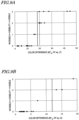
- the writing board sets of Examples 1 to 24 have a visibility evaluation of "0" (Cannot be seen) or “1" (Hard to see), and a color difference ⁇ E* ab as defined by eq. (1) of 16.4 or less.
- the writing board sets of Comparative Examples 1 to 9 have a visibility evaluation of "2" (Visible) or "3" (Easily seen), and a color difference ⁇ E* ab as defined by eq. (1) of 19.7 or more.
- the writing boards of Configuration 1, Configuration 2, and Configuration 3 are different in structure, but do not have any difference in their values of "cross reflectance", and L d *, a d *, and b d *. In other words, it is considered that there is no substantial difference in the reflectance hues of these writing boards when observed from outside of the space 500. Therefore, once an ink is evaluated with respect to the writing board of e.g. Configuration 1 as sufficiently restraining information that is displayed with it from being visible from outside of the space, basically the same evaluation will also be true of the writing boards of Configuration 2 and Configuration 3.
- markers containing a black, red, blue, or green ink was used in Examples and Comparative Examples, these colors are not limiting. It is considered that any marker may be used in conjunction with a writing board having a color difference ⁇ E* ab as defined by eq. (1) of 19 or less, whereby information that is displayed with the ink on the surface of the writing board can be sufficiently restrained from being visible from outside of the space. Likewise, without being limited to what was used in the Examples, any marker may be used in conjunction with a writing board having a color difference ⁇ E* ab as defined by eq. (2) is 12 or less, whereby information that is displayed with the ink on the surface of the writing board can be sufficiently restrained from being visible from outside of the space.
- a peeking prevention system and a writing board set according to an embodiment of the present invention can sufficiently restrain information that is displayed with an ink on the surface of a writing board from being visible from outside of the space.
- Embodiments of the present invention are applicable to a whiteboard or blackboard within a conference room, for example.
Landscapes
- Physics & Mathematics (AREA)
- General Physics & Mathematics (AREA)
- Optics & Photonics (AREA)
- Engineering & Computer Science (AREA)
- Structural Engineering (AREA)
- Chemical & Material Sciences (AREA)
- Ceramic Engineering (AREA)
- Architecture (AREA)
- Civil Engineering (AREA)
- Drawing Aids And Blackboards (AREA)
- Polarising Elements (AREA)
- Inks, Pencil-Leads, Or Crayons (AREA)
Applications Claiming Priority (1)
| Application Number | Priority Date | Filing Date | Title |
|---|---|---|---|
| JP2022058215A JP2023149575A (ja) | 2022-03-31 | 2022-03-31 | ライティングボードセットおよび覗き見防止システム |
Publications (2)
| Publication Number | Publication Date |
|---|---|
| EP4265433A2 true EP4265433A2 (de) | 2023-10-25 |
| EP4265433A3 EP4265433A3 (de) | 2024-01-10 |
Family
ID=85792063
Family Applications (1)
| Application Number | Title | Priority Date | Filing Date |
|---|---|---|---|
| EP23165443.5A Withdrawn EP4265433A3 (de) | 2022-03-31 | 2023-03-30 | Schreibtafel-set und sichtschutzsystem |
Country Status (4)
| Country | Link |
|---|---|
| US (1) | US20230311559A1 (de) |
| EP (1) | EP4265433A3 (de) |
| JP (1) | JP2023149575A (de) |
| CN (1) | CN116890557A (de) |
Families Citing this family (1)
| Publication number | Priority date | Publication date | Assignee | Title |
|---|---|---|---|---|
| EP4239380A1 (de) * | 2020-10-29 | 2023-09-06 | Nitto Denko Corporation | Weisstafelfolie, weisstafel und peep-verhinderungssystem |
Citations (12)
| Publication number | Priority date | Publication date | Assignee | Title |
|---|---|---|---|---|
| JP2004113966A (ja) | 2002-09-27 | 2004-04-15 | Kurashiki Seni Kako Kk | 生分解性空気清浄用フィルター |
| JP2006011175A (ja) | 2004-06-28 | 2006-01-12 | Pentax Corp | 反射防止膜を有する光学素子及びその製造方法 |
| JP2008040171A (ja) | 2006-08-07 | 2008-02-21 | Pentax Corp | セルフクリーニング効果を有する反射防止膜を設けた光学素子及びその製造方法 |
| JP2010189212A (ja) | 2009-02-17 | 2010-09-02 | Shinshu Univ | 多孔質シリカ膜およびその製造方法 |
| JP2012073580A (ja) | 2010-09-03 | 2012-04-12 | Nitto Denko Corp | 薄型偏光膜の製造方法 |
| JP2017054111A (ja) | 2015-09-07 | 2017-03-16 | 日東電工株式会社 | 低屈折率層、積層フィルム、低屈折率層の製造方法、積層フィルムの製造方法、光学部材および画像表示装置 |
| JP2018123233A (ja) | 2017-01-31 | 2018-08-09 | 日東電工株式会社 | 空隙層、空隙層含有粘接着シート、空隙層の製造方法、空隙層含有粘接着シートの製造方法、および光学デバイス |
| JP2018123299A (ja) | 2017-01-31 | 2018-08-09 | 日東電工株式会社 | 低屈折率層含有粘接着シート、低屈折率層含有粘接着シートの製造方法、および光学デバイス |
| US10061138B2 (en) | 2013-02-06 | 2018-08-28 | Steelcase Inc. | Polarized enhanced confidentiality |
| WO2019146628A1 (ja) | 2018-01-26 | 2019-08-01 | 日東電工株式会社 | Led照明器具用フィルム、led照明器具 |
| WO2021200722A1 (ja) | 2020-03-31 | 2021-10-07 | 日東電工株式会社 | 覗き見防止システム、覗き見防止方法および窓部材 |
| JP2022058215A (ja) | 2020-09-30 | 2022-04-11 | インターナショナル・ビジネス・マシーンズ・コーポレーション | 音声コマンドに基づいて複数のコンピューティング・デバイス間の通信を行うための方法、コンピュータ・プログラム及びコンピュータ・システム(音声コマンドの実行) |
Family Cites Families (4)
| Publication number | Priority date | Publication date | Assignee | Title |
|---|---|---|---|---|
| KR102280969B1 (ko) * | 2013-10-02 | 2021-07-26 | 쓰리엠 이노베이티브 프로퍼티즈 컴파니 | 질소-함유 중합체를 갖는 폴리아크릴레이트 프라이머를 포함하는 물품 및 방법 |
| US9857657B2 (en) * | 2015-06-12 | 2018-01-02 | Gentex Corporation | Electrochromic whiteboard privacy window or divider |
| US10921638B2 (en) * | 2016-07-06 | 2021-02-16 | Sharp Kabushiki Kaisha | Display device, electronic apparatus, semi-transmissive reflection plate, and electrical apparatus |
| CN110291159B (zh) * | 2017-02-15 | 2022-04-26 | 3M创新有限公司 | 包含疏水硅烷的涂料和制品 |
-
2022
- 2022-03-31 JP JP2022058215A patent/JP2023149575A/ja active Pending
-
2023
- 2023-03-28 US US18/127,345 patent/US20230311559A1/en not_active Abandoned
- 2023-03-30 EP EP23165443.5A patent/EP4265433A3/de not_active Withdrawn
- 2023-03-31 CN CN202310332045.8A patent/CN116890557A/zh active Pending
Patent Citations (12)
| Publication number | Priority date | Publication date | Assignee | Title |
|---|---|---|---|---|
| JP2004113966A (ja) | 2002-09-27 | 2004-04-15 | Kurashiki Seni Kako Kk | 生分解性空気清浄用フィルター |
| JP2006011175A (ja) | 2004-06-28 | 2006-01-12 | Pentax Corp | 反射防止膜を有する光学素子及びその製造方法 |
| JP2008040171A (ja) | 2006-08-07 | 2008-02-21 | Pentax Corp | セルフクリーニング効果を有する反射防止膜を設けた光学素子及びその製造方法 |
| JP2010189212A (ja) | 2009-02-17 | 2010-09-02 | Shinshu Univ | 多孔質シリカ膜およびその製造方法 |
| JP2012073580A (ja) | 2010-09-03 | 2012-04-12 | Nitto Denko Corp | 薄型偏光膜の製造方法 |
| US10061138B2 (en) | 2013-02-06 | 2018-08-28 | Steelcase Inc. | Polarized enhanced confidentiality |
| JP2017054111A (ja) | 2015-09-07 | 2017-03-16 | 日東電工株式会社 | 低屈折率層、積層フィルム、低屈折率層の製造方法、積層フィルムの製造方法、光学部材および画像表示装置 |
| JP2018123233A (ja) | 2017-01-31 | 2018-08-09 | 日東電工株式会社 | 空隙層、空隙層含有粘接着シート、空隙層の製造方法、空隙層含有粘接着シートの製造方法、および光学デバイス |
| JP2018123299A (ja) | 2017-01-31 | 2018-08-09 | 日東電工株式会社 | 低屈折率層含有粘接着シート、低屈折率層含有粘接着シートの製造方法、および光学デバイス |
| WO2019146628A1 (ja) | 2018-01-26 | 2019-08-01 | 日東電工株式会社 | Led照明器具用フィルム、led照明器具 |
| WO2021200722A1 (ja) | 2020-03-31 | 2021-10-07 | 日東電工株式会社 | 覗き見防止システム、覗き見防止方法および窓部材 |
| JP2022058215A (ja) | 2020-09-30 | 2022-04-11 | インターナショナル・ビジネス・マシーンズ・コーポレーション | 音声コマンドに基づいて複数のコンピューティング・デバイス間の通信を行うための方法、コンピュータ・プログラム及びコンピュータ・システム(音声コマンドの実行) |
Also Published As
| Publication number | Publication date |
|---|---|
| CN116890557A (zh) | 2023-10-17 |
| JP2023149575A (ja) | 2023-10-13 |
| EP4265433A3 (de) | 2024-01-10 |
| US20230311559A1 (en) | 2023-10-05 |
Similar Documents
| Publication | Publication Date | Title |
|---|---|---|
| KR100924609B1 (ko) | 방현성 필름 및 화상표시장치 | |
| KR100816700B1 (ko) | 하드코트 필름, 반사방지 하드코트 필름, 광학소자 및화상표시장치 | |
| JP7517345B2 (ja) | 光学フィルム、偏光板、画像表示装置及び光学フィルムの選定方法 | |
| JP6521264B2 (ja) | 積層ポリエステルフィルム | |
| WO2020145373A1 (ja) | 反射防止部材、並びに、これを備える偏光板、画像表示装置及び反射防止性物品 | |
| WO2007000856A1 (ja) | 防眩性ハードコートフィルム | |
| JPWO2020100926A1 (ja) | 光学フィルム、偏光板、画像表示装置用の表面板及び画像表示装置 | |
| WO2019087963A1 (ja) | 粘着層付ハードコートフィルム、画像表示装置 | |
| KR20190053920A (ko) | 눈부심 방지성 반사 방지 하드 코팅 필름, 화상 표시 장치, 눈부심 방지성 반사 방지 하드 코팅 필름 제조 방법 | |
| JP6716870B2 (ja) | 量子ドットシート、バックライト及び液晶表示装置 | |
| EP4266096A1 (de) | Weisstafelfilmsystem, weisstafelsystem und peeking-verhinderungssystem | |
| WO2022085751A1 (ja) | 光学フィルム、偏光板、画像表示装置及び光学フィルムの選定方法 | |
| EP4265433A2 (de) | Schreibtafel-set und sichtschutzsystem | |
| JP2006010724A (ja) | 光拡散性防眩フィルム | |
| KR100915242B1 (ko) | 높은 광확산성을 갖는 리플렉터 | |
| JPH10206615A (ja) | 半透過型反射板、偏光板及び液晶表示装置 | |
| WO2021065967A1 (ja) | 光学用の二軸延伸プラスチックフィルム、偏光板、画像表示装置及び二軸延伸プラスチックフィルムの選定方法 | |
| JP5911785B2 (ja) | 光学積層体 | |
| US12455500B2 (en) | Whiteboard film, whiteboard, peep prevention system | |
| TWI903999B (zh) | 液晶顯示器 | |
| JP2008292987A (ja) | 光学積層体 |
Legal Events
| Date | Code | Title | Description |
|---|---|---|---|
| PUAI | Public reference made under article 153(3) epc to a published international application that has entered the european phase |
Free format text: ORIGINAL CODE: 0009012 |
|
| STAA | Information on the status of an ep patent application or granted ep patent |
Free format text: STATUS: THE APPLICATION HAS BEEN PUBLISHED |
|
| AK | Designated contracting states |
Kind code of ref document: A2 Designated state(s): AL AT BE BG CH CY CZ DE DK EE ES FI FR GB GR HR HU IE IS IT LI LT LU LV MC ME MK MT NL NO PL PT RO RS SE SI SK SM TR |
|
| PUAL | Search report despatched |
Free format text: ORIGINAL CODE: 0009013 |
|
| AK | Designated contracting states |
Kind code of ref document: A3 Designated state(s): AL AT BE BG CH CY CZ DE DK EE ES FI FR GB GR HR HU IE IS IT LI LT LU LV MC ME MK MT NL NO PL PT RO RS SE SI SK SM TR |
|
| RIC1 | Information provided on ipc code assigned before grant |
Ipc: G02B 5/02 20060101ALI20231201BHEP Ipc: B43L 1/00 20060101AFI20231201BHEP |
|
| STAA | Information on the status of an ep patent application or granted ep patent |
Free format text: STATUS: THE APPLICATION IS DEEMED TO BE WITHDRAWN |
|
| 18D | Application deemed to be withdrawn |
Effective date: 20240711 |