EP4265436B1 - Pneu de motocyclette - Google Patents
Pneu de motocyclette Download PDFInfo
- Publication number
- EP4265436B1 EP4265436B1 EP23163472.6A EP23163472A EP4265436B1 EP 4265436 B1 EP4265436 B1 EP 4265436B1 EP 23163472 A EP23163472 A EP 23163472A EP 4265436 B1 EP4265436 B1 EP 4265436B1
- Authority
- EP
- European Patent Office
- Prior art keywords
- parts
- mass
- rubber composition
- tire
- tan
- Prior art date
- Legal status (The legal status is an assumption and is not a legal conclusion. Google has not performed a legal analysis and makes no representation as to the accuracy of the status listed.)
- Active
Links
Images

Classifications
-
- B—PERFORMING OPERATIONS; TRANSPORTING
- B60—VEHICLES IN GENERAL
- B60C—VEHICLE TYRES; TYRE INFLATION; TYRE CHANGING; CONNECTING VALVES TO INFLATABLE ELASTIC BODIES IN GENERAL; DEVICES OR ARRANGEMENTS RELATED TO TYRES
- B60C1/00—Tyres characterised by the chemical composition or the physical arrangement or mixture of the composition
- B60C1/0016—Compositions of the tread
-
- B—PERFORMING OPERATIONS; TRANSPORTING
- B60—VEHICLES IN GENERAL
- B60C—VEHICLE TYRES; TYRE INFLATION; TYRE CHANGING; CONNECTING VALVES TO INFLATABLE ELASTIC BODIES IN GENERAL; DEVICES OR ARRANGEMENTS RELATED TO TYRES
- B60C11/00—Tyre tread bands; Tread patterns; Anti-skid inserts
- B60C11/0041—Tyre tread bands; Tread patterns; Anti-skid inserts comprising different tread rubber layers
-
- B—PERFORMING OPERATIONS; TRANSPORTING
- B60—VEHICLES IN GENERAL
- B60C—VEHICLE TYRES; TYRE INFLATION; TYRE CHANGING; CONNECTING VALVES TO INFLATABLE ELASTIC BODIES IN GENERAL; DEVICES OR ARRANGEMENTS RELATED TO TYRES
- B60C11/00—Tyre tread bands; Tread patterns; Anti-skid inserts
- B60C11/0008—Tyre tread bands; Tread patterns; Anti-skid inserts characterised by the tread rubber
- B60C2011/0016—Physical properties or dimensions
- B60C2011/0025—Modulus or tan delta
-
- B—PERFORMING OPERATIONS; TRANSPORTING
- B60—VEHICLES IN GENERAL
- B60C—VEHICLE TYRES; TYRE INFLATION; TYRE CHANGING; CONNECTING VALVES TO INFLATABLE ELASTIC BODIES IN GENERAL; DEVICES OR ARRANGEMENTS RELATED TO TYRES
- B60C2200/00—Tyres specially adapted for particular applications
- B60C2200/10—Tyres specially adapted for particular applications for motorcycles, scooters or the like
Definitions
- the present invention relates to a motorcycle tire.
- the center rubber CR includes a center cap layer CRc and a center base layer CRb.
- the loss tangent of the center base layer CRb and the width L1b thereof in the tire axial direction are each limited so as to be set within a predetermined range.
- US 2004/244894 A1 discloses a two-piece tire assembly having a removable tread belt 12 for installing about the circumference of the tire carcass 14.
- the tread belt has a pair of lateral ends each axially extending beyond the inflated unloaded carcass 14 at the circumferential surface by a distance of at least 4% of the width as measured at the tread belt 12 and the carcass 14 interface.
- the carcass 14 has an abrasion resistant rubber layer 82 at the tread belt interface.
- the tread belt 12 also has the abrasion resistant tread compound 82 at the carcass 14 interface.
- the tread belt 12 has a tread portion 80 that includes a tread cap 80A and a tread base 80B.
- the motorcycle tire of the present invention is a motorcycle tire comprising a tread part, the tread part comprising a center part having a tire equator, and a pair of shoulder parts having tread grounding ends, wherein a rubber composition constituting the center part comprises a filler (C), the filler (C) comprising silica, and a ratio of silica in the filler (C) is greater than 50% by mass, wherein a rubber composition constituting the shoulder parts comprises a filler (S), the filler (S) comprising carbon black, and a ratio of carbon black in the filler (S) is greater than 50% by mass, and wherein, when a loss tangent at 70°C of the rubber composition constituting the center part is defined as 70°C tan ⁇ (c), a complex elastic modulus at 0°C of the rubber composition constituting the center part is defined as 0°CE*(c), a loss tangent at 70°C of the rubber composition constituting the shoulder parts is defined as 70°C tan ⁇ (
- a mechanism by which peeling on the interface between the center part and each of the shoulder parts is suppressed in the present invention is considered as follows, although it is not intended to be bound by any theory.
- the center part comprises a filler (C) in which a ratio of silica is greater than 50% by mass
- each of the shoulder parts comprises a filler (S) in which a ratio of carbon black is greater than 50% by mass.
- a temperature of the center part easily becomes high due to deformation of the center part during a rolling motion, and thus it is considered that a deformation amount of a rubber surface easily increases when the tire is tilted. Since silica tends to easily keep elongation at break of a rubber composition high as compared with other fillers, it is considered that abrasion of the center part with a road surface in a case of application of large deformation can be suppressed.
- a thickness D of an interface part between the center part and each shoulder part on a tire meridian cross section is preferably greater than 4.0 mm and less than 10.0 mm.
- the interface part has a thickness equal to or larger than a certain value, a sufficient heat generation is obtained, which is considered to be advantageous for suppression of peeling on the interface.
- the thickness of the interface part is reduced to be equal to or less than a certain value, rigidity of the entire tread part is increased and an amount of deformation on the interface between the center portion and each shoulder part can be reduced, which is considered to be advantageous for suppression of peeling on the interface.
- a rubber component in the rubber composition constituting the shoulder parts preferably comprises greater than 70% by mass of a styrene-butadiene rubber.
- the styrene-butadiene rubber preferably comprises a solution-polymerized styrene-butadiene rubber and an emulsion-polymerized styrene-butadiene rubber.
- the solution-polymerized styrene-butadiene rubber In the solution-polymerized styrene-butadiene rubber, a uniform weight-average molecular weight is easily obtained, and breaking strength of the entire rubber component is easily improved.
- the emulsion-polymerized styrene-butadiene rubber comprises a polymer component whose molecular weight is higher than that of the solution-polymerized styrene-butadiene rubber, it is considered that it is excellent in strength against a locally large deformation. Accordingly, these styrene-butadiene rubbers are preferably used in combination.
- a content of the filler (S) in the rubber composition constituting the shoulder parts is preferably greater than 50 parts by mass based on 100 parts by mass of the rubber component.
- the content of the filler is set to be equal to or greater than a certain value, a sufficient heat generation is obtained at the shoulder part, the interface part is easily heated and becomes flexible, which is thus considered to be advantageous for suppression of peeling on the interface.
- a content of carbon black in the rubber composition constituting the shoulder parts is preferably greater than 50 parts by mass based on 100 parts by mass of the rubber component.
- the content of carbon black is set to be equal to or greater than a certain amount, a sufficient heat generation is obtained at the shoulder part, the interface part is easily heated and becomes flexible, which is thus considered to be advantageous for suppression of peeling on the interface.
- the rubber composition constituting the shoulder parts preferably comprises greater than 5 parts by mass and less than 40 parts by mass of resin based on 100 parts by mass of the rubber component.
- the content of resin is set to be within a certain range, a sufficient heat generation is obtained at the shoulder part, the interface part is easily heated and becomes flexible, which is thus considered to be advantageous for suppression of peeling on the interface. Moreover, it is considered that a slip relative to a road surface is also easily suppressed with adhesiveness of the resin component.
- a content of the filler (C) in the rubber composition constituting the center part is preferably greater than 60 parts by mass based on 100 parts by mass of a rubber component.
- the content of silica in the center part is set to be equal to or greater than a certain value, the rubber component is reinforced by the filler, elongation at break is improved, and it is considered that abrasion of the rubber in the vicinity of the interface when the tire is tilted is easily suppressed.
- a degree ⁇ of a shoulder part-side angle is preferably greater than 90°.
- ⁇ is set to be within a range as described above, a rubber of the center part covers rubbers of the shoulder parts during turning, and thus, in relationship with a reaction force applied during turning, it becomes difficult for the interface part to split finely, which is thus considered to be advantageous for suppression of peeling on the interface.
- H(c) hardness of the rubber composition constituting the center part
- H(s) hardness of the rubber composition constituting the shoulder parts
- the reason is that improvement of grip performance of the shoulder part during turning can be expected.
- M300(c) When stress (MPa) at 300% elongation of the rubber composition constituting the center part is defined as M300(c) and stress (MPa) at 300% elongation of the rubber composition constituting the shoulder parts is defined as M300(s), M300(c) and M300(s) preferably satisfy the following relationship.
- a size or the like of each part of a tire is defined as a value specified in a standardized state in which the tire is rim-assembled to a standardized rim, filled with air at a standardized internal pressure, and applied with no load.
- sizes on the tire meridian cross section for example, such as "the thickness D of the interface part” and "the degree ⁇ ", are defined as values specified in a state where the tire cut along the tire meridian cross section is put on a standardized rim.
- the "standardized rim” is a rim defined for each tire in a standard system including a standard, on which the tire is based, by the standard, and refers to, for example, a standard rim in applicable sizes described in "JATMA YEAR BOOK” in JATMA (Japan Automobile Tyre Manufacturers Association, Inc), "Measuring Rim” described in “STANDARDS MANUAL” in ETRTO (The European Tyre and Rim Technical Organisation), or “Design Rim” described in "YEAR BOOK” in TRA (The Tire and Rim Association, Inc.).
- a “standardized internal pressure” is an air pressure defined for each tire in a standard system including a standard, on which the tire is based, by each standard, i.e., the "MAXIMUM AIR PRESSURE” in JATMA, the maximum value described in the table “TIRE LOAD LIMITS AT VARIOUS COLD INFLATION PRESSURES" in TRA, or "INFLATION PRESSURE” in ETRTO.
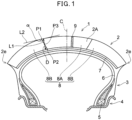
- the "thickness of the interface part” means a thickness (D in FIG. 1 ) of the tread part in a direction perpendicular to a tread surface from a midpoint (P3 in FIG. 1 ) of the junction line on the tire meridian cross section.
- the "filler (C)" means a filler contained in the rubber composition constituting the center part.
- the "filler (S)" means a filler contained in the rubber composition constituting the shoulder parts.
- a "70°C tan ⁇ " is a loss tangent measured using EPLEXOR series manufactured by gabo Systemtechnik GmbH under a condition of a temperature at 70°C, a frequency of 10 Hz, an initial strain of 10%, a dynamic strain of 1%, and an extension mode.
- a vulcanized rubber composition having a length of 20 mm, a width of 4 mm, and a thickness of 1 mm, which is cut out from the tread part of the tire such that a tire circumferential direction becomes a longitudinal direction, is used as a sample for measurement.
- a "0°C E*" is a complex elastic modulus measured using EPLEXOR series manufactured by gabo Systemtechnik GmbH under a condition of a temperature at 0°C, a frequency of 10 Hz, an initial strain of 5%, a dynamic strain of 1%, and an extension mode.
- a vulcanized rubber composition having a length of 20 mm, a width of 4 mm, and a thickness of 1 mm, which is cut out from the tread part of the tire such that a tire circumferential direction becomes a longitudinal direction, is used as a sample for measurement.
- a "tan ⁇ peak temperature of a rubber composition” is determined as a temperature (tan ⁇ peak temperature) corresponding to the largest value of tan ⁇ in a temperature distribution curve of tan ⁇ measured using EPLEXOR series manufactured by gabo Systemtechnik GmbH under a condition of a frequency of 10 Hz, an initial strain of 10%, a dynamic strain of ⁇ 0.5%, and a temperature rising rate of 2°C/min.
- a vulcanized rubber composition having a length of 20 mm, a width of 4 mm, and a thickness of 1 mm, which is cut out from the tread part of the tire such that a tire circumferential direction becomes a longitudinal direction, is used as a sample for measurement.
- a "styrene content" is calculated by 1 H-NMR measurement. For example, it is applied for a styrene-containing rubber such as SBR.
- a "vinyl bond amount (1,2-bond butadiene unit amount)" is measured by infrared absorption spectrometry. For example, it is applied for a SBR, a BR, and the like.
- a "cis-1,4-bond content (cis content)" is a value calculated by infrared absorption spectrometry. For example, it is applied for a BR and the like.
- a "weight-average molecular weight” can be calculated in terms of a standard polystyrene based on measurement values obtained by a gel permeation chromatography (GPC) (GPC-8000 Series manufactured by Tosoh Corporation, detector: differential refractometer, column: TSKGEL SUPERMULTIPORE HZ-M manufactured by Tosoh Corporation). For example, it is applied for a SBR, a BR, resin, a liquid polymer, and the like.
- GPC gel permeation chromatography
- N 2 SA of carbon black is measured according to JIS K 6217-2 "Carbon black for rubber industry-Fundamental characteristics- Part 2: Determination of specific surface area-Nitrogen adsorption methods-Single-point procedures.
- a “DBP oil absorption amount of carbon black” is measured according to JIS K6217-4:2001.
- a "N 2 SA of silica” is measured by a BET method according to ASTM D3037-93.
- a "softening point” is a temperature at which a sphere drops when the softening point specified in JIS K 6220-1: 2001 is measured with a ring and ball softening point measuring device. For example, it is applied for resin and the like.
- a "SP value” means a Solubility Parameter calculated based on a structure of a compound by the Hoy method.
- the Hoy method is a calculation method described in K. L. Hoy, "Table of Solubility Parameters", Solvent and Coatings Materials Research and Development Department, Union Carbites Corp. (1985).
- the SP value is applied for, for example, resin and the like.
- the tread part should satisfy the relationship between a center part and a shoulder part of the present invention at an interface other than the interface around a central part.
- the tread part may satisfy the relationship between a center part and a shoulder part of the present invention at any interface, preferably, at an interface that is nearest to each tread grounding end 2e.
- a tread rubber 8 is arranged on the outside of the belt layer 7 in the radial direction.
- the tread rubber 8 constitutes a portion ranging from an outer surface of the belt layer 7 to the tread surface 2A.
- the tread rubber 8 is composed of a center part 8A with a tire equator C centered thereon, and a pair of shoulder parts 8B adjacent to the center part 8A and extending to the tread grounding ends 2e. That is, two types of members of the center part 8A and the shoulder parts 8B are arranged side by side from the vicinity of the tire equator C toward the both sides in the tire axial direction.
- a rubber composition constituting a tread rubber according to the present invention will be described below.
- the rubber composition constituting the tread rubber means both the rubber composition constituting the center part of the tread part and the rubber composition constituting the shoulder parts of the tread part.
- Both the rubber composition constituting the center part of the tread part and the rubber composition constituting the shoulder parts of the tread part can be produced by appropriately determining types and compounding amounts of components in accordance with respective physical properties based on explanations described below.
- a rubber component preferably comprises a diene-based rubber.
- a main component of the rubber component is preferably a diene-based rubber, and for example, a content of the diene-based rubber in the rubber component is more preferably greater than 90% by mass, further preferably 100% by mass.
- the diene-based rubber examples include, for example, a styrene-butadiene rubber (SBR), a butadiene rubber (BR), and the like.
- the diene-based rubber preferably comprises the SBR and the BR and may be one consisting of the SBR and the BR.
- the diene-based rubber consists of the SBR and the BR, when a content (% by mass) of one of the SBR and the BR is determined based on the explanations described below, a content (% by mass) of the other of the SBR and the BR is accordingly determined.
- a plasticizing agent-extended rubber previously extended with a plasticizing agent component such as oil, resin, and a liquid polymer may be used.
- the SBR is not particularly limited, and those common in the tire industry can be used, for example, such as an emulsion-polymerized SBR (E-SBR) and a solution-polymerized SBR (S-SBR). These SBRs may be used alone, or two or more thereof may be used in combination. The E-SBR and the S-SBR can be appropriately used in combination.
- E-SBR emulsion-polymerized SBR
- S-SBR solution-polymerized SBR
- an unmodified SBR can be used or a modified SBR can be used.
- a modified SBR any of those common in the tire industry can be used, examples of which include one into which a functional group interacting with a filler such as silica is introduced.
- Examples of such a SBR include, for example, a terminal-modified SBR obtained by modifying at least one terminal of a SBR with a compound (a modifying agent) having a functional group described below, a main chain modified SBR whose main chain has a functional group described below, a main chain terminal-modified SBR having functional groups described below at the main chain and the terminal (for example, a main chain terminal-modified SBR whose main chain has a functional group described below and at least one terminal of which is modified with a compound (a modifying agent) having a functional group described below), a terminal-modified SBR which is modified (coupled) with a polyfunctional compound having two or more epoxy groups in a molecule and into which a hydroxyl group or an epoxy group is introduced, and the like.
- a terminal-modified SBR obtained by modifying at least one terminal of a SBR with a compound (a modifying agent) having a functional group described below
- a main chain modified SBR whose main chain has a functional group
- Examples of the above-described functional group include, for example, an amino group (preferably an amino group whose hydrogen atom is substituted with an alkyl group having 1 to 6 carbon atoms), an amido group, a silyl group, an alkoxysilyl group (preferably an alkoxysilyl group having 1 to 6 carbon atoms), an isocyanate group, an imino group, an imidazole group, an urea group, an ether group, a carbonyl group, an oxycarbonyl group, a mercapto group, a sulfide group, a disulfide group, a sulfonyl group, a sulfinyl group, a thiocarbonyl group, an ammonium group, an imide group, a hydrazo group, an azo group, a diazo group, a carboxyl group, a nitrile group, a pyridyl group, an alkoxy group (preferably an alkoxy group having
- these functional groups may have a substituent.
- substituent can include one into which a functional group such as, for example, an amino group, an amido group, an alkoxysilyl group, a carboxyl group, and a hydroxyl group is introduced.
- examples of the modified SBR can include one obtained by further hydrogenating the above-described unmodified or modified SBR, one obtained by further epoxidizing the same, one obtained by further tin-modifying the same, and the like.
- a SBR obtained by further hydrogenating the above-described modified SBR (a modified hydrogenated SBR) is preferable.
- the hydrogenated SBR is one improved in motility of a molecular chain by decreasing double bonds and increasing single bonds and is preferable from the viewpoint of the effects of the present invention because it tends to improve an entanglement effect between polymers and enhance a reinforcing property.
- a plasticizing agent-extended SBR for example, an oil-extended SBR
- a non-extended SBR can be used.
- an oil-extending amount of the SBR that is, a content of the extending oil contained in the SBR is preferably 10 parts by mass or more and 50 parts by mass or less based on 100 parts by mass of a rubber solid content of the SBR.
- SBR SBRs manufactured and sold by, for example, Sumitomo Chemical Co., Ltd., JSR Corporation, Asahi Kasei Corporation, Zeon Corporation, etc. can be used.
- a styrene content of the SBR is preferably greater than 10% by mass, more preferably greater than 20% by mass, more preferably 24% by mass or more, further preferably greater than 30% by mass, for the reason that the effects of the present invention are obtained more appropriately.
- the styrene content is preferably less than 60% by mass, more preferably less than 50% by mass, further preferably 40% by mass or less.
- the styrene content is calculated by the above-described measuring method.
- a vinyl bond amount of the SBR is preferably greater than 10 mol%, more preferably greater than 15 mol%, further preferably 17 mol% or more, for the reason that the effects of the present invention are obtained more appropriately.
- the vinyl bond amount is preferably less than 80 mol%, more preferably less than 60 mol%, further preferably less than 50 mol%, further preferably 46 mol% or less.
- the vinyl bond amount (1,2-bond butadiene unit amount) is measured by the above-described method.
- a glass transition temperature (Tg) of the SBR is preferably greater than -90°C, more preferably greater than -70°C, further preferably greater than -60°C, further preferably greater than -53°C or more, for the reason that the effects of the present invention are obtained more appropriately.
- the Tg is preferably less than 0°C, more preferably less than -10°C, further preferably less than -15°C, further preferably less than -20°C, further preferably -25°C or less.
- the glass transition temperature is measured by the above-described method.
- a weight-average molecular weight (Mw) of the SBR is preferably greater than 200,000, more preferably greater than 300,000, for the reason that the effects of the present invention are obtained more appropriately. Moreover, the Mw is preferably less than 2,000,000, more preferably less than 1,500,000, further preferably less than 1,000,000. Besides, the weight-average molecular weight (Mw) can be calculated by the above-described method.
- a content of the SBR in 100% by mass of the rubber component is preferably greater than 50% by mass, more preferably 60% by mass or more, further preferably greater than 70% by mass, further preferably 80% by mass or more, further preferably greater than 90% by mass, and may be 100% by mass.
- the content of SBR is, in a case of a plasticizing agent-extended SBR, a content of the SBR itself excluding an extending plasticizing agent.
- the BR is not particularly limited, and those common in the tire industry can be used, such as, for example, a BR having a cis-1, 4- bond content (a cis content) greater than 90 mol% (a high cis BR), a rare-earth-based butadiene rubber synthesized using a rare-earth element-based catalyst (a rare-earth-based BR), a BR containing a syndiotactic polybutadiene crystal (a SPB-containing BR), and a modified BR (a high cis modified BR, a low cis modified BR).
- These BRs may be used alone, or two or more thereof may be used in combination.
- the high cis BR is preferable.
- high cis BR examples include, for example, those manufactured by Zeon Corporation, Ube Industries, Ltd., JSR Corporation, and the like.
- a cis content of the high cis BR is preferably greater than 95 mol%, more preferably greater than 96 mol%, further preferably 97 mol% or more, further preferably greater than 98 mol%.
- rare-earth-based BR those which are synthesized using a rare-earth element-based catalyst, and have a vinyl bond amount (1,2-bond butadiene unit amount) of preferably less than 1.8 mol%, more preferably 1.0 mol% or less, further preferably less than 0.8 mol%, and a cis content (cis-1,4 bond content) of preferably less than 95 mol%, more preferably greater than 96 mol%, more preferably 97 mol% or more, can be used.
- the cis-1,4-bond content and the vinyl bond amount are measured by the above-described methods.
- Examples of the modified BR include a BR modified in the same manner as described above for the SBR.
- examples of the modified BR include those obtained by adding a tin compound after polymerizing 1,3-butadiene by a lithium initiator (tin-modified BRs), a butadiene rubber having a condensed alkoxysilane compound at an active terminal of the butadiene rubber (modified BR for silica), and the like.
- tin-modified BRs tin-modified BRs
- modified BR for silica a modified BR, for example, those manufactured by ZS Elastomer Co., Ltd., and the like. can be used.
- a glass transition temperature (Tg) of the BR is preferably greater than -130°C, more preferably greater than -120°C, further preferably greater than -110°C, for the reason that the effects of the present invention are obtained more appropriately.
- the Tg is preferably less than 0°C, more preferably less than -10°C, further preferably less than -60°C, further preferably less than -70°C, further preferably less than -80°C.
- the glass transition temperature is measured by the above-described method.
- a weight-average molecular weight (Mw) of the BR is preferably greater than 200,000, more preferably greater than 300,000, for the reason that the effects of the present invention are obtained more appropriately. Moreover, the Mw is preferably less than 2,000,000, more preferably less than 1,500,000, more preferably less than 1,000,000. Besides, in the present specification, the weight-average molecular weight (Mw) can be calculated by the above-described method.
- a content of the BR in 100% by mass of the rubber component is preferably less than 50% by mass, more preferably 40% by mass or less, further preferably less than 30% by mass.
- a lower limit of the content of the BR is not particularly limited and may be 0% by mass, or may be, for example, 5% by mass, 10% by mass, or 20% by mass.
- the rubber component may comprise other diene-based rubber components other than the above-described SBR and BR.
- diene-based rubber components cross-linkable rubber components commonly used in the tire industry can be used, examples of which include, for example, a natural rubber (NR), an isoprene rubber (IR), a styrene-isoprene-butadiene copolymer rubber (SIBR), a chloroprene rubber (CR), an acrylonitrile-butadiene rubber (NBR), a polynorbornene rubber, and the like.
- NR natural rubber
- IR isoprene rubber
- SIBR styrene-isoprene-butadiene copolymer rubber
- CR chloroprene rubber
- NBR acrylonitrile-butadiene rubber
- polynorbornene rubber and the like.
- the rubber component can comprise non-diene-based rubbers.
- the non-diene-based rubber include a butyl rubber (IIR), a hydrogenated nitrile rubber (HNBR), an ethylene propylene rubber, a silicone rubber, a polyethylene chloride rubber, a fluororubber (FKM), an acrylic rubber (ACM), a hydrin rubber, and the like.
- IIR butyl rubber
- HNBR hydrogenated nitrile rubber
- FKM fluororubber
- ACM acrylic rubber
- hydrin rubber hydrin rubber
- the rubber composition constituting the center part comprises a filler (C) including greater than 50% by mass of silica
- the rubber composition constituting the shoulder parts comprises a filler (S) including greater than 50% by mass of carbon black.
- the filler (C) of the rubber composition constituting the center part may include silica and carbon black or may consist of silica and carbon black.
- the filler (S) of the rubber composition constituting the shoulder parts may include silica and carbon black or may consist of silica and carbon black.
- a content of silica in the filler (C) is preferably greater than 60% by mass, more preferably greater than 70% by mass, further preferably 80% by mass or more.
- a content of carbon black in the filler (S) is preferably greater than 60% by mass, more preferably greater than 70% by mass, further preferably 80% by mass or more.
- a nitrogen adsorption specific surface area (N 2 SA) of silica is preferably greater than 140 m 2 /g, more preferably greater than 160 m 2 /g, further preferably greater than 170 m 2 /g, further preferably 175 m 2 /g or more, from the viewpoints of fuel efficiency and abrasion resistance. Moreover, it is preferably less than 350 m 2 /g, more preferably less than 300 m 2 /g, further preferably less than 250 m 2 /g, from the viewpoints of fuel efficiency and processability. Besides, the N 2 SA of silica is measured by the above-described method.
- rosin-based resin examples include, but not particularly limited to, for example, a natural resin rosin, and a rosin-modified resin obtained by modifying it by hydrogenation, disproportionation, dimerization, esterification, or the like.
- the rosin-based resin may be used alone, or two or more thereof may be used in combination.
- a content of resin based on 100 parts by mass of the rubber component is preferably greater than 1 part by mass, more preferably greater than 2 parts by mass, further preferably greater than 3 parts by mass, particularly preferably greater than 5 parts by mass, from the viewpoints of adhesiveness and grip performance. Moreover, it is preferably less than 50 parts by mass, more preferably less than 40 parts by mass, further preferably 35 parts by mass or less, further preferably 30 parts by mass or less, from the viewpoints of abrasion resistance and grip performance. Besides, in the present specification, the content of resin also includes an amount of resin contained in a rubber extended by this resin.
- a content of the liquid polymer when compounded based on 100 parts by mass of the rubber component is preferably greater than 1 part by mass, more preferably greater than 5 parts by mass, from the viewpoint of grip performance. Moreover, it is preferably less than 40 parts by mass, more preferably less than 30 parts by mass, further preferably less than 20 parts by mass, particularly preferably less than 10 parts by mass, from the viewpoint of abrasion resistance. Besides, in the present specification, the content of the liquid polymer also includes an amount of a liquid polymer contained in a rubber extended by this liquid polymer.
- a content of the wax when compounded based on 100 parts by mass of the rubber component is preferably greater than 0.5 parts by mass, more preferably 1 part by mass or more, from the viewpoint of weather resistance of a rubber. Moreover, it is preferably less than 10 parts by mass, more preferably less than 5 parts by mass, from the viewpoint of suppression of whitening of a tire due to bloom.
- processing aid those conventionally and commonly used in the tire industry can be used, examples of which include, for example, a fatty acid metal salt, a fatty acid amide, an amide ester, a silica surfactant, a fatty acid ester, a mixture of a fatty acid metal salt and an amide ester, a mixture of a fatty acid metal salt and a fatty acid amide, and the like.
- the processing aid may be used alone, or two or more thereof may be used in combination.
- a content of the processing aid when compounded based on 100 parts by mass of the rubber component is preferably greater than 0.5 parts by mass, more preferably greater than 1 part by mass, from the viewpoint of exhibiting an effect of improving processability. Moreover, it is preferably less than 10 parts by mass, more preferably less than 8 parts by mass, from the viewpoints of abrasion resistance and breaking strength.
- antioxidant those conventionally and commonly used in the tire industry can be used.
- examples of the antioxidant include, for example, each amine-based, quinoline-based, quinone-based, phenol-based, imidazole-based, and phenylenediamine-based compound, and antioxidants such as a carbamic acid metal salt.
- phenylenediamine-based antioxidants such as N-(1,3-dimethylbutyl)-N'-phenyl-p-phenylenediamine, N-isopropyl-N'-phenyl-p-phenylenediamine, N,N'-diphenyl-p-phenylenediamine, N,N'-di-2-naphthyl-p-phenylenediamine, N-cyclohexyl-N'-phenyl-p-phenylenediamine, N,N'-bis(1-methylheptyl)-p-phenylenediamine, N,N'-bis(1,4-dimethylpentyl)-p-phenylenediamine, N,N'-bis(1-ethyl-3-methylpentyl)-p-phenylenediamine, N-4-methyl-2-pentyl-N'-phenyl-p-phenylenediamine, N,N,N-
- a content of the antioxidant when compounded based on 100 parts by mass of the rubber component is preferably greater than 0.5 parts by mass or may be 1 part by mass or more, from the viewpoint of ozone crack resistance of a rubber. Moreover, it is preferably less than 10 parts by mass, more preferably less than 5 parts by mass, from the viewpoints of abrasion resistance and wet grip performance.
- a content of stearic acid when compounded based on 100 parts by mass of the rubber component is preferably greater than 0.5 parts by mass, more preferably greater than 1 part by mass, from the viewpoint of processability. Moreover, it is preferably less than 10 parts by mass, more preferably less than 5 parts by mass, from the viewpoint of vulcanization rate.
- a content of zinc oxide when compounded based on 100 parts by mass of the rubber component is preferably greater than 0.5 parts by mass, more preferably greater than 1 part by mass, from the viewpoint of processability. Moreover, it is preferably less than 10 parts by mass, more preferably less than 5 parts by mass, from the viewpoint of abrasion resistance.
- Sulfur is appropriately used as a vulcanizing agent.
- sulfur a powdery sulfur, an oil processing sulfur, a precipitated sulfur, a colloidal sulfur, an insoluble sulfur, a highly dispersible sulfur, and the like can be used, and the respective ones may be used alone, or two or more thereof may be used in combination.
- sulfenamide-based vulcanization accelerator examples include, for example, N-tert-butyl-2-benzothiazolyl sulfenamide (TBBS), N-cyclohexyl-2-benzothiazolyl sulfenamide (CBS), N,N-dicyclohexyl-2-benzothiazolyl sulfenamide (DCBS), and the like.
- TBBS N-tert-butyl-2-benzothiazolyl sulfenamide
- CBS N-cyclohexyl-2-benzothiazolyl sulfenamide
- DCBS N,N-dicyclohexyl-2-benzothiazolyl sulfenamide
- TBBS N-tert-butyl-2-benzothiazolyl sulfenamide
- a known method can be appropriately applied.
- it can be produced by kneading the above-described components with a rubber kneading machine such as an open roll and a sealed type kneader (a Banbury mixer, a kneader, and the like).
- a kneading step includes, for example, a base kneading step of kneading compounding agents and additives other than a vulcanizing agent and a vulcanization accelerator, and a final kneading (F-kneading) step of adding the vulcanizing agent and the vulcanization accelerator to the kneaded product obtained in the base kneading step and kneading them.
- the base kneading step can also be divided into multiple steps as necessary.
- Examples of a kneading condition include, but not particularly limited to, for example, a method of kneading at a discharge temperature of 150°C or more and 170°C or less for a period of 3 minutes or more and 10 minutes or less in the base kneading step and kneading at a temperature of 50°C or more and 110°C or less for a period of 1 minute or more and 5 minutes or less in the final kneading step.
- the rubber composition as described above is extruded into a desired shape of a tread at an unvulcanized stage, and is molded together with other tire members by a normal method on a tire molding machine, thereby allowing for production of an unvulcanized tire.
- a motorcycle tire of the present invention can be obtained by heating and pressurizing (vulcanizing) this unvulcanized tire in a vulcanizing machine.
- a vulcanization condition include, but not particularly limited to, for example, a method of vulcanizing at a temperature of 150°C or more and 200°C or less for a period of 5 minutes or more and 30 minutes or less.
- a form of the motorcycle tire of the present invention is not particularly limited and may be any of a pneumatic tire and a solid tire
- the tire of the present invention is preferably used as a pneumatic tire.
- the tire of the present invention can also be used for any of various applications, such as an on-road tire, an off-road tire, and a racing tire.
- test tires are produced. That is, the above-described rubber composition for center part and rubber composition for shoulder parts are molded into shapes of a center part and a pair of shoulder parts of a tread, respectively, and attached together with other tire members to produce an unvulcanized tire, and the unvulcanized tire is press-vulcanized at 170°C for 12 minutes, thereby obtaining each test tire.
- a size of each test tire is 120/70ZR17 for a front tire or 180/55ZR17 for a rear tire.
- a complex elastic modulus at 0°C of the vulcanized rubber composition, 0°CE* (MPa), is measured using EPLEXOR Series manufactured by gabo Systemtechnik GmbH under a condition of a temperature at 0°C, a frequency of 10 Hz, an initial strain of 5%, a dynamic strain of 1%, and an extension mode.
- a sample for measurement is prepared in the same manner as that for the above-described sample for measurement of tan ⁇ .
- Hardness of the vulcanized rubber composition is measured by preparing a sample for measuring hardness which is cut out from the tread part forming a grounding surface of a test tire so that a tire radial direction became a thickness direction, and pressing a type A durometer against the sample from the grounding surface side at 23°C in accordance with JIS K 6253.
- the present invention provides a motorcycle tire as defined in claim 1.
- a motorcycle tire comprising a tread part, the tread part comprising a center part having a tire equator, and a pair of shoulder parts having tread grounding ends, wherein a rubber composition constituting the center part comprises a filler (C), the filler (C) comprising silica, and a ratio of silica in the filler (C) is greater than 50% by mass, wherein a rubber composition constituting the shoulder parts comprises a filler (S), the filler (S) comprising carbon black, and a ratio of carbon black in the filler (S) is greater than 50% by mass, and wherein, when a loss tangent at 70°C of the rubber composition constituting the center part is defined as 70°C tan ⁇ (c), a complex elastic modulus at 0°C of the rubber composition constituting the center part is defined as 0°CE*(c
Landscapes
- Engineering & Computer Science (AREA)
- Mechanical Engineering (AREA)
- Compositions Of Macromolecular Compounds (AREA)
- Tires In General (AREA)
Claims (16)
- Pneu de moto (1) comprenant une bande de roulement (2),la partie de bande de roulement (2) comprenant une partie centrale (8A) ayant un équateur de pneu (C), et une paire de parties d'épaulement (8B) ayant des extrémités de contact de la bande de roulement (2e) ;
dans lequel le pneu de moto est caractérisé en ce queune composition de caoutchouc constituant la partie centrale (8A) comprend une charge (C), la charge (C) comprenant de la silice, et un rapport de silice dans la charge (C) est supérieur à 50 % en masse,une composition de caoutchouc constituant les parties d'épaulement (8B) comprend une charge (S), la charge (S) comprenant du noir de carbone, et un rapport de noir de carbone dans la charge (S) est supérieur à 50 % en masse, etlorsqu'une tangente de perte à 70°C de la composition de caoutchouc constituant la partie centrale (8A) est définie comme 70°C tan δ(c), un module élastique complexe à 0°C de la composition de caoutchouc constituant la partie centrale (8A) est défini comme 0°CE*(c), une tangente de perte à 70°C de la composition de caoutchouc constituant les parties d'épaulement (8B) est définie comme 70°C tan δ(s), la "70°C tan δ" est une tangente de perte mesurée en mode extension à une température de 70°C, une fréquence de 10 Hz, une déformation initiale de 10 %, une déformation dynamique de 1 %, et un module élastique complexe à 0°C de la composition de caoutchouc constituant les parties d'épaulement (8B) est défini comme 0°CE*(s), le "0°CE*" est un module élastique complexe mesuré en mode extension à une température de 0°C, une fréquence de 10 Hz, une déformation initiale de 5 %, une déformation dynamique de 1 % et 70°C tan δ(c) et 70°C tan δ(s) satisfont à l'inégalité suivante (1)
0°CE*(c) et 0°CE*(s) satisfont à l'inégalité suivante (2)
- Pneu de moto selon la revendication 1, dans lequel un côté gauche de l'inégalité (1) est 1,35.
- Pneu de moto selon la revendication 1 ou 2, dans lequel un côté droit de l'inégalité (2) est 1,40.
- Pneu de moto selon l'une quelconque des revendications 1 à 3, dans lequel une épaisseur (D) d'une partie d'interface entre la partie centrale (8A) et chaque partie d'épaulement (8B) sur une section transversale méridienne du pneu est supérieure à 4,0 mm et inférieure à 10,0 mm.
- Pneu de moto selon l'une quelconque des revendications 1 à 4, dans lequel un composant de caoutchouc dans la composition de caoutchouc constituant les parties d'épaulement (8B) comprend plus de 70% en masse d'un caoutchouc styrène-butadiène.
- Pneu de moto selon l'une quelconque des revendications 1 à 5, dans lequel une teneur en charge (S) dans la composition de caoutchouc constituant les parties d'épaulement (8B) est supérieure à 50 parties en masse sur la base de 100 parties en masse d'un composant de caoutchouc.
- Pneu de moto selon l'une quelconque des revendications 1 à 6, dans lequel une teneur en noir de carbone dans la composition de caoutchouc constituant les parties d'épaulement (8B) est supérieure à 50 parties en masse sur la base de 100 parties en masse d'un composant de caoutchouc.
- Pneu de moto selon l'une quelconque des revendications 1 à 7, dans lequel la composition de caoutchouc constituant les parties d'épaulement (8B) comprend plus de 5 parties en masse et moins de 40 parties en masse de résine sur la base de 100 parties en masse d'un composant de caoutchouc.
- Pneu de moto selon la revendication 8, dans lequel la résine comprend une résine aromatique.
- Pneu de moto selon l'une quelconque des revendications 1 à 9, dans lequel une teneur en charge (C) dans la composition de caoutchouc constituant la partie centrale (8A) est supérieure à 60 parties en masse sur la base de 100 parties en masse d'un composant de caoutchouc.
- Pneu de moto selon l'une quelconque des revendications 1 à 10, dans lequel une teneur en silice dans la composition de caoutchouc constituant la partie centrale (8A) est supérieure à 60 parties en masse sur la base de 100 parties en masse d'un composant de caoutchouc.
- Pneu de moto selon l'une quelconque des revendications 1 à 11, dans lequel, lorsqu'une épaisseur (D) (mm) de la partie d'interface entre la partie centrale (8A) et chaque partie d'épaulement (8B) sur une section transversale méridienne du pneu est définie comme D, D et 70°C tan δ(s)/70°C tan δ(c) satisfont à la relation suivante.

- Pneu de moto selon l'une quelconque des revendications 1 à 12, dans lequel, parmi des angles formés entre une ligne de jonction sur l'interface (L1) entre la partie centrale (8A) et chaque partie d'épaulement (8B) et une ligne tangente (L2) tracée à une intersection (P1) à laquelle la ligne de jonction et une surface de contact se croisent l'une avec l'autre, sur la section transversale méridienne du pneu, un degré (α) d'un angle de côté partie d'épaulement est supérieur à 90°.
- Pneu de moto selon l'une quelconque des revendications 1 à 13, dans lequel, lorsqu'une température de pointe tan δ (°C) de la composition de caoutchouc constituant la partie centrale (8A) est définie comme T(c) et qu'une température de pointe tan δ (°C) de la composition de caoutchouc constituant les parties d'épaulement (8B) est définie comme T(s), T(c) et T(s) satisfont à la relation suivante.

- Pneu de moto selon l'une quelconque des revendications 1 à 14, dans lequel, lorsqu'une dureté de la composition de caoutchouc constituant la partie centrale (8A) est définie comme H(c) et qu'une dureté de la composition de caoutchouc constituant les parties d'épaulement (8B) est définie comme H(s), H(c) et H(s) satisfont à la relation suivante.

- Pneu de moto selon l'une quelconque des revendications 1 à 15, dans lequel, lorsqu'une contrainte (MPa) à 300 % d'allongement de la composition de caoutchouc constituant la partie centrale (8A) est définie comme M300(c) et qu'une contrainte (MPa) à 300 % d'allongement de la composition de caoutchouc constituant les parties d'épaulement (8B) est définie comme M300(s), M300(c) et M300(s) satisfont à la relation suivante.

Applications Claiming Priority (2)
| Application Number | Priority Date | Filing Date | Title |
|---|---|---|---|
| JP2022070816 | 2022-04-22 | ||
| JP2023012050A JP2023160726A (ja) | 2022-04-22 | 2023-01-30 | 二輪自動車用タイヤ |
Publications (2)
| Publication Number | Publication Date |
|---|---|
| EP4265436A1 EP4265436A1 (fr) | 2023-10-25 |
| EP4265436B1 true EP4265436B1 (fr) | 2025-07-09 |
Family
ID=85726338
Family Applications (1)
| Application Number | Title | Priority Date | Filing Date |
|---|---|---|---|
| EP23163472.6A Active EP4265436B1 (fr) | 2022-04-22 | 2023-03-22 | Pneu de motocyclette |
Country Status (1)
| Country | Link |
|---|---|
| EP (1) | EP4265436B1 (fr) |
Families Citing this family (1)
| Publication number | Priority date | Publication date | Assignee | Title |
|---|---|---|---|---|
| JP2025186870A (ja) * | 2024-06-12 | 2025-12-24 | 住友ゴム工業株式会社 | 自動二輪車用タイヤ及び自動二輪車用タイヤセット |
Family Cites Families (4)
| Publication number | Priority date | Publication date | Assignee | Title |
|---|---|---|---|---|
| US7000661B2 (en) * | 2003-06-09 | 2006-02-21 | The Goodyear Tire & Rubber Company | Two-piece tire with improved tire tread belt and carcass |
| JP5457234B2 (ja) | 2010-03-12 | 2014-04-02 | 住友ゴム工業株式会社 | 二輪車用タイヤ |
| US9751992B2 (en) * | 2011-12-12 | 2017-09-05 | Compagnie Generale Des Etablissements Michelin | Elastomeric composition having a very good dispersion of the filler in the elastomeric matrix |
| JP5548183B2 (ja) * | 2011-12-29 | 2014-07-16 | 住友ゴム工業株式会社 | 自動二輪車用タイヤ |
-
2023
- 2023-03-22 EP EP23163472.6A patent/EP4265436B1/fr active Active
Also Published As
| Publication number | Publication date |
|---|---|
| EP4265436A1 (fr) | 2023-10-25 |
Similar Documents
| Publication | Publication Date | Title |
|---|---|---|
| JP7497618B2 (ja) | 自動二輪車用タイヤ | |
| EP3693185B1 (fr) | Composition de bande de roulement en caoutchouc et pneumatique | |
| EP3925793B1 (fr) | Pneumatique | |
| US20230286325A1 (en) | Tire | |
| EP4349617B1 (fr) | Pneumatique | |
| EP4389457B1 (fr) | Pneu pour poids lourds | |
| EP4201701B1 (fr) | Pneumatique | |
| EP3533622A1 (fr) | Composition de caoutchouc pour bande de roulement et pneu | |
| EP4265436B1 (fr) | Pneu de motocyclette | |
| EP4389459B1 (fr) | Pneumatique | |
| EP4119361B1 (fr) | Pneu pour véhicules automatisés à deux roues | |
| EP4046820A1 (fr) | Composition de caoutchouc pour pneumatiques, et pneumatique | |
| EP4309917B1 (fr) | Pneumatique | |
| EP4186712B1 (fr) | Pneumatique | |
| JP2023160726A (ja) | 二輪自動車用タイヤ | |
| EP4151430B1 (fr) | Pneumatique | |
| JP7848477B2 (ja) | 二輪車用タイヤ | |
| JP7844967B2 (ja) | 自動二輪車用タイヤ | |
| EP4186711B1 (fr) | Pneumatique | |
| EP4382313B1 (fr) | Pneumatique | |
| EP4338980A1 (fr) | Pneumatique | |
| EP4349618B1 (fr) | Pneumatique | |
| EP4147882A1 (fr) | Pneumatique | |
| EP4155346A1 (fr) | Pneu | |
| JP2024099432A (ja) | タイヤ |
Legal Events
| Date | Code | Title | Description |
|---|---|---|---|
| STAA | Information on the status of an ep patent application or granted ep patent |
Free format text: STATUS: THE APPLICATION HAS BEEN PUBLISHED |
|
| PUAI | Public reference made under article 153(3) epc to a published international application that has entered the european phase |
Free format text: ORIGINAL CODE: 0009012 |
|
| AK | Designated contracting states |
Kind code of ref document: A1 Designated state(s): AL AT BE BG CH CY CZ DE DK EE ES FI FR GB GR HR HU IE IS IT LI LT LU LV MC ME MK MT NL NO PL PT RO RS SE SI SK SM TR |
|
| STAA | Information on the status of an ep patent application or granted ep patent |
Free format text: STATUS: REQUEST FOR EXAMINATION WAS MADE |
|
| 17P | Request for examination filed |
Effective date: 20240326 |
|
| P01 | Opt-out of the competence of the unified patent court (upc) registered |
Effective date: 20240327 |
|
| GRAP | Despatch of communication of intention to grant a patent |
Free format text: ORIGINAL CODE: EPIDOSNIGR1 |
|
| STAA | Information on the status of an ep patent application or granted ep patent |
Free format text: STATUS: GRANT OF PATENT IS INTENDED |
|
| INTG | Intention to grant announced |
Effective date: 20250423 |
|
| GRAS | Grant fee paid |
Free format text: ORIGINAL CODE: EPIDOSNIGR3 |
|
| GRAA | (expected) grant |
Free format text: ORIGINAL CODE: 0009210 |
|
| STAA | Information on the status of an ep patent application or granted ep patent |
Free format text: STATUS: THE PATENT HAS BEEN GRANTED |
|
| AK | Designated contracting states |
Kind code of ref document: B1 Designated state(s): AL AT BE BG CH CY CZ DE DK EE ES FI FR GB GR HR HU IE IS IT LI LT LU LV MC ME MK MT NL NO PL PT RO RS SE SI SK SM TR |
|
| REG | Reference to a national code |
Ref country code: GB Ref legal event code: FG4D |
|
| REG | Reference to a national code |
Ref country code: CH Ref legal event code: EP |
|
| REG | Reference to a national code |
Ref country code: IE Ref legal event code: FG4D |
|
| REG | Reference to a national code |
Ref country code: DE Ref legal event code: R096 Ref document number: 602023004606 Country of ref document: DE |
|
| REG | Reference to a national code |
Ref country code: NL Ref legal event code: MP Effective date: 20250709 |
|
| PG25 | Lapsed in a contracting state [announced via postgrant information from national office to epo] |
Ref country code: PT Free format text: LAPSE BECAUSE OF FAILURE TO SUBMIT A TRANSLATION OF THE DESCRIPTION OR TO PAY THE FEE WITHIN THE PRESCRIBED TIME-LIMIT Effective date: 20251110 |
|
| PG25 | Lapsed in a contracting state [announced via postgrant information from national office to epo] |
Ref country code: NL Free format text: LAPSE BECAUSE OF FAILURE TO SUBMIT A TRANSLATION OF THE DESCRIPTION OR TO PAY THE FEE WITHIN THE PRESCRIBED TIME-LIMIT Effective date: 20250709 |
|
| REG | Reference to a national code |
Ref country code: AT Ref legal event code: MK05 Ref document number: 1811537 Country of ref document: AT Kind code of ref document: T Effective date: 20250709 |
|
| PG25 | Lapsed in a contracting state [announced via postgrant information from national office to epo] |
Ref country code: IS Free format text: LAPSE BECAUSE OF FAILURE TO SUBMIT A TRANSLATION OF THE DESCRIPTION OR TO PAY THE FEE WITHIN THE PRESCRIBED TIME-LIMIT Effective date: 20251109 |
|
| PG25 | Lapsed in a contracting state [announced via postgrant information from national office to epo] |
Ref country code: NO Free format text: LAPSE BECAUSE OF FAILURE TO SUBMIT A TRANSLATION OF THE DESCRIPTION OR TO PAY THE FEE WITHIN THE PRESCRIBED TIME-LIMIT Effective date: 20251009 |
|
| REG | Reference to a national code |
Ref country code: LT Ref legal event code: MG9D |
|
| PG25 | Lapsed in a contracting state [announced via postgrant information from national office to epo] |
Ref country code: AT Free format text: LAPSE BECAUSE OF FAILURE TO SUBMIT A TRANSLATION OF THE DESCRIPTION OR TO PAY THE FEE WITHIN THE PRESCRIBED TIME-LIMIT Effective date: 20250709 |
|
| PG25 | Lapsed in a contracting state [announced via postgrant information from national office to epo] |
Ref country code: FI Free format text: LAPSE BECAUSE OF FAILURE TO SUBMIT A TRANSLATION OF THE DESCRIPTION OR TO PAY THE FEE WITHIN THE PRESCRIBED TIME-LIMIT Effective date: 20250709 |
|
| PG25 | Lapsed in a contracting state [announced via postgrant information from national office to epo] |
Ref country code: HR Free format text: LAPSE BECAUSE OF FAILURE TO SUBMIT A TRANSLATION OF THE DESCRIPTION OR TO PAY THE FEE WITHIN THE PRESCRIBED TIME-LIMIT Effective date: 20250709 |
|
| PG25 | Lapsed in a contracting state [announced via postgrant information from national office to epo] |
Ref country code: GR Free format text: LAPSE BECAUSE OF FAILURE TO SUBMIT A TRANSLATION OF THE DESCRIPTION OR TO PAY THE FEE WITHIN THE PRESCRIBED TIME-LIMIT Effective date: 20251010 |
|
| PG25 | Lapsed in a contracting state [announced via postgrant information from national office to epo] |
Ref country code: SE Free format text: LAPSE BECAUSE OF FAILURE TO SUBMIT A TRANSLATION OF THE DESCRIPTION OR TO PAY THE FEE WITHIN THE PRESCRIBED TIME-LIMIT Effective date: 20250709 |
|
| PG25 | Lapsed in a contracting state [announced via postgrant information from national office to epo] |
Ref country code: LV Free format text: LAPSE BECAUSE OF FAILURE TO SUBMIT A TRANSLATION OF THE DESCRIPTION OR TO PAY THE FEE WITHIN THE PRESCRIBED TIME-LIMIT Effective date: 20250709 |
|
| PG25 | Lapsed in a contracting state [announced via postgrant information from national office to epo] |
Ref country code: PL Free format text: LAPSE BECAUSE OF FAILURE TO SUBMIT A TRANSLATION OF THE DESCRIPTION OR TO PAY THE FEE WITHIN THE PRESCRIBED TIME-LIMIT Effective date: 20250709 Ref country code: BG Free format text: LAPSE BECAUSE OF FAILURE TO SUBMIT A TRANSLATION OF THE DESCRIPTION OR TO PAY THE FEE WITHIN THE PRESCRIBED TIME-LIMIT Effective date: 20250709 |
|
| PG25 | Lapsed in a contracting state [announced via postgrant information from national office to epo] |
Ref country code: RS Free format text: LAPSE BECAUSE OF FAILURE TO SUBMIT A TRANSLATION OF THE DESCRIPTION OR TO PAY THE FEE WITHIN THE PRESCRIBED TIME-LIMIT Effective date: 20251009 |
|
| PG25 | Lapsed in a contracting state [announced via postgrant information from national office to epo] |
Ref country code: ES Free format text: LAPSE BECAUSE OF FAILURE TO SUBMIT A TRANSLATION OF THE DESCRIPTION OR TO PAY THE FEE WITHIN THE PRESCRIBED TIME-LIMIT Effective date: 20250709 |
|
| PG25 | Lapsed in a contracting state [announced via postgrant information from national office to epo] |
Ref country code: SM Free format text: LAPSE BECAUSE OF FAILURE TO SUBMIT A TRANSLATION OF THE DESCRIPTION OR TO PAY THE FEE WITHIN THE PRESCRIBED TIME-LIMIT Effective date: 20250709 |
|
| PG25 | Lapsed in a contracting state [announced via postgrant information from national office to epo] |
Ref country code: DK Free format text: LAPSE BECAUSE OF FAILURE TO SUBMIT A TRANSLATION OF THE DESCRIPTION OR TO PAY THE FEE WITHIN THE PRESCRIBED TIME-LIMIT Effective date: 20250709 |
|
| PGFP | Annual fee paid to national office [announced via postgrant information from national office to epo] |
Ref country code: DE Payment date: 20260128 Year of fee payment: 4 |
|
| PG25 | Lapsed in a contracting state [announced via postgrant information from national office to epo] |
Ref country code: IT Free format text: LAPSE BECAUSE OF FAILURE TO SUBMIT A TRANSLATION OF THE DESCRIPTION OR TO PAY THE FEE WITHIN THE PRESCRIBED TIME-LIMIT Effective date: 20250709 |
|
| PGFP | Annual fee paid to national office [announced via postgrant information from national office to epo] |
Ref country code: FR Payment date: 20260209 Year of fee payment: 4 |
|
| PG25 | Lapsed in a contracting state [announced via postgrant information from national office to epo] |
Ref country code: CZ Free format text: LAPSE BECAUSE OF FAILURE TO SUBMIT A TRANSLATION OF THE DESCRIPTION OR TO PAY THE FEE WITHIN THE PRESCRIBED TIME-LIMIT Effective date: 20250709 |
|
| PG25 | Lapsed in a contracting state [announced via postgrant information from national office to epo] |
Ref country code: SK Free format text: LAPSE BECAUSE OF FAILURE TO SUBMIT A TRANSLATION OF THE DESCRIPTION OR TO PAY THE FEE WITHIN THE PRESCRIBED TIME-LIMIT Effective date: 20250709 Ref country code: EE Free format text: LAPSE BECAUSE OF FAILURE TO SUBMIT A TRANSLATION OF THE DESCRIPTION OR TO PAY THE FEE WITHIN THE PRESCRIBED TIME-LIMIT Effective date: 20250709 |