EP4265513A2 - Procédé d'utilisation dans un transfert d'équipage offshore - Google Patents
Procédé d'utilisation dans un transfert d'équipage offshore Download PDFInfo
- Publication number
- EP4265513A2 EP4265513A2 EP23195284.7A EP23195284A EP4265513A2 EP 4265513 A2 EP4265513 A2 EP 4265513A2 EP 23195284 A EP23195284 A EP 23195284A EP 4265513 A2 EP4265513 A2 EP 4265513A2
- Authority
- EP
- European Patent Office
- Prior art keywords
- vessel
- bow motion
- prediction
- bow
- data sets
- Prior art date
- Legal status (The legal status is an assumption and is not a legal conclusion. Google has not performed a legal analysis and makes no representation as to the accuracy of the status listed.)
- Granted
Links
Images

Classifications
-
- B—PERFORMING OPERATIONS; TRANSPORTING
- B63—SHIPS OR OTHER WATERBORNE VESSELS; RELATED EQUIPMENT
- B63B—SHIPS OR OTHER WATERBORNE VESSELS; EQUIPMENT FOR SHIPPING
- B63B79/00—Monitoring properties or operating parameters of vessels in operation
- B63B79/30—Monitoring properties or operating parameters of vessels in operation for diagnosing, testing or predicting the integrity or performance of vessels
-
- B—PERFORMING OPERATIONS; TRANSPORTING
- B63—SHIPS OR OTHER WATERBORNE VESSELS; RELATED EQUIPMENT
- B63B—SHIPS OR OTHER WATERBORNE VESSELS; EQUIPMENT FOR SHIPPING
- B63B27/00—Arrangement of ship-based loading or unloading equipment for cargo or passengers
- B63B27/14—Arrangement of ship-based loading or unloading equipment for cargo or passengers of ramps, gangways or outboard ladders ; Pilot lifts
-
- B—PERFORMING OPERATIONS; TRANSPORTING
- B63—SHIPS OR OTHER WATERBORNE VESSELS; RELATED EQUIPMENT
- B63B—SHIPS OR OTHER WATERBORNE VESSELS; EQUIPMENT FOR SHIPPING
- B63B27/00—Arrangement of ship-based loading or unloading equipment for cargo or passengers
-
- B—PERFORMING OPERATIONS; TRANSPORTING
- B63—SHIPS OR OTHER WATERBORNE VESSELS; RELATED EQUIPMENT
- B63B—SHIPS OR OTHER WATERBORNE VESSELS; EQUIPMENT FOR SHIPPING
- B63B49/00—Arrangements of nautical instruments or navigational aids
-
- B—PERFORMING OPERATIONS; TRANSPORTING
- B63—SHIPS OR OTHER WATERBORNE VESSELS; RELATED EQUIPMENT
- B63B—SHIPS OR OTHER WATERBORNE VESSELS; EQUIPMENT FOR SHIPPING
- B63B79/00—Monitoring properties or operating parameters of vessels in operation
- B63B79/10—Monitoring properties or operating parameters of vessels in operation using sensors, e.g. pressure sensors, strain gauges or accelerometers
-
- B—PERFORMING OPERATIONS; TRANSPORTING
- B63—SHIPS OR OTHER WATERBORNE VESSELS; RELATED EQUIPMENT
- B63B—SHIPS OR OTHER WATERBORNE VESSELS; EQUIPMENT FOR SHIPPING
- B63B79/00—Monitoring properties or operating parameters of vessels in operation
- B63B79/10—Monitoring properties or operating parameters of vessels in operation using sensors, e.g. pressure sensors, strain gauges or accelerometers
- B63B79/15—Monitoring properties or operating parameters of vessels in operation using sensors, e.g. pressure sensors, strain gauges or accelerometers for monitoring environmental variables, e.g. wave height or weather data
-
- G—PHYSICS
- G06—COMPUTING OR CALCULATING; COUNTING
- G06N—COMPUTING ARRANGEMENTS BASED ON SPECIFIC COMPUTATIONAL MODELS
- G06N20/00—Machine learning
-
- B—PERFORMING OPERATIONS; TRANSPORTING
- B63—SHIPS OR OTHER WATERBORNE VESSELS; RELATED EQUIPMENT
- B63B—SHIPS OR OTHER WATERBORNE VESSELS; EQUIPMENT FOR SHIPPING
- B63B2201/00—Signalling devices
Definitions
- the present invention relates to a system for predicting vessel bow motion of a crew transfer vessel and a method for the use in offshore crew transfer when transferring a person between a crew transfer vessel and a structure.
- the present invention takes it outset in the operation and service offshore wind farms, but is applicable on a wide range of other offshore operations. Such operations may necessitate service crew to be sailed to an offshore location by boat, referred to hereinafter as the crew transfer vessel.
- the crew transfer vessel At the offshore location, the persons who are part of or form the service crew need to be transferred from the crew transfer vessel to a structure to perform the service. Also, equipment or cargo may need to be transferred.
- the structure is typically a fixed structure such as a wind turbine or a platform on a fixed foundation, but could also be a floating structure anchored or not. Likewise, the persons need to transfer back to a crew transfer vessel from the structure.
- the crew transfer vessel Because of the sea waves, be it local wind driven waves or sea swells coming from far away, the crew transfer vessel will be in motion and typically move with respect to the structure to or from which the transfer is to take place. Such relative motion poses a risk to the safe transfer of persons.
- a normal countermeasure is to push the bow of the crew transfer vessel against the structure using the crew transfer vessel's propulsion and manoeuvring system to create friction between the bow and the structure.
- the bow is typically fitted with a rubber cushion. If the sea waves are not too big, this will keep the bow in permanent engagement with the structure in the sense that there is no relative motion, which could endanger the safe transfer. If, however, the sea waves become too big, there is a risk of sudden slip of the engagement between the bow and the structure and a sudden rapid motion of the vessel bow along the structure be it upwardly or downwardly in a vertical direction, to the side or away from the structure.
- this object is achieved by a method for the use in offshore crew transfer when transferring a person between a crew transfer vessel and a structure or vice versa
- the crew transfer vessel comprises a propulsion and manoeuvring system, a wave detection device adapted for detecting sea waves, a prediction system for predicting vessel bow motion in response to sea waves detected by said wave detection device, an indicator adapted to indicate a prediction of vessel bow motion below a first bow motion threshold value within a first predetermined time period based on said prediction system
- said method comprising the steps of: pressing said crew transfer vessel against said structure using said propulsion and manoeuvring system, detecting said sea waves using said wave detection device, based on said detected sea waves, predicting using said prediction system whether vessel bow motion will be below the first bow motion threshold value within the first predetermined time period, and if so indicating this using the indicator, and transferring the person only when said vessel bow motion is indicated to be below the first vessel bow motion threshold value within the first predetermined time period.
- the object is solved by a system for predicting vessel bow motion of a crew transfer vessel comprising a propulsion and manoeuvring system, a wave detection device, and a bow motion detection system, said system comprising a predictor adapted to receive data sets indicative of a sea wave pattern from said wave detection device, to receive data sets indicative of vessel bow motion and to correlate said data sets indicative of sea wave patterns with said data sets indicative of sea wave patterns, so as to be able to make predictions based on experienced correlation between said data sets indicative of sea wave patterns and data sets indicative of vessel bow motion, and based on said prediction outputting a prediction of vessel bow motions to be experienced within a first time period after the receipt of a data set indicative of a sea wave pattern from said wave detection device.
- Introducing a prediction system of this kind in a method of crew transfer allows the real time assessment of the bow motion risk in response to each individual data set produced by the wave detection device in relation to waves, and thus a continuous real time assessment of the risk of vessel slip beyond a certain threshold within the near future.
- This prediction will take place in real time based on each individual data set and will therefore be much more precise than the skipper's estimate, even if he is experienced.
- This provides a safe time window during which safe transfer may take place.
- the prediction may yield a simple go or no-go result that can easily be presented and interpreted on the indicator to the person to be transferred and those assisting in the transfer.
- the indicator is adapted to indicate a second prediction of vessel bow motion below a second bow motion threshold value within a second predetermined time period based on said prediction system, where said second bow motion threshold value is lower than said first bow motion threshold value and said second predetermined time period, and transferring the person only when said vessel bow motion is indicated to be below the second vessel bow motion threshold value within the second predetermined time period.
- This may open up a further window allowing distinction between times where less experienced persons may transfer, and times where only more experienced persons may transfer.
- a safety line is attached to the structure, and the attachment of the person to the safety line is not performed until said vessel bow motion is indicated to be below the first vessel bow motion threshold value within the first predetermined time period.
- the structure is a fixed structure.
- the motion of the crew transfer vessel is easier to predict with respect to a fixed structure, and therefor renders itself most useful, for such transfers.
- the structure could be a floating structure, e.g. an anchored platform or even another vessel.
- the prediction system comprises an adaptive algorithm, which is continuously trained during operation using input data sets from the wave detection device and from a bow motion detector. This constantly improves current prediction, and improves the quality of the predictions of the prediction system over time, thus increasing safety.
- the predictor is furthermore adapted to add new correlations of data sets indicative of sea wave patterns with said data sets indicative of sea wave patterns to said experienced correlations. In this way, better predictions of a specific vessel's behaviour will be achieved, in turn allowing more transfer opportunities to be indicated and more transfers to be performed.
- the system further comprises an indicator for indicating the result of said prediction.
- the predictor is adapted to further correlate the experience to a given location.
- the vessel's own response to waves in general may be factored in but also specific characteristics of wave patterns at a given location.
- an even better prediction is achieved. This would of course also be the case for other relevant structures, such as service platforms, oil rigs etc. positioned at a specific location.
- a crew transfer vessel 1 is shown with the bow 2 pressed against a structure 3, such as a monopile foundation of an offshore wind turbine, more specifically a buffer 4 at the bow 2 is pressing against vertical columns 5 protecting the entry ladder providing access to the structure 3.
- the crew transfer vessel 1 is not moored but merely pressed against the structure 3 by means of its propulsion and manoeuvring system, e.g. comprising engine 13, propeller 6, rudder, 7 and possibly bow propellers 8.
- the bow will not move but form a pivotal point about which the crew transfer vessel 1 will still perform pitch, roll and yaw motions.
- waves of a certain energy e.g.
- slipping Such sudden movements may pose a risk to persons, cargo or equipment if it happens in the transfer process between the crew transfer vessel and the structure or vice versa, even when strapped in harness and attached to security lines attached to the structure 3.
- the present invention reduces this risk by making qualified predictions on when and for how long such slipping is unlikely, and conversely on when such slipping is imminent.
- the basis for this prediction is the continuous series data sets recorded by a wave detection device 9 of the crew transfer vessel 1, such as an x-band radar.
- a wave detection device 9 of the crew transfer vessel 1 such as an x-band radar.
- other means such as LIDAR or other laser ranging, microwave detection or the like could be used.
- LIDAR laser ranging
- microwave detection or the like could be used.
- These data sets represent sea wave patterns filtered out of the returned radar signals from the radar 9, as exemplified in Fig. 2 .
- These data sets are fed to a predictive algorithm running on a computer 10, preferably located on the crew transfer vessel 1.
- the predictive algorithm is also fed with continuous data sets indicating the bow motion of the crew transfer vessel 1.
- the bow motion may be detected using a bow motion detector 11, such as an accelerometer, at the bow 2, a fine resolution GNSS receiver or any other suitable detector.
- the predictive algorithm is preferably a machine learning algorithm trained to correlate detected wave patterns, based on the data sets from the radar, and the data sets indicating the bow motion, recorded during prior crew transfer operations and/or training sessions.
- the predictive algorithm will be able to output a simple result indicative of whether within a predetermined duration from a detected sea wave pattern, the bow 2 of the crew transfer vessel 1 will experience slipping above a certain threshold or not. This, in turn, may serve as a readily understandable indication to persons to be transferred and those assisting them that transfer is now possible without the risk of the bow 2 slipping, so that persons are only transferred during such indication.
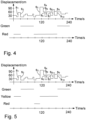
- the predictive algorithm may set an indicator 12 to "go" or “green” if no slipping above e.g. 30 cm will take place within the next 30 seconds. If not, "no-go” or “red” may be indicated instead. For psychological reasons, an indication of "no-go” is preferred as addition to “go", but in principle only the indication of one or the other suffices. Most people are familiar with the concept of traffic lights, and it is therefore preferred to simply use red and green lights on the indicator 12 to signal "go” or "no-go". The analogy will also implicitly be used in the following description.
- the duration of bow motions below a given threshold i.e. the 30 seconds mentioned above, is selected to be so long that there is sufficient time to attach the person in harness to the safety line(s) attached to the structure 3. There is thus no risk that the bow 2 of the crew transfer vessel 1 suddenly falls away below the person leaving him suspended from the safety line.
- the indicator 12 could indicate "possible” or “yellow”, until prediction yields below 30 cm for the next 30 second and goes “green” or, as the case may be, goes “red” because both thresholds are predicted to be exceeded within the duration. So, the transfer period is extended, because distinction can be made between good conditions i.e. "yellow condition", where experienced persons may transfer, and very good conditions. i.e. "green condition” where also less experienced persons may transfer. Also in this embodiment of the invention a presentation similar to a traffic light is preferred.
- a number of significant slips s 1 -s 10 up and down have been predicted, significant meaning larger than 30 cm.
- the next predicted slip s 2 is still predicted within 30 s and the indication would remain “red”. Thereafter, no slips are predicted until the rather big slip s 3 and indication would remain "green” until 30 s before the predicted slip s 3 .
- the slips s4-s10 are predicted to be between 30 cm and 60 cm and thus yield a "yellow” condition and an indication thereof.
- the duration of the time of predicted "red” condition is substantially reduced as compared to Fig. 4 .
- prediction is constantly updated based on new radar data sets and bow motion data sets, and the predictive algorithm constantly learns more about the crew transfer vessels behaviour when pressed against a structure 3.
- the mere pressing of the crew transfer vessel 1 against a structure makes the prediction difficult, and even if the response of the vessel 1 to wind, waves current etc. in general is known to some extent e.g. when floating free, the pressing against a structure 3 makes exact modelling of the response in that situation impossible.
- a predictive algorithm has been found to yield useful results, without exact modelling of each and every situation that may be experienced when pressed against a structure 3 even based solely on radar data and bow motion data.
- Prediction may, however, be improved if the predictive algorithm is trained with additional input parameters.
- One such parameter could be the force with which the crew transfer vessel 1 is pressed against structure 3, e.g. based on utilized engine power or thrust.
- Another such parameter could be the geographic location of the crew transfer vessel 1. This would allow the predictive algorithm to also learn or incorporate local factors typical for the location, such as wind, waves, swells, current etc.
- the algorithm could be specifically trained for specific locations, so that an algorithm trained for the location of the transfer could be utilized. This could be a specific training for a specific structure (monopile, jacket, floating foundation or any other structures known to a person skilled in the art) or a more general training for a larger area such as an offshore wind farm.
- the predictions based on prior knowledge of wave patterns may be put into use. For instance a prediction of "dockability" may be forecast. So if predictions by the prediction system yield that a high risk of slipping exists, this could be indicated to the skipper, thus also relieving him of the decision on whether to dock or not.
- the prediction system may give an indication to the skipper as to how to approach and dock, e.g. the optimal angle for a given wave pattern to push the crew transfer vessel 1 against the structure at, i.e. an angle yielding the best predictions for slipping under the predetermined thresholds.
- the prediction and indication system as described above is used in a method where the person is only transferred when said vessel bow motion is indicated to be below the first vessel bow motion threshold value within the first predetermined time period.
Landscapes
- Engineering & Computer Science (AREA)
- Combustion & Propulsion (AREA)
- Mechanical Engineering (AREA)
- Ocean & Marine Engineering (AREA)
- Chemical & Material Sciences (AREA)
- Software Systems (AREA)
- Environmental & Geological Engineering (AREA)
- Atmospheric Sciences (AREA)
- Life Sciences & Earth Sciences (AREA)
- Theoretical Computer Science (AREA)
- Computer Vision & Pattern Recognition (AREA)
- Evolutionary Computation (AREA)
- Computing Systems (AREA)
- General Engineering & Computer Science (AREA)
- General Physics & Mathematics (AREA)
- Mathematical Physics (AREA)
- Medical Informatics (AREA)
- Physics & Mathematics (AREA)
- Data Mining & Analysis (AREA)
- Artificial Intelligence (AREA)
- Radar, Positioning & Navigation (AREA)
- Remote Sensing (AREA)
- Traffic Control Systems (AREA)
- Radar Systems Or Details Thereof (AREA)
- Navigation (AREA)
Applications Claiming Priority (3)
| Application Number | Priority Date | Filing Date | Title |
|---|---|---|---|
| EP18181713.1A EP3590817A1 (fr) | 2018-07-04 | 2018-07-04 | Procédé d'utilisation dans un transfert d'équipage offshore |
| EP19731773.8A EP3817974B1 (fr) | 2018-07-04 | 2019-06-24 | Procédé d'utilisation dans un transfert d'équipage offshore |
| PCT/EP2019/066719 WO2020007637A1 (fr) | 2018-07-04 | 2019-06-24 | Procédé destiné au transfert d'équipage en mer |
Related Parent Applications (2)
| Application Number | Title | Priority Date | Filing Date |
|---|---|---|---|
| EP19731773.8A Division-Into EP3817974B1 (fr) | 2018-07-04 | 2019-06-24 | Procédé d'utilisation dans un transfert d'équipage offshore |
| EP19731773.8A Division EP3817974B1 (fr) | 2018-07-04 | 2019-06-24 | Procédé d'utilisation dans un transfert d'équipage offshore |
Publications (3)
| Publication Number | Publication Date |
|---|---|
| EP4265513A2 true EP4265513A2 (fr) | 2023-10-25 |
| EP4265513A3 EP4265513A3 (fr) | 2023-11-01 |
| EP4265513B1 EP4265513B1 (fr) | 2026-01-28 |
Family
ID=62873254
Family Applications (3)
| Application Number | Title | Priority Date | Filing Date |
|---|---|---|---|
| EP18181713.1A Withdrawn EP3590817A1 (fr) | 2018-07-04 | 2018-07-04 | Procédé d'utilisation dans un transfert d'équipage offshore |
| EP23195284.7A Active EP4265513B1 (fr) | 2018-07-04 | 2019-06-24 | Procédé d'utilisation dans un transfert d'équipage offshore |
| EP19731773.8A Active EP3817974B1 (fr) | 2018-07-04 | 2019-06-24 | Procédé d'utilisation dans un transfert d'équipage offshore |
Family Applications Before (1)
| Application Number | Title | Priority Date | Filing Date |
|---|---|---|---|
| EP18181713.1A Withdrawn EP3590817A1 (fr) | 2018-07-04 | 2018-07-04 | Procédé d'utilisation dans un transfert d'équipage offshore |
Family Applications After (1)
| Application Number | Title | Priority Date | Filing Date |
|---|---|---|---|
| EP19731773.8A Active EP3817974B1 (fr) | 2018-07-04 | 2019-06-24 | Procédé d'utilisation dans un transfert d'équipage offshore |
Country Status (8)
| Country | Link |
|---|---|
| US (1) | US11787511B2 (fr) |
| EP (3) | EP3590817A1 (fr) |
| JP (1) | JP7434191B2 (fr) |
| KR (1) | KR102734077B1 (fr) |
| DK (1) | DK4265513T3 (fr) |
| PL (1) | PL3817974T3 (fr) |
| TW (1) | TWI745709B (fr) |
| WO (1) | WO2020007637A1 (fr) |
Families Citing this family (6)
| Publication number | Priority date | Publication date | Assignee | Title |
|---|---|---|---|---|
| AU2021100933A4 (en) * | 2020-12-17 | 2021-04-29 | C W F Hamilton & Co Limited | Marine vessel fender and control system |
| US12077265B1 (en) * | 2021-09-08 | 2024-09-03 | Next Ocean, B.V. | Ship motion prediction system and method |
| CN116307273B (zh) * | 2023-05-17 | 2023-08-01 | 华中科技大学 | 一种基于XGBoost算法的船舶运动实时预报方法及系统 |
| GB2630132A (en) | 2023-05-19 | 2024-11-20 | Iwave Systems Ltd | Offshore crew transfer |
| CN119918949B (zh) * | 2025-03-31 | 2025-07-25 | 交通运输部水运科学研究所 | 一种基于大数据分析的邮轮运输风险评估方法及系统 |
| JP7736961B1 (ja) * | 2025-04-10 | 2025-09-09 | 日鉄エンジニアリング株式会社 | 船舶係留方法 |
Family Cites Families (12)
| Publication number | Priority date | Publication date | Assignee | Title |
|---|---|---|---|---|
| GB2427253A (en) * | 2005-06-14 | 2006-12-20 | Windcat Workboats Ltd | Technique for stabilising a boat against a structure using a fender |
| EP2078669B1 (fr) * | 2006-10-31 | 2015-06-17 | The Yokohama Rubber Co., Ltd. | Procédé et système d'assistance au pilotage/amarrage d'un navire |
| NL2006710C2 (nl) * | 2011-05-03 | 2012-11-06 | Presign Holding B V | Systeem en werkwijze voor het aanmeren van een drijvend vaartuig tegen een stationair object. |
| US10259544B2 (en) * | 2012-10-24 | 2019-04-16 | Naiad Maritime Group, Inc. | Predictive sea state mapping for ship motion control |
| GB2510418B (en) | 2013-02-04 | 2018-02-28 | Windcat Workboats Ltd | Vessel fender structure with anchor points and draw mechanisms |
| GB201303031D0 (en) * | 2013-02-21 | 2013-04-03 | Limpet Holdings Uk Ltd | Improved appratus for and method of transferring an object between a marine transport vessel and a construction or vessel |
| WO2015085352A1 (fr) * | 2013-12-11 | 2015-06-18 | Nauti-Craft Pty Ltd | Commande d'amarrage pour navires |
| JP2016044556A (ja) | 2014-08-20 | 2016-04-04 | 株式会社日立製作所 | メンテナンス計画システムまたは風力発電システム |
| DE102015108882B3 (de) * | 2015-06-04 | 2016-07-21 | Harald Hübner | Verfahren zum Anlanden eines Wasserfahrzeugs an einem Bauwerk |
| US10677891B2 (en) | 2016-09-16 | 2020-06-09 | Applied Physical Sciences Corp. | Systems and methods for wave sensing and ship motion forecasting using multiple radars |
| WO2019060411A1 (fr) * | 2017-09-19 | 2019-03-28 | Marine Technologies, Llc | Système conditionnel en ligne de conseil sur les risques (cobras) |
| US10780968B2 (en) * | 2017-11-27 | 2020-09-22 | Applied Physical Sciences Corp. | Systems and methods for wave sensing and ship motion forecasting with operational period indicators |
-
2018
- 2018-07-04 EP EP18181713.1A patent/EP3590817A1/fr not_active Withdrawn
-
2019
- 2019-06-24 PL PL19731773.8T patent/PL3817974T3/pl unknown
- 2019-06-24 JP JP2020572728A patent/JP7434191B2/ja active Active
- 2019-06-24 WO PCT/EP2019/066719 patent/WO2020007637A1/fr not_active Ceased
- 2019-06-24 US US17/255,256 patent/US11787511B2/en active Active
- 2019-06-24 DK DK23195284.7T patent/DK4265513T3/da active
- 2019-06-24 KR KR1020207037222A patent/KR102734077B1/ko active Active
- 2019-06-24 EP EP23195284.7A patent/EP4265513B1/fr active Active
- 2019-06-24 EP EP19731773.8A patent/EP3817974B1/fr active Active
- 2019-07-02 TW TW108123313A patent/TWI745709B/zh active
Also Published As
| Publication number | Publication date |
|---|---|
| EP3817974B1 (fr) | 2023-10-11 |
| WO2020007637A1 (fr) | 2020-01-09 |
| DK4265513T3 (da) | 2026-05-04 |
| JP2021528315A (ja) | 2021-10-21 |
| TW202005871A (zh) | 2020-02-01 |
| EP3817974C0 (fr) | 2023-10-11 |
| EP4265513B1 (fr) | 2026-01-28 |
| EP4265513A3 (fr) | 2023-11-01 |
| EP3817974A1 (fr) | 2021-05-12 |
| EP3590817A1 (fr) | 2020-01-08 |
| JP7434191B2 (ja) | 2024-02-20 |
| KR102734077B1 (ko) | 2024-11-25 |
| US20210129952A1 (en) | 2021-05-06 |
| PL3817974T3 (pl) | 2024-02-26 |
| KR20210048442A (ko) | 2021-05-03 |
| US11787511B2 (en) | 2023-10-17 |
| TWI745709B (zh) | 2021-11-11 |
Similar Documents
| Publication | Publication Date | Title |
|---|---|---|
| EP3817974B1 (fr) | Procédé d'utilisation dans un transfert d'équipage offshore | |
| US9849944B2 (en) | System and method for guiding cargo transfer between two bodies | |
| JP6538569B2 (ja) | 海上輸送船と建造物若しくは船舶との間で対象体を転移するための改良した装置及び方法 | |
| US20040156266A1 (en) | Harbor fence | |
| CN102498286A (zh) | 水动力装置包括其阵列的功率控制协议 | |
| CN106005264A (zh) | 一种基于自动监测控制技术的钻井平台推进器辅助锚泊定位系统 | |
| JP7473169B2 (ja) | 走錨リスク評価プログラム、走錨リスク評価システム、及び走錨リスク回避システム | |
| CN110937076B (zh) | 一种基于双通道参数的模型预测设计的船舶舒适度控制系统及其控制方法 | |
| CN111861233B (zh) | 一种防抗台期间港内锚泊船风险评估和调度规划方法 | |
| US20070022937A1 (en) | Motion compensation system for under water sonar systems | |
| Halstensen et al. | 'Next Minutes' Ocean Waves and Vessel Motion Predictions for more Efficient Offshore Lifting Operations | |
| RU2743239C1 (ru) | Способ транспортировки крупного айсберга | |
| KR20230095777A (ko) | 인공지능 기반 해상교통관제 가이던스 제공 장치 및 제공 방법 | |
| US20240367765A1 (en) | Anchor assist system for marine leisure craft | |
| CA2419707C (fr) | Dispositif de deploiement controle de canot de sauvetage | |
| JP4798346B2 (ja) | 係船管理支援システム | |
| KR20260030744A (ko) | 해양 탐지 시스템 및 방법 | |
| WO2025196088A9 (fr) | Procédé et outil mis en œuvre par ordinateur pour gérer des opérations de pont | |
| US20250196973A1 (en) | Turbine Platform Current Energy Conversion System With Debris Protection | |
| DENG | Numerical investigation of ROV deployment onboard a small offshore service vessel for offshore wind farm O&M | |
| Панасенкова et al. | On Iceberg Drift in the Barents Sea | |
| CN120867252A (zh) | 一种自动跟踪桥梁船撞拦截系统 | |
| KR20250104682A (ko) | 인공리프 시스템 | |
| CN121325204A (zh) | 基于多点定位的船舶靠泊方法、系统、设备及存储介质 | |
| CN121385899A (zh) | 一种用于湖库鱼群探测的智能化无人船及鱼群探测方法 |
Legal Events
| Date | Code | Title | Description |
|---|---|---|---|
| PUAI | Public reference made under article 153(3) epc to a published international application that has entered the european phase |
Free format text: ORIGINAL CODE: 0009012 |
|
| STAA | Information on the status of an ep patent application or granted ep patent |
Free format text: STATUS: THE APPLICATION HAS BEEN PUBLISHED |
|
| REG | Reference to a national code |
Free format text: PREVIOUS MAIN CLASS: B63B0027140000 Ipc: B63B0027300000 Ref country code: DE Ref legal event code: R079 Ref document number: 602019081073 Country of ref document: DE Free format text: PREVIOUS MAIN CLASS: B63B0027140000 Ipc: B63B0027300000 |
|
| PUAL | Search report despatched |
Free format text: ORIGINAL CODE: 0009013 |
|
| AC | Divisional application: reference to earlier application |
Ref document number: 3817974 Country of ref document: EP Kind code of ref document: P |
|
| AK | Designated contracting states |
Kind code of ref document: A2 Designated state(s): AL AT BE BG CH CY CZ DE DK EE ES FI FR GB GR HR HU IE IS IT LI LT LU LV MC MK MT NL NO PL PT RO RS SE SI SK SM TR |
|
| AK | Designated contracting states |
Kind code of ref document: A3 Designated state(s): AL AT BE BG CH CY CZ DE DK EE ES FI FR GB GR HR HU IE IS IT LI LT LU LV MC MK MT NL NO PL PT RO RS SE SI SK SM TR |
|
| RIC1 | Information provided on ipc code assigned before grant |
Ipc: B63B 27/14 20060101ALI20230928BHEP Ipc: B63B 27/30 20060101AFI20230928BHEP |
|
| STAA | Information on the status of an ep patent application or granted ep patent |
Free format text: STATUS: REQUEST FOR EXAMINATION WAS MADE |
|
| 17P | Request for examination filed |
Effective date: 20240429 |
|
| RBV | Designated contracting states (corrected) |
Designated state(s): AL AT BE BG CH CY CZ DE DK EE ES FI FR GB GR HR HU IE IS IT LI LT LU LV MC MK MT NL NO PL PT RO RS SE SI SK SM TR |
|
| GRAP | Despatch of communication of intention to grant a patent |
Free format text: ORIGINAL CODE: EPIDOSNIGR1 |
|
| STAA | Information on the status of an ep patent application or granted ep patent |
Free format text: STATUS: GRANT OF PATENT IS INTENDED |
|
| INTG | Intention to grant announced |
Effective date: 20250821 |
|
| GRAS | Grant fee paid |
Free format text: ORIGINAL CODE: EPIDOSNIGR3 |
|
| GRAA | (expected) grant |
Free format text: ORIGINAL CODE: 0009210 |
|
| STAA | Information on the status of an ep patent application or granted ep patent |
Free format text: STATUS: THE PATENT HAS BEEN GRANTED |
|
| AC | Divisional application: reference to earlier application |
Ref document number: 3817974 Country of ref document: EP Kind code of ref document: P |
|
| AK | Designated contracting states |
Kind code of ref document: B1 Designated state(s): AL AT BE BG CH CY CZ DE DK EE ES FI FR GB GR HR HU IE IS IT LI LT LU LV MC MK MT NL NO PL PT RO RS SE SI SK SM TR |
|
| REG | Reference to a national code |
Ref country code: CH Ref legal event code: F10 Free format text: ST27 STATUS EVENT CODE: U-0-0-F10-F00 (AS PROVIDED BY THE NATIONAL OFFICE) Effective date: 20260128 Ref country code: GB Ref legal event code: FG4D |
|
| REG | Reference to a national code |
Ref country code: DE Ref legal event code: R096 Ref document number: 602019081073 Country of ref document: DE |
|
| REG | Reference to a national code |
Ref country code: IE Ref legal event code: FG4D |
|
| REG | Reference to a national code |
Ref country code: DK Ref legal event code: T3 Effective date: 20260501 |