EP4265538A1 - Emballage réutilisable - Google Patents
Emballage réutilisable Download PDFInfo
- Publication number
- EP4265538A1 EP4265538A1 EP23168370.7A EP23168370A EP4265538A1 EP 4265538 A1 EP4265538 A1 EP 4265538A1 EP 23168370 A EP23168370 A EP 23168370A EP 4265538 A1 EP4265538 A1 EP 4265538A1
- Authority
- EP
- European Patent Office
- Prior art keywords
- lid
- container
- edge
- reusable packaging
- wall
- Prior art date
- Legal status (The legal status is an assumption and is not a legal conclusion. Google has not performed a legal analysis and makes no representation as to the accuracy of the status listed.)
- Granted
Links
Images

Classifications
-
- B—PERFORMING OPERATIONS; TRANSPORTING
- B65—CONVEYING; PACKING; STORING; HANDLING THIN OR FILAMENTARY MATERIAL
- B65D—CONTAINERS FOR STORAGE OR TRANSPORT OF ARTICLES OR MATERIALS, e.g. BAGS, BARRELS, BOTTLES, BOXES, CANS, CARTONS, CRATES, DRUMS, JARS, TANKS, HOPPERS, FORWARDING CONTAINERS; ACCESSORIES, CLOSURES, OR FITTINGS THEREFOR; PACKAGING ELEMENTS; PACKAGES
- B65D43/00—Lids or covers for rigid or semi-rigid containers
- B65D43/02—Removable lids or covers
- B65D43/0202—Removable lids or covers without integral tamper element
- B65D43/0214—Removable lids or covers without integral tamper element secured only by friction or gravity
- B65D43/022—Removable lids or covers without integral tamper element secured only by friction or gravity only on the inside, or a part turned to the inside, of the mouth of the container
-
- B—PERFORMING OPERATIONS; TRANSPORTING
- B65—CONVEYING; PACKING; STORING; HANDLING THIN OR FILAMENTARY MATERIAL
- B65D—CONTAINERS FOR STORAGE OR TRANSPORT OF ARTICLES OR MATERIALS, e.g. BAGS, BARRELS, BOTTLES, BOXES, CANS, CARTONS, CRATES, DRUMS, JARS, TANKS, HOPPERS, FORWARDING CONTAINERS; ACCESSORIES, CLOSURES, OR FITTINGS THEREFOR; PACKAGING ELEMENTS; PACKAGES
- B65D51/00—Closures not otherwise provided for
- B65D51/18—Arrangements of closures with protective outer cap-like covers or of two or more co-operating closures
- B65D51/20—Caps, lids, or covers co-operating with an inner closure arranged to be opened by piercing, cutting, or tearing
-
- B—PERFORMING OPERATIONS; TRANSPORTING
- B65—CONVEYING; PACKING; STORING; HANDLING THIN OR FILAMENTARY MATERIAL
- B65D—CONTAINERS FOR STORAGE OR TRANSPORT OF ARTICLES OR MATERIALS, e.g. BAGS, BARRELS, BOTTLES, BOXES, CANS, CARTONS, CRATES, DRUMS, JARS, TANKS, HOPPERS, FORWARDING CONTAINERS; ACCESSORIES, CLOSURES, OR FITTINGS THEREFOR; PACKAGING ELEMENTS; PACKAGES
- B65D43/00—Lids or covers for rigid or semi-rigid containers
- B65D43/02—Removable lids or covers
- B65D43/0202—Removable lids or covers without integral tamper element
- B65D43/0204—Removable lids or covers without integral tamper element secured by snapping over beads or projections
- B65D43/021—Removable lids or covers without integral tamper element secured by snapping over beads or projections only on the inside, or a part turned to the inside, of the mouth
-
- B—PERFORMING OPERATIONS; TRANSPORTING
- B65—CONVEYING; PACKING; STORING; HANDLING THIN OR FILAMENTARY MATERIAL
- B65D—CONTAINERS FOR STORAGE OR TRANSPORT OF ARTICLES OR MATERIALS, e.g. BAGS, BARRELS, BOTTLES, BOXES, CANS, CARTONS, CRATES, DRUMS, JARS, TANKS, HOPPERS, FORWARDING CONTAINERS; ACCESSORIES, CLOSURES, OR FITTINGS THEREFOR; PACKAGING ELEMENTS; PACKAGES
- B65D77/00—Packages formed by enclosing articles or materials in preformed containers, e.g. boxes, cartons, sacks or bags
- B65D77/10—Container closures formed after filling
- B65D77/20—Container closures formed after filling by applying separate lids or covers, i.e. flexible membrane or foil-like covers
- B65D77/2024—Container closures formed after filling by applying separate lids or covers, i.e. flexible membrane or foil-like covers the cover being welded or adhered to the container
-
- B—PERFORMING OPERATIONS; TRANSPORTING
- B65—CONVEYING; PACKING; STORING; HANDLING THIN OR FILAMENTARY MATERIAL
- B65D—CONTAINERS FOR STORAGE OR TRANSPORT OF ARTICLES OR MATERIALS, e.g. BAGS, BARRELS, BOTTLES, BOXES, CANS, CARTONS, CRATES, DRUMS, JARS, TANKS, HOPPERS, FORWARDING CONTAINERS; ACCESSORIES, CLOSURES, OR FITTINGS THEREFOR; PACKAGING ELEMENTS; PACKAGES
- B65D2543/00—Lids or covers essentially for box-like containers
- B65D2543/00009—Details of lids or covers for rigid or semi-rigid containers
- B65D2543/00018—Overall construction of the lid
- B65D2543/00064—Shape of the outer periphery
- B65D2543/00074—Shape of the outer periphery curved
- B65D2543/00092—Shape of the outer periphery curved circular
-
- B—PERFORMING OPERATIONS; TRANSPORTING
- B65—CONVEYING; PACKING; STORING; HANDLING THIN OR FILAMENTARY MATERIAL
- B65D—CONTAINERS FOR STORAGE OR TRANSPORT OF ARTICLES OR MATERIALS, e.g. BAGS, BARRELS, BOTTLES, BOXES, CANS, CARTONS, CRATES, DRUMS, JARS, TANKS, HOPPERS, FORWARDING CONTAINERS; ACCESSORIES, CLOSURES, OR FITTINGS THEREFOR; PACKAGING ELEMENTS; PACKAGES
- B65D2543/00—Lids or covers essentially for box-like containers
- B65D2543/00009—Details of lids or covers for rigid or semi-rigid containers
- B65D2543/00444—Contact between the container and the lid
- B65D2543/00481—Contact between the container and the lid on the inside or the outside of the container
- B65D2543/0049—Contact between the container and the lid on the inside or the outside of the container on the inside, or a part turned to the inside of the mouth of the container
- B65D2543/00509—Cup
-
- B—PERFORMING OPERATIONS; TRANSPORTING
- B65—CONVEYING; PACKING; STORING; HANDLING THIN OR FILAMENTARY MATERIAL
- B65D—CONTAINERS FOR STORAGE OR TRANSPORT OF ARTICLES OR MATERIALS, e.g. BAGS, BARRELS, BOTTLES, BOXES, CANS, CARTONS, CRATES, DRUMS, JARS, TANKS, HOPPERS, FORWARDING CONTAINERS; ACCESSORIES, CLOSURES, OR FITTINGS THEREFOR; PACKAGING ELEMENTS; PACKAGES
- B65D2543/00—Lids or covers essentially for box-like containers
- B65D2543/00009—Details of lids or covers for rigid or semi-rigid containers
- B65D2543/00444—Contact between the container and the lid
- B65D2543/00481—Contact between the container and the lid on the inside or the outside of the container
- B65D2543/00537—Contact between the container and the lid on the inside or the outside of the container on the outside, or a part turned to the outside of the mouth of the container
- B65D2543/00546—NO contact
-
- B—PERFORMING OPERATIONS; TRANSPORTING
- B65—CONVEYING; PACKING; STORING; HANDLING THIN OR FILAMENTARY MATERIAL
- B65D—CONTAINERS FOR STORAGE OR TRANSPORT OF ARTICLES OR MATERIALS, e.g. BAGS, BARRELS, BOTTLES, BOXES, CANS, CARTONS, CRATES, DRUMS, JARS, TANKS, HOPPERS, FORWARDING CONTAINERS; ACCESSORIES, CLOSURES, OR FITTINGS THEREFOR; PACKAGING ELEMENTS; PACKAGES
- B65D2543/00—Lids or covers essentially for box-like containers
- B65D2543/00009—Details of lids or covers for rigid or semi-rigid containers
- B65D2543/00824—Means for facilitating removing of the closure
- B65D2543/00833—Integral tabs, tongues, handles or similar
- B65D2543/00842—Integral tabs, tongues, handles or similar outside of the lid
-
- B—PERFORMING OPERATIONS; TRANSPORTING
- B65—CONVEYING; PACKING; STORING; HANDLING THIN OR FILAMENTARY MATERIAL
- B65D—CONTAINERS FOR STORAGE OR TRANSPORT OF ARTICLES OR MATERIALS, e.g. BAGS, BARRELS, BOTTLES, BOXES, CANS, CARTONS, CRATES, DRUMS, JARS, TANKS, HOPPERS, FORWARDING CONTAINERS; ACCESSORIES, CLOSURES, OR FITTINGS THEREFOR; PACKAGING ELEMENTS; PACKAGES
- B65D2543/00—Lids or covers essentially for box-like containers
- B65D2543/00009—Details of lids or covers for rigid or semi-rigid containers
- B65D2543/00953—Sealing means
- B65D2543/00962—Sealing means inserted
- B65D2543/00972—Collars or rings
Definitions
- the invention relates to a reusable container with a press-in lid.
- a reusable container is packaging that can be reused several times and can be used in a deposit system or remains with a customer for repeated use.
- Disposable packaging which is basically designed like a conventional yogurt cup sealed with foil, with the foil being inserted into the cup so that an additional paper lid can be placed on the foil.
- the paper lid has a flat base body from which individual tabs protrude, which are folded upwards when inserted into the cup and then rest on the inside of the cup. A tight press-in is not possible and also not necessary, as the seal is ensured by the sealing film.
- the cover in question is different from that DE 8613072 U1 because it is dimensionally stable.
- the lid in question has a conical lid wall that is closed all around. With the packaging in question, the lid itself seals the reusable container. There is no additional welded-on film. Furthermore, it is up to the DE 8613072 U1 the opening in one tab far above the top edge of the cup.
- the engagement element of the lid has at least one opening, with a gap being present between the upper edge of the opening and the upper edge of the container when the lid is pressed in. In other words, the gap in the present invention is limited by the upper edge of the opening of the engagement element and the upper edge of the container.
- the object on which the invention is based is to create a reusable container that can be easily sealed and can be produced with little use of material.
- a reusable packaging in the form of a container, which is present in combination with a lid that can be pressed into the container, the container having a conical press-in area at its upper edge region and a container edge above the press-in region, and the lid having a downwardly offset lid bottom and has a conical lid wall rising from this, wherein the lid with its conical lid wall can be pressed into the press-in area of the container, the lid having at least one engagement element which connects to the upper edge of the conical lid wall and projects upwards beyond it, the engagement element at least has an opening and wherein when the lid is pressed in there is a gap between the upper edge of the opening and the upper edge of the container.
- the gap is continuously open from the outside of the lid to the inside of the lid.
- the lower edge of the opening lies below the edge of the container when the lid is pressed in.
- the engagement element comprises a tab with an opening, wherein when the lid is pressed on, the upper edge of the opening lies above the edge of the container and the lower edge of the opening lies below the edge of the container.
- the engagement element has the same inclination as the cover wall and is connected in one piece with it.
- the lid comprises two engagement elements which lie opposite one another on the lid wall.
- the lid or the container or both comprise a flange, the flanging of the lid being on the inside in relation to the lid wall and the flanging of the container being on the outside in relation to the container wall.
- the cover has a circumferential groove in the outer surface of the cover wall and a sealing ring can be inserted or inserted into this groove. It is preferred that the lid and the container are each dimensionally stable at least in the press-in area.
- the lid and the container are dimensionally stable bodies.
- the cover wall is closed in the circumferential direction and comprises a hollow truncated cone-shaped lateral surface.
- the gap is limited at the top by the upper edge of the opening of the engagement element and at the bottom by the upper edge of the container.
- One embodiment variant relates to a filled physical reusable packaging, in which a medium to be packaged, in particular a food, is present and the lid is pressed into the container.
- the sealing of the reusable packaging takes place exclusively between the top wall and the press-in area of the container.
- the reusable packaging in question comprises a container which has a conical press-in area at the upper edge region, the container being present in combination with a lid which has a downwardly offset base and a conical wall rising from it, which can be pressed into the press-in area of the container.
- the lid also has at least one engagement element which connects to the upper edge of the conical wall and projects upwards beyond it.
- the engagement element is preferably present as a tab with an opening. When the lid is pressed in, the engagement element projects beyond the upper edge of the container.
- the engagement element has an opening which lies partly above the upper edge of the container and partly below the edge of the container.
- a suitable tool is something that is narrow enough to be inserted into the opening of the tab, such as a wooden stick or the handle of a fork or spoon.
- a suitable tool can be included in one version of the reusable packaging.
- the conical wall of the lid is closed all around.
- the cover wall preferably has a hollow truncated cone-shaped lateral surface which is closed in the circumferential direction.
- the side of the bottom of the lid facing away from the lid wall faces the bottom of the container.
- the lid preferably does not have a handle located centrally on the base of the lid, which is used to open the lid.
- a carrying handle can be placed in these two engagement elements.
- the upper edge of the conical wall of the lid is preferably below the upper edge of the container.
- the container can have any shape.
- the area below the press-in area can be conical, vertical, or cylindrical.
- the empty containers can preferably be stacked one inside the other, as is known from drinking cups.
- the angle between the container wall and the vertical in the press-in area is preferably between 3 and 13 degrees.
- the angle between the top wall and the vertical is preferably between 3 and 13 degrees.
- the container and the lid are preferably designed to be circular, so that the lid can be placed on the container in any orientation.
- the lid has at least one engagement element.
- the cover has two opposing engagement elements.
- the engagement element or the plurality of engagement elements are preferably connected in one piece to the lid and are preferably present in a direct extension of the conical lid wall.
- the lid can be pressed into the container without any additional means, with a strong hold created solely by the conical shapes of the two parts. This effect can be referred to as the cone effect.
- the connection between container and lid is a self-locking cone connection.
- a wetting agent or an adhesive substance can also be applied between the lid and the container.
- an elastic sealing element in particular a sealing ring, can be present between the lid and the container.
- the adhesive substance or the elastic sealing element can contribute to forming a hermetic or airtight packaging.
- the container and the lid are made of metal. Preferably made of stainless steel or titanium.
- the container and the lid are preferably each deep-drawn from a sheet of metal.
- the wall thickness of the container and/or the lid is preferably in the range of 0.3-1.3 mm.
- the container or the lid can be made of another material, for example plastic or glass.
- Hard plastic especially thermosets, is suitable as plastic.
- the container and the lid are part of the reusable packaging, in the sense that both parts are reused several times and/or are in a circulation system.
- the container is designed as reusable packaging (especially with a deposit), whereby the lid, in particular in the form of a plastic, cardboard or fiber material lid, can be disposed of.
- the container and the lid are preferably dimensionally stable bodies, so that when the lid is pressed in, the container wall and the lid wall cannot be moved apart in the radial direction.
- the lid can only be removed from the container in the axial direction.
- the upper edge of the container can be flanged outwards.
- the upper edge of the lid can be rolled inwards.
- the engagement element can have a flange on its outer edge.
- the opening of the engagement element can have a flange.
- the opening can be formed by completely punching out an area of the tab.
- the opening can be done partially Punching (for example in a U-shape, in an H-shape, or star shape) and folding or curling the punched tongue(s).
- the lid preferably does not rest on the upper edge of the container and/or does not overlap the edge of the container in the radial direction.
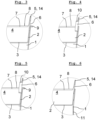
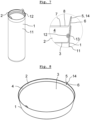
- the reusable packaging comprises a container 1, which is present in combination with a lid 2.
- the lid 2 includes a lid base 3, which is surrounded by a conical lid wall 4.
- the Top wall 4 runs obliquely outwards from the top base 3.
- the cover wall 4 is preferably monolithically connected to the cover base 3.
- the lid 2 comprises at least one engagement element 5, which extends upwards away from the lid wall 4.
- the engagement element 5 is preferably monolithically connected to the cover wall 4.
- the engagement element 5 preferably has the same angle of inclination as the cover wall 4.
- the engagement element 5 has an opening 6.
- the opening 6 lies at least partially above the lid edge 7.
- the opening 6 preferably lies partially above the lid edge 7 and partially below the lid edge 7.
- the engagement element 5 is present in such a way that when the lid 2 is pressed on, a tool can be placed in the gap between the upper section 14 of the engagement element 5 and the container edge 8.
- the gap is continuously open from the outside of the lid 2 to the inside of the lid 2.
- the upper section 14 of the engagement element 5 is connected to the cover wall 4 on both sides in order to prevent deformation due to the lever force.
- the engagement element 5 is preferably formed by a tab which has exactly one opening 6. The The upper edge of the opening 6 is above the edge of the container 8 when the lid 2 is pressed on. The lower edge of the opening 6 is below the edge of the container 8 when the lid 2 is pressed on.
- the opening 6 can be round as shown, but can also be oval or rectangular with rounded corners, for example.
- the position of the lid edge 7 away from the engagement elements 5 is not crucial, so that the lid edge 7 in these areas when the lid 2 is pressed on is either below the container edge 8 ( Fig. 2 and 3 ) or flush with the edge of the container 8 ( Fig. 1 ) or above the container edge 8 (not shown). However, it is preferred that the lid edge 7 lies below the container edge 8 in these areas when the lid 2 is pressed on. In this case, damage to the upper edge of the container 8 does not necessarily lead to damage, for example scratching, to the outer lid wall 4.
- the lower edge of the opening 6 is preferably below the lid edge 7 away from the engagement elements 5.
- the container edge 8 lies in the range of 1/3 to 2/3 of the height of the opening 6 when the lid 2 is pressed on. Particularly preferably, the container edge 8 lies approximately halfway up the opening 6 when the lid 2 is pressed on.
- the distance between the upper edge of the opening 6 of the engagement element 5 and the container edge 8 is preferably at least 1 mm, particularly preferably at least 2 mm, in particular at least 3 mm.
- the distance between the lower edge of the opening 6 of the engagement element 5 and the container edge 8 is preferably at least 1 mm, particularly preferably at least 2 mm, in particular at least 3 mm.
- the container edge 8 and the lid edge 7 can be present without flanging, i.e. with a simple edge.
- the exposed edges are preferred rounded. It is preferred that the container edge 8 and/or the lid edge 7 has a single edge that is oriented upwards.
- the simple edge is preferably in a straight extension or as the upper edge of the conical cover wall 4.
- the simple edge is preferably in a straight extension or as the upper edge of the conical press-in area of the container 1.
- Fig. 3 illustrates that the container wall can be shaped outwards (and preferably downwards) at the container edge 8.
- the flange 9 can also be made thicker, so that the free edge rests on the outside of the container wall and/or is covered by the flange 9.
- a carrying handle can be placed on the container 1 at or below the flange 9, as is known from buckets, for example.
- a carrying handle in particular made of wire with hook-shaped ends, can also be detachably attached in the openings 6 of two engagement elements 5, regardless of the design of the container 1.
- the container 1 can have two opposing tabs with openings for a carrying handle, similar to the lid 2 shown.
- the cover 2 has three or more engagement elements 5, or the two engagement elements 5 are not arranged opposite one another. This ensures that, regardless of the orientation of the lid 2, there is always an engagement element 5 that is not covered by a tab of the container 1.
- the opening 6 of the engagement element 5 can have an inwardly molded opening edge. If only the upper edge of the opening 6 is reshaped, the reshaping can also take place outwards.
- the flange 10 can also be made stronger than shown, so that the free edge rests on the cover wall 4 and/or from it Flaring 10 is covered.
- a punched-out material tongue from the engagement element 5 can be formed outwardly upwards or inwards to form the opening 6 (not shown).
- both the container 1 and the lid 2 can have a flange 9, 10.
- the container wall is shown to be completely conical.
- the container wall can have a constant inclination over its entire height.
- the inclination of the outer surface of the container wall and the inner surface of the container surface can be slightly different, which can be achieved by the material thickness of the container wall being different at the top and bottom ends.
- the outer surface and/or inner surface of the container wall can also be provided with a bend and thus have at least two areas with different inclinations.
- the container wall is provided with a structure or an engraving on the outside. This makes it easier to separate empty, nested containers 1 from each other, since air can pass through channels in the structure or engraving.
- the container Inside the press-in area, the container has a flat and smooth surface.
- the inner surface of the container is preferably polished, at least in the press-in area, or has a mirror-smooth finish (i.e. not brushed or structured in any other way).
- the inner surface of the container wall can have a structure or elevations, for example an embossing can be present as a depression in the outer surface and an elevation in the inner surface of the container wall.
- the outside of the cover wall 4 is flat and smooth, in particular polished or mirror-smooth.
- the container bottom is shown flat in the figures, but it can also be shaped in a dome shape towards the inside.
- the lid base 3 is shown flat in the figures, this can but also be shaped dome-shaped inwards or dome-shaped outwards.
- the lower end of the container 1 finds space in the interior of the lid 2 (formed by the lid base 3 and the lid wall 4), so that filled reusable packaging can be stacked well.
- the container 1 can have a differently shaped area, in particular a vertical or cylindrical area 11, below the upper conical press-in area. This structure is advantageous for reusable packaging in the form of bottles.
- the container 1 can have an area that tapers downwards, so that the lower end of a container 1 can be placed in the interior of a lid 2.
- the contents of the reusable packaging can be sealed purely by pressing in the lid 2, especially if the reusable packaging is used several times by a customer, for example as a lunch box.
- An improved seal can be achieved by wetting, for example with an adhesive liquid.
- the liquid is preferably food-safe or a foodstuff, for example the liquid can contain sugar and can be present, for example, as a syrup (beet, maple, ).
- FIG. 7 Another variant for sealing is shown, in which a sealing ring 13 is present between the container wall and the cover wall 4. As shown, it is preferred that the sealing ring 13 is present in a groove in the cover wall 4. The groove is preferably formed by an annular constriction 12 in the cover wall 4. The groove can be located approximately halfway between the lower edge of the cover wall 4 and the lower edge of the openings 6. It is assumed that this packaging is advantageous if partial quantities are removed from it several times, since a seal is created by the sealing ring when it is resealed. This type of packaging is suitable especially for liquids, such as milk, juices and other drinks.
- a bowl- or plate-shaped packaging can also be realized.
- the height and width of the container 1 and their ratio can therefore be dimensioned differently depending on the intended use.
- the or each engagement element 5 is preferably designed to be discrete, as shown in the figures, and therefore only extends over a partial area of the cover wall 4.
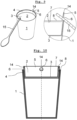
- Fig. 9 is illustrated how a tool, for example in the form of a spoon 15, can be guided through the opening 6 in order to be able to apply a force between the container edge 8 and the upper edge of the opening 6.
- the force causes the lid 2 to be moved upwards or axially out of the container 1.
- the engagement element 5 can also be present continuously, all around the cover wall 4 and be provided with at least one opening 6, in particular several openings 6 ( Fig. 10 ).
- the upper edge of the engagement element forms the upper lid edge 7, which is then above the container edge 8.
- the lid edge 7 can be flanged outwards, with the flanging preferably extending up to (at most) the upper edge of the opening 6.
- the disadvantage is the increased material requirement compared to the other variants Fig. 1-9 .
- An engagement element 5 with several openings 6 can also extend over a portion of the cover wall 4, for example as a tab with two openings 6.
Landscapes
- Engineering & Computer Science (AREA)
- Mechanical Engineering (AREA)
- Closures For Containers (AREA)
Applications Claiming Priority (1)
| Application Number | Priority Date | Filing Date | Title |
|---|---|---|---|
| ATA50268/2022A AT525969B1 (de) | 2022-04-22 | 2022-04-22 | Mehrwegverpackung |
Publications (3)
| Publication Number | Publication Date |
|---|---|
| EP4265538A1 true EP4265538A1 (fr) | 2023-10-25 |
| EP4265538C0 EP4265538C0 (fr) | 2025-12-24 |
| EP4265538B1 EP4265538B1 (fr) | 2025-12-24 |
Family
ID=86053877
Family Applications (1)
| Application Number | Title | Priority Date | Filing Date |
|---|---|---|---|
| EP23168370.7A Active EP4265538B1 (fr) | 2022-04-22 | 2023-04-18 | Emballage réutilisable |
Country Status (3)
| Country | Link |
|---|---|
| EP (1) | EP4265538B1 (fr) |
| AT (1) | AT525969B1 (fr) |
| DE (1) | DE102023110083A1 (fr) |
Citations (9)
| Publication number | Priority date | Publication date | Assignee | Title |
|---|---|---|---|---|
| US1403571A (en) * | 1919-12-23 | 1922-01-17 | American Cigar Company | Removable cover for containers |
| US1778175A (en) * | 1929-02-12 | 1930-10-14 | Thune Enoch Emanuel | Metallic receptacle |
| US2063185A (en) * | 1934-12-04 | 1936-12-08 | Nave Charles Arlin | Container |
| EP0161909A2 (fr) * | 1984-05-12 | 1985-11-21 | David Philip Moakes | Récipient tubulaire |
| DE8613072U1 (de) | 1986-05-14 | 1986-07-31 | Novoplast-Verpackungen Gmbh & Co Kg, 7970 Leutkirch | Verpackungsbecher mit aufgesiegeltem Folienverschluß |
| DE202007015728U1 (de) | 2007-11-12 | 2008-04-24 | Kuo, Wen-Lung, Kui Shan | Umweltfreundlicher Papierbecher mit Papierdeckel |
| US20100206763A1 (en) | 2009-02-19 | 2010-08-19 | Bongrain Sa | Receptacle Particularly for Solid or Pasty Products, its Method of Manufacture and Packaging Comprising this Receptacle and a Container Receiving Same |
| DE102011112505A1 (de) * | 2011-09-07 | 2013-03-07 | Feldmann+Schultchen Design Studios Gmbh | Trinkbecherdeckel mit Dichtungsrand |
| US20150251825A1 (en) | 2012-10-04 | 2015-09-10 | Å&R Carton Lund Ab | Sealing Membrane with Pull-Tab |
-
2022
- 2022-04-22 AT ATA50268/2022A patent/AT525969B1/de active
-
2023
- 2023-04-18 EP EP23168370.7A patent/EP4265538B1/fr active Active
- 2023-04-20 DE DE102023110083.1A patent/DE102023110083A1/de active Pending
Patent Citations (9)
| Publication number | Priority date | Publication date | Assignee | Title |
|---|---|---|---|---|
| US1403571A (en) * | 1919-12-23 | 1922-01-17 | American Cigar Company | Removable cover for containers |
| US1778175A (en) * | 1929-02-12 | 1930-10-14 | Thune Enoch Emanuel | Metallic receptacle |
| US2063185A (en) * | 1934-12-04 | 1936-12-08 | Nave Charles Arlin | Container |
| EP0161909A2 (fr) * | 1984-05-12 | 1985-11-21 | David Philip Moakes | Récipient tubulaire |
| DE8613072U1 (de) | 1986-05-14 | 1986-07-31 | Novoplast-Verpackungen Gmbh & Co Kg, 7970 Leutkirch | Verpackungsbecher mit aufgesiegeltem Folienverschluß |
| DE202007015728U1 (de) | 2007-11-12 | 2008-04-24 | Kuo, Wen-Lung, Kui Shan | Umweltfreundlicher Papierbecher mit Papierdeckel |
| US20100206763A1 (en) | 2009-02-19 | 2010-08-19 | Bongrain Sa | Receptacle Particularly for Solid or Pasty Products, its Method of Manufacture and Packaging Comprising this Receptacle and a Container Receiving Same |
| DE102011112505A1 (de) * | 2011-09-07 | 2013-03-07 | Feldmann+Schultchen Design Studios Gmbh | Trinkbecherdeckel mit Dichtungsrand |
| US20150251825A1 (en) | 2012-10-04 | 2015-09-10 | Å&R Carton Lund Ab | Sealing Membrane with Pull-Tab |
Also Published As
| Publication number | Publication date |
|---|---|
| AT525969B1 (de) | 2023-10-15 |
| DE102023110083A1 (de) | 2023-10-26 |
| EP4265538C0 (fr) | 2025-12-24 |
| EP4265538B1 (fr) | 2025-12-24 |
| AT525969A4 (de) | 2023-10-15 |
Similar Documents
| Publication | Publication Date | Title |
|---|---|---|
| EP1385745B1 (fr) | Couvercle de contenant et contenant | |
| EP0078403A2 (fr) | Récipient pour produits fluides muni d'un couvercle en matière plastique | |
| EP0011292B1 (fr) | Récipient d'emballage en forme de gobelet | |
| WO2000051908A1 (fr) | Chapeau rapporte facilitant la boisson et le deversement pour boites-boisson | |
| AT525969B1 (de) | Mehrwegverpackung | |
| EP2070826B1 (fr) | Récipient doté d'un élément de fermeture à ouverture facile | |
| DE3201469A1 (de) | Wiederverschliessbarer metalldeckel fuer eine dose fuer fluessige fuellgueter | |
| DE2825837C3 (de) | Aus Kunststoff-Folie geformter Behälter | |
| DE8713290U1 (de) | Behälter aus thermoformbarem Kunststoff | |
| EP0167666A2 (fr) | Récipient pour matières pâteuses ou semi-fluides | |
| EP1507714B1 (fr) | Bouchon verseur pour emballages pour liquide | |
| DE20206956U1 (de) | Behälterdeckel sowie Behälter | |
| EP3344559B1 (fr) | Fermeture de canette de boisson et ensemble composé de la canette de boisson et de la fermeture | |
| EP0887284A1 (fr) | Dispositif pour contenir des denrées alimentaires | |
| DE2439695C3 (de) | Behältnis | |
| EP2722284A1 (fr) | Emballage sous forme de gobelet | |
| DE102015116527B3 (de) | Behälter aus Kunststoff für ein Verschließen mit einem Nocken-Drehverschluss | |
| DE9421513U1 (de) | Becherförmiger Behälter | |
| EP0868355B1 (fr) | Corps de boite a conserves | |
| EP3699109B1 (fr) | Récipient pour recevoir des denrées alimentaires | |
| DE202007015084U1 (de) | Behälter | |
| EP0383235B1 (fr) | Récipient d'emballage | |
| DE19936977A1 (de) | Verschlußdeckel für ein Getränkeglas | |
| DE3229081A1 (de) | Deckel fuer einwegbehaelter | |
| DE19941040A1 (de) | Behälter für Güter, wie Flüssigkeiten, Streugut oder dergleichen |
Legal Events
| Date | Code | Title | Description |
|---|---|---|---|
| PUAI | Public reference made under article 153(3) epc to a published international application that has entered the european phase |
Free format text: ORIGINAL CODE: 0009012 |
|
| STAA | Information on the status of an ep patent application or granted ep patent |
Free format text: STATUS: THE APPLICATION HAS BEEN PUBLISHED |
|
| AK | Designated contracting states |
Kind code of ref document: A1 Designated state(s): AL AT BE BG CH CY CZ DE DK EE ES FI FR GB GR HR HU IE IS IT LI LT LU LV MC ME MK MT NL NO PL PT RO RS SE SI SK SM TR |
|
| STAA | Information on the status of an ep patent application or granted ep patent |
Free format text: STATUS: REQUEST FOR EXAMINATION WAS MADE |
|
| 17P | Request for examination filed |
Effective date: 20240313 |
|
| RBV | Designated contracting states (corrected) |
Designated state(s): AL AT BE BG CH CY CZ DE DK EE ES FI FR GB GR HR HU IE IS IT LI LT LU LV MC ME MK MT NL NO PL PT RO RS SE SI SK SM TR |
|
| GRAP | Despatch of communication of intention to grant a patent |
Free format text: ORIGINAL CODE: EPIDOSNIGR1 |
|
| STAA | Information on the status of an ep patent application or granted ep patent |
Free format text: STATUS: GRANT OF PATENT IS INTENDED |
|
| INTG | Intention to grant announced |
Effective date: 20250728 |
|
| GRAS | Grant fee paid |
Free format text: ORIGINAL CODE: EPIDOSNIGR3 |
|
| GRAA | (expected) grant |
Free format text: ORIGINAL CODE: 0009210 |
|
| STAA | Information on the status of an ep patent application or granted ep patent |
Free format text: STATUS: THE PATENT HAS BEEN GRANTED |
|
| AK | Designated contracting states |
Kind code of ref document: B1 Designated state(s): AL AT BE BG CH CY CZ DE DK EE ES FI FR GB GR HR HU IE IS IT LI LT LU LV MC ME MK MT NL NO PL PT RO RS SE SI SK SM TR |
|
| REG | Reference to a national code |
Ref country code: CH Ref legal event code: F10 Free format text: ST27 STATUS EVENT CODE: U-0-0-F10-F00 (AS PROVIDED BY THE NATIONAL OFFICE) Effective date: 20251224 Ref country code: GB Ref legal event code: FG4D Free format text: NOT ENGLISH |
|
| REG | Reference to a national code |
Ref country code: DE Ref legal event code: R096 Ref document number: 502023002551 Country of ref document: DE |
|
| U01 | Request for unitary effect filed |
Effective date: 20260107 |
|
| U07 | Unitary effect registered |
Designated state(s): AT BE BG DE DK EE FI FR IT LT LU LV MT NL PT RO SE SI Effective date: 20260112 |
|
| PG25 | Lapsed in a contracting state [announced via postgrant information from national office to epo] |
Ref country code: NO Free format text: LAPSE BECAUSE OF FAILURE TO SUBMIT A TRANSLATION OF THE DESCRIPTION OR TO PAY THE FEE WITHIN THE PRESCRIBED TIME-LIMIT Effective date: 20260324 |
|
| PG25 | Lapsed in a contracting state [announced via postgrant information from national office to epo] |
Ref country code: HR Free format text: LAPSE BECAUSE OF FAILURE TO SUBMIT A TRANSLATION OF THE DESCRIPTION OR TO PAY THE FEE WITHIN THE PRESCRIBED TIME-LIMIT Effective date: 20251224 |
|
| PG25 | Lapsed in a contracting state [announced via postgrant information from national office to epo] |
Ref country code: RS Free format text: LAPSE BECAUSE OF FAILURE TO SUBMIT A TRANSLATION OF THE DESCRIPTION OR TO PAY THE FEE WITHIN THE PRESCRIBED TIME-LIMIT Effective date: 20260324 |
|
| U20 | Renewal fee for the european patent with unitary effect paid |
Year of fee payment: 4 Effective date: 20260323 |