EP4266028A1 - Système optique d'émission, dispositif d'émission et dispositif de mesure optique - Google Patents
Système optique d'émission, dispositif d'émission et dispositif de mesure optique Download PDFInfo
- Publication number
- EP4266028A1 EP4266028A1 EP21924761.6A EP21924761A EP4266028A1 EP 4266028 A1 EP4266028 A1 EP 4266028A1 EP 21924761 A EP21924761 A EP 21924761A EP 4266028 A1 EP4266028 A1 EP 4266028A1
- Authority
- EP
- European Patent Office
- Prior art keywords
- light
- lens
- irradiation
- optical system
- shaping member
- Prior art date
- Legal status (The legal status is an assumption and is not a legal conclusion. Google has not performed a legal analysis and makes no representation as to the accuracy of the status listed.)
- Withdrawn
Links
Images





Classifications
-
- G—PHYSICS
- G01—MEASURING; TESTING
- G01N—INVESTIGATING OR ANALYSING MATERIALS BY DETERMINING THEIR CHEMICAL OR PHYSICAL PROPERTIES
- G01N21/00—Investigating or analysing materials by the use of optical means, i.e. using sub-millimetre waves, infrared, visible or ultraviolet light
- G01N21/01—Arrangements or apparatus for facilitating the optical investigation
-
- G—PHYSICS
- G01—MEASURING; TESTING
- G01N—INVESTIGATING OR ANALYSING MATERIALS BY DETERMINING THEIR CHEMICAL OR PHYSICAL PROPERTIES
- G01N21/00—Investigating or analysing materials by the use of optical means, i.e. using sub-millimetre waves, infrared, visible or ultraviolet light
- G01N21/62—Systems in which the material investigated is excited whereby it emits light or causes a change in wavelength of the incident light
- G01N21/63—Systems in which the material investigated is excited whereby it emits light or causes a change in wavelength of the incident light optically excited
- G01N21/64—Fluorescence; Phosphorescence
- G01N21/645—Specially adapted constructive features of fluorimeters
-
- G—PHYSICS
- G01—MEASURING; TESTING
- G01N—INVESTIGATING OR ANALYSING MATERIALS BY DETERMINING THEIR CHEMICAL OR PHYSICAL PROPERTIES
- G01N21/00—Investigating or analysing materials by the use of optical means, i.e. using sub-millimetre waves, infrared, visible or ultraviolet light
- G01N21/62—Systems in which the material investigated is excited whereby it emits light or causes a change in wavelength of the incident light
- G01N21/63—Systems in which the material investigated is excited whereby it emits light or causes a change in wavelength of the incident light optically excited
- G01N21/64—Fluorescence; Phosphorescence
-
- G—PHYSICS
- G01—MEASURING; TESTING
- G01N—INVESTIGATING OR ANALYSING MATERIALS BY DETERMINING THEIR CHEMICAL OR PHYSICAL PROPERTIES
- G01N21/00—Investigating or analysing materials by the use of optical means, i.e. using sub-millimetre waves, infrared, visible or ultraviolet light
- G01N21/75—Systems in which material is subjected to a chemical reaction, the progress or the result of the reaction being investigated
- G01N21/77—Systems in which material is subjected to a chemical reaction, the progress or the result of the reaction being investigated by observing the effect on a chemical indicator
- G01N21/78—Systems in which material is subjected to a chemical reaction, the progress or the result of the reaction being investigated by observing the effect on a chemical indicator producing a change of colour
-
- G—PHYSICS
- G01—MEASURING; TESTING
- G01N—INVESTIGATING OR ANALYSING MATERIALS BY DETERMINING THEIR CHEMICAL OR PHYSICAL PROPERTIES
- G01N21/00—Investigating or analysing materials by the use of optical means, i.e. using sub-millimetre waves, infrared, visible or ultraviolet light
- G01N21/62—Systems in which the material investigated is excited whereby it emits light or causes a change in wavelength of the incident light
- G01N21/63—Systems in which the material investigated is excited whereby it emits light or causes a change in wavelength of the incident light optically excited
- G01N21/64—Fluorescence; Phosphorescence
- G01N21/645—Specially adapted constructive features of fluorimeters
- G01N2021/6463—Optics
-
- G—PHYSICS
- G01—MEASURING; TESTING
- G01N—INVESTIGATING OR ANALYSING MATERIALS BY DETERMINING THEIR CHEMICAL OR PHYSICAL PROPERTIES
- G01N21/00—Investigating or analysing materials by the use of optical means, i.e. using sub-millimetre waves, infrared, visible or ultraviolet light
- G01N21/62—Systems in which the material investigated is excited whereby it emits light or causes a change in wavelength of the incident light
- G01N21/63—Systems in which the material investigated is excited whereby it emits light or causes a change in wavelength of the incident light optically excited
- G01N21/64—Fluorescence; Phosphorescence
- G01N21/645—Specially adapted constructive features of fluorimeters
- G01N2021/6463—Optics
- G01N2021/6471—Special filters, filter wheel
-
- G—PHYSICS
- G01—MEASURING; TESTING
- G01N—INVESTIGATING OR ANALYSING MATERIALS BY DETERMINING THEIR CHEMICAL OR PHYSICAL PROPERTIES
- G01N21/00—Investigating or analysing materials by the use of optical means, i.e. using sub-millimetre waves, infrared, visible or ultraviolet light
- G01N21/62—Systems in which the material investigated is excited whereby it emits light or causes a change in wavelength of the incident light
- G01N21/63—Systems in which the material investigated is excited whereby it emits light or causes a change in wavelength of the incident light optically excited
- G01N21/64—Fluorescence; Phosphorescence
- G01N21/645—Specially adapted constructive features of fluorimeters
- G01N2021/6463—Optics
- G01N2021/6478—Special lenses
-
- G—PHYSICS
- G01—MEASURING; TESTING
- G01N—INVESTIGATING OR ANALYSING MATERIALS BY DETERMINING THEIR CHEMICAL OR PHYSICAL PROPERTIES
- G01N21/00—Investigating or analysing materials by the use of optical means, i.e. using sub-millimetre waves, infrared, visible or ultraviolet light
- G01N21/75—Systems in which material is subjected to a chemical reaction, the progress or the result of the reaction being investigated
- G01N21/77—Systems in which material is subjected to a chemical reaction, the progress or the result of the reaction being investigated by observing the effect on a chemical indicator
- G01N2021/7769—Measurement method of reaction-produced change in sensor
- G01N2021/7786—Fluorescence
-
- G—PHYSICS
- G01—MEASURING; TESTING
- G01N—INVESTIGATING OR ANALYSING MATERIALS BY DETERMINING THEIR CHEMICAL OR PHYSICAL PROPERTIES
- G01N21/00—Investigating or analysing materials by the use of optical means, i.e. using sub-millimetre waves, infrared, visible or ultraviolet light
- G01N21/84—Systems specially adapted for particular applications
- G01N21/8483—Investigating reagent band
Definitions
- the present disclosure relates to an irradiation optical system, an irradiation device, and an optical measurement device.
- Patent Literature 1 and Patent Literature 2 describe an optical unit that is used for a sample concentration measurement device.
- the optical unit includes a semiconductor laser serving as a light source, a collimating lens converting a beam emitted from the semiconductor laser to a collimated beam, a cylindrical lens on which the beam passing through the collimating lens is incident via an aperture and a beam splitter and which guides the beam to an immunochromatographic test piece, and an optical bench accommodating these constituents.
- a beam emitted from the semiconductor laser is changed to a collimated beam while passing through the collimating lens.
- the collimated beam is incident on a polarizing beam splitter via an aperture.
- the beam passing through the polarizing beam splitter is incident on the cylindrical lens, is caused to form an image in a longitudinal direction of the immunochromatographic test piece by the cylindrical lens, and is applied to the immunochromatographic test piece.
- the present disclosure provides an irradiation optical system, an irradiation device, and an optical measurement device that enable more uniform light irradiation.
- An irradiation optical system configured to irradiate an object with first light
- the irradiation optical system comprising: a light source including a surface emitting element configured to emit the first light from a light emitting surface and a lens part configured to enhance directivity of the first light emitted from the surface emitting element; a light shaping member on which the first light emitted from the light source is incident via a light incidence surface and which shapes and emits the incident first light by a light passing hole and emits the shaped first light; and a first lens configured to form an image of the first light emitted from the light shaping member on the object, wherein a distance between the light emitting surface of the surface emitting element and the light incidence surface of the light shaping member is equal to or less than 26 times a size in one direction of the light emitting surface.
- first light emitted from the light source is shaped by the light shaping member and is then emitted to an object via the first lens.
- the light source includes the surface emitting element and the lens part configured to enhance directivity of the first light emitted from the surface emitting element.
- the distance between the light emitting surface of the surface emitting element and the light incidence surface of the light shaping member is equal to or less than 26 times the size in one direction of the light emitting surface of the surface emitting element.
- the size in one direction of the light emitting surface of the surface emitting element is, for example, a size in a longitudinal direction when the light emitting surface of the surface emitting element has the longitudinal direction.
- the irradiation optical system according to the present disclosure may further include a second lens provided between the light source and the first lens and configured to correct an aberration which is generated in the first lens. In this case, it is possible to perform irradiation with more uniform light.
- the second lens may be provided between the light source and the light shaping member or between the light shaping member and the first lens and have a function of enhancing directivity of the first light emitted from the light source. In this case, it is possible to reduce a loss due to diffusion of the first light.
- the second lens may be fixed to the light shaping member. In this case, a mechanism for separately holding the second lens is not necessary.
- the light source may include a light-transmitting portion with optical transparency configured to seal the surface emitting element, and the lens part may be formed in the light-transmitting portion and be integrated with the surface emitting element. In this case, it is possible to facilitate handling or positioning of the surface emitting element and the lens part.
- the irradiation optical system according to the present disclosure may further include a first wavelength selection filter provided between the light source and the first lens and configured to selectively transmit some wavelength components of the first light to the first lens. In this case, it is possible to selectively irradiate an object with some wavelength components of the first light.
- An irradiation device includes the aforementioned irradiation optical system and a housing accommodating the irradiation optical system, wherein the housing includes a first spatial portion in which an optical path of the first light is formed and a first inner wall surface defining the first spatial portion.
- a first widened portion widened between the light shaping member and the first lens may be formed in the first spatial portion, and the first inner wall surface may include a first crossing surface crossing an optical path of the first light and facing the light shaping member in the first widened portion.
- the first crossing surface since light propagating obliquely with a predetermined angle or greater from the light shaping member to the first lens is trapped by the first crossing surface, it is possible to curb generation of stray light.
- the irradiation device may further include a first light detector provided on the first inner wall surface to face an optical path of the first light and configured to detect a light amount of the first light emitted from the light source by detecting a part of the first light emitted and diffused from the light source. In this case, it is possible to monitor a light amount of the first light.
- the irradiation device may further include a drive circuit configured to drive the surface emitting element to keep the light amount constant while receiving a detection signal indicating the light amount of the first light from the light detector. In this case, it is possible to perform irradiation with light having a stable light amount.
- the housing may be formed of a material with absorbency for the first light.
- the housing may be formed of a material which does not cause autofluorescence in response to the first light. In this case, it is possible to more reliably curb generation of stray light.
- An optical measurement device includes the aforementioned irradiation device and a detection optical system configured to detect second light from the object irradiated with the first light, wherein the housing further accommodates the detection optical system and includes a second spatial portion in which an optical path of the second light is formed and a second inner wall surface defining the second spatial portion, and the detection optical system includes a second light detector configured to detect the second light and a third lens configured to focus the second light on the second light detector.
- the optical measurement device may further include a second wavelength selection filter provided between the third lens and the second light detector and configured to selectively transmit some wavelength components of the second light to the second light detector. In this case, it is possible to selectively detect some wavelength components of the second light.
- a second widened portion widened between the third lens and the second wavelength selection filter may be formed in the second spatial portion, and the second inner wall surface may include a second crossing surface crossing an optical path of the second light and facing the third lens in the second widened portion.
- the second inner wall surface may include a second crossing surface crossing an optical path of the second light and facing the third lens in the second widened portion.
- the second wavelength selection filter may include a dielectric multilayer filter and a colored glass filter provided at the second light detector side with respect to the dielectric multilayer filter. In this case, it is possible to reduce incidence angle dependency of the characteristics of the second wavelength selection filter.
- the optical measurement device may further include a current-voltage converter configured to convert a current signal output from the second light detector in response to detection of the second light to a voltage signal, and the second light detector may be mounted on a substrate of the current-voltage converter. In this case, it is possible to reduce noise.
- the optical measurement device may further include a metallic shield provided in the housing to cover at least the second light detector and the current-voltage converter. In this case, it is possible to reduce noise.
- the first light may include excitation light for exciting the object
- the second light may include fluorescent light emitted from the object in response to irradiation with the excitation light.
- an irradiation optical system an irradiation device, and an optical measurement device that enable more uniform light irradiation.
- FIG. 1 is a diagram schematically illustrating a configuration of an optical measurement device according to an embodiment.
- the optical measurement device 1 illustrated in FIG. 1 is a device that detects light which is generated from a sample in response to light applied to the sample.
- the optical measurement device 1 is assumed to be a fluorescence measurement device that detects fluorescent light generated from a sample in response to excitation light applied to the sample.
- Excitation light is light that excites a sample
- fluorescent light is light which is emitted from the sample in response to the excitation light and which has a wavelength different from the wavelength of the excitation light.
- the optical measurement device 1 is assumed to be a device that detects fluorescent light associated with measurement using immunochromatography.
- Immunochromatography is an immunity measurement method using an antigen-antibody reaction and is used, for example, to detect influenza viruses.
- FIG. 2 is a diagram illustrating an example of a test piece illustrated in FIG. 1 and a result of detection.
- an immunochromatographic test piece 500 is prepared as a sample.
- a dropping part 502 on which a sample drops a holding part 503 which holds a detection antibody marked by a fluorogenic reagent, and a measuring part (an object) 501 in which a captured antibody is fixed to a measurement target part 504 are arranged from upstream to downstream in a reagent holder 500A.
- the fluorogenic reagent is, for example, europium.
- the sample moves downstream due to a capillary phenomenon.
- a detection antibody of the holding part 503 and the substance to be detected react to form a complex body, and the complex body moves downstream in the measuring part 501.
- the complex body reaches the measurement target part 504 on the measuring part 501, the complex body is captured by a capturing antibody of the measurement target part 504, and a complex body including three of the substance to be detected, the detection antibody, and the capturing antibody is formed.
- a detection light intensity (a fluorescent light intensity) corresponding to the measurement position
- a measurement position at which the detection light intensity is relatively high is a measurement position corresponding to the position of the measurement target part 504 in which the complex body is captured.
- a measuring area in the immunochromatography is located on a line and a fluorescent substance is floating in a place (background) other than the line. Accordingly, when an illuminance distribution of excitation light in the irradiation surface is uneven, it is difficult to perform stable measurement. An amount of fluorescent substance present on the line varies depending on a position thereon, and thus a fluorescence emission distribution is likely to be uneven. In this case, it is also difficult to perform stable measurement. As a result, for the purpose of stable measurement, it is preferable to more uniformize the illuminance distribution of excitation light.
- detection light detected by a detection optical system of the optical measurement device 1 include light based on excitation light in addition to fluorescent light.
- An example of such light is scattered light of excitation light.
- the scattered light is, for example, a part of excitation light which is generated by applying excitation light to the immunochromatographic test piece 500 and scattering the excitation light.
- an immunochromatographic membrane or a reagent holder 500A of the immunochromatographic test piece 500 is white, the scattered light is more likely to be generated.
- Excitation light itself may be detected in certain arrangement of a measuring sample or the detection optical system. Accordingly, there is demand for curbing stray light other than fluorescent light to be detected.
- FIG. 3 is a side view schematically illustrating an inner part of the optical measurement device illustrated in FIG. 1 .
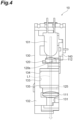
- FIG. 4 is a side view schematically illustrating an inner part of the optical measurement device illustrated in FIG. 1 when seen in another direction.
- FIG. 5 is a side view illustrating the light source illustrated in FIGS. 3 and 4 .
- the optical measurement device 1 includes an optical head 10.
- the optical head 10 includes an irradiation optical system C1 and a detection optical system C2.
- the irradiation optical system C1 irradiates the immunochromatographic test piece 500 with irradiation light (first light) L 1.
- the irradiation light L1 includes excitation light exciting a fluorogenic reagent of the immunochromatographic test piece 500.
- the irradiation light L1 is, for example, ultraviolet light including a wavelength component of 340 nm.
- the detection optical system C2 serves to detect detection light (second light) L2 from the immunochromatographic test piece 500.
- the detection light L2 includes fluorescent light from the fluorogenic reagent of the immunochromatographic test piece 500.
- the irradiation optical system C1 includes a light source 101, a first lens 111, a second lens 112, a light shaping member 120, a first wavelength selection filter 125, and a first light detector 140.
- the light source 101, the first lens 111, the second lens 112, the light shaping member 120, the first wavelength selection filter 125, and the first light detector 140 is accommodated in a housing 130, is held by the housing 130, and constitute an irradiation device 100 along with the housing 130.
- the light source 101 includes a surface emitting element 102 including a light emitting surface 102s and emitting irradiation light L1 from the light emitting surface 102s, a lens part 103b for enhancing directivity of the irradiation light L1 emitted from the surface emitting element 102, a reflector 104 having the surface emitting element 102 installed therein and reflecting the irradiation light L1 emitted from the surface emitting element 102 to the lens part 103b, and a sealing part 103a sealing the surface emitting element 102 and the reflector 104.
- the surface emitting element 102 is, for example, a light emitting diode (LED).
- the light emitting surface 102s is, for example, an area of one end face of the surface emitting element 102 from which the irradiation light L1 is emitted (the whole end face of the surface emitting element 102 in the illustrated example).
- the sealing part 103a and the lens part 103b are formed as an integrated member out of a light-transmitting material with optical transparency to the irradiation light L1, for example, a resin with optical transparency, and constitutes a resin part (a light transmitting portion) 103 sealing the surface emitting element 102 and the reflector 104.
- the lens part 103b is formed in the light-transmitting resin part 103 to be convex on the opposite side to the surface emitting element 102 and is integrated with the surface emitting element 102.
- the light source 101 is configured as a shell-shaped LED when the surface emitting element 102 is an LED.
- the light shaping member 120 includes a light incidence surface 121 on which the irradiation light L1 emitted from the light source 101 is incident and a slit 120s which is a light passing hole, and shapes and emits the irradiation light L1 incident from the light incidence surface 121 using the slit 120s.
- the slit 120s is open in the light incidence surface 121.
- the shape of the slit 120s when seen in a direction parallel to the optical axis of the irradiation light L1 is a shape corresponding to the shape of the measurement target part 504 and is, for example, a rectangular shape having a longitudinal direction.
- the light shaping member 120 is provided such that the light incidence surface 121 is separated by a distance H from the light emitting surface 102s of the surface emitting element 102.
- the distance H between the light emitting surface 102s and the light incidence surface 121 is equal to or less than 26 times a size d in one direction of the light emitting surface 102s.
- the size d in one direction of the light emitting surface 102s is, for example, a size of one side of a square when the light emitting surface 102s has a square shape, and is a size in a longitudinal direction when the light emitting surface 102s has the longitudinal direction. In the latter, the distance H is less than 26 times a size in a transverse direction of the light emitting surface 102s.
- the size d is, for example, 0.5 mm.
- the irradiation light L1 emitted from the light shaping member 120 via the slit 120s is incident on the first lens 111.
- the first lens 111 is, for example, a spherical lens that is convex on the light shaping member 120 side and the opposite side to the light shaping member 120 and is provided to form an image of the slit 120s which is an image of the irradiation light L1 emitted from the light shaping member on the immunochromatographic test piece 500.
- the second lens 112 is provided between the light source 101 and the first lens 111.
- the second lens 112 is disposed between the light source 101 and the light shaping member 120 and is fixed to the light shaping member 120.
- the second lens 112 has at least a function of correcting an aberration (for example, a spherical aberration) generated in the first lens 111.
- the second lens 112 also has a function of enhancing directivity of the irradiation light L1.
- the second lens 112 is, for example, a lens which is convex on the light source 101 side.
- the first wavelength selection filter 125 is provided between the light source 101 and the first lens 111 and serves to selectively transmit some wavelength components of the irradiation light L1 to the first lens 111.
- the first wavelength selection filter 125 is configured to selectively transmit, for example, a wavelength component (excitation light) contributing to excitation of a fluorogenic reagent of the irradiation light L1.
- the first wavelength selection filter 125 may have, for example, a configuration in which a dielectric multilayer filter transmitting only a specific wavelength band (excitation wavelengths of the fluorogenic reagent) is deposited on the first lens 111.
- the housing 130 includes a first spatial portion 131 in which an optical path of the irradiation light L1 is formed and a first inner wall surface 132 defining the first spatial portion 131.
- the housing 130 is solid in a region other than the first spatial portion 131 and a second spatial portion 171 which will be described later. In other words, the housing 130 has a configuration in which the first spatial portion 131 and the second spatial portion 171 are formed in a solid main portion 130A.
- the constituent members of the irradiation optical system C1 are provided in the first spatial portion 131 and are held by the first inner wall surface 132.
- the housing 130 is formed of a material with at least absorbency for the irradiation light L1.
- the housing 130 is also formed of a material not causing autofluorescence due to the irradiation light L1.
- the material of the housing 130 is, for example, a black ABS resin or a black polyoxymethylene (POM).
- the first light detector 140 is provided on the first inner wall surface 132 to face the optical path of the irradiation light L1 between the light source 101 and the light shaping member 120.
- the first light detector 140 serves to detect a light amount of the irradiation light L1 emitted from the light source 101 by detecting a part of the irradiation light L1 emitted from the light source 101 and diffused.
- the first light detector 140 is, for example, a photodiode (for example, a Si photodiode).
- the first light detector 140 outputs a signal indicating the result of detection to a drive circuit 50 which will be described later.
- a first widened portion 133 that is widened between the light shaping member 120 and the first lens 111 is formed in the first spatial portion 131.
- the first widened portion 133 is provided between the light shaping member 120 and the first wavelength selection filter 125.
- the first widened portion 133 is formed by recessing the first inner wall surface 132 to get apart from the optical path of the irradiation light L1.
- the width of the first widened portion 133 is fixed.
- the first widened portion 133 has, for example, a rectangular parallelepiped shape.
- the first inner wall surface 132 includes a pair of crossing surfaces 134 and 135 crossing the optical path of the irradiation light L1 (a direction from the light shaping member 120 to the first lens 111) in the first widened portion 133.
- the crossing surface 134 is a surface facing the first lens 111
- the crossing surface (a first crossing surface) 135 is a surface facing the light shaping member 120.
- the crossing surface 134 and the crossing surface 135 are opposite surfaces and are, for example, parallel to each other.
- the detection optical system C2 will be described below.
- the detection optical system C2 includes a second light detector 150, a third lens 153, and a second wavelength selection filter 160.
- the second light detector 150, the third lens 153, and the second wavelength selection filter 160 are accommodated in the housing 130 and are held by the housing 130.
- the second light detector 150 serves to detect detection light L2.
- the second light detector 150 is, for example, a photodiode (for example, a Si photodiode).
- the second light detector 150 may be an avalanche photodiode, a photomultiplier tube, or a multi-pixel array thereof.
- a substrate 21 of a current-voltage converter 20 which will be described later is attached to the outer surface of the housing 130, and the second light detector 150 is mounted on the substrate 21.
- the second light detector 150 outputs a signal indicating a result of detection of the detection light L2 to the current-voltage converter 20.
- the third lens 153 serves to focus the detection light L2 on the second light detector 150.
- the third lens 153 is, for example, a plano-convex lens that is convex on the opposite side to the second light detector 150.
- the second wavelength selection filter 160 is provided between the third lens 153 and the second light detector 150.
- the second wavelength selection filter 160 serves to selectively transmit some wavelength components of the detection light L2 to the second light detector 150.
- the second wavelength selection filter 160 is configured to selectively transmit, for example, fluorescent light generated from a fluorogenic reagent out of the detection light L2.
- the second wavelength selection filter 160 includes a dielectric multilayer filter 161 transmitting only a specific wavelength band (fluorescent light) and a colored glass filter 162.
- the second wavelength selection filter 160 is, for example, a band-pass filter in which the dielectric multilayer filter 161 and the colored glass filter 162 are combined.
- the colored glass filter 162 is provided at the second light detector 150 side with respect to the dielectric multilayer filter 161. For example, the colored glass filter 162 is bonded to the dielectric multilayer filter 161.
- the housing 130 includes a second spatial portion 171 in which an optical path of the detection light L2 is formed and a second inner wall surface 172 defining the second spatial portion 171.
- the constituent members of the detection optical system C2 are provided in the second spatial portion 171 and are held by the second inner wall surface 172.
- a second widened portion 173 that is widened between the third lens 153 and the second wavelength selection filter 160 is formed in the second spatial portion 171.
- the second widened portion 173 is formed by recessing the second inner wall surface 172 to get apart from the optical path of the detection light L2.
- the width of the second widened portion 173 is fixed.
- the second widened portion 173 has, for example, a rectangular parallelepiped shape.
- the second inner wall surface 172 includes a pair of crossing surfaces 174 and 175 crossing the optical path of the detection light L2 (a direction from the third lens 153 to the second light detector 150) in the second widened portion 173.
- the crossing surface (a second crossing surface) 174 is a surface facing the third lens 153
- the crossing surface 175 is a surface facing the second wavelength selection filter 160.
- the crossing surface 174 and the crossing surface 175 are opposite surfaces and are, for example, parallel to each other.
- the second wavelength selection filter 160 may have a configuration in which a dielectric multilayer filter 161 is deposited on the third lens 153.
- the optical measurement device 1 further includes a current-voltage converter 20, an AD converter 30, a CPU 40, and a drive circuit 50.
- the current-voltage converter 20 converts a current signal output from the second light detector 150 to a voltage signal and outputs the voltage signal to the AD converter 30.
- the substrate 21 of the current-voltage converter 20 is attached to the outer surface of the housing 130 (see FIG. 3 ).
- the AD converter 30 converts the voltage signal output from the current-voltage converter 20 to a digital signal and outputs the digital signal to the CPU 40.
- the CPU 40 performs, for example, signal processing of removing a signal component based on scattered light from a detection signal on the digital signal output from the AD converter 80.
- the drive circuit 50 receives an input from the CPU 40 and receives an input from the first light detector 140.
- the drive circuit 50 controls driving of the surface emitting element 102 such that a light amount of the irradiation light L1 is constant while receiving the detection signal indicating the light amount of the first light L 1 from the first light detector 140.
- irradiation light L1 emitted from the light source 101 is shaped by the light shaping member 120 and is then applied to an immunochromatographic test piece 500 via the first lens 111.
- the light source 101 includes the surface emitting element 102 and the lens part 103b for enhancing directivity of the irradiation light L1 emitted from the surface emitting element 102.
- the distance H between the light emitting surface 102s of the surface emitting element 102 and the light incidence surface 121 of the light shaping member 120 is equal to or less than 26 times the size d in one direction of the light emitting surface 102s of the surface emitting element 102. In this regard, the inventor's knowledge will be described below.
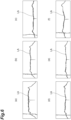
- FIGS. 6 and 7 are graphs LA illustrating an illuminance distribution of irradiation light in an irradiation surface separated by a specific distance from the light emitting surface of the surface emitting element.
- FIGS. 6 and 7 illustrate examples in which the size d is 0.5 mm.
- FIG. 7(a) in which the distance H is 26d the illuminance distribution in the central part is even in comparison with FIG. 6(f) and a large light amount is obtained.
- the knowledge that the illuminance distribution is even and a relatively large light amount is obtained when the distance H is equal to or less than 26d was obtained.
- the surface emitting element 102 which is used along with the lens part 103b to enhance directivity in this way an even illuminance distribution with a relatively large light amount is obtained in a close distance range which is less than 26 times the size d of the light emitting surface 102s.
- FIG. 8(a) is a diagram illustrating a light amount of the irradiation light L1 of which an image is formed by the irradiation optical system C1 according to this embodiment.
- FIG. 8(b) is a diagram illustrating a simulated light amount of the irradiation light L1 of which an image is formed by the irradiation optical system C1 according to this embodiment.
- light can be more uniformly emitted to the immunochromatographic test piece 500 by shaping the irradiation light L1 using the light shaping member 120 provided in the aforementioned distance range and forming an image of the irradiation light L1 using the first lens 111.
- the irradiation optical system C1 As described above, in the irradiation optical system C1 according to this embodiment, more uniform light emission to the immunochromatographic test piece 500 is possible by forming an image of the irradiation light L1 in the light incidence surface 121 of the light shaping member 120 (an image of the slit 120s) provided in the aforementioned distance range on the immunochromatographic test piece 500 using the first lens 111.
- the same advantage can be achieved in the irradiation device 100 and the optical measurement device 1 including the irradiation optical system C1.
- the optical measurement device 1 it is possible to perform stable measurement by detecting the detection light L2 from the immunochromatographic test piece 500 (a fluorogenic reagent) subjected to uniform irradiation with light using the irradiation optical system C1 and the irradiation device 100.
- the irradiation optical system C1 includes the second lens 112 provided between the light source 101 and the first lens 111 and configured to correct an aberration generated in the first lens 111. Accordingly, it is possible to more uniformly emit light.
- the second lens 112 is provided between the light source 101 and the light shaping member 120 and has a function of enhancing directivity of the irradiation light L1 emitted from the light source 101. Accordingly, it is possible to reduce a loss due to absorption of the irradiation light L1 by the first inner wall surface 132 based on diffusion of the irradiation light L1.
- the second lens 112 is fixed to the light shaping member 120. Accordingly, it is not necessary to provide a mechanism for holding the second lens 112 or positioning of the second lens 112.
- the light source 101 includes a light-transmitting resin part 103 sealing the surface emitting element 102, and the lens part 103b is formed in the resin part 103 and integrated with the surface emitting element 102. Accordingly, it is possible to facilitate handling or positioning of the surface emitting element 102 and the lens part 103b.
- the irradiation optical system C1 includes the first wavelength selection filter 125 provided between the light source 101 and the first lens 111 and configured to selectively transmit some wavelength components of the irradiation light L1 to the first lens 111. Accordingly, it is possible to selectively apply some wavelength components of the irradiation light L1 to the immunochromatographic test piece 500.
- the irradiation device 100 includes the irradiation optical system C1 and the housing 130 accommodating the irradiation optical system C1.
- the housing 130 includes the first spatial portion 131 in which an optical path of the irradiation light L1 is formed and the first inner wall surface 132 defining the first spatial portion 131.
- the first widened portion 133 that is widened between the light shaping member 120 and the first lens 111 is formed in the first spatial portion 131, and the first inner wall surface 132 includes the crossing surface 135 crossing the optical path of the irradiation light L1 in the first widened portion 133 and facing the light shaping member 120. Accordingly, since light propagating obliquely with a predetermined angle or more from the light shaping member 120 to the first lens 111 is trapped by the crossing surface 135, it is possible to curb generation of stray light. That is, the first widened portion 133 and the crossing surface 135 serve as a structure trapping stray light.
- the first widened portion 133 is provided between the light shaping member 120 and the first wavelength selection filter 125.
- the first wavelength selection filter 125 is disposed in the back stage of the first widened portion 133 in the optical path of the irradiation light L1. Accordingly, since the light propagating obliquely with a predetermined angle or more to the first wavelength selection filter 125 is trapped by the crossing surface 135, an incidence angle of the irradiation light L1 on the first wavelength selection filter is limited.
- the first wavelength selection filter 125 may include a dielectric multilayer filter.
- filtering characteristics may decrease. Accordingly, by limiting the incidence angle on the first wavelength selection filter 125 using the first widened portion 133 and the crossing surface 135 as described above, it is possible to curb a decrease in filtering characteristics in the first wavelength selection filter 125 and to more reliably selectively transmit only some wavelength components of the irradiation light L1 (to curb generation of stray light).
- the effect of curbing stray light using the first widened portion 133 and the crossing surface 135 is particularly effective when the first wavelength selection filter 125 including a dielectric multilayer filter is provided in the back stage thereof, but the present invention is not limited thereto.
- the effect can be exhibited by simply trapping light propagating obliquely with a predetermined angle or more in the first spatial portion 131.
- the irradiation device 100 includes the first light detector 140 provided in the first inner wall surface 132 to face the optical path of the irradiation light L1 and configured to detect a light amount of the irradiation light L1 emitted from the light source 101 by detecting a part of the irradiation light L1 emitted from the light source 101 and diffusing. Accordingly, it is possible to monitor the light amount of the irradiation light L1.
- the irradiation device 100 includes the drive circuit 50 configured to drive the surface emitting element 102 such that the light amount is constant while receiving the detection signal indicating the light amount of the irradiation light L1 from the first light detector 140. Accordingly, it is possible to perform light irradiation with a stable light amount.
- the housing 130 may be formed of a material with absorbency for the irradiation light L 1.
- the housing 130 may be formed of a material not causing autofluorescence due to the irradiation light L1. In this case, it is possible to more reliably curb generation of stray light.
- the optical measurement device 1 includes the irradiation device 100 and the detection optical system C2 configured to detect detection light L2 from an immunochromatographic test piece 500 (a fluorogenic reagent) irradiated with the irradiation light L1.
- the housing 130 further accommodates the detection optical system C2 and includes the second spatial portion 171 in which an optical path of the detection light L2 is formed and the second inner wall surface 172 defining the second spatial portion 171.
- the detection optical system C2 includes the second light detector 150 configured to detect the detection light L2 and the third lens 153 configured to focus the detection light L2 on the second light detector 150.
- the optical measurement device 1 it is possible to perform stable measurement of the immunochromatographic test piece 500 by detecting the detection light L2 from the immunochromatographic test piece 500 on which uniform light is incident from the irradiation optical system C1 and the irradiation device 100.
- the optical measurement device 1 includes the second wavelength selection filter 160 provided between the third lens 153 and the second light detector 150 and configured to selectively transmit some wavelength components of the detection light L2 to the second light detector 150. Accordingly, it is possible to selectively detect some wavelength components of the detection light L2.
- the second widened portion 173 that is widened between the third lens 153 and the second wavelength selection filter 160 is formed in the second spatial portion 171, and the second inner wall surface 172 includes the crossing surface 174 crossing the optical path of the detection light L2 in the second widened portion 173 and facing the third lens 153. Accordingly, since light propagating obliquely with a predetermined angle or more from the third lens 153 to the second wavelength selection filter 160 is trapped by the crossing surface 174, it is possible to limit a range of the incidence angle of the detection light L2 incident on the second wavelength selection filter 160.
- the second wavelength selection filter 160 includes the dielectric multilayer filter 161 as described above, the second wavelength selection filter 160 has incidence angle dependency of the filtering characteristics. Accordingly, by limiting the incidence angle on the second wavelength selection filter 160 using the second widened portion 173 and the crossing surface 174 as described above, it is possible to curb a decrease in filtering characteristics in the second wavelength selection filter 160 and to more reliably selectively transmit only some wavelength components of the detection light L2 (to curb generation of stray light). As a result, it is possible to perform measurement with high precision.
- FIG. 9(a) illustrates a light amount of the detection light L2 in a light receiving surface of the second light detector 150 when a stray light trapping structure using the second widened portion 173 and the crossing surface 174 is not provided
- FIG. 9(b) illustrates a light amount of the detection light L2 in a detection surface of the second light detector 150 when a stray light trapping structure using the second widened portion 173 and the crossing surface 174 is provided.
- noise due to stray light is reduced and uniform detection results are obtained by using the stray light trapping structure according to this embodiment.
- the effect of curbing stray light using the second widened portion 173 and the crossing surface 174 is particularly effective when the second wavelength selection filter 160 including the dielectric multilayer filter 161 is provided in the back stage thereof, but the present invention is not limited thereto.
- the effect can be exhibited by simply trapping light propagating obliquely with a predetermined angle or more in the second spatial portion 171.
- the second wavelength selection filter 160 includes the dielectric multilayer filter 161 and the colored glass filter 162 provided at the second light detector 150 side with respect to the dielectric multilayer filter 161.
- the characteristics of the dielectric multilayer filter include incidence angle dependency.
- the colored glass filter 162 it is possible to reduce the incidence angle dependency of the second wavelength selection filter 160 as a whole and to more effectively selectively transmit only some wavelength components in a wider range of incidence angles. Particularly, it is more effective that the dielectric multilayer filter 161 and the colored glass filter 162 are sequentially arranged toward the second light detector 150.
- the optical measurement device 1 includes the current-voltage converter 20 for converting a current signal output from the second light detector 150 in response to detection of the detection light L2 to a voltage signal, and the second light detector 150 is mounted in the substrate 21 of the current-voltage converter 20. Accordingly, it is possible to avoid addition of noise to a detection signal between the second light detector 150 and the current-voltage converter 20 and to reduce noise.
- the irradiation light L1 includes excitation light for exciting an immunochromatographic test piece 500 (a fluorogenic reagent), and the detection light L2 includes fluorescent light emitted from the immunochromatographic test piece 500 (the fluorogenic reagent) in response to irradiation with the excitation light. Accordingly, it is possible to perform stable measurement of fluorescent light.
- the present disclosure is not limited to the embodiment, and the irradiation optical system C1, the irradiation device 100, and the optical measurement device 1 can be arbitrarily modified.
- the optical measurement device 1 may include a metallic shield provided in the housing 130 to cover at least the second light detector 150 and the current-voltage converter 20.
- the metallic shield may be provided, for example, to cover the whole side surface of the housing 130. In this case, it is possible to further reduce noise.
- the second lens 112 may be provided between the light shaping member 120 and the first lens 111. In this case, the second lens 112 may be fixed to the light shaping member 120. Here, the second lens 112 may be fixed to the housing 130 separately from the light shaping member 120.
- the shape of the light passing hole of the light shaping member 120 when seen in a direction parallel to the optical axis of the irradiation light L1 is not limited to the rectangular shape having a longitudinal direction like the slit 120s as long as it is a shape corresponding to the shape of the measurement target part 504, and may be another shape (for example, a circular shape or an elliptical shape).
- the first wavelength selection filter 125 and the second wavelength selection filter 160 are not limited to the aforementioned configuration and can be arbitrarily modified.
- the first wavelength selection filter 125 may include a dielectric multilayer filter and a colored glass filter (which is provided, for example, at the first lens 111 side with respect to the dielectric multilayer filter) similarly to the second wavelength selection filter 160 or may include only the colored glass filter.
- the second wavelength selection filter 160 may include only one of the dielectric multilayer filter 161 and the colored glass filter 162.
- the light source 101 is not limited to the configuration as a shell-shaped LED in which the surface emitting element 102 and the lens part 103b are integrated, and the surface emitting element 102 and the lens part 103b may be provided as separate members.
- the optical measurement device 1 which is used for fluorescence immunochromatography has been described above, but the optical measurement device 1 may be used for other applications.
- the irradiation light L1 may not include excitation light for exciting an object
- the detection light L2 may not include fluorescent light emitted from an object in response to irradiation with excitation light.
Landscapes
- Health & Medical Sciences (AREA)
- Chemical & Material Sciences (AREA)
- Physics & Mathematics (AREA)
- General Physics & Mathematics (AREA)
- Pathology (AREA)
- Analytical Chemistry (AREA)
- Biochemistry (AREA)
- General Health & Medical Sciences (AREA)
- Life Sciences & Earth Sciences (AREA)
- Immunology (AREA)
- Nuclear Medicine, Radiotherapy & Molecular Imaging (AREA)
- Engineering & Computer Science (AREA)
- Chemical Kinetics & Catalysis (AREA)
- Plasma & Fusion (AREA)
- Investigating, Analyzing Materials By Fluorescence Or Luminescence (AREA)
- Investigating Or Analysing Materials By The Use Of Chemical Reactions (AREA)
- Investigating Or Analysing Materials By Optical Means (AREA)
- Measurement Of Optical Distance (AREA)
- Eye Examination Apparatus (AREA)
Applications Claiming Priority (2)
| Application Number | Priority Date | Filing Date | Title |
|---|---|---|---|
| JP2021015041A JP7704538B2 (ja) | 2021-02-02 | 2021-02-02 | 照射装置、及び、光学測定装置 |
| PCT/JP2021/038304 WO2022168374A1 (fr) | 2021-02-02 | 2021-10-15 | Système optique d'émission, dispositif d'émission et dispositif de mesure optique |
Publications (2)
| Publication Number | Publication Date |
|---|---|
| EP4266028A1 true EP4266028A1 (fr) | 2023-10-25 |
| EP4266028A4 EP4266028A4 (fr) | 2024-12-04 |
Family
ID=82741014
Family Applications (1)
| Application Number | Title | Priority Date | Filing Date |
|---|---|---|---|
| EP21924761.6A Withdrawn EP4266028A4 (fr) | 2021-02-02 | 2021-10-15 | Système optique d'émission, dispositif d'émission et dispositif de mesure optique |
Country Status (7)
| Country | Link |
|---|---|
| US (1) | US12517037B2 (fr) |
| EP (1) | EP4266028A4 (fr) |
| JP (1) | JP7704538B2 (fr) |
| KR (1) | KR20230137907A (fr) |
| CN (1) | CN116848396A (fr) |
| TW (1) | TW202232081A (fr) |
| WO (1) | WO2022168374A1 (fr) |
Families Citing this family (1)
| Publication number | Priority date | Publication date | Assignee | Title |
|---|---|---|---|---|
| JP6923702B1 (ja) * | 2020-04-01 | 2021-08-25 | 浜松ホトニクス株式会社 | 光学測定装置及び光学測定方法 |
Family Cites Families (21)
| Publication number | Priority date | Publication date | Assignee | Title |
|---|---|---|---|---|
| JPH09133628A (ja) | 1995-11-12 | 1997-05-20 | Terametsukusu Kk | 複合素子を内蔵した光源を持つ分析装置 |
| JP4797233B2 (ja) | 2000-09-25 | 2011-10-19 | パナソニック株式会社 | 小型試料濃度測定装置 |
| JP4737896B2 (ja) | 2001-09-20 | 2011-08-03 | パナソニック株式会社 | 試料濃度測定装置 |
| US7173704B2 (en) | 2003-02-26 | 2007-02-06 | Hamamatsu Photonics K.K. | Measuring device for immunochromatography test piece and light source device |
| US7173705B2 (en) | 2003-02-26 | 2007-02-06 | Hamamatsu Photonics K.K. | Measuring device for immunochromatography test piece |
| JP4696959B2 (ja) | 2006-02-22 | 2011-06-08 | アイシン精機株式会社 | 光学検出装置 |
| WO2008094285A2 (fr) * | 2006-06-16 | 2008-08-07 | University Of Washington | Système d'imagerie par résonance plasmonique de surface miniaturisé |
| WO2012086376A1 (fr) | 2010-12-20 | 2012-06-28 | コニカミノルタオプト株式会社 | Dispositif d'analyse par chromatographie |
| JP5664386B2 (ja) | 2011-03-22 | 2015-02-04 | コニカミノルタ株式会社 | クロマトグラフィー分析装置及びクロマトグラフィー分析方法 |
| CN103163126A (zh) | 2011-12-08 | 2013-06-19 | 中国检验检疫科学研究院 | 差分免疫层析检测试纸条显色信号定量检测器 |
| PL2812675T3 (pl) | 2012-02-06 | 2021-12-13 | The Regents Of The University Of California | Przenośny czytnik szybkich testów diagnostycznych |
| EP3306682A4 (fr) | 2015-05-28 | 2019-03-20 | Sumitomo Chemical Company Limited | Dispositif à del, module de del et dispositif électroluminescent à ultraviolets |
| JP6547514B2 (ja) | 2015-08-13 | 2019-07-24 | 富士ゼロックス株式会社 | 計測装置 |
| WO2017199510A1 (fr) | 2016-05-19 | 2017-11-23 | 浜松ホトニクス株式会社 | Corps de référence d'étalonnage pour dispositif de mesure de fluorescence |
| US11747603B2 (en) * | 2017-10-31 | 2023-09-05 | Samantree Medical Sa | Imaging systems with micro optical element arrays and methods of specimen imaging |
| FR3079028B1 (fr) | 2018-03-15 | 2020-05-15 | Horiba France Sas | Ellipsometre ou scatterometre spectroscopique instantane et procede de mesure associe |
| CN108709858A (zh) * | 2018-03-30 | 2018-10-26 | 侯茂元 | 糖化血红蛋白分析仪检测器 |
| CN112912715B (zh) | 2018-10-25 | 2024-08-09 | 浜松光子学株式会社 | 光学测定装置及光学测定方法 |
| CN209784190U (zh) | 2018-12-28 | 2019-12-13 | 南京大渊生物技术工程有限责任公司 | 荧光光强检测装置 |
| CN112556990B (zh) * | 2019-09-10 | 2025-02-14 | 宁波法里奥光学科技发展有限公司 | 镜片折射率测量装置及其测量方法 |
| CN210984098U (zh) | 2019-11-13 | 2020-07-10 | 舜宇光学(浙江)研究院有限公司 | Micro LED显示装置和微投影系统 |
-
2021
- 2021-02-02 JP JP2021015041A patent/JP7704538B2/ja active Active
- 2021-10-15 US US18/274,538 patent/US12517037B2/en active Active
- 2021-10-15 EP EP21924761.6A patent/EP4266028A4/fr not_active Withdrawn
- 2021-10-15 KR KR1020237025658A patent/KR20230137907A/ko active Pending
- 2021-10-15 WO PCT/JP2021/038304 patent/WO2022168374A1/fr not_active Ceased
- 2021-10-15 CN CN202180092662.4A patent/CN116848396A/zh active Pending
- 2021-11-05 TW TW110141278A patent/TW202232081A/zh unknown
Also Published As
| Publication number | Publication date |
|---|---|
| KR20230137907A (ko) | 2023-10-05 |
| EP4266028A4 (fr) | 2024-12-04 |
| US20240102916A1 (en) | 2024-03-28 |
| TW202232081A (zh) | 2022-08-16 |
| JP2022118476A (ja) | 2022-08-15 |
| WO2022168374A1 (fr) | 2022-08-11 |
| US12517037B2 (en) | 2026-01-06 |
| JP7704538B2 (ja) | 2025-07-08 |
| CN116848396A (zh) | 2023-10-03 |
Similar Documents
| Publication | Publication Date | Title |
|---|---|---|
| US20200003688A1 (en) | Surface Plasmon Resonance Fluorescence Analysis Device And Surface Plasmon Resonance Fluorescence Analysis Method | |
| JP2011013167A (ja) | 分光蛍光光度計及び試料セル | |
| JP2021503608A (ja) | 落射蛍光測定用の光学フローサイトメータ | |
| US9086377B2 (en) | Optical system for fluorescence detection and fine particle analyzing apparatus | |
| JP5241274B2 (ja) | 被検出物質の検出方法 | |
| JP6733664B2 (ja) | 検出チップの製造方法および検出チップ | |
| JP2010091441A (ja) | 光量モニタリング装置、および光量モニタリング方法 | |
| US12517037B2 (en) | Emission optical system, emission device, and optical measurement device | |
| EP3588059A1 (fr) | Cellule d'écoulement | |
| US12000785B2 (en) | Apparatus and method for detecting photoluminescent light emitted from a sample | |
| US10775307B2 (en) | Optical fiber fluorescence detection device | |
| JP2009204484A (ja) | センシング装置 | |
| JP4742166B2 (ja) | 試料分析装置 | |
| JP4141985B2 (ja) | 分光蛍光光度計及び試料セル | |
| US20170089835A1 (en) | Sensor Element For Photoluminescence Measurements, Photoluminescence Detection Means, Method For Operating Photoluminescence Detection Means, Method For Producing A Sensor Element And Use Of A Sensor Element | |
| JP6114097B2 (ja) | 表面プラズモン増強蛍光測定装置 | |
| JP2007225400A (ja) | 光学検出装置 | |
| JP4405881B2 (ja) | 標的物質検出装置及び標的物質検出方法 | |
| JP6082273B2 (ja) | 蛍光検出装置 | |
| CN211122535U (zh) | 荧光检测器 | |
| JP6673336B2 (ja) | 検出装置 | |
| CN118777234A (zh) | 用于产生照明光的光源 | |
| JP2014142316A (ja) | 光検出装置および光検出方法 | |
| JP2010112852A (ja) | 測定系 |
Legal Events
| Date | Code | Title | Description |
|---|---|---|---|
| STAA | Information on the status of an ep patent application or granted ep patent |
Free format text: STATUS: THE INTERNATIONAL PUBLICATION HAS BEEN MADE |
|
| PUAI | Public reference made under article 153(3) epc to a published international application that has entered the european phase |
Free format text: ORIGINAL CODE: 0009012 |
|
| STAA | Information on the status of an ep patent application or granted ep patent |
Free format text: STATUS: REQUEST FOR EXAMINATION WAS MADE |
|
| 17P | Request for examination filed |
Effective date: 20230718 |
|
| AK | Designated contracting states |
Kind code of ref document: A1 Designated state(s): AL AT BE BG CH CY CZ DE DK EE ES FI FR GB GR HR HU IE IS IT LI LT LU LV MC MK MT NL NO PL PT RO RS SE SI SK SM TR |
|
| DAV | Request for validation of the european patent (deleted) | ||
| DAX | Request for extension of the european patent (deleted) | ||
| A4 | Supplementary search report drawn up and despatched |
Effective date: 20241105 |
|
| RIC1 | Information provided on ipc code assigned before grant |
Ipc: G01N 21/84 20060101ALN20241029BHEP Ipc: G01N 21/77 20060101ALN20241029BHEP Ipc: G01N 21/78 20060101ALI20241029BHEP Ipc: G01N 21/64 20060101ALI20241029BHEP Ipc: G01N 21/01 20060101AFI20241029BHEP |
|
| STAA | Information on the status of an ep patent application or granted ep patent |
Free format text: STATUS: THE APPLICATION IS DEEMED TO BE WITHDRAWN |
|
| 18D | Application deemed to be withdrawn |
Effective date: 20250523 |