EP4266331A1 - Tôle d'acier magnétique à grains orientés et son procédé d'affinement de domaine magnétique - Google Patents
Tôle d'acier magnétique à grains orientés et son procédé d'affinement de domaine magnétique Download PDFInfo
- Publication number
- EP4266331A1 EP4266331A1 EP21911401.4A EP21911401A EP4266331A1 EP 4266331 A1 EP4266331 A1 EP 4266331A1 EP 21911401 A EP21911401 A EP 21911401A EP 4266331 A1 EP4266331 A1 EP 4266331A1
- Authority
- EP
- European Patent Office
- Prior art keywords
- punctuated
- grooves
- groove
- steel sheet
- electrical steel
- Prior art date
- Legal status (The legal status is an assumption and is not a legal conclusion. Google has not performed a legal analysis and makes no representation as to the accuracy of the status listed.)
- Pending
Links
Images


Classifications
-
- H—ELECTRICITY
- H01—ELECTRIC ELEMENTS
- H01F—MAGNETS; INDUCTANCES; TRANSFORMERS; SELECTION OF MATERIALS FOR THEIR MAGNETIC PROPERTIES
- H01F1/00—Magnets or magnetic bodies characterised by the magnetic materials therefor; Selection of materials for their magnetic properties
- H01F1/01—Magnets or magnetic bodies characterised by the magnetic materials therefor; Selection of materials for their magnetic properties of inorganic materials
- H01F1/03—Magnets or magnetic bodies characterised by the magnetic materials therefor; Selection of materials for their magnetic properties of inorganic materials characterised by their coercivity
- H01F1/12—Magnets or magnetic bodies characterised by the magnetic materials therefor; Selection of materials for their magnetic properties of inorganic materials characterised by their coercivity of soft-magnetic materials
- H01F1/14—Magnets or magnetic bodies characterised by the magnetic materials therefor; Selection of materials for their magnetic properties of inorganic materials characterised by their coercivity of soft-magnetic materials metals or alloys
- H01F1/16—Magnets or magnetic bodies characterised by the magnetic materials therefor; Selection of materials for their magnetic properties of inorganic materials characterised by their coercivity of soft-magnetic materials metals or alloys in the form of sheets
-
- B—PERFORMING OPERATIONS; TRANSPORTING
- B23—MACHINE TOOLS; METAL-WORKING NOT OTHERWISE PROVIDED FOR
- B23K—SOLDERING OR UNSOLDERING; WELDING; CLADDING OR PLATING BY SOLDERING OR WELDING; CUTTING BY APPLYING HEAT LOCALLY, e.g. FLAME CUTTING; WORKING BY LASER BEAM
- B23K26/00—Working by laser beam, e.g. welding, cutting or boring
- B23K26/36—Removing material
- B23K26/362—Laser etching
- B23K26/364—Laser etching for making a groove or trench, e.g. for scribing a break initiation groove
-
- B—PERFORMING OPERATIONS; TRANSPORTING
- B23—MACHINE TOOLS; METAL-WORKING NOT OTHERWISE PROVIDED FOR
- B23K—SOLDERING OR UNSOLDERING; WELDING; CLADDING OR PLATING BY SOLDERING OR WELDING; CUTTING BY APPLYING HEAT LOCALLY, e.g. FLAME CUTTING; WORKING BY LASER BEAM
- B23K26/00—Working by laser beam, e.g. welding, cutting or boring
- B23K26/36—Removing material
- B23K26/40—Removing material taking account of the properties of the material involved
-
- C—CHEMISTRY; METALLURGY
- C21—METALLURGY OF IRON
- C21D—MODIFYING THE PHYSICAL STRUCTURE OF FERROUS METALS; GENERAL DEVICES FOR HEAT TREATMENT OF FERROUS OR NON-FERROUS METALS OR ALLOYS; MAKING METAL MALLEABLE, e.g. BY DECARBURISATION OR TEMPERING
- C21D8/00—Modifying the physical properties of ferrous metals or ferrous alloys by deformation combined with, or followed by, heat treatment
- C21D8/12—Modifying the physical properties of ferrous metals or ferrous alloys by deformation combined with, or followed by, heat treatment during manufacturing of articles with special electromagnetic properties
-
- C—CHEMISTRY; METALLURGY
- C21—METALLURGY OF IRON
- C21D—MODIFYING THE PHYSICAL STRUCTURE OF FERROUS METALS; GENERAL DEVICES FOR HEAT TREATMENT OF FERROUS OR NON-FERROUS METALS OR ALLOYS; MAKING METAL MALLEABLE, e.g. BY DECARBURISATION OR TEMPERING
- C21D8/00—Modifying the physical properties of ferrous metals or ferrous alloys by deformation combined with, or followed by, heat treatment
- C21D8/12—Modifying the physical properties of ferrous metals or ferrous alloys by deformation combined with, or followed by, heat treatment during manufacturing of articles with special electromagnetic properties
- C21D8/1277—Modifying the physical properties of ferrous metals or ferrous alloys by deformation combined with, or followed by, heat treatment during manufacturing of articles with special electromagnetic properties involving a particular surface treatment
-
- C—CHEMISTRY; METALLURGY
- C21—METALLURGY OF IRON
- C21D—MODIFYING THE PHYSICAL STRUCTURE OF FERROUS METALS; GENERAL DEVICES FOR HEAT TREATMENT OF FERROUS OR NON-FERROUS METALS OR ALLOYS; MAKING METAL MALLEABLE, e.g. BY DECARBURISATION OR TEMPERING
- C21D8/00—Modifying the physical properties of ferrous metals or ferrous alloys by deformation combined with, or followed by, heat treatment
- C21D8/12—Modifying the physical properties of ferrous metals or ferrous alloys by deformation combined with, or followed by, heat treatment during manufacturing of articles with special electromagnetic properties
- C21D8/1294—Modifying the physical properties of ferrous metals or ferrous alloys by deformation combined with, or followed by, heat treatment during manufacturing of articles with special electromagnetic properties involving a localised treatment
-
- H—ELECTRICITY
- H01—ELECTRIC ELEMENTS
- H01F—MAGNETS; INDUCTANCES; TRANSFORMERS; SELECTION OF MATERIALS FOR THEIR MAGNETIC PROPERTIES
- H01F41/00—Apparatus or processes specially adapted for manufacturing or assembling magnets, inductances or transformers; Apparatus or processes specially adapted for manufacturing materials characterised by their magnetic properties
- H01F41/02—Apparatus or processes specially adapted for manufacturing or assembling magnets, inductances or transformers; Apparatus or processes specially adapted for manufacturing materials characterised by their magnetic properties for manufacturing cores, coils, or magnets
- H01F41/0206—Manufacturing of magnetic cores by mechanical means
- H01F41/0233—Manufacturing of magnetic circuits made from sheets
- H01F41/024—Manufacturing of magnetic circuits made from deformed sheets
-
- B—PERFORMING OPERATIONS; TRANSPORTING
- B23—MACHINE TOOLS; METAL-WORKING NOT OTHERWISE PROVIDED FOR
- B23K—SOLDERING OR UNSOLDERING; WELDING; CLADDING OR PLATING BY SOLDERING OR WELDING; CUTTING BY APPLYING HEAT LOCALLY, e.g. FLAME CUTTING; WORKING BY LASER BEAM
- B23K2101/00—Articles made by soldering, welding or cutting
- B23K2101/18—Sheet panels
-
- B—PERFORMING OPERATIONS; TRANSPORTING
- B23—MACHINE TOOLS; METAL-WORKING NOT OTHERWISE PROVIDED FOR
- B23K—SOLDERING OR UNSOLDERING; WELDING; CLADDING OR PLATING BY SOLDERING OR WELDING; CUTTING BY APPLYING HEAT LOCALLY, e.g. FLAME CUTTING; WORKING BY LASER BEAM
- B23K2103/00—Materials to be soldered, welded or cut
- B23K2103/02—Iron or ferrous alloys
- B23K2103/04—Steel or steel alloys
-
- C—CHEMISTRY; METALLURGY
- C21—METALLURGY OF IRON
- C21D—MODIFYING THE PHYSICAL STRUCTURE OF FERROUS METALS; GENERAL DEVICES FOR HEAT TREATMENT OF FERROUS OR NON-FERROUS METALS OR ALLOYS; MAKING METAL MALLEABLE, e.g. BY DECARBURISATION OR TEMPERING
- C21D2201/00—Treatment for obtaining particular effects
- C21D2201/05—Grain orientation
Definitions
- the present invention relates to a grain oriented electrical steel sheet and a method for refining magnetic domains therein. More particularly, the present invention relates to a grain oriented electrical steel sheet and a method for refining magnetic domains therein capable of securing electrical insulation as well as core loss characteristics by combining continuous grooves and discontinuous grooves.
- the grain oriented electrical steel sheet contains a large amount of Si, and is a functional steel sheet in which a texture of secondary recrystallized grains is oriented in the same Goss orientation ( ⁇ 110 ⁇ 001 >) as a rolling direction through melting, casting, hot rolling sheet annealing, cold rolling, and high temperature annealing processes, and the like.
- a magnetic domain refinement technology of the grain oriented electrical steel sheet is a technology that improves core loss characteristics by reducing a 180° magnetic domain width in secondary crystal grains when a magnetic field is applied, and is applied to a wide range of thickness products, from ultra-thin materials having a thickness of less than 0.20 mm to thick materials having a thickness of 0.30 mm.
- a technology capable of securing a magnetic domain refinement effect even after stress relief annealing (SRA) to improve core loss is called a permanent magnetic domain refinement technology.
- This permanent magnetic domain refinement technology is used for a transformer core that requires molding and heat treatment due to its technical characteristics, and is necessary to secure electrical insulation as well as core loss characteristics of the iron core in a dry (wet) environment of room temperature or higher.
- the present invention attempts to provide a grain oriented electrical steel sheet and a method for refining magnetic domains therein. Specifically, the present invention attempts to provide a grain oriented electrical steel sheet and a method for refining magnetic domains therein capable of securing electrical insulation as well as core loss characteristics by combining continuous grooves and discontinuous grooves.
- a grain oriented electrical steel sheet includes: linear grooves formed on one surface or both surfaces of the electrical steel sheet in the direction (X 1 direction) crossing a rolling direction; and punctuated grooves formed on one surface or both surfaces of the electrical steel sheet so as to be arranged in the direction (X 2 direction) crossing the rolling direction, wherein the plurality of linear grooves and the plurality of punctuated grooves are formed in the rolling direction, and an interval D3 between the punctuated grooves with respect to an arrangement direction (X 2 direction) of the punctuated grooves is 0.02 to 1.7 times an interval D2 between the punctuated grooves with respect to the rolling direction.
- the interval D3 between the punctuated grooves with respect to the arrangement direction (X 2 direction) of the punctuated grooves may be 0.01 to 9.00 mm, and the interval D2 between the punctuated grooves with respect to the rolling direction may be 1.8 to 5.0 mm.
- An interval D1 between the linear grooves with respect to the rolling direction may be 0.2 to 3 times the interval D2 between the punctuated grooves with respect to the rolling direction.
- the linear groove and the punctuated groove may be formed on one surface of the steel sheet.
- a depth of the linear groove and the punctuated groove may be 5 to 15% of a thickness of the steel sheet.
- a longitudinal direction of the linear groove and the arrangement direction of the punctuated groove may form an angle of 75 to 105° with respect to the rolling direction.
- 2 to 10 linear grooves may be intermittently formed along a rolling vertical direction of the steel sheet.
- the punctuated groove may have a diameter L G of 0.02 to 0.4 mm with respect to the arrangement direction (X 2 direction) of the punctuated groove.
- a method for refining magnetic domains in a grain oriented electrical steel sheet includes: preparing the grain oriented electrical steel sheet; forming linear grooves by irradiating a continuous oscillation frequency laser to one surface or both surfaces of the grain oriented electrical steel sheet in a direction crossing a rolling direction; and forming punctuated grooves by irradiating a pulsed oscillation frequency laser to one surface or both surfaces of the grain oriented electrical steel sheet in the direction crossing the rolling direction.
- the forming of the linear groove and the forming of the punctuated groove may be performed plural times, and an interval D3 between the punctuated grooves with respect to an arrangement direction (X 2 direction) of the punctuated grooves may be 0.02 to 1.7 times an interval D2 between the punctuated grooves with respect to the rolling direction.
- a frequency F q of the laser may be 20 kHz to 100 kHz.
- a duty of the laser may be 50% or less.
- an energy density of the laser may be 0.5 to 2 J/mm 2 .
- a beam length of the laser in a rolling vertical direction of the steel sheet may be 50 to 750 ⁇ m, and a beam width of the laser in the rolling direction of the steel sheet may be 10 to 30 ⁇ m.
- first, second, third, and the like are used to describe, but are not limited to, various parts, components, areas, layers and/or sections. These terms are used only to distinguish a part, component, region, layer, or section from other parts, components, regions, layers, or sections. Accordingly, a first part, a component, an area, a layer, or a section described below may be referred to as a second part, a component, an area, a layer, or a section without departing from the scope of the present invention.
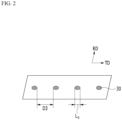
- FIGS. 1 and 2 illustrate a schematic diagram of a grain oriented electrical steel sheet 10 magnetically refined according to an embodiment of the present invention.
- the grain oriented electrical steel sheet 10 includes linear grooves 20 formed on one surface 11 or both surfaces 11 and 12 of the electrical steel sheet in a direction (X 1 direction) crossing a rolling direction (RD direction) and punctuated grooves 30 formed on one surface 11 or both surfaces 11 and 12 of the electrical steel sheet so as to be arranged in a direction (X 2 direction) crossing the rolling direction.
- the plurality of linear grooves 20 and the plurality of punctuated grooves 30 are formed in the rolling direction, and an interval D3 between the punctuated grooves with respect to an arrangement direction (X 2 direction) of the punctuated grooves is 0.02 to 1.7 times an interval D2 between the punctuated grooves with respect to the rolling direction.
- the linear groove 20 and the punctuated groove 30 are formed at the same time, so magnetic properties and electrical insulation properties may be improved at the same time.
- the linear groove 20 or the punctuated groove 30 may be formed alone, heel-up occurs due to an increase in groove depth to secure magnetic properties, resulting in poor magnetic properties and electrical insulation.
- the magnetic properties and electrical insulation properties can be simultaneously improved.
- a ratio D3/D2 of the interval D3 between the punctuated grooves with respect to the arrangement direction (X 2 direction) of the punctuated grooves and the interval D2 between the punctuated grooves with respect to the rolling direction is also important.
- the punctuated groove 30 becomes similar to the linear groove, making it difficult to obtain the effect of simultaneously forming the linear groove 20 or the punctuated groove 30.
- the linear groove 20 becomes the same shape as when the punctuated groove 30 is not substantially formed, so it is difficult to obtain the effect of simultaneously forming the linear groove 20 or the punctuated groove 30.
- the interval D3 between the punctuated grooves with respect to the arrangement direction (X 2 direction) of the punctuated grooves is 0.02 to 1.7 times the interval D2 between the punctuated grooves with respect to the rolling direction. More specifically, it needs to be 0.30 to 1.7 times. More specifically, it needs to be 0.65 to 1.7 times.
- the interval between the linear grooves 20 is indicated as D1
- the interval between the punctuated grooves 30 with respect to the rolling direction is indicated as D2.
- the interval between the punctuated grooves with respect to the arrangement direction (X 2 direction) of the punctuated grooves is indicated as D3.
- an arbitrary linear groove 20 and a linear groove 20 closest to the arbitrary linear groove 20 are defined as the interval D1 between the grooves.
- a punctuated groove 30 closest to an arbitrary punctuated groove 30 in the rolling direction is defined as the interval D2 between punctuated grooves.
- an arbitrary punctuated groove 30 and a punctuated groove 30 closest to the arbitrary punctuated groove 30 in the arrangement direction (X 2 direction) of the punctuated groove are defined as the interval D2 between the punctuated grooves.
- the interval is defined based on a center line of the linear groove 20 and an outermost line of the punctuated groove 30.
- the linear groove 20 and the punctuated groove 30 are substantially parallel, but when they are not parallel, the closest position is regarded as an interval.
- an average value of each interval D1, D2, and D3, that is, a value obtained by dividing a total sum of the intervals D1, D2, and D3 by the total number may satisfy the above-described range.
- the interval D3 between the punctuated grooves with respect to the arrangement direction (X 2 direction) of the punctuated grooves may be 0.01 to 9.00 mm, and the interval D2 between the punctuated grooves with respect to the rolling direction may be 1.8 to 5.0 mm.
- the interval D3 between the punctuated grooves with respect to the arrangement direction (X 2 direction) of the punctuated grooves is too large, the effect of forming only the linear groove 20 instead of the punctuated groove 30 occurs, resulting in poor magnetism and insulation.
- the interval D2 between the punctuated grooves in the rolling direction is too small, the effect of forming only the punctuated grooves 30 instead of the linear grooves 20 may occur, resulting in poor magnetism and insulation.
- the interval D2 between the punctuated grooves with respect to the rolling direction is too large, the effect of forming only the linear grooves 20 instead of the linear grooves 20 may occur, resulting in poor magnetism and insulation. More specifically, the interval D3 between the punctuated grooves with respect to the arrangement direction (X 2 direction) of the punctuated grooves may be 0.1 to 3.0 mm, and the interval D2 between the punctuated grooves with respect to the rolling direction may be 2.0 to 4.0mm.
- the interval D1 between the linear grooves 20 with respect to the rolling direction may be 0.2 to 3.0 times the interval D2 between the punctuated grooves 30 with respect to the rolling direction.
- FIG. 3 illustrates the case where one punctuated groove 30 is formed between the linear grooves 20, that is, the case where D2/D1 is 1, but is not limited thereto.
- the interval D1 between the linear grooves 20 with respect to the rolling direction may be 0.5 to 1.5 times the interval D2 between the punctuated grooves 30 with respect to the rolling direction.
- the interval D1 between the linear grooves 20 with respect to the rolling direction may be 2 to 15 mm.
- the interval D1 between the linear grooves 20 with respect to the rolling direction, the interval D2 between the punctuated grooves 30 with respect to the rolling direction, and the interval D3 between the punctuated grooves with respect to the arrangement direction (X 2 direction) of the punctuated grooves may be constant within the entire electrical sheet. Specifically, all the intervals D1, D2, and D3 within the entire electrical sheet may fall within 10% of average intervals D1, D2, and D3. More specifically, it may correspond to within 1%.
- FIGS. 1 and 2 illustrate that the linear groove 20 and the punctuated groove 30 are formed on one surface 11 of the steel sheet, but are not limited thereto.
- the linear groove 20 is formed on one surface 11 of the steel sheet, and the punctuated groove 30 is formed on the other surface 12 of the steel sheet.
- D2/D1 is smaller than 1. More specifically, the interval D2 between the punctuated grooves 30 may be 0.2 to 0.5 times the interval D1 between the linear grooves 20. In this case, as described above, the average value of each interval D1 and D2 may satisfy the above range. More specifically, the interval D2 between the punctuated grooves 30 may be 0.2 to 0.4 times the interval D1 between the linear grooves 20.
- D2/D1 is greater than 1. More specifically, the interval D2 between the punctuated grooves 30 may be 2 to 2.8 times the interval D1 between the linear grooves 20.
- the linear groove 20 and the punctuated groove 30 refer to a part of the surface of the steel sheet removed by irradiation with a laser, plasma, an ion beam, or the like.
- the shape of the linear groove 20 is expressed as a wedge shape
- the shape of the punctuated groove 30 is expressed as a semicircular shape, but this is only an example, and the linear groove 20 and the punctuated groove 30 may be formed in various shapes such as square, trapezoidal, U-shaped, and W-shape.
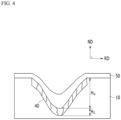
- FIG. 4 illustrates a schematic diagram of the linear groove 20 or the punctuated groove 30 according to the embodiment of the present invention.
- a depth H G of the linear groove 20 or the punctuated groove 30 may be 5 to 15% of the thickness of the steel sheet.
- the depth H G of the groove is too shallow, it is difficult to obtain an appropriate core loss improvement effect.
- the structural characteristics of the steel sheet 10 may greatly change due to strong laser irradiation, or a large amount of heel-up and spatter may be formed to deteriorate magnetism. Accordingly, it is possible to control the depth of the linear groove 20 or the punctuated groove 30 within the above-described range.
- a solidified alloy layer 40 is formed below the linear groove 20 or the punctuated groove 30, and may have a thickness H c of 0.1 ⁇ m to 3 ⁇ m.
- H c thickness of the solidified alloy layer 40
- the solidified alloy layer contains recrystallization with an average grain size of 1 to 10 ⁇ m, and is distinguished from other steel sheet parts.
- an insulating film layer 50 may be formed above the linear groove 20 or the punctuated groove 30 .
- FIGS. 1 and 2 illustrate that the longitudinal direction (X 1 direction) of the linear groove 20 or the arrangement direction (X 2 direction) of the punctuated groove 30 and the rolling direction (RD direction) form a right angle, but are not limited thereto.
- the longitudinal direction (X 1 direction) of the linear groove 20 or the arrangement direction (X 2 direction) of the punctuated groove 30 may form an angle of 75 to 105°.
- it may contribute to improving the core loss of the grain oriented electrical steel sheet. More specifically, it may be 75 to 88° or 97 to 105°.
- FIG. 1 shows that the linear groove 20 is continuously formed along the rolling vertical direction (TD direction), but is not limited thereto.
- 2 to 10 linear grooves 20 may be intermittently formed along the rolling vertical direction (TD direction) of the steel sheet. When formed intermittently like this, it may contribute to improving the core loss of the grain oriented electrical steel sheet.
- the linear groove may have a diameter L G of 0.02 to 0.40mm with respect to the arrangement direction (X 2 direction) of the punctuated groove. Through an appropriate diameter L G , it may contribute to improving the core loss of the grain oriented electrical steel sheet.
- the punctuated groove may have a diameter L G of 0.05 to 0.3mm with respect to the arrangement direction (X 2 direction) of the punctuated groove.
- a method for refining magnetic domains in a grain oriented electrical steel sheet includes preparing the grain oriented electrical steel sheet 10, forming the linear grooves 20 by irradiating a continuous oscillation frequency laser to one surface or both surfaces of the grain oriented electrical steel sheet 10 in a direction crossing a rolling direction (RD direction), and forming the punctuated grooves 30 by irradiating a pulsed oscillation frequency laser to one surface or both surfaces of the grain oriented electrical steel sheet in the direction crossing the rolling direction.
- RD direction rolling direction
- the grain oriented electrical steel sheet 10 is prepared.
- the magnetic domain refinement method and the shapes of the linear groove 20 and the punctuated groove 30 have the above-described features, and the grain oriented electrical steel sheet to be subjected to magnetic domain refinement may be used without limitation.
- the effect of the present invention is exhibited regardless of the alloy composition of the grain oriented electrical steel sheet. Therefore, a detailed description of the alloy composition of the grain oriented electrical steel sheet will be omitted.
- the grain oriented electrical steel sheet may use a grain oriented electrical steel sheet rolled from a slab to a predetermined thickness through hot rolling and cold rolling.
- the grain oriented electrical steel sheets that have undergone primary recrystallization annealing or secondary recrystallization annealing may be used.
- a laser is irradiated to one surface 11 of the grain oriented electrical steel sheet in a direction crossing the rolling direction (RD direction) to form the linear groove 20.
- an energy density Ed of the laser may be 0.5 to 2J/mm 2 .
- the linear groove 20 with an appropriate depth is not formed, and it is difficult to obtain the core loss improvement effect.
- the linear groove 20 with a depth that is too thick is formed, making it difficult to obtain the core loss improvement effect.
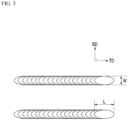
- FIG. 5 illustrates a schematic diagram of the shape of the laser beam.
- the beam length L of the laser in the rolling vertical direction (TD direction) of the steel sheet may be 50 to 750 ⁇ m.
- the laser irradiation time is too short, making it impossible to form an appropriate groove and making it difficult to obtain the core loss improvement effect.
- the beam length L in the rolling vertical direction (TD direction) is too long, the laser irradiation time is too long, so the linear groove 20 having too thick depth is formed, making it difficult to obtain the core loss improvement effect.
- a beam width W of the laser in the rolling direction (RD direction) of the steel sheet may be 10 to 30 ⁇ m.
- the beam width W is too short or too long, the width of the linear groove 20 becomes short or long, so the appropriate magnetic domain refinement effect may not be obtained.
- the shape of the beam is shown as an ellipse in FIG. 5 , it is not limited to a shape such as a sphere or a rectangle.
- a laser having an output of 10 W to 100 kW may be used, and a laser of a Gaussian mode, a single mode, or a fundamental Gaussian mode may be used. It is a TEMoo-shaped beam, and the M2 value may have a value in the range of 1.0 to 1.2.
- the pulsed oscillation frequency laser is irradiated to one surface or both surfaces of the grain oriented electrical steel sheet 10 in the direction crossing the rolling direction (RD direction) to form the punctuated groove 30.
- the forming of the linear groove 20 and the forming of the punctuated groove 30 described above may be performed without any limitations on the time line or later. Specifically, after forming the linear groove 20, the punctuated groove 30 may be formed. In addition, after forming the punctuated groove 30, the linear groove 20 may be formed. In addition, it is also possible to simultaneously form the linear groove 20 and the punctuated groove 30.
- a laser having the same energy density, shape, output, and type as in the forming of the linear groove 20 described above may be used.
- the pulsed oscillation frequency laser may be irradiated.
- the pulsed oscillation frequency laser is a laser in which the output of the laser beam changes over time. Since there is such a change in output, the grooves are not formed in areas where the laser peak energy is low, and the grooves are formed only in areas where the laser peak energy is high, resulting in the formation of the punctuated grooves 30.
- the frequency F q of the laser and the interval D2 between the punctuated grooves with respect to the rolling direction may satisfy Equation 1 below. 11 mm ⁇ s ⁇ F q / D 2 ⁇ 20000 mm ⁇ s (In Equation 1, [F q ] represents the frequency (Hz) of the laser in the forming of the punctuated groove, and [D2] represents the interval (mm) between the punctuated grooves with respect to the rolling direction.)
- the punctuated groove 30 becomes similar to the linear groove, making it difficult to obtain the effect of simultaneously forming the linear groove 20 or the punctuated groove 30.
- the linear groove 20 becomes the same shape as when the punctuated groove 30 is not substantially formed, so it is difficult to obtain the effect of simultaneously forming the linear groove 20 or the punctuated groove 30.
- the value of Equation 1 needs to be 111 to 2000 mm.s.
- the frequency F q of the laser may be 20 to 100 kHz. In the above range, the punctuated groove 30 is appropriately formed, so the magnetism and insulation may be improved at the same time.
- the duty of the laser may be 50% or less.
- the duty represents a ratio T b /T a of [irradiation time with an output of 10% or more of maximum output (Pmax)] (T b ) to [output modulation cycle time] (T a ) in the time waveform for the output of the laser beam.
- Pmax maximum output
- T b maximum output
- T a output modulation cycle time
- the method for refining magnetic domains in a grain oriented electrical steel sheet according to an embodiment of the present invention may further include forming the insulating film layer.
- the forming of the insulating film layer may be included after the preparing of the grain oriented electrical steel sheet, after the forming of the linear groove, or after the forming of the punctuated groove. More specifically, it may be included after the forming of the linear groove and the punctuated groove. After forming the linear groove and the punctuated groove, when forming the insulating film layer, there is an advantage in that the insulation coating only needs to be performed once.
- a method of forming an insulating film layer may be used without particular limitation, and for example, the insulating coating layer may be formed by applying an insulating coating liquid containing phosphate.
- an insulating coating liquid it is preferable to use a coating liquid containing colloidal silica and metal phosphate.
- the metal phosphate may be Al phosphate, Mg phosphate, or a combination thereof, and the content of Al, Mg, or a combination thereof relative to the weight of the insulating coating liquid may be 15 wt% or more.
- a grain oriented electrical steel sheet with a thickness of 0.30 mm was prepared by cold rolling, primary recrystallization annealing, and secondary recrystallization annealing.
- a width W of the laser beam is 20 ⁇ m, and a length L of the laser beam is 600 ⁇ m.
- the energy density of the laser was 1.5 J/mm 2 .
- the interval between the linear grooves was 2.5 mm. Groove depths were shown in Table 1 below.
- the width W of the laser beam is 20 ⁇ m
- the length L of the laser beam is 500 ⁇ m.
- the energy density of the laser was 1.5 J/mm 2 .
- the interval D2 between the punctuated grooves in the rolling direction, the interval D3 between the punctuated grooves in the arrangement direction, and the groove depth were shown in Table 1 below.
- Table 1 shows an embodiment of the present invention.
- the coercive force was measured at 50Hz and 1.7T.
- the core loss was measured as a core loss value (W 17/50 ) when the frequency was 50Hz when a value of magnetic flux density was 1.7 Telsa.
Landscapes
- Engineering & Computer Science (AREA)
- Physics & Mathematics (AREA)
- Chemical & Material Sciences (AREA)
- Optics & Photonics (AREA)
- Mechanical Engineering (AREA)
- Power Engineering (AREA)
- Manufacturing & Machinery (AREA)
- Plasma & Fusion (AREA)
- Electromagnetism (AREA)
- Thermal Sciences (AREA)
- Crystallography & Structural Chemistry (AREA)
- Materials Engineering (AREA)
- Metallurgy (AREA)
- Organic Chemistry (AREA)
- Dispersion Chemistry (AREA)
- Soft Magnetic Materials (AREA)
- Manufacturing Of Steel Electrode Plates (AREA)
Applications Claiming Priority (2)
| Application Number | Priority Date | Filing Date | Title |
|---|---|---|---|
| KR1020200179813A KR102415741B1 (ko) | 2020-12-21 | 2020-12-21 | 방향성 전기강판 및 그 자구미세화 방법 |
| PCT/KR2021/019216 WO2022139334A1 (fr) | 2020-12-21 | 2021-12-16 | Tôle d'acier magnétique à grains orientés et son procédé d'affinement de domaine magnétique |
Publications (2)
| Publication Number | Publication Date |
|---|---|
| EP4266331A1 true EP4266331A1 (fr) | 2023-10-25 |
| EP4266331A4 EP4266331A4 (fr) | 2024-06-12 |
Family
ID=82159670
Family Applications (1)
| Application Number | Title | Priority Date | Filing Date |
|---|---|---|---|
| EP21911401.4A Pending EP4266331A4 (fr) | 2020-12-21 | 2021-12-16 | Tôle d'acier magnétique à grains orientés et son procédé d'affinement de domaine magnétique |
Country Status (6)
| Country | Link |
|---|---|
| US (1) | US20240024985A1 (fr) |
| EP (1) | EP4266331A4 (fr) |
| JP (1) | JP7680542B2 (fr) |
| KR (1) | KR102415741B1 (fr) |
| CN (1) | CN116710578A (fr) |
| WO (1) | WO2022139334A1 (fr) |
Family Cites Families (8)
| Publication number | Priority date | Publication date | Assignee | Title |
|---|---|---|---|---|
| US4963199A (en) * | 1988-10-14 | 1990-10-16 | Abb Power T&D Company, Inc. | Drilling of steel sheet |
| JPH07320922A (ja) * | 1994-03-31 | 1995-12-08 | Kawasaki Steel Corp | 鉄損の低い一方向性電磁鋼板 |
| JP4239233B2 (ja) * | 1998-03-26 | 2009-03-18 | Jfeスチール株式会社 | 方向性電磁鋼板の製造方法および方向性電磁鋼板のエッチングマスク形成装置 |
| JP5000182B2 (ja) * | 2006-04-07 | 2012-08-15 | 新日本製鐵株式会社 | 磁気特性の優れた方向性電磁鋼板の製造方法 |
| KR101659350B1 (ko) * | 2016-02-11 | 2016-09-23 | 주식회사 포스코 | 방향성 전기강판 및 그 제조방법 |
| KR101944899B1 (ko) | 2016-12-22 | 2019-02-01 | 주식회사 포스코 | 방향성 전기강판의 자구미세화 방법 |
| KR102044320B1 (ko) * | 2017-12-26 | 2019-11-13 | 주식회사 포스코 | 방향성 전기강판 및 그 자구미세화 방법 |
| JP7010311B2 (ja) * | 2018-02-08 | 2022-02-10 | 日本製鉄株式会社 | 方向性電磁鋼板 |
-
2020
- 2020-12-21 KR KR1020200179813A patent/KR102415741B1/ko active Active
-
2021
- 2021-12-16 EP EP21911401.4A patent/EP4266331A4/fr active Pending
- 2021-12-16 US US18/268,407 patent/US20240024985A1/en active Pending
- 2021-12-16 JP JP2023537528A patent/JP7680542B2/ja active Active
- 2021-12-16 WO PCT/KR2021/019216 patent/WO2022139334A1/fr not_active Ceased
- 2021-12-16 CN CN202180085715.XA patent/CN116710578A/zh active Pending
Also Published As
| Publication number | Publication date |
|---|---|
| JP7680542B2 (ja) | 2025-05-20 |
| JP2024500836A (ja) | 2024-01-10 |
| WO2022139334A1 (fr) | 2022-06-30 |
| EP4266331A4 (fr) | 2024-06-12 |
| KR102415741B1 (ko) | 2022-06-30 |
| CN116710578A (zh) | 2023-09-05 |
| US20240024985A1 (en) | 2024-01-25 |
| KR20220089310A (ko) | 2022-06-28 |
Similar Documents
| Publication | Publication Date | Title |
|---|---|---|
| JP7245285B2 (ja) | 方向性電磁鋼板およびその磁区微細化方法 | |
| US11638971B2 (en) | Grain-oriented silicon steel with low core loss and manufacturing method therefore | |
| US6083326A (en) | Grain-oriented electromagnetic steel sheet | |
| EP3239325B1 (fr) | Tôle d'acier électrique à grains orientés et procédé permettant la production de cette dernière | |
| KR101944899B1 (ko) | 방향성 전기강판의 자구미세화 방법 | |
| EP3733881B1 (fr) | Tôle d'acier électrique à grains orientés et son procédé d'affinement de domaine magnétique | |
| JP7440638B2 (ja) | 方向性電磁鋼板およびその磁区微細化方法 | |
| EP4266331A1 (fr) | Tôle d'acier magnétique à grains orientés et son procédé d'affinement de domaine magnétique | |
| WO2016105055A1 (fr) | Tôle d'acier électrique à grains orientés et procédé permettant la production de cette dernière | |
| JP7391087B2 (ja) | 方向性電磁鋼板およびその磁区微細化方法 |
Legal Events
| Date | Code | Title | Description |
|---|---|---|---|
| STAA | Information on the status of an ep patent application or granted ep patent |
Free format text: STATUS: THE INTERNATIONAL PUBLICATION HAS BEEN MADE |
|
| PUAI | Public reference made under article 153(3) epc to a published international application that has entered the european phase |
Free format text: ORIGINAL CODE: 0009012 |
|
| STAA | Information on the status of an ep patent application or granted ep patent |
Free format text: STATUS: REQUEST FOR EXAMINATION WAS MADE |
|
| 17P | Request for examination filed |
Effective date: 20230705 |
|
| AK | Designated contracting states |
Kind code of ref document: A1 Designated state(s): AL AT BE BG CH CY CZ DE DK EE ES FI FR GB GR HR HU IE IS IT LI LT LU LV MC MK MT NL NO PL PT RO RS SE SI SK SM TR |
|
| DAV | Request for validation of the european patent (deleted) | ||
| DAX | Request for extension of the european patent (deleted) | ||
| A4 | Supplementary search report drawn up and despatched |
Effective date: 20240515 |
|
| RIC1 | Information provided on ipc code assigned before grant |
Ipc: B23K 103/04 20060101ALN20240508BHEP Ipc: B23K 101/18 20060101ALN20240508BHEP Ipc: B23K 26/40 20140101ALI20240508BHEP Ipc: B23K 26/364 20140101ALI20240508BHEP Ipc: H01F 41/02 20060101ALI20240508BHEP Ipc: C21D 8/12 20060101ALI20240508BHEP Ipc: H01F 1/16 20060101AFI20240508BHEP |