EP4266417A1 - Matériau d'électrode positive, son procédé de préparation et son utilisation, et batterie au lithium-ion - Google Patents
Matériau d'électrode positive, son procédé de préparation et son utilisation, et batterie au lithium-ion Download PDFInfo
- Publication number
- EP4266417A1 EP4266417A1 EP22914693.1A EP22914693A EP4266417A1 EP 4266417 A1 EP4266417 A1 EP 4266417A1 EP 22914693 A EP22914693 A EP 22914693A EP 4266417 A1 EP4266417 A1 EP 4266417A1
- Authority
- EP
- European Patent Office
- Prior art keywords
- cathode material
- following relationship
- precipitation reaction
- sub
- phase
- Prior art date
- Legal status (The legal status is an assumption and is not a legal conclusion. Google has not performed a legal analysis and makes no representation as to the accuracy of the status listed.)
- Granted
Links
Images


Classifications
-
- H—ELECTRICITY
- H01—ELECTRIC ELEMENTS
- H01M—PROCESSES OR MEANS, e.g. BATTERIES, FOR THE DIRECT CONVERSION OF CHEMICAL ENERGY INTO ELECTRICAL ENERGY
- H01M4/00—Electrodes
- H01M4/02—Electrodes composed of, or comprising, active material
- H01M4/36—Selection of substances as active materials, active masses, active liquids
- H01M4/48—Selection of substances as active materials, active masses, active liquids of inorganic oxides or hydroxides
- H01M4/52—Selection of substances as active materials, active masses, active liquids of inorganic oxides or hydroxides of nickel, cobalt or iron
- H01M4/525—Selection of substances as active materials, active masses, active liquids of inorganic oxides or hydroxides of nickel, cobalt or iron of mixed oxides or hydroxides containing iron, cobalt or nickel for inserting or intercalating light metals, e.g. LiNiO2, LiCoO2 or LiCoOxFy
-
- C—CHEMISTRY; METALLURGY
- C01—INORGANIC CHEMISTRY
- C01G—COMPOUNDS CONTAINING METALS NOT COVERED BY SUBCLASSES C01D OR C01F
- C01G53/00—Compounds of nickel
- C01G53/40—Complex oxides containing nickel and at least one other metal element
- C01G53/42—Complex oxides containing nickel and at least one other metal element containing alkali metals, e.g. LiNiO2
- C01G53/44—Complex oxides containing nickel and at least one other metal element containing alkali metals, e.g. LiNiO2 containing manganese
- C01G53/50—Complex oxides containing nickel and at least one other metal element containing alkali metals, e.g. LiNiO2 containing manganese of the type (MnO2)n-, e.g. Li(NixMn1-x)O2 or Li(MyNixMn1-x-y)O2
-
- C—CHEMISTRY; METALLURGY
- C01—INORGANIC CHEMISTRY
- C01G—COMPOUNDS CONTAINING METALS NOT COVERED BY SUBCLASSES C01D OR C01F
- C01G53/00—Compounds of nickel
- C01G53/80—Compounds containing nickel, with or without oxygen or hydrogen, and containing one or more other elements
- C01G53/82—Compounds containing nickel, with or without oxygen or hydrogen, and containing two or more other elements
-
- H—ELECTRICITY
- H01—ELECTRIC ELEMENTS
- H01M—PROCESSES OR MEANS, e.g. BATTERIES, FOR THE DIRECT CONVERSION OF CHEMICAL ENERGY INTO ELECTRICAL ENERGY
- H01M10/00—Secondary cells; Manufacture thereof
- H01M10/05—Accumulators with non-aqueous electrolyte
- H01M10/052—Li-accumulators
-
- H—ELECTRICITY
- H01—ELECTRIC ELEMENTS
- H01M—PROCESSES OR MEANS, e.g. BATTERIES, FOR THE DIRECT CONVERSION OF CHEMICAL ENERGY INTO ELECTRICAL ENERGY
- H01M10/00—Secondary cells; Manufacture thereof
- H01M10/05—Accumulators with non-aqueous electrolyte
- H01M10/052—Li-accumulators
- H01M10/0525—Rocking-chair batteries, i.e. batteries with lithium insertion or intercalation in both electrodes; Lithium-ion batteries
-
- H—ELECTRICITY
- H01—ELECTRIC ELEMENTS
- H01M—PROCESSES OR MEANS, e.g. BATTERIES, FOR THE DIRECT CONVERSION OF CHEMICAL ENERGY INTO ELECTRICAL ENERGY
- H01M4/00—Electrodes
- H01M4/02—Electrodes composed of, or comprising, active material
- H01M4/13—Electrodes for accumulators with non-aqueous electrolyte, e.g. for lithium-accumulators; Processes of manufacture thereof
- H01M4/131—Electrodes based on mixed oxides or hydroxides, or on mixtures of oxides or hydroxides, e.g. LiCoOx
-
- H—ELECTRICITY
- H01—ELECTRIC ELEMENTS
- H01M—PROCESSES OR MEANS, e.g. BATTERIES, FOR THE DIRECT CONVERSION OF CHEMICAL ENERGY INTO ELECTRICAL ENERGY
- H01M4/00—Electrodes
- H01M4/02—Electrodes composed of, or comprising, active material
- H01M4/36—Selection of substances as active materials, active masses, active liquids
-
- H—ELECTRICITY
- H01—ELECTRIC ELEMENTS
- H01M—PROCESSES OR MEANS, e.g. BATTERIES, FOR THE DIRECT CONVERSION OF CHEMICAL ENERGY INTO ELECTRICAL ENERGY
- H01M4/00—Electrodes
- H01M4/02—Electrodes composed of, or comprising, active material
- H01M4/36—Selection of substances as active materials, active masses, active liquids
- H01M4/362—Composites
- H01M4/366—Composites as layered products
-
- H—ELECTRICITY
- H01—ELECTRIC ELEMENTS
- H01M—PROCESSES OR MEANS, e.g. BATTERIES, FOR THE DIRECT CONVERSION OF CHEMICAL ENERGY INTO ELECTRICAL ENERGY
- H01M4/00—Electrodes
- H01M4/02—Electrodes composed of, or comprising, active material
- H01M4/36—Selection of substances as active materials, active masses, active liquids
- H01M4/48—Selection of substances as active materials, active masses, active liquids of inorganic oxides or hydroxides
- H01M4/485—Selection of substances as active materials, active masses, active liquids of inorganic oxides or hydroxides of mixed oxides or hydroxides for inserting or intercalating light metals, e.g. LiTi2O4 or LiTi2OxFy
-
- H—ELECTRICITY
- H01—ELECTRIC ELEMENTS
- H01M—PROCESSES OR MEANS, e.g. BATTERIES, FOR THE DIRECT CONVERSION OF CHEMICAL ENERGY INTO ELECTRICAL ENERGY
- H01M4/00—Electrodes
- H01M4/02—Electrodes composed of, or comprising, active material
- H01M4/36—Selection of substances as active materials, active masses, active liquids
- H01M4/48—Selection of substances as active materials, active masses, active liquids of inorganic oxides or hydroxides
- H01M4/50—Selection of substances as active materials, active masses, active liquids of inorganic oxides or hydroxides of manganese
- H01M4/505—Selection of substances as active materials, active masses, active liquids of inorganic oxides or hydroxides of manganese of mixed oxides or hydroxides containing manganese for inserting or intercalating light metals, e.g. LiMn2O4 or LiMn2OxFy
-
- C—CHEMISTRY; METALLURGY
- C01—INORGANIC CHEMISTRY
- C01P—INDEXING SCHEME RELATING TO STRUCTURAL AND PHYSICAL ASPECTS OF SOLID INORGANIC COMPOUNDS
- C01P2002/00—Crystal-structural characteristics
- C01P2002/50—Solid solutions
- C01P2002/52—Solid solutions containing elements as dopants
-
- C—CHEMISTRY; METALLURGY
- C01—INORGANIC CHEMISTRY
- C01P—INDEXING SCHEME RELATING TO STRUCTURAL AND PHYSICAL ASPECTS OF SOLID INORGANIC COMPOUNDS
- C01P2002/00—Crystal-structural characteristics
- C01P2002/70—Crystal-structural characteristics defined by measured X-ray, neutron or electron diffraction data
- C01P2002/72—Crystal-structural characteristics defined by measured X-ray, neutron or electron diffraction data by d-values or two theta-values, e.g. as X-ray diagram
-
- C—CHEMISTRY; METALLURGY
- C01—INORGANIC CHEMISTRY
- C01P—INDEXING SCHEME RELATING TO STRUCTURAL AND PHYSICAL ASPECTS OF SOLID INORGANIC COMPOUNDS
- C01P2002/00—Crystal-structural characteristics
- C01P2002/70—Crystal-structural characteristics defined by measured X-ray, neutron or electron diffraction data
- C01P2002/74—Crystal-structural characteristics defined by measured X-ray, neutron or electron diffraction data by peak-intensities or a ratio thereof only
-
- C—CHEMISTRY; METALLURGY
- C01—INORGANIC CHEMISTRY
- C01P—INDEXING SCHEME RELATING TO STRUCTURAL AND PHYSICAL ASPECTS OF SOLID INORGANIC COMPOUNDS
- C01P2004/00—Particle morphology
- C01P2004/01—Particle morphology depicted by an image
- C01P2004/03—Particle morphology depicted by an image obtained by SEM
-
- C—CHEMISTRY; METALLURGY
- C01—INORGANIC CHEMISTRY
- C01P—INDEXING SCHEME RELATING TO STRUCTURAL AND PHYSICAL ASPECTS OF SOLID INORGANIC COMPOUNDS
- C01P2004/00—Particle morphology
- C01P2004/50—Agglomerated particles
-
- C—CHEMISTRY; METALLURGY
- C01—INORGANIC CHEMISTRY
- C01P—INDEXING SCHEME RELATING TO STRUCTURAL AND PHYSICAL ASPECTS OF SOLID INORGANIC COMPOUNDS
- C01P2004/00—Particle morphology
- C01P2004/51—Particles with a specific particle size distribution
-
- C—CHEMISTRY; METALLURGY
- C01—INORGANIC CHEMISTRY
- C01P—INDEXING SCHEME RELATING TO STRUCTURAL AND PHYSICAL ASPECTS OF SOLID INORGANIC COMPOUNDS
- C01P2004/00—Particle morphology
- C01P2004/60—Particles characterised by their size
- C01P2004/61—Micrometer sized, i.e. from 1-100 micrometer
-
- C—CHEMISTRY; METALLURGY
- C01—INORGANIC CHEMISTRY
- C01P—INDEXING SCHEME RELATING TO STRUCTURAL AND PHYSICAL ASPECTS OF SOLID INORGANIC COMPOUNDS
- C01P2006/00—Physical properties of inorganic compounds
- C01P2006/12—Surface area
-
- C—CHEMISTRY; METALLURGY
- C01—INORGANIC CHEMISTRY
- C01P—INDEXING SCHEME RELATING TO STRUCTURAL AND PHYSICAL ASPECTS OF SOLID INORGANIC COMPOUNDS
- C01P2006/00—Physical properties of inorganic compounds
- C01P2006/16—Pore diameter
-
- C—CHEMISTRY; METALLURGY
- C01—INORGANIC CHEMISTRY
- C01P—INDEXING SCHEME RELATING TO STRUCTURAL AND PHYSICAL ASPECTS OF SOLID INORGANIC COMPOUNDS
- C01P2006/00—Physical properties of inorganic compounds
- C01P2006/16—Pore diameter
- C01P2006/17—Pore diameter distribution
-
- C—CHEMISTRY; METALLURGY
- C01—INORGANIC CHEMISTRY
- C01P—INDEXING SCHEME RELATING TO STRUCTURAL AND PHYSICAL ASPECTS OF SOLID INORGANIC COMPOUNDS
- C01P2006/00—Physical properties of inorganic compounds
- C01P2006/40—Electric properties
-
- H—ELECTRICITY
- H01—ELECTRIC ELEMENTS
- H01M—PROCESSES OR MEANS, e.g. BATTERIES, FOR THE DIRECT CONVERSION OF CHEMICAL ENERGY INTO ELECTRICAL ENERGY
- H01M4/00—Electrodes
- H01M4/02—Electrodes composed of, or comprising, active material
- H01M2004/021—Physical characteristics, e.g. porosity, surface area
-
- H—ELECTRICITY
- H01—ELECTRIC ELEMENTS
- H01M—PROCESSES OR MEANS, e.g. BATTERIES, FOR THE DIRECT CONVERSION OF CHEMICAL ENERGY INTO ELECTRICAL ENERGY
- H01M4/00—Electrodes
- H01M4/02—Electrodes composed of, or comprising, active material
- H01M2004/026—Electrodes composed of, or comprising, active material characterised by the polarity
- H01M2004/028—Positive electrodes
-
- Y—GENERAL TAGGING OF NEW TECHNOLOGICAL DEVELOPMENTS; GENERAL TAGGING OF CROSS-SECTIONAL TECHNOLOGIES SPANNING OVER SEVERAL SECTIONS OF THE IPC; TECHNICAL SUBJECTS COVERED BY FORMER USPC CROSS-REFERENCE ART COLLECTIONS [XRACs] AND DIGESTS
- Y02—TECHNOLOGIES OR APPLICATIONS FOR MITIGATION OR ADAPTATION AGAINST CLIMATE CHANGE
- Y02E—REDUCTION OF GREENHOUSE GAS [GHG] EMISSIONS, RELATED TO ENERGY GENERATION, TRANSMISSION OR DISTRIBUTION
- Y02E60/00—Enabling technologies; Technologies with a potential or indirect contribution to GHG emissions mitigation
- Y02E60/10—Energy storage using batteries
Definitions
- the present disclosure relates to the technical field of cathode materials for lithium-ion battery, particularly to a cathode material, a preparation method and a use thereof, and a lithium-ion battery.
- the cathode materials for lithium-ion battery have undergone the evolutions of LiCoO 2 , Li 2 MnO 4 and LiFeP04 and the like, the current development goal is mainly focused on the ternary materials.
- the pore diameter is larger and the more pores are presented, it is prone to cause collapse of the surface crystal structure during the lithium ion deintercalation process, thereby decreasing the actual service life of the battery. Therefore, it is very important to effectively control the most appropriate pore distribution in the particles, especially the pore size and the number of pores during the process of preparing the cathode material.
- CN108123119A discloses a nickel-based active material for lithium secondary battery, wherein a porosity of an exterior portion of the secondary particle may be within a range of 6-20%, a porosity of an interior portion of the secondary particle may be 5%.
- the prior art comprises a cathode material having an exterior porosity more than interior porosity, while in practical use, the electrolyte is immersed the surface of material in a short time, and the porous exterior structure can increase the initial capacity, however, the surface may easily collapse during the process of charging and discharging for many times, causing an irreversible existence of "dead lithium", the interior structure is relatively dense, and the capacity will significantly decrease during the later stage of charging and discharging process, such a situation is undesired for the industrial practitioners.
- the present disclosure intends to overcome the problem in the prior art that the short-term and long-term properties of a lithium-ion battery in the charging and discharging can hardly balanced, and provides a cathode material and a preparation method and a use thereof; the cathode material has a specific pore diameter, pore diameter distribution, pore diameter area and microcrystallite structure, so that both the short-term properties such as initial charge-discharge capacity and long-term properties such as capacity retention ratio of a lithium ion battery prepared with the cathode material can be improved during the charge-discharge process.
- a third aspect of the present disclosure provides a cathode material prepared by the aforementioned method.
- a fourth aspect the present disclosure provides a use of the aforementioned cathode material in a lithium-ion battery.
- the cathode material and the method and use thereof provided by the present disclosure produce the following favorable effects: the cathode material provided by the present disclosure has a specific pore diameter distribution, such that both the short-term properties such as initial charge-discharge capacity and long-term properties such as capacity retention ratio of a lithium ion battery prepared with the cathode material can be improved during the charge-discharge process.
- the cathode material provided by the present disclosure has a specific pore diameter distribution such that in a short term of the charging and discharging process of the lithium-ion battery, the difficulty of side reaction performed between the surface and electrolyte can be controlled, and the surface impedance of lithium ions in the charge-discharge process can also be regulated.
- the cathode material provided by the present disclosure has a specific microcrystallite structure, pore diameter area, and pore diameter, so that the cathode material can effectively compensate a decrease of the surface capacity caused by an increase of the surface "dead lithium" after collapse of the surface crystal structure, alleviate the aging degree of the material, and extend service life of the battery.
- a suitable pore diameter distribution of the cell material can be achieved in the method for preparing the cathode material provided by the present disclosure, by controlling the pH at various phases during the co-precipitation reaction to obtain a suitable precursor, and subsequently controlling the doping and sintering process and the cladding and post-treatment process in the later stage, thereby ensuring the desirable performance for the short-term and long-term properties of a lithium ion battery prepared with the cathode material.
- any value of the ranges disclosed herein are not limited to the precise ranges or values, such ranges or values shall be comprehended as comprising the values adjacent to the ranges or values.
- numerical ranges the endpoint values of the various ranges, the endpoint values and the individual point value of the various ranges, and the individual point values may be combined with one another to produce one or more new numerical ranges, which should be deemed have been specifically disclosed herein.
- a cathode material having the above-described specific pore diameter and pore diameter distribution enables that both the short-term properties such as initial charge-discharge capacity and long-term properties such as capacity retention ratio of a lithium ion battery prepared with the cathode material can be improved during the charge-discharge process.
- the cathode material having the above-mentioned pore diameter dso exhibits excellent initial charge-discharge capacity and cycle performance. Specifically, when the pore diameter dso is less than 10nm, the internal pore diameter is small, the Li ions in the cathode material are confronted with multiple barriers when shuttling back and forth, which is unfavorable for exertion of the entire capacity of the material. When dso is greater than 40nm, the internal pore diameter is large, the grain strength of the material is weakened, the grain breakage and pulverization would easily occur when a positive electrode of the battery is rolled.
- the cathode material having the above-mentioned pore diameter d 90 exhibits excellent initial charge-discharge capacity and cycle performance. Specifically, when k 90 is less than 1, the pore diameter distribution is close to uniformity, which is quite difficult in practical production; when k 90 is greater than 8, the pore sizes are not uniformly dispersed in the material, and the degree of infiltration of the electrolyte is different, which leads to different charge and discharge depths, such that the cycle performance finally deteriorates.
- the pore diameters die, dso and d 90 of the secondary particles obtained by BJH satisfy the following relationship: 12nm ⁇ d 50 ⁇ 35nm; 2 ⁇ k 90 ⁇ 6.
- a ratio y of an area S II of pore diameters of average sizes of the secondary particles to an average area S I of the primary particles satisfies the following relationship: 0.01% ⁇ 0.2%.
- the area of pore diameters of average sizes of the secondary particles refers to an area which is calculated based on an average value of the pore diameters.
- SEM Scanning Electron Microscopy
- the ratio y of an area S II of pore diameters of average sizes of the secondary particles to an average area S I of the primary particles satisfies the above relationship, the effect of pores can be exerted at a maximum, and the performance of capacity is not affected, so that the battery fabricated with the cathode material simultaneously has high initial charge-discharge capacity and excellent cycle performance.
- the ratio y of an area S II of pore diameters of average sizes of the secondary particles to an average area S I of the primary particles satisfies the following relationship: 0.05% ⁇ 0.20%.
- an intensity I 103 of the (003) crystallographic plane and a peak intensity I 104 of the (104) crystallographic plane of the cathode material obtained by XRD satisfy the following relationship: 1 ⁇ I 003 /I 104 ⁇ 1.8.
- the intensity I 103 of the (003) crystallographic plane and the peak intensity I 104 of the (104) crystallographic plane of the cathode material obtained by XRD are obtained by using an XRD diffractometer, through a step scan and a small angle test method.
- the microcrystalline structure of the cathode material has a desirable lamellar structure, which causing that the cathode material is more conducive to the deintercalation of lithium ions during the charging and discharging cycles, thereby improving properties of the lithium-ion battery fabricated with the cathode material.
- an intensity I 103 of the (003) crystallographic plane obtained by XRD and a peak intensity I 104 of the (104) crystallographic plane satisfy the following relationship: 1.1 ⁇ I 003 /I 104 ⁇ 1.7.
- an interlayer spacing d 003 of the (003) crystallographic plane and an interlayer spacing d 104 of the (104) crystallographic plane of the cathode material obtained by XRD satisfy the following relationship: d 003 /d 104 ⁇ 1.
- the interlayer spacing does of the (003) crystallographic plane and the interlayer spacing d 104 of the (104) crystallographic plane of the cathode material obtained by XRD satisfy the aforementioned relationship, it can ensure that the material has an appropriate contact area and angle when contacting with the electrolyte, so that the capacity and cycle performance and other property of the final material are effectively improved.
- an interlayer spacing does of the (003) crystallographic plane and an interlayer spacing d 104 of the (104) crystallographic plane of the cathode material obtained by XRD satisfy the following relationship: 1.2 ⁇ d003/d 104 ⁇ 3.
- the grain diameter D 50 of the cathode material shall fall into the above range; if the D 50 of the cathode material is less than 5 ⁇ m, the mobility of particles is poor, thus the requirements on humidity and temperature of the environment during the preparation of cathode material and the fabrication of the battery cell are high. If the D 50 of the cathode material is larger than 20 ⁇ m, when the cathode material is used for the fabrication of a battery cell, the capacity of said battery cell cannot be sufficiently exerted, and the particles of the cathode material are easily crushed during the rolling process of the battery.
- the grain diameters D 5 , D 50 and D 95 of the cathode material are measured by a laser particle size analyzer.
- a particle strength MCT of the cathode material satisfies the following relationship: 60MPa ⁇ MCT ⁇ 200MPa.
- the material when the particle strength MCT of the cathode material satisfies the above range, the material has an appropriate strength. If the particle strength MCT is less than 60MPa, the particles can be easily crushed during the fabrication process of the pole piece of battery. If the particle strength MCT is greater than 200MPa, it also prevents the deintercalation of lithium ions. Only when the particle strength of the cathode material falls into the above range, the comprehensive performance of the material can be enhanced.
- the particle strength MCT of the cathode material is measured by a miniature compression test machine.
- the BET of the cathode material satisfies the following relationship: 0.25m 2 /g ⁇ BET ⁇ 0.95m 2 /g.
- the pores on a surface of the cathode material effectively increase the contact area when the material is in contact with the electrolyte, effectively enhancing the exertion of the first charge and discharge capacity of the material; however, if the specific surface area BET of the cathode material is excessively high and the pores on the surface is too much, the surface crystal structure is prone to collapse during the long charge and discharge cycles, thereby causing rapid attenuation of the reversible capacity. Therefore, an appropriate BET ensures that the comprehensive performance of the material can be improved.
- the cathode material has a composition as shown in Formula 1: Li e (Ni 1-x-y-z-m Co x M y G z H m )O 2 Formula 1;
- the cathode material comprises a doping element G and a cladding element H, and the specific kinds of doping element G and cladding element H are selected so as to form a different bonding between the transition metal and various doping and cladding elements in the cathode material; in particular, after treating with appropriate process conditions, the battery fabricated with the cathode material has a high initial charge-discharge capacity and excellent cycle performance.
- M is Mn; G is at least one element selected from the group consisting of Al, Mg, Ca, Sr, Zr, Nb and Mo; and H is at least one element selected from the group consisting of B, Zr, Nb, Al and Y
- the method for preparing a cathode material used in the present disclosure comprises a design of continuously varying the pH during the process of preparing a precursor; in particular, the pH varies within a range of 10-13.
- the method for preparing a cathode material used in the present disclosure further comprises a design in regard to a sintering temperature and a sintering time during the sintering process, wherein the sintering temperature is 650-900°C and the sintering time is 6-30h.
- the method for preparing a cathode material used in the present disclosure further comprises a design in regard to a treatment temperature and a treatment time during the surface heat treatment process, wherein the heat treatment temperature is within a range of 200-500°C, and the heat treatment time is within a range of 5-18h.
- a second aspect of the present disclosure provides a method for preparing a cathode material comprising:
- the method for preparing the cathode material used in the present disclosure comprises a design of continuously varying the pH during the preparation process of precursor material; in particular, the pH is varied within a range of 10-13.
- a suitable pore diameter distribution of the cell material can be achieved, by controlling the pH at various phases during the co-precipitation reaction to obtain a suitable precursor, and subsequently controlling the doping and sintering process and the cladding and post-treatment process in the later stage, thereby ensuring the desirable performance for the short-term and long-term properties of a lithium ion battery prepared with the cathode material.
- the nickel salt is at least one selected from the group consisting of nickel sulfate, nickel nitrate and nickel chloride;
- the cobalt salt is at least one selected from the group consisting of cobalt sulfate, cobalt nitrate and cobalt chloride;
- the M salt is selected from Al salt and/or Mn salt, more preferably, the Al salt is at least one selected from the group consisting of aluminium sulphate, aluminium nitrate and aluminium chloride, and the Mn salt is at least one selected from the group consisting of manganese sulphate, manganese nitrate and manganese chloride.
- the precipitating agent is an alkaline solution, such as a sodium hydroxide solution; the complexing agent is aqueous ammonia.
- lOh ⁇ t ⁇ _120h preferably 15h ⁇ t ⁇ 100h.
- the temperature of co-precipitation reaction is within a range of 30-100°C, more preferably within a range of 40-70°C.
- the Q1, Q2 and Q3 are decremented in an arithmetic progression.
- the co-precipitation reaction is performed in the presence of nitrogen gas and/or oxygen gas.
- the co-precipitation reaction when the co-precipitation reaction is performed during the 0-t/3 phase, the co-precipitation reaction is performed in the presence of nitrogen gas and oxygen gas, the volume fraction of oxygen gas is 0-5vol%, based on the total volume of nitrogen gas and oxygen gas; when the co-precipitation reaction is performed during the t/3-2/3t phase, the co-precipitation reaction is performed in the presence of nitrogen gas and oxygen gas, the volume fraction of oxygen is 0-3vol%, based on the total volume of nitrogen gas and oxygen gas; when the co-precipitation reaction is performed during the 2/3t-t phase, the co-precipitation reaction is performed in the presence of nitrogen gas.
- the precursors with a specific structure and pore diameter can be obtained by arranging that the co-precipitation reaction is performed in the presence of oxygen gas during the 0-t/3 phase and t/3-2/3t phase, and the volume fraction of oxygen is respectively controlled within the above-mentioned ranges.
- the 0-t/3 phase of the co-precipitation reaction has a volume fraction of oxygen gas within a range of 0-3vol% based on the total volume of nitrogen gas and oxygen gas
- the t/3-2/3t phase of the co-precipitation reaction has a volume fraction of oxygen gas within a range of 0-2vol% based on the total volume of nitrogen gas and oxygen gas.
- the cathode material precursor has a composition as shown in Formula II: (Ni 1-x-y Co x M y )(OH) 2 Formula II; wherein x ⁇ (1-x-y), y ⁇ (1-x-y), 0.5 ⁇ 1-x-y ⁇ 1, 0 ⁇ y ⁇ 0.2.
- the Li source is added in an amount such that 0.9 ⁇ [n(Li)]/[n(Ni)+n(Co)+n(M)] ⁇ 1.3.
- the Li source is added in an amount such that 0.95 ⁇ [n(Li)]/[n(Ni)+n(Co)+n(M)] ⁇ 1.2.
- the doping element G can be introduced in step (2) of the co-precipitation reaction process or in step (3) of the sintering process, the present disclosure does not impose particular definition for the addition amount of the doping element G solution in step (2) and/or the addition amount of the doping element G in step (3), so long as the doping element G is used in an amount of 5,000ppm or less, based on the total weight of the cathode material precursor.
- the method of the present disclosure includes the designing of the doping element and the sintering temperature and sintering time in the sintering process, wherein the sintering temperature is within a range of 650-900°C, and the sintering time is within a range of 6-30h.
- the sintering conditions comprise: a sintering temperature of 650-900°C; and a sintering time of 6-30h.
- the doping element G is at least one element selected from groups IIA-IIIA of the periods 2-5.
- the growth of primary particles can be further controlled by controlling the type of the doping element G and the sintering conditions, especially the sintering temperature, in order to control the average area of the primary particles, such that the area of average pore diameter and the area of the primary particles of the prepared cathode material satisfy the definitions of the present disclosure, thereby maximizing the functions of pores without affecting the exertion of battery capacity.
- a use of the particular type of the aforementioned doping element G can form a material which can increase the crystal particles during the reaction, control the growth direction and the crystal planes, so as to control a ratio of the major diameter to the minor diameter of the crystal particles, and control the interfacial contact and pores between the crystal particles.
- the porosity on a surface of the cathode material can be reduced, and the residual alkali on a surface of the cathode material can be controlled.
- the added amounts of the doping element G solution and the doping element G cause that the doping element G is used in an amount of 0-3,000ppm, based on the total weight of the cathode material precursor.
- the sintering conditions comprise: a sintering temperature of 700-890°C; and a sintering time of 8-25h.
- the doping element G is at least one element selected from the group consisting of Al, Mg, Ca, Sr, Zr, Nb and Mo.
- the method used in the present disclosure comprises the designs in regard to the cladding element in a surface heat treatment process and the treatment temperature and treatment time in a heat treatment process, wherein the heat treatment temperature is within a range of 200-500°C, and the heat treatment time is within a range of 5-18h.
- the cladding element H is used in an amount of 5,000ppm or less, based on the total weight of the first sintered material.
- the transition metal and the surface doping element can be bonded with each other to stabilize the crystal structure, and ensure that a proper amount of addition does not block the intercalation and deintercalation of the lithium ions on a surface of the material, thereby effectively ensuring an exertion of the first charge-discharge capacity of the material.
- the cladding element H is used in an amount of 0-3000ppm, based on the total weight of the first sintered material.
- the cladding element H is at least one element selected from the group consisting of B, Mg, Ca, Sr, Y, Ti, V, Cr, Fe, Cu, Zr, W, Nb and Al.
- a use of the special type elements as the cladding element H enables that the cladding element further reacts with the residual alkali on a surface to generate a lithium metal oxide and form a cladding layer on the material surface, in order to stabilize the structure of the material surface and improve the cycle performance.
- the cladding element H is at least one element selected from the group consisting of B, Al, Zr, Nb and Y
- the heat treatment conditions comprises: a heat treatment temperature of 300-500°C; and a heat treatment time of 5-18h.
- the heat treatment performed under the above-mentioned specific conditions can enable that the material only react with the residual alkali on the surface without further entering the crystal lattice and without forming an internal crystal structure that blocks the shuttling of lithium ions, merely form a thin cladding layer on a surface of the material, thereby effectively improving the cycle performance without reducing capacity of the material.
- the heat treatment conditions comprise: a heat treatment temperature of 300-480°C; and a heat treatment time of 5-12h.
- a third aspect of the present disclosure provides a cathode material prepared by the aforementioned method.
- a ratio y of an area S II of pore diameters of average sizes of the secondary particles to an average area S I of the primary particles satisfying the following relationship: 0.01% ⁇ 0.2%.
- an intensity I 103 of the (003) crystallographic plane and a peak intensity I 104 of the (104) crystallographic plane of the cathode material obtained by XRD satisfying the following relationship: 1 ⁇ I 003 /I 104 ⁇ 1.8.
- an interlayer spacing does of the (003) crystallographic plane and an interlayer spacing d 104 of the (104) crystallographic plane of the cathode material obtained by XRD satisfy the following relationship: d 003 /d 104 ⁇ 1.
- a particle strength MCT of the cathode material satisfies the following relationship: 60MPa ⁇ MCT ⁇ 200MPa.
- the BET of the cathode material satisfies the following relationship: 0.25m 2 /g ⁇ BET ⁇ 0.95m 2 /g.
- the cathode material has a composition as shown in Formula 1: Li e (Ni 1-x-y-z-m Co x M y G z H m )O 2 Formula 1; wherein 0.9 ⁇ e ⁇ 1.3, x ⁇ (1-x-y-z-m), y ⁇ (1-x-y-z-m), 0.5 ⁇ 1-x-y-z-m ⁇ 1, 0 ⁇ y ⁇ 0.2, 0 ⁇ z ⁇ 0.05, 0 ⁇ m ⁇ 0.05, y and z are not 0 at the same time;
- M is selected from Al and/or Mn
- G is at least one element selected from the groups IIA-IIIA of the periods 2-5
- H is at least one element selected from the group consisting of B, Mg, Ca, Sr, Y, Ti, V, Cr, Fe, Cu, Zr, W, Nb and Al.
- a fourth aspect the present disclosure provides a use of the aforementioned cathode material in a lithium-ion battery.
- the samples were measured with an XRD diffractometer (SmartLab 9KV) using a Cu Ka radiation source through a step scan and a small angle test method.
- the measurement results comprised diffraction diagrams of (003) peak and (104) peak.
- the glass sample holder was first loaded with excessive amount of materials, the surface was slightly pressed and scratched with a LED lamp, the parameters were set, the test category was selected, and the BB light path adjustment was performed. The cabin door was opened, the sample was placed on the sample table, the "Execute" button was clicked for carrying out the test, the data was saved, the test was completed.
- the test was carried out using a Tri-star 3020 specific surface analyzer, 3g of sample was weighted, and the sample tube was mounted on a vacuum connector at the de-aeration station port.
- the heating temperature was set at 300°C and the de-aeration time was set at 120 min.
- the sample tube was cooled down.
- the mass of an empty sample tube and the mass of de-aerated sample and sample tube were input the tester software interface, and the output of the surface area data calculated by the software (BET method and BJH pore diameter test method) were recorded, the test of specific surface area and pore diameter distribution of the cathode material sample was accomplished.
- the test was carried out using a Mastersizer2000 laser particle size analyzer.
- the "sample test time” and a “background test time” in the item “number of tests” in “measurement” in the software were modified to 6s; a cycle number of the item “measurement cycle” was 3 times, a latency time was 5s, the option “creating a record of the average results from the measurement” was clicked.
- the "Start” was clicked to automatically perform the background measurement; after the automatic measurement was completed, 40 mL of sodium pyrophosphate was initially added, a small amount of sample was then added with a medicine spoon, the "Start” was clicked until the light cover degree reached 1/2 of the 10-20% visual area, three results and an average value were recorded.
- the measurement was performed using an MCT-210 miniature compression test machine.
- the MCT-210 test software was first started, the sample table was clamped at an intermediate position of a squash without sliding, to ensure that a height of the sample table was at least 3cm below the objective lens; the LED light switch in the host machine was turned on, and the hand wheel at the bottom right position of the host machine was shaken, so as to adjust the height of the sample table to ensure that the image of the sample particles in the CCD image display window was distinct.
- the "start testing" was clicked to measure the particle diameter, the image of particles prior to the compression was saved; the hand wheel was rotated, the particle apex was moved to the lens focus, the sample table was pushed to right side to underneath the squash, the compression test was started; after completion of compression, the sample table was pushed to left side to underneath the objective lens, the hand wheel was rotated until the image obtained after compression was distinct, the image was saved.
- the Morphology of the cathode material was tested using a Scanning Electron Microscope (SEM), the cathode material was first subjected to treatments such as embedding, it was then placed in an ion grinder and subjected to thinning to obtain an ion-milled cross-sectional sample of particles. Finally, the cross-sectional sample was fastened on a SEM sample table for carrying out the SEM analysis.
- SEM Scanning Electron Microscope
- the button-type battery was placed for 2h following the fabrication, after the open circuit voltage was stabilized, the cathode was charged to a cut-off voltage 4.3V with a current density of 0.1C, then charged at a constant voltage for 30min, subsequently discharged to the cut-off voltage of 3V with the same current density, the charging and discharging process was performed once more with the same manner, the battery in the meanwhile was regarded as the activated battery.
- the cycle performance test was as follows: using the activated cell, the capacity retention ratio was measured by performing the charging and discharging process for 50 cycles under a temperature of 45°C with a current density of 1C (200mA/g) and a voltage range of 3-4.3 V.
- the cathode materials were prepared according to the method of Example 1, the raw material ratios and specific process conditions were shown in Table 1.
- the cathode materials A2-A10 were prepared.
- the cathode materials were prepared according to the method of Example 1, the raw material ratios and specific process conditions were shown in Table 1.
- the cathode materials D1-D4 were prepared.
- Example 2 Example 3
- Example 4 Molar ratio of transition metal Ni 85 85 85 85 Co 9 9 9 9 9
- the cathode materials of the Examples and the Comparative Example were used for the preparation of a lithium-ion battery, the specific preparation method was as follows: a composite nickel cobalt manganese multi-element cathode material used for a non-aqueous electrolyte secondary battery, acetylene black and polyvinylidene fluoride (PVDF) were mixed according to a mass ratio of 95:3:2, the mixture was coated on aluminum foil and subjected to a drying process, the coated aluminum foil was subjected to a press-forming process with a pressure of 100MPa, in order to produce positive electrode having a diameter of 12mm and a thickness of 120 ⁇ m, the positive electrode were placed in a vacuum drying oven and subjected to baking at 120°C for 12h.
- PVDF polyvinylidene fluoride
- the Li metal sheet having a diameter of 17mm and a thickness of 1 mm was used as the negative electrode; the polyethylene porous membrane having a thickness of 25 ⁇ m was used as the diaphragm; Imol/L of a mixture consisting of LiPF 6 , ethylene carbonate (EC) and diethyl carbonate (DEC) in an equal amount was used as the electrolyte.
- Example 1 210.5 98.9
- Example 2 209.1 99.1
- Example 3 209.4 99.1
- Example 4 208.6 99.2
- Example 5 208.4 98.7
- Example 6 212.5 97.5
- Example 7 210.6 98.8
- Example 8 212.7 97.2
- Example 9 211.7 97.6
- Example 10 209.5 98.9 Comparative Example 1 205.4 97.9 Comparative Example 2 208.5 95.2 Comparative Example 3 210.5 94.2 Comparative Example 4 204.6 95.6
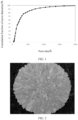
- FIG. 1 illustrates a graph of pore diameter distribution and cumulative fraction of pore diameter of the cathode material A1 prepared in Example 1; as shown in Fig. 1 , the trend chart of the pore diameter fraction is close to a logarithmic form.
- FIG. 2 illustrates a SEM graph of a cross-section of the cathode material A2 prepared in Example 1;
- FIG. 3 illustrates a SEM graph of a cross-section of the cathode material D1 prepared in Comparative Example 1;
- FIG. 4 illustrates a SEM graph of a cross-section of the cathode material D2 prepared in Comparative Example 2; as shown in FIGS. 2-4 , the cross-sections of the cathode materials have different pore sizes and pore diameter distribution.
- FIG. 2-4 the cross-sections of the cathode materials have different pore sizes and pore diameter distribution.
- FIG. 5 illustrates a cycle curve graph of lithium-ion batteries fabricated with the cathode material Al, the cathode material D1 and the cathode material D2, as shown in FIG. 5 , the electrochemical performance of the lithium-ion battery prepared with the cathode material of the present disclosure having a specific pore diameter and pore diameter distribution is more excellent.
- the lithium-ion battery fabricated by using a cathode material of the present disclosure having a specific pore diameter and pore diameter distribution not only exhibits a high initial charge-discharge capacity, but also has a high capacity retention ratio.
- both the initial charge-discharge capacity and capacity retention ratio of the lithium-ion battery can be further improved, so that the comprehensive performance of the battery is further enhanced.
Landscapes
- Chemical & Material Sciences (AREA)
- Chemical Kinetics & Catalysis (AREA)
- Electrochemistry (AREA)
- General Chemical & Material Sciences (AREA)
- Inorganic Chemistry (AREA)
- Organic Chemistry (AREA)
- Engineering & Computer Science (AREA)
- Composite Materials (AREA)
- Materials Engineering (AREA)
- Manufacturing & Machinery (AREA)
- Battery Electrode And Active Subsutance (AREA)
- Inorganic Compounds Of Heavy Metals (AREA)
Applications Claiming Priority (2)
| Application Number | Priority Date | Filing Date | Title |
|---|---|---|---|
| CN202111611309.0A CN115832231B (zh) | 2021-12-27 | 2021-12-27 | 正极材料及其制备方法与应用、锂离子电池 |
| PCT/CN2022/142015 WO2023125439A1 (fr) | 2021-12-27 | 2022-12-26 | Matériau d'électrode positive, son procédé de préparation et son utilisation, et batterie au lithium-ion |
Publications (3)
| Publication Number | Publication Date |
|---|---|
| EP4266417A1 true EP4266417A1 (fr) | 2023-10-25 |
| EP4266417A4 EP4266417A4 (fr) | 2024-08-14 |
| EP4266417B1 EP4266417B1 (fr) | 2026-04-29 |
Family
ID=85515550
Family Applications (1)
| Application Number | Title | Priority Date | Filing Date |
|---|---|---|---|
| EP22914693.1A Active EP4266417B1 (fr) | 2021-12-27 | 2022-12-26 | Matériau d'électrode positive, son procédé de préparation et son utilisation, et batterie au lithium-ion |
Country Status (6)
| Country | Link |
|---|---|
| US (1) | US20230369584A1 (fr) |
| EP (1) | EP4266417B1 (fr) |
| JP (1) | JP7549150B2 (fr) |
| KR (1) | KR102665222B1 (fr) |
| CN (1) | CN115832231B (fr) |
| WO (1) | WO2023125439A1 (fr) |
Families Citing this family (12)
| Publication number | Priority date | Publication date | Assignee | Title |
|---|---|---|---|---|
| KR102327532B1 (ko) * | 2018-11-20 | 2021-11-17 | 주식회사 엘지화학 | 리튬 이차전지용 양극 활물질 및 이의 제조 방법 |
| JP7483987B1 (ja) | 2023-05-31 | 2024-05-15 | 住友化学株式会社 | リチウム金属複合酸化物、リチウム二次電池用正極活物質、リチウム二次電池用正極、及び、リチウム二次電池 |
| CN117832472B (zh) * | 2023-11-21 | 2025-07-15 | 上海恩捷新材料科技有限公司 | 一种钠离子正极材料及其制备方法和应用 |
| CN117374274B (zh) * | 2023-11-29 | 2024-07-09 | 湖南中伟新能源科技有限公司 | 正极材料及其制备方法、锂离子电池和涉电设备 |
| CN118039873B (zh) * | 2024-03-04 | 2025-08-15 | 北京当升材料科技股份有限公司 | 正极材料及其制备方法、锂离子电池 |
| JP2025144403A (ja) * | 2024-03-19 | 2025-10-02 | 株式会社田中化学研究所 | 金属複合化合物及びリチウム二次電池用正極活物質の製造方法 |
| CN118315581B (zh) * | 2024-04-30 | 2025-07-18 | 北京当升材料科技股份有限公司 | 正极活性材料及其制备方法、正极极片、电池和用电设备 |
| CN118315582B (zh) * | 2024-04-30 | 2025-06-24 | 北京当升材料科技股份有限公司 | 正极活性材料及其制备方法、正极极片、电池和用电设备 |
| CN118676362B (zh) * | 2024-06-28 | 2025-11-18 | 北京当升材料科技股份有限公司 | 正极活性材料及其制备方法、正极极片、电池和用电装置 |
| CN118658979A (zh) * | 2024-07-10 | 2024-09-17 | 浙江极氪智能科技有限公司 | 一种复合磷酸铁锂及其制备方法与应用 |
| KR102871129B1 (ko) * | 2024-11-26 | 2025-10-15 | 한국에너지기술연구원 | 입자크기 제어가 가능한 단결정성 양극재 업사이클링 방법 및 이에 의해 제조된 업사이클링 양극재 |
| CN119764349A (zh) * | 2024-12-29 | 2025-04-04 | 长三角物理研究中心有限公司 | 一种二次电池正极极片及其制备方法 |
Family Cites Families (22)
| Publication number | Priority date | Publication date | Assignee | Title |
|---|---|---|---|---|
| CN100492728C (zh) * | 2003-09-26 | 2009-05-27 | 三菱化学株式会社 | 用于锂二次电池正极材料的锂复合氧化物颗粒、使用该颗粒的锂二次电池正极以及锂二次电池 |
| JP5772197B2 (ja) * | 2011-05-09 | 2015-09-02 | ソニー株式会社 | リチウムイオン二次電池用活物質、リチウムイオン二次電池用電極、リチウムイオン二次電池、電子機器、電動工具、電動車両および電力貯蔵システム |
| JP5741932B2 (ja) | 2011-06-01 | 2015-07-01 | 住友金属鉱山株式会社 | 非水系電解質二次電池用正極活物質の前駆体となる遷移金属複合水酸化物とその製造方法、及び非水系電解質二次電池用正極活物質の製造方法 |
| JP6407515B2 (ja) * | 2013-10-04 | 2018-10-17 | 株式会社東芝 | 正極活物質、非水電解質二次電池、電池パック及び車 |
| KR20150081936A (ko) * | 2014-01-07 | 2015-07-15 | 주식회사 엘지화학 | 양극 활물질 2차 입자 및 그를 포함하는 리튬 이차전지 |
| WO2016013674A1 (fr) | 2014-07-25 | 2016-01-28 | 住友金属鉱山株式会社 | Particules d'hydroxyde d'un composé de nickel et de manganèse et procédé de production associé |
| JP6848249B2 (ja) * | 2016-07-29 | 2021-03-24 | 住友金属鉱山株式会社 | 非水系電解質二次電池用正極活物質とその製造方法、及び非水系電解質二次電池 |
| WO2018097137A1 (fr) | 2016-11-25 | 2018-05-31 | 住友金属鉱山株式会社 | Hydroxyde composite contenant un métal de tradition et procédé de production associé, substance active d'électrode positive pour batterie secondaire à électrolyte non aqueux et procédé de production associé et batterie secondaire à électrolyte non aqueux |
| JP2018092931A (ja) | 2016-11-30 | 2018-06-14 | 三星エスディアイ株式会社Samsung SDI Co., Ltd. | リチウム二次電池用ニッケル系活物質、その製造方法、及びそれを含んだ正極を含んだリチウム二次電池 |
| WO2018155156A1 (fr) * | 2017-02-21 | 2018-08-30 | 日本碍子株式会社 | Plaque de corps fritté d'oxyde complexe de lithium |
| JP6254732B1 (ja) * | 2017-03-13 | 2017-12-27 | Basf戸田バッテリーマテリアルズ合同会社 | 非水電解質二次電池用正極活物質の製造方法及び非水電解質二次電池の製造方法 |
| JP6523508B1 (ja) * | 2018-03-30 | 2019-06-05 | 住友化学株式会社 | リチウム複合金属化合物、リチウム二次電池用正極活物質、リチウム二次電池用正極、リチウム二次電池、及びリチウム複合金属化合物の製造方法 |
| JP7035167B2 (ja) * | 2018-04-04 | 2022-03-14 | 株式会社東芝 | 電極群及び非水電解質電池 |
| WO2021054469A1 (fr) * | 2019-09-19 | 2021-03-25 | 住友金属鉱山株式会社 | Matériau actif d'électrode positive pour batterie secondaire au lithium-ion et batterie secondaire au lithium-ion |
| JP7384540B2 (ja) * | 2019-10-02 | 2023-11-21 | エルジー・ケム・リミテッド | リチウム二次電池用正極活物質前駆体の製造方法 |
| CN111435738B (zh) | 2019-12-18 | 2024-08-20 | 蜂巢能源科技有限公司 | 正极材料及其制备方法和应用 |
| CN111435743B (zh) | 2019-12-19 | 2022-06-21 | 蜂巢能源科技有限公司 | 四元正极材料、正极、电池 |
| JP6705068B1 (ja) * | 2020-01-17 | 2020-06-03 | 住友化学株式会社 | 全固体リチウムイオン電池用正極活物質、電極および全固体リチウムイオン電池 |
| KR102379561B1 (ko) | 2020-03-05 | 2022-03-28 | 삼성에스디아이 주식회사 | 리튬이차전지용 복합양극활물질, 그 제조방법 및 이를 포함하는 양극을 함유한 리튬이차전지 |
| CN111384392B (zh) | 2020-03-13 | 2021-02-19 | 江门市科恒实业股份有限公司 | 一种高镍低钴型耐高压三元正极材料及其制备方法 |
| CN112635750A (zh) * | 2020-12-04 | 2021-04-09 | 银隆新能源股份有限公司 | 磷掺杂的三元锂离子正极材料及其制备方法、锂离子电池 |
| CN113651369A (zh) * | 2021-08-18 | 2021-11-16 | 宁波容百新能源科技股份有限公司 | 球形高镍三元前驱体材料、其制备方法与高镍三元正极材料 |
-
2021
- 2021-12-27 CN CN202111611309.0A patent/CN115832231B/zh active Active
-
2022
- 2022-12-26 EP EP22914693.1A patent/EP4266417B1/fr active Active
- 2022-12-26 KR KR1020237025432A patent/KR102665222B1/ko active Active
- 2022-12-26 WO PCT/CN2022/142015 patent/WO2023125439A1/fr not_active Ceased
- 2022-12-26 JP JP2023547895A patent/JP7549150B2/ja active Active
-
2023
- 2023-07-24 US US18/357,866 patent/US20230369584A1/en active Pending
Also Published As
| Publication number | Publication date |
|---|---|
| WO2023125439A1 (fr) | 2023-07-06 |
| KR20230121912A (ko) | 2023-08-21 |
| JP7549150B2 (ja) | 2024-09-10 |
| CN115832231A (zh) | 2023-03-21 |
| JP2024506054A (ja) | 2024-02-08 |
| EP4266417A4 (fr) | 2024-08-14 |
| CN115832231B (zh) | 2025-08-26 |
| US20230369584A1 (en) | 2023-11-16 |
| KR102665222B1 (ko) | 2024-05-10 |
| EP4266417B1 (fr) | 2026-04-29 |
Similar Documents
| Publication | Publication Date | Title |
|---|---|---|
| EP4266417A1 (fr) | Matériau d'électrode positive, son procédé de préparation et son utilisation, et batterie au lithium-ion | |
| EP4471893A1 (fr) | Précurseur de matériau d'électrode positive ternaire, son procédé de préparation, matériau d'électrode positive ternaire, batterie au lithium et électrode positive, et dispositif électrique | |
| EP3875434A1 (fr) | Matériau actif à électrode positive composite pour batterie secondaire au lithium, son procédé de préparation et batterie secondaire au lithium comprenant une électrode positive l'incorporant | |
| EP2544280B1 (fr) | Matière active d'électrode positive destinée à une batterie au lithium-ion, électrode positive destinée à une batterie au lithium-ion et batterie au lithium-ion | |
| CN114342119B (zh) | 锂离子二次电池用正极活性物质和锂离子二次电池 | |
| JP7021366B2 (ja) | 充電式リチウム二次電池用正極活物質としてのリチウム遷移金属複合酸化物 | |
| EP2606524B1 (fr) | Précurseurs de matériaux cathodiques revêtus par voie sèche et traités thermiquement | |
| EP3588632A1 (fr) | Précurseur de matériau actif à base de nickel, son procédé de préparation, matériau actif à base de nickel et batterie secondaire au lithium | |
| EP3272711A1 (fr) | Matériau actif à base de nickel pour batterie secondaire au lithium, son procédé de préparation et batterie secondaire au lithium comprenant une électrode positive l'incorporant | |
| EP3550643A1 (fr) | Précurseur de matériau actif de nickel pour pile rechargeable au lithium et son procédé de fabrication, matériau actif de nickel pour pile rechargeable au lithium fabriquée au moyen dudit procédé, et pile rechargeable au lithium ayant une cathode contenant ledit matériau actif de nickel | |
| CN115472838B (zh) | 一种正极材料及其制备方法和锂离子电池 | |
| EP3082183A1 (fr) | Poudre de matériau actif d'électrode positive, électrode positive contenant une poudre de matériau actif d'électrode positive et batterie secondaire | |
| EP2314545A1 (fr) | Poudre de particules d hydroxyde d oxycobalt et procédé de fabrication de cette poudre, et également poudre de particules de cobaltate de lithium, procédé de fabrication de cette poudre, et batterie secondaire à électrolyte non aqueux les utilisant | |
| US12244011B2 (en) | Modified high-nickel cathode material and preparation method thereof | |
| CN116190631B (zh) | 一种富锂锰基正极活性材料和电池 | |
| CN117916913A (zh) | 锂二次电池正极活性材料及其制备方法和包含它的锂二次电池 | |
| WO2022105696A1 (fr) | Précurseur de matériau actif d'électrode positive et procédé de préparation associé, matériau actif d'électrode positive et procédé de préparation associé, électrode positive de batterie secondaire lithium-ion et batterie secondaire lithium-ion | |
| EP3993102A1 (fr) | Matériau actif d'électrode positive pour batteries rechargeables au lithium-ion, son procédé de fabrication et batterie rechargeable au lithium-ion | |
| EP4155271A2 (fr) | Matériau de cathode pour une batterie au lithium-ion et son procédé de préparation et application | |
| CN110649230A (zh) | 一种纳米铆钉核壳结构正极材料及制备方法 | |
| EP4624422A1 (fr) | Précurseur de matériau d'électrode positive, matériau d'électrode positive et utilisation | |
| JP2025524787A (ja) | 類凝集状多元系正極材料及びその製造方法、使用並びにリチウムイオン電池 | |
| CN112514118A (zh) | 锂离子二次电池用正极活性物质、锂离子二次电池用正极活性物质的制造方法以及锂离子二次电池 | |
| JP7102973B2 (ja) | リチウムイオン二次電池用の正極活物質とその製造方法、およびチウムイオン二次電池 | |
| JP2026508024A (ja) | 正極材料およびその調製方法、電池 |
Legal Events
| Date | Code | Title | Description |
|---|---|---|---|
| STAA | Information on the status of an ep patent application or granted ep patent |
Free format text: STATUS: THE INTERNATIONAL PUBLICATION HAS BEEN MADE |
|
| PUAI | Public reference made under article 153(3) epc to a published international application that has entered the european phase |
Free format text: ORIGINAL CODE: 0009012 |
|
| STAA | Information on the status of an ep patent application or granted ep patent |
Free format text: STATUS: REQUEST FOR EXAMINATION WAS MADE |
|
| 17P | Request for examination filed |
Effective date: 20230718 |
|
| AK | Designated contracting states |
Kind code of ref document: A1 Designated state(s): AL AT BE BG CH CY CZ DE DK EE ES FI FR GB GR HR HU IE IS IT LI LT LU LV MC ME MK MT NL NO PL PT RO RS SE SI SK SM TR |
|
| STAA | Information on the status of an ep patent application or granted ep patent |
Free format text: STATUS: EXAMINATION IS IN PROGRESS |
|
| A4 | Supplementary search report drawn up and despatched |
Effective date: 20240715 |
|
| RIC1 | Information provided on ipc code assigned before grant |
Ipc: C01G 53/00 20060101ALI20240709BHEP Ipc: H01M 4/525 20100101ALI20240709BHEP Ipc: H01M 4/36 20060101AFI20240709BHEP |
|
| 17Q | First examination report despatched |
Effective date: 20240726 |
|
| DAV | Request for validation of the european patent (deleted) | ||
| DAX | Request for extension of the european patent (deleted) | ||
| REG | Reference to a national code |
Ref country code: DE Ref legal event code: R079 Ref country code: DE Ref legal event code: R079 Ref document number: 602022035903 Country of ref document: DE Free format text: PREVIOUS MAIN CLASS: H01M0004360000 Ipc: C01G0053500000 |
|
| GRAP | Despatch of communication of intention to grant a patent |
Free format text: ORIGINAL CODE: EPIDOSNIGR1 |
|
| STAA | Information on the status of an ep patent application or granted ep patent |
Free format text: STATUS: GRANT OF PATENT IS INTENDED |
|
| RIC1 | Information provided on ipc code assigned before grant |
Ipc: C01G 53/50 20250101AFI20251125BHEP Ipc: H01M 4/525 20100101ALI20251125BHEP Ipc: H01M 10/0525 20100101ALI20251125BHEP |
|
| INTG | Intention to grant announced |
Effective date: 20251218 |
|
| P01 | Opt-out of the competence of the unified patent court (upc) registered |
Free format text: CASE NUMBER: UPC_APP_0003013_4266417/2026 Effective date: 20260128 |
|
| GRAS | Grant fee paid |
Free format text: ORIGINAL CODE: EPIDOSNIGR3 |
|
| GRAA | (expected) grant |
Free format text: ORIGINAL CODE: 0009210 |
|
| STAA | Information on the status of an ep patent application or granted ep patent |
Free format text: STATUS: THE PATENT HAS BEEN GRANTED |
|
| AK | Designated contracting states |
Kind code of ref document: B1 Designated state(s): AL AT BE BG CH CY CZ DE DK EE ES FI FR GB GR HR HU IE IS IT LI LT LU LV MC ME MK MT NL NO PL PT RO RS SE SI SK SM TR |
|
| REG | Reference to a national code |
Ref country code: CH Ref legal event code: F10 Free format text: ST27 STATUS EVENT CODE: U-0-0-F10-F00 (AS PROVIDED BY THE NATIONAL OFFICE) Effective date: 20260429 |