EP4266442A1 - Batterie secondaire, procédé de préparation de batterie secondaire, module de batterie, bloc-batterie et appareil électrique - Google Patents
Batterie secondaire, procédé de préparation de batterie secondaire, module de batterie, bloc-batterie et appareil électrique Download PDFInfo
- Publication number
- EP4266442A1 EP4266442A1 EP22891668.0A EP22891668A EP4266442A1 EP 4266442 A1 EP4266442 A1 EP 4266442A1 EP 22891668 A EP22891668 A EP 22891668A EP 4266442 A1 EP4266442 A1 EP 4266442A1
- Authority
- EP
- European Patent Office
- Prior art keywords
- secondary battery
- lithium
- positive electrode
- electrolyte solution
- battery
- Prior art date
- Legal status (The legal status is an assumption and is not a legal conclusion. Google has not performed a legal analysis and makes no representation as to the accuracy of the status listed.)
- Pending
Links
Images
Classifications
-
- H—ELECTRICITY
- H01—ELECTRIC ELEMENTS
- H01M—PROCESSES OR MEANS, e.g. BATTERIES, FOR THE DIRECT CONVERSION OF CHEMICAL ENERGY INTO ELECTRICAL ENERGY
- H01M4/00—Electrodes
- H01M4/02—Electrodes composed of, or comprising, active material
- H01M4/36—Selection of substances as active materials, active masses, active liquids
- H01M4/48—Selection of substances as active materials, active masses, active liquids of inorganic oxides or hydroxides
- H01M4/52—Selection of substances as active materials, active masses, active liquids of inorganic oxides or hydroxides of nickel, cobalt or iron
- H01M4/525—Selection of substances as active materials, active masses, active liquids of inorganic oxides or hydroxides of nickel, cobalt or iron of mixed oxides or hydroxides containing iron, cobalt or nickel for inserting or intercalating light metals, e.g. LiNiO2, LiCoO2 or LiCoOxFy
-
- H—ELECTRICITY
- H01—ELECTRIC ELEMENTS
- H01M—PROCESSES OR MEANS, e.g. BATTERIES, FOR THE DIRECT CONVERSION OF CHEMICAL ENERGY INTO ELECTRICAL ENERGY
- H01M10/00—Secondary cells; Manufacture thereof
- H01M10/05—Accumulators with non-aqueous electrolyte
- H01M10/052—Li-accumulators
- H01M10/0525—Rocking-chair batteries, i.e. batteries with lithium insertion or intercalation in both electrodes; Lithium-ion batteries
-
- H—ELECTRICITY
- H01—ELECTRIC ELEMENTS
- H01M—PROCESSES OR MEANS, e.g. BATTERIES, FOR THE DIRECT CONVERSION OF CHEMICAL ENERGY INTO ELECTRICAL ENERGY
- H01M10/00—Secondary cells; Manufacture thereof
- H01M10/05—Accumulators with non-aqueous electrolyte
- H01M10/056—Accumulators with non-aqueous electrolyte characterised by the materials used as electrolytes, e.g. mixed inorganic/organic electrolytes
- H01M10/0564—Accumulators with non-aqueous electrolyte characterised by the materials used as electrolytes, e.g. mixed inorganic/organic electrolytes the electrolyte being constituted of organic materials only
- H01M10/0566—Liquid materials
- H01M10/0567—Liquid materials characterised by the additives
-
- H—ELECTRICITY
- H01—ELECTRIC ELEMENTS
- H01M—PROCESSES OR MEANS, e.g. BATTERIES, FOR THE DIRECT CONVERSION OF CHEMICAL ENERGY INTO ELECTRICAL ENERGY
- H01M10/00—Secondary cells; Manufacture thereof
- H01M10/05—Accumulators with non-aqueous electrolyte
- H01M10/056—Accumulators with non-aqueous electrolyte characterised by the materials used as electrolytes, e.g. mixed inorganic/organic electrolytes
- H01M10/0564—Accumulators with non-aqueous electrolyte characterised by the materials used as electrolytes, e.g. mixed inorganic/organic electrolytes the electrolyte being constituted of organic materials only
- H01M10/0566—Liquid materials
- H01M10/0568—Liquid materials characterised by the solutes
-
- H—ELECTRICITY
- H01—ELECTRIC ELEMENTS
- H01M—PROCESSES OR MEANS, e.g. BATTERIES, FOR THE DIRECT CONVERSION OF CHEMICAL ENERGY INTO ELECTRICAL ENERGY
- H01M10/00—Secondary cells; Manufacture thereof
- H01M10/05—Accumulators with non-aqueous electrolyte
- H01M10/056—Accumulators with non-aqueous electrolyte characterised by the materials used as electrolytes, e.g. mixed inorganic/organic electrolytes
- H01M10/0564—Accumulators with non-aqueous electrolyte characterised by the materials used as electrolytes, e.g. mixed inorganic/organic electrolytes the electrolyte being constituted of organic materials only
- H01M10/0566—Liquid materials
- H01M10/0569—Liquid materials characterised by the solvents
-
- H—ELECTRICITY
- H01—ELECTRIC ELEMENTS
- H01M—PROCESSES OR MEANS, e.g. BATTERIES, FOR THE DIRECT CONVERSION OF CHEMICAL ENERGY INTO ELECTRICAL ENERGY
- H01M10/00—Secondary cells; Manufacture thereof
- H01M10/05—Accumulators with non-aqueous electrolyte
- H01M10/058—Construction or manufacture
-
- H—ELECTRICITY
- H01—ELECTRIC ELEMENTS
- H01M—PROCESSES OR MEANS, e.g. BATTERIES, FOR THE DIRECT CONVERSION OF CHEMICAL ENERGY INTO ELECTRICAL ENERGY
- H01M10/00—Secondary cells; Manufacture thereof
- H01M10/42—Methods or arrangements for servicing or maintenance of secondary cells or secondary half-cells
- H01M10/4235—Safety or regulating additives or arrangements in electrodes, separators or electrolyte
-
- H—ELECTRICITY
- H01—ELECTRIC ELEMENTS
- H01M—PROCESSES OR MEANS, e.g. BATTERIES, FOR THE DIRECT CONVERSION OF CHEMICAL ENERGY INTO ELECTRICAL ENERGY
- H01M4/00—Electrodes
- H01M4/02—Electrodes composed of, or comprising, active material
- H01M4/13—Electrodes for accumulators with non-aqueous electrolyte, e.g. for lithium-accumulators; Processes of manufacture thereof
- H01M4/131—Electrodes based on mixed oxides or hydroxides, or on mixtures of oxides or hydroxides, e.g. LiCoOx
-
- H—ELECTRICITY
- H01—ELECTRIC ELEMENTS
- H01M—PROCESSES OR MEANS, e.g. BATTERIES, FOR THE DIRECT CONVERSION OF CHEMICAL ENERGY INTO ELECTRICAL ENERGY
- H01M4/00—Electrodes
- H01M4/02—Electrodes composed of, or comprising, active material
- H01M4/36—Selection of substances as active materials, active masses, active liquids
- H01M4/48—Selection of substances as active materials, active masses, active liquids of inorganic oxides or hydroxides
- H01M4/50—Selection of substances as active materials, active masses, active liquids of inorganic oxides or hydroxides of manganese
- H01M4/505—Selection of substances as active materials, active masses, active liquids of inorganic oxides or hydroxides of manganese of mixed oxides or hydroxides containing manganese for inserting or intercalating light metals, e.g. LiMn2O4 or LiMn2OxFy
-
- H—ELECTRICITY
- H01—ELECTRIC ELEMENTS
- H01M—PROCESSES OR MEANS, e.g. BATTERIES, FOR THE DIRECT CONVERSION OF CHEMICAL ENERGY INTO ELECTRICAL ENERGY
- H01M50/00—Constructional details or processes of manufacture of the non-active parts of electrochemical cells other than fuel cells, e.g. hybrid cells
- H01M50/20—Mountings; Secondary casings or frames; Racks, modules or packs; Suspension devices; Shock absorbers; Transport or carrying devices; Holders
- H01M50/202—Casings or frames around the primary casing of a single cell or a single battery
-
- H—ELECTRICITY
- H01—ELECTRIC ELEMENTS
- H01M—PROCESSES OR MEANS, e.g. BATTERIES, FOR THE DIRECT CONVERSION OF CHEMICAL ENERGY INTO ELECTRICAL ENERGY
- H01M4/00—Electrodes
- H01M4/02—Electrodes composed of, or comprising, active material
- H01M2004/026—Electrodes composed of, or comprising, active material characterised by the polarity
- H01M2004/028—Positive electrodes
-
- H—ELECTRICITY
- H01—ELECTRIC ELEMENTS
- H01M—PROCESSES OR MEANS, e.g. BATTERIES, FOR THE DIRECT CONVERSION OF CHEMICAL ENERGY INTO ELECTRICAL ENERGY
- H01M2300/00—Electrolytes
- H01M2300/0017—Non-aqueous electrolytes
- H01M2300/0025—Organic electrolyte
- H01M2300/0028—Organic electrolyte characterised by the solvent
- H01M2300/0037—Mixture of solvents
- H01M2300/004—Three solvents
-
- Y—GENERAL TAGGING OF NEW TECHNOLOGICAL DEVELOPMENTS; GENERAL TAGGING OF CROSS-SECTIONAL TECHNOLOGIES SPANNING OVER SEVERAL SECTIONS OF THE IPC; TECHNICAL SUBJECTS COVERED BY FORMER USPC CROSS-REFERENCE ART COLLECTIONS [XRACs] AND DIGESTS
- Y02—TECHNOLOGIES OR APPLICATIONS FOR MITIGATION OR ADAPTATION AGAINST CLIMATE CHANGE
- Y02E—REDUCTION OF GREENHOUSE GAS [GHG] EMISSIONS, RELATED TO ENERGY GENERATION, TRANSMISSION OR DISTRIBUTION
- Y02E60/00—Enabling technologies; Technologies with a potential or indirect contribution to GHG emissions mitigation
- Y02E60/10—Energy storage using batteries
-
- Y—GENERAL TAGGING OF NEW TECHNOLOGICAL DEVELOPMENTS; GENERAL TAGGING OF CROSS-SECTIONAL TECHNOLOGIES SPANNING OVER SEVERAL SECTIONS OF THE IPC; TECHNICAL SUBJECTS COVERED BY FORMER USPC CROSS-REFERENCE ART COLLECTIONS [XRACs] AND DIGESTS
- Y02—TECHNOLOGIES OR APPLICATIONS FOR MITIGATION OR ADAPTATION AGAINST CLIMATE CHANGE
- Y02P—CLIMATE CHANGE MITIGATION TECHNOLOGIES IN THE PRODUCTION OR PROCESSING OF GOODS
- Y02P70/00—Climate change mitigation technologies in the production process for final industrial or consumer products
- Y02P70/50—Manufacturing or production processes characterised by the final manufactured product
Definitions
- the present application belongs to the technical field of batteries, and specifically relates to a secondary battery, a method for preparing a secondary battery, a battery module, a battery pack and an electrical apparatus.
- Secondary batteries rely on lithium ions to intercalate and deintercalate back and forth between the positive and negative electrodes for charging and discharging, and they have outstanding features such as high energy density, long cycle life, no pollution, and memoryless effect. Therefore, as a clean energy source, secondary batteries have gradually spread from electronic products to energy storage power source systems such as hydraulic power, firepower, wind power and solar power stations, as well as electric tools, electric bicycles, electric motorcycles, electric vehicles, military equipment, aerospace and other fields to adapt to the sustainable development strategy of environment and energy.
- Cobalt is an important component element of the positive electrode active material of the secondary battery. However, the content of cobalt in the crust is small, and it is difficult to mine and expensive.
- An objective of the present application is to provide a secondary battery, a method for preparing a secondary battery, a battery module, a battery pack, and an electrical apparatus so as to improve the lithium ion diffusion rate of a low-cobalt or cobalt-free positive electrode active material, and improve the cycling performance of the secondary battery.
- a first aspect of the present application provides a secondary battery comprising an electrolyte solution and a positive electrode plate.
- the electrolyte solution comprises lithium difluoro(oxalato)borate, and based on the total mass of the electrolyte solution, the percentage mass content of the lithium difluoro(oxalato)borate is x%, with 0 ⁇ x ⁇ 1.0.
- the secondary battery satisfies c + x/10 ⁇ 0.10.
- the inventors found that the cobalt content c of the low-cobalt or cobalt-free positive electrode active material is closely related to the percentage mass content x% of lithium difluoro(oxalato)borate in the electrolyte solution.
- the B atom in the lithium difluoro(oxalato)borate can fully bind to the O atom in the positive electrode active material, which better reduces the diffusion resistance of lithium ions in the bulk phase of the low-cobalt or cobalt-free positive electrode active material, and avoids excessive delithiation on the surface of the low-cobalt or cobalt-free positive electrode active material, thereby helping to better stabilize the crystalline structure of the low-cobalt or cobalt-free positive electrode active material and improve the diffusion rate of lithium ions. Therefore, the secondary battery can have good high-temperature storage performance while having significantly improved cycling performance.
- lithium difluoro(oxalato)borate in the electrolyte solution is not enough to enable the formation of a low-impedance protective film with excellent performance on the surface of the low-cobalt or cobalt-free positive electrode active material, and lithium difluoro(oxalato)borate cannot effectively reduce the charge transfer resistance of the low-cobalt or cobalt-free positive electrode active material, cannot effectively reduce the diffusion resistance of lithium ions in the bulk phase of the low-cobalt or cobalt-free positive electrode active material and inhibit the excessive delithiation on the surface of the low-cobalt or cobalt-free positive electrode active material. Therefore, it is difficult for the secondary battery to have significantly improved cycling performance.
- the electrolyte solution further comprises one or more of fluoroethylene carbonate and lithium fluorosulfonylimide.
- the molecular formula of the lithium fluorosulfonylimide is LiN(SO 2 R 1 )(SO 2 R 2 ), wherein R 1 and R 2 each independently represent F, or C n F 2n+1 , and n is an integer from 1 to 10.
- the lithium fluorosulfonylimide comprises one or both of lithium bis(fluorosulfonyl)imide and lithium bis(trifluoromethanesulfonyl)imide.
- the percentage mass content of the fluoroethylene carbonate is y%, with 0 ⁇ y ⁇ 2.5. Optionally, it satisfies 0 ⁇ y ⁇ 2.0.
- the percentage mass content of the lithium fluorosulfonylimide is z%, with 0 ⁇ z ⁇ 2.5. Optionally, it satisfies 0 ⁇ z ⁇ 2.0.
- fluoroethylene carbonate After adding fluoroethylene carbonate to the electrolyte solution, it can effectively improve the cycling performance of the secondary battery; fluoroethylene carbonate is resistant to high-voltage oxidation, which is conducive to matching high-voltage positive electrode active materials, thereby helping to improve the energy density of the secondary battery.
- the rate performance and low-temperature performance of the secondary battery After adding the lithium fluorosulfonylimide into the electrolyte solution, the rate performance and low-temperature performance of the secondary battery can be significantly improved.
- the secondary battery further satisfies 0.5 ⁇ y/x ⁇ 2.0.
- it satisfies 0.5 ⁇ y/x ⁇ 1.0.
- the synergistic effect of lithium difluoro(oxalato)borate and fluoroethylene carbonate can be fully utilized, which not only will not increase the gas evolution of the secondary battery, but will further improve the cycling performance and energy density of the secondary battery.
- the secondary battery further satisfies 0.5 ⁇ x/z ⁇ 2.0.
- it satisfies 0.5 ⁇ x/z ⁇ 1.5.
- the synergistic effect of lithium difluoro(oxalato)borate and lithium fluorosulfonylimide can be fully utilized, which not only will not deteriorate the cycling performance of the secondary battery, but can further improve the rate performance and low-temperature performance of the secondary battery.
- the secondary battery further satisfies 0.5 ⁇ y/x ⁇ 2.0 and 0.5 ⁇ x/z ⁇ 2.0.
- the secondary battery further satisfies 0.5 ⁇ y/x ⁇ 2.0, 0.5 ⁇ x/z ⁇ 2.0 and 0.25 ⁇ y/z ⁇ 2.0 simultaneously.
- the secondary battery has significantly improved cycling performance, storage performance, rate performance, and low-temperature performance simultaneously.
- a second aspect of the present application provides a method for preparing a secondary battery, comprising at least the following steps:
- the B atom in the lithium difluoro(oxalato)borate can fully bind to the O atom in the positive electrode active material, which better reduces the diffusion resistance of lithium ions in the bulk phase of the low-cobalt or cobalt-free positive electrode active material, and avoids excessive delithiation on the surface of the low-cobalt or cobalt-free positive electrode active material, thereby helping to better stabilize the crystalline structure of the low-cobalt or cobalt-free positive electrode active material and improve the diffusion rate of lithium ions. Therefore, the secondary batteries obtained by the preparation method of the present application can have both significantly improved cycling performance and good high-temperature storage performance.
- the method further comprises a step of selecting secondary batteries satisfying 0.5 ⁇ y/x ⁇ 2.0 from the secondary batteries obtained in step 2.
- the prepared secondary battery has good storage performance and significantly improved cycling performance and energy density simultaneously.
- the method further comprises a step of selecting secondary batteries satisfying 0.5 ⁇ x/z ⁇ 2.0 from the secondary batteries obtained in step 2.
- the prepared secondary battery has good storage performance and significantly improved cycling performance, rate performance, and low-temperature performance simultaneously.
- the method further comprises a step of selecting secondary batteries simultaneously satisfying 0.5 ⁇ y/x ⁇ 2.0 and 0.5 ⁇ x/z ⁇ 2.0 from the secondary batteries obtained in step 2.
- the prepared secondary battery has good storage performance and significantly improved cycling performance, rate performance, and low-temperature performance simultaneously.
- the method further comprises a step of selecting secondary batteries simultaneously satisfying 0.5 ⁇ y/x ⁇ 2.0, 0.5 ⁇ x/z ⁇ 2.0 and 0.25 ⁇ y/z ⁇ 2.0 from the secondary batteries obtained in step 2.
- the prepared secondary battery has good storage performance and significantly improved cycling performance, rate performance, and low-temperature performance simultaneously.
- a third aspect of the present application provides a battery module comprising one of the secondary battery of the first aspect of the present application and the secondary battery prepared by the method of the second aspect of the present application.
- a fourth aspect of the present application provides a battery pack comprising one of the secondary battery of the first aspect of the present application, the secondary battery prepared by the method of the second aspect of the present application, and the battery module of the third aspect of the present application.
- a fifth aspect of the present application provides an electrical apparatus comprising at least one of the secondary battery of the first aspect of the present application, the secondary battery prepared by the method of the second aspect of the present application, the battery module of the third aspect of the present application, and the battery pack of the fourth aspect of the present application.
- the battery module, battery pack, and electrical apparatus of the present application comprise the secondary battery provided by the present application, and thus have at least the same advantages as those of the secondary battery.
- range disclosed in the present application is defined in terms of lower and upper limits, and a given range is defined by selecting a lower limit and an upper limit, which define the boundaries of a particular range.
- a range defined in this manner may be inclusive or exclusive of end values, and may be arbitrarily combined, that is, any lower limit may be combined with any upper limit to form a range. For example, if ranges of 60-120 and 80-110 are listed for a particular parameter, it is understood that ranges of 60-110 and 80-120 are also expected. Additionally, if the minimum range values 1 and 2 are listed, and if the maximum range values 3, 4 and 5 are listed, the following ranges are all contemplated: 1-3, 1-4, 1-5, 2- 3, 2-4 and 2-5.
- the numerical range "a-b” represents an abbreviated representation of any combination of real numbers between a to b, wherein both a and b are real numbers.
- the numerical range "0-5" means that all real numbers between "0-5" have been listed herein, and "0-5" is just an abbreviated representation of the combination of these numerical values.
- a parameter is expressed as an integer greater than or equal to 2, it is equivalent to disclosing that the parameter is, for example, an integer of 2, 3, 4, 5, 6, 7, 8, 9, 10, 11, 12, and the like.
- steps in the present application may be performed sequentially or randomly, and are preferably performed sequentially.
- the method includes steps (a) and (b), indicating that the method may include steps (a) and (b) performed sequentially, or may include steps (b) and (a) performed sequentially.
- the reference to the method may further comprise step (c), meaning that step (c) may be added to the method in any order, for example, the method may comprise steps (a), (b) and (c), or may comprise steps (a), (c) and (b), or may comprise steps (c), (a) and (b), and so on.
- the "including” and “comprising” mentioned in the present application mean open-ended, or may be closed-ended.
- the “including” and “comprising” may indicate that it is possible to include or comprise other components not listed, and it is also possible to include or comprise only the listed components.
- the term "or” is inclusive in the present application.
- the phrase “A or B” means “A, B, or both A and B”. More specifically, the condition “A or B” is satisfied by any of the following: A is true (or present) and B is false (or absent); A is false (or absent) and B is true (or present); or both A and B are true (or present).
- Secondary batteries also known as rechargeable batteries or storage batteries, refer to batteries that, after being discharged, can activate active materials by charging for continuous use.
- the secondary battery pack includes a positive electrode plate, a negative electrode plate, a separator and an electrolyte solution.
- the separator is provided between the positive electrode plate and the negative electrode plate, and mainly functions to prevent a short circuit between the positive electrode and the negative electrode while allowing ions to pass through.
- the electrolyte solution serves to conduct lithium ions between the positive electrode plate and the negative electrode plate.
- lithium ions are preferentially deintercalated from the surface of the positive electrode active material, and then the lithium ions in the bulk phase of the positive electrode active material are replenished to the surface in time.
- the cobalt content of the positive electrode active material is high, lithium ions in the bulk phase of the positive electrode active material can be replenished to the surface of the positive electrode active material in time.
- the lithium ions in the bulk phase of the positive electrode active material have no time to be replenished to the surface of the positive electrode active material, whereas the lithium ions on the surface have already been deintercalated, which will lead to over-delithiation of the surface of the positive electrode active material, thereby affecting the crystalline structure of the positive electrode active materials (for example, irreversible distortion of positive electrode active materials and increase of lattice defects), and reducing the cycling performance of secondary batteries. Therefore, it is of great practical significance to improve the lithium ion diffusion rate of low-cobalt or cobalt-free positive electrode active materials.
- a first aspect of the embodiments of the present application provides a secondary battery comprising an electrolyte solution and a positive electrode plate.
- the electrolyte solution comprises lithium difluoro(oxalato)borate (LiDFOB), and based on the total mass of the electrolyte solution, the percentage mass content of the lithium difluoro(oxalato)borate is x%, with 0 ⁇ x ⁇ 1.0.
- the secondary battery satisfies c + x/10 ⁇ 0.10.
- lithium difluoro(oxalato)borate can form a low-impedance protective film on the surface of the positive electrode active material, and the B atom in lithium difluoro(oxalato)borate is prone to binding to the O atom in the positive electrode active material to reduce the charge transfer resistance of the positive electrode active material, thereby reducing the diffusion resistance of lithium ions in the bulk phase of the positive electrode active material.
- the low-cobalt or cobalt-free positive electrode active material can have significantly improved lithium ion diffusion rate, and the lithium ions in the bulk phase of the low-cobalt or cobalt-free positive electrode active material can be timely replenished to the surface to avoid excessive delithiation on the surface of low-cobalt or cobalt-free positive electrode active materials, thereby stabilizing the crystalline structure of low-cobalt or cobalt-free positive electrode active materials.
- the crystalline structure of the low-cobalt or cobalt-free positive electrode active material of the present application is more stable, which can greatly reduce the probability of problems including unstable structural properties, chemical properties or electrochemical properties of the positive electrode active material due to excessive delithiation on the surface of the low-cobalt or cobalt-free positive electrode active material, such as problems of irreversible distortion of the positive electrode active material and increased lattice defects.
- Lithium difluoro(oxalato)borate itself is not resistant to oxidation, and too much of it will deteriorate the storage performance of the secondary battery, especially the storage performance under high temperature environment. Therefore, the amount of lithium difluoro(oxalato)borate added should be moderate.
- the inventors found that the cobalt content c of the low-cobalt or cobalt-free positive electrode active material is closely related to the percentage mass content x% of lithium difluoro(oxalato)borate in the electrolyte solution.
- the B atom in the lithium difluoro(oxalato)borate can fully bind to the O atom in the positive electrode active material, which better reduces the diffusion resistance of lithium ions in the bulk phase of the low-cobalt or cobalt-free positive electrode active material, and avoids excessive delithiation on the surface of the low-cobalt or cobalt-free positive electrode active material, thereby helping to better stabilize the crystalline structure of the low-cobalt or cobalt-free positive electrode active material and improve the diffusion rate of lithium ions.
- c +x/10 can be ⁇ 0.10, ⁇ 0.11, ⁇ 0.12, ⁇ 0.13, ⁇ 0.14, ⁇ 0.15, ⁇ 0.16, ⁇ 0.17, ⁇ 0.18, or ⁇ 0.19.
- lithium difluoro(oxalato)borate in the electrolyte solution is not enough to enable the formation of a low-impedance protective film with excellent performance on the surface of the low-cobalt or cobalt-free positive electrode active material, and lithium difluoro(oxalato)borate cannot effectively reduce the charge transfer resistance of the low-cobalt or cobalt-free positive electrode active material, cannot effectively reduce the diffusion resistance of lithium ions in the bulk phase of the low-cobalt or cobalt-free positive electrode active material and inhibit the excessive delithiation on the surface of the low-cobalt or cobalt-free positive electrode active material. Therefore, it is difficult for the secondary battery to have significantly improved cycling performance.
- the layered material with the molecular formula of Li a Ni b Co c M1 d M2 e O f A g is optionally modified by doping with M2 cations, by doping with A anions, or by doping with both M2 cations and A anions, and the crystalline structure of the layered material obtained after doping is more stable, which can further improve the electrochemical performance of the secondary battery, such as cycling performance and rate performance.
- A is selected from F. After being modified by doping with F, the structure of Li a Ni b Co c M1 d M2 e O f A g is more stable, which can make the secondary battery have better cycling performance and rate performance.
- M1 is selected from Mn.
- M1 is selected from Al.
- M1 is selected from a combination of Mn and Al.
- the molar ratio of Mn to Al is not particularly limited and may be selected based on actual requirements.
- it satisfies 0.50 ⁇ b ⁇ 0.98.
- it satisfies 0.55 ⁇ b ⁇ 0.98, 0.60 ⁇ b ⁇ 0.98, 0.65 ⁇ b ⁇ 0.98, 0.70 ⁇ b ⁇ 0.98, 0.75 ⁇ b ⁇ 0.98, 0.80 ⁇ b ⁇ 0.98.
- it satisfies 0 ⁇ c ⁇ 0.1.
- it satisfies 0 ⁇ c ⁇ 0.09, 0 ⁇ c ⁇ 0.08, 0 ⁇ c ⁇ 0.07, 0 ⁇ c ⁇ 0.06, 0 ⁇ c ⁇ 0.05, 0 ⁇ c ⁇ 0.04, 0 ⁇ c ⁇ 0.03, 0 ⁇ c ⁇ 0.02, or 0 ⁇ c ⁇ 0.01.
- it satisfies 0 ⁇ d ⁇ 0.45.
- it satisfies 0 ⁇ d ⁇ 0.40, 0 ⁇ d ⁇ 0.35, 0 ⁇ d ⁇ 0.30, 0 ⁇ d ⁇ 0.25, 0 ⁇ d ⁇ 0.20, 0 ⁇ d ⁇ 0.15, or 0 ⁇ d ⁇ 0.10.
- it satisfies 0 ⁇ e ⁇ 0.5.
- it satisfies 0 ⁇ e ⁇ 0.45, 0 ⁇ e ⁇ 0.40, 0 ⁇ e ⁇ 0.35, 0 ⁇ e ⁇ 0.30, 0 ⁇ e ⁇ 0.25, 0 ⁇ e ⁇ 020, 0 ⁇ e ⁇ 0.15, 0 ⁇ e ⁇ 0.10, or 0 ⁇ e ⁇ 0.05.
- layered materials with the molecular formula of Li a Ni b Co c M1 d M2 e O f A g include, but are not limited to, one or more of LiNi 0.7 Mn 0.3 O 2 , LiNi 0.69 Co 0.01 Mn 0.3 O 2 , LiNi 0.68 Co 0.02 Mn 0.3 O 2 , LiNi 0.65 Co 0.05 Mn 0.3 O 2 , LiNi 0.63 Co 0.07 Mn 0.3 O 2 , and LiNi 0.61 Co 0.09 Mn 0.3 O 2.
- Li a Ni b Co c M1 d M2 e O f A g can be prepared according to conventional methods in the art.
- An exemplary preparation method is as follows: a lithium source, a nickel source, a cobalt source, an M1 element precursor, an optional M2 element precursor, and an optional A element precursor are mixed and then sintered.
- the sintering atmosphere may be an oxygen-containing atmosphere, for example, an air atmosphere or an oxygen atmosphere.
- the O 2 concentration of the sintering atmosphere is, for example, 70% to 100%.
- the sintering temperature and sintering time can be adjusted according to the actual situation.
- the lithium source includes, but is not limited to, one or more of lithium oxide (Li 2 O), lithium phosphate (Li 3 PO 4 ), lithium dihydrogen phosphate (LiH 2 PO 4 ), lithium acetate (CH 3 COOLi), lithium hydroxide (LiOH), lithium carbonate (Li 2 CO 3 ) and lithium nitrate (LiNO 3 ).
- the nickel source includes, but is not limited to, one or more of nickel sulfate, nickel nitrate, nickel chloride, nickel oxalate and nickel acetate.
- the cobalt source includes, but is not limited to, one or more of cobalt sulfate, cobalt nitrate, cobalt chloride, cobalt oxalate and cobalt acetate.
- the M1 element precursor includes, but is not limited to, one or more of oxides, nitric acid compounds, carbonic acid compounds, hydroxide compounds, and acetic acid compounds of the M1 element.
- the M2 element precursor includes, but is not limited to, one or more of oxides, nitric acid compounds, carbonic acid compounds, hydroxide compounds, and acetic acid compounds of the M2 element.
- the A element precursor includes, but is not limited to, one or more of ammonium fluoride, lithium fluoride, hydrogen fluoride, ammonium chloride, lithium chloride, hydrogen chloride, ammonium nitrate, ammonium nitrite, ammonium carbonate, ammonium bicarbonate, ammonium phosphate, phosphoric acid, ammonium sulfate, ammonium bisulfate, ammonium bisulfite, ammonium sulfite, ammonium bisulfide, hydrogen sulfide, lithium sulfide, ammonium sulfide, and elemental sulfur.
- the electrolyte solution further comprises fluoroethylene carbonate (FEC).
- FEC fluoroethylene carbonate
- the percentage mass content of the fluoroethylene carbonate is y%, with 0 ⁇ y ⁇ 2.5.
- y is 0, 0.10, 0.20, 0.50, 0.75, 1.0, 1.25, 1.50, 1.75, 2.0, 2.25, 2.50 or within a range consisting of any of the above numerical values.
- it satisfies 0 ⁇ y ⁇ 2.5, 0 ⁇ y ⁇ 2.25, 0 ⁇ y ⁇ 2.0, 0 ⁇ y ⁇ 1.75, 0 ⁇ y ⁇ 1.5, 0 ⁇ y ⁇ 1.25, 0 ⁇ y ⁇ 1.0, 0 ⁇ y ⁇ 0.75, or 0 ⁇ y ⁇ 0.5.
- fluoroethylene carbonate can undergo reductive decomposition at high potentials, and form a solid electrolyte interphase film (SEI film for short) with certain flexibility on the surface of the negative electrode active material. At the same time, it can inhibit the reductive decomposition of organic solvents with a lower potential and inhibit the intercalation of the organic solvent into negative electrode active materials. Therefore, adding fluoroethylene carbonate to the electrolyte solution can effectively improve the cycling performance of the secondary battery.
- fluoroethylene carbonate is resistant to high-voltage oxidation, which is conducive to matching high-voltage positive electrode active materials, thereby improving the energy density of secondary batteries.
- the percentage mass content x% of lithium difluoro(oxalato)borate and the percentage mass content y% of fluoroethylene carbonate also satisfy 0.5 ⁇ y/x ⁇ 2.0.
- they satisfy 0.5 ⁇ y/x ⁇ 1.9, 0.5 ⁇ y/x ⁇ 1.8, 0.5 ⁇ y/x ⁇ 1.7, 0.5 ⁇ y/x ⁇ 1.6, 0.5 ⁇ y/x ⁇ 1.5, 0.5 ⁇ 5y/ x ⁇ 1.4, 0.5 ⁇ y/x ⁇ 1.3, 0.5 ⁇ y/x ⁇ 1.2, 0.5 ⁇ y/x ⁇ 1.1, or 0.5 ⁇ y/x ⁇ 1.0.
- Adding fluoroethylene carbonate to the electrolyte solution is capable of effectively improving the cycling performance of the secondary battery.
- HF will be formed when fluoroethylene carbonate decomposes, and HF will destroy the structural stability of the positive electrode active material, increase the gas evolution of the secondary battery, and deteriorate the storage performance of the secondary battery.
- Lithium difluoro(oxalato)borate is used as a stabilizer of the positive electrode active material, and the B atom in it also has the function of interacting with the O atom on the surface of the positive electrode active material, and inhibits the damage of HF to the structure of the positive electrode active material.
- the combination of lithium difluoro(oxalato)borate and fluoroethylene carbonate is conductive to giving full play to the improvement effect of fluoroethylene carbonate on the cycling performance and energy density of the secondary battery.
- the relationship between the percentage mass content x% of lithium difluoro(oxalato)borate and the percentage mass content y% of fluoroethylene carbonate is reasonably controlled so that it satisfies 0.5 ⁇ y/x ⁇ 2.0, which can give full play to the synergistic effect of lithium difluoro(oxalato)borate and fluoroethylene carbonate. It not only does not increase the gas evolution of the secondary battery, but also further improves the cycling performance and energy density of the secondary battery.
- the electrolyte solution further comprises lithium fluorosulfonylimide.
- the molecular formula of the lithium fluorosulfonylimide is LiN(SO 2 R 1 )(SO 2 R 2 ), wherein R 1 and R 2 each independently represent F, or C n F 2n+1 , and n is an integer from 1 to 10.
- the lithium fluorosulfonylimide comprises one or both of lithium bis(fluorosulfonyl)imide (LiFSI) and lithium bis(trifluoromethanesulfonyl)imide (LiTFSI).
- the percentage mass content of the lithium fluorosulfonylimide is z%, with 0 ⁇ z ⁇ 2.5.
- z is 0, 0.10, 0.20, 0.50, 0.75, 1.0, 1.25, 1.50, 1.75, 2.0, 2.25, 2.50 or within a range consisting of any of the above numerical values.
- it satisfies 0 ⁇ z ⁇ 2.5, 0 ⁇ z ⁇ 2.25, 0 ⁇ z ⁇ 2.0, 0 ⁇ z ⁇ 1.75, 0 ⁇ z ⁇ 1.50, 0 ⁇ z ⁇ 1.25, 0 ⁇ z ⁇ 1.0, 0 ⁇ z ⁇ 0.75, or 0 ⁇ z ⁇ 0.50.
- Fluorosulfonylimide anion is a weakly coordinated anion centered on N, containing conjugated groups and strong charge-absorbing -F or -C n F 2n+1 , the anion charge is highly delocalized, and the force between the anion and lithium ion is weakened. Therefore, the lithium fluorosulfonylimide has low lattice energy and is easy to dissociate, thereby improving the ionic conductivity of the electrolyte solution, reducing the viscosity of the electrolyte solution, and improving the rate performance and low-temperature performance of the secondary battery.
- the lithium fluorosulfonylimide also has high thermal stability and a wider electrochemical window, and can form a LiF-rich SEI film on the surface of the negative electrode active material.
- the LiF-rich SEI film is thinner, has lower impedance and higher thermal stability, and can reduce the side reaction between the negative electrode active material and the electrolyte solution. Therefore, after adding the lithium fluorosulfonylimide into the electrolyte solution, the rate performance and low-temperature performance of the secondary battery can be significantly improved.
- the percentage mass content x% of lithium difluoro(oxalato)borate and the percentage mass content z% of lithium fluorosulfonylimide also satisfy 0.5 ⁇ x/z ⁇ 2.0.
- they satisfies 0.5 ⁇ x/z ⁇ 1.9, 0.5 ⁇ x/z ⁇ 1.8, 0.5 ⁇ x/z ⁇ 1.7, 0.5 ⁇ x/z ⁇ 1.6, 0.5 ⁇ x/z ⁇ 1.5, 0.5 ⁇ x/z ⁇ 1.4, 0.5 ⁇ x/z ⁇ 1.3, 0.5 ⁇ x/z ⁇ 1.2, 0.5 ⁇ x/z ⁇ 1.1, or 0.5 ⁇ x/z ⁇ 1.0.
- the rate performance and low-temperature performance of the secondary battery can be improved.
- the lithium fluorosulfonylimide is not resistant to high voltage and will corrode the positive electrode current collector (for example, aluminum foil) at a high potential, and increase the side reaction between the positive electrode active material and the electrolyte solution. Also, its film-forming effect on the surface of the positive electrode active material is poor, which easily affects the cycling performance of the secondary battery.
- lithium difluoro(oxalato)borate As a stabilizer for the positive electrode active material can form a low-impedance protective film with excellent performance on the surface of the positive electrode active material to suppress the side reaction between the positive electrode active material and the electrolyte solution. Therefore, the combination of lithium difluoro(oxalato)borate and lithium fluorosulfonylimide is conducive to giving full play to the improvement effect of lithium fluorosulfonylimide on the rate performance and low-temperature performance of secondary batteries.
- the relationship between the percentage mass content x% of lithium difluoro(oxalato)borate and the percentage mass content z% of lithium fluorosulfonylimide is reasonably controlled to satisfy 0.5 ⁇ x/z ⁇ 2.0, which can give full play to the synergistic effect of lithium difluoro(oxalato)borate and lithium fluorosulfonylimide. It not only does not deteriorate the cycling performance of the secondary battery, but can further improve the rate performance and low-temperature performance of the secondary battery.
- the electrolyte solution further comprises both fluoroethylene carbonate and lithium fluorosulfonylimide.
- the secondary battery also satisfies 0.5 ⁇ y/x ⁇ 2.0 and 0.5 ⁇ x/z ⁇ 2.0 simultaneously. Moreover, the secondary battery further satisfies 0.5 ⁇ y/x ⁇ 2.0, 0.5 ⁇ x/z ⁇ 2.0 and 0.25 ⁇ y/z ⁇ 2.0 simultaneously. In this case, the secondary battery has significantly improved cycling performance, storage performance, rate performance, and low-temperature performance simultaneously.
- Fluoroethylene carbonate can effectively improve the cycling performance of secondary batteries, and lithium fluorosulfonylimide can improve the rate performance and low-temperature performance of secondary batteries.
- Lithium difluoro(oxalato)borate is used as a stabilizer for positive electrode active materials, and can form a low-impedance protective film with excellent performance on the surface of the positive electrode active material, which significantly improves the lithium ion diffusion rate of the low-cobalt or cobalt-free positive electrode active material, and at the same time inhibits the side reaction between the positive electrode active material and the electrolyte solution, and inhibits the destruction of the structure of the positive electrode activity material by HF.
- the electrolyte solution of the secondary battery of the present application is conducive to matching the high-voltage positive electrode active material, thereby further improving the energy density of the secondary battery.
- the positive electrode charging voltage is ⁇ 4.1V.
- the positive electrode charging voltage is ⁇ 4.2V.
- the positive electrode charging voltage is tested as follows.
- the secondary battery comprises an electrolyte solution and a positive electrode plate.
- the electrolyte solution comprises lithium difluoro(oxalato)borate and fluoroethylene carbonate, and based on the total mass of the electrolyte solution, the percentage mass content of the lithium difluoro(oxalato)borate is x%, with 0 ⁇ x ⁇ 1.0, and the percentage mass content of the fluoroethylene carbonate is y%, with 0 ⁇ y ⁇ 2.5.
- the secondary battery satisfies c + x/10 ⁇ 0.10 and 0.5 ⁇ y/x ⁇ 2.0.
- the secondary battery comprises an electrolyte solution and a positive electrode plate.
- the electrolyte solution comprises lithium difluoro(oxalato)borate and lithium fluorosulfonylimide
- the lithium fluorosulfonylimide comprises one or both of lithium bis(fluorosulfonyl)imide and lithium bis(trifluoromethanesulfonyl)imide.
- the percentage mass content of the lithium difluoro(oxalato)borate is x%, with 0 ⁇ x ⁇ 1.0
- the percentage mass content of the lithium fluorosulfonylimide is z%, with 0 ⁇ z ⁇ 2.5.
- the secondary battery satisfies c + x/10 ⁇ 0.10 and 0.5 ⁇ x/z ⁇ 2.0.
- the secondary battery comprises an electrolyte solution and a positive electrode plate.
- the electrolyte solution comprises lithium difluoro(oxalato)borate, fluoroethylene carbonate and lithium fluorosulfonylimide, and the lithium fluorosulfonylimide comprises one or both of lithium bis(fluorosulfonyl)imide and lithium bis(trifluoromethanesulfonyl)imide.
- the percentage mass content of the lithium difluoro(oxalato)borate is x%, with 0 ⁇ x ⁇ 1.0
- the percentage mass content of the fluoroethylene carbonate is y%, with 0 ⁇ y ⁇ 2.5
- the percentage mass content of the lithium fluorosulfonylimide is z%, with 0 ⁇ z ⁇ 2.5.
- the secondary battery satisfies c + x/10 ⁇ 0.10, 0.5 ⁇ y/x ⁇ 2.0 and 0.5 ⁇ x/z ⁇ 2.0.
- the secondary battery comprises an electrolyte solution and a positive electrode plate.
- the electrolyte solution comprises lithium difluoro(oxalato)borate, fluoroethylene carbonate and lithium fluorosulfonylimide, and the lithium fluorosulfonylimide comprises one or both of lithium bis(fluorosulfonyl)imide and lithium bis(trifluoromethanesulfonyl)imide.
- the percentage mass content of the lithium difluoro(oxalato)borate is x%, with 0 ⁇ x ⁇ 1.0
- the percentage mass content of the fluoroethylene carbonate is y%, with 0 ⁇ y ⁇ 2.5
- the percentage mass content of the lithium fluorosulfonylimide is z%, with 0 ⁇ z ⁇ 2.5.
- the secondary battery satisfies c + x/10 ⁇ 0.10, 0.5 ⁇ y/x ⁇ 2.0, 0.5 ⁇ x/z ⁇ 2.0 and 0.25 ⁇ y/z ⁇ 2.0.
- the electrolyte solution further comprises an electrolyte salt and an organic solvent.
- electrolyte salt and organic solvent are not specifically limited, and may be selected based on actual requirements.
- the electrolyte salt may comprise one or more of lithium hexafluorophosphate LiPF 6 , lithium tetrafluoroborate LiBF 4 , lithium perchlorate LiClO 4 , lithium hexafluoroarsenate LiAsF 6 , lithium trifluoromethanesulfonate LiTFS, lithium bis(oxalato)borate LiBOB, lithium difluorophosphate LiPO 2 F 2 , lithium difluoro bis(oxalato)phosphate LiDFOP and lithium tetrafluoro(oxalato)phosphate LiTFOP.
- the electrolyte salt comprises LiPF 6 .
- the organic solvent may comprise one or more of ethylene carbonate (EC), propylene carbonate (PC), ethyl methyl carbonate (EMC), diethyl carbonate (DEC), dimethyl carbonate (DMC), dipropyl carbonate (DPC), methyl propyl carbonate (MPC), ethyl propyl carbonate (EPC), butylene carbonate (BC), fluoroethylene carbonate (FEC), methyl formate (MF), methyl acetate (MA), ethyl acetate (EA), propyl acetate (PA), methyl propionate (MP), ethyl propionate (EP), propyl propionate (PP), methyl butyrate (MB), ethyl butyrate (EB), 1,4-butyrolactone (GBL), sulfolane (SF), methylsulfonylmethane (MSM), ethyl methyl sulfone (EMS) and ethylsulf
- the electrolyte solution does not exclude other components than the above-mentioned components.
- the electrolyte solution may optionally comprise other additives, such as an additive for improving the overcharge performance of the battery, an additive for improving the high-temperature performance of the battery, and an additive for improving the low-temperature power performance of the battery.
- the electrolyte solution can be prepared in accordance with the conventional method in the art.
- an organic solvent, electrolyte salt, lithium difluoro(oxalato)borate, optional fluoroethylene carbonate, and optional lithium fluorosulfonylimide can be uniformly mixed to obtain an electrolyte solution.
- the order of adding the materials is not particularly limited.
- the electrolyte salt, lithium difluoro(oxalato)borate, optional fluoroethylene carbonate, optional lithium fluorosulfonylimide are added to the organic solvent and mixed uniformly, to obtain an electrolyte solution; or, the electrolyte salt is first added to the organic solvent, and then the lithium difluoro(oxalato)borate, optional fluoroethylene carbonate, and optional lithium fluorosulfonylimide are added to the organic solvent and mixed evenly, to obtain an electrolyte solution.
- the positive electrode plate comprises a positive electrode current collector, and a positive electrode film layer arranged on at least one surface of the positive electrode current collector and comprising a positive electrode active material.
- the positive electrode current collector has two opposite surfaces in the direction of its own thickness, and the positive electrode film layer is provided on either or both of the two opposite surfaces of the positive electrode current collector.
- the positive electrode current collector may be a metal foil or a composite current collector.
- the metal foil an aluminum foil can be used.
- the composite current collector may comprise a high molecular material substrate layer and a metal material layer formed on at least one surface of the high molecular material substrate layer.
- the metal material may comprise one or more of aluminum, aluminum alloy, nickel, nickel alloy, titanium, titanium alloy, silver, and silver alloy.
- the high molecular material substrate layer may comprise, for example, polypropylene (PP), polyethylene terephthalate (PET), polybutylene terephthalate (PBT), polystyrene (PS), and polyethylene (PE).
- the positive electrode film layer typically comprises a positive electrode active material, an optional binder and an optional conductive agent.
- the positive electrode film layer is usually formed by coating a positive electrode slurry on the positive electrode current collector, followed by drying and cold pressing.
- the positive electrode slurry is generally formed by dispersing the positive electrode active material, the optional conductive agent, the optional binder and any other components in a solvent and sufficiently stirring the mixture.
- the solvent may be N-methyl pyrrolidone (NMP), but is not limited thereto.
- the binder for the positive electrode film layer may comprise one or more of polyvinylidene fluoride (PVDF), polytetrafluoroethylene (PTFE), vinylidene fluoride-tetrafluoroethylene-propylene terpolymer, vinylidene fluoridehexafluoropropylene-tetrafluoroethylene terpolymer, tetrafluoroethylene-hexafluoropropylene copolymer and fluorine-containing acrylate resin.
- PVDF polyvinylidene fluoride
- PTFE polytetrafluoroethylene
- PTFE polytetrafluoroethylene
- vinylidene fluoride-tetrafluoroethylene-propylene terpolymer vinylidene fluoridehexafluoropropylene-tetrafluoroethylene terpolymer
- tetrafluoroethylene-hexafluoropropylene copolymer and fluorine-containing
- the conductive agent for the positive electrode film layer can comprise one or more of superconducting carbon, conductive graphite, acetylene black, carbon black, Ketjen black, carbon dots, carbon nanotubes, graphene and carbon nanofibers.
- the positive electrode active material comprises the above-mentioned layered material having the molecular formula of Li a Ni b Co c M1 d M2 e O f A g .
- the surface of Li a Ni b Co c M1 d M2 e O f A g may also have a cladding layer, such as a carbon cladding layer.
- the carbon cladding layer is conducive to stabilizing the surface of the positive electrode active material, further reducing the charge transfer resistance of the positive electrode active material, and reducing the diffusion resistance of lithium ions in the bulk phase of the positive electrode active material.
- the carbon cladding layer is amorphous carbon, such as soft carbon and hard carbon.
- the positive electrode active material does not exclude other components than Li a Ni b Co c M1 d M2 e O f A g .
- the positive electrode active material further comprises one or more of olivine-structured lithium-containing phosphates, and their modified compounds.
- the olivine-structured lithium-containing phosphate may comprise, but are not limited to, one or more of lithium iron phosphate, composites of lithium iron phosphate and carbon, lithium manganese phosphate, composites of lithium manganese phosphate and carbon, lithium manganese iron phosphate, composites of lithium manganese iron phosphate and carbon, and their respective modified compounds.
- the present application is not limited to these materials, and other conventionally known materials that can be used as positive electrode active materials for secondary batteries can also be used. It is possible to use only one of these positive electrode active materials alone, or to use more than two in combination.
- the percentage mass content of the layered material with the molecular formula of Li a Ni b Co c M1 d M2 e O f A g is 80% to 99%.
- the percentage mass content of the layered material with the molecular formula of Li a Ni b Co c M1 d M2 e O f A g is 80%, 81%, 82%, 83%, 84%, 85%, 86%, 87%, 88%, 89%, 90%, 91%, 92%, 93%, 94%, 95%, 96%, 97%, 98%, 99% or within a range consisting of any of the above numerical values.
- the percentage mass content of the layered material with the molecular formula of Li a Ni b Co c M1 d M2 e O f A g is 85%-99%, 90%-99%, 95%-99%, 80% -98%, 85%-98%, 90%-98%, 95%-98%, 80%-97%, 85%-97%, 90%-97%, or 95%-97%.
- the positive electrode plate does not exclude other additional functional layers other than the positive electrode film layer.
- the positive electrode plate in the present application further comprises a conductive primer coating (e.g., composed of a conductive agent and a binder) sandwiched between the positive electrode current collector and the positive electrode film layer and arranged on the surface of the positive electrode current collector.
- the positive electrode plate of the present application further comprises a protective layer covering the surface of the positive electrode film layer.
- the secondary battery of the present application further comprises a negative electrode plate.
- the negative electrode plate comprises a negative electrode current collector and a negative electrode film layer provided on at least one surface of the negative electrode current collector.
- the negative electrode current collector has two opposite surfaces in the direction of its own thickness, and the negative electrode film layer is provided on either or both of the two opposite surfaces of the negative electrode current collector.
- the negative electrode current collector may be a metal foil or a composite current collector.
- a metal foil a copper foil can be used.
- the composite current collector may comprise a high molecular material substrate layer and a metal material layer formed on at least one surface of the high molecular material substrate layer.
- the metal material may comprise one or more of copper, copper alloy, nickel, nickel alloy, titanium, titanium alloy, silver, and silver alloy.
- the high molecular material substrate layer may comprise, for example, polypropylene (PP), polyethylene terephthalate (PET), polybutylene terephthalate (PBT), polystyrene (PS), and polyethylene (PE).
- the negative electrode film layer generally comprises a negative electrode active material, an optional binder, an optional conductive agent and other optional auxiliaries.
- the negative electrode film layer is usually formed by coating a negative electrode slurry on the negative electrode current collector, followed by drying and cold pressing.
- the negative electrode slurry is generally formed by dispersing the negative electrode active material, the optional conductive agent, the optional binder, and other optional auxiliaries in a solvent and sufficiently stirring the mixture.
- the solvent may be N-methyl pyrrolidone (NMP) or deionized water, but is not limited thereto.
- the binder for the negative electrode film layer may comprise one or more of styrene butadiene rubber (SBR), water-soluble unsaturated resin SR-1B, water-based acrylic resin (such as polyacrylic acid (PAA), polymethacrylic acid (PMAA), and sodium polyacrylate (PAAS)), polyacrylamide (PAM), polyvinyl alcohol (PVA), sodium alginate (SA) and carboxymethyl chitosan (CMCS).
- the conductive agent for the negative electrode film layer may comprise one or more of superconducting carbon, acetylene black, carbon black, Ketjen black, carbon dot, carbon nanotube, graphene, and carbon nanofiber.
- Other optional auxiliaries may comprise thickeners (e.g., sodium carboxymethyl cellulose (CMC-Na)), PTC thermistor material and the like.
- the negative electrode active material may use a negative electrode active material known in the art for use in secondary batteries.
- the negative electrode active material may comprise one or more of natural graphite, artificial graphite, soft carbon, hard carbon, silicon-based material, tin-based material, and lithium titanate.
- the silicon-based material may be selected from one or more of elemental silicon, silicon oxide, siliconcarbon composite, silicon-nitrogen composite, and silicon alloy.
- the tin-based material may comprise one or more of elemental tin, tin oxide, and tin alloy.
- the present application is not limited to these materials, and other conventionally known materials that can be used as negative electrode active materials for secondary batteries can also be used. It is possible to use only one of these negative active materials alone, or to use more than two in combination.
- the negative electrode plate of the present application does not exclude other additional functional layers other than the negative electrode film layer.
- the negative electrode plate of the present application further comprises a conductive primer coating (e.g., composed of a conductive agent and a binder) sandwiched between the negative electrode current collector and the negative electrode film layer and arranged on the surface of the negative electrode current collector.
- the negative electrode plate of the present application further comprises a protective layer covering the surface of the negative electrode film layer.
- the secondary battery according to the present application further comprises a separator.
- the separator is provided between the positive electrode plate and the negative electrode plate and functions to separate.
- the type of the separator is not particularly limited in the present application, and any well-known separator with a porous structure having good chemical stability and mechanical stability may be selected.
- the material of the separator may comprise one or more of glass fiber, non-woven cloth, polyethylene, polypropylene, and polyvinylidene fluoride.
- the separator may be a single-layer film or a multi-layer composite film. When the separator is a multi-layer composite film, the materials of the layers may be the same or different.
- the positive electrode plate, the separator and the negative electrode plate can be made into an electrode assembly by a winding process or a stacking process.
- the secondary battery may include an outer package.
- the outer package can be used to encapsulate the above-mentioned electrode assembly and electrolyte solution.
- the outer package of the secondary battery may be a hard shell, such as a hard plastic shell, an aluminum shell, and a steel shell.
- the outer package of the secondary battery may also be a soft pack, such as a bag-type soft pack.
- the material of the soft package can be plastic, such as one or more of polypropylene (PP), polybutylene terephthalate (PBT), and polybutylene succinate (PBS).
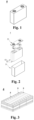
- Fig. 1 shows a secondary battery 5 with a square structure as an example.
- the outer package can include a case 51 and a cover plate 53.
- the case 51 may include a bottom plate and a side plate connected to the bottom plate, with the bottom plate and the side plate enclosing to form an accommodating cavity.
- the case 51 has an opening that communicates with the accommodating cavity, and the cover plate 53 is used to cover the opening to close the accommodating cavity.
- the positive electrode plate, the negative electrode plate, and the separator may be formed into an electrode assembly 52 by a winding process or a stacking process.
- the electrode assembly 52 is encapsulated within the accommodating cavity.
- the electrolyte solution impregnates the electrode assembly 52.
- the number of electrode assemblies 52 contained in the secondary battery 5 can be one or more, which can be adjusted according to requirements.
- a second aspect of the embodiments of the present application provides a method for preparing a secondary battery, and the method at least comprises step 1 and step 2.
- Step 1 assembling a positive electrode plate, a separator, a negative electrode plate, and an electrolyte solution into a secondary battery.
- the electrolyte solution comprises lithium difluoro(oxalato)borate, optional fluoroethylene carbonate, and optional lithium fluorosulfonylimide, wherein based on the total mass of the electrolyte solution, the percentage mass content of the lithium difluoro(oxalato)borate is x%, with 0 ⁇ x ⁇ 1.0, based on the total mass of the electrolyte solution, the percentage mass content of the fluoroethylene carbonate is y%, with 0 ⁇ y ⁇ 2.5, and based on the total mass of the electrolyte solution, the percentage mass content of the lithium fluorosulfonylimide is z%, with 0 ⁇ z ⁇ 2.5.
- Step 2 selecting secondary batteries satisfying c + x/10 ⁇ 0.10 from the secondary batteries obtained in step 1.
- the B atom in the lithium difluoro(oxalato)borate can fully bind to the O atom in the positive electrode active material, which better reduces the diffusion resistance of lithium ions in the bulk phase of the low-cobalt or cobalt-free positive electrode active material, and avoids excessive delithiation on the surface of the low-cobalt or cobalt-free positive electrode active material, thereby helping to better stabilize the crystalline structure of the low-cobalt or cobalt-free positive electrode active material and improve the diffusion rate of lithium ions. Therefore, the secondary batteries obtained by the preparation method of the present application can have both significantly improved cycling performance and good high-temperature storage performance.
- the molecular formula of the lithium fluorosulfonylimide is LiN(SO 2 R 1 )(SO 2 R 2 ), wherein R 1 and R 2 each independently represent F, or C n F 2n+1 , and n is an integer from 1 to 10.
- the lithium fluorosulfonylimide comprises one or both of lithium bis(fluorosulfonyl)imide (LiFSI) and lithium bis(trifluoromethanesulfonyl)imide (LiTFSI).
- the method further comprises a step of selecting secondary batteries satisfying 0.5 ⁇ y/x ⁇ 2.0 from the secondary batteries obtained in step 2.
- the prepared secondary battery has good storage performance and significantly improved cycling performance and energy density simultaneously.
- the method further comprises a step of selecting secondary batteries satisfying 0.5 ⁇ x/z ⁇ 2.0 from the secondary batteries obtained in step 2.
- the prepared secondary battery has good storage performance and significantly improved cycling performance, rate performance, and low-temperature performance simultaneously.
- the method further comprises a step of selecting secondary batteries simultaneously satisfying 0.5 ⁇ y/x ⁇ 2.0 and 0.5 ⁇ x/z ⁇ 2.0 from the secondary batteries obtained in step 2.
- the prepared secondary battery has good storage performance and significantly improved cycling performance, rate performance, and low-temperature performance simultaneously.
- the method further comprises a step of selecting secondary batteries simultaneously satisfying 0.5 ⁇ y/x ⁇ 2.0, 0.5 ⁇ x/z ⁇ 2.0 and 0.25 ⁇ y/z ⁇ 2.0 from the secondary batteries obtained in step 2.
- the prepared secondary battery has good storage performance and significantly improved cycling performance, rate performance, and low-temperature performance simultaneously.
- the secondary battery according to the present application can be assembled into a battery module, the number of secondary batteries comprised in the battery module can be multiple, and the specific number can be adjusted according to the application and capacity of the battery module.
- Fig. 3 is a schematic diagram of a battery module 4 as an example.
- a plurality of secondary batteries 5 can be sequentially arranged along the length direction of the battery module 4. Of course, they can be arranged in any other way.
- the plurality of secondary batteries 5 may further be fixed by fasteners.
- the battery module 4 can further comprise a case having an accommodating space, in which the plurality of secondary batteries 5 are accommodated.
- the aforementioned battery modules can further be assembled into a battery pack, and the number of battery modules included in the battery pack can be adjusted according to the application and capacity of the battery pack.
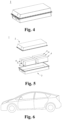
- Figs. 4 and 5 are schematic diagrams of a battery pack 1 as an example.
- the battery pack 1 may comprise a battery box and a plurality of battery modules 4 provided in the battery box.
- the battery box comprises an upper box 2 and a lower box 3, wherein the upper box 2 is used to cover the lower box 3 to form an enclosed space for accommodating the battery modules 4.
- the plurality of battery modules 4 may be arranged in the battery box in any manner.
- An embodiment of the present application further provides an electrical apparatus comprising at least one of the secondary battery, battery module, or battery pack of the present application.
- the secondary battery, battery module, or battery pack may be used as a power source for the electrical apparatus, and may also be used as an energy storage unit for the electrical apparatus.
- the electrical apparatus may be, but is not limited to, a mobile device (such as a mobile phone, a laptop), an electric vehicle (such as an all-electric vehicle, a hybrid electric vehicle, a plug-in hybrid electric vehicle, an electric bicycle, an electric scooter, an electric golf cart, an electric truck), an electric train, a ship, a satellite, an energy storage system, etc.
- the secondary battery, the battery module, or the battery pack can be selected according to the use requirements of the electrical apparatus.
- Fig. 6 is a schematic diagram of an electrical apparatus as an example.
- the electrical apparatus is an all-electric vehicle, a hybrid electric vehicle or a plug-in hybrid electric vehicle, and the like.
- a battery pack or a battery module may be used.
- the electrical apparatus may be a mobile phone, a tablet, a laptop, etc.
- the electrical apparatus is generally required to be light and thin, and can use a secondary battery as a power source.
- the positive electrode active material LiNi 0.65 Co 0.05 Mn 0.3 O 2 , conductive agent carbon black and binder polyvinylidene fluoride (PVDF) in a weight ratio of 97.5:1.4:1.1 are mixed in a proper amount of solvent NMP with sufficient stirring to form a uniform positive electrode slurry; the positive electrode slurry is evenly coated on the surface of a positive electrode current collector aluminum foil, and after drying and cold pressing, a positive electrode plate is obtained.
- PVDF polyvinylidene fluoride
- the negative electrode active material graphite, binder styrene butadiene rubber (SBR), thickener sodium carboxymethyl cellulose (CMC-Na) and conductive agent carbon black (Super P) in a weight ratio of 96.2:1.8:1.2:0.8 are mixed in a proper amount of solvent deionized water with sufficient stirring to form a uniform negative electrode slurry; the negative electrode slurry is evenly coated on the surface of the negative electrode current collector copper foil, and after drying and cold pressing, a negative electrode plate is obtained.
- a porous polyethylene (PE) film is used as the separator.
- Ethylene carbonate (EC), methyl ethyl carbonate (EMC) and diethyl carbonate (DEC) are mixed in a volume ratio of 1:1:1 to obtain an organic solvent.
- LiPF 6 and lithium difluoro(oxalato)borate are uniformly dissolved in the above organic solvent to obtain an electrolyte solution, the concentration of LiPF 6 is 1mol/L, and based on the total mass of the electrolyte solution, the percentage mass content of lithium difluoro(oxalato)borate is 0.5%.
- the positive electrode plate, the separator and the negative electrode plate are stacked in sequence and wound to obtain an electrode assembly; the electrode assembly is placed in an outer package, the above electrolyte solution is added thereto, and after packaging, standing, formation, shaping and other procedures, a secondary battery is obtained.
- the methods for preparing the secondary batteries are similar to that of Embodiment 1, except that the type of the positive electrode active material and the preparation parameters of the electrolyte solution are adjusted.
- the specific parameters are shown in Table 1.
- fluoroethylene carbonate is further added
- lithium bis(fluorosulfonyl)imide is further added in the electrolyte solutions in Embodiments 14-19
- both fluoroethylene carbonate and lithium bis(fluorosulfonyl)imide are further added in the electrolyte solutions of Embodiments 20-25 simultaneously.
- x% is the percentage mass content of lithium difluoro(oxalato)borate based on the total mass of the electrolyte solution
- y% is the percentage mass content of fluoroethylene carbonate based on the total mass of the electrolyte solution
- z % represents the percentage mass content of lithium bis(fluorosulfonyl)imide based on the total mass of the electrolyte solution.
- the secondary battery is charged to 4.3V at a constant current of 1C, and continues to charge at a constant voltage until the current is 0.05C. At this time, the secondary battery is in a full charge state, and the charge capacity at this time is recorded, which is the charge capacity of cycle 1. After the secondary battery is allowed to stand for 5 min, it is discharged to 2.8V at a constant current of 1C. This is one cyclic charge-discharge process, and the discharge capacity at this time is recorded, which is the discharge capacity of cycle 1. The secondary battery is subjected to the cyclic charge-discharge test according to the above method, and the discharge capacity after each cycle is recorded.
- Capacity retention rate (%) of secondary battery after 600 cycles at 45°C (discharge capacity after 600 cycles/discharge capacity of cycle 1) ⁇ 100%.
- the secondary battery is charged at a constant current of 1C to 4.3V, continues to charge at a constant voltage until the current is 0.05C, and the secondary battery is in a full charge state at this time; the secondary battery is discharged at a constant current of 0.5C and the secondary battery is adjusted to 50% SOC, the voltage of the secondary battery at this time is recorded as U 1 ; the secondary battery is discharged at a constant current of 4C for 30 s, with site sampling at 0.1 s, and the voltage at the end of discharge is recorded as U 2 .
- the secondary battery is charged to 4.3V at a constant current of 1C, and continues to charge at a constant voltage until the current is 0.05C.
- the volume of the secondary battery is tested by the water displacement method and recorded as Vo.
- the secondary battery is placed into a 60°C thermostat, stored for 30 d and then taken out. The volume of the secondary battery at this time is tested by the water displacement method and recorded as V 1 .
- Embodiments 1-25 and Comparative Embodiments 1-3 are provided in Table 2.
- Table 2 No. Capacity retention rate (%) after 600 cycles at 25°C Capacity retention rate (%) after 600 cycles at 45°C Volume expansion rate (%) after storage at 60°C for 30 d
- the secondary battery has significantly improved cycling performance as well as good high-temperature storage performance.
- lithium difluoro(oxalato)borate is not added in the electrolyte solution, or the amount of lithium difluoro(oxalato)borate added is insufficient, and in these cases, lithium difluoro(oxalato)borate cannot form a low-impedance protective film with excellent performance on the surface of the low-cobalt or cobalt-free positive electrode active material, and lithium difluoro(oxalato)borate also cannot effectively reduce the charge transfer resistance of the low-cobalt or cobalt-free positive electrode active material, cannot effectively reduce the diffusion resistance of lithium ions in the bulk phase of the low-cobalt or cobalt-free positive electrode active material and inhibit the excessive delithiation on the surface of the low-cobalt or cobalt-free positive electrode active material. Therefore, it is difficult for the secondary battery to have significantly improved cycling performance.
- the relationship between the percentage mass content x% of lithium difluoro(oxalato)borate, the percentage mass content y% of fluoroethylene carbonate and the percentage mass content of lithium bis(fluorosulfonyl)imide is further reasonably controlled to satisfy 0.5 ⁇ y/x ⁇ 2.0, 0.5 ⁇ x/z ⁇ 2.0 and 0.25 ⁇ y/z ⁇ 2.0.
- the secondary battery can not only have good high-temperature storage performance, but also have significantly improved cycling performance and rate performance.
Landscapes
- Chemical & Material Sciences (AREA)
- Chemical Kinetics & Catalysis (AREA)
- Electrochemistry (AREA)
- General Chemical & Material Sciences (AREA)
- Engineering & Computer Science (AREA)
- Manufacturing & Machinery (AREA)
- Inorganic Chemistry (AREA)
- Materials Engineering (AREA)
- Physics & Mathematics (AREA)
- Condensed Matter Physics & Semiconductors (AREA)
- General Physics & Mathematics (AREA)
- Secondary Cells (AREA)
- Battery Electrode And Active Subsutance (AREA)
Applications Claiming Priority (2)
| Application Number | Priority Date | Filing Date | Title |
|---|---|---|---|
| CN202111321034.7A CN116111177B (zh) | 2021-11-09 | 2021-11-09 | 二次电池、用于制备二次电池的方法、电池模块、电池包及用电装置 |
| PCT/CN2022/121240 WO2023082866A1 (fr) | 2021-11-09 | 2022-09-26 | Batterie secondaire, procédé de préparation de batterie secondaire, module de batterie, bloc-batterie et appareil électrique |
Publications (2)
| Publication Number | Publication Date |
|---|---|
| EP4266442A1 true EP4266442A1 (fr) | 2023-10-25 |
| EP4266442A4 EP4266442A4 (fr) | 2025-02-26 |
Family
ID=86258437
Family Applications (1)
| Application Number | Title | Priority Date | Filing Date |
|---|---|---|---|
| EP22891668.0A Pending EP4266442A4 (fr) | 2021-11-09 | 2022-09-26 | Batterie secondaire, procédé de préparation de batterie secondaire, module de batterie, bloc-batterie et appareil électrique |
Country Status (6)
| Country | Link |
|---|---|
| US (1) | US20230395860A1 (fr) |
| EP (1) | EP4266442A4 (fr) |
| JP (1) | JP7668887B2 (fr) |
| KR (2) | KR102881997B1 (fr) |
| CN (1) | CN116111177B (fr) |
| WO (1) | WO2023082866A1 (fr) |
Families Citing this family (1)
| Publication number | Priority date | Publication date | Assignee | Title |
|---|---|---|---|---|
| CN117083745B (zh) * | 2023-06-01 | 2026-01-27 | 宁德时代新能源科技股份有限公司 | 锂二次电池用电解液、二次电池和用电设备 |
Family Cites Families (23)
| Publication number | Priority date | Publication date | Assignee | Title |
|---|---|---|---|---|
| JP2013030284A (ja) * | 2011-07-26 | 2013-02-07 | Mitsubishi Chemicals Corp | 非水系電解液電池 |
| CN105074994B (zh) * | 2013-03-27 | 2018-10-19 | 三菱化学株式会社 | 非水电解液及使用该非水电解液的非水电解质电池 |
| KR20160117961A (ko) * | 2015-04-01 | 2016-10-11 | 에스케이케미칼주식회사 | 이차 전지용 전해액 조성물 및 이를 포함하는 이차 전지 |
| CN105186039A (zh) * | 2015-06-25 | 2015-12-23 | 珠海市赛纬电子材料有限公司 | 一种高电压锂离子电池的非水电解液 |
| KR102068707B1 (ko) * | 2015-10-27 | 2020-01-22 | 주식회사 엘지화학 | 비수성 전해질 및 이를 포함하는 리튬 이차전지 |
| KR20170061017A (ko) * | 2015-11-25 | 2017-06-02 | 솔브레인 주식회사 | 전해질 및 이를 포함하는 리튬 이차 전지 |
| JP2018206523A (ja) * | 2017-05-31 | 2018-12-27 | 日立化成株式会社 | リチウムイオン二次電池 |
| KR102045472B1 (ko) * | 2017-11-21 | 2019-11-15 | 울산과학기술원 | 리튬 금속 이차전지용 전해액 |
| KR102543244B1 (ko) * | 2018-06-21 | 2023-06-14 | 주식회사 엘지에너지솔루션 | 리튬 금속 전지용 전해질 및 이를 포함하는 리튬 금속 전지 |
| CN110660962B (zh) * | 2018-06-29 | 2021-02-02 | 宁德时代新能源科技股份有限公司 | 二次电池 |
| CN109244530A (zh) * | 2018-09-21 | 2019-01-18 | 深圳市卓能新能源股份有限公司 | 一种锂离子电池和制备方法 |
| JP2020161466A (ja) * | 2019-02-05 | 2020-10-01 | 株式会社豊田自動織機 | 電解液及びリチウムイオン二次電池 |
| KR102501252B1 (ko) * | 2019-04-30 | 2023-02-20 | 주식회사 엘지에너지솔루션 | 리튬 이차 전지용 비수 전해질 및 이를 포함하는 리튬 이차 전지 |
| CN110085913A (zh) * | 2019-05-23 | 2019-08-02 | 河南电池研究院有限公司 | 一种适用于高镍正极材料和硅碳负极材料的锂离子电池电解液及其制备方法 |
| CN110212235B (zh) * | 2019-06-12 | 2022-04-08 | 广州天赐高新材料股份有限公司 | 一种降低电池阻抗的锂二次电池电解液及其锂二次电池 |
| CN110783628A (zh) * | 2019-10-29 | 2020-02-11 | 珠海冠宇电池有限公司 | 一种锂离子电池非水电解液及使用该电解液的锂离子电池 |
| CN110797575A (zh) * | 2019-10-29 | 2020-02-14 | 珠海冠宇电池有限公司 | 一种锂离子电池非水电解液及使用该电解液的锂离子电池 |
| CN110854433A (zh) * | 2019-11-15 | 2020-02-28 | 欣旺达电动汽车电池有限公司 | 一种电解液和电化学装置 |
| CN111048840B (zh) * | 2019-12-27 | 2021-06-18 | 苏州凌威新能源科技有限公司 | 锂离子电池电解液以及锂离子电池 |
| WO2021172175A1 (fr) * | 2020-02-28 | 2021-09-02 | パナソニックIpマネジメント株式会社 | Procédé de charge et de décharge pour batterie secondaire à électrolyte non aqueux, et système de charge et de décharge pour batterie secondaire à électrolyte non aqueux |
| CN113451646A (zh) * | 2020-03-25 | 2021-09-28 | 深圳格林德能源集团有限公司 | 一种三元掺锰酸锂二次电池电解液 |
| CN111509298B (zh) * | 2020-06-01 | 2022-04-12 | 蜂巢能源科技股份有限公司 | 锂离子电池用电解液功能添加剂、锂离子电池电解液及锂离子电池 |
| WO2022012601A1 (fr) * | 2020-07-15 | 2022-01-20 | 浙江中蓝新能源材料有限公司 | Additif de silane, électrolyte et batterie au lithium-ion contenant cet additif |
-
2021
- 2021-11-09 CN CN202111321034.7A patent/CN116111177B/zh active Active
-
2022
- 2022-09-26 KR KR1020237025511A patent/KR102881997B1/ko active Active
- 2022-09-26 EP EP22891668.0A patent/EP4266442A4/fr active Pending
- 2022-09-26 KR KR1020257036451A patent/KR20250161044A/ko active Pending
- 2022-09-26 WO PCT/CN2022/121240 patent/WO2023082866A1/fr not_active Ceased
- 2022-09-26 JP JP2023546553A patent/JP7668887B2/ja active Active
-
2023
- 2023-08-09 US US18/231,794 patent/US20230395860A1/en active Pending
Also Published As
| Publication number | Publication date |
|---|---|
| JP7668887B2 (ja) | 2025-04-25 |
| KR102881997B1 (ko) | 2025-11-10 |
| WO2023082866A1 (fr) | 2023-05-19 |
| JP2024505265A (ja) | 2024-02-05 |
| US20230395860A1 (en) | 2023-12-07 |
| EP4266442A4 (fr) | 2025-02-26 |
| KR20230125041A (ko) | 2023-08-28 |
| KR20250161044A (ko) | 2025-11-14 |
| CN116111177B (zh) | 2026-02-17 |
| CN116111177A (zh) | 2023-05-12 |
Similar Documents
| Publication | Publication Date | Title |
|---|---|---|
| EP3651245B1 (fr) | Plaque d'électrode négative et batterie secondaire au lithium-ion | |
| EP3955358A1 (fr) | Batterie secondaire, module de batterie, bloc-batterie et dispositif contenant la batterie secondaire | |
| KR20250002531A (ko) | 리튬 이차 배터리용 전해액, 이차 배터리 및 전기 장치 | |
| EP4231407A1 (fr) | Solution électrolytique, batterie secondaire la comprenant, et procédé de préparation de batterie secondaire | |
| US12418047B2 (en) | Electrolyte, secondary battery, battery module, battery pack, and power consuming device | |
| US20240282920A1 (en) | Lithium-ion secondary battery, battery module, battery pack, and electrical device | |
| US20230378539A1 (en) | Secondary battery, method for preparing secondary battery, battery module, battery pack, and electrical apparatus | |
| CN116998040B (zh) | 二次电池、电池模块、电池包及用电装置 | |
| US20230395860A1 (en) | Secondary battery, method for preparing secondary battery, battery module, battery pack, and electrical apparatus | |
| KR20240023649A (ko) | 비수전해액과 이를 포함하는 이차 전지, 전지 모듈, 전지 팩 및 전기 장치 | |
| US20240266617A1 (en) | Secondary battery, preparation method therefor, battery module, battery pack, and power consuming device | |
| EP4611099A1 (fr) | Batterie au lithium-ion contenant un matériau actif d'électrode positive dopé | |
| EP4280302A1 (fr) | Batterie secondaire, procédé de préparation de matériau actif d'électrode positive correspondant, module de batterie, bloc-batterie et dispositif électrique | |
| EP4629327A1 (fr) | Matériau actif d'électrode négative et son procédé de préparation, feuille d'électrode négative, batterie secondaire et dispositif | |
| EP4611064A1 (fr) | Matériau actif d'électrode positive, pièce polaire positive, batterie secondaire et appareil électrique | |
| EP4178001A1 (fr) | Batterie au lithium-ion, module de batterie, bloc-batterie et dispositif électrique | |
| EP4654294A1 (fr) | Matériau composite de silicium et son procédé de préparation, feuille d'électrode négative, batterie secondaire et dispositif électrique | |
| EP4654296A1 (fr) | Matériau composite à base de silicium et son procédé de préparation, feuille d'électrode négative, batterie secondaire et dispositif électrique | |
| CN120709366A (zh) | 正极活性材料及其制备方法、正极极片、二次电池和应用 |
Legal Events
| Date | Code | Title | Description |
|---|---|---|---|
| STAA | Information on the status of an ep patent application or granted ep patent |
Free format text: STATUS: THE INTERNATIONAL PUBLICATION HAS BEEN MADE |
|
| PUAI | Public reference made under article 153(3) epc to a published international application that has entered the european phase |
Free format text: ORIGINAL CODE: 0009012 |
|
| STAA | Information on the status of an ep patent application or granted ep patent |
Free format text: STATUS: REQUEST FOR EXAMINATION WAS MADE |
|
| 17P | Request for examination filed |
Effective date: 20230717 |
|
| AK | Designated contracting states |
Kind code of ref document: A1 Designated state(s): AL AT BE BG CH CY CZ DE DK EE ES FI FR GB GR HR HU IE IS IT LI LT LU LV MC MK MT NL NO PL PT RO RS SE SI SK SM TR |
|
| RAP1 | Party data changed (applicant data changed or rights of an application transferred) |
Owner name: CONTEMPORARY AMPEREX TECHNOLOGY(HONG KONG) LIMITED |
|
| DAV | Request for validation of the european patent (deleted) | ||
| DAX | Request for extension of the european patent (deleted) | ||
| A4 | Supplementary search report drawn up and despatched |
Effective date: 20250123 |
|
| RIC1 | Information provided on ipc code assigned before grant |
Ipc: H01M 4/525 20100101ALI20250117BHEP Ipc: H01M 4/131 20100101ALI20250117BHEP Ipc: H01M 10/0569 20100101ALI20250117BHEP Ipc: H01M 10/0568 20100101ALI20250117BHEP Ipc: H01M 10/058 20100101ALI20250117BHEP Ipc: H01M 10/0525 20100101AFI20250117BHEP |