EP4266744A1 - Verfahren und vorrichtung zur ressourcenauswahl auf basis von partieller erfassung, vorrichtung und speichermedium - Google Patents
Verfahren und vorrichtung zur ressourcenauswahl auf basis von partieller erfassung, vorrichtung und speichermedium Download PDFInfo
- Publication number
- EP4266744A1 EP4266744A1 EP21934094.0A EP21934094A EP4266744A1 EP 4266744 A1 EP4266744 A1 EP 4266744A1 EP 21934094 A EP21934094 A EP 21934094A EP 4266744 A1 EP4266744 A1 EP 4266744A1
- Authority
- EP
- European Patent Office
- Prior art keywords
- slot
- resource
- moment
- selection
- sensing
- Prior art date
- Legal status (The legal status is an assumption and is not a legal conclusion. Google has not performed a legal analysis and makes no representation as to the accuracy of the status listed.)
- Granted
Links
Images




Classifications
-
- H—ELECTRICITY
- H04—ELECTRIC COMMUNICATION TECHNIQUE
- H04W—WIRELESS COMMUNICATION NETWORKS
- H04W72/00—Local resource management
- H04W72/02—Selection of wireless resources by user or terminal
-
- H—ELECTRICITY
- H04—ELECTRIC COMMUNICATION TECHNIQUE
- H04L—TRANSMISSION OF DIGITAL INFORMATION, e.g. TELEGRAPHIC COMMUNICATION
- H04L27/00—Modulated-carrier systems
- H04L27/26—Systems using multi-frequency codes
- H04L27/2601—Multicarrier modulation systems
- H04L27/2602—Signal structure
- H04L27/26025—Numerology, i.e. varying one or more of symbol duration, subcarrier spacing, Fourier transform size, sampling rate or down-clocking
-
- H—ELECTRICITY
- H04—ELECTRIC COMMUNICATION TECHNIQUE
- H04L—TRANSMISSION OF DIGITAL INFORMATION, e.g. TELEGRAPHIC COMMUNICATION
- H04L5/00—Arrangements affording multiple use of the transmission path
- H04L5/003—Arrangements for allocating sub-channels of the transmission path
- H04L5/0037—Inter-user or inter-terminal allocation
-
- H—ELECTRICITY
- H04—ELECTRIC COMMUNICATION TECHNIQUE
- H04L—TRANSMISSION OF DIGITAL INFORMATION, e.g. TELEGRAPHIC COMMUNICATION
- H04L5/00—Arrangements affording multiple use of the transmission path
- H04L5/003—Arrangements for allocating sub-channels of the transmission path
- H04L5/0058—Allocation criteria
- H04L5/0062—Avoidance of ingress interference, e.g. ham radio channels
-
- H—ELECTRICITY
- H04—ELECTRIC COMMUNICATION TECHNIQUE
- H04W—WIRELESS COMMUNICATION NETWORKS
- H04W24/00—Supervisory, monitoring or testing arrangements
- H04W24/08—Testing, supervising or monitoring using real traffic
-
- H—ELECTRICITY
- H04—ELECTRIC COMMUNICATION TECHNIQUE
- H04W—WIRELESS COMMUNICATION NETWORKS
- H04W28/00—Network traffic management; Network resource management
- H04W28/16—Central resource management; Negotiation of resources or communication parameters, e.g. negotiating bandwidth or QoS [Quality of Service]
- H04W28/26—Resource reservation
-
- H—ELECTRICITY
- H04—ELECTRIC COMMUNICATION TECHNIQUE
- H04W—WIRELESS COMMUNICATION NETWORKS
- H04W4/00—Services specially adapted for wireless communication networks; Facilities therefor
- H04W4/30—Services specially adapted for particular environments, situations or purposes
- H04W4/40—Services specially adapted for particular environments, situations or purposes for vehicles, e.g. vehicle-to-pedestrians [V2P]
-
- H—ELECTRICITY
- H04—ELECTRIC COMMUNICATION TECHNIQUE
- H04W—WIRELESS COMMUNICATION NETWORKS
- H04W72/00—Local resource management
- H04W72/04—Wireless resource allocation
- H04W72/044—Wireless resource allocation based on the type of the allocated resource
- H04W72/0446—Resources in time domain, e.g. slots or frames
-
- H—ELECTRICITY
- H04—ELECTRIC COMMUNICATION TECHNIQUE
- H04W—WIRELESS COMMUNICATION NETWORKS
- H04W72/00—Local resource management
- H04W72/12—Wireless traffic scheduling
- H04W72/1263—Mapping of traffic onto schedule, e.g. scheduled allocation or multiplexing of flows
-
- H—ELECTRICITY
- H04—ELECTRIC COMMUNICATION TECHNIQUE
- H04W—WIRELESS COMMUNICATION NETWORKS
- H04W72/00—Local resource management
- H04W72/20—Control channels or signalling for resource management
- H04W72/25—Control channels or signalling for resource management between terminals via a wireless link, e.g. sidelink
-
- H—ELECTRICITY
- H04—ELECTRIC COMMUNICATION TECHNIQUE
- H04W—WIRELESS COMMUNICATION NETWORKS
- H04W72/00—Local resource management
- H04W72/50—Allocation or scheduling criteria for wireless resources
- H04W72/54—Allocation or scheduling criteria for wireless resources based on quality criteria
- H04W72/542—Allocation or scheduling criteria for wireless resources based on quality criteria using measured or perceived quality
-
- H—ELECTRICITY
- H04—ELECTRIC COMMUNICATION TECHNIQUE
- H04W—WIRELESS COMMUNICATION NETWORKS
- H04W92/00—Interfaces specially adapted for wireless communication networks
- H04W92/16—Interfaces between hierarchically similar devices
- H04W92/18—Interfaces between hierarchically similar devices between terminal devices
-
- H—ELECTRICITY
- H04—ELECTRIC COMMUNICATION TECHNIQUE
- H04W—WIRELESS COMMUNICATION NETWORKS
- H04W72/00—Local resource management
- H04W72/40—Resource management for direct mode communication, e.g. D2D or sidelink
-
- Y—GENERAL TAGGING OF NEW TECHNOLOGICAL DEVELOPMENTS; GENERAL TAGGING OF CROSS-SECTIONAL TECHNOLOGIES SPANNING OVER SEVERAL SECTIONS OF THE IPC; TECHNICAL SUBJECTS COVERED BY FORMER USPC CROSS-REFERENCE ART COLLECTIONS [XRACs] AND DIGESTS
- Y02—TECHNOLOGIES OR APPLICATIONS FOR MITIGATION OR ADAPTATION AGAINST CLIMATE CHANGE
- Y02D—CLIMATE CHANGE MITIGATION TECHNOLOGIES IN INFORMATION AND COMMUNICATION TECHNOLOGIES [ICT], I.E. INFORMATION AND COMMUNICATION TECHNOLOGIES AIMING AT THE REDUCTION OF THEIR OWN ENERGY USE
- Y02D30/00—Reducing energy consumption in communication networks
- Y02D30/70—Reducing energy consumption in communication networks in wireless communication networks
Definitions
- Embodiments of the present disclosure relate to the technical field of communication, and in particular to a resource selection method based on partial sensing, apparatus, device and storage medium.
- a User Equipment In Sidelink (SL) communication, a User Equipment (UE) can select transmission resources in a resource pool by sensing.
- SL Sidelink
- UE User Equipment
- a partial sensing mechanism In order to save power consumption of the UE, a partial sensing mechanism is introduced.
- the partial sensing mechanism a number of time units for resource selection and a number of time units for resource sensing are limited, so as to achieve the purpose of saving energy and power.
- Embodiments of the disclosure provide a resource selection method based on partial sensing, apparatus, device and storage medium.
- the technical solution is as follows.
- a resource selection method based on partial sensing is provided.
- the method is performed by a LTE, and includes the following two operations.
- At least one selection slot and at least one sensing slot are determined, where the at least one selection slot is after a target moment and the at least one sensing slot is before the target moment.
- a candidate resource set is determined from available resources in the at least one selection slot based on a sensing result in the at least one sensing slot, and a transmission resource is selected from the candidate resource set.
- a resource selection device based on partial sensing.
- the device includes a slot determining module and a resource selecting module.
- the slot determining module is configured to determine at least one selection slot and at least one sensing slot, where the at least one selection slot is after a target moment and the at least one sensing slot is before the target moment.
- the resource selecting module is configured to determine a candidate resource set from available resources in the at least one selection slot based on a sensing result in the at least one sensing slot, and select a transmission resource from the candidate resource set.
- a UE includes a processor.
- the processor is configured to determine at least one selection slot and at least one sensing slot, where the at least one selection slot is after a target moment and the at least one sensing slot is before the target moment.
- the processor is further configured to determine a candidate resource set from available resources in the at least one selection slot based on a sensing result in the at least one sensing slot, and select a transmission resource from the candidate resource set.
- computer-readable storage medium configured to be executed by a processor so as to implement the above-mentioned resource selection method based on partial sensing.
- a chip includes at least one of a programmable logic circuitry or program instructions that is configured to implement the above-mentioned resource selection method based on partial sensing when the chip is running.
- a computer program product or computer program includes computer instructions stored in a computer-readable storage medium.
- a processor reads and executes the computer instructions from the computer-readable storage medium to implement the above-mentioned resource selection method based on partial sensing.
- the technical solution provided by the embodiments of the disclosure may include the following beneficial effects.
- the selection slot is after a target moment and the sensing slot is before the target moment, which can ensure that there would be no slots not having been sensed when the candidate resource set for data transmission is determined from the available resources in the selection slot, thereby ensuring the accuracy and reliability of resource selection.
- the network architecture and the service scenario described in the embodiments of the disclosure are intended to provide a clearer explanation of the technical solution of the embodiments of the disclosure, and do not constitute a limitation to the technical solution of the embodiments of the disclosure. Those skilled in the art would appreciate that the technical solution provided by the embodiments of the present disclosure is also applicable to similar technical problems with the evolution of the network architecture and the emergence of new business scenarios.
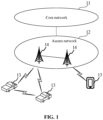
- the network architecture may include a core network 11, an access network 12, and a UE 13.
- the core network 11 includes multiple core network devices.
- the function of the core network device is mainly to provide user connection, manage users, and complete the bearing of services, and is provided to an interface of an external network as a bearer network.
- a core network of a 5th Generation (5G) New Radio (NR) system may include devices, such as an Access and Mobility Management Function (AMF) entity, a User Plane Function (UPF) entity, and a Session Management Function (SMF) entity.
- AMF Access and Mobility Management Function
- UPF User Plane Function
- SMF Session Management Function
- the access network 12 includes multiple access network devices 14.
- the access network in the 5G NR system may be called a New Generation-Radio Access Network (NG-RAN).
- the access network device 14 is an apparatus that is deployed in the access network 12 and is configured to provide a wireless communication function for the UE 13.
- the access network device 14 may include various forms of macro base stations, micro base stations, relay nodes, access points, and the like.
- devices having the function of an access network device may have different names, for example, the devices may be called gNodeB or gNB in the 5G NR system.
- the name "access network device" may change.
- the above-mentioned devices configured to provide a wireless communication function for the UE 13 are collectively referred to as the access network device.
- the UEs 13 may be distributed within a cell managed by each access network device 14.
- the UEs 13 may include various handheld devices, on-board devices, wearable devices, or computing devices that have the wireless communication function, or other processing devices connected to a wireless modem, and various forms of user equipments, Mobile Stations (MS), and the like.
- MS Mobile Stations
- the access network device 14 and the core network device communicate with each other via a certain in-air technology, such as an NG interface in the 5G NR system.
- the access network device 14 and the UE 13 communicate with each other by a certain in-air technology, such as a Uu interface.
- the UEs 13 may communicate with each other through a direct communication interface (such as a PCS interface).
- a direct communication interface such as a PCS interface
- the communication link established on the basis of the direct communication interface may be called a direct link or an SL.
- SL transmission is the direct communication data transmission between UEs through the SL. Different from receiving or transmitting communication data through an access network device in a traditional cellular system, the SL transmission has the characteristics of short delay, low overhead, and the like, and is suitable for communication between two UEs that are geographically close (such as vehicle-mounted devices and other peripheral devices that are geographically close). It should be noted that in FIG.
- V2X vehicle to everything
- the "5G NR system" in the embodiments of the disclosure may also be referred to as a 5G system or an NR system. However, those skilled in the art may understand its meaning.
- the technical solutions described in the embodiments of the disclosure may be applied to the 5G NR system, and may also be applied to a subsequent evolution system of the 5G NR system.
- 3rd Generation Partnership Project 3rd Generation Partnership Project
- 3GPP 3rd Generation Partnership Project
- Mode A transmission resources of a UE are assigned by the access network device (such as a base station).
- the UE transmits communication data on the SL according to the transmission resources assigned by the access network device.
- the access network device may not only allocate transmission resources for a single transmission to the UE, but also allocate the transmission resources for semi-static transmission to the UE.
- Mode B the UE autonomously selects transmission resources from a resource pool to transmit communication data. Specifically, the UE may select the transmission resources from the resource pool in a manner of sensing, or select the transmission resource from the resource pool in manner of random selection.
- the following mainly introduces the method for the UE to autonomously select the resources for the SL communication in NR V2X system (i.e., the above Mode B).
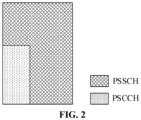
- a structure of a physical layer of SL communication in NR V2X system is illustrated in FIG. 2 .
- a Physical Sidelink Control Channel (PSCCH) is configured to carry first sidelink control information
- a Physical Sidelink Shared Channel (PSSCH) is configured to carry data and second sidelink control information.
- the PSCCH and the PSSCH are transmitted in the same slot.
- the first sidelink control information and the second sidelink control information may be two pieces of sidelink control information having different functions.
- the first sidelink control information is carried in the PSCCH and includes a domain related to resource sensing, so as to facilitate resource exclusion and resource selection by other UEs after decoding.
- the PSSCH also carries the second sidelink control information
- the second sidelink control information mainly includes a domain related to data demodulation, so as to facilitate demodulation of date in the PSSCH by other UEs.
- the UE autonomously selects the transmission resources to send the data.
- Resource reservation is the prerequisite for the resource selection.
- resource reservation within a Transport Block (TB) is supported, and resource reservation between TBs is also supported.
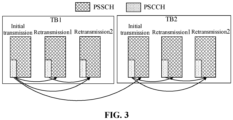
- the UE sends the first sidelink control information, and indicates N time-frequency resources (including resources currently used for transmission) of the current TB by using a "Time resource assignment" domain and "Frequency resource assignment" domain in the first sidelink control information.
- the indicated N time-frequency resources should be distributed in W slots.
- W 32.
- the UE indicates the time-frequency resource positions of the retransmission 1 and the retransmission 2 by using the first sidelink control information transmitted in the PSCCH of the retransmission 1, and the retransmission 1 and the retransmission 2 are distributed within 32 slots in the time domain.
- the "Resource reservation period" domain is used for the resource reservation between the TBs when the UE sends the first sidelink control information.
- the time-frequency resource positions of the initial transmission of TB1 and the retransmission 1 of TB1 are indicated by using the "Time resource assignment" domain and "Frequency resource assignment” domain, and the time-frequency resource positions are denoted as ⁇ (t 1 ,f 1 ), (t 2 ,f 2 ) ⁇ .
- t 1 and t 2 represent positions of the initial transmission resource and retransmission 1 resource of TB1 in the time domain
- f 1 and f 2 represent the corresponding positions in the frequency domain.
- the value of "Resource reservation period" domain may be 0 milliseconds (ms), 1-99 ms, 100 ms, 200ms, 300ms, 400 ms, 500 ms, 600 ms, 700 ms, 800 ms, 900 ms and 1000 ms, which is more flexible than Long Term Evolution (LTE) V2X.
- LTE Long Term Evolution
- the UE determines the possible values according to the used resource pool.
- the e of the possible values in the resource pool configuration compose a resource reservation period set M. Exemplarily, e is less than or equal to 16.
- the reservation between TBs can be activated or deactivated in unit of the resource pool.
- the "Resource reservation period" domain is not included in the first sidelink control information.
- the value of the "Resource reservation period” domain used by the UE i.e., the resource reservation period
- the "Resource reservation period” domain is configured to reserve the resources in the next period for the transmission of another TB, so as to achieve periodic semi-persistent transmission.
- the UE can obtain the first sidelink control information sent by other UEs by sensing the PSCCH sent by other UEs, so as to acquire the resources reserved by other UEs.
- the resources reserved by other UEs would be excluded, so as to avoid resource collision.
- the UE needs to autonomously select resources in the above Mode B.
- the UE triggers resource selection or resource reselection in a slot n or the slot n is a slot where the higher layer triggers a physical layer to report the candidate resource set.
- the resource selection window starts at n+T1 and ends at n+T2.
- T proc,1 is 3 slots, 5 slots, 9 slots, 17 slots, respectively.
- the UE determines T2 min from the set of value according to a priority of data to be transmitted by the UE. For example, when the subcarrier interval is 15kHz, the UE determines T2 min from the set ⁇ 1, 5, 10, 20 ⁇ according to the priority of data to be transmitted.
- T2 min is greater than or equal to the residual delay budget of service
- T2 is equal to the residual delay budget of service.
- the residual delay budget is a difference between a moment corresponding to a data delay requirement and a current moment.
- the delay requirement is 50 ms.
- the residual delay budget is 50 ms, and if the current time is slot n+20, the residual delay budget is 30 ms.
- the UE performs resource sensing between n-T0 and n-T proc,0 , and the value of T0 is 100 ms or 1100 ms.
- T proc,0 is 1 slot, 1 slot, 2 slots, 4 slots, respectively.
- the UE would sense the first sidelink control information sent by other UEs in each slot (except its own transmission slot).
- the resource selection or the resource reselection is triggered at slot n, the UE uses the results of resource sensing between n-T0 and n-T proc,0 .
- Step 1 The UE takes all available resources belonging to the resource pool used by the UE in the resource selection window as a resource set A.
- Any resource in the set A is denoted as R(x,y), and x and y respectively indicate the position of the resource in frequency domain and the position of the resource in time domain.
- a initial number of resources in set A is denoted as M total .
- the UE excludes the resources in the resource set A according to the slot (Step 1-1) not being sensed in a resource sensing window and/or a result of the resource sensing (Step 1-2) in the resource sensing window.
- the UE determines whether the resource R(x,y) or a series of periodic resources corresponding to the resource R(x,y) overlaps with a slot determined according to the slot not being sensed in Step 1-1 or a resource determined according to the first sidelink control information sensed in Step 1-2, and if there is an overlap, the resource R(x,y) is excluded from the resource set A.
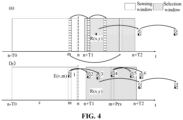
- Step 1-1 if the LTE sends data at slot m in the sensing window without sensing, the UE would determine corresponding Q slots based on the slot m and each allowed resource reservation period in the resource pool used by the UE by taking the resource reservation period as an interval. If the Q slots overlap with the resource R(x,y) or with the series of periodic resources corresponding to the resource R(x,y), the resource R(x,y) is excluded from the resource set A.
- Tscal is a value in millisecond converted from T2.
- Prx is one of the resource reservation periods allowed by the resource pool used by the UE.
- the resource exclusion is performed sequentially according to each resource reservation period in the resource reservation period set M in the resource pool configuration used by the UE. For a certain resource reservation period 1, assuming that the value of Q is calculated to be 2, the corresponding Q slots are the next two slots mapped from the slot m with the resource reservation period 1 as the interval, and the next two slots are marked by horizontal shading in the subfigure (a) of FIG. 4 .
- the corresponding Q slot is a slot mapped from the slot m with the resource reservation period 2 as the interval, and the slot is marked by the dot in the subfigure (a) of FIG. 4 .
- the UE would determine whether Q slots respectively corresponding to each reservation period overlap with the resource R(x,y) or the series of periodic resources corresponding to the resource R(x,y), and if there is an overlap, the resource R(x,y) is excluded from the resource set A.
- the UE may not perform the above Step 1-1 when the resource pool used by the UE deactivates the reservation between TBs.
- Step 1-2 If the first sidelink control information transmitted in the PSCCH is sensed by the UE in the slot m in the resource sensing window, a Sidelink Reference Signal Received Power (SL-RSRP) of the PSCCH is measured, or a SL-RSRP of the PSSCH scheduled by the PSCCH (i.e., the SL-RSRP of the PSSCH transmitted in the same slot as the PSCCH) is measured.
- SL-RSRP Sidelink Reference Signal Received Power
- the UE would determine the corresponding Q slots based on the slot m and the resource reservation period carried in the sensed first sidelink control information by taking the resource reservation period as an interval. It is assumed that the UE receives the first sidelink control information having the same content in the Q slots. The UE determines whether the resources indicated by the "Time resource assignment" domains and “Frequency resource assignment” domains of the first sidelink control information received in the slot m and the Q pieces of first sidelink control information that are assumed to be received overlap with the resource R(x,y) or the series of periodic resources corresponding to the resource R(x,y).
- Tscal is a value in millisecond converted from T2.
- Prx is a resource reservation period carried in the sensed first sidelink control information.
- the resource pool used by the UE activates the reservation between TBs
- the resource reservation period in the first sidelink control information is Prx. It is assumed that the value of Q is calculated to be 1, the UE would assume that the first sidelink control information having the same content is received in the slot m+Prx.
- the UE would determine whether the resource 1, resource 2, resource 3, resource 4, resource 5 and resource 6 indicated in the "Time resource assignment" domains and "Frequency resource assignment” domains of the first sidelink control information received at slot m and the first sidelink control information that is assumed to be received at slot m+Prx overlap with the resource R(x,y) or the series of periodic resources corresponding to the resource R(x,y).
- the resource R(x,y) would be excluded from the resource set A if there is an overlap and a Reference Signal Received Power (RSRP) condition is met.
- RSRP Reference Signal Received Power
- the UE only determines whether the resources indicated by the "Time resource assignment" domain and "Frequency resource assignment” domain of the first sidelink control information received in the slot m overlap with the resource R(x,y) or the series of resources corresponding to the resource R(x,y). If there is an overlap, the resource R(x,y) is excluded from the resource set A.
- the UE determines whether the resource 1, resource 2 and resource 3 indicated by the "Time resource assignment" domain and "Frequency resource assignment" domain of the first sidelink control information overlap with the resource R(x,y) or the series of periodic resources corresponding to the resource R(x,y).
- the resource R(x,y) is excluded from the resource set A if there is an overlap and the RSRP condition is met.
- the SL-RSRP threshold is raised by 3dB, and the Step 1 is performed again.
- the physical layer takes the resource set A subjected to the resource exclusion as a candidate resource set and reports the candidate resource set to the higher layer.
- Step 2 the higher layer randomly selects resources from the reported candidate resource set to send data. That is, the UE randomly selects resources from the candidate resource set to send data.
- the optional values of the priority P1 and the priority P2 are both 0-7
- the SL-RSRP thresholds corresponding to different combinations of the priorities are represented by ⁇ ij .
- i in ⁇ ij is a value of the priority P1
- j is a value of the priority P2.
- the UE When the PSCCH sent by other UE is sensed by the UE, the UE acquires the priority P1 carried in the first sidelink control information in the PSCCH and the priority P2 of the data to be sent. The UE determines the SL-RSRP threshold by querying the Table 1.
- the measured PSCCH-RSRP or the PSSCH-RSRP scheduled by the PSCCH is used by the UE for comparison with the SL-RSRP threshold depends on the resource pool configuration of the resource pool used by the UE.
- the resource pool configuration can be configured by the network or pre-configured.
- Possible values for X in X% mentioned above may be ⁇ 20, 35, 50 ⁇ .
- the resource pool configuration used by the UE includes the corresponding relationship between the priorities and the possible values. The UE determines the value of X according to the priority of the data to be sent and the corresponding relationship.
- the resource pool configuration can be configured by the network or pre-configured.
- a SL communication mode in NR-V2X is introduced above.
- the UE autonomously selects transmission resources through resource sensing and transmits data on the sidelink.
- the SL communication mode can also be applied to various SL communications such as direct communication between handheld terminals, and direct communication between pedestrians and vehicles.
- the method in which the UE autonomously selects transmission resources through resource sensing described above does not consider saving power consumption.
- the resource selection method based on partial sensing is an energy-saving and power-saving resource selection method designed for power-sensitive terminals such as handheld terminals.
- the resource selection method based on partial sensing mainly limits the number of time units for resource selection and the number of time units for resource sensing to achieve the purpose of saving energy and power.
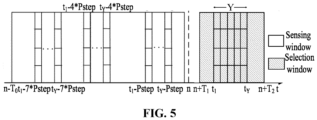
- the resource selection method based on partial sensing for SL communication in LTE-V2X would be explained with reference to FIG. 5 .
- the partial sensing means that the UE determines the subframe to be sensed in the resource sensing window according to at least Y subframes determined in the resource selection window and the sensing bitmap in the resource pool configuration.
- the resource exclusion is performed on the resources in the at least Y subframes according to the sensing result in the subframes determined in the resource sensing window, and a resource is selected from the resources that are not excluded to send data.
- the above determination of the at least Y subframes depends on the implementation of the UE, and Y should be greater than or equal to the configuration parameter minNumCandidateSF of the resource pool used by the UE.
- a length of the sensing bitmap is 10 bits.
- the configuration parameter minNumCandidateSF represents a minimum number of candidate subframes.
- the UE determines Y subframes (i.e., t 1 to t Y ) in the resource selection window, and the sensing bitmap in the resource pool configuration used by the UE is (1001001000) 2 . Because the 1st bit, the 4 th bit, and the 7th bit in the bitmap are 1, the UE should sense the SCIs sent by other UEs in subframe t 1 -Pstep to t Y -Pstep, subframe t 1 -4 ⁇ Pstep to ty-4*Pstep, and subframe t 1 -7 ⁇ Pstep to ty-7*Pstep within the resource sensing window.
- the above Pstep is 100 ms. If the UE multiplexes the frequency band used by Time Division Duplexing (TDD) cellular system, Pstep should be adjusted according to the ratio of uplink subframes and downlink subframes.
- TDD Time Division Duplexing
- the UE would exclude the resources in the Y subframes according to the sensing result within the determined subframe in the resource sensing window, and finally select resources from the residual resources in the Y subframes to send data.
- the above mechanism is suitable for the case where the moment n for triggering the resource selection or the resource reselection can be predicted.
- the UE predicts that the next resource reselection may occur at moment n, determines the corresponding Y subframes, and determines the corresponding sensing subframe according to the Y subframes. Sensing is performed when the time reaches the sensing subframes, and the resource selection or the resource reselection is triggered when the time reaches the moment n so that the resources can be selected from the Y subframes according to the sensing result.
- the resource selection mechanism based on partial sensing for NR SL transmission is currently being discussed in standardization, which starts with the above described resource selection mechanism based on partial sensing for SL transmission in LTE V2X.
- a maximum value of T2 is 100 ms.
- the maximum value of the sensing subframe determined according to the subframe is y1-Pstep in the time domain.
- Pstep is also 100 ms. Therefore, the case that the determined sensing sub frame is after the moment n would not happen.
- the maximum value of T2 is the residual delay budget of service.
- the resource selection would be triggered in the slot n, but there are still slots not having been sensed at this time. Therefore, the reliability of the resource selection would be affected. This problem is more obvious when the residual delay budget of service is large.
- the selection slot is after a target moment and the sensing slot is before the target moment. In this way it can be ensured that there would be no slot not having sensed when the candidate resource set for data transmission is determined from the available resources in the selection slot, thereby ensuring the accuracy and reliability of the resource selection.
- FIG. 6 a flowchart of a resource selection method based on partial sensing according to an embodiment of the present disclosure is illustrated.
- the method may be applied to the network architecture illustrated in FIG. 1 , for example, the method may be performed by a UE.
- the method includes operations 610 to 620.
- At least one selection slot and at least one sensing slot are determined.
- the at least one selection slot is after a target moment and the at least one sensing slot is before the target moment.
- the UE determines the at least one selection slot from a resource selection window.
- the target moment is denoted as n; a starting moment of the resource selection window may be denoted as n+T1, and the ending moment of the resource selection window may be denoted as n+T2.
- T1 and T2 may be determined by using the method described above.
- a moment to trigger a resource selection, or to trigger a resource reselection, or when a high layer triggers a physical layer to report the candidate resource set is denoted as n
- the starting moment of the resource selection window may be represented as n+T1
- the ending moment of the resource selection window may be represented as n+T2.
- T1 and T2 can be determined in the method described above.
- the UE determines the resource selection window ranging from n+T1 to n+T2, and the at least one selection slot is determined from the resource selection window.
- a number of the at least one selection slot determined above is greater than or equal to a number threshold.
- the number of the at least one selection slot determined above is greater than or equal to Y, and Y is greater than or equal to the number threshold.
- the number threshold is configured by the network device, or pre-configured, or predefined in the communication protocol, or determined by the UE itself.
- the at least one selection slot determined above is continuous or discontinuous.
- the multiple selection slots may be continuous (i.e. there are no intermediate slots between any set of selection slots adjacent to each other), or the multiple selection slots may also be discontinuous slots (i.e. there are at least one set of selection slots adjacent to each other with intermediate slots between the selection slots).
- the set of selection slots adjacent to each other means that multiple selection slots are arranged according to the time sequence in the time domain, and the i-th selection slot and the i+1th selection slot are a set of selection slots adjacent to each other.
- i is a positive integer.
- the UE determines at least one sensing slot based on the determined at least one selection slot and a resource reservation period set in a resource configuration pool, and ensures that each of the determined at least one sensing slot is before the target moment.
- the target moment is any of a moment to trigger the resource selection, a moment to trigger the resource reselection, a moment when the high layer triggers the physical layer to report the candidate resource set, a moment to trigger the determination of the candidate resource set, a moment when the candidate resource set is determined or a moment when the physical layer reports the candidate resource set to the higher layer.
- the UE may determine at least one selection time unit and at least one sensing time unit.
- the selection time unit is after the target moment and the sensing time unit is before the target moment.
- each of the at least one selection time unit determined by the UE is after the target moment; and/or, each of the at least one sensing time unit determined by the UE is before the target moment.
- the time unit may be any one of time domain measurement units that include but are not limited to any one of a frame, a subframe, a slot, or a subslot.
- the target moment mentioned in the present disclosure may be a time point or may be a time unit to which the time point corresponding to the target moment belongs.
- the time unit may be a slot
- the target moment may be the slot to which the time point corresponding to the target moment belongs.
- the slot may be referred to as the target slot.
- the A time unit/moment is before the B time unit/moment mentioned in the disclosure, which means that the A time unit/moment is less than or equal to the B time unit/moment. Accordingly, the A time unit/moment is after the B time unit/moment, which means that the A time unit/moment is greater than or equal to the B time unit/moment.
- the at least one selection slot is after the target moment as described above, which means that the at least one selection slot is greater than or equal to the target moment.
- the at least one sensing slot is before the target moment as described above, which means that the at least one sensing slot is less than or equal to the target moment. Description of the sequence of two time units/moments elsewhere in the present disclosure follows the explanation herein and would not be repeated elsewhere.
- a candidate resource set is determined from available resources in the at least one selection slot based on a sensing result in the at least one sensing slot, and a transmission resource is selected from the candidate resource set.
- the UE performs resource exclusion on the available resources in the determined at least one selection slot based on the sensing result in the determined at least one sensing slot, constructs a set of candidate resources, and selects transmission resources from the set of candidate resources to transmit data.
- the positions of the at least one selection slot and the at least one sensing slot are determined; the at least one selection slot is after a target moment and the at least one sensing slot is before the target moment. In this way it can be ensured that there would be no slot not having been sensed when the candidate resource set for data transmission is determined from the available resources in the at least one selection slot, thereby ensuring the accuracy and reliability of the resource selection.
- the UE determines the at least one selection slot and at least one sensing slot through the following operations.
- the at least one selection slot is determined from a resource selection window.
- a target candidate slot corresponding to the selection slot is determined as one of the at least one sensing slot.
- the target candidate slot is before a first moment.
- An interval between the target candidate slot and the selection slot is an integer multiple of a resource reservation period, and the first moment is determined based on the target moment.
- the interval between the target candidate slot and the at least one selection slot is i times the resource reservation period, and i is a smallest positive integer to make the target candidate slot to be before the first moment.
- the sensing slot determined according to ty is ty-Px.
- Px is all values of the resource reservation period set in the resource pool configuration. For a certain Px, if ty-Px is greater than or equal to the first moment, the sensing slot is ty-i*Px, and i is the smallest positive integer satisfying that ty-i*Px is less than or equal to the first moment. If ty-Px is less than or equal to the first moment, the sensing slot is ty-Px.
- the first moment is the target moment, or the first moment is the target moment minus a first offset.
- the first offset is determined from multiple candidate offsets based on a subcarrier interval.
- the first offset is T proc,0 or T proc,1 . Explanation about T proc,0 and T proc,1 can refer to the description mentioned above.
- the first moment may also be a time point or a time unit to which the time point corresponding to the first moment belongs.
- the target moment is the target slot n
- the first slot A may be the target slot n or may be the target slot n minus the first offset.
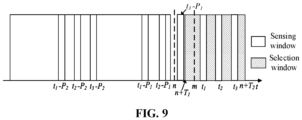
- the sensing slots determined according to t1 and t2 are t1-P1, t1-P2, t2-P1, and t2-P2. Since t3-P1 is larger than the target slot n, the sensing slots determined according to t3 are t3-2*P1 and t3-P2.
- the determined at least one sensing slot is before the target moment, which can ensure that when the resource exclusion is performed on the available resources in the at least one selection slot to construct the candidate resource set for data transmission, there would be no slot not having been sensed, thereby ensuring the accuracy and reliability of the resource selection.
- the UE determines the at least one selection slot and the at least one sensing slot through the following operations.
- a maximum threshold of the at least one selection slot is determined based on the target moment.
- the at least one selection slot from a resource selection window is determined based on the maximum threshold.
- the at least one selection slot is before the maximum threshold.
- the at least one sensing slot is determined based on the at least one selection slot and a resource reservation period.
- the UE adds the target moment and a second offset to obtain the maximum threshold of the at least one selection slot.
- the UE adds a first moment and a second offset to obtain the maximum threshold of the at least one selection slot, and the first moment is determined based on the target moment.
- the first moment is the target moment minus a first offset.
- the second offset is determined based on a minimum value in a resource reservation period set in a resource pool configuration (e.g., the second offset may be a minimum value in the resource reservation period set in the resource pool configuration or the second offset may be an integer multiple of the minimum value).
- the second offset is determined based on a minimum value of resource reservation periods in a resource pool used by the UE (e.g., the second offset may be a minimum value of the resource reservation periods in the resource pool used by the UE, or the second offset may be an integer multiple of the minimum value).
- the second offset is configured by a network device, or the second offset is pre-configured.
- the first offset is determined from multiple candidate offsets based on a subcarrier interval.
- the first offset is T proc,0 or T proc,1 .
- Explanation about T proc,0 and T proc,1 can refer to the description mentioned above.
- the UE subtracts an integer multiple of the resource reservation period from the determined at least one selection slot to obtain the at least one sensing slot. For example, the UE may subtract the resource reservation period from the determined at least one selection slot to obtain at least one sensing slot, or may subtract k times the resource reservation period from the determined at least one selection slot to obtain the at least one sensing slot.
- k is an integer greater than 1.
- the UE may subtract the resource reservation period from the determined at least one selection slot to obtain the at least one sensing slot.
- the second offset is k times the minimum value in the resource reservation period set in the resource pool configuration, or k times the minimum value of the resource reservation periods in the resource pool used by the UE, or the second offset is configured by the network device or pre-configured
- the UE can subtract k times the resource reservation period from the determined at least one selection slot to obtain the at least one sensing slot.
- the at least one selection slot determined by the UE within the resource selection window should be less than or equal to the maximum threshold.
- the at least one selection slot determined by the UE in the resource selection window should be less than or equal to the slot n+W, and W is the second offset described above.
- W may be determined according to the minimum value in the resource reservation period set in the resource pool configuration, or W may be determined by the minimum value of the resource reservation periods in the resource pool used by the UE, or W may be configured by the network device or pre-configured.
- the sensing slot determined by the UE according to ty is ty-Px.
- Px may be all values in the resource reservation period set in the resource pool configuration.
- the sensing slot determined by the UE according to ty is ty-k*Px.
- Px may be all values in the resource reserved period set in the resource pool configuration, and k may be a positive integer or may be the smallest positive integer that makes ty-k*Px to be before the target moment.
- the selection slots determined by the UE are t1, t2, and t3; the values in the resource reservation period set in the resource pool configuration are P1 and P2, and the minimum value in the resource reservation period set is P1.
- the selection slots t1, t2, and t3 determined by the UE are all smaller than the slot n+W, and W is equal to P1. It is ensured that the sensing slots t1-P1, t2 -P 1, t3-P1, t1-P2, t2-P2 and t3-P2 determined by the LTE are all before the target slot n.
- the determined at least one selection slot is before the maximum threshold, and the at least one sensing slot determined based on the at least one selection slot and the resource reservation period is before the target moment, which can ensure that when the resource exclusion is performed on the available resources in the at least one selection slot to construct the candidate resource set for data transmission, there would be no slot not having been sensed, thereby ensuring the accuracy and reliability of the resource selection.
- the UE determines the at least one selection slot and the at least one sensing slot through the following operations.
- the at least one selection slot are determined from the resource selection window.
- the at least one sensing slot is determined based on the at least one selection slot and the resource reservation period.
- Position of the target moment includes at least one of being after a last one of the at least one sensing slot or being before a first one of the at least one selection slot.
- the sensing slot determined according to ty is ty-Px.
- Px may be all values in the resource reservation period set in the resource pool configuration.
- the target moment is greater than or equal to the last one (i.e., the largest in the time domain) of the at least one sensing slot determined by the UE and/or less than or equal to the first one (i.e., smallest in the time domain) of the at least one selection slot determined by the UE.
- the sensing slot determined according to ty is ty-k*Px.
- Px may be all values in the resource reservation period set in the resource pool configuration, and k is a positive integer.
- the target moment is greater than or equal to the last one (i.e., the largest in the time domain) of the at least one sensing slot determined by the UE and/or less than or equal to the first one (i.e., smallest in the time domain) of the at least one selection slot determined by the UE.
- the target moment is the first one of the at least one selection slot minus a third offset.
- the third offset is determined from multiple candidate offsets based on a subcarrier interval.
- the third offset is T proc,0 or T proc,1 . Explanation about T proc,0 and T proc,1 can refer to the description mentioned above.
- the UE continues sensing in the determined at least one sensing slot between a second moment and a third moment.
- the second moment is any one of the moment to trigger the resource selection, the moment to trigger the resource reselection, or the moment when the high layer triggers the physical layer to report the candidate resource set
- the third moment is any one of the moment to trigger the determination of the candidate resource set, the moment when the candidate resource set is determined, or the moment when the physical layer reports the candidate resource set to the higher layer.
- the at least one selection slots determined by the UE are t1, t2, and t3, and the sensing slots determined by the UE are t1-P1, t2-P1, t3-P1, t1-P2, t2-P2, and t3-P2.
- the target slot n when the UE triggers the resource selection or the resource reselection or when the higher layer triggers the physical layer to report the candidate resource set, the slot t3-P1 has not been sensed.
- the UE reports the candidate resource set in slot m.
- the slot m is greater than or equal to the determined last sensing slot t3-P1 and less than or equal to the determined first one of the at least one selection slot t1.
- the slot m is slot t1-T proc,0 or the slot t1-T proc,1 .
- the UE continues sensing in the sensing slots t3-P1 greater than or equal to the slot n and less than or equal to the slot m.
- a timer is introduced, and the UE starts the timer at a second moment.
- the second moment is any one of any one of the moment to trigger the resource selection, the moment to trigger the resource reselection, or the moment when the high layer triggers the physical layer to report the candidate resource set.
- the UE performs any one of the following operations: triggering the determination of the candidate resource set, determining the candidate resource set, or reporting the candidate resource set to the high layer by the physical layer.
- the setting of the timer ensures that the moment when the physical layer reports the candidate resource set or the UE determines the candidate resource set or the UE triggers the determination of the candidate resource set is greater than or equal to the last one of the at least one sensing slot determined by the UE and/or less than or equal to the first one of the at least one selection slot determined by the UE.
- the target moment (such as the moment when the physical layer reports the candidate resource set or the UE determines the candidate resource set or the UE triggers the determination of the candidate resource set)
- the target moment is after the last one of the at least one sensing slot and/or before the first one of the at least one selection slot, which can ensure that when the resource exclusion is performed on the available resources in the at least one selection slot to construct the candidate resource set for data transmission, there would be no slot not having been sensed, thereby ensuring the accuracy and reliability of the resource selection.
- the above operation 620 may include the following four sub-operations.
- the first sidelink control information is carried in the PSCCH and includes the domain related to resource sensing, so as to facilitate resource exclusion and resource selection by other UEs after decoding.
- the channel quality may be RSRP of the SL, Reference Signal Receiving Quality (RSRQ) of the SL, or Signal to Interference plus Noise Ratio (SINR), or the like, which are not limited herein.
- whether the measured channel quality of the PSCCH or the channel quality of the PSSCH scheduled by the PSCCH is used by the UE for comparison with the channel quality threshold depends on the resource pool configuration of the resource pool used by the UE.
- the resource pool configuration can be configured by the network or pre-configured.
- Q slots are determined according to the target sensing slot and a resource reservation period carried in the first sidelink control information in response to the measured channel quality being greater than the channel quality threshold and the resource pool used by the UE activating a resource reservation between TBs.
- Q is a positive integer.
- the UE determines Q slots after the target sensing slot with the resource reservation period carried in the first sidelink control information as an interval. For example, a first slot of the Q slots is the target sensing slot plus the resource reservation period, a second slot of the Q slots is the target sensing slot plus 2* resource reservation period, and so on.
- the available resource is excluded from the at least one selection slot in response to that a time-frequency resource indicated by a time-frequency resource indication domain in the first sidelink control information received in the target sensing slot and in Q pieces of the first sidelink control information assumed to be received in the Q slots overlaps with the available resource or periodic resources corresponding to the available resource.
- the UE takes the available resources in the determined at least one selection slot as a resource set A, and any one available resource in the resource set A is denoted as R(x,y).
- X and y indicate a position of the resource in the frequency domain and a position of the resource in the time domain, respectively.
- An initial number of resources in the resource set A is M total .
- the UE determines Q slots. It is assumed that the UE receives the first sidelink control information having the same content in the Q slots. The UE determines whether the time-frequency resource indicated by the time-frequency resource indication domain (which includes "Time resource assignment" domain and "Frequency resource assignment” domain) in the first sidelink control information received in the target sensing slot and in Q pieces of the first sidelink control information assumed to be received in the Q slots overlaps with the available resource R(x,y) or the periodic resources corresponding to the available resource R(x,y). If there is an overlap, the corresponding resource R(x,y) is excluded from the at least one selection slot. Alternatively, if there is no overlap, the available resource R(x,y) is reserved.
- the candidate resource set is obtained based on an exclusion result of the available resource in the at least one selection slot, and the transmission resource is selected from the candidate resource set.
- the physical layer obtains the candidate resource set based on the exclusion result of the available resource in the at least one selection slot, and the physical layer reports the candidate resource set to the higher layer.
- the higher layer randomly selects transmission resources from the candidate resource set to send data.
- Q is equal to 1.
- Q ⁇ Tscal/Prx ⁇ . ⁇ ⁇ represents rounding up
- Prx represents the resource reservation period carried in the first sidelink control information
- Tscal is any one of the following (1) to (9).
- Q is equal to i
- i is a multiple of an interval between the target sensing slot and the at least one selection slot and the resource reservation period.
- the first condition includes at least one of the following.
- the Prxlg which is the number of logical slots converted from the Prx mentioned above in (1) may be as follows: assuming that one slot is equal to 1 ms and Prx is 5 ms, 2 slots in the 5 slots may be downlink slots or slots for transmitting synchronization signals in the TDD mode, and these slots are not included in the resource pool of SL. Therefore, it is necessary to convert the 5 ms represented by Prx into 3 logical slots, i.e. Prxlg.
- the operation 620 may also include the following sub-operations: in response to the measured channel quality being greater than the channel quality threshold and the resource pool used by the UE deactivating the resource reservation between the TBs, if the time-frequency resource indicated by the time-frequency resource indication domain in the first sidelink control information received in the target sensing slot overlaps with the available resource or the periodic resources corresponding to the available resource, the available resource is excluded from the at least one selection slot.
- the UE In response to the measured channel quality being greater than the channel quality threshold and the resource pool used by the UE deactivating the resource reservation between the TBs, the UE only determines whether the time-frequency resource indicated by the time-frequency resource indication domain (which includes the "Time resource assignment" domain and "Frequency resource assignment” domain) in the first sidelink control information received in the target sensing slot overlaps with the available resource R(x,y) or the periodic resource corresponding to the available resource R(x,y). If there is an overlap, the available resource R(x,y) is excluded from the at least one selection slot. Alternatively, if there is no overlap, the available resource R(x,y) is reserved.
- the channel quality threshold is raised by a set value, and the measured channel quality is re-compared with the channel quality threshold.
- the resource exclusion is performed again on all available resources in the determined at least one selection slot.
- the remaining resources are determined as the candidate resource set until the number of the remaining resources is greater than or equal to the threshold.
- the threshold is determined based on a total number of available resources contained in the at least one selection slot. For example, the total number of available resources contained in the at least one selection slot is M total , and the threshold is M total ⁇ X%.
- the possible values for X may be ⁇ 20, 35, 50 ⁇ .
- the resource pool configuration used by the UE includes the corresponding relationship between the priorities and the possible values.
- the UE determines the value of X according to the priority of the data to be sent and the corresponding relationship.
- the resource pool configuration may be configured by the network or pre-configured.
- FIG. 10 a flowchart of a resource selection method based on partial sensing according to another embodiment of the present disclosure is illustrated.
- the method may be applied to the network architecture illustrated in FIG. 1 .
- the method may be performed by a LTE.
- the method includes the operations 1010 to 1050.
- At least one selection slot and at least one sensing slot are determined.
- the at least one selection slot is after a target moment and the at least one sensing slot is before the target moment.
- the number of the at least one selection slot determined above is greater than or equal to a number threshold.
- the number of the at least one selection slot determined above is greater than or equal to Y, and Y is greater than or equal to the number threshold.
- the number threshold is configured by the network device, or pre-configured, or predefined in the communication protocol, or determined by the UE itself.
- the multiple selection slots are continuous or discontinuous.
- Q slots are determined according to the target sensing slot and a resource reservation period carried in the first sidelink control information in response to the measured channel quality being greater than a channel quality threshold and a resource pool used by the UE activating a resource reservation between TBs.
- Q is a positive integer.
- Q ⁇ Tscal/Prx ⁇ . ⁇ ⁇ represents rounding up.
- Prx represents the resource reservation period carried in the first sidelink control information, and Tscal is any one of the following (1) to (9).
- Q i
- i is a multiple of an interval between the target sensing slot and the at least one selection slot and the resource reservation period.
- the first condition includes at least one of the following.
- the available resource is excluded from the at least one selection slot in response to that a time-frequency resource indicated by a time-frequency resource indication domain in the first sidelink control information received in the target sensing slot and in Q pieces of the first sidelink control information assumed to be received in the Q slots overlaps with the available resource or periodic resources corresponding to the available resource.
- the candidate resource set is obtained based on an exclusion result of the available resource in the at least one selection slot, and the transmission resource is selected from the candidate resource set.
- the method of the embodiments further includes the following operations: in response to the measured channel quality being greater than the channel quality threshold and the resource pool used by the UE deactivating the resource reservation between the TBs, if the time-frequency resource indicated by the time-frequency resource indication domain in the first sidelink control information received in the target sensing slot overlaps with the available resource or the periodic resources corresponding to the available resource, the available resource is excluded from the at least one selection slot.
- the channel quality threshold is raised by a set value, and the measured channel quality is re-compared with the channel quality threshold.
- the resource exclusion is performed again on all available resources in the determined at least one selection slot.
- the remaining resources are determined as the candidate resource set until the number of the remaining resources is greater than or equal to the threshold.
- FIG. 11 a block diagram of a resource selection device based on partial sensing according to an embodiment of the present disclosure is illustrated.
- the device has functions of implementing the above method embodiments, and the functions can be implemented by hardware or by execution of corresponding software by hardware.
- the device may be the UE described above, or may be arranged in the UE.
- the device 1100 includes a slot determining module 1110 and a resource selecting module 1120.
- the slot determining module 1110 is configured to determine at least one selection slot and at least one sensing slot.
- the at least one selection slot is after a target moment and the at least one sensing slot is before the target moment.
- the resource selecting module 1120 is configured to determine a candidate resource set from available resources in the at least one selection slot based on a sensing result in the at least one sensing slot, and select a transmission resource from the candidate resource set.
- the target moment is any of a moment to trigger a resource selection, a moment to trigger a resource reselection, a moment when a high layer triggers a physical layer to report the candidate resource set, a moment to trigger the determination of the candidate resource set, a moment when the candidate resource set is determined, or a moment when the physical layer reports the candidate resource set to the higher layer.
- the slot determining module 1110 is configured to: determine the at least one selection slot from a resource selection window, and for any one of the at least one selection slot, determine a target candidate slot corresponding to the selection slot as one of the at least one sensing slot.
- the target candidate slot is before a first moment, an interval between the target candidate slot and the selection slot is an integer multiple of a resource reservation period, and the first moment is determined based on the target moment.
- the interval between the target candidate slot and the at least one selection slot is i times the resource reservation period, and i is a smallest positive integer to make the target candidate slot to be before the first moment.
- the first moment is the target moment, or the first moment is the target moment minus a first offset.
- the first offset is determined from multiple candidate offsets based on a subcarrier interval.
- the slot determining module 1110 is configured to: determine a maximum threshold of the at least one selection slot based on the target moment, and determine the at least one selection slot from a resource selection window based on the maximum threshold. The at least one selection slot is before the maximum threshold. The slot determining module 1110 is also configured to determine the at least one sensing slot based on the at least one selection slot and a resource reservation period.
- the slot determining module 1110 is configured to add the target moment and a second offset to obtain the maximum threshold of the at least one selection slot.
- the second offset is determined based on a minimum value in a resource reservation period set in a resource pool configuration.
- the second offset is determined based on a minimum value of resource reservation periods in a resource pool used by a UE.
- the second offset is configured by a network device, or the second offset is pre-configured.
- the slot determining module 1110 is configured to subtract an integer multiple of the resource reservation period from the at least one selection slot to obtain the at least one sensing slot.
- the slot determining module 1110 is configured to: determine the at least one selection slot from a resource selection window, and determine the at least one sensing slot based on the at least one selection slot and a resource reservation period.
- the position of the target moment includes at least one of being after a last one of the at least one sensing slot or being before a first one of the at least one selection slot.
- the target moment is the first one of the at least one selection slot minus a third offset.
- the third offset is determined from multiple candidate offsets based on a subcarrier interval.
- the device 1100 further includes an information sensing module 1130.
- the information sensing module 1130 is configured to continue sensing in the determined sensing slot between a second moment and a third moment.
- the second moment is any one of a moment to trigger a resource selection, a moment to trigger a resource reselection, or a moment when a high layer triggers a physical layer to report the candidate resource set
- the third moment is any one of a moment to trigger the determination of the candidate resource set, a moment when the candidate resource set is determined, or a moment when the physical layer reports the candidate resource set to the higher layer.
- the device 1110 further includes a timer starting module 1140 and an operation performing module 1150.
- the timer starting module 1140 is configured to start a timer at a second moment, where the second moment is any one of a moment to trigger a resource selection, a moment to trigger a resource reselection, or a moment when a high layer triggers a physical layer to report the candidate resource set.
- the operation performing module 1150 is configured to perform, in response to the timer reaching a set moment, any one of following operations: triggering the determination of the candidate resource set, determining the candidate resource set, or reporting the candidate resource set to the high layer by the physical layer.
- a number of the at least one selection slot is greater than or equal to a number threshold.
- the number threshold is configured by a network device, or pre-configured, or predefined in a communication protocol, or determined by the UE itself.
- the at least one selection slot is continuous or discontinuous.
- the resource selecting module 1120 is configured to perform the following four operations.
- the resource selecting module 1120 is configured to measure a channel quality of a PSCCH or a PSSCH scheduled by the PSCCH in response to sensing first sidelink control information transmitted by the PSCCH in a target sensing slot.
- the resource selecting module 1120 is configured to determine Q slots according to the target sensing slot and a resource reservation period carried in the first sidelink control information in response to the measured channel quality being greater than a channel quality threshold and a resource pool used by the UE activating a resource reservation between TBs.
- Q is a positive integer.
- the resource selecting module 1120 is configured to exclude the available resource from the at least one selection slot in response to that a time-frequency resource indicated by a time-frequency resource indication domain in the first sidelink control information received in the target sensing slot and in Q pieces of the first sidelink control information assumed to be received in the Q slots overlaps with the available resource or periodic resources corresponding to the available resource.
- the resource selecting module 1120 is configured to obtain the candidate resource set based on an exclusion result of the available resource in the at least one selection slot, and select the transmission resource from the candidate resource set.
- Prx represents the resource reservation period carried in the first sidelink control information
- Tscal is any one of a value in millisecond converted from a difference between an ending moment of the resource selection window and the target moment, a residual delay budget of service, a value in millisecond converted from the residual delay budget of the service, a value in millisecond converted from a difference between a last one of the at least one selection slot and a second moment, a value in millisecond converted from a difference between the last one of the at least one selection slot and a third moment, a value in millisecond converted from a difference between the last one of the at least one selection slot and a first one of the at least one selection slot, a value in millisecond converted from a difference between the last one of the at least one selection slot and a last one of the at least one sensing slot, a value in millisecond converted from a difference between a ending moment of the resource selection
- the second moment is any one of a moment to trigger a resource selection, a moment to trigger a resource reselection, or a moment when a high layer triggers a physical layer to report the candidate resource set
- the third moment is any one of a moment to trigger the determination of the candidate resource set, a moment when the candidate resource set is determined, or a moment when the physical layer reports the candidate resource set to the higher layer.
- Q i
- the i is a multiple of an interval between the target sensing slot and the at least one selection slot and the resource reservation period.
- the first condition includes at least one of followings.
- a fourth moment determined based on the target sensing slot is after the last one of the at least one sensing slot determined by the UE.
- the fourth moment is equal to a sum of the target sensing slot and Prx or the fourth moment is equal to a sum of the target sensing slot and Prxlg.
- Prxlg is a number of logical slots converted from the Prx.
- Prx is less than Tscal.
- the resource selecting module 1120 is further configured to exclude the available resource from the at least one selection slot.
- the resource selecting module 1120 is further configured to raise the channel quality threshold by a set value, and re-compare the measured channel quality with the channel quality threshold, perform the resource exclusion again on all available resources in the determined at least one selection slot, and determine the remaining resources as the candidate resource set until the number of the remaining resources is greater than or equal to the threshold.
- the threshold is determined based on a total number of available resources contained in the at least one selection slot.
- the device provided by the embodiments implements its function
- the division of the functional modules described above is only used an example.
- the above functions can be implemented by assigning the functions to different functional modules according to actual needs. That is, the content structure of the device can be divided into different functional modules to complete all or part of the functions described above.
- the UE 130 includes a processor 131, a receiver 132, a transmitter 133, a memory 134 and a bus 135.
- the processor 131 includes one or more processing cores and performs various functional applications and information processing by running software programs and modules.
- the receiver 132 and the transmitter 133 may be implemented as a transceiver 136.
- the transceiver 136 may be a communication chip.
- the memory 134 is connected to the processor 131 through the bus 135.
- the memory 134 may be configured to store a computer program and the processor 131 may be configured to execute the computer program to implement the various operations performed by the UE in the method embodiments described above.
- the memory 134 may be implemented by any type of volatile or non-volatile storage devices or a combination thereof.
- the volatile or non-volatile storage devices may include, but are not limited to: a Random Access Memory (RAM) and a Read-Only Memory (ROM), an Erasable Programmable Read-Only Memory (EPROM), an Electrically Erasable Programmable Read-Only Memory (EEPROM), a flash memory or other solid-state storage technology, a Compact Disc Read-Only Memory (CD-ROM), a Digital Video Disc (DVD) or other optical storages, a magnetic tape cassette, a magnetic tape, a magnetic disk storage or other magnetic storage devices.
- RAM Random Access Memory
- ROM Read-Only Memory
- EPROM Erasable Programmable Read-Only Memory
- EEPROM Electrically Erasable Programmable Read-Only Memory
- CD-ROM Compact Disc Read-Only Memory
- DVD Digital Video Disc
- the processor 131 is configured to determine at least one selection slot and at least one sensing slot.
- the at least one selection slot is after a target moment and the at least one sensing slot is before the target moment.
- the processor 131 is further configured to determine a candidate resource set from available resources in the at least one selection slot based on a sensing result in the at least one sensing slot, and select a transmission resource from the candidate resource set.
- the target moment is any of a moment to trigger a resource selection, a moment to trigger a resource reselection, a moment when a high layer triggers a physical layer to report the candidate resource set, a moment to trigger the determination of the candidate resource set, a moment when the candidate resource set is determined, or a moment when the physical layer reports the candidate resource set to the higher layer.
- the processor 131 is configured to: determine the at least one selection slot from a resource selection window, and for any one of the at least one selection slot, determine a target candidate slot corresponding to the selection slot as one of the at least one sensing slot.
- the target candidate slot is before a first moment, an interval between the target candidate slot and the selection slot is an integer multiple of a resource reservation period, and the first moment is determined based on the target moment.
- the interval between the target candidate slot and the selection slot is i times the resource reservation period, and i is a smallest positive integer to make the target candidate slot to be before the first moment.
- the first moment is the target moment, or the first moment is the target moment minus a first offset.
- the first offset is determined from multiple candidate offsets based on a subcarrier interval.
- the processor 131 is configured to: determine a maximum threshold of the at least one selection slot based on the target moment, and determine the at least one selection slot from a resource selection window based on the maximum threshold. The at least one selection slot is before the maximum threshold. The processor 131 is also configured to determine the at least one sensing slot based on the at least one selection slot and a resource reservation period.
- the processor 131 is configured to add the target moment and a second offset to obtain the maximum threshold of the at least one selection slot.
- the second offset is determined based on a minimum value in a resource reservation period set in a resource pool configuration.
- the second offset is determined based on a minimum value of resource reservation periods in a resource pool used by a UE.
- the second offset is configured by a network device, or the second offset is pre-configured.
- the processor 131 is configured to subtract an integer multiple of the resource reservation period from the at least one selection slot to obtain the at least one sensing slot.
- the processor 131 is configured to: determine the at least one selection slot from a resource selection window, and determine the at least one sensing slot based on the at least one selection slot and a resource reservation period.
- the position of the target moment includes at least one of being after a last one of the at least one sensing slot or being before a first one of the at least one selection slot.
- the target moment is the first one of the at least one selection slot minus a third offset.
- the third offset is determined from multiple candidate offsets based on a subcarrier interval.
- the processor 131 is also configured to continue sensing in the determined at least one sensing slot between a second moment and a third moment.
- the second moment is any one of a moment to trigger a resource selection, a moment to trigger a resource reselection, or a moment when a high layer triggers a physical layer to report the candidate resource set
- the third moment is any one of a moment to trigger the determination of the candidate resource set, a moment when the candidate resource set is determined, or a moment when the physical layer reports the candidate resource set to the higher layer.
- the processor 131 is also configured to start a timer at a second moment.
- the second moment is any one of a moment to trigger a resource selection, a moment to trigger a resource reselection, or a moment when a high layer triggers a physical layer to report the candidate resource set.
- the processor 131 is further configured to perform, in response to the timer reaching a set moment, any one of following operations: triggering the determination of the candidate resource set, determining the candidate resource set, or reporting the candidate resource set to the high layer by the physical layer.
- a number of the at least one selection slot is greater than or equal to a number threshold.
- the number threshold is configured by a network device, or pre-configured, or predefined in a communication protocol, or determined by the UE itself.
- the at least one selection slot is continuous or discontinuous.
- the processor 131 is configured to perform the following four operations.
- the processor 131 is configured to measure a channel quality of a PSCCH or a PSSCH scheduled by the PSCCH in response to sensing first sidelink control information transmitted by the PSCCH in a target sensing slot.
- the processor 131 is configured to determine Q slots according to the target sensing slot and a resource reservation period carried in the first sidelink control information in response to the measured channel quality being greater than a channel quality threshold and a resource pool used by the UE activating a resource reservation between TBs.
- Q is a positive integer.
- the processor 131 is configured to exclude the available resource from the at least one selection slot in response to that a time-frequency resource indicated by a time-frequency resource indication domain in the first sidelink control information received in the target sensing slot and in Q pieces of the first sidelink control information assumed to be received in the Q slots overlaps with the available resource or periodic resources corresponding to the available resource.
- the processor 131 is configured to obtain the candidate resource set based on an exclusion result of the available resource in the at least one selection slot, and select the transmission resource from the candidate resource set.
- Prx represents the resource reservation period carried in the first sidelink control information
- Tscal is any one of a value in millisecond converted from a difference between an ending moment of the resource selection window and the target moment, a residual delay budget of service, a value in millisecond converted from the residual delay budget of the service, a value in millisecond converted from a difference between a last one of the at least one selection slot and a second moment, a value in millisecond converted from a difference between the last one of the at least one selection slot and a third moment, a value in millisecond converted from a difference between the last one of the at least one selection slot and a first one of the at least one selection slot, a value in millisecond converted from a difference between the last one of the at least one selection slot and a last one of the at least one sensing slot, a value in millisecond converted from a difference between a ending moment of the resource selection
- the second moment is any one of a moment to trigger a resource selection, a moment to trigger a resource reselection, or a moment when a high layer triggers a physical layer to report the candidate resource set
- the third moment is any one of a moment to trigger the determination of the candidate resource set, a moment when the candidate resource set is determined, or a moment when the physical layer reports the candidate resource set to the higher layer.
- Q i
- the i is a multiple of an interval between the target sensing slot and the at least one selection slot and the resource reservation period.
- the first condition includes at least one of followings.
- a fourth moment determined based on the target sensing slot is after the last one of the at least one sensing slot determined by the UE.
- the fourth moment is equal to a sum of the target sensing slot and Prx or the fourth moment is equal to a sum of the target sensing slot and Prxlg.
- Prxlg is a number of logical slots converted from the Prx.
- Prx is less than Tscal.
- the processor 131 is further configured to exclude the available resource from the at least one selection slot.
- the processor 131 in response to a number of remaining resources in the at least one selection slot after resource exclusion being less than a threshold, is further configured to raise the channel quality threshold by a set value, and re-compare the measured channel quality with the channel quality threshold, perform the resource exclusion again on all available resources in the determined at least one selection slot, and determine the remaining resources as the candidate resource set until the number of the remaining resources is greater than or equal to the threshold.
- the threshold is determined based on a total number of available resources contained in the at least one selection slot.
- Embodiments of the disclosure also provide a computer-readable storage medium having stored thereon a computer program that, when executed by a processor, causes the processor to implement the resource selection method based on partial sensing.
- the computer-readable storage medium may include a ROM, a RAM, a Solid State Drives (SSD), an optical disk, and the like.
- the RAM includes a Resistive Random Access Memory (ReRAM) and a Dynamic Random Access Memory (DRAM).
- Embodiments of the disclosure also provide a chip including at least one of a programmable logic circuitry or program instructions.
- the chip runs on the UE, the chip is configured to implement the above-mentioned resource selection method based on partial sensing.
- Embodiments of the disclosure also provide a computer program product or a computer program.
- the computer program product or computer program includes computer instructions stored in a computer-readable storage medium, a processor reads and executes the computer instructions from the computer-readable storage medium to implement the above-mentioned resource selection method based on partial sensing.
- indication in the embodiments of the present disclosure may be a direct indication, may be an indirect indication, or may represent an associated relationship.
- a indicating B can mean that A directly indicates B (e.g., B can be obtained through A); it can also mean that A indirectly indicates B (e.g., A indicates C, and B can be obtained by C); and it can also indicate that there is an association between A and B.
- corresponding may mean that there is a direct correspondence or an indirect correspondence between the two, may also mean that there is an association relationship between the two, may also be a relationship of indicating and being indicated, configuring and being configured, etc.
- the term “multiple” in the present disclosure may be two or more.
- the term “and/or” describes the association relationship between associated objects, and means that there can be three kinds of relationships. For example, A and/or B, can mean that there are three situations. That is, only A exists, A and B exist at the same time, and only B exists.
- the character “f” generally indicates that the related objects are of an "or" relationship.
- the numbers of the operations described in the present disclosure only represents a possible sequence of implementation between the operations by example, and in some other embodiments, the above-mentioned operations may also be performed not in the sequence. For example, two differently numbered operations are performed simultaneously, or two differently numbered operations are performed in a sequence reverse to the illustration, which is not limited in the embodiments of the present disclosure.
- the functions described in the embodiments of the present disclosure may be implemented in hardware, software, firmware or any combination thereof.
- these functions may be stored in a computer-readable medium or transmitted as one or more instructions or codes on the computer-readable medium.
- the computer-readable medium includes a computer storage medium and a communication medium.
- the communication medium includes any medium that facilitates the transfer of computer programs from one place to another place.
- the storage medium may be any available medium accessible to a general-purpose or special-purpose computer.
Landscapes
- Engineering & Computer Science (AREA)
- Signal Processing (AREA)
- Computer Networks & Wireless Communication (AREA)
- Quality & Reliability (AREA)
- Physics & Mathematics (AREA)
- Mathematical Physics (AREA)
- Mobile Radio Communication Systems (AREA)
- Supplying Of Containers To The Packaging Station (AREA)
- Indexing, Searching, Synchronizing, And The Amount Of Synchronization Travel Of Record Carriers (AREA)
- Signal Processing For Digital Recording And Reproducing (AREA)
Applications Claiming Priority (1)
| Application Number | Priority Date | Filing Date | Title |
|---|---|---|---|
| PCT/CN2021/085359 WO2022205437A1 (zh) | 2021-04-02 | 2021-04-02 | 部分侦听的资源选择方法、装置、设备及存储介质 |
Publications (3)
| Publication Number | Publication Date |
|---|---|
| EP4266744A1 true EP4266744A1 (de) | 2023-10-25 |
| EP4266744A4 EP4266744A4 (de) | 2024-02-21 |
| EP4266744B1 EP4266744B1 (de) | 2025-12-31 |
Family
ID=83455509
Family Applications (1)
| Application Number | Title | Priority Date | Filing Date |
|---|---|---|---|
| EP21934094.0A Active EP4266744B1 (de) | 2021-04-02 | 2021-04-02 | Verfahren und vorrichtung zur ressourcenauswahl auf basis von partieller erfassung, vorrichtung und speichermedium |
Country Status (9)
| Country | Link |
|---|---|
| US (2) | US11937220B2 (de) |
| EP (1) | EP4266744B1 (de) |
| JP (1) | JP7685602B2 (de) |
| KR (1) | KR20230163359A (de) |
| CN (2) | CN116602041A (de) |
| AU (1) | AU2021439069B2 (de) |
| BR (1) | BR112023017761A2 (de) |
| ES (1) | ES3064377T3 (de) |
| WO (1) | WO2022205437A1 (de) |
Families Citing this family (4)
| Publication number | Priority date | Publication date | Assignee | Title |
|---|---|---|---|---|
| JP7685602B2 (ja) * | 2021-04-02 | 2025-05-29 | オッポ広東移動通信有限公司 | 部分センシングのリソース選択方法、装置、機器及び記憶媒体 |
| EP4325962A4 (de) * | 2021-05-26 | 2024-10-23 | LG Electronics Inc. | Verfahren und vorrichtung zur durchführung von partieller erfassung in nr v2x |
| WO2022267606A1 (zh) * | 2021-06-24 | 2022-12-29 | 华为技术有限公司 | 资源选择方法及装置 |
| WO2024138343A1 (zh) * | 2022-12-26 | 2024-07-04 | Oppo广东移动通信有限公司 | 资源选择方法、侧行通信方法、装置、设备及存储介质 |
Family Cites Families (28)
| Publication number | Priority date | Publication date | Assignee | Title |
|---|---|---|---|---|
| WO2010061635A1 (ja) * | 2008-11-28 | 2010-06-03 | 三洋電機株式会社 | 報知方法および無線装置 |
| RU2733062C2 (ru) | 2016-09-10 | 2020-09-29 | ЭлДжи ЭЛЕКТРОНИКС ИНК. | Способ для резервирования конечного числа ресурсов, используемых для выполнения v2х-связи в системе беспроводной связи, и терминал, использующий его |
| JP2020017778A (ja) | 2016-11-02 | 2020-01-30 | 株式会社Nttドコモ | ユーザ装置及びリソース選択方法 |
| EP3577967B1 (de) * | 2017-02-06 | 2022-03-30 | Apple Inc. | Partielle erfassung und überlastungssteuerung für long term evolution (lte)-fahrzeugkommunikation |
| CN109121198A (zh) | 2017-06-23 | 2019-01-01 | 维沃移动通信有限公司 | 一种非授权频段下的信息传输方法及网络设备 |
| KR20200077578A (ko) * | 2017-11-03 | 2020-06-30 | 광동 오포 모바일 텔레커뮤니케이션즈 코포레이션 리미티드 | D2d 통신에서 리소스를 선택하는 방법 및 단말기기 |
| CN111357389B (zh) | 2017-11-17 | 2024-03-12 | 诺基亚技术有限公司 | 在接收到非连续接收触发器之后的控制监测 |
| MX2020008213A (es) * | 2018-02-05 | 2020-09-21 | Guangdong Oppo Mobile Telecommunications Corp Ltd | Metodo y dispositivo de reserva de recursos y medio de almacenamiento de computadora. |
| CN110324910B (zh) * | 2018-03-30 | 2023-08-22 | 华为技术有限公司 | 通信方法和通信设备 |
| DE102019209844A1 (de) | 2018-07-10 | 2020-01-16 | Research Triangle Institute | Verfahren zum selektiven gewinnen einer phenolischen verbindung aus einer charge, die rohe bio-rohöl und/oder bio-öl umfasst |
| US11304180B2 (en) * | 2019-03-28 | 2022-04-12 | Samsung Electronics Co., Ltd | Method and device of resource allocation for sidelink transmission in wireless communication system |
| CN112118630B (zh) * | 2019-06-20 | 2024-01-05 | 成都华为技术有限公司 | 资源分配方法、装置及存储介质 |
| US11821977B2 (en) * | 2019-07-10 | 2023-11-21 | Samsung Electronics Co., Ltd. | Target detection and tracking for feature extraction |
| KR20210015334A (ko) * | 2019-08-01 | 2021-02-10 | 삼성전자주식회사 | 무선 통신 시스템에서 사이드링크 자원결정 및 사이드링크 신호 송수신 방법 및 장치 |
| CN114223285A (zh) * | 2019-08-16 | 2022-03-22 | 华为技术有限公司 | 一种通信方法及装置 |
| WO2021060936A1 (en) * | 2019-09-26 | 2021-04-01 | Samsung Electronics Co., Ltd. | Resource allocation and a power control method for sidelink communication system |
| CN110856270B (zh) * | 2019-11-08 | 2021-08-10 | 中国信息通信研究院 | 一种信道接入侦听方法和终端设备 |
| KR20220092892A (ko) * | 2019-11-08 | 2022-07-04 | 엘지전자 주식회사 | Nr v2x에서 사이드링크 재전송을 수행하는 방법 및 장치 |
| CN111246426B (zh) | 2020-01-16 | 2023-07-04 | 北京紫光展锐通信技术有限公司 | 辅链路通信的资源选择方法及通信装置 |
| KR20210142481A (ko) * | 2020-05-18 | 2021-11-25 | 삼성전자주식회사 | V2x 시스템에서 반송파 결합을 통한 자원 할당 방법 및 장치 |
| CN111885620B (zh) * | 2020-06-29 | 2023-01-17 | 中国信息通信研究院 | 一种信道部分侦听方法、终端设备 |
| CN112153602B (zh) | 2020-09-24 | 2024-05-14 | 中信科智联科技有限公司 | 一种资源选择方法及终端 |
| CN112272397B (zh) | 2020-10-22 | 2022-09-27 | 大唐高鸿智联科技(重庆)有限公司 | 一种数据传输方法、装置及终端 |
| WO2022094933A1 (zh) * | 2020-11-06 | 2022-05-12 | Oppo广东移动通信有限公司 | 侦听方法和终端设备 |
| CN112512124B (zh) | 2021-02-03 | 2021-07-09 | 之江实验室 | 一种确定侧行链路传输资源的方法 |
| US20240172320A1 (en) * | 2021-03-12 | 2024-05-23 | Lg Electronics Inc. | Method and device for carrying out partial sensing during sl drx operation in nr v2x |
| EP4316074A1 (de) * | 2021-03-30 | 2024-02-07 | InterDigital Patent Holdings, Inc. | Auf teilweiser erfassung basierende ressourcenzuweisung |
| JP7685602B2 (ja) * | 2021-04-02 | 2025-05-29 | オッポ広東移動通信有限公司 | 部分センシングのリソース選択方法、装置、機器及び記憶媒体 |
-
2021
- 2021-04-02 JP JP2023549110A patent/JP7685602B2/ja active Active
- 2021-04-02 EP EP21934094.0A patent/EP4266744B1/de active Active
- 2021-04-02 AU AU2021439069A patent/AU2021439069B2/en active Active
- 2021-04-02 CN CN202180082499.3A patent/CN116602041A/zh active Pending
- 2021-04-02 CN CN202311417499.1A patent/CN117377066B/zh active Active
- 2021-04-02 WO PCT/CN2021/085359 patent/WO2022205437A1/zh not_active Ceased
- 2021-04-02 BR BR112023017761A patent/BR112023017761A2/pt unknown
- 2021-04-02 ES ES21934094T patent/ES3064377T3/es active Active
- 2021-04-02 KR KR1020237026883A patent/KR20230163359A/ko active Pending
-
2023
- 2023-07-17 US US18/353,818 patent/US11937220B2/en active Active
- 2023-12-15 US US18/542,523 patent/US12262359B2/en active Active
Also Published As
| Publication number | Publication date |
|---|---|
| WO2022205437A1 (zh) | 2022-10-06 |
| CN117377066A (zh) | 2024-01-09 |
| EP4266744B1 (de) | 2025-12-31 |
| CN116602041A (zh) | 2023-08-15 |
| WO2022205437A9 (zh) | 2023-02-16 |
| BR112023017761A2 (pt) | 2023-11-21 |
| JP2024511270A (ja) | 2024-03-13 |
| EP4266744A4 (de) | 2024-02-21 |
| US20240121763A1 (en) | 2024-04-11 |
| US20230362903A1 (en) | 2023-11-09 |
| CN117377066B (zh) | 2025-04-15 |
| US12262359B2 (en) | 2025-03-25 |
| JP7685602B2 (ja) | 2025-05-29 |
| KR20230163359A (ko) | 2023-11-30 |
| US11937220B2 (en) | 2024-03-19 |
| AU2021439069A1 (en) | 2023-08-31 |
| ES3064377T3 (en) | 2026-04-24 |
| AU2021439069B2 (en) | 2025-11-27 |
Similar Documents
| Publication | Publication Date | Title |
|---|---|---|
| US12262359B2 (en) | Partial sensing-based resource selection method and user equipment | |
| US11343814B2 (en) | Slot scheduling method and apparatus | |
| CN116368919B (zh) | 用于改进nr v2x中的资源分配的方法和装置 | |
| CN110859005B (zh) | 一种通信方法及相关设备 | |
| US12439425B2 (en) | Systems and methods for slot offset information management | |
| US12389377B2 (en) | Partial sensing method and device for device-to-device communication in wireless communication system | |
| US20230247596A1 (en) | Resource reservation prediction for sideline ues | |
| US20240015702A1 (en) | Method for reselecting sidelink resource and apparatus for the same | |
| EP4181595A1 (de) | Kommunikationsverfahren und sidelink-vorrichtung | |
| US20240231950A9 (en) | Resource reselection method and apparatus, device, and storage medium | |
| CN109495967A (zh) | 一种控制信息发送方法、接收方法、发送设备和接收设备 | |
| US20240323919A1 (en) | Resource reselection method and apparatus, device and storage medium | |
| KR102940189B1 (ko) | 데이터 송신 방법, 단말 장치 및 네트워크 장치 | |
| US20240314810A1 (en) | Method for resource exclusion, and device, and storage medium | |
| CN119155796A (zh) | 资源排除方法、装置、设备、存储介质及程序产品 | |
| CN117642999A (zh) | 确定资源集合的方法、装置、终端及存储介质 | |
| CN118251911A (zh) | 资源排除方法、装置、终端、存储介质及程序产品 | |
| CN116982376A (zh) | 确定资源选择窗和侦听窗的方法、装置、终端及存储介质 |
Legal Events
| Date | Code | Title | Description |
|---|---|---|---|
| STAA | Information on the status of an ep patent application or granted ep patent |
Free format text: STATUS: THE INTERNATIONAL PUBLICATION HAS BEEN MADE |
|
| PUAI | Public reference made under article 153(3) epc to a published international application that has entered the european phase |
Free format text: ORIGINAL CODE: 0009012 |
|
| STAA | Information on the status of an ep patent application or granted ep patent |
Free format text: STATUS: REQUEST FOR EXAMINATION WAS MADE |
|
| 17P | Request for examination filed |
Effective date: 20230717 |
|
| AK | Designated contracting states |
Kind code of ref document: A1 Designated state(s): AL AT BE BG CH CY CZ DE DK EE ES FI FR GB GR HR HU IE IS IT LI LT LU LV MC MK MT NL NO PL PT RO RS SE SI SK SM TR |
|
| A4 | Supplementary search report drawn up and despatched |
Effective date: 20240123 |
|
| RIC1 | Information provided on ipc code assigned before grant |
Ipc: H04W 74/08 20090101ALI20240117BHEP Ipc: H04W 28/26 20090101AFI20240117BHEP |
|
| DAV | Request for validation of the european patent (deleted) | ||
| DAX | Request for extension of the european patent (deleted) | ||
| STAA | Information on the status of an ep patent application or granted ep patent |
Free format text: STATUS: EXAMINATION IS IN PROGRESS |
|
| 17Q | First examination report despatched |
Effective date: 20241127 |
|
| REG | Reference to a national code |
Ref country code: DE Ref legal event code: R079 Ipc: H04W0072020000 Ref country code: DE Ref legal event code: R079 Ref document number: 602021045806 Country of ref document: DE Free format text: PREVIOUS MAIN CLASS: H04W0028260000 Ipc: H04W0072020000 |
|
| RIC1 | Information provided on ipc code assigned before grant |
Ipc: H04W 72/02 20090101AFI20250724BHEP Ipc: H04L 5/00 20060101ALI20250724BHEP |
|
| GRAP | Despatch of communication of intention to grant a patent |
Free format text: ORIGINAL CODE: EPIDOSNIGR1 |
|
| STAA | Information on the status of an ep patent application or granted ep patent |
Free format text: STATUS: GRANT OF PATENT IS INTENDED |
|
| INTG | Intention to grant announced |
Effective date: 20250917 |
|
| GRAS | Grant fee paid |
Free format text: ORIGINAL CODE: EPIDOSNIGR3 |
|
| GRAA | (expected) grant |
Free format text: ORIGINAL CODE: 0009210 |
|
| STAA | Information on the status of an ep patent application or granted ep patent |
Free format text: STATUS: THE PATENT HAS BEEN GRANTED |
|
| AK | Designated contracting states |
Kind code of ref document: B1 Designated state(s): AL AT BE BG CH CY CZ DE DK EE ES FI FR GB GR HR HU IE IS IT LI LT LU LV MC MK MT NL NO PL PT RO RS SE SI SK SM TR |
|
| REG | Reference to a national code |
Ref country code: CH Ref legal event code: F10 Free format text: ST27 STATUS EVENT CODE: U-0-0-F10-F00 (AS PROVIDED BY THE NATIONAL OFFICE) Effective date: 20251231 Ref country code: GB Ref legal event code: FG4D |
|
| REG | Reference to a national code |
Ref country code: DE Ref legal event code: R096 Ref document number: 602021045806 Country of ref document: DE |
|
| REG | Reference to a national code |
Ref country code: IE Ref legal event code: FG4D |
|
| REG | Reference to a national code |
Ref country code: NL Ref legal event code: FP |
|
| P01 | Opt-out of the competence of the unified patent court (upc) registered |
Free format text: CASE NUMBER: UPC_APP_0001927_4266744/2026 Effective date: 20260120 |
|
| PGFP | Annual fee paid to national office [announced via postgrant information from national office to epo] |
Ref country code: GB Payment date: 20260327 Year of fee payment: 6 |
|
| REG | Reference to a national code |
Ref country code: LT Ref legal event code: MG9D |
|
| PG25 | Lapsed in a contracting state [announced via postgrant information from national office to epo] |
Ref country code: NO Free format text: LAPSE BECAUSE OF FAILURE TO SUBMIT A TRANSLATION OF THE DESCRIPTION OR TO PAY THE FEE WITHIN THE PRESCRIBED TIME-LIMIT Effective date: 20260331 |
|
| PG25 | Lapsed in a contracting state [announced via postgrant information from national office to epo] |
Ref country code: FI Free format text: LAPSE BECAUSE OF FAILURE TO SUBMIT A TRANSLATION OF THE DESCRIPTION OR TO PAY THE FEE WITHIN THE PRESCRIBED TIME-LIMIT Effective date: 20251231 Ref country code: HR Free format text: LAPSE BECAUSE OF FAILURE TO SUBMIT A TRANSLATION OF THE DESCRIPTION OR TO PAY THE FEE WITHIN THE PRESCRIBED TIME-LIMIT Effective date: 20251231 |
|
| PG25 | Lapsed in a contracting state [announced via postgrant information from national office to epo] |
Ref country code: RS Free format text: LAPSE BECAUSE OF FAILURE TO SUBMIT A TRANSLATION OF THE DESCRIPTION OR TO PAY THE FEE WITHIN THE PRESCRIBED TIME-LIMIT Effective date: 20260331 |
|
| REG | Reference to a national code |
Ref country code: ES Ref legal event code: FG2A Ref document number: 3064377 Country of ref document: ES Kind code of ref document: T3 Effective date: 20260424 |
|
| PG25 | Lapsed in a contracting state [announced via postgrant information from national office to epo] |
Ref country code: LV Free format text: LAPSE BECAUSE OF FAILURE TO SUBMIT A TRANSLATION OF THE DESCRIPTION OR TO PAY THE FEE WITHIN THE PRESCRIBED TIME-LIMIT Effective date: 20251231 |