EP4266780A1 - Verfahren und vorrichtung zur bestimmung eines hilfsressourcensatzes und speichermedium - Google Patents
Verfahren und vorrichtung zur bestimmung eines hilfsressourcensatzes und speichermedium Download PDFInfo
- Publication number
- EP4266780A1 EP4266780A1 EP20966246.9A EP20966246A EP4266780A1 EP 4266780 A1 EP4266780 A1 EP 4266780A1 EP 20966246 A EP20966246 A EP 20966246A EP 4266780 A1 EP4266780 A1 EP 4266780A1
- Authority
- EP
- European Patent Office
- Prior art keywords
- auxiliary resource
- auxiliary
- proportion
- resource set
- length
- Prior art date
- Legal status (The legal status is an assumption and is not a legal conclusion. Google has not performed a legal analysis and makes no representation as to the accuracy of the status listed.)
- Pending
Links
- 238000000034 method Methods 0.000 title claims abstract description 77
- 238000012545 processing Methods 0.000 claims description 15
- 230000001174 ascending effect Effects 0.000 claims description 10
- 230000011664 signaling Effects 0.000 abstract description 16
- 238000004891 communication Methods 0.000 description 43
- 238000010586 diagram Methods 0.000 description 17
- 238000005516 engineering process Methods 0.000 description 10
- 230000005540 biological transmission Effects 0.000 description 8
- 230000006870 function Effects 0.000 description 7
- 230000003993 interaction Effects 0.000 description 5
- 230000003287 optical effect Effects 0.000 description 5
- 230000007246 mechanism Effects 0.000 description 3
- 230000005236 sound signal Effects 0.000 description 3
- 230000001133 acceleration Effects 0.000 description 2
- 230000003044 adaptive effect Effects 0.000 description 2
- 230000008859 change Effects 0.000 description 2
- 238000007726 management method Methods 0.000 description 2
- 230000002093 peripheral effect Effects 0.000 description 2
- 230000008569 process Effects 0.000 description 2
- 230000009471 action Effects 0.000 description 1
- 238000003491 array Methods 0.000 description 1
- 230000009286 beneficial effect Effects 0.000 description 1
- 238000013500 data storage Methods 0.000 description 1
- 238000013461 design Methods 0.000 description 1
- 238000011161 development Methods 0.000 description 1
- 230000002708 enhancing effect Effects 0.000 description 1
- 238000003384 imaging method Methods 0.000 description 1
- 230000002452 interceptive effect Effects 0.000 description 1
- 239000004973 liquid crystal related substance Substances 0.000 description 1
- 230000007774 longterm Effects 0.000 description 1
- 238000004519 manufacturing process Methods 0.000 description 1
- 239000000203 mixture Substances 0.000 description 1
- 238000010295 mobile communication Methods 0.000 description 1
- 238000012986 modification Methods 0.000 description 1
- 230000004048 modification Effects 0.000 description 1
- 238000013468 resource allocation Methods 0.000 description 1
- 230000003068 static effect Effects 0.000 description 1
Images



Classifications
-
- H—ELECTRICITY
- H04—ELECTRIC COMMUNICATION TECHNIQUE
- H04W—WIRELESS COMMUNICATION NETWORKS
- H04W74/00—Wireless channel access
- H04W74/08—Non-scheduled access, e.g. ALOHA
- H04W74/0808—Non-scheduled access, e.g. ALOHA using carrier sensing, e.g. carrier sense multiple access [CSMA]
-
- H—ELECTRICITY
- H04—ELECTRIC COMMUNICATION TECHNIQUE
- H04W—WIRELESS COMMUNICATION NETWORKS
- H04W72/00—Local resource management
- H04W72/04—Wireless resource allocation
- H04W72/044—Wireless resource allocation based on the type of the allocated resource
- H04W72/0446—Resources in time domain, e.g. slots or frames
-
- H—ELECTRICITY
- H04—ELECTRIC COMMUNICATION TECHNIQUE
- H04W—WIRELESS COMMUNICATION NETWORKS
- H04W4/00—Services specially adapted for wireless communication networks; Facilities therefor
- H04W4/30—Services specially adapted for particular environments, situations or purposes
- H04W4/40—Services specially adapted for particular environments, situations or purposes for vehicles, e.g. vehicle-to-pedestrians [V2P]
-
- H—ELECTRICITY
- H04—ELECTRIC COMMUNICATION TECHNIQUE
- H04W—WIRELESS COMMUNICATION NETWORKS
- H04W72/00—Local resource management
- H04W72/04—Wireless resource allocation
- H04W72/044—Wireless resource allocation based on the type of the allocated resource
- H04W72/0453—Resources in frequency domain, e.g. a carrier in FDMA
-
- H—ELECTRICITY
- H04—ELECTRIC COMMUNICATION TECHNIQUE
- H04W—WIRELESS COMMUNICATION NETWORKS
- H04W72/00—Local resource management
- H04W72/20—Control channels or signalling for resource management
- H04W72/25—Control channels or signalling for resource management between terminals via a wireless link, e.g. sidelink
-
- H—ELECTRICITY
- H04—ELECTRIC COMMUNICATION TECHNIQUE
- H04W—WIRELESS COMMUNICATION NETWORKS
- H04W74/00—Wireless channel access
- H04W74/002—Transmission of channel access control information
-
- H—ELECTRICITY
- H04—ELECTRIC COMMUNICATION TECHNIQUE
- H04W—WIRELESS COMMUNICATION NETWORKS
- H04W76/00—Connection management
- H04W76/10—Connection setup
- H04W76/14—Direct-mode setup
-
- H—ELECTRICITY
- H04—ELECTRIC COMMUNICATION TECHNIQUE
- H04W—WIRELESS COMMUNICATION NETWORKS
- H04W92/00—Interfaces specially adapted for wireless communication networks
- H04W92/16—Interfaces between hierarchically similar devices
- H04W92/18—Interfaces between hierarchically similar devices between terminal devices
-
- H—ELECTRICITY
- H04—ELECTRIC COMMUNICATION TECHNIQUE
- H04W—WIRELESS COMMUNICATION NETWORKS
- H04W72/00—Local resource management
- H04W72/40—Resource management for direct mode communication, e.g. D2D or sidelink
-
- Y—GENERAL TAGGING OF NEW TECHNOLOGICAL DEVELOPMENTS; GENERAL TAGGING OF CROSS-SECTIONAL TECHNOLOGIES SPANNING OVER SEVERAL SECTIONS OF THE IPC; TECHNICAL SUBJECTS COVERED BY FORMER USPC CROSS-REFERENCE ART COLLECTIONS [XRACs] AND DIGESTS
- Y02—TECHNOLOGIES OR APPLICATIONS FOR MITIGATION OR ADAPTATION AGAINST CLIMATE CHANGE
- Y02D—CLIMATE CHANGE MITIGATION TECHNOLOGIES IN INFORMATION AND COMMUNICATION TECHNOLOGIES [ICT], I.E. INFORMATION AND COMMUNICATION TECHNOLOGIES AIMING AT THE REDUCTION OF THEIR OWN ENERGY USE
- Y02D30/00—Reducing energy consumption in communication networks
- Y02D30/70—Reducing energy consumption in communication networks in wireless communication networks
Definitions
- the present disclosure relates to a field of communication technology, and particularly to a method and an apparatus for determining an auxiliary resource set, and a storage medium.
- SL sidelink
- NR new radio
- SA service and system aspects
- the enhancement of the NR sidelink is taken as a work item, in order to enhance a reliability of sidelink transmission and reduce a delay.
- UE A in sidelink communication can send one auxiliary resource set to UE B with a resource selection mode of mode 2, and the UE B takes the auxiliary resource set in account in resource selection for its own data transmission.
- UE A sends the auxiliary resource set
- signaling overhead of sending the auxiliary resource set by the UE A is large due to a fact that the sensed auxiliary resource set has a large amount of resources.
- a method and an apparatus for determining an auxiliary resource set, and a storage medium are provided in the present disclosure, which may improve a resource utilization rate and reduce signaling overhead.
- a method for determining an auxiliary resource set is provided.
- the method is applied to a first device, and includes: determining an auxiliary resource subset, in which the auxiliary resource subset includes a part of time frequency resources in a candidate auxiliary resource set sensed by the first device.
- the auxiliary resource subset is a resource list having a first list length.
- the auxiliary resource subset includes one or more time frequency resources conforming to the first list length and randomly selected from the candidate auxiliary resource set.
- the auxiliary resource subset includes one or more time frequency resources conforming to the first list length and selected from the candidate auxiliary resource set based on a reference signal receiving power.
- the auxiliary resource subset includes one or more time frequency resources conforming to the first list length and selected from the candidate auxiliary resource set based on an ascending order of values of the reference signal receiving power.
- the first list length is a pre-configured constant list length.
- the first list length is determined based on a proportion offset value relative to a first proportion, and the first proportion is a minimum proportion satisfied by a proportion of resources in the candidate auxiliary resource set to resources within a resource selection window of a second device.
- the first list length is determined based on a number of the resources within the resource selection window of the second device, the first proportion, and the proportion offset value relative to the first proportion.
- the auxiliary resource subset includes one or more time frequency resources having a first slot length within a resource selection window of a second device, and the first slot length is less than a slot length of the resource selection window of the second device.
- the auxiliary resource set includes one or more continuous time frequency resources having the first slot length and determined based on a first time.
- the first time is a start time or an end time of the resource selection window.
- the method for determining an auxiliary resource set includes: sending the auxiliary resource subset.
- a method for determining an auxiliary resource set is provided.
- the method is applied to a second device, and includes: receiving an auxiliary resource subset, in which the auxiliary resource subset includes a part of time frequency resources in a candidate auxiliary resource set sensed by a first device.
- the auxiliary resource subset is a resource list having a first list length.
- the auxiliary resource subset includes one or more time frequency resources conforming to the first list length and randomly selected from the candidate auxiliary resource set.
- the auxiliary resource subset includes one or more time frequency resources conforming to the first list length and selected from the candidate auxiliary resource set based on a reference signal receiving power.
- the auxiliary resource subset includes one or more time frequency resources conforming to the first list length and selected from the candidate auxiliary resource set based on an ascending order of values of the reference signal receiving power.
- the first list length is a pre-configured constant list length.
- the first list length is determined based on a proportion offset value relative to a first proportion, and the first proportion is a minimum proportion satisfied by a proportion of resources in the candidate auxiliary resource set to resources within a resource selection window of the second device.
- the first list length is determined based on a number of the resources within the resource selection window of the second device, the first proportion, and the proportion offset value relative to the first proportion.
- the auxiliary resource subset includes one or more time frequency resources having a first slot length within a resource selection window of the second device, and the first slot length is less than a slot length of the resource selection window of the second device.
- the auxiliary resource set includes one or more continuous time frequency resources having the first slot length and determined based on a first time.
- the first time is a start time or an end time of the resource selection window.
- an apparatus for determining an auxiliary resource set is provided.
- the apparatus is applied to a first device, and includes: a processing unit, configured to determine an auxiliary resource subset, in which the auxiliary resource subset includes a part of time frequency resources in a candidate auxiliary resource set sensed by the first device.
- the auxiliary resource subset is a resource list having a first list length.
- the auxiliary resource subset includes one or more time frequency resources conforming to the first list length and randomly selected from the candidate auxiliary resource set.
- the auxiliary resource subset includes one or more time frequency resources conforming to the first list length and selected from the candidate auxiliary resource set based on a reference signal receiving power.
- the auxiliary resource subset includes one or more time frequency resources conforming to the first list length and selected from the candidate auxiliary resource set based on an ascending order of values of the reference signal receiving power.
- the first list length is a pre-configured constant list length.
- the first list length is determined based on a proportion offset value relative to a first proportion, and the first proportion is a minimum proportion satisfied by a proportion of resources in the candidate auxiliary resource set to resources within a resource selection window of a second device.
- the first list length is determined based on a number of the resources within the resource selection window of the second device, the first proportion, and the proportion offset value relative to the first proportion.
- the auxiliary resource subset includes one or more time frequency resources having a first slot length within a resource selection window of a second device, and the first slot length is less than a slot length of the resource selection window of the second device.
- the auxiliary resource set includes one or more continuous time frequency resources having the first slot length and determined based on a first time.
- the first time is a start time or an end time of the resource selection window.
- the apparatus for determining the auxiliary resource set further includes a sending unit.
- the sending unit is configured to send the auxiliary resource subset.
- an apparatus for determining an auxiliary resource set is provided.
- the apparatus is applied to a second device, and includes: a receiving unit, configured to receive an auxiliary resource subset, in which the auxiliary resource subset includes a part of time frequency resources in a candidate auxiliary resource set sensed by a first device.
- the auxiliary resource subset is a resource list having a first list length.
- the auxiliary resource subset includes one or more time frequency resources conforming to the first list length and randomly selected from the candidate auxiliary resource set.
- the auxiliary resource subset includes one or more time frequency resources conforming to the first list length and selected from the candidate auxiliary resource set based on a reference signal receiving power.
- the auxiliary resource subset includes one or more time frequency resources conforming to the first list length and selected from the candidate auxiliary resource set based on an ascending order of values of the reference signal receiving power.
- the first list length is a pre-configured constant list length.
- the first list length is determined based on a proportion offset value relative to a first proportion, and the first proportion is a minimum proportion satisfied by a proportion of resources in the candidate auxiliary resource set to resources within a resource selection window of the second device.
- the first list length is determined based on a number of the resources within the resource selection window of the second device, the first proportion, and the proportion offset value relative to the first proportion.
- the auxiliary resource subset includes one or more time frequency resources having a first slot length within a resource selection window of the second device, and the first slot length is less than a slot length of the resource selection window of the second device.
- the auxiliary resource set includes one or more continuous time frequency resources having the first slot length and determined based on a first time.
- the first time is a start time or an end time of the resource selection window.
- an apparatus for determining an auxiliary resource set includes:
- an apparatus for determining auxiliary resource set includes:
- a non-transitory computer-readable storage medium having stored therein instructions that, when executed by a processor of a mobile terminal, cause the mobile terminal to perform the method for determining an auxiliary resource set according to the first aspect or any one implementation of the first aspect.
- a non-transitory computer-readable storage medium having stored therein instructions that, when executed by a processor of a mobile terminal, cause the mobile terminal to perform the method for determining an auxiliary resource set according to the second aspect or any one implementation of the second aspect.
- the technical solution provided in the embodiments of the present disclosure may include the following beneficial effects: a part of the time frequency resources in the candidate auxiliary resource set sensed by the first device can be determined as the auxiliary resource subset, so that the amount of resources reported to the second device can be reduced, thus reducing signaling overhead.
- a method for determining an auxiliary resource set provided in the embodiments of the present disclosure may be applied to a sidelink communication system shown in FIG. 1 .
- a network device configures various transmission parameters for data transmission for a sidelink communication device 1.
- the sidelink communication device 1, a sidelink communication device 2 and a sidelink communication device 3 may perform the sidelink communication.
- Links for communications between the network device and the sidelink communication device are regarded as an uplink and a downlink, and a link between the sidelink communication devices is regarded as a sidelink.
- a communication scenario of the sidelink communication between the sidelink communication devices may be a vehicle to everything (V2X) service scenario.
- V represents a vehicle-mounted device
- X represents any object interacting with the vehicle-mounted device.
- X mainly includes a vehicle-mounted device, a handheld device, a traffic roadside infrastructure, and a network.
- the information interaction mode of V2X includes: vehicle to vehicle (V2V), vehicle to infrastructure (V2I), vehicle to pedestrian (V2P), and vehicle to network (V2N).
- 5G NR technologies are used in 3GPP Rel-16 to support new V2X communication services and scenarios, such as vehicles platooning, extended sensors, advanced driving, remote driving, and the like.
- V2X sidelink can provide a higher communication rate, a shorter communication delay, and a more reliable communication quality.
- the communication scenario of the sidelink communication between the sidelink communication devices may also be a device to device (D2D) communication scenario.
- the sidelink communication devices performing the sidelink communication in the embodiments of the present disclosure may include various handheld devices, vehicle-mounted devices, wearable devices, computing devices with a wireless communication function, or other processing devices connected to a wireless modem, and various forms of user equipments (UEs), mobile stations (MSs), terminals, terminal equipments, and the like.
- UEs user equipments
- MSs mobile stations
- terminals terminal equipments
- terminal equipments terminal equipments
- the enhancement of the NR sidelink may improve the reliability of transmission and reduce the delay.
- the 3GPP work group reaches a conclusion that it is necessary to study a way to assist selection of resources between UEs.
- two UEs are specified, for example, a UE A is an auxiliary UE of a UE B, and the UE B refers to the UE that needs to perform resource selection to send data.
- the UE A determines a resource set and sends the resource set to the UE B in the mode 2.
- the UE B takes the auxiliary resource set sent by the UE A into account in the resource selection. That is, it can be understood that the UE B uses a mechanism with the assistance of the auxiliary resource set to perform resource selection.
- the UE B may send data to the UE A and/or other UEs.
- a method for determining an auxiliary resource set is provided in the embodiments of the present disclosure.
- the UE A selects a part of time frequency resources in the sensed candidate auxiliary resource set as an auxiliary resource subset, and reports the auxiliary resource subset to the UE B, which reduces the amount of resources reported to the UE B by the UE A, and assists the UE B in resource selection.
- a device providing an auxiliary resource set is referred to as a first device, and a device using the mechanism with the assistance of the auxiliary resource set to perform the resource selection is referred to as a second device.
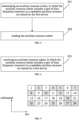
- FIG. 2 is a flowchart illustrating a method for determining an auxiliary resource set according to an embodiment. As shown in FIG. 2 , the method for determining an auxiliary resource set is applied in the first device, and includes the following steps.
- an auxiliary resource subset is determined.
- the auxiliary resource subset includes a part of time frequency resources in a candidate auxiliary resource set sensed by the first device.
- a part of the time frequency resources in the candidate auxiliary resource set sensed by the first device can be determined as the auxiliary resource subset, so that the amount of resources reported to the second device can be reduced, thus reducing signaling overhead.
- FIG. 3 is a flowchart illustrating a method for determining an auxiliary resource set according to an embodiment. As shown in FIG. 3 , the method for determining an auxiliary resource set is applied in the first device, and includes the following steps.
- an auxiliary resource subset is determined.
- the auxiliary resource subset includes a part of time frequency resources in a candidate auxiliary resource set sensed by the first device.
- the auxiliary resource subset is sent.
- a part of the time frequency resources in the candidate auxiliary resource set sensed by the first device can be determined as the auxiliary resource subset, and the auxiliary resource subset is sent to the second device, so that the amount of resources reported to the second device can be reduced, thus reducing signaling overhead.
- the second device may receive the auxiliary resource subset sent by the first device.
- the second device takes the auxiliary resource subset sent by the first device into account, and uses the mechanism with the assistance of the auxiliary resource set to perform the resource selection.
- FIG. 4 is a flowchart illustrating a method for determining an auxiliary resource set according to an embodiment. As shown in FIG. 4 , the method for determining the auxiliary resource set is applied in the second device, and includes the following steps.
- the auxiliary resource subset includes a part of time frequency resources in a candidate auxiliary resource set sensed by the first device.
- the second device receives the auxiliary resource subset.
- the auxiliary resource subset includes a part of the time frequency resources in the candidate auxiliary resource set sensed by the first device, which can reduce signaling overhead of the second device receiving the auxiliary resource set.
- auxiliary resource subset sent by the first device and/or the auxiliary resource subset received by the second device will be described below.
- the auxiliary resource subset may be a resource list (ist).
- the list serving as the auxiliary resource subset has a list length, hereinafter referred to as a first list length.
- the first device may report the auxiliary resource subset in a format of a list, and report the list with the first list length. It is assumed that the first list length is L. The first device reports the auxiliary resource subset in the format of the list, and reports the auxiliary resource subset with the list length of L.
- the second device may receive the list with the list length of L, and determine the auxiliary resource subset based on the list.
- the first list length of the auxiliary resource subset in the format of the list may be a constant list length.
- the first list length is a pre-configured constant list length.
- the auxiliary resource subset may be determined based on a resource selection window of the second device.
- the second device sends an auxiliary request carrying the resource selection window of the second device to the first device through a control signaling.
- the first device numbers one or more resources in the sensed candidate auxiliary resource set and within the resource selection window of the second device to form the list.
- a numbering mode of the list is agreed by the first device and the second device in advance. In other words, both the first device and the second device can determine the list and serial numbers in the list.
- the serial numbers in the list are numbered at granularity of a frequency domain unit in a frequency domain and at granularity of a time domain unit in a time domain.
- the frequency domain unit may be a channel, a subchannel, a subband, a band, or the like.
- the time domain unit may be a slot, a radio frame, a sub frame, a mini-slot, a symbol, a transmission time interval (TTI), or the like.
- TTI transmission time interval
- the serial numbers in the list are numbered at granularity of a subchannel in the frequency domain, and are numbered at granularity of a time slot in the time domain, but the present disclosure is not limited thereto.
- the auxiliary resource subset may include one or more time frequency resources conforming to the first list length and randomly selected from the candidate auxiliary resource set. That is, in an embodiment of the present disclosure, the first device may randomly select one or more time frequency resources conforming to the first list length from the candidate auxiliary resource set as the auxiliary resource subset.
- FIG. 5 is a diagram illustrating an embodiment of the present disclosure in which the first device randomly selects one or more time frequency resources conforming to a first list length from a candidate auxiliary resource set sensed by the first device as an auxiliary resource set.
- resources in the candidate auxiliary resource set sensed by the first device are numbered at granularity of the subchannel in the frequency domain and at granularity of the slot in the time domain.
- the one or more time frequency resources in the list compose the candidate auxiliary resource set sensed by the first device.
- the first device randomly reports a list with the list length of 8 from the candidate auxiliary resource set.
- the time frequency resources numbered ⁇ 2, 4, 5, 7, 8, 10, 12, 20 ⁇ may be randomly selected as the auxiliary resource subset and sent to the second device.
- the auxiliary resource subset may include the one or more time frequency resources selected from the candidate auxiliary resource set based on a reference signal receiving power (RSRP), and the one or more time frequency resources conform to the first list length. That is, the first device selects, based on the RSRP, the one or more time frequency resources conforming to the first list length from the sensed candidate auxiliary resource set as the auxiliary resource subset.
- RSRP reference signal receiving power
- the first device selects the one or more time frequency resources conforming to the first list length from the candidate auxiliary resource set based on an ascending order of values of the RSRP.
- FIG. 6 shows a diagram illustrating an embodiment of the present disclosure, in which the first device selects one or more time frequency resources conforming to a first list length from a sensed candidate auxiliary resource set based on RSRP as an auxiliary resource subset.
- the RSRP values of the demodulation reference signal (DMRS) of the physical sidelink control channel (PSCCH) measured on the monitored resources are sorted in an ascending order, and one or more resources with a low RSRP value are preferentially selected.
- DMRS demodulation reference signal
- PSCCH physical sidelink control channel
- the first device selects resources with a list length of 8 and a low RSRP value, such as resources numbered ⁇ 5, 7, 8, 10, 12, 20, 22, 25 ⁇ . These time frequency resources have minimal interference for data transmission by the second device. For example, the time frequency resources numbered ⁇ 5, 7, 8, 10, 12, 20, 22, 25 ⁇ are used as the auxiliary resource subset and sent to the second device.
- the first list length L of the reported list is pre-configured, and the first device reports the auxiliary resource set with the length of L in the candidate auxiliary resource set sensed by the first device as the auxiliary resource subset.
- the first list length of the list may be a pre-configured constant list length; on the other hand, the first list length may also be flexibly and dynamically changed.
- the first list length in the embodiment of the present disclosure is determined based on a minimum proportion satisfied by a proportion of resources in the candidate auxiliary resource set to the resources within a resource selection window of the second device.
- the minimum proportion satisfied by the proportion of the resources in the candidate auxiliary resource set to the resources within the resource selection window of the second device is referred to as a first proportion.
- a first proportion Based on a communication protocol Rel-16, in order to ensure a randomness of the resource selection, the proportion of the resources in the candidate auxiliary resource set determined by step 1 of resource sensing to the resources within the resource selection window needs to meet a requirement of > X% (i.e., the first proportion).
- X% is specified according to the protocol, which ensures more resources, and meets the randomness of the resource selection.
- a proportion offset value (Y%) relative to the first proportion may be set.
- the first list length is determined based on the proportional offset value relative to the first proportion.
- the first list length may be determined based on the number of the resources within the resource selection window of the second device, the first proportion, and the proportion offset value relative to the first proportion.
- S is the number of resources within the resource selection window of the UE B
- X% is the first proportion
- Y% is the proportion offset value relative to the first proportion
- L is the first list length.
- the proportion offset value Y% relative to the first proportion is pre-configured through radio resource control (RRC).
- RRC radio resource control
- the number S of resources within the resource selection window of the UE B is calculated based on a position of the resource selection window.
- the first device obtains the position of the resource selection window based on the auxiliary request of the second device.
- the first device calculates the first list length of the list, and notifies the second device the determined list through a control signaling.
- the first device randomly selects an auxiliary resource subset with a list length of L from the sensed candidate auxiliary resource set, and reports the auxiliary resource subset to the second device.
- the first list length is determined based on the number of resources within the resource selection window of the second device, the first proportion and the proportion offset value relative to the first proportion, so that the reported first list length varies with the number of resources in the candidate auxiliary resource set sensed by the first device, and the solution is more flexible.
- the first proportion X% is 40%.
- the resource proportion finally determined needs to be greater than X%.
- the proportion of the candidate auxiliary resource set is set as 75%.
- FIG. 7 is a diagram illustrating a traditional technology, in which a candidate auxiliary resource set is determined. Referring to FIG. 7 , the first device needs to select 21 time frequency resources from 28 time frequency resources as auxiliary resources and send the auxiliary resources to the second device.
- FIG. 8 is a diagram illustrating an embodiment of the present disclosure, in which the first device determines a first list length based on the number of resources within a resource selection window of the second device, a first proportion, and a proportion offset value relative to the first proportion and determines an auxiliary resource set.
- the selected resources need to meet a requirement of larger than the first proportion X% and less than (X% + Y%). Assuming that the first proportion X% is 40% and (X% + Y%) is 50%, the first device may select 12 time frequency resources from the 28 time frequency resources as the auxiliary resources and send the auxiliary resources to the second device.
- the first device may select 12 time frequency resources from 28 time frequency resources as auxiliary resources and send the auxiliary resources to the second device, which can reduce the amount of reported auxiliary resources, thus reducing signaling overhead.
- the first device may determine the auxiliary resource subset based on the resource selection window of the second device.
- the auxiliary resource subset includes one or more time frequency resources with a first slot length within the resource selection window of the second device.
- the first slot length is less than a slot length of the resource selection window of the second device.
- the auxiliary resource set includes one or more continuous time frequency resources determined based on a first time and having the first slot length.
- the first time is a start time or an end time of the resource selection window of the second device.
- FIG. 9 is a diagram illustrating an embodiment of the present disclosure, in which the first device determines an auxiliary resource subset based on a resource selection window of the second device.
- the UE A selects the time frequency resources with a constant slot length of L (L ⁇ the number of slots of the resource selection window of the UE B, and the value of L is pre-configured through the RRC) before the time slot n+T2 as the auxiliary resource subset, and reports the auxiliary resource subset to the UE B.
- the time slot n+T2 is an end position of the resource selection window of the UE B.
- the position of the time slot n+T2 at the end position of the resource selection window of the UE B is notified to the UE A by the UE B in an auxiliary request through a control signaling.
- the value of the slot length L is pre-configured by the RRC signaling.
- the resource selection window [n+T1, n+T2] of the UE B is known to the UE A.
- the UE A senses the time frequency resources within the resource selection window of the UE B.
- the UE A selects the time frequency resources with the time slot length of L as the auxiliary resource subset and reports the auxiliary resource subset to the UE B. That is, a time frequency resource subset of the time frequency resources located in the resource selection window of the UE B is reported.
- the first device selects one or more resources with a slot length less than the slot length of the resource selection window of the second device within the resource selection window of the second device as the auxiliary resource subset, and sends the auxiliary resource subset to the second device, which can reduce the amount of auxiliary resources to be sent, thus reducing signaling overhead.
- the method for determining an auxiliary resource set provided in the embodiment of the present disclosure may be applied to an interaction process of sending and receiving the auxiliary resource set between the first device and the second device.
- the first device and the second device have corresponding functions for implementing the method for determining an auxiliary resource set involved in the above embodiments, which are not elaborated in the embodiments of the present disclosure.
- an apparatus for determining an auxiliary resource set is also provided in the embodiments of the present disclosure.
- the transmission configuration apparatus includes corresponding hardware structures and/or software modules for executing respective functions.
- units and algorithm steps may be implemented by electronic hardware, computer software, or a combination thereof.
- the foregoing has generally described compositions and steps of each example according to functions. Whether the functions are performed by hardware or software depends on particular applications and design constraint conditions of the technical solutions. A person skilled in the art may use different methods to implement the described functions for each particular application, but it should not be considered that the implementation goes beyond the scope of the present invention.
- FIG. 10 is a block diagram illustrating an apparatus for determining an auxiliary resource set according to an embodiment.
- the apparatus 100 for determining an auxiliary resource set is applied to a first device, and includes a processing unit 101.
- the processing unit 101 is configured to determine an auxiliary resource subset.
- the auxiliary resource subset includes a part of time frequency resources in a candidate auxiliary resource set sensed by the first device.
- the auxiliary resource subset is a resource list having a first list length.
- the auxiliary resource subset includes one or more time frequency resources conforming to the first list length and randomly selected from candidate auxiliary resource set.
- the auxiliary resource subset includes one or more time frequency resources selected from the candidate auxiliary resource set based on a reference signal receiving power, and the one or more time frequency resources conform to the first list length.
- the auxiliary resource subset includes one or more time frequency resources selected from the candidate auxiliary resource set based on the ascending order of values of the reference signal receiving power, and the one or more time frequency resources conform to first list length.
- the first list length is a pre-configured constant list length.
- the first list length is determined based on the proportion offset value relative to the first proportion, and the first proportion is the minimum proportion satisfied by the proportion of the resources in candidate auxiliary resource set to the resources within the resource selection window of the second device.
- the first list length is determined based on the number of the resources within the resource selection window of the second device, the first proportion, and the proportion offset value relative to the first proportion.
- the auxiliary resource subset includes one or more time frequency resources with a first slot length within a resource selection window of a second device, and the first slot length is less than the slot length of the resource selection window of the second device.
- the auxiliary resource set is includes one or more continuous time frequency resources with the first slot length and determined based on a first time.
- the first time is a start time or an end time of the resource selection window.
- the apparatus 100 for determining an auxiliary resource set includes a sending unit 102.
- the sending unit 102 is configured to send the auxiliary resource subset.
- FIG. 11 is a block diagram illustrating an apparatus for determining an auxiliary resource set according to an embodiment.
- the apparatus 200 for determining an auxiliary resource set is applied to a second device, and includes a receiving unit 201.
- the receiving unit 201 is configured to receive the auxiliary resource subset.
- the auxiliary resource subset includes a part of time frequency resources in a candidate auxiliary resource set sensed by the first device.
- the auxiliary resource subset is a resource list having a first list length.
- the auxiliary resource subset includes one or more time frequency resources conforming to the first list length and randomly selected from candidate auxiliary resource set.
- the auxiliary resource subset includes one or more time frequency resources selected from the candidate auxiliary resource set based on a reference signal receiving power, and the one or more time frequency resources conform to the first list length.
- the auxiliary resource subset includes one or more time frequency resources selected from candidate auxiliary resource set based on an ascending order of values of the reference signal receiving power, and the one or more time frequency resources conform to first list length.
- the first list length is a pre-configured constant list length.
- the first list length is determined based on a proportion offset value relative to a first proportion, and the first proportion is a minimum proportion satisfied by a proportion of resources in candidate auxiliary resource set to resources within a resource selection window of the second device.
- the first list length is determined based on a number of the resources within the resource selection window of the second device, the first proportion, and the proportion offset value relative to the first proportion.
- the auxiliary resource subset includes one or more time frequency resources with a first slot length within a resource selection window of the second device, and the first slot length is less than a slot length of the resource selection window of the second device.
- the auxiliary resource set includes one or more continuous time frequency resources with the first slot length and determined based on a first time.
- the first time is a start time or an end time of the resource selection window.
- FIG. 12 is a block diagram illustrating an apparatus 300 for determining an auxiliary resource set according to an embodiment.
- the apparatus 300 may be a mobile phone, a computer, a digital broadcasting terminal, a messaging device, a game console, a tablet device, a medical equipment, a fitness equipment, a personal digital assistant, etc.
- the apparatus 300 may include one or more components: a processing component 302, a memory 304, a power supply component 306, a multimedia component 308, an audio component 310, an input/output (I/O) interface 312, a sensor component 314, and a communication component 316.
- the processing component 302 generally controls the whole operation of the apparatus 300, such as the operations related to display, phone call, data communication, camera operation and recording operation.
- the processing component 302 may include one or more processors 320 to perform instructions, to complete all or part of steps of the above method.
- the processing component 302 may include one or more modules for the convenience of interaction between the processing component 302 and other components.
- the processing component 302 may include a multimedia module for the convenience of interaction between the multimedia component 308 and the processing component 302.
- the memory 304 is configured to store all types of data to support the operation of the apparatus 300. Examples of the data include the instructions of any applications or methods operated on the apparatus 300, contact data, phone book data, messages, pictures, videos, etc.
- the memory 304 may be implemented by any type of volatile or non-volatile storage devices or their combination, such as a static random access memory (SRAM), an electrically erasable programmable read-only memory (EEPROM), an erasable programmable read-only memory (EPROM), a programmable read-only memory (PROM), a read-only memory (ROM), a magnetic memory, a flash memory, a magnetic disk or an optical disk.
- SRAM static random access memory
- EEPROM electrically erasable programmable read-only memory
- EPROM erasable programmable read-only memory
- PROM programmable read-only memory
- ROM read-only memory
- the power supply component 306 may provide power supply for all components of the apparatus 300.
- the power supply component 306 may include power supply management system, one or more power supplies, and other units related to generating, managing and distributing power for the apparatus 300.
- the multimedia component 308 includes an output interface screen provided between the apparatus 300 and the user.
- a screen may include a liquid crystal display (LCD) and a touch panel (TP).
- the screen may be implemented as a touch screen to receive input signals from the user.
- the touch panel includes one or more touch sensors to sense touching, sliding and gestures on the touch panel. The touch sensor may not only sense the boundary of touch or slide action, but also detect the duration and pressure related to the touching or sliding operation.
- the multimedia component 308 includes a front camera and/or a rear camera. When the apparatus 300 is in operation mode, such as shooting mode or video mode, the front camera or the rear camera may receive the external multimedia data.
- Each front camera and rear camera may be a fixed optical lens system or an optical lens system with focal length and optical zoom capacity.
- the audio component 310 is configured as an output and/or input signal.
- the audio component 310 includes a microphone (MIC).
- the microphone is configured to receive the external audio signals.
- the audio signals received may be further stored in the memory 304 or sent via the communication component 316.
- the audio component 310 further includes a speaker configured to output an audio signal.
- the I/O interface 312 provides an interface for the processing component 302 and the peripheral interface module, and the peripheral interface module may be a keyboard, a click wheel, a button, etc.
- the buttons may include but not limited to a home button, a volume button, a start button and a lock button.
- the sensor component 314 includes one or more sensors, configured to provide various aspects of status assessment for the apparatus 300.
- the sensor component 314 may detect the on/off state of the apparatus 300 and the relative positioning of the component.
- the component is a display and a keypad of the apparatus 300.
- the sensor component 314 may further detect the location change of the apparatus 300 or one component of the apparatus 300, the presence or absence of contact between the user and the apparatus 300, the orientation or acceleration/deceleration of the apparatus 300, and the temperature change of the apparatus 300.
- the sensor component 314 may include a proximity sensor, which is configured to detect the existence of the objects nearby without any physical contact.
- the sensor component 314 may further include a light sensor such as CMOS or CCD image sensor, which is configured to use in imaging applications.
- the sensor component 314 may further include an acceleration transducer, a gyroscope sensor, a magnetic sensor, a pressure sensor or a temperature sensor.
- the communication component 316 is configured for the convenience of wire or wireless communication between the apparatus 300 and other devices.
- the apparatus 300 may access wireless networks based on communication standard, such as WiFi, 2G or 3G, or their combination.
- the communication component 316 receives broadcast signals or broadcast-related information from an external broadcast management system via a broadcast channel.
- the communication component 316 further includes a near field communication (NFC) module to facilitate short-range communication.
- NFC near field communication
- an NFC module may be implemented based on radio frequency identification (RFID) technology, infrared data association (IRDA) technology, ultra-wideband (UWB) technology, bluetooth (BT) technology and other technologies.
- RFID radio frequency identification
- IRDA infrared data association
- UWB ultra-wideband
- BT bluetooth
- the apparatus 300 may be implemented by one or more application specific integrated circuits (ASIC), digital signal processors (DSP), digital signal processing devices (DSPD), programmable logic devices (PLD), field programmable gate arrays (FPGA), controllers, microcontrollers, microprocessors or other electronics components, which is configured to perform the above method.
- ASIC application specific integrated circuits
- DSP digital signal processors
- DSPD digital signal processing devices
- PLD programmable logic devices
- FPGA field programmable gate arrays
- controllers microcontrollers, microprocessors or other electronics components, which is configured to perform the above method.
- a non-temporary computer readable storage medium is further provided which includes instructions, such as the memory 304 including instructions.
- the instructions may be executed by the processor 320 of the apparatus 300 to complete the above methods.
- the non-transitory computer readable storage medium may be a ROM, a random access memory (RAM), a CD-ROM, a magnetic tape, a floppy disk, an optical data storage device, etc.
- a plurality of in the present disclosure means two or above, which is similar to other quantifiers.
- "and/or” describes the relationship of the association objects, indicating that there may exist three relationships, for example, A and/or B, may represent: any of existing A only, existing both A and B, or existing B only.
- the character “/” generally means the contextual object is a kind of "or” relationship.
- the singular forms “a”, “the” and “said are also intended to include plural forms, unless the context clearly indicates otherwise.
- first, second, third, etc. may be configured to describe various information, such information shall not be limited to these terms. These terms are only used to distinguish the same type of information, rather than indicate a particular order or importance degree. In fact, “first”, “second” and other similar descriptions may be used interchangeably.
- first information may also be referred to as second information, and similarly, and second information may also be referred to as first information.
Landscapes
- Engineering & Computer Science (AREA)
- Computer Networks & Wireless Communication (AREA)
- Signal Processing (AREA)
- Mobile Radio Communication Systems (AREA)
Applications Claiming Priority (1)
| Application Number | Priority Date | Filing Date | Title |
|---|---|---|---|
| PCT/CN2020/138068 WO2022133665A1 (zh) | 2020-12-21 | 2020-12-21 | 辅助资源集确定方法、装置及存储介质 |
Publications (2)
| Publication Number | Publication Date |
|---|---|
| EP4266780A1 true EP4266780A1 (de) | 2023-10-25 |
| EP4266780A4 EP4266780A4 (de) | 2024-01-17 |
Family
ID=75457679
Family Applications (1)
| Application Number | Title | Priority Date | Filing Date |
|---|---|---|---|
| EP20966246.9A Pending EP4266780A4 (de) | 2020-12-21 | 2020-12-21 | Verfahren und vorrichtung zur bestimmung eines hilfsressourcensatzes und speichermedium |
Country Status (6)
| Country | Link |
|---|---|
| US (1) | US12532300B2 (de) |
| EP (1) | EP4266780A4 (de) |
| JP (1) | JP7692043B2 (de) |
| KR (1) | KR20230118685A (de) |
| CN (2) | CN115529670B (de) |
| WO (1) | WO2022133665A1 (de) |
Families Citing this family (3)
| Publication number | Priority date | Publication date | Assignee | Title |
|---|---|---|---|---|
| MX2023007798A (es) * | 2020-12-31 | 2023-07-11 | Huawei Tech Co Ltd | Metodo y aparato de comunicacion. |
| WO2022236613A1 (zh) * | 2021-05-10 | 2022-11-17 | Oppo广东移动通信有限公司 | 一种确定参考资源的方法及装置、终端 |
| CN115004732B (zh) * | 2022-04-18 | 2025-06-06 | 北京小米移动软件有限公司 | 一种基于辅助资源集进行通信的方法、装置及存储介质 |
Family Cites Families (13)
| Publication number | Priority date | Publication date | Assignee | Title |
|---|---|---|---|---|
| CN110431893B (zh) * | 2017-03-23 | 2023-08-29 | 苹果公司 | 根据短传输时间间隔(tti)用于车辆到车辆(v2v)侧链路通信的用户设备(ue)和方法 |
| CN115835288A (zh) * | 2017-10-21 | 2023-03-21 | 上海朗帛通信技术有限公司 | 一种无线通信的用户设备、网络设备中的方法和装置 |
| EP3697127B1 (de) * | 2017-11-16 | 2023-08-30 | Huawei Technologies Co., Ltd. | Kommunikationsverfahren und endgerätevorrichtung |
| CN110958096B (zh) * | 2018-09-27 | 2021-09-28 | 大唐移动通信设备有限公司 | 一种资源指示方法及终端 |
| EP3672133B1 (de) * | 2018-12-20 | 2022-09-14 | ASUSTek Computer Inc. | Verfahren und vorrichtung zur handhabung einer kollision zwischen sidelink-feedback und sidelink-daten in einem drahtloskommunikationssystem |
| CN116567707A (zh) * | 2019-02-13 | 2023-08-08 | 苹果公司 | 网络辅助的新无线电v2x侧链路资源分配的无线电资源管理 |
| WO2020166089A1 (ja) * | 2019-02-15 | 2020-08-20 | 株式会社Nttドコモ | ユーザ装置 |
| KR102353395B1 (ko) * | 2019-03-21 | 2022-01-19 | 아서스테크 컴퓨터 인코포레이션 | 무선 통신 시스템에 있어서 디바이스-대-디바이스 피드백 송신을 핸들링하는 방법 및 장치 |
| US20200229171A1 (en) * | 2019-04-02 | 2020-07-16 | Intel Corporation | Methods of autonomous resource selection in new radio (nr) vehicle-to-everything (v2x) sidelink communication |
| US11937273B2 (en) * | 2019-04-08 | 2024-03-19 | Lg Electronics Inc. | Operation method of UE related to sidelink communication and feedback in wireless communication system |
| US11895651B2 (en) * | 2019-05-02 | 2024-02-06 | Comcast Cable Communications, Llc | Wireless communications for a sidelink |
| US11576157B2 (en) * | 2019-08-15 | 2023-02-07 | Intel Corporation | NR V2X sidelink resource selection and reselection using scheduling window |
| CN111246483A (zh) | 2020-01-21 | 2020-06-05 | 北京展讯高科通信技术有限公司 | 辅链路通信的资源选择方法及装置 |
-
2020
- 2020-12-21 WO PCT/CN2020/138068 patent/WO2022133665A1/zh not_active Ceased
- 2020-12-21 KR KR1020237024590A patent/KR20230118685A/ko active Pending
- 2020-12-21 CN CN202210977164.4A patent/CN115529670B/zh active Active
- 2020-12-21 US US18/257,060 patent/US12532300B2/en active Active
- 2020-12-21 EP EP20966246.9A patent/EP4266780A4/de active Pending
- 2020-12-21 JP JP2023537308A patent/JP7692043B2/ja active Active
- 2020-12-21 CN CN202080004230.9A patent/CN112690035B/zh active Active
Also Published As
| Publication number | Publication date |
|---|---|
| CN115529670B (zh) | 2026-04-14 |
| WO2022133665A1 (zh) | 2022-06-30 |
| CN115529670A (zh) | 2022-12-27 |
| CN112690035B (zh) | 2022-09-02 |
| CN112690035A (zh) | 2021-04-20 |
| US20240049194A1 (en) | 2024-02-08 |
| JP7692043B2 (ja) | 2025-06-12 |
| KR20230118685A (ko) | 2023-08-11 |
| US12532300B2 (en) | 2026-01-20 |
| EP4266780A4 (de) | 2024-01-17 |
| JP2023553752A (ja) | 2023-12-25 |
Similar Documents
| Publication | Publication Date | Title |
|---|---|---|
| US20230362739A1 (en) | Communication method, communication apparatus and storage medium | |
| CN113632582B (zh) | 基于物理直连通信数据信道的通信方法、装置及存储介质 | |
| US20250024377A1 (en) | Sidelink communication method and apparatus, and storage medium | |
| CN112438057B (zh) | 辅助资源集发送接收方法、装置及存储介质 | |
| US12407384B2 (en) | Method and apparatus for selecting antenna panel | |
| US12513663B2 (en) | Method and device for resource selection, and storage medium | |
| US12538271B2 (en) | Method and apparatus for determining resource, and storage medium | |
| US12538272B2 (en) | Method for selecting resource, apparatus for selecting resource, and storage medium | |
| US12532300B2 (en) | Auxiliary resource set determining method and apparatus, and storage medium | |
| CN110383749B (zh) | 控制信道发送、接收方法、装置及存储介质 | |
| CN112205067A (zh) | 直连通信方法、直连通信装置及存储介质 | |
| CN115606207B (zh) | 资源选择方法、资源选择装置及存储介质 | |
| CN112514420B (zh) | 辅助资源集发送方法、装置及存储介质 | |
| WO2024207455A1 (zh) | Pssch资源的确定方法、装置、通信设备及存储介质 | |
| RU2820333C1 (ru) | Способ и устройство для определения набора вспомогательных ресурсов, а также носитель данных | |
| US20250294523A1 (en) | Auxiliary resource set-based communication method and apparatus, and non-transitory computer-readable storage medium | |
| WO2024065126A1 (zh) | 一种连续多时隙的传输方法、装置及存储介质 |
Legal Events
| Date | Code | Title | Description |
|---|---|---|---|
| STAA | Information on the status of an ep patent application or granted ep patent |
Free format text: STATUS: THE INTERNATIONAL PUBLICATION HAS BEEN MADE |
|
| PUAI | Public reference made under article 153(3) epc to a published international application that has entered the european phase |
Free format text: ORIGINAL CODE: 0009012 |
|
| STAA | Information on the status of an ep patent application or granted ep patent |
Free format text: STATUS: REQUEST FOR EXAMINATION WAS MADE |
|
| 17P | Request for examination filed |
Effective date: 20230718 |
|
| AK | Designated contracting states |
Kind code of ref document: A1 Designated state(s): AL AT BE BG CH CY CZ DE DK EE ES FI FR GB GR HR HU IE IS IT LI LT LU LV MC MK MT NL NO PL PT RO RS SE SI SK SM TR |
|
| A4 | Supplementary search report drawn up and despatched |
Effective date: 20231219 |
|
| RIC1 | Information provided on ipc code assigned before grant |
Ipc: H04W 72/40 20230101ALN20231213BHEP Ipc: H04W 74/00 20090101ALI20231213BHEP Ipc: H04W 72/25 20230101ALI20231213BHEP Ipc: H04W 74/08 20090101ALI20231213BHEP Ipc: H04W 72/04 20230101AFI20231213BHEP |
|
| DAV | Request for validation of the european patent (deleted) | ||
| DAX | Request for extension of the european patent (deleted) |