EP4266820A1 - Verfahren und vorrichtung zur kommunikationsverarbeitung und kommunikationsvorrichtung - Google Patents
Verfahren und vorrichtung zur kommunikationsverarbeitung und kommunikationsvorrichtung Download PDFInfo
- Publication number
- EP4266820A1 EP4266820A1 EP21905775.9A EP21905775A EP4266820A1 EP 4266820 A1 EP4266820 A1 EP 4266820A1 EP 21905775 A EP21905775 A EP 21905775A EP 4266820 A1 EP4266820 A1 EP 4266820A1
- Authority
- EP
- European Patent Office
- Prior art keywords
- harq
- target
- ack
- pdsch
- time
- Prior art date
- Legal status (The legal status is an assumption and is not a legal conclusion. Google has not performed a legal analysis and makes no representation as to the accuracy of the status listed.)
- Pending
Links
Images

Classifications
-
- H—ELECTRICITY
- H04—ELECTRIC COMMUNICATION TECHNIQUE
- H04W—WIRELESS COMMUNICATION NETWORKS
- H04W76/00—Connection management
- H04W76/20—Manipulation of established connections
- H04W76/28—Discontinuous transmission [DTX]; Discontinuous reception [DRX]
-
- H—ELECTRICITY
- H04—ELECTRIC COMMUNICATION TECHNIQUE
- H04L—TRANSMISSION OF DIGITAL INFORMATION, e.g. TELEGRAPHIC COMMUNICATION
- H04L1/00—Arrangements for detecting or preventing errors in the information received
- H04L1/12—Arrangements for detecting or preventing errors in the information received by using return channel
- H04L1/16—Arrangements for detecting or preventing errors in the information received by using return channel in which the return channel carries supervisory signals, e.g. repetition request signals
- H04L1/18—Automatic repetition systems, e.g. Van Duuren systems
- H04L1/1829—Arrangements specially adapted for the receiver end
- H04L1/1861—Physical mapping arrangements
-
- H—ELECTRICITY
- H04—ELECTRIC COMMUNICATION TECHNIQUE
- H04L—TRANSMISSION OF DIGITAL INFORMATION, e.g. TELEGRAPHIC COMMUNICATION
- H04L1/00—Arrangements for detecting or preventing errors in the information received
- H04L1/12—Arrangements for detecting or preventing errors in the information received by using return channel
- H04L1/16—Arrangements for detecting or preventing errors in the information received by using return channel in which the return channel carries supervisory signals, e.g. repetition request signals
- H04L1/18—Automatic repetition systems, e.g. Van Duuren systems
- H04L1/1812—Hybrid protocols; Hybrid automatic repeat request [HARQ]
-
- H—ELECTRICITY
- H04—ELECTRIC COMMUNICATION TECHNIQUE
- H04L—TRANSMISSION OF DIGITAL INFORMATION, e.g. TELEGRAPHIC COMMUNICATION
- H04L1/00—Arrangements for detecting or preventing errors in the information received
- H04L1/12—Arrangements for detecting or preventing errors in the information received by using return channel
- H04L1/16—Arrangements for detecting or preventing errors in the information received by using return channel in which the return channel carries supervisory signals, e.g. repetition request signals
- H04L1/1607—Details of the supervisory signal
- H04L1/1614—Details of the supervisory signal using bitmaps
-
- H—ELECTRICITY
- H04—ELECTRIC COMMUNICATION TECHNIQUE
- H04L—TRANSMISSION OF DIGITAL INFORMATION, e.g. TELEGRAPHIC COMMUNICATION
- H04L1/00—Arrangements for detecting or preventing errors in the information received
- H04L1/12—Arrangements for detecting or preventing errors in the information received by using return channel
- H04L1/16—Arrangements for detecting or preventing errors in the information received by using return channel in which the return channel carries supervisory signals, e.g. repetition request signals
- H04L1/18—Automatic repetition systems, e.g. Van Duuren systems
- H04L1/1822—Automatic repetition systems, e.g. Van Duuren systems involving configuration of automatic repeat request [ARQ] with parallel processes
-
- H—ELECTRICITY
- H04—ELECTRIC COMMUNICATION TECHNIQUE
- H04L—TRANSMISSION OF DIGITAL INFORMATION, e.g. TELEGRAPHIC COMMUNICATION
- H04L1/00—Arrangements for detecting or preventing errors in the information received
- H04L1/12—Arrangements for detecting or preventing errors in the information received by using return channel
- H04L1/16—Arrangements for detecting or preventing errors in the information received by using return channel in which the return channel carries supervisory signals, e.g. repetition request signals
- H04L1/18—Automatic repetition systems, e.g. Van Duuren systems
- H04L1/1829—Arrangements specially adapted for the receiver end
- H04L1/1848—Time-out mechanisms
-
- H—ELECTRICITY
- H04—ELECTRIC COMMUNICATION TECHNIQUE
- H04L—TRANSMISSION OF DIGITAL INFORMATION, e.g. TELEGRAPHIC COMMUNICATION
- H04L1/00—Arrangements for detecting or preventing errors in the information received
- H04L1/12—Arrangements for detecting or preventing errors in the information received by using return channel
- H04L1/16—Arrangements for detecting or preventing errors in the information received by using return channel in which the return channel carries supervisory signals, e.g. repetition request signals
- H04L1/18—Automatic repetition systems, e.g. Van Duuren systems
- H04L1/1829—Arrangements specially adapted for the receiver end
- H04L1/1848—Time-out mechanisms
- H04L1/1851—Time-out mechanisms using multiple timers
-
- H—ELECTRICITY
- H04—ELECTRIC COMMUNICATION TECHNIQUE
- H04L—TRANSMISSION OF DIGITAL INFORMATION, e.g. TELEGRAPHIC COMMUNICATION
- H04L1/00—Arrangements for detecting or preventing errors in the information received
- H04L1/12—Arrangements for detecting or preventing errors in the information received by using return channel
- H04L1/16—Arrangements for detecting or preventing errors in the information received by using return channel in which the return channel carries supervisory signals, e.g. repetition request signals
- H04L1/18—Automatic repetition systems, e.g. Van Duuren systems
- H04L1/1829—Arrangements specially adapted for the receiver end
- H04L1/1854—Scheduling and prioritising arrangements
-
- H—ELECTRICITY
- H04—ELECTRIC COMMUNICATION TECHNIQUE
- H04L—TRANSMISSION OF DIGITAL INFORMATION, e.g. TELEGRAPHIC COMMUNICATION
- H04L5/00—Arrangements affording multiple use of the transmission path
- H04L5/003—Arrangements for allocating sub-channels of the transmission path
- H04L5/0044—Allocation of payload; Allocation of data channels, e.g. PDSCH or PUSCH
-
- H—ELECTRICITY
- H04—ELECTRIC COMMUNICATION TECHNIQUE
- H04L—TRANSMISSION OF DIGITAL INFORMATION, e.g. TELEGRAPHIC COMMUNICATION
- H04L5/00—Arrangements affording multiple use of the transmission path
- H04L5/003—Arrangements for allocating sub-channels of the transmission path
- H04L5/0053—Allocation of signalling, i.e. of overhead other than pilot signals
- H04L5/0055—Physical resource allocation for ACK/NACK
-
- H—ELECTRICITY
- H04—ELECTRIC COMMUNICATION TECHNIQUE
- H04L—TRANSMISSION OF DIGITAL INFORMATION, e.g. TELEGRAPHIC COMMUNICATION
- H04L5/00—Arrangements affording multiple use of the transmission path
- H04L5/003—Arrangements for allocating sub-channels of the transmission path
- H04L5/0078—Timing of allocation
- H04L5/0082—Timing of allocation at predetermined intervals
-
- H—ELECTRICITY
- H04—ELECTRIC COMMUNICATION TECHNIQUE
- H04L—TRANSMISSION OF DIGITAL INFORMATION, e.g. TELEGRAPHIC COMMUNICATION
- H04L5/00—Arrangements affording multiple use of the transmission path
- H04L5/0091—Signalling for the administration of the divided path, e.g. signalling of configuration information
- H04L5/0092—Indication of how the channel is divided
-
- H—ELECTRICITY
- H04—ELECTRIC COMMUNICATION TECHNIQUE
- H04W—WIRELESS COMMUNICATION NETWORKS
- H04W72/00—Local resource management
- H04W72/04—Wireless resource allocation
- H04W72/11—Semi-persistent scheduling
-
- H—ELECTRICITY
- H04—ELECTRIC COMMUNICATION TECHNIQUE
- H04L—TRANSMISSION OF DIGITAL INFORMATION, e.g. TELEGRAPHIC COMMUNICATION
- H04L5/00—Arrangements affording multiple use of the transmission path
- H04L5/0001—Arrangements for dividing the transmission path
- H04L5/0014—Three-dimensional division
- H04L5/0016—Time-frequency-code
-
- H—ELECTRICITY
- H04—ELECTRIC COMMUNICATION TECHNIQUE
- H04L—TRANSMISSION OF DIGITAL INFORMATION, e.g. TELEGRAPHIC COMMUNICATION
- H04L5/00—Arrangements affording multiple use of the transmission path
- H04L5/14—Two-way operation using the same type of signal, i.e. duplex
- H04L5/1469—Two-way operation using the same type of signal, i.e. duplex using time-sharing
Definitions
- This application pertains to the field of wireless communication technologies and specifically relates to a communication processing method and apparatus and a communication device.
- a semi-persistent scheduling physical downlink shared channel (Semi-Persistent Scheduling Physical downlink shared channel, SPS PDSCH) as an example
- SPS PDSCH semi-persistent scheduling physical downlink shared channel
- HARQ-ACK hybrid automatic repeat request acknowledgement
- HARQ-ACK disabling scheme that is, disabling, turning off, or skipping HARQ-ACK feedback
- some functions that rely on or are associated with HARQ-ACK feedback may not be executed normally, resulting in degraded communication performance.
- Embodiments of this application provide a communication processing method and apparatus and a communication device, so as to at least resolve the problem that some functions relying on or associated with HARQ-ACK feedback may not be executed normally in a case that a HARQ-ACK disabling scheme is adopted or that there is feedback delay for HARQ-ACK, thereby guaranteeing communication performance.
- a communication processing method including: performing a predetermined operation based on a transmission time of a target physical downlink shared channel PDSCH, where the target PDSCH is configured as having no feedback of target hybrid automatic repeat request acknowledgement HARQ-ACK information, or there is feedback delay for target HARQ-ACK information corresponding to the target PDSCH; the predetermined operation includes at least one of the following: determining whether the target PDSCH corresponds to a nominal HARQ-ACK feedback time unit; determining an effective time of a target medium access control control element MAC CE, where the target MAC CE is carried on the target PDSCH; determining a target HARQ-ACK codebook corresponding to the target PDSCH; determining application of a first rule, where the first rule characterizes a timing relationship requirement between the target PDSCH and a feedback time corresponding to the target HARQ-ACK information; and determining start of a target discontinuous reception DRX timer, where the target DRX timer corresponds to a
- a communication processing apparatus including: an execution module, configured to perform a predetermined operation based on a transmission time of a target physical downlink shared channel PDSCH, where the target PDSCH is configured as having no feedback of target hybrid automatic repeat request acknowledgement HARQ-ACK information, or there is feedback delay for target HARQ-ACK information corresponding to the target PDSCH.
- the predetermined operation includes at least one of the following: determining whether the target PDSCH corresponds to a nominal HARQ-ACK feedback time unit; determining an effective time of a target medium access control control element MAC CE, where the target MAC CE is carried on the target PDSCH; determining a target HARQ-ACK codebook corresponding to the target PDSCH; determining application of a first rule, where the first rule characterizes a timing relationship requirement between the target PDSCH and a feedback time corresponding to the target HARQ-ACK information; and determining start of a target discontinuous reception DRX timer, where the target DRX timer corresponds to a first HARQ process, and the first HARQ process corresponds to the target PDSCH.
- a communication device including a processor, a memory, and a program or instructions stored in the memory and capable of running on the processor, where when the program or the instructions are executed by the processor, the steps of the communication processing method according to the first aspect are implemented.
- a readable storage medium where a program or instructions are stored in the readable storage medium, and when the program or the instructions are executed by a processor, the steps of the communication processing method according to the first aspect are implemented.
- a chip includes a processor and a communication interface, the communication interface is coupled to the processor, and the processor is configured to run a program or instructions to implement the method according to the first aspect.
- a computer program product includes a processor, a memory, and a program or instructions stored in the memory and capable of running on the processor, and when the program or the instructions are executed by the processor, the steps of the method according to the first aspect are implemented.
- a predetermined operation can be performed based on a transmission time of the target PDSCH.
- the predetermined operation includes at least one of the following: determining whether the target PDSCH corresponds to a nominal HARQ-ACK feedback time unit; determining an effective time of a target MAC CE; determining a target HARQ-ACK codebook corresponding to the target PDSCH; determining application of a first rule; and determining start of a target DRX timer.
- first the terms “first”, “second”, and the like are intended to distinguish between similar objects rather than to describe a specific order or sequence. It should be understood that data used in this way is used interchangeably in appropriate circumstances so that the embodiments of this application can be implemented in other orders than the order illustrated or described herein.
- the objects distinguished by “first” and “second” usually belong to one category, and the number of objects is not limited. For example, there may be one or more first objects.
- “and/or” indicates at least one of connected objects, and the symbol “/” generally indicates that the associated objects have an "or” relationship.
- technologies described in the embodiments of this application are not limited to the long term evolution (Long Term Evolution, LTE) or LTE-Advanced (LTE-Advanced, LTE-A) system, but may also be applied to other wireless communication systems, for example, code division multiple access (Code Division Multiple Access, CDMA), time division multiple access (Time Division Multiple Access, TDMA), frequency division multiple access (Frequency Division Multiple Access, FDMA), orthogonal frequency division multiple access (Orthogonal Frequency Division Multiple Access, OFDMA), single-carrier frequency-division multiple access (Single-carrier Frequency-Division Multiple Access, SC-FDMA), and other systems.
- code division multiple access Code Division Multiple Access
- TDMA time division multiple access
- FDMA frequency division multiple access
- OFDMA Orthogonal frequency division multiple access
- SC-FDMA single-carrier Frequency-Division Multiple Access
- system and “network” in the embodiments of this application are often used interchangeably.
- the technologies described herein may be used in the above-mentioned systems and radio technologies as well as other systems and radio technologies.
- the new radio (New Radio, NR) system is described for an illustration purpose, and NR terms are used in most of the following descriptions.
- NR New Radio
- These technologies may also have other applications than the application in NR system, for example, being used in the 6th generation (6 th Generation, 6G) communication system.
- FIG. 1 is a block diagram of a wireless communication system to which the embodiments of this application are applicable.
- the wireless communication system includes a terminal 11 and a network device 12.
- the terminal 11 may also be referred to as a terminal device or user terminal (User Equipment, UE), and the terminal 11 may be a terminal-side device, such as a mobile phone, a tablet computer (Tablet Personal Computer), a laptop computer (Laptop Computer) or a notebook computer, a personal digital assistant (Personal Digital Assistant, PDA), a palmtop computer, a netbook, an ultra-mobile personal computer (ultra-mobile personal computer, UMPC), a mobile Internet device (Mobile Internet Device, MID), a wearable device (Wearable Device), vehicle user equipment (VUE), or pedestrian user equipment (PUE).
- a terminal device such as a mobile phone, a tablet computer (Tablet Personal Computer), a laptop computer (Laptop Computer) or a notebook computer, a personal digital assistant (Personal Digital Assistant, PDA),
- the wearable device includes: wrist bands, earphones, glasses, and the like. It should be noted that the specific type of the terminal 11 is not limited in the embodiments of this application.
- the network device 12 may be a base station or a core network.
- the base station may be referred to as a NodeB, an evolved NodeB, an access point, a base transceiver station (Base Transceiver Station, BTS), a radio base station, a radio transceiver, a basic service set (Basic Service Set, BSS), an extended service set (Extended Service Set, ESS), a NodeB, an evolved NodeB (eNB), a home NodeB, a home evolved NodeB, a WLAN access point, a Wi-Fi node, a transmission-reception point (Transmitting Receiving Point, TRP), or other appropriate terms in the art.
- the base station is not limited to any specific technical term. It should be noted that in the embodiments of this application, only the base station in
- FIG. 2 is a schematic flowchart of a communication processing method 200 according to an example embodiment of this application.
- the method 200 may be applied to a communication device, such as a terminal and a network device, and specifically may be performed by software and/or hardware installed in the communication device.
- the method 200 may include the following steps.
- the target PDSCH is configured as having no feedback of target HARQ-ACK information.
- a HARQ-ACK disabling scheme is used or configured for the target PDSCH, where the HARQ-ACK disabling scheme is used to reduce feedback overheads.
- the target PDSCH is an SPS PDSCH
- the HARQ-ACK disabling scheme has been configured for the SPS PDSCH
- no feedback of HARQ-ACK information is required for transmission of the SPS PDSCH, but when the network device configures transmission resources and attributes and activates the SPS PDSCH, correct transmission of the corresponding SPS PDSCH can be ensured.
- the target HARQ-ACK information corresponding to the target PDSCH there is feedback delay for the target HARQ-ACK information corresponding to the target PDSCH.
- feedback may not be implemented at a predefined feedback position for an SPS HARQ-ACK corresponding to a target PDSCH due to direction collision of transmission resources at the predefined feedback position, and therefore feedback needs to be delayed.
- the target PDSCH may be an SPS PDSCH or the like.
- the target HARQ-ACK information may be SPS HARQ-ACK information corresponding to the SPS PDSCH.
- the target PDSCH may alternatively be a dynamically scheduled PDSCH.
- the target PDSCH may further be extended to a target physical uplink shared channel (Physical Uplink Shared Channel, PUSCH), such as a configured grant (Configured Grant, CG) PUSCH.
- PUSCH Physical Uplink shared channel
- CG configured Grant
- the target HARQ-ACK information may correspond to the PUSCH and is sent by the network device to the terminal, for example, the target HARQ-ACK information corresponds to configured grant downlink feedback information (Configured Grant downlink feedback information, CG-DFI) in NR-U. This is not limited in this embodiment.
- configured grant downlink feedback information Configured Grant downlink feedback information, CG-DFI
- an SPS PDSCH corresponding to the SPS Config may also be hereinafter referred to as a non-feedback SPS PDSCH, while SPS PDSCHs corresponding to other SPS Configs (which have not been configured with HARQ-ACK disabling) are hereinafter referred to as normal SPS PDSCHs.
- SPS PDSCHs mentioned hereinafter refer to SPS PDSCH transmissions corresponding to SPS Config, including non-feedback SPS PDSCHs and normal SPS PDSCHs.
- the predetermined operation may include at least one of the following (1)-(5).
- the nominal HARQ-ACK feedback time unit can be understood as that when a HARQ-ACK feedback time or HARQ-ACK feedback time unit of the SPS PDSCH needs to be used, the nominal HARQ-ACK feedback time unit or a time corresponding to the nominal HARQ-ACK feedback time unit (that is, a nominal HARQ-ACK feedback time, for example, the time corresponding to the nominal HARQ-ACK feedback time unit may be an end time of the time unit) can be used, ensuring that subsequent functions or procedures that rely on the HARQ-ACK feedback time or HARQ-ACK feedback time unit of the SPS PDSCH can be executed smoothly.
- each non-feedback SPS PDSCH may still have a corresponding HARQ-ACK feedback time, that is, a nominal HARQ-ACK feedback time or a nominal HARQ-ACK feedback time unit; or certainly, each non-feedback SPS PDSCH may have no corresponding nominal HARQ-ACK feedback time unit.
- the non-feedback SPS PDSCH when a non-feedback SPS PDSCH has a corresponding nominal HARQ-ACK feedback time unit, in the nominal HARQ-ACK feedback time unit or at the nominal HARQ-ACK feedback time (for example, the nominal HARQ-ACK feedback time is determined based on an end time of the nominal HARQ-ACK feedback time unit), the non-feedback SPS PDSCH, that is, the target PDSCH, may have been acknowledged as having been successfully transmitted.
- the nominal HARQ-ACK feedback time unit or nominal HARQ-ACK feedback time may also be used as a successful transmission time of the target PDSCH.
- the concept of nominal HARQ-ACK feedback time unit or nominal HARQ-ACK feedback time may also be introduced.
- the nominal HARQ-ACK feedback time unit or nominal HARQ-ACK feedback time may be determined based on a predefined/pre-indicated feedback time unit/feedback time or based on other manners.
- the target MAC CE is carried on the target PDSCH.
- MAC CE-based indication has been introduced for multiple functions. This manner corresponds to L2 signaling (signaling).
- determining the effective time of the target MAC CE based on a transmission time of the target PDSCH can avoid or resolve a problem that a HARQ-ACK feedback time is unavailable or ambiguous when the effective time of the target MAC CE is determined based on the HARQ-ACK feedback time, and ensure normal execution of the MAC CE-based indication function or procedure (that is, the effective time of the MAC CE is clearly defined and consistent understanding is ensured between a network side and a terminal side).
- the target MAC CE carried on the target PDSCH is a downlink MAC CE.
- the specified MAC CE may be an uplink MAC CE.
- Non-feedback SPS PDSCH transmission generally has no corresponding HARQ-ACK feedback bit, or no corresponding HARQ-ACK codebook.
- codebook size that is, length of a HARQ-ACK bit sequence corresponding to a codebook
- some types of HARQ-ACK codebooks use a semi-persistent scheduling codebook size. In this case, codebook size does not rely on downlink data scheduling or transmission.
- HARQ-ACK bits corresponding to the non-feedback SPS PDSCH transmission may still be present in the codebook, and setting of these HARQ-ACK bits at a transmit end and understanding of these HARQ-ACK bits at a receive end need to be correspondingly specified.
- HARQ-ACK codebook types reference may be made to the type-2 HARQ-ACK codebook mentioned in subsequent embodiments.
- setting of HARQ-ACK bits included and values thereof relies on downlink data scheduling or transmission.
- the target HARQ-ACK codebook can be determined based on the transmission time of the target PDSCH, so as to ensure consistent understanding of two sides on a correspondence between PDSCHs and HARQ-ACK codebooks and setting of HARQ-ACK bits in the HARQ-ACK codebooks.
- the first rule characterizes a timing relationship requirement between the target PDSCH and a feedback time corresponding to the target HARQ-ACK information. For example, it is required that HARQ-ACK feedback of a PDSCH that starts being transmitted earlier is not later than HARQ-ACK feedback of a PDSCH that starts being transmitted later, so as to ensure that operations of the terminal side receiving downlink control information (Downlink Control Information, DCI), receiving PDSCH, reporting HARQ-ACK, and the like can be executed in a pipelined manner, thereby avoiding disorder and reducing implementation complexity of the terminal.
- DCI Downlink Control Information
- the foregoing first rule can also be understood as an Out-of-Order rule or OoO rule, or a guaranteed-order rule, or a disorder avoidance rule.
- the application of the first rule is determined based on the transmission time of the target PDSCH, which can ensure the consistent understanding of the terminal and the network side on limitations on the operations such as receiving scheduling DCI, receiving PDSCH and reporting HARQ-ACK, and ensure smooth implementation of downlink PDSCH transmission and HARQ-ACK feedback, thereby ensuring downlink data transmission performance.
- the target DRX timer corresponds to a first HARQ process
- the first HARQ process corresponds to the target PDSCH.
- a DRX mechanism for a HARQ process corresponding to the non-feedback SPS PDSCH transmission, corresponding DRX timers may not be started, so as to simplify implementation of the terminal. Certainly, in an implementation, the corresponding DRX timers or some of the corresponding DRX timers may alternatively be started.
- whether to start the target DRX timer or not is determined based on the transmission time of the target PDSCH, which can ensure that the terminal and the network side have consistent understanding on a state and a time period for monitoring a downlink control channel, thereby ensuring performance of radio interface data transmission.
- the predetermined operation may include one or more of the foregoing operations (1)-(5), and may be specifically determined based on actual communication requirements. This is not limited in this embodiment.
- a predetermined operation can be performed based on a transmission time of the target PDSCH.
- the predetermined operation includes at least one of the following: determining whether the target PDSCH corresponds to a nominal HARQ-ACK feedback time unit; determining an effective time of a target MAC CE; determining a target HARQ-ACK codebook corresponding to the target PDSCH; determining application of a first rule; and determining start of a target DRX timer.
- FIG. 3 is a schematic flowchart of a communication processing method 300 according to an example embodiment of this application.
- the method 300 may be applied to a communication device, such as a user terminal and a network device, and may be specifically performed by hardware and/or software installed in the communication device.
- the method 300 may include the following steps.
- the determining whether the target PDSCH corresponds to a nominal HARQ-ACK feedback time unit may include any one of the following (1) and (2).
- the target PDSCH in a case that the target PDSCH is a non-feedback PDSCH, the target PDSCH does not correspond to (or has no) the first nominal HARQ-ACK feedback time unit (that is, the nominal HARQ-ACK feedback time unit).
- the first nominal HARQ-ACK feedback time unit is determined in any one of the following manners (21) and (22).
- (21) Determining the first nominal HARQ-ACK feedback time unit based on the transmission time and a first time indicated by predetermined indication information.
- the transmission time is a transmission end time of the target PDSCH, or the transmission time is a time unit to which the transmission end time of the target PDSCH belongs.
- the time unit in which the transmission end time of the target PDSCH described herein may be understood as a time unit in an uplink direction or an uplink time unit, and may specifically be an uplink slot, an uplink sub-slot, or other predefined durations in the uplink direction.
- the target PDSCH is in a time unit n' in a downlink direction (that is, a downlink time unit n') and the transmission end time of the target PDSCH is in a time unit n in an uplink direction (that is, an uplink time unit n)
- n' and n are not necessarily equal
- the downlink time unit n' and the uplink time unit n may overlap in time domain, but do not necessarily coincide fully with each other, and a corresponding time period of the target PDSCH transmission is not necessarily located fully within the uplink time unit n.
- This is related to parameters such as subcarrier spacings that are respectively configured for the uplink direction and the downlink direction.
- the uplink time unit n to which the transmission end time of the target PDSCH belongs can be used as the transmission time.
- the time unit may include but is not limited to any one of a symbol (OFDM), a sub-slot (sub-slot), and a slot (slot).
- the predetermined indication information may include activation downlink control information (Downlink Control Information, DCI), reactivation DCI, or higher-layer signaling (such as radio resource control (Radio Resource Control, RRC) signaling).
- DCI Downlink Control Information
- RRC Radio Resource Control
- the activation DCI/reactivation DCI is used for implementing activation or reactivation of a series of SPS PDSCHs including the target PDSCH.
- a PDSCH-to-HARQ_feedback timing indicator field namely, a timing indicator field between a PDSCH and HARQ-ACK feedback
- dl-DataToLTL-ACK when the DCI does not include the timing indicator field between the PDSCH and HARQ-ACK feedback
- a value indicated by the PDSCH-to-HARQ_feedback timing indicator field in the activation DCI or reactivation DCI or the higher-layer parameter dl-DataToUL-ACK is k
- an end time of the PDSCH transmission scheduled by the activation DCI or reactivation DCI is in an uplink slot n
- a corresponding HARQ-ACK feedback time unit is n+k.
- An offset between an uplink time unit to which the end time of these SPS PDSCHs or the target PDSCH belongs and a first time or first time unit predetermined and indicated by the uplink time unit is still k. That is, assuming that the end time of the target PDSCH is in an uplink time unit n", a corresponding first nominal HARQ-ACK feedback time unit is n"+k.
- the first nominal HARQ-ACK feedback time unit determined in (22) can be understood as being obtained by delaying the transmission time (that is, a start time) by a predefined duration. It should be noted that for the transmission time, reference may be made to the descriptions in (1), and details are not described herein again.
- the predefined duration may include a predetermined quantity of time units.
- the time unit may include any one of a symbol, a sub-slot, and a slot.
- the predefined duration (or the predetermined quantity) may be determined based on a duration required for the terminal to decode the target PDSCH.
- the predefined duration may be a duration corresponding to N time domain symbols, or may be simply understood as N time domain symbols.
- a time obtained after applying this predefined duration based on the transmission time may be further rounded up, that is, a corresponding uplink time unit with a start time not later than the time obtained above is taken, or the start time of this uplink time unit or this uplink time unit is used as the first nominal HARQ-ACK feedback time unit corresponding to the target PDSCH.
- this manner of determining the predefined duration can be used.
- the predefined duration may alternatively be a duration corresponding to M uplink slots, or may be simply understood as M uplink slots or M time units.
- this manner of determining the predefined duration can be used.
- the predefined duration can be configured by higher-layer signaling or specified by a protocol. This is not limited herein.
- the nominal HARQ-ACK feedback time unit corresponding to the target PDSCH is determined based on the transmission time of the target PDSCH, so that functions originally implemented depending on the HARQ-ACK feedback time can be continuously executed depending on the nominal HARQ-ACK feedback time unit, effectively guaranteeing the communication performance.
- the predetermined operation is determining an effective time of a target MAC CE
- the following describes the implementation process of S310 depending on the target PDSCH.
- the target PDSCH in a case that the target PDSCH is configured as having no feedback of target HARQ-ACK information, it can be considered that the target PDSCH has been configured by a higher layer as having no feedback of target HARQ-ACK information.
- a successful transmission time of the target PDSCH can be considered and the effective time of the MAC CE is determined based on this successful transmission time.
- the successful transmission time of the target PDSCH can be delayed by a predetermined duration (such as 3 ms) to obtain the effective time of the target MAC CE.
- the following describes a process of determining the effective time of the target MAC CE in any one of the following manners (1)-(4).
- the target PDSCH has been configured by the higher layer as having no feedback of target HARQ-ACK information, that is, when the higher layer is configured with HARQ-ACK disabling, it has been assumed or expected that non-feedback SPS PDSCH is transmitted correctly at one time without HARQ retransmission, it can be considered that at the transmission end time (that is, the transmission time) of the target PDSCH, the target PDSCH has been successfully transmitted. Therefore, the successful transmission time of the target PDSCH can be determined directly based on the transmission time, that is, the successful transmission time of the target PDSCH may be the transmission end time of the target PDSCH or the time unit to which the transmission end time of the target PDSCH belongs.
- the effective time of the target MAC CE is determined based on the successful transmission time of the target PDSCH.
- the effective time of the target MAC CE in determining the effective time of the target MAC CE, it is unnecessary to consider a HARQ-ACK feedback time or feedback time unit corresponding to the target PDSCH, or in other words, the effective time of the target MAC CE carried on the target PDSCH is no longer determined based on the HARQ-ACK feedback time or feedback time unit corresponding to the target PDSCH; instead, the effective time of the target MAC CE carried on the target PDSCH is determined based on the transmission time (such as the foregoing successful transmission time) of the target PDSCH.
- a first nominal HARQ-ACK feedback time unit corresponding to the target PDSCH can be used as the successful transmission time of the target PDSCH, in the foregoing (2) and (3), for a process of determining the successful transmission time of the target PDSCH, reference may be made to the descriptions of the process of determining the first nominal HARQ-ACK feedback time unit in the foregoing example 1.
- the determined first nominal HARQ-ACK feedback time unit is used as the successful transmission time of the target PDSCH, and then the effective time of the target MAC CE is determined based on the successful transmission time of the target PDSCH. To avoid repetition, details are not described herein again.
- the second nominal HARQ-ACK feedback time unit may be the same as the first nominal HARQ-ACK feedback time unit in the foregoing example 1, or the second nominal HARQ-ACK feedback time unit is indicated by higher-layer signaling or specified by a protocol. This is not limited herein.
- the second nominal HARQ-ACK feedback time unit may be the same as the first nominal HARQ-ACK feedback time unit in the foregoing example 1, for a process of determining the second nominal HARQ-ACK feedback time unit, reference may be made to the related descriptions of determining the first nominal HARQ-ACK feedback time unit in the foregoing example 1. This is not described herein again.
- the process of determining the effective time of the target MAC CE based on the second nominal HARQ-ACK feedback time unit may include delaying the second nominal HARQ-ACK feedback time unit by a predetermined duration to obtain the effective time of the MAC CE.
- the performing a predetermined operation based on a transmission time of a target PDSCH includes any one of the following (1)-(3).
- the transmission time is a transmission end time of the target PDSCH, or the transmission time is a time unit to which the transmission end time of the target PDSCH belongs.
- the feedback delay duration k' can be determined based on a feedback delay time of the target HARQ-ACK information, that is, k' can be understood as a time domain offset between an uplink time unit n+k' to which feedback delay for the target HARQ-ACK information belongs and the uplink time unit n to which the transmission end time of the target PDSCH belongs (the time unit herein may be a slot (Slot) or a sub-slot (Sub-slot), and the time domain offset can be understood as a difference at a granularity of time units).
- the foregoing manner (2) can also be seen as that a successful transmission time of the target PDSCH is first determined based on the transmission time and a feedback delay duration, and then the effective time of the target MAC CE is determined based on the successful transmission time, for example, the successful transmission time is delayed by a predetermined duration to obtain the effective time of the target MAC CE.
- the second nominal HARQ-ACK feedback time unit may be the same as the first nominal HARQ-ACK feedback time unit in the foregoing example 1, or the second nominal HARQ-ACK feedback time unit is indicated by higher-layer signaling or specified by a protocol. To avoid repetition, details are not described herein again.
- the effective time of the target MAC CE is determined based on the transmission time (for example, the successful transmission time) of the target PDSCH, which can ensure smooth implementation of the process of determining the effective time of the target MAC CE, and ensure consistent understanding of the network side and the terminal on the effective time of the MAC CE, thereby guaranteeing communication performance.
- the example 3 describes how S310 is implemented in a case that the target PDSCH is configured as having no feedback of target HARQ-ACK information and the predetermined operation is determining a target HARQ-ACK codebook corresponding to the target PDSCH.
- the target PDSCH does not correspond to a second nominal HARQ-ACK feedback time unit, the target PDSCH has no corresponding target HARQ-ACK codebook; or in a case that the target PDSCH corresponds to a second nominal HARQ-ACK feedback time unit, the target PDSCH has a corresponding target HARQ-ACK codebook.
- the second nominal HARQ-ACK feedback time unit reference may be made to the related descriptions in the foregoing example 2. To avoid repetition, details are not described herein again.
- the second nominal HARQ-ACK feedback time unit may be the same as the first nominal HARQ-ACK feedback time unit in the foregoing example 1, or the second nominal HARQ-ACK feedback time unit may be indicated by higher-layer signaling or specified by a protocol. To avoid repetition, details are not described herein again.
- the target HARQ-ACK codebook may correspond to a type-1 HARQ-ACK codebook or a type-2 HARQ-ACK codebook.
- the type-1 HARQ-ACK codebook may include any one of codebook including semi-persistent scheduling HARQ-ACK only (SPS HARQ-ACK only), type-2 codebook (Type-2 codebook), and enhanced (enhanced) Type-2 codebook.
- the type-2 HARQ-ACK codebook may include Type-1 codebook or Type-3 codebook.
- the target PDSCH has the corresponding target HARQ-ACK codebook and the target HARQ-ACK codebook corresponds to the type-1 HARQ-ACK codebook
- no HARQ-ACK information is reported in the second nominal HARQ-ACK feedback time unit, or first HARQ-ACK information is reported in the second nominal HARQ-ACK feedback time unit, where the first HARQ-ACK information is HARQ-ACK information other than the target HARQ-ACK information.
- the target HARQ-ACK information herein can be understood as HARQ-ACK information that needs to be carried or reported in the target HARQ-ACK codebook when an SPS Config corresponding to a non-feedback SPS PDSCH is not configured as adopting a HARQ-ACK disabling scheme, and the target HARQ-ACK information corresponds to the non-feedback SPS PDSCH (that is, the target PDSCH). It can be understood that whether the first HARQ-ACK information is reported in the second nominal HARQ-ACK feedback time unit relies on whether the target HARQ-ACK codebook includes the first HARQ-ACK information.
- no HARQ-ACK information (including HARQ-ACK for dynamically scheduled PDSCHs, normal SPS PDSCHs, and SPS release) other than the target HARQ-ACK information corresponding to the target PDSCH needs to be reported in the second nominal HARQ-ACK feedback time unit
- no HARQ-ACK is reported in the second nominal HARQ-ACK feedback time unit, which can be understood as that the first HARQ-ACK information is not reported; otherwise, only HARQ-ACK other than the target HARQ-ACK information corresponding to the target PDSCH is reported in the second nominal HARQ-ACK feedback time unit as the reported first HARQ-ACK information.
- the number of HARQ-ACK bits in the type-1 HARQ-ACK codebook can be determined based on transmission of the dynamically scheduled or actually transmitted target PDSCH.
- the transmission can be understood as that time locations and quantity of PDSCH transmissions or DCI indications for which HARQ-ACK needs to be reported in a time unit in which the target HARQ-ACK codebook is located.
- HARQ-ACK being reported in a designated time unit can be understood as that when a HARQ-ACK feedback time of a PDSCH transmission or DCI indication corresponds to a designated time unit (such as an uplink Slot or an uplink Sub-slot), HARQ-ACK corresponding to this PDSCH transmission or this DCI indication is reported in this designated time unit.
- an SPS HARQ-ACK bit sequence corresponding to the target HARQ-ACK codebook does not include a HARQ-ACK bit or HARQ-ACK bit sequence corresponding to the target PDSCH.
- the HARQ-ACK bit or HARQ-ACK bit sequence corresponding to the target PDSCH can be understood as target HARQ-ACK information corresponding to the target PDSCH, represented in a form of a HARQ-ACK bit or bit sequence.
- an SPS HARQ-ACK bit sequence is organized in a cyclic order of "Serving cell -> SPS Config -> DL slot", or the SPS HARQ-ACK bit sequence is determined according to a specified cyclic order of multiple dimensions including Serving cell, SPS Config and DL slot/SPS PDSCH, where a HARQ-ACK bit/bit sequence corresponding to a non-feedback SPS PDSCH needs to be skipped in the cyclic process, meaning that the finally obtained or transmitted SPS HARQ-ACK bit sequence does not include the HARQ-ACK bit or bit sequence corresponding to a non-feedback SPS PDSCH.
- a corresponding bit sequence is appended to a dynamically scheduled HARQ-ACK bit sequence.
- the SPS HARQ-ACK bit sequence may be organized in the same way as that for SPS HARQ-ACK only. Reference may be made to the foregoing corresponding descriptions.
- the number of HARQ-ACK bits in the type-2 HARQ-ACK codebook is determined based on a higher-layer semi-static parameter, without relying on transmissions of dynamically scheduled or actually transmitted PDSCHs.
- corresponding HARQ-ACK bits are reserved in the type-2 HARQ-ACK codebook for PDSCH transmissions (including SPS PDSCHs) in all possible cases. Therefore, for non-feedback SPS PDSCHs, corresponding HARQ-ACK bits may also be present in the type-2 HARQ-ACK codebook.
- these HARQ-ACK bits cannot be deleted; otherwise, two sides may have inconsistent understandings on the bit quantity or mapping between the bits, for example, in the case of multiplexing with dynamically scheduled HARQ-ACK and missed detection on DCI.
- the target PDSCH has the corresponding target HARQ-ACK codebook and the target HARQ-ACK codebook corresponds to the type-2 HARQ-ACK codebook, HARQ-ACK bits corresponding to the target PDSCH are definitely present in the target HARQ-ACK codebook.
- a first HARQ-ACK bit in the target HARQ-ACK codebook is set in any one of the following manners (1)-(4), where the first HARQ-ACK bit corresponds to the target PDSCH.
- the first predetermined value may be ACK.
- the first HARQ-ACK bit is always set to ACK.
- the first HARQ-ACK bit may alternatively be set to NACK.
- the value setting of the first HARQ-ACK bit is consistent with that when no HARQ-ACK disabling scheme is configured. For example, when the decoding result is decoding failure, the value of the first HARQ-ACK bit may be set to NACK; when the decoding result is decoding success, the value of the first HARQ-ACK bit may be set to ACK.
- the setting manner of the first HARQ-ACK bit varies with the type-2 HARQ-ACK codebook.
- the first HARQ-ACK bit is set to a second predetermined value. That is, for Type-1 codebook, the first HARQ-ACK bit may be set to a default value (that is, the second predetermined value), where the second predetermined value may be but is not limited to NACK.
- the first HARQ-ACK bit is set based on a first PDSCH, where the first PDSCH corresponds to a same HARQ process as the target PDSCH, and a transmission time of the first PDSCH is earlier than the transmission time of the target PDSCH.
- bits corresponding to the HARQ process are set based on setting of the first HARQ-ACK bit for the dynamically scheduled PDSCH transmission or normal SPS PDSCH transmission for this HARQ process that is before the non-feedback SPS PDSCH.
- how the first HARQ-ACK bit is set at the transmit end may be implemented based on HARQ-ACK bits, or the first HARQ-ACK bit is set to any value because these HARQ-ACK bits are directly ignored at the receive end (for example, the network device) without additional influences.
- Type-1 codebook only when HARQ-ACK feedback points to a PDSCH of an uplink time unit in which a codebook transmission is performed, values of corresponding HARQ-ACK bits (in the codebook) are valid. Therefore, for a non-feedback SPS PDSCH, only when the non-feedback SPS PDSCH has a corresponding nominal HARQ-ACK feedback time unit that is the uplink time unit in which the Type-1 codebook transmission is performed, HARQ-ACK bits corresponding to the non-feedback SPS PDSCH are present in Type-1 codebook.
- an uplink time unit for example, an uplink slot or sub-slot
- an uplink time unit for example, an uplink slot or sub-slot
- HARQ-ACK feedback for dynamically scheduled PDSCHs or SPS release apart from HARQ-ACK corresponding to the non-feedback SPS PDSCH
- normal Type-1 codebook is not reported.
- the non-feedback SPS PDSCH has no corresponding nominal HARQ-ACK feedback time unit, the non-feedback SPS PDSCH does not correspond to Type-1 codebook in any uplink time unit.
- Type-3 codebooks are organized based on HARQ processes, so it is unnecessary to consider whether the non-feedback SPS PDSCH has the corresponding nominal HARQ-ACK feedback time unit. Only when a latest PDSCH transmission of a HARQ process is a non-feedback SPS PDSCH, it can be considered that HARQ-ACK bits corresponding to the non-feedback SPS PDSCH are present in Type-3 codebook including HARQ-ACK of this HARQ process.
- bit values thereof may be set to 1; and when HARQ-ACK bits are set to NACK, bit values thereof may be set to 0.
- first HARQ-ACK bits when first HARQ-ACK bits are present in the codebook, these first HARQ-ACK bits may be deleted from the codebook during actual transmission of the codebook, and only a (new) codebook constituted by other HARQ-ACK bits in the codebook is transmitted.
- this manner may lead to inconsistent understandings of two sides on the number of bits of a transmission codebook when there is missed detection on DCI at the terminal side, thus influencing HARQ-ACK feedback performance.
- a related protocol when the number of bits of uplink control information (UCI) carried on a PUCCH is not greater than 11 (that is, O ACK + O SR + O CSI ⁇ 11, where O ACK , O SR , and Ocsi are respectively a HARQ-ACK codebook size, the number of scheduling request (Scheduling Request, SR) bits and the number of channel state information (Channel State Information, CSI) bits), the number of valid HARQ-ACK bits in Type-1 codebook or Type-2 codebook, that is, a PUCCH power control variable n HARQ-ACK , needs to be calculated, so as to determine an adjustment amount of PUCCH transmit power.
- UCI uplink control information
- a PUCCH power control variable corresponding to the target HARQ-ACK codebook (corresponding to Type-1 codebook) can be calculated in the following manner (21) or (22).
- a setting manner of the first HARQ-ACK bit may include setting the first HARQ-ACK bit to a first predetermined value or setting the first HARQ-ACK bit based on a decoding result of the target PDSCH.
- the first HARQ-ACK bit corresponding to the non-feedback SPS PDSCH is not considered, or the non-feedback SPS PDSCH or the TB (transport block) or CBG (code block group) carried on the non-feedback SPS PDSCH is not considered, that is, the non-feedback SPS PDSCH is excluded from the calculation of the PUCCH power control variable n HARQ-ACK .
- the foregoing setting manner of the first HARQ-ACK bit may be setting the first HARQ-ACK bit as if there is no transmission of the target PDSCH.
- the target HARQ-ACK codebook corresponding to the target PDSCH and the PUCCH power control variable are determined based on the transmission time of the target PDSCH, thus guaranteeing communication performance.
- Example 4 describes how S310 is implemented in a case that the predetermined operation is determining application of a first rule.
- the determining application of a first rule includes any one of the following (1) and (2).
- the first rule does not apply to the target PDSCH, including a non-feedback SPS PDSCH, because the target PDSCH has no actual HARQ-ACK feedback based on configuration.
- the first rule does not apply to the target PDSCH, that is, the first rule does not apply to the target PDSCH because the target PDSCH has no corresponding HARQ-ACK feedback time; and in a case that the target PDSCH corresponds to a nominal HARQ-ACK feedback time unit, the first rule applies to the target PDSCH.
- the first rule is still applicable to the target PDSCH, including the non-feedback SPS PDSCH.
- a HARQ-ACK feedback time corresponding to the target PDSCH needs to be used.
- the first rule is applied with the nominal HARQ-ACK feedback time unit corresponding to the target PDSCH as a corresponding HARQ-ACK feedback time; and in a case that the target PDSCH does not correspond to a nominal HARQ-ACK feedback time unit, other manners can be used for determining a HARQ-ACK feedback time corresponding to the target PDSCH and applying the first rule.
- the first rule applies to the target PDSCH.
- the first rule can be applied based on a nominal HARQ-ACK feedback time unit corresponding to a non-feedback target PDSCH. It can be understood that in a case that the first rule applies to the target PDSCH, a first feedback time corresponding to the target HARQ-ACK information can be used as a second nominal HARQ-ACK feedback time unit corresponding to the target PDSCH.
- the second nominal HARQ-ACK feedback time unit may be the same as the first nominal HARQ-ACK feedback time unit in the foregoing example 1, or the second nominal HARQ-ACK feedback time unit is configured by higher-layer signaling or specified by a protocol. This is not limited herein. It can be understood that in a case that the second nominal HARQ-ACK feedback time unit is the same as the first nominal HARQ-ACK feedback time unit in the foregoing example 1, for a process of determining the second nominal HARQ-ACK feedback time unit, reference may be made to the related descriptions of the first nominal HARQ-ACK feedback time unit in the foregoing example 1, and details are not described herein again.
- the determining application of a first rule includes any one of the following (1) or (2).
- a position of delayed HARQ-ACK feedback can be considered as HARQ-ACK retransmission.
- a second feedback time for applying the OoO rule can be determined in any one of the following manners (1)-(3), where the second feedback time is a feedback time of the target HARQ-ACK information corresponding to the target PDSCH.
- the target DRX timer includes a downlink HARQ round trip time timer drx-HARQ-RTT-TimerDL and a downlink retransmission timer drx-Retransmission-TimerDL.
- the determining start of a target DRX timer may include any one of the following (1)-(4).
- the starting the drx-HARQ-RTT-TimerDL may include: starting the drx-HARQ-RTT-TimerDL at a third feedback time, where the third feedback time is determined in any one of the following manners (a)-(d).
- an implementation process of the communication processing method in this embodiment may include one or more of the foregoing examples 1-5, depending on the predetermined operation.
- the predetermined operation includes determining whether the target PDSCH corresponds to a nominal HARQ-ACK feedback time unit and determining an effective time of a target MAC CE
- the implementation process of the communication processing method may include the implementations in example 1 and example 2. This is not limited in this embodiment.
- an SPS Config adopts a HARQ-ACK disabling scheme
- functions and processes that relay on or are associated with HARQ-ACK feedback a series of adaptive solutions are introduced, so as to ensure that the HARQ-ACK disabling scheme can be applied entirely, thereby reducing SPS HARQ-ACK feedback load.
- all communication devices including a terminal side device and a network side device
- a corresponding protocol or configuration is preset in the network side device corresponding to the terminal side device, so that the network side device can understand the foregoing operation performed by the terminal side device, thereby guaranteeing smooth implementation of the communication process.
- the communication processing method provided in the embodiments of this application may be performed by a communication processing apparatus or a control module for performing the communication processing method in the communication processing apparatus.
- the embodiments of this application use the communication processing apparatus performing the communication processing method as an example to describe the communication processing apparatus provided in the embodiments of this application.
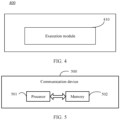
- FIG. 4 is a block diagram of a communication processing apparatus 400 according to an example embodiment of this application.
- the apparatus includes an execution module 410 configured to perform a predetermined operation based on a transmission time of a target physical downlink shared channel PDSCH, where the target PDSCH is configured as having no feedback of target hybrid automatic repeat request acknowledgement HARQ-ACK information, or there is feedback delay for target HARQ-ACK information corresponding to the target PDSCH.
- an execution module 410 configured to perform a predetermined operation based on a transmission time of a target physical downlink shared channel PDSCH, where the target PDSCH is configured as having no feedback of target hybrid automatic repeat request acknowledgement HARQ-ACK information, or there is feedback delay for target HARQ-ACK information corresponding to the target PDSCH.
- the predetermined operation includes at least one of the following: determining whether the target PDSCH corresponds to a nominal HARQ-ACK feedback time unit; determining an effective time of a target MAC CE, where the target MAC CE is carried on the target PDSCH; determining a target HARQ-ACK codebook corresponding to the target PDSCH; determining application of a first rule, where the first rule characterizes a timing relationship requirement between the target PDSCH and a feedback time corresponding to the target HARQ-ACK information; and determining start of a target discontinuous reception DRX timer, where the target DRX timer corresponds to a first HARQ process, and the first HARQ process corresponds to the target PDSCH.
- the determining, by the execution module 410, whether the target PDSCH corresponds to a nominal HARQ-ACK feedback time unit includes any one of the following: the target PDSCH not corresponding to a first nominal HARQ-ACK feedback time unit; and the target PDSCH corresponding to a first nominal HARQ-ACK feedback time unit.
- the execution module 410 is configured to perform any one of the following: determining the first nominal HARQ-ACK feedback time unit based on the transmission time and a first time indicated by predetermined indication information; and determining the first nominal HARQ-ACK feedback time unit based on the transmission time and a predefined duration; where the transmission time is a transmission end time of the target PDSCH, or the transmission time is a time unit to which the transmission end time of the target PDSCH belongs.
- the execution module 410 is configured to perform any one of the following: determining the effective time of the target MAC CE based on the transmission time; determining the effective time of the target MAC CE based on the transmission time and a first time indicated by predetermined indication information; determining the effective time of the target MAC CE based on the transmission time and a predefined duration; and in a case that the target PDSCH corresponds to a second nominal HARQ-ACK feedback time unit, determining the effective time of the target MAC CE based on the second nominal HARQ-ACK feedback time unit; where the transmission time is a transmission end time of the target PDSCH, or the transmission time is a time unit to which the transmission end time of the target PDSCH belongs.
- the execution module 410 is configured to perform any one of the following: determining the effective time of the target MAC CE based on the transmission time and a first time indicated by predetermined indication information; determining the effective time of the target MAC CE based on the transmission time and a feedback delay duration; and in a case that the target PDSCH corresponds to a second nominal HARQ-ACK feedback time unit, determining the effective time of the target MAC CE based on the second nominal HARQ-ACK feedback time unit; where the transmission time is a transmission end time of the target PDSCH, or the transmission time is a time unit to which the transmission end time of the target PDSCH belongs; and the feedback delay duration is determined based on a feedback delay time of the target HARQ-ACK information.
- the execution module 410 is configured to include any one of the following: in a case that the target PDSCH does not correspond to a second nominal HARQ-ACK feedback time unit, the target PDSCH having no corresponding target HARQ-ACK codebook; and in a case that the target PDSCH corresponds to a second nominal HARQ-ACK feedback time unit, the target PDSCH having a corresponding target HARQ-ACK codebook.
- the target HARQ-ACK codebook in a case that the target PDSCH corresponds to a target HARQ-ACK codebook, that is, in this implementation, the target HARQ-ACK codebook is an actual to-be-transmitted codebook, the target HARQ-ACK codebook may correspond to a type-1 HARQ-ACK codebook or a type-2 HARQ-ACK codebook.
- the type-1 HARQ-ACK codebook includes any one of the following: codebook including semi-persistent scheduling HARQ-ACK only; type-2 codebook (Type-2 codebook); and enhanced (enhanced) Type-2 codebook; and/or the type-2 HARQ-ACK codebook includes any one of the following: Type-1 codebook; and Type-3 codebook.
- an SPS HARQ-ACK bit sequence corresponding to the target HARQ-ACK codebook does not include a HARQ-ACK bit or HARQ-ACK bit sequence corresponding to the target PDSCH.
- the execution module 410 is further configured to perform any one of the following: reporting no HARQ-ACK information in the second nominal HARQ-ACK feedback time unit; and reporting first HARQ-ACK information in the second nominal HARQ-ACK feedback time unit, where the first HARQ-ACK information is HARQ-ACK information other than the target HARQ-ACK information.
- a first HARQ-ACK bit in the target HARQ-ACK codebook is set in any one of the following manners: setting the first HARQ-ACK bit to a first predetermined value; setting the first HARQ-ACK bit based on a decoding result of the target PDSCH; and setting the first HARQ-ACK bit as if there is no transmission of the target PDSCH; where the first HARQ-ACK bit corresponds to the target PDSCH.
- the setting the first HARQ-ACK bit as if there is no transmission of the target PDSCH includes: in a case that the target HARQ-ACK codebook corresponds to a Type-1 codebook, setting the first HARQ-ACK bit to a second predetermined value; and in a case that the target HARQ-ACK codebook corresponds to a Type-3 codebook, setting the first HARQ-ACK bit based on a first PDSCH, where the first PDSCH corresponds to a same HARQ process as the target PDSCH, and a transmission time of the first PDSCH is earlier than the transmission time of the target PDSCH.
- the execution module 410 is further configured to: in a case that the target HARQ-ACK codebook corresponds to a Type-1 codebook, calculate a physical uplink control channel PUCCH power control variable corresponding to the target HARQ-ACK codebook through any one of the following: in a case of calculating the PUCCH power control variable, incorporating the target PDSCH into a count of received PDSCHs; and in a case of calculating the PUCCH power control variable, skipping considering the target PDSCH.
- the determining application of a first rule includes any one of the following: the first rule does not apply to the target PDSCH; and the first rule applies to the target PDSCH.
- a first feedback time corresponding to the target HARQ-ACK information is a second nominal HARQ-ACK feedback time unit corresponding to the target PDSCH.
- the determining application of a first rule includes any one of the following: the first rule does not apply to the target PDSCH; and the first rule applies to the target PDSCH.
- a second feedback time of the target HARQ-ACK information corresponding to the target PDSCH is determined in any one of the following manners: determining the second feedback time based on the transmission time and a first time indicated by predetermined indication information; determining the second feedback time based on the transmission time and a feedback delay duration; and in a case that the target PDSCH corresponds to a second nominal HARQ-ACK feedback time unit, determining the second feedback time based on the second nominal HARQ-ACK feedback time unit; where the transmission time is a transmission end time of the target PDSCH, or the transmission time is a time unit to which the transmission end time of the target PDSCH belongs; and the feedback delay duration is determined based on a feedback delay time of the target HARQ-ACK information.
- the target DRX timer includes a downlink HARQ round trip time timer drx-HARQ-RTT-TimerDL and a downlink retransmission timer drx-Retransmission-TimerDL.
- the determining start of a target DRX timer includes any one of the following: skipping starting the drx-HARQ-RTT-TimerDL and the drx-Retransmission-TimerDL; starting the drx-HARQ-RTT-TimerDL, and in a case that the drx-HARQ-RTT-TimerDL expires, skipping starting the drx-Retransmission-TimerDL; starting the drx-HARQ-RTT-TimerDL, and in a case that the drx-HARQ-RTT-TimerDL expires and the first HARQ process is not decoded successfully, starting the drx-Retransmission-TimerDL; and skipping starting the drx-HARQ-RTT-TimerDL, but starting the drx-Retransmission-TimerDL.
- the starting the drx-HARQ-RTT-TimerDL includes: starting the drx-HARQ-RTT-TimerDL at a third feedback time, where the third feedback time is determined in any one of the following manners: determining the third feedback time based on the transmission time; determining the third feedback time based on the transmission time and a first time indicated by predetermined indication information; determining the third feedback time based on the transmission time and a predetermined duration; and in a case that the target PDSCH corresponds to a second nominal HARQ-ACK feedback time unit, determining the third feedback time based on the second nominal HARQ-ACK feedback time unit; where the transmission time is a transmission end time of the target PDSCH, or the transmission time is a time unit to which the transmission end time of the target PDSCH belongs.
- the predetermined indication information includes activation DCI, reactivation DCI, or higher-layer signaling.
- the predetermined duration includes a predetermined quantity of time units.
- the time unit includes any one of a symbol, a sub-slot, and a slot.
- the target PDSCH includes SPS PDSCH.
- the communication processing apparatus 400 provided in this embodiment of this application is capable of implementing the processes implemented in the method embodiments in FIG. 2 and FIG. 3 , with the same technical effects achieved. To avoid repetition, details are not described herein again.
- the communication processing apparatus 400 in this embodiment of this application may be an apparatus or may be a component, an integrated circuit, or a chip in a terminal.
- the apparatus may be a mobile terminal or a non-mobile terminal.
- the mobile terminal may include but is not limited to a type of the terminal 11 listed above, and the non-mobile terminal may be a server, a network attached storage (Network Attached Storage, NAS), a personal computer (personal computer, PC), a television (television, TV), a teller machine, a self-service machine, or the like, which is not specifically limited in this embodiment of this application.
- Network Attached Storage Network Attached Storage
- the communication processing apparatus in this embodiment of this application may be an apparatus with an operating system.
- the operating system may be an Android (Android) operating system, an iOS operating system, or other possible operating systems, and is not specifically limited in this embodiment of this application.
- an example embodiment of this application further provides a communication device 500, including a processor 501, a memory 502, a program or instructions stored in the memory 502 and capable of running on the processor 501.
- a communication device 500 including a processor 501, a memory 502, a program or instructions stored in the memory 502 and capable of running on the processor 501.
- the communication device 500 is a terminal
- the program or instructions are executed by the processor 501 to implement the processes of the foregoing communication processing method embodiment, with the same technical effects achieved.
- the communication device 500 is a network device and when the program or the instructions are executed by the processor 501, the processes of the foregoing communication processing method embodiment are implemented, with the same technical effects achieved. To avoid repetition, details are not described herein again.
- the communication device 500 may be a terminal.
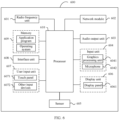
- FIG. 6 is a schematic diagram of a hardware structure of a terminal according to an example embodiment of this application.
- the terminal 600 includes but is not limited to components such as a radio frequency unit 601, a network module 602, an audio output unit 603, an input unit 604, a sensor 605, a display unit 606, a user input unit 607, an interface unit 608, a memory 609, and a processor 610.
- the terminal 600 may further include a power supply (such as a battery) for supplying power to the components.
- the power supply may be logically connected to the processor 610 via a power management system. In this way, functions such as charge management, discharge management, and power consumption management are implemented via the power management system.
- the structure of the terminal shown in FIG. 6 does not constitute any limitation on the terminal.
- the terminal may include more or fewer components than shown in the figure, or combine some of the components, or have different arrangements of the components. Details are not described herein again.
- the input unit 604 may include a graphics processing unit (Graphics Processing Unit, GPU) 1041 and a microphone 6042.
- the graphics processing unit 6041 processes image data of a static picture or video acquired by an image capture apparatus (for example, camera) in a picture capture mode or video capture mode.
- the display unit 606 may include a display panel 6061, and the display panel 6061 may be configured in a form of a liquid crystal display, an organic light-emitting diode, or the like.
- the user input unit 607 includes a touch panel 6071 and other input devices 6072.
- the touch panel 6071 is also referred to as a touchscreen.
- the touch panel 6071 may include two parts: a touch detection apparatus and a touch controller.
- the other input devices 6072 may include but are not limited to a physical keyboard, a function button (such as a volume control button or a power button), a trackball, a mouse, and a joystick. Details are not described herein.
- the radio frequency unit 601 receives downlink data from a network device, and then sends the downlink data to the processor 610 for processing; and also sends uplink data to the network device.
- the radio frequency unit 601 includes but is not limited to an antenna, at least one amplifier, a transceiver, a coupler, a low noise amplifier, and a duplexer.
- the memory 609 may be configured to store software programs or instructions and various data.
- the memory 609 may mainly include a program or instruction storage region and a data storage region.
- the program or instruction storage region may store an operating system, an application program or instructions required by at least one function (for example, an audio play function or an image play function), and the like.
- the memory 609 may include a high-speed random access memory, and may further include a non-volatile memory.
- the non-volatile memory may be a read-only memory (Read-Only Memory, ROM), a programmable read-only memory (Programmable ROM, PROM), an erasable programmable read-only memory (Erasable PROM, EPROM), an electrically erasable programmable read-only memory (Electrically EPROM, EEPROM), or a flash memory, for example, at least one magnetic disk storage device, flash storage device, or other volatile solid-state storage device.
- ROM Read-Only Memory
- PROM programmable read-only memory
- Erasable PROM Erasable PROM
- EPROM electrically erasable programmable read-only memory
- EEPROM electrically erasable programmable read-only memory
- flash memory for example, at least one magnetic disk storage device, flash storage device, or other volatile solid-state storage device.
- the processor 610 may include one or more processing units.
- the processor 610 may integrate an application processor and a modem processor.
- the application processor mainly processes an operating system, user interface, application programs or instructions, and the like.
- the modem processor mainly processes wireless communication, for example, being a baseband processor. It can be understood that the modem processor may alternatively be not integrated in the processor 610.
- the processor 610 invokes the program or instructions in the memory 609 to perform the method performed by the modules in FIG. 4 , with the same technical effects achieved. To avoid repetition, details are not described herein again.
- the communication device 500 may alternatively be a network device.
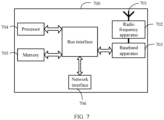
- the network device is shown in FIG. 7 which is a block diagram of a network device 700.
- the network device may include an antenna 701, a radio frequency apparatus 702, and a baseband apparatus 703.
- the antenna 701 is connected to the radio frequency apparatus 702.
- the radio frequency apparatus 702 receives information via the antenna 701, and sends the received information to the baseband apparatus 703 for processing.
- the baseband apparatus 703 processes to-be-sent information, and sends the information to the radio frequency apparatus 702; and the radio frequency apparatus 702 processes the information received and then sends the information via the antenna 701.
- the band processor may be located in the baseband apparatus 703.
- the method performed by the network device in the foregoing embodiment may be implemented by the baseband apparatus 703, and the baseband apparatus 703 includes a processor 704 and a memory 705.
- the baseband apparatus 703 may include, for example, at least one baseband board, where a plurality of chips are disposed on the baseband board. As shown in FIG. 7 , one of the chips, for example, the processor 704, is connected to the memory 705, to invoke the program in the memory 705 so as to perform the operations of the network device as given in the foregoing method embodiment.
- the baseband apparatus 703 may further include a network interface 706, configured to exchange information with the radio frequency apparatus 702, where the interface is, for example, a common public radio interface (common public radio interface, CPRI for short).
- a network interface 706, configured to exchange information with the radio frequency apparatus 702, where the interface is, for example, a common public radio interface (common public radio interface, CPRI for short).
- the network device in this embodiment of this application further includes: instructions or a program stored in the memory 705 and capable of running on the processor 704.
- the processor 704 invokes the instructions or program in the memory 705 to execute the method executed by the modules shown in FIG. 4 , with the same technical effects achieved. To avoid repetition, details are not described herein again.
- An embodiment of this application further provides a readable storage medium, where a program or instructions are stored in the readable storage medium.
- a program or instructions are stored in the readable storage medium.
- the processes of the foregoing communication processing method embodiment can be implemented, with the same technical effects achieved. To avoid repetition, details are not described herein again.
- the processor is a processor in the terminal described in the foregoing embodiment.
- the readable storage medium includes a computer-readable storage medium, for example, a computer read-only memory (Read-Only Memory, ROM), a random access memory (Random Access Memory, RAM), a magnetic disk, or an optical disc.
- An embodiment of this application further provides a chip, where the chip includes a processor and a communication interface.
- the communication interface is coupled to the processor, and the processor is configured to run a program or instructions of a network device to implement the processes of the communication processing method embodiment, with the same technical effects achieved. To avoid repetition, details are not described herein again.
- the chip mentioned in this embodiment of this application may also be referred to as a system-level chip, a system chip, a chip system, a system-on-chip, or the like.
- An embodiment of this application further provides a computer program product.
- the computer program product includes a processor, a memory, and a program or instructions stored in the memory and capable of running on the processor.
- the program or instructions are executed by the processor, the processes of the foregoing communication processing method embodiment are implemented, with the same technical effects achieved. To avoid repetition, details are not described herein again.
- the computer software product is stored in a storage medium (such as ROM/RAM, a magnetic disk, or an optical disc), and includes several instructions for instructing a terminal (which may be a mobile phone, a computer, a server, an air conditioner, a network device, or the like) to perform the methods described in the embodiments of this application.
- a storage medium such as ROM/RAM, a magnetic disk, or an optical disc
Landscapes
- Engineering & Computer Science (AREA)
- Signal Processing (AREA)
- Computer Networks & Wireless Communication (AREA)
- Mobile Radio Communication Systems (AREA)
- Detection And Prevention Of Errors In Transmission (AREA)
Applications Claiming Priority (2)
| Application Number | Priority Date | Filing Date | Title |
|---|---|---|---|
| CN202011511911.2A CN114650621B (zh) | 2020-12-18 | 2020-12-18 | 通信处理方法、装置和通信设备 |
| PCT/CN2021/138724 WO2022127849A1 (zh) | 2020-12-18 | 2021-12-16 | 通信处理方法、装置和通信设备 |
Publications (2)
| Publication Number | Publication Date |
|---|---|
| EP4266820A1 true EP4266820A1 (de) | 2023-10-25 |
| EP4266820A4 EP4266820A4 (de) | 2024-06-19 |
Family
ID=81990003
Family Applications (1)
| Application Number | Title | Priority Date | Filing Date |
|---|---|---|---|
| EP21905775.9A Pending EP4266820A4 (de) | 2020-12-18 | 2021-12-16 | Verfahren und vorrichtung zur kommunikationsverarbeitung und kommunikationsvorrichtung |
Country Status (6)
| Country | Link |
|---|---|
| US (1) | US20230318755A1 (de) |
| EP (1) | EP4266820A4 (de) |
| JP (2) | JP7662792B2 (de) |
| KR (1) | KR20230118672A (de) |
| CN (2) | CN119946916A (de) |
| WO (1) | WO2022127849A1 (de) |
Families Citing this family (4)
| Publication number | Priority date | Publication date | Assignee | Title |
|---|---|---|---|---|
| WO2022188171A1 (zh) * | 2021-03-12 | 2022-09-15 | 北京小米移动软件有限公司 | 非连续接收处理方法、装置、终端设备和存储介质 |
| JP7761664B2 (ja) * | 2021-03-16 | 2025-10-28 | オッポ広東移動通信有限公司 | 情報伝送方法、装置、デバイス及び記憶媒体 |
| CN115884339A (zh) * | 2021-09-27 | 2023-03-31 | 大唐移动通信设备有限公司 | 一种功率控制参数确定方法及装置 |
| WO2025033976A1 (ko) * | 2023-08-10 | 2025-02-13 | 엘지전자 주식회사 | 무선 통신 시스템에서 상향링크 제어 정보 송수신 방법 및 장치 |
Family Cites Families (7)
| Publication number | Priority date | Publication date | Assignee | Title |
|---|---|---|---|---|
| CN109391422B (zh) * | 2017-08-11 | 2020-11-17 | 华为技术有限公司 | 一种反馈码本确定的方法及终端设备、网络设备 |
| US11246155B2 (en) * | 2018-03-27 | 2022-02-08 | Qualcomm Incorporated | Acknowledgement feedback in unlicensed new radio |
| CN110943806B (zh) * | 2018-09-21 | 2021-10-26 | 大唐移动通信设备有限公司 | 一种混合自动重传请求确认码本的传输方法和设备 |
| CN111106903B (zh) * | 2018-10-26 | 2021-06-04 | 电信科学技术研究院有限公司 | 混合自动重传的反馈方法、接收方法、终端及网络设备 |
| CN111385080B (zh) * | 2018-12-28 | 2024-08-06 | 北京三星通信技术研究有限公司 | 发送上行控制信息的方法及设备 |
| WO2020222693A1 (en) * | 2019-05-02 | 2020-11-05 | Telefonaktiebolaget Lm Ericsson (Publ) | Hybrid automatic repeat request (harq) feedback for multiple physical downlink shared channel (pdsch) with downlink (dl) semi-persistent scheduling |
| WO2021184317A1 (zh) * | 2020-03-19 | 2021-09-23 | Oppo广东移动通信有限公司 | 生效时间的确定方法、终端及网络设备 |
-
2020
- 2020-12-18 CN CN202510367993.4A patent/CN119946916A/zh active Pending
- 2020-12-18 CN CN202011511911.2A patent/CN114650621B/zh active Active
-
2021
- 2021-12-16 WO PCT/CN2021/138724 patent/WO2022127849A1/zh not_active Ceased
- 2021-12-16 JP JP2023535044A patent/JP7662792B2/ja active Active
- 2021-12-16 EP EP21905775.9A patent/EP4266820A4/de active Pending
- 2021-12-16 KR KR1020237024132A patent/KR20230118672A/ko active Pending
-
2023
- 2023-06-06 US US18/329,998 patent/US20230318755A1/en active Pending
-
2025
- 2025-04-02 JP JP2025061287A patent/JP2025108477A/ja active Pending
Also Published As
| Publication number | Publication date |
|---|---|
| WO2022127849A1 (zh) | 2022-06-23 |
| JP7662792B2 (ja) | 2025-04-15 |
| JP2025108477A (ja) | 2025-07-23 |
| CN114650621A (zh) | 2022-06-21 |
| CN114650621B (zh) | 2025-03-21 |
| JP2023552477A (ja) | 2023-12-15 |
| US20230318755A1 (en) | 2023-10-05 |
| EP4266820A4 (de) | 2024-06-19 |
| CN119946916A (zh) | 2025-05-06 |
| KR20230118672A (ko) | 2023-08-11 |
Similar Documents
| Publication | Publication Date | Title |
|---|---|---|
| US11641646B2 (en) | Method and apparatus for receiving a transport block in a transmission occasion | |
| US10674458B2 (en) | Method and apparatus for determining transmit power sharing | |
| EP3949189B1 (de) | Verfahren und vorrichtung zur unterdrückung der übertragung auf der grundlage von überlappenden übertragungsgelegenheiten | |
| US10225826B2 (en) | Transmission of uplink control information for multiple control channel format lengths | |
| EP3738378B1 (de) | Uplink-kanalplanung zur erhaltung der kanalbelegung für unlizenziertes drahtloses spektrum | |
| US20230318755A1 (en) | Communication processing method and apparatus and communication device | |
| US10516507B2 (en) | Radio communication device | |
| CN115225218B (zh) | 旁链路反馈资源的确定方法、终端及网络侧设备 | |
| US12261700B2 (en) | Method and apparatus for semi-static HARQ-ACK codebook determination | |
| CN114374486B (zh) | Harq-ack的传输方法、终端及网络侧设备 | |
| US20180288794A1 (en) | Information transmission method, terminal, and base station | |
| US11228933B2 (en) | Method for transmitting information and terminal device | |
| US12113625B2 (en) | HARQ-ACK feedback method and apparatus | |
| US12238769B2 (en) | Method, device and computer readable medium for contention window adjustment | |
| US20240171321A1 (en) | HARQ-ACK Transmission Method and Apparatus | |
| US20240080847A1 (en) | Information transmission method and apparatus, terminal, and storage medium | |
| US20240048294A1 (en) | Pdsch transmission method and apparatus, pdsch reception method and apparatus, and communication device | |
| EP4418752A1 (de) | Signalrückkopplung mit niedriger stromaufwachung für drahtlose netzwerke | |
| CN115225222B (zh) | 传输处理方法、装置、终端及网络侧设备 | |
| WO2024125458A1 (zh) | Dci处理方法、ue和网络侧设备 | |
| CN114630367A (zh) | 数据接收方法、装置、终端及可读存储介质 |
Legal Events
| Date | Code | Title | Description |
|---|---|---|---|
| STAA | Information on the status of an ep patent application or granted ep patent |
Free format text: STATUS: THE INTERNATIONAL PUBLICATION HAS BEEN MADE |
|
| PUAI | Public reference made under article 153(3) epc to a published international application that has entered the european phase |
Free format text: ORIGINAL CODE: 0009012 |
|
| STAA | Information on the status of an ep patent application or granted ep patent |
Free format text: STATUS: REQUEST FOR EXAMINATION WAS MADE |
|
| 17P | Request for examination filed |
Effective date: 20230602 |
|
| AK | Designated contracting states |
Kind code of ref document: A1 Designated state(s): AL AT BE BG CH CY CZ DE DK EE ES FI FR GB GR HR HU IE IS IT LI LT LU LV MC MK MT NL NO PL PT RO RS SE SI SK SM TR |
|
| DAV | Request for validation of the european patent (deleted) | ||
| DAX | Request for extension of the european patent (deleted) | ||
| A4 | Supplementary search report drawn up and despatched |
Effective date: 20240522 |
|
| RIC1 | Information provided on ipc code assigned before grant |
Ipc: H04L 5/00 20060101ALI20240515BHEP Ipc: H04L 1/18 20060101ALI20240515BHEP Ipc: H04W 76/28 20180101AFI20240515BHEP |