EP4267261B1 - Appareil d'entraînement avec indicateur de progression et base unifiée pour différents types d'appareil - Google Patents
Appareil d'entraînement avec indicateur de progression et base unifiée pour différents types d'appareil Download PDFInfo
- Publication number
- EP4267261B1 EP4267261B1 EP22706414.4A EP22706414A EP4267261B1 EP 4267261 B1 EP4267261 B1 EP 4267261B1 EP 22706414 A EP22706414 A EP 22706414A EP 4267261 B1 EP4267261 B1 EP 4267261B1
- Authority
- EP
- European Patent Office
- Prior art keywords
- frame
- training
- user
- fitness
- fitness apparatus
- Prior art date
- Legal status (The legal status is an assumption and is not a legal conclusion. Google has not performed a legal analysis and makes no representation as to the accuracy of the status listed.)
- Active
Links
Images




Classifications
-
- A—HUMAN NECESSITIES
- A63—SPORTS; GAMES; AMUSEMENTS
- A63B—APPARATUS FOR PHYSICAL TRAINING, GYMNASTICS, SWIMMING, CLIMBING, OR FENCING; BALL GAMES; TRAINING EQUIPMENT
- A63B22/00—Exercising apparatus specially adapted for conditioning the cardio-vascular system, for training agility or co-ordination of movements
- A63B22/0046—Details of the support elements or their connection to the exercising apparatus, e.g. adjustment of size or orientation
-
- A—HUMAN NECESSITIES
- A63—SPORTS; GAMES; AMUSEMENTS
- A63B—APPARATUS FOR PHYSICAL TRAINING, GYMNASTICS, SWIMMING, CLIMBING, OR FENCING; BALL GAMES; TRAINING EQUIPMENT
- A63B22/00—Exercising apparatus specially adapted for conditioning the cardio-vascular system, for training agility or co-ordination of movements
- A63B22/06—Exercising apparatus specially adapted for conditioning the cardio-vascular system, for training agility or co-ordination of movements with support elements performing a rotating cycling movement, i.e. a closed path movement
- A63B22/0605—Exercising apparatus specially adapted for conditioning the cardio-vascular system, for training agility or co-ordination of movements with support elements performing a rotating cycling movement, i.e. a closed path movement performing a circular movement, e.g. ergometers
-
- A—HUMAN NECESSITIES
- A63—SPORTS; GAMES; AMUSEMENTS
- A63B—APPARATUS FOR PHYSICAL TRAINING, GYMNASTICS, SWIMMING, CLIMBING, OR FENCING; BALL GAMES; TRAINING EQUIPMENT
- A63B21/00—Exercising apparatus for developing or strengthening the muscles or joints of the body by working against a counterforce, with or without measuring devices
- A63B21/005—Exercising apparatus for developing or strengthening the muscles or joints of the body by working against a counterforce, with or without measuring devices using electromagnetic or electric force-resisters
- A63B21/0053—Exercising apparatus for developing or strengthening the muscles or joints of the body by working against a counterforce, with or without measuring devices using electromagnetic or electric force-resisters using alternators or dynamos
- A63B21/0054—Exercising apparatus for developing or strengthening the muscles or joints of the body by working against a counterforce, with or without measuring devices using electromagnetic or electric force-resisters using alternators or dynamos for charging a battery
-
- A—HUMAN NECESSITIES
- A63—SPORTS; GAMES; AMUSEMENTS
- A63B—APPARATUS FOR PHYSICAL TRAINING, GYMNASTICS, SWIMMING, CLIMBING, OR FENCING; BALL GAMES; TRAINING EQUIPMENT
- A63B21/00—Exercising apparatus for developing or strengthening the muscles or joints of the body by working against a counterforce, with or without measuring devices
- A63B21/005—Exercising apparatus for developing or strengthening the muscles or joints of the body by working against a counterforce, with or without measuring devices using electromagnetic or electric force-resisters
- A63B21/0053—Exercising apparatus for developing or strengthening the muscles or joints of the body by working against a counterforce, with or without measuring devices using electromagnetic or electric force-resisters using alternators or dynamos
- A63B21/0055—Exercising apparatus for developing or strengthening the muscles or joints of the body by working against a counterforce, with or without measuring devices using electromagnetic or electric force-resisters using alternators or dynamos the produced electric power used as a source for other equipment, e.g. for TVs
-
- A—HUMAN NECESSITIES
- A63—SPORTS; GAMES; AMUSEMENTS
- A63B—APPARATUS FOR PHYSICAL TRAINING, GYMNASTICS, SWIMMING, CLIMBING, OR FENCING; BALL GAMES; TRAINING EQUIPMENT
- A63B21/00—Exercising apparatus for developing or strengthening the muscles or joints of the body by working against a counterforce, with or without measuring devices
- A63B21/005—Exercising apparatus for developing or strengthening the muscles or joints of the body by working against a counterforce, with or without measuring devices using electromagnetic or electric force-resisters
- A63B21/0056—Exercising apparatus for developing or strengthening the muscles or joints of the body by working against a counterforce, with or without measuring devices using electromagnetic or electric force-resisters using electromagnetically-controlled friction, e.g. magnetic particle brakes
-
- A—HUMAN NECESSITIES
- A63—SPORTS; GAMES; AMUSEMENTS
- A63B—APPARATUS FOR PHYSICAL TRAINING, GYMNASTICS, SWIMMING, CLIMBING, OR FENCING; BALL GAMES; TRAINING EQUIPMENT
- A63B21/00—Exercising apparatus for developing or strengthening the muscles or joints of the body by working against a counterforce, with or without measuring devices
- A63B21/005—Exercising apparatus for developing or strengthening the muscles or joints of the body by working against a counterforce, with or without measuring devices using electromagnetic or electric force-resisters
- A63B21/0058—Exercising apparatus for developing or strengthening the muscles or joints of the body by working against a counterforce, with or without measuring devices using electromagnetic or electric force-resisters using motors
-
- A—HUMAN NECESSITIES
- A63—SPORTS; GAMES; AMUSEMENTS
- A63B—APPARATUS FOR PHYSICAL TRAINING, GYMNASTICS, SWIMMING, CLIMBING, OR FENCING; BALL GAMES; TRAINING EQUIPMENT
- A63B21/00—Exercising apparatus for developing or strengthening the muscles or joints of the body by working against a counterforce, with or without measuring devices
- A63B21/005—Exercising apparatus for developing or strengthening the muscles or joints of the body by working against a counterforce, with or without measuring devices using electromagnetic or electric force-resisters
- A63B21/0058—Exercising apparatus for developing or strengthening the muscles or joints of the body by working against a counterforce, with or without measuring devices using electromagnetic or electric force-resisters using motors
- A63B21/0059—Exercising apparatus for developing or strengthening the muscles or joints of the body by working against a counterforce, with or without measuring devices using electromagnetic or electric force-resisters using motors using a frequency controlled AC motor
-
- A—HUMAN NECESSITIES
- A63—SPORTS; GAMES; AMUSEMENTS
- A63B—APPARATUS FOR PHYSICAL TRAINING, GYMNASTICS, SWIMMING, CLIMBING, OR FENCING; BALL GAMES; TRAINING EQUIPMENT
- A63B21/00—Exercising apparatus for developing or strengthening the muscles or joints of the body by working against a counterforce, with or without measuring devices
- A63B21/008—Exercising apparatus for developing or strengthening the muscles or joints of the body by working against a counterforce, with or without measuring devices using hydraulic or pneumatic force-resisters
- A63B21/0084—Exercising apparatus for developing or strengthening the muscles or joints of the body by working against a counterforce, with or without measuring devices using hydraulic or pneumatic force-resisters by moving the surrounding water
-
- A—HUMAN NECESSITIES
- A63—SPORTS; GAMES; AMUSEMENTS
- A63B—APPARATUS FOR PHYSICAL TRAINING, GYMNASTICS, SWIMMING, CLIMBING, OR FENCING; BALL GAMES; TRAINING EQUIPMENT
- A63B21/00—Exercising apparatus for developing or strengthening the muscles or joints of the body by working against a counterforce, with or without measuring devices
- A63B21/008—Exercising apparatus for developing or strengthening the muscles or joints of the body by working against a counterforce, with or without measuring devices using hydraulic or pneumatic force-resisters
- A63B21/0085—Exercising apparatus for developing or strengthening the muscles or joints of the body by working against a counterforce, with or without measuring devices using hydraulic or pneumatic force-resisters using pneumatic force-resisters
- A63B21/0088—Exercising apparatus for developing or strengthening the muscles or joints of the body by working against a counterforce, with or without measuring devices using hydraulic or pneumatic force-resisters using pneumatic force-resisters by moving the surrounding air
-
- A—HUMAN NECESSITIES
- A63—SPORTS; GAMES; AMUSEMENTS
- A63B—APPARATUS FOR PHYSICAL TRAINING, GYMNASTICS, SWIMMING, CLIMBING, OR FENCING; BALL GAMES; TRAINING EQUIPMENT
- A63B22/00—Exercising apparatus specially adapted for conditioning the cardio-vascular system, for training agility or co-ordination of movements
- A63B22/02—Exercising apparatus specially adapted for conditioning the cardio-vascular system, for training agility or co-ordination of movements with movable endless bands, e.g. treadmills
- A63B22/0235—Exercising apparatus specially adapted for conditioning the cardio-vascular system, for training agility or co-ordination of movements with movable endless bands, e.g. treadmills driven by a motor
- A63B22/0242—Exercising apparatus specially adapted for conditioning the cardio-vascular system, for training agility or co-ordination of movements with movable endless bands, e.g. treadmills driven by a motor with speed variation
- A63B22/025—Exercising apparatus specially adapted for conditioning the cardio-vascular system, for training agility or co-ordination of movements with movable endless bands, e.g. treadmills driven by a motor with speed variation electrically, e.g. D.C. motors with variable speed control
-
- A—HUMAN NECESSITIES
- A63—SPORTS; GAMES; AMUSEMENTS
- A63B—APPARATUS FOR PHYSICAL TRAINING, GYMNASTICS, SWIMMING, CLIMBING, OR FENCING; BALL GAMES; TRAINING EQUIPMENT
- A63B22/00—Exercising apparatus specially adapted for conditioning the cardio-vascular system, for training agility or co-ordination of movements
- A63B22/06—Exercising apparatus specially adapted for conditioning the cardio-vascular system, for training agility or co-ordination of movements with support elements performing a rotating cycling movement, i.e. a closed path movement
-
- A—HUMAN NECESSITIES
- A63—SPORTS; GAMES; AMUSEMENTS
- A63B—APPARATUS FOR PHYSICAL TRAINING, GYMNASTICS, SWIMMING, CLIMBING, OR FENCING; BALL GAMES; TRAINING EQUIPMENT
- A63B22/00—Exercising apparatus specially adapted for conditioning the cardio-vascular system, for training agility or co-ordination of movements
- A63B22/16—Platforms for rocking motion about a horizontal axis, e.g. axis through the middle of the platform; Balancing drums; Balancing boards or the like
-
- A—HUMAN NECESSITIES
- A63—SPORTS; GAMES; AMUSEMENTS
- A63B—APPARATUS FOR PHYSICAL TRAINING, GYMNASTICS, SWIMMING, CLIMBING, OR FENCING; BALL GAMES; TRAINING EQUIPMENT
- A63B24/00—Electric or electronic controls for exercising apparatus of preceding groups; Controlling or monitoring of exercises, sportive games, training or athletic performances
- A63B24/0062—Monitoring athletic performances, e.g. for determining the work of a user on an exercise apparatus, the completed jogging or cycling distance
-
- A—HUMAN NECESSITIES
- A63—SPORTS; GAMES; AMUSEMENTS
- A63B—APPARATUS FOR PHYSICAL TRAINING, GYMNASTICS, SWIMMING, CLIMBING, OR FENCING; BALL GAMES; TRAINING EQUIPMENT
- A63B24/00—Electric or electronic controls for exercising apparatus of preceding groups; Controlling or monitoring of exercises, sportive games, training or athletic performances
- A63B24/0087—Electric or electronic controls for exercising apparatus of groups A63B21/00 - A63B23/00, e.g. controlling load
-
- A—HUMAN NECESSITIES
- A63—SPORTS; GAMES; AMUSEMENTS
- A63B—APPARATUS FOR PHYSICAL TRAINING, GYMNASTICS, SWIMMING, CLIMBING, OR FENCING; BALL GAMES; TRAINING EQUIPMENT
- A63B26/00—Exercising apparatus not covered by groups A63B1/00 - A63B25/00
- A63B26/003—Exercising apparatus not covered by groups A63B1/00 - A63B25/00 for improving balance or equilibrium
-
- A—HUMAN NECESSITIES
- A63—SPORTS; GAMES; AMUSEMENTS
- A63B—APPARATUS FOR PHYSICAL TRAINING, GYMNASTICS, SWIMMING, CLIMBING, OR FENCING; BALL GAMES; TRAINING EQUIPMENT
- A63B71/00—Games or sports accessories not covered in groups A63B1/00 - A63B69/00
- A63B71/02—Games or sports accessories not covered in groups A63B1/00 - A63B69/00 for large-room or outdoor sporting games
- A63B71/023—Supports, e.g. poles
-
- A—HUMAN NECESSITIES
- A63—SPORTS; GAMES; AMUSEMENTS
- A63B—APPARATUS FOR PHYSICAL TRAINING, GYMNASTICS, SWIMMING, CLIMBING, OR FENCING; BALL GAMES; TRAINING EQUIPMENT
- A63B71/00—Games or sports accessories not covered in groups A63B1/00 - A63B69/00
- A63B71/06—Indicating or scoring devices for games or players, or for other sports activities
- A63B71/0619—Displays, user interfaces and indicating devices, specially adapted for sport equipment, e.g. display mounted on treadmills
- A63B71/0622—Visual, audio or audio-visual systems for entertaining, instructing or motivating the user
-
- A—HUMAN NECESSITIES
- A63—SPORTS; GAMES; AMUSEMENTS
- A63B—APPARATUS FOR PHYSICAL TRAINING, GYMNASTICS, SWIMMING, CLIMBING, OR FENCING; BALL GAMES; TRAINING EQUIPMENT
- A63B22/00—Exercising apparatus specially adapted for conditioning the cardio-vascular system, for training agility or co-ordination of movements
- A63B22/06—Exercising apparatus specially adapted for conditioning the cardio-vascular system, for training agility or co-ordination of movements with support elements performing a rotating cycling movement, i.e. a closed path movement
- A63B22/0605—Exercising apparatus specially adapted for conditioning the cardio-vascular system, for training agility or co-ordination of movements with support elements performing a rotating cycling movement, i.e. a closed path movement performing a circular movement, e.g. ergometers
- A63B2022/0635—Exercising apparatus specially adapted for conditioning the cardio-vascular system, for training agility or co-ordination of movements with support elements performing a rotating cycling movement, i.e. a closed path movement performing a circular movement, e.g. ergometers specially adapted for a particular use
- A63B2022/0641—Exercising apparatus specially adapted for conditioning the cardio-vascular system, for training agility or co-ordination of movements with support elements performing a rotating cycling movement, i.e. a closed path movement performing a circular movement, e.g. ergometers specially adapted for a particular use enabling a lateral movement of the exercising apparatus, e.g. for simulating movement on a bicycle
-
- A—HUMAN NECESSITIES
- A63—SPORTS; GAMES; AMUSEMENTS
- A63B—APPARATUS FOR PHYSICAL TRAINING, GYMNASTICS, SWIMMING, CLIMBING, OR FENCING; BALL GAMES; TRAINING EQUIPMENT
- A63B22/00—Exercising apparatus specially adapted for conditioning the cardio-vascular system, for training agility or co-ordination of movements
- A63B22/06—Exercising apparatus specially adapted for conditioning the cardio-vascular system, for training agility or co-ordination of movements with support elements performing a rotating cycling movement, i.e. a closed path movement
- A63B22/0605—Exercising apparatus specially adapted for conditioning the cardio-vascular system, for training agility or co-ordination of movements with support elements performing a rotating cycling movement, i.e. a closed path movement performing a circular movement, e.g. ergometers
- A63B2022/0635—Exercising apparatus specially adapted for conditioning the cardio-vascular system, for training agility or co-ordination of movements with support elements performing a rotating cycling movement, i.e. a closed path movement performing a circular movement, e.g. ergometers specially adapted for a particular use
- A63B2022/0658—Exercising apparatus specially adapted for conditioning the cardio-vascular system, for training agility or co-ordination of movements with support elements performing a rotating cycling movement, i.e. a closed path movement performing a circular movement, e.g. ergometers specially adapted for a particular use for cycling with a group of people, e.g. spinning classes
-
- A—HUMAN NECESSITIES
- A63—SPORTS; GAMES; AMUSEMENTS
- A63B—APPARATUS FOR PHYSICAL TRAINING, GYMNASTICS, SWIMMING, CLIMBING, OR FENCING; BALL GAMES; TRAINING EQUIPMENT
- A63B24/00—Electric or electronic controls for exercising apparatus of preceding groups; Controlling or monitoring of exercises, sportive games, training or athletic performances
- A63B24/0062—Monitoring athletic performances, e.g. for determining the work of a user on an exercise apparatus, the completed jogging or cycling distance
- A63B2024/0068—Comparison to target or threshold, previous performance or not real time comparison to other individuals
-
- A—HUMAN NECESSITIES
- A63—SPORTS; GAMES; AMUSEMENTS
- A63B—APPARATUS FOR PHYSICAL TRAINING, GYMNASTICS, SWIMMING, CLIMBING, OR FENCING; BALL GAMES; TRAINING EQUIPMENT
- A63B24/00—Electric or electronic controls for exercising apparatus of preceding groups; Controlling or monitoring of exercises, sportive games, training or athletic performances
- A63B24/0087—Electric or electronic controls for exercising apparatus of groups A63B21/00 - A63B23/00, e.g. controlling load
- A63B2024/0093—Electric or electronic controls for exercising apparatus of groups A63B21/00 - A63B23/00, e.g. controlling load the load of the exercise apparatus being controlled by performance parameters, e.g. distance or speed
-
- A—HUMAN NECESSITIES
- A63—SPORTS; GAMES; AMUSEMENTS
- A63B—APPARATUS FOR PHYSICAL TRAINING, GYMNASTICS, SWIMMING, CLIMBING, OR FENCING; BALL GAMES; TRAINING EQUIPMENT
- A63B71/00—Games or sports accessories not covered in groups A63B1/00 - A63B69/00
- A63B71/02—Games or sports accessories not covered in groups A63B1/00 - A63B69/00 for large-room or outdoor sporting games
- A63B71/023—Supports, e.g. poles
- A63B2071/025—Supports, e.g. poles on rollers or wheels
-
- A—HUMAN NECESSITIES
- A63—SPORTS; GAMES; AMUSEMENTS
- A63B—APPARATUS FOR PHYSICAL TRAINING, GYMNASTICS, SWIMMING, CLIMBING, OR FENCING; BALL GAMES; TRAINING EQUIPMENT
- A63B71/00—Games or sports accessories not covered in groups A63B1/00 - A63B69/00
- A63B71/02—Games or sports accessories not covered in groups A63B1/00 - A63B69/00 for large-room or outdoor sporting games
- A63B71/023—Supports, e.g. poles
- A63B2071/026—Supports, e.g. poles stabilised by weight
-
- A—HUMAN NECESSITIES
- A63—SPORTS; GAMES; AMUSEMENTS
- A63B—APPARATUS FOR PHYSICAL TRAINING, GYMNASTICS, SWIMMING, CLIMBING, OR FENCING; BALL GAMES; TRAINING EQUIPMENT
- A63B71/00—Games or sports accessories not covered in groups A63B1/00 - A63B69/00
- A63B71/06—Indicating or scoring devices for games or players, or for other sports activities
- A63B71/0619—Displays, user interfaces and indicating devices, specially adapted for sport equipment, e.g. display mounted on treadmills
- A63B2071/065—Visualisation of specific exercise parameters
-
- A—HUMAN NECESSITIES
- A63—SPORTS; GAMES; AMUSEMENTS
- A63B—APPARATUS FOR PHYSICAL TRAINING, GYMNASTICS, SWIMMING, CLIMBING, OR FENCING; BALL GAMES; TRAINING EQUIPMENT
- A63B22/00—Exercising apparatus specially adapted for conditioning the cardio-vascular system, for training agility or co-ordination of movements
- A63B22/0015—Exercising apparatus specially adapted for conditioning the cardio-vascular system, for training agility or co-ordination of movements with an adjustable movement path of the support elements
- A63B22/0023—Exercising apparatus specially adapted for conditioning the cardio-vascular system, for training agility or co-ordination of movements with an adjustable movement path of the support elements the inclination of the main axis of the movement path being adjustable, e.g. the inclination of an endless band
-
- A—HUMAN NECESSITIES
- A63—SPORTS; GAMES; AMUSEMENTS
- A63B—APPARATUS FOR PHYSICAL TRAINING, GYMNASTICS, SWIMMING, CLIMBING, OR FENCING; BALL GAMES; TRAINING EQUIPMENT
- A63B22/00—Exercising apparatus specially adapted for conditioning the cardio-vascular system, for training agility or co-ordination of movements
- A63B22/0076—Rowing machines for conditioning the cardio-vascular system
-
- A—HUMAN NECESSITIES
- A63—SPORTS; GAMES; AMUSEMENTS
- A63B—APPARATUS FOR PHYSICAL TRAINING, GYMNASTICS, SWIMMING, CLIMBING, OR FENCING; BALL GAMES; TRAINING EQUIPMENT
- A63B2209/00—Characteristics of used materials
-
- A—HUMAN NECESSITIES
- A63—SPORTS; GAMES; AMUSEMENTS
- A63B—APPARATUS FOR PHYSICAL TRAINING, GYMNASTICS, SWIMMING, CLIMBING, OR FENCING; BALL GAMES; TRAINING EQUIPMENT
- A63B2210/00—Space saving
- A63B2210/50—Size reducing arrangements for stowing or transport
-
- A—HUMAN NECESSITIES
- A63—SPORTS; GAMES; AMUSEMENTS
- A63B—APPARATUS FOR PHYSICAL TRAINING, GYMNASTICS, SWIMMING, CLIMBING, OR FENCING; BALL GAMES; TRAINING EQUIPMENT
- A63B2220/00—Measuring of physical parameters relating to sporting activity
- A63B2220/10—Positions
- A63B2220/13—Relative positions
-
- A—HUMAN NECESSITIES
- A63—SPORTS; GAMES; AMUSEMENTS
- A63B—APPARATUS FOR PHYSICAL TRAINING, GYMNASTICS, SWIMMING, CLIMBING, OR FENCING; BALL GAMES; TRAINING EQUIPMENT
- A63B2220/00—Measuring of physical parameters relating to sporting activity
- A63B2220/30—Speed
- A63B2220/31—Relative speed
-
- A—HUMAN NECESSITIES
- A63—SPORTS; GAMES; AMUSEMENTS
- A63B—APPARATUS FOR PHYSICAL TRAINING, GYMNASTICS, SWIMMING, CLIMBING, OR FENCING; BALL GAMES; TRAINING EQUIPMENT
- A63B2220/00—Measuring of physical parameters relating to sporting activity
- A63B2220/40—Acceleration
-
- A—HUMAN NECESSITIES
- A63—SPORTS; GAMES; AMUSEMENTS
- A63B—APPARATUS FOR PHYSICAL TRAINING, GYMNASTICS, SWIMMING, CLIMBING, OR FENCING; BALL GAMES; TRAINING EQUIPMENT
- A63B2220/00—Measuring of physical parameters relating to sporting activity
- A63B2220/50—Force related parameters
- A63B2220/51—Force
-
- A—HUMAN NECESSITIES
- A63—SPORTS; GAMES; AMUSEMENTS
- A63B—APPARATUS FOR PHYSICAL TRAINING, GYMNASTICS, SWIMMING, CLIMBING, OR FENCING; BALL GAMES; TRAINING EQUIPMENT
- A63B2220/00—Measuring of physical parameters relating to sporting activity
- A63B2220/80—Special sensors, transducers or devices therefor
-
- A—HUMAN NECESSITIES
- A63—SPORTS; GAMES; AMUSEMENTS
- A63B—APPARATUS FOR PHYSICAL TRAINING, GYMNASTICS, SWIMMING, CLIMBING, OR FENCING; BALL GAMES; TRAINING EQUIPMENT
- A63B2220/00—Measuring of physical parameters relating to sporting activity
- A63B2220/80—Special sensors, transducers or devices therefor
- A63B2220/806—Video cameras
-
- A—HUMAN NECESSITIES
- A63—SPORTS; GAMES; AMUSEMENTS
- A63B—APPARATUS FOR PHYSICAL TRAINING, GYMNASTICS, SWIMMING, CLIMBING, OR FENCING; BALL GAMES; TRAINING EQUIPMENT
- A63B2225/00—Miscellaneous features of sport apparatus, devices or equipment
- A63B2225/09—Adjustable dimensions
-
- A—HUMAN NECESSITIES
- A63—SPORTS; GAMES; AMUSEMENTS
- A63B—APPARATUS FOR PHYSICAL TRAINING, GYMNASTICS, SWIMMING, CLIMBING, OR FENCING; BALL GAMES; TRAINING EQUIPMENT
- A63B2225/00—Miscellaneous features of sport apparatus, devices or equipment
- A63B2225/09—Adjustable dimensions
- A63B2225/096—Adjustable dimensions automatically adjusted according to anthropometric data of the user
-
- A—HUMAN NECESSITIES
- A63—SPORTS; GAMES; AMUSEMENTS
- A63B—APPARATUS FOR PHYSICAL TRAINING, GYMNASTICS, SWIMMING, CLIMBING, OR FENCING; BALL GAMES; TRAINING EQUIPMENT
- A63B2225/00—Miscellaneous features of sport apparatus, devices or equipment
- A63B2225/50—Wireless data transmission, e.g. by radio transmitters or telemetry
Definitions
- the invention relates to a training device, also called a fitness device, such as an ergometer, a speed bike, a recumbent bike, a bicycle exercise bike or ergometer without watt functionality, a rowing machine, an elliptical trainer, a cross trainer or even a treadmill.
- a training device also called a fitness device
- Such training or fitness devices of different device types are used in particular for use at home as an exercise bike or in a fitness studio.
- FIG. 10 Another type of training equipment that has a stand for holding a regular bicycle on its rear axle is known to be placed on a platform-like base ( US 10,434,394 B2 ).
- the platform is tiltable and can also be moved lengthways on the substructure using a curved roller track.
- the bend in the roller track creates a stable central position around which the platform can perform a passive oscillating lengthwise movement; the same applies to a back and forth movement as a lateral inclination. This gives the user a certain illusion of movement and promotes the user's balancing ability.
- KR 2019 0029151 A discloses an ergometer with an actuator which is intended to move the frame with seat and pedal unit in the longitudinal direction by motor.
- different types of fitness equipment are provided, such as ergometers, speed bikes, recumbent bikes, exercise bikes, rowing machines, elliptical trainers, cross trainers or treadmills, with the fitness equipment being designed as a device of one of these different types of equipment.
- the design concept according to the invention works for a fitness device of each of the above-mentioned device types.
- the design structure or platform is unified for all device types, i.e. a design basis is created on which different types of equipment can be built externally. This is in turn made possible by the design features of such a structure or base, described below.
- the fitness device comprises a frame on which the drive device and a power transmission device are arranged, wherein the frame is further designed to Users of the fitness equipment to carry it while performing fitness exercises as well as a stand that supports the frame for resting it on a surface.
- the fitness device is equipped with at least one sensor for recording the training performance provided by the user and with a control device, wherein the control device is designed to receive data from at least one sensor.
- the control device interacts with a computing unit, wherein the computing unit is designed to determine a so-called success measure from the training performance provided by the user.
- a success measure is understood to be a quantifiable measure that provides an image of the training performance provided by the user.
- the fitness device also includes a signal unit that is designed to generate a signal for a so-called progress indicator based on the determined success measure.
- a progress indicator is understood to be a measure that is calculated from the above-mentioned success measure in relation to a selectable reference.
- the above-mentioned advantage that the fitness equipment of every type can be manufactured on a structurally unified structure or basis for fitness equipment of different types is due to the special features of this structure.
- the frame or stand of the fitness equipment has rollers which are arranged on the frame or stand in such a way that the frame can be positioned in a way that prevents it from tipping over relative to the ground and the frame or the frame together with the stand can be moved longitudinally relative to the ground.
- the fitness device has at least one actuator which is designed to move the frame relative to the stand or the frame together with the stand relative to the ground in the longitudinal direction by means of the rollers depending on the signal produced by the signal unit based on the success measure.
- the fitness device according to the invention can be designed as an ergometer, a speed bike, a recumbent bike, an exercise bike, a rowing machine, an elliptical trainer, a cross trainer or a treadmill.
- Such fitness devices which belong to different types of equipment, often have different dimensions.
- a treadmill will normally have a wider frame than, for example, an ergometer, speed bike or exercise bike, and a rowing machine or a recumbent bike will normally have a longer frame than an ergometer, speed bike or treadmill. Therefore, the dimensions of the respective stands for fitness devices of different types of equipment are also adapted accordingly.
- the stand that is intended to support the frame of a rowing machine can be designed to be correspondingly longer and the stand for a treadmill can be designed to be correspondingly wider, but the construction-technical structure or design for training or fitness devices of different types of equipment remains the same.
- the dimensions of the respective device stand can be compensated for by a telescopic design of the stand.
- the stand for a rowing machine can simply be extended to be longer and the stand for a treadmill can simply be extended to be wider.
- fitness equipment such as an ergometer, a speed bike and a stationary bike (ie ergometer without watt functionality) have approximately the same dimensions.
- the same stand can therefore be used for devices of these types.
- the devices can be easily exchanged by the user themselves due to a unified structure or base, for example an ergometer be replaced by a speed bike.
- a fitness device has at least one roller which is driven by a servomotor of the actuator, so that a longitudinal displacement of the frame or the frame together with the stand relative to the ground can be generated.
- a fitness device has at least one sensor for detecting the training performance of the user.
- the sensor can be arranged on the drive device and/or on the power transmission device.
- One or more of the above-mentioned rollers can preferably be designed as a friction roller, a toothed roller, a toothed roller, a sliding roller and/or a running roller.
- a fitness device is designed as an ergometer, a speed bike, a recumbent bike or an exercise bike.
- the stand of such a fitness device namely an ergometer, a speed bike, a recumbent bike or an exercise bike, can be formed by two crossbeams, at each end of which a roller is arranged, wherein the rollers rest on the ground, and wherein at least two rollers are driven by a servomotor.
- the stand can be formed by two crossbeams, at the ends of which sliders and/or rollers are arranged, which rest on the ground, whereby the at least one roller driven by the servomotor can either be used as a steerable Central roller or as a set of driven rollers arranged on a boom between the crossbeams.
- the rollers of a fitness device namely an ergometer, a speed bike, a recumbent bike or an exercise bike
- a fitness device namely an ergometer, a speed bike, a recumbent bike or an exercise bike
- the at least one driven roller is designed to move the frame relative to the stationary stand and thus also relative to the ground.
- the computing unit of the fitness device is designed to control the actuator reversibly.
- the signal unit of the fitness device interacts with an amplifier module which is designed to take into account an acceleration provided by the training performance for the progress indicator.
- the actuator of the fitness device is provided with an end position detection device, which is designed to switch off and/or reverse the actuator when an end position is reached.
- the actuator can be designed to be form-fitting.
- the actuator of the fitness device is designed as a crawling drive which drives the at least one roller at a speed which is lower than walking speed and at most 1 m/s.
- the actuator of the fitness device has a traction control for the at least one driven roller, wherein a detected slip of the at least one driven roller is fed back to the computing unit.
- the actuator of the fitness device has a device for position detection, which is designed to output a signal to the computing unit.
- the device for position detection has a sensor, wherein the sensor is designed to detect ground track markings.
- the ground track markings can be designed as track markings with distance markings.
- the ground track markings can be designed as marking tape.
- the marking tape can be arranged on the ground.
- the fitness device can have an alignment module, wherein the alignment module is designed to detect and display directional deviations based on the floor track markings.
- the alignment module is designed to indicate a correction direction.
- the preferred features of the training or fitness device according to the invention described above contribute to the user of the fitness device being able to experience an increased illusion of training success, which leads to increased training performance and thus also to better real fitness of the user.
- the rollers of the fitness device can be arranged on the frame or on the stand in such a way that, for example, a longitudinal displacement of the frame or the frame together with the stand relative to the ground is possible, minimizing the risk of crushing.
- the frame of the fitness device is arranged in relation to the stand with the help of rollers in such a way that the extremities of the User's feet, for example, are not normally affected - in contrast to a printed KR 20190029151 A known device - between the frame and the stand.
- This safety aspect is particularly important when the fitness equipment is used by the user without the supervision of another person, for example without the supervision of medical personnel in hospitals or doctor's offices, which is usually the case in gyms or at home.
- an ergometer in particular a bicycle ergometer, with a tilt-resistant frame on which a seat for a user and a pedal unit to be operated by the user are arranged, and a stand supporting the frame with feet for resting on a surface, wherein the pedal unit acts on a braking device, and a control device is provided which controls the braking device and to which at least one sensor is connected for detecting a training performance provided by the user
- the invention provides that the control device interacts with a computing unit which is designed to determine a measure of success from the training performance provided by the user in relation to a training reference, and with a signal unit which generates a signal for a progress indicator based on the measure of success
- an actuator is provided which motor-drivenly moves the frame with the seat and pedal unit in the longitudinal direction (so that its relative position to the surface changes), wherein the actuator is automatically controlled by the computing unit depending on the signal for the progress indicator.
- An ergometer is usually understood to be a training device that is designed for use indoors (gym, room in the user's home). Of course, an ergometer can also be set up outdoors.
- a pedal unit is the device with which the user predominantly exerts his training force. This usually happens with the lower extremities such as legs or feet, for example with a stationary bike or bicycle trainer, indoor cycling bike (especially without freewheel), treadmill training device or cross trainer. However, this term should be understood in a broader sense and also refer to the upper extremities, as they are used in particular with rowing machines or similar training devices to exert training force.
- a stand is the component of the supporting structure of the ergometer with which the ergometer stands on a surface, in particular the floor of the room or the fitness studio.
- the longitudinal direction is a direction that is predominantly oriented parallel to the surface (horizontally), approximately along a longitudinal axis of the ergometer.
- the training force applied by the user results in a certain training work, the quotient of which by time gives the training performance.
- the training force exerted by the user and the resulting training performance cannot be easily dissipated in an indoor ergometer, unlike, for example, in an outdoor ergometer in the Naturally moving bicycle, where the training effort is used to increase the speed and overcome air resistance.
- these natural resistances are replaced by a braking device.
- This can be designed in various known ways, for example as a friction braking device, as a magnetically acting braking device, as a generator for generating electrical energy or as a braking device acting against a fluid (e.g. a fan or elements rotating in a water container).
- the training reference can be artificially created, for example calculated by a computer on the ergometer, it can result from stored courses (for example, the user's previous training performance), and/or it can also result from the training performance of other users who have previously used the same device or who use or have used another similar device that is connected to the ergometer via a (remote) data connection, in particular the Internet.
- stored courses for example, the user's previous training performance
- remote data connection
- the progress indicator is a measure calculated from the success measure in relation to a selectable reference.
- a selectable reference For example, in the case of a bicycle ergometer or a treadmill training device, it can be the ratio of the distance covered
- the distance to a previously determined target distance can be used as a reference, e.g. which part of a 10,000-meter run has already been completed or which part of a 50 km bike training session.
- it can also be a relative measure, for example the progress achieved relative to another training session, e.g. your own previous training session (racing against yourself) or compared to the training performance of another user on another training device.
- the motor displacement of the frame with seat and pedal unit in the longitudinal direction means that the relative position of the frame with seat and pedal unit to the surface on which the ergometer training device is arranged changes in the longitudinal direction of the training unit.
- An actuator is a servo drive with a control unit that changes the position of a component of the ergometer training device (or the entire device if necessary) by a predetermined amount in a direction specified (by the design of the ergometer) in a controlled or regulated manner.
- a position feedback in which the position change caused by the servo drive is recorded and fed back to a control unit of the servo drive.
- the energy required for the servo drive can preferably be taken from the ergometer training device's own energy storage unit or generated by a generator (e.g. auxiliary generator on the braking device or generator as braking device); however, an external supply using a power cable or similar should not be ruled out.
- the invention ensures that the user on the ergometer moves slowly but noticeably depending on his training performance. In this way, the user is able to see the result of his effort directly. makes clear what motivates the user. This creates an incentive to continue training, as the user can intuitively see what and how much they have achieved based on the movement caused by the actuator. This applies both to an individual user, for whom the completed part of a previously determined training spectrum is made clear and tangible in this way. This is particularly true for increasing comparability between multiple users, e.g. in a fitness studio, where the user with the highest training performance slowly moves ahead of the other users with lower training performance.
- the user can immediately and physically experience how he is doing in relation to a training task and/or what his position is in relation to other participants, whereby the improvement (or deterioration) of his training performance is made clear to him by adjusting the actuator.
- the actuator is reversibly controlled, especially by the computing unit. This means that the user can not only move forwards, depending on his training performance, but can also move in the opposite direction, i.e. backwards. The latter makes it clear to the user that his training performance has decreased.
- the reference here can be the user's previous performance, a specified reference in writing or the training performance of other users.
- the signal unit expediently works together with an amplifier module which is designed to take into account further parameters for the progress indicator, in particular acceleration and/or speed achieved through training performance. For example, if the acceleration, i.e. the increase in a user's training performance, is evaluated by the amplifier module in addition to the position achieved, the user's most recent increase in performance can be magnified, so to speak, by a stronger movement of the actuator. This results in a kind of magnifying glass effect, in which position battles between two users are clearly highlighted and even small advances are made clear by the magnification caused by the amplifier module, resulting in a special motivational effect.
- acceleration i.e. the increase in a user's training performance
- the user's most recent increase in performance can be magnified, so to speak, by a stronger movement of the actuator.
- the amplifier module is preferably also designed to perform compression in the time domain.
- the adjustment can not only be continuous, but can also be discontinuous. With discontinuous adjustment, for example, the adjustment is made forwards in pulses if the user's training performance is appropriate. The resulting acceleration increases the effect experience for the user. If the user's training performance is constant, the adjustment can then be made slowly (imperceptibly) in order to be able to adjust forwards again with a pulse afterwards if necessary. If the performance drops, the adjustment can also be made quickly back again if necessary.
- the actuator is advantageously provided with an end position detection device, which is designed to switch off and/or reverse the actuator when an end position is reached. This prevents the maximum deflection of the actuator from being exceeded, which benefits the operational and/or stability of the ergometer.
- the actuator is designed to be positively locked. Although it cannot be ruled out that it also works with a force lock, a positively locked actuator makes it easier to reach a predefined position precisely. In this way, incorrect positioning due to slippage, which can occur with actuators based on friction, can be practically eliminated.
- the actuator is arranged between the frame and the stand, so that the frame can be moved relative to the stand.
- This opens up the possibility of the actuator to be integrated into the stand in a space-saving manner. This also results in a low center of gravity.
- the actuator is arranged on the movable frame. This design can be useful if relatively large adjustment paths are planned for the actuator and/or the actuator includes long guides, in particular telescopic guides.
- the stand is provided with castors and the actuator is arranged on the stand, with the actuator driving at least one of the castors.
- a castor is understood here to be a foot with which the stand stands on the floor, whereby the foot is not a rigid body but is provided with a roller.
- the actuator is expediently designed as a crawling drive that drives at least one of the castors at a low speed that is lower than walking speed, preferably at most 1 m/s or at most at a safe speed as defined in the relevant Machinery Directive. This counteracts any danger due to an ergometer moving too quickly in the confined environment of a room or a space within a building.
- All feet of the stand are expediently designed as roller feet, of which at least one, preferably two, are driven by the actuator. If there are two driven roller feet, one is preferably arranged on the left and one on the right of the stand, viewed in the longitudinal direction.
- the actuator has a traction control device for the roller foot, whereby preferably detected Slippage of at least one driven roller base is fed back to the computing unit.
- a traction control device for the roller foot whereby preferably detected Slippage of at least one driven roller base is fed back to the computing unit.
- roller bases are driven and any slip detected is compensated for.
- the roller foot on which slippage has occurred is additionally driven in order to achieve the desired slip compensation.
- the actuator is expediently provided with a device for position detection, the signal of which is fed back to the computing unit. With such a feedback, a precisely defined displacement distance can be set and achieved by the actuator.
- the position detection device is equipped with a sensor that is designed to detect floor markings. This means that the floor of the room or the fitness studio can be used for position detection.
- the floor markings are preferably designed as a marking tape, which can also preferably be glued to the base. This makes it easy to create the required floor markings in any room or space, namely by simply rolling out the tape on the floor and attaching it by gluing if necessary.
- the floor markings are designed as a track marking with distance markings.
- the achieved displacement distance can be recorded using the distance markings, and the straightness of the displacement distance can be ensured using the track markings.
- Ensuring the straightness of the displacement distance is particularly important in cases where several ergometers are arranged relatively close to one another, as is typically the case in fitness studios.
- By aligning the ergometers in parallel overlapping of the displacement distances can be avoided, but only if the displacement distance of the respective ergometer is straight and there are no deviations from it. This can be achieved by designing the floor markings as track markings for the respective ergometer.
- an alignment module can be provided which is designed to detect and display directional deviations based on the ground markings, wherein a correction direction is preferably also displayed.
- a correction direction is preferably also displayed.
- the correction device acts on at least two castors and controls them with a differential speed that depends on a desired correction effect. In this way, the desired straight course of the displacement path can be achieved automatically.
- the actuator with its own energy source on the ergometer, in particular a storage device and/or (auxiliary) generator.
- This makes the ergometer independent of an external energy supply. This is a significant advantage, especially for the version with castors, as otherwise there would be a risk that the energy supply cables would be too short depending on the distance to be moved or would pose a tripping hazard for users.
- a wireless supply is also advantageous when several ergometers are set up next to each other, in order to avoid mutual interference.
- transport rollers on the stand, which are preferably not driven.
- the transport rollers allow the user to easily move the ergometer after training, for example, in order to put it away.
- the transport rollers are preferably arranged in such a way that they only reach the ground when the stand is raised on one side, thus allowing it to roll away. When the stand is completely on the ground, they are spaced away from the ground so that the stand cannot roll away but remains immovable in its place.
- the ergometer can be a bicycle, a rowing machine or a treadmill.
- the user position is formed by a seat, whereas the treadmill naturally has no seat. Instead, the seat is replaced by the user position, which is defined by the location on the treadmill where the user is located when the treadmill is being used.
- the pedal unit is understood to mean the corresponding actuators (the rowing handles or the moving treadmill).
- the invention further extends to a corresponding method for operating the ergometer, in particular controlling the actuator. It also relates to a method for operating an ergometer, in particular a bicycle ergometer, with a tilt-stable frame on which a seat for a user and a pedal unit are arranged, and a stand supporting the frame with feet for resting on a surface, wherein the pedal unit acts on a braking device, comprising actuation of the pedal unit by the user, detection of a training performance provided by the user by means of a sensor and control of the braking device by means of a control device to which the sensor is connected, wherein the invention further provides for determining a measure of success from the training performance provided by the user in relation to a training reference, generating a signal for a progress indicator based on the measure of success and automatically controlling an actuator depending on the signal for the progress indicator, whereby the actuator motor-drivenly moves the frame with the seat and the pedal unit in the longitudinal direction.
- the method further comprises exchanging data, in particular including training data and/or data for the success measure, with other ergometers via a networking unit.
- provision can also be made for generating the training reference in relation to users on the other ergometers.
- the other ergometers can be located locally, e.g. in the same fitness studio when networked in particular via LAN, WLAN or Bluetooth, or remotely, when networked in particular via a WAN (Wide Area Network) or the Internet.
- the actuator of the respective ergometers is preferably adjusted so that the ergometers are positioned according to a relative placement of the users.
- a relative placement can be determined, optionally including the amplifier module as described above.
- virtual competitions can be carried out with other users on other ergometers.
- the user can be moved forward by the actuator if he is better (has a higher level of success) than the other users, or he can be moved back if he is worse, i.e. falls behind relative to the other users.
- the process can make this very tangible for the user, which increases motivation and thus also training performance.
- the device and method can further be provided with the other ergometers being substations and receiving communication signals such as training instructions and send appropriate feedback, are exchanged via the networking unit.
- the other ergometers being substations and receiving communication signals such as training instructions and send appropriate feedback, are exchanged via the networking unit.
- one of the ergometers acts as a master, e.g. it is a trainer or instructor station from which one or more substations with training users are controlled.
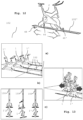
- Figures 1a and 1b show perspective overall views of examples of a construction-technically unified base or structure for fitness equipment 1 of different equipment types 1a, 1b, 1c, 1d, 1e, namely structures with concealed ( Fig. 1a ) and open ( Fig. 1b ) Rolls 48, 49, 48', 49'.
- the fitness device 1 comprises a drive device 27 for receiving a training performance provided by a user and a power transmission device 21 for transmitting the power provided by the user during training to the drive device 27.
- the present invention provides for different types of fitness equipment 1, eg ergometers 1a, speed bikes 1a', recumbent bikes, exercise bikes, rowing machines 1b, elliptical trainers 1c, cross trainers 1d or treadmills 1e.
- the fitness equipment 1 is designed as a device of one of these different device types 1a, 1a ⁇ , 1b, 1c, 1d, 1e.
- the construction-technical structure or basis for all device types 1a, 1a ⁇ , 1b, 1c, 1d, 1e is designed uniformly in terms of the construction concept, ie unified.
- the fitness device 1 also comprises a frame 2, 2a, 2b on which the drive device 27 and a power transmission device 21 are arranged, wherein the frame 2, 2a, 2b is further designed to support the user of the fitness device 1 during the performance of fitness exercises, as well as a stand 3, 3' supporting the frame 2 for resting on a surface.
- the power transmission device 21 can be designed differently for devices 1 of different device types, e.g. as a pedal unit 21, 21a in an ergometer 1a or a speed bike 1a', a pull rope 21b in a rowing machine 1b, as running arms, including movable arms 21c, 21d and pedal arms 21c', 21d', in an elliptical trainer 1c and a cross trainer 1d or as a running belt 21e in a treadmill 1e.
- devices 1 of different device types e.g. as a pedal unit 21, 21a in an ergometer 1a or a speed bike 1a', a pull rope 21b in a rowing machine 1b, as running arms, including movable arms 21c, 21d and pedal arms 21c', 21d', in an elliptical trainer 1c and a cross trainer 1d or as a running belt 21e in a treadmill 1e.
- Such a longitudinal displacement X, X' of the frame 2 relative to the column 3 or of the frame 2 together with the column 3 ⁇ relative to the ground is ensured by means of at least one actuator 9 depending on a measure of success of the user training.
- the fitness device 1 has at least one sensor 26 for detecting the training performance provided by the user and a control device 6, wherein the control device 6 is designed to receive data from at least one sensor 26.
- the control device 6 interacts with a computing unit 7, wherein the computing unit 7 is designed to determine a so-called measure of success from the training performance provided by the user.
- the fitness device 1 also comprises a signal unit 8, which is designed to generate a signal 80 for a so-called progress indicator based on the determined measure of success, whereby the above-mentioned longitudinal displacement X, X' of the frame 2 relative to the stand 3 or of the frame 2 together with the stand 3' relative to the ground is controlled.
- the embodiments shown for the ergometers according to the invention are bicycle ergometers.
- the invention is not limited to this and can also be provided for other types of fitness equipment or other types of ergometers, in particular recumbent bike ergometers, treadmill ergometers, cross trainers and/or rowing machine ergometers.
- a bicycle ergometer according to a first embodiment of the invention, as in Figure 1i shown, comprises as main components a frame 2, on which a seat 20 for a user and a handlebar-type handle 22 are arranged, as well as a stand 3, which carries the frame 2 and on which the frame 2 is arranged in a tilt-resistant manner.
- the stand 3 is provided with feet 4, by means of which it stands firmly on a floor or other suitable surface.
- a pedal unit 21 is assigned to the seat 20 and so arranged so that a user sitting on the seat 20 can operate the pedal unit 21 with his legs and can support himself on the handle 22.
- the user applies the training power to the pedal unit 21, which is then absorbed by the pedal unit 21 and fed into the bicycle ergometer and is typically absorbed by a braking device 27.
- the braking device 27 is designed as a magnetic brake wheel, but other alternative types of braking device known to those skilled in the art are also possible, examples being brake bands or regenerative braking devices.
- the frame 2 is actuated by means of an actuator 9, which is installed largely concealed in the embodiment shown (in Figure 1 not shown), longitudinally movable relative to the stand 3. Starting from a middle position, as shown in Figure 1 As shown, the position of the frame 2 with the user on the seat saddle 20 can thus be adjusted longitudinally forwards (in Figure 1 to the right) and preferably also in the opposite direction, i.e. longitudinally backwards (in Figure 1 to the left) using actuator 9.
- the guide comprises a pair of U-shaped guide rails 90, which are arranged in opposite directions on the long sides of the stand 3.
- the term "opposite direction” means that the open side of the "U” of the guide rails 90 both face inwards (see Figure 2a ) or both are arranged outwards (see Figure 2b ).
- the guide rails 90 two rollers run on each side, of which one roller 48 (in Figure 2 not shown) is not driven and the other roller 49 is driven by a servomotor 94 of the actuator 9.
- the frame By rotating in one direction, the frame can be moved forwards, and correspondingly by rotating the spindle 90' in the other direction, the frame 3 can be moved back relative to the stand 3.
- the spindle 90' can also be installed in a concealed manner, for example in the interior of a U-profile with an opening facing inwards, as in Figure 2a shown.
- frame 2 can return to the middle position, as in Figure 5a This creates the basis for allowing the user to experience his training performance in terms of over-/under-fulfillment by adjusting the position of frame 2 (and thus also of the user on it) accordingly.
- the control device 6 also works together with a computing unit 7.
- the signals from the control device 6 are applied to this, in particular those for the training performance provided by the user, the distance covered, speed and acceleration.
- a signal for a training reference, as set by the user via the input device 23, is also applied to it.
- the computing unit 7 determines a measure of success from the training performance provided by the user in relation to the training reference, which is absolute and/or can be relative.
- the computing unit 7 works together with a signal unit 8, which is designed to generate a signal 80 for a progress indicator 81 based on the measure of success.
- the actuator 9 has an actuator 94 which acts on the frame 3 for displacement by means of a driven roller 49. Also shown is a non-driven roller 48 which is provided with a device for detecting rotation (encoder or resolver) 96.
- the signal generated by it is a measure of the distance covered by the roller 48, and therefore a signal for the displacement of the frame 2, and is fed back to the actuator 9.
- the speed of the actuator 94 is also monitored, from which a signal for the speed of the driven roller 49 can be generated. This signal is also fed back to the position drive 9.
- This comprises a traction control device 93 to which both the speed signals of the driven roller 49 and the speed signals of the non-driven roller 48 are applied.
- the signal unit 8 also works together with an amplifier module 82.
- signals for speed and/or acceleration, as determined by the control device 6 from the training performance of the user, are additionally applied to this. They can be taken into account as additional parameters for the progress indicator. For example, a user catching up with respect to a training reference or exceeding the training reference can be amplified, so that in this way even small progress is amplified by the amplifier module 82 and thus made clearer for the user. This applies accordingly if the training reference is formed by other users on other ergometers 1', in particular if two users are battling for position.
- the actuator 9 always takes into account, by means of a limiter 98, that the adjustment speed of the frame 3 caused by the actuator 94 is a safe speed that is permitted under the Machinery Directive, in order to avoid the risk of injury to the user.
- the limiter 98 is expediently designed in such a way that, together with the actuator 94, it forms a creep drive whose adjustment speed is limited to a maximum of 1 m/s.
- the stand 3 ⁇ is not designed as a rectangular frame as in the Figure 1 illustrated first embodiment, but is formed by means of two crossbeams 32, 33. At their ends, feet 4 are arranged by means of which the crossbeam 32, 33 stands on a base, in particular the floor of a fitness studio. Here, two of the feet 4 are designed as rolling feet 42, 43, each of which has a roller 49, 49 ⁇ arranged at the end of the front crossbeam 33. The rollers 49, 49 ⁇ are driven by the actuator 9, as already described above. The stand 3 is thus rollable. This means that the entire ergometer moves depending on the signal 80 for the progress indicator calculated by the computing unit 7.
- a networking unit 5 is provided for communication with other users on other ergometers 1'. It is designed to establish a connection to a data network (in particular the Internet) 50 in order to be able to communicate with other users and their ergometers 1'.
- the other users can be anywhere, be it in the same or another room in the fitness studio or at home or in a completely different place in the world. Training data is exchanged with these other users so that competitive competitions can take place virtually.
- a non-driven roller 48 can function as a position detection device, which is expediently arranged on the other crossbeam 32. In this way, as already described above in connection with an encoder 96, signals for the displacement distance actually covered can be obtained and fed back to the actuator 9.
- the actuator 9 is provided with a track following device 97.
- a track following device 97 As in Figure 7 As shown, it is designed to follow a floor track marking 100 on the floor, which preferably is designed as a linear element and extends across the room in which the ergometer is arranged. If there are several ergometers in one room, as is typically the case in fitness studios, several floor track markings 100 can be arranged next to one another without crossing, in particular parallel.
- the track following device 97 is provided with an image sensor 97' for detecting the floor track marking 100. If the image sensor 97' detects a deviation to the left (or to the right), a corresponding signal is transmitted to the track following device 97.
- This is designed to detect a directional error based on the deviation and to determine a correction direction and, if necessary, to display it on the display device 24. Furthermore, it expediently interacts with the traction control 93 in such a way that it functions as a correction device.
- the driven roller 49' opposite to the side towards which a deviation has occurred i.e. the right roller deviates to the left
- the servo motor 5 is driven at a reduced speed by the servo motor 5 in order to return the deviation of the ergometer 1 back to the floor track marking 100.
- the floor track marking 100 is preferably designed to be adhesive, for example as a one-sided adhesive tape. Distance markings 102 are expediently printed on the top side, which can also be provided with intermediate markings 103. Furthermore, a marking for the starting point 105 and a target marking 106 are expediently provided on the top side of the floor track marking 100.
- the floor track marking 100 is expediently shorter, so that a shortened version can also be used in the home with the smaller room dimensions typically found there.
- the edges 101 of the floor track marking 100 function as a longitudinal guide for the track following device 97.
- driven roller 49, 49' is actuated by means of the actuator 9 in a manner corresponding to that described above for the displacement of the frame 3 relative to the stand 2 of the first embodiment.
- the frame 3 is moved forward by the actuator 9 by means of the driven rollers 49, 49' along the floor track marking 100 (see Figure 8a ).
- the ergometer 1 with its frame 3 is moved further forward by means of the amplifier module 82 in order to make the position gain immediately perceptible for the user (see Figure 8b ).
- a special feature of the second embodiment with driven rollers 49, 49 ⁇ is that under the effect of the oscillating pedal force of the user on the pedals arranged on both sides of the ergometer 1, different contact forces can occur on the feet arranged on the left side in relation to the feet arranged on the right side.
- An example of this is shown in Figure 9 visualized, where due to the driving force of the user acting on the pedal, the contact force compared to the static normal case (black arrow) is increased on the right side (see the light shaded additional arrow). Accordingly, on the left side, the dynamic contact force caused by the pedal force is reduced compared to the static normal case (black arrow) (see shaded arrow).
- the different contact forces on the left and right lead to different contact pressures of the rollers 49, 49'.
- the traction module 82 is expediently designed to detect such an imbalance caused by the effect of the user's driving force on the pedal drive and the resulting slip difference and to compensate for it by controlling the traction control.
- a driven central roller 47 is provided, which is arranged on a boom between the crossbeams 32, 33.
- the crossbeams 32, 33 themselves are provided with sliders 45 on their underside, which are dimensioned such that the central driven roller 47 absorbs a large part of the contact force of at least the rear crossbeam 32.
- this central driven roller 47 can be designed to be steerable in order to compensate for a directional deviation, for example from the lane marking 100, by pivoting the driven central roller 47.
- transport rollers 41 can be provided on both sides of the crossbeam 32. They are arranged in such a way that they Figure 10 In the position shown, the ergometer 1 should not rest on the floor, but are arranged somewhat higher. If the ergometer 1 is tilted backwards over the rear cross-beam 32 for example for storage, the transport rollers 41 come into contact with the floor and the ergometer 1 can easily be rolled away.
- a second set of driven rollers 49, 49' is arranged on an axle carrier which is also attached to the boom.
- the function largely corresponds to that according to Figure 9 , whereby additionally by targeted driving of the driven roller on 49, 49' on one side, a compensation of directional deviations can be achieved (as described above).
- the driven rollers 49, 49' are provided on a front crossbeam and non-driven rollers 48, 48' are provided on a rear crossbeam.
- FIG. 12 is a variant of Figure 7 It differs from the one in Figure 7
- the second embodiment shown in FIG. 1 is characterized by the fact that a form-fitting lane marking 100' is provided. It is provided with a toothing on its upper side in the manner of a rack.
- the teeth are preferably rectangular in profile in order to create a surface that is easy to walk on even in the area of the toothing.
- the rollers 48, 48' on the crossbeams are not driven. Instead, the servomotor 94 of the actuator 9 acts on a toothed wheel 46. It has a toothing on its outer circumference that is designed to be complementary to the toothing of the lane marking 100'.
- the toothed wheel 46 is mounted in the lower area of the frame 3 in such a way that its toothing on the outer circumference engages in a form-fitting manner with the toothing of the lane marking 100'. In this way, a form-fitting drive is formed that also works in the event of contamination with liquids (sweat). a reliable and precise positioning of the frame 3. This is particularly suitable for use in fitness studios or other sports performance centers in which users achieve the highest level of physical performance.
- Figure 13 Such use in fitness studios is in Figure 13 visualized with different views.
- Figure 13a shows several bicycle ergometers 1, 1' according to the invention, which are set up next to each other in a fitness studio with their floor markings 100 parallel to each other. At the start they stand next to each other, and during training they are moved by the actuator 9 depending on the training performance of the respective user.
- the relative positioning is also shown here. If two users are competing for a position (e.g. the leading position), the amplifier module 82 can be used to highlight which user is currently in the lead, even if the lead is only a few centimeters. The competition for places can thus be made clearly tangible, even if the simulated competition distance of 10 or 100 km is shortened to a typically 5 to 15 m short shift along the floor track marking 100.
- the invention also makes use of the fact that the loss of position by a user compared to another user may then also result in the actuator 9 reversing, i.e. the user who falls behind in the position sequence then moves backwards not only relative to the others, but also absolutely.
- FIG 13c an example of aligning the bicycle ergometers 1, 1' on the floor track markings 100 is shown. This is particularly important if several bicycle ergometers 1, 1' are to be operated next to one another in order to ensure parallel running and to avoid collisions with the neighboring device.
- the track following module expediently works together with an alignment module, which displays deviations detected by the track following device 97 on the display device 24 in order to support rapid and correct alignment.
- Figures 14a-e show perspective views of different actuators 9.
- This is, for example, an actuator 9 with a rack 61 and a toothed roller 62 ( Fig. 14a ), an actuator 9 with one or more friction rollers 63 ( Fig. 14b and 14c ), an actuator 9 with a cable pull 64 ( Fig. 14d ) and an actuator 9 with a chain 65 ( Fig. 14e ).
- Such actuators 9 can easily be accommodated under the panel of the frame (2, 2a, 2b) of a training device 1, so that they are less likely to get dirty and thus also require little maintenance.
- such actuators 9 are cost-effective and reliable.
- Figures 15a-c show schematic representations of other possible actuators 9, e.g. an alternative chain drive ( Fig. 15a ), an axle drive with two rollers 48, 48' ( Fig. 15b ) and a drive for individual rollers 49, 49' ( Fig. 15c ).
- actuators 9 are also cost-effective, reliable and low-maintenance.
- FIG. 16a to 16c A possible positioning of rollers 48, 49, 48', 49 ⁇ of a frame 2 and a stand 3 consisting of round tubes 71 is shown in Figures 16a to 16c shown.
- Figures 17a to 17c schematic representations for a possible positioning of rollers 48, 49, 48', 49 ⁇ of a frame 2 and a stand 3 consisting of C-profiles 72 or guide rails 90.
- Figures 18a and 18b a possible positioning of rollers 48, 49, 48', 49 ⁇ of a frame 2 and a stand 3 consisting of rectangular profiles 73.
- the rollers 48, 49, 48', 49 ⁇ of the frame 2 can be positioned vertically, horizontally or diagonally on or in the tubes 71 or profiles 72, 73. What all of these embodiments have in common is that the user can easily exchange different types of fitness equipment, e.g. by pushing the fitness equipment 1 into the stand 3 or by placing the fitness equipment 1 on the stand 3.
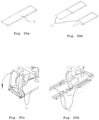
- Figures 19a to 19e show different types of rollers 48, 49, 48', 49', e.g. right-angled ( Fig. 19a ), convex ( Fig. 19b ), concave ( Fig. 19c ) rollers or so-called H-rolls ( Fig. 19d ) and so-called L-rollers (19).
- Each type of rollers 48, 49, 48', 49' is particularly well suited to a specific construction of the stand 3, such as concave rollers for stands 3 made of round tubes 71 or H and L rollers for stands 3 made of rectangular profiles 73.
- Figures 20a-d show different designs of the stand 3 of a fitness device 1, for example a large stand 74, a telescopic stand 75, whereby the telescoping is possible not only in the stand length but also in the stand width, a foldable stand 76 and a plug-in stand 77 formed from assembled parts.
- the stands 3 can be adapted by the user to the specific features of the respective device types 1a, 1a', 1b, 1c, 1d, 1e, e.g. extended for a rowing machine 1b or widened for a treadmill 1e.
Landscapes
- Health & Medical Sciences (AREA)
- General Health & Medical Sciences (AREA)
- Physical Education & Sports Medicine (AREA)
- Life Sciences & Earth Sciences (AREA)
- Orthopedic Medicine & Surgery (AREA)
- Biophysics (AREA)
- Electromagnetism (AREA)
- Physics & Mathematics (AREA)
- Vascular Medicine (AREA)
- Cardiology (AREA)
- Engineering & Computer Science (AREA)
- Human Computer Interaction (AREA)
- Multimedia (AREA)
- Rehabilitation Tools (AREA)
Claims (21)
- Appareil de fitness (1) comprenant:un dispositif d'entraînement (27) pour recevoir une performance d'entraînement générée par un utilisateur ;un dispositif de transmission de force (21) permettant de transmettre au dispositif d'actionnement (27) la performance fournie par l'utilisateur pendant l'entraînement;un cadre (2, 2a, 2b) sur lequel sont disposés le dispositif d'actionnement (27) et le dispositif de transmission de force (21), le cadre (2, 2a, 2b) étant en outre adapté pour supporter l'utilisateur de l'appareil de fitness (1) pendant les exercices de fitness;un support (3, 3`) portant le cadre (2, 2a, 2b) et destiné à être posé sur un sol;au moins un capteur (26) permettant de détecter la performance d'entraînement fournie par l'utilisateur;un dispositif de commande (6) qui est conçu pour recevoir des données d'au moins un capteur (26), le dispositif de commande (6) interagissant avec:une unité de calcul (7) qui est conçue pour déterminer une mesure de réussite à partir de la performance d'entraînement fournie par l'utilisateur, etune unité de signalisation (8) qui est conçue pour générer, sur la base de la mesure de réussite déterminée, un signal (80) pour un indicateur de progression,caractérisé en ce que- le cadre (2, 2a, 2b) ou le support (3') de l'appareil de fitness (1) présente des galets (47, 48, 49, 48', 49') qui sont disposés sur le cadre (2, 2a, 2b) ou sur le support (3') de manière à permettre un positionnement du cadre (2) stable au basculement par rapport au sol ainsi qu'un déplacement longitudinal du cadre (2) ou du cadre (2) avec le support (3') par rapport au sol, et- l'appareil de fitness (1) présentant en outre au moins un actionneur (9) qui est conçu pour effectuer un déplacement motorisé- du cadre (2) par rapport au support (3) ou- du cadre (2) avec le support (3') par rapport au soldans le sens longitudinal au moyen des galets (47, 48, 49, 48', 49') en fonction du signal (80).
- Appareil de fitness (1) selon la revendication 1, l'appareil de fitness (1) étant conçu comme un appareil de l'un des différents types d'appareils mentionnés ci-après, à savoir comme un ergomètre (1a), un speed bike (la'), un vélo couché, un home-trainer, un rameur (lb), un vélo elliptique (1c), un cross-trainer (1d) ou un tapis roulant (le).
- Appareil de fitness (1) selon l'une des revendications précédentes, au moins un galet (47, 48, 49, 48', 49') étant entraîné par un servomoteur (94) de l'actionneur (9) de façon à ce qu'un déplacement longitudinal du cadre (2, 2a, 2b) ou du cadre (2) avec le support (3') par rapport au sol puisse être généré.
- Appareil de fitness (1) selon l'une des revendications précédentes, l'au moins un capteur (26) étant disposé sur le dispositif de commande (27) et/ou sur le dispositif de transmission de force (21, 21a, 21b, 21c, 21d, 2le) pour détecter la performance d'entraînement fournie par l'utilisateur.
- Appareil de fitness (1) selon l'une des revendications précédentes, le galet (47, 48, 49, 48', 49') étant conçu comme un galet de friction, un galet dentelé, un galet denté, un galet de glissement et/ou un galet de roulement.
- Appareil de fitness (1) selon l'une des revendications précédentes, l'appareil de fitness (1) est conçu comme un ergomètre (la), un speed bike (la'), un vélo couché ou un home-trainer.
- Appareil de fitness (1), à savoir ergomètre (la), speed bike (la'), vélo couché ou home-trainer, selon la revendication 6, le support (3) étant formé par deux traverses (32, 33) aux extrémités desquelles est respectivement disposé un galet (48, 49, 48', 49'), les galets (48, 49, 48', 49') reposant sur le sol, et au moins deux galets (49, 49') étant entraînés par le servomoteur (94).
- Appareil de fitness (1), à savoir ergomètre (la), speed bike (la'), vélo couché ou home-trainer, selon la revendication 6:le support (3) étant formé par deux traverses (32, 33) aux extrémités desquelles sont disposés respectivement des patins (45) et/ou des galets (48, 49, 48', 49') qui reposent sur le sol, etl'au moins un galet (47, 49) entraîné par le servomoteur (94) étant disposé sur un bras, comme galet central orientable (47) ou comme jeu de galets entraînés (49, 49').
- Appareil de fitness (1), à savoir ergomètre (la), speed bike (la'), vélo couché ou home-trainer, selon la revendication 6:les galets (48, 49, 48', 49') étant disposés sur le cadre (2, 2b) et se déplaçant dans ou sur des rails de guidage (90) du support (3, 3a, 3b); etl'au moins un galet entraîné (49) étant conçu pour déplacer le cadre (2, 2a, 2b) par rapport au support fixe (3) et par conséquent également par rapport au sol.
- Appareil de fitness (1) selon l'une des revendications précédentes, l'unité de calcul (7) étant conçue pour commander l'actionneur (9) de manière réversible.
- Appareil de fitness (1) selon l'une des revendications précédentes, l'unité de signalisation (8) interagissant avec un module amplificateur (82) qui est conçu pour prendre en compte une accélération produite par l'effort d'entraînement pour l'indicateur de progression.
- Appareil de fitness (1) selon l'une des revendications précédentes:l'actionneur (9) étant pourvu d'un détecteur de position finale (92, 92`) qui est conçu pour déconnecter et/ou inverser l'actionneur (9) lorsqu'une position finale est atteinte; et/oule dispositif d'actionnement (9) est réalisé par emboîtement.
- Appareil de fitness (1) selon l'une des revendications précédentes, l'actionneur (9) étant un actionneur rampant qui entraîne l'au moins un galet (49, 49') à une vitesse inférieure à la vitesse du pas et au plus égale à 1 m/s.
- Appareil de fitness (1) selon l'une des revendications précédentes, l'actionneur (9) présentant un contrôle de traction (93) pour l'au moins un galet entraîné (49, 49`), un patinage détecté de l'au moins un galet entraîné (49, 49`) étant renvoyé à l'unité de calcul (7).
- Appareil de fitness (1) selon l'une des revendications précédentes, l'actionneur (9) présentant un dispositif de reconnaissance de position (96, 97) qui est conçu pour envoyer un signal à l'unité de calcul (7).
- Appareil de fitness (1) selon la revendication 15, le dispositif de reconnaissance de position présentant un capteur (97`) qui est conçu pour reconnaître des marquages de traces au sol (100), les marquages de traces au sol (100) étant réalisés sous forme de marquages de traces avec des repères de distance (102, 103).
- Appareil de fitness (1) selon la revendication 16, les marquages au sol (100) étant réalisés sous la forme d'une bande de marquage qui est disposée sur le sol.
- Appareil de fitness (1) selon la revendication 16 ou 17, comprenant en outre un module d'alignement qui est conçu pour détecter et indiquer des déviations de direction à l'aide des marquages de traces au sol (100).
- Appareil de fitness (1) selon la revendication 18, le module d'alignement étant conçu pour indiquer une direction de correction.
- Appareil de fitness (1) selon l'une des revendications précédentes, les galets (47, 48, 49, 48', 49') étant disposés sur le cadre (2) ou sur le support (3') de manière à permettre un déplacement longitudinal du cadre (2) ou du cadre (2) avec le support (3') par rapport au sol, en minimisant le risque d'écrasement.
- Appareil de fitness (1) selon la revendication 2, l'appareil de fitness (1) de chaque type d'appareil des différents types d'appareils (la, la', lb, lc, ld, 1e) étant basé sur une base unifiée du point de vue de la technique de construction pour des appareils de fitness de différents types (la, lb, lc, ld, le).
Applications Claiming Priority (2)
| Application Number | Priority Date | Filing Date | Title |
|---|---|---|---|
| EP21157617.8A EP4046693B1 (fr) | 2021-02-17 | 2021-02-17 | Dispositif d'entrainement à ergomètre, en particulier à ergomètre de bicyclette, pourvu d'indicateur de progression |
| PCT/IB2022/051410 WO2022175857A1 (fr) | 2021-02-17 | 2022-02-17 | Appareil d'entraînement avec indicateur de progression et base unifiée pour différents types d'appareil |
Publications (3)
| Publication Number | Publication Date |
|---|---|
| EP4267261A1 EP4267261A1 (fr) | 2023-11-01 |
| EP4267261B1 true EP4267261B1 (fr) | 2025-01-15 |
| EP4267261C0 EP4267261C0 (fr) | 2025-01-15 |
Family
ID=74666584
Family Applications (2)
| Application Number | Title | Priority Date | Filing Date |
|---|---|---|---|
| EP21157617.8A Active EP4046693B1 (fr) | 2021-02-17 | 2021-02-17 | Dispositif d'entrainement à ergomètre, en particulier à ergomètre de bicyclette, pourvu d'indicateur de progression |
| EP22706414.4A Active EP4267261B1 (fr) | 2021-02-17 | 2022-02-17 | Appareil d'entraînement avec indicateur de progression et base unifiée pour différents types d'appareil |
Family Applications Before (1)
| Application Number | Title | Priority Date | Filing Date |
|---|---|---|---|
| EP21157617.8A Active EP4046693B1 (fr) | 2021-02-17 | 2021-02-17 | Dispositif d'entrainement à ergomètre, en particulier à ergomètre de bicyclette, pourvu d'indicateur de progression |
Country Status (4)
| Country | Link |
|---|---|
| US (1) | US12440721B2 (fr) |
| EP (2) | EP4046693B1 (fr) |
| CN (1) | CN117042850A (fr) |
| WO (1) | WO2022175857A1 (fr) |
Families Citing this family (2)
| Publication number | Priority date | Publication date | Assignee | Title |
|---|---|---|---|---|
| TWI884813B (zh) * | 2024-06-18 | 2025-05-21 | 岱宇國際股份有限公司 | 可同步調整阻力與坡度的飛輪車 |
| TWI889564B (zh) * | 2024-10-01 | 2025-07-01 | 國立臺灣科技大學 | 用於腳踏車運動時序同步的設備 |
Citations (5)
| Publication number | Priority date | Publication date | Assignee | Title |
|---|---|---|---|---|
| US4976426A (en) * | 1989-09-06 | 1990-12-11 | Garden Reach Developments Ltd. | Rehabilitation exercise device |
| US20110275500A1 (en) * | 2009-01-23 | 2011-11-10 | Young-Baek Hur | Strengthening and rehabilitation exercise apparatus |
| KR20190029151A (ko) * | 2017-09-12 | 2019-03-20 | 함형석 | 안장 이동형 실내 자전거 운동기 |
| US20190118058A1 (en) * | 2017-08-17 | 2019-04-25 | Saris Cycling Group, Inc. | Movable Support For Exercise Equipment |
| CN210644982U (zh) * | 2019-08-19 | 2020-06-02 | 厦门帝玛斯健康科技有限公司 | 一种可折叠的跑步机 |
Family Cites Families (14)
| Publication number | Priority date | Publication date | Assignee | Title |
|---|---|---|---|---|
| US7736272B2 (en) | 2001-08-21 | 2010-06-15 | Pantometrics, Ltd. | Exercise system with graphical feedback and method of gauging fitness progress |
| US6902513B1 (en) * | 2002-04-02 | 2005-06-07 | Mcclure Daniel R. | Interactive fitness equipment |
| US7747671B2 (en) * | 2003-08-22 | 2010-06-29 | King I Tech Corporation | Data transmission system for linking multiple exercise facilities |
| US7604575B2 (en) * | 2005-09-14 | 2009-10-20 | Papadopoulos Larry C | Roller trainer assembly |
| US20100197460A1 (en) * | 2009-02-05 | 2010-08-05 | Czarnecki Derek J | Fitness equipment with power generation |
| US9248071B1 (en) * | 2013-03-15 | 2016-02-02 | Ergoflex, Inc. | Walking, rehabilitation and exercise machine |
| TWI637770B (zh) * | 2016-11-01 | 2018-10-11 | 美商愛康運動與健康公司 | 用於固定式腳踏車的落入式樞軸配置 |
| EP3327597A1 (fr) | 2016-11-24 | 2018-05-30 | Anna Kucher | Appareil d'exercice physique et procédé de motivation d'un utilisateur à interagir avec une installation d'entraînement |
| CN108421215B (zh) * | 2018-03-08 | 2024-04-12 | 泊康科技股份有限公司 | 一种脚部蹬力训练装置及其划船器 |
| CN110193166A (zh) * | 2019-05-24 | 2019-09-03 | 韩山师范学院 | 一种体操锻炼用双杠的间距和高度调节机构及其使用方法 |
| CO2019006686A1 (es) * | 2019-06-21 | 2019-07-10 | Hernandez Wilson Hernan Pacheco | Simulador de ciclismo o motociclismo para la recreación y ejercicio físico |
| EP4026591B1 (fr) * | 2019-09-03 | 2024-09-25 | Real Design Tech Co., Ltd. | Simulateur de bicyclette |
| EP4464386A3 (fr) * | 2020-03-16 | 2025-06-18 | Saris Cycling Group, Inc. | Dispositif d'exercice mobile |
| US20240416182A1 (en) * | 2023-06-13 | 2024-12-19 | Zwift, Inc. | Exercise device communication system |
-
2021
- 2021-02-17 EP EP21157617.8A patent/EP4046693B1/fr active Active
-
2022
- 2022-02-17 US US18/546,771 patent/US12440721B2/en active Active
- 2022-02-17 WO PCT/IB2022/051410 patent/WO2022175857A1/fr not_active Ceased
- 2022-02-17 EP EP22706414.4A patent/EP4267261B1/fr active Active
- 2022-02-17 CN CN202280014894.2A patent/CN117042850A/zh active Pending
Patent Citations (5)
| Publication number | Priority date | Publication date | Assignee | Title |
|---|---|---|---|---|
| US4976426A (en) * | 1989-09-06 | 1990-12-11 | Garden Reach Developments Ltd. | Rehabilitation exercise device |
| US20110275500A1 (en) * | 2009-01-23 | 2011-11-10 | Young-Baek Hur | Strengthening and rehabilitation exercise apparatus |
| US20190118058A1 (en) * | 2017-08-17 | 2019-04-25 | Saris Cycling Group, Inc. | Movable Support For Exercise Equipment |
| KR20190029151A (ko) * | 2017-09-12 | 2019-03-20 | 함형석 | 안장 이동형 실내 자전거 운동기 |
| CN210644982U (zh) * | 2019-08-19 | 2020-06-02 | 厦门帝玛斯健康科技有限公司 | 一种可折叠的跑步机 |
Also Published As
| Publication number | Publication date |
|---|---|
| WO2022175857A1 (fr) | 2022-08-25 |
| US20240131391A1 (en) | 2024-04-25 |
| EP4046693A1 (fr) | 2022-08-24 |
| EP4046693B1 (fr) | 2024-02-21 |
| CN117042850A (zh) | 2023-11-10 |
| US20240226651A9 (en) | 2024-07-11 |
| EP4267261A1 (fr) | 2023-11-01 |
| US12440721B2 (en) | 2025-10-14 |
| EP4267261C0 (fr) | 2025-01-15 |
Similar Documents
| Publication | Publication Date | Title |
|---|---|---|
| DE3789318T2 (de) | Vorrichtung zum üben des treppensteigens. | |
| DE69736016T2 (de) | Crosslauf-Übungsgerät | |
| DE10315723B4 (de) | Verfahren für ein gezieltes Training und Trainingsgerät | |
| EP4046693B1 (fr) | Dispositif d'entrainement à ergomètre, en particulier à ergomètre de bicyclette, pourvu d'indicateur de progression | |
| DE8530853U1 (de) | Krafttrainingsvorrichtung | |
| DE602004004202T2 (de) | Übungsgeräte | |
| DE69733216T2 (de) | Stationäres Trainingsgerät | |
| WO1988006776A1 (fr) | Simulateur de sports | |
| DE68905317T2 (de) | Ruder-uebungsgeraet. | |
| EP3621704B1 (fr) | Appareil de fitness pour effectuer des exercices de type pompes | |
| EP0894515B1 (fr) | Appareil de sport et de jeu | |
| EP4536367B1 (fr) | Rameur avec repose-pieds coulissant et procédé de fonctionnement du rameur | |
| DE202016104682U1 (de) | Der Kraftübertragungsmechanismus mit kinetischer Energie durch Treten | |
| DE60115318T2 (de) | Übungsgerät mit verlängerter Schrittweite | |
| WO1995032767A1 (fr) | Appareil d'entrainement permettant de simuler les mouvements de crawl hors de l'eau | |
| EP1901823A1 (fr) | Dispositif pour deplacer une personne dans l'espace | |
| DE69811175T2 (de) | Crosslauf-Übungsgerät | |
| DE29507690U1 (de) | Vorrichtung zum Gehen und Laufen auf der Stelle | |
| DE4432875C2 (de) | Vorrichtung und Verfahren zur Ausführung eines Bewegungsablaufes | |
| DE202007016167U1 (de) | Vorrichtung für ein Training und/oder eine Analyse des Bewegungsapparates eines Benutzers | |
| DE3613618C2 (fr) | ||
| DE102022114779A1 (de) | Rudergerät mit Schlittenkonstruktion und Verfahren zum Betreiben des Rudergeräts | |
| EP1580106A2 (fr) | Appareil d'exercice sportif et medical | |
| DE202023102429U1 (de) | Rudergerät mit verschiebbarem Stemmbrett | |
| DE102017106640B3 (de) | Lauftrainer |
Legal Events
| Date | Code | Title | Description |
|---|---|---|---|
| STAA | Information on the status of an ep patent application or granted ep patent |
Free format text: STATUS: UNKNOWN |
|
| STAA | Information on the status of an ep patent application or granted ep patent |
Free format text: STATUS: THE INTERNATIONAL PUBLICATION HAS BEEN MADE |
|
| PUAI | Public reference made under article 153(3) epc to a published international application that has entered the european phase |
Free format text: ORIGINAL CODE: 0009012 |
|
| STAA | Information on the status of an ep patent application or granted ep patent |
Free format text: STATUS: REQUEST FOR EXAMINATION WAS MADE |
|
| 17P | Request for examination filed |
Effective date: 20230728 |
|
| AK | Designated contracting states |
Kind code of ref document: A1 Designated state(s): AL AT BE BG CH CY CZ DE DK EE ES FI FR GB GR HR HU IE IS IT LI LT LU LV MC MK MT NL NO PL PT RO RS SE SI SK SM TR |
|
| DAV | Request for validation of the european patent (deleted) | ||
| DAX | Request for extension of the european patent (deleted) | ||
| GRAP | Despatch of communication of intention to grant a patent |
Free format text: ORIGINAL CODE: EPIDOSNIGR1 |
|
| STAA | Information on the status of an ep patent application or granted ep patent |
Free format text: STATUS: GRANT OF PATENT IS INTENDED |
|
| INTG | Intention to grant announced |
Effective date: 20240807 |
|
| GRAS | Grant fee paid |
Free format text: ORIGINAL CODE: EPIDOSNIGR3 |
|
| GRAA | (expected) grant |
Free format text: ORIGINAL CODE: 0009210 |
|
| STAA | Information on the status of an ep patent application or granted ep patent |
Free format text: STATUS: THE PATENT HAS BEEN GRANTED |
|
| AK | Designated contracting states |
Kind code of ref document: B1 Designated state(s): AL AT BE BG CH CY CZ DE DK EE ES FI FR GB GR HR HU IE IS IT LI LT LU LV MC MK MT NL NO PL PT RO RS SE SI SK SM TR |
|
| REG | Reference to a national code |
Ref country code: CH Ref legal event code: EP Ref country code: GB Ref legal event code: FG4D Free format text: NOT ENGLISH |
|
| REG | Reference to a national code |
Ref country code: DE Ref legal event code: R096 Ref document number: 502022002648 Country of ref document: DE |
|
| REG | Reference to a national code |
Ref country code: IE Ref legal event code: FG4D Free format text: LANGUAGE OF EP DOCUMENT: GERMAN |
|
| U01 | Request for unitary effect filed |
Effective date: 20250131 |
|
| U07 | Unitary effect registered |
Designated state(s): AT BE BG DE DK EE FI FR IT LT LU LV MT NL PT RO SE SI Effective date: 20250205 |
|
| U20 | Renewal fee for the european patent with unitary effect paid |
Year of fee payment: 4 Effective date: 20250130 |
|
| PG25 | Lapsed in a contracting state [announced via postgrant information from national office to epo] |
Ref country code: RS Free format text: LAPSE BECAUSE OF FAILURE TO SUBMIT A TRANSLATION OF THE DESCRIPTION OR TO PAY THE FEE WITHIN THE PRESCRIBED TIME-LIMIT Effective date: 20250415 |
|
| PG25 | Lapsed in a contracting state [announced via postgrant information from national office to epo] |
Ref country code: PL Free format text: LAPSE BECAUSE OF FAILURE TO SUBMIT A TRANSLATION OF THE DESCRIPTION OR TO PAY THE FEE WITHIN THE PRESCRIBED TIME-LIMIT Effective date: 20250115 |
|
| PG25 | Lapsed in a contracting state [announced via postgrant information from national office to epo] |
Ref country code: ES Free format text: LAPSE BECAUSE OF FAILURE TO SUBMIT A TRANSLATION OF THE DESCRIPTION OR TO PAY THE FEE WITHIN THE PRESCRIBED TIME-LIMIT Effective date: 20250115 |
|
| PG25 | Lapsed in a contracting state [announced via postgrant information from national office to epo] |
Ref country code: NO Free format text: LAPSE BECAUSE OF FAILURE TO SUBMIT A TRANSLATION OF THE DESCRIPTION OR TO PAY THE FEE WITHIN THE PRESCRIBED TIME-LIMIT Effective date: 20250415 Ref country code: IS Free format text: LAPSE BECAUSE OF FAILURE TO SUBMIT A TRANSLATION OF THE DESCRIPTION OR TO PAY THE FEE WITHIN THE PRESCRIBED TIME-LIMIT Effective date: 20250515 |
|
| PG25 | Lapsed in a contracting state [announced via postgrant information from national office to epo] |
Ref country code: HR Free format text: LAPSE BECAUSE OF FAILURE TO SUBMIT A TRANSLATION OF THE DESCRIPTION OR TO PAY THE FEE WITHIN THE PRESCRIBED TIME-LIMIT Effective date: 20250115 |
|
| PG25 | Lapsed in a contracting state [announced via postgrant information from national office to epo] |
Ref country code: GR Free format text: LAPSE BECAUSE OF FAILURE TO SUBMIT A TRANSLATION OF THE DESCRIPTION OR TO PAY THE FEE WITHIN THE PRESCRIBED TIME-LIMIT Effective date: 20250416 |
|
| PG25 | Lapsed in a contracting state [announced via postgrant information from national office to epo] |
Ref country code: SM Free format text: LAPSE BECAUSE OF FAILURE TO SUBMIT A TRANSLATION OF THE DESCRIPTION OR TO PAY THE FEE WITHIN THE PRESCRIBED TIME-LIMIT Effective date: 20250115 |
|
| PG25 | Lapsed in a contracting state [announced via postgrant information from national office to epo] |
Ref country code: MC Free format text: LAPSE BECAUSE OF FAILURE TO SUBMIT A TRANSLATION OF THE DESCRIPTION OR TO PAY THE FEE WITHIN THE PRESCRIBED TIME-LIMIT Effective date: 20250115 |
|
| PG25 | Lapsed in a contracting state [announced via postgrant information from national office to epo] |
Ref country code: CZ Free format text: LAPSE BECAUSE OF FAILURE TO SUBMIT A TRANSLATION OF THE DESCRIPTION OR TO PAY THE FEE WITHIN THE PRESCRIBED TIME-LIMIT Effective date: 20250115 |
|
| PG25 | Lapsed in a contracting state [announced via postgrant information from national office to epo] |
Ref country code: SK Free format text: LAPSE BECAUSE OF FAILURE TO SUBMIT A TRANSLATION OF THE DESCRIPTION OR TO PAY THE FEE WITHIN THE PRESCRIBED TIME-LIMIT Effective date: 20250115 |
|
| PLBE | No opposition filed within time limit |
Free format text: ORIGINAL CODE: 0009261 |
|
| STAA | Information on the status of an ep patent application or granted ep patent |
Free format text: STATUS: NO OPPOSITION FILED WITHIN TIME LIMIT |
|
| REG | Reference to a national code |
Ref country code: CH Ref legal event code: L10 Free format text: ST27 STATUS EVENT CODE: U-0-0-L10-L00 (AS PROVIDED BY THE NATIONAL OFFICE) Effective date: 20251126 |
|
| 26N | No opposition filed |
Effective date: 20251016 |
|
| PG25 | Lapsed in a contracting state [announced via postgrant information from national office to epo] |
Ref country code: IE Free format text: LAPSE BECAUSE OF NON-PAYMENT OF DUE FEES Effective date: 20250217 |
|
| U20 | Renewal fee for the european patent with unitary effect paid |
Year of fee payment: 5 Effective date: 20260112 |
|
| REG | Reference to a national code |
Ref country code: CH Ref legal event code: U11 Free format text: ST27 STATUS EVENT CODE: U-0-0-U10-U11 (AS PROVIDED BY THE NATIONAL OFFICE) Effective date: 20260301 |
|
| PGFP | Annual fee paid to national office [announced via postgrant information from national office to epo] |
Ref country code: GB Payment date: 20260219 Year of fee payment: 5 |
|
| PGFP | Annual fee paid to national office [announced via postgrant information from national office to epo] |
Ref country code: CH Payment date: 20260301 Year of fee payment: 5 |