EP4268592A1 - Dispositif pour attirer les diptères du type cératite et dispositif de piégeage - Google Patents
Dispositif pour attirer les diptères du type cératite et dispositif de piégeage Download PDFInfo
- Publication number
- EP4268592A1 EP4268592A1 EP22382395.6A EP22382395A EP4268592A1 EP 4268592 A1 EP4268592 A1 EP 4268592A1 EP 22382395 A EP22382395 A EP 22382395A EP 4268592 A1 EP4268592 A1 EP 4268592A1
- Authority
- EP
- European Patent Office
- Prior art keywords
- container
- membrane
- aqueous composition
- composition
- walls
- Prior art date
- Legal status (The legal status is an assumption and is not a legal conclusion. Google has not performed a legal analysis and makes no representation as to the accuracy of the status listed.)
- Withdrawn
Links
Images





Classifications
-
- A—HUMAN NECESSITIES
- A01—AGRICULTURE; FORESTRY; ANIMAL HUSBANDRY; HUNTING; TRAPPING; FISHING
- A01M—CATCHING, TRAPPING OR SCARING OF ANIMALS; APPARATUS FOR THE DESTRUCTION OF NOXIOUS ANIMALS OR NOXIOUS PLANTS
- A01M1/00—Stationary means for catching or killing insects
- A01M1/02—Stationary means for catching or killing insects with devices or substances, e.g. food, pheronones attracting the insects
-
- A—HUMAN NECESSITIES
- A01—AGRICULTURE; FORESTRY; ANIMAL HUSBANDRY; HUNTING; TRAPPING; FISHING
- A01M—CATCHING, TRAPPING OR SCARING OF ANIMALS; APPARATUS FOR THE DESTRUCTION OF NOXIOUS ANIMALS OR NOXIOUS PLANTS
- A01M1/00—Stationary means for catching or killing insects
- A01M1/10—Catching insects by using Traps
- A01M1/106—Catching insects by using Traps for flying insects
Definitions
- the present invention relates to field of devices for attracting Ceratitis capitata and trapping device for capturing and eliminating such insects that makes use of the aforementioned device.
- ES2257219B1 disclosed a trapping device comprising an enveloped type diffuser container containing attractant compositions for Ceratitis capitata.
- Said diffuser container comprises inside a support material made of cellulose which is impregnated with a solution comprising cadaverine, ammonium acetate and trimethylamine.
- the container is made of an impermeable sheet composed by aluminum, polyethylene and polyester and has a nonwoven polyethylene that allows vapor emission of the attractant components controllably.
- EP3127426A1 disclosed a diffuser which comprises a dry powder mixture composition containing attractant substances for Ceratitis capitata, such as ammonium acetate, trimethylamine hydrochloride and a diaminoalkane, along with powdery sodium polyacrylate.
- the powder composition is placed inside a packet which comprises a permeable membrane on one side that allows the exchange of vapors of the attractant substances and a material that is impermeable to vapors on the other side.
- the diffusers comprising dry mixtures present some drawbacks. Once dry mixtures are manufactured, they need to be stored in hermetic recipients before they are introduced into the packets that conform the diffusers.
- EP3127426A1 have the disadvantage that they comprise a diaminoalkane, such as cadaverine.
- Cadaverine and putrescine are among the most common biogenic amines (BA) in foods, but it is advisable that their accumulation be avoided.
- a device for attracting Ceratitis capitata comprising a container made of a permeable material such as polyurethane or polyamide.
- the container has the shape of a packet and comprises an aqueous solution containing attractant substances for Diptera such as ammonia, trimethylamine or triethylamine, which are released thought out the walls of the container.
- attractant substances for Diptera such as ammonia, trimethylamine or triethylamine
- the first aspect of the invention relates to a device (1) for attracting dipterans, preferably Ceratitis capitata fly, that comprises:
- Said device (1) has the advantage that allows a prolong and controlled release of the vapors of the aqueous composition (7) through the membrane (6A), while attracting a high number of Diptera. Said device allows an effective and prolong release of the attractants without the need to use any support material wherein the attractant composition is absorbed.
- the device (1) of the first aspect is a ready-to-use device that can be easily incorporated in a trapping device (8) to be placed in the field. Furthermore, and the device (1) can be easily replaced when the aqueous composition (7) is fully consumed.
- the shape and characteristics of the device (1) provides good controlled and prolong release of its composition which helps to reduces or minimizes the undesired loss of the attractant substances. Furthermore, the device (1) does not comprise a cellulose support wherein the aqueous composition (7) is absorbed to ensure the adequate adsorption and release of the composition by capillarity as needed in the prior art. Preferably, it does not comprise a support. Hence the device (1) comprises a small number of components allowing an easier and more feasible manufacturing process comprises said process less steps.
- the device (1) of the first aspect distinctively from other devices, has the advantage that, as it comprises an aqueous composition (7), said composition (7) does not need to be stored in a separate hermetic recipient; it can be directly incorporated into the attractant device (1) once it is manufactured
- the second aspect of the invention describes a method for obtaining the device (1) according to the first aspect of the invention, the method comprising the steps of:
- the third aspect of the invention refers to a device (1) obtainable by the method of the second aspect of the invention.
- the fourth aspect of the invention relates to a method for attracting and trapping dipterans that comprises:
- the fifth aspect of the invention refers to the use of the device (1) according to any of the first or the third aspect or the device obtained from the second aspect, to attract dipterans.
- the sixth aspect of the present invention relates to a trapping device (8) adapted to attract and kill Diptera from a genus selected from the list consisting of Bractocera spp., Ceratitis spp, preferably the Ceratitis capitata fly, wherein said trapping device (8) comprises:
- the first aspect of the invention relates to a device (1) for attracting dipterans that comprises:
- the attractant salts for dipterans are selected from the list consisting of, ammonium acetate, trimethylamine hydrochloride or combinations thereof.
- the device (1) does not comprise a cellulose support wherein the aqueous composition (7) is absorbed to ensure the adequate adsorption and release of the composition by capillarity as needed in the prior art.
- the term membrane refers to a membrane that allows the exchange of vapors, but not water or any liquid phase. Said membranes area also refer as semipermeable membranes. These membranes comprise means or sheets containing or made of semipermeable materials.
- the semipermeable membrane of the first aspect of the invention has a water vapor transmission rate from 500-3300 g. m- 2 . d -1 , preferably from 1000-2500 g. m- 2 . d -1 , preferably from 1100-1900 g. m- 2 . d -1 , more preferably from 1300-1800 g. m- 2 . d -1 .
- the term "semi-permeable material” refers to the characteristic of the material that allows the exchange of vapors of the aqueous composition (7) between the inside and outside of the device.
- the semi-permeable material of the membrane comprises at least a layer of high-density polyethylene, preferably a layer of high-density polyethylene fibers and optionally it also comprises a layer of polypropylene.
- the aqueous composition (7) further comprises silica, that is SiO 2 .
- the silica reduces the aggregation of the attractant salts within the aqueous composition (7) improving the stability of the composition and its effectiveness when attracting Diptera.
- aqueous composition (7) may be a solution, a suspension or a dispersion.
- the aqueous composition (7) is a suspension or a dispersion.
- the impermeable material comprises at least one layer of an impermeable material wherein the water permeability coefficient (PO) is equal or higher than 0.0001-3.0 g ⁇ mm.m -2 ⁇ d -1 , preferably from 0.0005 -0.40 g ⁇ mm.m- 2 ⁇ d -1 or a water vapor transmission rate from 1-60 g.m -2 . d -1 , preferably from 2-40 g.m -2 . d -1 .
- the water permeability coefficient was measured at 37°C, 0.98 atm (1 bar) and 90% of relative humidity.
- the water vapor transmission rate was measured at 25°C and 1 atm.
- the material of the at least one layer of an impermeable material of the walls (3) and the bottom (4) is selected from the list consisting of polyethylene, polypropylene, polystyrene, polyethylene terephthalate, polymethyl methacrylate (PMMA), polystyrene-acrylonitrile (SAN), acrylonitrile butadiene styrene (ABS) and combinations thereof. More preferably, the material of the at least one layer of an impermeable material is selected from the list consisting of polyethylene and polyethylene terephthalate. Even more preferably, the polyethylene is low density polyethylene
- the impermeable material comprises at least one layer of polyethylene and at least one layer of polyethylene terephthalate.
- the layer of polyethylene is placed in the inner part of the container (2) walls (3) and bottom (4) in direct contact with the aqueous composition (7). Therefore, the walls (3) and the bottom (4) are impermeable so that the only part of the device that allows the vapor exchange of the attractant composition is the lid (6) that closes the opening (5), wherein the lid (6) comprises a membrane (6A) which comprises a semi-permeable material.
- the thickness of the walls (3) and the bottom (4) of the container (2) is of at least 0.35 mm, preferably from 0.35 to 3 mm, preferably from 0.5-1.5 mm.
- the thickness of the walls (3) and the bottom (4) ensures that the aqueous composition (7) is not released through the impermeable material and only via the membrane (6A) of the lid (6).
- the container (2) may have a conical, frustoconical or cylindrical shape.
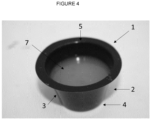
- the container (2) has a frustoconical shape comprising walls (3), an opening (5) and a bottom (4).
- the container (2) having the frustoconical shape comprises an opening (5) and bottom (4) having a circular shape.
- the opening (5) has a diameter from 35-100mm; more preferably from 40-80mm; even more preferably from 40-65mm and/or the diameter of the bottom (4) is preferably from 25-50mm; more preferably from 25-35mm.
- the height (2a) of the container (2) is from 20-100mm; more preferably from 25-75mm; even more preferably from 25-60mm.
- the above dimensions of the container (2) allow to fill it with the appropriate amount of the attractant composition (7) for the device to be used effectively for a long period of time in the field, ensures a sustain release of the attractant components via the membrane (6A) as well as it allows to manufacture an attractant device (1) that can be easy placed in any trapping device (8).
- the lid (6) can have the same size or diameter as the size or diameter of the opening or the lid (6) can have a slightly larger size or diameter than the opening (5), In a preferred embodiment, the lid (6) has the same diameter or size as the opening (5).
- the membrane (6A) comprised in the lid (6) has the same diameter or size as the opening (5), and the membrane (6A) comprises a semi-permeable material that allows the exchange of vapors of the aqueous composition (7). Therefore, the vapors of the components of the aqueous composition (7) are released through the membrane (6A) that has the same diameter or size as the opening (5).
- the membrane comprised in the lid (6) can also have a smaller diameter or size than the opening (5).
- the walls (3) of the container can have ridges where the lid (6) rests.
- the opening (5) of the container (2) may be closed with a lid (6) that comprises the membrane (6A), by heat sealing.
- the membrane (6A) has a water vapor transmission rate from 500-3300 g. m- 2 . d -1 , preferably from 1000-2500 g. m -2 . d -1 , preferably from 1100-1800 g. m -2 . d -1 .
- the semi-permeable material of the membrane (6A) comprises at least a layer of high-density polyethylene (HDPE), preferably layer of high-density polyethylene fibers.
- the semi-permeable material of the membrane (6A) may also comprise polypropylene.
- the membrane (6A) is sealed or covered with a layer of an impermeable material (not shown) situated over the semi-permeable material of the membrane (6A) and which is suitable to be removed before the use of the device or wherein the device (1) is covered and/or enclosed by a layer of an impermeable material which is suitable to be removed before the use of the device (1).
- This layer minimizes the risk of contamination and the risk of particulates been introduced in the aqueous composition (7) which may affect the rate of release. Furthermore, it allows the release the vapors of the aqueous composition (7) once the device (1) is placed in the field, as the release will begin as soon as the layer of an impermeable material which covers or encloses the membrane (6A) is removed.
- the aqueous composition (7) comprises:
- the aqueous composition (7) of the first aspect shows high effectivity and a good release, without the need to use an aminoalkane.
- the aqueous composition (7) does not comprise an aminoalkane selected from cadaverine or putrescine, more preferably it does not comprise an aminoalkane.
- the aqueous composition (7) comprises ammonium acetate in a range from 45%-65% w/w %, to the total weight of the aqueous composition (7) and/or trimethylamine hydrochloride in a range from 5-9% w/w % to the total weight of the aqueous composition (7).
- the device (1) comprises from 5-50 g of aqueous composition (7) preferably from 10-25g.
- the dipterans are selected from a genus selected from the list consisting of Bractocera spp., Ceratitis spp., and combinations thereof. More specifically, the dipterans from the genus Cerattitis spp., are dipterans from the species Ceratitis capitata.
- the second aspect of the invention describes a method for obtaining the device (1) according to the first aspect of the invention, the method comprising the steps of:
- the walls (3) of the container can have ridges where the lid (6) rests.
- the opening (5) of the container (2) may be closed with a lid (6) that comprises the membrane (6A), by heat sealing.
- the aqueous composition of step (i) further comprisessilica.
- the attractant salts for dipterans are selected from the list consisting of; ammonium acetate, trimethylamine hydrochloride and combinations.
- the aqueous composition (7) of step (i) comprises:
- the percentage of the components are referred to the total weight of the composition (7).
- the attractant salts for dipterans comprise ammonium acetate in a range from 45%-65%, w/w %, to the total weight of the aqueous composition (7).
- the attractant salts for dipterans comprise trimethylamine hydrochloride in a range from 5-9%, w/w % with respect to the total weight of the aqueous composition (7).
- the step (i) is carried out by mixing at least water and the attractant salts for dipterans and optionally silica followed by stirring the mixture until the aqueous composition (7) is obtained.
- the step (ii) comprises filling the empty container (5) of step ii) with from 5-50g of the aqueous composition (7) obtained in step i), preferably with an amount from 10-25 g of the aqueous composition (7) of step i).
- the container is as the container (2) of the device (1) according to the first aspect or any of the embodiments of the first aspect.
- the third aspect of the invention refers to a device (1) obtainable by the method of the second aspect of the invention or any of the embodiments of the second aspect.
- the fourth aspect of the invention relates to a method for attracting and trapping dipterans that comprises:
- the place of interest can be a field, a tree or any hanging device.
- the step (ii) comprises leaving the trapping device (8) in a place of interest for at least 4 weeks. More preferably, the trapping device (8) is left in a place of interest for at least 4 months and more preferably for at least 6 months.
- the humidity of the place of interest is from 40%-90% and/or the temperature in the place of interest is from 5-50°C.
- the fifth aspect of the invention refers to the use of the device (1) according to any of the first aspect or the third aspect to trap dipterans.
- the dipterans are from a genus selected from the list consisting of Bractocera spp., Ceratitis spp., and combinations thereof. More specifically, dipterans from the genus Ceratitis spp. Comprise dipterans from the species Ceratitis capitata.
- the sixth aspect of the present invention relates to a trapping device (8) adapted to attract and kill Diptera from a genus selected from the list consisting of Bractocera spp., Ceratitis spp, preferably the Ceratitis capitata fly, wherein said trapping device (8) comprises:
- the trapping device (8) is left in a place of interest, for example a field, for at least 2 days. More preferably, the trapping device (8) is left in a place of interest for at least 4 weeks. More preferably, the trapping device (8) is left in a place of interest for at least 4 months and more preferably for at least 6 months, as the device is effective in attracting and killing dipterans for said period of time.
- the proposed solution does not require additional support elements for the device (1) of the first aspect or for the contact insecticide, since the trapping device (8) itself acts as a holder for both.
- the inner wall of the entrapment chamber (8) does not have to be completely coated with contact insecticide in order for it to kill the insects.
- the inner walls of lid (10) of the trapping device (8) can also be partially or fully coated with the contact insecticide.
- the entrapment chamber (9) may have a conical, frustoconical or cylindrical shape with an essentially round base, to improve and facilitate the collection and removal of insects when the entrapment chamber (9) is full.
- the Diptera Once the Diptera have been attracted into the entrapment chamber (9) of the trapping device of the sixth aspect, through at least one inlet (11), in search of the exit and during this flight, it hits the inner walls of said entrapment chamber (9), where it dies due to physical contact with the contact insecticide. Therefore, after the capture of the Diptera inside the entrapment chamber (9), their death occurs as a result of their contact with the contact insecticide.
- the contact insecticides are selected from the list consisting of pyrethroids and pyrethrins.
- the pyrethroids are selected from the list consisting of Fluvalinate, Cyfluthrin, Bifenthrin, Fenpropathrin, Resmethrin, Sumithrin, Permethrin, Esfenvalerate, Cypermethrin, Lambda-Cyhalothrin, Deltamethrin, Pyrethrin, Tefluthrin, Tetramethrin and Tralomethrin.
- the pyrethroids are selected form the list consisting of Deltamethrin, Lambda-Cyhalothrin, Cypermethrin and Esfenvalerate.
- the lid (10) may be a removable lid, such that the trap can be reused multiple times or can be emptied when a high number of captures occurs.
- the lid (10) is configured to be coupled to the entrapment chamber (9) by pressure through a blocking system (not shown).
- the blocking system can be a "snap fit" (releasable connection) system or a turn system. Even more preferably, there is a releasable connection system in the blocking system wherein the lid (10) is configured with protrusions (not shown) that snap into an edge of the confinement chamber by pressure.
- the lid (10) comprises a slot and the edge of the entrapment chamber (9) comprises a protrusion in the shape of a tooth adapted to fit into the slot of the lid (10) by turning the chamber and/or lid (10), preferably anticlockwise.
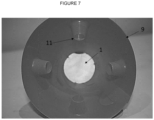
- the entrapment chamber (9) comprises at least one inlet (11) configured to enable the Diptera to enter into the entrapment chamber (9).
- the trap comprises a plurality of inlets (11) arranged in the walls that form the entrapment chamber (9), thus facilitating the entry of the Diptera into the entrapment chamber (9) and increasing the number of captures for trapping device (8).
- the inlet (11) is provided with a blocking element or part (not shown) configured to prevent the Diptera from exiting the entrapment chamber (9) once they have entered inside said entrapment chamber (9) and/or to prevent the entry of larger non-target insects that are not Ceratitis capitata.
- the inlet (11) is circular in shape such that the blocking part takes the form of a vertically oriented diametrical rib.
- the device (1) of the first aspect is removable arranged within the entrapment chamber (9).
- the device (1) is coupled or engaged within the entrapment chamber (9) by pressure through a blocking system.
- the blocking system can be a "snap fit" (releasable connection) system or a turn system.
- the blocking system comprises flanges (12) that are located on or attached to the internal walls of the entrapment chamber (9).
- the inlet (11) is formed in the walls (3) of the entrapment chamber (9) from a circular perforation such that the blocking part takes the form of a vertically oriented diametrical rib in the circular perforation.
- the entrapment chamber (9) is opaque and/or the lid (10) is translucent or opaque.
- the trapping device (8) may be made of polymeric material suitable for said preferred embodiment.
- the polymeric material is selected from the list consisting of polyethylene, high-density polyethylene, medium-density polyethylene and lowdensity polyethylene, polyethylene copolymers, polypropylene, polypropylene copolymers, polystyrene, polyethylene terephthalate, polymethyl methacrylate, polystyrene-acrylonitrile, acrylonitrile butadiene styrene and mixtures thereof.
- a device (1) as in the first aspect was manufactured.
- the walls (3) and the bottom(4) of the container (2) comprised a layer of polyethylene terephthalate and an inner layer made of polyethylene.
- the device had a frustoconical shape wherein the opening (5) had a diameter of 43mm; the diameter of the bottom (4) was 31mm and the height (2a) of the container (2) was 31mm.
- the container was filled with 15 g of an aqueous composition (7) which was obtained by mixing the appropriate amounts of water, ammonium acetate, trimethylamine hydrochloride and silica followed by stirring until the aqueous composition is obtained.
- the amounts of each component in the composition are detailed in the table 1.
- the upper opening was closed by means of hermetic and heat sealing with a semi-permeable material that conforms the membrane with a water vapor transmission rate from 1100-1800 g. m- 2 . D -1 .
- the diameter of the lid was 54.5mm and the diameter of the membrane covering the opening was 43 mm.
- the membrane (6A) had a semipermeable material made of high-density polyethylene (non-woven polyethylene).
- Table 1 Aqueous composition of example 1 comprising attractant salts.
- Component Amount in g in the composition Amount in % in the composition Ammonium acetate 9.00 60.00
- a further device (1) as in the first aspect was manufactured.
- the walls (3) and the bottom (4) of the container (2) comprised a layer of polyethylene terephthalate and an inner layer made of polyethylene.
- the device had a frustoconical shape wherein the opening (5) had a diameter of 43mm; the diameter of the bottom (4) was 31mm and the height (2a) was 31mm.
- the container was filled with 13.04g of an aqueous composition which was obtained by mixing the appropriate amounts of water, ammonium acetate, trimethylamine hydrochloride, followed by stirring until the aqueous composition is obtained.
- the amounts of each component are detailed in the table 2.
- the upper opening was closed by means of hermetic and heat sealing with a semi-permeable material that conforms the membrane with a water vapor transmission rate from 1100-1800 g. m- 2 . d -1 .
- the diameter of the lid was 54.5 mm and the diameter of the membrane covering the opening was 43 mm.
- the semipermeable material of the membrane comprised high-density polyethylene (non-woven polyethylene). Table 2.
- Aqueous composition of example 2 comprising attractant salts
- Component Amount in g in the composition Amount in % in the composition
- Ammonium acetate 9.04 69.51
- Trimethylamine hydrochloride 1.00 7.67
- a further device was manufactured as reference example.
- This device had a shape of an envelope.
- the device was filled with 12.0g of a dry composition which was obtained by mixing the appropriate amounts of ammonium acetate, trimethylamine hydrochloride, putrescine and silica.
- the amounts of each component are detailed in the table 3.
- the envelope device comprised a semi-permeable membrane that closed an opening on one side. Said membrane allowed the exchange of vapors of the attractant substances.
- the device comprised a material that was impermeable to vapors.
- the semi-permeable material that conforms the membrane had a water vapor transmission rate from 1100-1800 g. m- 2 . d -1 .
- the semi-permeable material of the membrane comprised high-density polyethylene (non-woven polyethylene).
- This device was uses as reference. Table 3. Composition of the reference sample. Component Amount in g in the composition Amount in % in the composition Ammonium acetate 9.00 75 Trimethylamine hydrochloride 1.00 8.33 Putrescine 0.04 0.33 Silica 1.96 16.33 Water 0.00 0.00 Total 12.00 100
- the devices manufactured in the examples 1, 2 and reference example were introduced within a trapping device as that of the sixth aspect of the invention.
- the trapping device comprised an entrapment chamber confined by a lid that can be coupled to and removed from said chamber.
- the entrapment chamber comprised one inlet configured for the entry of Diptera.
- the inner wall of the entrapment chamber and the inner wall of the lid were coated with a contact insecticide.
- the devices of the examples 1, 2 or reference example were placed within the entrapment chamber of different trap devices. Afterwards the lid of the trapping device was closed and 3 trapping devices were placed in citrus fields for up to 4 months. The number of trapped and killed Ceratitis capitata flies was measured once or two times a week for approximately 4 months.
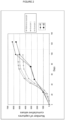
- Results are shown in table 4 as the cumulative value. These results are shown in table 4 and are also compared with the data of the experiments from ES2257219B1 , wherein two different types of trapping devices comprising diffusors for attracting Diptera were described and tested. 3 trapping devices were also used. Figure 7 and figure 8 of ES2257219B1 correspond to two different trapping device configurations placed and tested in different fields of citrus or peaches (see table 4 below). Table 4. Number of trapped and killed flies of Ceratitis capitata cumulative values. Number of attracted, trapped and killed flies Present invention ES2257219B1 Day Example. 1 Example.
- A1 corresponds to a device comprising three diffusers each one containing a porous cellulose support which has impregnated an aqueous solutions of ammonium acetate, trimethylamine hydrochloride and cadaverine respectively.
- A2 corresponds to a device which comprises one diffuser containing a porous cellulose support which has impregnated an aqueous composition containing ammonium acetate, trimethylamine hydrochloride and cadaverine.
- the trapping device containing the devices of examples 1 and 2 according to the invention showed a higher number of attracted, trapped and killed Ceratitis capitata flies than the traps containing the reference example device. Therefore, the trapping device comprising the device of the first aspect, attracted, trapped and killed more flies than the traps comprising a device according to the reference composition (dry composition). Thus, the trapping device of the invention was more effective than the trapping device comprising the reference composition (Envelope shape and filled with a dry composition of said attractants salts).
- the trapping devices according to the sixth aspect comprising the attractant devices of the present invention, examples 1 and 2, showed higher cumulative values of attracted, trapped and killed flies than those of the reference sample of ES2257219B1 , as can be seen from table 4 and from figures 1 and 2 .
Landscapes
- Life Sciences & Earth Sciences (AREA)
- Pest Control & Pesticides (AREA)
- Engineering & Computer Science (AREA)
- Insects & Arthropods (AREA)
- Wood Science & Technology (AREA)
- Zoology (AREA)
- Environmental Sciences (AREA)
- Agricultural Chemicals And Associated Chemicals (AREA)
Priority Applications (3)
| Application Number | Priority Date | Filing Date | Title |
|---|---|---|---|
| EP22382395.6A EP4268592A1 (fr) | 2022-04-26 | 2022-04-26 | Dispositif pour attirer les diptères du type cératite et dispositif de piégeage |
| PCT/EP2023/054327 WO2023208443A1 (fr) | 2022-04-26 | 2023-02-21 | Dispositif d'attraction de diptères de type ceratitis et dispositif de piégeage |
| EP23706748.3A EP4478880B1 (fr) | 2022-04-26 | 2023-02-21 | Dispositif pour attirer les diptères du type cératite et dispositif de piégeage |
Applications Claiming Priority (1)
| Application Number | Priority Date | Filing Date | Title |
|---|---|---|---|
| EP22382395.6A EP4268592A1 (fr) | 2022-04-26 | 2022-04-26 | Dispositif pour attirer les diptères du type cératite et dispositif de piégeage |
Publications (1)
| Publication Number | Publication Date |
|---|---|
| EP4268592A1 true EP4268592A1 (fr) | 2023-11-01 |
Family
ID=81389028
Family Applications (2)
| Application Number | Title | Priority Date | Filing Date |
|---|---|---|---|
| EP22382395.6A Withdrawn EP4268592A1 (fr) | 2022-04-26 | 2022-04-26 | Dispositif pour attirer les diptères du type cératite et dispositif de piégeage |
| EP23706748.3A Active EP4478880B1 (fr) | 2022-04-26 | 2023-02-21 | Dispositif pour attirer les diptères du type cératite et dispositif de piégeage |
Family Applications After (1)
| Application Number | Title | Priority Date | Filing Date |
|---|---|---|---|
| EP23706748.3A Active EP4478880B1 (fr) | 2022-04-26 | 2023-02-21 | Dispositif pour attirer les diptères du type cératite et dispositif de piégeage |
Country Status (2)
| Country | Link |
|---|---|
| EP (2) | EP4268592A1 (fr) |
| WO (1) | WO2023208443A1 (fr) |
Citations (10)
| Publication number | Priority date | Publication date | Assignee | Title |
|---|---|---|---|---|
| US4947578A (en) * | 1989-06-16 | 1990-08-14 | Ecolab Inc. | Controlled release system for insect attractant |
| US5008107A (en) * | 1990-01-31 | 1991-04-16 | Farnam Companies, Inc. | Attractant composition for synanthropic flies |
| US5229126A (en) * | 1989-06-16 | 1993-07-20 | Ecolab Inc. | Flying insect attractant composition |
| WO1999045772A1 (fr) * | 1998-03-10 | 1999-09-16 | The United States Of America, As Represented By The Secretary Of Agriculture | Attractifs chimiques destines aux guepes jaunes et aux polistes |
| ES2257219B1 (es) | 2005-12-16 | 2007-05-01 | Sociedad Española De Desarrollos Quimicos S.L. | Dispositivo de trampeo para insectos frugivoros. |
| EP2489261A1 (fr) * | 2009-10-16 | 2012-08-22 | Sociedad Española de Desarrollos Quimicos S.L. | Dispositif de piégeage pour insectes frugivores |
| EP2559338A1 (fr) * | 2010-04-12 | 2013-02-20 | Probodelt S.L. | Piège pour insectes frugivores |
| WO2016123625A1 (fr) * | 2015-02-01 | 2016-08-04 | Trece, Inc | Leurre et piège à insectes |
| EP3127426A1 (fr) | 2014-03-31 | 2017-02-08 | AO Midori Biocontrol S.L. | Diffuseur de substances attractives d'insectes |
| WO2020127785A1 (fr) * | 2018-12-21 | 2020-06-25 | Zobele Holding Spa | Dispositif pour la diffusion de substances volatiles |
-
2022
- 2022-04-26 EP EP22382395.6A patent/EP4268592A1/fr not_active Withdrawn
-
2023
- 2023-02-21 EP EP23706748.3A patent/EP4478880B1/fr active Active
- 2023-02-21 WO PCT/EP2023/054327 patent/WO2023208443A1/fr not_active Ceased
Patent Citations (11)
| Publication number | Priority date | Publication date | Assignee | Title |
|---|---|---|---|---|
| US4947578A (en) * | 1989-06-16 | 1990-08-14 | Ecolab Inc. | Controlled release system for insect attractant |
| US5229126A (en) * | 1989-06-16 | 1993-07-20 | Ecolab Inc. | Flying insect attractant composition |
| US5008107A (en) * | 1990-01-31 | 1991-04-16 | Farnam Companies, Inc. | Attractant composition for synanthropic flies |
| WO1999045772A1 (fr) * | 1998-03-10 | 1999-09-16 | The United States Of America, As Represented By The Secretary Of Agriculture | Attractifs chimiques destines aux guepes jaunes et aux polistes |
| ES2257219B1 (es) | 2005-12-16 | 2007-05-01 | Sociedad Española De Desarrollos Quimicos S.L. | Dispositivo de trampeo para insectos frugivoros. |
| WO2007068329A1 (fr) * | 2005-12-16 | 2007-06-21 | Sociedad Española De Desarrollos Quimicos S.L. | Dispositif de piégeage pour des insectes frugivores |
| EP2489261A1 (fr) * | 2009-10-16 | 2012-08-22 | Sociedad Española de Desarrollos Quimicos S.L. | Dispositif de piégeage pour insectes frugivores |
| EP2559338A1 (fr) * | 2010-04-12 | 2013-02-20 | Probodelt S.L. | Piège pour insectes frugivores |
| EP3127426A1 (fr) | 2014-03-31 | 2017-02-08 | AO Midori Biocontrol S.L. | Diffuseur de substances attractives d'insectes |
| WO2016123625A1 (fr) * | 2015-02-01 | 2016-08-04 | Trece, Inc | Leurre et piège à insectes |
| WO2020127785A1 (fr) * | 2018-12-21 | 2020-06-25 | Zobele Holding Spa | Dispositif pour la diffusion de substances volatiles |
Also Published As
| Publication number | Publication date |
|---|---|
| WO2023208443A1 (fr) | 2023-11-02 |
| EP4478880B1 (fr) | 2026-04-29 |
| EP4478880A1 (fr) | 2024-12-25 |
Similar Documents
| Publication | Publication Date | Title |
|---|---|---|
| EP1959729B1 (fr) | Dispositif de piégeage pour des insectes frugivores | |
| CN101583267B (zh) | 害虫捕获器及害虫捕获方法 | |
| JP4430121B2 (ja) | 害虫捕獲器および害虫捕獲方法 | |
| CN1104837C (zh) | 灭蚊繁殖容器和控制容器繁殖蚊子数量的方法 | |
| JP2002173407A (ja) | 飛翔昆虫忌避剤 | |
| WO1990015532A1 (fr) | Systeme a liberation regulee pour substance attirant les insectes | |
| US5665370A (en) | Compositions containing cockroach aggregation pheromones, their production and uses | |
| JP6290680B2 (ja) | 飛翔害虫誘引防除装置 | |
| JP6307759B2 (ja) | 樹幹注入剤およびナラ枯れ防止方法 | |
| EP4478880B1 (fr) | Dispositif pour attirer les diptères du type cératite et dispositif de piégeage | |
| JP6879735B2 (ja) | 飛翔害虫捕獲器 | |
| JP5586488B2 (ja) | 飛翔害虫捕獲具用担体及びこれを用いた飛翔害虫捕獲具 | |
| EP4458147B1 (fr) | Dispositif d'attraction d'insectes diptères et piège utilisant ledit dispositif | |
| EP3673733B1 (fr) | Dispositif pour la libération contrôlée et/ou l'administration contrôlée d'agents de lutte contre les arthropodes, et utilisation de celui-ci | |
| Tysowsky et al. | Ovicidal Activity of Ambush™, a Synthetic Pyrethroid Insecticide, on Corn Earworm, Fall Armyworm, and Cabbage Looper | |
| JP2021078518A (ja) | 飛翔害虫捕獲器 | |
| JP5773656B2 (ja) | 飛翔害虫捕獲具 | |
| JP6762120B2 (ja) | 誘引殺虫用具 | |
| Smith | Dispersible microparticles | |
| JP2004016151A (ja) | 害虫駆除装置 | |
| JP2026084474A (ja) | 飛翔害虫誘引駆除剤、飛翔害虫誘引駆除器及びこれらの製造方法並びに飛翔害虫誘引駆除方法 | |
| EP4221499A1 (fr) | Système de libération pour lutter contre les parasites | |
| JP2004008161A (ja) | シロアリの殺虫、成育抑制方法 | |
| JP2011101613A (ja) | 飛翔害虫捕獲具 |
Legal Events
| Date | Code | Title | Description |
|---|---|---|---|
| PUAI | Public reference made under article 153(3) epc to a published international application that has entered the european phase |
Free format text: ORIGINAL CODE: 0009012 |
|
| STAA | Information on the status of an ep patent application or granted ep patent |
Free format text: STATUS: THE APPLICATION HAS BEEN PUBLISHED |
|
| AK | Designated contracting states |
Kind code of ref document: A1 Designated state(s): AL AT BE BG CH CY CZ DE DK EE ES FI FR GB GR HR HU IE IS IT LI LT LU LV MC MK MT NL NO PL PT RO RS SE SI SK SM TR |
|
| STAA | Information on the status of an ep patent application or granted ep patent |
Free format text: STATUS: THE APPLICATION IS DEEMED TO BE WITHDRAWN |
|
| 18D | Application deemed to be withdrawn |
Effective date: 20240503 |