EP4268771B1 - Dispositif d'augmentation et procédé d'ajustement d'un dispositif d'augmentation - Google Patents
Dispositif d'augmentation et procédé d'ajustement d'un dispositif d'augmentation Download PDFInfo
- Publication number
- EP4268771B1 EP4268771B1 EP22169675.0A EP22169675A EP4268771B1 EP 4268771 B1 EP4268771 B1 EP 4268771B1 EP 22169675 A EP22169675 A EP 22169675A EP 4268771 B1 EP4268771 B1 EP 4268771B1
- Authority
- EP
- European Patent Office
- Prior art keywords
- cone
- augmentation device
- grooves
- segments
- axial
- Prior art date
- Legal status (The legal status is an assumption and is not a legal conclusion. Google has not performed a legal analysis and makes no representation as to the accuracy of the status listed.)
- Active
Links
Images



Classifications
-
- A—HUMAN NECESSITIES
- A61—MEDICAL OR VETERINARY SCIENCE; HYGIENE
- A61F—FILTERS IMPLANTABLE INTO BLOOD VESSELS; PROSTHESES; DEVICES PROVIDING PATENCY TO, OR PREVENTING COLLAPSING OF, TUBULAR STRUCTURES OF THE BODY, e.g. STENTS; ORTHOPAEDIC, NURSING OR CONTRACEPTIVE DEVICES; FOMENTATION; TREATMENT OR PROTECTION OF EYES OR EARS; BANDAGES, DRESSINGS OR ABSORBENT PADS; FIRST-AID KITS
- A61F2/00—Filters implantable into blood vessels; Prostheses, i.e. artificial substitutes or replacements for parts of the body; Appliances for connecting them with the body; Devices providing patency to, or preventing collapsing of, tubular structures of the body, e.g. stents
- A61F2/02—Prostheses implantable into the body
- A61F2/30—Joints
- A61F2/30721—Accessories
- A61F2/30734—Modular inserts, sleeves or augments, e.g. placed on proximal part of stem for fixation purposes or wedges for bridging a bone defect
-
- A—HUMAN NECESSITIES
- A61—MEDICAL OR VETERINARY SCIENCE; HYGIENE
- A61F—FILTERS IMPLANTABLE INTO BLOOD VESSELS; PROSTHESES; DEVICES PROVIDING PATENCY TO, OR PREVENTING COLLAPSING OF, TUBULAR STRUCTURES OF THE BODY, e.g. STENTS; ORTHOPAEDIC, NURSING OR CONTRACEPTIVE DEVICES; FOMENTATION; TREATMENT OR PROTECTION OF EYES OR EARS; BANDAGES, DRESSINGS OR ABSORBENT PADS; FIRST-AID KITS
- A61F2/00—Filters implantable into blood vessels; Prostheses, i.e. artificial substitutes or replacements for parts of the body; Appliances for connecting them with the body; Devices providing patency to, or preventing collapsing of, tubular structures of the body, e.g. stents
- A61F2/02—Prostheses implantable into the body
- A61F2/30—Joints
- A61F2/30767—Special external or bone-contacting surface, e.g. coating for improving bone ingrowth
-
- A—HUMAN NECESSITIES
- A61—MEDICAL OR VETERINARY SCIENCE; HYGIENE
- A61F—FILTERS IMPLANTABLE INTO BLOOD VESSELS; PROSTHESES; DEVICES PROVIDING PATENCY TO, OR PREVENTING COLLAPSING OF, TUBULAR STRUCTURES OF THE BODY, e.g. STENTS; ORTHOPAEDIC, NURSING OR CONTRACEPTIVE DEVICES; FOMENTATION; TREATMENT OR PROTECTION OF EYES OR EARS; BANDAGES, DRESSINGS OR ABSORBENT PADS; FIRST-AID KITS
- A61F2/00—Filters implantable into blood vessels; Prostheses, i.e. artificial substitutes or replacements for parts of the body; Appliances for connecting them with the body; Devices providing patency to, or preventing collapsing of, tubular structures of the body, e.g. stents
- A61F2/02—Prostheses implantable into the body
- A61F2/30—Joints
- A61F2002/30001—Additional features of subject-matter classified in A61F2/28, A61F2/30 and subgroups thereof
- A61F2002/30003—Material related properties of the prosthesis or of a coating on the prosthesis
- A61F2002/30004—Material related properties of the prosthesis or of a coating on the prosthesis the prosthesis being made from materials having different values of a given property at different locations within the same prosthesis
-
- A—HUMAN NECESSITIES
- A61—MEDICAL OR VETERINARY SCIENCE; HYGIENE
- A61F—FILTERS IMPLANTABLE INTO BLOOD VESSELS; PROSTHESES; DEVICES PROVIDING PATENCY TO, OR PREVENTING COLLAPSING OF, TUBULAR STRUCTURES OF THE BODY, e.g. STENTS; ORTHOPAEDIC, NURSING OR CONTRACEPTIVE DEVICES; FOMENTATION; TREATMENT OR PROTECTION OF EYES OR EARS; BANDAGES, DRESSINGS OR ABSORBENT PADS; FIRST-AID KITS
- A61F2/00—Filters implantable into blood vessels; Prostheses, i.e. artificial substitutes or replacements for parts of the body; Appliances for connecting them with the body; Devices providing patency to, or preventing collapsing of, tubular structures of the body, e.g. stents
- A61F2/02—Prostheses implantable into the body
- A61F2/30—Joints
- A61F2002/30001—Additional features of subject-matter classified in A61F2/28, A61F2/30 and subgroups thereof
- A61F2002/30003—Material related properties of the prosthesis or of a coating on the prosthesis
- A61F2002/30004—Material related properties of the prosthesis or of a coating on the prosthesis the prosthesis being made from materials having different values of a given property at different locations within the same prosthesis
- A61F2002/30011—Material related properties of the prosthesis or of a coating on the prosthesis the prosthesis being made from materials having different values of a given property at different locations within the same prosthesis differing in porosity
-
- A—HUMAN NECESSITIES
- A61—MEDICAL OR VETERINARY SCIENCE; HYGIENE
- A61F—FILTERS IMPLANTABLE INTO BLOOD VESSELS; PROSTHESES; DEVICES PROVIDING PATENCY TO, OR PREVENTING COLLAPSING OF, TUBULAR STRUCTURES OF THE BODY, e.g. STENTS; ORTHOPAEDIC, NURSING OR CONTRACEPTIVE DEVICES; FOMENTATION; TREATMENT OR PROTECTION OF EYES OR EARS; BANDAGES, DRESSINGS OR ABSORBENT PADS; FIRST-AID KITS
- A61F2/00—Filters implantable into blood vessels; Prostheses, i.e. artificial substitutes or replacements for parts of the body; Appliances for connecting them with the body; Devices providing patency to, or preventing collapsing of, tubular structures of the body, e.g. stents
- A61F2/02—Prostheses implantable into the body
- A61F2/30—Joints
- A61F2002/30001—Additional features of subject-matter classified in A61F2/28, A61F2/30 and subgroups thereof
- A61F2002/30003—Material related properties of the prosthesis or of a coating on the prosthesis
- A61F2002/3006—Properties of materials and coating materials
- A61F2002/3008—Properties of materials and coating materials radio-opaque, e.g. radio-opaque markers
-
- A—HUMAN NECESSITIES
- A61—MEDICAL OR VETERINARY SCIENCE; HYGIENE
- A61F—FILTERS IMPLANTABLE INTO BLOOD VESSELS; PROSTHESES; DEVICES PROVIDING PATENCY TO, OR PREVENTING COLLAPSING OF, TUBULAR STRUCTURES OF THE BODY, e.g. STENTS; ORTHOPAEDIC, NURSING OR CONTRACEPTIVE DEVICES; FOMENTATION; TREATMENT OR PROTECTION OF EYES OR EARS; BANDAGES, DRESSINGS OR ABSORBENT PADS; FIRST-AID KITS
- A61F2/00—Filters implantable into blood vessels; Prostheses, i.e. artificial substitutes or replacements for parts of the body; Appliances for connecting them with the body; Devices providing patency to, or preventing collapsing of, tubular structures of the body, e.g. stents
- A61F2/02—Prostheses implantable into the body
- A61F2/30—Joints
- A61F2002/30001—Additional features of subject-matter classified in A61F2/28, A61F2/30 and subgroups thereof
- A61F2002/30108—Shapes
- A61F2002/30199—Three-dimensional shapes
- A61F2002/30205—Three-dimensional shapes conical
- A61F2002/30215—Stepped cones, i.e. having discrete diameter changes
-
- A—HUMAN NECESSITIES
- A61—MEDICAL OR VETERINARY SCIENCE; HYGIENE
- A61F—FILTERS IMPLANTABLE INTO BLOOD VESSELS; PROSTHESES; DEVICES PROVIDING PATENCY TO, OR PREVENTING COLLAPSING OF, TUBULAR STRUCTURES OF THE BODY, e.g. STENTS; ORTHOPAEDIC, NURSING OR CONTRACEPTIVE DEVICES; FOMENTATION; TREATMENT OR PROTECTION OF EYES OR EARS; BANDAGES, DRESSINGS OR ABSORBENT PADS; FIRST-AID KITS
- A61F2/00—Filters implantable into blood vessels; Prostheses, i.e. artificial substitutes or replacements for parts of the body; Appliances for connecting them with the body; Devices providing patency to, or preventing collapsing of, tubular structures of the body, e.g. stents
- A61F2/02—Prostheses implantable into the body
- A61F2/30—Joints
- A61F2002/30001—Additional features of subject-matter classified in A61F2/28, A61F2/30 and subgroups thereof
- A61F2002/30108—Shapes
- A61F2002/30199—Three-dimensional shapes
- A61F2002/30205—Three-dimensional shapes conical
- A61F2002/30217—Three-dimensional shapes conical hollow cones, e.g. tubular-like cones
-
- A—HUMAN NECESSITIES
- A61—MEDICAL OR VETERINARY SCIENCE; HYGIENE
- A61F—FILTERS IMPLANTABLE INTO BLOOD VESSELS; PROSTHESES; DEVICES PROVIDING PATENCY TO, OR PREVENTING COLLAPSING OF, TUBULAR STRUCTURES OF THE BODY, e.g. STENTS; ORTHOPAEDIC, NURSING OR CONTRACEPTIVE DEVICES; FOMENTATION; TREATMENT OR PROTECTION OF EYES OR EARS; BANDAGES, DRESSINGS OR ABSORBENT PADS; FIRST-AID KITS
- A61F2/00—Filters implantable into blood vessels; Prostheses, i.e. artificial substitutes or replacements for parts of the body; Appliances for connecting them with the body; Devices providing patency to, or preventing collapsing of, tubular structures of the body, e.g. stents
- A61F2/02—Prostheses implantable into the body
- A61F2/30—Joints
- A61F2002/30001—Additional features of subject-matter classified in A61F2/28, A61F2/30 and subgroups thereof
- A61F2002/30316—The prosthesis having different structural features at different locations within the same prosthesis; Connections between prosthetic parts; Special structural features of bone or joint prostheses not otherwise provided for
- A61F2002/30317—The prosthesis having different structural features at different locations within the same prosthesis
- A61F2002/30321—The prosthesis having different structural features at different locations within the same prosthesis differing in roughness
-
- A—HUMAN NECESSITIES
- A61—MEDICAL OR VETERINARY SCIENCE; HYGIENE
- A61F—FILTERS IMPLANTABLE INTO BLOOD VESSELS; PROSTHESES; DEVICES PROVIDING PATENCY TO, OR PREVENTING COLLAPSING OF, TUBULAR STRUCTURES OF THE BODY, e.g. STENTS; ORTHOPAEDIC, NURSING OR CONTRACEPTIVE DEVICES; FOMENTATION; TREATMENT OR PROTECTION OF EYES OR EARS; BANDAGES, DRESSINGS OR ABSORBENT PADS; FIRST-AID KITS
- A61F2/00—Filters implantable into blood vessels; Prostheses, i.e. artificial substitutes or replacements for parts of the body; Appliances for connecting them with the body; Devices providing patency to, or preventing collapsing of, tubular structures of the body, e.g. stents
- A61F2/02—Prostheses implantable into the body
- A61F2/30—Joints
- A61F2002/30001—Additional features of subject-matter classified in A61F2/28, A61F2/30 and subgroups thereof
- A61F2002/30316—The prosthesis having different structural features at different locations within the same prosthesis; Connections between prosthetic parts; Special structural features of bone or joint prostheses not otherwise provided for
- A61F2002/30535—Special structural features of bone or joint prostheses not otherwise provided for
- A61F2002/30561—Special structural features of bone or joint prostheses not otherwise provided for breakable or frangible
-
- A—HUMAN NECESSITIES
- A61—MEDICAL OR VETERINARY SCIENCE; HYGIENE
- A61F—FILTERS IMPLANTABLE INTO BLOOD VESSELS; PROSTHESES; DEVICES PROVIDING PATENCY TO, OR PREVENTING COLLAPSING OF, TUBULAR STRUCTURES OF THE BODY, e.g. STENTS; ORTHOPAEDIC, NURSING OR CONTRACEPTIVE DEVICES; FOMENTATION; TREATMENT OR PROTECTION OF EYES OR EARS; BANDAGES, DRESSINGS OR ABSORBENT PADS; FIRST-AID KITS
- A61F2/00—Filters implantable into blood vessels; Prostheses, i.e. artificial substitutes or replacements for parts of the body; Appliances for connecting them with the body; Devices providing patency to, or preventing collapsing of, tubular structures of the body, e.g. stents
- A61F2/02—Prostheses implantable into the body
- A61F2/30—Joints
- A61F2002/30001—Additional features of subject-matter classified in A61F2/28, A61F2/30 and subgroups thereof
- A61F2002/30316—The prosthesis having different structural features at different locations within the same prosthesis; Connections between prosthetic parts; Special structural features of bone or joint prostheses not otherwise provided for
- A61F2002/30535—Special structural features of bone or joint prostheses not otherwise provided for
- A61F2002/30593—Special structural features of bone or joint prostheses not otherwise provided for hollow
-
- A—HUMAN NECESSITIES
- A61—MEDICAL OR VETERINARY SCIENCE; HYGIENE
- A61F—FILTERS IMPLANTABLE INTO BLOOD VESSELS; PROSTHESES; DEVICES PROVIDING PATENCY TO, OR PREVENTING COLLAPSING OF, TUBULAR STRUCTURES OF THE BODY, e.g. STENTS; ORTHOPAEDIC, NURSING OR CONTRACEPTIVE DEVICES; FOMENTATION; TREATMENT OR PROTECTION OF EYES OR EARS; BANDAGES, DRESSINGS OR ABSORBENT PADS; FIRST-AID KITS
- A61F2/00—Filters implantable into blood vessels; Prostheses, i.e. artificial substitutes or replacements for parts of the body; Appliances for connecting them with the body; Devices providing patency to, or preventing collapsing of, tubular structures of the body, e.g. stents
- A61F2/02—Prostheses implantable into the body
- A61F2/30—Joints
- A61F2002/30001—Additional features of subject-matter classified in A61F2/28, A61F2/30 and subgroups thereof
- A61F2002/30667—Features concerning an interaction with the environment or a particular use of the prosthesis
- A61F2002/30677—Means for introducing or releasing pharmaceutical products, e.g. antibiotics, into the body
-
- A—HUMAN NECESSITIES
- A61—MEDICAL OR VETERINARY SCIENCE; HYGIENE
- A61F—FILTERS IMPLANTABLE INTO BLOOD VESSELS; PROSTHESES; DEVICES PROVIDING PATENCY TO, OR PREVENTING COLLAPSING OF, TUBULAR STRUCTURES OF THE BODY, e.g. STENTS; ORTHOPAEDIC, NURSING OR CONTRACEPTIVE DEVICES; FOMENTATION; TREATMENT OR PROTECTION OF EYES OR EARS; BANDAGES, DRESSINGS OR ABSORBENT PADS; FIRST-AID KITS
- A61F2/00—Filters implantable into blood vessels; Prostheses, i.e. artificial substitutes or replacements for parts of the body; Appliances for connecting them with the body; Devices providing patency to, or preventing collapsing of, tubular structures of the body, e.g. stents
- A61F2/02—Prostheses implantable into the body
- A61F2/30—Joints
- A61F2002/30001—Additional features of subject-matter classified in A61F2/28, A61F2/30 and subgroups thereof
- A61F2002/30667—Features concerning an interaction with the environment or a particular use of the prosthesis
- A61F2002/3069—Revision endoprostheses
-
- A—HUMAN NECESSITIES
- A61—MEDICAL OR VETERINARY SCIENCE; HYGIENE
- A61F—FILTERS IMPLANTABLE INTO BLOOD VESSELS; PROSTHESES; DEVICES PROVIDING PATENCY TO, OR PREVENTING COLLAPSING OF, TUBULAR STRUCTURES OF THE BODY, e.g. STENTS; ORTHOPAEDIC, NURSING OR CONTRACEPTIVE DEVICES; FOMENTATION; TREATMENT OR PROTECTION OF EYES OR EARS; BANDAGES, DRESSINGS OR ABSORBENT PADS; FIRST-AID KITS
- A61F2/00—Filters implantable into blood vessels; Prostheses, i.e. artificial substitutes or replacements for parts of the body; Appliances for connecting them with the body; Devices providing patency to, or preventing collapsing of, tubular structures of the body, e.g. stents
- A61F2/02—Prostheses implantable into the body
- A61F2/30—Joints
- A61F2/30721—Accessories
- A61F2/30734—Modular inserts, sleeves or augments, e.g. placed on proximal part of stem for fixation purposes or wedges for bridging a bone defect
- A61F2002/30736—Augments or augmentation pieces, e.g. wedges or blocks for bridging a bone defect
-
- A—HUMAN NECESSITIES
- A61—MEDICAL OR VETERINARY SCIENCE; HYGIENE
- A61F—FILTERS IMPLANTABLE INTO BLOOD VESSELS; PROSTHESES; DEVICES PROVIDING PATENCY TO, OR PREVENTING COLLAPSING OF, TUBULAR STRUCTURES OF THE BODY, e.g. STENTS; ORTHOPAEDIC, NURSING OR CONTRACEPTIVE DEVICES; FOMENTATION; TREATMENT OR PROTECTION OF EYES OR EARS; BANDAGES, DRESSINGS OR ABSORBENT PADS; FIRST-AID KITS
- A61F2/00—Filters implantable into blood vessels; Prostheses, i.e. artificial substitutes or replacements for parts of the body; Appliances for connecting them with the body; Devices providing patency to, or preventing collapsing of, tubular structures of the body, e.g. stents
- A61F2/02—Prostheses implantable into the body
- A61F2/30—Joints
- A61F2/30721—Accessories
- A61F2/30734—Modular inserts, sleeves or augments, e.g. placed on proximal part of stem for fixation purposes or wedges for bridging a bone defect
- A61F2002/30738—Sleeves
-
- A—HUMAN NECESSITIES
- A61—MEDICAL OR VETERINARY SCIENCE; HYGIENE
- A61F—FILTERS IMPLANTABLE INTO BLOOD VESSELS; PROSTHESES; DEVICES PROVIDING PATENCY TO, OR PREVENTING COLLAPSING OF, TUBULAR STRUCTURES OF THE BODY, e.g. STENTS; ORTHOPAEDIC, NURSING OR CONTRACEPTIVE DEVICES; FOMENTATION; TREATMENT OR PROTECTION OF EYES OR EARS; BANDAGES, DRESSINGS OR ABSORBENT PADS; FIRST-AID KITS
- A61F2/00—Filters implantable into blood vessels; Prostheses, i.e. artificial substitutes or replacements for parts of the body; Appliances for connecting them with the body; Devices providing patency to, or preventing collapsing of, tubular structures of the body, e.g. stents
- A61F2/02—Prostheses implantable into the body
- A61F2/30—Joints
- A61F2/30767—Special external or bone-contacting surface, e.g. coating for improving bone ingrowth
- A61F2/30771—Special external or bone-contacting surface, e.g. coating for improving bone ingrowth applied in original prostheses, e.g. holes or grooves
- A61F2002/3082—Grooves
- A61F2002/30822—Circumferential grooves
-
- A—HUMAN NECESSITIES
- A61—MEDICAL OR VETERINARY SCIENCE; HYGIENE
- A61F—FILTERS IMPLANTABLE INTO BLOOD VESSELS; PROSTHESES; DEVICES PROVIDING PATENCY TO, OR PREVENTING COLLAPSING OF, TUBULAR STRUCTURES OF THE BODY, e.g. STENTS; ORTHOPAEDIC, NURSING OR CONTRACEPTIVE DEVICES; FOMENTATION; TREATMENT OR PROTECTION OF EYES OR EARS; BANDAGES, DRESSINGS OR ABSORBENT PADS; FIRST-AID KITS
- A61F2/00—Filters implantable into blood vessels; Prostheses, i.e. artificial substitutes or replacements for parts of the body; Appliances for connecting them with the body; Devices providing patency to, or preventing collapsing of, tubular structures of the body, e.g. stents
- A61F2/02—Prostheses implantable into the body
- A61F2/30—Joints
- A61F2/30767—Special external or bone-contacting surface, e.g. coating for improving bone ingrowth
- A61F2/30771—Special external or bone-contacting surface, e.g. coating for improving bone ingrowth applied in original prostheses, e.g. holes or grooves
- A61F2002/3082—Grooves
- A61F2002/30827—Plurality of grooves
-
- A—HUMAN NECESSITIES
- A61—MEDICAL OR VETERINARY SCIENCE; HYGIENE
- A61F—FILTERS IMPLANTABLE INTO BLOOD VESSELS; PROSTHESES; DEVICES PROVIDING PATENCY TO, OR PREVENTING COLLAPSING OF, TUBULAR STRUCTURES OF THE BODY, e.g. STENTS; ORTHOPAEDIC, NURSING OR CONTRACEPTIVE DEVICES; FOMENTATION; TREATMENT OR PROTECTION OF EYES OR EARS; BANDAGES, DRESSINGS OR ABSORBENT PADS; FIRST-AID KITS
- A61F2/00—Filters implantable into blood vessels; Prostheses, i.e. artificial substitutes or replacements for parts of the body; Appliances for connecting them with the body; Devices providing patency to, or preventing collapsing of, tubular structures of the body, e.g. stents
- A61F2/02—Prostheses implantable into the body
- A61F2/30—Joints
- A61F2/30767—Special external or bone-contacting surface, e.g. coating for improving bone ingrowth
- A61F2/30771—Special external or bone-contacting surface, e.g. coating for improving bone ingrowth applied in original prostheses, e.g. holes or grooves
- A61F2002/3082—Grooves
- A61F2002/30827—Plurality of grooves
- A61F2002/30828—Plurality of grooves parallel
-
- A—HUMAN NECESSITIES
- A61—MEDICAL OR VETERINARY SCIENCE; HYGIENE
- A61F—FILTERS IMPLANTABLE INTO BLOOD VESSELS; PROSTHESES; DEVICES PROVIDING PATENCY TO, OR PREVENTING COLLAPSING OF, TUBULAR STRUCTURES OF THE BODY, e.g. STENTS; ORTHOPAEDIC, NURSING OR CONTRACEPTIVE DEVICES; FOMENTATION; TREATMENT OR PROTECTION OF EYES OR EARS; BANDAGES, DRESSINGS OR ABSORBENT PADS; FIRST-AID KITS
- A61F2/00—Filters implantable into blood vessels; Prostheses, i.e. artificial substitutes or replacements for parts of the body; Appliances for connecting them with the body; Devices providing patency to, or preventing collapsing of, tubular structures of the body, e.g. stents
- A61F2/02—Prostheses implantable into the body
- A61F2/30—Joints
- A61F2/30767—Special external or bone-contacting surface, e.g. coating for improving bone ingrowth
- A61F2/30771—Special external or bone-contacting surface, e.g. coating for improving bone ingrowth applied in original prostheses, e.g. holes or grooves
- A61F2002/3082—Grooves
- A61F2002/30827—Plurality of grooves
- A61F2002/3083—Plurality of grooves inclined obliquely with respect to each other
-
- A—HUMAN NECESSITIES
- A61—MEDICAL OR VETERINARY SCIENCE; HYGIENE
- A61F—FILTERS IMPLANTABLE INTO BLOOD VESSELS; PROSTHESES; DEVICES PROVIDING PATENCY TO, OR PREVENTING COLLAPSING OF, TUBULAR STRUCTURES OF THE BODY, e.g. STENTS; ORTHOPAEDIC, NURSING OR CONTRACEPTIVE DEVICES; FOMENTATION; TREATMENT OR PROTECTION OF EYES OR EARS; BANDAGES, DRESSINGS OR ABSORBENT PADS; FIRST-AID KITS
- A61F2/00—Filters implantable into blood vessels; Prostheses, i.e. artificial substitutes or replacements for parts of the body; Appliances for connecting them with the body; Devices providing patency to, or preventing collapsing of, tubular structures of the body, e.g. stents
- A61F2/02—Prostheses implantable into the body
- A61F2/30—Joints
- A61F2/30767—Special external or bone-contacting surface, e.g. coating for improving bone ingrowth
- A61F2002/3092—Special external or bone-contacting surface, e.g. coating for improving bone ingrowth having an open-celled or open-pored structure
-
- A—HUMAN NECESSITIES
- A61—MEDICAL OR VETERINARY SCIENCE; HYGIENE
- A61F—FILTERS IMPLANTABLE INTO BLOOD VESSELS; PROSTHESES; DEVICES PROVIDING PATENCY TO, OR PREVENTING COLLAPSING OF, TUBULAR STRUCTURES OF THE BODY, e.g. STENTS; ORTHOPAEDIC, NURSING OR CONTRACEPTIVE DEVICES; FOMENTATION; TREATMENT OR PROTECTION OF EYES OR EARS; BANDAGES, DRESSINGS OR ABSORBENT PADS; FIRST-AID KITS
- A61F2/00—Filters implantable into blood vessels; Prostheses, i.e. artificial substitutes or replacements for parts of the body; Appliances for connecting them with the body; Devices providing patency to, or preventing collapsing of, tubular structures of the body, e.g. stents
- A61F2/02—Prostheses implantable into the body
- A61F2/30—Joints
- A61F2/3094—Designing or manufacturing processes
- A61F2/30942—Designing or manufacturing processes for designing or making customized prostheses, e.g. using templates, CT or NMR scans, finite-element analysis or CAD-CAM techniques
- A61F2002/3096—Designing or manufacturing processes for designing or making customized prostheses, e.g. using templates, CT or NMR scans, finite-element analysis or CAD-CAM techniques trimmed or cut to a customised size
-
- A—HUMAN NECESSITIES
- A61—MEDICAL OR VETERINARY SCIENCE; HYGIENE
- A61F—FILTERS IMPLANTABLE INTO BLOOD VESSELS; PROSTHESES; DEVICES PROVIDING PATENCY TO, OR PREVENTING COLLAPSING OF, TUBULAR STRUCTURES OF THE BODY, e.g. STENTS; ORTHOPAEDIC, NURSING OR CONTRACEPTIVE DEVICES; FOMENTATION; TREATMENT OR PROTECTION OF EYES OR EARS; BANDAGES, DRESSINGS OR ABSORBENT PADS; FIRST-AID KITS
- A61F2310/00—Prostheses classified in A61F2/28 or A61F2/30 - A61F2/44 being constructed from or coated with a particular material
- A61F2310/00005—The prosthesis being constructed from a particular material
- A61F2310/00353—Bone cement, e.g. polymethylmethacrylate or PMMA
-
- A—HUMAN NECESSITIES
- A61—MEDICAL OR VETERINARY SCIENCE; HYGIENE
- A61F—FILTERS IMPLANTABLE INTO BLOOD VESSELS; PROSTHESES; DEVICES PROVIDING PATENCY TO, OR PREVENTING COLLAPSING OF, TUBULAR STRUCTURES OF THE BODY, e.g. STENTS; ORTHOPAEDIC, NURSING OR CONTRACEPTIVE DEVICES; FOMENTATION; TREATMENT OR PROTECTION OF EYES OR EARS; BANDAGES, DRESSINGS OR ABSORBENT PADS; FIRST-AID KITS
- A61F2310/00—Prostheses classified in A61F2/28 or A61F2/30 - A61F2/44 being constructed from or coated with a particular material
- A61F2310/00389—The prosthesis being coated or covered with a particular material
- A61F2310/00395—Coating or prosthesis-covering structure made of metals or of alloys
- A61F2310/00401—Coating made of iron, of stainless steel or of other Fe-based alloys
-
- A—HUMAN NECESSITIES
- A61—MEDICAL OR VETERINARY SCIENCE; HYGIENE
- A61F—FILTERS IMPLANTABLE INTO BLOOD VESSELS; PROSTHESES; DEVICES PROVIDING PATENCY TO, OR PREVENTING COLLAPSING OF, TUBULAR STRUCTURES OF THE BODY, e.g. STENTS; ORTHOPAEDIC, NURSING OR CONTRACEPTIVE DEVICES; FOMENTATION; TREATMENT OR PROTECTION OF EYES OR EARS; BANDAGES, DRESSINGS OR ABSORBENT PADS; FIRST-AID KITS
- A61F2310/00—Prostheses classified in A61F2/28 or A61F2/30 - A61F2/44 being constructed from or coated with a particular material
- A61F2310/00389—The prosthesis being coated or covered with a particular material
- A61F2310/00395—Coating or prosthesis-covering structure made of metals or of alloys
- A61F2310/00407—Coating made of titanium or of Ti-based alloys
-
- A—HUMAN NECESSITIES
- A61—MEDICAL OR VETERINARY SCIENCE; HYGIENE
- A61F—FILTERS IMPLANTABLE INTO BLOOD VESSELS; PROSTHESES; DEVICES PROVIDING PATENCY TO, OR PREVENTING COLLAPSING OF, TUBULAR STRUCTURES OF THE BODY, e.g. STENTS; ORTHOPAEDIC, NURSING OR CONTRACEPTIVE DEVICES; FOMENTATION; TREATMENT OR PROTECTION OF EYES OR EARS; BANDAGES, DRESSINGS OR ABSORBENT PADS; FIRST-AID KITS
- A61F2310/00—Prostheses classified in A61F2/28 or A61F2/30 - A61F2/44 being constructed from or coated with a particular material
- A61F2310/00389—The prosthesis being coated or covered with a particular material
- A61F2310/00395—Coating or prosthesis-covering structure made of metals or of alloys
- A61F2310/00419—Other metals
- A61F2310/00544—Coating made of tantalum or Ta-based alloys
Definitions
- the invention is defined in claims 1 and 9. It relates to an augmentation device comprising an annular cone surrounding a channel which extends through the cone from a proximal cone end to a distal cone end of the cone.
- the invention further relates to a method for adapting a cone size of such an augmentation device.
- the subject of the invention is in particular an augmentation device for use in joint endoprosthesis operations, in particular revision joint endoprosthesis operations.
- the augmentation device according to the invention is suitable for reinforcing debrided bone tissue or even partially replacing it and thus enabling a safe and stable anchoring of a joint endoprosthesis, in particular a revision endoprosthesis, in a bone canal.
- the augmentation device according to the invention serves in particular for a uniform introduction of force into the surrounding bone tissue during the implantation of a joint endoprosthesis, in particular a revision joint endoprosthesis.
- one possible treatment option is the use of an augmentation device in Form of a metal cone.
- the infected bone tissue is removed and the resulting cavity is filled by inserting the augmentation device.
- the cone-shaped design of the augmentation device serves to accommodate a shaft of a joint endoprosthesis, or a revision joint endoprosthesis, in a central channel of the augmentation device and to anchor it there, for example using bone cement.
- the augmentation device itself is designed in such a way that it can be inserted into the cavity created by the debridement.
- Such an augmentation device is described, for example, in the patent specification US8,506,645 B2 described.
- the augmentation devices available on the market have a defined, predetermined size and cannot be adapted to the individual anatomical condition of the patient. Therefore, augmentation devices of different sizes are offered on the market.
- the augmentation device has an annular cone which has at least one axially extending bending joint.
- the at least one joint allows the cone to be compressed by external pressure, which reduces the outer diameter of the augmentation device.
- the augmentation device has a "kink" due to the adjustment of the size, which makes it difficult to fit the augmentation device into the patient's bone and can have a detrimental effect on the implantation of the joint endoprosthesis or the revision joint endoprosthesis.
- the size of the augmentation device can only be adjusted to a limited extent. Adjusting the axial extension of the augmentation device is not possible during an ongoing operation in an operating room.
- a disadvantage of an augmentation device made of metal mesh is that it is not dimensionally stable, which negatively affects the stability of a prosthesis implanted with it.
- the force required to implant the prosthesis which acts on the augmentation device and the patient's tissue connected to it, cannot be transmitted evenly. The latter in particular can lead to damage to the patient's bone tissue.
- cutting off can lead to sharp-edged strands of tissue, which pose a risk of injury to the surgeon and the patient.
- an augmentation device that is dimensionally stable and can be easily and quickly adjusted in size, particularly in diameter and length.
- the size should be able to be adjusted without deforming the augmentation device.
- the size should be able to be adjusted using means that are usually used in orthopedic surgery, such as saws.
- An object of the present invention is to at least partially overcome one or more of the disadvantages resulting from the prior art.
- an augmentation device should be provided which is dimensionally stable and whose size can be easily and quickly adjusted to the anatomical conditions of a patient. Furthermore, the augmentation device should not be deformed when the size is adjusted. Furthermore, the augmentation device should not pose a risk of injury after the size has been adjusted.
- Another object of the invention is to provide a method by which an augmentation device can be adjusted in size and which avoids limitations of conventional implantation methods.
- a first embodiment of the invention according to claim 1 is an augmentation device comprising an annular cone which surrounds a channel which extends from a proximal cone end to a distal cone end of the cone through the cone, wherein the cone consists of at least 50 percent by volume, preferably at least 70 percent by volume, more preferably at least 90 percent by volume, based on the total volume of the cone, of a biocompatible polymer and is divided into annular cone segments by at least three, preferably three to eight, more preferably three to six, more preferably three to five, radially encircling grooves in a cone surface opposite the channel, wherein the grooves have a groove depth of at least 1 mm and a groove width of at least 1 mm and form saw guides to adapt a cone size of the cone by separating one or more cone segments.
- the conical surface is roughened or porous at least in sections.
- This embodiment is a second embodiment of the invention, which preferably depends on the first embodiment of the invention.
- the cone surface is formed to at least 70 area percent, preferably at least 80 area percent, more preferably at least 90 area percent, based on the entire cone surface from tantalum, a tantalum alloy, titanium, a titanium alloy or stainless steel.
- This embodiment is a third embodiment of the invention, which preferably depends on the first or second embodiment of the invention.
- the biocompatible polymer is a PMMA bone cement.
- This embodiment is a fourth embodiment of the invention, which preferably depends on one of the preceding embodiments of the invention.
- the PMMA bone cement contains at least one antibiotic.
- This embodiment is a fifth embodiment of the invention, which preferably depends on the fourth embodiment of the invention.
- the cone has radially encircling inner grooves in a cone inner surface facing the channel, which are arranged opposite the grooves, in particular radially opposite them.
- This embodiment is a sixth embodiment of the invention, which preferably depends on one of the preceding embodiments of the invention.
- the conical surface has at least two axially extending axial grooves with an axial groove depth of at least 1 mm and an axial groove width of at least 1 mm, which are each connected to at least one of the grooves.
- This embodiment is a seventh embodiment of the invention, which preferably depends on one of the preceding embodiments of the invention.
- the cone segments are spaced apart from one another in steps.
- This embodiment is an eighth embodiment of the invention, which preferably depends on one of the preceding embodiments of the invention.
- a ninth embodiment of the invention is a method according to claim 9 for adapting a cone size of an augmentation device according to one of the preceding embodiments of the invention, comprising a step of separating one or more cone segments at the proximal cone end, at the distal cone end or at the proximal and distal cone ends by sawing, cutting or breaking off along the radially circumferential groove or grooves.
- An embodiment of the method for adapting the cone size of an augmentation device according to the seventh embodiment of the invention comprises a step of separating a cone section from the cone by sawing, cutting or breaking off along two of the axially extending axial grooves.
- This embodiment is a tenth embodiment of the invention, which preferably depends on the ninth embodiment of the invention.
- ranges also include the values referred to as limits.
- a statement of the type "in the range from X to Y" in relation to a size A therefore means that A can assume the values X, Y and values between X and Y.
- Unilaterally limited ranges of the type "up to Y" for a size A correspondingly mean the value Y and less than Y.
- proximal and distal are used only to designate the spatially opposite ends of the augmentation device, the cone, or other structural units of the augmentation device and the augmentation system and do not allow any conclusions to be drawn about the orientation of the augmentation device implanted in a human body. "Distal to " and “proximal to " or similar formulations accordingly only express the spatial arrangement of two structural units of the augmentation device and the augmentation system in relation to one another.
- a first subject of the invention relates to an augmentation device comprising an annular cone which surrounds a channel which extends from a proximal cone end to a distal cone end of the cone through the cone, wherein the cone consists of at least 50 volume percent, preferably at least 70 volume percent, more preferably at least 90 volume percent, based on the total volume of the cone, a biocompatible polymer and is divided into annular cone segments by at least three, preferably three to eight, more preferably three to six, more preferably three to five, radially encircling grooves in a cone surface opposite the channel, wherein the grooves have a groove depth of at least 1 mm and a groove width of at least 1 mm and form saw guides to adapt a cone size of the cone by separating one or more cone segments.
- the augmentation device has an annular cone.
- a cone is a conical, in particular truncated cone-shaped, component with a proximal cone end and a distal cone end axially opposite the proximal cone end, with a cone outer diameter decreasing from one cone end to the other cone end.
- the cone according to the invention preferably tapers from the proximal cone end towards the distal cone end.
- the cone is ring-shaped, or in other words tube-like.
- the cone thus encloses a channel which extends axially through the cone from the proximal cone end to the distal cone end.
- the channel is formed by an inner cone surface facing the channel.
- ring-shaped includes, in an axial view of the cone, bodies with a circular, elliptical, angular, for example square, pentagonal or hexagonal, and irregular circumference, with bodies with an elliptical circumference being preferred due to better implantability in a patient, in particular in a patient's bone canal.
- the channel serves to accommodate and fix a shaft of a joint endoprosthesis or a revision joint endoprosthesis.
- the shaft of the corresponding endoprosthesis can be introduced into the channel, in particular from the proximal end of the cone.
- the channel has a channel diameter which is determined by an inner diameter of the cone.
- the inner diameter of the cone can be constant over the entire axial extension of the channel or the cone.
- the inner diameter of the cone decreases in parallel with the outer diameter of the cone from the proximal end of the cone to the distal end of the cone.
- the cone has a cone wall thickness which is essentially the same over the entire axial extension of the cone.
- the cone wall thickness can, for example, be in a range of 2 to 30 mm, preferably 2 to 15 mm, more preferably 2 to 10 mm.
- the axial extension of the cone can, for example, be in a range of 30 mm to 50 mm, so that the augmentation device is suitable or adaptable for the widest possible range of different anatomical conditions of patients.
- the cone has a conical surface opposite the channel and thus on the outside. At least three, preferably three to eight, more preferably three to six, more preferably three to five, radially encircling grooves run in the conical surface, which divide the cone into annular conical segments.
- Grooves are elongated depressions in the cone surface.
- the grooves are radially circumferential and preferably extend essentially in one plane, which preferably lies essentially perpendicular to a longitudinal axis of the augmentation device.
- the grooves thus run essentially "horizontally" to the longitudinal axis of the augmentation device.
- the cone wall thickness is reduced in the area of the grooves so that the cone is divided into ring-shaped cone segments by the grooves. For example, three grooves divide the cone into four cone segments and four grooves divide the cone into five cone segments.
- the grooves facilitate the separation of individual cone segments, so that the augmentation device has an adaptable cone size, in particular an adaptable maximum and/or minimum cone outer diameter and an adaptable axial extension of the cone.
- the grooves have a groove depth of at least 1 mm and a groove width of at least 1 mm, so that the grooves serve as saw guides for means for separating individual cone segments, for example by sawing, cutting or breaking off.
- Suitable means for separating are, for example, saws, in particular circular saws, pliers and scissors.
- breaking edges can be used to break off cone segments.
- the groove depth does not correspond to more than a quarter (25%) of the cone wall thickness.
- the groove width is not more than 5 mm, preferably not more than 4 mm, more preferably not more than 3 mm.
- the grooves show the user suitable places for separating individual cone segments and in particular facilitate the controlled and safe separation of individual cone segments along the corresponding groove or grooves.
- the grooves reduce the risk of injury to the operator, for example by reducing the risk of a saw slipping on the surface of the cone.
- the grooves can also be used as predetermined breaking points for the controlled breaking off of individual cone segments.
- the grooves each extend by at least 90% of the respective cone outer diameter. In another embodiment, the grooves each extend by at least 95% of the respective cone outer diameter. Preferably, the grooves each run around the entire respective cone outer diameter of the cone. The latter corresponds to grooves in the form of a closed "ring".
- the grooves are distributed substantially uniformly over the lateral surface, so that the individual cone segments have substantially the same axial extension.
- the cone segments can have different axial extensions.
- the grooves are arranged so that the cone segments have an axial extension in the range of 1 mm to 10 mm, preferably in the range of 2 mm to 8 mm.
- the cone is designed to be solid, so that the inner surface of the cone and the outer surface of the cone are not connected to one another in a fluid-conducting manner through the cone, for example via a feedthrough or a line.
- a solid cone improves the structural integrity of the augmentation device and thus allows for improved force introduction during an operation.
- the cone consists of at least 50 volume percent, preferably at least 70 volume percent, more preferably at least 90 volume percent of a biocompatible polymer based on the total volume of the cone.
- the inner surface of the cone is formed entirely from the biocompatible polymer.
- the cone consists essentially entirely of a biocompatible polymer.
- biocompatible polymers are PEEK (polyether ketone), PES (polyether sulfone), polyamides and polyimides, with polyamide-12 being preferred among the polyamides.
- the biocompatible polymer is a PMMA bone cement. Since the attachment of a prosthesis in the channel of the augmentation device is usually carried out using a PMMA bone cement, a cone also made of a PMMA bone cement offers the highest possible compatibility. In order to increase the compatibility with the PMMA bone cement used to attach a prosthesis, the inner surface of the cone is preferably made essentially completely from a PMMA bone cement.
- the PMMA bone cement can be loaded with other materials, such as fillers or a radiopaque agent such as barium sulfate or zirconium oxide.
- the PMMA bone cement contains at least one antibiotic.
- the PMMA bone cement can contain two, three or four antibiotics.
- antibiotics are gentamicin, tobramycin, amikacin, vancomycin, teicoplanin, ramoplanin, daptomycin, colistin and meropenem, with gentamicin and/or vancomycin being preferred.
- the PMMA bone cement contains at least one antibiotic, in particular at least gentamicin or vancomycin, and is substantially free of radiopaque agents, since radiopaque agents, in particular zirconium oxide, due to their structural hardness could make it difficult or hinder the separation of individual cone segments, for example by blunting the saw teeth of a saw when separating a cone segment along a groove.
- antibiotic in particular at least gentamicin or vancomycin
- the conical surface is smooth.
- the augmentation device is characterized in that the cone surface is roughened or porous, preferably open-porous, at least in sections, preferably at least 80 percent by area, more preferably at least 90 percent by area, in each case based on the entire cone surface, more preferably substantially completely.
- the cone surface between and/or next to the grooves is roughened or porous, preferably open-porous, at least in sections, preferably at least 80 percent by area, more preferably at least 90 percent by area, in each case based on the entire cone surface, more preferably substantially completely.
- the surface is provided with blind boreholes in order to provide a roughened surface.
- the blind boreholes preferably have a blind borehole diameter in the range from 300 ⁇ m to 500 ⁇ m.
- a roughened or porous, preferably open-porous, surface improves the incorporation and/or growth of bone tissue onto and/or into the augmentation device and thus improves the stability of the augmentation device in the implanted state. Such a surface simulates spongy bone tissue.
- the shell surface may consist of or comprise the biocompatible polymer or other biocompatible materials, such as biocompatible metals.
- An embodiment of the augmentation device is characterized in that the cone surface consists of at least 90 percent of the area, preferably at least 95 percent of the area, in each case based on the entire cone surface, more preferably essentially completely, of tantalum, a tantalum alloy, titanium, a titanium alloy or stainless steel.
- the aforementioned materials improve the ingrowth and/or growth of bone tissue to and/or into the augmentation device and thus improve the stability of the augmentation device in the implanted state.
- the outer surface made of tantalum, a tantalum alloy, titanium, a titanium alloy or stainless steel is provided by a coating process, such as vapor deposition, on the cone made of a biocompatible polymer.
- the layer made of tantalum, a tantalum alloy, titanium, a titanium alloy or stainless steel can have a layer thickness in a range of 10 ⁇ m to 1000 ⁇ m.
- the outer surface made of tantalum, a tantalum alloy, titanium, a titanium alloy or stainless steel is provided as a partial cone, which is connected to another partial cone made of the biocompatible polymer, for example by gluing, clamping or welding, in order to provide the augmentation device.
- the layer made of tantalum, a tantalum alloy, titanium, a titanium alloy or stainless steel can have a layer thickness in a range of 1 mm to 7 mm.
- the augmentation device consists of a cone which consists of at least 50 percent by volume, preferably at least 70 percent by volume, more preferably at least 90 percent by volume of a biocompatible polymer, wherein the bone cement preferably contains at least one antibiotic, and wherein the remaining percent by volume consists of the cone shell surface consisting of tantalum, a tantalum alloy, titanium, a titanium alloy or stainless steel.
- the inner surface of the cone is smooth.
- the augmentation device is characterized in that the cone has radially encircling inner grooves in the inner cone surface facing the channel, which are arranged opposite the grooves.
- an opposite, in particular radially opposite, inner groove is arranged opposite each groove.
- the groove and the inner groove opposite it reduce the jacket thickness of the cone, so that individual cone segments can be easily separated from the augmentation device, in particular by sawing, cutting or breaking off.
- Internal grooves are, like the grooves, elongated depressions. While the grooves extend in the cone surface, the internal grooves extend in the cone inner surface.
- the internal grooves are radially circumferential and preferably extend essentially in one plane, which preferably lies essentially perpendicular to a longitudinal axis of the augmentation device.
- the internal grooves thus run in the Essentially "horizontal" to the longitudinal axis of the augmentation device.
- the grooves and the inner grooves arranged opposite them preferably run essentially in a common plane which is essentially perpendicular to the longitudinal axis of the augmentation device.
- the inner grooves have an inner groove depth in a range of 1 mm up to 25% of the wall thickness of the cone and an inner groove width in a range of 1 mm up to a maximum of 5 mm, preferably no more than 4 mm, more preferably no more than 3 mm. This facilitates the separation of individual cone segments to adapt the cone size and maintains sufficient structural integrity of the augmentation device so that a uniform force can be applied when implanting a prosthesis via the augmentation device.
- the conical surface has at least two axially extending axial grooves with an axial groove depth of at least 1 mm and an axial groove width of at least 1 mm, which are each connected to at least one of the grooves.
- the axial grooves extend in particular in the direction of the longitudinal axis of the augmentation device.
- the axial grooves make it easier to separate an axially extending cone section between two of the axial grooves. Separating a cone section enables the augmentation device to be better adapted to the anatomical conditions of a patient.
- the cone preferably has at least four axial grooves, so that at least two disjoint cone sections can be separated more easily by separating along two of the axial grooves.
- two of the axial grooves each have a radial distance from one another in a range of 2 mm to 5 mm, so that corresponding cone sections with a width in this range can be separated.
- the axial grooves have a groove depth of at least 1 mm and an axial groove width of at least 1 mm, so that the axial grooves serve as saw guides for means for separating a conical section, for example by sawing, cutting or breaking off.
- Suitable means for separating are, for example, saws, in particular circular saws, pliers and scissors.
- the axial groove depth does not exceed one quarter (25%) of the cone wall thickness.
- the axial groove width is not more than 5 mm, preferably not more than 4 mm, more preferably not more than 3 mm.
- the axial grooves show the user suitable places for cutting off a cone section and in particular facilitate a controlled and safe separation of a cone section along the corresponding axial grooves.
- the axial grooves reduce the risk of injury to the operator, for example by reducing the risk of a saw slipping on the cone surface.
- the axial grooves can also be used as predetermined breaking points for the controlled breaking off of a cone section.
- the axial grooves preferably extend from the proximal cone end in the direction of the distal cone end, so that a simplified separation of a cone section is possible at least in the area of the proximal cone end.
- the axial grooves are connected to at least one of the grooves.
- the axial grooves can open into a groove or extend axially beyond a groove. Since the axial grooves are connected to at least one groove, a simplified separation of a conical section along two of the axial grooves and along the at least one groove is possible.
- the axial grooves extend beyond one of the grooves and are connected to one another at least at their respective distal axial groove ends via a connecting groove.
- the axial grooves are connected to one another with one or two connecting grooves which extend between at least two of the grooves between the axial grooves.
- the at least two axial grooves run over the entire axial extent of the cone, so that a cone section with an axial extent that corresponds to the axial extent of the cone can be easily separated from the cone.
- the resulting cone is in the form of an open ring after the cone section has been separated.
- the outer surface is designed to be stepless, so that the outer diameter of the cone varies from one cone end to the other Cone end, preferably from the proximal cone end to the distal cone end, reduced concurrently.
- One embodiment of the augmentation device is characterized in that the cone segments are stepped apart from one another. As a result, the outer diameter of the cone decreases in steps from one of the cone segments to its adjacent cone segment.
- the grooves between adjacent step-like cone segments run in such a way that when separated along the corresponding groove, an essentially complete separation of the two cone segments from one another is possible.
- a further subject matter of the invention relates to a method for adapting a cone size of an augmentation device according to one of the preceding embodiments, comprising a step of separating one or more cone segments at the proximal cone end, at the distal cone end or at the proximal cone end and at the distal cone end by sawing, cutting or breaking off along the radially circumferential groove or grooves.
- one or more cone segments are separated at the cone end with the larger cone outer diameter, preferably this is the proximal cone end.
- one or more cone segments are separated at the cone end with the smaller cone outer diameter, preferably this is the distal cone end.
- At least one cone segment is cut off at both the proximal and distal cone ends.
- Each separation of a cone segment reduces the axial extension of the augmentation device.
- an embodiment of the method is characterized in that the method additionally comprises a step of separating a cone section from the cone by sawing, cutting or breaking off along two of the axially extending axial grooves.
- an augmentation device with at least two axial grooves is used.
- Two cone sections are separated from the cone by sawing, cutting or breaking off along two pairs of axial grooves.
- the cone sections are preferably arranged at opposite positions, preferably both at the proximal end of the cone. The separation of the cone section can take place before or after the separation of one or more cone segments.
- the cone of the augmentation device preferably consists of at least 50 percent by volume, preferably at least 70 percent by volume, more preferably at least 90 percent by volume, based on the total volume of the cone, of a biocompatible polymer in the form of a PMMA bone cement (polymethyl methacrylate bone cement).
- PMMA bone cements have long been used in medical applications and date back to the work of Sir Charnley (cf. Charnley, J. Anchorage of the femoral head prosthesis of the shaft of the femur. J. Bone Joint Surg. 1960; 42, 28-30 .).
- PMMA bone cements can be made from a bone cement powder as the first starting component and a monomer liquid as the second starting component.
- the two starting components can be stored separately.
- a plastically deformable bone cement dough is formed by swelling of the polymer components of the bone cement powder. This initiates polymerization of the monomer by radicals. As the polymerization of the monomer progresses, the viscosity of the bone cement dough increases until it hardens completely.
- a bone cement powder is understood to mean a powder which comprises at least one particulate polymethyl methacrylate and/or a particulate polymethyl methacrylate copolymer. Examples of copolymers are styrene and/or methyl acrylate.
- the bone cement powder can additionally comprise a hydrophilic additive which supports the distribution of the monomer liquid within the bone cement powder.
- the bone cement powder can additionally comprise an initiator which initiates the polymerization.
- the bone cement powder can additionally comprise an X-ray opaque.
- the bone cement powder can additionally comprise pharmaceutically active substances, such as antibiotics.
- the bone cement powder comprises as hydrophilic additive at least one particulate polymethyl methacrylate and/or one particulate polymethyl methacrylate copolymer, an initiator and a radiopaque agent or consists of these components. More preferably, the bone cement powder comprises at least one particulate polymethyl methacrylate and/or one particulate polymethyl methacrylate copolymer, an initiator, a radiopaque agent and a hydrophilic additive or consists of these components.
- the bone cement powder comprises at least one particulate polymethyl methacrylate and/or one particulate polymethyl methacrylate copolymer, an initiator, a radiopaque agent, a hydrophilic additive and an antibiotic or consists of these components.
- the particle size of the particulate polymethyl methacrylate and/or the particulate polymethyl methacrylate copolymer of the bone cement powder of the sieve fraction can correspond to less than 150 ⁇ m, preferably less than 100 ⁇ m.
- the hydrophilic additive can be particulate and/or fibrous.
- the hydrophilic additive can be sparingly soluble, preferably insoluble, in methyl methacrylate.
- the hydrophilic additive can have an absorption capacity of at least 0.6 g of methyl methacrylate per gram of hydrophilic additive.
- the hydrophilic additive can comprise a chemical substance with at least one OH group. It can preferably be provided that the hydrophilic additive has covalently bound OH groups on its surface. Examples of such preferred hydrophilic additives can be additives selected from the group comprising cellulose, oxycellulose, starch, titanium dioxide and silicon dioxide, with pyrogenic silicon dioxide being particularly preferred.
- the particle size of the hydrophilic additive of the sieve fraction can correspond to less than 100 ⁇ m, preferably less than 50 ⁇ m and most preferably less than 10 ⁇ m.
- the hydrophilic additive may be present in an amount of 0.1 to 2.5 wt.% based on the total weight of the bone cement powder.
- the initiator can contain dibenzoyl peroxide or consist of dibenzoyl peroxide.
- a radiopaque agent is understood to mean a substance which allows the bone cement to be made visible on X-ray diagnostic images.
- radiopaque agents can include barium sulfate, zirconium dioxide and calcium carbonate.
- the pharmaceutically active substance can include one or more antibiotics and optionally added co-factors for the one or more antibiotics.
- the pharmaceutically active substance consists of one or more antibiotics and optionally added co-factors for the one or more antibiotics.
- antibiotics include gentamicin, clindamycin and vancomycin.
- the monomer liquid can comprise the monomer methyl methacrylate or consist of methyl methacrylate.
- the monomer liquid comprises, in addition to the monomer, an activator dissolved therein, such as N,N-dimethyl-p-toluidine, or consists of methyl methacrylate and N,N-dimethyl-p-toluidine.
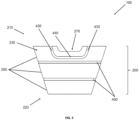
- Figure 1 shows a schematic side view of an exemplary embodiment of an augmentation device 100.
- the augmentation device 100 is formed in one piece and consists of a PMMA bone cement loaded with an antibiotic.
- the augmentation device 100 comprises a solid ring-shaped cone 200 with a proximal cone end 210 and a distal cone end 220, wherein a cone outer diameter, formed by a lateral surface 230 of the cone, decreases from the proximal cone end 210 towards the distal cone end 220.
- the cone outer diameter decreases essentially linearly from the proximal cone end 210 to the distal cone end 220.
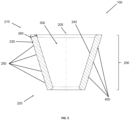
- a channel extends through the cone 200 from the proximal cone end 210 to the distal cone end 220 (see Figure 3 ).
- three grooves 400 each extend radially all the way around, dividing the cone into four annular cone segments 250.
- the grooves 400 are arranged in such a way that the cone segments 250 have a substantially equal have a large axial extension.
- the grooves 400 serve as saw guides so that one or more cone segments 250 can be easily and safely severed from the augmentation device 100 using suitable means, for example with a saw.
- a cone size of the augmentation device 100 is adapted. For example, by separating a cone segment 250 at the proximal cone end 210, both the axial extension of the cone 200 is reduced by substantially 25% and a maximum cone outer diameter of the cone 200 is reduced.
- the grooves 400 each extend in a plane which extends perpendicular to a longitudinal axis 205 of the cone 200.
- axial grooves 430 In the lateral surface 230 there are also twelve axial grooves 430 (only six are in Figure 1 can be seen, the remaining six are arranged on a side of the cone 200 opposite the view shown).
- the axial grooves 430 extend over the cone segment 250 at the proximal cone end 210 and partly also over the cone segment 250 distally adjacent to it.
- All axial grooves 440 are connected at least to the groove 400 at the proximal cone end 210, with four of the axial grooves 440 opening into this groove 400, while the remaining axial grooves 400 extend further in the direction of the distal cone end 220 beyond the groove 400 at the proximal cone end 210.
- the axial grooves 440 form cone sections 270 (provided with a reference symbol only as an example) with the groove 400 at the proximal cone end 210 and/or with the connecting grooves 440, which can be easily and safely separated from the cone 200, for example by sawing, and allow improved adaptation to the anatomical conditions of a patient.
- Figure 2 shows the augmentation device 100 from Figure 1 in a side view rotated by 90° around the longitudinal axis.
- the axial grooves 430 are arranged symmetrically, so that conical sections 270 (cf. Figure 1 ) can be separated from the cone 200 on two sides at the proximal cone end 210.
- Figure 3 shows the augmentation device 100 from the Figures 1 and 2 in a schematic longitudinal section.
- the channel 300 is formed by a conical inner surface 240 and extends from the proximal conical end 210 through the cone 200 to the distal conical end 220.
- the cone 200 has a conical wall thickness 260 which, apart from slight variations at the proximal cone end 210 and the distal cone end 220, is constant over the entire axial extent.
- the cone wall thickness 260 of the embodiment of the augmentation device 100 shown is 10 mm. It can also be seen that the cone 200 is solid and thus there is no fluid-conducting connection between the cone inner surface 240 and the cone outer surface 230 through the cone 200.
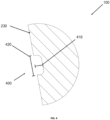
- Figure 4 shows an enlarged section of the schematic longitudinal section of the Figure 3 .
- Figure 4 shows in particular an enlarged longitudinal section through one of the grooves 400 of the augmentation device 100.
- the groove 400 has a groove depth 410 running perpendicular to the lateral surface 230 and a groove width 420 running parallel to the lateral surface 230.
- the groove 40 has a groove depth 410 of 1 mm and a groove width 420 of 2.5 mm.
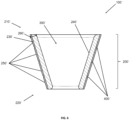
- Figure 5 shows the augmentation device 100 from the Figures 1 to 4 in a schematic side view with adjusted cone size.
- the cone segment 250 with the largest outer diameter at the proximal cone end 210 was removed so that the augmentation device 100 in Figure 3 has a reduced maximum cone outer diameter.
- a cone section 270 was cut off on both sides of the cone 200 along the middle pair of axial grooves 430 and their connecting groove 440 running on both cone sides (cf. Figure 1 and 2 ).
- Figure 6 shows a schematic longitudinal section of another exemplary augmentation device 100'.
- the embodiment of the augmentation device 100' largely corresponds to that described above and in the Figures 1 to 5 shown embodiment, so that to avoid repetition, reference is made to the above description. Modifications of a variant of the embodiment shown in the Figures 1 to 5 The embodiment shown have the same reference numeral with an apostrophe.
- the augmentation device 100' differs from the augmentation device 100 of the Figures 1 to 5 by a porous shell surface 230' made of titanium.
- the shell surface 230' is made entirely of titanium.
- FIG 7 shows a schematic side view of another exemplary augmentation device 100".
- the embodiment of the augmentation device 100" largely corresponds to the one described above and in the Figures 1 to 5 and Figure 6 shown embodiments, so that in order to avoid repetition, reference is made to the above descriptions. Modifications of a variant of the Figures 1 to 5 and Figure 6 The embodiment shown have the same reference numeral with two apostrophes.
- the augmentation device 100" differs from the augmentation devices 100 and 100' of the Figures 1 to 5 and Figure 6 by means of cone segments 250" which are stepped from one another. Due to the stepped cone segments 250", the outer cone diameter of the augmentation device 100" does not decrease essentially linearly from the proximal cone end 210" to the distal cone end 220", but rather "in a jump" manner between the cone segments 250".
Landscapes
- Health & Medical Sciences (AREA)
- Orthopedic Medicine & Surgery (AREA)
- Cardiology (AREA)
- Oral & Maxillofacial Surgery (AREA)
- Transplantation (AREA)
- Engineering & Computer Science (AREA)
- Biomedical Technology (AREA)
- Heart & Thoracic Surgery (AREA)
- Vascular Medicine (AREA)
- Life Sciences & Earth Sciences (AREA)
- Animal Behavior & Ethology (AREA)
- General Health & Medical Sciences (AREA)
- Public Health (AREA)
- Veterinary Medicine (AREA)
- Prostheses (AREA)
Claims (10)
- Dispositif d'augmentation (100, 100', 100") comprenantun cône (200, 200', 200") annulaire qui entoure un canal (300, 300'), lequel canal s'étend à travers le cône (200, 200', 200") à partir d'une extrémité de cône proximale (210, 210', 210") jusqu'à une extrémité de cône distale (220, 220', 220") du cône (200, 200', 200"),et lequel cône est constitué à raison d'au moins 50 pour cent en volume, par rapport au volume total du cône (200, 200', 200"), d'un polymère biocompatible,caractérisé en ce quele cône (200, 200', 200") est divisé en segments de cône (250, 250', 250") annulaires par au moins trois rainures (400, 400', 400") radialement périphériques dans une surface d'enveloppe de cône (230, 230', 230") opposée au canal (300, 300'),les rainures (400, 400', 400") présentant une profondeur de rainure (410) d'au moins 1 mm et une largeur de rainure (420) d'au moins 1 mm et formant des guide-lames afin d'adapter une dimension de cône du cône (200, 200', 200") par séparation d'un ou de plusieurs segments de cône (250, 250', 250").
- Dispositif d'augmentation (100, 100', 100") selon la revendication 1, dans lequel la surface d'enveloppe de cône (230, 230', 230") est rendue rugueuse ou poreuse au moins dans certaines zones.
- Dispositif d'augmentation (100') selon la revendication 1 ou 2, dans lequel la surface d'enveloppe de cône (230') est formée, au moins à raison de 70 pour cent de la surface, par rapport à la totalité de la surface d'enveloppe de cône (230'), de tantale, d'un alliage de tantale, de titane, d'un alliage de titane ou d'acier inoxydable.
- Dispositif d'augmentation (100, 100', 100") selon l'une des revendications précédentes, dans lequel le polymère biocompatible est un ciment osseux à base de PMMA.
- Dispositif d'augmentation (100, 100', 100") selon la revendication 4, dans lequel le ciment osseux à base de PMMA contient au moins un antibiotique.
- Dispositif d'augmentation (100, 100', 100") selon l'une des revendications précédentes, dans lequel le cône (200, 200', 200") présente, dans une surface interne de cône (240, 240') orientée vers le canal (300, 300'), des rainures internes radialement périphériques qui sont disposées à l'opposé des rainures (400, 400', 400").
- Dispositif d'augmentation (100, 100', 100") selon l'une des revendications précédentes, dans lequel la surface d'enveloppe de cône (230, 230', 230") présente au moins deux rainures axiales (430, 430") s'étendant axialement et comportant une profondeur de rainure axiale d'au moins 1 mm et une largeur de rainure axiale d'au moins 1 mm, lesquelles rainures axiales sont reliées respectivement au moins à l'une des rainures (400, 400', 400").
- Dispositif d'augmentation (100) selon l'une des revendications précédentes, dans lequel les segments de cône (250") sont écartés de façon étagée les uns des autres.
- Procédé pour l'adaptation d'une dimension de cône d'un dispositif d'augmentation (100, 100', 100") selon l'une des revendications 1 à 8, comprenant une étape de séparation d'un ou de plusieurs segments de cône (250, 250', 250") au niveau de l'extrémité de cône proximale (210, 210', 210") et/ou de l'extrémité de cône distale (220, 220', 220") par sciage, découpe ou rupture le long de la rainure (400, 400', 400") ou des rainures (400, 400', 400") radialement périphériques.
- Procédé selon la revendication 9 pour l'adaptation d'un dispositif d'augmentation (100, 100', 100") selon la revendication 7, comprenant une étape de séparation d'un morceau partiel de cône (270, 270") du cône (200, 200', 200") par sciage, découpe ou rupture le long de deux rainures axiales parmi les rainures axiales (430, 430") s'étendant axialement.
Priority Applications (2)
| Application Number | Priority Date | Filing Date | Title |
|---|---|---|---|
| EP22169675.0A EP4268771B1 (fr) | 2022-04-25 | 2022-04-25 | Dispositif d'augmentation et procédé d'ajustement d'un dispositif d'augmentation |
| US18/303,291 US20230338151A1 (en) | 2022-04-25 | 2023-04-19 | Augmentation device and method for adapting an augmentation device |
Applications Claiming Priority (1)
| Application Number | Priority Date | Filing Date | Title |
|---|---|---|---|
| EP22169675.0A EP4268771B1 (fr) | 2022-04-25 | 2022-04-25 | Dispositif d'augmentation et procédé d'ajustement d'un dispositif d'augmentation |
Publications (2)
| Publication Number | Publication Date |
|---|---|
| EP4268771A1 EP4268771A1 (fr) | 2023-11-01 |
| EP4268771B1 true EP4268771B1 (fr) | 2024-04-10 |
Family
ID=81386593
Family Applications (1)
| Application Number | Title | Priority Date | Filing Date |
|---|---|---|---|
| EP22169675.0A Active EP4268771B1 (fr) | 2022-04-25 | 2022-04-25 | Dispositif d'augmentation et procédé d'ajustement d'un dispositif d'augmentation |
Country Status (2)
| Country | Link |
|---|---|
| US (1) | US20230338151A1 (fr) |
| EP (1) | EP4268771B1 (fr) |
Family Cites Families (7)
| Publication number | Priority date | Publication date | Assignee | Title |
|---|---|---|---|---|
| US5766262A (en) * | 1996-03-29 | 1998-06-16 | Mikhail; W. E. Michael | Femoral prosthesis with spacer |
| US20040162619A1 (en) * | 2001-08-27 | 2004-08-19 | Zimmer Technology, Inc. | Tibial augments for use with knee joint prostheses, method of implanting the tibial augment, and associated tools |
| EP2319558B1 (fr) | 2006-03-14 | 2014-05-21 | University Of Southern California | Dispositif Mems de livraison d'agents therapeutiques |
| EP2394609B1 (fr) * | 2008-06-03 | 2015-06-24 | DePuy (Ireland) | Gaines fémorales poreuses en titane |
| US9526513B2 (en) * | 2013-03-13 | 2016-12-27 | Howmedica Osteonics Corp. | Void filling joint prosthesis and associated instruments |
| CN105496609B (zh) | 2015-12-17 | 2017-12-01 | 北京市春立正达医疗器械股份有限公司 | 一种翻修钛网 |
| US12521245B2 (en) * | 2019-07-24 | 2026-01-13 | Waldemar Link Gmbh & Co. Kg | Combination of augment and replacement piece for filling a bone defect |
-
2022
- 2022-04-25 EP EP22169675.0A patent/EP4268771B1/fr active Active
-
2023
- 2023-04-19 US US18/303,291 patent/US20230338151A1/en active Pending
Also Published As
| Publication number | Publication date |
|---|---|
| US20230338151A1 (en) | 2023-10-26 |
| EP4268771A1 (fr) | 2023-11-01 |
Similar Documents
| Publication | Publication Date | Title |
|---|---|---|
| DE69737756T2 (de) | Wirbelsäulenfusionsimplantat | |
| DE69526094T2 (de) | Konischer fusionskäfig | |
| DE69514337T2 (de) | Implantat zur stabilisierung von bandscheiben, und eine vorrichtung zum erleichterten einsetzen des implantats | |
| DE69417098T2 (de) | Biologisch abbaubarer medullärer Pfropfen | |
| AT507086B1 (de) | Implantat, insbesondere marknagel für die behandlung einer proximalen humerusfraktur | |
| DE69532086T2 (de) | Ventilanordnung zum verringern von synovialem flüssigkeitsdruck | |
| EP4226897B1 (fr) | Dispositif d'augmentation | |
| EP1572040A2 (fr) | Implant utilise pour des operations de rigidification de la colonne vertebrale | |
| EP0920289A1 (fr) | Endoprothese | |
| WO2002043628A1 (fr) | Procédé et dispositif pour élargir une cavité corporelle | |
| WO2010124760A1 (fr) | Système implantable à mécanisme de décomposition pendant la guérison | |
| DE8814923U1 (de) | Verschlußvorrichtung zum Einführen von Zement in einen Knochenkanal | |
| EP1713421A1 (fr) | Implant intervertebral et methode chirurgicale de spondylodese de la colonne vertebrale lombaire | |
| EP0444197A1 (fr) | Endoprothese de l'articulation de la hanche | |
| EP3923840A1 (fr) | Dispositif d'ancrage osseux pour l'abord pédiculaire | |
| DE60212881T2 (de) | Biologisch abbaubare aurikuläre prothesen | |
| WO2025067730A1 (fr) | Espaceur d'épaule inverse, moule, kit et procédé de production d'un espaceur d'épaule inverse | |
| EP3668427A1 (fr) | Vis à os | |
| EP4268771A1 (fr) | Dispositif d'augmentation et procédé d'ajustement d'un dispositif d'augmentation | |
| EP1166724A1 (fr) | Partie articulaire d'une prothèse temporaire et prothèse temporaire | |
| DE4325714A1 (de) | Hüftprothese | |
| EP4147678A1 (fr) | Dispositif d'augmentation et système d'augmentation | |
| EP3982869B1 (fr) | Implant dentaire et ensemble | |
| DE102017106846A1 (de) | Chirurgisches Retraktorsystem mit einem Retraktor und einem Extraktor sowie ein torsionsbeaufschlagendes chirurgisches Instrument | |
| EP3831344A1 (fr) | Dispositif de scellage destiné à appliquer du ciment osseux |
Legal Events
| Date | Code | Title | Description |
|---|---|---|---|
| PUAI | Public reference made under article 153(3) epc to a published international application that has entered the european phase |
Free format text: ORIGINAL CODE: 0009012 |
|
| STAA | Information on the status of an ep patent application or granted ep patent |
Free format text: STATUS: REQUEST FOR EXAMINATION WAS MADE |
|
| 17P | Request for examination filed |
Effective date: 20220425 |
|
| AK | Designated contracting states |
Kind code of ref document: A1 Designated state(s): AL AT BE BG CH CY CZ DE DK EE ES FI FR GB GR HR HU IE IS IT LI LT LU LV MC MK MT NL NO PL PT RO RS SE SI SK SM TR |
|
| GRAP | Despatch of communication of intention to grant a patent |
Free format text: ORIGINAL CODE: EPIDOSNIGR1 |
|
| STAA | Information on the status of an ep patent application or granted ep patent |
Free format text: STATUS: GRANT OF PATENT IS INTENDED |
|
| GRAS | Grant fee paid |
Free format text: ORIGINAL CODE: EPIDOSNIGR3 |
|
| INTG | Intention to grant announced |
Effective date: 20240209 |
|
| GRAA | (expected) grant |
Free format text: ORIGINAL CODE: 0009210 |
|
| STAA | Information on the status of an ep patent application or granted ep patent |
Free format text: STATUS: THE PATENT HAS BEEN GRANTED |
|
| AK | Designated contracting states |
Kind code of ref document: B1 Designated state(s): AL AT BE BG CH CY CZ DE DK EE ES FI FR GB GR HR HU IE IS IT LI LT LU LV MC MK MT NL NO PL PT RO RS SE SI SK SM TR |
|
| REG | Reference to a national code |
Ref country code: GB Ref legal event code: FG4D Free format text: NOT ENGLISH |
|
| REG | Reference to a national code |
Ref country code: CH Ref legal event code: EP |
|
| REG | Reference to a national code |
Ref country code: DE Ref legal event code: R096 Ref document number: 502022000721 Country of ref document: DE |
|
| REG | Reference to a national code |
Ref country code: IE Ref legal event code: FG4D Free format text: LANGUAGE OF EP DOCUMENT: GERMAN |
|
| P01 | Opt-out of the competence of the unified patent court (upc) registered |
Effective date: 20240404 |
|
| REG | Reference to a national code |
Ref country code: LT Ref legal event code: MG9D |
|
| REG | Reference to a national code |
Ref country code: NL Ref legal event code: MP Effective date: 20240410 |
|
| PG25 | Lapsed in a contracting state [announced via postgrant information from national office to epo] |
Ref country code: NL Free format text: LAPSE BECAUSE OF FAILURE TO SUBMIT A TRANSLATION OF THE DESCRIPTION OR TO PAY THE FEE WITHIN THE PRESCRIBED TIME-LIMIT Effective date: 20240410 |
|
| PG25 | Lapsed in a contracting state [announced via postgrant information from national office to epo] |
Ref country code: NL Free format text: LAPSE BECAUSE OF FAILURE TO SUBMIT A TRANSLATION OF THE DESCRIPTION OR TO PAY THE FEE WITHIN THE PRESCRIBED TIME-LIMIT Effective date: 20240410 |
|
| PG25 | Lapsed in a contracting state [announced via postgrant information from national office to epo] |
Ref country code: IS Free format text: LAPSE BECAUSE OF FAILURE TO SUBMIT A TRANSLATION OF THE DESCRIPTION OR TO PAY THE FEE WITHIN THE PRESCRIBED TIME-LIMIT Effective date: 20240810 |
|
| PG25 | Lapsed in a contracting state [announced via postgrant information from national office to epo] |
Ref country code: BG Free format text: LAPSE BECAUSE OF FAILURE TO SUBMIT A TRANSLATION OF THE DESCRIPTION OR TO PAY THE FEE WITHIN THE PRESCRIBED TIME-LIMIT Effective date: 20240410 |
|
| PG25 | Lapsed in a contracting state [announced via postgrant information from national office to epo] |
Ref country code: FI Free format text: LAPSE BECAUSE OF FAILURE TO SUBMIT A TRANSLATION OF THE DESCRIPTION OR TO PAY THE FEE WITHIN THE PRESCRIBED TIME-LIMIT Effective date: 20240410 Ref country code: HR Free format text: LAPSE BECAUSE OF FAILURE TO SUBMIT A TRANSLATION OF THE DESCRIPTION OR TO PAY THE FEE WITHIN THE PRESCRIBED TIME-LIMIT Effective date: 20240410 |
|
| PG25 | Lapsed in a contracting state [announced via postgrant information from national office to epo] |
Ref country code: GR Free format text: LAPSE BECAUSE OF FAILURE TO SUBMIT A TRANSLATION OF THE DESCRIPTION OR TO PAY THE FEE WITHIN THE PRESCRIBED TIME-LIMIT Effective date: 20240711 |
|
| PG25 | Lapsed in a contracting state [announced via postgrant information from national office to epo] |
Ref country code: PT Free format text: LAPSE BECAUSE OF FAILURE TO SUBMIT A TRANSLATION OF THE DESCRIPTION OR TO PAY THE FEE WITHIN THE PRESCRIBED TIME-LIMIT Effective date: 20240812 |
|
| PG25 | Lapsed in a contracting state [announced via postgrant information from national office to epo] |
Ref country code: ES Free format text: LAPSE BECAUSE OF FAILURE TO SUBMIT A TRANSLATION OF THE DESCRIPTION OR TO PAY THE FEE WITHIN THE PRESCRIBED TIME-LIMIT Effective date: 20240410 |
|
| PG25 | Lapsed in a contracting state [announced via postgrant information from national office to epo] |
Ref country code: PL Free format text: LAPSE BECAUSE OF FAILURE TO SUBMIT A TRANSLATION OF THE DESCRIPTION OR TO PAY THE FEE WITHIN THE PRESCRIBED TIME-LIMIT Effective date: 20240410 |
|
| PG25 | Lapsed in a contracting state [announced via postgrant information from national office to epo] |
Ref country code: LV Free format text: LAPSE BECAUSE OF FAILURE TO SUBMIT A TRANSLATION OF THE DESCRIPTION OR TO PAY THE FEE WITHIN THE PRESCRIBED TIME-LIMIT Effective date: 20240410 |
|
| PG25 | Lapsed in a contracting state [announced via postgrant information from national office to epo] |
Ref country code: PT Free format text: LAPSE BECAUSE OF FAILURE TO SUBMIT A TRANSLATION OF THE DESCRIPTION OR TO PAY THE FEE WITHIN THE PRESCRIBED TIME-LIMIT Effective date: 20240812 Ref country code: PL Free format text: LAPSE BECAUSE OF FAILURE TO SUBMIT A TRANSLATION OF THE DESCRIPTION OR TO PAY THE FEE WITHIN THE PRESCRIBED TIME-LIMIT Effective date: 20240410 Ref country code: NO Free format text: LAPSE BECAUSE OF FAILURE TO SUBMIT A TRANSLATION OF THE DESCRIPTION OR TO PAY THE FEE WITHIN THE PRESCRIBED TIME-LIMIT Effective date: 20240710 Ref country code: LV Free format text: LAPSE BECAUSE OF FAILURE TO SUBMIT A TRANSLATION OF THE DESCRIPTION OR TO PAY THE FEE WITHIN THE PRESCRIBED TIME-LIMIT Effective date: 20240410 Ref country code: IS Free format text: LAPSE BECAUSE OF FAILURE TO SUBMIT A TRANSLATION OF THE DESCRIPTION OR TO PAY THE FEE WITHIN THE PRESCRIBED TIME-LIMIT Effective date: 20240810 Ref country code: HR Free format text: LAPSE BECAUSE OF FAILURE TO SUBMIT A TRANSLATION OF THE DESCRIPTION OR TO PAY THE FEE WITHIN THE PRESCRIBED TIME-LIMIT Effective date: 20240410 Ref country code: GR Free format text: LAPSE BECAUSE OF FAILURE TO SUBMIT A TRANSLATION OF THE DESCRIPTION OR TO PAY THE FEE WITHIN THE PRESCRIBED TIME-LIMIT Effective date: 20240711 Ref country code: FI Free format text: LAPSE BECAUSE OF FAILURE TO SUBMIT A TRANSLATION OF THE DESCRIPTION OR TO PAY THE FEE WITHIN THE PRESCRIBED TIME-LIMIT Effective date: 20240410 Ref country code: ES Free format text: LAPSE BECAUSE OF FAILURE TO SUBMIT A TRANSLATION OF THE DESCRIPTION OR TO PAY THE FEE WITHIN THE PRESCRIBED TIME-LIMIT Effective date: 20240410 Ref country code: BG Free format text: LAPSE BECAUSE OF FAILURE TO SUBMIT A TRANSLATION OF THE DESCRIPTION OR TO PAY THE FEE WITHIN THE PRESCRIBED TIME-LIMIT Effective date: 20240410 Ref country code: RS Free format text: LAPSE BECAUSE OF FAILURE TO SUBMIT A TRANSLATION OF THE DESCRIPTION OR TO PAY THE FEE WITHIN THE PRESCRIBED TIME-LIMIT Effective date: 20240710 |
|
| PG25 | Lapsed in a contracting state [announced via postgrant information from national office to epo] |
Ref country code: LU Free format text: LAPSE BECAUSE OF NON-PAYMENT OF DUE FEES Effective date: 20240425 |
|
| REG | Reference to a national code |
Ref country code: BE Ref legal event code: MM Effective date: 20240430 |
|
| PG25 | Lapsed in a contracting state [announced via postgrant information from national office to epo] |
Ref country code: LU Free format text: LAPSE BECAUSE OF NON-PAYMENT OF DUE FEES Effective date: 20240425 |
|
| REG | Reference to a national code |
Ref country code: DE Ref legal event code: R097 Ref document number: 502022000721 Country of ref document: DE |
|
| PG25 | Lapsed in a contracting state [announced via postgrant information from national office to epo] |
Ref country code: DK Free format text: LAPSE BECAUSE OF FAILURE TO SUBMIT A TRANSLATION OF THE DESCRIPTION OR TO PAY THE FEE WITHIN THE PRESCRIBED TIME-LIMIT Effective date: 20240410 |
|
| PG25 | Lapsed in a contracting state [announced via postgrant information from national office to epo] |
Ref country code: BE Free format text: LAPSE BECAUSE OF NON-PAYMENT OF DUE FEES Effective date: 20240430 |
|
| PG25 | Lapsed in a contracting state [announced via postgrant information from national office to epo] |
Ref country code: EE Free format text: LAPSE BECAUSE OF FAILURE TO SUBMIT A TRANSLATION OF THE DESCRIPTION OR TO PAY THE FEE WITHIN THE PRESCRIBED TIME-LIMIT Effective date: 20240410 |
|
| PG25 | Lapsed in a contracting state [announced via postgrant information from national office to epo] |
Ref country code: CZ Free format text: LAPSE BECAUSE OF FAILURE TO SUBMIT A TRANSLATION OF THE DESCRIPTION OR TO PAY THE FEE WITHIN THE PRESCRIBED TIME-LIMIT Effective date: 20240410 |
|
| PG25 | Lapsed in a contracting state [announced via postgrant information from national office to epo] |
Ref country code: SK Free format text: LAPSE BECAUSE OF FAILURE TO SUBMIT A TRANSLATION OF THE DESCRIPTION OR TO PAY THE FEE WITHIN THE PRESCRIBED TIME-LIMIT Effective date: 20240410 Ref country code: RO Free format text: LAPSE BECAUSE OF FAILURE TO SUBMIT A TRANSLATION OF THE DESCRIPTION OR TO PAY THE FEE WITHIN THE PRESCRIBED TIME-LIMIT Effective date: 20240410 |
|
| PG25 | Lapsed in a contracting state [announced via postgrant information from national office to epo] |
Ref country code: SM Free format text: LAPSE BECAUSE OF FAILURE TO SUBMIT A TRANSLATION OF THE DESCRIPTION OR TO PAY THE FEE WITHIN THE PRESCRIBED TIME-LIMIT Effective date: 20240410 |
|
| PG25 | Lapsed in a contracting state [announced via postgrant information from national office to epo] |
Ref country code: SM Free format text: LAPSE BECAUSE OF FAILURE TO SUBMIT A TRANSLATION OF THE DESCRIPTION OR TO PAY THE FEE WITHIN THE PRESCRIBED TIME-LIMIT Effective date: 20240410 Ref country code: SK Free format text: LAPSE BECAUSE OF FAILURE TO SUBMIT A TRANSLATION OF THE DESCRIPTION OR TO PAY THE FEE WITHIN THE PRESCRIBED TIME-LIMIT Effective date: 20240410 Ref country code: RO Free format text: LAPSE BECAUSE OF FAILURE TO SUBMIT A TRANSLATION OF THE DESCRIPTION OR TO PAY THE FEE WITHIN THE PRESCRIBED TIME-LIMIT Effective date: 20240410 Ref country code: EE Free format text: LAPSE BECAUSE OF FAILURE TO SUBMIT A TRANSLATION OF THE DESCRIPTION OR TO PAY THE FEE WITHIN THE PRESCRIBED TIME-LIMIT Effective date: 20240410 Ref country code: DK Free format text: LAPSE BECAUSE OF FAILURE TO SUBMIT A TRANSLATION OF THE DESCRIPTION OR TO PAY THE FEE WITHIN THE PRESCRIBED TIME-LIMIT Effective date: 20240410 Ref country code: CZ Free format text: LAPSE BECAUSE OF FAILURE TO SUBMIT A TRANSLATION OF THE DESCRIPTION OR TO PAY THE FEE WITHIN THE PRESCRIBED TIME-LIMIT Effective date: 20240410 Ref country code: BE Free format text: LAPSE BECAUSE OF NON-PAYMENT OF DUE FEES Effective date: 20240430 Ref country code: MC Free format text: LAPSE BECAUSE OF FAILURE TO SUBMIT A TRANSLATION OF THE DESCRIPTION OR TO PAY THE FEE WITHIN THE PRESCRIBED TIME-LIMIT Effective date: 20240410 |
|
| PG25 | Lapsed in a contracting state [announced via postgrant information from national office to epo] |
Ref country code: IT Free format text: LAPSE BECAUSE OF FAILURE TO SUBMIT A TRANSLATION OF THE DESCRIPTION OR TO PAY THE FEE WITHIN THE PRESCRIBED TIME-LIMIT Effective date: 20240410 |
|
| PLBE | No opposition filed within time limit |
Free format text: ORIGINAL CODE: 0009261 |
|
| STAA | Information on the status of an ep patent application or granted ep patent |
Free format text: STATUS: NO OPPOSITION FILED WITHIN TIME LIMIT |
|
| 26N | No opposition filed |
Effective date: 20250113 |
|
| PG25 | Lapsed in a contracting state [announced via postgrant information from national office to epo] |
Ref country code: IE Free format text: LAPSE BECAUSE OF NON-PAYMENT OF DUE FEES Effective date: 20240425 |
|
| PG25 | Lapsed in a contracting state [announced via postgrant information from national office to epo] |
Ref country code: SI Free format text: LAPSE BECAUSE OF FAILURE TO SUBMIT A TRANSLATION OF THE DESCRIPTION OR TO PAY THE FEE WITHIN THE PRESCRIBED TIME-LIMIT Effective date: 20240410 |
|
| PG25 | Lapsed in a contracting state [announced via postgrant information from national office to epo] |
Ref country code: FR Free format text: LAPSE BECAUSE OF NON-PAYMENT OF DUE FEES Effective date: 20240610 |
|
| PGFP | Annual fee paid to national office [announced via postgrant information from national office to epo] |
Ref country code: DE Payment date: 20250422 Year of fee payment: 4 |
|
| PGFP | Annual fee paid to national office [announced via postgrant information from national office to epo] |
Ref country code: AT Payment date: 20250721 Year of fee payment: 4 |
|
| PG25 | Lapsed in a contracting state [announced via postgrant information from national office to epo] |
Ref country code: CY Free format text: LAPSE BECAUSE OF FAILURE TO SUBMIT A TRANSLATION OF THE DESCRIPTION OR TO PAY THE FEE WITHIN THE PRESCRIBED TIME-LIMIT; INVALID AB INITIO Effective date: 20220425 |
|
| PG25 | Lapsed in a contracting state [announced via postgrant information from national office to epo] |
Ref country code: HU Free format text: LAPSE BECAUSE OF FAILURE TO SUBMIT A TRANSLATION OF THE DESCRIPTION OR TO PAY THE FEE WITHIN THE PRESCRIBED TIME-LIMIT; INVALID AB INITIO Effective date: 20220425 |
|
| PG25 | Lapsed in a contracting state [announced via postgrant information from national office to epo] |
Ref country code: SE Free format text: LAPSE BECAUSE OF FAILURE TO SUBMIT A TRANSLATION OF THE DESCRIPTION OR TO PAY THE FEE WITHIN THE PRESCRIBED TIME-LIMIT Effective date: 20240410 |
|
| REG | Reference to a national code |
Ref country code: CH Ref legal event code: H13 Free format text: ST27 STATUS EVENT CODE: U-0-0-H10-H13 (AS PROVIDED BY THE NATIONAL OFFICE) Effective date: 20251125 |
|
| PG25 | Lapsed in a contracting state [announced via postgrant information from national office to epo] |
Ref country code: CH Free format text: LAPSE BECAUSE OF NON-PAYMENT OF DUE FEES Effective date: 20250430 |