EP4269537A1 - Procédé de conversion catalytique fluidisée pour la préparation d'oléfines à faible teneur en carbone - Google Patents
Procédé de conversion catalytique fluidisée pour la préparation d'oléfines à faible teneur en carbone Download PDFInfo
- Publication number
- EP4269537A1 EP4269537A1 EP21917016.4A EP21917016A EP4269537A1 EP 4269537 A1 EP4269537 A1 EP 4269537A1 EP 21917016 A EP21917016 A EP 21917016A EP 4269537 A1 EP4269537 A1 EP 4269537A1
- Authority
- EP
- European Patent Office
- Prior art keywords
- catalytic conversion
- olefin
- catalyst
- reaction
- reactor
- Prior art date
- Legal status (The legal status is an assumption and is not a legal conclusion. Google has not performed a legal analysis and makes no representation as to the accuracy of the status listed.)
- Pending
Links
Images


Classifications
-
- C—CHEMISTRY; METALLURGY
- C10—PETROLEUM, GAS OR COKE INDUSTRIES; TECHNICAL GASES CONTAINING CARBON MONOXIDE; FUELS; LUBRICANTS; PEAT
- C10G—CRACKING HYDROCARBON OILS; PRODUCTION OF LIQUID HYDROCARBON MIXTURES, e.g. BY DESTRUCTIVE HYDROGENATION, OLIGOMERISATION, POLYMERISATION; RECOVERY OF HYDROCARBON OILS FROM OIL-SHALE, OIL-SAND, OR GASES; REFINING MIXTURES MAINLY CONSISTING OF HYDROCARBONS; REFORMING OF NAPHTHA; MINERAL WAXES
- C10G11/00—Catalytic cracking, in the absence of hydrogen, of hydrocarbon oils
- C10G11/14—Catalytic cracking, in the absence of hydrogen, of hydrocarbon oils with preheated moving solid catalysts
- C10G11/18—Catalytic cracking, in the absence of hydrogen, of hydrocarbon oils with preheated moving solid catalysts according to the "fluidised-bed" technique
-
- C—CHEMISTRY; METALLURGY
- C10—PETROLEUM, GAS OR COKE INDUSTRIES; TECHNICAL GASES CONTAINING CARBON MONOXIDE; FUELS; LUBRICANTS; PEAT
- C10G—CRACKING HYDROCARBON OILS; PRODUCTION OF LIQUID HYDROCARBON MIXTURES, e.g. BY DESTRUCTIVE HYDROGENATION, OLIGOMERISATION, POLYMERISATION; RECOVERY OF HYDROCARBON OILS FROM OIL-SHALE, OIL-SAND, OR GASES; REFINING MIXTURES MAINLY CONSISTING OF HYDROCARBONS; REFORMING OF NAPHTHA; MINERAL WAXES
- C10G11/00—Catalytic cracking, in the absence of hydrogen, of hydrocarbon oils
- C10G11/02—Catalytic cracking, in the absence of hydrogen, of hydrocarbon oils characterised by the catalyst used
- C10G11/04—Oxides
- C10G11/05—Crystalline alumino-silicates, e.g. molecular sieves
-
- C—CHEMISTRY; METALLURGY
- C10—PETROLEUM, GAS OR COKE INDUSTRIES; TECHNICAL GASES CONTAINING CARBON MONOXIDE; FUELS; LUBRICANTS; PEAT
- C10G—CRACKING HYDROCARBON OILS; PRODUCTION OF LIQUID HYDROCARBON MIXTURES, e.g. BY DESTRUCTIVE HYDROGENATION, OLIGOMERISATION, POLYMERISATION; RECOVERY OF HYDROCARBON OILS FROM OIL-SHALE, OIL-SAND, OR GASES; REFINING MIXTURES MAINLY CONSISTING OF HYDROCARBONS; REFORMING OF NAPHTHA; MINERAL WAXES
- C10G11/00—Catalytic cracking, in the absence of hydrogen, of hydrocarbon oils
- C10G11/14—Catalytic cracking, in the absence of hydrogen, of hydrocarbon oils with preheated moving solid catalysts
- C10G11/18—Catalytic cracking, in the absence of hydrogen, of hydrocarbon oils with preheated moving solid catalysts according to the "fluidised-bed" technique
- C10G11/182—Regeneration
-
- C—CHEMISTRY; METALLURGY
- C10—PETROLEUM, GAS OR COKE INDUSTRIES; TECHNICAL GASES CONTAINING CARBON MONOXIDE; FUELS; LUBRICANTS; PEAT
- C10G—CRACKING HYDROCARBON OILS; PRODUCTION OF LIQUID HYDROCARBON MIXTURES, e.g. BY DESTRUCTIVE HYDROGENATION, OLIGOMERISATION, POLYMERISATION; RECOVERY OF HYDROCARBON OILS FROM OIL-SHALE, OIL-SAND, OR GASES; REFINING MIXTURES MAINLY CONSISTING OF HYDROCARBONS; REFORMING OF NAPHTHA; MINERAL WAXES
- C10G51/00—Treatment of hydrocarbon oils, in the absence of hydrogen, by two or more cracking processes only
- C10G51/02—Treatment of hydrocarbon oils, in the absence of hydrogen, by two or more cracking processes only plural serial stages only
- C10G51/026—Treatment of hydrocarbon oils, in the absence of hydrogen, by two or more cracking processes only plural serial stages only only catalytic cracking steps
-
- C—CHEMISTRY; METALLURGY
- C10—PETROLEUM, GAS OR COKE INDUSTRIES; TECHNICAL GASES CONTAINING CARBON MONOXIDE; FUELS; LUBRICANTS; PEAT
- C10G—CRACKING HYDROCARBON OILS; PRODUCTION OF LIQUID HYDROCARBON MIXTURES, e.g. BY DESTRUCTIVE HYDROGENATION, OLIGOMERISATION, POLYMERISATION; RECOVERY OF HYDROCARBON OILS FROM OIL-SHALE, OIL-SAND, OR GASES; REFINING MIXTURES MAINLY CONSISTING OF HYDROCARBONS; REFORMING OF NAPHTHA; MINERAL WAXES
- C10G9/00—Thermal non-catalytic cracking, in the absence of hydrogen, of hydrocarbon oils
- C10G9/34—Thermal non-catalytic cracking, in the absence of hydrogen, of hydrocarbon oils by direct contact with inert preheated fluids, e.g. with molten metals or salts
- C10G9/36—Thermal non-catalytic cracking, in the absence of hydrogen, of hydrocarbon oils by direct contact with inert preheated fluids, e.g. with molten metals or salts with heated gases or vapours
-
- C—CHEMISTRY; METALLURGY
- C10—PETROLEUM, GAS OR COKE INDUSTRIES; TECHNICAL GASES CONTAINING CARBON MONOXIDE; FUELS; LUBRICANTS; PEAT
- C10G—CRACKING HYDROCARBON OILS; PRODUCTION OF LIQUID HYDROCARBON MIXTURES, e.g. BY DESTRUCTIVE HYDROGENATION, OLIGOMERISATION, POLYMERISATION; RECOVERY OF HYDROCARBON OILS FROM OIL-SHALE, OIL-SAND, OR GASES; REFINING MIXTURES MAINLY CONSISTING OF HYDROCARBONS; REFORMING OF NAPHTHA; MINERAL WAXES
- C10G2300/00—Aspects relating to hydrocarbon processing covered by groups C10G1/00 - C10G99/00
- C10G2300/10—Feedstock materials
- C10G2300/1088—Olefins
-
- C—CHEMISTRY; METALLURGY
- C10—PETROLEUM, GAS OR COKE INDUSTRIES; TECHNICAL GASES CONTAINING CARBON MONOXIDE; FUELS; LUBRICANTS; PEAT
- C10G—CRACKING HYDROCARBON OILS; PRODUCTION OF LIQUID HYDROCARBON MIXTURES, e.g. BY DESTRUCTIVE HYDROGENATION, OLIGOMERISATION, POLYMERISATION; RECOVERY OF HYDROCARBON OILS FROM OIL-SHALE, OIL-SAND, OR GASES; REFINING MIXTURES MAINLY CONSISTING OF HYDROCARBONS; REFORMING OF NAPHTHA; MINERAL WAXES
- C10G2300/00—Aspects relating to hydrocarbon processing covered by groups C10G1/00 - C10G99/00
- C10G2300/40—Characteristics of the process deviating from typical ways of processing
- C10G2300/4006—Temperature
-
- C—CHEMISTRY; METALLURGY
- C10—PETROLEUM, GAS OR COKE INDUSTRIES; TECHNICAL GASES CONTAINING CARBON MONOXIDE; FUELS; LUBRICANTS; PEAT
- C10G—CRACKING HYDROCARBON OILS; PRODUCTION OF LIQUID HYDROCARBON MIXTURES, e.g. BY DESTRUCTIVE HYDROGENATION, OLIGOMERISATION, POLYMERISATION; RECOVERY OF HYDROCARBON OILS FROM OIL-SHALE, OIL-SAND, OR GASES; REFINING MIXTURES MAINLY CONSISTING OF HYDROCARBONS; REFORMING OF NAPHTHA; MINERAL WAXES
- C10G2300/00—Aspects relating to hydrocarbon processing covered by groups C10G1/00 - C10G99/00
- C10G2300/40—Characteristics of the process deviating from typical ways of processing
- C10G2300/4012—Pressure
-
- C—CHEMISTRY; METALLURGY
- C10—PETROLEUM, GAS OR COKE INDUSTRIES; TECHNICAL GASES CONTAINING CARBON MONOXIDE; FUELS; LUBRICANTS; PEAT
- C10G—CRACKING HYDROCARBON OILS; PRODUCTION OF LIQUID HYDROCARBON MIXTURES, e.g. BY DESTRUCTIVE HYDROGENATION, OLIGOMERISATION, POLYMERISATION; RECOVERY OF HYDROCARBON OILS FROM OIL-SHALE, OIL-SAND, OR GASES; REFINING MIXTURES MAINLY CONSISTING OF HYDROCARBONS; REFORMING OF NAPHTHA; MINERAL WAXES
- C10G2300/00—Aspects relating to hydrocarbon processing covered by groups C10G1/00 - C10G99/00
- C10G2300/40—Characteristics of the process deviating from typical ways of processing
- C10G2300/4081—Recycling aspects
-
- C—CHEMISTRY; METALLURGY
- C10—PETROLEUM, GAS OR COKE INDUSTRIES; TECHNICAL GASES CONTAINING CARBON MONOXIDE; FUELS; LUBRICANTS; PEAT
- C10G—CRACKING HYDROCARBON OILS; PRODUCTION OF LIQUID HYDROCARBON MIXTURES, e.g. BY DESTRUCTIVE HYDROGENATION, OLIGOMERISATION, POLYMERISATION; RECOVERY OF HYDROCARBON OILS FROM OIL-SHALE, OIL-SAND, OR GASES; REFINING MIXTURES MAINLY CONSISTING OF HYDROCARBONS; REFORMING OF NAPHTHA; MINERAL WAXES
- C10G2300/00—Aspects relating to hydrocarbon processing covered by groups C10G1/00 - C10G99/00
- C10G2300/70—Catalyst aspects
- C10G2300/701—Use of spent catalysts
-
- C—CHEMISTRY; METALLURGY
- C10—PETROLEUM, GAS OR COKE INDUSTRIES; TECHNICAL GASES CONTAINING CARBON MONOXIDE; FUELS; LUBRICANTS; PEAT
- C10G—CRACKING HYDROCARBON OILS; PRODUCTION OF LIQUID HYDROCARBON MIXTURES, e.g. BY DESTRUCTIVE HYDROGENATION, OLIGOMERISATION, POLYMERISATION; RECOVERY OF HYDROCARBON OILS FROM OIL-SHALE, OIL-SAND, OR GASES; REFINING MIXTURES MAINLY CONSISTING OF HYDROCARBONS; REFORMING OF NAPHTHA; MINERAL WAXES
- C10G2400/00—Products obtained by processes covered by groups C10G9/00 - C10G69/14
- C10G2400/20—C2-C4 olefins
-
- Y—GENERAL TAGGING OF NEW TECHNOLOGICAL DEVELOPMENTS; GENERAL TAGGING OF CROSS-SECTIONAL TECHNOLOGIES SPANNING OVER SEVERAL SECTIONS OF THE IPC; TECHNICAL SUBJECTS COVERED BY FORMER USPC CROSS-REFERENCE ART COLLECTIONS [XRACs] AND DIGESTS
- Y02—TECHNOLOGIES OR APPLICATIONS FOR MITIGATION OR ADAPTATION AGAINST CLIMATE CHANGE
- Y02P—CLIMATE CHANGE MITIGATION TECHNOLOGIES IN THE PRODUCTION OR PROCESSING OF GOODS
- Y02P20/00—Technologies relating to chemical industry
- Y02P20/50—Improvements relating to the production of bulk chemicals
- Y02P20/52—Improvements relating to the production of bulk chemicals using catalysts, e.g. selective catalysts
-
- Y—GENERAL TAGGING OF NEW TECHNOLOGICAL DEVELOPMENTS; GENERAL TAGGING OF CROSS-SECTIONAL TECHNOLOGIES SPANNING OVER SEVERAL SECTIONS OF THE IPC; TECHNICAL SUBJECTS COVERED BY FORMER USPC CROSS-REFERENCE ART COLLECTIONS [XRACs] AND DIGESTS
- Y02—TECHNOLOGIES OR APPLICATIONS FOR MITIGATION OR ADAPTATION AGAINST CLIMATE CHANGE
- Y02P—CLIMATE CHANGE MITIGATION TECHNOLOGIES IN THE PRODUCTION OR PROCESSING OF GOODS
- Y02P30/00—Technologies relating to oil refining and petrochemical industry
- Y02P30/40—Ethylene production
Definitions
- the present application relates to the technical field of fluidized catalytic conversion, particularly to a fluidized catalytic conversion method for preparing low-carbon olefins (also refered to as light olefins).
- Propylene and ethylene are two most important basic raw materials for modern petrochemical industry, but with the increasing production of oil fields, the available yield of conventional crude oil is gradually reduced, the quality of crude oil is becoming deteriorated and heavy, and although the production capacity of light olefins is rapidly increased at present, the demand of light olefins in the market still cannot be met.
- Ethylene and propylene are increasingly demanded as important chemical intermediates, and are mainly used for producing various important organic chemical raw materials, synthetic resins, synthetic rubbers, various fine chemicals and the like.
- Ethylene is one of the chemical products with the largest yield in the world, and accounts for more than 75% of the whole petrochemical product yield in the world; the bulk downstream products of ethylene mainly include polyethylene, ethylene oxide, ethylene glycol, polyvinyl chloride, styrene, vinyl acetate and the like.
- Propylene is an important organic chemical raw material, and is mainly used for preparing acrylonitrile, propylene oxide, acetone and the like.
- the traditional route for preparing ethylene and propylene by steam cracking has a large demand for light hydrocarbons such as naphtha and the like
- the steam cracking raw materials mainly include light hydrocarbons (such as ethane, propane and butane), naphtha, diesel oil, condensate oil and hydrogenated tail oil, among which the mass fraction of the naphtha accounts for more than 50%
- typical naphtha steam cracking has an ethylene yield of about 29-34%, a propylene yield of 13-16%, and the lower ethylene/propylene output ratio is difficult to meet the current situation of light olefin demand.
- Chinese patent application No. CN101092323A discloses a method for preparing ethylene and propylene from a mixture of C4-C8 olefins, comprising reacting the mixture at a reaction temperature of 400-600 °C and an absolute pressure of 0.02-0.3 MPa, and recycling 30-90 wt% of a C4 fraction to the reactor after separating in a separator for further cracking.
- the method improves the conversion rate of olefin mainly by recycling the C4 fraction, the ethylene and propylene obtained account for not less than 62% of the total amount of the olefin feedstock, but it suffers from the problems including a relatively low ethylene/propylene ratio, which cannot be flexibly adjusted according to market demands, low reaction selectivity, high butylene content in the product, and energy consumption for C4 separation.
- Chinese patent application No. CN101239878A discloses a method using a mixture rich in C4+ olefins a raw material, comprising reacting at a reaction temperature of 400-680 °C, a reaction pressure of -0.09 MPa to 1.0MPa and a weight space velocity of 0.1-50 h -1 , the resulting product has an ethylene/propylene ratio of lower than 0.41, and as the temperature rises, the ethylene/propylene ratio increases, and the production of hydrogen, methane and ethane increases.
- the olefin production route also includes a non-petroleum route, that is a process for producing light olefins mainly comprising ethylene and propylene by using oxygen-containing organic compounds, typically methanol or dimethyl ether, as raw materials, which is called MTO for short.
- Methanol or dimethyl ether is a typical oxygen-containing organic compound
- the reaction for producing light olefins from which has the characteristics of rapid reaction, strong heat release, low catalyst-to-alcohol ratio and long reaction induction period, and rapid deactivation of catalyst is a major challenge of the MTO process. How to solve the problems of long reaction induction period, easy deactivation of catalyst and the like in the MTO process in a scientific and efficient way is a subject always lies ahead the majority of scientific researchers and engineers.
- An object of the present application is to provide a fluidized catalytic conversion method for preparing light olefins (such as ethylene, propylene and butylene), which can simultaneously improve the yield and selectivity of light olefins and increase the ethylene/propylene ratio of the product.
- light olefins such as ethylene, propylene and butylene
- the present application provides a fluidized catalytic conversion method for producing light olefins, comprising the steps of:
- the method further comprises the steps of: 4) recycling at least a part of the butylene separated in step 2) to the catalytic conversion reactor upstream of the position at which the olefin-rich feedstock is introduced to contact with the catalytic conversion catalyst and react under second catalytic conversion conditions including:
- the method further comprises the steps of: 1a) introducing an oxygen-containing organic compound into the catalytic conversion reactor downstream of the position at which the olefin-rich feedstock is introduced to contact with the catalytic conversion catalyst after the reaction of step 1) and react under third catalytic conversion conditions including:
- the olefin-rich feedstock is subjected to cracking reaction on a catalyst having a high temperature (>650 °C), and then the olefin-containing stream obtained by separating the product is introduced into the reactor again for further reaction, so that the yield of light olefins can be effectively increased, the selectivity can be improved, and the ethylene/propylene ratio of the product can be improved; and at the same time the generation of hydrogen, methane and ethane can be reduced, and especially the generation of methane can be inhibited.
- the further reaction of the olefin in the separated product can further improve the utilization rate of petroleum resources.
- any specific numerical value, including the endpoints of a numerical range, described in the context of the present application is not restricted to the exact value thereof, but should be interpreted to further encompass all values close to said exact value, for example all values within ⁇ 5% of said exact value.
- any numerical range described herein arbitrary combinations can be made between the endpoints of the range, between each endpoint and any specific value within the range, or between any two specific values within the range, to provide one or more new numerical range(s), where said new numerical range(s) should also be deemed to have been specifically described in the present application.
- C5+ means having at least 5 carbon atoms
- C5+ olefins refers to olefins having at least 5 carbon atoms
- C5+ fraction refers to a fraction of which the compounds have at least 5 carbon atoms.
- any matter or matters not mentioned are considered to be the same as those known in the art without any change.
- any of the embodiments described herein can be freely combined with another one or more embodiments described herein, and the technical solutions or ideas thus obtained are considered as part of the original disclosure or original description of the present application, and should not be considered to be a new matter that has not been disclosed or anticipated herein, unless it is clear to the person skilled in the art that such a combination is obviously unreasonable.
- the inventors of the present application after studying the differences in the distribution of products formed by catalytic cracking of alkanes and olefins, have surprisingly found that: the effect on the production of light olefins through catalytic cracking of olefins is obviously superior to that of alkanes, the catalytic cracking of olefins under high-temperature catalytic reaction conditions can not only improve the yield and selectivity of ethylene, propylene and butylene simultaneously, but also significantly reduce the generation of byproducts such as methane and the like, and improve the cracking effect and the utilization rate of resources, thereby arriving at the technical solution of the present application.
- the present application provides a fluidized catalytic conversion method for producing light olefins, comprising the steps of:
- an olefin-rich material is used as the feedstock, which is subjected to cracking reaction on a catalyst having a high temperature (>650 °C), and then the olefin-containing stream obtained by separating the product is introduced into the fluidized catalytic conversion reactor again for further reaction, so that the yield of light olefins can be effectively increased, the selectivity can be improved, and the ethylene/propylene ratio of the product can be improved; and at the same time the generation of hydrogen, methane and ethane can be reduced, and especially the generation of methane can be inhibited.
- the further reaction of the olefin-containing stream rich in olefins in the cracked product can further improve the utilization rate of petroleum resources.
- the reaction of step 1) is carried out under first catalytic conversion conditions including: a reaction temperature of 600-800 °C; a reaction pressure of 0.05-1 MPa; a reaction time of 0.01-100 seconds; and a weight ratio of the catalytic conversion catalyst to the olefin-rich feedstock of (1-200) : 1.
- the first catalytic conversion conditions include: a reaction temperature of 630-780 °C; a reaction pressure of 0.1-0.8 MPa; a reaction time of 0.1-80 seconds; and a weight ratio of the catalytic conversion catalyst to the olefin-rich feedstock of (3-180) : 1.
- the first catalytic conversion conditions include: a reaction temperature of 650-780 °C; a reaction pressure of 0.1-0.7 MPa; a reaction time of 0.1-20 seconds; and a weight ratio of the catalytic conversion catalyst to the olefin-rich feedstock of (3-150) : 1.
- the olefin-rich feedstock used in step 1) is a feedstock having an olefin content of 80 wt% or more, preferably 90 wt% or more, more preferably a pure olefin feedstock.
- the higher the olefin content in the olefin-rich feedstock used the higher the yields of ethylene, propylene and butylene obtained by the catalytic conversion reaction and the further inhibtion of the production of hydrogen, methane and ethane in the product.
- the olefins in the olefin-rich feedstock consist essentially of C5+ olefins, e.g. 80% or more, 85% or more, 90% or more, or 95% or more of the olefins, more preferably 100% of the olefins, in the olefin-rich feedstock are C5+ olefins.
- the olefin-rich feedstock used in step 1) may be derived from any one or more of the following sources: a C5+ fraction produced by an alkane dehydrogenation unit, a C5+ fraction produced by a catalytic cracking unit in an oil refinery, a C5+ fraction produced by a steam cracking unit in an ethylene plant, an olefin-rich C5+ fraction produced by MTO (methanol-to-olefin) process, and an olefin-rich C5+ byproduct fraction of MTP (methanol-to-propylene) process.
- the alkane feedstock for the alkane dehydrogenation unit can be derived from at least one of naphtha, aromatic raffinate, and other light hydrocarbons.
- the alkane product from other petrochemical plants can be used.
- the olefin-rich feedstock used herein is obtainable by contacting an alkane with a dehydrogenation catalyst in a dehydrogenation reactor under catalytic dehydrogenation conditions, wherein the dehydrogenation conditions used include: an inlet temperature of the dehydrogenation reactor of 400-700 °C, a volume space velocity of alkane of 200-5000 h -1 , and a reaction pressure of 0-0.1 MPa.
- the dehydrogenation catalyst consists of a carrier and an active component and a promoter that are supported on the carrier; based on the total weight of the dehydrogenation catalyst, the carrier is present in an amount of 60-90 wt%, the active component is present in an amount of 8-35 wt%, and the promoter is present in an amount of 0.1-5 wt%.
- the carrier may be an alumina comprising a modifier, wherein the modifier may be present in an amount of 0.1 to 2 wt%, based on the total weight of the dehydrogenation catalyst, and may be La and/or Ce;
- the active component may be platinum and/or chromium;
- the promoter may be a composition of bismuth and an alkali metal component or a composition of bismuth and an alkaline earth metal component, wherein the molar ratio of bismuth to the active component is 1 : (5-50), and the molar ratio of bismuth to the alkali metal component is 1 : (0.1-5), the molar ratio of bismuth to the alkaline earth metal component is 1 : (0.1-5).
- the alkali metal component may be one or more selected from of Li, Na and K;
- the alkaline earth metal component may be one or more selected from of Mg, Ca and Ba.
- the stream comprising C5+ olefins separated in step 2) has an olefin content of 50 wt% or more, for example a C5+ olefin content of 50 wt% or higher, the higher the olefin content in the stream comprising C5+ olefins, the better the effect of recycling and the better the utilization of resources.
- the reaction product vapor may be separated by separation device commonly used in the art, such as a product fractionator.
- the reaction product vapor may be separated by a separation system comprising a product fractionator and an olefin separator.
- the reaction product vapor is first sent to a product fractionator to separate into ethylene, propylene, butylene and an olefin-containing stream (for example, a fraction with a boiling point of 20 °C or higher), and then the olefin-containing stream is sent to an olefin separator to further separate into the stream comprising C5+ olefins, so as to further increase the olefin content thereof.
- said step 2) further comprises:
- the fluidized catalytic conversion reactor may comprise one reactor or a plurality of reactors connected in series and/or parallel.
- the fluidized catalytic conversion reactor may be selected from a riser reactor, a fluidized bed reactor, an ascending transfer line, a descending transfer line, or a combination of two or more thereof, wherein the riser reactor may be an equal-diameter riser reactor or a diameter-transformed riser reactor, the fluidized bed reactor may be a constant-linear-velocity fluidized bed reactor or an equal-diameter fluidized bed reactor, and the diameter-transformed riser reactor may be a riser reactor as described in, for example, Chinese patent No. CN 1078094C .
- the fluidized catalytic conversion reactor is a fluidized bed reactor, and the stream comprising C5+ olefins separated in step 2) may be recycled to the bottom of the fluidized bed reactor for further reaction.
- the fluidized catalytic conversion reactor is a riser reactor, and the butylene and the stream comprising C5+ olefins separated in step 2) may be recycled to the riser reactor for further reaction.
- the fluidized catalytic conversion method of the present application further comprises the steps of:
- the fluidized catalytic conversion method of the present application further comprises the steps of:
- the oxygen-containing organic compound comprises at least one of methanol, ethanol, dimethyl ether, methyl ethyl ether and ethyl ether.
- the oxygen-containing organic compound such as methanol or dimethyl ether, may be derived from coal-based or natural gas-based synthesis gas.
- the catalytic conversion catalyst employed herein may comprise a molecular sieve, an inorganic oxide, and optionally a clay, wherein the catalytic conversion catalyst comprises from 1 to 50 wt% of the molecular sieve, from 5 to 99 wt% of the inorganic oxide, and from 0 to 70 wt% of the clay, based on the weight of the catalyst.
- the molecular sieve serves as an active component, which may be selected from mesoporous molecular sieves and/or microporous molecular sieves; the molecular sieve may comprise 50 to 100 wt% of a mesoporous molecular sieve and 0 to 50 wt% of a microporous molecular sieve, based on the total weight of the molecular sieve. It is particularly preferred that the molecular sieve is free of macroporous molecular sieve (e.g., a Y-type molecular sieve).
- the mesoporous molecular sieve may be a ZSM molecular sieve, for example, the ZSM molecular sieve may be one or more selected from the group consisting of ZSM-5, ZSM-11, ZSM-12, ZSM-23, ZSM-35, AND ZSM-48;
- the microporous molecular sieve may be SAPO molecular sieve and/or SSZ molecular sieve, for example, the SAPO molecular sieve may be one or more selected from the group consisting of SAPO-34, SAPO-11 and SAPO-47, and the SSZ molecular sieve may be one or more selected from the group consisting of SSZ-13, SSZ-39 and SSZ-62.
- the inorganic oxide serves as a binder, and preferably, the inorganic oxide may be selected from silicon dioxide (SiO 2 ) and/or aluminum oxide (Al 2 O 3 ).
- the clay serves as a matrix, preferably the clay may be selected from kaolin and/or halloysite.
- the catalytic conversion catalyst employed herein may also be loaded with a modifying element.
- the catalytic conversion catalyst may comprise 0.1 to 3 wt% of the modifying element, based on the weight of the catalyst; the modifying element may be one or more selected from Group VIII metals, Group IVA metals, Group VA metals and rare earth metals.
- the modifying element may be one or more selected from phosphorus, iron, cobalt and nickel.
- the fluidized catalytic conversion method of the present application further comprises the steps of: 5) regenerating the spent catalyst obtained by the separation in step 2) by coke burning to obtain a regenerated catalyst, adjusting the temperature of the regenerated catalyst to be 650 °C or higher, and then recycling the regenerated catalyst to the fluidized catalytic conversion reactor to be used as the catalytic conversion catalyst.
- the deactivated spent catalyst is regenerated by coke buring, so that the catalyst may be recycled, and the utilization rate of the catalyst is improved; and the regenerated catalyst is subjected to temperature adjustment, such as preheated to 650 °C or higher, and then recycled to the reactor, so that the catalytic effect of the catalyst may be improved.
- the thermal energy for preheating the regenerated catalyst may be provided electrically or by combustion of byproduct gases of the method of the present application, inferior heavy oils, fuel oils and fuel gases from other units of a refinery, and the like.
- the fluidized catalytic conversion method for producing light olefins of the present application is carried out as follows:
- Reaction product vapor generated in the reaction is withdrawn from the top of the fluidized catalytic conversion reactor 103, passed to a subsequent product fractionator 111 through pipeline 110 for product separation, the separated hydrogen, methane and ethane are withdrawn through pipeline 112, ethylene is withdrawn through pipeline 113, propylene is withdrawn through pipeline 114, propane and butane are withdrawn through pipeline 115, butylene is withdrawn through pipeline 116, and the stream comprising residual olefins (the fraction with a boiling point of 20 °C or higher in the product) is passed into an olefin separator 118 through pipeline 117; the olefin-depleted stream (mainly comprising alkanes, a small amount of aromatic hydrocarbons, naphthenes and the like) obtained by separation is withdrawn from pipeline 119, the separated stream comprising C5+ olefins and having an olefin content of 50% or more is passed into a heat exchanger 109 through pipeline 120 to be preheated to 650
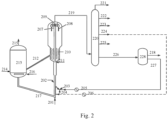
- the fluidized catalytic conversion method for producing light olefins of the present application is carried out as follows: a pre-lifting medium is introduced from the bottom of a fluidized catalytic conversion reactor (a diameter-transformed riser reactor) 202 via pipeline 201, a regenerated fluidized catalytic conversion catalyst from pipeline 217 moves upward along the fluidized catalytic conversion reactor 202 under the lifting action of the pre-lifting medium, and an olefin-rich feedstock is injected into the bottom of the fluidized catalytic conversion reactor 202 via pipeline 203 along with atomized steam from pipeline 204, contacted with the hot catalytic conversion catalyst for reaction, and moves upward.
- a pre-lifting medium is introduced from the bottom of a fluidized catalytic conversion reactor (a diameter-transformed riser reactor) 202 via pipeline 201
- a regenerated fluidized catalytic conversion catalyst from pipeline 217 moves upward along the fluidized catalytic conversion reactor 202 under the lifting action of the pre-lifting medium
- reaction product vapor and spent catalyst generated are passed to a cyclone separator 208 in the disengager through an outlet section 207 to conduct a separation of the spent catalyst and the reaction product vapor, the reaction product vapor is passed to a plenum chamber 209, and fine powder of the spent catalyst is returned to the disengager through a dipleg.
- Spent catalyst in the disengager is passed to a stripping section 210 where it is contacted with stripping steam from pipeline 211.
- the product vapor stripped from the spent catalyst is sent to the plenum chamber 209 after passing through the cyclone separator.
- the stripped spent catalyst is passed to a regenerator 213 through a standpipe 212, main air is introduced into the regenerator through pipeline 216 to burn out the coke on the spent catalyst so as to regenerate the inactivated spent catalyst, and make-up fuel is introduced into the regenerator through pipeline 214 for combustion, so that the regenerated catalyst is preheated to 650 °C or higher.
- the flue gas is passed to a flue gas turbine via pipeline 215 and the preheated regenerated catalyst is passed to the fluidized catalytic conversion reactor 202 via pipeline 217.
- the reaction product vapor is passed to a subsequent fractionator 220 through a reactor vapor line 219, the separated hydrogen, methane and ethane are withdrawn through pipeline 221, ethylene is withdrawn through pipeline 222, propylene is withdrawn through pipeline 223, butylene is withdrawn through pipeline 224, optionally passed into a heat exchanger 206 for preheating, and then recycled to the fluidized catalytic conversion reactor 202 at the upstream of the feeding position of the olefin-rich feedstock for further reaction, propane and butane are withdrawn through pipeline 225, a stream comprising residual olefins is passed into an olefin separator 228 through pipeline 226, the olefin-depleted stream obtained by separation is withdrawn through pipeline 218, the separated stream comprising C5+ olefins and having an olefin content of 50% or more is passed into a heat exchanger 205 through pipeline 227 for preheating, and then is passed to the fluidized catalytic conversion reactor 202 together with
- the fluidized catalytic conversion method for producing light olefins of the present application is carried out as follows: a pre-lifting medium is introduced from the bottom of a fluidized catalytic conversion reactor (a diameter-transformed riser reactor) 302 via pipeline 301, a regenerated fluidized catalytic conversion catalyst from pipeline 317 moves upward along the fluidized catalytic conversion reactor 302 under the lifting action of the pre-lifting medium, and the olefin-rich feedstock is injected into the bottom of the fluidized catalytic conversion reactor 302 via pipeline 303 along with atomized steam from pipeline 304 to contact with the hot catalytic conversion catalyst for reaction.
- a pre-lifting medium is introduced from the bottom of a fluidized catalytic conversion reactor (a diameter-transformed riser reactor) 302 via pipeline 301
- a regenerated fluidized catalytic conversion catalyst from pipeline 317 moves upward along the fluidized catalytic conversion reactor 302 under the lifting action of the pre-lifting medium
- Methanol feed is introduced via pipeline 329, mixed with the material in reactor 302, contacted with the catalytic conversion catalyst for reaction and moves upward.
- the reaction product vapor and spent catalyst generated are passed to a cyclone separator 308 in the disengager through an outlet section 307 to conduct a separation of the spent catalyst and the reaction product vapor, the reaction product vapor is passed to a plenum chamber 309, and fine powder of the spent catalyst is returned to the disengager through a dipleg.
- Spent catalyst in the disengager is passed to a stripping section 310 where it is contacted with stripping steam from pipeline 311.
- the product vapor stripped from the spent catalyst is passed to the plenum chamber 309 after passing through a cyclone separator.
- the stripped spent catalyst is passed to a regenerator 313 through a standpipe 312, main air is introduced into the regenerator through pipeline 316 to burn out the coke on the spent catalyst so as to regenerate the inactivated spent catalyst, and make-up fuel is introduced into the regenerator through pipeline 314 for combustion, so that the regenerated catalyst is preheated to 650 °C or higher.
- the flue gas is passed to a flue gas turbine via pipeline 315 and the preheated regenerated catalyst is passed to the fluidized catalytic conversion reactor 302 via pipeline 317.
- the reaction product vapor is passed to a subsequent fractionator 320 through a reactor vapor line 319, the separated hydrogen, methane and ethane are withdrawn through pipeline 321, ethylene is withdrawn through pipeline 322, propylene is withdrawn through pipeline 323, butylene is withdrawn through pipeline 324, optionally passed into a heat exchanger 306 for preheating, and then recycled to the fluidized catalytic conversion reactor 302 at the upstream of the feeding position of the olefin-rich feedstock for further reaction, propane and butane are withdrawn through pipeline 325, a stream comprising residual olefins is passed into an olefin separator 328 through pipeline 326, the olefin-depleted stream obtained by separation is withdrawn through pipeline 318, the separated stream comprising C5+ olefins and having an olefin content of 50% or more is passed into a heat exchanger 305 through pipeline 327 for preheating, and then is passed to the fluidized catalytic conversion reactor 302 together
- the present application provides the following technical solutions:
- Feedstocks I and II used in the examples below are light catalytic cracking gasoline fractions and the properties of the Feedstocks I and II are shown in Tables 1 and 2, respectively.
- the catalytic conversion catalyst M used in the following examples and comparative examples was prepared by the following method:
- 1-pentane feedstock was subjected to thermal cracking reaction on a pilot plant of thermal cracking single-tube reactor under conditions including a reaction temperature of 800 °C, a reaction time of 0.2s, and a weight ratio of steam to feedstock of 0.8, the resulting reaction product was passed into a separation system for separation, to obtain products such as ethylene, propylene, butylene, an olefin-containing stream, and the like.
- the product distribution is shown in Table 3.
- Example 3 An experiment was carried out as described in Example 1, except that the 1-pentene feedstock was changed to a mixture of C5-C8 olefins, and the molar ratio of C5, C6, C7 and C8 olefins in the olefin mixture was 1 : 1 : 1 : 1.
- the product distribution is shown in Table 3.
- Example 3 An experiment was carried out as described in Example 1, except that the 1-pentene feedstock was changed to a mixture of C5-C8 alkanes, and the molar ratio of C5, C6, C7 and C8 alkanes in the alkane mixture was 1 : 1 : 1 : 1.
- the product distribution is shown in Table 3.
- Example 3 An experiment was carried out as described in Example 1, except that the temperature of the regenerated catalyst was raised to 800 °C and the reaction temperature was raised to 750 °C.
- the product distribution is shown in Table 3.
- Example 3 An experiment was carried out as described in Example 1, except that the temperature of the regenerated catalyst was lowered to 650 °C and the reaction temperature was lowered to 600 °C.
- the product distribution is shown in Table 3.
- Example 3 An experiment was carried out as described in Example 1, except that the temperature of the regenerated catalyst was lowered to 600 °C and the reaction temperature was lowered to 530 °C.
- the product distribution is shown in Table 3.
- the reaction product vapor was separated from the carbon-deposited spent catalyst, and the reaction product vapor was split in a product fractionator according to the distillation range to obtain products such as ethylene, propylene, butylene, a stream comprising residual olefins (with a distillation range of 20-250 °C) and the like.
- the stream comprising the residual olefins was further separated in an olefin separator to obtain a stream comprising C5+ olefins and having an olefin content of 80 wt%.
- the product butylene was fed into the bottom of the riser reactor for cracking under conditions including a reaction temperature of 740 °C, a weight ratio of the catalytic conversion catalyst to the butylene of 100: 1, and a reaction time of 0.2 s.
- the stream comprising C5+ olefins was fed into the bottom of the riser reactor together with the 1-pentene feedstock downstream of the feeding position of butylene for further cracking under a reaction temperature of 700 °C for a reaction time of 5 s.
- the product distribution is shown in Table 3.
- Example 3 the cracking of olefin-containing feedstocks at high temperature in Examples 1-4 provides higher yields of ethylene, propylene and butylene, and the higher the olefin content of the feedstock the higher the yield.
- Example 1 when 1-pentene with an olefin content of 100% was used as the feedstock, the ethylene content in the product was 23.30%, the propylene content was 34.22%, and the butylene content was 17.44%, the total content of the three was 74.96%.
- Example 7 employed a higher reaction temperature and recycling of butylene, which provided an ethylene yield of 34.33%, a propylene yield of 39.12%, and a yield of the two olefins of 73.45%.
Landscapes
- Chemical & Material Sciences (AREA)
- Oil, Petroleum & Natural Gas (AREA)
- Engineering & Computer Science (AREA)
- Chemical Kinetics & Catalysis (AREA)
- General Chemical & Material Sciences (AREA)
- Organic Chemistry (AREA)
- Crystallography & Structural Chemistry (AREA)
- Physics & Mathematics (AREA)
- Thermal Sciences (AREA)
- Organic Low-Molecular-Weight Compounds And Preparation Thereof (AREA)
- Catalysts (AREA)
- Low-Molecular Organic Synthesis Reactions Using Catalysts (AREA)
Applications Claiming Priority (3)
| Application Number | Priority Date | Filing Date | Title |
|---|---|---|---|
| CN202110031545.9A CN114763483B (zh) | 2021-01-11 | 2021-01-11 | 一种制取乙烯和丙烯的催化转化方法 |
| CN202110031544.4A CN114763482B (zh) | 2021-01-11 | 2021-01-11 | 一种制取乙烯、丙烯和丁烯的催化转化方法 |
| PCT/CN2021/101925 WO2022147970A1 (fr) | 2021-01-11 | 2021-06-24 | Procédé de conversion catalytique fluidisée pour la préparation d'oléfines à faible teneur en carbone |
Publications (2)
| Publication Number | Publication Date |
|---|---|
| EP4269537A1 true EP4269537A1 (fr) | 2023-11-01 |
| EP4269537A4 EP4269537A4 (fr) | 2024-06-26 |
Family
ID=82357111
Family Applications (1)
| Application Number | Title | Priority Date | Filing Date |
|---|---|---|---|
| EP21917016.4A Pending EP4269537A4 (fr) | 2021-01-11 | 2021-06-24 | Procédé de conversion catalytique fluidisée pour la préparation d'oléfines à faible teneur en carbone |
Country Status (7)
| Country | Link |
|---|---|
| US (1) | US12441943B2 (fr) |
| EP (1) | EP4269537A4 (fr) |
| JP (1) | JP7713019B2 (fr) |
| KR (1) | KR20230128380A (fr) |
| MY (1) | MY210101A (fr) |
| TW (1) | TWI886295B (fr) |
| WO (1) | WO2022147970A1 (fr) |
Families Citing this family (2)
| Publication number | Priority date | Publication date | Assignee | Title |
|---|---|---|---|---|
| WO2025072077A1 (fr) * | 2023-09-25 | 2025-04-03 | ExxonMobil Technology and Engineering Company | Naphta renouvelable oléfinique en tant que composant de mélange d'essence |
| US12331518B1 (en) | 2024-08-12 | 2025-06-17 | United Arab Emirates University | 3D printed construction element and a system, a method for manufacturing the 3D printed construction element |
Family Cites Families (16)
| Publication number | Priority date | Publication date | Assignee | Title |
|---|---|---|---|---|
| EP0921180A1 (fr) | 1997-12-05 | 1999-06-09 | Fina Research S.A. | Production d'oléfines |
| CN1078094C (zh) | 1999-04-23 | 2002-01-23 | 中国石油化工集团公司 | 一种用于流化催化转化的提升管反应器 |
| JP2004509928A (ja) | 2000-05-19 | 2004-04-02 | エクソンモービル・ケミカル・パテンツ・インク | 流動接触分解法においてc3オレフィンを選択的に製造する方法。 |
| US7317133B2 (en) | 2002-11-21 | 2008-01-08 | Uop Llc | Process for enhanced olefin production |
| CN100368359C (zh) * | 2005-08-15 | 2008-02-13 | 中国石油化工股份有限公司 | 增产丙烯的生产方法 |
| CN101092323B (zh) | 2006-06-21 | 2010-07-21 | 中国石油化工股份有限公司 | 含碳烯烃催化裂解制轻质烯烃的方法 |
| JP5050469B2 (ja) | 2006-09-26 | 2012-10-17 | 三菱化学株式会社 | プロピレンの製造方法 |
| CN101239878B (zh) | 2007-02-07 | 2010-05-19 | 中国石油化工股份有限公司 | 碳四及其以上烯烃增产乙烯、丙烯的方法 |
| CN101293800B (zh) * | 2007-04-28 | 2012-11-14 | 中国石油化工股份有限公司 | 含氧化合物与轻烃转化集成制取小分子烯烃的方法 |
| CN101531558B (zh) | 2008-03-13 | 2013-04-24 | 中国石油化工股份有限公司 | 一种制取丙烯和芳烃的催化转化方法 |
| CN101760228B (zh) * | 2008-12-25 | 2013-06-26 | 中国石油化工股份有限公司 | 制取丙烯和高辛烷值汽油的催化转化方法 |
| CN103121894A (zh) * | 2011-11-18 | 2013-05-29 | 中国石油化工股份有限公司 | 生产低碳烯烃的组合方法 |
| EP2814913A1 (fr) * | 2012-02-14 | 2014-12-24 | Reliance Industries Limited | Procédé pour la conversion catalytique de courants d'hydrocarbure à faible valeur en oléfines légères |
| CN107434755B (zh) * | 2016-05-27 | 2020-02-04 | 中国科学院大连化学物理研究所 | 一种低碳烯烃的制备方法 |
| CN111718753B (zh) | 2019-03-22 | 2021-10-08 | 中国石油化工股份有限公司 | 一种多产丙烯的催化转化方法和系统 |
| CN110437023A (zh) * | 2019-07-12 | 2019-11-12 | 中国神华煤制油化工有限公司 | 制备烯烃的方法和烯烃生产系统 |
-
2021
- 2021-06-24 WO PCT/CN2021/101925 patent/WO2022147970A1/fr not_active Ceased
- 2021-06-24 US US18/260,643 patent/US12441943B2/en active Active
- 2021-06-24 TW TW110123189A patent/TWI886295B/zh active
- 2021-06-24 KR KR1020237027290A patent/KR20230128380A/ko active Pending
- 2021-06-24 JP JP2023541767A patent/JP7713019B2/ja active Active
- 2021-06-24 MY MYPI2023004098A patent/MY210101A/en unknown
- 2021-06-24 EP EP21917016.4A patent/EP4269537A4/fr active Pending
Also Published As
| Publication number | Publication date |
|---|---|
| TW202237805A (zh) | 2022-10-01 |
| US12441943B2 (en) | 2025-10-14 |
| JP2024502193A (ja) | 2024-01-17 |
| EP4269537A4 (fr) | 2024-06-26 |
| JP7713019B2 (ja) | 2025-07-24 |
| TWI886295B (zh) | 2025-06-11 |
| KR20230128380A (ko) | 2023-09-04 |
| MY210101A (en) | 2025-08-27 |
| US20240067885A1 (en) | 2024-02-29 |
| WO2022147970A1 (fr) | 2022-07-14 |
Similar Documents
| Publication | Publication Date | Title |
|---|---|---|
| US9284235B2 (en) | Process for methanol coupled catalytic cracking reaction of naphtha using a modified ZSM-5 molecular sieve catalyst | |
| EP1200901A2 (fr) | Production catalytique d'olefines legeres a partir d'une charge de naphta | |
| CN110540869B (zh) | 一种催化裂化的方法 | |
| TWI899361B (zh) | 含烴原料油催化裂解生產低碳烯烴和btx的方法及裝置 | |
| EP2334759A1 (fr) | Procédé de production d'oléfines de faible poids moléculaire dans des unités de craquage catalytique avec une déficience en énergie | |
| US12441943B2 (en) | Fluidized catalytic conversion method for preparing low-carbon olefins | |
| CN114763483B (zh) | 一种制取乙烯和丙烯的催化转化方法 | |
| CN114763315B (zh) | 一种制取低碳烯烃的催化转化方法 | |
| CN110950731A (zh) | 一种催化裂解的方法 | |
| US12435284B2 (en) | Fluidized catalytic conversion method for producing low-carbon olefins from hydrocarbons | |
| US12269794B2 (en) | Fluidized catalytic conversion method for maximizing production of propylene | |
| CN114763482B (zh) | 一种制取乙烯、丙烯和丁烯的催化转化方法 | |
| CN114763495B (zh) | 一种制取乙烯、丙烯和丁烯的催化转化方法 | |
| CN110951501B (zh) | 一种低生焦原料的催化转化方法 | |
| CN110951502B (zh) | 一种改善热量分布的催化裂化方法 | |
| CN115108876A (zh) | 一种制取低碳烯烃的催化转化方法 | |
| CN114763488B (zh) | 一种制取低碳烯烃的催化转化方法 | |
| CN114763484B (zh) | 一种制取丙烯和丁烯的催化转化方法 | |
| CN111073695A (zh) | 一种费托合成石脑油改质方法 |
Legal Events
| Date | Code | Title | Description |
|---|---|---|---|
| STAA | Information on the status of an ep patent application or granted ep patent |
Free format text: STATUS: THE INTERNATIONAL PUBLICATION HAS BEEN MADE |
|
| PUAI | Public reference made under article 153(3) epc to a published international application that has entered the european phase |
Free format text: ORIGINAL CODE: 0009012 |
|
| STAA | Information on the status of an ep patent application or granted ep patent |
Free format text: STATUS: REQUEST FOR EXAMINATION WAS MADE |
|
| 17P | Request for examination filed |
Effective date: 20230726 |
|
| AK | Designated contracting states |
Kind code of ref document: A1 Designated state(s): AL AT BE BG CH CY CZ DE DK EE ES FI FR GB GR HR HU IE IS IT LI LT LU LV MC MK MT NL NO PL PT RO RS SE SI SK SM TR |
|
| DAV | Request for validation of the european patent (deleted) | ||
| DAX | Request for extension of the european patent (deleted) | ||
| A4 | Supplementary search report drawn up and despatched |
Effective date: 20240527 |
|
| RIC1 | Information provided on ipc code assigned before grant |
Ipc: C07C 11/08 20060101ALI20240521BHEP Ipc: C07C 11/06 20060101ALI20240521BHEP Ipc: C07C 11/04 20060101ALI20240521BHEP Ipc: C10G 11/18 20060101ALI20240521BHEP Ipc: C10G 11/00 20060101AFI20240521BHEP |
|
| STAA | Information on the status of an ep patent application or granted ep patent |
Free format text: STATUS: EXAMINATION IS IN PROGRESS |
|
| 17Q | First examination report despatched |
Effective date: 20251205 |