EP4270215A2 - Système et procédé d'analyse de la parole - Google Patents
Système et procédé d'analyse de la parole Download PDFInfo
- Publication number
- EP4270215A2 EP4270215A2 EP23188583.1A EP23188583A EP4270215A2 EP 4270215 A2 EP4270215 A2 EP 4270215A2 EP 23188583 A EP23188583 A EP 23188583A EP 4270215 A2 EP4270215 A2 EP 4270215A2
- Authority
- EP
- European Patent Office
- Prior art keywords
- type
- script
- structural block
- speech
- derived
- Prior art date
- Legal status (The legal status is an assumption and is not a legal conclusion. Google has not performed a legal analysis and makes no representation as to the accuracy of the status listed.)
- Withdrawn
Links
Images






Classifications
-
- G—PHYSICS
- G10—MUSICAL INSTRUMENTS; ACOUSTICS
- G10L—SPEECH ANALYSIS TECHNIQUES OR SPEECH SYNTHESIS; SPEECH RECOGNITION; SPEECH OR VOICE PROCESSING TECHNIQUES; SPEECH OR AUDIO CODING OR DECODING
- G10L25/00—Speech or voice analysis techniques not restricted to a single one of groups G10L15/00 - G10L21/00
- G10L25/48—Speech or voice analysis techniques not restricted to a single one of groups G10L15/00 - G10L21/00 specially adapted for particular use
- G10L25/69—Speech or voice analysis techniques not restricted to a single one of groups G10L15/00 - G10L21/00 specially adapted for particular use for evaluating synthetic or decoded voice signals
-
- G—PHYSICS
- G10—MUSICAL INSTRUMENTS; ACOUSTICS
- G10L—SPEECH ANALYSIS TECHNIQUES OR SPEECH SYNTHESIS; SPEECH RECOGNITION; SPEECH OR VOICE PROCESSING TECHNIQUES; SPEECH OR AUDIO CODING OR DECODING
- G10L15/00—Speech recognition
- G10L15/08—Speech classification or search
- G10L15/18—Speech classification or search using natural language modelling
- G10L15/1807—Speech classification or search using natural language modelling using prosody or stress
-
- G—PHYSICS
- G10—MUSICAL INSTRUMENTS; ACOUSTICS
- G10L—SPEECH ANALYSIS TECHNIQUES OR SPEECH SYNTHESIS; SPEECH RECOGNITION; SPEECH OR VOICE PROCESSING TECHNIQUES; SPEECH OR AUDIO CODING OR DECODING
- G10L25/00—Speech or voice analysis techniques not restricted to a single one of groups G10L15/00 - G10L21/00
- G10L25/03—Speech or voice analysis techniques not restricted to a single one of groups G10L15/00 - G10L21/00 characterised by the type of extracted parameters
-
- G—PHYSICS
- G06—COMPUTING OR CALCULATING; COUNTING
- G06F—ELECTRIC DIGITAL DATA PROCESSING
- G06F16/00—Information retrieval; Database structures therefor; File system structures therefor
- G06F16/60—Information retrieval; Database structures therefor; File system structures therefor of audio data
- G06F16/61—Indexing; Data structures therefor; Storage structures
-
- G—PHYSICS
- G06—COMPUTING OR CALCULATING; COUNTING
- G06F—ELECTRIC DIGITAL DATA PROCESSING
- G06F16/00—Information retrieval; Database structures therefor; File system structures therefor
- G06F16/60—Information retrieval; Database structures therefor; File system structures therefor of audio data
- G06F16/64—Browsing; Visualisation therefor
-
- G—PHYSICS
- G06—COMPUTING OR CALCULATING; COUNTING
- G06F—ELECTRIC DIGITAL DATA PROCESSING
- G06F16/00—Information retrieval; Database structures therefor; File system structures therefor
- G06F16/60—Information retrieval; Database structures therefor; File system structures therefor of audio data
- G06F16/68—Retrieval characterised by using metadata, e.g. metadata not derived from the content or metadata generated manually
- G06F16/683—Retrieval characterised by using metadata, e.g. metadata not derived from the content or metadata generated manually using metadata automatically derived from the content
-
- G—PHYSICS
- G06—COMPUTING OR CALCULATING; COUNTING
- G06F—ELECTRIC DIGITAL DATA PROCESSING
- G06F16/00—Information retrieval; Database structures therefor; File system structures therefor
- G06F16/60—Information retrieval; Database structures therefor; File system structures therefor of audio data
- G06F16/68—Retrieval characterised by using metadata, e.g. metadata not derived from the content or metadata generated manually
- G06F16/683—Retrieval characterised by using metadata, e.g. metadata not derived from the content or metadata generated manually using metadata automatically derived from the content
- G06F16/685—Retrieval characterised by using metadata, e.g. metadata not derived from the content or metadata generated manually using metadata automatically derived from the content using automatically derived transcript of audio data, e.g. lyrics
-
- G—PHYSICS
- G06—COMPUTING OR CALCULATING; COUNTING
- G06F—ELECTRIC DIGITAL DATA PROCESSING
- G06F16/00—Information retrieval; Database structures therefor; File system structures therefor
- G06F16/70—Information retrieval; Database structures therefor; File system structures therefor of video data
- G06F16/78—Retrieval characterised by using metadata, e.g. metadata not derived from the content or metadata generated manually
- G06F16/783—Retrieval characterised by using metadata, e.g. metadata not derived from the content or metadata generated manually using metadata automatically derived from the content
- G06F16/7844—Retrieval characterised by using metadata, e.g. metadata not derived from the content or metadata generated manually using metadata automatically derived from the content using original textual content or text extracted from visual content or transcript of audio data
-
- G—PHYSICS
- G06—COMPUTING OR CALCULATING; COUNTING
- G06F—ELECTRIC DIGITAL DATA PROCESSING
- G06F16/00—Information retrieval; Database structures therefor; File system structures therefor
- G06F16/90—Details of database functions independent of the retrieved data types
- G06F16/903—Querying
- G06F16/90335—Query processing
- G06F16/90344—Query processing by using string matching techniques
-
- G—PHYSICS
- G06—COMPUTING OR CALCULATING; COUNTING
- G06F—ELECTRIC DIGITAL DATA PROCESSING
- G06F40/00—Handling natural language data
- G06F40/20—Natural language analysis
- G06F40/279—Recognition of textual entities
- G06F40/289—Phrasal analysis, e.g. finite state techniques or chunking
-
- G—PHYSICS
- G10—MUSICAL INSTRUMENTS; ACOUSTICS
- G10L—SPEECH ANALYSIS TECHNIQUES OR SPEECH SYNTHESIS; SPEECH RECOGNITION; SPEECH OR VOICE PROCESSING TECHNIQUES; SPEECH OR AUDIO CODING OR DECODING
- G10L15/00—Speech recognition
- G10L15/02—Feature extraction for speech recognition; Selection of recognition unit
-
- G—PHYSICS
- G10—MUSICAL INSTRUMENTS; ACOUSTICS
- G10L—SPEECH ANALYSIS TECHNIQUES OR SPEECH SYNTHESIS; SPEECH RECOGNITION; SPEECH OR VOICE PROCESSING TECHNIQUES; SPEECH OR AUDIO CODING OR DECODING
- G10L15/00—Speech recognition
- G10L15/04—Segmentation; Word boundary detection
-
- G—PHYSICS
- G10—MUSICAL INSTRUMENTS; ACOUSTICS
- G10L—SPEECH ANALYSIS TECHNIQUES OR SPEECH SYNTHESIS; SPEECH RECOGNITION; SPEECH OR VOICE PROCESSING TECHNIQUES; SPEECH OR AUDIO CODING OR DECODING
- G10L15/00—Speech recognition
- G10L15/22—Procedures used during a speech recognition process, e.g. man-machine dialogue
-
- G—PHYSICS
- G10—MUSICAL INSTRUMENTS; ACOUSTICS
- G10L—SPEECH ANALYSIS TECHNIQUES OR SPEECH SYNTHESIS; SPEECH RECOGNITION; SPEECH OR VOICE PROCESSING TECHNIQUES; SPEECH OR AUDIO CODING OR DECODING
- G10L19/00—Speech or audio signals analysis-synthesis techniques for redundancy reduction, e.g. in vocoders; Coding or decoding of speech or audio signals, using source filter models or psychoacoustic analysis
- G10L19/02—Speech or audio signals analysis-synthesis techniques for redundancy reduction, e.g. in vocoders; Coding or decoding of speech or audio signals, using source filter models or psychoacoustic analysis using spectral analysis, e.g. transform vocoders or subband vocoders
-
- G—PHYSICS
- G10—MUSICAL INSTRUMENTS; ACOUSTICS
- G10L—SPEECH ANALYSIS TECHNIQUES OR SPEECH SYNTHESIS; SPEECH RECOGNITION; SPEECH OR VOICE PROCESSING TECHNIQUES; SPEECH OR AUDIO CODING OR DECODING
- G10L25/00—Speech or voice analysis techniques not restricted to a single one of groups G10L15/00 - G10L21/00
- G10L25/48—Speech or voice analysis techniques not restricted to a single one of groups G10L15/00 - G10L21/00 specially adapted for particular use
- G10L25/51—Speech or voice analysis techniques not restricted to a single one of groups G10L15/00 - G10L21/00 specially adapted for particular use for comparison or discrimination
-
- G—PHYSICS
- G10—MUSICAL INSTRUMENTS; ACOUSTICS
- G10L—SPEECH ANALYSIS TECHNIQUES OR SPEECH SYNTHESIS; SPEECH RECOGNITION; SPEECH OR VOICE PROCESSING TECHNIQUES; SPEECH OR AUDIO CODING OR DECODING
- G10L15/00—Speech recognition
- G10L15/26—Speech to text systems
-
- G—PHYSICS
- G10—MUSICAL INSTRUMENTS; ACOUSTICS
- G10L—SPEECH ANALYSIS TECHNIQUES OR SPEECH SYNTHESIS; SPEECH RECOGNITION; SPEECH OR VOICE PROCESSING TECHNIQUES; SPEECH OR AUDIO CODING OR DECODING
- G10L21/00—Speech or voice signal processing techniques to produce another audible or non-audible signal, e.g. visual or tactile, in order to modify its quality or its intelligibility
- G10L21/06—Transformation of speech into a non-audible representation, e.g. speech visualisation or speech processing for tactile aids
- G10L21/10—Transforming into visible information
-
- G—PHYSICS
- G10—MUSICAL INSTRUMENTS; ACOUSTICS
- G10L—SPEECH ANALYSIS TECHNIQUES OR SPEECH SYNTHESIS; SPEECH RECOGNITION; SPEECH OR VOICE PROCESSING TECHNIQUES; SPEECH OR AUDIO CODING OR DECODING
- G10L25/00—Speech or voice analysis techniques not restricted to a single one of groups G10L15/00 - G10L21/00
- G10L25/90—Pitch determination of speech signals
Definitions
- the invention relates to a system and a method for processing an audio signal and, more particularly, to a system and method for analyzing and/or visualizing audio speech clips.
- a good narration requires speakers to use proper prosody, that is, the melody of speech including pitch, intensity, speed rate, pause etc., to deliver information expressively.
- Many systems have been proposed in recent years to help speakers analyze their narration performance. Some work aims at providing instant feedback to speakers during rehearsal, and others summarize a speaker's performance such as voice modulation to support self-reflection. Recently, certain systems were proposed to modify speakers' recordings by re-synthesis technology that allows speakers to hear how they can speak better. Although these systems successfully promote speakers' awareness of their voice status in the presentation, they also have limitations. First, some work requires speakers to repeatedly listen to their recordings and to improved ones, which is inefficient and easily makes users feel frustrated. Secondly, since a good speech can be delivered with various styles, it is better to allow users to explore and customize the narration style they want to imitate.
- TED Talks which provide rich samples of good narration strategies. While many people consider these as references to better speech narration, it is challenging to identify specific samples of desired narration strategies.
- TED Talks comprises a large-scale dataset with, at present, in excess of 2,900 talks, which makes it extremely difficult, if not impractical, for people to readily search for a suitable sample by watching all the talks.
- a public speaking exploration system using a data-driven approach is therefore desired. To achieve this, it is advantageous to provide an improved audio signal processing system and method.
- An object of the invention is to mitigate or obviate to some degree one or more problems associated with known public speaking exploration systems and/or known audio signal processing systems.
- Another object of the invention is to provide a data-driven public speaking exploration system.
- Another object of the invention is to provide an improved method of analyzing and/or processing an audio signal with an associated script.
- Yet another object of the invention is to provide an improved method of visualizing an audio signal with an associated script.
- the invention generally relates to a visual analytics system that allows users to understand good prosodic patterns in high-quality speech samples, and thus to discover good narration strategies.
- the invention first extracts the prosodic features of each speech and aligns these features with the script. Then, a three-level hierarchy, i.e., speech-level, sentence-level and word-level, is preferably constructed and visually presented.
- the system may consist of four linked views and rich interactions to facilitate this three-level-of-detail analysis.
- the invention provides a computer implemented method of processing an audio signal, comprising the steps of: extracting prosodic features, by a signal analysis module from the audio signal; aligning, by a signal alignment module the extracted prosodic features with a script derived from or associated with the audio signal; and segmenting, by a script segmenting module, the script with said aligned extracted prosodic features into structural blocks of a first type, the segmented structural blocks of a first type of the script comprise any one or any combination of clauses, phrases or sentences comprising the script; determining a distance measure between a structural block of the first type derived from the script with another structural block of the first type; wherein the distance measure comprises a measure of similarity between the structural block of the first type derived from the script and the other structural block of the first type; wherein the determining of distance measure comprising: for each of the structural block of the first type derived from the script and the other structural block of the first type, extracting part-of-speech (POS) tags for each structural
- POS part-
- the audio signal comprises a digital audio clip of a human speech or a digital audio clip of a computer synthesized speech generated from a text.
- the segmenting step simultaneously segments the script and the aligned extracted prosodic features into structural blocks of a first type.
- the prosodic features are extracted from the audio signal to form a time series with a predefined, selected or calculated sample rate.
- each structural block of a second type comprising the script may be labelled with one or both of a start timestamp and an end timestamp.
- the method further comprises the step of: determining a distance measure between a structural block of the first type derived from the script with another structural block of the first type.
- the other structural block of the first type may be derived from a source other than the script.
- the edit distance between the POS for the structural block of the first type may be derived from the script and the POS for the other structural block of the first type may be calculated using the Damerau-Levenshtein distance.
- the invention provides a system for processing an audio signal, the system comprising: a signal analysis module for extracting prosodic features from the audio signal; a signal alignment module for aligning the extracted prosodic features with a script derived from or associated with the audio signal; and a script segmenting module for segmenting the script with the extracted prosodic features into structural blocks of a first type, each structural block of the first type comprising any one or any combination of clauses, phrases, or sentences; a memory storing machine-readable instructions; and a processor configured to execute said machine-readable instructions to implement the method of the first main aspect of the invention.
- the invention provides a non-transitory computer readable medium storing machine-readable instructions executable by a processor to configure a signal processing system to perform the method of the first main aspect of the invention.
- the invention provides a computer implemented method of searching a speech dataset, the method comprising the steps of: receiving a user input comprising a structural block of a first type from a script comprising a part of the speech dataset; extracting part-of-speech (POS) tags for each structural block of a second type comprising said inputted structural block of the first type to form a POS sequence for said inputted structural block of the first type; and comparing said extracted POS sequence for said inputted structural block of the first type with POS sequences for structural blocks of the first type in the speech dataset to thereby identify one or more other structural blocks of the first type in the speech dataset which have a same or similar POS as the inputted structural block of the first type.
- POS part-of-speech
- the step of identifying one or more other structural blocks of the first type in the speech dataset which have a same or similar POS as the inputted structural block of the first type identifies their associated scripts or speeches.
- One or more of the identified associated scripts or speeches may be made available to a speech replay or speech synthesis module or system to audio play all of part of said associated scripts or speeches to a user.
- the step of comparing said extracted POS sequence for said inputted structural block of the first type with POS sequences for structural blocks of the first type comprises determining a distance measure between the inputted structural block of a first type and each of the one or more other structural blocks of the first type in the speech dataset.
- the distance measure may comprise a measure of similarity between the inputted structural block of the first type and each of the one or more other structural blocks of the first type in the speech dataset.
- the method may further comprise the step of calculating an edit distance between the POS for the inputted structural block of the first type and each of the one or more other structural blocks of the first type in the speech dataset.
- the edit distance between the POS for the inputted structural block of the first type and each of the one or more other structural blocks of the first type in the speech dataset may be calculated using the Damerau-Levenshtein distance.
- the invention provides a system for searching a speech dataset, the system comprising: a processor configured to: receive a user input comprising a structural block of a first type from a script comprising a part of the speech dataset; extract part-of-speech (POS) tags for each structural block of a second type comprising said inputted structural block of the first type to form a POS sequence for said inputted structural block of the first type; and compare said extracted POS sequence for said inputted structural block of the first type with POS sequences for structural blocks of the first type in the speech dataset to thereby identify one or more other structural blocks of the first type in the speech dataset which have a same or similar POS as the inputted structural block of the first type.
- POS part-of-speech
- the invention provides a non-transitory computer readable medium storing machine-readable instructions executable by a processor to configure a signal processing system to perform the method of the third main aspect of the invention.
- FIGS may be implemented in various forms of hardware, software or combinations thereof. These elements may be implemented in a combination of hardware and software on one or more appropriately programmed general-purpose devices, which may include a processor, memory and input/output interfaces.
- processor or “controller” should not be construed to refer exclusively to hardware capable of executing software, and may implicitly include, without limitation, digital signal processor (“DSP”) hardware, read-only memory (“ROM”) for storing software, random access memory (“RAM”), and non-volatile storage.
- DSP digital signal processor
- ROM read-only memory
- RAM random access memory
- any element expressed as a means for performing a specified function is intended to encompass any way of performing that function including, for example, a) a combination of circuit elements that performs that function or b) software in any form, including, therefore, firmware, microcode or the like, combined with appropriate circuitry for executing that software to perform the function.
- the invention as defined by such claims resides in the fact that the functionalities provided by the various recited means are combined and brought together in the manner which the claims call for. It is thus regarded that any means that can provide those functionalities are equivalent to those shown herein.
- prosodic patterns in speech analysis it is often necessary to associate prosodic features with scripts.
- Several systems have been presented to embed prosodic features into script visualization. The most straightforward way to embed prosodic features is drawing a line/bar chart along the script or overlaying a heatmap on the script.
- two visualization schemes for multiple prosodic features have been disclosed. One is to manipulate text directly and the other is to augment scripts with overlaid text rendering techniques.
- Other systems further add vertical sparklines with summarized musical features to show the overall structure of songs.
- the present invention features an overview component, which summarizes prosodic features of each speech, allowing users to effectively identify speeches with desired narration style. Moreover, the present invention's ⁇ focus and context' design scales better when analyzing and comparing speech-level prosodic features.
- Some work provides real-time feedback with the help of extra devices, for example, by generating visual summaries from a user recorded video, and the latter system also provides comments from the audience. It is also known to use a Google Glass device to inform speakers of their speed rate and volume, or to use a detachable wristband which can be used to increase a speaker's awareness of their voice pitch, words per minute and filler words.
- the present invention provides a system to tackle this problem from a data-driven perspective, that is, to provide a visual analytic system to explore and imitate high-quality public speeches.
- the system allows users to identify speech samples according to their desired narration style and understand the characteristics of those good samples, and therefore apply the strategy into their narrations.
- case studies using TED Talks data and collected feedback from domain experts were conducted.
- the system of the present invention aims to help speakers explore a large-scale speech dataset and identify good speech samples with meaningful narration strategies.
- potential prosodic features were first collected based on a comprehensive literature review. Then, a user-centered design process was followed in collaboration with three domain experts to understand user requirements. All the experts have been engaged in English teaching in universities, and one of the experts has taught a presentation skill course for over 10 years. Based on the literature review and the interviews with experts, the requirements of the system are summarized as:
- prosody In linguistics, prosody is concerned with those elements of speech that are not individual phonetic segments (vowels and consonants) but are properties of syllables and larger units of speech, including linguistic functions such as intonation, tone, stress and rhythm, among others. Such elements are known as supra-segmentals.
- Prosody may reflect various features of the speaker or the utterance: the emotional state of the speaker; the form of the utterance (statement, question, or command); the presence of irony or sarcasm, emphasis, contrast, and focus. It may otherwise reflect other elements of language that may not be encoded by grammar or by choice of vocabulary.
- the invention is not limited to only the prosodic features of pitch, volume and pause, but may include other prosodic features such as stress, tempo, rhythm and chunking.
- Stress, or emphasis is easy to use and recognize in spoken language, but harder to describe.
- a stressed word or syllable is usually preceded by a very slight pause, and is spoken at slightly increased volume.
- Chunking is where an often-spoken familiar group of words is delivered almost as a single word sound.
- Other prosodic aspects that may be included comprise: superfast, loud, diaphragm, whisper, staccato, and three-second pause. Superfast may be considered as speaking some words or parts of a speech at an unusually fast speed.
- Loud or loudness is similar to volume but differs in the sense that the variations in spoken sound level may be less subtle.
- Another type of prosody which may be included is alliteration. It will be understood therefore that the methods of the invention herein disclosed can employ any and all known types of prosodic features and/or prosodic techniques and that there are overlaps between such prosodic features and/or prosodic techniques.
- R1 To support quick identification of speeches with similar narration styles or distinctive speeches. Given a speech dataset, it is important to provide users with an overview that shows groups of speeches sharing similar narration styles or a few speeches as outliers. It gives users a rough idea of the dataset and serves as the entry point of the analysis.
- R2 To present speech-level temporal distribution of prosodic features. For each speech, it is necessary to show the evolution of prosodic features. Since speeches may vary in length and prosodic patterns, the proposed design needs to handle the variance of scales among different speeches.
- R3 To present sentence-level distribution of prosodic features. Upon analyzing the prosodic features of a speech, it is helpful to allow users to narrow down to single sentences. The sentence-level design should keep certain prosodic information to keep users aware of the speech context.
- R4 To compare prosodic features of sentences with similar constituent structure. After identifying a sentence with desired prosodic patterns, it is still tedious for users to search for similar ones manually. Therefore, the system should provide an automatic method to identify similar sentences.
- R5 To summarize prosodic patterns of a specific word or phrase. It is also helpful to summarize prosodic patterns of a selected word/phrase, and hence tell users what kind of narration strategies can be chosen from for that word/phrase.
- the system of the present invention has been designed and developed which relates to a visual analytics system for interactively exploring narration strategies in a large-scale speech dataset.
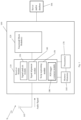
- Fig. 1 shows an exemplary embodiment of a signal processing system 100 in accordance with concepts of the present invention.
- the signal processing system 100 comprises a computer processing device such as a communication equipment (e.g. a smart phone), a tablet computer, a laptop computer, a personal computer (PC), or the like, although any suitable data processing device or system may be utilized.
- the signal processing system 100 may be connected via a communication network to a server and/or to a database 106 or the like, although this is not essential to the implementation of the invention.
- the communication network may comprise a wireless network, e.g. a wireless cellular network, a wired network, the internet or any combination of the foregoing.
- the signal processing system 100 may comprise a plurality of functional blocks for performing various functions thereof.
- the signal processing system 100 may include a receiver module 110 providing received signal processing and/or configured to provide received signals and/or information extracted therefrom to functional block module(s) 120 such as may comprise various data sink, control element(s), user interface(s), etc.
- functional block module(s) 120 such as may comprise various data sink, control element(s), user interface(s), etc.
- receiver module 110 is described as providing received signal processing, it will be appreciated that this functional block may be implemented as a transceiver providing both transmitted and received signal processing via antenna 105 and/or another type of system input, although it will be understood that audio signals in the form of audio speech clips may be received or inputted to the receiver module 110 of the signal processing system 100 by suitable means familiar to one skilled in the art.
- the signal processing system 100 may comprise a stand-alone device or system. Irrespective of the presence or particular configuration of receiver module 110, embodiments may include a signal analysis module 130 for extracting prosodic features from a received or inputted audio signal, a signal alignment module 140 for aligning the extracted prosodic features with a script derived from or associated with the audio signal, a script segmenting module 150 for segmenting the script with the extracted prosodic features into structural blocks of a first type, and a part-of-speech (POS) tag extractor module 180 for extracting tags from the script or a structural block of the script.
- POS part-of-speech
- the signal analysis module 130, the signal alignment module 140, the script segmenting module 150 and the POS tag extractor module 180 are shown as being deployed as part of the receiver module 110 (e.g. comprising a portion of the receiver module control and logic circuits), there is no limitation to such a deployment configuration according to the concepts of the invention.
- each of the signal analysis module 130, the signal alignment module 140, the script segmenting module 150, and the POS tag extractor module 180 may be deployed as respective functional blocks of the signal processing system 100 that is distinct from, but connected to, the receiver module 110 if present.
- Each of the signal analysis module 130, the signal alignment module 140, the script segmenting module 150, and the POS tag extractor module 180 may, for example, be separately implemented using logic circuits and/or executable code/machine readable instructions stored in a memory 160 of the signal processing system 100 for execution by a processor 170 to thereby perform functions as described herein.
- the executable code/machine readable instructions may be stored in one or more memories 160 (e.g. random access memory (RAM), read only memory (ROM), flash memory, magnetic memory, optical memory or the like) suitable for storing one or more instruction sets (e.g. application software, firmware, operating system, applets, and/or the like), data (e.g.
- the one or more memories 160 may comprise processor-readable memories for use with respect to one or more processors 170 operable to execute code segments of any of the signal analysis module 130, the signal alignment module 140, the script segmenting module 150, and the POS tag extractor module 180 and/or to utilize data provided thereby to perform functions of the signal processing system 100 as described herein.
- each of the signal analysis module 130, the signal alignment module 140, the script segmenting module 150, and the POS tag extractor module 180 may comprise one or more special purpose processors (e.g. application specific integrated circuit (ASIC), field programmable gate array (FPGA), graphics processing unit (GPU), and/or the like configured to perform functions of the signal processing system 100 as described herein.
- ASIC application specific integrated circuit
- FPGA field programmable gate array
- GPU graphics processing unit
- a first step is to extract prosodic features from a received or inputted audio signal.
- the audio signals to be processed preferably comprise digital audio clips of human speeches, preferably in digital format, but, for some embodiments, may comprise synthesized speeches, e.g. speeches generated from texts by a computer synthesizer application or the like.
- the signal analysis module 130 preferably comprises a speech synthesis or speech analysis module 130 and may, in some embodiments, comprise a known speech analysis tool named Praat (P. Boersma. Praat, a system for doing phonetics by computer. Glot international, 5, 2002) for feature extraction, although any suitable speech analysis tool may be utilized.
- the desired/required prosodic features are extracted to a form of time series with a predefined, selected or calculated sample rate.
- a sample rate of 0.01 seconds may be chosen as this is considered sufficiently fine-grained enough for the analysis, but other sample rates may be chosen.
- the next step is to align the extracted prosodic features with a script derived from or associated with the audio speech clip being processed.
- the signal alignment module 140 which preferably comprises a speech to text alignment module 140 may, in some embodiments, comprise an existing speech to text alignment tool named Gentle ( https://lowerquality.com/gentle/ ) which is a robust yet lenient toolkit for aligning speech with text, although any suitable speech to text alignment tool may be utilized.
- Gentle https://lowerquality.com/gentle/
- the start and/or end timestamp of each unigram, i.e. word are labelled which allows easy automatic drawing or alignment of prosodic features along the script. Additionally, or alternatively, this is preferably performed for bigrams and may also be performed for trigrams, etc. in the script.
- the script segmenting module 150 which preferably comprises a human language analysis module 150 and which may, in some embodiments, comprise CoreNLP ( C. Manning, M. Surdeanu, J. Bauer, J. Finkel, S. Bethard, and D. McClosky; the stanford corenlp natural language processing tool; in Proceedings of the 2014 Annual Meeting of the Association for Computational Linguistics: System Demonstrations, pages 55-60, 2014 ) is used to segment the script into structural blocks of a first type, such as, for example, clauses, phrases and/or sentences, comprising the script, although any suitable human language analysis tool may be utilized. More preferably, the structural blocks of a first type comprise sentences comprising the script. Since the script is already aligned with a timeline of the audio clip, this step will automatically and simultaneously segment the already aligned prosodic feature values with the structural blocks of a first type.
- CoreNLP C. Manning, M. Surdeanu, J. Bauer, J. Finkel, S. Bethard, and D. McClosky;
- the unigrams, bigrams and/or trigrams, etc. in the script can be considered as comprising structural blocks of a second type.
- Fig. 2 depicts an enhanced architecture of the signal processing system 100 connected directly with or via a network to server/database 106 where such are present, although the signal processing system 100 may comprise a stand-alone device or system.
- the signal processing system 100 is configured not only to process audio speech clips via the receiver module 110 in the form of a Data Analysis module 110A as herein described to extract prosodic features, etc., but it may also be configured to extract data via a Raw Data module 110B including scripts from such audio speech clips as well as to establish visualizations of the processed audio speech clips via a Visualization module 110C as hereinafter described of the processed audio speech clips.
- each of the Data Analysis module 110A, the Raw Data module 110B, and the Visualization module 110C may be deployed as respective functional blocks of the signal processing system 100 that are distinct from, but connected to, the receiver module 110.
- Each of the Data Analysis module 110A, the Raw Data module 110B, and the Visualization module 110C may, for example, be separately implemented using logic circuits and/or executable code/machine readable instructions stored in a memory 160 of the signal processing system 100 for execution by a processor 170 to thereby perform functions as described herein.
- the signal processing system 100 can benefit users by providing structural blocks of the first type, e.g. sentences, with similar structures to a selected structure.
- users can validate and summarize their hypothesis and better understand their narration strategy.
- existing, i.e. conventional, sentence to sentence querying methods are mostly based on semantics or topics. For example, given an input sentence "I have a dream, a beautiful dream", most existing methods will query sentences talking about the word "dream”.
- a sentence with a similar structure such as "We have a problem, an environmental problem.” is more useful for a user to learn a narration style.
- the present invention preferably provides a constituent structure-based similarity (CSS) to measure the distance, such as edit distance, between a structural block of the first type derived from the script with another structural block of the first type, e.g. a sentence or the like from the script with a sentence or the like also from the script or from another source such as, for example, a user input or user selection.
- the distance measure preferably comprises a measure of similarity between the structural block of the first type derived from the script and the other structural block of the first type.
- This may comprise, for each of the structural block of the first type derived from the script and the other structural block of the first type, extracting POS tags for each structural block of a second type comprising said structural block of the first type to form a POS sequence and then calculating an edit distance between the POS for the structural block of the first type derived from the script and the POS for the other structural block of the first type.
- the edit distance between the POS for the structural block of the first type derived from the script and the POS for the other structural block of the first type is preferably calculated using the Damerau-Levenshtein distance.
- the POS tagger extractor module 180 which, in some embodiments, may comprise a known tagger extractor tool, such as that disclosed in K. Toutanova, D. Klein, C. D. Manning, and Y.
- Fig. 3 shows a screenshot of a user interface 200.
- the user interface 200 consists of four linked views 200A, B, C, D: the overview 200A which shows the prosodic feature distribution in speech-level, the list view 200B which displays selected speeches with their temporal prosodic feature evolution, the main view 200C supporting sentence-level analysis, and the word view 200D showing the intonation summary of a word.
- the layout of the linked user interface views 200A, B, C, D shown in Fig. 3 is merely an example of one such layout and that said views 200A, B, C, D may be arranged differently in some embodiments.
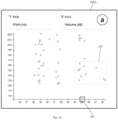
- Fig. 4A provides a more detailed view of overview 200A which is configured to illustrate the overall distribution of speeches to meet objective R1 above.
- the overview 200A consists of a scatter plot where each node represents a speech.
- the x and y-axis represent volume and pitch, respectively, but users may be enabled to change either or both axes to encode other attributes, such as average sentence length, sentence count, etc.
- Fig. 4B provides a more detailed view of the list view 200B which presents the attributes of each speech in a tabular form.
- the three columns display a speech title, tag and temporal distribution of prosodic features to meet objective R2 above. Speeches can be ranked in order by their word count, sentence count, etc.
- the list view 200B visualizes the temporal distribution of each speech with a space-filling representation 410.
- the upper half 410A of each representation 410 represents the distribution of pitch and the bottom half 410B of each representation 410 represents the distribution of volume.
- the opacity of the halves 410A, B of each representation 410 may encode values over time of the represented features. This type of representation of features may be used consistently used in other user interface views.
- a user can click or use a lasso selection or similar operation on the speeches in, for example, the overview 200A and the list view 200B will automatically be updated to show the filtered results. In this way, users can only focus on a relevant or selected part of the dataset.
- users can click on a speech in the list view 200B, and then the main view 200C ( Fig. 4C ) will be updated to show the clicked speech.
- Fig. 4C provides a more detailed view of the main view 200C which consists of two parts.
- a top part 420A shows the prosodic features of a speech with a focused sentence to achieve objective R3 above.
- a bottom part 420B visualizes a user's querying results.
- the dashed line shows the separation of the two part-views 420A, B. Since this is the user interface view displaying both prosodic features and semantics of the script, users can directly learn potentially useful narration strategies by exploring this view. Therefore, the main view 200C is considered as the core view of the visualization system of the invention.
- Fig. 5 shows an enlarged view of the top part 420A of the main view 200C.
- This comprises a novel focus+context design to preserve the context of a selected sentence while keeping the design scalable to the length of the represented speech.
- the focused sentence is directly placed along with a horizontal timeline and an overlay of its prosodic features as shown at a.
- a volume chart 430 overlying the displayed text encodes volume values and a line chart 440 drawn above the volume chart 430 presents the pitch values.
- the design rationale is that the width or depth of the volume chart 430 naturally conveys whether the represented attribute is stronger or weaker, while the line chart 440 may be considered more intuitive to present values that become higher or lower.
- the duration of pauses between words may be encoded by blank spaces in the text, i.e. between words in the text, so users can easily observe whether there is a clear pause or not between words or other structural blocks in the displayed text of the script.
- the timeline is extended to draw remaining parts (i.e., the context) of the speech before and after the focused sentence at each b.
- the focused sentence has a visual effect as an expanded detail view, which is intuitive to analyze according to users' feedback.
- Users can click on the volume chart 430 to change the focused sentence.
- the same volume chart 430 and line chart 440 are used to encode volume and pitch for each displayed sentence with only a possible modification of the time scale to fit the context in the screen view.
- Each pause between sentences may be encoded by a vertical bar 450 on the timeline. The height of the bar 450 displays the duration of the pause. In this way, users can identify interesting pause patterns (e.g., dense pause usage or an unusually long pause) and quickly locate the corresponding sentences.
- context sentences are displayed vertically along the focused sentence as at each c.
- the font size and opacity are preferably decreased for the context sentences to encode the distance between such a sentence and the focused sentence, so a context sentence is smaller and lighter if it is further away from the focused sentence.
- the design of the main view 200C requires several design alternatives to be considered and implemented.
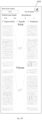
- Fig. 6 which displays design alternatives: A showing a segmented horizontal timeline; B showing a segmented volume chart; and C showing the preferred timeline as seen in Fig. 4C and Fig. 5 .
- B it is possible as in B to divide the volume chart 430 into segments and use blank spaces in the volume chart 430 to indicate pauses.
- the available blank space can be limited to clearly show the pause duration. For example, it can be difficult to discriminate a 1 second pause from a 10 second pause. Therefore, it is preferred to use the timeline bar chart of C to represent each pause. In this way, the tall bar indicating unusual long pause can easily catch users' attention.
- the signal processing system 100 For comparison of similar sentences upon users selecting a focused sentence, the signal processing system 100 will take this sentence as input and use the previously described CSS query to search for similar sentences, namely sentences having a similarity measure within a predefined, selected or calculated range or margin with respect to the distance measure for the user selected sentence. With the query result, the signal processing system 100 will also display the prosodic features of these sentences at the bottom part 420B of the main view 200C. To compare and summarize the narration strategies among these sentences, a side-by-side visual comparison is used and encode prosodic features in the same way as the focused sentence to thereby achieve objective R4.
- main view 200C can help users find a sentence with a desired narration style, users usually need more samples to understand and generalize their findings.
- the side-by-side comparison in the main view 200C can provide more sentence samples.
- Another option, however, is to provide more narration samples for a critical word in the focused sentence, such as a transition word.
- the word view 200D as shown in Fig. 4D is designed for this purpose and achieves objective R5.
- Fig. 8 illustrates a word cloud in the word view 200D where occurrences of a user selected word are classified into three groups from top to bottom: depreciation; regular usage; and emphasis, according to the prosodic feature values.
- the intonation of this word can be classified into three categories as above, e.g. emphasis, depreciation and regular usage.
- typical pitch values for each of the categories is shown in Fig. 8 .
- both volume value and pitch deviation can help to detect an emphasized word. Therefore, in one embodiment of this invention, the words can be classified in a similar but simpler way. Preferably two classification results are generated based on the volume value and the pitch deviation, respectively.
- the volume value of the antecedent and subsequent words is calculated. Then, if the volume value of the selected word is larger or smaller than the average by a predetermined, selected or calculated threshold ⁇ 1 , it is classified as emphasis or depreciation, respectively. Otherwise, it is considered as a regular usage. Similarly, all the occurrences of the given word can be grouped based on the pitch deviation with another predetermined, selected or calculated threshold ⁇ 2 . In one embodiment, the two thresholds are set to 25% and 5dB, respectively. Users can adjust the thresholds through the user interface.
- the word cloud of Fig. 4D and Fig. 8 is used to visualize the context information.
- the antecedent and subsequent words of the selected word are collected to generate a word cloud, respectively.
- word clouds are linked with curves, and the color and shape of the curves denote the intonation categories.
- the height of each word cloud represents the number of occurrences of the selected word, allowing users to observe the most commonly used intonation strategy.
- the word distribution inside word clouds helps users understand the context of the word. By changing the settings, the signal processing system 100 allows users to replace all the words with their POS tags, and to generate word clouds based on tag distribution.
- the timelines described herein provide the technical advantage that, when searching a speech dataset, the locations of results provided or displayed to a user within the scripts or the associated audio signals can readily be found through use of any timestamps associated with said results.
- the use of the similarity measures based on POS tags has the technical advantage that it enables a user to identify speeches or parts of speeches with similar narration styles despite the structural blocks being used for the similarity measure not being linguistically or syntactically similar or linked, i.e. the structural blocks being used for the similarity measure are structurally similar, but need not be linguistically or syntactically similar or linked. This enables a user to search a very large database of speeches which may be unrelated in subject matter and which may use very different vocabulary, but which have similar narration styles due to similar underlying word structure(s).
- E0 used the focus+context design to explore a technology speech about a digital farm.
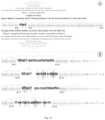
- E0 browsed its contextual text and found the phrase "what if" occurred several times in different sentences. For further investigation, he clicked on one of them. Then the focused sentence switched to the clicked sentence with its prosodic features ( Fig. 10 a). He noticed the blank space between "what if" and subsequence words, indicating a long pause. Keeping this pattern in mind, E0 wanted to check the usage of other occurrences of "what if" ( R4 ), so he queried this sentence.
- the screenshot of the querying results is shown in Fig. 10 b.
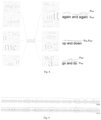
- the first pattern is related to the word “know”. Usually, words “ don't “ and “ didn't” occur before the word “know” when it is depreciated ( Fig. 11 , left-hand side). It means that speakers tend to depreciate the word “know” when expressing a negative notion.
- the second pattern is about the word “believe”. When “believe” is emphasized, it is usually followed by the word “that” ( Fig. 11 , right-hand side). It suggests that the word “believe” is usually emphasized when followed by a clause.
- the present invention relates to a system for analysis of a narration performance, and particularly, but not exclusively, an interactive visual analytics system for exploring and understanding narration strategies in large-scale speech data.
- the system displays prosodic features extracted from public speeches in multiple level-of-details. It features a novel scalable focus+context visual design to simultaneously present text and prosodic features. Through in-depth case studies with end users, the effectiveness and usefulness of the system with real world datasets is demonstrated.
- the invention provides one or more of:
- the apparatus described above may be implemented at least in part in software. Those skilled in the art will appreciate that the apparatus described above may be implemented at least in part using general purpose computer equipment or using bespoke equipment.
- aspects of the methods and apparatuses described herein can be executed on any apparatus comprising the communication system.
- Program aspects of the technology can be thought of as "products” or “articles of manufacture” typically in the form of executable code and/or associated data that is carried on or embodied in a type of machine readable medium.
- “Storage” type media include any or all of the memory of the mobile stations, computers, processors or the like, or associated modules thereof, such as various semiconductor memories, tape drives, disk drives, and the like, which may provide storage at any time for the software programming. All or portions of the software may at times be communicated through the Internet or various other telecommunications networks. Such communications, for example, may enable loading of the software from one computer or processor into another computer or processor.
- another type of media that may bear the software elements includes optical, electrical and electromagnetic waves, such as used across physical interfaces between local devices, through wired and optical landline networks and over various air-links.
- the physical elements that carry such waves, such as wired or wireless links, optical links or the like, also may be considered as media bearing the software.
- terms such as computer or machine "readable medium” refer to any medium that participates in providing instructions to a processor for execution.
Landscapes
- Engineering & Computer Science (AREA)
- Multimedia (AREA)
- Physics & Mathematics (AREA)
- Theoretical Computer Science (AREA)
- Computational Linguistics (AREA)
- Health & Medical Sciences (AREA)
- Audiology, Speech & Language Pathology (AREA)
- Human Computer Interaction (AREA)
- Acoustics & Sound (AREA)
- Databases & Information Systems (AREA)
- General Physics & Mathematics (AREA)
- General Engineering & Computer Science (AREA)
- Data Mining & Analysis (AREA)
- Library & Information Science (AREA)
- Signal Processing (AREA)
- Artificial Intelligence (AREA)
- General Health & Medical Sciences (AREA)
- Computer Vision & Pattern Recognition (AREA)
- Spectroscopy & Molecular Physics (AREA)
- Software Systems (AREA)
- Machine Translation (AREA)
- Testing, Inspecting, Measuring Of Stereoscopic Televisions And Televisions (AREA)
- Electrically Operated Instructional Devices (AREA)
Applications Claiming Priority (3)
| Application Number | Priority Date | Filing Date | Title |
|---|---|---|---|
| US201962808372P | 2019-02-21 | 2019-02-21 | |
| US16/707,073 US11282508B2 (en) | 2019-02-21 | 2019-12-09 | System and a method for speech analysis |
| EP20155262.7A EP3699777A3 (fr) | 2019-02-21 | 2020-02-04 | Système et procédé d'analyse de la parole |
Related Parent Applications (1)
| Application Number | Title | Priority Date | Filing Date |
|---|---|---|---|
| EP20155262.7A Division EP3699777A3 (fr) | 2019-02-21 | 2020-02-04 | Système et procédé d'analyse de la parole |
Publications (2)
| Publication Number | Publication Date |
|---|---|
| EP4270215A2 true EP4270215A2 (fr) | 2023-11-01 |
| EP4270215A3 EP4270215A3 (fr) | 2023-11-29 |
Family
ID=69468365
Family Applications (2)
| Application Number | Title | Priority Date | Filing Date |
|---|---|---|---|
| EP20155262.7A Ceased EP3699777A3 (fr) | 2019-02-21 | 2020-02-04 | Système et procédé d'analyse de la parole |
| EP23188583.1A Withdrawn EP4270215A3 (fr) | 2019-02-21 | 2020-02-04 | Système et procédé d'analyse de la parole |
Family Applications Before (1)
| Application Number | Title | Priority Date | Filing Date |
|---|---|---|---|
| EP20155262.7A Ceased EP3699777A3 (fr) | 2019-02-21 | 2020-02-04 | Système et procédé d'analyse de la parole |
Country Status (3)
| Country | Link |
|---|---|
| US (1) | US11282508B2 (fr) |
| EP (2) | EP3699777A3 (fr) |
| CN (1) | CN111739556B (fr) |
Families Citing this family (10)
| Publication number | Priority date | Publication date | Assignee | Title |
|---|---|---|---|---|
| US11335360B2 (en) * | 2019-09-21 | 2022-05-17 | Lenovo (Singapore) Pte. Ltd. | Techniques to enhance transcript of speech with indications of speaker emotion |
| TWI807428B (zh) * | 2020-09-23 | 2023-07-01 | 南韓商納寶股份有限公司 | 一同管理與語音檔有關的文本轉換記錄和備忘錄的方法、系統及電腦可讀記錄介質 |
| CN114386406B (zh) * | 2020-10-16 | 2024-04-09 | 腾讯科技(深圳)有限公司 | 一种文本处理方法、装置、计算机设备及存储介质 |
| CN112634902A (zh) * | 2020-12-11 | 2021-04-09 | 天津讯飞极智科技有限公司 | 语音转写方法、装置、录音笔和存储介质 |
| WO2022133125A1 (fr) * | 2020-12-16 | 2022-06-23 | Truleo, Inc. | Analyse d'audio de caméra-piéton |
| JP2022144261A (ja) * | 2021-03-18 | 2022-10-03 | 株式会社東芝 | 情報処理装置、情報処理方法、および情報処理プログラム |
| CN113658599A (zh) * | 2021-08-18 | 2021-11-16 | 平安普惠企业管理有限公司 | 基于语音识别的会议记录生成方法、装置、设备及介质 |
| CN115101052B (zh) * | 2022-06-23 | 2025-08-19 | 腾讯音乐娱乐科技(深圳)有限公司 | 音频识别方法及计算机设备 |
| CN115482833B (zh) * | 2022-09-13 | 2024-10-25 | 中国银行股份有限公司 | 语音可视化方法及装置 |
| CN115602195B (zh) * | 2022-12-12 | 2023-04-04 | 杭州兆华电子股份有限公司 | 一种汽车后视镜电机转动异响测试的方法 |
Citations (1)
| Publication number | Priority date | Publication date | Assignee | Title |
|---|---|---|---|---|
| US20130325464A1 (en) * | 2012-06-05 | 2013-12-05 | Quanta Computer Inc. | Method for displaying words and processing device and computer program product thereof |
Family Cites Families (11)
| Publication number | Priority date | Publication date | Assignee | Title |
|---|---|---|---|---|
| US6636238B1 (en) * | 1999-04-20 | 2003-10-21 | International Business Machines Corporation | System and method for linking an audio stream with accompanying text material |
| US7490092B2 (en) * | 2000-07-06 | 2009-02-10 | Streamsage, Inc. | Method and system for indexing and searching timed media information based upon relevance intervals |
| US7398274B2 (en) * | 2004-04-27 | 2008-07-08 | International Business Machines Corporation | Mention-synchronous entity tracking system and method for chaining mentions |
| US8966389B2 (en) * | 2006-09-22 | 2015-02-24 | Limelight Networks, Inc. | Visual interface for identifying positions of interest within a sequentially ordered information encoding |
| JP2009163643A (ja) * | 2008-01-09 | 2009-07-23 | Sony Corp | 映像検索装置、編集装置、映像検索方法およびプログラム |
| US8401849B2 (en) * | 2008-12-18 | 2013-03-19 | Lessac Technologies, Inc. | Methods employing phase state analysis for use in speech synthesis and recognition |
| US9514109B2 (en) * | 2012-01-12 | 2016-12-06 | Educational Testing Service | Computer-implemented systems and methods for scoring of spoken responses based on part of speech patterns |
| US9570065B2 (en) * | 2014-09-29 | 2017-02-14 | Nuance Communications, Inc. | Systems and methods for multi-style speech synthesis |
| US10445822B2 (en) * | 2016-03-24 | 2019-10-15 | Autodata Solutions, Inc. | System and method for generating and supplying viewer customized multimedia presentations |
| US10713432B2 (en) * | 2017-03-31 | 2020-07-14 | Adobe Inc. | Classifying and ranking changes between document versions |
| US20180315428A1 (en) * | 2017-04-27 | 2018-11-01 | 3Play Media, Inc. | Efficient transcription systems and methods |
-
2019
- 2019-12-09 US US16/707,073 patent/US11282508B2/en active Active
-
2020
- 2020-02-04 EP EP20155262.7A patent/EP3699777A3/fr not_active Ceased
- 2020-02-04 EP EP23188583.1A patent/EP4270215A3/fr not_active Withdrawn
- 2020-02-21 CN CN202010106462.7A patent/CN111739556B/zh active Active
Patent Citations (1)
| Publication number | Priority date | Publication date | Assignee | Title |
|---|---|---|---|---|
| US20130325464A1 (en) * | 2012-06-05 | 2013-12-05 | Quanta Computer Inc. | Method for displaying words and processing device and computer program product thereof |
Non-Patent Citations (4)
| Title |
|---|
| C. MANNINGM. SURDEANUJ. BAUERJ. FINKELS. BETHARDD. MCCLOSKY: "the stanford corenlp natural language processing tool", PROCEEDINGS OF THE 2014 ANNUAL MEETING OF THE ASSOCIATION FOR COMPUTATIONAL LINGUISTICS: SYSTEM DEMONSTRATIONS, 2014, pages 55 - 60, XP055678293, DOI: 10.3115/v1/P14-5010 |
| E. BRILLR. C. MOORE: "In Proceedings of the 2000 Annual Meeting on Association for Computational Linguistics", 2000, ASSOCIATION FOR COMPUTATIONAL LINGUISTICS, article "An improved error model for noisy channel spelling correction", pages: 286 - 293 |
| K. TOUTANOVAD. KLEINC. D. MANNINGY. SINGER: "Feature-rich part-of-speech tagging with a cyclic dependency network", IN PROCEEDINGS OF THE 2003 CONFERENCE OF THE NORTH AMERICAN CHAPTER OF THE ASSOCIATION FOR COMPUTATIONAL LINGUISTICS ON HUMAN LANGUAGE TECHNOLOGY, vol. 1, pages 173 - 180, XP058168341, DOI: 10.3115/1073445.1073478 |
| YUAN LINPING ET AL: "SpeechLens: A Visual Analytics Approach for Exploring Speech Strategies with Textural and Acoustic Features", 2019 IEEE INTERNATIONAL CONFERENCE ON BIG DATA AND SMART COMPUTING (BIGCOMP), IEEE, 27 February 2019 (2019-02-27), pages 1 - 8, XP033533411, DOI: 10.1109/BIGCOMP.2019.8679261 * |
Also Published As
| Publication number | Publication date |
|---|---|
| US20200273450A1 (en) | 2020-08-27 |
| CN111739556A (zh) | 2020-10-02 |
| EP4270215A3 (fr) | 2023-11-29 |
| EP3699777A3 (fr) | 2020-12-30 |
| CN111739556B (zh) | 2023-12-15 |
| US11282508B2 (en) | 2022-03-22 |
| EP3699777A2 (fr) | 2020-08-26 |
Similar Documents
| Publication | Publication Date | Title |
|---|---|---|
| US11282508B2 (en) | System and a method for speech analysis | |
| US20230223016A1 (en) | User interface linking analyzed segments of transcripts with extracted key points | |
| Cole et al. | New methods for prosodic transcription: Capturing variability as a source of information | |
| JP5664978B2 (ja) | 学習支援システム及び学習支援方法 | |
| Stevens | Principles for the design of auditory interfaces to present complex information to blind people | |
| CN101551947A (zh) | 辅助口语语言学习的计算机系统 | |
| MX2014002537A (es) | Sistemas y metodos para el aprendizaje de idiomas. | |
| Schmidt | EXMARaLDA and the FOLK tools–two toolsets for transcribing and annotating spoken language | |
| CN120123474A (zh) | 一种面向大学第二外语教学的aigc赋能辅助系统及实现方法 | |
| Riesberg et al. | Using Rapid Prosody Transcription to probe little-known prosodic systems: The case of Papuan Malay | |
| Szekrényes | Annotation and interpretation of prosodic data in the hucomtech corpus for multimodal user interfaces | |
| Vetchinnikova et al. | Chunking up speech in real time: Linguistic predictors and cognitive constraints | |
| Gibbon | Prosody: The rhythms and melodies of speech | |
| CN120048243A (zh) | 基于多模态融合的语音生成方法、装置、设备及介质 | |
| Yuan et al. | Speechlens: A visual analytics approach for exploring speech strategies with textural and acoustic features | |
| Liu et al. | Storytts: A highly expressive text-to-speech dataset with rich textual expressiveness annotations | |
| Brognaux et al. | A new prosody annotation protocol for live sports commentaries. | |
| Guillén Galve et al. | New research genres and English prosody: an exploratory analysis of academic English intonation in Video Methods Articles in experimental biology | |
| Chun | Technological advances in researching and teaching phonology | |
| KR20140078810A (ko) | 언어 데이터 및 원어민의 발음 데이터를 이용한 리듬 패턴 학습장치 및 방법 | |
| Akhtar et al. | UrduSER: A comprehensive dataset for speech emotion recognition in Urdu language | |
| Macías López | Computational analysis of the prosodic characteristics of the poets’ voice | |
| KR20140087955A (ko) | 이미지 데이터 및 원어민의 발음 데이터를 이용한 영어 전치사 학습장치 및 방법 | |
| Ekpenyong et al. | A Template-Based Approach to Intelligent Multilingual Corpora Transcription | |
| EP4557278A1 (fr) | Procédé d'aide à la production d'un document électronique |
Legal Events
| Date | Code | Title | Description |
|---|---|---|---|
| PUAI | Public reference made under article 153(3) epc to a published international application that has entered the european phase |
Free format text: ORIGINAL CODE: 0009012 |
|
| STAA | Information on the status of an ep patent application or granted ep patent |
Free format text: STATUS: REQUEST FOR EXAMINATION WAS MADE |
|
| REG | Reference to a national code |
Ref country code: DE Ref legal event code: R079 Free format text: PREVIOUS MAIN CLASS: G06F0016610000 Ipc: G06F0016683000 |
|
| PUAL | Search report despatched |
Free format text: ORIGINAL CODE: 0009013 |
|
| 17P | Request for examination filed |
Effective date: 20230731 |
|
| AC | Divisional application: reference to earlier application |
Ref document number: 3699777 Country of ref document: EP Kind code of ref document: P |
|
| AK | Designated contracting states |
Kind code of ref document: A2 Designated state(s): AL AT BE BG CH CY CZ DE DK EE ES FI FR GB GR HR HU IE IS IT LI LT LU LV MC MK MT NL NO PL PT RO RS SE SI SK SM TR |
|
| AK | Designated contracting states |
Kind code of ref document: A3 Designated state(s): AL AT BE BG CH CY CZ DE DK EE ES FI FR GB GR HR HU IE IS IT LI LT LU LV MC MK MT NL NO PL PT RO RS SE SI SK SM TR |
|
| RIC1 | Information provided on ipc code assigned before grant |
Ipc: G10L 15/26 20060101ALN20231023BHEP Ipc: G10L 21/10 20130101ALN20231023BHEP Ipc: G10L 25/90 20130101ALN20231023BHEP Ipc: G06F 16/61 20190101ALI20231023BHEP Ipc: G06F 16/783 20190101ALI20231023BHEP Ipc: G06F 16/903 20190101ALI20231023BHEP Ipc: G10L 25/03 20130101ALI20231023BHEP Ipc: G06F 40/289 20200101ALI20231023BHEP Ipc: G06F 16/34 20190101ALI20231023BHEP Ipc: G06F 16/683 20190101AFI20231023BHEP |
|
| STAA | Information on the status of an ep patent application or granted ep patent |
Free format text: STATUS: EXAMINATION IS IN PROGRESS |
|
| 17Q | First examination report despatched |
Effective date: 20250131 |
|
| STAA | Information on the status of an ep patent application or granted ep patent |
Free format text: STATUS: THE APPLICATION IS DEEMED TO BE WITHDRAWN |
|
| 18D | Application deemed to be withdrawn |
Effective date: 20250603 |