EP4270232A1 - Modelltrainingsverfahren und -vorrichtung, identitätsanonymisierungsverfahren und -vorrichtung, vorrichtung, speichermedium und programmprodukt - Google Patents
Modelltrainingsverfahren und -vorrichtung, identitätsanonymisierungsverfahren und -vorrichtung, vorrichtung, speichermedium und programmprodukt Download PDFInfo
- Publication number
- EP4270232A1 EP4270232A1 EP22773378.9A EP22773378A EP4270232A1 EP 4270232 A1 EP4270232 A1 EP 4270232A1 EP 22773378 A EP22773378 A EP 22773378A EP 4270232 A1 EP4270232 A1 EP 4270232A1
- Authority
- EP
- European Patent Office
- Prior art keywords
- identity
- vectors
- loss
- image
- network model
- Prior art date
- Legal status (The legal status is an assumption and is not a legal conclusion. Google has not performed a legal analysis and makes no representation as to the accuracy of the status listed.)
- Pending
Links
Images




Classifications
-
- G—PHYSICS
- G06—COMPUTING OR CALCULATING; COUNTING
- G06V—IMAGE OR VIDEO RECOGNITION OR UNDERSTANDING
- G06V10/00—Arrangements for image or video recognition or understanding
- G06V10/70—Arrangements for image or video recognition or understanding using pattern recognition or machine learning
- G06V10/77—Processing image or video features in feature spaces; using data integration or data reduction, e.g. principal component analysis [PCA] or independent component analysis [ICA] or self-organising maps [SOM]; Blind source separation
- G06V10/776—Validation; Performance evaluation
-
- G—PHYSICS
- G06—COMPUTING OR CALCULATING; COUNTING
- G06N—COMPUTING ARRANGEMENTS BASED ON SPECIFIC COMPUTATIONAL MODELS
- G06N3/00—Computing arrangements based on biological models
- G06N3/02—Neural networks
- G06N3/08—Learning methods
-
- G—PHYSICS
- G06—COMPUTING OR CALCULATING; COUNTING
- G06F—ELECTRIC DIGITAL DATA PROCESSING
- G06F21/00—Security arrangements for protecting computers, components thereof, programs or data against unauthorised activity
- G06F21/60—Protecting data
- G06F21/62—Protecting access to data via a platform, e.g. using keys or access control rules
- G06F21/6218—Protecting access to data via a platform, e.g. using keys or access control rules to a system of files or objects, e.g. local or distributed file system or database
- G06F21/6245—Protecting personal data, e.g. for financial or medical purposes
- G06F21/6254—Protecting personal data, e.g. for financial or medical purposes by anonymising data, e.g. decorrelating personal data from the owner's identification
-
- G—PHYSICS
- G06—COMPUTING OR CALCULATING; COUNTING
- G06N—COMPUTING ARRANGEMENTS BASED ON SPECIFIC COMPUTATIONAL MODELS
- G06N3/00—Computing arrangements based on biological models
- G06N3/02—Neural networks
- G06N3/04—Architecture, e.g. interconnection topology
- G06N3/045—Combinations of networks
-
- G—PHYSICS
- G06—COMPUTING OR CALCULATING; COUNTING
- G06N—COMPUTING ARRANGEMENTS BASED ON SPECIFIC COMPUTATIONAL MODELS
- G06N3/00—Computing arrangements based on biological models
- G06N3/02—Neural networks
- G06N3/04—Architecture, e.g. interconnection topology
- G06N3/045—Combinations of networks
- G06N3/0455—Auto-encoder networks; Encoder-decoder networks
-
- G—PHYSICS
- G06—COMPUTING OR CALCULATING; COUNTING
- G06N—COMPUTING ARRANGEMENTS BASED ON SPECIFIC COMPUTATIONAL MODELS
- G06N3/00—Computing arrangements based on biological models
- G06N3/02—Neural networks
- G06N3/04—Architecture, e.g. interconnection topology
- G06N3/0475—Generative networks
-
- G—PHYSICS
- G06—COMPUTING OR CALCULATING; COUNTING
- G06T—IMAGE DATA PROCESSING OR GENERATION, IN GENERAL
- G06T12/00—Tomographic reconstruction from projections
-
- G—PHYSICS
- G06—COMPUTING OR CALCULATING; COUNTING
- G06T—IMAGE DATA PROCESSING OR GENERATION, IN GENERAL
- G06T3/00—Geometric image transformations in the plane of the image
- G06T3/04—Context-preserving transformations, e.g. by using an importance map
-
- G—PHYSICS
- G06—COMPUTING OR CALCULATING; COUNTING
- G06T—IMAGE DATA PROCESSING OR GENERATION, IN GENERAL
- G06T3/00—Geometric image transformations in the plane of the image
- G06T3/40—Scaling of whole images or parts thereof, e.g. expanding or contracting
-
- G—PHYSICS
- G06—COMPUTING OR CALCULATING; COUNTING
- G06T—IMAGE DATA PROCESSING OR GENERATION, IN GENERAL
- G06T3/00—Geometric image transformations in the plane of the image
- G06T3/40—Scaling of whole images or parts thereof, e.g. expanding or contracting
- G06T3/4038—Image mosaicing, e.g. composing plane images from plane sub-images
-
- G—PHYSICS
- G06—COMPUTING OR CALCULATING; COUNTING
- G06V—IMAGE OR VIDEO RECOGNITION OR UNDERSTANDING
- G06V10/00—Arrangements for image or video recognition or understanding
- G06V10/70—Arrangements for image or video recognition or understanding using pattern recognition or machine learning
- G06V10/77—Processing image or video features in feature spaces; using data integration or data reduction, e.g. principal component analysis [PCA] or independent component analysis [ICA] or self-organising maps [SOM]; Blind source separation
- G06V10/7715—Feature extraction, e.g. by transforming the feature space, e.g. multi-dimensional scaling [MDS]; Mappings, e.g. subspace methods
-
- G—PHYSICS
- G06—COMPUTING OR CALCULATING; COUNTING
- G06V—IMAGE OR VIDEO RECOGNITION OR UNDERSTANDING
- G06V10/00—Arrangements for image or video recognition or understanding
- G06V10/70—Arrangements for image or video recognition or understanding using pattern recognition or machine learning
- G06V10/77—Processing image or video features in feature spaces; using data integration or data reduction, e.g. principal component analysis [PCA] or independent component analysis [ICA] or self-organising maps [SOM]; Blind source separation
- G06V10/774—Generating sets of training patterns; Bootstrap methods, e.g. bagging or boosting
-
- G—PHYSICS
- G06—COMPUTING OR CALCULATING; COUNTING
- G06T—IMAGE DATA PROCESSING OR GENERATION, IN GENERAL
- G06T2207/00—Indexing scheme for image analysis or image enhancement
- G06T2207/20—Special algorithmic details
- G06T2207/20212—Image combination
- G06T2207/20221—Image fusion; Image merging
Definitions
- This application relates to the field of image processing technologies, and in particular, to a model training method and apparatus, an identity anonymization method and apparatus, a device, a storage medium, and a program product.
- Identity anonymization is also referred to as de-identification, and is to remove a recognizable identity feature in an image or a video, but meanwhile keep other identity-free attributes unchanged, and ensure that an anonymized picture or video is still visually real.
- a conditional generative adversarial network (GAN) is used for generating an anonymized picture, and a posture key point of an original picture is extracted, and the posture key point of the original picture and a background picture with a face area removed are inputted to a model as conditions, to generate a new virtual identity to fill the vacant face area.
- GAN conditional generative adversarial network
- the background picture with the face area removed is used as model input, and therefore a picture generated by the model has poor quality.
- Embodiments of this application provide a model training method and apparatus, an identity anonymization method and apparatus, a computing device, a computer-readable storage medium, and a computer program product, to improve quality of a generated identity-anonymized image.
- An embodiment of this application provides a model training method, including:
- An embodiment of this application further provides an identity anonymization method, including:
- An embodiment of this application further provides a model training apparatus, including:
- An embodiment of this application further provides an identity anonymization apparatus, including:
- An embodiment of this application further provides a computing device, including a processor and a memory.
- the memory is configured to store a computer program.
- the processor is configured to invoke and run the computer program stored in the memory to perform the model training method or the identity anonymization method provided in the embodiments of this application.
- An embodiment of this application further provides a chip, configured to implement the model training method or the identity anonymization method provided in the embodiments of this application.
- the chip includes: a processor, configured to call and run a computer program from the memory, so that the device with the chip installed executes the foregoing model training method or identity anonymization method provided in the embodiments of this application.
- An embodiment of this application further provides a computer-readable storage medium.
- the computer-readable storage medium is configured to store a computer program, the computer program, when executed, implementing the model training method or identity anonymization method provided in the embodiments of this application.
- An embodiment of this application further provides a computer program product, including computer program instructions, when the computer program instructions are executed by a computer, the model training method or identity anonymization method in any one of the foregoing embodiments is implemented.
- An embodiment of this application further provides a computer program, when run on a computer, performing the model training method or identity anonymization method according to the foregoing embodiments.
- the first training image is projected to the target space to obtain the N first virtual identity vectors, so that the target network model can fully learn identity information in the image; attribute vector extraction is performed on the second training image to obtain the M attribute vectors, so that the target network model fully learns attribute information in the image; and image generation is performed based on the N first virtual identity vectors and the M attribute vectors to obtain the identity-anonymized image of the second training image.
- a trained model can generate an image carrying virtual identity information while ensuring that attribute information of an original image remains unchanged;
- sampling is performed on the target space of the projection module to obtain the N virtual identity vectors, so that virtual identity information is generated; attribute vector extraction is performed on the to-be-processed image to obtain the M attribute vectors, to ensure that an attribute feature in the to-be-processed image is not lost, and therefore ensure quality of the generated identity-anonymized image; and image generation is performed based on the N virtual identity vectors and the M attribute vectors to obtain the identity-anonymized image of the to-be-processed image, so that an identity-anonymized image carrying virtual identity information, that is, with a real identity hidden, is generated while ensuring that attribute information of the to-be-processed image remains unchanged. That is, in the embodiments of this application, during identity anonymization, an independent virtual identity is generated by using the target network model, without removing a face area in an image, thereby improving fidelity and a resolution of identity anonymization.
- B corresponding to A indicates that B is associated with A.
- B may be determined based on A.
- determining B according to A does not mean that determining B only according to A, and B may be determined according to A and/or other information.
- a plurality of means two or more than two.
- AI Artificial intelligence
- AI is a theory, method, technology, and application system that uses a digital computer or a machine controlled by the digital computer to simulate, extend, and expand human intelligence, perceive an environment, obtain knowledge, and use knowledge to obtain an optimal result.
- AI is a comprehensive technology in computer science. This technology attempts to understand the essence of intelligence and produce a new intelligent machine that can react in a manner similar to human intelligence.
- AI is to study the design principles and implementation methods of various intelligent machines, so that the machines can perceive, infer, and make decisions.
- the AI technology is a comprehensive subject, relating to a wide range of fields, and involving both hardware and software techniques.
- Basic AI technologies generally include technologies such as sensors, dedicated AI chips, cloud computing, distributed storage, big data processing technologies, operating/interaction systems, and mechatronics.
- An AI software technology mainly includes fields such as a CV technology, a speech processing technology, a natural language processing technology, and machine learning/deep learning (DL).
- ML is a multi-field interdiscipline, and relates to a plurality of disciplines such as the probability theory, statistics, the approximation theory, convex analysis, and the algorithm complexity theory. ML specializes in studying how a computer simulates or implements a human learning behavior to acquire new knowledge or skills, and reorganize an existing knowledge structure, so as to keep improving its performance.
- the ML is the core of the AI, is a basic way to make the computer intelligent, and is applied to various fields of AI.
- the ML and DL generally include technologies such as an artificial neural network, a belief network, reinforcement learning, transfer learning, inductive learning, and learning from demonstrations.
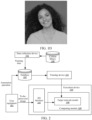
- FIG. 1A shows a real image
- FIG. 1B to FIG. 1D show an identity-anonymized image of FIG. 1A .
- FIG. 1A and FIG. 1B to FIG. 1D it can be learned that, in FIG. 1B to FIG. 1D , a recognizable identity feature in FIG. 1A is removed, while other identity-free attributes are kept unchanged, and it is ensured that the image is still visually real.
- Scenario 1 The embodiments of this application may be applied to a privacy protection scenario.
- the method in the embodiments of this application may be used for replacing a real identity with a virtual identity, so that subsequent tasks such as detection can be further performed without privacy leakage.
- a user may also use the method in the embodiments of this application to an identity feature of the user, to avoid leakage of real information.
- Scenario 2 The embodiments of this application may be applied to a scenario of generating a virtual image.
- the technical solutions in the embodiments of this application may be used for generating a virtual identity, for example, a fixed latent identity variable, and replacing a background picture, to generate pictures or videos of a specific virtual image in different scenarios.
- the scenario 1 and the scenario 2 are described by using an example in which a target is a face.
- the method in the embodiments of this application may be alternatively applied to a scenario of performing identity anonymization on another non-face target, for example, performing identity anonymization on any target such as an animal or a vehicle in a to-be-processed image.
- the method in the embodiments of the application may be applied to an intelligent transport system.
- An intelligent transport system Intelligent Transport System, ITS
- Intelligent Transportation System Intelligent Transportation System
- advanced technologies an information technology, a computer technology, a data communications technology, a sensor technology, an electronic control technology, an automatic control technology, an artificial intelligence technology, and the like
- transportation, service control, and vehicle manufacturing comprehensively and effectively, so as to strengthen a connection between a vehicle, a road, and a user, thereby forming an integrated transportation system for safety assurance, efficiency improvement, environmental enhancement, and energy saving.
- a solution combined with intelligent traffic in this application may be as follows: An in-vehicle device collects a face image of a user, performs identity anonymization on the collected face image by using the method in the embodiments of this application, and then transmits an identity-anonymized image to another device for performing task analysis or the like, for example, performing illegal driving analysis or intelligent driving analysis.
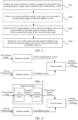
- FIG. 2 is a schematic diagram of a system architecture according to an embodiment of this application.
- the system architecture includes user equipment 101, a data collection device 102, a training device 103, an execution device 104, a database 105, a content library 106, an I/O interface 107, and a target network model 108.
- the data collection device 102 is configured to read training data from the content library 106, and store the read training data to the database 105.
- the training data involved in this embodiment of this application includes a first training image, a second training image, and a third training image, and the first training image, the second training image, and the third training image are all used for training the target network model.
- the user equipment 101 is configured to perform an annotation operation on data in the database 105.
- the training device 103 trains the target network model 108 based on the training data maintained in the database 105, so that a trained target network model 108 can generate an identity-anonymized image of a to-be-processed image.
- the target network model 108 obtained by the training device 103 may be applied to different systems or devices.
- the execution device 104 is equipped with an I/O interface 107, for exchanging data with an external device, for example, receiving, by using the I/O interface, a to-be-processed image transmitted by the user equipment 101.
- a computing module 109 in the execution device 104 processes the inputted to-be-processed image by using the trained target network model 108 to output an identity-anonymized image, and outputs the generated identity-anonymized image to the user equipment 101 for display, or inputs the generated identity-anonymized image to another task model for performing other task processing.
- the user equipment 101 may include a mobile phone, a tablet computer, a notebook computer, a palmtop computer, a mobile Internet device (MID), or another terminal device with a function of installing a browser.
- a mobile phone a tablet computer, a notebook computer, a palmtop computer, a mobile Internet device (MID), or another terminal device with a function of installing a browser.
- MID mobile Internet device
- the execution device 104 may be a server. There may be one or more servers. When there are a plurality of servers, there may be at least one of the following cases: At least two servers are configured to provide different services; or at least two servers are configured to provide the same service, for example, provide the same service in a load balancing manner. This is not limited in this embodiment of this application.
- the server may be an independent physical server, or may be a server cluster or a distributed system formed by a plurality of physical servers, or may be a cloud server that provides basic cloud computing services such as a cloud service, a cloud database, cloud computing, a cloud function, cloud storage, a network service, cloud communication, a middleware service, a domain name service, a security service, a content delivery network (CDN), big data, and an AI platform.
- the server may become a node of a blockchain.
- the execution device 104 is connected to the user equipment 101 through a network.
- the network may be a wireless or wired network, for example, an intranet, the Internet, a Global System for Mobile Communications (GSM) network, a wideband code division multiple access (WCDMA) network, a 4G network, a 5G network, a Bluetooth network, a Wi-Fi network, or a call network.
- GSM Global System for Mobile Communications
- WCDMA wideband code division multiple access
- FIG. 2 is only a schematic diagram of a system architecture according to an embodiment of this application, and a position relationship between the devices, the components, the modules, and the like shown in the figure does not constitute any limitation.
- the data collection device 102, the user equipment 101, the training device 103, and the execution device 104 may be the same device.
- the database 105 may be distributed on one or more servers, and the content library 106 may be distributed on one or more servers.
- This application provides a target network model, and the target network model is used for performing identity anonymization on a target (for example, a face) in a to-be-processed image to generate an identity-anonymized image of the to-be-processed image. Therefore, in some embodiments, the target network model may be referred to as an identity anonymization model or an identity anonymizer.
- FIG. 3 is a schematic flowchart of a model training method according to an embodiment of this application.
- the method is performed by an apparatus with a model training function, for example, a model training apparatus, and the model training apparatus may be a computing device, or a part of a computing device.
- the method of this embodiment of this application includes:
- the computing device projects, by using a projection module in a target network model, a first training image to a target space to obtain N first virtual identity vectors, N being a positive integer.
- the first training image is a training image in training data.
- the first training image is obtained with permission by a user, and collection, use, and processing of related image data need to comply with related laws, regulations, and standards of related countries and regions.
- processes of training models by using first training images are basically similar.
- one first training image is used as an example for description.
- the first training image is projected to the target space by using the target network model to obtain one or more virtual identity vectors of the first training image, so that the target network model learns identity information of the first training image.
- the target network model After the target network model fully learns the identity information, during actual identity anonymization, the target space of the target network model may be directly sampled to generate a virtual identity vector.
- This embodiment of this application mainly relates to the following concepts: an attribute vector and a virtual identity vector.
- the virtual identity vector is a vector corresponding to virtual identity information, and the virtual identity information is identity information with a recognizable identity feature hidden, for example, face information with a recognizable identity feature of a face hidden.
- the attribute vector is a vector corresponding to attribute information, and feature information other than a recognizable identity feature in an image is referred to as attribute information, for example, background information.
- the target network model may generate an independent virtual identity vector.
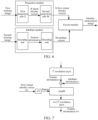
- FIG. 4 is a schematic structural diagram of a target network model according to an embodiment of this application.
- the target network model in this embodiment of this application includes a projection module, an attribute module, and a fusion module.
- the projection module is configured to project a first training image to a target space to obtain N first virtual identity vectors of the first training image.
- N is a positive integer.
- a value of N is not limited in this embodiment of this application, and may be set according to an actual requirement.
- the attribute unit is configured to perform attribute vector extraction on a second training image to obtain M attribute vectors of the second training image.
- M is a positive integer.
- a value of M is not limited in this embodiment of this application, and may be set according to an actual requirement. In some embodiments, M is equal to N.
- the fusion module is configured to perform image generation based on the N first virtual identity vectors and the M attribute vectors to obtain an identity-anonymized image of the second training image.
- N is a positive integer greater than 1
- the N first virtual identity vectors respectively correspond to different resolutions.
- the projection module is configured to generate a virtual identity vector of a target in the second training image, a real identity feature of the target in the second training image being hidden in the virtual identity vector; and the attribute module is configured to extract an attribute vector of the second training image, features other than the real identity feature of the target in the second training image being retained in the attribute vector.
- the fusion module performs image generation based on the virtual identity vector and the attribute vector, an anonymized image in which an identity of the target in the second training image is hidden, namely, an identity-anonymized image, can be obtained.
- the projection module includes a first projection unit and a second projection unit
- the target space includes a first space Z and a second space W.
- the computing device may implement, in the following manner by using the projection module in the target network model, the projecting a first training image to a target space to obtain N first virtual identity vectors:
- the priori identity information of the first training image is extracted, for example, the priori identity information of the first training image is extracted by using a pre-trained recognition model; then the priori identity information of the first training image is projected, by using the first projection unit, to the first space Z to obtain the N latent identity vectors; and then the N latent identity vectors is projected, by using the second projection unit, to the second space W to obtain the N first virtual identity vectors.
- the first space Z and the second space W may be different latent spaces.
- the first space Z and the second space W are not limited in this embodiment of this application.
- the first space is a latent space Z
- the latent space Z conforms to a standard Gaussian distribution.
- the first projection unit may project, in the following manner, the priori identity information to the first space Z to obtain the N latent identity vectors: projecting, by using the first projection unit, the priori identity information as a mean and a variance of the first space; and performing sampling based on the mean and the variance of the first space to obtain the N latent identity vectors.
- the first projection unit is a variational autoencoder (VAE), for example, a conditional variational autoencoder (CVAE).
- VAE variational autoencoder
- CVAE conditional variational autoencoder
- the conditional variational autoencoder is a generative network, and learns a data distribution by using an encoder to obtain a latent variable, and then restores the latent variable to an original form of data by using a decoder.
- the conditional variational autoencoder may learn a data distribution and then perform sampling to generate new data, and is usually used for image generation.
- the priori identity information of the first training image may be inputted to the VAE, and the VAE projects the priori identity information as a mean and a variance of the first space. Then sampling is performed based on the mean and the variance of the first space to obtain the N latent identity vectors of the first training image.
- the first space is the latent space Z conforming to a standard Gaussian distribution. Therefore, to enhance an expression ability of the latent space, in this embodiment of this application, different latent vectors are generated at different resolution layers, for example, the N latent identity vectors are generated. This is equivalent to constructing a Z + space including a plurality of latent identity vectors.
- the second space W is obtained based on the latent space Z, for example, obtained by performing linear or nonlinear mapping on the latent space Z.
- a network structure of the second projection unit is not limited in this embodiment of this application.
- a mapping network is used, and the mapping network includes a plurality of fully connected layers.
- the priori identity information of the first training image is projected to a latent space (namely, the target space) of the projection module, so that the projection module fully learns identity information of the first training image, for subsequently generating a virtual identity vector that meets an actual requirement.
- S302 Perform, by using an attribute module in the target network model, attribute vector extraction on a second training image to obtain M attribute vectors, M being a positive integer.
- the second training image is any image in a training data set, and the second training image and the first training image may be the same image or different images.
- the attribute module is configured to learn attribute information of the second training image to generate the M attribute vectors.
- a network model of the attribute module is not limited in this embodiment of this application.
- the attribute module includes an encoding unit and a decoding unit.
- attribute vector extraction may be performed on the second training image in the following manner by using the attribute module in target network model, to obtain the M attribute vectors: inputting the second training image to the encoding unit to obtain feature information of the second training image; and inputting the feature information to the decoding unit to obtain the M attribute vectors.
- the encoding unit includes a plurality of feature extraction layers
- the decoding unit also includes a plurality of feature extraction units
- a skip connection is implemented between at least one feature extraction layer in the encoding unit and at least one feature extraction layer in the decoding unit.
- S303 Perform, by using a fusion module in the target network model, image generation based on the N first virtual identity vectors and the M attribute vectors to obtain an identity-anonymized image of the second training image.
- Example 1 The N first virtual identity vectors are spliced to obtain a spliced first virtual identity vector, the M attribute vectors are spliced to obtain a spliced attribute vector, and the spliced first virtual identity vector and the spliced attribute vector are used for performing image generation and then inputted to the fusion module to generate the identity-anonymized image.
- the spliced first virtual identity vector and the spliced attribute vector are concatenated and then inputted to the fusion module to generate the identity-anonymized image.
- the spliced first virtual identity vector and the spliced attribute vector are added up and then inputted to the fusion module to generate the identity-anonymized image.
- the fusion module includes a plurality of different resolution layers.
- the fusion module may perform image generation in the following manner based on the N first virtual identity vectors and the M attribute vectors to obtain the identity-anonymized image of the second training image: according to resolutions corresponding to the N first virtual identity vectors, inputting the N first virtual identity vectors to a corresponding resolution layer as patterns, and inputting the M attribute vectors to a corresponding resolution layer as noises, to obtain the identity-anonymized image of the second training image.
- N is 3
- M is 4, and the fusion module includes four different resolution layers.
- the three first virtual identity vectors are denoted as a first virtual identity vector 1, a first virtual identity vector 2, and a first virtual identity vector 3.
- the four attribute vectors are denoted as an attribute vector 1, an attribute vector 2, an attribute vector 3, and an attribute vector 4.
- the four resolution layers are denoted as a resolution layer 1, a resolution layer 2, a resolution layer 3, and a resolution layer 4 in sequence according to magnitudes of resolutions.
- the first virtual identity vector 1 corresponds to the resolution layer 1 and the resolution layer 2 with a lower resolution
- the first virtual identity vector 2 corresponds to the resolution layer 3 with a medium resolution
- the virtual identity vector 3 corresponds to the resolution layer 4 with the highest resolution.
- the four attribute vectors correspond to the four resolution layers in sequence according to magnitudes of resolutions.
- the first virtual identity vector 1 is inputted to the resolution layer 1 to obtain feature information 1; the attribute vector 1 and the feature information 1 are combined and then inputted to the resolution layer 2 along with the first virtual identity vector 1 to obtain feature information 2; the attribute vector 2 and the feature information 2 are combined and then inputted to the resolution layer 3 along with the first virtual identity vector 3 to obtain feature information 3; the attribute vector 3 and the feature information 3 are combined and then inputted to the resolution layer 4 along with the first virtual identity vector 4 to obtain feature information 4; and finally, the feature information 4 and the attribute vector 4 undergo processing such as combination to generate the identity-anonymized image of the second training image.
- the fusion module is a style-based generator (StyleGAN2).
- StyleGAN2 style-based generator
- an AdaIN layer is included between two adjacent resolution layers of the fusion module. For example, affine transform (AT) is performed on a first virtual identity vector i+1; feature information i outputted by the i th resolution layer and an attribute vector i are combined and then inputted to the AdaIN layer along with a first virtual identity vector i+1 obtained through affine transform; an AdaIN operation is performed, and an AdaIN operation result is inputted to the (i+1) th resolution layer.
- affine transform AT
- feature information i outputted by the i th resolution layer and an attribute vector i are combined and then inputted to the AdaIN layer along with a first virtual identity vector i+1 obtained through affine transform
- an AdaIN operation is performed, and an AdaIN operation result is inputted to the (i+1) th resolution layer.
- the fusion module in this embodiment of this application may be alternatively an adversarial model, for example, a StyleGAN3 or a ProGAN.
- an adversarial model for example, a StyleGAN3 or a ProGAN.
- the identity-anonymized image of the second training image may be determined in different manners. This is not limited in this embodiment of this application.
- the model training process in this embodiment of this application is described by using an example in which the first projection unit is a VAE, the second projection unit is a mapping network, the attribute module is an autoencoder, and the fusion module is a StyleGAN2.
- priori identity information is generated based on a first training image Xs by using a pre-trained face recognition model. Then the priori identity information is inputted to the VAE, and the VAE projects the priori identity information to the first space Z to obtain N latent identity vectors, for example, obtain three N latent identity vectors, the three N latent identity vectors respectively corresponding to three different resolutions: low, medium, and high. Then the N latent identity vectors are inputted to the mapping network, and the mapping network projects the N latent identity vectors from the first space Z to the second space W to obtain N first virtual identity vectors.
- a second training image Xt is inputted to the autoencoder, and the autoencoder processes the second training image Xt to generate M attribute vectors.
- the M attribute vectors are inputted to layers of the StyleGAN2 as noises, and the N first virtual identity vectors are inputted to layers of the StyleGAN2 as patterns, to obtain an identity-anonymized image Ys,t, outputted by the StyleGAN2, of the second training image.
- the first training image and the second training image are inputted to the target network model to obtain the identity-anonymized image, outputted by the target network model, of the second training image. Then the following S304 is performed to train the target network model.
- S304 Determine a loss of the target network model according to the identity-anonymized image, and train the target network model according to the loss.
- the target network model outputs the identity-anonymized image of the second training image, and the loss of the target network model is determined according to the identity-anonymized image.
- the identity-anonymized image is inputted to a judgment model
- the judgment model is a pre-trained model capable of predicting an anonymization degree of the identity-anonymized image.
- the identity-anonymized image is inputted to the judgment model, and the judgment model performs identity recognition on the identity-anonymized image, and determines a recognition result as the loss of the target network model.
- recognition accuracy is high
- an anonymization effect of the current target network model is not desired.
- a parameter in the target network model is adjusted according to the loss of the target network model.
- a new first training image and a new second training image are selected for performing the foregoing steps S301 to S304, to continue to train the target network model until the target network model meets a training end condition.
- the training end condition includes at least a quantity of training times reaching a preset quantity of times, or an anonymization degree of the model reaching an expected effect.
- a KL divergence constraint L kl is applied to the N latent identity vectors in the first space Z to ensure that identity information is projected to a standard Gaussian distribution.
- the divergence constraint of the N latent identity vectors may be further determined.
- the determining a loss of the target network model according to the identity-anonymized image may include: determining the loss of the target network model according to the identity-anonymized image and the divergence constraint.
- the formula (1) is only an example, and a manner of determining the divergence constraint of the N latent identity vectors in this embodiment of this application includes but is not limited to the formula (1), and for example, may be another manner of calculating a divergence constraint, for example, by using a variant of the formula (1).
- the divergence constraint L kl is applied to the N latent identity vectors.
- the projection module fully learns identity information, and the first space of the projection module meets a standard Gaussian distribution. Therefore, during subsequent anonymization, the first space may be directly sampled to generate N latent identity vectors conforming to a standard Gaussian distribution, for generating a virtual identity vector.
- the second space is obtained by performing nonlinear mapping on the first space, and is a complex non-Gaussian distribution.
- identity information is mapped to the first space, it is found that a distribution of an intermediate latent space, namely, the second space W , is not uniform in this case, and real identity vectors gather to a plurality of different centers and do not overlap generated virtual identity vectors. Therefore, no reasonable face identity can be generated based on the virtual identity vectors.
- this embodiment of this application proposes use of a contrast loss to constrain a latent vector of the second space, namely, a W space (namely, the first virtual identity vector), so that latent vectors from the same identity gather and repel latent vectors from different identities, and all latent vectors are evenly distributed in the entire space.
- an identity loss may be further determined in the following manner:
- the third training image and first training image are two different images of a first target.
- the third training image and the first training image are two different face images of the same user.
- the projection reference module and the projection module have the same network structure, and are updated according to the projection module.
- the projection reference module is updated according to momentum of the projection module, that is, the projection reference module is updated slowly with an update of the projection module.
- P ⁇ '(t) is a projection reference module parameter obtained after the t th update
- P ⁇ '(t-1) is a projection reference module parameter obtained after the (t-1) th update
- P ⁇ (t) is a projection module parameter obtained after the t th update
- ⁇ is a small value, for example, 0.01.
- the projection reference module with a network structure completely the same as that of the projection module is set, to constrain the first virtual identity vector outputted by the projection module.
- the first training image is inputted to the projection module to obtain the N first virtual identity vectors of the first training image
- the third training image is inputted to the projection reference module to obtain the N second virtual identity vectors of the third training image.
- the first training image and the third training image are images of the same target, and the projection module and the projection reference module have the same network structure.
- the projection module in the target network model may be trained according to the N second virtual identity vectors and the N first virtual identity vectors corresponding to the first training image, so that the projection module can generate a virtual identity vector that meets a requirement.
- Manners of determining the identity loss according to the N first virtual identity vectors and the N second virtual identity vectors in step 1 include but are not limited to the following manners:
- Step 31 For the i th first virtual identity vector in the N first virtual identity vectors, update, by using the i th second virtual identity vector, a virtual identity vector corresponding to the first target in the i th dynamic list.
- the i th dynamic list includes virtual identity vectors of different targets at the i th resolution, and i is a positive integer ranging from 1 to N.
- each of the N second virtual identity vectors corresponds to a dynamic list.
- N is 3, and corresponds to a low resolution, a medium resolution, and a high resolution.
- a virtual identity vector corresponding to the first target in the first dynamic list is updated by using the 1 st second virtual identity vector.
- a virtual identity vector corresponding to the first target in the second dynamic list is updated by using the 2 nd second virtual identity vector.
- a virtual identity vector corresponding to the first target in the third dynamic list is updated by using the 3rd second virtual identity vector.
- Step 32 Determine, according to the i th first virtual identity vector and the updated i th dynamic list, an identity sub-loss corresponding to the i th first virtual identity vector.
- the first training image and the third training image are two different images of a first target j
- the first training image Xj is inputted to the projection module to obtain N first virtual identity vectors Wj
- the third training image Xj' is inputted to the projection reference module to obtain N second virtual identity vectors Wj'.
- the i th dynamic list Ki includes second virtual identity vectors of different targets at the i th resolution
- the i th dynamic list Ki is updated in real time.
- the i th second virtual identity vector is used for updating a virtual identity vector kj corresponding to the first target j in the i th dynamic list Ki, that is, kj is updated to Wj'. Then the identity sub-loss i corresponding to the i th first virtual identity vector is determined according to the i th second virtual identity vector and the updated i th dynamic list.
- a manner of determining the identity sub-loss corresponding to the i th first virtual identity vector is not limited in this embodiment of this application.
- the identity sub-loss corresponding to the i th first virtual identity vector is determined according to the i th first virtual identity vector and the updated i th dynamic list by using a loss method, for example, a center loss or a triplet loss.
- the determining an identity sub-loss corresponding to the i th first virtual identity vector in the N first virtual identity vectors may include the following steps:
- Step 321 Obtain a first ratio of the i th second virtual identity vector to a first preset value, multiply the first ratio by the i th first virtual identity vector to obtain a first result, and perform an exponential operation on the first result to obtain a first operation value.
- Step 322 Obtain a second ratio of each second virtual identity vector to the first preset value in the updated i th dynamic list, for each second ratio, multiply the second ratio by the corresponding i th first virtual identity vector to obtain a second result, and perform an exponential operation on the second result to obtain a second operation value corresponding to each second virtual identity vector.
- Step 323 Determine a sum of second operation values corresponding to all second virtual identity vectors, obtain a third ratio of the first operation value to the sum, and perform a logarithmic operation on the third ratio to obtain a third operation value.
- Step 324 Determine a negative number of the third operation value as the identity sub-loss corresponding to the i th first virtual identity vector.
- w j is an anchor point
- the j th item in Ki is a positive sample
- others are negative samples.
- An identity sub-loss L c is determined by using a contrast loss in an information noise contrastive noise (InfoNCE) form.
- InfoNCE is a loss function for modifying autoregression based on mutual information.
- K k ⁇ w j is the i th first virtual identity vector of the first target j
- K [ j ] is the i th second virtual identity vector of the first target j
- ⁇ is the first preset value
- K [ k ] is the i th second virtual identity vector corresponding to the k th target in the i th dynamic list
- w k is a first virtual identity vector corresponding to the k th target
- K is a total quantity of targets included in the i th dynamic list.
- Step 33 Determine, as the identity loss of the target network model, a sum of identity sub-losses respectively corresponding to the N first virtual identity vectors.
- the identity sub-loss corresponding to the i th first virtual identity vector is determined according to step 32, the sum of the identity sub-losses respectively corresponding to the N first virtual identity vectors is determined as the identity loss.
- N is 3.
- An identity sub-loss corresponding to each of the three first virtual identity vectors is determined according to the foregoing method, and then a sum of identity sub-losses corresponding to the three first virtual identity vectors is determined as the identity loss of the model.
- the determining the loss of the target network model according to the identity-anonymized image and the divergence constraint includes the following steps:
- a reconstruction loss between the identity-anonymized image and the second training image is determined, and the loss of the target network model is determined according to the reconstruction loss, the divergence constraint, and the identity loss.
- a difference between the identity-anonymized image and the second training image is determined as the reconstruction loss.
- a sum of differences between pixels of the identity-anonymized image and corresponding pixels of the second training image is determined as the reconstruction loss.
- 1 is a 1-norm operation.
- the loss of the target network model is determined according to the reconstruction loss, the divergence constraint, and the identity loss. For example, a weighted sum of the reconstruction loss, the divergence constraint, and the identity loss is determined as a final loss of the target network model.
- this embodiment of this application further includes determining an identity contrast loss of the identity-anonymized image, for example, including the following steps:
- Step A Determine a first distance between the identity-anonymized image and the first training image, a second distance between the identity-anonymized image and the second training image, and a third distance between the first training image and the second training image.
- Step B Determine a contrast loss according to the first distance, the second distance, and the third distance.
- the first distance, the second distance, and the third distance may be determined by using any distance method, for example, a cosine distance.
- Example 1 After the first distance, the second distance, and the third distance are determined according to step A, a sum of the first distance, the second distance, and the third distance is determined as the contrast loss.
- Example 2 A sum of the first distance and a square of a difference between the second distance and the third distance is determined, and a difference between a preset value and the sum is determined as the contrast loss.
- the contrast loss L ICL is determined according to the following formula (5):
- L ICL 1 ⁇ cos z id Y s , t , z id X s + cos z id Y s , t , z id X t ⁇ cos z id X s , z id X t 2
- z id indicates a 512-dimensional identity vector representation, of an image X, that is extracted from a pre-trained face recognition model
- cos( z id ( Y s,t ), z id ( X s )) is the first distance between the identity-anonymized image and the first training image
- cos( z id ( Y st ), z id ( X t )) is the second distance between the identity-anonymized image and the second training image
- the loss of the target network model is determined according to the reconstruction loss, the divergence constraint, the identity loss, and the contrast loss. For example, a weighted sum of the reconstruction loss, the divergence constraint, the identity loss, and the contrast loss is determined as the loss of the target network model.
- an adversarial loss of the model is further determined.
- the adversarial loss is determined according to the identity-anonymized image and the first training image.
- L GAN min G max D E log D X s + E log 1 ⁇ D Y s , t
- D is a discriminator
- G is a generator
- E(*) indicates an expected value of a distribution function
- D ( X s ) is a discrimination result of the discriminator on the first training image X s
- D ( Y s,t ) is a discrimination result of the discriminator on the identity-anonymized image Y s,t .
- the loss of the target network model may be determined according to the reconstruction loss, the divergence constraint, the identity loss, the contrast loss, and the adversarial loss. For example, a weighted sum of the reconstruction loss, the divergence constraint, the identity loss, the contrast loss, and the adversarial loss is determined as the loss of the target network model.
- Weight values corresponding to the reconstruction loss, the divergence constraint, the identity loss, the contrast loss, and the adversarial loss are not limited in this embodiment of this application, and may be determined according to an actual requirement.
- a weighting operation is performed on the reconstruction loss, the divergence constraint, the identity loss, the contrast loss, and the adversarial loss according to the following formula (7) to obtain the loss L total of the target network model:
- L total L GAN + 10 ⁇ L rec + 5 ⁇ L ICL + L c + 0.0001 ⁇ L kl
- a weight corresponding to each loss in the formula (7) is an example, and the weight corresponding to each loss in this embodiment of this application includes but is not limited to that shown in the formula (7), and may be determined as needed.
- a loss other than the losses described in the foregoing embodiment may be determined. This is not limited in this embodiment of this application, and may be determined according to an actual requirement.
- first virtual identity vectors corresponding to different resolutions are generated to implement identity anonymization.
- This can increase a resolution for anonymization. For example, an anonymization result at a resolution of 1024 2 may be generated.
- little picture artifact is produced, and fidelity is high.
- model training does not rely on a key regression model or a segmentation model, that is, a face area in an image is not removed, and a posture, details, and occlusion in an original picture are retained.
- the first training image is projected to the target space by using the projection module to obtain the N first virtual identity vectors, so that the target network model can fully learn identity information in the image; attribute vector extraction is performed on the second training image to obtain the M attribute vectors, so that the target network model fully learns attribute information in the image; and image generation is performed based on the N first virtual identity vectors and the M attribute vectors to obtain the identity-anonymized image of the second training image.
- a trained model can generate an image carrying virtual identity information while ensuring that attribute information of an original image remains unchanged; That is, this application provides a new target network model.
- the target network model can learn identity information in the first training image, so that the target network model can independently generate a virtual identity, and the target network model also fully learns attribute information in the second training image. In an entire learning process, a face area in the image does not need to be removed, and no real identity information is required for guidance either.
- the target network model is trained by using a specific supervised target in a face swapping task, thereby improving fidelity and a resolution of an identity-anonymized image generated by the target network model, so that the trained target network model can generate a high-quality identity-anonymized image.
- FIG. 11 is a schematic flowchart of an identity anonymization method according to an embodiment of this application.
- the identity anonymization method shown in FIG. 11 is to perform identity anonymization by using the foregoing trained target network model.
- the method includes: S401: Perform sampling on a target space of a projection module in the target network model to obtain N virtual identity vectors, N being a positive integer.
- the projection module is trained by using a first training image, so that the projection module fully learns identity information in the first training image.
- sampling may be performed on the target space of the projection module to obtain the N virtual identity vectors.
- Implementations of S401 include but are not limited to the following:
- the first projection unit in the projection module is no longer used, and only the second projection unit in the projection module is used for projection.
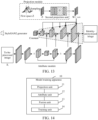
- sampling is performed on a first space Z conforming to a standard Gaussian distribution, to obtain N latent identity vectors, and then the N latent identity vectors are inputted to the second projection unit.
- the second projection unit projects the N latent identity vectors to the W space to obtain the N virtual identity vectors.
- N is 3, and the second projection unit is a mapping network.
- the projection module in this embodiment of this application is not limited to that shown in FIG. 12 .
- the first space is trained by using the first training image, so that a variance and a mean of the first space conform to a standard Gaussian distribution.
- sampling is first performed on the first space to generate the N latent identity vectors. For example, sampling is performed based on the mean and the variance of the first space to obtain the N latent identity vectors. Random sampling is performed on a variance of the first space, and then the variance is added to the mean of the first space to obtain a latent identity vector.
- the foregoing step may be repeatedly performed to obtain the N latent identity vectors. Then the N latent identity vectors are projected, by using the second projection unit, to the second space to obtain the N virtual identity vectors.
- the N virtual identity vectors respectively correspond to different resolutions.
- N 3
- the 1 st virtual identity vector corresponds to a low resolution
- the 2 nd virtual identity vector corresponds to a medium resolution
- the 3 rd virtual identity vector corresponds to a high resolution.
- S402 Perform, by using an attribute module in the target network model, attribute vector extraction on a to-be-processed image to obtain M attribute vectors, M being a positive integer.
- the attribute module is configured to extract attribute information in the to-be-processed image.
- the attribute module includes an encoding unit and a decoding unit.
- attribute vector extraction may be performed on the to-be-processed image in the following manner to obtain the M attribute vectors:
- the encoding unit may include a plurality of feature extraction layers, and likewise, the decoding unit may also include a plurality of feature extraction layers.
- the feature extraction layer may include a convolutional layer or the like.
- a skip connection is implemented between at least one feature extraction layer in the encoding unit and at least one feature extraction layer in the decoding unit.
- the generated M attribute vectors may correspond to different resolutions.
- the target network model is an autoencoder.
- S403 Perform, by using a fusion module in the target network model, image generation based on the N virtual identity vectors and the M attribute vectors to obtain an identity-anonymized image of the to-be-processed image.
- the generated N virtual identity vectors and M attribute vectors are inputted to the fusion module to obtain the identity-anonymized image of the to-be-processed image.
- Implementations of S403 include but are not limited to the following examples:
- Example 1 The N virtual identity vectors are spliced, the M attribute vectors are spliced, and a spliced virtual identity vector and a spliced attribute vector are combined and then inputted to the fusion module.
- the spliced virtual identity vector and the spliced attribute vector are concatenated and then inputted to the fusion module.
- the spliced virtual identity vector and the spliced attribute vector are added up and then inputted to the fusion module.
- the fusion module includes a plurality of different resolution layers.
- the N virtual identity vectors may be inputted to a corresponding resolution layer as patterns
- the M attribute vectors may be inputted to a corresponding resolution layer as noises, to obtain the identity-anonymized image of the to-be-processed image.
- the fusion module is a StyleGAN2.
- an AdaIN layer is included between two adjacent resolution layers of the fusion module. For example, affine transform is performed on a first virtual identity vector i+1; feature information outputted by the i th resolution layer and an attribute vector i are combined and then inputted to the AdaIN layer along with a virtual identity vector i+1 obtained through affine transform; an AdaIN operation is performed, and an AdaIN operation result is inputted to the (i+1) th resolution layer.
- the fusion module in this embodiment of this application may be alternatively an adversarial model, for example, a StyleGAN3 or a ProGAN.
- the identity anonymization process in this embodiment of this application is described by using an example in which the second projection unit is a mapping network, the attribute module is an autoencoder, and the fusion module is a StyleGAN2.
- sampling is performed on the first space Z of the projection module to obtain N latent identity vectors, for example, obtain three N latent identity vectors, the three N latent identity vectors respectively corresponding to three different resolutions: low, module, and high.
- the N latent identity vectors are inputted to the mapping network, and the mapping network projects the N latent identity vectors from the first space Z to the second space W to obtain N virtual identity vectors.
- a to-be-processed image Xt is inputted to the autoencoder, and the autoencoder processes the to-be-processed image Xt to generate M attribute vectors.
- the M attribute vectors are inputted to layers of the StyleGAN2 as noises, and the N virtual identity vectors are inputted to layers of the StyleGAN2 as patterns, to obtain an identity-anonymized image Ys,t, outputted by the StyleGAN2, of the to-be-processed image.
- sampling is performed on the target space of the projection module in the target network model to obtain the N virtual identity vectors; attribute vector extraction is performed, by using the attribute module in the target network model, on the to-be-processed image to obtain the M attribute vectors; and image generation is performed by using the fusion module in the target network model based on the N virtual identity vectors and the M attribute vectors to obtain the identity-anonymized image of the to-be-processed image.
- the target network model in this embodiment of this application may generate an independent virtual identity, and during identity anonymization on the to-be-processed image, a face area in the to-be-processed image does not need to be removed, thereby improving fidelity of identity anonymization.
- FIG. 14 is a schematic block diagram of a model training apparatus according to an embodiment of this application.
- the training apparatus 10 may be a computing device, or a part of a computing device.
- the model training apparatus 10 includes:
- the projection module includes a first projection unit and a second projection unit
- the target space includes a first space and a second space
- the projection unit 11 is further configured to: extract priori identity information of the first training image; project, by using the first projection unit, the priori identity information to the first space to obtain N latent identity vectors; and project, by using the second projection unit, the N latent identity vectors to the second space to obtain the N first virtual identity vectors.
- the projection unit 11 is further configured to: project, by using the first projection unit, the priori identity information as a mean and a variance of the first space; and perform sampling based on the mean and the variance of the first space to obtain the N latent identity vectors.
- the training unit 14 is further configured to: determine a divergence constraint of the N latent identity vectors; and determine the loss of the target network model according to the identity-anonymized image and the divergence constraint.
- the N first virtual identity vectors respectively correspond to different resolutions.
- the first projection unit is a variational autoencoder.
- the training unit 14 is further configured to: obtain a third training image, the third training image and the first training image being two different images of a first target; project, by using a projection reference module in the target network model, the third training image to the target space to obtain N second virtual identity vectors, the projection reference module and the projection module having the same network structure, and being updated according to the projection module; determine an identity loss according to the N first virtual identity vectors and the N second virtual identity vectors; and determine the loss of the target network model according to the identity-anonymized image, the divergence constraint, and the identity loss.
- the training unit 14 is further configured to: for the i th second virtual identity vector in the N second virtual identity vectors, update, by using the i th second virtual identity vector, a virtual identity vector corresponding to the first target in the i th dynamic list, the i th dynamic list including virtual identity vectors of different targets at the i th resolution, and i being a positive integer ranging from 1 to N; determine, according to the i th first virtual identity vector and the updated i th dynamic list, an identity sub-loss corresponding to the i th first virtual identity vector; and determine, as the identity loss, a sum of identity sub-losses respectively corresponding to the N first virtual identity vectors.
- the training unit 14 is further configured to: obtain a first ratio of the i th second virtual identity vector to a first preset value, multiply the first ratio by the i th first virtual identity vector to obtain a first result, and perform an exponential operation on the first result to obtain a first operation value; obtain a second ratio of each second virtual identity vector to the first preset value in the updated i th dynamic list, for each second ratio, multiply the second ratio by the corresponding i th first virtual identity vector to obtain a second result, and perform an exponential operation on the second result to obtain a second operation value corresponding to each second virtual identity vector; determine a sum of second operation values corresponding to all second virtual identity vectors, obtain a third ratio of the first operation value to the sum, and perform a logarithmic operation on the third ratio to obtain a third operation value; and determine a negative number of the third operation value as the identity sub-loss corresponding to the i th first virtual identity vector.
- the attribute module includes an encoding unit and a decoding unit
- the attribute unit 12 is further configured to: perform, by using the encoding unit, feature extraction on the second training image to obtain feature information of the second training image; and decode, by using the decoding unit, the feature information to obtain M attribute vectors.
- a skip connection is implemented between at least one feature extraction layer in the encoding unit and at least one feature extraction layer in the decoding unit.
- the fusion module includes a plurality of different resolution layers
- the fusion unit 13 is further configured to: according to resolutions corresponding to the N first virtual identity vectors, input the N first virtual identity vectors to a corresponding resolution layer as patterns, and input the M attribute vectors to a corresponding resolution layer as noises, to obtain the identity-anonymized image of the second training image.
- the training unit 14 is further configured to: determine a reconstruction loss between the identity-anonymized image and the second training image; and determine the loss of the target network model based on the reconstruction loss, the divergence constraint, and the identity loss.
- the training unit 14 is further configured to: determine a first distance between the identity-anonymized image and the first training image, a second distance between the identity-anonymized image and the second training image, and a third distance between the first training image and the second training image; determine a contrast loss according to the first distance, the second distance, and the third distance; and determine the loss of the target network model based on the reconstruction loss, the divergence constraint, the identity loss, and the contrast loss.
- the training unit 14 is further configured to: determine a sum of the first distance and a square of a difference between the second distance and the third distance; and determine a difference between a preset value and the sum as the contrast loss.
- the training unit 14 is further configured to: determine an adversarial loss according to the identity-anonymized image and the first training image; and determine a weighted sum of the reconstruction loss, the divergence constraint, the identity loss, the contrast loss, and the adversarial loss as the loss of the target network model.
- the device embodiments and the method embodiments correspond to each other.
- the apparatus shown in FIG. 14 may perform the embodiment of the model training method shown in FIG. 3 , and the foregoing and other operations and/or functions of the modules in the apparatus are separately intended to implement the method embodiments corresponding to the computing device.
- details are not described herein again.
- FIG. 15 is a schematic block diagram of an identity anonymization apparatus according to an embodiment of this application.
- the identity anonymization apparatus 20 may be a computing device, or a part of a computing device. As shown in FIG. 15 , the identity anonymization apparatus 20 includes:
- a sampling unit 21 configured to perform sampling on a target space of a projection module in a target network model to obtain N virtual identity vectors, N being a positive integer;
- an attribute unit 22 configured to perform, by using an attribute module in the target network model, attribute vector extraction on a to-be-processed image to obtain M attribute vectors, M being a positive integer;
- an anonymization unit 23 configured to perform, by using a fusion module in the target network model, image generation based on the N virtual identity vectors and the M attribute vectors to obtain an identity-anonymized image of the to-be-processed image.
- the target space includes a first space and a second space
- the target network model includes a second projection unit
- the sampling unit 21 is further configured to: perform sampling on the first space to obtain N latent identity vectors; and project, by using the second projection unit, the N latent identity vectors to the second space to obtain the N virtual identity vectors.
- a mean and a variance of the first space meet a standard Gaussian distribution
- the sampling unit 21 is further configured to perform sampling based on the mean and the variance of the first space to obtain the N latent identity vectors.
- the N virtual identity vectors respectively correspond to different resolutions.
- the attribute module includes an encoding unit and a decoding unit
- the attribute unit 22 is further configured to: perform, by using the encoding unit, feature extraction on the to-be-processed image to obtain feature information of the to-be-processed image; and decode, by using the decoding unit, the feature information to obtain M attribute vectors.
- a skip connection is implemented between at least one feature extraction layer in the encoding unit and at least one feature extraction layer in the decoding unit.
- the fusion module includes a plurality of different resolution layers
- the anonymization unit 23 is further configured to: according to resolutions corresponding to the N virtual identity vectors, input the N virtual identity vectors to a corresponding resolution layer as patterns, and input the M attribute vectors to a corresponding resolution layer as noises, to obtain the identity-anonymized image of the to-be-processed image.
- the device embodiments and the method embodiments correspond to each other.
- the apparatus shown in FIG. 15 may perform the embodiment of the identity anonymization method shown in FIG. 11 , and the foregoing and other operations and/or functions of the modules in the apparatus are separately intended to implement the method embodiments corresponding to the computing device.
- details are not described herein again.
- the foregoing describes the apparatuses in the embodiments of this application from a perspective of functional modules with reference to the accompanying drawings.
- the functional modules may be implemented in a form of hardware, or may be implemented by instructions in a form of software, or may be implemented by a combination of hardware and software modules.
- the steps of the method embodiments in the embodiments of this application may be performed by an integrated logic circuit in a processor and/or instructions in a form of software, and the steps of the methods disclosed with reference to the embodiments of this application may be directly performed by a hardware decoding processor, or may be performed by a combination of hardware and software modules in a decoding processor.
- the software module may be located in a mature storage medium in the art, such as a random access memory, a flash memory, a read-only memory, a programmable read-only memory, an electrically-erasable programmable memory, and a register.
- the storage medium is located in the memory.
- the processor reads information in the memory and completes the steps of the foregoing method embodiments in combination with hardware thereof.
- FIG. 16 is a schematic block diagram of a computing device according to an embodiment of this application.
- the computing device is configured to perform the foregoing method embodiments.
- the computing device 30 may include:
- the memory 31 being configured to store a computer program 33 and transmit the program code 33 to the processor 32.
- the processor 32 may invoke the computer program 33 from the memory 31 and run the computer program 33, to implement the methods in the embodiments of this application.
- the processor 32 may be configured to perform the foregoing method steps according to instructions in the computer program 33.
- the processor 32 may include but is not limited to:
- DSP Digital Signal Processing
- ASIC Application Specific Integrated Circuit
- FPGA Field Programmable Gate Array
- the storage module 31 includes, but is not limited to: a non-volatile and/or volatile memory.
- the non-volatile memory may be a read-only memory (ROM), a programmable read-only memory (PROM), an erasable programmable read-only memory (EPROM), an electrically erasable programmable read-only memory (EEPROM) or a flash memory.
- the volatile memory may be a random access memory (RAM), used as an external cache.
- RAMs may be used, for example, a static random access memory (static RAM, SRAM), a dynamic random access memory (dynamic RAM, DRAM), a synchronous dynamic random access memory (synchronous DRAM, SDRAM), a double data rate synchronous dynamic random access memory (double data rate SDRAM, DDR SDRAM), an enhanced synchronous dynamic random access memory (enhanced SDRAM, ESDRAM), a synchronous link dynamic random access memory (synchlink DRAM, SLDRAM), and a direct rambus dynamic random access memory (direct rambus RAM, DR RAM).
- static random access memory static random access memory
- DRAM dynamic random access memory
- DRAM dynamic random access memory
- SDRAM synchronous dynamic random access memory
- double data rate SDRAM double data rate SDRAM
- DDR SDRAM double data rate SDRAM
- ESDRAM enhanced synchronous dynamic random access memory
- SLDRAM synchronous link dynamic random access memory
- direct rambus RAM direct rambus RAM
- the computer program 33 may be divided into one or more modules, and the one or more modules are stored in the memory 31 and executed by the processor 32 to perform the page recording method provided in this application.
- the one or more modules may be a series of computer program instruction segments capable of performing specific functions, and the instruction segments are used for describing execution processes of the computer program 33 on the computing device.
- the computing device 30 may further include: a transceiver 34, where the transceiver 34 may be connected to the processor 32 or the memory 31.
- the processor 32 may control the transceiver 34 to communicate with another device. For example, information or data may be sent to another device or receive information or data sent by another device.
- the transceiver 34 may include a transmitter and a receiver.
- the transceiver 34 may further include an antenna, and a quantity of the antenna can be one or more.
- the bus system further includes a power bus, a control bus, and a status signal bus.
- An embodiment of this application provides a computer storage medium, where the computer storage medium stores a computer program, and when the computer program is executed by a computer, the method in any one of the foregoing embodiments is implemented by the computer, or, a computer program product including instructions is further provided in the embodiments of this application.
- the instructions run on a computer the computer is caused to perform the method provided in the foregoing method embodiments.
- a computer program product or a computer program including computer instructions, the computer instructions being stored in a computer-readable storage medium.
- a processor of a computer device reads the computer instructions from the computer-readable storage medium.
- the processor executes the computer instructions, so that the computer device performs the method in the foregoing various method embodiments.
Landscapes
- Engineering & Computer Science (AREA)
- Theoretical Computer Science (AREA)
- Physics & Mathematics (AREA)
- General Physics & Mathematics (AREA)
- Health & Medical Sciences (AREA)
- General Health & Medical Sciences (AREA)
- Software Systems (AREA)
- General Engineering & Computer Science (AREA)
- Computing Systems (AREA)
- Evolutionary Computation (AREA)
- Artificial Intelligence (AREA)
- Bioethics (AREA)
- Biophysics (AREA)
- Molecular Biology (AREA)
- Mathematical Physics (AREA)
- Biomedical Technology (AREA)
- Life Sciences & Earth Sciences (AREA)
- Computational Linguistics (AREA)
- Data Mining & Analysis (AREA)
- Databases & Information Systems (AREA)
- Medical Informatics (AREA)
- Computer Vision & Pattern Recognition (AREA)
- Computer Security & Cryptography (AREA)
- Computer Hardware Design (AREA)
- Multimedia (AREA)
- Image Analysis (AREA)
- Image Processing (AREA)
Applications Claiming Priority (2)
| Application Number | Priority Date | Filing Date | Title |
|---|---|---|---|
| CN202210234385.2A CN114936377B (zh) | 2022-03-10 | 2022-03-10 | 模型训练和身份匿名化方法、装置、设备及存储介质 |
| PCT/CN2022/111704 WO2023168903A1 (zh) | 2022-03-10 | 2022-08-11 | 模型训练和身份匿名化方法、装置、设备、存储介质及程序产品 |
Publications (2)
| Publication Number | Publication Date |
|---|---|
| EP4270232A1 true EP4270232A1 (de) | 2023-11-01 |
| EP4270232A4 EP4270232A4 (de) | 2023-12-06 |
Family
ID=87932145
Family Applications (1)
| Application Number | Title | Priority Date | Filing Date |
|---|---|---|---|
| EP22773378.9A Pending EP4270232A4 (de) | 2022-03-10 | 2022-08-11 | Modelltrainingsverfahren und -vorrichtung, identitätsanonymisierungsverfahren und -vorrichtung, vorrichtung, speichermedium und programmprodukt |
Country Status (4)
| Country | Link |
|---|---|
| US (1) | US12494047B2 (de) |
| EP (1) | EP4270232A4 (de) |
| JP (1) | JP7577131B2 (de) |
| KR (1) | KR20230133755A (de) |
Family Cites Families (12)
| Publication number | Priority date | Publication date | Assignee | Title |
|---|---|---|---|---|
| CN101957828B (zh) | 2009-07-20 | 2013-03-06 | 阿里巴巴集团控股有限公司 | 一种对搜索结果进行排序的方法和装置 |
| US10621378B1 (en) | 2019-10-24 | 2020-04-14 | Deeping Source Inc. | Method for learning and testing user learning network to be used for recognizing obfuscated data created by concealing original data to protect personal information and learning device and testing device using the same |
| CN111652121B (zh) * | 2020-06-01 | 2023-11-03 | 腾讯科技(深圳)有限公司 | 一种表情迁移模型的训练方法、表情迁移的方法及装置 |
| CN111754596B (zh) | 2020-06-19 | 2023-09-19 | 北京灵汐科技有限公司 | 编辑模型生成、人脸图像编辑方法、装置、设备及介质 |
| CN111783603B (zh) | 2020-06-24 | 2025-05-09 | 有半岛(北京)信息科技有限公司 | 生成对抗网络训练方法、图像换脸、视频换脸方法及装置 |
| US11756309B2 (en) * | 2020-11-23 | 2023-09-12 | Waymo Llc | Contrastive learning for object detection |
| CN112668401B (zh) | 2020-12-09 | 2023-01-17 | 中国科学院信息工程研究所 | 一种基于特征解耦合的人脸隐私保护方法和装置 |
| CN112949535B (zh) * | 2021-03-15 | 2022-03-11 | 南京航空航天大学 | 一种基于生成式对抗网络的人脸数据身份去识别方法 |
| CN113033511B (zh) * | 2021-05-21 | 2021-08-10 | 中国科学院自动化研究所 | 一种基于操控解耦身份表示的人脸匿名方法 |
| CN113642409A (zh) | 2021-07-15 | 2021-11-12 | 上海交通大学 | 一种人脸匿名化系统及方法、终端 |
| CN114139198B (zh) | 2021-11-29 | 2025-05-23 | 杭州电子科技大学 | 基于层次k匿名身份替换的人脸生成隐私保护方法 |
| CN114120041B (zh) | 2021-11-29 | 2024-05-17 | 暨南大学 | 一种基于双对抗变分自编码器的小样本分类方法 |
-
2022
- 2022-08-11 EP EP22773378.9A patent/EP4270232A4/de active Pending
- 2022-08-11 KR KR1020227038590A patent/KR20230133755A/ko active Pending
- 2022-08-11 JP JP2022566254A patent/JP7577131B2/ja active Active
- 2022-12-06 US US18/076,073 patent/US12494047B2/en active Active
Also Published As
| Publication number | Publication date |
|---|---|
| US20230290128A1 (en) | 2023-09-14 |
| JP7577131B2 (ja) | 2024-11-01 |
| JP2024513274A (ja) | 2024-03-25 |
| US12494047B2 (en) | 2025-12-09 |
| KR20230133755A (ko) | 2023-09-19 |
| EP4270232A4 (de) | 2023-12-06 |
Similar Documents
| Publication | Publication Date | Title |
|---|---|---|
| CN112084331B (zh) | 文本处理、模型训练方法、装置、计算机设备和存储介质 | |
| CN115239593B (zh) | 图像复原方法、装置、电子设备及存储介质 | |
| WO2023168903A1 (zh) | 模型训练和身份匿名化方法、装置、设备、存储介质及程序产品 | |
| US12131520B2 (en) | Methods, devices, and computer readable storage media for image processing | |
| EP3555812B1 (de) | Umwandlung von quelldomänenbildern in zieldomänenbilder | |
| US11144782B2 (en) | Generating video frames using neural networks | |
| CN114332578A (zh) | 图像异常检测模型训练方法、图像异常检测方法和装置 | |
| CN114418030A (zh) | 图像分类方法、图像分类模型的训练方法及装置 | |
| CN118115622B (zh) | 图像生成模型的处理方法、装置、设备、存储介质及产品 | |
| CN111626134B (zh) | 一种基于隐密度分布的密集人群计数方法、系统及终端 | |
| CN114707589A (zh) | 对抗样本的生成方法、装置、存储介质、设备及程序产品 | |
| Kono et al. | Passive video forgery detection considering spatio-temporal consistency | |
| Piotrowski et al. | Fixed points of nonnegative neural networks | |
| CN116704588B (zh) | 面部图像的替换方法、装置、设备及存储介质 | |
| CN114328915A (zh) | 语料标签获取方法、装置及计算机设备 | |
| EP4270232A1 (de) | Modelltrainingsverfahren und -vorrichtung, identitätsanonymisierungsverfahren und -vorrichtung, vorrichtung, speichermedium und programmprodukt | |
| CN114022928B (zh) | 一种基于双流的Deepfakes视频检测方法及系统 | |
| CN113850012B (zh) | 数据处理模型生成方法、装置、介质及电子设备 | |
| CN115965839A (zh) | 图像识别方法、存储介质及设备 | |
| JP2026502558A (ja) | ニューラルネットワークモデルを訓練する方法、ニューラルネットワークモデルに基づいて情報処理を行う方法、ニューラルネットワークモデルを訓練する装置、コンピュータプログラム、及び電子デバイス | |
| CN117852644A (zh) | 一种基于bert和yolo的多模态视觉推理方法 | |
| CN118504579A (zh) | 基于语义信息预测的多智能体通信协作方法、装置及设备 | |
| Xu et al. | Integrating Large Vision Models into Agentic AI Communications and Networking: A Survey | |
| CN115130670A (zh) | 表格数据的自监督学习方法、装置、设备及介质 | |
| CN116309151B (zh) | 图片去压缩失真网络的参数生成方法、装置和存储介质 |
Legal Events
| Date | Code | Title | Description |
|---|---|---|---|
| STAA | Information on the status of an ep patent application or granted ep patent |
Free format text: STATUS: UNKNOWN |
|
| STAA | Information on the status of an ep patent application or granted ep patent |
Free format text: STATUS: THE INTERNATIONAL PUBLICATION HAS BEEN MADE |
|
| PUAI | Public reference made under article 153(3) epc to a published international application that has entered the european phase |
Free format text: ORIGINAL CODE: 0009012 |
|
| STAA | Information on the status of an ep patent application or granted ep patent |
Free format text: STATUS: REQUEST FOR EXAMINATION WAS MADE |
|
| 17P | Request for examination filed |
Effective date: 20220929 |
|
| AK | Designated contracting states |
Kind code of ref document: A1 Designated state(s): AL AT BE BG CH CY CZ DE DK EE ES FI FR GB GR HR HU IE IS IT LI LT LU LV MC MK MT NL NO PL PT RO RS SE SI SK SM TR |
|
| RIN1 | Information on inventor provided before grant (corrected) |
Inventor name: WANG, CHENGJIE Inventor name: TAI, YING Inventor name: CHU, WENQING Inventor name: HE, KEKE Inventor name: ZHU, JUNWEI Inventor name: LUO, YUCHEN |
|
| A4 | Supplementary search report drawn up and despatched |
Effective date: 20231103 |
|
| RIC1 | Information provided on ipc code assigned before grant |
Ipc: G06N 3/0475 20230101ALI20231027BHEP Ipc: G06N 3/0455 20230101ALI20231027BHEP Ipc: G06T 11/00 20060101ALI20231027BHEP Ipc: G06N 3/08 20230101ALI20231027BHEP Ipc: G06N 3/045 20230101ALI20231027BHEP Ipc: G06T 3/00 20060101ALI20231027BHEP Ipc: G06F 21/62 20130101AFI20231027BHEP |
|
| DAV | Request for validation of the european patent (deleted) | ||
| DAX | Request for extension of the european patent (deleted) |