EP4270903B1 - Réseau de distribution multimédia à bord d'un aéronef et procédé de distribution de contenu multimédia à bord d'un aéronef - Google Patents
Réseau de distribution multimédia à bord d'un aéronef et procédé de distribution de contenu multimédia à bord d'un aéronef Download PDFInfo
- Publication number
- EP4270903B1 EP4270903B1 EP22170635.1A EP22170635A EP4270903B1 EP 4270903 B1 EP4270903 B1 EP 4270903B1 EP 22170635 A EP22170635 A EP 22170635A EP 4270903 B1 EP4270903 B1 EP 4270903B1
- Authority
- EP
- European Patent Office
- Prior art keywords
- multimedia
- control signal
- controllers
- end device
- signal packets
- Prior art date
- Legal status (The legal status is an assumption and is not a legal conclusion. Google has not performed a legal analysis and makes no representation as to the accuracy of the status listed.)
- Active
Links
Images
Classifications
-
- H—ELECTRICITY
- H04—ELECTRIC COMMUNICATION TECHNIQUE
- H04L—TRANSMISSION OF DIGITAL INFORMATION, e.g. TELEGRAPHIC COMMUNICATION
- H04L12/00—Data switching networks
- H04L12/02—Details
- H04L12/16—Arrangements for providing special services to substations
- H04L12/18—Arrangements for providing special services to substations for broadcast or conference, e.g. multicast
-
- H—ELECTRICITY
- H04—ELECTRIC COMMUNICATION TECHNIQUE
- H04L—TRANSMISSION OF DIGITAL INFORMATION, e.g. TELEGRAPHIC COMMUNICATION
- H04L65/00—Network arrangements, protocols or services for supporting real-time applications in data packet communication
- H04L65/60—Network streaming of media packets
- H04L65/61—Network streaming of media packets for supporting one-way streaming services, e.g. Internet radio
- H04L65/611—Network streaming of media packets for supporting one-way streaming services, e.g. Internet radio for multicast or broadcast
-
- H—ELECTRICITY
- H04—ELECTRIC COMMUNICATION TECHNIQUE
- H04L—TRANSMISSION OF DIGITAL INFORMATION, e.g. TELEGRAPHIC COMMUNICATION
- H04L67/00—Network arrangements or protocols for supporting network services or applications
- H04L67/01—Protocols
- H04L67/12—Protocols specially adapted for proprietary or special-purpose networking environments, e.g. medical networks, sensor networks, networks in vehicles or remote metering networks
-
- H—ELECTRICITY
- H04—ELECTRIC COMMUNICATION TECHNIQUE
- H04L—TRANSMISSION OF DIGITAL INFORMATION, e.g. TELEGRAPHIC COMMUNICATION
- H04L67/00—Network arrangements or protocols for supporting network services or applications
- H04L67/2866—Architectures; Arrangements
- H04L67/2871—Implementation details of single intermediate entities
-
- H—ELECTRICITY
- H04—ELECTRIC COMMUNICATION TECHNIQUE
- H04L—TRANSMISSION OF DIGITAL INFORMATION, e.g. TELEGRAPHIC COMMUNICATION
- H04L67/00—Network arrangements or protocols for supporting network services or applications
- H04L67/50—Network services
- H04L67/56—Provisioning of proxy services
-
- H—ELECTRICITY
- H04—ELECTRIC COMMUNICATION TECHNIQUE
- H04L—TRANSMISSION OF DIGITAL INFORMATION, e.g. TELEGRAPHIC COMMUNICATION
- H04L69/00—Network arrangements, protocols or services independent of the application payload and not provided for in the other groups of this subclass
- H04L69/16—Implementation or adaptation of Internet protocol [IP], of transmission control protocol [TCP] or of user datagram protocol [UDP]
- H04L69/161—Implementation details of TCP/IP or UDP/IP stack architecture; Specification of modified or new header fields
-
- H—ELECTRICITY
- H04—ELECTRIC COMMUNICATION TECHNIQUE
- H04L—TRANSMISSION OF DIGITAL INFORMATION, e.g. TELEGRAPHIC COMMUNICATION
- H04L69/00—Network arrangements, protocols or services independent of the application payload and not provided for in the other groups of this subclass
- H04L69/16—Implementation or adaptation of Internet protocol [IP], of transmission control protocol [TCP] or of user datagram protocol [UDP]
- H04L69/164—Adaptation or special uses of UDP protocol
Definitions
- the invention relates to a multimedia distribution network, particularly for synchronized distribution of video, audio and/or lighting control data on board of a passenger aircraft. Moreover, the invention relates to a method of distributing multimedia content via a network on board of a passenger aircraft, in particular video, audio and/or lighting control data.
- LED light-emitting diodes
- cabin illumination systems in passenger aircraft utilize or rely on pre-programmed setting of colors and intensity of light for specific flight phases, such as landing or departure as well as times of the day and time zones.
- coordinated control of lighting systems may aid passengers in overcoming fatigue of long-distance travel or in keeping calm and relaxed in potentially stressful moments of the flight, such as landing and departure.
- coordination of other multimedia systems on-board an aircraft with the control of the cabin illumination system may further help in creating a believable and satisfying ambience for aircraft passengers.
- Decentralized cabin systems require sophisticated approaches in distribution of control data for controlling the various cabin systems in synchronicity.
- Several approaches have been made but there has not been a comprehensive solution for distributed on-board networks supporting the advantages of decentralized software architectures.
- Document US 2012/0019164 A1 discloses a method of operating a lighting fixture in an aircraft.
- Document WO 2014/024078 A1 discloses a timed lighting control network.
- Document US 2015/0257224 A1 discloses an LED strip lighting device for a cabin of a passenger aircraft.
- Document CN 112702818 A1 discloses flight illumination linkage control methods based on a flight illumination linkage control system, the system comprising a flight information management unit, an illumination control unit and a main control unit.
- Document US 2020/0068226 A1 discloses an aircraft cabin management system comprising a video data distributor for distribution of image and video data on-board an aircraft, a central processing unit and at least one graphics processor coupled to the central processing unit.
- Document US 8,378,595 B2 indicates an illumination system with an intelligent light module group controller comprising controls for the illumination levels and an interface for receiving and sending information.
- Document US 201570245449 A1 discloses a lighting system and a method for controlling a lighting system, particularly for use in lighting systems of airborne vehicles.
- Documents US 2021/0211156 A1 and US 7,433,354 A disclose systems for transmitting audio and lighting control data via a communication data bus between multiple devices in an aircraft, and a method for transmitting data packets on a bus system between multiple devices in an aircraft.
- Document US 2008/0187282 A1 describes a system and method for providing a digital In-Flight-Entertainment system in an aircraft, that is capable of presenting a video program and associated audio in a synchronized manner to a large number of individual video monitors and speakers. It particularly relates to a system and method for achieving synchronized playback of a video program and associated audio across a large population of video and audio playback devices.
- Document WO 2009/036391 A1 relates generally to data and multi-media content provisioning for aircraft using wireless networks.
- One of the objects of the invention is to find improved solutions for synchronizing the distribution of multimedia content such as video, audio and/or lighting control data within a network of data nodes in a passenger aircraft.
- a multimedia distribution network having the features of Claim 1 by a method of distributing multimedia content via a network on board of a passenger aircraft having the features of Claim 10 and by an aircraft with a multimedia distribution network having the features of Claim 14.
- the head controller is configured to transmit a multicast stream of multimedia control signal packets for controlling the plurality of end device controllers to the plurality of intermediate controllers.
- the plurality of intermediate controllers are configured to periodically transmit unicast delay queries to the head controller, to process the received multimedia control signal packets and to distribute processed multimedia control signal packets to the end device controllers with a controllable delay based on the content of unicast delay indicator signals sent by the head controller to the plurality of intermediate controllers in response to the unicast delay queries.
- a method of distributing multimedia content via a decentralized network on board of a passenger aircraft includes the steps of transmitting, by a first network node of the decentralized network configured as a head controller, a multicast stream of multimedia control signal packets for controlling a plurality of third network nodes of the decentralized network configured as a plurality of end device controllers; receiving, by a plurality of second network nodes of the decentralized network configured as a plurality of intermediate controllers, the a multicast stream from the head controller; periodically transmitting, by the plurality of intermediate controllers, unicast delay queries to the head controller; receiving, by the plurality of intermediate controllers, unicast delay indicator signals sent by the head controller to the plurality of intermediate controllers in response to the unicast delay queries; and processing, by the plurality of intermediate controllers, the received multimedia control signal packets to the end device controllers and distributing processed multimedia control signal packets with a controllable delay based on the content of the received unicast delay indicator signals.
- a passenger aircraft comprises a multimedia distribution network according to the first aspect of the invention.
- the aircraft may further comprise cabin lighting units controlled by lighting control data distributed via the multimedia distribution network.
- control settings may be pre-loaded in network nodes lower down in the control hierarchy which may aid in keeping synchronicity of executing multimedia control commands to an improved degree.
- this pre-loading enhances flexibility and intelligence in end devices at the outer edges of any kind of network which advantageously aids in increasing reliability of control in the overall system.
- the network is highly scalable.
- the standardized network control policies further enable interchangeability of single network nodes without the need for re-designing the network entirely. Standardizing the distribution of partial settings over multiple network nodes in different hierarchy levels in a network will guarantee high real-time capabilities as well as simplified pre-deployment procedures, specifically in retrofit scenarios.
- the multimedia control signal packets may indicate audio data content, video data content and/or lighting control data content to be processed by the intermediate controllers.
- the solution for disseminating multimedia control signal packets is advantageous as a central controller may coherently orchestrate pre-defined lighting scenes or effects.
- the cabin management system may select the pre-defined lighting scenes or effects and pass parameters to the head controller which in turn selects a number of required intermediate controllers connected to the correct lighting units within the cabin.
- the intermediate controllers are provided with commands to execute the requested scenes or effects.
- the packets with lighting control data content are locally synchronized within the intermediate controllers with the aid of the unicast delay querying procedure of the second aspect of the invention so that each of the intermediate controllers may execute the correct part of a scene or effect within the correct timing.
- a plurality of end devices may be connected to the plurality of end device controllers.
- the plurality of end device controllers may be configured to control the plurality of end devices on the basis of the audio data content, video data content and/or lighting control data content indicated in the multimedia control signal packets.
- the end devices may in some cases be included in end device modules, such as lighting modules, which also include one of the end device controllers.
- the multimedia distribution network may further include a plurality of end device interpreters connected between respective ones of the plurality of intermediate controllers and the plurality of end device controllers.
- the plurality of end device interpreters may be configured to convert the content of the multimedia control signal packets into control signals specific to the plurality of end devices.
- the end device interpreters may advantageously be used for protocol conversion between the communication protocol used in the multimedia distribution network and the "last mile" of command communication within an end device module, such as a lighting module. This enables retrofit solutions with existing end device modules in an aircraft cabin as well as easy and quick integration and/or replacement of end device modules of various origins.
- the plurality of end device interpreters may be configured to transmit feedback information regarding operation status and/or debug information of the plurality of end device controllers to the respectively connected one of the plurality of intermediate controllers. This advantageously allows for feedback regarding certain information collected within end device modules, such as for example periodic heartbeat information to indicate error-free operation, data indicating the configuration of the end device, debug information or sensor values gathered within the end device module.
- the head controller may be configured to transmit the multicast stream with a configurable delay between subsequent multimedia control signal packets.
- the plurality of intermediate controllers may be configured to distribute the received multimedia control signal packets to the end device controllers in a multicast stream of end device control signal packets.
- the multicast stream of end device control signal packets may be an IP multicast with to the User Datagram Protocol (UDP) as transport protocol.
- UDP User Datagram Protocol
- the multicast stream of multimedia control signal packets may be an IP multicast with to the User Datagram Protocol (UDP) as transport protocol.
- UDP User Datagram Protocol
- transmitting the multicast stream of multimedia control signal packets may be performed with a configurable delay between subsequent multimedia control signal packets.
- distributing the received multimedia control signal packets to the end device controllers may be performed using a multicast stream of end device control signal packets.
- Multicast messaging in the context of this invention comprises any form of one-to-many communication between nodes in a network where datagrams, such as data packets or data frames, are addressed for or directed to a particular group of network nodes subscribed to the multicast service, the so-called multicast group. Members of that group may receive and process any multicast messaging content sent by a specific multicast messaging transmitter within the network. The multicast messaging transmitter will send only one copy/version of the content to be distributed which will be delivered to a plurality of network nodes in the multicast group. Association with a multicast group and labelling of the multicast messages may be affected by means of protocol-specific multicast addresses, such as for example IP addresses. Multicast messaging in the context of this invention may particularly include network-assisted multicasting where copies of multicast messages are automatically created in network segments including multicast group members.
- Unicast messaging in the context of this invention comprises any form of one-to-one communication between nodes in a network where datagrams, such as data packets or data frames, are transmitted from one node in the network to another predetermined destination node in the network. Both transmitting and destination network node are identified by an unambiguous network address such as an IP address. Unicast messaging in the context of this invention may be unidirectional or bidirectional.
- Datagrams within the context of this invention comprise any type of data transfer unit in a packet-switched network for communication data content without the need for a connection.
- Datagrams may include a payload section preceded by an administrative header section.
- Datagrams in the context of this invention may in particular be data packets or data frames, and underlying communication protocols relying on such datagrams may be Ethernet, IP, UDP or TCP.
- MQTT Message Queuing Telemetry Transport
- MQTT Message Queuing Telemetry Transport
- Advantages of using MQTT for transmission of certain commands and/or control signals between participants in a multimedia distribution network are its easy manageable footprint of code and the concomitant low requirements with respect to bandwidth resources and reliability measures of the underlying network.
- MQTT is based on TCP/IP establishing a connection between server type network nodes (brokers) and other network nodes participating in the communication under MQTT (clients).
- the brokers act as intermediaries for any communication with the clients and any communication of the clients among each other. Clients may either publish content, i.e.
- Topics may be branched into subtopics. Due to MQTT communication being driven by events (actual subscription queries triggering multicasting of corresponding published data), the bandwidth requirements are kept low since data transmission is not performed continuously or periodically in line with a predefined transmission schedule.
- UDP User Datagram Protocol
- IP Internet Protocol
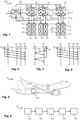
- Fig. 1 shows a schematic diagram of a multimedia distribution network 100 for use on-board of a passenger aircraft, such as for example the passenger aircraft A depicted in conjunction with Fig. 5 .
- the network 100 includes a number of network nodes which are interconnected among each other.
- a first network node acts as a head controller 1.
- a number of second network nodes connected to the first network node act as a plurality of intermediate controllers 10.
- the multimedia distribution network 100 is implemented as a star topology, however, other forms of network topologies are equally possible, such as daisy-chain topologies, cluster topologies, ring topologies, partially or fully connected mesh topologies or any sort of hybrid network topologies as combination of two or more of the aforementioned topology types.
- the multimedia distribution network 100 may be arranged in a star-ring network, a snowflake network or a cluster-mesh network.
- the first and second network nodes may be functionally equipped with the necessary elements and features to dynamically take on either the role of a head controller 1 or of one of the intermediate controllers 10.
- the role of a head controller 1 is pre-determined, however, in other forms the role of the head controller 1 may dynamically be re-assigned to a different one of the second network nodes, for example in order to provide functional redundancy in case of permanent or temporary failure or unavailability of the respective first network node acting as head controller 1 previously.
- the end device controllers 22 may be internal processors of end device modules 20.
- the end device modules 20 may further include functional units 23 that are controlled by the respective end device controller 22, such as for example lighting units, loudspeakers, displays or other multimedia end devices.
- the head controller 1 is configured to transmit a multicast stream MC of multimedia control signal packets for controlling the plurality of end device controllers 22 to the plurality of intermediate controllers 10.
- the head controller 1 may include a central processor 6 that controls various communication interfaces 2, 3, 4 and 5.
- a cabin communication interface 2 may receive control data from a cabin management system (not shown) of the aircraft which the multimedia distribution network 100 is part of, for example via MQTT. This control data includes commands and parameters to select a pre-defined multimedia scenario for display by a number of end devices 23.
- the multicast stream MC may for example be disseminated to a number of selected or subscribed intermediate controllers 10 via a multicast output 3 of the head controller 1 to multicast inputs 11 of the intermediate controllers 10.
- the multicast stream MC may include a stream of multimedia control signal packets indicating audio data content, video data content and/or lighting control data content to be processed by the intermediate controllers.
- the payload content of the multimedia control signal packets is determined to reach a number of end device controllers 22 which in turn are configured to control the plurality of end devices 23 on the basis of the payload content included in processed multimedia control signal packets processed by the intermediate controllers according to the indicated content of the original multimedia control signal packets.
- the head controller 1 is configured to transmit the multicast stream MC with a configurable multicast delay d1 between subsequent multimedia control signal packets.
- the multicast stream MC of multimedia control signal packets may in some cases be an IP multicast with the User Datagram Protocol (UDP) as transport protocol.
- UDP User Datagram Protocol
- the end device modules 20 may include an end device interpreter 21 each of which is connected between respective ones of the intermediate controllers 10 and the end device controllers 22. Those end device interpreters 21 are used to convert the payload content of the multimedia control signal packets into control signals specific to the respectively associated end devices 23, for example audio control signals for loudspeakers, video control commands for displays or lighting control signals for lighting units such as LED strips or panels.
- the end device interpreters 21 may in some forms of implementation be configured to transmit feedback information FD regarding operation status and/or debug information of the plurality of end device controllers 22 to the respectively connected one of the plurality of intermediate controllers 10, for example via a route through a feedback interface 14 of the corresponding intermediate controller 10 to a debug interface 5 of the head controller 1.
- the feedback information FD may be used to fine-tune the performance of the end devices 23 or by re-arranging the selection of the end devices 23 by the head controller 1 in order to achieve the desired output of the pre-defined multimedia scenario.
- the intermediate controllers 10 may include control interfaces 12 used to distribute the received multimedia control signal packets to the end device controllers 22, optionally supported by the end device interpreters 21.
- each intermediate controller 10 includes a query interface 13 over which the intermediate controller 10 may periodically transmit unicast delay queries DC to the head controller 1.
- the head controller 1 receives a unicast delay query DC at the query interface 4 and immediately returns a timestamped unicast delay indicator signal back to the querying intermediate controller 10.
- the round-trip time (RTT) of the unicast delay query DC and the corresponding unicast delay indicator signal is evaluated by the intermediate controller 10 so that the distribution of the received multimedia control signal packets to the end device controllers 22 may be performed with a controllable delay based on the evaluated RTT.
- the received multimedia control signal packets may in some cases be distributed using a multicast stream LC of end device control signal packets which in some forms of implementation be an IP multicast with the User Datagram Protocol (UDP).
- the controllable delay d3 may then be set by the intermediate controllers 10 to improve synchronicity of the decentralized multicast streams LC from different intermediate controllers 10.
- One application scenario for the multimedia distribution network 100 is an overall system architecture envisioned for the lighting units and panels in passenger cabin of a passenger aircraft, such as for example the aircraft A of Fig. 5 .
- the head controller 1 acts as a central light controller receiving lighting scenario commands via MQTT from the cabin management system. These commands select a pre-defined scene or effect and pass some parameters to the head controller 1.
- the head controller 1 selects the required intermediate controllers 10 within the aircraft cabin and commands those to execute the requested scene.
- the intermediate controllers 10 are programmed with the necessary settings needed to know how a certain scene or effect should be executed.
- the packets send from the head controller 1 to the intermediate controllers 10 also synchronize the state of the intermediate controllers 10, so that each of the intermediate controllers 10 executes the right part of a scene or effect at the right time. Dynamically adjusting the delays for each of the intermediate controllers 10 on the basis of the delay polling with the head controller 1 greatly aids in achieving that level of synchronicity.
- Packets generated by the intermediate controllers 10 command the associated end devices 23, for example lighting units and/or LED panels or strips, to display certain colours, hues, brightness etc. Additionally, each end devices 23 may provide certain feedback information FD to the associated intermediate controller 10 via MQTT. All or most of this feedback information FD is then passed to the head controller 1 by the intermediate controllers 10 for further evaluation and action.
- the unicast delay querying procedure initiated by the intermediate controllers 10 from time to time with a delay d2 provides the intermediate controllers 10 with information about the network delay that the received multimedia control signal packets experience when received from the head controller 1.
- Fig. 6 shows a flowchart of the method steps of a method M of distributing multimedia content via a network on board of a passenger aircraft, for example the multimedia distribution network 100 as shown in Fig. 1 .
- the method M may advantageously be carried out on-board of a passenger aircraft, such as the aircraft A as exemplarily depicted in Fig. 5 .
- the method M may be used to disseminate lighting control among lighting modules distributed and installed in various places of a passenger cabin within the passenger aircraft A.
- a head controller 1 which is selected as a first network node from a multiplicity of nodes in the multimedia distribution network 100 transmits a multicast stream MC of multimedia control signal packets to other nodes in the multimedia distribution network 100 selected and configured as intermediate controllers 10.
- the multimedia control signal packets are intended to control nodes in the multimedia distribution network 100 which are configured as end device controllers 22.
- the multimedia control signal packets may indicate audio data content, video data content and/or lighting control data content, i.e. payload with respect to audio data, video data and/or commands for controlling lighting units.
- the head controller 1 introduces a configurable delay d1 between subsequent multimedia control signal packets during transmission of the multicast stream MC.
- the intermediate controllers 10 receive the multicast stream MC from the head controller 1.
- the multicast stream MC may for example be an IP multicast with the User Datagram Protocol (UDP) as transport protocol.
- UDP User Datagram Protocol
- the receiving intermediate controllers 10 Upon receipt of the multicast stream MC, the receiving intermediate controllers 10 periodically transmit unicast delay queries DC to the head controller 1 in a third step M3.
- the unicast delay queries DC elicit responses by the head controller 1 which in turn sends out unicast delay indicator signals targeted to the specific intermediate controllers 10 from where the unicast delay queries DC had been obtained.
- the unicast delay indicator signals are received in a fourth step M4 by the querying intermediate controllers 10.
- the unicast delay indicator signals enable the receiving intermediate controllers 10 to measure the delay a received multimedia control signal packet of the multicast stream MC is subject to when transmitted from the head controller 1 to the respective intermediate controller 10.
- the timestamps of the unicast delay queries DC and the unicast delay indicator signals may be evaluated by the intermediate controllers 10 to estimate the difference between the clocks in the head controller 1 and the intermediate controller 10.
- the intermediate controllers 10 may further measure the time it took to receive the unicast delay indicator signal in response to the unicast delay query DC. For example, assuming equal network load in upstream (towards the head controller 1) and downstream (towards the intermediate controller 10), half of the measured Round-Trip-Time (RTT) for one unicast delay querying cycle can be determined as the packet delay time. Subsequent packet delay times may be measured and subject to a moving window averaging procedure in order to smoothen out the measured delay times when there are high fluctuations in the measurements.
- the intermediate controllers 10 then process the received multimedia control signal packets and distribute the processed multimedia control signal packets to the end device controllers 22 in a fifth step M5.
- the distribution may be performed using a multicast stream LC of end device control signal packets.
- the intermediate controllers 10 use the currently determined packet delay times from the last unicast delay querying cycle(s) to set a controllable delay of the end device control signal packets. That way, synchronicity between the end device controllers 22 may be established based on the content of the received unicast delay indicator signals for each of the intermediate controllers 10 individually.
Landscapes
- Engineering & Computer Science (AREA)
- Multimedia (AREA)
- Computer Networks & Wireless Communication (AREA)
- Signal Processing (AREA)
- Health & Medical Sciences (AREA)
- Computing Systems (AREA)
- General Health & Medical Sciences (AREA)
- Medical Informatics (AREA)
- Computer Security & Cryptography (AREA)
- Two-Way Televisions, Distribution Of Moving Picture Or The Like (AREA)
- Data Exchanges In Wide-Area Networks (AREA)
Claims (14)
- Réseau de distribution multimédia (100) à bord d'un avion de passagers (A), le réseau (100) comprenant : un premier nœud de réseau configuré en tant que contrôleur principal (1) ; une pluralité de seconds nœuds de réseau configurés comme une pluralité de contrôleurs intermédiaires (10) connectés au premier nœud de réseau ; une pluralité de troisièmes nœuds de réseau configurés comme une pluralité de contrôleurs de dispositifs terminaux (22), chacun connecté à l'un de la pluralité de deuxièmes nœuds de réseau, le contrôleur principal (1) étant en outre configuré pour transmettre un flux de multidiffusion (MC) de paquets de signaux de commande multimédia pour contrôler la pluralité de contrôleurs de dispositifs terminaux (22) à la pluralité de contrôleurs intermédiaires (10), caractérisé en ce que la pluralité de contrôleurs intermédiaires (10) est en outre configurée pour transmettre périodiquement des requêtes de retard de monodiffusion (DC) au contrôleur principal (1), pour traiter les paquets de signaux de commande multimédia reçus et distribuer les paquets de signaux de commande multimédia traités aux contrôleurs de dispositif final (22) avec un retard contrôlable sur la base du contenu de signaux indicateurs de retard de monodiffusion envoyés par le contrôleur principal (1) à la pluralité de contrôleurs intermédiaires (10) en réponse aux requêtes de retard de monodiffusion (DC).
- Réseau de distribution multimédia (100) selon la revendication 1, dans lequel les paquets de signaux de commande multimédia indiquent un contenu de données audio, un contenu de données vidéo et/ou un contenu de données de commande d'éclairage à traiter par les contrôleurs intermédiaires (10).
- Réseau de distribution multimédia (100) selon la revendication 2, comprenant en outre une pluralité de dispositifs terminaux (23) connectés à la pluralité de contrôleurs de dispositifs terminaux (22), la pluralité de contrôleurs de dispositifs terminaux (22) étant configurée pour contrôler la pluralité de dispositifs terminaux (23) sur la base du contenu de données audio, du contenu de données vidéo et/ou du contenu de données de commande d'éclairage indiqués dans les paquets de signaux de commande multimédia.
- Réseau de distribution multimédia (100) selon la revendication 3, comprenant en outre une pluralité d'interprètes de dispositifs terminaux (21) connectés entre ceux respectifs de la pluralité de contrôleurs intermédiaires (10) et la pluralité de contrôleurs de dispositifs terminaux (22), la pluralité d'interprètes de dispositifs terminaux (21) étant configurée pour convertir le contenu des paquets de signaux de commande multimédia en signaux de commande spécifiques à la pluralité de dispositifs terminaux (23).
- Réseau de distribution multimédia (100) selon la revendication 4, dans lequel la pluralité d'interprètes de dispositifs terminaux (21) est configurée pour transmettre des informations de retour concernant l'état de fonctionnement et/ou des informations de débogage de la pluralité de contrôleurs de dispositifs terminaux (22) à celui respectivement connecté de la pluralité de contrôleurs intermédiaires (10).
- Réseau de distribution multimédia (100) selon l'une des revendications 1 à 5, dans lequel le contrôleur principal (1) est configuré pour transmettre le flux de multidiffusion (MC) avec un délai de multidiffusion (d1) configurable entre les paquets de signaux de commande multimédia suivants.
- Réseau de distribution multimédia (100) selon l'une des revendications 1 à 6, dans lequel la pluralité de contrôleurs intermédiaires (10) sont configurés pour distribuer les paquets de signaux de commande multimédia reçus aux contrôleurs de dispositifs terminaux (22) dans un flux multicast (LC) de paquets de signaux de commande de dispositifs terminaux.
- Réseau de distribution multimédia (100) selon la revendication 7, dans lequel le flux de multidiffusion (LC) de paquets de signaux de commande de dispositif final est une multidiffusion IP avec le protocole de datagramme utilisateur, UDP, comme protocole de transport.
- Réseau de distribution multimédia (100) selon l'une des revendications 1 à 8, dans lequel le flux multicast (MC) de paquets de signaux de contrôle multimédia est un multicast IP avec le User Datagram Protocol, UDP, comme protocole de transport.
- Procédé (M) de distribution de contenu multimédia dans un réseau décentralisé (100) à bord d'un avion de passagers (A), le procédé (M) comprenant : la transmission (M1), par un premier nœud de réseau du réseau décentralisé (100) configuré en tant que contrôleur principal (1), d'un flux de multidiffusion (MC) de paquets de signaux de commande multimédia pour contrôler une pluralité de troisièmes nœuds de réseau du réseau décentralisé (100) configuré en tant que pluralité de contrôleurs de dispositifs terminaux (22) ; recevoir (M2), par une pluralité de seconds nœuds de réseau du réseau décentralisé (100) configurés comme une pluralité de contrôleurs intermédiaires (10), le flux de multidiffusion (MC) provenant du contrôleur principal (1), caractérisé en ce que le procédé comprend en outre la transmission périodique (M3), par la pluralité de contrôleurs intermédiaires (10), de requêtes de retard de monodiffusion (DC) au contrôleur principal (1) ; recevoir (M4), par la pluralité de contrôleurs intermédiaires (10), des signaux indicateurs de retard de monodiffusion envoyés par le contrôleur principal (1) à la pluralité de contrôleurs intermédiaires (10) en réponse aux requêtes de retard de monodiffusion (DC) ; et traiter (M5), par la pluralité de contrôleurs intermédiaires (10), les paquets de signaux de commande multimédia reçus et distribuer les paquets de signaux de commande multimédia traités aux contrôleurs de dispositif final (22) avec un retard contrôlable sur la base du contenu des signaux indicateurs de retard de monodiffusion reçus.
- Procédé (M) selon la revendication 10, dans lequel les paquets de signaux de commande multimédia indiquent un contenu de données audio, un contenu de données vidéo et/ou un contenu de données de commande d'éclairage à traiter par les contrôleurs intermédiaires (10).
- Procédé (M) selon la revendication 10 ou 11, dans lequel la transmission (M1) du flux de multidiffusion (MC) de paquets de signaux de commande multimédia est effectuée avec un délai configurable (d1) entre les paquets de signaux de commande multimédia suivants.
- Procédé (M) selon l'une des revendications 10 à 12, dans lequel la distribution (M5) des paquets de signaux de commande multimédia reçus aux contrôleurs de dispositifs terminaux (22) est effectuée à l'aide d'un flux multicast (LC) de paquets de signaux de commande de dispositifs terminaux.
- Aéronef (A) comportant un réseau de distribution multimédia (100) selon l'une des revendications 1 à 9.
Priority Applications (3)
| Application Number | Priority Date | Filing Date | Title |
|---|---|---|---|
| EP22170635.1A EP4270903B1 (fr) | 2022-04-28 | 2022-04-28 | Réseau de distribution multimédia à bord d'un aéronef et procédé de distribution de contenu multimédia à bord d'un aéronef |
| CN202310465773.6A CN116980242A (zh) | 2022-04-28 | 2023-04-26 | 机载多媒体分发网络和在飞行器上分发多媒体内容的方法 |
| US18/307,235 US11991229B2 (en) | 2022-04-28 | 2023-04-26 | Onboard multimedia distribution network for an aircraft and method for distributing multimedia content on board of an aircraft |
Applications Claiming Priority (1)
| Application Number | Priority Date | Filing Date | Title |
|---|---|---|---|
| EP22170635.1A EP4270903B1 (fr) | 2022-04-28 | 2022-04-28 | Réseau de distribution multimédia à bord d'un aéronef et procédé de distribution de contenu multimédia à bord d'un aéronef |
Publications (2)
| Publication Number | Publication Date |
|---|---|
| EP4270903A1 EP4270903A1 (fr) | 2023-11-01 |
| EP4270903B1 true EP4270903B1 (fr) | 2025-06-04 |
Family
ID=81585135
Family Applications (1)
| Application Number | Title | Priority Date | Filing Date |
|---|---|---|---|
| EP22170635.1A Active EP4270903B1 (fr) | 2022-04-28 | 2022-04-28 | Réseau de distribution multimédia à bord d'un aéronef et procédé de distribution de contenu multimédia à bord d'un aéronef |
Country Status (3)
| Country | Link |
|---|---|
| US (1) | US11991229B2 (fr) |
| EP (1) | EP4270903B1 (fr) |
| CN (1) | CN116980242A (fr) |
Families Citing this family (1)
| Publication number | Priority date | Publication date | Assignee | Title |
|---|---|---|---|---|
| EP4645087A1 (fr) * | 2024-05-03 | 2025-11-05 | Rockwell Collins, Inc. | Isolation probabiliste sur aile par l'utilisation d'une analyse de sécurité basée sur un modèle |
Family Cites Families (19)
| Publication number | Priority date | Publication date | Assignee | Title |
|---|---|---|---|---|
| DE10360856A1 (de) | 2003-12-23 | 2005-07-28 | Airbus Deutschland Gmbh | Bussystem für ein Flugzeug |
| US7869794B1 (en) * | 2004-02-18 | 2011-01-11 | Sprint Spectrum L.P. | Method and system for providing timely message delivery |
| JP4490314B2 (ja) * | 2005-03-07 | 2010-06-23 | Kddi株式会社 | 通信システム |
| US8027560B2 (en) * | 2007-02-05 | 2011-09-27 | Thales Avionics, Inc. | System and method for synchronizing playback of audio and video |
| US20090070841A1 (en) * | 2007-09-12 | 2009-03-12 | Proximetry, Inc. | Systems and methods for delivery of wireless data and multimedia content to aircraft |
| KR100880893B1 (ko) * | 2007-09-14 | 2009-01-30 | 한국전자통신연구원 | 복수의 멀티캐스트를 이용한 iptv 고속 채널 전환을위한 장치 및 그 방법 |
| EP2329186B1 (fr) | 2008-09-24 | 2018-02-21 | B/E Aerospace Inc. | Systeme d'eclairage en douche a del multiples pour aeronef et procede de commande associe |
| US20110066746A1 (en) * | 2009-09-11 | 2011-03-17 | Broadcom Corporation | Synchronized data streaming |
| KR101268629B1 (ko) * | 2009-11-05 | 2013-05-29 | 한국전자통신연구원 | 시청률 예측 연동 복수 멀티캐스트를 이용한 고속 채널 전환을 위한 채널 서버, 채널 예측 서버, 단말기 및 그 방법 |
| WO2011106661A1 (fr) | 2010-02-25 | 2011-09-01 | B/E Aerospace, Inc. | Procédé de calibration pour systèmes d'éclairage à del |
| JP6461791B2 (ja) | 2012-08-07 | 2019-01-30 | フィリップス ライティング ホールディング ビー ヴィ | 時限照明制御 |
| EP2914067B1 (fr) | 2014-02-27 | 2018-04-25 | Airbus Operations GmbH | Système d'éclairage et procédé de commande dudit système |
| EP2915699A3 (fr) | 2014-03-07 | 2016-04-20 | IDD Aerospace Corporation | Systèmes d'éclairage d'une cabine d'avion |
| WO2016101257A1 (fr) * | 2014-12-26 | 2016-06-30 | 华为技术有限公司 | Procédé et dispositif de transmission de données |
| DE102017218515A1 (de) | 2017-10-17 | 2019-04-18 | Airbus Operations Gmbh | Videodatenverteiler und Flugzeugkabinenmanagementsystem |
| IL277233B2 (en) * | 2018-03-18 | 2024-04-01 | Driveu Tech Ltd | Device, system, and method of autonomous driving and tele-operated vehicles |
| US11218438B2 (en) * | 2019-04-12 | 2022-01-04 | Huawei Technologies Co., Ltd. | System, apparatus and method to support data server selection |
| US11411607B2 (en) | 2020-01-07 | 2022-08-09 | Analog Devices, Inc. | Audio and lighting control via a communication bus |
| CN112702818A (zh) | 2020-12-17 | 2021-04-23 | 上海博昂电气有限公司 | 航班照明联动控制方法 |
-
2022
- 2022-04-28 EP EP22170635.1A patent/EP4270903B1/fr active Active
-
2023
- 2023-04-26 US US18/307,235 patent/US11991229B2/en active Active
- 2023-04-26 CN CN202310465773.6A patent/CN116980242A/zh active Pending
Also Published As
| Publication number | Publication date |
|---|---|
| EP4270903A1 (fr) | 2023-11-01 |
| US20230353618A1 (en) | 2023-11-02 |
| CN116980242A (zh) | 2023-10-31 |
| US11991229B2 (en) | 2024-05-21 |
Similar Documents
| Publication | Publication Date | Title |
|---|---|---|
| TWI724100B (zh) | 用於無線網路之動態傳輸控制 | |
| CN102202425B (zh) | 基于主从异构型数传模块的卫星集群自组织组网方法 | |
| US12547576B2 (en) | Low complexity ethernet node (LEN) one port | |
| US9847954B2 (en) | Distributed method of data acquisition in an AFDX network | |
| CN115134421B (zh) | 一种多源异构数据跨系统协同管理系统及方法 | |
| EP4270903B1 (fr) | Réseau de distribution multimédia à bord d'un aéronef et procédé de distribution de contenu multimédia à bord d'un aéronef | |
| WO2020108160A1 (fr) | Procédé d'accélération de rtps, nœud et système de réseau dds | |
| EP2806633A1 (fr) | Procédé et appareil d'optimisation de réseau améliorée pour fournir une vidéo à partir de plusieurs sources vers une pluralité de clients | |
| JP2010500848A (ja) | 連携された通信サービスをサポートする方法 | |
| CN112087356B (zh) | 一种兼容通用TTE的uTTE网络系统 | |
| CN109819010A (zh) | 用于向电子接收设备发送数据消息的方法,相关电子发送设备和计算机程序 | |
| JP2012253506A (ja) | 到着パケット同期方法およびシステム | |
| Mahajan et al. | Athena: Reliable multicast for group communication in SDN-based data centers | |
| WO2022185587A1 (fr) | Procédé de communication, système de communication et commutateur | |
| KR102025885B1 (ko) | 군집 무인 항공 시스템 환경을 위한 실시간 통신 장치 | |
| EP2865134B1 (fr) | Procédé et dispositif de formation de chemins optimaux chronocommandés dans un réseau d'ordinateurs | |
| US8316170B2 (en) | Method and device for transferring data over network nodes of a network | |
| CN102263669B (zh) | 基于组播转换的可控组播系统的网管系统及方法 | |
| CN108011760B (zh) | Fans应用和fms之间接口实现系统 | |
| JP2009021652A (ja) | 無線通信システム | |
| Álvarez et al. | A first qualitative comparison of the admission control in FTT-SE, HaRTES and AVB | |
| US12113648B2 (en) | Information processing apparatus, information processing method, and program | |
| CN100542167C (zh) | 基于igrs协议的主从设备组之间无线路由实现方法 | |
| CN120812037B (zh) | 一种优化控制器集中管理大量连接的会话共享及复用方法 | |
| US20230318877A1 (en) | Information processing apparatus, information processing system, information processing method, and program |
Legal Events
| Date | Code | Title | Description |
|---|---|---|---|
| PUAI | Public reference made under article 153(3) epc to a published international application that has entered the european phase |
Free format text: ORIGINAL CODE: 0009012 |
|
| STAA | Information on the status of an ep patent application or granted ep patent |
Free format text: STATUS: THE APPLICATION HAS BEEN PUBLISHED |
|
| AK | Designated contracting states |
Kind code of ref document: A1 Designated state(s): AL AT BE BG CH CY CZ DE DK EE ES FI FR GB GR HR HU IE IS IT LI LT LU LV MC MK MT NL NO PL PT RO RS SE SI SK SM TR |
|
| STAA | Information on the status of an ep patent application or granted ep patent |
Free format text: STATUS: REQUEST FOR EXAMINATION WAS MADE |
|
| 17P | Request for examination filed |
Effective date: 20240502 |
|
| RBV | Designated contracting states (corrected) |
Designated state(s): AL AT BE BG CH CY CZ DE DK EE ES FI FR GB GR HR HU IE IS IT LI LT LU LV MC MK MT NL NO PL PT RO RS SE SI SK SM TR |
|
| GRAP | Despatch of communication of intention to grant a patent |
Free format text: ORIGINAL CODE: EPIDOSNIGR1 |
|
| STAA | Information on the status of an ep patent application or granted ep patent |
Free format text: STATUS: GRANT OF PATENT IS INTENDED |
|
| RIC1 | Information provided on ipc code assigned before grant |
Ipc: H04L 65/611 20220101ALI20241118BHEP Ipc: H04L 67/12 20220101AFI20241118BHEP |
|
| INTG | Intention to grant announced |
Effective date: 20241202 |
|
| GRAS | Grant fee paid |
Free format text: ORIGINAL CODE: EPIDOSNIGR3 |
|
| GRAA | (expected) grant |
Free format text: ORIGINAL CODE: 0009210 |
|
| STAA | Information on the status of an ep patent application or granted ep patent |
Free format text: STATUS: THE PATENT HAS BEEN GRANTED |
|
| AK | Designated contracting states |
Kind code of ref document: B1 Designated state(s): AL AT BE BG CH CY CZ DE DK EE ES FI FR GB GR HR HU IE IS IT LI LT LU LV MC MK MT NL NO PL PT RO RS SE SI SK SM TR |
|
| REG | Reference to a national code |
Ref country code: GB Ref legal event code: FG4D |
|
| REG | Reference to a national code |
Ref country code: CH Ref legal event code: EP |
|
| REG | Reference to a national code |
Ref country code: DE Ref legal event code: R096 Ref document number: 602022015365 Country of ref document: DE |
|
| REG | Reference to a national code |
Ref country code: IE Ref legal event code: FG4D |
|
| REG | Reference to a national code |
Ref country code: NL Ref legal event code: MP Effective date: 20250604 |
|
| PG25 | Lapsed in a contracting state [announced via postgrant information from national office to epo] |
Ref country code: ES Free format text: LAPSE BECAUSE OF FAILURE TO SUBMIT A TRANSLATION OF THE DESCRIPTION OR TO PAY THE FEE WITHIN THE PRESCRIBED TIME-LIMIT Effective date: 20250604 Ref country code: FI Free format text: LAPSE BECAUSE OF FAILURE TO SUBMIT A TRANSLATION OF THE DESCRIPTION OR TO PAY THE FEE WITHIN THE PRESCRIBED TIME-LIMIT Effective date: 20250604 |
|
| REG | Reference to a national code |
Ref country code: LT Ref legal event code: MG9D |
|
| PG25 | Lapsed in a contracting state [announced via postgrant information from national office to epo] |
Ref country code: GR Free format text: LAPSE BECAUSE OF FAILURE TO SUBMIT A TRANSLATION OF THE DESCRIPTION OR TO PAY THE FEE WITHIN THE PRESCRIBED TIME-LIMIT Effective date: 20250905 Ref country code: NO Free format text: LAPSE BECAUSE OF FAILURE TO SUBMIT A TRANSLATION OF THE DESCRIPTION OR TO PAY THE FEE WITHIN THE PRESCRIBED TIME-LIMIT Effective date: 20250904 |
|
| PG25 | Lapsed in a contracting state [announced via postgrant information from national office to epo] |
Ref country code: PL Free format text: LAPSE BECAUSE OF FAILURE TO SUBMIT A TRANSLATION OF THE DESCRIPTION OR TO PAY THE FEE WITHIN THE PRESCRIBED TIME-LIMIT Effective date: 20250604 |
|
| PG25 | Lapsed in a contracting state [announced via postgrant information from national office to epo] |
Ref country code: BG Free format text: LAPSE BECAUSE OF FAILURE TO SUBMIT A TRANSLATION OF THE DESCRIPTION OR TO PAY THE FEE WITHIN THE PRESCRIBED TIME-LIMIT Effective date: 20250604 |
|
| PG25 | Lapsed in a contracting state [announced via postgrant information from national office to epo] |
Ref country code: HR Free format text: LAPSE BECAUSE OF FAILURE TO SUBMIT A TRANSLATION OF THE DESCRIPTION OR TO PAY THE FEE WITHIN THE PRESCRIBED TIME-LIMIT Effective date: 20250604 |
|
| PG25 | Lapsed in a contracting state [announced via postgrant information from national office to epo] |
Ref country code: RS Free format text: LAPSE BECAUSE OF FAILURE TO SUBMIT A TRANSLATION OF THE DESCRIPTION OR TO PAY THE FEE WITHIN THE PRESCRIBED TIME-LIMIT Effective date: 20250904 |
|
| PG25 | Lapsed in a contracting state [announced via postgrant information from national office to epo] |
Ref country code: LV Free format text: LAPSE BECAUSE OF FAILURE TO SUBMIT A TRANSLATION OF THE DESCRIPTION OR TO PAY THE FEE WITHIN THE PRESCRIBED TIME-LIMIT Effective date: 20250604 |
|
| PG25 | Lapsed in a contracting state [announced via postgrant information from national office to epo] |
Ref country code: NL Free format text: LAPSE BECAUSE OF FAILURE TO SUBMIT A TRANSLATION OF THE DESCRIPTION OR TO PAY THE FEE WITHIN THE PRESCRIBED TIME-LIMIT Effective date: 20250604 |
|
| PG25 | Lapsed in a contracting state [announced via postgrant information from national office to epo] |
Ref country code: PT Free format text: LAPSE BECAUSE OF FAILURE TO SUBMIT A TRANSLATION OF THE DESCRIPTION OR TO PAY THE FEE WITHIN THE PRESCRIBED TIME-LIMIT Effective date: 20251006 |
|
| REG | Reference to a national code |
Ref country code: AT Ref legal event code: MK05 Ref document number: 1801462 Country of ref document: AT Kind code of ref document: T Effective date: 20250604 |
|
| PG25 | Lapsed in a contracting state [announced via postgrant information from national office to epo] |
Ref country code: IS Free format text: LAPSE BECAUSE OF FAILURE TO SUBMIT A TRANSLATION OF THE DESCRIPTION OR TO PAY THE FEE WITHIN THE PRESCRIBED TIME-LIMIT Effective date: 20251004 |
|
| PG25 | Lapsed in a contracting state [announced via postgrant information from national office to epo] |
Ref country code: SM Free format text: LAPSE BECAUSE OF FAILURE TO SUBMIT A TRANSLATION OF THE DESCRIPTION OR TO PAY THE FEE WITHIN THE PRESCRIBED TIME-LIMIT Effective date: 20250604 Ref country code: AT Free format text: LAPSE BECAUSE OF FAILURE TO SUBMIT A TRANSLATION OF THE DESCRIPTION OR TO PAY THE FEE WITHIN THE PRESCRIBED TIME-LIMIT Effective date: 20250604 |
|
| PG25 | Lapsed in a contracting state [announced via postgrant information from national office to epo] |
Ref country code: CZ Free format text: LAPSE BECAUSE OF FAILURE TO SUBMIT A TRANSLATION OF THE DESCRIPTION OR TO PAY THE FEE WITHIN THE PRESCRIBED TIME-LIMIT Effective date: 20250604 |
|
| PG25 | Lapsed in a contracting state [announced via postgrant information from national office to epo] |
Ref country code: EE Free format text: LAPSE BECAUSE OF FAILURE TO SUBMIT A TRANSLATION OF THE DESCRIPTION OR TO PAY THE FEE WITHIN THE PRESCRIBED TIME-LIMIT Effective date: 20250604 |
|
| PG25 | Lapsed in a contracting state [announced via postgrant information from national office to epo] |
Ref country code: SK Free format text: LAPSE BECAUSE OF FAILURE TO SUBMIT A TRANSLATION OF THE DESCRIPTION OR TO PAY THE FEE WITHIN THE PRESCRIBED TIME-LIMIT Effective date: 20250604 |
|
| PG25 | Lapsed in a contracting state [announced via postgrant information from national office to epo] |
Ref country code: IT Free format text: LAPSE BECAUSE OF FAILURE TO SUBMIT A TRANSLATION OF THE DESCRIPTION OR TO PAY THE FEE WITHIN THE PRESCRIBED TIME-LIMIT Effective date: 20250604 |
|
| REG | Reference to a national code |
Ref country code: DE Ref legal event code: R097 Ref document number: 602022015365 Country of ref document: DE |
|
| PLBE | No opposition filed within time limit |
Free format text: ORIGINAL CODE: 0009261 |
|
| STAA | Information on the status of an ep patent application or granted ep patent |
Free format text: STATUS: NO OPPOSITION FILED WITHIN TIME LIMIT |
|
| PG25 | Lapsed in a contracting state [announced via postgrant information from national office to epo] |
Ref country code: DK Free format text: LAPSE BECAUSE OF FAILURE TO SUBMIT A TRANSLATION OF THE DESCRIPTION OR TO PAY THE FEE WITHIN THE PRESCRIBED TIME-LIMIT Effective date: 20250604 |
|
| REG | Reference to a national code |
Ref country code: CH Ref legal event code: L10 Free format text: ST27 STATUS EVENT CODE: U-0-0-L10-L00 (AS PROVIDED BY THE NATIONAL OFFICE) Effective date: 20260416 |