EP4273068A1 - Speichervorrichtung und verfahren zum sicheren transport einer abfallsekundärbatterie - Google Patents
Speichervorrichtung und verfahren zum sicheren transport einer abfallsekundärbatterie Download PDFInfo
- Publication number
- EP4273068A1 EP4273068A1 EP21915811.0A EP21915811A EP4273068A1 EP 4273068 A1 EP4273068 A1 EP 4273068A1 EP 21915811 A EP21915811 A EP 21915811A EP 4273068 A1 EP4273068 A1 EP 4273068A1
- Authority
- EP
- European Patent Office
- Prior art keywords
- dry ice
- storage device
- main body
- body part
- opening
- Prior art date
- Legal status (The legal status is an assumption and is not a legal conclusion. Google has not performed a legal analysis and makes no representation as to the accuracy of the status listed.)
- Pending
Links
Images


Classifications
-
- B—PERFORMING OPERATIONS; TRANSPORTING
- B65—CONVEYING; PACKING; STORING; HANDLING THIN OR FILAMENTARY MATERIAL
- B65D—CONTAINERS FOR STORAGE OR TRANSPORT OF ARTICLES OR MATERIALS, e.g. BAGS, BARRELS, BOTTLES, BOXES, CANS, CARTONS, CRATES, DRUMS, JARS, TANKS, HOPPERS, FORWARDING CONTAINERS; ACCESSORIES, CLOSURES, OR FITTINGS THEREFOR; PACKAGING ELEMENTS; PACKAGES
- B65D85/00—Containers, packaging elements or packages, specially adapted for particular articles or materials
- B65D85/68—Containers, packaging elements or packages, specially adapted for particular articles or materials for machines, engines or vehicles in assembled or dismantled form
-
- B—PERFORMING OPERATIONS; TRANSPORTING
- B65—CONVEYING; PACKING; STORING; HANDLING THIN OR FILAMENTARY MATERIAL
- B65D—CONTAINERS FOR STORAGE OR TRANSPORT OF ARTICLES OR MATERIALS, e.g. BAGS, BARRELS, BOTTLES, BOXES, CANS, CARTONS, CRATES, DRUMS, JARS, TANKS, HOPPERS, FORWARDING CONTAINERS; ACCESSORIES, CLOSURES, OR FITTINGS THEREFOR; PACKAGING ELEMENTS; PACKAGES
- B65D65/00—Wrappers or flexible covers; Packaging materials of special type or form
- B65D65/38—Packaging materials of special type or form
-
- B—PERFORMING OPERATIONS; TRANSPORTING
- B65—CONVEYING; PACKING; STORING; HANDLING THIN OR FILAMENTARY MATERIAL
- B65D—CONTAINERS FOR STORAGE OR TRANSPORT OF ARTICLES OR MATERIALS, e.g. BAGS, BARRELS, BOTTLES, BOXES, CANS, CARTONS, CRATES, DRUMS, JARS, TANKS, HOPPERS, FORWARDING CONTAINERS; ACCESSORIES, CLOSURES, OR FITTINGS THEREFOR; PACKAGING ELEMENTS; PACKAGES
- B65D77/00—Packages formed by enclosing articles or materials in preformed containers, e.g. boxes, cartons, sacks or bags
- B65D77/04—Articles or materials enclosed in two or more containers disposed one within another
-
- B—PERFORMING OPERATIONS; TRANSPORTING
- B65—CONVEYING; PACKING; STORING; HANDLING THIN OR FILAMENTARY MATERIAL
- B65D—CONTAINERS FOR STORAGE OR TRANSPORT OF ARTICLES OR MATERIALS, e.g. BAGS, BARRELS, BOTTLES, BOXES, CANS, CARTONS, CRATES, DRUMS, JARS, TANKS, HOPPERS, FORWARDING CONTAINERS; ACCESSORIES, CLOSURES, OR FITTINGS THEREFOR; PACKAGING ELEMENTS; PACKAGES
- B65D81/00—Containers, packaging elements, or packages, for contents presenting particular transport or storage problems, or adapted to be used for non-packaging purposes after removal of contents
- B65D81/18—Containers, packaging elements, or packages, for contents presenting particular transport or storage problems, or adapted to be used for non-packaging purposes after removal of contents providing specific environment for contents, e.g. temperature above or below ambient
-
- H—ELECTRICITY
- H01—ELECTRIC ELEMENTS
- H01M—PROCESSES OR MEANS, e.g. BATTERIES, FOR THE DIRECT CONVERSION OF CHEMICAL ENERGY INTO ELECTRICAL ENERGY
- H01M50/00—Constructional details or processes of manufacture of the non-active parts of electrochemical cells other than fuel cells, e.g. hybrid cells
- H01M50/20—Mountings; Secondary casings or frames; Racks, modules or packs; Suspension devices; Shock absorbers; Transport or carrying devices; Holders
-
- H—ELECTRICITY
- H01—ELECTRIC ELEMENTS
- H01M—PROCESSES OR MEANS, e.g. BATTERIES, FOR THE DIRECT CONVERSION OF CHEMICAL ENERGY INTO ELECTRICAL ENERGY
- H01M50/00—Constructional details or processes of manufacture of the non-active parts of electrochemical cells other than fuel cells, e.g. hybrid cells
- H01M50/20—Mountings; Secondary casings or frames; Racks, modules or packs; Suspension devices; Shock absorbers; Transport or carrying devices; Holders
- H01M50/233—Mountings; Secondary casings or frames; Racks, modules or packs; Suspension devices; Shock absorbers; Transport or carrying devices; Holders characterised by physical properties of casings or racks, e.g. dimensions
- H01M50/24—Mountings; Secondary casings or frames; Racks, modules or packs; Suspension devices; Shock absorbers; Transport or carrying devices; Holders characterised by physical properties of casings or racks, e.g. dimensions adapted for protecting batteries from their environment, e.g. from corrosion
-
- B—PERFORMING OPERATIONS; TRANSPORTING
- B65—CONVEYING; PACKING; STORING; HANDLING THIN OR FILAMENTARY MATERIAL
- B65D—CONTAINERS FOR STORAGE OR TRANSPORT OF ARTICLES OR MATERIALS, e.g. BAGS, BARRELS, BOTTLES, BOXES, CANS, CARTONS, CRATES, DRUMS, JARS, TANKS, HOPPERS, FORWARDING CONTAINERS; ACCESSORIES, CLOSURES, OR FITTINGS THEREFOR; PACKAGING ELEMENTS; PACKAGES
- B65D2585/00—Containers, packaging elements or packages specially adapted for particular articles or materials
- B65D2585/68—Containers, packaging elements or packages specially adapted for particular articles or materials for machines, engines, or vehicles in assembled or dismantled form
- B65D2585/86—Containers, packaging elements or packages specially adapted for particular articles or materials for machines, engines, or vehicles in assembled or dismantled form for electrical components
- B65D2585/88—Batteries
-
- H—ELECTRICITY
- H01—ELECTRIC ELEMENTS
- H01M—PROCESSES OR MEANS, e.g. BATTERIES, FOR THE DIRECT CONVERSION OF CHEMICAL ENERGY INTO ELECTRICAL ENERGY
- H01M10/00—Secondary cells; Manufacture thereof
- H01M10/05—Accumulators with non-aqueous electrolyte
- H01M10/052—Li-accumulators
-
- Y—GENERAL TAGGING OF NEW TECHNOLOGICAL DEVELOPMENTS; GENERAL TAGGING OF CROSS-SECTIONAL TECHNOLOGIES SPANNING OVER SEVERAL SECTIONS OF THE IPC; TECHNICAL SUBJECTS COVERED BY FORMER USPC CROSS-REFERENCE ART COLLECTIONS [XRACs] AND DIGESTS
- Y02—TECHNOLOGIES OR APPLICATIONS FOR MITIGATION OR ADAPTATION AGAINST CLIMATE CHANGE
- Y02E—REDUCTION OF GREENHOUSE GAS [GHG] EMISSIONS, RELATED TO ENERGY GENERATION, TRANSMISSION OR DISTRIBUTION
- Y02E60/00—Enabling technologies; Technologies with a potential or indirect contribution to GHG emissions mitigation
- Y02E60/10—Energy storage using batteries
Definitions
- the present disclosure relates to a device and a method for storing a waste secondary battery and, more particularly, to a storage device and a method for safe transport of a waste secondary battery.
- Secondary batteries are widely used around the world in personal transportation devices including electric vehicles, electronic devices, and large-capacity energy storage systems (ESS) .
- a secondary battery is composed of a lithium-based cathode material and a carbon-based anode material, and consists of a liquid electrolyte that promotes the movement of charges.
- the demand for secondary batteries is continuously increasing, and as the performance of secondary batteries deteriorates due to repetitive rapid charging and discharging, it is necessary to recycle secondary battery parts as resources when they reach the end of their useful life.
- explosion and fire may occur during road transport after battery parts are separated, there is a need for a storage device and a method for safely transporting waste secondary batteries.
- lithium-ion secondary batteries The transit of lithium-ion secondary batteries is subject to UN3480 lithium-ion battery international maritime dangerous goods regulations, and the lithium-ion secondary batteries should be properly packaged in accordance with special provision 377 and related instruction LP904.
- these regulations merely suggest methods for preventing physical damage to secondary batteries, while methods for suppressing fire or explosion are not suggested.
- steel, aluminum, metal, etc. have been proposed as containers to prevent such physical damage, if a battery is stored in a container made of such materials, in case the battery itself catches fire, metal combustion may occur explosively, which may lead to a large fire.
- An objective of the present disclosure is to provide a storage device for a lithium-ion waste secondary battery for safely transporting discarded lithium-ion secondary batteries and suppressing fire or explosion that may occur during transport of lithium-ion waste secondary batteries.
- an objective of the present disclosure is to provide a method having the above-mentioned advantages for safely transporting lithium-ion waste secondary batteries.
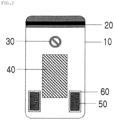
- a storage device 100 for a lithium-ion waste secondary battery including: a main body part 10 made of a silicone-based material, the main body part having an opening 11 on at least one side thereof and including a space portion 12 in which contents may be accommodated;
- the main body part 10 made of a silicone-based material may be made of a flame-retardant soft or hard material made using a silicone resin or a copolymer of a silicone resin and another synthetic resin.
- the opening and closing part 20 may be installed to an end of the opening 11 or may be spaced apart from the end of the opening 11 by a predetermined distance to be installed on the main body part 10.
- the opening and closing part 20 may be a zipper.
- the one-way valve 30 may be installed on the surface of the main body part 10 at a position that does not come into contact with the dry ice storage part 60.
- the dry ice storage part 60 may be separately put into the space portion 12 of the main body part 10 independently of the main body part 10, or may be installed on an inner surface of the main body part 10.
- the one-way valve 30 may be positioned in an upper region of the main body part 10 while the dry ice storage part 60 may be positioned in a lower region of the main body part 10.
- the dry ice storage part 60 may include at least one flame-retardant fiber selected from meta-aramid and para-aramid fibers.
- a method for storing and transporting a lithium-ion waste secondary battery including: preparing the storage device for a lithium-ion waste secondary battery according to claim 1; inserting a lithium-ion waste secondary battery into the storage device; and locking the opening and closing part of the storage device.
- the method may further include: calculating an appropriate amount of dry ice according to travel time on the basis of a weight loss rate of dry ice over time.
- method may further include: putting the storage device 100 for a lithium-ion waste secondary battery, in which a lithium-ion waste secondary battery is inserted and the opening and closing part thereof is locked, into a hard case storage box 70.
- a storage device for a lithium-ion waste secondary battery due to dry ice contained in a main body part made of a silicone-based material, the partial pressure of CO2is significantly increased to induce oxygen deficiency and significantly reduce the possibility of ignition, while the temperature drops due to sublimation of the dry ice, which slows down the diffusion rate of lithium ions in a secondary battery, so that a chemical reaction can be additionally suppressed.
- the possibility of ignition due to physical damage can be further suppressed, thereby suppressing not only fire in a waste secondary battery, which was limited only to physical damage, but also fire and explosion caused by a chemical reaction.
- a method having the above-mentioned advantages for safely transporting waste lithium-ion secondary batteries can be provided.
- a layer formed "on" a substrate or other layer refers to a layer formed directly on the substrate or other layer, or to an intermediate layer formed on or a layer formed on intermediate layers formed on the substrate or other layer.
- a structure or shape disposed "adjacent" to another shape may have a portion overlapping or underlying the adjacent shape.
- relative terms such as “below”, “above”, “upper”, “lower”, “horizontal” or “vertical” may be used to describe the relationship that one component, layer or region has with another component, layer or region, as shown in the drawings. It should be understood that these terms cover not only the directions indicated in the drawings, but also other orientations of the device.
- conventional safe transport method of lithium-ion waste secondary batteries only serves to prevent fire or explosion due to physical damage by storing the batteries in a hard case storage box 70 as shown in FIG. 7.
- a method and device capable of, aside from preventing fire due to physical damage, minimizing the combustion reaction to lower the possibility of fire or explosion during transport of waste secondary batteries Accordingly, the present disclosure provides a method and device capable of economically and safely transporting a waste lithium-ion secondary battery in consideration of the problems of the conventional transport method.
- FIGS. 2 and 3 a storage device 100 for a lithium-ion waste secondary battery according to an embodiment of the present disclosure will be described with reference to FIGS. 2 and 3 .
- the storage device 100 for a lithium-ion waste secondary battery includes a main body part 10 made of a silicone-based material that blocks the inside from an external gas atmosphere or environment, and the main body part 10 has an opening 11 on at least one side thereof and a space portion 12 in which contents may be accommodated. If necessary, the main body part 10 may further include a bottom portion 13 at a position opposite to the opening 11. Like the opening 11, the bottom portion 13 may seal the main body part by being in close contact with the entire perimeter of the main body part, and in some cases, when folding the storage device 100, it is folded inward or outward whereas when placing the storage device 100, the bottom surface thereof may be three-dimensional to have a floor surface of a certain shape so as to be able to stand on the floor.
- the main body part 10 may be made of a silicone-based material.
- the material of the silicone-based material is not particularly limited as long as it is a material whose inherent properties are kept relatively constant at low and high temperatures, and a material that is difficult to combust, that is flexible and soft, or stiff and hard.
- the silicone-based material may be prepared using a silicone resin or copolymer of a silicone resin and another synthetic resin, and may be prepared by further adding additives such as flame retardants and reinforcing silica.
- the storage device 100 also includes: an opening and closing part 20 for opening and closing the main body part 10 so that external gas does not permeate and internal oxygen deficiency is maintained; and a one-way valve 30 for preventing the formation of high pressure in an inner container.
- the opening and closing part 20 may be installed to the end of the opening 11 or may be installed on the main body part 10 by being spaced apart from the end of the opening 11 by a predetermined distance.
- the opening and closing part 20 may be installed along the entire perimeter of the main body part or may be installed only on a part of the perimeter.
- the opening and closing part 20 may be a zipper.
- the opening and closing part 20 may be a cover.
- the one-way valve 30 may be installed on one surface of the main body part 10 at a position not in contact with a dry ice storage part 60.
- the one-way valve 30 is to prevent damage such as bursting of the storage device as carbon dioxide generated by the sublimation of dry ice accumulates inside the storage device, and due to the internal carbon dioxide pressure, the storage device expands and this expansion causes the storage device to burst.
- the one-way valve 30 may be one, but depending on the capacity of the storage device 100, two or more may be installed. In order for the one-way valve 30 to easily discharge internal gas such as carbon dioxide to the outside, it is preferable to position the storage device 100 such that the one-way valve 30 faces upward when transporting the storage device.
- the one-way valve 30 may be positioned at the center of the upper region of the main body part 10 or at the edge of the upper region, and the storage device 100 may be placed upright and transferred so that the upper region of the main body part 10 faces upward.
- the dry ice storage part 60 may be separately inserted into the space portion 12 of the main body part 10 independently of the main body part 10 or attached and installed on the inner surface of the main body part 10.
- the one-way valve 30 may be positioned in the upper region of the main body part 10 while the dry ice storage part 60 may be positioned in the lower region of the main body part 10.
- the dry ice storage part 60 may be positioned near one end of the main body part 10 so as not to contact the waste secondary battery 40 that is input as much as possible.
- the dry ice storage part 60 is to prevent the dry ice 50 from directly contacting the waste secondary battery 40, and may be a cloth covering the dry ice or a pouch type container according to the embodiment of the present disclosure.
- internal oxygen is diluted with CO2 generated by dry ice sublimation to suppress electrochemical combustion of the secondary battery.
- the role of the dry ice 50 is to significantly lower the temperature inside the storage device compared to the ambient temperature, and the dry ice 50 has an additional function of lowering the risk of fire and explosion of a lithium-ion waste secondary battery by lowering driving force of mass transfer for a reaction by significantly increasing the ion diffusion rate, ion conductivity and resistance of ionic conduction in electrolytes at low temperatures.
- the dry ice storage part 60 may include at least one flame retardant fiber selected from meta-aramid and para-aramid fibers.
- the dry ice storage part 60 may be manufactured using a blend of two or more types of fibers.
- the dry ice storage part 60 may be a woven or non-woven fabric containing meta-aramids and/or para-aramids. Examples of para-aramid fibers include Kevlar ® and Technora ® .
- Meta-aramid fibers include Nomex ® and Conex ® .
- the dry ice storage part 60 may be manufactured to be porous because the dry ice storage part 60 needs to be breathable so that generated carbon dioxide can be discharged.
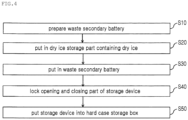
- the method for storing and transporting may include: preparing a lithium-ion waste secondary battery 40 (step S10); putting a dry ice storage part 60 containing dry ice 50 into a space portion 12 of a main body part 10 or into the dry ice accommodation part (not shown) on the inner surface of the main body part 10 (step S20); putting the lithium-ion waste secondary battery 40 into the space portion 12 of the main body part 10 or into the waste secondary battery accommodation part (not shown) on the inner surface of the main body part 10 (step S30); locking an opening and closing part 20 of a storage device 100 (step S40); and putting the storage device 100 into a hard case storage box 70 (step S50).
- the method for storing and transporting may further include: transporting the storage device 100 or the hard case storage box 70 containing the storage device 100 to a destination.
- the hard case storage box 70 may be made of highly durable aluminum (Al) or steel material to prevent physical damage to the battery.
- Al highly durable aluminum
- the hard case storage box 70 should meet the requirements set out in the UN standard UN3480 lithium-ion battery international maritime dangerous goods regulations, as well as special provision 377 and related instruction LP904 for international transport.
- steps S20 and S30 may be reversed so that step S30 is performed first and then step S20 is performed.
- Dry ice is used to lower the oxygen partial pressure and temperature in a container, and the sublimation rate of dry ice is approximately 102 g/h (1.7 g/min) as a result of preliminary experiments at room temperature.
- the dry ice may be input.
- This input step may be a step of mixing about 2.7 g or more of dry ice using the ideal gas equation at an absolute temperature of 298 K, which is a room temperature condition, since the molar mass of dry ice (solid carbon dioxide) is 44 g/mol relative to the volume of 1.5 L of the sealed storage device. Due to the dry ice, the temperature inside the container is lowered, thereby slowing down the diffusion rate of lithium ions and reducing the possibility of combustion reaction.
- in determining the proper amount of dry ice 50 it is put into the flame-retardant porous storage part 60 using the ideal gas equation according to the ambient temperature below.
- m is equal to the amount (g) of dry ice
- P is equal to the atmospheric pressure (1 atm)
- V is equal to the volume (L) of the silicone container
- MW CO 2 is equal to the molar mass of carbon dioxide (44 g/mol)
- R is equal to the gas constant (0.082 L ⁇ atm/K ⁇ mol)
- T is equal to the ambient absolute temperature (K) .
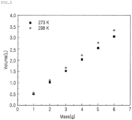
- FIG. 5 is a theoretical graph showing the volume of gas generated by sublimation of dry ice according to the temperature based on the ideal gas equation according to an embodiment of the present disclosure.
- the dry ice occupies a volume of approximately 0.51 L, and when 5 g of dry ice is put into, the dry ice occupies a volume of approximately 2.54 L.
- the ambient temperature of the body portion 10 is 298 K
- the dry ice occupies a volume of approximately 0.56 L
- the dry ice occupies a volume of approximately 2.78 L.
- the amount of dry ice may be adjusted according to the volume of a storage container to ensure safety required for road transport, and as the sublimation speed of dry ice may vary depending on the ambient temperature, if it is necessary to partially adjust the amount of dry ice, the appropriate amount may be adjusted in consideration of the ideal gas equation presented above and the maximum sublimation rate of dry ice of 3 g/min.
- the amount of dry ice determined according to the ideal gas equation as described above may further increase depending on the transport time.
- a step of calculating an appropriate amount of dry ice depending on the travel time on the basis of a weight loss rate of the dry ice over time may be further included.
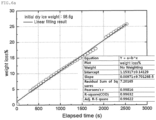
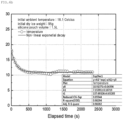
- FIGS. 6a and 6b are graphs of actual measurement results of measuring the weight change rate of dry ice and the temperature change in the storage container according to the embodiment of the present disclosure.
- weight loss % 1.153 + 0.097 ⁇ time seconds
- FIGS. 6a and 6b of this embodiment as a result of putting 95 g of dry ice in a 1.5 L silicone storage pouch and measuring the temperature in real time using a thermocouple, it can be seen that the temperature continuously decreases from the initial ambient temperature of 18.1 °C for 500 seconds and is maintained at about 10.8 °C while balancing with the ambient temperature while dry ice exists. From the result, it can be said that the time point at which the amount of gas generation of CO2, the dilution of oxygen, and the temperature in the 1.5 L container are balanced is approximately 500 seconds. This means that the temperature inside the container may actually drop to about -10 °C compared to the ambient temperature, and it is judged that approximately 140 g of dry ice is required to transport a 1.5 L storage pouch for 4 hours.
Landscapes
- Engineering & Computer Science (AREA)
- Mechanical Engineering (AREA)
- Chemical & Material Sciences (AREA)
- Chemical Kinetics & Catalysis (AREA)
- Electrochemistry (AREA)
- General Chemical & Material Sciences (AREA)
- Battery Mounting, Suspending (AREA)
- Manufacturing & Machinery (AREA)
- Secondary Cells (AREA)
Applications Claiming Priority (2)
| Application Number | Priority Date | Filing Date | Title |
|---|---|---|---|
| KR1020200187698A KR102250245B1 (ko) | 2020-12-30 | 2020-12-30 | 폐이차전지의 안전 이송을 위한 보관 장치 및 방법 |
| PCT/KR2021/020123 WO2022146013A1 (ko) | 2020-12-30 | 2021-12-29 | 폐이차전지의 안전 이송을 위한 보관 장치 및 방법 |
Publications (2)
| Publication Number | Publication Date |
|---|---|
| EP4273068A1 true EP4273068A1 (de) | 2023-11-08 |
| EP4273068A4 EP4273068A4 (de) | 2025-03-19 |
Family
ID=75918361
Family Applications (1)
| Application Number | Title | Priority Date | Filing Date |
|---|---|---|---|
| EP21915811.0A Pending EP4273068A4 (de) | 2020-12-30 | 2021-12-29 | Speichervorrichtung und verfahren zum sicheren transport einer abfallsekundärbatterie |
Country Status (3)
| Country | Link |
|---|---|
| EP (1) | EP4273068A4 (de) |
| KR (1) | KR102250245B1 (de) |
| WO (1) | WO2022146013A1 (de) |
Families Citing this family (3)
| Publication number | Priority date | Publication date | Assignee | Title |
|---|---|---|---|---|
| KR102250245B1 (ko) * | 2020-12-30 | 2021-05-10 | 연세대학교 산학협력단 | 폐이차전지의 안전 이송을 위한 보관 장치 및 방법 |
| KR102473711B1 (ko) | 2022-05-19 | 2022-12-01 | 허민 | 배터리 보관장치 및 그 제어방법 |
| KR20250109075A (ko) | 2024-01-09 | 2025-07-16 | 주식회사 국일인토트 | 배터리 보관 케이스 |
Family Cites Families (6)
| Publication number | Priority date | Publication date | Assignee | Title |
|---|---|---|---|---|
| KR200318529Y1 (ko) * | 2003-04-15 | 2003-06-28 | 김대성 | 저장팩 |
| US7779856B2 (en) * | 2005-10-05 | 2010-08-24 | Societe Bic | Fuel cartridge of a fuel cell with fuel stored outside fuel liner |
| JP2010086885A (ja) * | 2008-10-02 | 2010-04-15 | Sr:Kk | 使用済み電池の保管容器 |
| KR101050007B1 (ko) * | 2008-11-03 | 2011-07-19 | 율촌화학 주식회사 | 셀 포장재 및 그 제조방법 |
| DE102014110654A1 (de) * | 2014-07-29 | 2016-02-04 | Genius Patentverwertung Gmbh & Co. Kg | Vorrichtung und Verfahren zum Transport von galvanischen Zellen |
| KR102250245B1 (ko) * | 2020-12-30 | 2021-05-10 | 연세대학교 산학협력단 | 폐이차전지의 안전 이송을 위한 보관 장치 및 방법 |
-
2020
- 2020-12-30 KR KR1020200187698A patent/KR102250245B1/ko active Active
-
2021
- 2021-12-29 WO PCT/KR2021/020123 patent/WO2022146013A1/ko not_active Ceased
- 2021-12-29 EP EP21915811.0A patent/EP4273068A4/de active Pending
Also Published As
| Publication number | Publication date |
|---|---|
| WO2022146013A1 (ko) | 2022-07-07 |
| KR102250245B1 (ko) | 2021-05-10 |
| EP4273068A4 (de) | 2025-03-19 |
Similar Documents
| Publication | Publication Date | Title |
|---|---|---|
| EP4273068A1 (de) | Speichervorrichtung und verfahren zum sicheren transport einer abfallsekundärbatterie | |
| US11670811B2 (en) | Battery cooling method and system | |
| CN107431157B (zh) | 电池模块 | |
| JP2017523576A (ja) | ガルバニ電池を搬送するための装置および方法 | |
| KR102808772B1 (ko) | 차량 배터리 화재 감지 장치 및 감지 방법 | |
| KR100863401B1 (ko) | 전지의 수송용 포장용기 | |
| CN110335977A (zh) | 惰化含锂电池和相关容器的方法 | |
| KR102738646B1 (ko) | 차량 배터리 화재 감지 장치 및 감지 방법 | |
| US20150207182A1 (en) | Method of manufacturing battery | |
| KR102449106B1 (ko) | 내외부 압력 평형이 가능한 이차 전지 | |
| KR102473711B1 (ko) | 배터리 보관장치 및 그 제어방법 | |
| US20220024674A1 (en) | Shipping package for lithium battery | |
| KR20250060892A (ko) | 극저온 냉동 물질을 수송하는 새로운 시스템 | |
| KR20120058676A (ko) | 안전성이 향상된 리튬 이차전지 및 전지팩 | |
| JP2004071427A (ja) | 緩衝材及びこの緩衝材を充填した電池運搬用容器 | |
| DE102013220957A1 (de) | Batterie und Verfahren zur Sicherung der Batterie sowie Batteriesystem mit der Batterie | |
| KR102871623B1 (ko) | 재활용 이차전지 방전용 자동소화장치 | |
| Jansen et al. | Low-cost, flexible battery packaging materials | |
| KR102748203B1 (ko) | 전지셀 및 이를 포함하는 전지 모듈 | |
| KR20240030537A (ko) | 재사용 배터리 보관 및 운반용 박스 | |
| EP4239775A2 (de) | Behältersystem zum lagern und/oder transportieren einer wiederaufladbaren batterie und verfahren zum lagern und/oder transportieren der wiederaufladbaren batterie | |
| JPH07272704A (ja) | 電池パック | |
| US20250105434A1 (en) | Power storage device | |
| KR20240072715A (ko) | 재활용 이차전지 방전작업용 침수조 | |
| JP2024511347A (ja) | 安全性が向上したバッテリーパック |
Legal Events
| Date | Code | Title | Description |
|---|---|---|---|
| STAA | Information on the status of an ep patent application or granted ep patent |
Free format text: STATUS: THE INTERNATIONAL PUBLICATION HAS BEEN MADE |
|
| PUAI | Public reference made under article 153(3) epc to a published international application that has entered the european phase |
Free format text: ORIGINAL CODE: 0009012 |
|
| STAA | Information on the status of an ep patent application or granted ep patent |
Free format text: STATUS: REQUEST FOR EXAMINATION WAS MADE |
|
| 17P | Request for examination filed |
Effective date: 20230727 |
|
| AK | Designated contracting states |
Kind code of ref document: A1 Designated state(s): AL AT BE BG CH CY CZ DE DK EE ES FI FR GB GR HR HU IE IS IT LI LT LU LV MC MK MT NL NO PL PT RO RS SE SI SK SM TR |
|
| DAV | Request for validation of the european patent (deleted) | ||
| DAX | Request for extension of the european patent (deleted) | ||
| REG | Reference to a national code |
Ref country code: DE Ref legal event code: R079 Free format text: PREVIOUS MAIN CLASS: B65D0085680000 Ipc: B65D0081180000 |
|
| A4 | Supplementary search report drawn up and despatched |
Effective date: 20250218 |
|
| RIC1 | Information provided on ipc code assigned before grant |
Ipc: H01M 10/052 20100101ALI20250212BHEP Ipc: H01M 50/20 20210101ALI20250212BHEP Ipc: B65D 81/18 20060101AFI20250212BHEP |
|
| GRAP | Despatch of communication of intention to grant a patent |
Free format text: ORIGINAL CODE: EPIDOSNIGR1 |
|
| STAA | Information on the status of an ep patent application or granted ep patent |
Free format text: STATUS: GRANT OF PATENT IS INTENDED |
|
| INTG | Intention to grant announced |
Effective date: 20260102 |
|
| GRAS | Grant fee paid |
Free format text: ORIGINAL CODE: EPIDOSNIGR3 |
|
| GRAA | (expected) grant |
Free format text: ORIGINAL CODE: 0009210 |
|
| STAA | Information on the status of an ep patent application or granted ep patent |
Free format text: STATUS: THE PATENT HAS BEEN GRANTED |