EP4273131B1 - Procédés et intermédiaires pour la préparation d'analogues de carbaprostacycline - Google Patents
Procédés et intermédiaires pour la préparation d'analogues de carbaprostacycline Download PDFInfo
- Publication number
- EP4273131B1 EP4273131B1 EP23165427.8A EP23165427A EP4273131B1 EP 4273131 B1 EP4273131 B1 EP 4273131B1 EP 23165427 A EP23165427 A EP 23165427A EP 4273131 B1 EP4273131 B1 EP 4273131B1
- Authority
- EP
- European Patent Office
- Prior art keywords
- formula
- compound
- reaction
- alkyl
- mixture
- Prior art date
- Legal status (The legal status is an assumption and is not a legal conclusion. Google has not performed a legal analysis and makes no representation as to the accuracy of the status listed.)
- Active
Links
Classifications
-
- C—CHEMISTRY; METALLURGY
- C07—ORGANIC CHEMISTRY
- C07C—ACYCLIC OR CARBOCYCLIC COMPOUNDS
- C07C49/00—Ketones; Ketenes; Dimeric ketenes; Ketonic chelates
- C07C49/587—Unsaturated compounds containing a keto groups being part of a ring
- C07C49/703—Unsaturated compounds containing a keto groups being part of a ring containing hydroxy groups
- C07C49/743—Unsaturated compounds containing a keto groups being part of a ring containing hydroxy groups having unsaturation outside the rings, e.g. humulones, lupulones
-
- C—CHEMISTRY; METALLURGY
- C07—ORGANIC CHEMISTRY
- C07D—HETEROCYCLIC COMPOUNDS
- C07D307/00—Heterocyclic compounds containing five-membered rings having one oxygen atom as the only ring hetero atom
- C07D307/02—Heterocyclic compounds containing five-membered rings having one oxygen atom as the only ring hetero atom not condensed with other rings
- C07D307/04—Heterocyclic compounds containing five-membered rings having one oxygen atom as the only ring hetero atom not condensed with other rings having no double bonds between ring members or between ring members and non-ring members
- C07D307/10—Heterocyclic compounds containing five-membered rings having one oxygen atom as the only ring hetero atom not condensed with other rings having no double bonds between ring members or between ring members and non-ring members with substituted hydrocarbon radicals attached to ring carbon atoms
- C07D307/16—Radicals substituted by carbon atoms having three bonds to hetero atoms with at the most one bond to halogen, e.g. ester or nitrile radicals
-
- C—CHEMISTRY; METALLURGY
- C07—ORGANIC CHEMISTRY
- C07C—ACYCLIC OR CARBOCYCLIC COMPOUNDS
- C07C49/00—Ketones; Ketenes; Dimeric ketenes; Ketonic chelates
- C07C49/527—Unsaturated compounds containing keto groups bound to rings other than six-membered aromatic rings
- C07C49/573—Unsaturated compounds containing keto groups bound to rings other than six-membered aromatic rings containing hydroxy groups
-
- C—CHEMISTRY; METALLURGY
- C07—ORGANIC CHEMISTRY
- C07C—ACYCLIC OR CARBOCYCLIC COMPOUNDS
- C07C49/00—Ketones; Ketenes; Dimeric ketenes; Ketonic chelates
- C07C49/587—Unsaturated compounds containing a keto groups being part of a ring
- C07C49/597—Unsaturated compounds containing a keto groups being part of a ring of a five-membered ring
-
- C—CHEMISTRY; METALLURGY
- C07—ORGANIC CHEMISTRY
- C07B—GENERAL METHODS OF ORGANIC CHEMISTRY; APPARATUS THEREFOR
- C07B57/00—Separation of optically-active compounds
-
- C—CHEMISTRY; METALLURGY
- C07—ORGANIC CHEMISTRY
- C07C—ACYCLIC OR CARBOCYCLIC COMPOUNDS
- C07C33/00—Unsaturated compounds having hydroxy or O-metal groups bound to acyclic carbon atoms
- C07C33/05—Alcohols containing rings other than six-membered aromatic rings
- C07C33/12—Alcohols containing rings other than six-membered aromatic rings containing five-membered rings
-
- C—CHEMISTRY; METALLURGY
- C07—ORGANIC CHEMISTRY
- C07C—ACYCLIC OR CARBOCYCLIC COMPOUNDS
- C07C405/00—Compounds containing a five-membered ring having two side-chains in ortho position to each other, and having oxygen atoms directly attached to the ring in ortho position to one of the side-chains, one side-chain containing, not directly attached to the ring, a carbon atom having three bonds to hetero atoms with at the most one bond to halogen, and the other side-chain having oxygen atoms attached in gamma-position to the ring, e.g. prostaglandins ; Analogues or derivatives thereof
-
- C—CHEMISTRY; METALLURGY
- C07—ORGANIC CHEMISTRY
- C07C—ACYCLIC OR CARBOCYCLIC COMPOUNDS
- C07C49/00—Ketones; Ketenes; Dimeric ketenes; Ketonic chelates
- C07C49/587—Unsaturated compounds containing a keto groups being part of a ring
- C07C49/703—Unsaturated compounds containing a keto groups being part of a ring containing hydroxy groups
- C07C49/707—Unsaturated compounds containing a keto groups being part of a ring containing hydroxy groups a keto group being part of a three- to five-membered ring
-
- C—CHEMISTRY; METALLURGY
- C07—ORGANIC CHEMISTRY
- C07C—ACYCLIC OR CARBOCYCLIC COMPOUNDS
- C07C51/00—Preparation of carboxylic acids or their salts, halides or anhydrides
- C07C51/09—Preparation of carboxylic acids or their salts, halides or anhydrides from carboxylic acid esters or lactones
-
- C—CHEMISTRY; METALLURGY
- C07—ORGANIC CHEMISTRY
- C07C—ACYCLIC OR CARBOCYCLIC COMPOUNDS
- C07C59/00—Compounds having carboxyl groups bound to acyclic carbon atoms and containing any of the groups OH, O—metal, —CHO, keto, ether, groups, groups, or groups
- C07C59/40—Unsaturated compounds
- C07C59/42—Unsaturated compounds containing hydroxy or O-metal groups
- C07C59/46—Unsaturated compounds containing hydroxy or O-metal groups containing rings other than six-membered aromatic rings
-
- C—CHEMISTRY; METALLURGY
- C07—ORGANIC CHEMISTRY
- C07C—ACYCLIC OR CARBOCYCLIC COMPOUNDS
- C07C59/00—Compounds having carboxyl groups bound to acyclic carbon atoms and containing any of the groups OH, O—metal, —CHO, keto, ether, groups, groups, or groups
- C07C59/40—Unsaturated compounds
- C07C59/58—Unsaturated compounds containing ether groups, groups, groups, or groups
- C07C59/62—Unsaturated compounds containing ether groups, groups, groups, or groups containing rings other than six-membered aromatic rings
-
- C—CHEMISTRY; METALLURGY
- C07—ORGANIC CHEMISTRY
- C07C—ACYCLIC OR CARBOCYCLIC COMPOUNDS
- C07C59/00—Compounds having carboxyl groups bound to acyclic carbon atoms and containing any of the groups OH, O—metal, —CHO, keto, ether, groups, groups, or groups
- C07C59/40—Unsaturated compounds
- C07C59/74—Unsaturated compounds containing —CHO groups
-
- C—CHEMISTRY; METALLURGY
- C07—ORGANIC CHEMISTRY
- C07C—ACYCLIC OR CARBOCYCLIC COMPOUNDS
- C07C67/00—Preparation of carboxylic acid esters
- C07C67/30—Preparation of carboxylic acid esters by modifying the acid moiety of the ester, such modification not being an introduction of an ester group
- C07C67/31—Preparation of carboxylic acid esters by modifying the acid moiety of the ester, such modification not being an introduction of an ester group by introduction of functional groups containing oxygen only in singly bound form
-
- C—CHEMISTRY; METALLURGY
- C07—ORGANIC CHEMISTRY
- C07C—ACYCLIC OR CARBOCYCLIC COMPOUNDS
- C07C67/00—Preparation of carboxylic acid esters
- C07C67/30—Preparation of carboxylic acid esters by modifying the acid moiety of the ester, such modification not being an introduction of an ester group
- C07C67/333—Preparation of carboxylic acid esters by modifying the acid moiety of the ester, such modification not being an introduction of an ester group by isomerisation; by change of size of the carbon skeleton
-
- C—CHEMISTRY; METALLURGY
- C07—ORGANIC CHEMISTRY
- C07C—ACYCLIC OR CARBOCYCLIC COMPOUNDS
- C07C69/00—Esters of carboxylic acids; Esters of carbonic or haloformic acids
- C07C69/66—Esters of carboxylic acids having esterified carboxylic groups bound to acyclic carbon atoms and having any of the groups OH, O—metal, —CHO, keto, ether, acyloxy, groups, groups, or in the acid moiety
- C07C69/73—Esters of carboxylic acids having esterified carboxylic groups bound to acyclic carbon atoms and having any of the groups OH, O—metal, —CHO, keto, ether, acyloxy, groups, groups, or in the acid moiety of unsaturated acids
- C07C69/732—Esters of carboxylic acids having esterified carboxylic groups bound to acyclic carbon atoms and having any of the groups OH, O—metal, —CHO, keto, ether, acyloxy, groups, groups, or in the acid moiety of unsaturated acids of unsaturated hydroxy carboxylic acids
-
- C—CHEMISTRY; METALLURGY
- C07—ORGANIC CHEMISTRY
- C07C—ACYCLIC OR CARBOCYCLIC COMPOUNDS
- C07C69/00—Esters of carboxylic acids; Esters of carbonic or haloformic acids
- C07C69/66—Esters of carboxylic acids having esterified carboxylic groups bound to acyclic carbon atoms and having any of the groups OH, O—metal, —CHO, keto, ether, acyloxy, groups, groups, or in the acid moiety
- C07C69/73—Esters of carboxylic acids having esterified carboxylic groups bound to acyclic carbon atoms and having any of the groups OH, O—metal, —CHO, keto, ether, acyloxy, groups, groups, or in the acid moiety of unsaturated acids
- C07C69/738—Esters of keto-carboxylic acids or aldehydo-carboxylic acids
-
- C—CHEMISTRY; METALLURGY
- C07—ORGANIC CHEMISTRY
- C07C—ACYCLIC OR CARBOCYCLIC COMPOUNDS
- C07C69/00—Esters of carboxylic acids; Esters of carbonic or haloformic acids
- C07C69/74—Esters of carboxylic acids having an esterified carboxyl group bound to a carbon atom of a ring other than a six-membered aromatic ring
-
- C—CHEMISTRY; METALLURGY
- C07—ORGANIC CHEMISTRY
- C07D—HETEROCYCLIC COMPOUNDS
- C07D307/00—Heterocyclic compounds containing five-membered rings having one oxygen atom as the only ring hetero atom
- C07D307/02—Heterocyclic compounds containing five-membered rings having one oxygen atom as the only ring hetero atom not condensed with other rings
- C07D307/04—Heterocyclic compounds containing five-membered rings having one oxygen atom as the only ring hetero atom not condensed with other rings having no double bonds between ring members or between ring members and non-ring members
- C07D307/10—Heterocyclic compounds containing five-membered rings having one oxygen atom as the only ring hetero atom not condensed with other rings having no double bonds between ring members or between ring members and non-ring members with substituted hydrocarbon radicals attached to ring carbon atoms
- C07D307/12—Radicals substituted by oxygen atoms
-
- C—CHEMISTRY; METALLURGY
- C07—ORGANIC CHEMISTRY
- C07D—HETEROCYCLIC COMPOUNDS
- C07D307/00—Heterocyclic compounds containing five-membered rings having one oxygen atom as the only ring hetero atom
- C07D307/02—Heterocyclic compounds containing five-membered rings having one oxygen atom as the only ring hetero atom not condensed with other rings
- C07D307/34—Heterocyclic compounds containing five-membered rings having one oxygen atom as the only ring hetero atom not condensed with other rings having two or three double bonds between ring members or between ring members and non-ring members
- C07D307/38—Heterocyclic compounds containing five-membered rings having one oxygen atom as the only ring hetero atom not condensed with other rings having two or three double bonds between ring members or between ring members and non-ring members with substituted hydrocarbon radicals attached to ring carbon atoms
- C07D307/40—Radicals substituted by oxygen atoms
- C07D307/42—Singly bound oxygen atoms
-
- C—CHEMISTRY; METALLURGY
- C07—ORGANIC CHEMISTRY
- C07F—ACYCLIC, CARBOCYCLIC OR HETEROCYCLIC COMPOUNDS CONTAINING ELEMENTS OTHER THAN CARBON, HYDROGEN, HALOGEN, OXYGEN, NITROGEN, SULFUR, SELENIUM OR TELLURIUM
- C07F7/00—Compounds containing elements of Groups 4 or 14 of the Periodic Table
- C07F7/02—Silicon compounds
- C07F7/08—Compounds having one or more C—Si linkages
- C07F7/18—Compounds having one or more C—Si linkages as well as one or more C—O—Si linkages
- C07F7/1804—Compounds having Si-O-C linkages
-
- C—CHEMISTRY; METALLURGY
- C07—ORGANIC CHEMISTRY
- C07F—ACYCLIC, CARBOCYCLIC OR HETEROCYCLIC COMPOUNDS CONTAINING ELEMENTS OTHER THAN CARBON, HYDROGEN, HALOGEN, OXYGEN, NITROGEN, SULFUR, SELENIUM OR TELLURIUM
- C07F7/00—Compounds containing elements of Groups 4 or 14 of the Periodic Table
- C07F7/02—Silicon compounds
- C07F7/08—Compounds having one or more C—Si linkages
- C07F7/18—Compounds having one or more C—Si linkages as well as one or more C—O—Si linkages
- C07F7/1804—Compounds having Si-O-C linkages
- C07F7/1872—Preparation; Treatments not provided for in C07F7/20
- C07F7/188—Preparation; Treatments not provided for in C07F7/20 by reactions involving the formation of Si-O linkages
-
- C—CHEMISTRY; METALLURGY
- C07—ORGANIC CHEMISTRY
- C07F—ACYCLIC, CARBOCYCLIC OR HETEROCYCLIC COMPOUNDS CONTAINING ELEMENTS OTHER THAN CARBON, HYDROGEN, HALOGEN, OXYGEN, NITROGEN, SULFUR, SELENIUM OR TELLURIUM
- C07F7/00—Compounds containing elements of Groups 4 or 14 of the Periodic Table
- C07F7/02—Silicon compounds
- C07F7/08—Compounds having one or more C—Si linkages
- C07F7/18—Compounds having one or more C—Si linkages as well as one or more C—O—Si linkages
- C07F7/1804—Compounds having Si-O-C linkages
- C07F7/1872—Preparation; Treatments not provided for in C07F7/20
- C07F7/1892—Preparation; Treatments not provided for in C07F7/20 by reactions not provided for in C07F7/1876 - C07F7/1888
-
- C—CHEMISTRY; METALLURGY
- C12—BIOCHEMISTRY; BEER; SPIRITS; WINE; VINEGAR; MICROBIOLOGY; ENZYMOLOGY; MUTATION OR GENETIC ENGINEERING
- C12P—FERMENTATION OR ENZYME-USING PROCESSES TO SYNTHESISE A DESIRED CHEMICAL COMPOUND OR COMPOSITION OR TO SEPARATE OPTICAL ISOMERS FROM A RACEMIC MIXTURE
- C12P41/00—Processes using enzymes or microorganisms to separate optical isomers from a racemic mixture
- C12P41/003—Processes using enzymes or microorganisms to separate optical isomers from a racemic mixture by ester formation, lactone formation or the inverse reactions
- C12P41/004—Processes using enzymes or microorganisms to separate optical isomers from a racemic mixture by ester formation, lactone formation or the inverse reactions by esterification of alcohol- or thiol groups in the enantiomers or the inverse reaction
-
- C—CHEMISTRY; METALLURGY
- C12—BIOCHEMISTRY; BEER; SPIRITS; WINE; VINEGAR; MICROBIOLOGY; ENZYMOLOGY; MUTATION OR GENETIC ENGINEERING
- C12P—FERMENTATION OR ENZYME-USING PROCESSES TO SYNTHESISE A DESIRED CHEMICAL COMPOUND OR COMPOSITION OR TO SEPARATE OPTICAL ISOMERS FROM A RACEMIC MIXTURE
- C12P7/00—Preparation of oxygen-containing organic compounds
- C12P7/24—Preparation of oxygen-containing organic compounds containing a carbonyl group
- C12P7/26—Ketones
-
- C—CHEMISTRY; METALLURGY
- C12—BIOCHEMISTRY; BEER; SPIRITS; WINE; VINEGAR; MICROBIOLOGY; ENZYMOLOGY; MUTATION OR GENETIC ENGINEERING
- C12P—FERMENTATION OR ENZYME-USING PROCESSES TO SYNTHESISE A DESIRED CHEMICAL COMPOUND OR COMPOSITION OR TO SEPARATE OPTICAL ISOMERS FROM A RACEMIC MIXTURE
- C12P7/00—Preparation of oxygen-containing organic compounds
- C12P7/24—Preparation of oxygen-containing organic compounds containing a carbonyl group
- C12P7/26—Ketones
- C12P7/38—Cyclopentanone- or cyclopentadione-containing products
-
- C—CHEMISTRY; METALLURGY
- C12—BIOCHEMISTRY; BEER; SPIRITS; WINE; VINEGAR; MICROBIOLOGY; ENZYMOLOGY; MUTATION OR GENETIC ENGINEERING
- C12P—FERMENTATION OR ENZYME-USING PROCESSES TO SYNTHESISE A DESIRED CHEMICAL COMPOUND OR COMPOSITION OR TO SEPARATE OPTICAL ISOMERS FROM A RACEMIC MIXTURE
- C12P7/00—Preparation of oxygen-containing organic compounds
- C12P7/62—Carboxylic acid esters
-
- C—CHEMISTRY; METALLURGY
- C07—ORGANIC CHEMISTRY
- C07B—GENERAL METHODS OF ORGANIC CHEMISTRY; APPARATUS THEREFOR
- C07B2200/00—Indexing scheme relating to specific properties of organic compounds
- C07B2200/07—Optical isomers
-
- C—CHEMISTRY; METALLURGY
- C07—ORGANIC CHEMISTRY
- C07C—ACYCLIC OR CARBOCYCLIC COMPOUNDS
- C07C2601/00—Systems containing only non-condensed rings
- C07C2601/06—Systems containing only non-condensed rings with a five-membered ring
- C07C2601/10—Systems containing only non-condensed rings with a five-membered ring the ring being unsaturated
-
- C—CHEMISTRY; METALLURGY
- C07—ORGANIC CHEMISTRY
- C07C—ACYCLIC OR CARBOCYCLIC COMPOUNDS
- C07C2602/00—Systems containing two condensed rings
- C07C2602/02—Systems containing two condensed rings the rings having only two atoms in common
- C07C2602/14—All rings being cycloaliphatic
- C07C2602/22—All rings being cycloaliphatic the ring system containing eight carbon atoms, e.g. pentalene
Definitions
- Step 8 of Scheme A pertains to a Piancatelli rearrangement.
- the reaction may be carried out in a suitable phosphate buffer solution, and is then heated to reflux.
- a suitable phosphate buffer solution may be prepared with K 2 HPO 4 and H 3 PO 4 with a pH of about 2.0 to 4.5 in this step.
- Step 9 of Scheme A pertains to an isomerization rearrangement.
- the reaction may be carried out by using chloral hydride and triethyl amine in tetrahydrofuran.
- Step 10 of Scheme A pertains to a silylation reaction.
- the reaction may be carried out by using tert-butyldimethylsilyl chloride and imidazole in tetrahydrofuran at less than 20°C.
- the primary alcohol can be protected first to form the compound of Formula 1b .
- a compound of Formula ( R )-1 enriched in the (R)-enantiomer and having an optical purity of at least 95% enantiomeric excess, preferably at least about 99% enantiomeric excess, and most preferably at least about 99.9% enantiomeric excess, can be prepared from the starting compound of Formula 1, the compound of Formula ( R )-1 having the following structure: wherein Y is -CH 2 OP or -COOR 1 , X is F, Cl, Br, I, or -OTs; P 1 is H or a hydroxyl protective group; and R 1 is C 1-7 -alkyl, aryl or aralkyl, each of which is unsubstituted or substituted by C 1-4 -alkyl, C 2-7 -alkenyl, C 2-7 -alkynyl, nitro, halogen or alkoxy, the process comprising the steps of:
- the acyl donor of Formula D may be vinyl acetate, isopropenyl acetate, vinyl valerate, isopropenyl valerate, vinyl butyrate, isopropenyl butyrate or a mixture thereof.
- the first lipase is commercially available and may be derived from Burkholderia cepacia, Candida antarcitica, Alcaligenese sp., Pseudomonas stutzri, Pseudomonas cepacia or a mixture thereof.
- the removing step (2) comprises converting the unreacted ( S )-alcohol into a corresponding ( R )-ester by reacting the ( S )-alcohol with an acyloxy donor of Formula R 4 COOH, wherein R 4 is H or C 1-6 alkyl, in the presence of dialkylazodicarboxylate and trialkyl/triaryl phosphine.
- a suitable dialkylazodicarboxylate includes, but is not limited to, dimethyl azodicarboxylate (DMAD), diethyl azodicarboxylate (DEAD), diisopropyl azodicarboxylate (DIAD), di- tert -butyl azodicarboxylate (DTBAD), dibenzyl azodicarboxylate (DBAD), bis-trichloroethyl azodicarboxylate (BTCEAD), di-p-chlorobenzyl azodicarboxylate (DCAD), di-4-nitrobenzyl azodicarboxylate (DNAD), dicyclopentyl azodicarboxylate (DCpAD), and a mixture thereof; and preferably diethyl azodicarboxylate, diisopropyl azodicarboxylate, dibenzyl azodicarboxylate, and a mixture thereof.
- a suitable trialkyl/triaryl phosphine includes, but is not
- the deacylation step (3) comprises an enzymatic cleavage reaction using a second lipase derived from Candida cylindracea, Pseudomonas stutzri, Alcaligenese sp., Achromobacter sp., Burkholderia cepacia, Candida antarcitica or a mixture thereof, preferably Candida antarcitica.
- the deacylation step (3) is a chemical hydrolysis.
- Scheme C depicts a process for preparing an optically active cyclopentenone of Formula ( R )-1b.
- the racemic cyclopentenone of Formula ( ⁇ )-1b can be chirally resolved to form a cyclopentenone enriched in the ( R )-enantiomer and having a high optical purity.
- the racemic compound of Formula ( ⁇ )-1b is resolved via enantioselective esterification (step 1) by using a first lipase to form a mixture of unreacted alcohol of Formula ( S )-1b and a compound of Formula ( R )-1c.
- step 2 the mixture can directly undergo a Mitsunobu reaction (step 2) to convert the alcohol of Formula ( S )-1b into the compound of Formula ( R )-1c.
- step 3 the compound of Formula ( R )-1c is deacylated to form the compound of Formula ( R )-1b having a high optical purity by using a chemical hydrolysis reaction or an enzymatic cleavage reaction (step 3),
- step 1 of Scheme C the enantioselective esterification of the cyclopentenone of Formula ( ⁇ )-1b is performed with an acyl donor of Formula D, wherein R 4 and R 5 are independently H or C 1-6 alkyl, in the presence of a first lipase, wherein the acyl donor preferentially reacts with the cyclopentenone in ( R )-form, thereby generating a mixture essentially consisting of an optically active ester of Formula ( R )-1c and an unreacted alcohol of Formula ( S )-1b,
- a suitable first lipase is commercially available and may be derived from Burkholderia cepacia, Candida antarcitica, Alcaligenese sp., Pseudomonas stutzri, Pseudomonas cepacia or a mixture thereof, preferably Alcaligenese sp. or Burkholderia cepacia, and most preferably Burkholderia cepacia.
- a suitable acyl donor includes, but is not limited to, vinyl acetate, isopropenyl acetate, vinyl valerate, isopropenyl valerate, vinyl butyrate, isopropenyl butyrate, and a mixture thereof, and vinyl acetate is particularly preferable.
- the enantioselective esterification reaction may be performed in a single organic solvent or a mixture of organic solvents, such as hexane, cyclohexane, toluene, tetrahydrofuran, methyl ethyl ketone, methyl isobutyl ketone, ether, isopropyl ether, methyl isopropyl ether, tert -butyl methyl ether, and a mixture thereof.
- An appropriate reaction temperature ranges from about 5°C to about 50°C, preferably at ambient temperature.
- Step 2 of Scheme C pertains to a Mitsunobu reaction.
- the unreacted alcohol of Formula ( S )-1b can be treated with an acyloxy donor of Formula R 4 COOH (wherein R 4 is H or C 1-6 alkyl), to convert it into the compound of Formula ( R )-1c, in the presence of dialkyl azodicarboxylate and trialkyl/triaryl phosphine in a suitable solvent.
- R 4 COOH wherein R 4 is H or C 1-6 alkyl
- a suitable dialkyl azodicarboxylate includes, but is not limited to, dimethyl azodicarboxylate (DMAD), diethyl azodicarboxylate (DEAD), diisopropyl azodicarboxylate (DIAD), di- tert -butyl azodicarboxylate (DTBAD), dibenzyl azodicarboxylate (DBAD), bis-trichloroethyl azodicarboxylate (BTCEAD), di-p-chlorobenzyl azodicarboxylate (DCAD), di-4-nitrobenzyl azodicarboxylate (DNAD), dicyclopentyl azodicarboxylate (DCpAD), and a mixture thereof; and preferably diethyl azodicarboxylate, diisopropyl azodicarboxylate, dibenzyl azodicarboxylate, and a mixture thereof.
- DMAD dimethyl azodicarboxylate
- DEAD dieth
- a suitable trialkyl/triaryl phosphine includes, but is not limited to, tri-n -butyl phosphine, triphenylphosphine, and a mixture thereof; and preferably triphenylphosphine.
- a suitable solvent in the Mitsunobu reaction includes, but is not limited to, tetrahydrofuran, toluene, benzene, dimethylformamide, diethyl ether, acetonitrile, dichloromethane, and a mixture thereof.
- the Mitsunobu reaction is preferably carried out at an appropriate temperature ranging from about -30°C to about 70°C, preferably at ambient temperature.
- Step 3 of Scheme C pertains to a deacylation reaction.
- the deacylation reaction in Step 3 of Scheme C is a chemical hydrolysis in the presence of an alcohol and a base such as lithium hydroxide, sodium hydroxide, or potassium hydroxide.
- the deacylation reaction in step 3 of Scheme C is an enzymatic cleavage reaction.
- the enzymatic cleavage reaction can be performed in the presence of a second lipase in a suitable organic solvent or an aqueous system at an appropriate temperature to obtain the compound of Formula ( R )-1b.
- a suitable second lipase is commercially available and can be derived from Candida cylindracea, Pseudomonas stutzri, Alcaligenese sp., Achromobacter sp., Burkholderia cepacia, Candida antarcitica or a mixture thereof; and preferably from Alcaligenese sp., Burkholderia cepacia, Candida antarcitica, or a mixture thereof; and most preferably from Burkholderia cepacia.
- the suitable organic solvent and the appropriate temperature in this step are obvious in the art.
- the deacetylation reaction is monitored for the purpose of an optical purity of the resultant compound of Formula ( R )-1b.
- the deacetylation reaction is monitored by HPLC using a chiral column and stopped by removing the second lipase, preferably when the optical purity of the resultant compound decreases to about 95% e.e., preferably about 99% e.e., and more preferably about 99.9% e.e.
- the unreacted ester of Formula ( R )-1c and it's enantiomer can be removed such as by column chromatography after the deacetylation reaction.
- the compound of Formula ( R )-1b is produced with an optical activity of at least about 95% e.e., preferably at least about 99% e.e., and most preferably at least about 99.9% e.e.
- the methylene group can also be introduced by a two-step procedure as taught by Johnson in J. Am. Chem. Soc. 95, 6462(1973 ).
- the cyclopentanone of Formula 2 is reacted with an anion of methylphenyl-N-methyl-sulfoximine in a suitable solvent followed by treatment of the resulting crude adduct with aluminum amalgam in a solvent mixture of water-acetic acid-tetrahydrofuran so as to obtain the compound of Formula 3.
- the compound of Formula 3a' is subjected to an intramolecular Suzuki cross-coupling reaction with a boron reagent, 9-borabicyclo[3.3.1]nonane (9-BBN), in the presence of Pd(dppf) 2 Cl 2 and Na 2 CO 3 , to form the compound of Formula 4a' (step 3).
- a boron reagent 9-borabicyclo[3.3.1]nonane (9-BBN)
- Pd(dppf) 2 Cl 2 and Na 2 CO 3 9-borabicyclo[3.3.1]nonane
- the process of the present invention comprises fewer steps and has higher yields, and the geometric isomer ( Z -isomer) in the resultant crude 16 S -Iloprost can be controlled to be less than 0.6% such that an expensive preparative HPLC method is unnecessary and thus the costs for separation and purification of 16S-Iloprost can be significantly reduced.
- the synthesis of the compound of Formula 4b starts from an optically enriched compound of Formula ( R )-1, wherein Y is -CH 2 OP or -COOR 1 ; X is F, Cl, Br, I, or -OTs; P 1 is a hydroxyl protective group; P is H or a hydroxyl protective group; R 1 is C 1-7 -alkyl, aryl or aralkyl, each of which is unsubstituted or substituted by C 1-4 -alkyl, C 2-7 -alkenyl, C 2-7 -alkynyl, nitro, halogen or alkoxy, and a optically enriched (3 S, 4S and 4R)-compound of Formula L 1b , Formula L 2b or Formula L 3b , wherein X 1 is Cl, Br, or I; and P 2 is a hydroxyl protective group, in the same manufacturing process as shown in Scheme G or H.
- the compound of Formula 4b can be prepared according to the reactions shown in Scheme J via a coupling reaction to form a compound of Formula 2b (step 1). Thereafter, the compound of Formula 2b is subjected to an olefination reaction (step 2) and an intramolecular cyclization reaction (step 3) to form a compound of Formula 4b.
- the present invention provides a process for preparing a compound of Formula 4b: wherein Y is -CH 2 OP or -COOR 1 ; P is H or a hydroxyl protective group; and R 1 is C 1-7 -alkyl, aryl or aralkyl, each of which is unsubstituted or substituted by C 1-4 -alkyl, C 2-7 -alkenyl, C 2-7 -alkynyl, nitro, halogen or alkoxy, the process comprising the steps of:
- the intramolecular cyclization reaction comprises the steps of:
- the compound of Formula 4b' is prepared from the compound of Formula ( R )-1" , which contains less than 0.5% geometric isomer ( E -isomer), and a cuprate derived from a vinyl stannane of Formula L 2b via a coupling reaction to form a compound of Formula 2b' (step 1).
- the coupling product of Formula 2b' is converted to a compound of Formula 3b' comprising a terminal double bond under an olefination conditions with CH 2 Br 2 -Zn, in good yields in the presence of a Lewis acid, such as TiCl 4 (step 2).
- the compound of Formula 3b' is subjected to an intramolecular Suzuki cross-coupling reaction with a boron reagent, 9-borabicyclo[3.3.1]nonane (9-BBN), in the presence of Pd(dppf) 2 Cl 2 and Na 2 CO 3 , to form the compound of Formula 4b' (step 3).
- a boron reagent 9-borabicyclo[3.3.1]nonane (9-BBN)
- the compound of Formula 3b' is also subjected to an intramolecular cross-coupling reaction.
- the intramolecular cross-coupling reaction involves three stages, hydroboration-oxidation (step 3-1), alkyl sulfonation (step 3-2) and intramolecular cross-coupling reaction (step 3-3) as shown in Scheme J-2.
- Step 3-1 of Scheme J-2 pertains to a hydroboration-oxidation reaction.
- the compound of Formula 3b' is reacted with a boron reagent, followed by oxidation with basic hydrogen peroxide so as to give the alcohol compound of Formula 3b'-1.
- a suitable boron reagent includes, but is not limited to, Py 2 BH 2 , sodium tetrahydroborate, borane-THF, borane-DMS and 9-BBN.
- Step 3-2 of Scheme J-2 the alcohol compound of Formula 3b'-1 is further subjected to a sulfonylation reaction to obtain a compound of Formula 3b'-2, wherein Z is a sulfonyl group consisting of alkylsulfonyl, arylsulfonyl and aralkylsulfonyl, such as methanesulfonyl or p -toluenesulfonyl.
- Z is a sulfonyl group consisting of alkylsulfonyl, arylsulfonyl and aralkylsulfonyl, such as methanesulfonyl or p -toluenesulfonyl.
- the sulfonylation reaction is achieved in the presence of a base, such as an amine, e.g., triethylamine, by using an appropriate sulfonyl donor, such as methanesulfonyl chloride or p -toluenesulfonyl chloride.
- a base such as an amine, e.g., triethylamine
- an appropriate sulfonyl donor such as methanesulfonyl chloride or p -toluenesulfonyl chloride.
- Step 3-3 of Scheme J-2 pertains to an intramolecular cross-coupling reaction.
- a carbaprostacyclin analogues analogue of Formula 4b' is prepared by an intramolecular cyclization reaction of the compound of Formula 3b'-2 in the presence of a suitable base condition.
- the intramolecular cyclization reaction is achieved by using a suitable base in a suitable solvent at a temperature ranging from about -70°C to about -50°C.
- a suitable base includes, but is not limited to, n -butyllithium, sec-butyllithium, tert -butyllithium, and a mixture thereof.
- a suitable solvent includes, but is not limited to, tetrahydrofuran, ether, toluene, and a mixture thereof.
- Step 2 of Scheme K pertains to an oxidation reaction.
- the primary alcohol Formula 5b is oxidized to form the protected Iloprost of Formula 6b comprising a carbonyl acid group by using 2,2,6,6-tetramethylpiperidine-1-oxyl(TEMPO)/bis(acetoxy)iodobenzene (BAIB) oxidation conditions. Therefore, an acid or TBAF is used to remove the TBS protective group so as to form Iloprost (step 3).
- the process of the present invention comprises fewer steps and has higher yields, and the geometric isomer ( Z -isomer) in the resultant crude Iloprost can be controlled to be less than 0.6% such that an expensive preparative HPLC method is unnecessary and thus the costs for separation and purification of Iloprost can be significantly reduced.
- Scheme L depicts the synthesis of Iloprost from the compound of Formula ( R )-1' (Y is -COOR 1 and R 1 is methyl in Formula (R)-1 ) .
- the methyl ester of TBS-protected 16 S - Iloprost of Formula 4b' is prepared from the compound of Formula ( R )-1', which contains less than 0.5% geometric isomer ( E -isomer), and a cuprate derived from a vinyl stannane of Formula L 2a , which contains less than 0.2% (3 R )-enantiomer, via a coupling reaction to form a compound of Formula 2b' (step 1).
- the coupling product of Formula 2b' is converted to the compound of Formula 3b' comprising a terminal double bond under olefination conditions with CH 2 Br 2 -Zn in good yields in the presence of a Lewis acid, such as TiCl 4 (step 2).
- the compound of Formula 3b' is subjected to an intramolecular Suzuki cross-coupling reaction with a boron reagent, 9-borabicyclo[3.3.1]nonane (9-BBN), in the presence of Pd(dppf) 2 Cl 2 and Na 2 CO 3 , to form the compound of Formula 4b' (step 3).
- TBAF is used to remove the TBS protective group of the compound of Formula 4b' to form the compound of Formula 5b' (step 4) and a hydrolysis step is carried out under alkaline conditions to form Iloprost (step 5).
- the process of the present invention comprises fewer steps and has higher yields, and the geometric isomer ( Z -isomer) can be controlled to be less than 0.6%, and the 15-epi-Iloprost can be controlled to less than 0.2% such that an expensive preparative HPLC method is unnecessary, and thus the costs for separation and purification of Iloprost can be significantly reduced.
- reaction mixture warm to 0°C and keep stir for 1 hour at the same temperature.
- the completion of reaction was confirmed by TLC monitor.
- the reaction mixture was quenched with 10% aqueous NH 4 Cl (3 L) and the reaction mixture was phase separated.
- the organic layer was collected and dried over anhydrous Na 2 SO 4 .
- the solid was filtered off and the organic solvent was evaporated off under vacuum to give the 531 g of crude compound.
- triphenylphosphine (14.7 g, 56 mmole) was added thereto and keep stir until the triphenylphosphine solid was dissolved in toluene then cool to -10°C and keep stir at the same temperature.
- acetic acid (3.36 g, 56 mmole) and diisopropyl azodicarboxylate (11.3 g, 56 mmole) were added thereto.
- the reaction mixture was stirred at -10°C. The completion of reaction was confirmed by TLC. Then the reaction mixture was concentrated and the crude product was purified by chromatography on silica gel by using a mixture of hexane and ethyl acetate as a gradient eluent. Yield of the title compound was 42.27 g (89.5%, 2 steps). HPLC analysis of the product showed that 0.63% enantiomer was found.
- the reaction mixture was quenched with 10% aqueous NaHCO 3 (200 mL) and the reaction mixture was phase separated. The organic layer was collected and dried over anhydrous Na 2 SO 4 . The solid was filtered off and the organic solvent was evaporated off under vacuum to give the crude compound.
- the crude product was purified by chromatography on silica gel using a mixture of hexane and ethyl acetate as a gradient eluent. Yield of the title compound was 0.53 g (46 %).
- the compound was obtained from ( Z )-methyl 6-bromo-7-((1 R ,2 R ,3 R )-3-(( tert -butyldimethylsilyl)oxy)-2-((3 S , E )-3-(( tert -butyldimet hylsilyl)oxy)-4-methyloct-1-en-6-yn-1-yl)-5-oxocyclopentyl)hept-5-enoate (56.0 g, 81.9 mmole, from Example 23) by following the procedure of Example 19. Yield of the title compound was 29.77 g (53 %).
- the compound was obtained from ( E )-methyl 5-((3a S ,4 R ,5 R ,6a S )-5-hydroxy-4-((3 S , E )-3-hydroxy-4-methyloct-1-en-6-yn-1-yl)hexa hydropentalen-2(1 H )-ylidene)pentanoate (3.0 g, 8 mmole, from Example 26) by following the procedure of Example 22. Yield of the title compound was 2.31 g (80 %). HPLC analysis of the product showed that 0.41 % Z -isomers was found and no 15-epimers was detected.
- the compound was obtained from ( R , Z )-2-(2-bromo-7-(( tert -butyldimethylsilyl)oxy)hept-2-en-1-yl)-4-(( tert -butyldimeth ylsilyl)oxy)cyclopent-2-enone (10.0 g, 19.3 mmole, from Example 13) and tert -butyldimethyl(((3 S,E )-4-methyl-1-(tributylstannyl)oct-1-en-6-yn-3-yl)oxy)silane (31.4 g, 58 mmole) by following the procedure of Example 18. Yield of the title compound was 10.41 g (70 %).
- the compound was obtained from (2 R ,3 R ,4 R )-2-(( Z )-2-bromo-7-(( tert -butyldimethylsilyl)oxy)hept-2-en-1-yl)-4-(( tert -b utyldimethylsi-lyl)oxy)-3-((3 S , E )-3-(( tert -butyldimethylsilyl)oxy)-4-methyloct-1-en-6-yn-1-yl)cyclo pentanone (11.0 g, 14.3 mmole, from Example 28) by following the procedure of Example 19. Yield of the title compound was 8.47 g (77 %).
- the compound was obtained from ((( Z )-6-bromo-7-((1 R ,2 R ,3 R )-3-(( tert -butyldimethylsilyl)oxy)-2-((3 S , E )-3-(( tert -butyl dimethylsilyl)oxy)-4-methyloct-1-en-6-yn-1-yl)-5-methylenecyclopentyl)hept-5-en-1-yl)oxy)( te rt -butyl)dimethylsilane (4.0 g, 5.2 mmole, from Example 29) by following the procedure of Example 20. Yield of the title compound was 2.01 g (56 %).
Landscapes
- Chemical & Material Sciences (AREA)
- Organic Chemistry (AREA)
- Engineering & Computer Science (AREA)
- Life Sciences & Earth Sciences (AREA)
- Zoology (AREA)
- Wood Science & Technology (AREA)
- Chemical Kinetics & Catalysis (AREA)
- Health & Medical Sciences (AREA)
- Microbiology (AREA)
- General Chemical & Material Sciences (AREA)
- Biotechnology (AREA)
- Biochemistry (AREA)
- Bioinformatics & Cheminformatics (AREA)
- General Engineering & Computer Science (AREA)
- General Health & Medical Sciences (AREA)
- Genetics & Genomics (AREA)
- Analytical Chemistry (AREA)
- Oil, Petroleum & Natural Gas (AREA)
- Organic Low-Molecular-Weight Compounds And Preparation Thereof (AREA)
- Pharmaceuticals Containing Other Organic And Inorganic Compounds (AREA)
Claims (13)
- Composé racémique ou optiquement actif correspondant à la formule 1 :

- Composé selon la revendication 1 enrichi en énantiomère (R) et ayant une pureté optique d'au moins 95 %, au moins 99 % ou au moins 99,9 % d'excès énantiomérique.
- Procédé de préparation d'un composé correspondant à la formule (R)-l, enrichi en énantiomère (R) et ayant une pureté optique d'au moins 95 % d'excès énantiomérique,
 (1) soumettre un composé correspondant à la formule 1 à une estérification (R) de manière énantiosélective :
 dans laquelle Y et X ont la définition ci-dessus, avec un donneur d'acyle correspondant à la formule D :
 dans laquelle R4 et R5 représentent indépendamment H ou alkyle en C1-6 et une première lipase, pour former un ester (R) correspondant à la formule (R)-1b' et un alcool (S) correspondant à la formule (S)-1 n'ayant pas réagi :
 (2) éliminer ledit alcool (S) n'ayant pas réagi ; et(3) désacylifier l'ester (R) résultant.
 - Procédé selon la revendication 3, dans laquelle la première lipase est dérivée de Burkholderia cepacia, Candida antarcitica, Alcaligenese sp., Pseudomonas stutzri. Pseudomonas cepacia ou un mélange de celles-ci.
- Procédé selon la revendication 3, dans lequel (i) l'étape de désacylation (3) comprend une réaction de clivage enzymatique utilisant une deuxième lipase dérivée de Candida cylindracea, Pseudomonas stutzri, Alcaligenese sp., Achromobacter sp., Burkholderia cepacia, Candida antarcitica ou un mélange de celles-ci ; ou (ii) l'étape de désacylation (3) est une hydrolyse chimique.
- Procédé selon la revendication 3, dans lequel l'étape d'élimination (2) comprend la conversion de l'alcool (S) n'ayant pas réagi en un ester (R) correspondant, par réaction de l'alcool (S) avec un donneur d'acyloxy de formule R4COOH, dans laquelle R4 a la définition selon la revendication 3, en présence d'azodicarboxylate de dialkyle sélectionné dans le groupe consistant en azodicarboxylate de diéthyle, azodicarboxylate de diisopropyle, azodicarboxylate de dibenzyle et un mélange de ceux-ci, et de trialkylphosphine/triarylphosphine sélectionnée dans le groupe consistant en la tri-n-butylphosphine, la triphénylphosphine et un mélange de celles-ci.
- Procédé de préparation d'un composé correspondant à la formule (R)-1d enrichi en énantiomère (R) et ayant une pureté optique d'au moins 95 % d'excès énantiomérique,
 (1) soumettre un composé correspondant à la formule 1a à une estérification (R) de manière énantiosélective :
 dans laquelle X représente F, Cl, Br, I ou -OTs, avec un donneur d'acyle de formule D :
 dans laquelle R4 et R5 représentent indépendamment H ou alkyle en C1-6 et une première lipase, pour former un mélange d'un composé de formule (R)-1d et un composé de formule (S)-1e :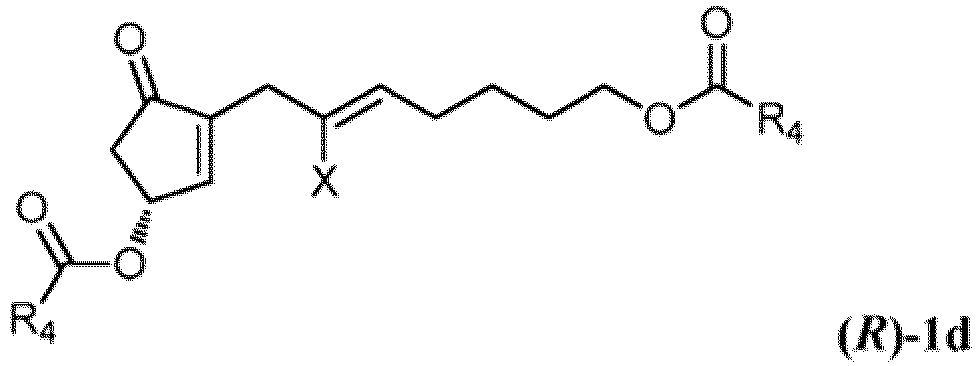
 (2) éliminer le composé de formule ( S)-1e.
 - Procédé selon la revendication 7, dans lequel la première lipase est dérivée de Burkholderia cepacia, Candida antarcitica, Alcaligenese sp., Pseudomonas stutzri. Pseudomonas cepacia ou un mélange de celles-ci.
- Procédé selon la revendication 7, dans lequel l'étape d'élimination (2) comprend la conversion du composé de formule (S)-1e en un ester (R) correspondant, par réaction du composé de formule (S)-1e avec un donneur d'acyloxy de formule R4COOH, dans laquelle R4 a la définition selon la revendication 7, en présence d'azodicarboxylate de dialkyle et de trialkylphosphine/triarylphosphine.
- Procédé de préparation du composé correspondant à la formule 4 :
 (1) faire réagir un composé de départ correspondant à la formule 1 :
 dans laquelle X représente F, Cl, Br, I ou -OTs ; P1 représente un groupe protecteur hydroxyle ; et Y a la définition ci-dessus, avec un cuprate de départ dérivé d'un composé de formule L1 , L2 ou L3 :
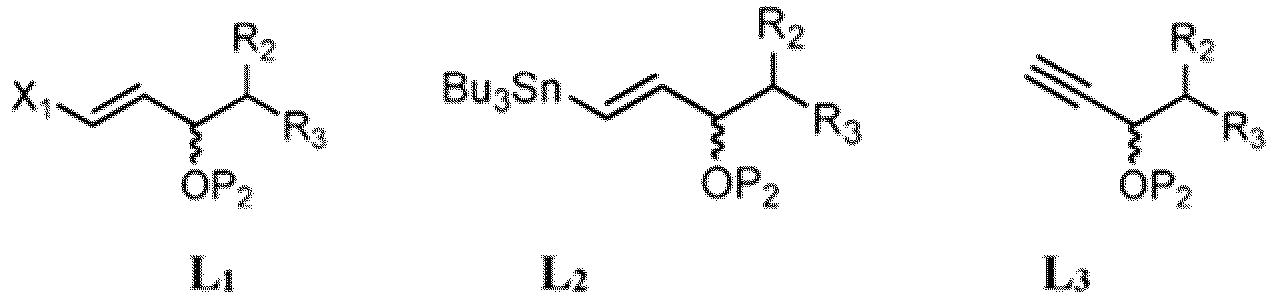 dans lesquelles X1 représente Cl, Br ou I; P2 représente un groupe protecteur hydroxyle; et R2 et R3 ont les définitions ci-dessus, pour former un composé correspondant à la formule 2 :
 dans laquelle P, X, Y, R2 et R3 ont les définitions ci-dessus ;(2) soumettre à une méthylénation un radical cétone du composé de formule 2 pour former un composé correspondant à la formule 3 suivante :
 (3) effectuer une réaction de cyclisation intramoléculaire sur le composé de formule 3 pour former le composé correspondant à la formule 4 :
 (4) éventuellement effectuer une réaction de déprotection facultative pour éliminer P1 et/ou P2.
 - Procédé selon la revendication 10, dans lequel la réaction de cyclisation intramoléculaire est une réaction de Suzuki intramoléculaire avec un réactif au bore utilisant un catalyseur au palladium et une base pour former le composé de formule 4 ; ou la réaction de cyclisation intramoléculaire comprend les étapes consistant à :(a) effectuer une hydroboration du composé de formule 3 avec un réactif au bore puis une oxydation avec du peroxyde d'hydrogène basique pour former un composé alcool de formule 3' :
 (b) effectuer une sulfonylation du composé de formule 3' en présence d'une base avec un donneur de sulfonyle pour former un composé correspondant à la formule 3" :
 (c) effectuer une alkylation intramoléculaire du composé de formule 3" en présence d'une base pour former un composé de formule 4.
 - Procédé selon la revendication 10 pour préparer un composé correspondant à la formule 4a,
 (1') faire réagir un composé optiquement enrichi correspondant à la formule (R)-1 :
 dans laquelle X représente F, Cl, Br, I ou -OTs ; P1 représente un groupe protecteur hydroxyle ; et Y a la définition ci-dessus, avec un cuprate dérivé d'un composé de formule L1a, L2a ou L3a :
 dans lesquelles X1 représente Cl, Br ou I ; et P2 représente un groupe protecteur hydroxyle, pour former un composé correspondant à la formule 2a :
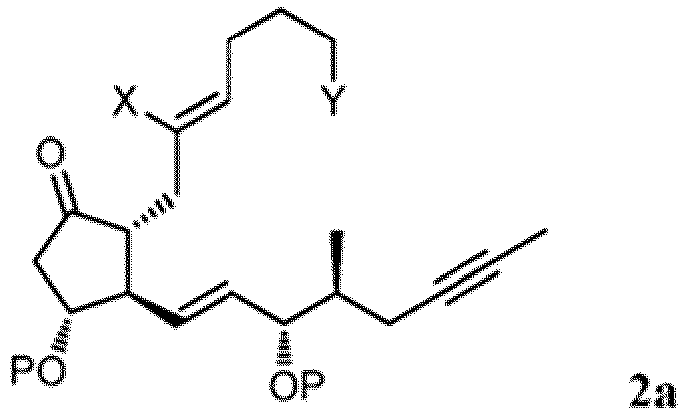 dans laquelle P, X et Y ont les définitions ci-dessus ;(2') soumettre à une méthylénation un radical cétone du composé de formule 2a pour former un composé correspondant à la formule 3a :
 (3') effectuer une réaction de cyclisation intramoléculaire sur le composé de formule 3a pour former le composé correspondant à la formule 4a :
 (4') éventuellement effectuer une réaction de déprotection facultative pour éliminer P1 et/ou P2.
 - Procédé selon la revendication 10 pour préparer un composé correspondant à la formule 4b :
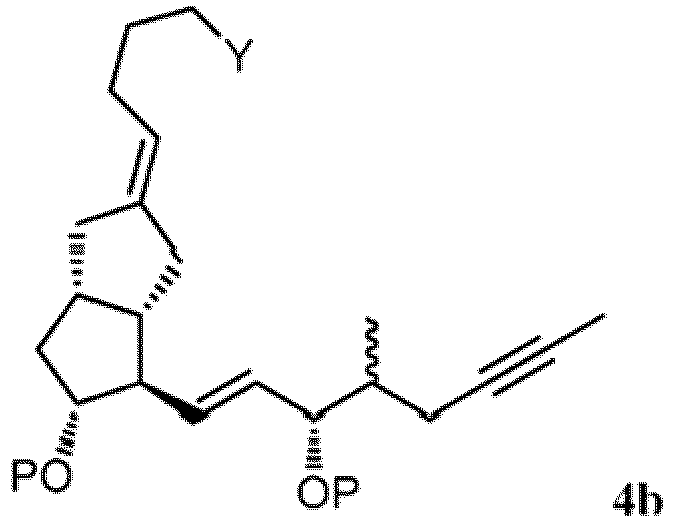 (1 "') faire réagir un composé optiquement enrichi correspondant à la formule (R)-1 :
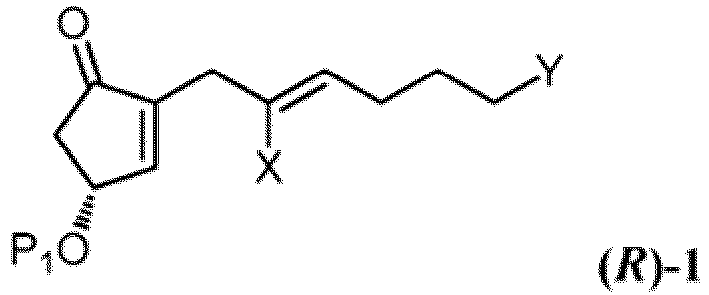 dans laquelle X représente F, Cl, Br, I ou -OTs ; P1 représente un groupe protecteur hydroxyle ; et Y a la définition ci-dessus, avec un cuprate dérivé d'un composé de formule L1b, L2b ou L3b,
 dans lesquelles X1 représente Cl, Br ou I ; et P2 représente un groupe protecteur hydroxyle, pour former un composé correspondant à la formule 2b :
 dans laquelle P, X et Y ont les définitions ci-dessus ;(2"') soumettre à une méthylénation un radical cétone du composé de la formule 2b pour former un composé correspondant à la formule 3b :
 (3"') effectuer une réaction de cyclisation intramoléculaire sur le composé de formule 3b pour former le composé correspondant à la formule 4b :
 (4‴) éventuellement effectuer une réaction de déprotection facultative en éliminant P1 et/ou P2.
Applications Claiming Priority (1)
| Application Number | Priority Date | Filing Date | Title |
|---|---|---|---|
| US17/737,273 US11884613B2 (en) | 2022-05-05 | 2022-05-05 | Processes and intermediates for the preparation of carbaprostacyclin analogues |
Publications (3)
| Publication Number | Publication Date |
|---|---|
| EP4273131A1 EP4273131A1 (fr) | 2023-11-08 |
| EP4273131C0 EP4273131C0 (fr) | 2025-07-02 |
| EP4273131B1 true EP4273131B1 (fr) | 2025-07-02 |
Family
ID=85792407
Family Applications (1)
| Application Number | Title | Priority Date | Filing Date |
|---|---|---|---|
| EP23165427.8A Active EP4273131B1 (fr) | 2022-05-05 | 2023-03-30 | Procédés et intermédiaires pour la préparation d'analogues de carbaprostacycline |
Country Status (6)
| Country | Link |
|---|---|
| US (4) | US11884613B2 (fr) |
| EP (1) | EP4273131B1 (fr) |
| JP (1) | JP7680058B2 (fr) |
| KR (1) | KR20230156257A (fr) |
| CN (1) | CN117003630A (fr) |
| TW (1) | TWI861857B (fr) |
Families Citing this family (1)
| Publication number | Priority date | Publication date | Assignee | Title |
|---|---|---|---|---|
| US11884613B2 (en) * | 2022-05-05 | 2024-01-30 | Chirogate International Inc. | Processes and intermediates for the preparation of carbaprostacyclin analogues |
Family Cites Families (13)
| Publication number | Priority date | Publication date | Assignee | Title |
|---|---|---|---|---|
| US4233231A (en) | 1977-11-22 | 1980-11-11 | American Cyanamid Company | Novel vinyl-stannyl derivatives |
| US4415501A (en) | 1981-12-16 | 1983-11-15 | American Cyanamid Company | Alkenylzirconium reagents useful for prostaglandin analog synthesis |
| JPS6212743A (ja) * | 1985-07-10 | 1987-01-21 | Teijin Ltd | カルバサイクリン類の製造法 |
| JPH01102059A (ja) * | 1987-10-16 | 1989-04-19 | Asahi Glass Co Ltd | 6−フルオロプロスタグランジン誘導体 |
| US6294679B1 (en) | 1999-04-12 | 2001-09-25 | Chirotech Technology Limited | Intermediate for the synthesis of prostaglandins |
| TWI310763B (en) * | 2006-01-18 | 2009-06-11 | Chirogate Int Inc | Processes and intermediates for the preparations of prostaglandins |
| TWI378146B (en) * | 2006-01-18 | 2012-12-01 | Chirogate Int Inc | Processes for the preparations of optically active cyclopentenones and cyclopentenones prepared therefrom |
| AR071312A1 (es) * | 2008-04-09 | 2010-06-09 | Scinopharm Taiwan Ltd | Proceso para la preparacion de analogos de prostaglandina y sus intermediarios |
| US8524939B2 (en) * | 2011-08-24 | 2013-09-03 | Chirogate International Inc. | Intermediates for the synthesis of benzindene prostaglandins and preparations thereof |
| CN104837806A (zh) * | 2012-12-07 | 2015-08-12 | 开曼化学股份有限公司 | 前列环素类似物的合成方法 |
| CN106478572B (zh) * | 2016-09-26 | 2019-04-19 | 上海北卡医药技术有限公司 | 一种贝前列素及其盐的制备方法 |
| HU231212B1 (hu) * | 2018-04-16 | 2021-11-29 | CHINOIN Gyógyszer és Vegyészeti Termékek Gyára Zrt. | Eljárás iloprost előállítására |
| US11884613B2 (en) * | 2022-05-05 | 2024-01-30 | Chirogate International Inc. | Processes and intermediates for the preparation of carbaprostacyclin analogues |
-
2022
- 2022-05-05 US US17/737,273 patent/US11884613B2/en active Active
-
2023
- 2023-03-30 EP EP23165427.8A patent/EP4273131B1/fr active Active
- 2023-04-25 JP JP2023071199A patent/JP7680058B2/ja active Active
- 2023-04-27 KR KR1020230055274A patent/KR20230156257A/ko active Pending
- 2023-05-04 TW TW112116586A patent/TWI861857B/zh active
- 2023-05-05 CN CN202310493494.0A patent/CN117003630A/zh active Pending
- 2023-05-30 US US18/325,214 patent/US12221411B2/en active Active
- 2023-09-27 US US18/476,137 patent/US12428361B2/en active Active
-
2025
- 2025-06-11 US US19/234,901 patent/US20250304519A1/en active Pending
Also Published As
| Publication number | Publication date |
|---|---|
| KR20230156257A (ko) | 2023-11-14 |
| US20230357118A1 (en) | 2023-11-09 |
| US11884613B2 (en) | 2024-01-30 |
| TWI861857B (zh) | 2024-11-11 |
| US20230357119A1 (en) | 2023-11-09 |
| EP4273131A1 (fr) | 2023-11-08 |
| JP2023165632A (ja) | 2023-11-16 |
| US20250304519A1 (en) | 2025-10-02 |
| EP4273131C0 (fr) | 2025-07-02 |
| US12221411B2 (en) | 2025-02-11 |
| US20240025832A1 (en) | 2024-01-25 |
| US12428361B2 (en) | 2025-09-30 |
| JP7680058B2 (ja) | 2025-05-20 |
| CN117003630A (zh) | 2023-11-07 |
| TW202344495A (zh) | 2023-11-16 |
Similar Documents
| Publication | Publication Date | Title |
|---|---|---|
| EP2581361B1 (fr) | Intermédiaires pour la synthèse de prostaglandines du benzindène et leurs préparations | |
| EP4273131B1 (fr) | Procédés et intermédiaires pour la préparation d'analogues de carbaprostacycline | |
| KR20260022358A (ko) | 벤조프로스타사이클린 유사체 제조를 위한 방법 및 중간체 및 이로부터 제조된 벤조프로스타사이클린 유사체 | |
| EP3594201B1 (fr) | Procédé de préparation de lubiprostone et intermédiaires correspondants | |
| KR20170028990A (ko) | 프로스타글란딘 및 프로스타글란딘 유사체를 생산하기 위한 2-치환된-4-옥시-사이클로펜트-2-엔-1-온에 대한 비닐붕소 화합물의 금속-촉매화된 비대칭 1,4-콘주게이트 첨가 | |
| JP3541417B2 (ja) | フェニル置換ヒドロキシシクロペンテノン類、ペンタノン類及びフェニル置換プロスタグランジンi2類中間体並びにその製造法及び光学分割法 | |
| JP7218863B2 (ja) | ペンテノマイシン誘導体の製造法 | |
| US6214611B1 (en) | Process for the preparation of prostaglandin precursors | |
| US6897324B2 (en) | Process for the preparation of 11-oxaprostaglandins and intermediates therein | |
| EP0817764A1 (fr) | Preparation de derives de cis-4-o-protege-2-cyclopentenol |
Legal Events
| Date | Code | Title | Description |
|---|---|---|---|
| PUAI | Public reference made under article 153(3) epc to a published international application that has entered the european phase |
Free format text: ORIGINAL CODE: 0009012 |
|
| STAA | Information on the status of an ep patent application or granted ep patent |
Free format text: STATUS: THE APPLICATION HAS BEEN PUBLISHED |
|
| AK | Designated contracting states |
Kind code of ref document: A1 Designated state(s): AL AT BE BG CH CY CZ DE DK EE ES FI FR GB GR HR HU IE IS IT LI LT LU LV MC ME MK MT NL NO PL PT RO RS SE SI SK SM TR |
|
| STAA | Information on the status of an ep patent application or granted ep patent |
Free format text: STATUS: REQUEST FOR EXAMINATION WAS MADE |
|
| 17P | Request for examination filed |
Effective date: 20240508 |
|
| RBV | Designated contracting states (corrected) |
Designated state(s): AL AT BE BG CH CY CZ DE DK EE ES FI FR GB GR HR HU IE IS IT LI LT LU LV MC ME MK MT NL NO PL PT RO RS SE SI SK SM TR |
|
| REG | Reference to a national code |
Ref country code: DE Ref legal event code: R079 Free format text: PREVIOUS MAIN CLASS: C07D0307160000 Ipc: C07C0051090000 Ref document number: 602023004399 Country of ref document: DE |
|
| GRAP | Despatch of communication of intention to grant a patent |
Free format text: ORIGINAL CODE: EPIDOSNIGR1 |
|
| STAA | Information on the status of an ep patent application or granted ep patent |
Free format text: STATUS: GRANT OF PATENT IS INTENDED |
|
| RIC1 | Information provided on ipc code assigned before grant |
Ipc: C12P 41/00 20060101ALI20250225BHEP Ipc: C12P 7/62 20220101ALI20250225BHEP Ipc: C07F 7/18 20060101ALI20250225BHEP Ipc: C12P 7/26 20060101ALI20250225BHEP Ipc: C07C 69/738 20060101ALI20250225BHEP Ipc: C07C 69/732 20060101ALI20250225BHEP Ipc: C07C 67/333 20060101ALI20250225BHEP Ipc: C07C 59/46 20060101ALI20250225BHEP Ipc: C07C 59/74 20060101ALI20250225BHEP Ipc: C07C 51/09 20060101AFI20250225BHEP |
|
| INTG | Intention to grant announced |
Effective date: 20250319 |
|
| GRAS | Grant fee paid |
Free format text: ORIGINAL CODE: EPIDOSNIGR3 |
|
| GRAA | (expected) grant |
Free format text: ORIGINAL CODE: 0009210 |
|
| STAA | Information on the status of an ep patent application or granted ep patent |
Free format text: STATUS: THE PATENT HAS BEEN GRANTED |
|
| AK | Designated contracting states |
Kind code of ref document: B1 Designated state(s): AL AT BE BG CH CY CZ DE DK EE ES FI FR GB GR HR HU IE IS IT LI LT LU LV MC ME MK MT NL NO PL PT RO RS SE SI SK SM TR |
|
| REG | Reference to a national code |
Ref country code: GB Ref legal event code: FG4D |
|
| REG | Reference to a national code |
Ref country code: CH Ref legal event code: EP |
|
| REG | Reference to a national code |
Ref country code: DE Ref legal event code: R096 Ref document number: 602023004399 Country of ref document: DE |
|
| REG | Reference to a national code |
Ref country code: IE Ref legal event code: FG4D |
|
| U01 | Request for unitary effect filed |
Effective date: 20250702 |
|
| U07 | Unitary effect registered |
Designated state(s): AT BE BG DE DK EE FI FR IT LT LU LV MT NL PT RO SE SI Effective date: 20250710 |
|
| PG25 | Lapsed in a contracting state [announced via postgrant information from national office to epo] |
Ref country code: IS Free format text: LAPSE BECAUSE OF FAILURE TO SUBMIT A TRANSLATION OF THE DESCRIPTION OR TO PAY THE FEE WITHIN THE PRESCRIBED TIME-LIMIT Effective date: 20251102 |
|
| PG25 | Lapsed in a contracting state [announced via postgrant information from national office to epo] |
Ref country code: NO Free format text: LAPSE BECAUSE OF FAILURE TO SUBMIT A TRANSLATION OF THE DESCRIPTION OR TO PAY THE FEE WITHIN THE PRESCRIBED TIME-LIMIT Effective date: 20251002 |
|
| PG25 | Lapsed in a contracting state [announced via postgrant information from national office to epo] |
Ref country code: HR Free format text: LAPSE BECAUSE OF FAILURE TO SUBMIT A TRANSLATION OF THE DESCRIPTION OR TO PAY THE FEE WITHIN THE PRESCRIBED TIME-LIMIT Effective date: 20250702 |
|
| PG25 | Lapsed in a contracting state [announced via postgrant information from national office to epo] |
Ref country code: GR Free format text: LAPSE BECAUSE OF FAILURE TO SUBMIT A TRANSLATION OF THE DESCRIPTION OR TO PAY THE FEE WITHIN THE PRESCRIBED TIME-LIMIT Effective date: 20251003 |
|
| PG25 | Lapsed in a contracting state [announced via postgrant information from national office to epo] |
Ref country code: CZ Free format text: LAPSE BECAUSE OF FAILURE TO SUBMIT A TRANSLATION OF THE DESCRIPTION OR TO PAY THE FEE WITHIN THE PRESCRIBED TIME-LIMIT Effective date: 20250702 |
|
| PG25 | Lapsed in a contracting state [announced via postgrant information from national office to epo] |
Ref country code: PL Free format text: LAPSE BECAUSE OF FAILURE TO SUBMIT A TRANSLATION OF THE DESCRIPTION OR TO PAY THE FEE WITHIN THE PRESCRIBED TIME-LIMIT Effective date: 20250702 |
|
| PG25 | Lapsed in a contracting state [announced via postgrant information from national office to epo] |
Ref country code: RS Free format text: LAPSE BECAUSE OF FAILURE TO SUBMIT A TRANSLATION OF THE DESCRIPTION OR TO PAY THE FEE WITHIN THE PRESCRIBED TIME-LIMIT Effective date: 20251002 |
|
| PG25 | Lapsed in a contracting state [announced via postgrant information from national office to epo] |
Ref country code: ES Free format text: LAPSE BECAUSE OF FAILURE TO SUBMIT A TRANSLATION OF THE DESCRIPTION OR TO PAY THE FEE WITHIN THE PRESCRIBED TIME-LIMIT Effective date: 20250702 |
|
| U20 | Renewal fee for the european patent with unitary effect paid |
Year of fee payment: 4 Effective date: 20260128 |
|
| PG25 | Lapsed in a contracting state [announced via postgrant information from national office to epo] |
Ref country code: SM Free format text: LAPSE BECAUSE OF FAILURE TO SUBMIT A TRANSLATION OF THE DESCRIPTION OR TO PAY THE FEE WITHIN THE PRESCRIBED TIME-LIMIT Effective date: 20250702 |
|
| PG25 | Lapsed in a contracting state [announced via postgrant information from national office to epo] |
Ref country code: SK Free format text: LAPSE BECAUSE OF FAILURE TO SUBMIT A TRANSLATION OF THE DESCRIPTION OR TO PAY THE FEE WITHIN THE PRESCRIBED TIME-LIMIT Effective date: 20250702 |