EP4273667A1 - Système de réalité augmentée - Google Patents
Système de réalité augmentée Download PDFInfo
- Publication number
- EP4273667A1 EP4273667A1 EP22171080.9A EP22171080A EP4273667A1 EP 4273667 A1 EP4273667 A1 EP 4273667A1 EP 22171080 A EP22171080 A EP 22171080A EP 4273667 A1 EP4273667 A1 EP 4273667A1
- Authority
- EP
- European Patent Office
- Prior art keywords
- augmented reality
- user
- reality device
- information
- computing unit
- Prior art date
- Legal status (The legal status is an assumption and is not a legal conclusion. Google has not performed a legal analysis and makes no representation as to the accuracy of the status listed.)
- Withdrawn
Links
Images

Classifications
-
- G—PHYSICS
- G06—COMPUTING OR CALCULATING; COUNTING
- G06F—ELECTRIC DIGITAL DATA PROCESSING
- G06F3/00—Input arrangements for transferring data to be processed into a form capable of being handled by the computer; Output arrangements for transferring data from processing unit to output unit, e.g. interface arrangements
- G06F3/01—Input arrangements or combined input and output arrangements for interaction between user and computer
- G06F3/011—Arrangements for interaction with the human body, e.g. for user immersion in virtual reality
Definitions
- the present disclosure is directed to a method of displaying information on an augmented reality device according to claim 1. Furthermore, the present disclosure is directed to an augmented reality system according to claim 12.
- an augmented reality device running augmented reality applications When an augmented reality device running augmented reality applications is used in an industrial application, e.g. for controlling and monitoring a technical plant, a field worker as a user of the augmented reality device needs manifold up-to-date information from multiple data sources - often at the same time.
- the user needs to easily integrate further information or modify his augmented reality views to be suitable for his tasks.
- An objective of the present invention is the ability to show a large amount of information by an augmented reality device wherein the augmented reality device does not have to comprise large computational resources.
- the problem is solved by a method of displaying information on an augmented reality device according to claim 1. Further, the problem is solved by an augmented reality system according to claim 12.
- Advantageous aspects of the invention are the subject of the dependent claims.
- the method of displaying information on an augmented reality device comprises the following steps:
- a user of the augmented reality device determines a hologram which is located within an augmented reality environment of the augmented reality device.
- the user can use a specific determination application which is hosted by the augmented reality device.
- the user can use a computer connected to the augmented reality device which hosts the determination application, and which can transfer the "engineering" information to the augmented reality device which renders the hologram within its augmented reality environment.
- the augmented reality environment is a three-dimensional space which the augmented reality device uses to place the hologram(s).
- the augmented reality environment has a specific relation to the real world which has been determined in advance calibrating the augmented reality device. This relation, respectively the calibrating, is not the subject of the present application.
- the hologram is determined automatically - by the augmented reality device or by a further device like the computer as mentioned before which is connected to the augmented reality device.
- the automatic generation can base on some typical presets which suit for most of the users.
- a hologram is a 2D or 3D object which can be filled with various information. So to say, the hologram is like a picture frame which can be filled with images the user determines. In the course of this invention, the term "hologram" is used for a 2D object which can display the information the user determines.
- the (same) user or a further user determines which information shall be displayed/shown within the hologram.
- the determinations of the user, or of the user and of the further user, i.e. the hologram and the information which shall be shown within the hologram, are transmitted to a computing unit which is physically separated from the augmented reality device.
- “Physically separated” means that the augmented reality device and the computing unit are two separated devices/units wherein each device/unit comprises its own computational resources. In most scenarios “physically separated” also means that the augmented reality device and the computing unit are also located distantly from each other. “Physically separated” can (but it is not mandatory) also mean that there is no hard wiring based physical connection between the augmented reality device and the computing unit but a wireless connection like Bluetooth ® , Wi-Fi ® , LTE or the like.
- the computing unit generates an image of the information determined by the user, or by the user and the further user.
- the image is a graphic file which has a bmp-, jpeg-, gif- or a comparable format. It is only essential that the augmented reality device which the image is transmitted to in a following step can handle the image (file) and that the image is compatible with the hologram in which it shall be shown.
- the information is shown to the user (or the further user) by means of showing an image of the information.
- the image (file) is rather small, typically within a size range from few Kilobytes to 10 Megabyte.
- the augmented reality device can handle the image easily without the need of having large computational resources.
- steps d) through f) are repeated cyclically at a specific repeating rate, preferably every minute, most preferably every 5 to 30 seconds. This can be done to update/refresh the image of the information which is in particular relevant for information which change in time (like measuring values, diagrams, key performance indicators and so on).
- the repeating rate can depend on a type of the information, on a bandwidth of a connection between the computing unit and the augmented reality device, or on a number of users which are demanding the information from the computing device. For example, a higher repeating rate can be chosen if an update rate of the (underlying) information is rather high.
- the repeating rate can also be adjusted to the fact how many users of an amount of many users are interested in having shown a specific information.
- steps d through f can be repeated. It is also possible to perform steps a through f several times, wherein the location of the hologram and/or the information which shall be displayed within the hologram is varied each time by the user (or, optionally, the further user). By performing all steps several times the user (or the further user) can determine a plurality of holograms which show (the same or different) information. Obviously, these holograms should be located at different locations within the augmented reality environment.
- the computing unit can be part of a cloud computing infrastructure. Most preferably, the computing unit is initiating a web browser session to get access to the determined information. Thereby, the web browser session which is hosted by a further computing unit which is physically separated from the augmented reality device and from the computing unit, wherein the computing unit creates a screenshot of the web browser session to generate the image.
- the web browser session which allows an access to the determined information is hosted by the augmented reality device at least temporarily if the user gives an according command to the computing unit, especially by clicking on the hologram.
- the augmented reality technology used by the augmented reality device
- the augmented reality device is mostly used to view relevant information, in many cases no interaction with the shown image is necessary at all. However, if it's necessary to modify or interact, clicking on the image could open the information (document) in a respective application or show the web page in a browser session. But, in comparison to other approaches being state-of-the-art, only very few active applications are necessary so that no scaling problems occur for the augmented reality device.
- the computing unit uses a low code application to get access to the determined information and to generate the image of the information.
- a low code application is characterized in that graphical/visual tools are used to construct instructions readable by the computing unit to perform the steps as described above.
- the benefit of this solution is that it is relatively easy to update the content at any time in a comfortable manner inside the low code application.
- the user (or the further user) can configure the low code application via means of the augmented reality device.
- This procedure is very simple and easy to handle for the user.
- the augmented reality device can generate graphical control fields within the augmented reality environment the user can use to configure the low code application.
- an augmented reality system comprising at least one augmented reality device and at least one computing unit, being physically separated from the augmented reality device, wherein the augmented reality system is configured to perform a method as described above.
- FIG 1 there is depicted a schematic overview over a method of displaying information on an augmented reality device according to the invention.
- steps are performed in a context of an augmented reality device 2.
- steps are performed in a context of a cloud computing infrastructure 4.
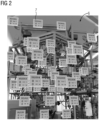
- a user places a hologram for a semi-live view in an augmented reality environment (cf. FIG 2 ) using the mobile augmented reality device 2, such as a smartphone, tablet, or head-mounted display.
- the mobile augmented reality device 2 such as a smartphone, tablet, or head-mounted display.
- the mobile augmented reality device 2 such as a smartphone, tablet, or head-mounted display.
- the (source of) information e.g. a certain screen area of a web page, he wants to be shown within the hologram.
- the determinations made by the user are transmitted to a computing unit being part of the cloud computing infrastructure 4 (step (2)).
- the transmission is done using a Wi-Fi ® connection 5.
- the computing unit in the cloud computation infrastructure 4 runs a low code application 5, e.g. Node-RED ® .
- the cloud computing unit gets access to the determined information.
- the determined information which are for example stored in a storing unit of a technical plant
- one and the same user management of the augmented reality device 2 and the source of unit of the information can be used and the user data with which the user logs on to the computing unit is also used for authenticating the user to get access to the determined data.
- step (3) in the low code application 5 an image of the determined information is generated and transmitted to the computing unit.
- the computing unit transmits the generated image to the augmented reality device in a following step (4).
- the augmented reality device 2 shows the image within the determined hologram in the augmented reality environment of the augmented reality device 2.
- the user is able to modify an existing low code semi-live workflow.
- Much information is related to certain objects in the plant.
- the user could just grab a component and attach it to an existing hologram.
- the information (source) is changed from the original one to the new one, if possible. That could be the user's guide as well as the measurement value of the electronics temperature for example.
- This allows the user to directly configure his augmented reality view by means of the augmented reality device 2 to reach his own needs - with very little time effort and very flexible during operation.
- the low code workflow could be adapted.
- the programming already is a graphical one, it's very easy to adjust it on the fly within the normal programming environment but on the user's device, i.e. the augmented reality device 2.
- the user even does not need to leave the augmented reality view in the augmented reality device 2 but the low code programming is directly performed in the augmented reality environment.
- the interaction steps of the low code application 5 could be moved like real objects and a completely new visualization could be created on the fly.
- FIG 2 shows an augmented reality environment 6, i.e. the augmented reality views the user has when he uses the augmented reality device 2 described above.
- a plurality of holograms 7 are located within the augmented reality environment 6.
- Each hologram 7 shows measuring (process) values of a process object of a process plant. Thereby, within each hologram 7 there is depicted an image of the respective information (source) as it is described above.
Landscapes
- Engineering & Computer Science (AREA)
- General Engineering & Computer Science (AREA)
- Theoretical Computer Science (AREA)
- Human Computer Interaction (AREA)
- Physics & Mathematics (AREA)
- General Physics & Mathematics (AREA)
- User Interface Of Digital Computer (AREA)
Priority Applications (2)
| Application Number | Priority Date | Filing Date | Title |
|---|---|---|---|
| EP22171080.9A EP4273667A1 (fr) | 2022-05-02 | 2022-05-02 | Système de réalité augmentée |
| PCT/EP2023/061029 WO2023213661A1 (fr) | 2022-05-02 | 2023-04-26 | Système de réalité augmentée |
Applications Claiming Priority (1)
| Application Number | Priority Date | Filing Date | Title |
|---|---|---|---|
| EP22171080.9A EP4273667A1 (fr) | 2022-05-02 | 2022-05-02 | Système de réalité augmentée |
Publications (1)
| Publication Number | Publication Date |
|---|---|
| EP4273667A1 true EP4273667A1 (fr) | 2023-11-08 |
Family
ID=81595675
Family Applications (1)
| Application Number | Title | Priority Date | Filing Date |
|---|---|---|---|
| EP22171080.9A Withdrawn EP4273667A1 (fr) | 2022-05-02 | 2022-05-02 | Système de réalité augmentée |
Country Status (2)
| Country | Link |
|---|---|
| EP (1) | EP4273667A1 (fr) |
| WO (1) | WO2023213661A1 (fr) |
Citations (4)
| Publication number | Priority date | Publication date | Assignee | Title |
|---|---|---|---|---|
| EP3318945A2 (fr) * | 2016-11-08 | 2018-05-09 | Rockwell Automation Technologies, Inc. | Réalité virtuelle et réalité augmentée pour l'automatisation industrielle |
| WO2021202616A1 (fr) * | 2020-03-31 | 2021-10-07 | Flir Systems Ab | Systèmes et procédés d'inspection de biens à imagerie thermique |
| EP3893096A1 (fr) * | 2020-04-06 | 2021-10-13 | Siemens Aktiengesellschaft | Alignement et augmentation d'un sous-espace partiel d'une infrastructure physique avec au moins un élément d'information |
| KR102371336B1 (ko) * | 2021-03-15 | 2022-03-07 | 주식회사 유시스 | 3d 통합관제 및 증강현실과 가상현실을 이용한 스마트 공장 모니터링 시스템 |
-
2022
- 2022-05-02 EP EP22171080.9A patent/EP4273667A1/fr not_active Withdrawn
-
2023
- 2023-04-26 WO PCT/EP2023/061029 patent/WO2023213661A1/fr not_active Ceased
Patent Citations (4)
| Publication number | Priority date | Publication date | Assignee | Title |
|---|---|---|---|---|
| EP3318945A2 (fr) * | 2016-11-08 | 2018-05-09 | Rockwell Automation Technologies, Inc. | Réalité virtuelle et réalité augmentée pour l'automatisation industrielle |
| WO2021202616A1 (fr) * | 2020-03-31 | 2021-10-07 | Flir Systems Ab | Systèmes et procédés d'inspection de biens à imagerie thermique |
| EP3893096A1 (fr) * | 2020-04-06 | 2021-10-13 | Siemens Aktiengesellschaft | Alignement et augmentation d'un sous-espace partiel d'une infrastructure physique avec au moins un élément d'information |
| KR102371336B1 (ko) * | 2021-03-15 | 2022-03-07 | 주식회사 유시스 | 3d 통합관제 및 증강현실과 가상현실을 이용한 스마트 공장 모니터링 시스템 |
Non-Patent Citations (1)
| Title |
|---|
| SUBAKTI HANAS ET AL: "Indoor Augmented Reality Using Deep Learning for Industry 4.0 Smart Factories", 2017 IEEE 41ST ANNUAL COMPUTER SOFTWARE AND APPLICATIONS CONFERENCE (COMPSAC), IEEE, vol. 2, 23 July 2018 (2018-07-23), pages 63 - 68, XP033409673, ISSN: 0730-3157, ISBN: 978-1-5386-2667-2, [retrieved on 20180608], DOI: 10.1109/COMPSAC.2018.10204 * |
Also Published As
| Publication number | Publication date |
|---|---|
| WO2023213661A1 (fr) | 2023-11-09 |
Similar Documents
| Publication | Publication Date | Title |
|---|---|---|
| US11977717B2 (en) | Guided user interface (GUI) based systems and methods for regionizing full-size process plant displays for rendering on mobile user interface devices | |
| US10135953B2 (en) | Self-describing diagnostic data for presentation on mobile devices | |
| US8321806B2 (en) | Visualization of process control data | |
| CN108073277B (zh) | 用于工业自动化的虚拟现实和增强现实的系统和方法 | |
| US11619924B2 (en) | Combined visualization thin client HMI system and method | |
| US11249628B2 (en) | Graphical user interface (GUI) systems and methods for refactoring full-size process plant displays at various zoom and detail levels for visualization on mobile user interface devices | |
| US10514768B2 (en) | Gestures and touch in operator interface | |
| EP3259679B1 (fr) | Interface de visualisation unifiée appelée automatiquement | |
| US20160349931A1 (en) | Responsive user interface for an industrial environment | |
| JP2013196689A (ja) | システムアセットの動作を監視するための方法および装置 | |
| JP6015881B2 (ja) | プロセス変数に関連するトレンドを表示する装置 | |
| US20040177357A1 (en) | Web-based presentation of automation processes | |
| CN112799664A (zh) | 支持异构环境的组态方法及系统 | |
| EP4273667A1 (fr) | Système de réalité augmentée | |
| EP2645335A1 (fr) | Système d'aide visuelle à la maintenance d'installations | |
| CN117749644A (zh) | 机电设备监控平台、监控方法及存储介质 | |
| CN112634433A (zh) | 一种数字工厂的实时控制及可视化系统 | |
| CN119512673B (zh) | 一种针对工业生产设备和智能制造环境的大屏可视化系统 | |
| EP4625080A1 (fr) | Système de visualisation d'un système d'automatisation | |
| Soares et al. | Hands Tech: An AR-Based Framework for Real-Time Monitoring and its Application in 4.0 Industry | |
| CN120542731A (zh) | 三维建模辅助安全管理方法及装置 | |
| HK40052349A (en) | Configuration method and system supporting heterogeneous environment | |
| CN120805375A (zh) | 一种飞机对接回溯系统、方法、设备及存储介质 | |
| CN120722783A (zh) | 生成过程控制系统中的过程示意图的方法和装置 | |
| CN119559311A (zh) | 一种液体循环处理组态的高清渲染方法及系统 |
Legal Events
| Date | Code | Title | Description |
|---|---|---|---|
| PUAI | Public reference made under article 153(3) epc to a published international application that has entered the european phase |
Free format text: ORIGINAL CODE: 0009012 |
|
| STAA | Information on the status of an ep patent application or granted ep patent |
Free format text: STATUS: THE APPLICATION HAS BEEN PUBLISHED |
|
| AK | Designated contracting states |
Kind code of ref document: A1 Designated state(s): AL AT BE BG CH CY CZ DE DK EE ES FI FR GB GR HR HU IE IS IT LI LT LU LV MC MK MT NL NO PL PT RO RS SE SI SK SM TR |
|
| STAA | Information on the status of an ep patent application or granted ep patent |
Free format text: STATUS: THE APPLICATION IS DEEMED TO BE WITHDRAWN |
|
| 18D | Application deemed to be withdrawn |
Effective date: 20240509 |