EP4273764A1 - Système de classification - Google Patents
Système de classification Download PDFInfo
- Publication number
- EP4273764A1 EP4273764A1 EP22811200.9A EP22811200A EP4273764A1 EP 4273764 A1 EP4273764 A1 EP 4273764A1 EP 22811200 A EP22811200 A EP 22811200A EP 4273764 A1 EP4273764 A1 EP 4273764A1
- Authority
- EP
- European Patent Office
- Prior art keywords
- classification
- correlation
- index matrix
- data
- correlation index
- Prior art date
- Legal status (The legal status is an assumption and is not a legal conclusion. Google has not performed a legal analysis and makes no representation as to the accuracy of the status listed.)
- Pending
Links
Images

Classifications
-
- G—PHYSICS
- G06—COMPUTING OR CALCULATING; COUNTING
- G06F—ELECTRIC DIGITAL DATA PROCESSING
- G06F16/00—Information retrieval; Database structures therefor; File system structures therefor
- G06F16/20—Information retrieval; Database structures therefor; File system structures therefor of structured data, e.g. relational data
- G06F16/28—Databases characterised by their database models, e.g. relational or object models
- G06F16/284—Relational databases
- G06F16/285—Clustering or classification
-
- G—PHYSICS
- G06—COMPUTING OR CALCULATING; COUNTING
- G06N—COMPUTING ARRANGEMENTS BASED ON SPECIFIC COMPUTATIONAL MODELS
- G06N3/00—Computing arrangements based on biological models
- G06N3/02—Neural networks
- G06N3/08—Learning methods
- G06N3/09—Supervised learning
-
- G—PHYSICS
- G06—COMPUTING OR CALCULATING; COUNTING
- G06N—COMPUTING ARRANGEMENTS BASED ON SPECIFIC COMPUTATIONAL MODELS
- G06N3/00—Computing arrangements based on biological models
- G06N3/02—Neural networks
- G06N3/08—Learning methods
- G06N3/084—Backpropagation, e.g. using gradient descent
-
- G—PHYSICS
- G06—COMPUTING OR CALCULATING; COUNTING
- G06N—COMPUTING ARRANGEMENTS BASED ON SPECIFIC COMPUTATIONAL MODELS
- G06N5/00—Computing arrangements using knowledge-based models
- G06N5/04—Inference or reasoning models
- G06N5/045—Explanation of inference; Explainable artificial intelligence [XAI]; Interpretable artificial intelligence
Definitions
- the present invention relates to a classification system that determines which class an obtained image or observation data belongs to using a great amount of imagery, observation data, or the like (so-called "big data").
- Deep learning and the like use a neural network consisting of many layers. Even if a recognition result is obtained, it is difficult for a human to understand why such a recognition result has been obtained.
- Japanese Unexamined Patent Application Publication No. 2019-106090 determines the presence or absence of defects in multiple types of objects (workpieces) by first performing training for identifying the types of workpieces and then performing defect presence/absence determination training specialized in the identified types of workpieces.
- this technology attempts to determine the presence or absence of defects at a high rate even in a work environment in which multiple types of workpieces coexist.
- Japanese Unexamined Patent Application Publication No. 2019-82883 performs training as to which classes objects belong to using deep learning and previously stores the representative feature value of each class and a frequent feature value frequently observed in the class.
- this technology compares the obtained feature value with the previously stored class-specific representative feature values and the frequent feature values and regards the most approximate class as an estimated class.
- this technology also uses attributes of an object corresponding to a matching frequent feature value as a ground for the inference of the class.
- the correct answer rate cannot be 100% due to inference being a stochastic process and false inference necessarily occurs at a certain rate.
- Japanese Unexamined Patent Application Publication No. 2019-82883 attempts to obtain a ground for explanation by associating frequent feature values and attributes and listing the attributes of a class estimated from a representative feature value.
- a corresponding attribute in the input layer estimated from a firing intermediate neuron corresponding to a frequent feature value is not a directly proven attribute.
- the relationships between frequent feature values and the attributes of a class are often unknown or uninterpretable.
- the inference device is trained using, as training data corresponding to an input pattern, only one actual measured value such as a class or rent. After making inference, the trained inference device estimates the attributes of the obtained class from the influence range of an intermediate neuron firing near the output, or changes only a part of the input pattern and estimates the meaning or attributes of the changed input pattern from a change in the output.
- the inference device is trained using, as training data corresponding to an input pattern, only one actual measured value such as a class or rent, and attributes are estimated after inference is made.
- Japanese Patent No. 6792751 provides a classification system that performs training using not only correct classes but also the correct attributes of the classes as training data and thus, when a certain image or the like is presented, causes the classifier to output not only the estimated class of the image but also estimated attributes of the class so that a ground for the class is estimated.
- This classification system is provided with check means (attribute list-based correct class estimation means) configured to check the obtained list of attributes of the class against a previously constructed class-specific attribute database (class-specific attribute list management means) and thus checks the validity of the class and allows a user to systematically explain a ground for the class.
- check means attribute list-based correct class estimation means
- class-specific attribute list management means configured to check the obtained list of attributes of the class against a previously constructed class-specific attribute database (class-specific attribute list management means) and thus checks the validity of the class and allows systematically explain a ground for the class.
- This classification system trains an inference device using not only classes but also the known attributes of the classes as training data corresponding to the input patterns.
- the inference device directly outputs not only the class thereof but also an estimated attribute value simultaneously.
- the class and the attribute serving as a ground for the class are obtained simultaneously and directly.
- this classification system has to give both correct classes and a list of correct attributes to the inference device as training data. Creating such training data disadvantageously takes effort and cost.
- the present invention has been made to solve the above problems, and an object thereof is to provide a classification system that includes correlation index matrix creation means configured to obtain correlation indexes of combinations of elements forming classification training data and to convert the correlation indexes into a matrix form and (ii) correlation index matrix eigenvector calculation means configured to obtain eigenvectors from the correlation index matrix.
- Data-to-be-classified acquisition means newly inputs data to be classified, to trained classification means, and classification result output means included in the trained classification means outputs classification results of the data to be classified and factor scores corresponding to eigenvectors of a corresponding correlation index matrix together so that validity of the classification results can be examined. This eliminates the need to create a list of correct attributes, which has been required for training.
- a user of an inference device is able to obtain classes inferred from the inputted data to be classified along with factor scores serving as a ground and thus to use the classes with confidence. Even if any of the inferred classes is wrong, the user is able to defend themself with force majeure, since the user has also obtained the factor scores serving as a ground for the inference. Other possible classes can also be estimated from the factor scores.
- a classification system of claim 1 includes classification training data management means configured to obtain classification training data, classification training data-based correct class setting means configured to set correct classes on the basis of the classification training data, classification means configured to receive and classify the classification training data, classification result output means configured to output classification results, classification training means configured to train the classification means by comparing the classification results and the correct classes previously set by the classification training data-based correct class setting means and feeding back an error, (i) correlation index matrix creation means configured to obtain correlation indexes of combinations of elements forming the classification training data and to convert the correlation indexes into a matrix form, and (ii) correlation index matrix eigenvector calculation means configured to obtain eigenvectors from the correlation index matrix.
- Data-to-be-classified acquisition means newly inputs data to be classified, to the trained classification means, and the classification result output means included in the trained classification means outputs classification results of the data to be classified and factor scores corresponding to eigenvectors of a corresponding correlation index matrix together so that validity of the classification results can be examined.
- the correlation index matrix eigenvector calculation means may include correlation index matrix eigenvector coordinate axis conversion means configured to convert coordinate axes of the eigenvectors of the correlation index matrix so that relationships between the elements forming the classification training data and the eigenvectors of the correlation index matrix can be easily understood.
- the correlation indexes obtained by the correlation index matrix creation means may be one of correlation coefficients, covariances, and co-occurrence frequencies
- the correlation index matrix creation means may include one of correlation coefficient calculation means, covariance calculation means, and co-occurrence frequency calculation means.
- the co-occurrence frequency calculation means may include general-purpose co-occurrence frequency calculation means configured to count, as a co-occurrence frequency, the number of one of (i) cases in which two elements of attention of the elements forming the classification training data are both positive, (ii) cases in which the two elements are both negative, (iii) cases in which one of the two elements is positive and the other is negative, (ii) indicating exclusive OR, and (iv) any combination of (i) to (iii).
- the classification system of claim 1 includes the correlation index matrix creation means and thus obtains correlation indexes of combinations of elements forming the classification training data and converts the correlation indexes into a matrix form.
- the classification system of claim 1 includes the correlation index matrix eigenvector calculation means and thus obtains eigenvectors from the correlation index matrix.
- the classification system of claim 1 includes classification result output means and thus outputs classification results of the data to be classified and factor scores corresponding to eigenvectors of a corresponding correlation index matrix together so that validity of the classification results can be examined.
- the classification system of claim 2 includes the correlation index matrix eigenvector coordinate axis conversion means and thus converts coordinate axes of the eigenvectors of the correlation index matrix so that relationships between the elements forming the classification training data and the eigenvectors of the correlation index matrix can be easily understood.
- the correlation indexes are one of correlation coefficients, covariances, and co-occurrence frequencies
- the correlation index matrix creation means includes one of correlation coefficient calculation means, covariance calculation means, and co-occurrence frequency calculation means.
- the co-occurrence frequency calculation means includes the general-purpose co-occurrence frequency calculation means configured to count, as a co-occurrence frequency, the number of one of (i) cases in which two elements of attention of the elements forming the classification training data are both positive, (ii) cases in which the two elements are both negative, (iii) cases in which one of the two elements is positive and the other is negative, (ii) indicating exclusive OR, and (iv) any combination of (i) to (iii).
- a classification system includes a server device, a database, and a terminal.
- the server device is a known computer device and includes an arithmetic unit, main memory, auxiliary storage, an input unit, an output unit, and a communication unit.
- the arithmetic unit, main memory, auxiliary storage, input unit, output unit, and communication unit are connected to each other through a bus interface.
- the arithmetic unit includes a known processor capable of executing an instruction set.
- the main memory includes a volatile memory such as RAM capable of temporarily storing an instruction set.
- the auxiliary storage includes a non-volatile data storage capable of storing an OS and programs.
- the data storage may be, for example, an HDD or SSD.
- the input unit is, for example, a keyboard.
- the output unit is, for example, a display such as an LCD.
- the communication unit includes a network interface connectable to a network.
- the server device includes means such as classification training data management means, correct class setting means, classification result output means, classification training means, correlation index matrix creation means, correlation index matrix eigenvector calculation means, data-to-be-classified acquisition means, trained classification means, correlation index matrix eigenvector coordinate axis conversion means, correlation coefficient calculation means, covariance calculation means, co-occurrence frequency calculation means, and general-purpose co-occurrence frequency calculation means.
- the processor of the server device performs these means.
- the database according to the present invention may be included in the auxiliary storage of the server device, or may be included in different auxiliary storage independent of the server device.
- the database stores information handled by a classification management system.
- the terminal according to the present invention has the hardware configuration of a known computer.
- the server device, database, and terminal according to the present invention are able to communicate with each other through a network.
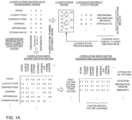
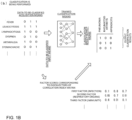
- FIGS. 1A and 1B are schematic drawings of the classification system according to the present invention.
- FIG. 1A shows a state in which training for classification is being performed
- FIG. 1B shows a state in which classification is being performed.
- FIG. 1A data on patient-specific symptoms and findings, which is data to be classified, is managed by the classification training data management means.
- a disease name that is a correct answer is given to data on each patient by the correct class setting means.
- the data to be classified may be acquired using any method such as reading from electronic health records, any observation data file, or a time-series data file.
- the symptoms and findings which are classification training data, are inputted to the input layer of the classification means (classification training data input means).
- the classification means connects many hidden layers including neural elements imitating neurons using weighted links and calculates the weighted links sequentially from the input layer.
- the amount of stimulation to a neural element is summed up on the basis of the presence or absence of firing of links in the preceding stage of the neural element and the weights of the links.
- a preset threshold is exceeded, the neural element fires and produces weighted outputs to the neural elements in the subsequent hidden layer.
- the last layer of the classification means produces classification result outputs, and firing of the respective neural elements in this output layer corresponds to the respective classification result outputs.
- the classification result outputs are compared with disease names that are correct classes set by classification training data-based correct class setting means. If both are not matched, the errors are fed back to the classification means using a technique such as backpropagation and the weights of the links are adjusted so that the outputs come close to the correct classes. When the errors become equal to or smaller than a preset reference, the training of the classification means is completed (trained classification means).
- correlation index matrix creation means the correlation indexes between elements such as symptoms and findings are calculated and organized into a matrix form.
- correlation coefficients are used as correlation indexes.
- Eigenvectors are calculated from the created correlation index matrix (correlation index matrix eigenvector calculation means).
- Factors are referred to as a first factor, a second factor, and the like in the descending order of the size of the eigenvalue, and the correlation coefficients (factor loadings) of the symptoms and findings are obtained for each factor.
- the attributes of the factors such as infection, respiratory disease, and immunity can be estimated.
- FIG. 1B shows a state in which classification is being performed.
- symptoms and findings which are data to be classified managed by data-to-be-classified management means, are inputted to the trained classification means using data-to-be-classified input means.
- the individual neural elements that have fired in the classification result output means correspond to classification results.
- the factor scores of each classification target are calculated from the presence or absence of the symptoms and findings, which are the data to be classified, and the sum of products of the factor loadings of the factors.
- the attributes of the factors such as infection, respiratory disease, and immunity have been estimated. For this reason, when one classification result has a high score of one factor, this means that the factor has a large attribute.
- the classification results of the data to be classified and the factor scores corresponding to the eigenvectors of the correlation index matrix are outputted together so that the validity of the classification results can be examined.
- the conventional methods only present the classification results. Accordingly, the reason why such classification results have been obtained is unknown.
- the present invention not only the classification results but also the factor scores corresponding to the eigenvectors of the correlation index matrix are outputted so that the validity of the classification results can be examined in comparison between both.
- FIG. 2 is a diagram showing that the coordinate axes (factor axes) of the eigenvectors of the correlation index matrix are converted so that the attributes of the factors become clearer.
- the factor axes are not absolute and vary with the combination or balance of the constituting elements and thus the meaning thereof ("the attributes of the factors" in the present invention) becomes ambiguous in some cases.
- correlation coefficients One of correlation coefficients, covariances, and co-occurrence frequencies is used as an example of the correlation indexes.
- the co-occurrence frequencies are obtained by calculating the frequency with which two elements (symptoms or findings in this example) of attention are observed simultaneously (co-occurrence frequency calculation means).
- a combination of (i) and (ii) corresponds to a positive correlation coefficient, and (ii) corresponds to a negative correlation coefficient, (i) and (ii) may be combined when necessary.
- a narrowing operation such as counting the number of only cases in which one element is positive and the other element is negative or counting the number of only cases in which the same element is observed as positive at a certain rate.
- the symptoms and findings are represented by + and - in the diagram to simplify the description, they may be represented by numbers. While the classification of disease names in the field of medicine has been used as an example, the present invention may be used for the evaluation of credit default risk, the prediction of crop yield, the determination of non-defective products, or other purposes.
- classification means While deep learning, which is currently spreading rapidly, has been used as an example of the classification means, this example is not limiting. Even if an appropriate classifier, such as classification means using a neural network that has been used or will appear in the future, various types of machine learning such as a support vector machine, or classification means using a frequency distribution, is used in accordance with the situation, the present invention can be carried out as well.
Landscapes
- Engineering & Computer Science (AREA)
- Theoretical Computer Science (AREA)
- Physics & Mathematics (AREA)
- Databases & Information Systems (AREA)
- Data Mining & Analysis (AREA)
- General Physics & Mathematics (AREA)
- General Engineering & Computer Science (AREA)
- General Health & Medical Sciences (AREA)
- Artificial Intelligence (AREA)
- Evolutionary Computation (AREA)
- Biophysics (AREA)
- Molecular Biology (AREA)
- Computing Systems (AREA)
- Biomedical Technology (AREA)
- Computational Linguistics (AREA)
- Mathematical Physics (AREA)
- Software Systems (AREA)
- Life Sciences & Earth Sciences (AREA)
- Health & Medical Sciences (AREA)
- Information Retrieval, Db Structures And Fs Structures Therefor (AREA)
- Image Analysis (AREA)
Applications Claiming Priority (2)
| Application Number | Priority Date | Filing Date | Title |
|---|---|---|---|
| JP2021090541A JP7101349B1 (ja) | 2021-05-28 | 2021-05-28 | 分類システム |
| PCT/JP2022/020478 WO2022249927A1 (fr) | 2021-05-28 | 2022-05-17 | Système de classification |
Publications (2)
| Publication Number | Publication Date |
|---|---|
| EP4273764A1 true EP4273764A1 (fr) | 2023-11-08 |
| EP4273764A4 EP4273764A4 (fr) | 2024-08-07 |
Family
ID=82446241
Family Applications (1)
| Application Number | Title | Priority Date | Filing Date |
|---|---|---|---|
| EP22811200.9A Pending EP4273764A4 (fr) | 2021-05-28 | 2022-05-17 | Système de classification |
Country Status (4)
| Country | Link |
|---|---|
| US (1) | US20240232230A9 (fr) |
| EP (1) | EP4273764A4 (fr) |
| JP (1) | JP7101349B1 (fr) |
| WO (1) | WO2022249927A1 (fr) |
Families Citing this family (1)
| Publication number | Priority date | Publication date | Assignee | Title |
|---|---|---|---|---|
| CN117574214B (zh) * | 2024-01-15 | 2024-04-12 | 中科链安(北京)科技有限公司 | 智能合约分类模型训练方法、智能合约分类方法及装置 |
Family Cites Families (17)
| Publication number | Priority date | Publication date | Assignee | Title |
|---|---|---|---|---|
| JPH02263263A (ja) * | 1989-04-03 | 1990-10-26 | Toshiba Corp | 説明機能付ニューラルネット |
| JPH09259139A (ja) * | 1996-03-22 | 1997-10-03 | Mitsubishi Electric Corp | 文書資料知的検索システム |
| JP2000250919A (ja) | 1999-02-26 | 2000-09-14 | Fujitsu Ltd | 文書処理装置及びそのプログラム記憶媒体 |
| JP2003122845A (ja) | 2001-10-09 | 2003-04-25 | Shinkichi Himeno | 医療情報の検索システム及びそのシステムを実行するためのプログラム |
| WO2004053074A2 (fr) * | 2002-12-06 | 2004-06-24 | Science And Technology Corporation @ Unm | Prevision des resultats et classification des risques en leucemie infantile |
| JP5718781B2 (ja) | 2011-09-30 | 2015-05-13 | 株式会社Screenホールディングス | 画像分類装置および画像分類方法 |
| US20190026630A1 (en) | 2016-03-28 | 2019-01-24 | Sony Corporation | Information processing apparatus and information processing method |
| US11026634B2 (en) * | 2017-04-05 | 2021-06-08 | doc.ai incorporated | Image-based system and method for predicting physiological parameters |
| JP6906347B2 (ja) | 2017-04-10 | 2021-07-21 | 富士フイルム株式会社 | 医用画像分類装置、方法およびプログラム |
| JP2019003396A (ja) | 2017-06-15 | 2019-01-10 | コニカミノルタ株式会社 | 目的物体検出装置、該方法およびプログラム |
| JP7032623B2 (ja) | 2017-10-31 | 2022-03-09 | 株式会社デンソー | 推論装置、推論方法及びプログラム |
| JP6955211B2 (ja) | 2017-12-14 | 2021-10-27 | オムロン株式会社 | 識別装置、識別方法及びプログラム |
| US20230285306A1 (en) * | 2018-09-28 | 2023-09-14 | Axsome Therapeutics, Inc. | Dosage forms comprising active pharmaceutical ingredients |
| JP6792751B2 (ja) | 2019-03-05 | 2020-12-02 | 株式会社医療情報技術研究所 | 分類システム |
| US20210004741A1 (en) | 2019-07-01 | 2021-01-07 | International Business Machines Corporation | Providing useful sets of top-k quality plans |
| KR102251599B1 (ko) * | 2020-05-22 | 2021-05-13 | (주)인포마이닝 | 병원 관제 시스템 및 그 제어방법 |
| JP6872214B1 (ja) * | 2020-08-20 | 2021-05-19 | 株式会社医療情報技術研究所 | 分類システム |
-
2021
- 2021-05-28 JP JP2021090541A patent/JP7101349B1/ja active Active
-
2022
- 2022-05-17 US US18/547,717 patent/US20240232230A9/en active Pending
- 2022-05-17 EP EP22811200.9A patent/EP4273764A4/fr active Pending
- 2022-05-17 WO PCT/JP2022/020478 patent/WO2022249927A1/fr not_active Ceased
Also Published As
| Publication number | Publication date |
|---|---|
| US20240232230A9 (en) | 2024-07-11 |
| WO2022249927A1 (fr) | 2022-12-01 |
| JP2022182806A (ja) | 2022-12-08 |
| US20240134886A1 (en) | 2024-04-25 |
| EP4273764A4 (fr) | 2024-08-07 |
| JP7101349B1 (ja) | 2022-07-15 |
Similar Documents
| Publication | Publication Date | Title |
|---|---|---|
| CN107193919A (zh) | 一种电子病历的检索方法及系统 | |
| WO2023160264A1 (fr) | Procédé et appareil de traitement de données médicales, et support d'informations | |
| Shrestha et al. | Supervised machine learning for early predicting the sepsis patient: modified mean imputation and modified chi-square feature selection | |
| CN120372296B (zh) | 基于多模态医疗数据融合的大模型训练系统及方法 | |
| Skitsan et al. | Evaluation of the Informative Features of Cardiac Studies Diagnostic Data using the Kullback Method. | |
| Hasan et al. | Development Of Heart Attack Prediction Model Based On Ensemble Learning. | |
| RU2752792C1 (ru) | Система для поддержки принятия врачебных решений | |
| EP4273764A1 (fr) | Système de classification | |
| US12475196B2 (en) | Classification system | |
| Kanwal et al. | Detection of heart disease using supervised machine learning | |
| Dawar et al. | Deep learning based Detection of Coronavirus (COVID-19) using Chest X-ray images | |
| RU2754723C1 (ru) | Способ анализа медицинских данных с помощью нейронной сети LogNNet | |
| Sinap | The impact of balancing techniques and feature selection on machine learning models for diabetes detection | |
| Pal | Foundation Models for Multi-Modal Clinical Decision Support Systems | |
| Rajaratanam et al. | Explainable RNN classification of right ventricular dysfunction from echocardiogram reports | |
| Litoriya et al. | MyoLA: Classifying Myocardial Infarction Based on Transcription Texts Leveraging AI and Linguistic Algorithms | |
| CN113724069A (zh) | 基于深度学习的定价方法、装置、电子设备和存储介质 | |
| CN114664415A (zh) | 基于深度学习模型的智能科室导诊推荐系统 | |
| Lawal et al. | Heart disease diagnosis using data mining techniques and a decision support system | |
| Gharegozloo et al. | Change Point Estimation Based on a Weighted Consensus Clustering Approach with Multiple Steps (A Real Case in Health Care: Diabetic Patients) | |
| Ahmed et al. | Clinical Support System for Cardiovascular Disease Forecasting Using ECG | |
| Ağlarcı et al. | Effect of various factors on classification performance of ordinal logistic regression | |
| Anusuya et al. | Predictive Modeling of Rheumatoid Arthritis Symptoms: A High‐Performance Approach Using HSFO‐SVM and UNET‐CNN | |
| Kumar | Automated Classification of chest X-ray images as normal or abnormal using Convolutional Neural Network | |
| Sivagurulingam et al. | Predictive Modelling for Early Cervical Cancer Diagnosis using Python–based Machine Learning |
Legal Events
| Date | Code | Title | Description |
|---|---|---|---|
| STAA | Information on the status of an ep patent application or granted ep patent |
Free format text: STATUS: THE INTERNATIONAL PUBLICATION HAS BEEN MADE |
|
| PUAI | Public reference made under article 153(3) epc to a published international application that has entered the european phase |
Free format text: ORIGINAL CODE: 0009012 |
|
| STAA | Information on the status of an ep patent application or granted ep patent |
Free format text: STATUS: REQUEST FOR EXAMINATION WAS MADE |
|
| 17P | Request for examination filed |
Effective date: 20230801 |
|
| AK | Designated contracting states |
Kind code of ref document: A1 Designated state(s): AL AT BE BG CH CY CZ DE DK EE ES FI FR GB GR HR HU IE IS IT LI LT LU LV MC MK MT NL NO PL PT RO RS SE SI SK SM TR |
|
| REG | Reference to a national code |
Ref country code: DE Ref legal event code: R079 Free format text: PREVIOUS MAIN CLASS: G06N0020000000 Ipc: G06N0003090000 |
|
| A4 | Supplementary search report drawn up and despatched |
Effective date: 20240710 |
|
| RIC1 | Information provided on ipc code assigned before grant |
Ipc: G06N 5/045 20230101ALN20240704BHEP Ipc: G06N 3/084 20230101ALI20240704BHEP Ipc: G06N 3/09 20230101AFI20240704BHEP |
|
| DAV | Request for validation of the european patent (deleted) | ||
| DAX | Request for extension of the european patent (deleted) | ||
| STAA | Information on the status of an ep patent application or granted ep patent |
Free format text: STATUS: EXAMINATION IS IN PROGRESS |
|
| 17Q | First examination report despatched |
Effective date: 20251223 |