EP4277016A1 - Circuit de déphasage numérique et déphaseur numérique - Google Patents
Circuit de déphasage numérique et déphaseur numérique Download PDFInfo
- Publication number
- EP4277016A1 EP4277016A1 EP22846879.9A EP22846879A EP4277016A1 EP 4277016 A1 EP4277016 A1 EP 4277016A1 EP 22846879 A EP22846879 A EP 22846879A EP 4277016 A1 EP4277016 A1 EP 4277016A1
- Authority
- EP
- European Patent Office
- Prior art keywords
- line
- grounding conductor
- digital phase
- phase shift
- electronic switch
- Prior art date
- Legal status (The legal status is an assumption and is not a legal conclusion. Google has not performed a legal analysis and makes no representation as to the accuracy of the status listed.)
- Pending
Links
Images



Classifications
-
- H—ELECTRICITY
- H03—ELECTRONIC CIRCUITRY
- H03H—IMPEDANCE NETWORKS, e.g. RESONANT CIRCUITS; RESONATORS
- H03H11/00—Networks using active elements
- H03H11/02—Multiple-port networks
- H03H11/16—Networks for phase shifting
-
- H—ELECTRICITY
- H01—ELECTRIC ELEMENTS
- H01P—WAVEGUIDES; RESONATORS, LINES, OR OTHER DEVICES OF THE WAVEGUIDE TYPE
- H01P1/00—Auxiliary devices
- H01P1/18—Phase-shifters
- H01P1/184—Strip line phase-shifters
-
- H—ELECTRICITY
- H03—ELECTRONIC CIRCUITRY
- H03H—IMPEDANCE NETWORKS, e.g. RESONANT CIRCUITS; RESONATORS
- H03H7/00—Multiple-port networks comprising only passive electrical elements as network components
- H03H7/18—Networks for phase shifting
- H03H7/185—Networks for phase shifting comprising distributed impedance elements together with lumped impedance elements
-
- H—ELECTRICITY
- H01—ELECTRIC ELEMENTS
- H01Q—ANTENNAS, i.e. RADIO AERIALS
- H01Q3/00—Arrangements for changing or varying the orientation or the shape of the directional pattern of the waves radiated from an antenna or antenna system
- H01Q3/26—Arrangements for changing or varying the orientation or the shape of the directional pattern of the waves radiated from an antenna or antenna system varying the relative phase or relative amplitude of energisation between two or more active radiating elements; varying the distribution of energy across a radiating aperture
- H01Q3/30—Arrangements for changing or varying the orientation or the shape of the directional pattern of the waves radiated from an antenna or antenna system varying the relative phase or relative amplitude of energisation between two or more active radiating elements; varying the distribution of energy across a radiating aperture varying the relative phase between the radiating elements of an array
- H01Q3/34—Arrangements for changing or varying the orientation or the shape of the directional pattern of the waves radiated from an antenna or antenna system varying the relative phase or relative amplitude of energisation between two or more active radiating elements; varying the distribution of energy across a radiating aperture varying the relative phase between the radiating elements of an array by electrical means
- H01Q3/36—Arrangements for changing or varying the orientation or the shape of the directional pattern of the waves radiated from an antenna or antenna system varying the relative phase or relative amplitude of energisation between two or more active radiating elements; varying the distribution of energy across a radiating aperture varying the relative phase between the radiating elements of an array by electrical means with variable phase-shifters
- H01Q3/38—Arrangements for changing or varying the orientation or the shape of the directional pattern of the waves radiated from an antenna or antenna system varying the relative phase or relative amplitude of energisation between two or more active radiating elements; varying the distribution of energy across a radiating aperture varying the relative phase between the radiating elements of an array by electrical means with variable phase-shifters the phase-shifters being digital
Definitions
- the present invention relates to a digital phase shift circuit and a digital phase shifter.
- a digital-controlled phase shift circuit for microwaves, submillimeter waves, or millimeter waves is disclosed in Non-Patent Document 1.
- the digital phase shift circuit includes a linear signal line, a pair of linear inner grounding lines that are provided on both sides of the signal line and are parallel to the signal line, a pair of linear outer grounding lines that are provided on the sides of the pair of inner grounding lines opposite to the signal line, that is, far sides from the signal line, and are parallel to the pair of inner grounding lines, a linear first grounding bar that is connected to each of first ends of the pair of inner grounding lines and the pair of outer grounding lines, a linear second grounding bar that is connected to each of second ends of the pair of outer grounding lines, and a pair of NMOS switches that are provided between each of the second ends of the pair of inner grounding lines and the second grounding bar.
- the digital phase shift circuit switches an operation mode between a low delay mode and a high delay mode by switching a return current flowing in the pair of inner grounding lines or the pair of outer grounding lines due to transmission of signal waves in the signal line according to turning-on/off of the pair of NMOS switches. That is, the operation mode of the digital phase shift circuit is switched to the low delay mode when a return current flows in the pair of inner grounding lines, and the operation mode is switched to the high delay mode when a return current flows in the pair of outer grounding lines.
- the digital phase shift circuit is applied to, for example, a base station using a phased array antenna or the like and is actually mounted on a semiconductor substrate in a state in which a plurality of digital phase shift circuits are connected in cascade. That is, the digital phase shift circuit is a basic unit in an actual configuration of a phase shifter, and a desired function is realized by connecting several tens of digital phase shift circuits in cascade.
- the present invention has been made in consideration of the aforementioned circumstances and an objective thereof is to provide a digital phase shift circuit and a digital phase shifter that enable a decrease in size in comparison with the related art.
- a digital phase shift circuit including: a signal line that extends in a predetermined direction; a first inner line that is separated from a first side of the signal line; a second inner line that is separated from a second side of the signal line; an outer line that is provided at a position which is farther from the signal line than from the first inner line or the second inner line on the first side or the second side; a first grounding conductor that is provided at each of first end sides of the first inner line, the second inner line, and the outer line; a second grounding conductor that is provided at a second end side of the outer line; a first connection conductor that connects the first end of the first inner line and the first grounding conductor; a second connection conductor that connects the first end of the second inner line and the first grounding conductor; a third connection conductor that connects the first end of the outer line and the first grounding conductor; a fourth connection conductor that connects the
- the first grounding conductor and the second grounding conductor are formed of multiple layers outside of the first inner line and the second inner line.
- the outer line has a width larger than a width of the first inner line and a width of the second inner line and is formed of multiple layers.
- the first grounding conductor and the second grounding conductor are formed of multiple layers outside of the first inner line and the second inner line, and the outer line has a width larger than a width of the first inner line and a width of the second inner line and is formed of multiple layers.
- the first inner line, the second inner line, and the outer line are formed in a first conductive layer, and the first grounding conductor and the second grounding conductor are formed in a second conductive layer which faces the first conductive layer with an insulating layer interposed therebetween.
- the first electronic switch and the second electronic switch are set to a simultaneously closed state in a low delay mode and are set to a simultaneously open state in a high delay mode.
- the first electronic switch and the second electronic switch are field-effect transistors, and a size of the field-effect transistors is equal to or greater than a summed length of a width of the first grounding conductor and a width of the second grounding conductor.
- a capacitor of which an upper electrode is connected to the signal line and a lower electrode is connected to at least one of the first grounding conductor and the second grounding conductor is further included.
- an electronic switch for a capacitor that is provided between the lower electrode of the capacitor and at least one of the first grounding conductor and the second grounding conductor is further included.
- the electronic switch for the capacitor is set to an open state in a low delay mode and is set to a closed state in a high delay mode.
- a digital phase shifter In a digital phase shifter according to an eleventh aspect of the present invention, a plurality of the digital phase shift circuits according to any one of the first to tenth aspects are connected in cascade.
- a digital phase shift circuit A includes a signal line 1, a first inner line 2a, a second inner line 2b, an outer line 3, a first grounding conductor 4a, a second grounding conductor 4b, a capacitor 5, a first connection conductor 6a, a second connection conductor 6b, a third connection conductor 6c, a fourth connection conductor 6d, a fifth connection conductor 6e, a first electronic switch 7a, a second electronic switch 7b, a third electronic switch 7c, a fourth electronic switch 7d, and a switch controller 8.
- the signal line 1 is a linear band-shaped conductor that extends in a predetermined direction. That is, the signal line 1 is a long plate-shaped conductor that has a fixed width, a fixed thickness, and a predetermined length.
- a signal current flows from a near side to a far side, that is, to a first end (an output end) on the far side from a second end (an input end) on the near side.
- the signal current is a high-frequency signal with a wavelength range of microwaves, submillimeter waves, or millimeter waves.
- the signal line 1 has an inductance L1 which is a distributed circuit constant from electrical point of view.
- the inductance L1 is a parasitic inductance with a magnitude corresponding to the shape of the signal line 1 such as a length of the signal line 1.
- the signal line 1 also has a capacitance C1 which is a distributed circuit constant from electrical point of view.
- the capacitance C1 is a parasitic capacitance between the signal line 1 and the first inner line 2a or the second inner line 2b, between the signal line 1 and the outer line 3, or between silicon substrates in each of which the digital phase shift circuit A is provided.
- the first inner line 2a is a linear band-shaped conductor that is separated to a first side (the right side in FIG. 1 ) of the signal line 1.
- the first inner line 2a is a long plate-shaped conductor that has a fixed width, a fixed thickness, and a predetermined length. That is, the first inner line 2a is provided parallel to the signal line 1 with a predetermined distance therebetween. That is, the first inner line 2a extends in the same direction as the extension direction of the signal line 1.
- the second inner line 2b is a linear band-shaped conductor that is separated to a second side (the left side in FIG. 1 ) of the signal line 1.
- the second inner line 2b is a long plate-shaped conductor that has a fixed width, a fixed thickness, and a predetermined length similarly to the first inner line 2a.
- the second inner line 2b is provided parallel to the signal line 1 with the same distance as the first inner line 2a has with respect to the signal line 1. That is, the second inner line 2b extends in the same direction as the extension direction of the signal line 1 similarly to the first inner line 2a.
- the outer line 3 is a linear band-shaped conductor that is provided at a position farther from the signal line 1 than the first inner line 2a on the first side of the signal line 1.
- the outer line 3 is a long plate-shaped conductor that has a fixed width, a fixed thickness, and a predetermined length.
- the outer line 3 is provided parallel to the signal line 1 with a predetermined distance therebetween in a state in which the first inner line 2a is interposed therebetween.
- the outer line 3 extends in the same direction as the extension direction of the signal line 1 similarly to the first inner line 2a and the second inner line 2b.
- the outer line 3 may be provided on the second side of the signal line 1, that is, at a position farther from the signal line 1 than the second inner line 2b, instead of the first side of the signal line 1. That is, the outer line 3 is provided at a position farther from the signal line 1 than the first inner line 2a or the second inner line 2b on the first side or the second side of the signal line 1.
- the first grounding conductor 4a is a linear band-shaped conductor that is provided at each of first end sides of the first inner line 2a, the second inner line 2b, and the outer line 3.
- the first grounding conductor 4a is a long plate-shaped conductor that has a fixed width, a fixed thickness, and a predetermined length and is electrically grounded.
- the first grounding conductor 4a is provided to be perpendicular to the first inner line 2a, the second inner line 2b, and the outer line 3 which extend in the same direction.
- the first grounding conductor 4a is provided a predetermined distance below the first inner line 2a, the second inner line 2b, and the outer line 3 to extend in the left and right direction at each of the first end sides of the first inner line 2a, the second inner line 2b, and the outer line 3.
- the first grounding conductor 4a is provided such that a first end in the left and right direction (the right end in FIG. 1 ) is located substantially at the same position as the right edge portion of the outer line 3.
- the first grounding conductor 4a is provided such that a second end in the left and right direction (the left end in FIG. 1 ) is located substantially at the same position as the left edge portion of the second inner line 2b.
- the second grounding conductor 4b is a linear band-shaped conductor that is provided at each of second end sides of the first inner line 2a, the second inner line 2b, and the outer line 3.
- the second grounding conductor 4b is a long plate-shaped conductor that has a fixed width, a fixed thickness, and a predetermined length similarly to the first grounding conductor 4a and is electrically grounded similarly to the first grounding conductor 4a.
- the second grounding conductor 4b is provided to be perpendicular to the first inner line 2a, the second inner line 2b, and the outer line 3 which extend in the same direction similarly to the first grounding conductor 4a.
- the second grounding conductor 4b is provided a predetermined distance below the first inner line 2a, the second inner line 2b, and the outer line 3 to extend in the left and right direction at each of the second end sides of the first inner line 2a, the second inner line 2b, and the outer line 3.
- the second grounding conductor 4b is provided such that a first end in the left and right direction (the right end in FIG. 1 ) is located substantially at the same position as the right edge portion of the outer line 3.
- the second grounding conductor 4b is provided such that a second end in the left and right direction (the left end in FIG. 1 ) is located substantially at the same position as the left edge portion of the second inner line 2b. That is, the second grounding conductor 4b is located at the same position in the left and right direction as the first grounding conductor 4a.
- the capacitor 5 is parallel plates of which an upper electrode is connected to the signal line 1 via the fifth connection conductor 6e and a lower electrode is connected to the second grounding conductor 4b via the fourth electronic switch 7d.
- the capacitor 5 has a capacitance Ca corresponding to an opposing area of the parallel plates. That is, the capacitance Ca is a circuit constant that is provided between the signal line 1 and the second grounding conductor 4b.
- the first connection conductor 6a is a conductor that electrically and mechanically connects the first end of the first inner line 2a and the first grounding conductor 4a. That is, the first connection conductor 6a is a conductor extending in the vertical direction, a first end (an upper end) thereof is connected to the lower surface of the first inner line 2a, and a second end (a lower end) thereof is connected to the upper surface of the first grounding conductor 4a.
- the second connection conductor 6b is a conductor that electrically and mechanically connects a first end of the second inner line 2b and the first grounding conductor 4a. That is, the second connection conductor 6b is a conductor extending in the vertical direction similarly to the first connection conductor 6a, a first end (an upper end) thereof is connected to the lower surface of the second inner line 2b, and a second end (a lower end) thereof is connected to the upper surface of the first grounding conductor 4a.
- the third connection conductor 6c is a conductor that electrically and mechanically connects a first end of the outer line 3 and the first grounding conductor 4a. That is, the third connection conductor 6c is a conductor extending in the vertical direction, a first end (an upper end) thereof is connected to the lower surface of the outer line 3 at the first end thereof, and a second end (a lower end) thereof is connected to the upper surface of the first grounding conductor 4a.
- the fourth connection conductor 6d is a conductor that electrically and mechanically connects the second end of the outer line 3 and the second grounding conductor 4b. That is, the fourth connection conductor 6d is a conductor extending in the vertical direction, a first end (an upper end) thereof is connected to the lower surface of the outer line 3 at the second end thereof, and a second end (a lower end) thereof is connected to the upper surface of the second grounding conductor 4b.
- the fifth connection conductor 6e is a conductor that electrically and mechanically connects the second end of the signal line 1 and the upper electrode of the capacitor 5. That is, the fifth connection conductor 6e is a conductor extending in the vertical direction, a first end (an upper end) thereof is connected to the lower surface of the second end of the signal line 1, and a second end (a lower end) thereof is connected to the upper electrode of the capacitor 5.
- the first electronic switch 7a is a transistor (a field-effect transistor) that disconnectably connects the second end of the first inner line 2a and the second grounding conductor 4b.
- the first electronic switch 7a is, for example, an MOS FET as illustrated in the drawing, a drain terminal thereof is connected to the second end of the first inner line 2a, a source terminal thereof is connected to the second grounding conductor 4b, and a gate terminal thereof is connected to the switch controller 8.
- the first electronic switch 7a switches a conduction state between the drain terminal and the source terminal to an open state or a closed state on the basis of a gate signal input to the gate terminal thereof from the switch controller 8. That is, the first electronic switch 7a turns on/off connection between the second end of the first inner line 2a and the second grounding conductor 4b under the control of the switch controller 8.
- the second electronic switch 7b is a transistor that disconnectably connects the second end of the second inner line 2b and the second grounding conductor 4b.
- the second electronic switch 7b is an MOS FET similarly to the first electronic switch 7a, a drain terminal thereof is connected to the second end of the second inner line 2b, a source terminal thereof is connected to the second grounding conductor 4b, and a gate terminal thereof is connected to the switch controller 8.
- the second electronic switch 7b switches a conduction state between the drain terminal and the source terminal to an open state or a closed state on the basis of a gate signal input to the gate terminal thereof from the switch controller 8. That is, the second electronic switch 7b turns on/off connection between the second end of the second inner line 2b and the second grounding conductor 4b under the control of the switch controller 8.
- the third electronic switch 7c is a transistor that disconnectably connects the first end of the signal line 1 and the first grounding conductor 4a.
- the third electronic switch 7c is an MOS FET similarly to the first electronic switch 7a and the second electronic switch 7b, a drain terminal thereof is connected to the first end of the signal line 1, a source terminal thereof is connected to the first grounding conductor 4a, and a gate terminal thereof is connected to the switch controller 8.
- the third electronic switch 7c may be provided between the second end of the signal line 1 and the second grounding conductor 4b instead of between the first end of the signal line 1 and the first grounding conductor 4a (see FIG. 1 ).
- the third electronic switch 7c switches a conduction state between the drain terminal and the source terminal to an open state or a closed state on the basis of a gate signal input to the gate terminal thereof from the switch controller 8. That is, the third electronic switch 7c turns on/off connection between the first end of the signal line 1 and the first grounding conductor 4a under the control of the switch controller 8.
- the fourth electronic switch 7d is a transistor that disconnectably connects the lower electrode of the capacitor 5 and the second grounding conductor 4b.
- the fourth electronic switch 7d is an MOS FET similarly to the first electronic switch 7a, the second electronic switch 7b, and the third electronic switch 7c, a drain terminal thereof is connected to the lower electrode of the capacitor 5, a source terminal thereof is connected to the second grounding conductor 4b, and a gate terminal thereof is connected to the switch controller 8.
- the fourth electronic switch 7d switches a conduction state between the drain terminal and the source terminal to an open state or a closed state on the basis of a gate signal input to the gate terminal thereof from the switch controller 8. That is, the fourth electronic switch 7d turns on/off connection between the lower electrode of the capacitor 5 and the second grounding conductor 4b under the control of the switch controller 8.
- the fourth electronic switch 7d corresponds to the electronic switch for the capacitor in the present invention.
- the switch controller 8 is a control circuit that controls the first electronic switch 7a, the second electronic switch 7b, the third electronic switch 7c, and the fourth electronic switch 7d. That is, the switch controller 8 includes four output ports and controls ON/OFF operations of the first electronic switch 7a, the second electronic switch 7b, the third electronic switch 7c, and the fourth electronic switch 7d by individually outputting the gate signal from each of the corresponding output ports and supplying the gate signal to the gate terminals of the first electronic switch 7a, the second electronic switch 7b, the third electronic switch 7c, and the fourth electronic switch 7d.
- FIG. 1 A perspective view schematically illustrating the digital phase shift circuit A such that the mechanical structure of the digital phase shift circuit A can be easily understood is illustrated in FIG. 1 , but an actual digital phase shift circuit A is formed as a multi-layered structure using semiconductor manufacturing technology as illustrated in FIG. 2 .
- the signal line 1, the first inner line 2a, the second inner line 2b, and the outer line 3 are formed in a first conductive layer R1
- the first grounding conductor 4a and the second grounding conductor 4b are formed in a second conductive layer R2 facing the first conductive layer R1 with an insulating layer I interposed therebetween.
- the constituents of the first conductive layer R1, the constituents of the second conductive layer R2, the capacitor 5, and the first to fourth electronic switches 7a to 7d are connected to each other using vias (through-holes). That is, the vias are buried in the insulating layer I and serve as the first connection conductor 6a, the second connection conductor 6b, the third connection conductor 6c, and the fourth connection conductor 6d.
- the first grounding conductor 4a and the second grounding conductor 4b are formed of multiple layers in an area outside of the first inner line 2a and the second inner line 2b. More specifically, in an areas which are outer side in the extension direction of the first grounding conductor 4a and the second grounding conductor 4b than ends of the first inner line 2a and the second inner line 2b facing the signal line 1, the first grounding conductor 4a and the second grounding conductor 4b are formed of multiple layers.
- Lamination of the first grounding conductor 4a and the second grounding conductor 4b achieves a decrease in impedance of the first grounding conductor 4a and the second grounding conductor 4b and achieves a decrease in loss of the digital phase shift circuit A as a whole.
- a width (a dimension in the vertical direction in FIG. 2 ) of the outer line 3 is larger than the width of the first inner line 2a and the width of the second inner line 2b.
- the outer line 3 is formed of multiple layers. An increase in width and lamination of the outer line 3 achieve a decrease in impedance of the outer line 3. By decreasing the impedance of the outer line 3, it is possible to achieve a decrease in difference between the loss of the digital phase shift circuit A in the low delay mode and the loss of the digital phase shift circuit A in the high delay mode.
- Only one of the lamination of the first grounding conductor 4a and the second grounding conductor 4b and the increase in width and the lamination of the outer line 3 has to be satisfied as needed. That is, only the lamination of the first grounding conductor 4a and the second grounding conductor 4b may be implemented or only the increase in width and the lamination of the outer line 3 may be implemented.
- An operation mode of the digital phase shift circuit A is switched according to conduction states of the first to fourth electronic switches 7a, 7b, 7c, and 7d. That is, the operation mode of the digital phase shift circuit A includes a low delay mode in which only the first electronic switch 7a and the second electronic switch 7b are set to the ON state by the switch controller 8 and a high delay mode in which only the fourth electronic switch 7d is similarly set to the ON state by the switch controller 8.
- the switch controller 8 sets the first electronic switch 7a and the second electronic switch 7b to the ON state and sets the fourth electronic switch 7d to the OFF state. That is, in the low delay mode, a first phase difference ⁇ L which is less than a second phase difference ⁇ H in the high delay mode is caused due to a first propagation delay time TL until a high-frequency signal propagates from the input end (the second end) of the signal line 1 to the output end (the first end) thereof.
- the low delay mode is as follows. Since the first electronic switch 7a is set to the ON state, the second end of the first inner line 2a is connected to the second grounding conductor 4b. That is, since the first end of the first inner line 2a is always connected to the first grounding conductor 4a via the first connection conductor 6a and the second end thereof is connected to the second grounding conductor 4b via the first electronic switch 7a, a first current path in which a current can flow between the first end and the second end thereof is formed.
- the second electronic switch 7b since the second electronic switch 7b is set to the ON state, the second end of the second inner line 2b is connected to the second grounding conductor 4b. That is, since the first end of the second inner line 2b is always connected to the first grounding conductor 4a via the second connection conductor 6b and the second end thereof is connected to the second grounding conductor 4b via the second electronic switch 7b, a second current path in which a current can flow between the first end and the second end thereof is formed.
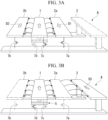
- a first return current D1 flowing in a direction opposite to the flow direction of the signal current flows due to flowing of the signal current in the signal line 1.
- a second return current D2 flowing in a direction opposite to the flow direction of the signal current that is, in the same direction as the first return current D1, flows due to flowing of the signal current in the signal line 1.
- flow directions of the first return current D1 flowing in the first inner line 2a and the second return current D2 flowing in the second inner line 2b are both opposite to the flow direction of the signal current. Accordingly, the first return current D1 and the second return current D2 act to decrease the inductance L1 of the signal line 1 due to electromagnetic coupling between the signal line 1 and the first inner line 2a and the second inner line 2b.
- a decrease of the inductance L1 is defined as ⁇ Ls
- an effective inductance Lm of the signal line 1 is (L1- ⁇ Ls).
- the signal line 1 has a capacitance C1 which is a parasitic capacitance as described above.
- the capacitor 5 is not connected between the signal line 1 and the second grounding conductor 4b. That is, the capacitance Ca of the capacitor 5 does not affect the high-frequency signal propagating in the signal line 1. Accordingly, the first propagation delay time TL which is proportional to (Lm ⁇ C1) 1/2 acts on the high-frequency signal propagating in the signal line 1.
- the high-frequency signal at the output end (the first end) of the signal line 1 is delayed in phase by the first phase difference ⁇ L from the high-frequency signal at the input end (the second end) of the signal line 1 due to the first propagation delay time TL. That is, in the low delay mode, the inductance L1 of the signal line 1 is decreased to the inductance Lm due to the first return current D1 and the second return current D2. Accordingly, the original propagation delay time of the signal line 1 is decreased and the first phase difference ⁇ L which is less than the original phase difference of the signal line 1 is realized as a result.
- a loss in the signal line 1 is intentionally increased by setting the third electronic switch 7c to the ON state. This addition of the loss is used for the loss on a high-frequency signal in the low delay mode to be set to the same as the loss on a high-frequency signal in the high delay mode.
- the loss of a high-frequency signal in the low delay mode is apparently smaller than the loss of a high-frequency signal in the high delay mode.
- This loss difference causes an amplitude difference between high-frequency signals output from the digital phase shift circuit A when the operation mode is switched between the low delay mode and the high delay mode.
- the amplitude difference is resolved by setting the third electronic switch 7c to the ON state in the low delay mode in the digital phase shift circuit A.
- the switch controller 8 sets the first electronic switch 7a, the second electronic switch 7b, and the third electronic switch 7c to the OFF state and sets the fourth electronic switch 7d to the ON state. That is, in the high delay mode, a second phase difference ⁇ H which is greater than the first phase difference ⁇ L in the low delay mode is caused due to a second propagation delay time TH until a high-frequency signal propagates from the input end (the second end) of the signal line 1 to the output end (the first end).
- the first electronic switch 7a and the second electronic switch 7b are set to the OFF state, a first current path is not formed in the first inner line 2a, and a second current path is not formed in the second inner line 2b. Accordingly, the first return current D1 flowing in the first inner line 2a becomes much smaller and the second return current D2 flowing in the second inner line 2b becomes much smaller.
- the first end of the outer line 3 is connected to the first grounding conductor 4a via the third connection conductor 6c and the second end thereof is connected to the second grounding conductor 4b via the fourth connection conductor 6d. That is, a third current path in which a current can flow between the first end and the second end is formed in advance in the outer line 3. Accordingly, in the high delay mode, a third return current D3 flows from the first end of the outer line 3 to the second end thereof due to the signal current in the signal line 1 as illustrated in FIG. 3B .
- the third return current D3 flows in a direction opposite to the flow direction of the signal current in the signal line 1. Accordingly, the third return current D3 can decrease the inductance L1 of the signal line 1 due to electromagnetic coupling between the signal line 1 and the outer line 3.
- a distance between the signal line 1 and the outer line 3 is larger than a distance between the signal line 1 and the first inner line 2a and the second inner line 2b. Accordingly, the third return current D3 has a weaker effect of decreasing the inductance L1 than the first return current D1 and the second return current D2.
- an effective inductance Lp of the signal line 1 is (L1- ⁇ Lh).
- the outer line 3 is provided on only a first side of the signal line 1, an effect of decreasing the inductance L1 is weaker in comparison with a case in which the outer line 3 is provided on both sides of the signal line 1.
- the signal line 1 has a capacitance C1 which is a parasitic capacitance.
- the capacitor 5 is connected between the signal line 1 and the second grounding conductor 4b. That is, the signal line 1 has a capacitance Cb which is a sum of the capacitance Ca of the capacitor 5 and the capacitance C1 (the parasitic capacitance). Accordingly, the second propagation delay time TH which is proportional to (Lp ⁇ Cb)1/2 acts on the high-frequency signal propagating in the signal line 1.
- the high-frequency signal at the output end (the second end) of the signal line 1 is delayed in phase by the second phase difference ⁇ H from the high-frequency signal at the input end of the signal line 1 due to the second propagation delay time TH. That is, in the high delay mode, since the inductance L1 of the signal line 1 is decreased to an inductance Lp due to the third return current D3 and the fourth electronic switch 7d is set to the ON state, the second phase difference ⁇ H which is greater than the first phase difference ⁇ L in the low delay mode is realized.
- the third electronic switch 7c is set to the OFF state. That is, in the high delay mode, a process of intentionally increasing the loss in the signal line 1 is not implemented. As a result, the output amplitude of the high-frequency signal in the high delay mode approaches the output amplitude of the high-frequency signal in the low delay mode.
- the third electronic switch 7c is not essential and may be deleted.
- the digital phase shift circuit A includes the outer line 3 outside of only one of the first inner line 2a and the second inner line 2b.
- the digital-controlled phase shift circuit according to the related art disclosed in Non-Patent Document 1 employs a configuration in which the outer grounding line is provided for each of a pair of inner grounding lines. Accordingly, according to this embodiment, since the outer line 3 is provided outside of only the first inner line 2a, it is possible to provide a digital phase shift circuit A that can enable a decrease in size in comparison with the related art.
- the first inner line 2a, the second inner line 2b, and the outer line 3 are formed in the first conductive layer R1 and the first grounding conductor 4a and the second grounding conductor 4b are formed in the second conductive layer R2 facing the first conductive layer R1 with the insulating layer I interposed therebetween by using semiconductor manufacturing technology.
- the outer line 3 is provided on only a first side of the signal line 1, an effect of decreasing the inductance L1 is weaker in comparison with a case in which the outer line 3 is provided on both sides of the signal line 1.
- the first electronic switch 7a and the second electronic switch 7b are set to the simultaneously ON (closed) state in the low delay mode, and the first electronic switch 7a and the second electronic switch 7b are set to the simultaneously OFF (open) state in the high delay mode.
- this embodiment it is possible to further increase the phase difference in comparison with a case in which only one of the first electronic switch 7a and the second electronic switch 7b is set to the ON state (closed state) in the low delay mode. That is, according to this embodiment, it is possible to set the phase difference against the high delay mode to be larger in comparison with a case in which only one of the first electronic switch 7a and the second electronic switch 7b is set to the ON state (closed state) in the low delay mode.
- the digital phase shift circuit A further includes the capacitor 5 of which the upper electrode is connected to the signal line 1 and the lower electrode is connected to the second grounding conductor 4b. According to this embodiment, it is possible to set the first phase difference ⁇ L in the low delay mode and the second phase difference ⁇ H in the high delay mode to be larger than those in a case in which the capacitor 5 is not provided.
- the lower electrode of the capacitor 5 is connected to the second grounding conductor 4b, but the lower electrode of the capacitor 5 may be connected to the first grounding conductor 4a or the lower electrode of the capacitor 5 may be connected to both the first grounding conductor 4a and the second grounding conductor 4b. That is, the upper electrode of the capacitor 5 according to this embodiment may only be connected to the signal line 1 and the lower electrode may only be connected to at least one of the first grounding conductor 4a and the second grounding conductor 4b.
- the digital phase shift circuit A further includes the fourth electronic switch 7d (the electronic switch for the capacitor) between the lower electrode of the capacitor 5 and the second grounding conductor 4b.
- the capacitor 5 can be switched between connection and disconnection in the low delay mode and the high delay mode, it is possible to set the difference between the first phase difference ⁇ L in the low delay mode and the second phase difference ⁇ H in the high delay mode to be larger.
- a digital phase shifter B using a plurality of digital phase shift circuits A according to this embodiment will be finally described below.
- the digital phase shifter B has a configuration in which a plurality of digital phase shift circuits A according to this embodiment are connected in cascade as illustrated in FIG. 4 . That is, the digital phase shifter B is a phase shift circuit in which a first digital phase shift circuit A1, a second digital phase shift circuit A2, (omission), and an n-th digital phase shift circuit An, that is, n digital phase shift circuits A, are linearly connected in cascade.
- each of the first digital phase shift circuit A1, the second digital phase shift circuit A2, (omission), and the n-th digital phase shift circuit An is smaller in size than the digital-controlled phase shift circuit according to the related art, it is possible to provide a digital phase shifter B that enables a decrease in size in comparison with the related art.
- the sizes of the first electronic switch 7a and the second electronic switch 7b may be set to be equal to or greater than a width H1 (see FIG. 4 ) which is a sum of the width of the second grounding conductor 4b and the width of the first grounding conductor 4a. More preferably, the sizes of the first electronic switch 7a and the second electronic switch 7b are set to be equal to the width H1 or slightly larger than the width H1. Accordingly, it is possible to decrease a loss in the first electronic switch 7a and the second electronic switch 7b.
Landscapes
- Waveguide Switches, Polarizers, And Phase Shifters (AREA)
- Networks Using Active Elements (AREA)
- Semiconductor Integrated Circuits (AREA)
Applications Claiming Priority (2)
| Application Number | Priority Date | Filing Date | Title |
|---|---|---|---|
| JP2022046122A JP7111923B1 (ja) | 2022-03-22 | 2022-03-22 | デジタル移相回路及びデジタル移相器 |
| PCT/JP2022/031153 WO2023181449A1 (fr) | 2022-03-22 | 2022-08-18 | Circuit de déphasage numérique et déphaseur numérique |
Publications (2)
| Publication Number | Publication Date |
|---|---|
| EP4277016A1 true EP4277016A1 (fr) | 2023-11-15 |
| EP4277016A4 EP4277016A4 (fr) | 2024-02-28 |
Family
ID=82693734
Family Applications (1)
| Application Number | Title | Priority Date | Filing Date |
|---|---|---|---|
| EP22846879.9A Pending EP4277016A4 (fr) | 2022-03-22 | 2022-08-18 | Circuit de déphasage numérique et déphaseur numérique |
Country Status (4)
| Country | Link |
|---|---|
| US (1) | US12206375B2 (fr) |
| EP (1) | EP4277016A4 (fr) |
| JP (1) | JP7111923B1 (fr) |
| WO (1) | WO2023181449A1 (fr) |
Families Citing this family (5)
| Publication number | Priority date | Publication date | Assignee | Title |
|---|---|---|---|---|
| JP7168817B1 (ja) * | 2022-08-30 | 2022-11-09 | 株式会社フジクラ | デジタル移相器 |
| JP7314385B1 (ja) * | 2022-12-20 | 2023-07-25 | 株式会社フジクラ | デジタル移相回路およびデジタル移相器 |
| JP7336050B1 (ja) * | 2023-06-07 | 2023-08-30 | 株式会社フジクラ | デジタル移相器 |
| JP7362964B1 (ja) | 2023-06-07 | 2023-10-17 | 株式会社フジクラ | デジタル移相回路及びデジタル移相器 |
| JP7326645B1 (ja) | 2023-06-07 | 2023-08-15 | 株式会社フジクラ | デジタル移相回路及びデジタル移相器 |
Family Cites Families (13)
| Publication number | Priority date | Publication date | Assignee | Title |
|---|---|---|---|---|
| AU1608501A (en) | 1999-11-18 | 2001-05-30 | Paratek Microwave, Inc. | Rf/microwave tunable delay line |
| US6816031B1 (en) * | 2001-12-04 | 2004-11-09 | Formfactor, Inc. | Adjustable delay transmission line |
| JP2011259215A (ja) | 2010-06-09 | 2011-12-22 | Toshiba Corp | 移相器 |
| US9059679B2 (en) | 2013-04-23 | 2015-06-16 | International Business Machines Corporation | Tunable interconnect structures, and integrated circuit containing the same |
| JP6587171B2 (ja) | 2015-02-23 | 2019-10-09 | 国立大学法人富山大学 | 位相シフタ |
| CN106785250B (zh) | 2016-12-23 | 2019-01-25 | 西安电子科技大学 | 基于射频微机电开关的螺旋五位分布式微机电移相器 |
| US10680581B2 (en) | 2017-11-22 | 2020-06-09 | International Business Machines Corporation | RF signal switching, phase shifting and polarization control |
| US10608335B2 (en) * | 2017-11-22 | 2020-03-31 | International Business Machines Corporation | RF signal switching, phase shifting and polarization control |
| TWI663842B (zh) * | 2018-06-06 | 2019-06-21 | 國立暨南國際大學 | RF transceiver front-end circuit |
| CN109616723B (zh) * | 2018-12-19 | 2021-07-13 | 上海秦芯信息科技有限公司 | 一种应用于5g毫米波基站的高精度移相器 |
| CN111326839B (zh) | 2020-03-04 | 2022-02-08 | 电子科技大学 | 一种片上可重构传输线及通信系统 |
| JP7456897B2 (ja) | 2020-09-10 | 2024-03-27 | ミネベアミツミ株式会社 | ファンモータ |
| JP7111920B1 (ja) * | 2022-02-18 | 2022-08-02 | 株式会社フジクラ | デジタル移相器 |
-
2022
- 2022-03-22 JP JP2022046122A patent/JP7111923B1/ja active Active
- 2022-08-18 WO PCT/JP2022/031153 patent/WO2023181449A1/fr not_active Ceased
- 2022-08-18 EP EP22846879.9A patent/EP4277016A4/fr active Pending
- 2022-08-18 US US18/018,357 patent/US12206375B2/en active Active
Also Published As
| Publication number | Publication date |
|---|---|
| US12206375B2 (en) | 2025-01-21 |
| WO2023181449A1 (fr) | 2023-09-28 |
| JP2023140206A (ja) | 2023-10-04 |
| JP7111923B1 (ja) | 2022-08-02 |
| EP4277016A4 (fr) | 2024-02-28 |
| US20240258998A1 (en) | 2024-08-01 |
Similar Documents
| Publication | Publication Date | Title |
|---|---|---|
| EP4277016A1 (fr) | Circuit de déphasage numérique et déphaseur numérique | |
| US12224472B2 (en) | Digital phase shifter | |
| US12255597B2 (en) | Digital phase shift circuit and digital phase shifter | |
| US12206147B2 (en) | Digital phase shifter | |
| US12052007B1 (en) | Digital phase shifter | |
| US12255373B2 (en) | Digital phase shifter | |
| US12224727B2 (en) | Digital phase shifter | |
| US12040765B1 (en) | Digital phase shifter | |
| US12519194B2 (en) | Digital phase shifter | |
| US12614826B2 (en) | Digital phase shifter | |
| JP7470873B2 (ja) | デジタル移相器 | |
| US12015387B2 (en) | Digital phase shifter | |
| WO2026023229A1 (fr) | Déphaseur numérique | |
| WO2026023690A1 (fr) | Déphaseur numérique | |
| WO2026023189A1 (fr) | Déphaseur numérique | |
| WO2026023691A1 (fr) | Déphaseur numérique |
Legal Events
| Date | Code | Title | Description |
|---|---|---|---|
| STAA | Information on the status of an ep patent application or granted ep patent |
Free format text: STATUS: UNKNOWN |
|
| STAA | Information on the status of an ep patent application or granted ep patent |
Free format text: STATUS: THE INTERNATIONAL PUBLICATION HAS BEEN MADE |
|
| PUAI | Public reference made under article 153(3) epc to a published international application that has entered the european phase |
Free format text: ORIGINAL CODE: 0009012 |
|
| STAA | Information on the status of an ep patent application or granted ep patent |
Free format text: STATUS: REQUEST FOR EXAMINATION WAS MADE |
|
| 17P | Request for examination filed |
Effective date: 20230130 |
|
| AK | Designated contracting states |
Kind code of ref document: A1 Designated state(s): AL AT BE BG CH CY CZ DE DK EE ES FI FR GB GR HR HU IE IS IT LI LT LU LV MC MK MT NL NO PL PT RO RS SE SI SK SM TR |
|
| REG | Reference to a national code |
Ref country code: DE Ref legal event code: R079 Free format text: PREVIOUS MAIN CLASS: H01P0001185000 Ipc: H01P0001180000 |
|
| A4 | Supplementary search report drawn up and despatched |
Effective date: 20240126 |
|
| RIC1 | Information provided on ipc code assigned before grant |
Ipc: H01Q 3/38 20060101ALN20240122BHEP Ipc: H03H 11/20 20060101ALI20240122BHEP Ipc: H01P 1/18 20060101AFI20240122BHEP |
|
| DAV | Request for validation of the european patent (deleted) | ||
| DAX | Request for extension of the european patent (deleted) |