EP4277100A1 - Abwärtswandler mit schwachlastfunktion und logik - Google Patents
Abwärtswandler mit schwachlastfunktion und logik Download PDFInfo
- Publication number
- EP4277100A1 EP4277100A1 EP23172633.2A EP23172633A EP4277100A1 EP 4277100 A1 EP4277100 A1 EP 4277100A1 EP 23172633 A EP23172633 A EP 23172633A EP 4277100 A1 EP4277100 A1 EP 4277100A1
- Authority
- EP
- European Patent Office
- Prior art keywords
- voltage
- current
- light load
- buck converter
- load
- Prior art date
- Legal status (The legal status is an assumption and is not a legal conclusion. Google has not performed a legal analysis and makes no representation as to the accuracy of the status listed.)
- Pending
Links
- 238000000034 method Methods 0.000 claims abstract description 32
- 230000004044 response Effects 0.000 claims abstract description 13
- 238000006243 chemical reaction Methods 0.000 claims abstract description 8
- 239000003990 capacitor Substances 0.000 claims description 4
- 238000004804 winding Methods 0.000 claims description 2
- 238000004590 computer program Methods 0.000 description 8
- 238000010586 diagram Methods 0.000 description 6
- 230000006870 function Effects 0.000 description 4
- 230000001360 synchronised effect Effects 0.000 description 4
- 230000003287 optical effect Effects 0.000 description 3
- 239000013307 optical fiber Substances 0.000 description 2
- 230000008569 process Effects 0.000 description 2
- 230000000644 propagated effect Effects 0.000 description 2
- 101000941450 Lasioglossum laticeps Lasioglossin-1 Proteins 0.000 description 1
- 238000007796 conventional method Methods 0.000 description 1
- 230000001419 dependent effect Effects 0.000 description 1
- 230000010354 integration Effects 0.000 description 1
- 238000004519 manufacturing process Methods 0.000 description 1
- 238000012986 modification Methods 0.000 description 1
- 230000004048 modification Effects 0.000 description 1
- 239000004065 semiconductor Substances 0.000 description 1
- 239000007787 solid Substances 0.000 description 1
- 230000001052 transient effect Effects 0.000 description 1
Images

Classifications
-
- H—ELECTRICITY
- H02—GENERATION; CONVERSION OR DISTRIBUTION OF ELECTRIC POWER
- H02M—APPARATUS FOR CONVERSION BETWEEN AC AND AC, BETWEEN AC AND DC, OR BETWEEN DC AND DC, AND FOR USE WITH MAINS OR SIMILAR POWER SUPPLY SYSTEMS; CONVERSION OF DC OR AC INPUT POWER INTO SURGE OUTPUT POWER; CONTROL OR REGULATION THEREOF
- H02M3/00—Conversion of DC power input into DC power output
- H02M3/02—Conversion of DC power input into DC power output without intermediate conversion into AC
- H02M3/04—Conversion of DC power input into DC power output without intermediate conversion into AC by static converters
- H02M3/10—Conversion of DC power input into DC power output without intermediate conversion into AC by static converters using discharge tubes with control electrode or semiconductor devices with control electrode
- H02M3/145—Conversion of DC power input into DC power output without intermediate conversion into AC by static converters using discharge tubes with control electrode or semiconductor devices with control electrode using devices of a triode or transistor type requiring continuous application of a control signal
- H02M3/155—Conversion of DC power input into DC power output without intermediate conversion into AC by static converters using discharge tubes with control electrode or semiconductor devices with control electrode using devices of a triode or transistor type requiring continuous application of a control signal using semiconductor devices only
- H02M3/156—Conversion of DC power input into DC power output without intermediate conversion into AC by static converters using discharge tubes with control electrode or semiconductor devices with control electrode using devices of a triode or transistor type requiring continuous application of a control signal using semiconductor devices only with automatic control of output voltage or current, e.g. switching regulators
- H02M3/158—Conversion of DC power input into DC power output without intermediate conversion into AC by static converters using discharge tubes with control electrode or semiconductor devices with control electrode using devices of a triode or transistor type requiring continuous application of a control signal using semiconductor devices only with automatic control of output voltage or current, e.g. switching regulators including plural semiconductor devices as final control devices for a single load
-
- H—ELECTRICITY
- H02—GENERATION; CONVERSION OR DISTRIBUTION OF ELECTRIC POWER
- H02M—APPARATUS FOR CONVERSION BETWEEN AC AND AC, BETWEEN AC AND DC, OR BETWEEN DC AND DC, AND FOR USE WITH MAINS OR SIMILAR POWER SUPPLY SYSTEMS; CONVERSION OF DC OR AC INPUT POWER INTO SURGE OUTPUT POWER; CONTROL OR REGULATION THEREOF
- H02M1/00—Details of apparatus for conversion
- H02M1/0003—Details of control, feedback or regulation circuits
- H02M1/0032—Control circuits allowing low power mode operation, e.g. in standby mode
-
- H—ELECTRICITY
- H02—GENERATION; CONVERSION OR DISTRIBUTION OF ELECTRIC POWER
- H02M—APPARATUS FOR CONVERSION BETWEEN AC AND AC, BETWEEN AC AND DC, OR BETWEEN DC AND DC, AND FOR USE WITH MAINS OR SIMILAR POWER SUPPLY SYSTEMS; CONVERSION OF DC OR AC INPUT POWER INTO SURGE OUTPUT POWER; CONTROL OR REGULATION THEREOF
- H02M1/00—Details of apparatus for conversion
- H02M1/0003—Details of control, feedback or regulation circuits
- H02M1/0009—Devices or circuits for detecting current in a converter
-
- H—ELECTRICITY
- H02—GENERATION; CONVERSION OR DISTRIBUTION OF ELECTRIC POWER
- H02M—APPARATUS FOR CONVERSION BETWEEN AC AND AC, BETWEEN AC AND DC, OR BETWEEN DC AND DC, AND FOR USE WITH MAINS OR SIMILAR POWER SUPPLY SYSTEMS; CONVERSION OF DC OR AC INPUT POWER INTO SURGE OUTPUT POWER; CONTROL OR REGULATION THEREOF
- H02M1/00—Details of apparatus for conversion
- H02M1/0003—Details of control, feedback or regulation circuits
- H02M1/0016—Control circuits providing compensation of output voltage deviations using feedforward of disturbance parameters
- H02M1/0019—Control circuits providing compensation of output voltage deviations using feedforward of disturbance parameters the disturbance parameters being load current fluctuations
-
- H—ELECTRICITY
- H02—GENERATION; CONVERSION OR DISTRIBUTION OF ELECTRIC POWER
- H02M—APPARATUS FOR CONVERSION BETWEEN AC AND AC, BETWEEN AC AND DC, OR BETWEEN DC AND DC, AND FOR USE WITH MAINS OR SIMILAR POWER SUPPLY SYSTEMS; CONVERSION OF DC OR AC INPUT POWER INTO SURGE OUTPUT POWER; CONTROL OR REGULATION THEREOF
- H02M1/00—Details of apparatus for conversion
- H02M1/0003—Details of control, feedback or regulation circuits
- H02M1/0016—Control circuits providing compensation of output voltage deviations using feedforward of disturbance parameters
- H02M1/0022—Control circuits providing compensation of output voltage deviations using feedforward of disturbance parameters the disturbance parameters being input voltage fluctuations
-
- H—ELECTRICITY
- H02—GENERATION; CONVERSION OR DISTRIBUTION OF ELECTRIC POWER
- H02M—APPARATUS FOR CONVERSION BETWEEN AC AND AC, BETWEEN AC AND DC, OR BETWEEN DC AND DC, AND FOR USE WITH MAINS OR SIMILAR POWER SUPPLY SYSTEMS; CONVERSION OF DC OR AC INPUT POWER INTO SURGE OUTPUT POWER; CONTROL OR REGULATION THEREOF
- H02M3/00—Conversion of DC power input into DC power output
- H02M3/02—Conversion of DC power input into DC power output without intermediate conversion into AC
- H02M3/04—Conversion of DC power input into DC power output without intermediate conversion into AC by static converters
- H02M3/10—Conversion of DC power input into DC power output without intermediate conversion into AC by static converters using discharge tubes with control electrode or semiconductor devices with control electrode
- H02M3/145—Conversion of DC power input into DC power output without intermediate conversion into AC by static converters using discharge tubes with control electrode or semiconductor devices with control electrode using devices of a triode or transistor type requiring continuous application of a control signal
- H02M3/155—Conversion of DC power input into DC power output without intermediate conversion into AC by static converters using discharge tubes with control electrode or semiconductor devices with control electrode using devices of a triode or transistor type requiring continuous application of a control signal using semiconductor devices only
- H02M3/156—Conversion of DC power input into DC power output without intermediate conversion into AC by static converters using discharge tubes with control electrode or semiconductor devices with control electrode using devices of a triode or transistor type requiring continuous application of a control signal using semiconductor devices only with automatic control of output voltage or current, e.g. switching regulators
- H02M3/157—Conversion of DC power input into DC power output without intermediate conversion into AC by static converters using discharge tubes with control electrode or semiconductor devices with control electrode using devices of a triode or transistor type requiring continuous application of a control signal using semiconductor devices only with automatic control of output voltage or current, e.g. switching regulators with digital control
Definitions
- the present disclosure relates to power conversion, and more particularly to buck converters for stepping an input voltage down to a lower output voltage.
- Buck converters can step down an input or link voltage to a lower output voltage.
- Buck synchronous and standard power converters with a wide input range e.g. 90VDC to 600VDC, which is a much wider input range than in traditional applications, can cause problems on loads that vary from light to heavy during normal and transient conditions.
- a method of DC-DC power conversion includes converting a DC link voltage to a DC output voltage for a load that is lower than the DC link voltage using a buck converter.
- the method includes controlling the buck converter in a normal switching mode in response to the DC link voltage, the DC output voltage, and the current of the load being within respective predetermined thresholds.
- the method includes controlling the buck converter in a light load switching mode in response the DC link voltage, the DC output voltage, and/or the current of the load being at or beyond the respective predetermined thresholds.
- Controlling the buck converter in the light load switching mode can include latching the light load switching mode in an enabled state upon occurrence of: the DC link voltage being at or above a predetermined high threshold, to keep the light load switching mode enabled even if the DC link voltage drops below the predetermined high threshold after latching, and the DC output voltage being at or below a predetermined light load voltage limit, to keep the light load switching mode enabled even if the DC output voltage exceeds the predetermined light load voltage limit after latching.
- Controlling the buck boost converter in the light load switching mode can include latching the light load switching mode in an enabled state upon occurrence of: the DC output voltage being above a predetermined output voltage limit, and load current being at or below a predetermined light load current limit.
- the method can include resetting the enabled state of the light load switching mode upon the DC output voltage being above the upper output voltage limit, the DC link voltage being at or below a predetermined lower light load limit, or the load current being at or above a predetermined lower light load limit, with a delay.
- Controlling the buck converter in the normal switching mode can include controlling current to the load based on: measured current supplied to the buck converter at the DC Link Voltage, and a commanded inductor current for controlling current in a main inductor of the buck converter.
- the commanded inductor current for controlling the current in the main inductor can be derived from a voltage regulation control signal that is based on a differential of commanded output voltage and measured output voltage to the load.
- Controlling the buck converter in the light load switching mode can include controlling current to the load based on: measured current supplied to the load, measured current supplied to the buck converter at the DC Link Voltage, and a commanded peak inductor light load command for controlling current in a main inductor of the buck converter.
- a DC-DC conversion system includes a buck converter configured to receive a DC link voltage as input and to output a DC output voltage that is lower than the DC link voltage.
- a controller is operatively connected to the buck converter to control the buck converter.
- the controller includes logic configured to perform a method as those disclosed above.
- the buck converter can include a positive DC link voltage node and a negative DC link voltage node.
- a switching component can connect the positive and negative DC link voltage nodes.
- the controller can be operatively connected to control switching of the switching component.
- the switching component can include a pair of switches connected in series.
- the buck converter can include a main inductor connecting a node between the two switches to a positive DC output node.
- the system can include a first reluctance in the form of an inductor winding resistance of the main inductor.
- a second reluctance can be connected in series between the positive DC output node and the negative DC link voltage node.
- the negative DC link voltage node can be configured to serve as a negative DC output node.
- An input capacitor can connect between the positive and negative DC link voltage nodes in parallel with the switching component.
- a first current sensor can be operatively connected to provide input indicative of current through the positive DC output node to a light load logic component of the controller.
- a second current sensor can be operatively connected to provide input indicative of current through the positive DC link voltage node to a current control logic component of the controller.
- the current control logic component can be operatively connected to control switching of the switching component.
- a first voltage sensor can be operatively connected to provide input indicative of voltage across the positive DC output node and the negative DC link voltage node to the controller.
- a second voltage sensor can be operatively connected to provide input indicative of voltage across the positive and negative DC link voltage nodes to the controller.
- a differential logic component can be operatively connected to output a differential signal indicative of difference between the input from the first voltage sensor and a commanded output voltage to a voltage regulation logic component configured to output a voltage control signal based on the differential signal.
- a light load limiter can be configured to output a light load current limiting signal.
- a switch logic component can be operatively connected to receive input from the light load logic component, from the light load limiter, and from the voltage control logic component, wherein the switch logic component is configured to switch between sending output from the light load limiter or from the voltage regulation logic component to the current control logic component.
- the light load logic component can be operatively connected to receive input from the first voltage sensor, and to control the switch logic component between the light load switching mode and the normal switching mode.
- Fig. 1 a partial view of an embodiment of a system in accordance with the disclosure is shown in Fig. 1 and is designated generally by reference character 100.
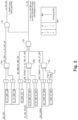
- FIG. 2 Other embodiments of systems in accordance with the disclosure, or aspects thereof, are provided in Fig. 2 and TABLE 1, as will be described.
- the systems and methods described herein can be used to provide a light load mode for synchronous/standard buck power converters with wide input voltage ranges, e.g. where the input voltage ranges from 90VDC to 600VDC.
- the DC-DC conversion system 100 includes a buck converter 102 configured to receive a DC link voltage as input and to output a DC output voltage that is lower than the DC link voltage.
- a controller 104 is operatively connected to the buck converter 102 to control the buck converter 102.
- the controller 104 includes logic configured to control the buck converter 102 in a normal switching mode in response to the DC link voltage, the DC output voltage, and the current of the load being within respective predetermined thresholds.
- the controller 104 also includes logic configured to control the buck converter 102 in a light load switching mode in response to in response the DC link voltage, the DC output voltage, and/or the current of the load being at or beyond the respective predetermined thresholds.
- the buck converter 102 includes a positive DC link voltage node 106 and a negative DC link voltage node 108.
- a switching component 110 connects the positive and negative DC link voltage nodes 106, 108.
- the controller 104 is operatively connected to control switching of the switching component 110.
- the switching component 110 includes a pair of switches Q 1 and Q 2 connected in series across the positive and negative DC link voltage nodes 106, 108.
- the switching components Q 1 and Q 2 can be any suitable type of switches, such as solid state switches where the gates are connected to the controller 104 so the controller 104 can control the switching of the switching components to produce the output voltage at the DC output nodes 114, 108.
- the buck converter 102 includes a main inductor L B connecting a node 112 between the two switches Q 1 and Q 2 to a positive DC output node 114.
- a first reluctance indicated with a dashed box in Fig. 1 includes the main inductor LB, wherein RB is the coil resistance of the main inductor LB.
- a second reluctance (the capacitor CO and its associated internal resistance, RCoesr as indicated by a dashed line box around them in Fig. 1 ) is connected across the positive DC output node 114 and the negative DC link voltage node 108, which is configured to serve as a negative DC output node.
- the second reluctance is connected in parallel with the load (represented in Fig. 1 by R L ).
- the load is not necessarily part of the buck converter 102, and can be any suitable load to be powered by the output voltage and current of the cuck converter 102.
- An input capacitor C in connects between the positive and negative DC link voltage nodes 106, 108 in parallel with the switching component 110.
- buck converter 100 in Fig. 1
- a synchronous buck converter that is a synchronous buck converter
- the second switch Q 2 can be changed to a diode, pointed upward as oriented in Fig. 1 , to make a standard buck converter which can operate using similar methods as disclosed herein without departing from the scope of this disclosure.
- a first current sensor C T2 is operatively connected to provide input indicative of current through the positive DC output node 114 to a light load logic component 116 of the controller 104.
- a second current sensor C T1 is operatively connected to provide input indicative of current through the positive DC link voltage node 106 to a current control logic component 118 of the controller 104.
- the current control logic component 118 is operatively connected to control switching of the switching component 110.
- a first voltage sensor Vo is operatively connected to provide input indicative of voltage across the positive DC output node 114 and the negative DC link voltage node 108 to the controller 104.
- a second voltage sensor 120 is operatively connected to provide input indicative of voltage across the positive and negative DC link voltage nodes 106, 108 to the controller 104.
- a differential logic component 122 is operatively connected to output a differential signal (V ERROR in Fig. 1 ) indicative of difference between the input from the first voltage sensor Vo and a commanded output voltage V CMD to a voltage regulation logic component 124 configured to output a voltage control signal based on the differential signal V ERROR .
- the control algorithm inside block 124 can be a standard control algorithm, i.e. a proportional plus integral, although any other suitable type of control algorithm can be used.
- a switch logic component 126 is operatively connected to receive input from the light load logic component 116, from the voltage control logic component 124, and from a light load limiter 128 (LL_IPK_CMD in Fig. 1 ).
- the switch logic component 126 is configured to switch between sending output from the light load limiter 128 or from the voltage regulation logic component 124 to the current control logic component 118.
- the light load logic component 116 is operatively connected to receive input from the second voltage sensor 120, and to control the switch logic component 126 between the light load switching mode and the normal switching mode.
- a method of DC-DC power conversion includes converting a DC link voltage to a DC output voltage for a load that is lower than the DC link voltage using a buck converter, e.g. buck converter 102.
- the method includes controlling the buck converter in a normal switching mode in response to the DC link voltage, e.g. at the voltage sensor 120) the DC link voltage, the DC output voltage (from the sensor Vo), and the current of the load (from sensor C T2 ) being within respective predetermined thresholds.
- the method also includes controlling the buck converter in a light load switching mode in response to the DC link voltage, the DC output voltage, and/or the current of the load being at or beyond the respective predetermined thresholds.
- LL_LO_LIMIT_28V predetermined light load voltage limit
- a third enablement requirement for enablement of the light load switching mode is the DC output voltage ( 28V_FDBK in Fig. 2 , at Vo in Fig. 1 ) being below a predetermined output voltage limit (28V_FDBK ⁇ UP_LIMIT_28V in Fig. 2 ).
- a fourth enablement requirement for enablement of the light load switching mode is load current (LOAD_CURRENT in Fig. 2 , sensed by sensor C T2 in Fig. 1 ) being at or below a predetermined light load current limit (LL_I_LOAD_UP_LIMIT in Fig. 2 ).
- TABLE 1 provides the logic for the S and R inputs for the set/reset logic boxes 136a-d, and the corresponding outputs. This selects the LL_IPK_CMD and sets the controller PI input and integrator to zero for the current control component 118.
- LL_EN is an input to the voltage regulation logic component 124 of Fig. 1 .
- LL_EN is an input to the switch logic component 126 of Fig. 1 and to the current control logic component 118.
- LL_EN 1
- the LL_IPK_CMD is selected (in the switch logic component 126) and the pulse width modulation (PWM) is enabled by the current control logic component 118.
- LL_SW_EN By operation of the first AND gage 130, LL_SW_EN, can also be reset if the output voltage is above its predetermined limit (e.g.
- Controlling the buck converter in the normal switching mode includes controlling current to the load based on measured current supplied to the buck converter 102 at the DC Link Voltage (using sensor feedback from sensor C T1 of Fig. 1 ), and a commanded inductor current from the voltage regulation component 124for controlling current in the main inductor L B of the buck converter 102.
- the commanded inductor current for controlling the current in the main inductor is derived from a voltage regulation control signal (from component 124 in Fig. 1 ) that is based on a differential of commanded output voltage and measured output voltage to the load (Verror in Fig. 1 ).
- Controlling the buck converter 102 in the light load switching mode includes controlling current to the load based on measured current supplied to the load (from sensor C T2 in Fig. 1 ), measured current supplied to the buck converter 102 at the DC Link Voltage (from sensor C T1 of Fig. 1 ), and a commanded peak inductor light load command for controlling current in a main inductor of the buck converter (LL_PK_CMD in Fig. 1 ).
- the LL_IPK_CMD is a constant value and dependent on application and should be greater than the LL_I_LOAD_UP_LIMIT.
- aspects of the present embodiments may be embodied as a system, method or computer program product. Accordingly, aspects of the present embodiments may take the form of an entirely hardware embodiment, an entirely software embodiment (including firmware, resident software, micro-code, etc.) or an embodiment combining software and hardware aspects that may all generally be referred to herein as a "logic,” “circuit,” “module,” “component” or “system.” Furthermore, aspects of the present disclosure may take the form of a computer program product embodied in one or more computer readable medium(s) having computer readable program code embodied thereon.
- the computer readable medium may be a computer readable signal medium or a computer readable storage medium.
- a computer readable storage medium may be, for example, but not limited to, an electronic, magnetic, optical, electromagnetic, infrared, or semiconductor system, apparatus, or device, or any suitable combination of the foregoing.
- a computer readable storage medium may be any tangible medium that can contain, or store a program for use by or in connection with an instruction execution system, apparatus, or device.
- a computer readable signal medium may include a propagated data signal with computer readable program code embodied therein, for example, in baseband or as part of a carrier wave. Such a propagated signal may take any of a variety of forms, including, but not limited to, electro-magnetic, optical, or any suitable combination thereof.
- a computer readable signal medium may be any computer readable medium that is not a computer readable storage medium and that can communicate, propagate, or transport a program for use by or in connection with an instruction execution system, apparatus, or device.
- Program code embodied on a computer readable medium may be transmitted using any appropriate medium, including but not limited to wireless, wireline, optical fiber cable, RF, etc., or any suitable combination of the foregoing.
- Computer program code for carrying out operations for aspects of the present disclosure may be written in any combination of one or more programming languages, including an object oriented programming language such as Java, Smalltalk, C++ or the like and conventional procedural programming languages, such as the "C" programming language or similar programming languages.
- the program code may execute entirely on the user's computer, partly on the user's computer, as a stand-alone software package, partly on the user's computer and partly on a remote computer or entirely on the remote computer or server.
- the remote computer may be connected to the user's computer through any type of network, including a local area network (LAN) or a wide area network (WAN), or the connection may be made to an external computer (for example, through the Internet using an Internet Service Provider).
- LAN local area network
- WAN wide area network
- Internet Service Provider for example, AT&T, MCI, Sprint, EarthLink, MSN, GTE, etc.
- These computer program instructions may also be stored in a computer readable medium that can direct a computer, other programmable data processing apparatus, or other devices to function in a particular manner, such that the instructions stored in the computer readable medium produce an article of manufacture including instructions which implement the function/act specified in the flowchart and/or block diagram block or blocks.
- the computer program instructions may also be loaded onto a computer, other programmable data processing apparatus, or other devices to cause a series of operational steps to be performed on the computer, other programmable apparatus or other devices to produce a computer implemented process such that the instructions which execute on the computer or other programmable apparatus provide processes for implementing the functions/acts specified in a flowchart and/or block diagram block or blocks.
Landscapes
- Engineering & Computer Science (AREA)
- Power Engineering (AREA)
- Dc-Dc Converters (AREA)
Applications Claiming Priority (1)
| Application Number | Priority Date | Filing Date | Title |
|---|---|---|---|
| US17/740,847 US12166408B2 (en) | 2022-05-10 | 2022-05-10 | Buck converters with light load function and logic |
Publications (1)
| Publication Number | Publication Date |
|---|---|
| EP4277100A1 true EP4277100A1 (de) | 2023-11-15 |
Family
ID=86331157
Family Applications (1)
| Application Number | Title | Priority Date | Filing Date |
|---|---|---|---|
| EP23172633.2A Pending EP4277100A1 (de) | 2022-05-10 | 2023-05-10 | Abwärtswandler mit schwachlastfunktion und logik |
Country Status (2)
| Country | Link |
|---|---|
| US (1) | US12166408B2 (de) |
| EP (1) | EP4277100A1 (de) |
Citations (3)
| Publication number | Priority date | Publication date | Assignee | Title |
|---|---|---|---|---|
| US20160276931A1 (en) * | 2015-03-20 | 2016-09-22 | Active-Semi, Inc. | Current Metering For Transitioning Between Operating Modes In Switching Regulators |
| US20170012525A1 (en) * | 2015-07-06 | 2017-01-12 | Qualcomm Incorporated | Voltage regulator having auto mode optimized for load profiles |
| WO2021076350A1 (en) * | 2019-10-15 | 2021-04-22 | Texas Instruments Incorporated | Method and system for buck converter current re-use |
Family Cites Families (5)
| Publication number | Priority date | Publication date | Assignee | Title |
|---|---|---|---|---|
| US7518885B2 (en) | 2006-10-04 | 2009-04-14 | Power Integrations, Inc. | Method and apparatus for a control circuit with multiple operation modes |
| KR102412717B1 (ko) * | 2017-07-18 | 2022-06-24 | 한국전자통신연구원 | 재구성 델타 시그마 모듈레이터를 이용한 스위치 모드 파워 서플라이 및 이의 구동 방법 |
| US10715039B1 (en) * | 2018-03-07 | 2020-07-14 | Cirrus Logic, Inc. | Peak current controlled switch mode power supply with embedded adaptive pulse frequency modulation control |
| US10622897B2 (en) * | 2018-09-17 | 2020-04-14 | Hamilton Sundstrand Corporation | Controller for buck DC/DC converter with effective decoupling |
| CN113489318A (zh) | 2021-06-09 | 2021-10-08 | 西安理工大学 | 一种控制Buck变换器工作模态的方法 |
-
2022
- 2022-05-10 US US17/740,847 patent/US12166408B2/en active Active
-
2023
- 2023-05-10 EP EP23172633.2A patent/EP4277100A1/de active Pending
Patent Citations (3)
| Publication number | Priority date | Publication date | Assignee | Title |
|---|---|---|---|---|
| US20160276931A1 (en) * | 2015-03-20 | 2016-09-22 | Active-Semi, Inc. | Current Metering For Transitioning Between Operating Modes In Switching Regulators |
| US20170012525A1 (en) * | 2015-07-06 | 2017-01-12 | Qualcomm Incorporated | Voltage regulator having auto mode optimized for load profiles |
| WO2021076350A1 (en) * | 2019-10-15 | 2021-04-22 | Texas Instruments Incorporated | Method and system for buck converter current re-use |
Also Published As
| Publication number | Publication date |
|---|---|
| US20230369973A1 (en) | 2023-11-16 |
| US12166408B2 (en) | 2024-12-10 |
Similar Documents
| Publication | Publication Date | Title |
|---|---|---|
| CN103081321B (zh) | 降压开关模式电力转换器大信号瞬时响应优化器 | |
| US9559604B2 (en) | DC/DC converter and control method of DC/DC converter | |
| EP2659577B1 (de) | Messung eines relativen wirkungsgrads in einem pwm umrichter | |
| CN111587526A (zh) | Dc-dc转换器装置 | |
| CN111344939A (zh) | 并联电源装置 | |
| US11056909B2 (en) | DC UPS architecture and solution | |
| EP3010130A1 (de) | Startsteuerungsverfahren für schaltergleichrichter sowie vorrichtung und speichermedium dafür | |
| JP4198588B2 (ja) | 制御ループを具える回路形態 | |
| EP4277100A1 (de) | Abwärtswandler mit schwachlastfunktion und logik | |
| EP4102712A1 (de) | Vorwärtskompensation für llc-resonanzwandler | |
| US10097079B1 (en) | Dual constant time switching regulator and switching control circuit and method thereof | |
| JP6354505B2 (ja) | スイッチング電源装置 | |
| AU2012364266B2 (en) | Power converter with digital current control circuit | |
| EP4262074A1 (de) | Sanftstart für abwärtswandler | |
| US12278588B2 (en) | Method and apparatus for controlling output power of generator, and generator system | |
| US20240014661A1 (en) | Power conversion device and estimation device | |
| EP4262070A1 (de) | Spitzenstromänderungsratenbegrenzung für abwärtswandler | |
| Kissaoui et al. | Output-feedback nonlinear adaptive control strategy of three-phase AC/DC boost power converter for on-line UPS systems | |
| JP4946642B2 (ja) | 高調波電流補償装置 | |
| Shukla et al. | A Methodology to Solve the Instability Issue in Decoupled Controller for Current Fed Triple Active Bridge Converter | |
| CN121193061B (zh) | 电流内环参考电流值补偿方法、控制方法、系统及介质 | |
| US20230369975A1 (en) | High voltage dc-dc converters | |
| Moon et al. | Multi-loop voltage control strategy of half-bridge voltage balancers with current sensorless scheme | |
| Espinosa et al. | FCS–MPC and Feedback Quantizer applied to a Multi-Cell AFE Rectifier | |
| CN118713460A (zh) | Boost-PFC控制电路及其控制方法 |
Legal Events
| Date | Code | Title | Description |
|---|---|---|---|
| PUAI | Public reference made under article 153(3) epc to a published international application that has entered the european phase |
Free format text: ORIGINAL CODE: 0009012 |
|
| STAA | Information on the status of an ep patent application or granted ep patent |
Free format text: STATUS: THE APPLICATION HAS BEEN PUBLISHED |
|
| AK | Designated contracting states |
Kind code of ref document: A1 Designated state(s): AL AT BE BG CH CY CZ DE DK EE ES FI FR GB GR HR HU IE IS IT LI LT LU LV MC ME MK MT NL NO PL PT RO RS SE SI SK SM TR |
|
| STAA | Information on the status of an ep patent application or granted ep patent |
Free format text: STATUS: REQUEST FOR EXAMINATION WAS MADE |
|
| 17P | Request for examination filed |
Effective date: 20240514 |
|
| RBV | Designated contracting states (corrected) |
Designated state(s): AL AT BE BG CH CY CZ DE DK EE ES FI FR GB GR HR HU IE IS IT LI LT LU LV MC ME MK MT NL NO PL PT RO RS SE SI SK SM TR |