EP4277242A2 - Réseautage centré sur l'information pour lte - Google Patents
Réseautage centré sur l'information pour lte Download PDFInfo
- Publication number
- EP4277242A2 EP4277242A2 EP23186051.1A EP23186051A EP4277242A2 EP 4277242 A2 EP4277242 A2 EP 4277242A2 EP 23186051 A EP23186051 A EP 23186051A EP 4277242 A2 EP4277242 A2 EP 4277242A2
- Authority
- EP
- European Patent Office
- Prior art keywords
- icn
- protocol
- transport
- transport protocol
- requests
- Prior art date
- Legal status (The legal status is an assumption and is not a legal conclusion. Google has not performed a legal analysis and makes no representation as to the accuracy of the status listed.)
- Granted
Links
Images




Classifications
-
- H—ELECTRICITY
- H04—ELECTRIC COMMUNICATION TECHNIQUE
- H04L—TRANSMISSION OF DIGITAL INFORMATION, e.g. TELEGRAPHIC COMMUNICATION
- H04L69/00—Network arrangements, protocols or services independent of the application payload and not provided for in the other groups of this subclass
- H04L69/22—Parsing or analysis of headers
-
- H—ELECTRICITY
- H04—ELECTRIC COMMUNICATION TECHNIQUE
- H04L—TRANSMISSION OF DIGITAL INFORMATION, e.g. TELEGRAPHIC COMMUNICATION
- H04L61/00—Network arrangements, protocols or services for addressing or naming
- H04L61/50—Address allocation
- H04L61/5007—Internet protocol [IP] addresses
-
- H—ELECTRICITY
- H04—ELECTRIC COMMUNICATION TECHNIQUE
- H04L—TRANSMISSION OF DIGITAL INFORMATION, e.g. TELEGRAPHIC COMMUNICATION
- H04L67/00—Network arrangements or protocols for supporting network services or applications
- H04L67/50—Network services
- H04L67/56—Provisioning of proxy services
- H04L67/568—Storing data temporarily at an intermediate stage, e.g. caching
-
- H—ELECTRICITY
- H04—ELECTRIC COMMUNICATION TECHNIQUE
- H04L—TRANSMISSION OF DIGITAL INFORMATION, e.g. TELEGRAPHIC COMMUNICATION
- H04L67/00—Network arrangements or protocols for supporting network services or applications
- H04L67/50—Network services
- H04L67/60—Scheduling or organising the servicing of application requests, e.g. requests for application data transmissions using the analysis and optimisation of the required network resources
- H04L67/63—Routing a service request depending on the request content or context
-
- H—ELECTRICITY
- H04—ELECTRIC COMMUNICATION TECHNIQUE
- H04L—TRANSMISSION OF DIGITAL INFORMATION, e.g. TELEGRAPHIC COMMUNICATION
- H04L69/00—Network arrangements, protocols or services independent of the application payload and not provided for in the other groups of this subclass
- H04L69/04—Protocols for data compression, e.g. ROHC
-
- H—ELECTRICITY
- H04—ELECTRIC COMMUNICATION TECHNIQUE
- H04W—WIRELESS COMMUNICATION NETWORKS
- H04W76/00—Connection management
- H04W76/10—Connection setup
- H04W76/12—Setup of transport tunnels
-
- H—ELECTRICITY
- H04—ELECTRIC COMMUNICATION TECHNIQUE
- H04W—WIRELESS COMMUNICATION NETWORKS
- H04W76/00—Connection management
- H04W76/20—Manipulation of established connections
- H04W76/28—Discontinuous transmission [DTX]; Discontinuous reception [DRX]
Definitions
- the present invention generally relates to the deployment of information centric networking (ICN) in long term evolution (LTE) mobile networks.
- ICN information centric networking
- LTE long term evolution
- LTE Long Term Evolution
- GSMA Global System Mobile Association'
- 3GPP 3rd Generation Partnership Project
- IP Internet Protocol
- a method for improving content delivery for a user equipment is implemented on a computing device and includes: receiving a request from an application layer on the UE, determining whether said request is an ICN-based request using Information Centric Networking (ICN) transport protocol or an IP-based request using Internet Protocol (IP) transport protocol, and for each ICN-based request according to the determining: forwarding the ICN-based request to an ICN function on the UE, and compressing ICN headers in the ICN-based request using robust header (RoHC) compression.
- ICN Information Centric Networking
- IP Internet Protocol
- a method for improving content delivery is performed on a mobile base station and includes: configuring the mobile base station to support ICN transport protocol, and storing content for delivery over the ICN transport protocol in an ICN content cache on the mobile base station.
- a method for supporting ICN on a long term evolution (LTE) evolved packet core (EPC) device includes: receiving an initial attach request from a user equipment (UE), where the initial attach request includes an indication of support for ICN transport protocol on the UE, authenticating the UE, creating a session for the UE, where a Packet Data Network (PDN) type is assigned for the session is ICN.
- UE user equipment
- PDN Packet Data Network
- ICN Information Centric Networking
- ICN may remedy some of the deficiencies of IP in an LTE environment.
- resource names are transitory, thereby necessitating redundant setup for requests for the same resource from different network entities.
- resource names are persistent, regardless of physical storage location. Accordingly, a given resource may be allocated a unique name that may be used consistently and uniformly throughout a network.
- LTE architecture may therefore be modified to support ICN for content delivery by implementing ICN in mobile user equipments (UEs), base stations (BSs), and/or the evolved packet core (EPC), sometimes referred to as a mobile packet core (MPC).
- UEs mobile user equipments
- BSs base stations
- EPC evolved packet core
- MPC mobile packet core
- Fig. 1 depicts a 3GPP environment, where the control plane uses IP based Non-Access Stratum (NAS) signaling on S-1 Mobility Management Entity (MME), and General Packet Radio Service Tunneling Protocol-Control (GTP-C) messages on S11 interfaces, for mobility management and session management respectively.
- NAS Non-Access Stratum
- MME Mobility Management Entity
- GTP-C General Packet Radio Service Tunneling Protocol-Control
- IP based, S1-U, S5, and S8 interfaces are used in unicast for content delivery.
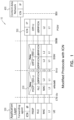
- ICN enabled LTE architecture 10 comprises UE protocol stack 100, mobile base station protocol stack 200 (e.g., implemented on an eNodeB as depicted in Fig. 1 ), Evolved Packet Core/Packet Data Network Gateway (EPC/PGW) protocol stack 300, and CDN 400.
- EPC/PGW Evolved Packet Core/Packet Data Network Gateway
- CDN 400 CDN 400.
- ICN may be implemented instead of, or in parallel with IP, as a dual stack protocol stack for a UE and PGW.
- a UE is any type of device which attaches to a cellular network using 3G/UMTS or LTE technologies.
- the protocols and software stack used inside an LTE capable UE may therefore support both 3G and LTE software inter-working and handover.
- the latest 3GPP Release 13 (Rel.13) (and subsequent) specifications describe the use of both IP and non-IP protocols to establish logical/session connectivity. In accordance with embodiments described herein, this specified functionality may be leveraged to deploy an ICN protocol stack in a UE.
- ICN may be implemented in a UE by inclusion of a forwarding agent function inserted between the application and network layers.
- This forwarding agent function may interface with the application layer, and may be configured to provide forwarding decision algorithms to route requests. For example, forwarding decisions may be based on criteria such as application preference (e.g., ICN vs IP transport), content locations, content types, publisher's details, cost, network congestion, quality of service (QoS) and/or any other customizable parameters.
- the forwarding agent function may, in at least one embodiment, monitor application layer parameters through software probes to discover network status, preference etc. and apply this to forwarding decision algorithms.
- ICN may be implemented in a dual stack arrangement in parallel with IP for a UE as represented in UE protocol stack 100.
- the UE ICN transport protocol may communicate with either the ICN function in EPC/PGW protocol stack 300 (if, for example, ICN is implemented in the PGW), and/or an ICN function in CDN 400, depending upon how, and to what extent, ICN is implemented in the network.
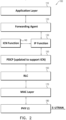
- FIG. 2 is a simplified schematic diagram of an exemplary dual stack UE protocol stack 100 for implementing ICN in parallel with IP for a UE in accordance with embodiments described herein.
- UE protocol stack 100 comprises application layer 110, forwarding agent 120, IP function 130, ICN function 140, Packet Data Convergence Protocol (PDCP) 150, Radio Link Control (RLC) 160, Medium Access Control (MAC) 170 and physical layer (PHY L1) 180.
- PDCP Packet Data Convergence Protocol
- RLC Radio Link Control
- MAC Medium Access Control
- PHY L1 physical layer
- Application layer 110 may refer to the protocol layer for any of a variety of software and/or hardware applications implemented on a UE in system 10, for example, but not limited to, applications for the provision and display of content on the UE. It will be appreciated that the applications in application layer 110 may not be uniformly configured to support the use of a given transport protocol. Specifically, some of the applications may be configured to support the use of IP, some may be configured to support the use of ICN, and some may be configured to support both.
- forwarding agent 120 may be configured to route outgoing traffic (e.g., fetch requests from CDN 400, communications with other UEs, etc.) from application layer 110 via either IP function 130 or ICN function 140 based on the capabilities of the originating applications in application layer 110.
- forwarding agent 120 may be implemented as a software based router implemented using any suitable mechanism such as, for example, Representational State Transfer (REST), TCP/IP socket and/or Extensible Markup Language (XML), etc.
- REST Representational State Transfer
- XML Extensible Markup Language
- Forwarding agent 120 may be configured to handle any one of three types of requests from application layer 110: IP-specific, where the application requests IP transport (either because the application doesn't support ICN or has, for whatever reason, been configured to prefer IP); ICN-specific, where the application requests ICN transport (either because the application doesn't support IP or has, for whatever reason, been configured to prefer ICN); or IP/ICN, where the application supports both IP and ICN and allows forwarding agent 120 to determine which transport protocol to use.
- Forwarding agent 120 may then forward the application request to either IP function 130 or ICN function 140.
- IP function 130 may represent already existing functionality in the LTE standard, such that minimal changes, if any, may be needed to implement IP function 130 in architecture 10.
- forwarding agent 120 may use a TCP/IP socket mechanism to communicate with IP function 130.
- ICN may typically be more efficient than IP, such that forwarding agent 120 may be configured to prefer to route communications through ICN function 140 if a request from application layer 110 does not specify a preference for transport protocol.
- ICN function 140 may forward ICN interest packets and/or data packets using ICN overlay over IP to IP function 130.
- ICN interest packets are typically packets in which a request for content is included, whereas ICN data packets are response packets including requested content.
- PDCP 150 may comprise existing PDCP functionality as currently implemented in existing LTE architecture. IP function 130 may therefore forward native IP traffic to PDCP 150, using a known header compression mechanism for IP. In accordance with embodiments described herein, PDCP 150 may also comprise additional functionality to support ICN overlaid over IP. PDCP 150 may also be configured to support header compression for ICN. For example, current PDCP implementations for LTE use robust header compression (RoHC) on air interface. In accordance with embodiments described herein, header compression for ICN may be implemented in PDCP 150 using a generally similar RoHC (RFC3095) header compression technique with enhanced algorithms that also support ICN.
- RoHC RoHC
- RLC 160, MAC 170, and PHY L1 180 may be generally unaffected by the implementation of ICN protocol in UE protocol stack 100.
- Communications received by RLC 160 from PDCP 150 may be in the form of either native IP or ICN over IP; in either case, continued processing with UE protocol stack 100 may be consistent with existing IP only implementations.
- a UE may be implemented with native ICN functionality to connect to a mobile network, where the mobile network may fetch content from internet/application servers within mobile provider to send some data to UE/application servers.
- native ICN functionality is provided, significant changes may be needed in device modem firmware and other software upgrades to support NAS signaling, mobility and/or session management.
- Protocol stack 101 is a simplified schematic diagram of an exemplary native ICN UE protocol stack 101 for implementing ICN on a UE in accordance with embodiments described herein.
- Protocol stack 101 may be generally similar to protocol stack 100 except as noted herein.
- protocol stack 110 may comprise application layer 110, RLC 160, MAC layer 170 and physical layer 180, each of which may respectively function in a generally similar manner as similarly referenced elements in protocol stack 100.
- Protocol stack 101 also comprises forwarding agent 121 and ICN function 140.
- Forwarding agent 121 may be a modified version of forwarding agent 120 configured to support communication between applications in application layer 110 and ICN function 140. Similar to forwarding agent 120, forwarding agent 121 may be implemented as a software based router implemented using any suitable mechanism such as, for example, Representational State Transfer (REST), TCP/IP socket and/or Extensible Markup Language (XML), etc.
- REST Representational State Transfer
- XML Extensible Markup Language
- forwarding agent 121 may be configured to handle any one of three types of requests from application layer 110: IP-specific, where the application requests IP transport (either because the application doesn't support ICN or has, for whatever reason, been configured to prefer IP); ICN-specific, where the application requests ICN transport (either because the application doesn't support IP or has, for whatever reason, been configured to prefer ICN); or IP/ICN, where the application supports both IP and ICN and allows forwarding agent 121 to determine which transport protocol to use.
- Forwarding agent 121 may therefore be operative to forward native ICN-based requests from application layer 110 to ICN function 140. Forwarding agent 121 may also be operative to forward protocol agnostic (i.e., where no transport protocol is specified) requests to ICN function 140. Forwarding agent 121 may also be operative to overlay ICN over IP-based requests and to forward the overlaid requests to ICN function 140.
- Protocol stack 101 also comprises PDCP 150, which may be modified to support ICN as in the embodiment of Fig. 2 . Accordingly, PDCP 150 may be operative to support both native IP and ICN overlaid over. As discussed with respect to the embodiment of Fig. 2 , ICN may be supported using a RoHC (RFC3095) header compression technique having enhanced algorithms to implement ICN.
- RoHC RoHC3095
- the mobile network may employ ICN functionality to fetch content from intemet/application servers serviced by the mobile provider to provide data to the UE.
- ICN IP-based LTE
- the UE may perform the attach procedures using ICN protocol.
- the UE may be configured to use a Protocol Configuration Option Information Element (PCO IE) field to communicate its ICN capability during attach procedures.
- PCO IE Protocol Configuration Option Information Element
- NAS signaling may be maintained using IP, whereas ICN may be implemented and used natively for content delivery.
- the term 'user equipment' may be inclusive of devices used to initiate a communication, such as a computer, an electronic device such as a parking meter, vending machine, appliance, Internet of Things (IoT) device, etc., a personal digital assistant (PDA), a laptop or electronic notebook, a cellular telephone, an iPhone TM , iPad TM , a Google Android TM phone, an IP phone, a wearable electronic device, or any other device, component, element, or object capable of initiating voice, audio, video, media, or data exchanges within communication system 10.
- PDA personal digital assistant
- a UE may also include a suitable interface to a human user such as a microphone, a display, a keyboard, or other terminal equipment.
- UEs may comprise a processor configured to operate the UE's software, firmware, and/or hardware components.
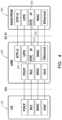
- Fig. 4 is a simplified schematic diagram illustrating an exemplary mobile base station protocol stack 200 (e.g., as implemented on an eNB as depicted in Fig.4 ) aligned opposite a UE protocol stack 100 and an exemplary EPC protocol stack 300 (e.g., as implemented on an SGW/PGW as depicted in Fig.4 ), in accordance with embodiments described herein.
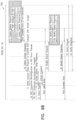
- Fig. 5 illustrates a logical flow for requests received by mobile base station 201 from UE 105 and forwarded to mobile gateway 301.
- UE 105 may be an IP-only UE, or configured with protocol stack 100 or 101 as described with respect to Figs. 2 and 3 ;
- base station 201 may be configured with mobile base station protocol stack 200; and mobile gateway 301 (e.g., an SGW or PGW) may configured with EPC protocol stack 300.
- UE 105 when UE 105 powers up, it may perform attach procedures using IP protocol to send control messages. Depending on the configuration of UE 105, on successful attachment, UE 105 may have an ICN-based identity, IP-based identity, or dual ICN + IP identity. When a user of UE 105 initiates a content request via an application on UE, the request may subsequently be sent to base station 201, and then forwarded to mobile gateway 301 according to the following logic:
- base station 201 may forward the request to mobile gateway 301 either using native ICN (if such transport is supported), or ICN as overlay on IP where native ICN support is unavailable.
- base station 201 may forward the request to mobile gateway 301 using native IP.
- UE 105 may also send a non-specified "ICN or IP" request (step 206) accompanied by additional qualifying parameters such as weight, priority, cost, network congestion. It will be appreciated that the additional qualifying parameters may be configurable. Base station 201 may use the parameters to determine the most resource efficient option for forwarding the request from among native IP, native ICN, or ICN over IP, depending on the supported transport
- protocol stack 200 may be implemented in a mobile base station (e.g. an eNodeB or eNB) and may comprise IP function 230 and ICN function 240 incorporated at the network layer on an S1-U interface between the mobile base station and an EPC element (e.g. SGW or PGW).
- an existing IP based S1-U interface may be modified to support a dual stack with both ICN and IP routing; this interface may be used to carry user plane traffic through a GPRS Transport Protocol (GTP) tunnel to either IP function 330 or ICN function 340 in protocol stack 300.
- GTP GPRS Transport Protocol
- ICN functionality may be incorporated into protocol stack 200 without disturbing the MAC layer.
- ICN function 240 may be used to process the received packets. If S1-U supports only IP routing, i.e., not ICN, ICN messages may be overlaid on top of IP. Similarly, when an IP-based request for content delivery is received, it will use the standard S1-U interface.
- ICN function 240 in protocol stack 200 may facilitate content caching for local delivery using the ICN transport protocol.
- ICN function 340 in protocol stack 300 is implemented at a SGW or PGW to support ICN based routing for the protocol stack 200 of base station.
- ICN function 340 may facilitate servicing content cached at the SGW or PGW. Similar ICN functionality may also be implemented at CDN 400.
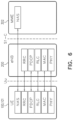
- Fig. 6 is a simplified schematic diagram illustrating an exemplary mobile base station protocol stack 200 aligned opposite either UE protocol stack 100 or 101 and an exemplary MME 302, in accordance with embodiments described herein.
- NAS signaling may also be implemented with ICN transport.
- ICN ICN for NAS signaling and mobility management, the following steps may be performed:
- a UE using protocol stack 100 or 101 may send NAS messages using a radio interface.
- the receiving base station e.g. eNB
- the S1-C interface may be configured to support IP, ICN, or dual stack (IP+ICN). If the NAS message was received using ICN protocol, then the base station may process the message and forward it to MME 302 using ICN transport. If ICN transport is not supported between the base station and MME 302, the base station may forward the NAS message using ICN overlay on IP transport. If the NAS message was received using IP protocol, then the base station may process the message and forward it to MME 302 using IP transport.
- Fig. 7 is a simplified schematic diagram illustrating an exemplary mobile base station protocol stack 200 aligned opposite either UE protocol stack 100 or 101, and either another protocol stack 200 or MME 302, in accordance with embodiments described herein.
- a UE sends mobility management messages such as location updates, handover requests, etc. Handover requests may be sent when the UE moves or it detects a better signal from another base station.
- the associated handover messages are processed via either X2 interface (for eNB to eNB handovers), or S1 interface (for eNB to MME/SGW handovers).
- ICN has built-in functionality to support mobility by re-expressing Interest when the UE moves or detects a better signal from another base station. The following steps may be used to implement ICN for mobility management:
- the base station may process and forward the message to MME 302 using ICN transport via the S1-C interface. If ICN transport is not supported between the base station and MME 302, the base station may forward the message using ICN overlay on IP transport.
- the base station may send handover control messages as well as user data using ICN protocol via an X2 interface. If ICN is not supported on the X2 interface, then the base station may use ICN overlay over IP transport via the X2 interface.
- the base station may process the message and forward it using IP transport to either MME 302 using S1-C interface, or to another base station using X2 interface.
- IP transport For eNB to eNB handover, both handover control messages and user data may be sent by the base station.
- the base station may determine which protocol, IP or ICN, to be used. The base station may factor weight, priority, cost, etc. into the determination process.
- a base station may include any subset of base station functionalities for a Radio Access Network (RAN), such as for example: NodeB functionalities, Radio Network Controller (RNC) functionalities, Home NodeB (HNB), and base transceiver station (BTS) functionalities for 2nd Generation (2G) and/or 3rd Generation (3G) mobile access network technologies such as Global System for Mobile Communications (GSM), Enhanced Data Rates for GSM (EDGE), radio access network (GERAN), and/or Universal Mobile Telecommunications System (UMTS) Terrestrial radio access network (UTRAN); evolved Node B (eNodeB or eNB) functionalities and/or Home eNodeB (HeNB) functionalities for 4th Generation (4G) LTE mobile access network technologies such as evolved UTRAN (E-UTRAN), 5th Generation (5G) access network base station functionalities; combinations thereof, or the like.
- RAN Radio Access Network
- NodeB functionalities Radio Network Controller (RNC) functionalities, Home NodeB (HNB), and base transceiver station
- the Evolved Packet Core provides session management functionality for a UE.
- a UE When a UE is powered-on, it performs NAS signaling and after successful authentication it attaches with either a PGW for LTE networks or a Gateway GPRS Support Node (GGSN) for 3G cellular network.
- the PGW or GGSN is the anchoring point for the UE and is responsible for service creations, authorization, session maintenance, eventual termination upon UE power-off, etc.
- ICN functionality may be implemented in the EPC.
- ICN function 340 may be inserted at the session management layer of protocol stack 300 in parallel with existing IP functionality.
- the session management layer is used for performing attach procedures and assigning a logical identity to the UE user.
- the MME may send a Create Session Request (CSR) to the SGW, and the SGW may send the CSR to the PGW.
- CSR Create Session Request
- a CSR may be enhanced to include a Protocol Configuration Option Information Element (PCO IE), which may be used to indicate ICN support by the UE providing the request, according to the embodiments of Figs. 3 and 4 .
- PCO IE Protocol Configuration Option Information Element
- the PGW may support attachment in terms of both IP and ICN based transport; the UE name may be registered and used for session management.
- the PGW may be configured to provide ICN attachment.
- the PGW may use known IP functionality for attachment.
- ICN function 340 may be configured with full ICN functionality, such as, for example, forwarding capabilities (e.g., Content Store (CS), Pending Interest Table (PIT) and Forwarding Information Base (FIB) tables).
- CS Content Store
- PIT Pending Interest Table
- FIB Forwarding Information Base
- the PGW may cache contents locally according to ICN protocol using CS functionality provided therein.
- Fig. 8 illustrates a 3GPP protocol configuration field layout 400 that may be leveraged to provide support for ICN in LTE according to embodiments described herein.
- Octet 3 may be used to carry configuration protocol information (where configuration protocols define a PDN type) which may be enhanced to contain details about IP (either IPv4, IPv6, or both) or ICN.
- configuration protocol information where configuration protocols define a PDN type
- IP either IPv4, IPv6, or both
- combinations of Octet 4 to Z may be used to provide additional information related to ICN capability.
- the PCO IE parameter (as discussed hereinabove) may be matched between UE and EPC gateways (e.g., MME, SGW, PGW) so that a UE may attach successfully.
- steps 1 and 12 - 22 may be enhanced to include additional parameters to facilitate ICN implementation.
- ICN capability may be indicated in a PCO IE using a Tag Length Value (TLV) format.
- TLV Tag Length Value
- Enhanced functionality may be added to the existing steps of the attach procedure to support enhanced ICN capabilities in a PGW in addition to normal IP attach procedures.
- a given UE may send an initial attach request. If the UE is ICN capable, the initial attach request may include the PCO IE field populated with an indication of ICN capability.
- CSR create session request
- the PGW will register the UE with a name according to the ICN protocol. This ICN-based name may then be used for the creation of session and context related functions (e.g., billing, mediation, enhanced charging function/deep packet inspection, lawful intercept, etc.) for the UE during the session.
- context related functions e.g., billing, mediation, enhanced charging function/deep packet inspection, lawful intercept, etc.
- an EPC may include one or more mobile gateways hosting any or all functionalities for any combination of: Serving Gateway (SGW), Serving General Packet Radio Service (GPRS) Support Node (SGSN), Packet Data Network (PDN) Gateway (PGW), and/or Gateway GPRS Support Node (GGSN) operations.
- SGW Serving Gateway
- GPRS General Packet Radio Service
- SGSN Serving General Packet Radio Service
- PDN Packet Data Network Gateway
- GGSN Gateway GPRS Support Node
- an SGW is a data-plane element that can provide functionality for managing user mobility and interfaces with RAN nodes (e.g., eNodeBs, NodeBs, HeNBs, HNBs, etc.).
- An SGW may also maintain data paths between RAN nodes and one or more PGWs.
- a PGW typically provides IP connectivity access network (IP-CAN) session connectivity for UEs to external Packet Data Networks (PDNs) (e.g., the Internet).
- a user can be associated with the operation of a corresponding UE for one or more voice and/or data sessions.
- a subscriber associated with a given UE can be identified using one or more identifiers such as, for example, an International Mobile Subscriber Identity (IMSI) or a Temporary IMSI (T-IMSI).
- IMSI International Mobile Subscriber Identity
- T-IMSI Temporary IMSI
- An IMSI for a given subscriber is typically stored on a Subscriber Identity Module (SIM) (e.g., a SIM card) within the subscriber's UE.
- SIM Subscriber Identity Module
- software components of the present invention may, if desired, be implemented in ROM (read only memory) form.
- the software components may, generally, be implemented in hardware, if desired, using conventional techniques.
- the software components may be instantiated, for example: as a computer program product or on a tangible medium. In some cases, it may be possible to instantiate the software components as a signal interpretable by an appropriate computer, although such an instantiation may be excluded in certain embodiments of the present invention.
- a non-transient computer readable medium carrying computer readable instructions that when executed by a computing device cause the computing device to carry out any of the methods described herein.
Landscapes
- Engineering & Computer Science (AREA)
- Computer Networks & Wireless Communication (AREA)
- Signal Processing (AREA)
- Computer Security & Cryptography (AREA)
- Mobile Radio Communication Systems (AREA)
Applications Claiming Priority (5)
| Application Number | Priority Date | Filing Date | Title |
|---|---|---|---|
| US201662356283P | 2016-06-29 | 2016-06-29 | |
| US15/470,938 US10447824B2 (en) | 2016-06-29 | 2017-03-28 | Information centric networking for long term evolution |
| US15/470,934 US10257327B2 (en) | 2016-06-29 | 2017-03-28 | Information centric networking for long term evolution |
| PCT/IB2017/053557 WO2018002758A1 (fr) | 2016-06-29 | 2017-06-15 | Réseautage centré sur l'information pour système d'évolution à long terme |
| EP17734486.8A EP3479549B1 (fr) | 2016-06-29 | 2017-06-15 | Réseautage centré sur l'information pour lte |
Related Parent Applications (1)
| Application Number | Title | Priority Date | Filing Date |
|---|---|---|---|
| EP17734486.8A Division EP3479549B1 (fr) | 2016-06-29 | 2017-06-15 | Réseautage centré sur l'information pour lte |
Publications (3)
| Publication Number | Publication Date |
|---|---|
| EP4277242A2 true EP4277242A2 (fr) | 2023-11-15 |
| EP4277242A3 EP4277242A3 (fr) | 2024-01-17 |
| EP4277242B1 EP4277242B1 (fr) | 2026-02-18 |
Family
ID=60806219
Family Applications (2)
| Application Number | Title | Priority Date | Filing Date |
|---|---|---|---|
| EP17734486.8A Active EP3479549B1 (fr) | 2016-06-29 | 2017-06-15 | Réseautage centré sur l'information pour lte |
| EP23186051.1A Active EP4277242B1 (fr) | 2016-06-29 | 2017-06-15 | Réseautage centré sur l'information pour lte |
Family Applications Before (1)
| Application Number | Title | Priority Date | Filing Date |
|---|---|---|---|
| EP17734486.8A Active EP3479549B1 (fr) | 2016-06-29 | 2017-06-15 | Réseautage centré sur l'information pour lte |
Country Status (2)
| Country | Link |
|---|---|
| US (4) | US10257327B2 (fr) |
| EP (2) | EP3479549B1 (fr) |
Families Citing this family (13)
| Publication number | Priority date | Publication date | Assignee | Title |
|---|---|---|---|---|
| US10257327B2 (en) | 2016-06-29 | 2019-04-09 | Cisco Technology, Inc. | Information centric networking for long term evolution |
| CN110431865B (zh) * | 2017-03-21 | 2022-02-01 | 华为技术有限公司 | 一种选择核心网设备的方法及装置 |
| FR3064437A1 (fr) * | 2017-03-24 | 2018-09-28 | Orange | Procede de recommandation d'une pile de communication |
| WO2019067343A1 (fr) * | 2017-09-29 | 2019-04-04 | Idac Holdings, Inc. | Protocole de transport pour une communication entre des points de terminaison de bord |
| US10462052B2 (en) * | 2017-12-26 | 2019-10-29 | Futurewei Technologies, Inc. | Method and apparatus for incremental deployment of information centric network |
| US11277280B2 (en) * | 2018-03-19 | 2022-03-15 | Cable Television Laboratories, Inc. | Content centric networking systems and methods |
| US11483890B2 (en) * | 2018-04-06 | 2022-10-25 | Telefonaktiebolaget Lm Ericsson (Publ) | First unit, second unit and methods in a wireless communications network |
| WO2020092914A1 (fr) * | 2018-11-02 | 2020-05-07 | Intel Corporation | Commande de politique et de facturation (pcc) dans un réseautage axé sur l'information |
| US11930471B2 (en) * | 2018-11-02 | 2024-03-12 | Apple Inc. | Supporting information centric networking in next generation cellular networks |
| US12004006B2 (en) | 2019-02-28 | 2024-06-04 | Apple Inc. | Methods and systems for compression and decompression of information centric networking names at the packet data convergence protocol (PDCP) |
| US11979315B2 (en) * | 2019-06-28 | 2024-05-07 | Intel Corporation | Information centric network interworking techniques |
| WO2023184548A1 (fr) * | 2022-04-02 | 2023-10-05 | 北京小米移动软件有限公司 | Procédé et appareil de traitement d'informations, dispositif de communication et support de stockage |
| CN114726924B (zh) * | 2022-05-17 | 2022-10-21 | 北京安盟信息技术股份有限公司 | 一种基于tcp/ip协议栈特性提高网络带宽利用率方法 |
Family Cites Families (27)
| Publication number | Priority date | Publication date | Assignee | Title |
|---|---|---|---|---|
| US8515421B2 (en) * | 2005-11-12 | 2013-08-20 | Interdigital Technology Corporation | IMS enabled attach procedure for LTE |
| US9210579B2 (en) * | 2009-10-14 | 2015-12-08 | Huawei Technologies Co., Ltd. | System and method for communicating in a wireless communications system |
| US10264029B2 (en) * | 2009-10-30 | 2019-04-16 | Time Warner Cable Enterprises Llc | Methods and apparatus for packetized content delivery over a content delivery network |
| US9781197B2 (en) * | 2009-11-30 | 2017-10-03 | Samsung Electronics Co., Ltd. | Methods and apparatus for selection of content delivery network (CDN) based on user location |
| KR101935785B1 (ko) * | 2011-08-16 | 2019-04-03 | 삼성전자 주식회사 | 무선통신시스템에서 멀티미디어 방송 서비스를 수신하는 방법 및 장치 |
| US8694675B2 (en) * | 2011-09-01 | 2014-04-08 | Futurewei Technologies, Inc. | Generalized dual-mode data forwarding plane for information-centric network |
| EP2749047A2 (fr) * | 2011-09-12 | 2014-07-02 | SCA IPLA Holdings Inc. | Terminal de communication et procédé associé |
| KR101913313B1 (ko) * | 2011-12-28 | 2018-10-31 | 삼성전자주식회사 | 게이트웨이에서 인터넷 프로토콜 기반 네트워크를 이용하여 컨텐츠 중심 네트워크를 구현하는 방법 및 그 게이트웨이 |
| US9049251B2 (en) | 2012-02-28 | 2015-06-02 | Futurewei Technologies, Inc. | Method and apparatus for internet protocol based content router |
| WO2013184941A1 (fr) * | 2012-06-06 | 2013-12-12 | Huawei Technologies Co., Ltd. | Procédé d'intégration transparente et d'évolution indépendante d'un réseautage centré sur l'information par l'intermédiaire d'un réseautage défini par logiciel |
| US20140020102A1 (en) * | 2012-07-16 | 2014-01-16 | Infosys Limited | Integrated network architecture |
| CN104904186B (zh) * | 2013-01-07 | 2018-11-06 | 华为技术有限公司 | 一种用于与以信息为中心的网络协议层接口的网元 |
| US10194414B2 (en) | 2013-01-07 | 2019-01-29 | Futurewei Technologies, Inc. | Information centric networking based service centric networking |
| US9124525B2 (en) * | 2013-06-24 | 2015-09-01 | Cisco Technology, Inc. | User-equipment-initiated framed routes on customer-premises equipment for wireless wide area networks |
| US20150195764A1 (en) * | 2014-01-07 | 2015-07-09 | Electronics And Telecommunications Research Institute | Network service system and method for providing network service in multiple mobile network environment |
| US9756681B2 (en) | 2014-08-21 | 2017-09-05 | Mavenir Systems, Inc. | System and method for providing IP version interworking for IMS access through EPC |
| US9609574B2 (en) * | 2014-09-29 | 2017-03-28 | At&T Mobility Ii Llc | Apparatus and method for accessing a back-end service |
| EP3202227B1 (fr) | 2014-10-01 | 2019-11-06 | Telefonaktiebolaget LM Ericsson (publ) | Station de base et appareils sans fil et méthodes correspondantes pour le traitement de communications basee sur réseautage centrique d'informations |
| WO2016057704A2 (fr) | 2014-10-07 | 2016-04-14 | Interdigital Patent Holdings, Inc. | Prise en charge de clients au protocole internet (ip) dans un réseau centré sur les informations (icn) |
| KR102349060B1 (ko) | 2014-10-14 | 2022-01-10 | 아이디에이씨 홀딩스, 인크. | Icn 네트워크들에서의 ip 디바이스들의 앵커링 |
| EP3032803B1 (fr) * | 2014-12-12 | 2021-08-25 | Tata Consultancy Services Limited | Fourniture du contenu demandé dans une architecture de réseautage centré sur des informations de superposition (o-icn) |
| US9736263B2 (en) * | 2015-02-16 | 2017-08-15 | Telefonaktiebolaget L M Ericsson (Publ) | Temporal caching for ICN |
| WO2016168009A1 (fr) * | 2015-04-13 | 2016-10-20 | Interdigital Patent Holdings, Inc. | Procédés, appareil et systèmes destinés à être utilisés avec un réseautage centrique d'informations (icn) |
| CN108139920A (zh) * | 2015-10-02 | 2018-06-08 | Idac控股公司 | 在动态条件及变约束下用于基于信息中心联网(icn)的代理服务器管理的方法、设备及系统 |
| US10244567B2 (en) * | 2016-05-31 | 2019-03-26 | Telefonaktiebolaget Lm Ericsson (Publ) | ICN connectivity awareness |
| EP3466186B1 (fr) * | 2016-05-31 | 2021-10-06 | Telefonaktiebolaget LM Ericsson (PUBL) | Distinction entre un trafic icn et un trafic non icn dans un réseau mobile |
| US10257327B2 (en) | 2016-06-29 | 2019-04-09 | Cisco Technology, Inc. | Information centric networking for long term evolution |
-
2017
- 2017-03-28 US US15/470,934 patent/US10257327B2/en active Active
- 2017-03-28 US US15/470,938 patent/US10447824B2/en active Active
- 2017-06-15 EP EP17734486.8A patent/EP3479549B1/fr active Active
- 2017-06-15 EP EP23186051.1A patent/EP4277242B1/fr active Active
-
2019
- 2019-02-22 US US16/283,009 patent/US10834242B2/en active Active
- 2019-08-12 US US16/538,120 patent/US11005978B2/en active Active
Non-Patent Citations (1)
| Title |
|---|
| 3GPP TS 23.401, March 2016 (2016-03-01) |
Also Published As
| Publication number | Publication date |
|---|---|
| US10257327B2 (en) | 2019-04-09 |
| US20180007177A1 (en) | 2018-01-04 |
| EP4277242A3 (fr) | 2024-01-17 |
| EP3479549A1 (fr) | 2019-05-08 |
| US11005978B2 (en) | 2021-05-11 |
| US10834242B2 (en) | 2020-11-10 |
| US20190191016A1 (en) | 2019-06-20 |
| US20180007176A1 (en) | 2018-01-04 |
| US10447824B2 (en) | 2019-10-15 |
| EP3479549B1 (fr) | 2023-07-19 |
| EP4277242B1 (fr) | 2026-02-18 |
| US20190364138A1 (en) | 2019-11-28 |
Similar Documents
| Publication | Publication Date | Title |
|---|---|---|
| US11005978B2 (en) | Information centric networking for long term evolution | |
| US10608842B2 (en) | GTP-U downlink packet sending method and apparatus | |
| US12477593B2 (en) | To core network functions | |
| CN103430516B (zh) | 业务提供系统、方法、移动边缘应用服务器及支持节点 | |
| US20220294855A1 (en) | Apparatus, method and computer program for user plane function control by a set of controllers | |
| JP2022033998A (ja) | セッションコンテキスト変換 | |
| WO2018145657A1 (fr) | Procédé et appareil de transfert intercellulaire entre systèmes dans une communication sans fil | |
| US20210058458A1 (en) | Network element system | |
| WO2019033920A1 (fr) | Procédé et dispositif permettant à un côté réseau d'identifier et de commander un équipement utilisateur distant | |
| EP4456663A2 (fr) | Procédé d'établissement de canal de transmission, dispositif et support d'informations | |
| US9455910B2 (en) | Exchanging internet protocol version capability information between client devices over a communications network | |
| KR102897874B1 (ko) | Gtp-u 엔티티 재시작에 대한 향상 | |
| CN106470465A (zh) | Wifi语音业务发起方法、lte通信设备、终端及通信系统 | |
| CN101136853B (zh) | 一种数据路由的方法 | |
| WO2018002758A1 (fr) | Réseautage centré sur l'information pour système d'évolution à long terme |
Legal Events
| Date | Code | Title | Description |
|---|---|---|---|
| PUAI | Public reference made under article 153(3) epc to a published international application that has entered the european phase |
Free format text: ORIGINAL CODE: 0009012 |
|
| STAA | Information on the status of an ep patent application or granted ep patent |
Free format text: STATUS: THE APPLICATION HAS BEEN PUBLISHED |
|
| REG | Reference to a national code |
Ref country code: DE Ref legal event code: R079 Free format text: PREVIOUS MAIN CLASS: H04L0067630000 Ipc: H04L0061500700 Ref country code: DE Ref legal event code: R079 Ref document number: 602017093992 Country of ref document: DE Free format text: PREVIOUS MAIN CLASS: H04L0067630000 Ipc: H04L0061500700 |
|
| AC | Divisional application: reference to earlier application |
Ref document number: 3479549 Country of ref document: EP Kind code of ref document: P |
|
| AK | Designated contracting states |
Kind code of ref document: A2 Designated state(s): AL AT BE BG CH CY CZ DE DK EE ES FI FR GB GR HR HU IE IS IT LI LT LU LV MC MK MT NL NO PL PT RO RS SE SI SK SM TR |
|
| RIC1 | Information provided on ipc code assigned before grant |
Ipc: H04L 67/63 20220101ALI20231103BHEP Ipc: H04W 76/12 20180101ALI20231103BHEP Ipc: H04L 67/568 20220101ALI20231103BHEP Ipc: H04L 61/5007 20220101AFI20231103BHEP |
|
| PUAL | Search report despatched |
Free format text: ORIGINAL CODE: 0009013 |
|
| AK | Designated contracting states |
Kind code of ref document: A3 Designated state(s): AL AT BE BG CH CY CZ DE DK EE ES FI FR GB GR HR HU IE IS IT LI LT LU LV MC MK MT NL NO PL PT RO RS SE SI SK SM TR |
|
| RIC1 | Information provided on ipc code assigned before grant |
Ipc: H04L 67/63 20220101ALI20231214BHEP Ipc: H04W 76/12 20180101ALI20231214BHEP Ipc: H04L 67/568 20220101ALI20231214BHEP Ipc: H04L 61/5007 20220101AFI20231214BHEP |
|
| STAA | Information on the status of an ep patent application or granted ep patent |
Free format text: STATUS: REQUEST FOR EXAMINATION WAS MADE |
|
| 17P | Request for examination filed |
Effective date: 20240717 |
|
| RBV | Designated contracting states (corrected) |
Designated state(s): AL AT BE BG CH CY CZ DE DK EE ES FI FR GB GR HR HU IE IS IT LI LT LU LV MC MK MT NL NO PL PT RO RS SE SI SK SM TR |
|
| GRAP | Despatch of communication of intention to grant a patent |
Free format text: ORIGINAL CODE: EPIDOSNIGR1 |
|
| STAA | Information on the status of an ep patent application or granted ep patent |
Free format text: STATUS: GRANT OF PATENT IS INTENDED |
|
| INTG | Intention to grant announced |
Effective date: 20250924 |
|
| P01 | Opt-out of the competence of the unified patent court (upc) registered |
Free format text: CASE NUMBER: UPC_APP_0010318_4277242/2025 Effective date: 20251020 |
|
| GRAS | Grant fee paid |
Free format text: ORIGINAL CODE: EPIDOSNIGR3 |
|
| GRAA | (expected) grant |
Free format text: ORIGINAL CODE: 0009210 |
|
| STAA | Information on the status of an ep patent application or granted ep patent |
Free format text: STATUS: THE PATENT HAS BEEN GRANTED |
|
| AC | Divisional application: reference to earlier application |
Ref document number: 3479549 Country of ref document: EP Kind code of ref document: P |
|
| AK | Designated contracting states |
Kind code of ref document: B1 Designated state(s): AL AT BE BG CH CY CZ DE DK EE ES FI FR GB GR HR HU IE IS IT LI LT LU LV MC MK MT NL NO PL PT RO RS SE SI SK SM TR |
|
| REG | Reference to a national code |
Ref country code: CH Ref legal event code: F10 Free format text: ST27 STATUS EVENT CODE: U-0-0-F10-F00 (AS PROVIDED BY THE NATIONAL OFFICE) Effective date: 20260218 Ref country code: GB Ref legal event code: FG4D |
|
| REG | Reference to a national code |
Ref country code: IE Ref legal event code: FG4D |
|
| REG | Reference to a national code |
Ref country code: DE Ref legal event code: R096 Ref document number: 602017093992 Country of ref document: DE |