EP4278940A2 - Gerät zur reinigung verschmutzter oberflächen - Google Patents
Gerät zur reinigung verschmutzter oberflächen Download PDFInfo
- Publication number
- EP4278940A2 EP4278940A2 EP23201753.3A EP23201753A EP4278940A2 EP 4278940 A2 EP4278940 A2 EP 4278940A2 EP 23201753 A EP23201753 A EP 23201753A EP 4278940 A2 EP4278940 A2 EP 4278940A2
- Authority
- EP
- European Patent Office
- Prior art keywords
- dirt
- sensor
- emptying
- area
- cleaning
- Prior art date
- Legal status (The legal status is an assumption and is not a legal conclusion. Google has not performed a legal analysis and makes no representation as to the accuracy of the status listed.)
- Granted
Links
Images






Classifications
-
- A—HUMAN NECESSITIES
- A47—FURNITURE; DOMESTIC ARTICLES OR APPLIANCES; COFFEE MILLS; SPICE MILLS; SUCTION CLEANERS IN GENERAL
- A47L—DOMESTIC WASHING OR CLEANING; SUCTION CLEANERS IN GENERAL
- A47L9/00—Details or accessories of suction cleaners, e.g. mechanical means for controlling the suction or for effecting pulsating action; Storing devices specially adapted to suction cleaners or parts thereof; Carrying-vehicles specially adapted for suction cleaners
- A47L9/28—Installation of the electric equipment, e.g. adaptation or attachment to the suction cleaner; Controlling suction cleaners by electric means
- A47L9/2805—Parameters or conditions being sensed
-
- A—HUMAN NECESSITIES
- A47—FURNITURE; DOMESTIC ARTICLES OR APPLIANCES; COFFEE MILLS; SPICE MILLS; SUCTION CLEANERS IN GENERAL
- A47L—DOMESTIC WASHING OR CLEANING; SUCTION CLEANERS IN GENERAL
- A47L9/00—Details or accessories of suction cleaners, e.g. mechanical means for controlling the suction or for effecting pulsating action; Storing devices specially adapted to suction cleaners or parts thereof; Carrying-vehicles specially adapted for suction cleaners
- A47L9/28—Installation of the electric equipment, e.g. adaptation or attachment to the suction cleaner; Controlling suction cleaners by electric means
- A47L9/2805—Parameters or conditions being sensed
- A47L9/2826—Parameters or conditions being sensed the condition of the floor
-
- A—HUMAN NECESSITIES
- A47—FURNITURE; DOMESTIC ARTICLES OR APPLIANCES; COFFEE MILLS; SPICE MILLS; SUCTION CLEANERS IN GENERAL
- A47L—DOMESTIC WASHING OR CLEANING; SUCTION CLEANERS IN GENERAL
- A47L11/00—Machines for cleaning floors, carpets, furniture, walls, or wall coverings
- A47L11/40—Parts or details of machines not provided for in groups A47L11/02 - A47L11/38, or not restricted to one of these groups, e.g. handles, arrangements of switches, skirts, buffers, levers
- A47L11/4061—Steering means; Means for avoiding obstacles; Details related to the place where the driver is accommodated
-
- A—HUMAN NECESSITIES
- A47—FURNITURE; DOMESTIC ARTICLES OR APPLIANCES; COFFEE MILLS; SPICE MILLS; SUCTION CLEANERS IN GENERAL
- A47L—DOMESTIC WASHING OR CLEANING; SUCTION CLEANERS IN GENERAL
- A47L11/00—Machines for cleaning floors, carpets, furniture, walls, or wall coverings
- A47L11/24—Floor-sweeping machines, motor-driven
-
- A—HUMAN NECESSITIES
- A47—FURNITURE; DOMESTIC ARTICLES OR APPLIANCES; COFFEE MILLS; SPICE MILLS; SUCTION CLEANERS IN GENERAL
- A47L—DOMESTIC WASHING OR CLEANING; SUCTION CLEANERS IN GENERAL
- A47L11/00—Machines for cleaning floors, carpets, furniture, walls, or wall coverings
- A47L11/29—Floor-scrubbing machines characterised by means for taking-up dirty liquid
- A47L11/30—Floor-scrubbing machines characterised by means for taking-up dirty liquid by suction
- A47L11/302—Floor-scrubbing machines characterised by means for taking-up dirty liquid by suction having rotary tools
- A47L11/305—Floor-scrubbing machines characterised by means for taking-up dirty liquid by suction having rotary tools the tools being disc brushes
-
- A—HUMAN NECESSITIES
- A47—FURNITURE; DOMESTIC ARTICLES OR APPLIANCES; COFFEE MILLS; SPICE MILLS; SUCTION CLEANERS IN GENERAL
- A47L—DOMESTIC WASHING OR CLEANING; SUCTION CLEANERS IN GENERAL
- A47L11/00—Machines for cleaning floors, carpets, furniture, walls, or wall coverings
- A47L11/40—Parts or details of machines not provided for in groups A47L11/02 - A47L11/38, or not restricted to one of these groups, e.g. handles, arrangements of switches, skirts, buffers, levers
- A47L11/4002—Installations of electric equipment
- A47L11/4008—Arrangements of switches, indicators or the like
-
- A—HUMAN NECESSITIES
- A47—FURNITURE; DOMESTIC ARTICLES OR APPLIANCES; COFFEE MILLS; SPICE MILLS; SUCTION CLEANERS IN GENERAL
- A47L—DOMESTIC WASHING OR CLEANING; SUCTION CLEANERS IN GENERAL
- A47L11/00—Machines for cleaning floors, carpets, furniture, walls, or wall coverings
- A47L11/40—Parts or details of machines not provided for in groups A47L11/02 - A47L11/38, or not restricted to one of these groups, e.g. handles, arrangements of switches, skirts, buffers, levers
- A47L11/4011—Regulation of the cleaning machine by electric means; Control systems and remote control systems therefor
-
- A—HUMAN NECESSITIES
- A47—FURNITURE; DOMESTIC ARTICLES OR APPLIANCES; COFFEE MILLS; SPICE MILLS; SUCTION CLEANERS IN GENERAL
- A47L—DOMESTIC WASHING OR CLEANING; SUCTION CLEANERS IN GENERAL
- A47L11/00—Machines for cleaning floors, carpets, furniture, walls, or wall coverings
- A47L11/40—Parts or details of machines not provided for in groups A47L11/02 - A47L11/38, or not restricted to one of these groups, e.g. handles, arrangements of switches, skirts, buffers, levers
- A47L11/4072—Arrangement of castors or wheels
-
- A—HUMAN NECESSITIES
- A47—FURNITURE; DOMESTIC ARTICLES OR APPLIANCES; COFFEE MILLS; SPICE MILLS; SUCTION CLEANERS IN GENERAL
- A47L—DOMESTIC WASHING OR CLEANING; SUCTION CLEANERS IN GENERAL
- A47L7/00—Suction cleaners adapted for additional purposes; Tables with suction openings for cleaning purposes; Containers for cleaning articles by suction; Suction cleaners adapted to cleaning of brushes; Suction cleaners adapted to taking-up liquids
- A47L7/04—Suction cleaners adapted for additional purposes; Tables with suction openings for cleaning purposes; Containers for cleaning articles by suction; Suction cleaners adapted to cleaning of brushes; Suction cleaners adapted to taking-up liquids for using the exhaust air for other purposes, e.g. for distribution of chemicals in a room, for sterilisation of the air
-
- A—HUMAN NECESSITIES
- A47—FURNITURE; DOMESTIC ARTICLES OR APPLIANCES; COFFEE MILLS; SPICE MILLS; SUCTION CLEANERS IN GENERAL
- A47L—DOMESTIC WASHING OR CLEANING; SUCTION CLEANERS IN GENERAL
- A47L9/00—Details or accessories of suction cleaners, e.g. mechanical means for controlling the suction or for effecting pulsating action; Storing devices specially adapted to suction cleaners or parts thereof; Carrying-vehicles specially adapted for suction cleaners
- A47L9/009—Carrying-vehicles; Arrangements of trollies or wheels; Means for avoiding mechanical obstacles
-
- A—HUMAN NECESSITIES
- A47—FURNITURE; DOMESTIC ARTICLES OR APPLIANCES; COFFEE MILLS; SPICE MILLS; SUCTION CLEANERS IN GENERAL
- A47L—DOMESTIC WASHING OR CLEANING; SUCTION CLEANERS IN GENERAL
- A47L9/00—Details or accessories of suction cleaners, e.g. mechanical means for controlling the suction or for effecting pulsating action; Storing devices specially adapted to suction cleaners or parts thereof; Carrying-vehicles specially adapted for suction cleaners
- A47L9/10—Filters; Dust separators; Dust removal; Automatic exchange of filters
- A47L9/16—Arrangement or disposition of cyclones or other devices with centrifugal action
- A47L9/1683—Dust collecting chambers; Dust collecting receptacles
-
- A—HUMAN NECESSITIES
- A47—FURNITURE; DOMESTIC ARTICLES OR APPLIANCES; COFFEE MILLS; SPICE MILLS; SUCTION CLEANERS IN GENERAL
- A47L—DOMESTIC WASHING OR CLEANING; SUCTION CLEANERS IN GENERAL
- A47L9/00—Details or accessories of suction cleaners, e.g. mechanical means for controlling the suction or for effecting pulsating action; Storing devices specially adapted to suction cleaners or parts thereof; Carrying-vehicles specially adapted for suction cleaners
- A47L9/10—Filters; Dust separators; Dust removal; Automatic exchange of filters
- A47L9/16—Arrangement or disposition of cyclones or other devices with centrifugal action
- A47L9/1691—Mounting or coupling means for cyclonic chamber or dust receptacles
-
- A—HUMAN NECESSITIES
- A47—FURNITURE; DOMESTIC ARTICLES OR APPLIANCES; COFFEE MILLS; SPICE MILLS; SUCTION CLEANERS IN GENERAL
- A47L—DOMESTIC WASHING OR CLEANING; SUCTION CLEANERS IN GENERAL
- A47L9/00—Details or accessories of suction cleaners, e.g. mechanical means for controlling the suction or for effecting pulsating action; Storing devices specially adapted to suction cleaners or parts thereof; Carrying-vehicles specially adapted for suction cleaners
- A47L9/28—Installation of the electric equipment, e.g. adaptation or attachment to the suction cleaner; Controlling suction cleaners by electric means
- A47L9/2805—Parameters or conditions being sensed
- A47L9/281—Parameters or conditions being sensed the amount or condition of incoming dirt or dust
- A47L9/2815—Parameters or conditions being sensed the amount or condition of incoming dirt or dust using optical detectors
-
- A—HUMAN NECESSITIES
- A47—FURNITURE; DOMESTIC ARTICLES OR APPLIANCES; COFFEE MILLS; SPICE MILLS; SUCTION CLEANERS IN GENERAL
- A47L—DOMESTIC WASHING OR CLEANING; SUCTION CLEANERS IN GENERAL
- A47L9/00—Details or accessories of suction cleaners, e.g. mechanical means for controlling the suction or for effecting pulsating action; Storing devices specially adapted to suction cleaners or parts thereof; Carrying-vehicles specially adapted for suction cleaners
- A47L9/28—Installation of the electric equipment, e.g. adaptation or attachment to the suction cleaner; Controlling suction cleaners by electric means
- A47L9/2836—Installation of the electric equipment, e.g. adaptation or attachment to the suction cleaner; Controlling suction cleaners by electric means characterised by the parts which are controlled
-
- A—HUMAN NECESSITIES
- A47—FURNITURE; DOMESTIC ARTICLES OR APPLIANCES; COFFEE MILLS; SPICE MILLS; SUCTION CLEANERS IN GENERAL
- A47L—DOMESTIC WASHING OR CLEANING; SUCTION CLEANERS IN GENERAL
- A47L9/00—Details or accessories of suction cleaners, e.g. mechanical means for controlling the suction or for effecting pulsating action; Storing devices specially adapted to suction cleaners or parts thereof; Carrying-vehicles specially adapted for suction cleaners
- A47L9/28—Installation of the electric equipment, e.g. adaptation or attachment to the suction cleaner; Controlling suction cleaners by electric means
- A47L9/2836—Installation of the electric equipment, e.g. adaptation or attachment to the suction cleaner; Controlling suction cleaners by electric means characterised by the parts which are controlled
- A47L9/2842—Suction motors or blowers
-
- A—HUMAN NECESSITIES
- A47—FURNITURE; DOMESTIC ARTICLES OR APPLIANCES; COFFEE MILLS; SPICE MILLS; SUCTION CLEANERS IN GENERAL
- A47L—DOMESTIC WASHING OR CLEANING; SUCTION CLEANERS IN GENERAL
- A47L9/00—Details or accessories of suction cleaners, e.g. mechanical means for controlling the suction or for effecting pulsating action; Storing devices specially adapted to suction cleaners or parts thereof; Carrying-vehicles specially adapted for suction cleaners
- A47L9/28—Installation of the electric equipment, e.g. adaptation or attachment to the suction cleaner; Controlling suction cleaners by electric means
- A47L9/2836—Installation of the electric equipment, e.g. adaptation or attachment to the suction cleaner; Controlling suction cleaners by electric means characterised by the parts which are controlled
- A47L9/2847—Surface treating elements
-
- A—HUMAN NECESSITIES
- A47—FURNITURE; DOMESTIC ARTICLES OR APPLIANCES; COFFEE MILLS; SPICE MILLS; SUCTION CLEANERS IN GENERAL
- A47L—DOMESTIC WASHING OR CLEANING; SUCTION CLEANERS IN GENERAL
- A47L9/00—Details or accessories of suction cleaners, e.g. mechanical means for controlling the suction or for effecting pulsating action; Storing devices specially adapted to suction cleaners or parts thereof; Carrying-vehicles specially adapted for suction cleaners
- A47L9/28—Installation of the electric equipment, e.g. adaptation or attachment to the suction cleaner; Controlling suction cleaners by electric means
- A47L9/2836—Installation of the electric equipment, e.g. adaptation or attachment to the suction cleaner; Controlling suction cleaners by electric means characterised by the parts which are controlled
- A47L9/2852—Elements for displacement of the vacuum cleaner or the accessories therefor, e.g. wheels, casters or nozzles
-
- A—HUMAN NECESSITIES
- A47—FURNITURE; DOMESTIC ARTICLES OR APPLIANCES; COFFEE MILLS; SPICE MILLS; SUCTION CLEANERS IN GENERAL
- A47L—DOMESTIC WASHING OR CLEANING; SUCTION CLEANERS IN GENERAL
- A47L9/00—Details or accessories of suction cleaners, e.g. mechanical means for controlling the suction or for effecting pulsating action; Storing devices specially adapted to suction cleaners or parts thereof; Carrying-vehicles specially adapted for suction cleaners
- A47L9/28—Installation of the electric equipment, e.g. adaptation or attachment to the suction cleaner; Controlling suction cleaners by electric means
- A47L9/30—Arrangement of illuminating devices
-
- G—PHYSICS
- G01—MEASURING; TESTING
- G01B—MEASURING LENGTH, THICKNESS OR SIMILAR LINEAR DIMENSIONS; MEASURING ANGLES; MEASURING AREAS; MEASURING IRREGULARITIES OF SURFACES OR CONTOURS
- G01B5/00—Measuring arrangements characterised by the use of mechanical techniques
- G01B5/18—Measuring arrangements characterised by the use of mechanical techniques for measuring depth
-
- A—HUMAN NECESSITIES
- A47—FURNITURE; DOMESTIC ARTICLES OR APPLIANCES; COFFEE MILLS; SPICE MILLS; SUCTION CLEANERS IN GENERAL
- A47L—DOMESTIC WASHING OR CLEANING; SUCTION CLEANERS IN GENERAL
- A47L2201/00—Robotic cleaning machines, i.e. with automatic control of the travelling movement or the cleaning operation
- A47L2201/04—Automatic control of the travelling movement; Automatic obstacle detection
-
- A—HUMAN NECESSITIES
- A47—FURNITURE; DOMESTIC ARTICLES OR APPLIANCES; COFFEE MILLS; SPICE MILLS; SUCTION CLEANERS IN GENERAL
- A47L—DOMESTIC WASHING OR CLEANING; SUCTION CLEANERS IN GENERAL
- A47L2201/00—Robotic cleaning machines, i.e. with automatic control of the travelling movement or the cleaning operation
- A47L2201/06—Control of the cleaning action for autonomous devices; Automatic detection of the surface condition before, during or after cleaning
Definitions
- the invention relates to a device and a method for automatically carrying out an activity, in particular for cleaning dirty surfaces, according to the preamble of the independent claims.
- a disadvantage of the prior art is that the device cannot be used in an environment with dust emissions because the infrared sensor is susceptible to errors in dust emissions.
- the disadvantage here is that a crash of the device cannot be reliably prevented.
- the device for automatically carrying out an activity, in particular for cleaning dirty surfaces comprises at least one sensor and at least one drive element, wherein the drive element can be a wheel, but also a caterpillar.
- the drive element divides the device into a rear area and a front area, based on the intended direction of movement.
- the sensor is a mechanical sensor which is used to detect a change in the level of the ground through contact with the ground and is arranged in the front area of the device. This means that edges in particular can be detected, so that the sensor serves as fall protection.
- mechanical means that the change in level is detected by a movable sensor element.
- electrical or optical methods are used to detect a movement of the sensor element.
- a two-part magnetic safety switch is preferably used.
- inductive sensors capacitive sensors, acceleration sensors, ultrasonic sensors or RFID sensors can also be used to detect a movement of the mechanical sensor element.
- a device with a mechanical sensor to detect changes in the level of the ground allows the device to be used in an environment with pollutant emissions.
- the advantage of placing the sensor in the front area of the device is that when the sensor is triggered, the device stops immediately and crashes are prevented in good time.
- the mechanical sensor is preferably designed as a pressure, strain or force sensor.
- the senor is integrated into a carrier of a wheel, in particular a swivel castor.
- a carrier of a wheel in particular a swivel castor.
- it can be integrated into any type of wheel in the front area, e.g. into an omnidirectional wheel or Mecanum wheel.
- the sensor is preferably arranged in particular in the center of rotating brushes.
- the senor is arranged so that the dirt has already been removed when the sensor comes into contact with the ground.
- the position of the sensor protects it from soil dirt and the resulting incorrect measurements. It also prevents loose objects on the floor from triggering the sensor.
- At least one contact plate can be used, preferably two contact plates.
- the contact plate or plates are arranged in the front area, behind one or more steering wheels.
- the contact plate(s) have no contact with the ground as long as the steering wheels are in contact with the ground. If the level of the floor changes abruptly, the castors lose contact with the floor and contact is established between one or both contact plates and the floor. This can generate a signal and thus prevent a crash.
- a device for automatically cleaning dirty surfaces comprises at least one cleaning device.
- the cleaning device includes an emptying device which includes a dirt receiving space for receiving the collected dirt.
- the emptying device is automatically movable between an operating position in which it picks up dirt from the cleaning device and an emptying position in which it empties dirt from the dirt receiving space.
- the emptying device can be moved automatically using an internal or external drive.
- the device can be provided with a coupling to which the external drive can be coupled.
- the emptying device can be brought into operative connection with an external retaining arrangement. By deliberately moving the device with the emptying device held back, the emptying device can be moved from the operating position to the emptying position.
- the device to empty the collected dirt automatically and without manual assistance and provides new filling space for further collection of dirt. Long downtimes are avoided to ensure efficient and quick cleaning.
- the automatic emptying of the device enables greater autonomy and no staff is required. It is conceivable that the dirt container can also be emptied manually if necessary.
- the device preferably comprises a dirt holding space and a closure element that is movably arranged on the device.
- the closure element can be tiltable, hinged and/or extendable.
- the movably arranged closure element allows the dirt holding space to be opened automatically and without manual assistance.
- the emptying device preferably comprises a fill level sensor for determining a remaining volume.
- a device for automatically cleaning dirty surfaces comprises at least one cleaning device and a blowing device for generating an air flow.
- the blowing device can be formed by a suction device for sucking out air.
- the suction device preferably has a filter arrangement for filtering particles from the extracted air.
- the device also includes an optical recognition system, preferably with an image recognition system, for example for detecting obstacles.
- An air duct of the blowing device and in particular an exhaust air duct of the filter arrangement is arranged such that air and preferably filtered exhaust air is guided past a detection unit of the optical detection system.
- the detection unit is typically a camera, but can also be a laser distance measuring unit or an IR sensor.
- the above cleaning device includes a sweeping device in all aspects.
- the device for automatically carrying out an activity comprises at least one cleaning device and an activatable transport aid.
- the transport aid can have an extendable handle attached to one end of the device.
- At least one wheel is arranged at the opposite end. This can be a transport wheel that only comes into contact with the ground during transport or a drive wheel that can be disengaged or has no self-locking mechanism. If the device is placed in a transport position, the wheel is already in contact with the ground or comes into contact with the ground.
- the principle described is similar to that of a standard suitcase trolley with two wheels. In the transport position, the two wheels are in contact with the ground and enable simplified and easy manual movement of the device in the manner of a suitcase trolley.
- the transport aid is formed by a pull-out leash arranged on the housing.
- the device then has at least three wheels in contact with the ground, which can be disengaged or have no self-locking mechanism.
- the wheels are preferably arranged so that at least one wheel is located at one end of the device and at least two wheels are located at the opposite end and are in contact with the ground.
- the setpoint can be, for example, a predetermined filling level, a filling weight and/or a time.
- the advantage of this method is autonomous operation and the device automatically, efficiently and quickly detecting when the device should move to the dirt collection area.
- a signal to be sent can be a visual signal, an audible signal or a wireless error message, via radio, email or SMS.
- the camera can be designed to capture and evaluate a 3D code.
- a target criterion can be a charge level, a filling level or a filling weight of the dirt collecting container.
- a station can be, for example, a charging station or the dirt collection area.
- an air blower or a source of compressed air can be used.
- optical sensors sensitive to dirt emissions can be used in a dirt emissions environment. Dirt is transported away from the area adjacent to the optical recognition system before it can be deposited on a lens, for example, or dirt that has already been deposited can also be removed if necessary.
- An in Figure 1 Device 1 shown is used for automatic cleaning in an industrial environment with dirt emissions.
- the device 1 contains a housing 10, which is divided into a front area 12 and a rear area 11 by two drive wheels 4, viewed in the direction of movement B.
- a cleaning device 2 In the front area 12, covered by the housing 10, there is a cleaning device 2.
- the cleaning device 2 contains two rotating brushes 20 lying next to one another (see Fig.3 ). Behind a front edge of the rotating brushes 20, a sensor 3 in the form of a folding device is arranged in the front area 12 in the direction of movement B (see Fig.3 / 4 ).
- the rear area 11 includes an emptying device 5 and a dirt collection space 51 (see Fig.5 ). In Figure 1 the emptying device 5 is shown in an operating position P1.
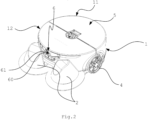
- Figure 2 shows in the front area 12 above the cleaning device 2 a camera 60 of the optical recognition system 6, which is used to determine the position of the device 1.
- the camera 60 has a lens 61.
- the optical recognition system 6 locates z. B. an image located in space (see also Fig.11 ).
- a relative position of the device 1 can be determined by measuring two distances d1, d2 to the image at each edge of the image (see Fig. 11 ).
- a code is assigned to the image, which, when recognized by the optical recognition system 6, leads to the execution of an action by the device 1 specified by the code.
- the device 1 After determining the Relative position, the device 1 automatically moves to a position determined relative to the location of the code. Alternatively or additionally, an action is carried out based on the data determined.
- Examples of the position of an image can be a loading station 91 or a dirt collection station 55 for emptying the dirt collection space 51 (see Fig. 10 ).
- a computer unit 90 of the device can (see Fig.10 ) include one or more target criteria. As long as a target value does not correspond to the target criterion, the cleaning process of device 1 continues. However, if the setpoint corresponds to the setpoint criterion, the device 1 carries out the intended action. This can be, for example, starting the charging station 91 to charge the battery or starting the dirt collection station 55 to empty the dirt collection space 51.
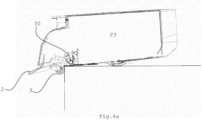
- FIGs 3 , 4a and 4b show the cleaning device 2 and the two folding devices 3 in the bottom and side view of the device 1.
- the cleaning device 2 comprises two rotating round brushes 20, each with a brush plate 21. Both round brushes 20 are arranged next to one another in the front area 12 of the device 1.
- the two folding devices 3 are arranged within the periphery of the brushes 20, preferably eccentrically to the brush plates 21 and can each be pivoted about an axis (see Fig. 4b ).
- the folding device 3 shown schematically includes an axle 30, a contact point 31, and a swivel roller with a carrier 32 and a wheel 33.
- the carrier 32 with the wheel 33 is pivotably arranged on the axle 30.
- the contact point 31 is with an am Carrier 32 arranged contact closed. If there is no change in the level of the floor, the cleaning process continues through the device 1.
- the carrier 32 pivots downwards and the electrical contact point 31 is opened.
- the device 1 preferably stops and sends a signal and/or changes its direction of travel in order to avoid the change in the level of the ground.
- Figure 4a shows the device 1 in a stop position P3, in which there is a change in the level of the floor and the folding device 3 is folded down.
- the two folding devices 3 can be triggered independently of one another. Depending on the angle at which the device 1 stands to change the level of the floor, one or both folding devices 3 can be folded down.
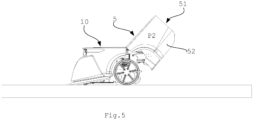
- Figure 5 shows the emptying device 5 of the device 1.
- the emptying device 5 includes the dirt receiving space 51, a closure element 52, a fill level sensor 54 (see Fig.10 ) and an internal drive 53 (see Fig.10 ).
- the closure element 52 can be moved automatically by the drive 53, for example by pivoting.
- the closure element 52 can assume two positions, either an open or a closed position.
- Fig. 5 shows the device 1 in an emptying position P2, with the closure element 52 in the open position. Emptying is carried out using a control 9 (see Fig. 10 ) carried out.
- the control 9 includes the computer unit 90 and the fill level sensor 54.
- the fill level sensor 54 determines the remaining volume of the dirt holding space 51.
- the computer unit 90 compares the remaining volume determined by the fill level sensor 54 with a predetermined target value.
- the level sensor 54 is For example, an ultrasonic sensor that is non-contact and insensitive to dirt. Alternatively, a touch sensor is also conceivable. It is also conceivable to determine the fill level via weight or based on the driving behavior of the device 1 by measuring acceleration.
- the computer unit 90 activates the drive element 4 of the device 1.
- the device 1 then moves into an adjacent position to a dirt collecting area of the dirt collecting station 55. Reaching the adjacent position of the dirt collecting area is detected by the optical recognition system 6 ( please refer Fig.2 ) recognized with the help of the camera 60. This in turn activates the drive 53 via the computer unit 90, which automatically opens the closure element 52.
- the dirt-receiving space 51 filled with dirt is emptied into the dirt-collecting area of the dirt-receiving station 55.
- the dirt collection area can be a dedicated container or simply a hole in the ground.
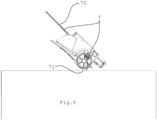
- the Figures 6-8 show how manual transport of the device 1 is carried out.
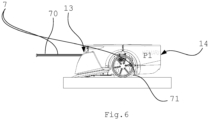
- Figure 6 shows a transport device 7 of the device 1.
- the device 1 is shown in an operating position P1 with an extended handle 70.
- the handle 70 is arranged at one end 13 of the device 1.
- Figure 7 is the device 1 without the dirt holding space 51 (see Fig.5 ) shown in operating position P1 with the extended handle 70.
- the dirt holding space 51 or parts thereof are removed so that the device can be in the transport position (see Fig. 8 ) can be brought.
- a cover for the dirt-receiving space or the entire dirt-receiving space 51 can be attached to the handle 70 or the housing 10 (see Fig.1 ) can be attached (not shown).
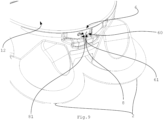
- Figure 9 shows an exhaust duct 8 for removing dirt from the area adjacent to the lens 61 of the detection unit 60. This is typically a camera of the optical detection system 6.
- Air guided through the exhaust air duct 8 is passed through a suction device 82 (see Fig.7 ) generated.
- a suction device 82 (see Fig.7 ) generated.
- This is provided with a filter arrangement 80.
- the suction device 82 and the filter arrangement 80 are arranged in the rear area 11 of the device 1.
- the optical recognition system 6 is arranged in the front area of the device 1.
- the exhaust air guide 8 is arranged so that exhaust air 81, which is generated by the suction device 82, is directed to the optical recognition system 6 in the front area 12 of the device 1 and flows over the surface of the lens 61 of the camera 60 (see arrows in Fig.9 ).
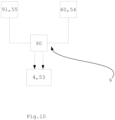
- FIG 10 shows the diagram of the essential components of the control 9 of the device 1.
- the control 9 includes the computer unit 90, the fill level sensor 54 or the camera 60, the drive element 4 or the internal or external drive 53.
- the control is used to start up the dirt collection station 55 or the Charging station 91 and to carry out actions when these stations are reached.
- the fill level sensor 54 or the camera 60 detect a target criterion. This is compared with a predetermined target value using the computer unit 90. If the target criterion and the target value match, the drive element 4 or the internal or external drive 53 is activated and the device 1 moves to the dirt pickup station 55 or the charging station 91. If the device 1 reaches the dirt pickup station 55 or the charging station 91, the respective action e.g. loading, emptying carried out.
- Figure 11 shows a system for localizing the device 1.
- the localization system includes a signal panel 62, the optical recognition system 6 and the computer unit 90 (see Fig.10 ).
- the system is used in particular to localize the device in relation to the dirt collection station 55 or the charging station 91.
- the optical recognition system 6 recognizes the signal board 62, which can contain, for example, an image and/or a code.
- the computer unit 90 determines a distance to the signal panel 62 based on the distances d1, d2 in order to determine the relative position to the signal panel 62. Based on the relative position, the device 1 controls the dirt collection station 55 or the charging station 91 and carries out an action defined by the image or the code.
Landscapes
- Engineering & Computer Science (AREA)
- Mechanical Engineering (AREA)
- Physics & Mathematics (AREA)
- General Physics & Mathematics (AREA)
- Cleaning In General (AREA)
- Electric Vacuum Cleaner (AREA)
- Control Of Position, Course, Altitude, Or Attitude Of Moving Bodies (AREA)
- Nozzles For Electric Vacuum Cleaners (AREA)
- Filters For Electric Vacuum Cleaners (AREA)
- Electric Suction Cleaners (AREA)
Abstract
Description
- Die Erfindung betrifft ein Gerät und ein Verfahren zur selbsttätigen Ausführung einer Tätigkeit, insbesondere zur Reinigung verschmutzter Oberflächen, gemäss dem Oberbegriff der unabhängigen Ansprüche.
- Aus dem Stand der Technik sind verschiedene Geräte zur selbsttätigen Ausführung einer Tätigkeit bekannt, die insbesondere zur Reinigung verschmutzter Oberflächen verwendet werden. Zweck der Geräte ist es, die auszuführende Tätigkeit für den Menschen zu erleichtern. Dafür müssen die Geräte selbsttätig navigieren, Hindernisse erkennen und die auszuführende Tätigkeit selbsttätig ausführen können. Eine besondere Herausforderung ist das Vermeiden von Abstürzen über Kanten.
- Aus
DE 102012108008 ist ein Sauggerät bekannt, welches zur Vermeidung von Abstürzen des Geräts einen Infrarotsensor verwendet. - Nachteilig am Stand der Technik ist, dass das Gerät nicht in einer Umgebung mit Staubemissionen verwendet werden kann, da der Infrarotsensor gegenüber Staubemissionen fehleranfällig ist.
- Aus der
US 6580246 ist ein selbsttätiges Kehrgerät bekannt, welches bei Verschiebung des Geräterumpfes Hindernisse erkennt. Gemessen wird die Rumpfverschiebung mittels magnetischer Sensoren. - Der Nachteil hier ist, dass ein Absturz des Geräts nicht zuverlässig verhindert werden kann.
- Es ist die Aufgabe der vorliegenden Erfindung, ein Gerät zur selbsttätigen Ausführung einer Tätigkeit zu schaffen, welches die Nachteile des Stands der Technik vermeidet und insbesondere ein Gerät und ein Verfahren zur selbsttätigen Ausführung einer Tätigkeit zu schaffen, so dass ein Absturz des Geräts in einer Umgebung mit Schmutzemissionen vermieden wird.
- Diese Aufgabe wird durch ein Gerät und ein Verfahren zur selbsttätigen Ausführung einer Tätigkeit, insbesondere zur Reinigung verschmutzter Oberflächen, gemäss den unabhängigen Ansprüchen gelöst.
- Erfindungsgemäss umfasst das Gerät zur selbsttätigen Ausführung einer Tätigkeit, insbesondere zur Reinigung verschmutzter Oberflächen, gemäss einem ersten Aspekt der Erfindung mindestens einen Sensor und wenigstens ein Antriebselement, wobei das Antriebselement ein Rad, aber auch eine Raupe sein kann. Das Antriebselement teilt das Gerät, bezogen auf eine bestimmungsgemässe Bewegungsrichtung, in einen hinteren Bereich und in einen vorderen Bereich. Erfindungsgemäss ist der Sensor ein mechanischer Sensor, der durch Kontakt mit dem Boden zur Feststellung einer Veränderung des Niveaus des Bodens dient und im vorderen Bereich des Geräts angeordnet ist. Damit können insbesondere Kanten festgestellt werden, so dass der Sensor als Absturzsicherung dient.
- Mechanisch heisst in diesem Zusammenhang, dass die Änderung des Niveaus durch ein bewegliches Sensorelement erfasst wird. Zur Detektion einer Bewegung des Sensorelements kommen z.B. elektrische oder optische Verfahren zur Anwendung. Bevorzugt wird ein zweiteiliger magnetischer Sicherheitsschalter verwendet.
- Alternativ können aber auch induktive Sensoren, kapazitive Sensoren, Beschleunigungssensoren, Ultraschallsensoren oder RFID Sensoren verwendet werden, um eine Bewegung des mechanischen Sensorelementes zu erfassen.
- Durch ein Gerät mit mechanischem Sensor zur Feststellung einer Veränderung des Niveaus des Bodens kann das Gerät auch in einer Umgebung mit Schmutzemissionen verwendet werden. Die Anordnung des Sensors im vorderen Bereich des Gerätes hat den Vorteil, dass das Auslösen des Sensors einen sofortigen Stopp des Geräts zur Folge hat und Abstürze rechtzeitig verhindert werden.
- Vorzugsweise ist der mechanische Sensor als Druck-, Dehnungsoder Kraftsensor ausgebildet.
- Durch die Verwendung eines mechanischen Sensors, dessen Messung mittels Druck, Dehnung oder Kraft durchgeführt wird, können Fehlmessungen gegenüber Sensoren, die anfällig bei Schmutzemissionen sind, reduziert werden.
- Vorzugsweise ist der Sensor in einen Träger eines Rads, insbesondere einer Lenkrolle integriert. Er kann grundsätzlich aber in jede Art von Rad in dem vorderen Bereich integriert sein, z.B. in ein omnidirektionales Rad oder Mecanum-Rad.
- Dies erlaubt eine einfache Konstruktion des Sensors. Da das Rad bereits in Bodenkontakt ist, kann auf einen zusätzlichen Mechanismus zur Herstellung des Bodenkontakts des Sensors im Bedarfsfall verzichtet werden.
- Vorzugsweise ist der Sensor insbesondere im Zentrum rotierender Bürsten angeordnet.
- Vorzugsweise ist der Sensor so angeordnet, dass der Schmutz bereits entfernt ist, wenn der Sensor in Kontakt mit dem Boden kommt.
- Durch die Lage des Sensors ist er vor Bodenschmutz und dadurch verursachten Fehlmessungen geschützt. Ausserdem wird vermieden, dass lose Gegenstände am Boden den Sensor auslösen.
- Alternativ kann mindestens ein Kontaktblech eingesetzt werden, bevorzugt zwei Kontaktbleche. Das oder die Kontaktbleche sind im vorderen Bereich, hinter einem oder mehreren Lenkrädern angeordnet. Das oder die Kontaktbleche besitzen keinen Bodenkontakt, solange die Lenkräder in Kontakt mit dem Boden sind. Bei abrupter Veränderung des Niveaus des Bodens verlieren die Lenkrollen Kontakt mit dem Boden und es wird zwischen einem oder beiden Kontaktblechen und dem Boden ein Kontakt hergestellt. Dadurch kann ein Signal erzeugt werden und damit ein Absturz verhindert werden.
- Gemäss einem weiteren Aspekt umfasst ein Gerät zur selbsttätigen Reinigung verschmutzter Oberflächen mindestens eine Reinigungsvorrichtung. Die Reinigungsvorrichtung umfasst eine Entleerungsvorrichtung, die einen Schmutzaufnahmeraum zum Aufnehmen des aufgesammelten Schmutzes umfasst. Die Entleerungsvorrichtung ist zwischen einer Betriebsposition, in der sie Schmutz von der Reinigungsvorrichtung aufnimmt, und einer Entleerposition, in der sie Schmutz aus dem Schmutzaufnahmeraum entleert, selbsttätig beweglich. Die Entleerungsvorrichtung kann über einen internen oder einen externen Antrieb selbsttätig bewegt werden.
- Zur Betätigung mit einem externen Antrieb kann das Gerät mit einer Kupplung versehen sein, an welche der externe Antrieb ankoppelbar ist.
- Alternativ ist es auch denkbar, die Entleerungsvorrichtung in Wirkverbindung mit einer externen Rückhalteanordnung zu bringen. Durch gezielte Bewegung des Geräts bei zurückgehaltener Entleerungsvorrichtung lässt sich die Entleerungsvorrichtung von der Betriebsposition in die Entleerposition bringen.
- Dadurch kann das Gerät selbsttätig und ohne manuelle Unterstützung den aufgesammelten Schmutz entleeren und stellt neuen Füllraum zum weiteren Aufsammeln von Schmutz bereit. Lange Standzeiten werden vermieden, um ein effizientes und schnelles Reinigen zu gewährleisten. Ausserdem ermöglicht die selbsttätige Entleerung des Geräts eine höhere Autonomie und es wird kein Personal benötigt. Es ist denkbar, dass der Schmutzbehälter bei Bedarf auch manuell entleert werden kann.
- Vorzugsweise umfasst das Gerät einen Schmutzaufnahmeraum und ein am Gerät beweglich angeordnetes Verschlusselement. Das Verschlusselement kann kippbar, aufklappbar und/oder ausziehbar sein.
- Das beweglich angeordnete Verschlusselement erlaubt es, den Schmutzaufnahmeraum selbsttätig und ohne manuelle Unterstützung zu öffnen.
- Vorzugsweise umfasst die Entleerungsvorrichtung einen Füllstandsensor zur Bestimmung eines Restvolumens.
- Das erlaubt eine einfache Bestimmung des noch vorhandenen Schmutzaufnahmevolumens des Schmutzaufnahmeraums.
- Gemäss einem weiteren Aspekt, umfasst ein Gerät zur selbsttätigen Reinigung verschmutzter Oberflächen mindestens eine Reinigungsvorrichtung und eine Blasvorrichtung zum Erzeugen eines Luftstroms. Die Blasvorrichtung kann durch eine Absaugvorrichtung zum Absaugen von Luft gebildet sein. In diesem Fall weist die Absaugvorrichtung bevorzugt eine Filteranordnung zum Filtern von Partikeln aus der abgesaugten Luft auf. Das Gerät umfasst ausserdem ein optisches Erkennungssystem, bevorzugt mit einem Bilderkennungssystem, z.B. zur Erkennung von Hindernissen. Eine Luftführung der Blasvorrichtung und insbesondere eine Abluftführung der Filteranordnung ist derart angeordnet, dass Luft und bevorzugt gefilterte Abluft an einer Erkennungseinheit des optischen Erkennungssystems vorbeigeführt wird. Die Erkennungseinheit ist typischerweise einer Kamera, kann aber auch eine Laserdistanzmesseinheit oder ein IR Sensor sein.
- Dadurch wird Schmutz aus einem Bereich vor der optischen Erkennungseinheit weggeführt und das schmutzempfindliche Bilderkennungssystem vor Schmutzemissionen geschützt und eine daraus resultierende Fehleranfälligkeit reduziert.
- Vorzugsweise umfasst die vorstehende Reinigungsvorrichtung in allen Aspekten eine Kehrvorrichtung.
- Dadurch kann eine Kehrvorrichtung zur Reinigung verschmutzter Oberflächen in einer Umgebung mit Schmutzemissionen mit Hilfe eines Bilderkennungssystems navigiert werden.
- Gemäss einem weiteren Aspekt umfasst das Gerät zur selbsttätigen Ausführung einer Tätigkeit mindestens eine Reinigungsvorrichtung und eine aktivierbare Transporthilfe. Die Transporthilfe kann einen ausziehbaren Griff aufweisen, der an einem Ende des Geräts befestigt ist. Am gegenüberliegenden Ende ist wenigstens ein Rad angeordnet. Dabei kann es sich um ein Transportrad handeln, das nur im Transportfall in Bodenkontakt gelangt oder aber auch ein Antriebsrad, welches auskuppelbar ist oder keine Selbsthemmung aufweist. Wird das Gerät in eine Transportposition gebracht, so ist das Rad bereits in Kontakt mit dem Boden oder tritt mit dem Boden in Kontakt. Das beschriebene Prinzip ähnelt dem eines handelsüblichen Koffertrolleys mit zwei Rädern. In Transportposition sind die beiden Räder in Kontakt mit dem Boden und ermöglichen eine vereinfachte und leichte manuelle Bewegung des Geräts in Art eines Koffertrolleys.
- Dadurch kann das Gerät einfach manuell fortbewegt werden.
- Alternativ ist die Transporthilfe durch eine am Gehäuse angeordnete, ausziehbare Leine gebildet. Das Gerät weist dann mindestens drei mit dem Boden in Kontakt stehende Räder auf, welche auskoppelbar sind oder keine Selbsthemmung aufweisen. Die Räder sind bevorzugt so angeordnet, dass mindestens ein Rad an einem Ende des Geräts und wenigstens zwei Räder am gegenüberliegenden Ende angeordnet sind und in Kontakt mit dem Boden sind.
- Die Aufgabe wird weiter durch ein Verfahren zur selbsttätigen Reinigung verschmutzter Oberflächen mittels eines Geräts gelöst. Das Verfahren umfasst die Schritte:
- Messen eines vorgegebenen Sollwerts eines Restvolumens in einem Schmutzaufnahmeraum
- wenn der Sollwert erreicht ist, Bewegen des Geräts in eine einem Schmutzauffangbereich benachbarte Position
- Selbsttätiges Öffnen des beweglichen Schmutzaufnahmeraums
- Entleeren des Schmutzes aus dem Schmutzaufnahmeraum in den Schmutzauffangbereich.
- Der Sollwert kann dabei beispielsweise eine vorbestimmte Füllhöhe, ein Füllgewicht und/oder ein Zeitpunkt sein.
- Vorteil dieses Verfahrens ist ein autonomer Betrieb und ein selbsttätiges, effizientes und schnelles Erkennen des Gerätes, wann sich das Gerät zum Schmutzaufnahmebereich bewegen soll.
- Die Aufgabe wird weiter durch ein Verfahren zur selbsttätigen Reinigung verschmutzter Oberflächen mittels eines Geräts gelöst. Das Verfahren umfasst die Schritte:
- Erkennung einer Veränderung des Niveaus in einem in Bewegungsrichtung vor einem Antriebselement liegenden Bereich des Bodens durch Kontakt eines Sensors mit dem Boden
- wenn keine Veränderung des Niveaus des Bodens erkannt wird, Fortsetzung eines Reinigungsvorgangs
- wenn eine Veränderung des Niveaus des Bodens erkannt wird, Beenden der Fortbewegung des Geräts und optionales Absetzen eines Signals und/oder Durchführung einer Richtungsänderung.
- Vorteil dieses Verfahrens ist ein selbsttätiges, effizientes bzw. schnelles Erkennen einer Änderung des Niveaus des Bodens, um Abstürze und/oder Beschädigungen des Geräts zu verhindern. Ein abzusetzendes Signal kann ein optisches Signal, ein Hörsignal oder eine drahtlose Fehlermeldung, via Funk, Mail oder SMS sein.
- Die Aufgabe wird weiter durch ein Verfahren zur selbsttätigen Reinigung verschmutzter Oberflächen mittels eines Geräts gelöst. Das Verfahren umfasst die Schritte:
- Lokalisierung eines Bildes, welches räumlich einer Station zugeordnet ist, mittels eines Bilderkennungssystems
- Bestimmen der relativen Lage des Geräts bezogen auf die Station mittels einer 3D Kamera in Echtzeit, durch Messung wenigstens einer Distanz zum lokalisierten Bild
- Bewegung des Geräts zur Station auf der Grundlage der bestimmten relativen Lage.
- Das Verfahren umfasst weiter bevorzugt die Schritte:
- Ermitteln eines durch das Bild gegebenen Codes
- Ausführen einer dem Code zugeordneten Aktion
- Alternativ kann die Kamera zu Erfassung und Auswertung eines 3D-Codes ausgebildet sein.
- Vorteile dieses Verfahrens sind die genaue Bestimmung der IstPosition des Geräts und die Durchführung einer Aktion bei Erkennung eines Codes.
- Vorzugsweise umfasst das Verfahren zur selbsttätigen Reinigung verschmutzter Oberflächen mittels eines Geräts folgende Schritte:
- wenn ein Sollwert nicht einem Sollkriterium entspricht, Fortsetzung eines Reinigungsvorgangs
- Bewegung des Geräts, wenn der Sollwert dem Sollkriterium entspricht, insbesondere zu einer Ladestation oder zu einer Schmutzaufnahmestation im Schmutzauffangbereich
- wenn die Station erreicht ist, Ausführung eines Befehls, insbesondere das Andocken und Aufladen bis zur Erreichung der maximalen Ladekapazität oder Leeren des Schmutzaufnahmeraums.
- Ein Sollkriterium kann ein Ladezustand, eine Füllhöhe oder ein Füllgewicht des Schmutzauffangbehälters sein.
- Vorteil dieses Verfahrens ist das selbsttätige Bewegen zu einer Station bei Erreichen eines vorbestimmten Sollkriteriums. Eine Station können beispielsweise eine Ladestation oder der Schmutzaufnahmebereich sein.
- Die Aufgabe wird weiter durch ein Verfahren zur selbsttätigen Reinigung verschmutzter Oberflächen mittels eines Geräts gelöst. Das Verfahren umfasst die Schritte:
- Erzeugen eines Luftstroms, insbesondere durch Absaugen von Luft durch eine Absaugvorrichtung
- optional, Filtern eines Abluftstroms der Absaugvorrichtung durch eine Filteranordnung
- Entfernung von Schmutz aus einem Bereich benachbart zu einem optischen Erkennungssystem, insbesondere einer Kamera, durch Vorbeiführung des Luftstroms, insbesondere des gefilterten Abluftstroms.
- Alternativ zu einer Absaugvorrichtung kann ein Luftgebläse oder auch eine Druckluftquelle verwendet werden.
- Mit einem derartigen Verfahren können optische Sensoren, die gegenüber Schmutzemissionen empfindlich sind, in einer Umgebung mit Schmutzemissionen verwendet werden. Schmutz wird aus dem Bereich benachbart zum optischen Erkennungssystem wegtransportiert, bevor er sich z.B. auf einer Linse ablagern kann oder bereits abgelagerter Schmutz kann gegebenenfalls auch entfernt werden.
- Die Erfindung wird im Folgenden anhand von Ausführungsbeispielen in Figuren weiter erläutert. Hierbei zeigen:
- Figur 1:
- Seitenansicht eines Geräts in einer ersten Ausführungsform,
- Figur 2:
- Perspektivische Darstellung der in
Figur 1 gezeigten Ausführungsform des Geräts, - Figur 3:
- Unteransicht der in
Figur 1 gezeigten Ausführungsform des Geräts, - Figur 4a:
- Seitenansicht der in
Figur 1 gezeigten Ausführungsform des Geräts in Betriebsposition bei Veränderung des Niveaus des Bodens, - Figur 4b:
- Schema einer Klappvorrichtung des Geräts bei Veränderung des Niveaus des Bodens,
- Figur 5:
- Seitenansicht der in
Figur 1 gezeigten Ausführungsform des Geräts in Entleerungsposition, - Figur 6:
- Seitenansicht der in
Figur 1 gezeigten Ausführungsform des Geräts in Betriebsposition mit ausgezogenem Griff, - Figur 7:
- Seitenansicht der in
Figur 1 gezeigten Ausführungsform des Geräts in Betriebsposition mit ausgezogenem Griff und ohne Schmutzaufnahmeraum, - Figur 8:
- Seitenansicht der in
Figur 1 gezeigten Ausführungsform des Geräts in Transportposition mit ausgezogenem Griff, - Figur 9:
- Darstellung einer Abluftführung angeordnet an einem optischen Erkennungssystem.
- Figur 10:
- Schematische Darstellung der Steuerung des Geräts.
- Figur 11:
- Schematische Darstellung des Lokalisierungssystems des Geräts.
- Ein in
Figur 1 dargestelltes Gerät 1 dient zur selbsttätigen Reinigung in einer industriellen Umgebung mit Schmutzemissionen. Das Gerät 1 enthält ein Gehäuse 10, das durch zwei Antriebsräder 4 in Bewegungsrichtung B gesehen in einen vorderen Bereich 12 und einen hinteren Bereich 11 unterteilt ist. Im vorderen Bereich 12 befindet sich, von dem Gehäuse 10 abgedeckt, eine Reinigungsvorrichtung 2. Die Reinigungsvorrichtung 2 enthält zwei nebeneinander liegende rotierende Bürsten 20 (sieheFig.3 ). Hinter einem vorderen Rand der rotierenden Bürsten 20 ist in Bewegungsrichtung B im vorderen Bereich 12 je ein Sensor 3 in Form einer Klappvorrichtung angeordnet (sieheFig.3 /4 ). Zudem befindet sich im vorderen Bereich 12 ein optisches Erkennungssystem 6. Der hintere Bereich 11 umfasst eine Entleerungsvorrichtung 5 und einen Schmutzaufnahmeraum 51 (sieheFig.5 ). InFigur 1 ist die Entleerungsvorrichtung 5 in einer Betriebsposition P1 gezeigt. -
Figur 2 zeigt im vorderen Bereich 12 über der Reinigungsvorrichtung 2 eine Kamera 60 des optischen Erkennungssystems 6, welches zur Bestimmung der Lage des Geräts 1 dient. Die Kamera 60 weist eine Linse 61 auf. Das optische Erkennungssystem 6 lokalisiert z. B. ein sich im Raum befindliches Bild (siehe auchFig.11 ). Bei Erkennung des Bildes kann eine relative Lage des Geräts 1 über eine Messung von zwei Distanzen d1,d2 zum Bild an je einem Rand des Bildes ermittelt werden (sieheFig. 11 ). Zusätzlich ist dem Bild ein Code zugeordnet, der bei Erkennung durch das optische Erkennungssystem 6 zur Ausführung einer durch den Code festgelegten Aktion des Geräts 1 führt. Nach Bestimmung der relativen Lage bewegt sich das Gerät 1 selbsttätig an eine relativ zum Standort des Codes bestimmte Position. Alternativ oder zusätzlich wird auf Basis der ermittelten Daten eine Aktion ausgeführt. - Beispiele für die Position eines Bildes kann eine Ladestation 91 oder eine Schmutzaufnahmestation 55 zur Entleerung des Schmutzaufnahmeraums 51 sein (siehe
Fig. 10 ). - Eine Rechnereinheit 90 des Geräts kann (siehe
Fig.10 ) ein oder mehrere Sollkriterien umfassen. Solange ein Sollwert nicht dem Sollkriterium entspricht, wird der Reinigungsvorgang des Geräts 1 fortgesetzt. Entspricht der Sollwert hingegen dem Sollkriterium, so führt das Gerät 1 die dafür vorgesehene Aktion aus. Dies kann beispielsweise ein Anfahren der Ladestation 91 sein, um die Batterie aufzuladen oder ein Anfahren der Schmutzaufnahmestation 55, um den Schmutzaufnahmeraum 51 zu entleeren. -
Figuren 3 ,4a und4b zeigen in der Unter- und Seitenansicht des Geräts 1 die Reinigungsvorrichtung 2 und die beiden Klappvorrichtungen 3. Die Reinigungsvorrichtung 2 umfasst zwei rotierende Rundbürsten 20 mit je einem Bürstenteller 21. Beide Rundbürsten 20 sind nebeneinander liegend, im vorderen Bereich 12 des Geräts 1 angeordnet. Die beiden Klappvorrichtungen 3 sind innerhalb der Peripherie der Bürsten 20, bevorzugt exzentrisch zu den Bürstentellern 21 angeordnet und je um eine Achse schwenkbar (sieheFig. 4b ). Die inFig. 4b schematisch dargestellte Klappvorrichtung 3 umfasst je eine Achse 30, eine Kontaktstelle 31, und eine Lenkrolle mit einen Träger 32 und einem Rad 33. An der Achse 30 ist der Träger 32 mit dem Rad 33 schwenkbar angeordnet. Solange sich der Träger 32 in einer Normalposition befindet, ist die Kontaktstelle 31 mit einem am Träger 32 angeordneten Kontakt geschlossen. Wenn keine Veränderung des Niveaus des Bodens vorliegt, wird der Reinigungsprozess durch das Gerät 1 fortgesetzt. Bei Veränderung des Niveaus des Bodens schwenkt der Träger 32 nach unten und es wird die elektrische Kontaktstelle 31 geöffnet. Das Gerät 1 stoppt und sendet bevorzugt ein Signal und/oder ändert seine Fortbewegungsrichtung, um der Änderung des Niveaus des Bodens auszuweichen.Figur 4a zeigt das Gerät 1 in einer Stopp-Position P3, bei der eine Veränderung des Niveaus des Bodens vorliegt und die Klappvorrichtung 3 nach unten geklappt ist. - Die beiden Klappvorrichtungen 3 können unabhängig voneinander ausgelöst werden. Je nach dem, in welchem Winkel das Gerät 1 zur Veränderung des Niveaus des Bodens steht, können eine oder beide Klappvorrichtungen 3 nach unten geklappt sein.
-
Figur 5 zeigt die Entleerungsvorrichtung 5 des Geräts 1. Die Entleerungsvorrichtung 5 umfasst den Schmutzaufnahmeraum 51, ein Verschlusselement 52, einen Füllstandsensor 54 (sieheFig.10 ) und einen internen Antrieb 53 (sieheFig.10 ). Das Verschlusselement 52 kann durch den Antrieb 53 selbsttätig bewegt werden, beispielsweise durch Verschwenken. Das Verschlusselement 52 kann zwei Positionen einnehmen, entweder eine geöffnete oder eine geschlossene Position. -
Fig. 5 zeigt das Gerät 1 in einer Entleerposition P2, wobei das Verschlusselement 52 in geöffneter Position vorliegt. Eine Entleerung wird mit Hilfe einer Steuerung 9 (sieheFig. 10 ) durchgeführt. Die Steuerung 9 umfasst die Rechnereinheit 90 und den Füllstandsensor 54. Der Füllstandsensor 54 bestimmt das Restvolumen des Schmutzaufnahmeraums 51. Die Rechnereinheit 90 gleicht das vom Füllstandsensor 54 bestimmte Restvolumen mit einem vorgegebenen Sollwert ab. Der Füllstandsensor 54 ist beispielsweise ein Ultraschallsensor, der berührungslos und schmutzunempfindlich ist. Alternativ ist aber auch ein Tastsensor denkbar. Ebenfalls ist es denkbar, den Füllstand via Gewicht oder aufgrund des Fahrverhaltens des Geräts 1 durch Beschleunigungsmessung zu ermitteln. Entspricht das Restvolumen dem vorgegebenen Sollwert, so aktiviert die Rechnereinheit 90 das Antriebselement 4 des Geräts 1. Das Gerät 1 bewegt sich dann in eine benachbarte Position zu einem Schmutzauffangbereich der Schmutzaufnahmestation 55. Das Erreichen der benachbarten Position des Schmutzauffangbereiches wird von dem optischen Erkennungssystem 6 (sieheFig.2 ) mit Hilfe der Kamera 60 erkannt. Dies wiederum aktiviert über die Rechnereinheit 90 den Antrieb 53, welcher selbsttätig das Verschlusselement 52 öffnet. Der mit Schmutz befüllte Schmutzaufnahmeraum 51 wird in den Schmutzauffangbereich der Schmutzaufnahmestation 55 entleert. Der Schmutzauffangbereich kann ein dedizierter Behälter oder auch einfach ein Loch im Boden sein. - Die
Figuren 6-8 zeigen, wie ein manueller Transport des Geräts 1 durchgeführt wird. -
Figur 6 zeigt eine Transportvorrichtung 7 des Geräts 1. Das Gerät 1 ist in einer Betriebsposition P1 mit einem ausgezogenen Griff 70 dargestellt. Der Griff 70 ist an einem Ende 13 des Geräts 1 angeordnet. An einem gegenüberliegenden Ende 14 ist mindestens ein Rad 71 angeordnet, welches in Betriebsposition P1 nicht in Kontakt mit dem Boden ist. Um das Gerät zu transportieren, wird es in eine Transportposition gebracht (sieheFig. 8 ). - In
Figur 7 ist das Gerät 1 ohne den Schmutzaufnahmeraum 51 (sieheFig.5 ) in Betriebsposition P1 mit dem ausgezogenen Griff 70 dargestellt. Der Schmutzaufnahmeraum 51 oder Teile davon werden entfernt, damit das Gerät in die Transportposition (sieheFig. 8 ) gebracht werden kann. - Eine Abdeckung des Schmutzaufnahmeraums oder der ganze Schmutzaufnahmeraum 51 kann mit Hilfe einer Haltevorrichtung (z.B. durch einen Rastmechanismus oder durch einen Magneten) an dem Griff 70 oder dem Gehäuse 10 (siehe
Fig.1 ) befestigt werden (nicht gezeigt). - In
Figur 8 wird gezeigt, wie in Abwesenheit des Schmutzaufnahmeraums 51 und durch Anheben des Griffs 7 das Rad 71 in Kontakt mit dem Boden gebracht wird. Ein manuelles Transportieren des Geräts 1 ist möglich. -
Figur 9 zeigt eine Abluftführung 8 zur Entfernung von Schmutz aus dem Bereich benachbart zu der Linse 61 der Erkennungseinheit 60. Dabei handelt es sich typischerweise um eine Kamera des optischen Erkennungssystems 6. - Durch die Abluftführung 8 geführte Luft wird durch eine Absaugvorrichtung 82 (siehe
Fig.7 ) erzeugt. Diese ist mit einer Filteranordnung 80 versehen. Die Absaugvorrichtung 82 und die Filteranordnung 80 sind im hinteren Bereich 11 des Geräts 1 angeordnet. Das optische Erkennungssystem 6 ist im vorderen Bereich des Geräts 1 angeordnet. - Die Abluftführung 8 ist so angeordnet, dass Abluft 81 welche von der Absaugvorrichtung 82 erzeugt wird, zum optischen Erkennungssystem 6 in den vorderen Bereich 12 des Geräts 1 geleitet wird und über die Oberfläche der Linse 61 der Kamera 60 strömt (siehe Pfeile in
Fig.9 ). -
Figur 10 zeigt das Schema der wesentlichen Komponenten der Steuerung 9 des Geräts 1. Die Steuerung 9 umfasst die Rechnereinheit 90, den Füllstandsensor 54 oder die Kamera 60, das Antriebselement 4 oder den internen oder externen Antrieb 53. die Steuerung dient zum Anfahren der Schmutzaufnahmestation 55 oder der Ladestation 91 und zum Ausführen von Aktionen bei Erreichen dieser Stationen. Der Füllstandsensor 54 oder die Kamera 60 detektieren ein Sollkriterium. Dieses wird mit Hilfe der Rechnereinheit 90 mit einem vorgegebenen Sollwert verglichen. Stimmen das Sollkriterium und der Sollwert überein, wird das Antriebselement 4 oder der interne oder externe Antrieb 53 aktiviert und es erfolgt die Bewegung des Geräts 1 zur Schmutzaufnahmestation 55 oder der Ladestation 91. Erreicht das Gerät 1 die Schmutzaufnahmestation 55 oder die Ladestation 91, wird die jeweilige Aktion z.B. Laden, Entleeren durchgeführt. -
Figur 11 zeigt ein System zur Lokalisierung des Geräts 1. Das Lokalisierungssystem umfasst eine Signaltafel 62, das optische Erkennungssystem 6 und die Rechnereinheit 90 (sieheFig.10 ). Das System dient insbesondere zur Lokalisierung des Geräts bezogen auf die Schmutzaufnahmestation 55 oder die Ladestation 91. Das optische Erkennungssystem 6 erkennt die Signaltafel 62, welche beispielsweise ein Bild und/oder einen Code enthalten kann. Die Rechnereinheit 90 bestimmt aufgrund der Abstände d1, d2 eine Distanz zur Signaltafel 62, um die relative Position zur Signaltafel 62 zu bestimmen. Auf Grundlage der relativen Lage steuert das Gerät 1 die Schmutzaufnahmestation 55 oder die Ladestation 91 an und führt eine durch die durch das Bild oder den Code definierte Aktion durch.
Claims (15)
- Gerät (1) zur selbsttätigen Reinigung verschmutzter Oberflächen, umfassend mindestens eine Reinigungsvorrichtung (2), dadurch gekennzeichnet,dass das Gerät (1) eine Blasvorrichtung zum Erzeugen eines Luftstroms, insbesondere eine Absaugvorrichtung (82) zum Absaugen von Luft und eine Filteranordnung (80) zum Filtern von Partikeln aus der Luft,sowie ein optisches Erkennungssystem (6), bevorzugt ein Bilderkennungssystem, besonders bevorzugt ein LIDAR Sensor zur Erkennung von Hindernissen umfasst,wobei eine Luftführung der Blasvorrichtung und insbesondere eine Abluftführung (8) der Filteranordnung (80) derart angeordnet ist, dass Luft (81) am optischen Erkennungssystem (6) vorbeiführbar ist.
- Verfahren zur selbsttätigen Reinigung verschmutzter Oberflächen mittels eines Geräts (1), umfassend die Schritte:- Erzeugen eines Luftstroms, insbesondere Absaugen von Luft durch eine Absaugvorrichtung (82)- optional, Filtern eines Abluftstroms (81) der Absaugvorrichtung (82) durch eine Filteranordnung (80)- Entfernung des Staubs aus einem Bereich benachbart zu einem optischen Erkennungssystem (6) des Geräts durch Vorbeiführung des Luftstroms, insbesondere des gefilterten Abluftstroms (81).
- Gerät (1) zur selbsttätigen Reinigung verschmutzter Oberflächen, umfassend mindestens eine Reinigungsvorrichtung (2), insbesondere nach Anspruch 1, dadurch gekennzeichnet, dass das Gerät (1) eine Entleerungsvorrichtung (5), umfassend einen Schmutzaufnahmeraum (51), zum Aufnehmen des aufgesammelten Schmutzes umfasst, wobei die Entleerungsvorrichtung (5) zwischen einer Betriebsposition (P1), in der Schmutz von der Reinigungsvorrichtung (2) aufnehmbar ist und einer Entleerposition (P2), in der Schmutz entleerbar ist, selbsttätig beweglich ist.
- Gerät nach Anspruch 3, dadurch gekennzeichnet, dass der Schmutzaufnahmeraum (51) ein beweglich am Gerät (1) angeordnetes Verschlusselement (52) aufweist, insbesondere kippbar, aufklappbar und/oder ausziehbar.
- Gerät nach einem der Ansprüche 3 oder 4, dadurch gekennzeichnet, dass die Entleerungsvorrichtung (5) einen Füllstandsensor (54) zur Bestimmung eines Restvolumens umfasst.
- Gerät nach einem der Ansprüche 1 bis 5, dadurch gekennzeichnet, dass die Reinigungsvorrichtung (2) eine Kehrvorrichtung umfasst.
- Verfahren zur selbsttätigen Reinigung verschmutzter Oberflächen mittels eines Geräts (1), umfassend die Schritte:- Messen eines vorgegebenen Sollwerts eines Restvolumens eines Schmutzaufnahmeraums (51)- wenn der Sollwert erreicht ist, Bewegen des Geräts (1) in eine zu einem Schmutzauffangbereich benachbarte Position- Selbsttätiges Öffnen des Schmutzaufnahmeraums (51)- Entleeren des Schmutzes aus dem Schmutzaufnahmeraum (51) in den Schmutzauffangbereich.
- Verfahren zur selbsttätigen Reinigung verschmutzter Oberflächen mittels eines Geräts (1), umfassend die Schritte:- Erkennung einer Veränderung des Niveaus in einem in Bewegungsrichtung (B) vor einem Antriebselement (4) liegenden Bereich des Bodens durch Kontakt eines Sensors (3) mit dem Boden- wenn keine Veränderung des Niveaus des Bodens erkannt wird, Fortsetzung eines Reinigungsvorgangs- wenn eine Veränderung des Niveaus des Bodens erkannt wird, Beenden der Fortbewegung des Geräts (1) und bevorzugt ein Signal absetzen und/oder Durchführung einer Richtungsänderung.
- Verfahren zur selbsttätigen Reinigung verschmutzter Oberflächen mittels eines Geräts (1), umfassend die Schritte:- Lokalisierung eines Bildes (62), welches räumlich einer Station (55;91) zugeordnet ist, mittels eines LIDAR Sensors oder eines Bilderkennungssystems- Bestimmen der relativen Lage des Geräts (1) bezogen auf das Bild (62) mittels LIDAR Sensor oder einer 3D Kamera in Echtzeit, durch Messung wenigstens einer Distanz zum lokalisierten Bild (62)- Bewegung des Geräts (1) zur Station auf der Grundlage der bestimmten relativen Lageenthaltend bevorzugt die weiteren Schritte:- Ermitteln eines durch das Bild (62) gegebenen Codes- Ausführen einer dem Code zugeordneten Aktion
- Verfahren nach einem der Ansprüche 7 bis 9, umfassend die Schritte:- wenn ein Sollwert nicht einem Sollkriterium entspricht, Fortsetzung eines Reinigungsvorgangs- Bewegung des Geräts (1), wenn der Sollwert dem Sollkriterium entspricht, insbesondere der Ladestation (91) oder des Schmutzauffangbereichs- wenn die Station erreicht ist, Ausführung eines Befehls, insbesondere das Andocken und Aufladen bis zur Erreichung der maximalen Ladekapazität oder Leeren des Schmutzaufnahmeraums (51).
- Gerät (1) zur selbsttätigen Ausführung einer Tätigkeit, insbesondere zur selbsttätigen Reinigung verschmutzter Oberflächen, insbesondere Gerät nach einem der Ansprüche 1 oder 3 bis 6, umfassend mindestens einen Sensor (3) zur Verhinderung eines Absturzes und wenigstens ein Antriebselement (4), wobei das Antriebselement (4) einen hinteren Bereich (11) und einen vorderen Bereich (12) des Geräts (1), bezogen auf eine bestimmungsgemässe Bewegungsrichtung (B) definiert,
dadurch gekennzeichnet, dass der Sensor (3) ein mechanischer Sensor ist und zur Feststellung einer Veränderung des Niveaus (N) des Bodens durch Kontakt mit dem Boden ausgebildet ist und im vorderen Bereich (12) angeordnet ist. - Gerät nach Anspruch 11, dadurch gekennzeichnet, dass der Sensor (3) zur Messung mittels Druck, Dehnung oder Kraft ausgebildet ist.
- Gerät nach einem der vorangehenden Ansprüche 11 oder 12,
dadurch gekennzeichnet, dass der Sensor (3) in einen Träger eines Rads, insbesondere in eine Lenkrolle (32, 33) integriert ausgebildet ist. - Gerät nach einem der vorangehenden Ansprüche 11 bis 13,
dadurch gekennzeichnet, dass der Sensor (3) räumlich im Bereich von Bürsten angeordnet ist. - Gerät nach einem der vorangehenden Ansprüche 13 oder 14,
dadurch gekennzeichnet, dass der Sensor (3) in klappbare Lenkrollen (32, 33) integriert ausgebildet ist.
Applications Claiming Priority (3)
| Application Number | Priority Date | Filing Date | Title |
|---|---|---|---|
| CH01542/18A CH715633A2 (de) | 2018-12-12 | 2018-12-12 | Gerät und Verfahren zur selbsttätigen Ausführung einer Tätigkeit, insbesondere zur Reinigung verschmutzter Oberflächen. |
| PCT/EP2019/084399 WO2020120462A2 (de) | 2018-12-12 | 2019-12-10 | Gerät und verfahren zur selbsttätigen ausführung einer tätigkeit, insbesondere zur reinigung verschmutzter oberflächen |
| EP19821063.5A EP3893710B1 (de) | 2018-12-12 | 2019-12-10 | Gerät zur reinigung verschmutzter oberflächen |
Related Parent Applications (1)
| Application Number | Title | Priority Date | Filing Date |
|---|---|---|---|
| EP19821063.5A Division EP3893710B1 (de) | 2018-12-12 | 2019-12-10 | Gerät zur reinigung verschmutzter oberflächen |
Publications (4)
| Publication Number | Publication Date |
|---|---|
| EP4278940A2 true EP4278940A2 (de) | 2023-11-22 |
| EP4278940A3 EP4278940A3 (de) | 2024-08-14 |
| EP4278940B1 EP4278940B1 (de) | 2025-12-31 |
| EP4278940C0 EP4278940C0 (de) | 2025-12-31 |
Family
ID=68887409
Family Applications (2)
| Application Number | Title | Priority Date | Filing Date |
|---|---|---|---|
| EP19821063.5A Active EP3893710B1 (de) | 2018-12-12 | 2019-12-10 | Gerät zur reinigung verschmutzter oberflächen |
| EP23201753.3A Active EP4278940B1 (de) | 2018-12-12 | 2019-12-10 | Gerät zur reinigung verschmutzter oberflächen |
Family Applications Before (1)
| Application Number | Title | Priority Date | Filing Date |
|---|---|---|---|
| EP19821063.5A Active EP3893710B1 (de) | 2018-12-12 | 2019-12-10 | Gerät zur reinigung verschmutzter oberflächen |
Country Status (11)
| Country | Link |
|---|---|
| US (1) | US20220022712A1 (de) |
| EP (2) | EP3893710B1 (de) |
| JP (1) | JP7458403B2 (de) |
| KR (1) | KR102947088B1 (de) |
| CN (1) | CN113164001A (de) |
| AU (1) | AU2019398399A1 (de) |
| BR (1) | BR112021009598A2 (de) |
| CA (1) | CA3121049A1 (de) |
| CH (1) | CH715633A2 (de) |
| SG (1) | SG11202105317UA (de) |
| WO (1) | WO2020120462A2 (de) |
Families Citing this family (4)
| Publication number | Priority date | Publication date | Assignee | Title |
|---|---|---|---|---|
| US11998150B2 (en) | 2019-05-01 | 2024-06-04 | Sharkninja Operating Llc | Vacuum cleaner and docking station for use with the same |
| CN119907635A (zh) | 2022-09-15 | 2025-04-29 | 尚科宁家运营有限公司 | 真空清洁器和被配置成与其协作的对接站 |
| CN116465837A (zh) * | 2023-05-15 | 2023-07-21 | 中国第一汽车股份有限公司 | 一种车辆卫生检测装置以及显示方法 |
| EP4650030A1 (de) | 2024-05-13 | 2025-11-19 | Kemaro AG | Vorrichtung und verfahren zum reinigen eines filters |
Citations (3)
| Publication number | Priority date | Publication date | Assignee | Title |
|---|---|---|---|---|
| US6580246B2 (en) | 2001-08-13 | 2003-06-17 | Steven Jacobs | Robot touch shield |
| US20060068696A1 (en) | 2004-09-16 | 2006-03-30 | Ashford James A | Apparatus and method for laser scanner cleaning and protection |
| DE102012108008A1 (de) | 2012-08-30 | 2014-03-06 | Miele & Cie. Kg | Selbstfahrendes Sauggerät und Verfahren zum Betreiben eines selbstfahrenden Sauggeräts |
Family Cites Families (26)
| Publication number | Priority date | Publication date | Assignee | Title |
|---|---|---|---|---|
| AUPR154400A0 (en) * | 2000-11-17 | 2000-12-14 | Duplex Cleaning Machines Pty. Limited | Robot machine |
| CN2605152Y (zh) * | 2002-12-25 | 2004-03-03 | 师峰 | 两用翻斗车 |
| CN2657571Y (zh) * | 2003-09-27 | 2004-11-24 | 雷祖荫 | 电动环带洁面机 |
| US7617557B2 (en) * | 2004-04-02 | 2009-11-17 | Royal Appliance Mfg. Co. | Powered cleaning appliance |
| US7620476B2 (en) * | 2005-02-18 | 2009-11-17 | Irobot Corporation | Autonomous surface cleaning robot for dry cleaning |
| KR100671897B1 (ko) * | 2005-04-04 | 2007-01-24 | 주식회사 대우일렉트로닉스 | 스위치형 센서가 구비된 로봇 청소기 |
| KR20070021764A (ko) * | 2005-08-19 | 2007-02-23 | 주식회사 대우일렉트로닉스 | 무배기 로봇청소기 |
| EP2574265B1 (de) * | 2007-05-09 | 2015-10-14 | iRobot Corporation | Kompakter Roboter mit autonomer Reichweite |
| DE102010016788B4 (de) * | 2010-05-05 | 2012-01-19 | Miele & Cie. Kg | Filter, Staubsauger mit einem solchen Filter und Verwendung eines solchen Filters als Staubsaugerabluftfilter |
| SE534963C2 (sv) * | 2010-06-29 | 2012-02-28 | Electrolux Ab | Dammindikator för en dammsugare |
| SG2014014997A (en) * | 2011-09-29 | 2014-06-27 | Sharp Kk | Cleaning robot |
| CN103356122A (zh) * | 2012-04-05 | 2013-10-23 | 科沃斯机器人科技(苏州)有限公司 | 擦玻璃装置 |
| GB2502132B (en) * | 2012-05-17 | 2014-11-05 | Dyson Technology Ltd | Autonomous vacuum cleaner |
| JP5803831B2 (ja) * | 2012-07-23 | 2015-11-04 | 株式会社デンソー | 車載光学センサ用洗浄装置 |
| GB201301578D0 (en) * | 2013-01-29 | 2013-03-13 | Dyson Technology Ltd | Mobile robot |
| US9326654B2 (en) * | 2013-03-15 | 2016-05-03 | Irobot Corporation | Roller brush for surface cleaning robots |
| WO2015072623A1 (ko) * | 2013-11-13 | 2015-05-21 | 엘지전자 주식회사 | 클리닝 디바이스 및 그 제어 방법 |
| JP6207388B2 (ja) * | 2013-12-27 | 2017-10-04 | シャープ株式会社 | 自走式電気掃除機 |
| JP6634223B2 (ja) * | 2015-06-15 | 2020-01-22 | シャープ株式会社 | 自走式電子機器および前記自走式電子機器の走行方法 |
| JP6476077B2 (ja) * | 2015-06-18 | 2019-02-27 | シャープ株式会社 | 自走式電子機器および前記自走式電子機器の走行方法 |
| CN105982624B (zh) * | 2015-12-30 | 2019-04-16 | 小米科技有限责任公司 | 自动清洁设备的防卡死处理方法及装置、自动清洁设备 |
| CN105962841A (zh) * | 2016-06-22 | 2016-09-28 | 洛阳圣瑞智能机器人有限公司 | 一种擦玻璃机器人防跌落装置及方法 |
| CN106223765B (zh) * | 2016-08-30 | 2018-03-13 | 北汽银翔汽车有限公司 | 一种具备上翻和下翻开启方式的汽车背门 |
| KR101976424B1 (ko) * | 2017-01-25 | 2019-05-09 | 엘지전자 주식회사 | 이동 로봇 |
| US20180299899A1 (en) * | 2017-04-13 | 2018-10-18 | Neato Robotics, Inc. | Localized collection of ambient data |
| US20190310470A1 (en) * | 2018-04-10 | 2019-10-10 | Visteon Global Technologies, Inc. | System to maintain a clear lens on a camera |
-
2018
- 2018-12-12 CH CH01542/18A patent/CH715633A2/de not_active Application Discontinuation
-
2019
- 2019-12-10 BR BR112021009598-5A patent/BR112021009598A2/pt not_active IP Right Cessation
- 2019-12-10 SG SG11202105317UA patent/SG11202105317UA/en unknown
- 2019-12-10 EP EP19821063.5A patent/EP3893710B1/de active Active
- 2019-12-10 CA CA3121049A patent/CA3121049A1/en active Pending
- 2019-12-10 CN CN201980080959.1A patent/CN113164001A/zh active Pending
- 2019-12-10 WO PCT/EP2019/084399 patent/WO2020120462A2/de not_active Ceased
- 2019-12-10 JP JP2021534295A patent/JP7458403B2/ja active Active
- 2019-12-10 KR KR1020217020946A patent/KR102947088B1/ko active Active
- 2019-12-10 US US17/311,736 patent/US20220022712A1/en not_active Abandoned
- 2019-12-10 EP EP23201753.3A patent/EP4278940B1/de active Active
- 2019-12-10 AU AU2019398399A patent/AU2019398399A1/en not_active Abandoned
Patent Citations (3)
| Publication number | Priority date | Publication date | Assignee | Title |
|---|---|---|---|---|
| US6580246B2 (en) | 2001-08-13 | 2003-06-17 | Steven Jacobs | Robot touch shield |
| US20060068696A1 (en) | 2004-09-16 | 2006-03-30 | Ashford James A | Apparatus and method for laser scanner cleaning and protection |
| DE102012108008A1 (de) | 2012-08-30 | 2014-03-06 | Miele & Cie. Kg | Selbstfahrendes Sauggerät und Verfahren zum Betreiben eines selbstfahrenden Sauggeräts |
Also Published As
| Publication number | Publication date |
|---|---|
| CA3121049A1 (en) | 2020-06-18 |
| CN113164001A (zh) | 2021-07-23 |
| EP4278940B1 (de) | 2025-12-31 |
| JP7458403B2 (ja) | 2024-03-29 |
| AU2019398399A1 (en) | 2021-06-03 |
| SG11202105317UA (en) | 2021-07-29 |
| EP3893710C0 (de) | 2023-10-18 |
| EP3893710B1 (de) | 2023-10-18 |
| BR112021009598A2 (pt) | 2021-08-10 |
| CH715633A2 (de) | 2020-06-15 |
| JP2022513900A (ja) | 2022-02-09 |
| EP4278940A3 (de) | 2024-08-14 |
| US20220022712A1 (en) | 2022-01-27 |
| KR102947088B1 (ko) | 2026-04-02 |
| EP4278940C0 (de) | 2025-12-31 |
| KR20210100151A (ko) | 2021-08-13 |
| WO2020120462A3 (de) | 2020-08-06 |
| WO2020120462A2 (de) | 2020-06-18 |
| EP3893710A2 (de) | 2021-10-20 |
Similar Documents
| Publication | Publication Date | Title |
|---|---|---|
| EP3893710B1 (de) | Gerät zur reinigung verschmutzter oberflächen | |
| DE102010000607B4 (de) | Als Basisstation für ein selbsttätig verfahrbares Saug- und/oder Kehrgerät einsetzbarer Haushaltsstaubsauger | |
| DE102012108008A1 (de) | Selbstfahrendes Sauggerät und Verfahren zum Betreiben eines selbstfahrenden Sauggeräts | |
| EP2680097B1 (de) | Selbstfahrendes Reinigungsgerät und Verfahren zur Bedienung eines selbstfahrenden Reinigungsgeräts | |
| EP3409168B1 (de) | Eckenreinigungsmodul für modular aufgebaute reinigungsroboter | |
| DE102017113285A1 (de) | System mit mindestens zwei Reinigungsgeräten | |
| DE102009041362A1 (de) | Verfahren zum Betreiben eines Reinigungsroboters | |
| DE102010017213A1 (de) | Entleerungsstation für einen Schmutzsammelbehälter eines Reinigungsgerätes sowie Verfahren hierzu | |
| DE102004021116A1 (de) | Luftreinigungsroboter und entsprechendes System | |
| EP3379990A1 (de) | Bodenreinigungssystem und verfahren zum reinigen einer bodenfläche | |
| EP3725202B1 (de) | Sich selbsttätig fortbewegender saugroboter sowie system aus einem sich selbsttätig fortbewegenden saugroboter und einem externen saugreinigungsgerät | |
| EP3409165A2 (de) | Stützanordnung an einem reinigungsroboter | |
| DE102018116065A1 (de) | Verfahren zum Betrieb eines sich selbsttätig fortbewegenden Servicegerätes | |
| DE102014001482A1 (de) | Entsorgungsfahrzeug mit zumindest einer Zuführungseinrichtung für die Aufnahme von Reststoffen oder dergleichen | |
| DE102013219444A1 (de) | Ladeeinrichtung zum induktiven Laden | |
| JP2022513900A5 (de) | ||
| DE102016120362A1 (de) | Reinigungssystem zur zumindest teilweise automatischen Reinigung von wenigstens einem Objekt im Überbodenbereich | |
| EP3527118B1 (de) | Reinigungsroboter | |
| DE102018132964A1 (de) | Autonome reinigungsvorrichtung mit einem saugarm | |
| DE102021205560B4 (de) | Kraftfahrzeug und Verfahren zum Betreiben eines Reinigungssystems für ein Kraftfahrzeug | |
| EP3428759B1 (de) | Verfahren zum betrieb eines sich selbsttätig fortbewegenden servicegerätes | |
| BE1029365B1 (de) | Verfahren zum Entleeren von Reinigungsrobotern und Reinigungssystem | |
| DE102020209600B4 (de) | Vorrichtung zur Reinigung eines Serviceroboters | |
| EP4310539A1 (de) | Verfahren zum betrieb eines mobilen, selbstfahrenden geräts | |
| DE102024210039A1 (de) | Behältereinheit für eine Basisstation eines Reinigungsroboters |
Legal Events
| Date | Code | Title | Description |
|---|---|---|---|
| PUAI | Public reference made under article 153(3) epc to a published international application that has entered the european phase |
Free format text: ORIGINAL CODE: 0009012 |
|
| STAA | Information on the status of an ep patent application or granted ep patent |
Free format text: STATUS: THE APPLICATION HAS BEEN PUBLISHED |
|
| AC | Divisional application: reference to earlier application |
Ref document number: 3893710 Country of ref document: EP Kind code of ref document: P |
|
| AK | Designated contracting states |
Kind code of ref document: A2 Designated state(s): AL AT BE BG CH CY CZ DE DK EE ES FI FR GB GR HR HU IE IS IT LI LT LU LV MC MK MT NL NO PL PT RO RS SE SI SK SM TR |
|
| RAP3 | Party data changed (applicant data changed or rights of an application transferred) |
Owner name: KEMARO AG |
|
| REG | Reference to a national code |
Ref country code: DE Ref legal event code: R079 Free format text: PREVIOUS MAIN CLASS: A47L0011300000 Ipc: A47L0011400000 Ref country code: DE Ref legal event code: R079 Ref document number: 502019014257 Country of ref document: DE Free format text: PREVIOUS MAIN CLASS: A47L0011300000 Ipc: A47L0011400000 |
|
| RIC1 | Information provided on ipc code assigned before grant |
Ipc: A47L 9/30 20060101ALI20240418BHEP Ipc: A47L 7/04 20060101ALI20240418BHEP Ipc: A47L 11/30 20060101ALI20240418BHEP Ipc: A47L 11/24 20060101ALI20240418BHEP Ipc: A47L 9/16 20060101ALI20240418BHEP Ipc: A47L 9/00 20060101ALI20240418BHEP Ipc: A47L 11/40 20060101AFI20240418BHEP Ipc: A47L 9/28 20060101ALI20240418BHEP |
|
| PUAL | Search report despatched |
Free format text: ORIGINAL CODE: 0009013 |
|
| AK | Designated contracting states |
Kind code of ref document: A3 Designated state(s): AL AT BE BG CH CY CZ DE DK EE ES FI FR GB GR HR HU IE IS IT LI LT LU LV MC MK MT NL NO PL PT RO RS SE SI SK SM TR |
|
| RIC1 | Information provided on ipc code assigned before grant |
Ipc: A47L 9/30 20060101ALI20240709BHEP Ipc: A47L 7/04 20060101ALI20240709BHEP Ipc: A47L 11/30 20060101ALI20240709BHEP Ipc: A47L 11/24 20060101ALI20240709BHEP Ipc: A47L 9/16 20060101ALI20240709BHEP Ipc: A47L 9/00 20060101ALI20240709BHEP Ipc: A47L 9/28 20060101ALI20240709BHEP Ipc: A47L 11/40 20060101AFI20240709BHEP |
|
| STAA | Information on the status of an ep patent application or granted ep patent |
Free format text: STATUS: REQUEST FOR EXAMINATION WAS MADE |
|
| 17P | Request for examination filed |
Effective date: 20250123 |
|
| GRAP | Despatch of communication of intention to grant a patent |
Free format text: ORIGINAL CODE: EPIDOSNIGR1 |
|
| STAA | Information on the status of an ep patent application or granted ep patent |
Free format text: STATUS: GRANT OF PATENT IS INTENDED |
|
| INTG | Intention to grant announced |
Effective date: 20250721 |
|
| GRAS | Grant fee paid |
Free format text: ORIGINAL CODE: EPIDOSNIGR3 |
|
| GRAA | (expected) grant |
Free format text: ORIGINAL CODE: 0009210 |
|
| STAA | Information on the status of an ep patent application or granted ep patent |
Free format text: STATUS: THE PATENT HAS BEEN GRANTED |
|
| TPAC | Observations filed by third parties |
Free format text: ORIGINAL CODE: EPIDOSNTIPA |
|
| AC | Divisional application: reference to earlier application |
Ref document number: 3893710 Country of ref document: EP Kind code of ref document: P |
|
| AK | Designated contracting states |
Kind code of ref document: B1 Designated state(s): AL AT BE BG CH CY CZ DE DK EE ES FI FR GB GR HR HU IE IS IT LI LT LU LV MC MK MT NL NO PL PT RO RS SE SI SK SM TR |
|
| REG | Reference to a national code |
Ref country code: CH Ref legal event code: F10 Free format text: ST27 STATUS EVENT CODE: U-0-0-F10-F00 (AS PROVIDED BY THE NATIONAL OFFICE) Effective date: 20251231 Ref country code: GB Ref legal event code: FG4D Free format text: NOT ENGLISH |
|
| REG | Reference to a national code |
Ref country code: DE Ref legal event code: R096 Ref document number: 502019014257 Country of ref document: DE |
|
| REG | Reference to a national code |
Ref country code: IE Ref legal event code: FG4D Free format text: LANGUAGE OF EP DOCUMENT: GERMAN |
|
| U01 | Request for unitary effect filed |
Effective date: 20260116 |
|
| U07 | Unitary effect registered |
Designated state(s): AT BE BG DE DK EE FI FR IT LT LU LV MT NL PT RO SE SI Effective date: 20260122 |
|
| PG25 | Lapsed in a contracting state [announced via postgrant information from national office to epo] |
Ref country code: NO Free format text: LAPSE BECAUSE OF FAILURE TO SUBMIT A TRANSLATION OF THE DESCRIPTION OR TO PAY THE FEE WITHIN THE PRESCRIBED TIME-LIMIT Effective date: 20260331 |
|
| PG25 | Lapsed in a contracting state [announced via postgrant information from national office to epo] |
Ref country code: HR Free format text: LAPSE BECAUSE OF FAILURE TO SUBMIT A TRANSLATION OF THE DESCRIPTION OR TO PAY THE FEE WITHIN THE PRESCRIBED TIME-LIMIT Effective date: 20251231 |
|
| PG25 | Lapsed in a contracting state [announced via postgrant information from national office to epo] |
Ref country code: RS Free format text: LAPSE BECAUSE OF FAILURE TO SUBMIT A TRANSLATION OF THE DESCRIPTION OR TO PAY THE FEE WITHIN THE PRESCRIBED TIME-LIMIT Effective date: 20260331 |