EP4279043A1 - Absorbierender artikel mit gemustertem aktivem material - Google Patents
Absorbierender artikel mit gemustertem aktivem material Download PDFInfo
- Publication number
- EP4279043A1 EP4279043A1 EP22173782.8A EP22173782A EP4279043A1 EP 4279043 A1 EP4279043 A1 EP 4279043A1 EP 22173782 A EP22173782 A EP 22173782A EP 4279043 A1 EP4279043 A1 EP 4279043A1
- Authority
- EP
- European Patent Office
- Prior art keywords
- absorbent
- core
- channels
- absorbent article
- article
- Prior art date
- Legal status (The legal status is an assumption and is not a legal conclusion. Google has not performed a legal analysis and makes no representation as to the accuracy of the status listed.)
- Pending
Links
Images






Classifications
-
- A—HUMAN NECESSITIES
- A61—MEDICAL OR VETERINARY SCIENCE; HYGIENE
- A61F—FILTERS IMPLANTABLE INTO BLOOD VESSELS; PROSTHESES; DEVICES PROVIDING PATENCY TO, OR PREVENTING COLLAPSING OF, TUBULAR STRUCTURES OF THE BODY, e.g. STENTS; ORTHOPAEDIC, NURSING OR CONTRACEPTIVE DEVICES; FOMENTATION; TREATMENT OR PROTECTION OF EYES OR EARS; BANDAGES, DRESSINGS OR ABSORBENT PADS; FIRST-AID KITS
- A61F13/00—Bandages or dressings; Absorbent pads
- A61F13/15—Absorbent pads, e.g. sanitary towels, swabs or tampons for external or internal application to the body; Supporting or fastening means therefor; Tampon applicators
- A61F13/45—Absorbent pads, e.g. sanitary towels, swabs or tampons for external or internal application to the body; Supporting or fastening means therefor; Tampon applicators characterised by the shape
- A61F13/49—Absorbent pads, e.g. sanitary towels, swabs or tampons for external or internal application to the body; Supporting or fastening means therefor; Tampon applicators characterised by the shape specially adapted to be worn around the waist, e.g. diapers, nappies
- A61F13/49001—Absorbent pads, e.g. sanitary towels, swabs or tampons for external or internal application to the body; Supporting or fastening means therefor; Tampon applicators characterised by the shape specially adapted to be worn around the waist, e.g. diapers, nappies having preferential bending zones, e.g. fold lines or grooves
-
- A—HUMAN NECESSITIES
- A61—MEDICAL OR VETERINARY SCIENCE; HYGIENE
- A61F—FILTERS IMPLANTABLE INTO BLOOD VESSELS; PROSTHESES; DEVICES PROVIDING PATENCY TO, OR PREVENTING COLLAPSING OF, TUBULAR STRUCTURES OF THE BODY, e.g. STENTS; ORTHOPAEDIC, NURSING OR CONTRACEPTIVE DEVICES; FOMENTATION; TREATMENT OR PROTECTION OF EYES OR EARS; BANDAGES, DRESSINGS OR ABSORBENT PADS; FIRST-AID KITS
- A61F13/00—Bandages or dressings; Absorbent pads
- A61F13/15—Absorbent pads, e.g. sanitary towels, swabs or tampons for external or internal application to the body; Supporting or fastening means therefor; Tampon applicators
- A61F13/51—Absorbent pads, e.g. sanitary towels, swabs or tampons for external or internal application to the body; Supporting or fastening means therefor; Tampon applicators characterised by the outer layers of the pads
- A61F13/511—Topsheet, i.e. the permeable cover or layer facing the skin
- A61F13/51104—Topsheet, i.e. the permeable cover or layer facing the skin the top sheet having a three-dimensional cross-section, e.g. corrugations, embossments, recesses or projections
- A61F13/51108—Topsheet, i.e. the permeable cover or layer facing the skin the top sheet having a three-dimensional cross-section, e.g. corrugations, embossments, recesses or projections the top sheet having corrugations or embossments having one axis relatively longer than the other axis, e.g. forming channels or grooves in a longitudinal direction
-
- A—HUMAN NECESSITIES
- A61—MEDICAL OR VETERINARY SCIENCE; HYGIENE
- A61F—FILTERS IMPLANTABLE INTO BLOOD VESSELS; PROSTHESES; DEVICES PROVIDING PATENCY TO, OR PREVENTING COLLAPSING OF, TUBULAR STRUCTURES OF THE BODY, e.g. STENTS; ORTHOPAEDIC, NURSING OR CONTRACEPTIVE DEVICES; FOMENTATION; TREATMENT OR PROTECTION OF EYES OR EARS; BANDAGES, DRESSINGS OR ABSORBENT PADS; FIRST-AID KITS
- A61F13/00—Bandages or dressings; Absorbent pads
- A61F13/15—Absorbent pads, e.g. sanitary towels, swabs or tampons for external or internal application to the body; Supporting or fastening means therefor; Tampon applicators
- A61F13/51—Absorbent pads, e.g. sanitary towels, swabs or tampons for external or internal application to the body; Supporting or fastening means therefor; Tampon applicators characterised by the outer layers of the pads
- A61F13/511—Topsheet, i.e. the permeable cover or layer facing the skin
- A61F13/51113—Topsheet, i.e. the permeable cover or layer facing the skin comprising an additive, e.g. lotion or odour control
-
- A—HUMAN NECESSITIES
- A61—MEDICAL OR VETERINARY SCIENCE; HYGIENE
- A61F—FILTERS IMPLANTABLE INTO BLOOD VESSELS; PROSTHESES; DEVICES PROVIDING PATENCY TO, OR PREVENTING COLLAPSING OF, TUBULAR STRUCTURES OF THE BODY, e.g. STENTS; ORTHOPAEDIC, NURSING OR CONTRACEPTIVE DEVICES; FOMENTATION; TREATMENT OR PROTECTION OF EYES OR EARS; BANDAGES, DRESSINGS OR ABSORBENT PADS; FIRST-AID KITS
- A61F13/00—Bandages or dressings; Absorbent pads
- A61F13/15—Absorbent pads, e.g. sanitary towels, swabs or tampons for external or internal application to the body; Supporting or fastening means therefor; Tampon applicators
- A61F13/84—Accessories, not otherwise provided for, for absorbent pads
- A61F13/8405—Additives, e.g. for odour, disinfectant or pH control
Definitions
- the disclosure relates to absorbent articles such as disposable absorbent articles, preferably selected from the group consisting of diapers (whether for baby or adults), pants (whether for baby or adults), briefs, pantyliners, slips, sanitary napkins or towels, preferably sanitary napkins for light incontinence.
- absorbent articles such as disposable absorbent articles, preferably selected from the group consisting of diapers (whether for baby or adults), pants (whether for baby or adults), briefs, pantyliners, slips, sanitary napkins or towels, preferably sanitary napkins for light incontinence.
- Articles comprising channelled cores are becoming more and more sought after in the market in view of their improved liquid distribution properties and reduction in amount of absorbent material used. Examples are described in the literature such as EP 3 342 386 A1 , EP 3 692 963 A1 , EP 3 542 766 A1 , EP 3 738 562 A1 and the like.
- the preferred means of creating such channels is consistently by bonding directly upper and lower layers of an enveloping core wrap sheet in such a way to create channel-forming areas that are substantially free of absorbent material.
- the disclosure relates to an absorbent article comprising: a topsheet; a backsheet; and an absorbent core sandwiched between said topsheet and backsheet; said core one or more channels being positioned inboard of an outer perimeter of said core formed by two opposed lateral edges connecting two opposed transversal ends of said core; wherein said article comprises an active composition that is applied in a pattern to one or more layers forming said article within an application zone being inboard of at least a portion of said outer perimeter (typically wherein said portion comprises at least one, preferably both, said lateral edges) and wherein said application zone is positioned inboard and/or outboard of said one or more channels such that it substantially does not overlap said one or more channels, said active composition providing skin care and/or odour control.
- the disclosure relates to a method for the manufacture of absorbent articles, said method comprising the steps of: providing a first web of material, preferably a liquid permeable nonwoven; depositing absorbent material onto said first web such that one or more areas of said first web material remain substantially void of absorbent material, said one or more areas corresponding to one or more attachment areas; providing a second web of material, preferably a liquid permeable nonwoven, and applying said second web of material over the deposited absorbent material, or folding said first web to enclose the deposited absorbent material therein; joining the first and second webs together, or the folded first web, at the one or more attachment areas to form an absorbent core having one or more channels substantially free of absorbent material substantially flanked by absorbent material; optionally applying an acquisition distribution layer; optionally sandwiching the absorbent core, and preferably the acquisition distribution layer, between a liquid permeable layer and a substantially liquid impermeable layer oppositely disposed, preferably with the acquisition distribution layer being in contact with the liquid perme
- a compartment refers to one or more than one compartment.
- % by weight or “%wt” (weight percent), here and throughout the description unless otherwise defined, refers to the relative weight of the respective component based on the overall weight of the formulation.
- a layer can refer, but is not limited, to any type of substrate, such as a woven web, nonwoven web, films, laminates, composites, elastomeric materials, absorbent materials (such as SAP and cellulose fibers/fluff mixtures), or the like.
- a layer can be liquid and air permeable, permeable to air but impermeable to liquids, impermeable both to air and liquid, or the like. When used in the singular, it can have the dual meaning of a single element or a plurality of elements, such as a laminate or stacked plural sub-layers forming a common layer.
- nonwoven nonwoven layer or “nonwoven web” are used interchangeably to mean an engineered fibrous assembly, primarily planar, which has been given a designed level of structural integrity by physical and/or chemical means, excluding weaving, knitting or papermaking (ISO 9092:2019 definition).
- the directionally or randomly orientated fibers are bonded by friction, and/or cohesion and/or adhesion.
- the fibers may be of natural or synthetic origin and may be staple or continuous filaments or be formed in situ.
- Nonwoven webs can be formed by many processes such as meltblowing, spunbonding, solvent spinning, electrospinning, carding and airlaying. The basis weight of nonwoven webs is usually expressed in grams per square meter (g/m2 or gsm).
- dispenser refers to absorbent articles and/or inserts that generally are not intended to be laundered or otherwise restored or reused as absorbent articles, i.e., they are intended to be discarded after a single use and, preferably, to be recycled, composted or otherwise disposed of in an environmentally compatible manner.
- disposed is used to mean that an element(s) is formed (joined and positioned) in a particular place or position as a unitary structure with other elements or as a separate element joined to another element.
- interior and exterior refer respectively to the location of an element that is intended to be placed against or toward the body of a wearer when an absorbent article is worn and the location of an element that is intended to be placed against or toward any clothing that is worn over the absorbent article.
- Synonyms for “interior” and “exterior” include, respectively, “inner” and “outer”, as well as “inside” and “outside”, or “body-facing” and “garment-facing”.
- synonyms include “upper” and “lower” and “top” and “bottom”, respectively.
- joind refers to configurations whereby an element is directly secured to another element by attaching the element directly to the other element, and configurations whereby an element is indirectly secured to another element by attaching the element to intermediate member(s) which in turn are attached to the other element.
- lateral or “transverse” refers to a direction running at a 90 degree angle to the longitudinal direction and when combined with the term “substantially” includes directions within ⁇ 45° of the lateral direction.
- longitudinal refers to a direction running parallel to the maximum linear dimension of the article and when combined with the term “substantially” includes directions within ⁇ 45° of the longitudinal direction.
- an “anti-bacterial agent” is defined in the present invention as a compound which is able to either kill bacteria, such as ammonia-generating bacteria which exist in the urogenital region of humans, or to suppress the growth of said bacteria.
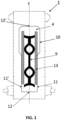
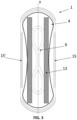
- Absorbent articles (1) described herein, and as exemplified in Figs. 1-4 comprise: a topsheet (2); a backsheet (3); and an absorbent core (4) sandwiched between said topsheet (2) and backsheet (3); said core (4) typically comprises absorbent material (5) that is substantially enclosed by a core wrap (6), wherein said core wrap (6) may comprise a top core wrap layer (7) and a bottom core wrap layer (8), and wherein said top and bottom layers are typically joined together along one or more continuous or discontinuous attachment areas forming one or more channels (9), substantially free of absorbent material, and being positioned inboard of an outer perimeter (10) of said core (4) formed by two opposed lateral edges (11, 11') connecting two opposed transversal ends (12, 12') of said core (4); wherein said article (1) comprises an active composition that is applied in a pattern to one or more layers forming said article (1) within an application zone (13) being inboard of at least a portion of said outer perimeter (10), typically wherein said portion comprises at least one, preferably both,
- Active composition means any composition or formulation that is applied to one or more layers making up the absorbent article and that generally has an effect of improving or reducing odour and/or skin rashes and/or irritations of a wearer.
- the active composition applied in this manner results in the formation of odour "barriers" (in the case of odour control) and/or skin moisturising/soothing at concentrated regions where most needed i.e. between the leg folds (or close thereto) of the wearer that are found to be most prone to sweat and humidity accumulation.
- risk of contamination e.g. by migration of the composition
- risk of contamination e.g. by migration of the composition
- the application zone (13) is outboard of said one or more channels (9) and at a distance therefrom. It has been surprisingly found that this leads to improved channel formation as well as odour barriers limiting odour seepage from the sides of the article.
- top and bottom core wrap layers (7, 8) are preferably joined together by one or more adhesives and/or mechanical bonds.
- adhesives and/or mechanical bonds are preferably joined together by one or more adhesives and/or mechanical bonds.
- the pattern comprises, preferably consists of, one or more stripes or swirls.
- the pattern may comprise, preferably consists of, no more than 3 stripes or swirls, preferably from 1 to 2 stripes or swirls.
- this aids to concentrate the active composition where most needed.
- the stripes or swirls may have a maximum width of at least 10mm, preferably from 15 mm to 55 mm, more preferably from 20 mm to 50 mm, even more preferably from greater than 20 mm to 40 mm, most preferably from 22 mm to 35 mm.
- widths that are below such sizes lead to less than optimal efficacy in terms of targeted barrier/benefits described herein whilst above results in added cost and increased liquid transfer impairment.
- the basis weight of active composition is less than 7 gsm (g/m 2 ), preferably from 1 gsm (g/m 2 ) to 6 gsm (g/m 2 ), more preferably from 2 gsm (g/m 2 ) to 5 gsm (g/m 2 ), even more preferably from 3 gsm (g/m 2 ) to 4 gsm (g/m 2 ).
- the active composition is an odour control formulation such amounts result in effective odour barriers with reduced contamination risk and overpowering sensation whilst containing cost.
- the application zone (13) has a first surface area in a planar view and the absorbent core (4) has a second surface area in said planar view, and wherein the first area is less than 15%, preferably less than 10%, even more preferably from 1% to 4%, of the second surface area.
- this aids to limit liquid transfer hindrance to the core and overall liquid absorption performance of the article.
- the one or more channels (9) have a length (I) along a longitudinal axis (y) that is less than a length (L) of the absorbent core (4) extending along said axis (y) such that the one or more channels (9) do not extend to the perimeter (10) of the core (4).
- this aids to limit risk of undesirable leakage from the edges of the core and article.
- the channels (9) suitable herein may have different shapes and sizes depending on the needs, some non-limiting examples are illustrated in Figs. 1 , 2A and 2B , and 3. It is however understood that any other channel configuration may be suitable.
- the active composition is applied outboard of said one or more channels (9) so that application zone (13) is located between at least one of said one or more channels (13) and at least a portion of the perimeter (10) of said core (4), and preferably not, typically directly, between two of said one or more of said channels (9).
- this allows the central region of the core to remain free of active composition hence aiding breathability and limiting liquid barrier effects in direct contact with the largest surface of the buttocks and rather be concentrated on the region of the leg folds, the latter particularly beneficial for sanitary napkins for light incontinence.
- the active composition may be applied to one or more layers positioned below the topsheet (2) in a thickness-direction being substantially parallel to a z-axis (z) that crosses said topsheet (2), backsheet (3), and absorbent core (4), preferably such that said topsheet (2) is substantially free of said active composition.
- z z-axis
- the active composition may be arranged to migrate from a layer below the topsheet (2) towards a skin/body-facing surface of said topsheet (2).
- the topsheet (2) is apertured to allow said active composition to migrate therethough upon application of pressure.
- the apertures may have a diameter (e.g. maximum dimension and/or extension in case of non-circular apetures/openings) of from 500 ⁇ m to 3800 ⁇ m, preferably from 700 ⁇ m to 3500 ⁇ m, more preferably from 800 ⁇ m to 3000 ⁇ m, even more preferably from 1000 ⁇ m to 2800 ⁇ m, more preferably from 1500 ⁇ m to 2500 ⁇ m.
- the apertures of this range allow for the generally highly viscous material to slowly migrate to the surface for gradual application onto the target locations of the subject's skin.
- the article (1) further comprises a liquid distribution layer (14) positioned between the topsheet (2) and the absorbent core (4), and wherein the active composition is applied to said liquid distribution layer (14) and/or absorbent core (4).
- the liquid distribution layer is a nonwoven layer selected from the group consisting of a spunbond nonwoven, carded nonwoven, spunlace nonwoven, and combinations thereof.
- the basis weight of the liquid distribution layer (14) is preferably from 15 gsm (g/m 2 ) to 45 gsm (g/m 2 ), preferably from 18 gsm (g/m 2 ) to 40 gsm (g/m 2 ), even more preferably from 20 gsm (g/m 2 ) to 38 gsm (g/m 2 ).
- higher basis weights lead to greater barriers to migration of the active material and moreover result in added cost.
- the active composition is selected from a lotion, an odour control formulation, and combinations thereof.
- the active composition is selected from an odour control formulation, preferably said odour control formulation comprising: one or more perfumes; one or more oils, an antibacterial agent or at least one alkali metal or alkaline earth metal chloride; an emollient; an organic acid; one or more cyclodextrins; and/or an organic or inorganic zinc salt.
- said odour control formulation comprising: one or more perfumes; one or more oils, an antibacterial agent or at least one alkali metal or alkaline earth metal chloride; an emollient; an organic acid; one or more cyclodextrins; and/or an organic or inorganic zinc salt.
- Preferred anti-bacterial agents are capable of yielding when starting at a concentration of about 103 CFU/ml. liquid for each type of bacteria (CFU is colony-forming unit) and at a given concentration of the anti-bacterial agent (e.g. 10-3 g/g dry absorbent core) an amount of bacteria after 12 hours of 105 CFU/ml liquid for each type of bacteria or lower, preferably 104-10 and more preferably 103-102.
- concentration of the anti-bacterial agent e.g. 10-3 g/g dry absorbent core
- This can be measured in line with the method "measuring bacteria inhibition in absorbent bodies" as described in WO 00/35505 (page 17, method 3).
- This method evaluates the capacity to suppress the growth of or to kill at least one bacterial strain selected from the species Escherichia coli, Proteus mirabilis and Enterococcus faecalis.
- Anti-bacterial agents for use herein are preferably compounds which are skin-friendly. It needs to be borne in mind that the skin area being in contact with absorbent products such as diaper, panty diaper, sanitary napkin or incontinence device is sensitive and delicate.
- Anti-bacterial agents which are approved for the use in food (e.g. as preservatives) are therefore used with preference (for instance those food preservatives being approved at the priority of the present application in any EC member state or the US or Japan).
- the anti-bacterial agent may be organic or inorganic. It may for instance be selected from the following organic compounds: isothiazolinones and benzisothiazolinones, oxazolidines, pyridines, optionally chlorinated phenols, bromo compounds, aldehyde and dialdehyde compounds, benzyl alcohols, cresols, p-hydroxybenzoic acids and their esters and salts (parabene compounds), organic acids and their salts, in particular alkali metal and earth alkaline metal salts and organic polyacids and their salts, in particular alkali metal and earth alkaline metal salts.
- An anti-bacterial agent belongs to the above classes if it displays (comprises) the corresponding structural features. Accordingly, (further) substituted members such as hydroxylated organic acids are also covered by the above classes.
- the inorganic anti-bacterial agent may be selected from sulfites, bisulfites, nitrates, nitrites and iodates of alkali metals such as sodium and potassium or earth alkaline metals such as calcium or magnesium.
- one of the following compounds or a mixture thereof is used as an anti-bacterial agent:
- the anti-bacterial agent is preferably selected from organic acids and polyacids (e.g. diacids or triacids), and their salts.
- the organic (poly)acid may be substituted by one, two or more hydroxy groups.
- the organic (poly)acid may be an unsaturated (e.g. mono- or diunsaturated) or saturated, linear or branched aliphatic carboxylic acid preferably having from 2 to 18 carbon atoms, more preferably 3 to 8 carbon atoms. Examples thereof were already mentioned in the above list.
- the organic acid may also represent an aromatic (poly)acid, preferably a phenyl(poly)carboxy acid, having preferably from 7 to 18 carbon atoms, in particular 7 to 10 carbon atoms as in benzoic acid, p-hydroxybenzoic acid or salicylic acid.
- the salt is preferably an alkali metal (e.g. K or Na) or earth alkaline metal salt (e.g. Ca or Mg).
- benzoic acid More preferably benzoic acid, sorbic acid, tartaric acid or citric acid, most preferably benzoic acid or citric acid, are used as the anti-bacterial agent herein.
- the alkali metal chloride may be potassium chloride (KCI) or sodium chloride (NaCI) and is preferably NaCl.
- the alkaline earth metal chloride may be magnesium chloride (MgCI2) or calcium chloride (CaCI2).
- the alkali metal chloride or alkaline earth metal chloride, when present, is typically present in an amount of at least 0.01, preferably at least 0.05, more preferably at least 0.1 g per g dry absorbent core.
- organic zinc salt to be used in combination with the component (i).
- zinc salts of organic carboxylic acids having 2 to 30 carbon atoms, in particular 12 to 24 carbon atoms are preferably used.
- the carboxylic acid group may be attached to aliphatic, aliphatic-aromatic, aromatic-aliphatic, alicyclic, or aromatic residues, wherein the aliphatic chain or the alicyclic ring(s) may be unsaturated and are optionally substituted, for instance by hydroxy or C1 to C4 alkyl.
- These salts include zinc acetate, zinc lactate, zinc ricinoleate and zinc abietate.
- the zinc salt is the zinc salt of an unsaturated hydroxylated fatty acid having 8 to 18 carbon atoms.
- an unsaturated hydroxylated fatty acid having 8 to 18 carbon atoms Although there is no specific restriction regarding the number of unsaturated double bonds or hydroxy groups, those fatty acids having one or two unsaturated double bonds and one or two hydroxyl groups seem to be preferred.
- the most preferred embodiment is zinc ricinoleate.
- the organic zinc salt may also be activated by the presence of amino acids as in TEGO ® Sorb available from Degussa.
- the organic zinc salt to be used in the present invention may also be capable of removing malodourous substances chemically based on amines, e.g., nicotine in cigarette smoke, thiocompounds, e.g., allicin in garlic and onions, and acids, e.g., isovaleric acid in human sweat, and butyric acid.
- malodourous substances chemically based on amines, e.g., nicotine in cigarette smoke, thiocompounds, e.g., allicin in garlic and onions, and acids, e.g., isovaleric acid in human sweat, and butyric acid.
- amines e.g., nicotine in cigarette smoke
- thiocompounds e.g., allicin in garlic and onions
- acids e.g., isovaleric acid in human sweat
- butyric acid e.g., zinc ricinoleate which is, e.g., marketed by Degussa
- the anti-bacterial agent is selected from the group consisting of benzoic acid, sorbic acid, tartaric acid and citric acid, or a mixture thereof
- the zinc salt is an organic zinc salt preferably consisting of zinc ricinoleate or an inorganic zinc salt preferably consisting of zinc oxide.
- the amount of anti-bacterial agent or at least one alkali metal or alkaline earth metal chloride and zinc salt to be used herein there are no specific restrictions. In the present specification, these amounts are expressed in relation to the weight (in g) of the dry absorbent core.
- dry used in relation to the absorbent core is to be understood such that no water has been added to the absorbent core and that the only water present in the absorbent core is the unavoidable residual water from manufacturing.
- an absorbent core is preferably regarded as "dry" after a circular test core having a thickness of 5 to 6 mm, a diameter of 5 cm and which has been compressed to a bulk of about 8-10 cm3/g has been kept for at least one week at ambient temperature (e.g. 20° C.) and a specified relative humidity, for example 50% RH.
- the amount of anti-bacterial agent is preferably at least 1 ⁇ 10-4 g, more preferably at least 5 ⁇ 10-4 g, most preferably at least 1 ⁇ 10-3 g per g of dry absorbent core.
- the antibacterial agent can be used in amounts as low as 5 to 10 ppm of antibacterial agent(s) (by weight) in terms of the dry absorbent core.
- the amount of alkali metal chloride or alkaline earth metal chloride, such as sodium chloride is at least 0.01 g, preferably at least 0.05 g, for instance at least 0.1 g per g dry absorbent core.
- the (earth) alkali metal chloride content is no specific upper limit for the (earth) alkali metal chloride content, although it may no longer be beneficial to increase the amount beyond values such as 0.5 g per g absorbent core or 1 g per g absorbent core.
- the weight ratio of the anti-bacterial agent, alkali metal chloride or alkaline earth metal chloride, and the zinc salt is also not specifically limited, but it is preferably 15/1 to 1/5, more preferably 5/1 to 1/2, for instance 3/1 to 1/1.
- the emollients for use herein are selected from the group consisting of stearyl alcohol, petrolatum, and mixtures thereof.
- the absorbent material (5) comprises superabsorbent polymer particles and/or cellulose fibers.
- the article (1) herein may be disposable and selected from the group consisting of diapers, pants, briefs, pantyliners, slips, sanitary napkins and towels, and combinations thereof, preferably sanitary napkins for light incontinence.
- the article (1) herein may further comprise oppositely disposed lateral cuffs (15, 15') that generally act as longitudinal barriers to liquid leakage.
- the cuffs typically comprise a hydrophobic nonwoven layer and one or more elastics proximal to an apex thereof to form stand-up gathers.
- each cuff may comprise from 1 to 4 elastic strands.
- the absorbent article may also comprise other typical components such as a back elastic waist feature, a front elastic waist feature, transverse barrier cuffs, a wetness indicator that changes colour when contacted with urine, etc.
- the absorbent article is a sanitary napkin preferably for use in light incontinence (or by continent women).
- the backsheet (3) is substantially liquid impermeable and comprises one or more adhesive stripes on a garment-facing side thereof such to provide a means of attachment to a wearer's undergarment such as underwear or slips.
- the one or more adhesive stripes may be covered by a paper, preferably siliconized, release strip to maintain the adhesive properties until intended use.
- a method for the manufacture of absorbent articles herein comprises the steps of: providing a first web of material, preferably a liquid permeable nonwoven; depositing absorbent material onto said first web such that one or more areas of said first web material remain substantially void of absorbent material, said one or more areas corresponding to one or more attachment areas; providing a second web of material, preferably a liquid permeable nonwoven, and applying said second web of material over the deposited absorbent material, or folding said first web to enclose the deposited absorbent material therein; joining the first and second webs together, or the folded first web, at the one or more attachment areas to form an absorbent core having one or more channels substantially free of absorbent material substantially flanked by absorbent material; optionally applying an acquisition distribution layer; optionally sandwiching the absorbent core, and preferably the acquisition distribution layer, between a liquid permeable layer and a substantially liquid impermeable layer oppositely disposed, preferably with the acquisition distribution layer being in contact with the liquid permeable layer; wherein an active composition is applied, preferably
- the method for making an absorbent article comprising the steps of:
- first and second distinct positions are the same or different, and wherein said first and/or second distinct positions comprise one or more bonding points positioned inboard of the perimeter of the absorbent core (4), and preferably wherein said bonding points have an aspect ratio of less than 3, preferably of from 1 to 2, and more preferably having a shape selected from the group consisting of circular, elliptical, line-form, star-shaped, polygonal, and combinations thereof, and preferably wherein said bonding points comprise mechanical bonds.
- the method further comprises the step of locally removing the absorbent material applied on said bottom and/or intermediate layers, preferably by a mechanical removal means preferably comprising one or more roller brush or air blower.
- the method further comprises the step of applying a first adhesive pattern on a surface of the intermediate layer facing the first absorbent material; and applying an second adhesive pattern on a surface of the top layer facing the second absorbent material, preferably wherein the first and second patterns are substantially the same or different.
- the joining step(s) comprises the step of applying a pressure and/or adhering force to join the first, second, and/or third sheet materials respectively, substantially concurrently with a suction force within the at least one suction zone typically such to combine a downward push with a substantially simultaneous downward pull wherein downward is the direction from the position at which pressure is applied to or towards the supporting member.
- This is typically achieved by ensuring that the attachment unit(s) herein is/are disposed such to superpose a vacuum region (V) within the support unit (typically in the form of a rotating drum).
- V vacuum region
- this allows to attain good and strong adhesion without having to apply excessive pressures with the use of e.g. pressure rollers (or embossing rollers) that may inadvertently damage sections of the absorbent core.
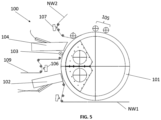
- the apparatus (100) used to make absorbent articles according to embodiments herein comprises:
- At least the first application unit (102) (but preferably all the application units described herein) comprises a blowing means (such as an air stream source) to direct the absorbent material onto the bottom layer/first sheet material and/or the intermediate layer/second sheet material, and is preferably a non-contact application unit in that it is free of a rotatable laying-out roller comprising a plurality of pockets for applying a spread of absorbent material (also conventionally known or referred to as absorbent material printing).
- a blowing means such as an air stream source
- the absorbent material comprises cellulose fibers it is desirable to apply such absorbent material via a non-contact application in order to achieve good mixing and spacing apart of the superabsorbent polymer particles between cellulose fibers and limit agglomeration of said particles, this allowing to achieve cores with better liquid distribution properties along and across its surface.
- the supporting member (101) is a rotating drum and the at least one non-suction zone comprises at least one elongate zone extending in a circumferential direction of the rotating drum, preferably a plurality of said non-suction zones are comprised in said pocket.
- the at least one non-suction zone is formed by at least one element being substantially planar with an outer surface of the rotating drum; and wherein the at least one suction zone is formed by at least one cavity comprising a substantially porous base that is positioned at a first radial distance from the center of said rotating drum being less than a second radial distance of said outer surface from said center.
- the apparatus further comprises a removing unit comprising a mechanical removal means configured for locally removing the absorbent material applied on said first and/or second sheet material above the at least one non-suction zone.
- a mechanical removal means comprises one or more roller brush or air blower.
- the first sheet feed unit is positioned between the first application unit and the second application unit, and typically upstream of the first attachment unit (103) along a machine direction (MD).
- MD machine direction
- the apparatus further comprises a first adhesive unit (106) arranged to apply an adhesive pattern on a surface of the second sheet material facing the first absorbent material; and a second adhesive unit (107) arranged to apply an adhesive pattern on a surface of the third sheet material facing the second absorbent material; said first and second adhesive units being positioned upstream of said first and second attachment units (103, 105) respectively.
- the apparatus may further comprise a further adhesive unit arranged to apply an adhesive pattern on a surface of the first sheet material facing the first absorbent material.
- the first and second attachment units comprise a pressure means, such as a pressure roller (typically having a substantially smooth contact surface generally such that it is free of protrusions pressing into the channel forming areas so as to limit the need for process registration), arranged to provide an adhering force to join the first, second, and third sheet materials respectively; and preferably wherein the first attachment unit comprises a single pressure means, and the second attachment unit comprises a plurality, preferably from 2 to 5, of pressure means.
- a pressure means such as a pressure roller (typically having a substantially smooth contact surface generally such that it is free of protrusions pressing into the channel forming areas so as to limit the need for process registration), arranged to provide an adhering force to join the first, second, and third sheet materials respectively; and preferably wherein the first attachment unit comprises a single pressure means, and the second attachment unit comprises a plurality, preferably from 2 to 5, of pressure means.
- the first attachment unit is positioned between the first application unit and the second application unit, and downstream of the first sheet feed unit, typically along a machine direction (MD).
- MD machine direction
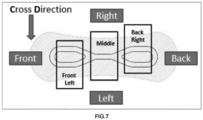
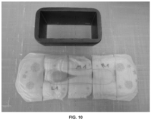
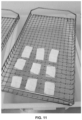
- Each napkin resembles the schematic embodiment of Fig.3 including channel(s) as described and shown with the same construction and adhesive type and amount for joining top and bottom core wrap layers to form the channel(s), and contains the same amount in gsm of an identical odour control (OC) formulation that is applied as follows: REFERENCE 1 [7 samples with odour control formulation applied to the top core wrap over substantially the full surface including the channel(s)]; SAMPLE A [7 samples with odour control formulation applied to the top core wrap inboard of the channel(s)]; SAMPLE B [7 samples with odour control formulation applied to the top core wrap ouboard of the channel(s)]; CONTROL [7 samples without odour control formulation].
- OC odour control
- Sample A and B achieve almost equivalent bonding strength as the Control sample. With Sample B even showing exceptional performance compared to sample A itself.
Landscapes
- Health & Medical Sciences (AREA)
- Epidemiology (AREA)
- Engineering & Computer Science (AREA)
- Biomedical Technology (AREA)
- Heart & Thoracic Surgery (AREA)
- Vascular Medicine (AREA)
- Life Sciences & Earth Sciences (AREA)
- Animal Behavior & Ethology (AREA)
- General Health & Medical Sciences (AREA)
- Public Health (AREA)
- Veterinary Medicine (AREA)
- Absorbent Articles And Supports Therefor (AREA)
Priority Applications (2)
| Application Number | Priority Date | Filing Date | Title |
|---|---|---|---|
| EP22173782.8A EP4279043A1 (de) | 2022-05-17 | 2022-05-17 | Absorbierender artikel mit gemustertem aktivem material |
| PCT/EP2023/063202 WO2023222737A1 (en) | 2022-05-17 | 2023-05-17 | Absorbent article with patterned active material |
Applications Claiming Priority (1)
| Application Number | Priority Date | Filing Date | Title |
|---|---|---|---|
| EP22173782.8A EP4279043A1 (de) | 2022-05-17 | 2022-05-17 | Absorbierender artikel mit gemustertem aktivem material |
Publications (1)
| Publication Number | Publication Date |
|---|---|
| EP4279043A1 true EP4279043A1 (de) | 2023-11-22 |
Family
ID=81748483
Family Applications (1)
| Application Number | Title | Priority Date | Filing Date |
|---|---|---|---|
| EP22173782.8A Pending EP4279043A1 (de) | 2022-05-17 | 2022-05-17 | Absorbierender artikel mit gemustertem aktivem material |
Country Status (2)
| Country | Link |
|---|---|
| EP (1) | EP4279043A1 (de) |
| WO (1) | WO2023222737A1 (de) |
Citations (5)
| Publication number | Priority date | Publication date | Assignee | Title |
|---|---|---|---|---|
| WO2000035505A1 (en) | 1998-12-16 | 2000-06-22 | Sca Hygiene Products Ab | An absorbent structure in an absorbent article, comprising a partially neutralised superabsorbent material, and an absorbent article that comprises the absorbent structure |
| WO2009082309A1 (en) * | 2007-12-21 | 2009-07-02 | Sca Hygiene Products Ab | Absorbent article with ventilated topsheet |
| WO2014074038A1 (en) * | 2012-11-12 | 2014-05-15 | Sca Hygiene Products Ab | Odor control material prepared by extrusion comprising particles encapsulated in a polymeric matrix |
| EP3342386A1 (de) | 2016-12-27 | 2018-07-04 | Ontex BVBA | Saugfähiger kern, artikel mit besagtem kern und verfahren zur herstellung |
| US20190000687A1 (en) * | 2017-06-30 | 2019-01-03 | The Procter & Gamble Company | Absorbent article with a lotioned topsheet |
Family Cites Families (6)
| Publication number | Priority date | Publication date | Assignee | Title |
|---|---|---|---|---|
| US4681793A (en) | 1985-05-31 | 1987-07-21 | The Procter & Gamble Company | Non-occluding, liquid-impervious, composite backsheet for absorptive devices |
| EP0657502A1 (de) | 1993-12-13 | 1995-06-14 | Du Pont De Nemours International S.A. | Kompatibilisierungsmittel enthaltende thermoplastische Zusammensetzung |
| US5571096A (en) | 1995-09-19 | 1996-11-05 | The Procter & Gamble Company | Absorbent article having breathable side panels |
| US5865823A (en) | 1996-11-06 | 1999-02-02 | The Procter & Gamble Company | Absorbent article having a breathable, fluid impervious backsheet |
| US5938648A (en) | 1997-12-03 | 1999-08-17 | The Procter & Gamble Co. | Absorbent articles exhibiting improved internal environmental conditions |
| US6946585B2 (en) | 2000-10-23 | 2005-09-20 | Mcneil-Ppc, Inc. | Absorbent article |
-
2022
- 2022-05-17 EP EP22173782.8A patent/EP4279043A1/de active Pending
-
2023
- 2023-05-17 WO PCT/EP2023/063202 patent/WO2023222737A1/en not_active Ceased
Patent Citations (8)
| Publication number | Priority date | Publication date | Assignee | Title |
|---|---|---|---|---|
| WO2000035505A1 (en) | 1998-12-16 | 2000-06-22 | Sca Hygiene Products Ab | An absorbent structure in an absorbent article, comprising a partially neutralised superabsorbent material, and an absorbent article that comprises the absorbent structure |
| WO2009082309A1 (en) * | 2007-12-21 | 2009-07-02 | Sca Hygiene Products Ab | Absorbent article with ventilated topsheet |
| WO2014074038A1 (en) * | 2012-11-12 | 2014-05-15 | Sca Hygiene Products Ab | Odor control material prepared by extrusion comprising particles encapsulated in a polymeric matrix |
| EP3342386A1 (de) | 2016-12-27 | 2018-07-04 | Ontex BVBA | Saugfähiger kern, artikel mit besagtem kern und verfahren zur herstellung |
| EP3542766A1 (de) | 2016-12-27 | 2019-09-25 | Ontex BVBA | Saugfähiger kern, artikel mit besagtem kern und verfahren zur herstellung |
| EP3692963A1 (de) | 2016-12-27 | 2020-08-12 | Ontex BVBA | Saugfähiger kern, artikel mit besagtem kern und verfahren zur herstellung |
| EP3738562A1 (de) | 2016-12-27 | 2020-11-18 | Ontex BV | Saugfähiger kern, artikel mit besagtem kern und verfahren zur herstellung |
| US20190000687A1 (en) * | 2017-06-30 | 2019-01-03 | The Procter & Gamble Company | Absorbent article with a lotioned topsheet |
Also Published As
| Publication number | Publication date |
|---|---|
| WO2023222737A1 (en) | 2023-11-23 |
Similar Documents
| Publication | Publication Date | Title |
|---|---|---|
| US8476483B2 (en) | Antibacterial sheet and absorbent article | |
| AU2016421117B2 (en) | Diaper with transverse barriers | |
| US20240058181A1 (en) | Absorbent article with partially enclosed waist containment member and method of manufacturing thereof | |
| EP1782783B1 (de) | Saugfähiges material | |
| JP5150159B2 (ja) | 使い捨ておむつ | |
| WO2005110504A1 (en) | Personal care products and methods for inhibiting the adherence of flora to skin | |
| EP2616106A1 (de) | Antimikrobielle saugfähige einwegartikel | |
| MX2011002944A (es) | Articulos absorbentes que tienen propiedades antimicrobianas y metodos de manufactura de los mismos. | |
| JP2008522772A (ja) | 吸収性物品のトップシート上に対するローションの不連続的適用 | |
| JP2014158509A (ja) | 吸収性物品 | |
| EP3515387B1 (de) | Saugfähiger artikel mit ph-gesteuerter deckschicht | |
| EP3634349B1 (de) | Saugfähiger artikel mit haut-ph-wert-anpassungseffekt | |
| JP2009505707A (ja) | 濃縮タンニンを含む吸収性製品 | |
| EP3267959A1 (de) | Hygieneartikel mit zusammensetzung zur kontrolle des ph-werts und verfahren zu dessen herstellung | |
| US20260138353A1 (en) | Absorbent article with patterned active material | |
| JP4537237B2 (ja) | 吸収性物品の吸収体の製造方法 | |
| WO2023222737A1 (en) | Absorbent article with patterned active material | |
| JP2006263074A5 (de) | ||
| JP5465823B2 (ja) | 機能性シートおよび吸収性物品 | |
| JP7194038B2 (ja) | 吸収性物品の製造方法 | |
| JP7194037B2 (ja) | 吸収性物品の製造方法 | |
| JP4790281B2 (ja) | 吸収性物品 | |
| JP5486655B2 (ja) | 使い捨ておむつ | |
| MXPA01010975A (es) | Articulo absorbente que comprende una hoja superior con poco tensioactivo o sin tensioactivo sintetico. | |
| EP4450034A1 (de) | Verbesserte saugfähige artikel und herstellungsverfahren |
Legal Events
| Date | Code | Title | Description |
|---|---|---|---|
| PUAI | Public reference made under article 153(3) epc to a published international application that has entered the european phase |
Free format text: ORIGINAL CODE: 0009012 |
|
| STAA | Information on the status of an ep patent application or granted ep patent |
Free format text: STATUS: THE APPLICATION HAS BEEN PUBLISHED |
|
| AK | Designated contracting states |
Kind code of ref document: A1 Designated state(s): AL AT BE BG CH CY CZ DE DK EE ES FI FR GB GR HR HU IE IS IT LI LT LU LV MC MK MT NL NO PL PT RO RS SE SI SK SM TR |
|
| STAA | Information on the status of an ep patent application or granted ep patent |
Free format text: STATUS: REQUEST FOR EXAMINATION WAS MADE |
|
| 17P | Request for examination filed |
Effective date: 20240329 |
|
| RBV | Designated contracting states (corrected) |
Designated state(s): AL AT BE BG CH CY CZ DE DK EE ES FI FR GB GR HR HU IE IS IT LI LT LU LV MC MK MT NL NO PL PT RO RS SE SI SK SM TR |
|
| STAA | Information on the status of an ep patent application or granted ep patent |
Free format text: STATUS: EXAMINATION IS IN PROGRESS |
|
| 17Q | First examination report despatched |
Effective date: 20250502 |