EP4280107A1 - Datenverarbeitungsverfahren und -vorrichtung, vorrichtung und medium - Google Patents
Datenverarbeitungsverfahren und -vorrichtung, vorrichtung und medium Download PDFInfo
- Publication number
- EP4280107A1 EP4280107A1 EP21927108.7A EP21927108A EP4280107A1 EP 4280107 A1 EP4280107 A1 EP 4280107A1 EP 21927108 A EP21927108 A EP 21927108A EP 4280107 A1 EP4280107 A1 EP 4280107A1
- Authority
- EP
- European Patent Office
- Prior art keywords
- tensor
- computation
- target
- tensors
- splitting
- Prior art date
- Legal status (The legal status is an assumption and is not a legal conclusion. Google has not performed a legal analysis and makes no representation as to the accuracy of the status listed.)
- Pending
Links
Images








Classifications
-
- G—PHYSICS
- G06—COMPUTING OR CALCULATING; COUNTING
- G06F—ELECTRIC DIGITAL DATA PROCESSING
- G06F16/00—Information retrieval; Database structures therefor; File system structures therefor
- G06F16/20—Information retrieval; Database structures therefor; File system structures therefor of structured data, e.g. relational data
- G06F16/24—Querying
- G06F16/245—Query processing
- G06F16/24569—Query processing with adaptation to specific hardware, e.g. adapted for using GPUs or SSDs
-
- G—PHYSICS
- G06—COMPUTING OR CALCULATING; COUNTING
- G06F—ELECTRIC DIGITAL DATA PROCESSING
- G06F17/00—Digital computing or data processing equipment or methods, specially adapted for specific functions
- G06F17/10—Complex mathematical operations
- G06F17/16—Matrix or vector computation, e.g. matrix-matrix or matrix-vector multiplication, matrix factorization
-
- G—PHYSICS
- G06—COMPUTING OR CALCULATING; COUNTING
- G06F—ELECTRIC DIGITAL DATA PROCESSING
- G06F16/00—Information retrieval; Database structures therefor; File system structures therefor
- G06F16/90—Details of database functions independent of the retrieved data types
- G06F16/901—Indexing; Data structures therefor; Storage structures
- G06F16/9024—Graphs; Linked lists
-
- G—PHYSICS
- G06—COMPUTING OR CALCULATING; COUNTING
- G06N—COMPUTING ARRANGEMENTS BASED ON SPECIFIC COMPUTATIONAL MODELS
- G06N3/00—Computing arrangements based on biological models
- G06N3/02—Neural networks
- G06N3/04—Architecture, e.g. interconnection topology
- G06N3/042—Knowledge-based neural networks; Logical representations of neural networks
-
- G—PHYSICS
- G06—COMPUTING OR CALCULATING; COUNTING
- G06N—COMPUTING ARRANGEMENTS BASED ON SPECIFIC COMPUTATIONAL MODELS
- G06N3/00—Computing arrangements based on biological models
- G06N3/02—Neural networks
- G06N3/04—Architecture, e.g. interconnection topology
- G06N3/0464—Convolutional networks [CNN, ConvNet]
-
- G—PHYSICS
- G06—COMPUTING OR CALCULATING; COUNTING
- G06N—COMPUTING ARRANGEMENTS BASED ON SPECIFIC COMPUTATIONAL MODELS
- G06N3/00—Computing arrangements based on biological models
- G06N3/02—Neural networks
- G06N3/08—Learning methods
- G06N3/092—Reinforcement learning
-
- G—PHYSICS
- G06—COMPUTING OR CALCULATING; COUNTING
- G06N—COMPUTING ARRANGEMENTS BASED ON SPECIFIC COMPUTATIONAL MODELS
- G06N3/00—Computing arrangements based on biological models
- G06N3/12—Computing arrangements based on biological models using genetic models
- G06N3/126—Evolutionary algorithms, e.g. genetic algorithms or genetic programming
-
- G—PHYSICS
- G06—COMPUTING OR CALCULATING; COUNTING
- G06N—COMPUTING ARRANGEMENTS BASED ON SPECIFIC COMPUTATIONAL MODELS
- G06N3/00—Computing arrangements based on biological models
- G06N3/02—Neural networks
- G06N3/04—Architecture, e.g. interconnection topology
- G06N3/044—Recurrent networks, e.g. Hopfield networks
- G06N3/0442—Recurrent networks, e.g. Hopfield networks characterised by memory or gating, e.g. long short-term memory [LSTM] or gated recurrent units [GRU]
-
- G—PHYSICS
- G06—COMPUTING OR CALCULATING; COUNTING
- G06N—COMPUTING ARRANGEMENTS BASED ON SPECIFIC COMPUTATIONAL MODELS
- G06N3/00—Computing arrangements based on biological models
- G06N3/02—Neural networks
- G06N3/06—Physical realisation, i.e. hardware implementation of neural networks, neurons or parts of neurons
- G06N3/063—Physical realisation, i.e. hardware implementation of neural networks, neurons or parts of neurons using electronic means
Definitions
- This application relates to the field of artificial intelligence, and in particular, to a data processing method, an apparatus, a device, and a medium.
- a neural network compiler considers a neural network (neural network, NN) model as a computation graph.
- graph compilation is performed, graph topology is analyzed, and computing nodes are converted into tasks on different computing engines, to determine a computation order and form an actual computation stream (stream).
- operator compilation is performed to generate computation task code that can be run on an accelerator SoC.
- many optimization and processing passes (passes) in graph optimization and operator optimization are involved. Most important optimization is how to efficiently use a system-on-chip high-speed cache & buffer (Cache & Buffer) to reduce data access overheads, and reduce a bandwidth limit of external storage access, thereby improving efficiency of data loading and data pipeline computation.
- cache & Buffer cache & buffer
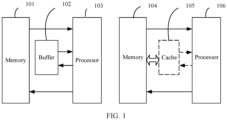
- FIG. 1 is a diagram of an architecture in which a high-speed cache & buffer run on an SoC.
- a memory DDR 101 sends data to a processor Engine 103 for computation, and the Engine 103 buffers intermediate data in a Buffer 102 in a computation process, thereby implementing buffering of the intermediate data.
- a Cache 105 is a part of an Engine 106.
- the Engine 106 exchanges with a DDR104, and the Engine 106 determines caching of intermediate data in the Cache 105.
- Embodiments of this application provide a data processing method, an apparatus, a device, and a medium, to reduce an intermediate data volume in processing a neural network model, reduce a frequency of data exchange between cache & buffer and external storage, thereby avoiding a cache & buffer overflow.
- an embodiment of this application provides a data processing method, including: splitting a first tensor into at least two first sub-tensors, where the first tensor is a to-be-processed multi-dimensional tensor; determining a target computation order of the at least two first sub-tensors, where the target computation order is a processing order of the at least two first sub-tensors; and processing the at least two first sub-tensors based on the target computation order.
- the first tensor is split into the at least two first sub-tensors, so that a data volume of a first sub-tensor that needs to be processed each time is reduced, and intermediate data is also reduced accordingly.
- the splitting a first tensor into at least two first sub-tensors includes: inputting the first tensor into a left-hand matrix; splitting the first tensor into N parts along an axis of the left-hand matrix, where N is a positive integer greater than or equal to 2; inputting the first tensor into a right-hand matrix; splitting the first tensor into M parts along an axis of the right-hand matrix, where M is a positive integer greater than or equal to 2; and performing tensor concatenation aggregation on the N parts of the split first tensor and the M parts of the split first tensor to obtain a split first tensor, where the split first tensor includes the at least two first sub-tensors.
- the split first tensor includes the at least two first sub-tensors.
- Tensor concatenation aggregation needs to be performed on data slices obtained through splitting along the left-hand matrix and data slices obtained through splitting along the right-hand matrix on two different axes when tensors are output, to obtain a plurality of split first sub-tensors.
- the plurality of first sub-tensors are concatenated to form the first tensor. In this way, operator splitting is implemented in the foregoing manner.
- the splitting a first tensor into at least two first sub-tensors includes: splitting the first tensor along an axis of the first tensor; and performing tensor reduction aggregation on the split first tensor to obtain a split first tensor, where the split first tensor includes the at least two first sub-tensors.
- the split first tensor includes the at least two first sub-tensors. Two first tensors that are split along a same axis are aggregated, so that operator splitting is implemented, and an obtained split tensor includes at least two first sub-tensors.
- the method further includes: obtaining all splitting manners of the first tensor; obtaining all split aggregation streams of the first tensor in a depth direction of a computation graph based on a mapping relationship, where the mapping relationship is a relationship between slices of the split first tensor, and each different splitting manner corresponds to one split aggregation stream; and determining a splitting manner corresponding to a split aggregation stream with a longest transmission distance of the mapping relationship as a target splitting manner; and the splitting a first tensor into at least two first sub-tensors includes: splitting the first tensor into the at least two first sub-tensors in the target splitting manner.
- the split aggregation stream corresponding to each splitting manner has a different transmission distance in the depth direction of the computation graph, and the splitting manner corresponding to the aggregation stream with the longest transmission distance is determined as the target splitting manner.
- a splitting method corresponding to the splitting manner can enable an operator of the first tensor to be transmitted farther in the depth direction after splitting, to minimize a processing volume of intermediate data and maximize cache & buffer benefit.
- the method further includes: obtaining training tensors, where the training tensors and the first tensor are different tensors; determining a plurality of different computation policies based on the training tensors, where the computation policy includes a splitting quantity of the training tensor and a computation order; and generating a target policy model through training based on the different computation policies, where the target policy model includes feedback time of a same training tensor corresponding to a case in which the different computation policies are executed.
- the target policy model is obtained based on the training tensors in a reinforcement learning manner, and the target policy model includes the feedback time of the same training tensor when the different computation policies are executed.
- the feedback time of the same training tensor when the different computation policies are executed can be obtained based on the target policy model, so that an optimal computation policy can be determined based on the target policy model when a new tensor is obtained.
- the method further includes: using, in each of a plurality of rounds of iterations, a target training tensor as fixed input that is input into the target policy model, where the target training tensor and the first tensor are different tensors; and optimizing the target policy model based on results output by the target policy model in the plurality of rounds of iterations.
- a policy model can be quickly obtained based on a training set, so that a long process of an evolutionary algorithm is not required, thereby improving computation efficiency.
- the generating a target policy model through training based on the different computation policies includes: encoding the different computation policies as gene sequences; performing iterative verification on a gene sequence of each individual by using each computation policy as an individual; and obtaining a converged optimal solution in iteration results as a computation policy in the target policy model.
- each computation policy is used as an individual, and is sampled as on-board data.
- a new individual (a computation policy) generated in each iteration is for on-board verification or is input into a simulator for verification, and a direction of population evolution is adjusted based on a feedback result to eventually converge an optimal solution through continuous iterations.
- the encoding the different computation policies as gene sequences includes: encoding the computation policy in the optimized target policy model as the gene sequence.
- a policy model obtained through a reinforcement learning algorithm is used as an initial gene sequence of an evolutionary algorithm, so that an initial point of the evolutionary algorithm has already been an ideal policy model.
- This improves a performance lower limit of the evolutionary algorithm.
- performance of a first policy model generated by the evolutionary algorithm in a subsequent working process is not lower than performance of the initial policy model.
- An initial sample of the iteration method is a policy model computed by the reinforcement algorithm. Therefore, initial point selection should be better, so that the evolutionary algorithm can obtain an optimal solution in a quicker and better manner, and the computation efficiency is greatly improved.
- the method further includes: inputting the target policy model into a simulator; and obtaining a feedback result output after the simulator performs data simulation on the target policy model, where the feedback result indicates performance of the target policy model; or inputting the target policy model into a performance predictor; and obtaining a prediction result output by the performance predictor, where the prediction result is for predicting performance of the target policy model.
- the simulator or the performance predictor may predict feedback time based on a preset method, replace actual on-board verification through prediction of the performance predictor, and feed back performance data through a prediction method, to improve the computation efficiency.
- the method further includes: adding the target policy model to a policy knowledge library; and the determining a target computation order of the at least two first sub-tensors includes: obtaining the target policy model from the policy knowledge library; and obtaining a target computation policy based on the target policy model, where the target computation policy includes a splitting quantity of the first tensor and the target computation order.
- a policy search algorithm inputs the obtained model into the policy knowledge library, so that in a subsequent working process, whenever a new tensor is input, a corresponding computation policy can be directly queried from the policy knowledge library, to determine a splitting quantity of a current vector. This does not require re-execution of the evolutionary algorithm, and shortens time for determining a splitting quantity of each tensor data, thereby improving the computation efficiency.
- an embodiment of this application provides a data processing apparatus, including:
- the splitting unit is further configured to:
- the splitting unit is further configured to:
- the apparatus further includes a determining unit, configured to:
- the splitting unit is further configured to: split the first tensor into the at least two first sub-tensors in the target splitting manner.
- the apparatus further includes a training unit, configured to:
- the training unit is further configured to:
- the training unit is further configured to:
- the training unit is further configured to: encode the computation policy in the optimized target policy model as the gene sequence.
- the training unit is further configured to:
- the training unit is further configured to:
- an embodiment of this application provides a computer device, including a processor and a memory.
- the processor When running computer instructions stored in the memory, the processor performs the method according to the first aspect or any one of the possible implementations of the first aspect.
- an embodiment of this application provides a computer-readable storage medium, including instructions.
- the instructions When the instructions are run on a computer, the computer is enabled to perform the method according to the first aspect or any one of the possible implementations of the first aspect.
- a neural network compiler considers a neural network (neural network, NN) model as a computation graph.
- graph compilation is performed, graph topology is analyzed, and computing nodes are converted into tasks on different computing engines, to determine a computation order and form an actual computation stream (stream).
- operator compilation is performed to generate computation task code that can be run on an accelerator SoC.
- many optimization and processing passes (passes) in graph optimization and operator optimization are involved. Most important optimization is how to efficiently use system-on-chip high-speed cache & buffer (Cache & Buffer) to reduce data access overheads, and reduce a bandwidth limit of external storage access, thereby improving efficiency of data loading and data pipeline computation.
- cache & Buffer cache & buffer
- a large data volume is computed by an operator in a neural network, and a data throughput of a task usually reaches dozens of MB or even more than one GB.
- capacities of the SoC cache & buffer are limited. Therefore, cache & buffer failure caused by a cache miss or a buffer overflow often occurs.
- FIG. 2 is a schematic diagram of using a common graph fusion and splitting technology.
- each block in FIG. 2 represents a splitting sub-graph (group).
- an upper layer of each block represents an output layer
- a lower layer represents an input layer
- a middle layer represents a sub-graph. Then, input layers and output layers that are kept (keep) in a buffer and input layers and output layers that are dropped (drop) are determined.
- the technology only performs grouping in the depth direction of the computation graph, then determines whether the input layers and the output layers are kept in high-speed cache & buffer based on a data volume (tensor shape) computed by a node, and does not perform splitting on a tensor layer. Once the data volume is large and cannot be cached/buffered, the manner becomes invalid.
- the method also controls an execution order of branch structures to a certain extent. However, because there is no graph operation such as tensor splitting and node replication, the branch structures are simple, and a computation order is not entirely controlled.
- a cache-aware kernel tiling (Cache-Aware Kernel Tiling) method is also used to perform data splitting.
- the method is a graph splitting optimization technology based on a GPU L2 cache.
- Tensor (tensor) data of an operator is split to reduce a cache miss.
- the method only optimizes the L2 cache of a GPU platform, a splitting quantity in a fusion depth is necessarily the same, and fusion of different splitting quantities is not supported.
- an embodiment of this application provides a data processing method.
- a tensor is split, to improve a data reuse rate of a high-speed cache & buffer, increase a computation data throughput, and reduce a frequency of data exchange between the cache & buffer and external storage.
- a data processing method provided in an embodiment of this application includes the following steps.
- the first tensor is a to-be-processed multi-dimensional tensor.
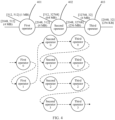
- FIG. 4 is a schematic diagram of a possible implementation of a first tensor.
- the first tensor may include three Matmul operators: a first operator 401, a second operator 402, and a third operator 403. Slices obtained by splitting each operator are the first sub-tensors. It can be seen from FIG. 4 that, the first operator 401 is split into two parts: Matmul0 and Matmul1. The second operator 402 is split into four parts: Matmul0 to Matmul3. The third operator 403 is split into four parts: Matmul0 to Matmul3.
- the first tensor is split into the at least two first sub-tensors, so that a data volume of a first sub-tensor that needs to be processed by a processor Engine each time is reduced, and intermediate data is also reduced accordingly.
- the first tensor may be split in the following two manners: 1. Tensor concatenation concat splitting. 2. Tensor reduction reduce splitting. For convenience of understanding, the two splitting manners are described in detail below.
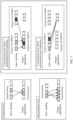
- the splitting of the first tensor through the concat splitting may be specifically implemented in the following manner.
- the first tensor is a matrix-multiplication Matmul operator.
- N is a positive integer greater than or equal to 2
- the first tensor is split along the axis of the left-hand matrix, to implement the step of tensor splitting.
- a first tensor 501 may be split into two parts along an M axis of the left-hand matrix.
- the first tensor is input into the right-hand matrix, to obtain the first tensor in the right-hand matrix.
- M is a positive integer greater than or equal to 2
- the first tensor is split along the axis of the right-hand matrix, to implement the step of tensor splitting.
- a first tensor 502 may be split into three parts along an N axis of the right-hand matrix.
- the split first tensor includes the at least two first sub-tensors.
- tensor concat aggregation needs to be performed on data slices (2 parts) obtained through splitting along the left-hand matrix and data slices (3 parts) obtained through splitting split along the right-hand matrix on a 0-axis and a 1-axis when tensors tensor are output, to obtain 6 split first sub-tensors.
- the 6 first sub-tensors are concatenated to form a first tensor 503. In this way, the concat splitting manner of the Matmul operator is implemented in the foregoing manner.
- the tensor reduction reduce splitting.
- the splitting of the first tensor through the reduce splitting may be specifically implemented in the following manner.
- a first tensor 601 is split along an axis of the first tensor.
- the first tensor is split along a K-axis, and a computation result of each slice is merely a partial result.
- the split first tensor includes the at least two first sub-tensors.
- reduce aggregation is performed on two first tensors 601 split along the K-axis, to implement the reduce splitting manner of a Matmul operator.
- An obtained split tensor 602 includes the at least two first sub-tensors.
- FIG. 7 is a diagram of a mapping relationship obtained after operator splitting. As shown in FIG. 7 , for concat splitting, an axis of an input tensor is split, and a computation result may be restored through a corresponding axis of an output tensor through concat aggregation.
- an axis of an input tensor is split, and a computation result may be restored through a corresponding axis of an output tensor through reduce aggregation.
- both the concat splitting manner and the reduce splitting manner may be used.
- the following method is required to determine a most appropriate splitting manner. Specifically, the following steps are included.
- the first tensor may include a plurality of operators.
- the first tensor includes three operators.
- Different splitting manners may be respectively used for splitting all operators. Therefore, all the splitting manners of the first tensor include all permutations and combinations in which the different splitting manners are respectively used for the operators.
- the mapping relationship is a relationship between slices of the split first tensor, and each different splitting manner corresponds to one split aggregation stream.
- FIG. 8 shows a split aggregation stream in a depth direction of a computation graph, and records a mapping relationship among an operator A 801, an operator B 802, and an operator C 803 of the split first tensor.
- a first slice and a third slice that are input by the operator A 801 have a mapping relationship with a first slice and a third slice that are output by the operator A 801
- the first slice and the third slice that are output by the operator A 801 further have a mapping relationship with a first slice and a third slice of the operator B 802.
- split aggregation streams of the slices in the depth direction extend a distance of one operator through the mapping relationships.
- the split aggregation stream corresponding to each splitting manner has a different transmission distance in the depth direction of the computation graph, and the splitting manner corresponding to the aggregation stream with the longest transmission distance is determined as the target splitting manner.
- a splitting method corresponding to the splitting manner can enable an operator of the first tensor to be transmitted farther in the depth direction after splitting, to minimize a processing volume of intermediate data and maximize cache & buffer benefit.
- the first tensor is split into the at least two first sub-tensors based on the target splitting manner determined in the foregoing manner, so that the first tensor is split, and operators between the obtained sub-tensors are transmitted farther in the depth direction after splitting.
- the first tensor is split in two manners: the concat splitting and the reduce splitting, so that more diversified splitting manners are provided for a multi-dimensional vector.
- an optimized splitting manner of the first tensor is determined through a transmission distance of the computation graph of the first tensor in the depth direction.
- a splitting quantity needs to be further determined.
- a quantity of the first sub-tensors that the first tensor is split into needs to be determined based on the determined splitting manner. For convenience of understanding, this is described in detail below.
- splitting quantity affects performance in the following aspects.
- each computation data volume is small, making it easier to store in the cache & buffer, thereby improving a data multiplexing.
- weight data may be transferred a plurality of times.
- Cache & buffer usage of splitting is related to a plurality of factors, such as a network structure (which affects a computation data volume in the lifecycle) and a quantity of operator parameters.
- splitting quantity affects data reuse of cache & buffer, but a larger splitting quantity is not necessarily better. This is a complex optimization problem. Because determining of the splitting quantity is complex, and cannot be resolved in a manual modeling manner, the splitting quantity may be determined in a machine learning manner. Specifically, the following steps are included.
- the training tensors and the first tensor are different tensors.
- the training tensors are some common types of tensors that need to be processed, so that a trained model can adapt to a work requirement.
- the computation policy includes a splitting quantity of the training tensor. Specifically, each operator in the first tensor may be split into different quantities of parts based on the splitting manner determined in the foregoing steps, to be used as the different computation policies.
- the policy model includes feedback time of a same training tensor corresponding to a case in which the different computation policies are executed. Therefore, feedback time corresponding to tensors of different splitting quantities can be predicted through the policy model obtained through the training, to determine a splitting quantity most appropriate to each tensor.
- an optimal splitting quantity of the first tensor is determined through a machine learning method.
- the foregoing machine learning method may be implemented in different manners, and may include as follows: 1. An evolutionary algorithm. 2. A reinforcement learning algorithm. 3. A reinforcement learning optimization. 4 An algorithm combining the evolutionary algorithm with reinforcement learning. For convenience of understanding, the four different implementations are described in detail as follows.
- an implementation of the evolutionary algorithm specifically includes the following steps.
- the different computation policies correspond to different splitting quantities, and the different computation policies are encoded as the gene sequences, so that the training tensors become input data of the evolutionary algorithm.
- each computation policy is used as an individual, and is sampled as on-board data.
- a new individual (a computation policy) generated in each iteration is for on-board verification or is input into a simulator for verification, and a direction of population evolution is adjusted based on a feedback result to eventually converge an optimal solution through continuous iterations
- FIG. 9 is a diagram of an architecture of an evolutionary algorithm.
- the architecture includes a policy search algorithm 901, model compilation 902, operator computation optimization 903, and on-board verification/a simulator 904.
- individuals of each iteration are obtained through the model compilation 902, and then the individuals are fine-tuned through the operator computation optimization 903, to implement individual mutation.
- a specific fine-tuning manner may include: adjusting splitting quantities of some operators in the first tensor, then inputting mutated individuals into the on-board verification/the simulator 904, performing verification on feedback time of the individuals, and feeding back a verification result to the policy search algorithm 901, so that the policy search algorithm knows a feedback time situation of the individuals in the current iteration.
- the optimal solution obtained through the evolutionary algorithm is the most ideal computation policy, to generate the first policy model, where the first policy model is a policy model obtained through the evolutionary algorithm.
- the policy search algorithm 901 is further connected to a policy knowledge library 905 and a performance predictor 906.
- the policy search algorithm 901 may input the models into the policy knowledge library 905, so that in a subsequent working process, whenever a new tensor is input, a corresponding computation policy can be directly queried from the policy knowledge library 905, to determine a splitting quantity of a current vector. This does not require re-execution of the evolutionary algorithm, and shortens time for determining a splitting quantity of each tensor data, thereby improving computation efficiency.
- the performance predictor 906 may predict feedback time based on a preset method, replace actual on-board verification through prediction of the performance predictor, and feed back performance data through a prediction method, to improve the computation efficiency.
- an implementation of the reinforcement learning algorithm specifically includes the following steps.
- a manner of generating a computation policy is the same as the foregoing manner.
- the different computation policies correspond to different splitting quantities.
- the training set is trained as a target policy model through reinforcement learning.
- the reinforcement learning obtains the target policy model based on the training set.
- a reinforcement learning optimization algorithm uses, in each of a plurality of rounds of iterations, a target training tensor as fixed input that is input into the target policy model, where the target training tensor and the first tensor are different tensors.
- the target policy model is optimized based on results output by the target policy model in the plurality of rounds of iterations.
- FIG. 10 is a diagram of an architecture of reinforcement learning optimization.
- the architecture includes a policy search algorithm 1001 of reinforcement learning, model compilation 1002, operator computation optimization 1003, and on-board verification/a simulator 1004.
- the policy search algorithm 1001 trains the training set.
- An obtained policy model is compiled by the model compilation 1002 and then sent to the operator computation optimization 1003 to adjust a splitting quantity.
- the on-board verification/the simulator 1004 performs on-board verification on data, to understand a feedback result of the current policy model.
- the optimized target policy model is obtained.
- the architecture further includes a performance predictor 1005, which may predict feedback time of a computation policy, to determine the computation policy more quickly.
- the policy search algorithm 1001 of the reinforcement learning may be a hybrid neural network model that combines time sequence units such as a GraphSage graph neural network and a long short time memory (long short time memory, LSTM) network.
- a network policy network of a policy generation model may generate a splitting quantity of each node in a computation graph in sequence.
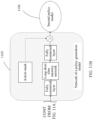
- FIG. 11A and FIG. 11B are a principle diagram of a reinforcement learning network. As shown in FIG. 11A and FIG. 11B , a training set 1101 is input into a GraphSage graph neural network 1102.
- the GraphSage graph neural network 1102 performs an Embedding operation 1103 of embedding a feature vector on the training set 1101, to obtain a graph vector 1104 of the training set 1101. Then, the graph vector 1104 is input into a network policy network of a policy generation model. A policy network 1105 processes the graph vector 1104 through a fully connected layer (fully connected layer, FC), an LSTM, and an FC layer in sequence. Finally, a second policy model 1106 is obtained.
- FC fully connected layer
- a network structure of the policy generation model namely, the policy network
- a policy model can be quickly obtained based on a training set, so that a long process of an evolutionary algorithm is not required, thereby improving computation efficiency.
- the policy model is obtained in a manner of the evolutionary algorithm, a model with higher accuracy can be obtained, but a speed is slower.
- the policy model is obtained in the manner of the reinforcement learning, because a plurality of rounds of iterations of the evolutionary algorithm are not required, the policy model can be obtained more quickly, but accuracy of the model is relatively low.
- the evolutionary algorithm is sensitive to initial point selection, to obtain a converged optimal solution in a quicker and better manner, the foregoing two manners can be combined.
- the policy generation model trained through reinforcement learning may be used to generate an initial population. Then, the evolutionary algorithm performs decrossover and mutation for optimization based on the population. This can improve search efficiency, and ensure a performance lower limit of the optimal solution. In this way, lowest performance of the policy model can reach performance of the policy model required by the reinforcement learning algorithm.
- the algorithm combining the evolutionary algorithm with the reinforcement learning is described in detail below.
- an implementation of the algorithm combining the evolutionary algorithm with the reinforcement learning specifically includes the following steps.
- a second policy model is a policy model obtained through reinforcement learning optimization.
- the second policy model obtained through a reinforcement learning algorithm is used as an initial gene sequence of the evolutionary algorithm, so that an initial point of the evolutionary algorithm has already been an ideal policy model. This improves a performance lower limit of the evolutionary algorithm. In other words, performance of a first policy model generated by the evolutionary algorithm in a subsequent working process is not lower than performance of the second policy model.
- an iteration method of the evolutionary algorithm is the same as an iteration method of the foregoing evolutionary algorithm.
- a difference lies in that an initial sample of the iteration method is the second policy model computed by the reinforcement algorithm. Therefore, initial point selection should be better, so that the evolutionary algorithm can obtain an optimal solution in a quicker and better manner, and computation efficiency is greatly improved.
- the solution compared with a solution in which only the evolutionary algorithm is used and a solution in which only the reinforcement learning algorithm is used, the solution combines the two solutions, so that the initial point and an initial sampling point of the evolutionary algorithm is better, thereby improving computation efficiency, and ensuring the performance lower limit of the evolutionary algorithm.
- FIG. 12 is a diagram of an architecture of an algorithm combining an evolutionary algorithm and reinforcement learning.
- the architecture includes a policy generation model 1201, an evolutionary search algorithm 1202, an initialization sample generation algorithm 1203, a computation graph compilation 1204, operator computation optimization 1205, on-board verification 1206, an automated search tool 1209, a policy knowledge library 1207, and a performance predictor 1208.
- the policy generation model 1201 generates a second policy model through a reinforcement learning algorithm, and sends the second policy model to the evolutionary search algorithm 1202 to execute a computation procedure of the evolutionary algorithm.
- the evolutionary search algorithm 1202 sends the second policy model to the initialization sample generation algorithm 1203 for initialization
- the computation graph compilation 1204 performs graph compilation.
- operator optimization and on-board verification are respectively performed by the operator computation optimization 1205 and the on-board verification 1206, to implement iteration steps of the evolutionary algorithm.
- the automated search tool 1209 is responsible for data transmission.
- the evolutionary search algorithm 1202 is further connected to the policy knowledge library 1207 and the performance predictor 1208.
- the evolutionary search algorithm 1202 may input the models into the policy knowledge library 1207, so that in a subsequent working process, whenever a new tensor is input, a corresponding computation policy can be directly queried from the policy knowledge library 1207, to determine a splitting quantity of a current vector. This does not require re-execution of the evolutionary algorithm, and shortens time for determining a splitting quantity of each tensor data, thereby improving computation efficiency.
- the performance predictor 1208 replaces actual on-board verification through prediction, and feeds back performance data through a prediction method, to improve the computation efficiency.
- the splitting manner and the splitting quantity of the first tensor are determined, to implement a splitting operation of the first tensor, where the first tensor is split into the at least two first sub-tensors. In this case, subsequent steps are further performed.
- the target computation order is a processing order of the at least two first sub-tensors.
- the first tensor includes three operators. A splitting manner and a splitting quantity of each operator are determined in the foregoing manner.
- the first operator 401 is split into two parts.
- the second operator 402 is split into four parts.
- the third operator 403 is split into four parts.
- For a computation order of the split operators there may be two different methods: 1. Depth first. 2. Breadth first. Descriptions are provided as follows respectively.
- FIG. 13a is a schematic diagram of different computation orders. As shown in 1301 in FIG. 13a , a computation order of the depth first is as follows. After a first slice 13011 (sub-tensor) of a first operator is computed, a first slice 13012 of a next operator is computed. After first slices of all operators are executed, second splitting of all the operators is executed in sequence until all slices of all the operators are executed.
- first slice 13011 sub-tensor
- FIG. 13a is a schematic diagram of different computation orders. As shown in 1302 in FIG. 13a , a computation order of the breadth first is as follows. A first slice 13021 to a last slice 13022 of a first operator are computed in sequence, and then a first slice to a last slice of a second operator are executed, until all slices of all operators are executed.
- FIG. 13b is a diagram of a correspondence between breadth first and a pipeline sub-graph boundary. As shown in FIG. 13b , a node 1303 of the breadth first may be considered as a boundary node of a pipeline sub-graph 1304.
- the order of the depth first can better reuse cached/buffered data, and obtain better memory benefit.
- the order of the depth first involves switching between operators, which causes more parameter loading (for example, weight and bias of conv2d).
- data in a cache is swapped out, or data in a buffer cannot be kept and is dropped (drop) to external storage.
- the order of the breadth first is better. Therefore, under a premise of meeting computational dependency, determining of a computation order is also a complex optimization problem, and cannot be resolved by manual modeling.
- the foregoing problems may also be resolved in a manner of machine learning. That is: 1. The manner of the evolutionary algorithm. 2. The reinforcement learning algorithm. 3. The reinforcement learning optimization. 4. The algorithm combining the evolutionary algorithm with the reinforcement learning. Descriptions are provided as follows respectively.
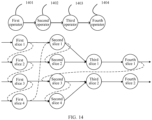
- FIG. 14 shows a memory encoding form of a computation order.
- gene code of a policy is like [4, B, 4, D, 2, D, 2, B].
- a meaning expressed by the gene code is that a tensor shown in FIG.
- the 14 includes four operators: a first operator 1401, a second operator 1402, a third operator 1403, and a fourth operator 1404, where the first operator 1401 is split into four slices op1_1 to op1_4, the second operator 1402 is split into four slices op2_1 to op2_4, the third operator 1403 is split into two slices op3_1 to op3_2, and the fourth operator 1404 is split into two slices op4_1 to op4_2.
- the Slices op1_1 to op1_4 use a computation order of the breadth first.
- the Slices op2_1 to op2_4 use the computation order of the breadth first.
- the Slices op3_1 to op3_2 use an order of the depth first.
- the Slices op4_1 to op4_2 use the order of the depth first.
- the gene code can be used as an individual of a round of iteration.
- the evolutionary algorithm performs optimization of the policy, and a policy model that can determine an optimal computation order is finally obtained.
- a policy model that can determine an optimal computation order is finally obtained.
- the policy model is obtained in the foregoing manner, when a new tensor is input, the tensor is input into the policy model. Then, a target computation order for the tensor may be obtained from the policy model.
- the splitting manner and the splitting quantity of the first tensor are respectively determined, so that the first tensor is split into the at least two first sub-tensors, and the target computation order is further determined. Therefore, the first tensor can be processed by processing the at least two split first sub-tensors through the target computation order.
- FIG. 15 is an entire flowchart according to an embodiment of this application.
- an architecture of a procedure includes a reinforcement learning RL training module 1501, a policy optimization module 1502, a test module 1503, and a compilation module 1504 configured to perform computation graph compilation.
- the RL training module 1501 obtains a policy model through training based on the foregoing reinforcement learning method, and sends the policy model to the compilation module 1504.
- the policy optimization module 1502 obtains an optimized policy model through evolutionary algorithm GA search, reinforcement learning optimization, or a combination thereof, and sends the optimized policy model to the compilation module 1504.
- the compilation module 1504 stores the optimized policy model in a knowledge library.
- a used initial policy model is obtained by the compilation module 1504 from the RL training module 1501, and is then sent to the policy optimization module 1502.
- the obtained policy model needs to be measured by the test module 1503 before being sent to the compilation module 1504.
- the test module 1503 enables the obtained policy model to exchange with a real environment in an on-board verification manner, so that performance of the policy model can be evaluated.
- the test module 1503 may further evaluate the performance of the policy model through simulation of a simulator or prediction of a performance predictor, to improving working efficiency of the test module 1503.
- the compilation module 1504 is configured to perform computation graph compilation.
- the compilation module 1504 first queries the knowledge library. If an optimal policy model that can be configured to process a current first tensor is found in the knowledge library, sub-graph/operator compilation is performed on the first tensor through the optimal policy model, so that optimal processing can be performed on the first tensor. If the compilation module 1504 does not find, in the knowledge library, the optimal policy model that can be configured to process the current first tensor, the first tensor is processed through the policy model generated by the RL training module 1501, to ensure that the first tensor can be processed.
- the data processing method provided in an embodiment of this application includes: splitting a first tensor into at least two first sub-tensors, where first tensor is a to-be-processed multi-dimensional tensor; determining a target computation order of the at least two first sub-tensors, where the target computation order is a processing order of the at least two first sub-tensors; and processing the at least two first sub-tensors based on the target computation order.
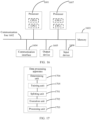
- an embodiment of this application provides a computer device. As shown in FIG. 16 , the device includes at least one processor 1601, a communication line 1602, a memory 1603, and at least one communication interface 1604.
- the processor 1601 may be a general-purpose central processing unit (central processing unit, CPU), a microprocessor, an application-specific integrated circuit (application-specific integrated circuit, ASIC), or one or more integrated circuits configured to control program execution of solutions in this application.
- CPU central processing unit
- ASIC application-specific integrated circuit
- the communication line 1602 may include a channel, to transmit information between the foregoing components.
- the communication interface 1604 uses any apparatus of a transceiver type to communicate with another device or a communication network such as an Ethernet, radio access network (radio access network, RAN), a wireless local area network (wireless local area network, WLAN), or the like.
- a transceiver type such as an Ethernet, radio access network (radio access network, RAN), a wireless local area network (wireless local area network, WLAN), or the like.
- the memory 1603 may be a read-only memory (read-only memory, ROM), another type of static storage device that can store static information and instructions, a random access memory (random access memory, RAM), or another type of dynamic storage device that can store information and instructions, or may be an electrically erasable programmable read-only memory (electrically erasable programmable read-only memory, EEPROM) or a compact disc read-only memory (compact disc read-only memory, CD-ROM) or another compact disc storage, optical disc storage (including a compressed optical disc, a laser disc, an optical disc, a digital versatile optical disc, a Blu-ray disc, or the like), a magnetic disk storage medium or another magnetic storage device, or any another medium that can be used to carry or store expected program code in the form of instructions or a data structure and that can be accessed by a computer, but not limited thereto.
- the memory may exist independently and is connected to the processor through the communication line 1602. Optionally, the memory may be integrated with the processor.
- the memory 1603 is configured to store computer executable instructions for performing the solutions of this application, and is controlled and executed by the processor 1601.
- the processor 1601 is configured to execute the computer executable instructions stored in the memory 1603 to implement the method provided in the following embodiments of this application.
- the computer executable instructions in this application may also be referred to as application code. This is not specifically limited in this application.
- the processor 1601 may include one or more CPUs, for example, a CPU0 and a CPU1 in FIG. 16 .
- an electronic device may include one or more processors, for example, a processor 1601 and a processor 1607 in FIG. 16 .
- processors may be a single-core processor, or may be a multi-core processor.
- the processor herein may be one or more devices, circuits, and/or processing cores configured to process data (for example, computer program instructions).
- the electronic device may further include an output device 1605 and an input device 1606.
- the output device 1605 communicates with the processor 1601, and may display information in a plurality of manners.
- the output device 1605 may be a liquid crystal display (liquid crystal display, LCD), a light emitting diode (light emitting diode, LED) display device, a cathode ray tube (cathode ray tube, CRT) display device, a projector (projector), or the like.
- the input device 1606 communicates with the processor 1601, and may receive user input in a plurality of manners.
- the input device 1606 may be a mouse, a keyboard, a touchscreen device, a sensor device, or the like.
- the electronic device may be a general-purpose device or a dedicated device. During specific implementation, the electronic device may be a device configured to run a circuit noise reduction method in embodiments of this application. A type of the electronic device is not limited in this application.
- each functional unit may be divided according to each function, or two or more functions may be integrated into one processing unit.
- the integrated unit may be implemented in a form of hardware, or may be implemented in a form of a software functional unit. It should be noted that, in embodiments of this application, the unit division is an example, and is merely logical function division, and there may be other division manners during actual implementation.
- FIG. 17 is a schematic diagram of a structure of a data processing apparatus according to an embodiment of this application.
- the data processing apparatus includes:
- the splitting unit 1701 is further configured to:
- the splitting unit 1701 is further configured to:
- the apparatus further includes a determining unit 1704, configured to:
- the splitting unit 1701 is further configured to: split the first tensor into the at least two first sub-tensors in the target splitting manner.
- the apparatus further includes a training unit 1705, configured to:
- the training unit 1705 is further configured to:
- the training unit 1705 is further configured to:
- the training unit 1705 is further configured to: encode the computation policy in the optimized target policy model as the gene sequence.
- the training unit 1705 is further configured to:
- the training unit 1705 is further configured to:
- the computer program product includes one or more computer instructions.
- the computer may be a general-purpose computer, a dedicated computer, a computer network, or another programmable apparatus.
- the computer instructions may be stored in a computer-readable storage medium or may be transmitted from a computer-readable storage medium to another computer-readable storage medium.
- the computer instructions may be transmitted from a website, computer, server, or data center to another website, computer, server, or data center in a wired (for example, a coaxial cable, an optical fiber, or a digital subscriber line (DSL)) or wireless (for example, infrared, radio, or microwave) manner.
- a wired for example, a coaxial cable, an optical fiber, or a digital subscriber line (DSL)
- wireless for example, infrared, radio, or microwave
- the computer-readable storage medium may be any usable medium stored by the computer, or a data storage device, such as a server or a data center, integrating one or more usable media.
- the usable medium may be a magnetic medium (for example, a floppy disk, a hard disk, or a magnetic tape), an optical medium (for example, a DVD), a semiconductor medium (for example, a solid state drive Solid State Disk (SSD)), or the like.
- example or “for example” or the like is used to represent giving an example, an illustration, or a description. Any embodiment or design scheme described as an “example” or “for example” in embodiments of this application should not be explained as being more preferred or having more advantages than another embodiment or design scheme. Exactly, use of the word “example”, “for example”, or the like is intended to present a relative concept in a specific manner.
Landscapes
- Engineering & Computer Science (AREA)
- Physics & Mathematics (AREA)
- Theoretical Computer Science (AREA)
- General Physics & Mathematics (AREA)
- Data Mining & Analysis (AREA)
- Mathematical Physics (AREA)
- General Engineering & Computer Science (AREA)
- Software Systems (AREA)
- Health & Medical Sciences (AREA)
- Life Sciences & Earth Sciences (AREA)
- Biophysics (AREA)
- Computing Systems (AREA)
- Computational Linguistics (AREA)
- Databases & Information Systems (AREA)
- Molecular Biology (AREA)
- General Health & Medical Sciences (AREA)
- Evolutionary Computation (AREA)
- Biomedical Technology (AREA)
- Artificial Intelligence (AREA)
- Mathematical Optimization (AREA)
- Computational Mathematics (AREA)
- Mathematical Analysis (AREA)
- Pure & Applied Mathematics (AREA)
- Evolutionary Biology (AREA)
- Bioinformatics & Computational Biology (AREA)
- Bioinformatics & Cheminformatics (AREA)
- Algebra (AREA)
- Physiology (AREA)
- Genetics & Genomics (AREA)
- Management, Administration, Business Operations System, And Electronic Commerce (AREA)
Applications Claiming Priority (1)
| Application Number | Priority Date | Filing Date | Title |
|---|---|---|---|
| PCT/CN2021/077413 WO2022178660A1 (zh) | 2021-02-23 | 2021-02-23 | 一种数据处理方法、装置、设备及介质 |
Publications (2)
| Publication Number | Publication Date |
|---|---|
| EP4280107A1 true EP4280107A1 (de) | 2023-11-22 |
| EP4280107A4 EP4280107A4 (de) | 2024-03-20 |
Family
ID=83048559
Family Applications (1)
| Application Number | Title | Priority Date | Filing Date |
|---|---|---|---|
| EP21927108.7A Pending EP4280107A4 (de) | 2021-02-23 | 2021-02-23 | Datenverarbeitungsverfahren und -vorrichtung, vorrichtung und medium |
Country Status (4)
| Country | Link |
|---|---|
| US (1) | US20230394110A1 (de) |
| EP (1) | EP4280107A4 (de) |
| CN (1) | CN116868202A (de) |
| WO (1) | WO2022178660A1 (de) |
Families Citing this family (4)
| Publication number | Priority date | Publication date | Assignee | Title |
|---|---|---|---|---|
| CN115269204B (zh) * | 2022-09-27 | 2022-12-30 | 之江实验室 | 一种用于神经网络编译的内存优化方法及装置 |
| US20240161223A1 (en) * | 2022-11-16 | 2024-05-16 | Nvidia Corporation | Application programming interface to translate a tensor |
| CN116150563B (zh) * | 2023-02-24 | 2024-01-05 | 之江实验室 | 一种业务执行方法、装置、存储介质及电子设备 |
| CN118012628B (zh) * | 2024-03-15 | 2024-11-01 | 北京壁仞科技开发有限公司 | 一种数据处理方法、装置和存储介质 |
Family Cites Families (11)
| Publication number | Priority date | Publication date | Assignee | Title |
|---|---|---|---|---|
| US10824693B2 (en) * | 2015-12-10 | 2020-11-03 | Reservoir Labs, Inc. | Systems and methods for selective expansive recursive tensor analysis |
| US10552119B2 (en) * | 2016-04-29 | 2020-02-04 | Intel Corporation | Dynamic management of numerical representation in a distributed matrix processor architecture |
| US11567816B2 (en) * | 2017-09-13 | 2023-01-31 | Hrl Laboratories, Llc | Transitive tensor analysis for detection of network activities |
| GB201801639D0 (en) * | 2018-02-01 | 2018-03-21 | Ruff Brendan Patrick | Low precision efficient multiplication free convolutional filter bank device |
| CN110647973A (zh) * | 2018-06-27 | 2020-01-03 | 北京中科寒武纪科技有限公司 | 运算方法及相关方法和产品 |
| WO2020028915A1 (en) * | 2018-08-03 | 2020-02-06 | Google Llc | Distributing tensor computations across computing devices |
| JP7279446B2 (ja) * | 2019-03-20 | 2023-05-23 | 富士通株式会社 | 学習プログラム、学習方法、及び学習装置 |
| US11568238B2 (en) * | 2019-06-28 | 2023-01-31 | Amazon Technologies, Inc. | Dynamic processing element array expansion |
| CN110473206B (zh) * | 2019-07-24 | 2023-03-21 | 东南大学 | 一种基于超体素与测度学习的弥散张量图像分割方法 |
| CN110263923B (zh) * | 2019-08-12 | 2019-11-29 | 上海燧原智能科技有限公司 | 张量卷积计算方法及系统 |
| CN111276183B (zh) * | 2020-02-25 | 2023-03-21 | 云南大学 | 一种基于参数估计的张量分解处理海量基因序列的方法 |
-
2021
- 2021-02-23 EP EP21927108.7A patent/EP4280107A4/de active Pending
- 2021-02-23 CN CN202180092652.0A patent/CN116868202A/zh active Pending
- 2021-02-23 WO PCT/CN2021/077413 patent/WO2022178660A1/zh not_active Ceased
-
2023
- 2023-08-22 US US18/453,681 patent/US20230394110A1/en active Pending
Also Published As
| Publication number | Publication date |
|---|---|
| US20230394110A1 (en) | 2023-12-07 |
| WO2022178660A1 (zh) | 2022-09-01 |
| EP4280107A4 (de) | 2024-03-20 |
| CN116868202A (zh) | 2023-10-10 |
Similar Documents
| Publication | Publication Date | Title |
|---|---|---|
| US20230394110A1 (en) | Data processing method, apparatus, device, and medium | |
| EP3754495B1 (de) | Datenverarbeitungsverfahren und zugehörige produkte | |
| Yang et al. | Betty: Enabling large-scale gnn training with batch-level graph partitioning | |
| CN113361680A (zh) | 一种神经网络架构搜索方法、装置、设备及介质 | |
| CN112579063A (zh) | 一种用于深度学习编译器中探索优化空间的加速方法 | |
| CN116057518A (zh) | 使用机器学习模型的自动查询谓词选择性预测 | |
| Wang et al. | {WLB-LLM}:{Workload-Balanced} 4D Parallelism for Large Language Model Training | |
| CN112529207B (zh) | 模型优化方法、装置、存储介质及设备 | |
| Miao et al. | Flexllm: A system for co-serving large language model inference and parameter-efficient finetuning | |
| US20230367640A1 (en) | Program execution strategies for heterogeneous computing systems | |
| CN119271398B (zh) | 面向深度强化学习模型训练的异构算力资源配置优化方法 | |
| CN120277102A (zh) | 跨数据源分页查询的性能优化方法及系统 | |
| He et al. | Home: A holistic gpu memory management framework for deep learning | |
| US20220197901A1 (en) | Ai model optimization method and apparatus | |
| Kim et al. | ADOR: A Design Exploration Framework for LLM Serving with Enhanced Latency and Throughput | |
| CN119046022B (zh) | 一种分布式并行方案的确定方法、装置、设备及介质 | |
| CN114518866A (zh) | 数据处理方法以及装置 | |
| JP7624056B2 (ja) | ニューラルネットワークアクセラレータ用の命令生成方法、装置および電子デバイス | |
| Li et al. | Performance optimization algorithm of radar signal processing system | |
| CN115412401B (zh) | 训练虚拟网络嵌入模型及虚拟网络嵌入的方法和装置 | |
| CN120450061A (zh) | 一种计算图中算子融合的方法及相应装置 | |
| CN116431205A (zh) | 数据流策略生成方法、装置、电子设备和存储介质 | |
| Sewal et al. | Algorithmic proficiency in spark configuration tuning: An empirical study using execution time metrics across varied workloads | |
| Huo et al. | Joint Prediction and Matching for Computing Resource Exchange Platforms | |
| CN120448238B (zh) | Ai芯片中的算子性能评估方法、装置、设备及介质 |
Legal Events
| Date | Code | Title | Description |
|---|---|---|---|
| STAA | Information on the status of an ep patent application or granted ep patent |
Free format text: STATUS: THE INTERNATIONAL PUBLICATION HAS BEEN MADE |
|
| PUAI | Public reference made under article 153(3) epc to a published international application that has entered the european phase |
Free format text: ORIGINAL CODE: 0009012 |
|
| STAA | Information on the status of an ep patent application or granted ep patent |
Free format text: STATUS: REQUEST FOR EXAMINATION WAS MADE |
|
| 17P | Request for examination filed |
Effective date: 20230817 |
|
| AK | Designated contracting states |
Kind code of ref document: A1 Designated state(s): AL AT BE BG CH CY CZ DE DK EE ES FI FR GB GR HR HU IE IS IT LI LT LU LV MC MK MT NL NO PL PT RO RS SE SI SK SM TR |
|
| REG | Reference to a national code |
Ref country code: DE Ref legal event code: R079 Free format text: PREVIOUS MAIN CLASS: G06N0003000000 Ipc: G06N0003042000 |
|
| A4 | Supplementary search report drawn up and despatched |
Effective date: 20240219 |
|
| RIC1 | Information provided on ipc code assigned before grant |
Ipc: G06N 3/126 20230101ALI20240213BHEP Ipc: G06N 3/092 20230101ALI20240213BHEP Ipc: G06N 3/063 20230101ALI20240213BHEP Ipc: G06N 3/0464 20230101ALI20240213BHEP Ipc: G06F 16/901 20190101ALI20240213BHEP Ipc: G06F 16/245 20190101ALI20240213BHEP Ipc: G06N 3/042 20230101AFI20240213BHEP |
|
| DAV | Request for validation of the european patent (deleted) | ||
| DAX | Request for extension of the european patent (deleted) | ||
| STAA | Information on the status of an ep patent application or granted ep patent |
Free format text: STATUS: EXAMINATION IS IN PROGRESS |
|
| 17Q | First examination report despatched |
Effective date: 20250408 |