EP4280568A1 - Commande de transfert de fichiers - Google Patents
Commande de transfert de fichiers Download PDFInfo
- Publication number
- EP4280568A1 EP4280568A1 EP23169903.4A EP23169903A EP4280568A1 EP 4280568 A1 EP4280568 A1 EP 4280568A1 EP 23169903 A EP23169903 A EP 23169903A EP 4280568 A1 EP4280568 A1 EP 4280568A1
- Authority
- EP
- European Patent Office
- Prior art keywords
- files
- type
- attribute
- transferred
- assigned
- Prior art date
- Legal status (The legal status is an assumption and is not a legal conclusion. Google has not performed a legal analysis and makes no representation as to the accuracy of the status listed.)
- Pending
Links
Images

Classifications
-
- H—ELECTRICITY
- H04—ELECTRIC COMMUNICATION TECHNIQUE
- H04L—TRANSMISSION OF DIGITAL INFORMATION, e.g. TELEGRAPHIC COMMUNICATION
- H04L67/00—Network arrangements or protocols for supporting network services or applications
- H04L67/01—Protocols
- H04L67/06—Protocols specially adapted for file transfer, e.g. file transfer protocol [FTP]
-
- H—ELECTRICITY
- H04—ELECTRIC COMMUNICATION TECHNIQUE
- H04L—TRANSMISSION OF DIGITAL INFORMATION, e.g. TELEGRAPHIC COMMUNICATION
- H04L45/00—Routing or path finding of packets in data switching networks
- H04L45/302—Route determination based on requested QoS
- H04L45/306—Route determination based on the nature of the carried application
-
- H—ELECTRICITY
- H04—ELECTRIC COMMUNICATION TECHNIQUE
- H04L—TRANSMISSION OF DIGITAL INFORMATION, e.g. TELEGRAPHIC COMMUNICATION
- H04L47/00—Traffic control in data switching networks
- H04L47/10—Flow control; Congestion control
- H04L47/24—Traffic characterised by specific attributes, e.g. priority or QoS
-
- H—ELECTRICITY
- H04—ELECTRIC COMMUNICATION TECHNIQUE
- H04L—TRANSMISSION OF DIGITAL INFORMATION, e.g. TELEGRAPHIC COMMUNICATION
- H04L67/00—Network arrangements or protocols for supporting network services or applications
- H04L67/01—Protocols
- H04L67/12—Protocols specially adapted for proprietary or special-purpose networking environments, e.g. medical networks, sensor networks, networks in vehicles or remote metering networks
Definitions
- the invention relates to a method for controlling a transfer of files, a system for carrying out the method, a computer program and a computer-readable medium.
- Such files concern, among other things, operating states, internal processes, maintenance information, diagnostic data, geographical positions or safety information of vehicles or machines and are of essential interest for control or monitoring instances. Therefore, the files mentioned are transferred from the machines or vehicles to the monitoring or control instances. Typically, these files are transferred according to a predetermined schedule. It may be that a predetermined type of files is only transferred once a day, while another predetermined type of files, for example, every second or minute. In addition, files are usually sent in an order according to their occurrence.
- the object of the invention is to improve a control for transferring files.
- This task is solved by a method with the features of independent claim 1. Furthermore, this task is solved by a device with the features of the subordinate device claim and by a system with the features of the subordinate system claim.
- the invention is based on the object of providing a computer program for carrying out the method according to the invention with the device according to the invention and/or with the system according to the invention.
- This task is solved by a computer program with the features of the subordinate computer program claim and by a computer-readable medium with the features of the subordinate claim relating to the computer-readable medium.
- the method according to the invention for controlling a transfer of files provides for determining a type of content of files to be transferred. Based on the type of content of the files, at least one attribute is assigned to the files to be transferred. Furthermore, the files to be transferred are transferred depending on the at least one attribute.
- an attribute is to be understood as an attribute in the sense of computer science, according to which each attribute assigns at least one feature or property and at least one expression of this feature or property to this file in accordance with a type of content of a file.
- One type of content of a file can be, for example, media data, process data, service data, maintenance data, communication data, timetable data, vehicle data, machine data and/or safety data.
- At least some of the files to be transferred are assigned an attribute of the first type as the at least one attribute. According to this, these files are each assigned a relevance. For each file to be transferred, it can be determined whether a transfer should be postponed, preferred or even take place immediately. A large number of files to be transferred can be evaluated and/or sorted quickly and efficiently in terms of their relevance.
- a further advantageous development provides that at least some of the files to be transferred are assigned an attribute of the second type as the at least one attribute.
- the content of these files, to which the attribute of the second type is assigned, is then evaluated. Based on the results of this evaluation, these files are each assigned a relevance.
- Protocol files also known as log files, are preferably assigned the attribute of the second type.
- Predetermined events are usually logged in log files.
- the log file may be a security log file whose contents relate to digital security. This can, among other things, log a number of failed or successful authentication and/or authorization attempts.
- Another example of a log file is a so-called “audit trail log file”.
- an advantageous development provides that at least some of the files to be transferred are assigned an attribute of a third type as the at least one attribute, according to which files are assigned to a predetermined category based on a type of content.
- files that, for example, relate to a type of process data can be assigned to corresponding subcategories. It is possible to assign process data to subcategories that relate to a drive, energy supply, air conditioning or other internal or external processes.
- a transfer of files of a predetermined category can be initiated quickly and reliably. This also simplifies the possible assignment of further attributes depending on a category.
- an advantageous development provides for assigning an attribute of the fourth type as the at least one attribute to at least some of the files to be transferred.
- These files are combined into at least one common file for the purpose of joint transmission. This makes it possible to transfer files efficiently and cost-effectively. In this way, times for establishing a connection and the data volume required for this can be reduced and saved. In addition, for example, the number of authentications or, in the case of an encrypted connection, the number of key exchanges can be reduced.
- a file summarized in the aforementioned manner can, for example, be designed as an archive be.
- a transmission of the summarized file can be sent, for example, depending on a predeterminable time or depending on predeterminable events.
- the combined file is preferably created using a large number of files, each of which has a relatively small file size.
- An advantageous embodiment variant provides that at least some of the files to which the fourth type attribute is assigned are assigned a first type attribute or a second type attribute.
- the file combined from individual files according to the fourth type attribute is transferred depending on a highest relevance assigned to one of the named individual files according to the first type or second type attribute. This means that a transfer of a combined file is made dependent on the highest relevance of the individual files. This makes it possible to delay a transfer of predetermined files until there is a reason for the transfer.
- Files whose contents relate to diagnostic data or safety data are preferably transferred in this way. These can be combined into a common file until the contents of one of these files indicate a state that deviates significantly from a predefined normal state.
- the combined file offers the advantage of being able to transfer and/or evaluate corresponding files sorted according to a history of events.
- an advantageous development provides for a recipient of the files to be transmitted to be transmitted information regarding the files to be transmitted and a related assignment of the at least one attribute.
- information may include, but is not limited to, a type of file content, a file size, a number of records, a number of records per record type, a creator of the file, or a source of the file.
- the recipient can It is possible to adapt and/or plan your own system resources, such as storage capacity, computing power or a number of transmission channels, to the volume of files to be received at an early stage. Furthermore, this makes it possible for the recipient to assign their own attributes to the files to be transferred based on this information.
- An advantageous embodiment variant provides that files to be transferred are read out by the receiver based on the information mentioned.
- the recipient can thus determine the time or sequence of files to be transferred depending on their own interests.
- an expression of a feature or a property of the at least one attribute is specified by a recipient of the files to be transferred.
- assessment or evaluation standards can be quickly and flexibly adjusted by a control or monitoring entity.
- rapid adaptation to a changed threat situation recognized by a recipient is made possible.
- assignment criteria which preferably concern security-relevant files, can be quickly adapted to a changed threat situation. Files that were initially classified as less relevant can then be transferred as a priority.
- An advantageous embodiment variant provides that files are transferred at predetermined time intervals according to a type of their content. These mentioned time intervals are adjusted based on the first type or second type attributes. Preferably, these mentioned time intervals are shortened or extended based on the attributes of the first type or attributes of the second type.
- a transfer of files of various types carried out according to a repeating sequence of transfer times can be controlled easily and inexpensively. In case of occurrence In the event of bottlenecks in the transmission of files due, for example, to a limited data volume, a limited bandwidth or poor reception quality, it is made possible to continue to transmit files of high relevance and to postpone the transmission of such files with lower or no assigned relevance.
- the files to be transferred are transferred between a mobile communication participant and a stationary communication participant.
- the files to be transferred are transmitted between the communication participants mentioned using a mobile radio network.
- the method according to the invention is carried out with the device according to the invention.
- the device has at least one data processing device.
- This data processing device is set up to determine a type of content of files to be transferred. Furthermore, this data processing device is set up to assign at least one attribute to the files to be transferred based on the type of their content. In addition, the data processing device is set up to transfer the files to be transferred depending on the at least one attribute.
- the data processing device can be, for example, a computer, a microcontroller, a processor or another programmable hardware component. Furthermore, it is conceivable that the data processing device is a virtualized hardware resource of a computer cloud or a runtime environment with changeable computing and/or storage capacities.
- the runtime environment mentioned should be understood in the sense of computer science. For example, the runtime environment is set up to read, write, transfer and/or manage data.
- the system has a stationary communication subscriber who is set up to communicate using a mobile radio network. Furthermore, the system has a mobile communication subscriber. This in turn has a device with at least one data processing device.
- the data processing device mentioned is in particular the data processing device described above.
- the device mentioned is in particular the device according to the invention mentioned above.
- the system device mentioned is furthermore set up to transmit files to the stationary communication subscriber using the mobile radio network.
- the mobile communication subscriber is preferably a vehicle.
- the vehicle mentioned is particularly preferably designed as a rail-bound vehicle.
- the system according to the invention enables efficient use of a data transmission capacity, number of transmission channels and/or usable data volume, which is usually limited in a mobile radio network. Despite poor network coverage or local overload of the mobile network, reliable monitoring and/or control of the mobile communication subscriber can be maintained. In the event of a bottleneck in transmission capacity, communication with the stationary communication participant be reduced to safety-relevant files, which, for example, relate to diagnostic data or process data. Transmission of media data, among other things, which serves the sole purpose of entertainment, for example, can be avoided in the event of bottlenecks.
- a computer program which, when executed, causes the device according to the invention to carry out the method according to the invention.
- the invention provides a computer program which, when executed, causes the system according to the invention to carry out the method according to the invention.
- a computer-readable medium is proposed. This has instructions which cause the device according to the invention to carry out the method according to the invention. Alternatively or additionally, the computer-readable medium has instructions which cause the system according to the invention to carry out the method according to the invention.
- the computer-readable medium can be, for example, a CD-ROM, a DVD, a USB or flash memory or a non-physical medium such as a data stream and/or a data carrier signal.
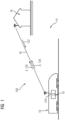
- FIG 1 shows an exemplary embodiment of a system 14 and an exemplary embodiment of a device 10 in a schematic representation. Furthermore illustrated FIG 1 a general example of a method 100 for controlling a transfer of files D.
- files D are transferred 120 between a rail-bound vehicle 18 and a stationary communication subscriber 16.
- This transfer 120 of files D takes place, for example, by means of a mobile radio network M.
- new files D of various types are constantly generated, which are to be sent to the stationary communication participant 16.
- the stationary communication participant 16 which is also called the land side in connection with communication between rail-bound vehicles
- the rail-bound vehicle 18 is monitored, among other things, for its operating status, its geographical position or its capacity utilization.
- the files D to be transferred can be, for example, those which contain media data, process data, service data, maintenance data, communication data, timetable data, vehicle data or others during a Driving operation of the rail-bound vehicle 18 concerns data arising.
- a transfer of these files D of various types is also implemented according to a schedule for the purpose of structuring.
- a time window is then assigned to files D of a predetermined type at predetermined time intervals, while these files D are being transmitted 120.
- a partially repeating sequence of time windows is specified, within which a transmission 120 of files D of a predetermined type each takes place.
- the specified time intervals or time windows can have different lengths depending on the type of content in the files.
- the time intervals mentioned can be a few seconds, minutes or even days. In the event of a bottleneck in data transmission via the mobile radio network M, however, considerable delays can occur in a transmission 120 of files D of a predetermined type.
- this transmission 120 of the files D is controlled by means of the data processing device 12 of the device 10.
- the data processing device 12 is set up in connection with FIG 2 to carry out a special example of method 100 explained in more detail.
- FIG 2 illustrates an example of the method 100 for controlling the transmission 120 of files D.
- a type of content of the files D to be transmitted is first determined 102.
- Such a type of content can be, for example, media data, process data, service data, maintenance data, communication data, schedule data, vehicle data or other data arising during operation of the rail-bound vehicle 18.
- the one to be transferred Files D are assigned at least one attribute to their content depending on a type 104, 106, 108, 110.
- a portion of the files D to be transferred is assigned an attribute of the first type 104.
- a file D is assigned a relevance depending on the type of content 112. If the content of the file D concerns, for example, media data or timetable data, This file D is initially assigned a lower relevance 112 than a file D whose content relates to process data or diagnostic data.
- a file D to be transferred is assigned an attribute of the second type 106 depending on a determined content 102 of this file D.
- the content of this file D, to which the attribute of the second type was assigned 106, is first evaluated 118. Thereafter, according to the provisions a result of this evaluation 118 assigned a relevance 112 to this file D.
- An assignment 106 of the attribute of the second type is suitable, for example, for log files or diagnostic files, the relevance of which depends on their actual content.
- a security log file can summarize failed or successful authentication and/or authorization attempts. The relevance of these security log files depends in particular on the number of failed authentication and/or authorization attempts.
- the security log file can be assigned a relevance depending on its content 112.
- this file will have no relevance or only a low relevance assigned 112. If, on the other hand, a logged number of failed authentication and/or authorization attempts is above the predeterminable limit, this security log file is assigned a high level of relevance 112.
- contents of files D, to which the attribute of the second type is assigned 106 are evaluated for a pattern 118 in accordance with the attribute of the second type. Such patterns can, for example, when evaluating 118 a security log file for a digital attack or in the case of process data for a indicate impending failure of operating components. Depending on such an evaluation 118, the respective file D is then assigned a relevance corresponding to the result 112.
- Example illustrated method 100 proposes to assign a third type attribute 108 to at least one file D to be transferred.
- the respective file D is assigned to a predetermined category based on a type of content 114.
- files D with different types of content can be assigned be combined into a category 114. It is conceivable that this category can be assigned a relevance 112.
- an assignment of a relevance 112 to such a category is not provided.
- a separate time window is provided for such a category as an example.
- files D with content of the same type are divided into different subcategories in a manner not illustrated in detail 114.
- Files D which have been assigned to a predetermined subcategory 114, can additionally have an attribute of the first type or second type the one previously described and in FIG 2 illustrated manner 104, 106.
- This procedure is particularly suitable for files D, which relate to process data from different processes. In this way, process data can be sorted according to processes that relate to, among other things, a drive, a control, room air conditioning or an energy supply. According to a subcategory, this makes it possible to add additional appropriate files to these files To assign attributes of the first type or second type 104, 106. In this way, the control process can be accelerated by pre-sorting the files D.
- Illustrated method 100 provides, by way of example, that an attribute of the fourth type is assigned to files D to be transferred 110.
- Files D to which the attribute of the fourth type is assigned 110 are combined into at least one common file for the purpose of a common transmission 116.
- times to establish a connection and the data volume required for this can be saved. For example, a number of authentications to establish a communication connection or a number of key exchanges for an encrypted connection can be reduced.
- the combined file can have both files D of the same type of content and files D of different types of content.
- Such a summarized file can have files D, which refer to the ones already described above and through FIG 2
- attributes of the first type, second type and/or third type were assigned 104, 106, 108.
- log files are transmitted in aggregate 120, which naturally each have a very small file size.
- a transfer 120 of the combined file is based on the attributes of the files D included in the combined file. If the combined file has at least one file D, which has been assigned a relevance according to the attribute of the first type or second type 112, a transfer 120 of this combined file is based on a highest relevance 112 assigned to one of the files D to be transferred.
- a transmission of files D can be controlled solely by means of the method 100 or the method 100 for controlling the transmission can be based on a type of transmission based on predetermined events or on a request from the stationary communication subscriber 16.
- files D are transferred depending on the at least one assigned attribute 120.
- a transfer of the files D basically takes place in accordance with what was previously described in connection with FIG 1 described schedule takes place.
- this stated schedule may be deviated from.
- files D are either transferred 120 immediately, transferred 120 with preference over other files D, or a transfer 120 of these files D is postponed.
- time intervals of the specified schedule are adjusted 124 based on the attributes of the first type or second type.
- the rail-bound vehicle 18 transmits 120 information I to the stationary communication participant 16 by means of the data processing device 12, which relates to the files D to be transmitted and a related assignment of the attributes 104, 106, 108, 110.
- the stationary communication participant 16 can determine a time or a sequence of files D to be transmitted depending on their own interests.
- the stationary communication participant can 16 determine a time and/or a sequence of transmission of predetermined files D according to their own interests, regardless of the aforementioned schedule.
- the stationary communication subscriber 16 is enabled to adjust the capacity of its own system resources. For example, storage capacities, computing power or a number of transmission channels can be adjusted before transferring large files.
- FIG 1 and FIG 2 illustrated method 100 suggests that an expression of a feature or a property of the at least one attribute is specified 122 by the stationary communication participant 16 or is adapted by it. If the stationary communication participant 16 recognizes, for example, a new threat situation, such as a new pattern through which a digital attack can be recognized, he can quickly initiate a corresponding assignment and evaluation of files D to be transmitted by the data processing device 12.
- a new threat situation such as a new pattern through which a digital attack can be recognized
Landscapes
- Engineering & Computer Science (AREA)
- Computer Networks & Wireless Communication (AREA)
- Signal Processing (AREA)
- Health & Medical Sciences (AREA)
- Computing Systems (AREA)
- General Health & Medical Sciences (AREA)
- Medical Informatics (AREA)
- Information Retrieval, Db Structures And Fs Structures Therefor (AREA)
Applications Claiming Priority (1)
| Application Number | Priority Date | Filing Date | Title |
|---|---|---|---|
| DE102022204927 | 2022-05-18 |
Publications (1)
| Publication Number | Publication Date |
|---|---|
| EP4280568A1 true EP4280568A1 (fr) | 2023-11-22 |
Family
ID=86226339
Family Applications (1)
| Application Number | Title | Priority Date | Filing Date |
|---|---|---|---|
| EP23169903.4A Pending EP4280568A1 (fr) | 2022-05-18 | 2023-04-25 | Commande de transfert de fichiers |
Country Status (2)
| Country | Link |
|---|---|
| US (1) | US20230379259A1 (fr) |
| EP (1) | EP4280568A1 (fr) |
Citations (3)
| Publication number | Priority date | Publication date | Assignee | Title |
|---|---|---|---|---|
| DE102019208515A1 (de) * | 2019-06-12 | 2020-12-17 | Siemens Mobility GmbH | Verfahren zum Aufbau einer drahtlosen Datenverbindung zwischen einem Fahrzeug und einer externen Einheit, Verbindungsaufbaueinheit und Fahrzeug |
| DE102019214476A1 (de) * | 2019-09-23 | 2021-03-25 | Siemens Mobility GmbH | Datenverbindungbetriebsverfahren, Datenübermittlungseinheit und Fahrzeug mit Datenübermittlungseinheit |
| WO2023036597A1 (fr) * | 2021-09-10 | 2023-03-16 | Siemens Mobility GmbH | Procédé et système de commande d'une transmission de données sur la base d'au moins un attribut d'un fichier |
Family Cites Families (13)
| Publication number | Priority date | Publication date | Assignee | Title |
|---|---|---|---|---|
| US6839751B1 (en) * | 1999-06-30 | 2005-01-04 | Hi/Fn, Inc. | Re-using information from data transactions for maintaining statistics in network monitoring |
| US6763517B2 (en) * | 2001-02-12 | 2004-07-13 | Sun Microsystems, Inc. | Automated analysis of kernel and user core files including searching, ranking, and recommending patch files |
| US20070016530A1 (en) * | 2005-07-15 | 2007-01-18 | Christopher Stasi | Multi-media file distribution system and method |
| US20090016307A1 (en) * | 2007-07-13 | 2009-01-15 | Rohm Co., Ltd. | Information Communication Terminal, Radio Communication Apparatus, Radio Communication Network System and Program Product Capable of Performing Communication Corresponding to Purpose |
| US10296941B2 (en) * | 2008-05-02 | 2019-05-21 | Level 3 Communications Llc | System and method for optimizing content distribution |
| US20130201316A1 (en) * | 2012-01-09 | 2013-08-08 | May Patents Ltd. | System and method for server based control |
| US8995823B2 (en) * | 2012-07-17 | 2015-03-31 | HighlightCam, Inc. | Method and system for content relevance score determination |
| US9633696B1 (en) * | 2014-05-30 | 2017-04-25 | 3Play Media, Inc. | Systems and methods for automatically synchronizing media to derived content |
| CA3072045A1 (fr) * | 2017-08-02 | 2019-02-07 | Strong Force Iot Portfolio 2016, Llc | Procedes et systemes de detection dans un environnement industriel de collecte de donnees d'internet des objets avec de grands ensembles de donnees |
| US11012362B2 (en) * | 2018-06-18 | 2021-05-18 | Akamai Technologies, Inc. | Download management with congestion mitigation for over the air content delivery to vehicles |
| US11558778B2 (en) * | 2019-06-07 | 2023-01-17 | Qualcomm Incorporated | Techniques for file aware communications |
| US11582161B2 (en) * | 2021-02-11 | 2023-02-14 | At&T Intellectual Property I, L.P. | Enhanced network with data flow differentiation |
| US20230022268A1 (en) * | 2021-07-23 | 2023-01-26 | Intuit Inc. | Generating and adjusting decision-making algorithms using reinforcement machine learning |
-
2023
- 2023-04-25 EP EP23169903.4A patent/EP4280568A1/fr active Pending
- 2023-05-18 US US18/319,633 patent/US20230379259A1/en not_active Abandoned
Patent Citations (3)
| Publication number | Priority date | Publication date | Assignee | Title |
|---|---|---|---|---|
| DE102019208515A1 (de) * | 2019-06-12 | 2020-12-17 | Siemens Mobility GmbH | Verfahren zum Aufbau einer drahtlosen Datenverbindung zwischen einem Fahrzeug und einer externen Einheit, Verbindungsaufbaueinheit und Fahrzeug |
| DE102019214476A1 (de) * | 2019-09-23 | 2021-03-25 | Siemens Mobility GmbH | Datenverbindungbetriebsverfahren, Datenübermittlungseinheit und Fahrzeug mit Datenübermittlungseinheit |
| WO2023036597A1 (fr) * | 2021-09-10 | 2023-03-16 | Siemens Mobility GmbH | Procédé et système de commande d'une transmission de données sur la base d'au moins un attribut d'un fichier |
Also Published As
| Publication number | Publication date |
|---|---|
| US20230379259A1 (en) | 2023-11-23 |
Similar Documents
| Publication | Publication Date | Title |
|---|---|---|
| EP3248362B1 (fr) | Transmission de données dans un réseau de communication | |
| DE102018204482A1 (de) | Überwachungs- und steuerungssystem, überwachungs- und steuerungsvorrichtung sowie überwachungs- und steuerungsverfahren | |
| DE102011116247B3 (de) | Verfahren zum Übertragen von Nachrichten aus einem Datennetzwerk an ein Fahrzeug und Servereinrichtung für ein Datennetzwerk | |
| EP2795848B1 (fr) | Station participante à un système de bus et procédé de transmission de messages entre des stations participantes à un système de bus | |
| DE102011122644B4 (de) | Nachrichtenverlustverhinderung unter Verwendung eines Senderpuffers und Verkehrsgestaltung in durch ein Ereignis ausgelösten verteilten eingebetteten Echtzeitsystemen | |
| DE102017220526A1 (de) | Verfahren und Vorrichtung zur Aktualisierung von Software | |
| WO2023036597A1 (fr) | Procédé et système de commande d'une transmission de données sur la base d'au moins un attribut d'un fichier | |
| EP3964419A1 (fr) | Transmission des données entre un véhicule guidé sur rails et un dispositif terrestre | |
| EP4280568A1 (fr) | Commande de transfert de fichiers | |
| EP3669501B1 (fr) | Procédé de préparation de paquets de données à partir d'un bus can ; appareil de commande et système pourvu d'un bus can | |
| EP1642207B1 (fr) | Attribution d'adresses de station a des abonnes de communication dans un systeme de bus | |
| DE102014207417A1 (de) | Schnittstelleneinheit | |
| DE102022113112A1 (de) | Verfahren und System zum Sammeln von Daten für Fahrzeuge | |
| EP3607437B1 (fr) | Procédé de configuration d'au moins un dispositif d'un véhicule ferroviaire dans un réseau, programme informatique et support d'enregistrement lisible par ordinateur | |
| DE102024000182B4 (de) | Computerimplementiertes Verfahren zum Konfigurieren einer Firewall, Computerprogrammprodukt, computerlesbares Speichermedium und Fahrzeug | |
| DE102024000183B4 (de) | Computerimplementiertes Verfahren zum Konfigurieren einer Firewall, Computerprogrammprodukt, computerlesbares Speichermedium und Fahrzeug | |
| DE102023112245B3 (de) | Verfahren zur Datenübertragung, Übertragungssystem zur Datenübertragung und Fahrzeug | |
| EP4464125A1 (fr) | Abonnement dans des dispositifs de commutation actifs simultanément | |
| EP4527062A1 (fr) | Transmission de fichiers au moyen d'un processus de stockage intermédiaire | |
| EP3838709B1 (fr) | Procédé de transfert de télégrammes d'un poste de commande central à un véhicule et poste de commande central | |
| EP3703333B1 (fr) | Procédé, dispositif et système de traitement d'au moins une information dans une installation technique de sécurité | |
| DE102016209715A1 (de) | Verfahren und eine Vorrichtung zum Senden von Daten | |
| EP3725061B1 (fr) | Procédé de fonctionnement d'un système de communication ainsi que système de communication | |
| DE102022208768A1 (de) | Übertragung von Datenblöcken mittels Zwischenspeichern | |
| DE112016007522T5 (de) | Fehlertolerante Betriebsgruppe bei einem verteilten Netzwerk |
Legal Events
| Date | Code | Title | Description |
|---|---|---|---|
| PUAI | Public reference made under article 153(3) epc to a published international application that has entered the european phase |
Free format text: ORIGINAL CODE: 0009012 |
|
| STAA | Information on the status of an ep patent application or granted ep patent |
Free format text: STATUS: THE APPLICATION HAS BEEN PUBLISHED |
|
| AK | Designated contracting states |
Kind code of ref document: A1 Designated state(s): AL AT BE BG CH CY CZ DE DK EE ES FI FR GB GR HR HU IE IS IT LI LT LU LV MC ME MK MT NL NO PL PT RO RS SE SI SK SM TR |
|
| STAA | Information on the status of an ep patent application or granted ep patent |
Free format text: STATUS: REQUEST FOR EXAMINATION WAS MADE |
|
| 17P | Request for examination filed |
Effective date: 20240517 |
|
| RBV | Designated contracting states (corrected) |
Designated state(s): AL AT BE BG CH CY CZ DE DK EE ES FI FR GB GR HR HU IE IS IT LI LT LU LV MC ME MK MT NL NO PL PT RO RS SE SI SK SM TR |
|
| STAA | Information on the status of an ep patent application or granted ep patent |
Free format text: STATUS: EXAMINATION IS IN PROGRESS |
|
| 17Q | First examination report despatched |
Effective date: 20250515 |
|
| RAP3 | Party data changed (applicant data changed or rights of an application transferred) |
Owner name: SIEMENS MOBILITY GMBH |