EP4280669A2 - Rapport d'informations relatives à l'état du canal pour une opération de trp - Google Patents
Rapport d'informations relatives à l'état du canal pour une opération de trp Download PDFInfo
- Publication number
- EP4280669A2 EP4280669A2 EP23200493.7A EP23200493A EP4280669A2 EP 4280669 A2 EP4280669 A2 EP 4280669A2 EP 23200493 A EP23200493 A EP 23200493A EP 4280669 A2 EP4280669 A2 EP 4280669A2
- Authority
- EP
- European Patent Office
- Prior art keywords
- trp
- csi
- mode
- processor
- reference resource
- Prior art date
- Legal status (The legal status is an assumption and is not a legal conclusion. Google has not performed a legal analysis and makes no representation as to the accuracy of the status listed.)
- Pending
Links
Images
Classifications
-
- H—ELECTRICITY
- H04—ELECTRIC COMMUNICATION TECHNIQUE
- H04L—TRANSMISSION OF DIGITAL INFORMATION, e.g. TELEGRAPHIC COMMUNICATION
- H04L5/00—Arrangements affording multiple use of the transmission path
- H04L5/003—Arrangements for allocating sub-channels of the transmission path
- H04L5/0053—Allocation of signalling, i.e. of overhead other than pilot signals
- H04L5/0057—Physical resource allocation for CQI
-
- H—ELECTRICITY
- H04—ELECTRIC COMMUNICATION TECHNIQUE
- H04B—TRANSMISSION
- H04B7/00—Radio transmission systems, i.e. using radiation field
- H04B7/02—Diversity systems; Multi-antenna system, i.e. transmission or reception using multiple antennas
- H04B7/04—Diversity systems; Multi-antenna system, i.e. transmission or reception using multiple antennas using two or more spaced independent antennas
- H04B7/06—Diversity systems; Multi-antenna system, i.e. transmission or reception using multiple antennas using two or more spaced independent antennas at the transmitting station
- H04B7/0613—Diversity systems; Multi-antenna system, i.e. transmission or reception using multiple antennas using two or more spaced independent antennas at the transmitting station using simultaneous transmission
- H04B7/0615—Diversity systems; Multi-antenna system, i.e. transmission or reception using multiple antennas using two or more spaced independent antennas at the transmitting station using simultaneous transmission of weighted versions of same signal
- H04B7/0619—Diversity systems; Multi-antenna system, i.e. transmission or reception using multiple antennas using two or more spaced independent antennas at the transmitting station using simultaneous transmission of weighted versions of same signal using feedback from receiving side
- H04B7/0621—Feedback content
- H04B7/0626—Channel coefficients, e.g. channel state information [CSI]
-
- H—ELECTRICITY
- H04—ELECTRIC COMMUNICATION TECHNIQUE
- H04W—WIRELESS COMMUNICATION NETWORKS
- H04W24/00—Supervisory, monitoring or testing arrangements
- H04W24/10—Scheduling measurement reports ; Arrangements for measurement reports
-
- H—ELECTRICITY
- H04—ELECTRIC COMMUNICATION TECHNIQUE
- H04B—TRANSMISSION
- H04B7/00—Radio transmission systems, i.e. using radiation field
- H04B7/02—Diversity systems; Multi-antenna system, i.e. transmission or reception using multiple antennas
- H04B7/04—Diversity systems; Multi-antenna system, i.e. transmission or reception using multiple antennas using two or more spaced independent antennas
- H04B7/06—Diversity systems; Multi-antenna system, i.e. transmission or reception using multiple antennas using two or more spaced independent antennas at the transmitting station
- H04B7/0613—Diversity systems; Multi-antenna system, i.e. transmission or reception using multiple antennas using two or more spaced independent antennas at the transmitting station using simultaneous transmission
- H04B7/0615—Diversity systems; Multi-antenna system, i.e. transmission or reception using multiple antennas using two or more spaced independent antennas at the transmitting station using simultaneous transmission of weighted versions of same signal
- H04B7/0619—Diversity systems; Multi-antenna system, i.e. transmission or reception using multiple antennas using two or more spaced independent antennas at the transmitting station using simultaneous transmission of weighted versions of same signal using feedback from receiving side
- H04B7/0621—Feedback content
- H04B7/0632—Channel quality parameters, e.g. channel quality indicator [CQI]
-
- H—ELECTRICITY
- H04—ELECTRIC COMMUNICATION TECHNIQUE
- H04L—TRANSMISSION OF DIGITAL INFORMATION, e.g. TELEGRAPHIC COMMUNICATION
- H04L1/00—Arrangements for detecting or preventing errors in the information received
- H04L1/02—Arrangements for detecting or preventing errors in the information received by diversity reception
- H04L1/06—Arrangements for detecting or preventing errors in the information received by diversity reception using space diversity
- H04L1/0618—Space-time coding
- H04L1/0675—Space-time coding characterised by the signaling
- H04L1/0693—Partial feedback, e.g. partial channel state information [CSI]
-
- H—ELECTRICITY
- H04—ELECTRIC COMMUNICATION TECHNIQUE
- H04L—TRANSMISSION OF DIGITAL INFORMATION, e.g. TELEGRAPHIC COMMUNICATION
- H04L5/00—Arrangements affording multiple use of the transmission path
- H04L5/003—Arrangements for allocating sub-channels of the transmission path
- H04L5/0032—Distributed allocation, i.e. involving a plurality of allocating devices, each making partial allocation
- H04L5/0035—Resource allocation in a cooperative multipoint environment
-
- H—ELECTRICITY
- H04—ELECTRIC COMMUNICATION TECHNIQUE
- H04L—TRANSMISSION OF DIGITAL INFORMATION, e.g. TELEGRAPHIC COMMUNICATION
- H04L5/00—Arrangements affording multiple use of the transmission path
- H04L5/003—Arrangements for allocating sub-channels of the transmission path
- H04L5/0048—Allocation of pilot signals, i.e. of signals known to the receiver
- H04L5/0051—Allocation of pilot signals, i.e. of signals known to the receiver of dedicated pilots, i.e. pilots destined for a single user or terminal
-
- H—ELECTRICITY
- H04—ELECTRIC COMMUNICATION TECHNIQUE
- H04L—TRANSMISSION OF DIGITAL INFORMATION, e.g. TELEGRAPHIC COMMUNICATION
- H04L5/00—Arrangements affording multiple use of the transmission path
- H04L5/0091—Signalling for the administration of the divided path, e.g. signalling of configuration information
- H04L5/0094—Indication of how sub-channels of the path are allocated
-
- H—ELECTRICITY
- H04—ELECTRIC COMMUNICATION TECHNIQUE
- H04W—WIRELESS COMMUNICATION NETWORKS
- H04W88/00—Devices specially adapted for wireless communication networks, e.g. terminals, base stations or access point devices
- H04W88/02—Terminal devices
- H04W88/022—Selective call receivers
- H04W88/023—Selective call receivers with message or information receiving capability
-
- H—ELECTRICITY
- H04—ELECTRIC COMMUNICATION TECHNIQUE
- H04W—WIRELESS COMMUNICATION NETWORKS
- H04W88/00—Devices specially adapted for wireless communication networks, e.g. terminals, base stations or access point devices
- H04W88/02—Terminal devices
- H04W88/06—Terminal devices adapted for operation in multiple networks or having at least two operational modes, e.g. multi-mode terminals
Definitions
- This application relates generally to wireless communication systems, and in particular relates to channel state information reporting for TRP operation.
- the 5G NR network may utilize transmission and reception points (TRP) to improve reliability of the wireless channels.
- TRP transmission and reception points
- 3GPP Release 16 discusses 6 different TRP schemes: multi downlink control information (DCI) based multi-TRP mode, single-DCI based multi-TRP special domain multiplexing (SDM)scheme, single-DCI based multi-TRP frequency domain multiplexing (FDM) Scheme A, single-DCI based multi-TRP FDM Scheme B, single-DCI based multi-TRP time domain multiplexing (TDM) scheme, and single-DCI based multi-TRP scheme 4 scheme.
- DCI downlink control information
- SDM single-DCI based multi-TRP special domain multiplexing
- FDM frequency domain multiplexing
- TDM time domain multiplexing
- TDM time domain multiplexing
- Some exemplary embodiments are related to a user equipment (UE) having a transceiver configured to connect to a base station and a processor communicatively coupled to the transceiver and configured to perform operations.
- the operations include receiving, from the base station, at least one channel state information (CSI) report configuration, wherein each CSI report configuration includes at least one reference resource set configuration, wherein each reference resource set configuration includes at least one reference resource configuration and sending, to the base station, a transmission indicating whether the UE prefers a single transmission and reception point (TRP) mode or a multiple TRP (multi-TRP) mode.
- CSI channel state information
- exemplary embodiments are related to one or more processors configured to perform operations.
- the operations include receiving, from a base station, at least one channel state information (CSI) report configuration, wherein each CSI report configuration includes at least one reference resource set configuration, wherein each reference resource set configuration includes at least one reference resource configuration and sending, to the base station, a transmission indicating whether the UE prefers a single transmission and reception point (TRP) mode or a multiple TRP (multi-TRP) mode.
- CSI channel state information
- the exemplary embodiments may be further understood with reference to the following description and the related appended drawings, wherein like elements are provided with the same reference numerals.
- the exemplary embodiments describe a device, system and method for a user equipment (UE) to apprise a 5G new radio (NR) network base station of the UE's preferred TRP scheme via a channel state information (CSI) report.
- UE user equipment
- NR new radio
- CSI channel state information
- the exemplary embodiments are described with regard to a network that includes 5G new radio NR radio access technology (RAT). However, the exemplary embodiments may be implemented in other types of networks using the principles described herein.
- RAT new radio NR radio access technology
- the exemplary embodiments are also described with regard to a UE.
- the use of a UE is merely for illustrative purposes.
- the exemplary embodiments may be utilized with any electronic component that may establish a connection with a network and is configured with the hardware, software, and/or firmware to exchange information and data with the network. Therefore, the UE as described herein is used to represent any electronic component.
- 3GPP Release 16 discusses six modes of multi-TRP mode: multi-DCI based Multi-TRP mode and five single-DCI based Multi-TRP mode schemes.
- the five single-DCI based Multi-TRP mode schemes are an SDM (single transport block (TB)), FDMSchemeA (single TB), FDMSchemeB (dual TB), TDMSchemeA (intra-slot repetition), and Scheme 4 (inter-slot repetition).
- SDM single transport block
- FDMSchemeA single TB
- FDMSchemeB dual TB
- TDMSchemeA intra-slot repetition
- Scheme 4 inter-slot repetition
- the UE informs the gNB of the UE's TRP mode preference and, in the case of multi-TRP mode, which TRP the UE prefers.
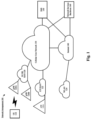
- Fig. 1 shows an exemplary network arrangement 100 according to various exemplary embodiments.
- the exemplary network arrangement 100 includes a UE 110.
- UE 110 may alternatively be any type of electronic component that is configured to communicate via a network, e.g., mobile phones, tablet computers, desktop computers, smartphones, phablets, embedded devices, wearables, Internet of Things (IoT) devices, etc.
- IoT Internet of Things
- an actual network arrangement may include any number of UEs being used by any number of users.
- the example of a single UE 110 is merely provided for illustrative purposes.
- the UE 110 may be configured to communicate with one or more networks.
- the networks with which the UE 110 may wirelessly communicate are a 5G New Radio (NR) radio access network (5G NR-RAN) 120, an LTE radio access network (LTE-RAN) 122 and a wireless local access network (WLAN) 124.
- NR 5G New Radio
- LTE-RAN LTE radio access network
- WLAN wireless local access network
- the UE 110 may also communicate with other types of networks and the UE 110 may also communicate with networks over a wired connection. Therefore, the UE 110 may include a 5G NR chipset to communicate with the 5G NR-RAN 120, an LTE chipset to communicate with the LTE-RAN 122 and an ISM chipset to communicate with the WLAN 124.
- the 5G NR-RAN 120 and the LTE-RAN 122 may be portions of cellular networks that may be deployed by cellular providers (e.g., Verizon, AT&T, Sprint, T-Mobile, etc.). These networks 120, 122 may include, for example, cells or base stations (Node Bs, eNodeBs, HeNBs, eNBS, gNBs, gNodeBs, macrocells, microcells, small cells, femtocells, etc.) that are configured to send and receive traffic from UE that are equipped with the appropriate cellular chip set.
- the WLAN 124 may include any type of wireless local area network (WiFi, Hot Spot, IEEE 802.11x networks, etc.).
- the UE 110 may connect to the 5G NR-RAN 120 via the gNB 120A and/or the gNB 120B. During operation, the UE 110 may be within range of a plurality of gNBs. Thus, either simultaneously or alternatively, the UE 110 may connect to the 5G NR-RAN 120 via the gNBs 120A and 120B. Further, the UE 110 may communicate with the eNB 122A of the LTE-RAN 122 to transmit and receive control information used for downlink and/or uplink synchronization with respect to the 5G NR-RAN 120 connection.
- any association procedure may be performed for the UE 110 to connect to the 5G NR-RAN 120.
- the 5G NR-RAN 120 may be associated with a particular cellular provider where the UE 110 and/or the user thereof has a contract and credential information (e.g., stored on a SIM card).
- the UE 110 may transmit the corresponding credential information to associate with the 5G NR-RAN 120.
- the UE 110 may associate with a specific base station (e.g., the gNB 120A of the 5G NR-RAN 120).
- the network arrangement 100 also includes a cellular core network 130, the Internet 140, an IP Multimedia Subsystem (IMS) 150, and a network services backbone 160.
- the cellular core network 130 may be considered to be the interconnected set of components that manages the operation and traffic of the cellular network, e.g. the 5GC for NR.
- the cellular core network 130 also manages the traffic that flows between the cellular network and the Internet 140.
- the IMS 150 may be generally described as an architecture for delivering multimedia services to the UE 110 using the IP protocol.
- the IMS 150 may communicate with the cellular core network 130 and the Internet 140 to provide the multimedia services to the UE 110.
- the network services backbone 160 is in communication either directly or indirectly with the Internet 140 and the cellular core network 130.
- the network services backbone 160 may be generally described as a set of components (e.g., servers, network storage arrangements, etc.) that implement a suite of services that may be used to extend the functionalities of the UE 110 in communication with the various networks.
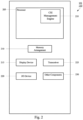
- Fig. 2 shows an exemplary UE 110 according to various exemplary embodiments.
- the UE 110 will be described with regard to the network arrangement 100 of Fig. 1 .
- the UE 110 may represent any electronic device and may include a processor 205, a memory arrangement 210, a display device 215, an input/output (I/O) device 220, a transceiver 225 and other components 230.
- the other components 230 may include, for example, an audio input device, an audio output device, a battery that provides a limited power supply, a data acquisition device, ports to electrically connect the UE 110 to other electronic devices, one or more antenna panels, etc.
- the UE 110 may be coupled to an industrial device via one or more ports.
- the processor 205 may be configured to execute a plurality of engines of the UE 110.
- the engines may include a CSI management engine 235.
- the CSI management engine 235 may perform various operations related to performing CSI measurements on a channel, determining a preferred TRP scheme, and providing a CSI report back to the network (e.g., via the gNB).
- the above referenced engine being an application (e.g., a program) executed by the processor 205 is only exemplary.
- the functionality associated with the engine may also be represented as a separate incorporated component of the UE 110 or may be a modular component coupled to the UE 110, e.g., an integrated circuit with or without firmware.
- the integrated circuit may include input circuitry to receive signals and processing circuitry to process the signals and other information.
- the engines may also be embodied as one application or separate applications.
- the functionality described for the processor 205 is split among two or more processors such as a baseband processor and an applications processor.
- the exemplary embodiments may be implemented in any of these or other configurations of a UE.
- the memory arrangement 210 may be a hardware component configured to store data related to operations performed by the UE 110.
- the display device 215 may be a hardware component configured to show data to a user while the I/O device 220 may be a hardware component that enables the user to enter inputs.
- the display device 215 and the I/O device 220 may be separate components or integrated together such as a touchscreen.
- the transceiver 225 may be a hardware component configured to establish a connection with the 5G NR-RAN 120, the LTE-RAN 122, the WLAN 124, etc. Accordingly, the transceiver 225 may operate on a variety of different frequencies or channels (e.g., set of consecutive frequencies).
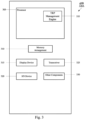
- Fig. 3 shows an exemplary network cell, in this case gNB 120A, according to various exemplary embodiments.
- the gNB 120A may represent any access node of the 5G NR network through which the UEs 110 may establish a connection.
- the gNB 120A illustrated in Fig. 3 may also represent the gNB 120B.
- the gNB 120A may include a processor 305, a memory arrangement 310, an input/output (I/O) device 320, a transceiver 325, and other components 330.
- the other components 330 may include, for example, a power supply, a data acquisition device, ports to electrically connect the gNB 120A to other electronic devices, etc.
- the processor 305 may be configured to execute a plurality of engines of the gNB 120A.
- the engines may include a TRP management engine 335 for performing operations including determining a TRP scheme for the UE 110 based on received TRP feedback from the UE. Examples of this process will be described in greater detail below.
- the above noted engine being an application (e.g., a program) executed by the processor 305 is only exemplary.
- the functionality associated with the engines may also be represented as a separate incorporated component of the gNB 120A or may be a modular component coupled to the gNB 120A, e.g., an integrated circuit with or without firmware.
- the integrated circuit may include input circuitry to receive signals and processing circuitry to process the signals and other information.
- the functionality described for the processor 305 is split among a plurality of processors (e.g., a baseband processor, an applications processor, etc.).
- the exemplary aspects may be implemented in any of these or other configurations of a gNB.
- the memory 310 may be a hardware component configured to store data related to operations performed by the UEs 110, 112.
- the I/O device 320 may be a hardware component or ports that enable a user to interact with the gNB 120A.
- the transceiver 325 may be a hardware component configured to exchange data with the UE 110 and any other UE in the system 100.
- the transceiver 325 may operate on a variety of different frequencies or channels (e.g., set of consecutive frequencies). Therefore, the transceiver 325 may include one or more components (e.g., radios) to enable the data exchange with the various networks and UEs.
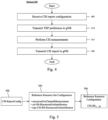
- Fig. 4 shows a method 400 of apprising a gNB of a UE's TRP preference according to various exemplary embodiments.
- the UE 110 receives a CSI report configuration from the gNB 120a (or 120b).
- the UE 110 transmits its TRP preference to the gNB 120a, as will be described in more detail below with respect to Fig. 5 .
- the UE 110 performs the CSI measurements.
- the UE 110 transmits the CSI report with the CSI measurements to the gNB 120a.
- the method 400 may be repeated to allow the UE 110 to report a change in TRP preference to the gNB 120a.
- Fig. 5 shows an exemplary diagram illustrating a CSI report hierarchy according to various exemplary embodiments.
- a CSI report configuration 502 is configured by the gNB 120a and send to the UE 110.
- multiple CSI report configurations 502 may be transmitted to the UE 110.
- Some CSI reports may correspond to single-TRP mode and other CSI reports may correspond to multi-TRP mode.
- the indication of which TRP mode a report corresponds to may either be implicitly or explicitly indicated in the report configuration.
- the UE 110 to apprise the gNB 120a of the UE's TRP preference, the UE 110 only performs the CSI measurements of the CSI reports corresponding to the desired TRP mode (e.g., multi-TRP mode).
- the remaining CSI reports corresponding to the other TRP mode are skipped.
- the UE 110 may alternatively report a reserved or invalid value for the CSI reports corresponding to the non-preferred TRP mode (instead of skipping those reports entirely).
- Each CSI report configuration 502 includes a reference resource set configuration 504.
- these resource sets may include channel measurement resources (CMR) (resourcesForChannelMeasurement), zero-power interference measurement resources (IMR) (csi-IM-ResourcesForInterference), and non-zero-power IMRs (nzp-RS-ResourcesForInterference).
- CMR channel measurement resources
- IMR zero-power interference measurement resources
- nzp-RS-ResourcesForInterference non-zero-power IMRs
- some resource sets correspond to the single-TRP mode and some sets correspond to the multi-TRP mode.
- the indication of which TRP mode a resource set corresponds to may either be implicitly or explicitly indicated in the report configuration.
- the UE 110 reports the reference resource set index of the preferred resource set.
- the reference resource set index identifies a particular resource set.
- the preferred resource set corresponds to a preferred TRP mode.
- the preferred reference resource set may also correspond to a preferred TRP.
- Each CSI reference resource set configuration 504 includes multiple (N) reference resource configurations 506 (CSI 1...N ).
- some resources correspond to the single-TRP mode and other resources correspond to the multi-TRP mode.
- the indication of which TRP mode a resource corresponds to may either be implicitly or explicitly indicated in the report configuration.
- the UE 110 reports the CSI-RS resource indicator (CRI) of the preferred resource set.
- the CRI identifies a particular resource from the configured resources.
- the preferred resource corresponds to a preferred TRP mode.
- the preferred reference resource may also correspond to a preferred TRP.
- the preferred reference resource may also correspond to a preferred TRP.
- the TRP-mode preference may alternatively be reported by the UE 110 to the gNB 120a at the port level.
- the CSI report configuration and CSI reference resource configuration may exceed the UE capability, which includes the maximum number of CSI processing units (CPUs) and the maximum number of active CSI-RS resources that the UE can handle simultaneously. This may be due to the fact that the gNB 120a requires the UE 110 to perform all CSI measurements regardless of whether the measurements correspond to single-TRP mode or multi-TRP mode.
- the UE 110 drops/omits CSI reports that the UE 110 cannot process.
- a priority rule may be defined for the dropping.
- the single TRP CSI reports may be prioritized over multi-TRP CSI reports.
- the multi-TRP CSI reports may alternatively be prioritized over single TRP CSI reports.
- the UE 110 may double count the number of CPUs that a multi-TRP CSI report will require due to the added complexity of multi-TRP CSI measurements compared to single TRP CSI measurements.
- a control resource set index (CORESETPoolIndex) is used to differentiate control from different TRPs.
- the CORESETPoolIndex (or other logic index) may be used to configure the TRP index for the CSI report configuration 502 (CSI-ReportConfig), the CSI reference resource set 504 (nzp-CSI-RS-ResourceSet) in each CSI report, and/or the CSI reference resource 506 (nzp-CSI-RS-Resource) in each resource set.
- CSI report configuration 502 CSI-ReportConfig
- nzp-CSI-RS-ResourceSet the CSI reference resource set 504
- the CSI reference resource 506 nzp-CSI-RS-Resource
- one (or more) CSI reference resource set may be configured for one TRP and one (or more) CSI reference resource set may be configured for another TRP.
- one (or more) CSI reference resource may be configured for one TRP and one (or more) CSI reference resource may be configured for another TRP.
- the UE 110 may alternatively report the index (report index, resource set index, or resource index) corresponding to the preferred TRP.
- the UE 110's reporting of a preferred TRP is considered dynamic point selection (DPS) and allows the UE 110 to switch between TRP modes and between TRPs.
- DPS dynamic point selection
- the UE 110 may report the Rank Indicator (RI), channel quality indicator (CQI) and precoding matrix indicator (PMI) for each TRP so that the gNB 120a has additional flexibility in selecting a TRP mode and/or a TRP.
- RI Rank Indicator
- CQI channel quality indicator
- PMI precoding matrix indicator
- the UE 110 may include a RI for each TRP in the CSI report.
- the UE 110 may alternatively perform joint encoding, as shown in Table 1 below, to reduce the payload size for the RI of the CSI report.
- Table 1 RI for TRP1 RI for TRP2 Joint RI 0 1 0 1 0 1 1 1 1 2 1 2 3 2 1 4 2 2 5
- An RI value of 0 indicates that the corresponding TRP is not preferred. Assuming the total number of layers per TRP that can be handled by the UE is four (4), in some embodiments, the difference between the RI for each TRP may be limited to 1 to reduce the total number of possible combinations of joint RI values. As a result, for two TRPs, the number of possible combinations is five, as shown in Table 1.
- RI restrictions may also be introduced based on the TRP mode.
- the RI restriction may be that the maximum RI for each TRP is two (2). This limits the total number of joint RI possibilities to eight.
- the RI restriction may be that the RI for each TRP must be equivalent to the RI for the other TRP. This limits the total number of joint RI possibilities to two (1,1 and 2,2).
- each TRP may be configured with an independent RI restriction.
- the RI restriction may be jointly configured for the multiple TRPs.
- Another parameter that the UE 110 reports to the gNB 120a in the CSI report is the PMI.
- the UE 110 may report multiple PMI values, each of which corresponds to a TRP.
- Yet another parameter that the UE 110 reports to the gNB 120a in the CSI report is the CQI.
- multiple CQI values may be reported, each of which corresponds to a TRP.
- the CQI values may be jointly encoded using differential encoding to reduce the reporting overhead.
- a single CQI value may be reported since a single transport block (TB) is being transmitted.
- the UE 110 in addition to reporting which TRP mode the UE 110 prefers, the UE 110 additionally indicates which scheme (SDMScheme, FDMSchemeA, FDMSchemeB, TDMSchemeA, Scheme4) of single-DCI based multi-TRP it prefers if the UE 110 prefers single-DCI based multi-TRP. Subsequently, the UE 110 may report the preferred PMI, CQI, RI, and CRI to the gNB 120a. Such a report may be a newly defined enhanced CSI report having a mode indicator quantity defined therein and transmitted via a physical uplink control channel (PUCCH) or a physical uplink shared channel (PUSCH). Alternatively, another type of report may be defined for reporting the preferred scheme. Since mode selection is semi-persistent, such a report may be transmitted to the UE 110 via a medium access control control element (MAC-CE) transmission or radio resource control (RRC) transmission.
- MAC-CE medium access control control element
- RRC radio resource control
- one or more processors are configured to perform operations comprising receiving, from a base station, at least one channel state information (CSI) report configuration, wherein each CSI report configuration includes at least one reference resource set configuration, wherein each reference resource set configuration includes at least one reference resource configuration and sending, to the base station, a transmission indicating whether the UE prefers a single transmission and reception point (TRP) mode or a multiple TRP (multi-TRP) mode.
- CSI channel state information
- the one or more processors of the first example wherein one or more of (a) the at least one CSI report configuration, (b) at least one reference resource set configuration, and (c) at least one reference resource configuration correspond to one of the single TRP mode or the multi-TRP mode.
- the one or more processors of the second example wherein the operations further comprise performing CSI measurements based on the at least one reference resource configuration, wherein the at least one CSI report configuration includes one or more CSI report configurations corresponding to the single TRP mode and one or more CSI configurations corresponding to the multi-TRP mode, wherein the CSI measurements correspond to the at least one CSI report configuration that corresponds to a preferred TRP mode, and wherein the transmission includes a CSI report including the CSI measurements.
- the one or more processors of the second example wherein the at least one reference resource set configuration includes one or more reference resource sets corresponding to the single TRP mode and one or more reference resource sets corresponding to the multi-TRP mode, and wherein the transmission includes a reference resource set index identifying one of the at least one reference resource set corresponding to a preferred TRP mode.
- the one or more processors of the second example wherein the at least one reference resource configuration includes one or more reference resources corresponding to the single TRP mode and one or more reference resources corresponding to the multi-TRP mode, and wherein the transmission includes a reference CSI resource indicator (CRI) identifying one of the at least one reference resource corresponding to a preferred TRP mode.
- CRI reference CSI resource indicator
- the one or more processors of the first example wherein when the at least one CSI report configuration includes a plurality of CSI report configurations that exceed a UE capability, the operations further comprise omitting one or more CSI reports corresponding to one or more of the plurality of CSI report configurations.
- the one or more processors of the sixth example wherein omitting the one or more CSI reports is based on a predetermined priority rule.
- the one or more processors of the sixth example wherein the UE capability is based on a maximum number of CSI processing units (CPUs) to process one or more CSI reports and a maximum number of resources that the UE can process simultaneously.
- CPUs CSI processing units
- the one or more processors of the eighth example wherein the number of CPUs required to process a multi-TRP report is doubled when determining how many CPUs are required to process a given CSI report.
- the one or more processors of the first example wherein the operations further comprise determining a CSI based on the at least one reference resource configuration and transmitting the CSI to the base station.
- the one or more processors of the tenth example, wherein transmitting the CSI includes transmitting a first CSI report corresponding to a first TRP and a second CSI report corresponding to a second TRP.
- the one or more processors of the tenth example, wherein transmitting the CSI includes transmitting a first CSI resource set corresponding to a first TRP and a second CSI resource set corresponding to a second TRP.
- the one or more processors of the tenth example, wherein transmitting the CSI includes transmitting a first CSI resource corresponding to a first TRP and a second CSI resource corresponding to a second TRP.
- the one or more processors of the first example wherein the operations further comprise transmitting a CSI report to the base station, wherein the CSI report includes at least one rank indicator (RI) corresponding to at least one TRP.
- RI rank indicator
- the one or more processors of the fourteenth example wherein an RI equal to zero indicates that the UE does not prefer the corresponding TRP.
- the one or more processors of the fourteenth example wherein the at least one RI includes a first RI corresponding to a first TRP and a second RI corresponding to a second TRP, and wherein the operations further comprise jointly encoding the first RI and the second RI to obtain a joint RI, wherein the joint RI is included in the CSI report.
- the one or more processors of the sixteenth example wherein a maximum difference between the first RI and the second RI is 1.
- the one or more processors of the sixteenth example wherein for a single downlink control information (DCI) based multi-TRP spatial domain multiplexing (SDM) mode, a maximum value for each RI is 2.
- DCI downlink control information
- SDM spatial domain multiplexing
- the one or more processors of the eighteenth example wherein for all single-DCI based multi-TRP modes, except the single-DCI based multi-TRP SDM mode, the first RI is equal to the second RI.
- the one or more processors of the first example wherein the operations further comprise transmitting a CSI report to the base station, wherein the CSI report includes at least one precoding matrix indicator (PMI) corresponding to at least one TRP.
- PMI precoding matrix indicator
- the one or more processors of the first example wherein the operations further comprise transmitting a CSI report to the base station, wherein the CSI report includes at least one channel quality indicator (CQI) corresponding to at least one TRP.
- CQI channel quality indicator
- the one or more processors of the twenty-first example wherein the at least one CQI includes a first CQI corresponding to a first TRP and a second CQI corresponding to a second TRP, and wherein for multi-DCI based multi-TRP reporting, the operations further comprise jointly encoding the first CQI and the second CQI using differential encoding.
- the one or more processors of the twenty-first example wherein for single-DCI based multi-TRP reporting, the at least one CQI is a single CQI.
- the one or more processors of the first example wherein the operations further comprise transmitting a single-DCI based multi-TRP scheme preference to the base station.
- An exemplary hardware platform for implementing the exemplary embodiments may include, for example, an Intel x86 based platform with compatible operating system, a Windows OS, a Mac platform and MAC OS, a mobile device having an operating system such as iOS, Android, etc.
- the exemplary embodiments of the above described method may be embodied as a program containing lines of code stored on a non-transitory computer readable storage medium that, when compiled, may be executed on a processor or microprocessor.
- personally identifiable information should follow privacy policies and practices that are generally recognized as meeting or exceeding industry or governmental requirements for maintaining the privacy of users.
- personally identifiable information data should be managed and handled so as to minimize risks of unintentional or unauthorized access or use, and the nature of authorized use should be clearly indicated to users.
Landscapes
- Engineering & Computer Science (AREA)
- Signal Processing (AREA)
- Computer Networks & Wireless Communication (AREA)
- Mobile Radio Communication Systems (AREA)
Priority Applications (1)
| Application Number | Priority Date | Filing Date | Title |
|---|---|---|---|
| EP23200493.7A EP4280669A3 (fr) | 2020-10-02 | 2020-10-02 | Rapport d'informations relatives à l'état du canal pour une opération de trp |
Applications Claiming Priority (3)
| Application Number | Priority Date | Filing Date | Title |
|---|---|---|---|
| PCT/CN2020/119797 WO2022067863A1 (fr) | 2020-10-02 | 2020-10-02 | Rapport d'informations relatives à l'état du canal pour une opération de trp |
| EP20955883.2A EP4205502A4 (fr) | 2020-10-02 | 2020-10-02 | Rapport d'informations relatives à l'état du canal pour une opération de trp |
| EP23200493.7A EP4280669A3 (fr) | 2020-10-02 | 2020-10-02 | Rapport d'informations relatives à l'état du canal pour une opération de trp |
Related Parent Applications (2)
| Application Number | Title | Priority Date | Filing Date |
|---|---|---|---|
| EP20955883.2A Division EP4205502A4 (fr) | 2020-10-02 | 2020-10-02 | Rapport d'informations relatives à l'état du canal pour une opération de trp |
| EP20955883.2A Division-Into EP4205502A4 (fr) | 2020-10-02 | 2020-10-02 | Rapport d'informations relatives à l'état du canal pour une opération de trp |
Publications (2)
| Publication Number | Publication Date |
|---|---|
| EP4280669A2 true EP4280669A2 (fr) | 2023-11-22 |
| EP4280669A3 EP4280669A3 (fr) | 2024-02-21 |
Family
ID=80949507
Family Applications (2)
| Application Number | Title | Priority Date | Filing Date |
|---|---|---|---|
| EP20955883.2A Pending EP4205502A4 (fr) | 2020-10-02 | 2020-10-02 | Rapport d'informations relatives à l'état du canal pour une opération de trp |
| EP23200493.7A Pending EP4280669A3 (fr) | 2020-10-02 | 2020-10-02 | Rapport d'informations relatives à l'état du canal pour une opération de trp |
Family Applications Before (1)
| Application Number | Title | Priority Date | Filing Date |
|---|---|---|---|
| EP20955883.2A Pending EP4205502A4 (fr) | 2020-10-02 | 2020-10-02 | Rapport d'informations relatives à l'état du canal pour une opération de trp |
Country Status (4)
| Country | Link |
|---|---|
| US (2) | US20230379031A1 (fr) |
| EP (2) | EP4205502A4 (fr) |
| CN (2) | CN116326194A (fr) |
| WO (1) | WO2022067863A1 (fr) |
Families Citing this family (6)
| Publication number | Priority date | Publication date | Assignee | Title |
|---|---|---|---|---|
| EP4238226A1 (fr) * | 2020-10-30 | 2023-09-06 | Lenovo (Singapore) Pte. Ltd. | Configuration d'un rapport d'informations d'état de canal |
| WO2023236812A1 (fr) * | 2022-06-10 | 2023-12-14 | Mediatek Inc. | Procédé et appareil d'adaptation d'émetteur-récepteur pour économie d'énergie de réseau |
| US20240057161A1 (en) * | 2022-08-12 | 2024-02-15 | Nokia Technologies Oy | Channel measurement and reporting for multi-trp |
| CN121014231A (zh) * | 2023-03-30 | 2025-11-25 | 中兴通讯股份有限公司 | 信道状态信息处理单元 |
| US12531615B2 (en) * | 2023-08-12 | 2026-01-20 | Sharp Kabushiki Kaisha | Channel state information processing in communication networks |
| CN120568470A (zh) * | 2024-02-29 | 2025-08-29 | 维沃移动通信有限公司 | 信道状态信息csi的上报方法、通信装置和通信设备 |
Family Cites Families (16)
| Publication number | Priority date | Publication date | Assignee | Title |
|---|---|---|---|---|
| US10720972B2 (en) * | 2015-09-24 | 2020-07-21 | Lg Electronics Inc. | Method for transmitting and receiving channel state information in wireless communication system and device therefor |
| CN107689843A (zh) * | 2016-08-05 | 2018-02-13 | 北京信威通信技术股份有限公司 | 反馈方法及装置 |
| CN108282212B (zh) * | 2017-01-06 | 2022-06-14 | 华为技术有限公司 | 一种信道状态信息处理的方法、装置和系统 |
| US10637705B1 (en) * | 2017-05-25 | 2020-04-28 | Genghiscomm Holdings, LLC | Peak-to-average-power reduction for OFDM multiple access |
| US11336354B2 (en) * | 2017-06-15 | 2022-05-17 | Lg Electronics Inc. | Channel state information reporting method in wireless communication system and device therefor |
| AU2018285662B2 (en) * | 2017-06-16 | 2020-11-05 | Telefonaktiebolaget Lm Ericsson (Publ) | Channel state information for reference signals in a wireless communication system |
| CN118200964A (zh) * | 2018-03-29 | 2024-06-14 | 中兴通讯股份有限公司 | 一种无线通信方法、装置及计算机可读程序存储介质 |
| US11552687B2 (en) * | 2018-06-15 | 2023-01-10 | Nec Corporation | CSI reporting for multiple TRP transmission/panel |
| US11013003B2 (en) * | 2018-08-03 | 2021-05-18 | Qualcomm Incorporated | Configuring a user equipment to operate in a transmission/reception point (TRP) mode |
| WO2020051922A1 (fr) * | 2018-09-15 | 2020-03-19 | Qualcomm Incorporated | Csi pour transmission conjointe non cohérente |
| EP4593318A3 (fr) * | 2018-11-02 | 2025-08-20 | Telefonaktiebolaget LM Ericsson (publ) | Rétroaction csi pour transmission de données sur de multiples points de transmission |
| CN111416644B (zh) * | 2019-01-07 | 2021-11-09 | 中国移动通信有限公司研究院 | 一种csi报告方法、配置方法、终端及网络侧设备 |
| US11405884B2 (en) * | 2019-02-14 | 2022-08-02 | Qualcomm Incorporated | Multi-level configuration and reporting for positioning in new radio |
| US11652526B2 (en) * | 2019-04-30 | 2023-05-16 | Ofinno, Llc | Channel state information feedback for multiple transmission reception points |
| US11929805B2 (en) * | 2019-07-26 | 2024-03-12 | Ofinno, Llc | Channel state information reporting for non-coherent joint transmission |
| US12224830B2 (en) * | 2020-04-08 | 2025-02-11 | Apple Inc. | Channel state information feedback in wireless communications |
-
2020
- 2020-10-02 CN CN202080105797.5A patent/CN116326194A/zh active Pending
- 2020-10-02 US US18/247,205 patent/US20230379031A1/en active Pending
- 2020-10-02 WO PCT/CN2020/119797 patent/WO2022067863A1/fr not_active Ceased
- 2020-10-02 EP EP20955883.2A patent/EP4205502A4/fr active Pending
- 2020-10-02 CN CN202311275506.9A patent/CN117097453A/zh active Pending
- 2020-10-02 EP EP23200493.7A patent/EP4280669A3/fr active Pending
-
2023
- 2023-09-27 US US18/475,652 patent/US20240022301A1/en active Pending
Also Published As
| Publication number | Publication date |
|---|---|
| EP4280669A3 (fr) | 2024-02-21 |
| CN117097453A (zh) | 2023-11-21 |
| US20230379031A1 (en) | 2023-11-23 |
| WO2022067863A1 (fr) | 2022-04-07 |
| EP4205502A4 (fr) | 2023-11-08 |
| CN116326194A (zh) | 2023-06-23 |
| EP4205502A1 (fr) | 2023-07-05 |
| US20240022301A1 (en) | 2024-01-18 |
Similar Documents
| Publication | Publication Date | Title |
|---|---|---|
| US20240022301A1 (en) | Channel State Information Reporting for TRP Operation | |
| US11937098B2 (en) | Spatial relation and pathloss reference signal for multi-TRP operation | |
| US12219545B2 (en) | Multi-TRP beam indication using TCI state | |
| US20260012240A1 (en) | Channel State Information Report for Multi-TRP Operation | |
| US12580620B2 (en) | UE capability-based CSI report configuration | |
| US12463787B2 (en) | SRS signaling in 5G new radio wireless communications | |
| US12562827B2 (en) | Determining default beam and QCL collision handling | |
| US12375959B2 (en) | Transmission and reception point configuration | |
| US20240195482A1 (en) | Machine Learning-Based Beam Selection | |
| WO2022056674A1 (fr) | Rapport de fluctuations de puissance d'interférence et de bruit | |
| US20250260451A1 (en) | Semi-Persistent Channel State Information (SP-CSI) Enhancement | |
| EP4131834A1 (fr) | Signalisation srs dans de nouvelles communications sans fil radio 5g |
Legal Events
| Date | Code | Title | Description |
|---|---|---|---|
| PUAI | Public reference made under article 153(3) epc to a published international application that has entered the european phase |
Free format text: ORIGINAL CODE: 0009012 |
|
| STAA | Information on the status of an ep patent application or granted ep patent |
Free format text: STATUS: REQUEST FOR EXAMINATION WAS MADE |
|
| 17P | Request for examination filed |
Effective date: 20230928 |
|
| AC | Divisional application: reference to earlier application |
Ref document number: 4205502 Country of ref document: EP Kind code of ref document: P |
|
| AK | Designated contracting states |
Kind code of ref document: A2 Designated state(s): AL AT BE BG CH CY CZ DE DK EE ES FI FR GB GR HR HU IE IS IT LI LT LU LV MC MK MT NL NO PL PT RO RS SE SI SK SM TR |
|
| REG | Reference to a national code |
Ref country code: DE Ref legal event code: R079 Free format text: PREVIOUS MAIN CLASS: H04W0024100000 Ipc: H04L0005000000 |
|
| PUAL | Search report despatched |
Free format text: ORIGINAL CODE: 0009013 |
|
| AK | Designated contracting states |
Kind code of ref document: A3 Designated state(s): AL AT BE BG CH CY CZ DE DK EE ES FI FR GB GR HR HU IE IS IT LI LT LU LV MC MK MT NL NO PL PT RO RS SE SI SK SM TR |
|
| RIC1 | Information provided on ipc code assigned before grant |
Ipc: H04W 88/06 20090101ALN20240116BHEP Ipc: H04W 24/10 20090101ALI20240116BHEP Ipc: H04L 5/00 20060101AFI20240116BHEP |
|
| STAA | Information on the status of an ep patent application or granted ep patent |
Free format text: STATUS: EXAMINATION IS IN PROGRESS |
|
| 17Q | First examination report despatched |
Effective date: 20260310 |