EP4284149A2 - Verfahren und mechanismen zur aufrechterhaltung eines elektroaktiven polymers in einem vorstreckzustand und verwendungen davon - Google Patents
Verfahren und mechanismen zur aufrechterhaltung eines elektroaktiven polymers in einem vorstreckzustand und verwendungen davon Download PDFInfo
- Publication number
- EP4284149A2 EP4284149A2 EP23195546.9A EP23195546A EP4284149A2 EP 4284149 A2 EP4284149 A2 EP 4284149A2 EP 23195546 A EP23195546 A EP 23195546A EP 4284149 A2 EP4284149 A2 EP 4284149A2
- Authority
- EP
- European Patent Office
- Prior art keywords
- electro
- active polymer
- stretched
- polymer film
- eap
- Prior art date
- Legal status (The legal status is an assumption and is not a legal conclusion. Google has not performed a legal analysis and makes no representation as to the accuracy of the status listed.)
- Pending
Links
Images






Classifications
-
- H—ELECTRICITY
- H05—ELECTRIC TECHNIQUES NOT OTHERWISE PROVIDED FOR
- H05K—PRINTED CIRCUITS; CASINGS OR CONSTRUCTIONAL DETAILS OF ELECTRIC APPARATUS; MANUFACTURE OF ASSEMBLAGES OF ELECTRICAL COMPONENTS
- H05K3/00—Apparatus or processes for manufacturing printed circuits
- H05K3/10—Apparatus or processes for manufacturing printed circuits in which conductive material is applied to the insulating support in such a manner as to form the desired conductive pattern
- H05K3/20—Apparatus or processes for manufacturing printed circuits in which conductive material is applied to the insulating support in such a manner as to form the desired conductive pattern by affixing prefabricated conductor pattern
- H05K3/207—Apparatus or processes for manufacturing printed circuits in which conductive material is applied to the insulating support in such a manner as to form the desired conductive pattern by affixing prefabricated conductor pattern using a prefabricated paste pattern, ink pattern or powder pattern
-
- B—PERFORMING OPERATIONS; TRANSPORTING
- B32—LAYERED PRODUCTS
- B32B—LAYERED PRODUCTS, i.e. PRODUCTS BUILT-UP OF STRATA OF FLAT OR NON-FLAT, e.g. CELLULAR OR HONEYCOMB, FORM
- B32B27/00—Layered products comprising a layer of synthetic resin
- B32B27/06—Layered products comprising a layer of synthetic resin as the main or only constituent of a layer, which is next to another layer of the same or of a different material
- B32B27/08—Layered products comprising a layer of synthetic resin as the main or only constituent of a layer, which is next to another layer of the same or of a different material of synthetic resin
-
- A—HUMAN NECESSITIES
- A61—MEDICAL OR VETERINARY SCIENCE; HYGIENE
- A61F—FILTERS IMPLANTABLE INTO BLOOD VESSELS; PROSTHESES; DEVICES PROVIDING PATENCY TO, OR PREVENTING COLLAPSING OF, TUBULAR STRUCTURES OF THE BODY, e.g. STENTS; ORTHOPAEDIC, NURSING OR CONTRACEPTIVE DEVICES; FOMENTATION; TREATMENT OR PROTECTION OF EYES OR EARS; BANDAGES, DRESSINGS OR ABSORBENT PADS; FIRST-AID KITS
- A61F13/00—Bandages or dressings; Absorbent pads
- A61F13/06—Bandages or dressings; Absorbent pads specially adapted for feet or legs; Corn-pads; Corn-rings
- A61F13/08—Elastic stockings; for contracting aneurisms
- A61F13/085—Openable readjustable
-
- B—PERFORMING OPERATIONS; TRANSPORTING
- B29—WORKING OF PLASTICS; WORKING OF SUBSTANCES IN A PLASTIC STATE IN GENERAL
- B29C—SHAPING OR JOINING OF PLASTICS; SHAPING OF MATERIAL IN A PLASTIC STATE, NOT OTHERWISE PROVIDED FOR; AFTER-TREATMENT OF THE SHAPED PRODUCTS, e.g. REPAIRING
- B29C53/00—Shaping by bending, folding, twisting, straightening or flattening; Apparatus therefor
- B29C53/02—Bending or folding
- B29C53/04—Bending or folding of plates or sheets
-
- B—PERFORMING OPERATIONS; TRANSPORTING
- B29—WORKING OF PLASTICS; WORKING OF SUBSTANCES IN A PLASTIC STATE IN GENERAL
- B29C—SHAPING OR JOINING OF PLASTICS; SHAPING OF MATERIAL IN A PLASTIC STATE, NOT OTHERWISE PROVIDED FOR; AFTER-TREATMENT OF THE SHAPED PRODUCTS, e.g. REPAIRING
- B29C55/00—Shaping by stretching, e.g. drawing through a die; Apparatus therefor
- B29C55/02—Shaping by stretching, e.g. drawing through a die; Apparatus therefor of plates or sheets
- B29C55/10—Shaping by stretching, e.g. drawing through a die; Apparatus therefor of plates or sheets multiaxial
- B29C55/12—Shaping by stretching, e.g. drawing through a die; Apparatus therefor of plates or sheets multiaxial biaxial
- B29C55/14—Shaping by stretching, e.g. drawing through a die; Apparatus therefor of plates or sheets multiaxial biaxial successively
-
- B—PERFORMING OPERATIONS; TRANSPORTING
- B32—LAYERED PRODUCTS
- B32B—LAYERED PRODUCTS, i.e. PRODUCTS BUILT-UP OF STRATA OF FLAT OR NON-FLAT, e.g. CELLULAR OR HONEYCOMB, FORM
- B32B3/00—Layered products comprising a layer with external or internal discontinuities or unevennesses, or a layer of non-planar shape; Layered products comprising a layer having particular features of form
- B32B3/02—Layered products comprising a layer with external or internal discontinuities or unevennesses, or a layer of non-planar shape; Layered products comprising a layer having particular features of form characterised by features of form at particular places, e.g. in edge regions
- B32B3/06—Layered products comprising a layer with external or internal discontinuities or unevennesses, or a layer of non-planar shape; Layered products comprising a layer having particular features of form characterised by features of form at particular places, e.g. in edge regions for securing layers together; for attaching the product to another member, e.g. to a support, or to another product, e.g. groove/tongue, interlocking
-
- B—PERFORMING OPERATIONS; TRANSPORTING
- B32—LAYERED PRODUCTS
- B32B—LAYERED PRODUCTS, i.e. PRODUCTS BUILT-UP OF STRATA OF FLAT OR NON-FLAT, e.g. CELLULAR OR HONEYCOMB, FORM
- B32B3/00—Layered products comprising a layer with external or internal discontinuities or unevennesses, or a layer of non-planar shape; Layered products comprising a layer having particular features of form
- B32B3/02—Layered products comprising a layer with external or internal discontinuities or unevennesses, or a layer of non-planar shape; Layered products comprising a layer having particular features of form characterised by features of form at particular places, e.g. in edge regions
- B32B3/08—Layered products comprising a layer with external or internal discontinuities or unevennesses, or a layer of non-planar shape; Layered products comprising a layer having particular features of form characterised by features of form at particular places, e.g. in edge regions characterised by added members at particular parts
-
- H—ELECTRICITY
- H05—ELECTRIC TECHNIQUES NOT OTHERWISE PROVIDED FOR
- H05K—PRINTED CIRCUITS; CASINGS OR CONSTRUCTIONAL DETAILS OF ELECTRIC APPARATUS; MANUFACTURE OF ASSEMBLAGES OF ELECTRICAL COMPONENTS
- H05K3/00—Apparatus or processes for manufacturing printed circuits
- H05K3/0011—Working of insulating substrates or insulating layers
- H05K3/0044—Mechanical working of the substrate, e.g. drilling or punching
-
- H—ELECTRICITY
- H05—ELECTRIC TECHNIQUES NOT OTHERWISE PROVIDED FOR
- H05K—PRINTED CIRCUITS; CASINGS OR CONSTRUCTIONAL DETAILS OF ELECTRIC APPARATUS; MANUFACTURE OF ASSEMBLAGES OF ELECTRICAL COMPONENTS
- H05K3/00—Apparatus or processes for manufacturing printed circuits
- H05K3/10—Apparatus or processes for manufacturing printed circuits in which conductive material is applied to the insulating support in such a manner as to form the desired conductive pattern
- H05K3/103—Apparatus or processes for manufacturing printed circuits in which conductive material is applied to the insulating support in such a manner as to form the desired conductive pattern by bonding or embedding conductive wires or strips
-
- H—ELECTRICITY
- H10—SEMICONDUCTOR DEVICES; ELECTRIC SOLID-STATE DEVICES NOT OTHERWISE PROVIDED FOR
- H10N—ELECTRIC SOLID-STATE DEVICES NOT OTHERWISE PROVIDED FOR
- H10N30/00—Piezoelectric or electrostrictive devices
- H10N30/01—Manufacture or treatment
- H10N30/04—Treatments to modify a piezoelectric or electrostrictive property, e.g. polarisation characteristics, vibration characteristics or mode tuning
-
- H—ELECTRICITY
- H10—SEMICONDUCTOR DEVICES; ELECTRIC SOLID-STATE DEVICES NOT OTHERWISE PROVIDED FOR
- H10N—ELECTRIC SOLID-STATE DEVICES NOT OTHERWISE PROVIDED FOR
- H10N30/00—Piezoelectric or electrostrictive devices
- H10N30/01—Manufacture or treatment
- H10N30/06—Forming electrodes or interconnections, e.g. leads or terminals
-
- H—ELECTRICITY
- H10—SEMICONDUCTOR DEVICES; ELECTRIC SOLID-STATE DEVICES NOT OTHERWISE PROVIDED FOR
- H10N—ELECTRIC SOLID-STATE DEVICES NOT OTHERWISE PROVIDED FOR
- H10N30/00—Piezoelectric or electrostrictive devices
- H10N30/80—Constructional details
- H10N30/85—Piezoelectric or electrostrictive active materials
- H10N30/857—Macromolecular compositions
-
- H—ELECTRICITY
- H10—SEMICONDUCTOR DEVICES; ELECTRIC SOLID-STATE DEVICES NOT OTHERWISE PROVIDED FOR
- H10N—ELECTRIC SOLID-STATE DEVICES NOT OTHERWISE PROVIDED FOR
- H10N30/00—Piezoelectric or electrostrictive devices
- H10N30/80—Constructional details
- H10N30/87—Electrodes or interconnections, e.g. leads or terminals
- H10N30/877—Conductive materials
- H10N30/878—Conductive materials the principal material being non-metallic, e.g. oxide or carbon based
-
- H—ELECTRICITY
- H10—SEMICONDUCTOR DEVICES; ELECTRIC SOLID-STATE DEVICES NOT OTHERWISE PROVIDED FOR
- H10N—ELECTRIC SOLID-STATE DEVICES NOT OTHERWISE PROVIDED FOR
- H10N30/00—Piezoelectric or electrostrictive devices
- H10N30/80—Constructional details
- H10N30/88—Mounts; Supports; Enclosures; Casings
-
- H—ELECTRICITY
- H10—SEMICONDUCTOR DEVICES; ELECTRIC SOLID-STATE DEVICES NOT OTHERWISE PROVIDED FOR
- H10N—ELECTRIC SOLID-STATE DEVICES NOT OTHERWISE PROVIDED FOR
- H10N30/00—Piezoelectric or electrostrictive devices
- H10N30/80—Constructional details
- H10N30/88—Mounts; Supports; Enclosures; Casings
- H10N30/886—Additional mechanical prestressing means, e.g. springs
-
- A—HUMAN NECESSITIES
- A61—MEDICAL OR VETERINARY SCIENCE; HYGIENE
- A61B—DIAGNOSIS; SURGERY; IDENTIFICATION
- A61B17/00—Surgical instruments, devices or methods
- A61B17/12—Surgical instruments, devices or methods for ligaturing or otherwise compressing tubular parts of the body, e.g. blood vessels or umbilical cord
- A61B17/132—Tourniquets
- A61B17/1322—Tourniquets comprising a flexible encircling member
-
- A—HUMAN NECESSITIES
- A61—MEDICAL OR VETERINARY SCIENCE; HYGIENE
- A61B—DIAGNOSIS; SURGERY; IDENTIFICATION
- A61B17/00—Surgical instruments, devices or methods
- A61B2017/00367—Details of actuation of instruments, e.g. relations between pushing buttons, or the like, and activation of the tool, working tip, or the like
- A61B2017/00398—Details of actuation of instruments, e.g. relations between pushing buttons, or the like, and activation of the tool, working tip, or the like using powered actuators, e.g. stepper motors, solenoids
- A61B2017/00402—Piezo electric actuators
-
- B—PERFORMING OPERATIONS; TRANSPORTING
- B32—LAYERED PRODUCTS
- B32B—LAYERED PRODUCTS, i.e. PRODUCTS BUILT-UP OF STRATA OF FLAT OR NON-FLAT, e.g. CELLULAR OR HONEYCOMB, FORM
- B32B2255/00—Coating on the layer surface
- B32B2255/10—Coating on the layer surface on synthetic resin layer or on natural or synthetic rubber layer
-
- B—PERFORMING OPERATIONS; TRANSPORTING
- B32—LAYERED PRODUCTS
- B32B—LAYERED PRODUCTS, i.e. PRODUCTS BUILT-UP OF STRATA OF FLAT OR NON-FLAT, e.g. CELLULAR OR HONEYCOMB, FORM
- B32B2264/00—Composition or properties of particles which form a particulate layer or are present as additives
- B32B2264/10—Inorganic particles
- B32B2264/105—Metal
-
- B—PERFORMING OPERATIONS; TRANSPORTING
- B32—LAYERED PRODUCTS
- B32B—LAYERED PRODUCTS, i.e. PRODUCTS BUILT-UP OF STRATA OF FLAT OR NON-FLAT, e.g. CELLULAR OR HONEYCOMB, FORM
- B32B2264/00—Composition or properties of particles which form a particulate layer or are present as additives
- B32B2264/10—Inorganic particles
- B32B2264/107—Ceramic
- B32B2264/108—Carbon, e.g. graphite particles
-
- B—PERFORMING OPERATIONS; TRANSPORTING
- B32—LAYERED PRODUCTS
- B32B—LAYERED PRODUCTS, i.e. PRODUCTS BUILT-UP OF STRATA OF FLAT OR NON-FLAT, e.g. CELLULAR OR HONEYCOMB, FORM
- B32B2307/00—Properties of the layers or laminate
- B32B2307/20—Properties of the layers or laminate having particular electrical or magnetic properties, e.g. piezoelectric
- B32B2307/202—Conductive
-
- B—PERFORMING OPERATIONS; TRANSPORTING
- B32—LAYERED PRODUCTS
- B32B—LAYERED PRODUCTS, i.e. PRODUCTS BUILT-UP OF STRATA OF FLAT OR NON-FLAT, e.g. CELLULAR OR HONEYCOMB, FORM
- B32B2307/00—Properties of the layers or laminate
- B32B2307/50—Properties of the layers or laminate having particular mechanical properties
- B32B2307/514—Oriented
-
- B—PERFORMING OPERATIONS; TRANSPORTING
- B32—LAYERED PRODUCTS
- B32B—LAYERED PRODUCTS, i.e. PRODUCTS BUILT-UP OF STRATA OF FLAT OR NON-FLAT, e.g. CELLULAR OR HONEYCOMB, FORM
- B32B2307/00—Properties of the layers or laminate
- B32B2307/50—Properties of the layers or laminate having particular mechanical properties
- B32B2307/514—Oriented
- B32B2307/518—Oriented bi-axially
-
- B—PERFORMING OPERATIONS; TRANSPORTING
- B32—LAYERED PRODUCTS
- B32B—LAYERED PRODUCTS, i.e. PRODUCTS BUILT-UP OF STRATA OF FLAT OR NON-FLAT, e.g. CELLULAR OR HONEYCOMB, FORM
- B32B2307/00—Properties of the layers or laminate
- B32B2307/50—Properties of the layers or laminate having particular mechanical properties
- B32B2307/582—Tearability
- B32B2307/5825—Tear resistant
-
- B—PERFORMING OPERATIONS; TRANSPORTING
- B32—LAYERED PRODUCTS
- B32B—LAYERED PRODUCTS, i.e. PRODUCTS BUILT-UP OF STRATA OF FLAT OR NON-FLAT, e.g. CELLULAR OR HONEYCOMB, FORM
- B32B2307/00—Properties of the layers or laminate
- B32B2307/70—Other properties
- B32B2307/75—Printability
-
- B—PERFORMING OPERATIONS; TRANSPORTING
- B32—LAYERED PRODUCTS
- B32B—LAYERED PRODUCTS, i.e. PRODUCTS BUILT-UP OF STRATA OF FLAT OR NON-FLAT, e.g. CELLULAR OR HONEYCOMB, FORM
- B32B2535/00—Medical equipment, e.g. bandage, prostheses or catheter
-
- H—ELECTRICITY
- H05—ELECTRIC TECHNIQUES NOT OTHERWISE PROVIDED FOR
- H05K—PRINTED CIRCUITS; CASINGS OR CONSTRUCTIONAL DETAILS OF ELECTRIC APPARATUS; MANUFACTURE OF ASSEMBLAGES OF ELECTRICAL COMPONENTS
- H05K2203/00—Indexing scheme relating to apparatus or processes for manufacturing printed circuits covered by H05K3/00
- H05K2203/12—Using specific substances
-
- H—ELECTRICITY
- H05—ELECTRIC TECHNIQUES NOT OTHERWISE PROVIDED FOR
- H05K—PRINTED CIRCUITS; CASINGS OR CONSTRUCTIONAL DETAILS OF ELECTRIC APPARATUS; MANUFACTURE OF ASSEMBLAGES OF ELECTRICAL COMPONENTS
- H05K2203/00—Indexing scheme relating to apparatus or processes for manufacturing printed circuits covered by H05K3/00
- H05K2203/16—Inspection; Monitoring; Aligning
- H05K2203/163—Monitoring a manufacturing process
-
- Y—GENERAL TAGGING OF NEW TECHNOLOGICAL DEVELOPMENTS; GENERAL TAGGING OF CROSS-SECTIONAL TECHNOLOGIES SPANNING OVER SEVERAL SECTIONS OF THE IPC; TECHNICAL SUBJECTS COVERED BY FORMER USPC CROSS-REFERENCE ART COLLECTIONS [XRACs] AND DIGESTS
- Y02—TECHNOLOGIES OR APPLICATIONS FOR MITIGATION OR ADAPTATION AGAINST CLIMATE CHANGE
- Y02E—REDUCTION OF GREENHOUSE GAS [GHG] EMISSIONS, RELATED TO ENERGY GENERATION, TRANSMISSION OR DISTRIBUTION
- Y02E60/00—Enabling technologies; Technologies with a potential or indirect contribution to GHG emissions mitigation
- Y02E60/10—Energy storage using batteries
Definitions
- the present invention relates to methods and mechanisms thereof for maintaining electro-active polymers film in a pre-stretch state.
- electro-active polymers are polymers that exhibit a change in size or shape when stimulated by an electric field.
- the present invention is directed to a method that at least includes one or more of the following steps of: a) mechanically pre-stretching an electro-active polymer film in a single or biaxial directions to form a pre-stretched electro-active polymer film; b) attaching a first semi-stiff conductor to a first surface of the electro-active polymer film and a second semi-stiff conductor to a second surface, each semi-stiff conductor is configured to fix the electro-active polymer film in a pre-stretched state; and c) coupling a pair of mechanical connectors at each end of the active region.
- a stretchable conductor is attached to the electro-active polymer (EAP) film which is, then, wrapped around a solid body.
- the EAP actuator can be covered on at least one side of the film by an isolating layer, which is configured to resist the voltage that is applied on the EAP film.
- the isolating layer can prevent voltage breakthrough from the EAP actuator and the solid body.
- the required pre-stretch in a single axis of the EAP film can be determined by a visual indicator, e.g. a hills and valley pattern with a solid strap or by pre-arranged guide lines or any other kind of visual indicator.
- the film is attached to a solid mechanism that fixes the film in a pre-stretch state in a single axis, while allowing it to expand and be wrapped around a solid body on the other axis.
- the solid mechanism can be parallel solid plastic straps attached to the electro active polymer film.
- the plastic straps used to fix the pre-stretched film in a single axis can also be used to prevent the film from contracting in the other axis, by attaching holders that keep the plastic straps at a minimal distance, while allowing them to expand.
- the attachment of the solid mechanism can be made by gluing and/or any other similarly method(s) of attachment.
- the attaching of a conductor is performed by at least one methodology selected from the group consisting of printing, etching, brushing, water dispersion, gluing, and any combination thereof.
- the instant method further includes: folding the electro-active polymer X times, wherein X is between 2 and 10,000.
- the conductor is selected from the group consisting of a stretchable conductor, a rigid conductor in an expanding pattern, a printed conductor in an expanding pattern and any combination thereof.
- the printed conductor is made from at least one of a conducting silver ink, a conducting carbon ink, and any combination thereof.
- the stretchable conductor is made from networks of gold or carbon nano-particles embedded in elastic polyurethane.
- the stretchable conductor is made from carbon graphite powder with silicon oil, conducting silicon grease, Polyaniline (PAni) based solution, carbon black powder, conducting polymer, conductive rubber and any combination thereof.
- the expanding pattern is one of a zigzag pattern, and expanding diamond pattern.
- the present invention is directed to an actuator that at least includes: a) at least one active region, having at least one electro-active polymer layer; b) at least two conducting layers arranged on the surface of the electro-active polymer layer such that each conducting layer is attached on each surface side of the electro-active polymer layer in an expanding pattern after pre-stretching of the electro-active polymer layer, thereby maintaining the electro-active polymer layer in a pre-stretched state; and c) a pair of mechanical connectors at either end of the active region, wherein a positive connector is operably connected to one end of the at least one active region, and a negative connector is operably connected to the other end of the at least one active region.
- the actuator further includes at least one strain measuring mechanism for monitoring strain feedback for the at least one active region, whereby turning the actuator into a transducer, meaning that mechanically stretching the actuator, creates an electric charge. In some embodiments, measuring the strain is based on measuring the electric charge while stretching and contracting the actuator. In some embodiments, the actuator further includes at least one strain measuring mechanism for monitoring strain feedback for the at least one active region, whereby measuring the capacitance of the actuator can be translated to measuring the actuator's strain.
- the electro-active polymer layer is mechanically pre-stretched during a fabrication. In some embodiments, the expanding pattern is a zigzag pattern.
- each conducting layer is a stretchable conductor. In some embodiments, a thickness of the electro-active polymer layer is between 10 um-5 mm. In some embodiments, the electro-active polymer is folded. In some embodiments, each conducting layer is printed or etched to the electro-active polymer.
- the EAP actuator can be used for the construction of an active compression bandage, including of: a bandage, which is placed on a body part of an animal or a human being.
- the active compression bandage can be placed on, for example, but not limited to, a leg, a calf, a foot, a hand or an arm.
- the bandage is fixed on the body part, by using between 1 to 20 elastic straps, which are wrapped around the body part, and are connected to the bandage by Velcro, clip-on buttons, buttons, zipper, sewing or any other similar fixation method.
- the elastic straps are stretched when wrapped around the body part.
- the bandage and the elastic straps are threaded with EAP actuators.
- the EAP actuators are pre-stretched, and, then, are fixed in a pre-stretch state.
- the bandage is connected to a control box, which activates and controls the EAP actuators activation.
- the control box at least includes: a battery or a connection to a power socket and an electrical circuit, which transforms the battery or the connection to a power socket output voltage to the required voltage for the EAP and activates and de-activates the EAP actuators, by applying voltage on each actuator, separately or simultaneously, according to a pre-determined sequence.
- the control box can also measure the expansion of the EAP actuator.
- EAP Electro-Active Polymer
- EAP electro-active polymer
- EAP electro-active polymer
- 3M TM VHB TM 4910, 4905, 4955, 4959 or 9460 Tape Dow Corning TM or Nusil TM silicon elastomer, Elastosil or Silpuran film by Wacker, or any other suitable silicon or acrylic dielectric elastomer.
- a “conductor” refers to an object or type of material that allows the flow of electrical current in one or more directions.
- the present invention provides a method for keeping the electro-active polymer film in a pre-stretched state/condition on a single axis, by wrapping and fixing it around a solid body, e.g. a human body part.
- the instant method of the present invention at least includes: a) mechanically pre-stretching an electro-active polymer film in a single or biaxial directions to form a pre-stretched electro-active polymer film; b) attaching a semi-stiff conductor to both surfaces of the electro-active polymer film, the semi-stiff conductor is configured to fix the electro-active polymer film in a pre-stretched state; and c) coupling a pair of mechanical connectors at each end of the active region.
- the attaching is performed by at least one methodology selected from the group consisting of printing, etching, brushing, water dispersion, gluing, and any combination thereof.
- the instant method further includes: folding the electro-active polymer X times, wherein X is between 2 and 10,000.
- the conductor is selected from the group consisting of a stretchable conductor, a rigid conductor in an expanding pattern, a printed conductor in an expanding patter and any combination thereof.
- said conductor might be a stretchable conductor, for example but not limited by, carbon or silver based conducting ink, Polyaniline (PAni) based solution, carbon based solution, carbon black powder, conducting polymer, conductive rubber, conductive silver or carbon paste, conductive epoxy, conducting grease, laser cut or molded rigid conducting sheet in an expanding pattern, graphite powder based solution, stretchable conducting sheet made by networks of gold and/or carbon nano-particles embedded in elastic polyurethane or any combination thereof.
- said conductor might be attached to the EAP film by, for example but not limited to, printing, etching, brushing, water dispersion, gluing and/or any other similarly suitable method(s) of attachment or any combination thereof.
- the inventive EAP film of the present invention can be used as a compression device or force feedback device.
- the stretchable conductor is made from carbon black powder. In some embodiments, the stretchable conductor is made from a conductive polymer. In some embodiments, the stretchable conductor is made from conductive rubber. In some embodiments, the expanding pattern is one of a zigzag pattern, and expanding diamond pattern.
- the instant actuator of the present invention at least includes: a) at least one active region, having at least one electro-active polymer layer; b) at least two conducting layers arranged on the surface of the electro-active polymer layer such that each conducting layer is attached on each surface side of the electro-active polymer layer in an expanding pattern after pre-stretching of the electro-active polymer layer, thereby maintaining the electro-active polymer layer in a pre-stretched state; and c) a pair of mechanical connectors at either end of the active region, wherein a positive connector is operably connected to one end of the at least one active region, and a negative connector is operably connected to the other end of the at least one active region.
- the actuator further includes at least one strain measuring mechanism for monitoring strain feedback for the at least one active region, whereby turning the actuator into a transducer, meaning that mechanically stretching the actuator, creates an electric charge. In some embodiments, measuring the strain is based on measuring the electric charge while stretching and contracting the actuator. In some embodiments, the exemplary actuator further includes at least one strain measuring mechanism for monitoring strain feedback for the at least one active region, whereby measuring the capacitance of the actuator can be translated to measuring the actuator's strain.
- the electro-active polymer layer is mechanically pre-stretched during a fabrication. In some embodiments, the expanding pattern is a zigzag pattern. In some embodiments, each conducting layer is a stretchable conductor. In some embodiments, a thickness of the electro-active polymer layer is between 10 um-5 mm. In some embodiments, the electro-active polymer is folded. In some embodiments, each conducting layer is printed or etched to the electro-active polymer.
- the present invention provides a method for keeping the electro-active polymer in a pre-stretched state/condition by coating the electro-active polymer with a stiffened material such as, but not limited to, a semi-stiff or stretchable conductor layer on both sides, and utilizing the semi-stiff conductor in a zigzag pattern or any other suitable expanding method, such as, but not limited to, the networks of gold or carbon nano-particles embedded in elastic polyurethane on the surface of the electro-active polymer.
- a stiffened material such as, but not limited to, a semi-stiff or stretchable conductor layer on both sides, and utilizing the semi-stiff conductor in a zigzag pattern or any other suitable expanding method, such as, but not limited to, the networks of gold or carbon nano-particles embedded in elastic polyurethane on the surface of the electro-active polymer.
- the present invention provides electro-active polymers, transducers and/or devices that maintain pre-stretch condition in one or more portions of an electro-active polymer.
- electro-active polymers described herein includes a pre-stretched portion and at least one conductor configured to maintain the pre-stretch condition in the pre-stretched portion.
- an exemplary conductor is in a form of a semi-stiff conductor made, for example but not limited to, by a conducting ink (e.g., silver and/or carbon based conductive ink, for example Creative Materials, Inc.
- the exemplary conductor is in a form of a stretchable conductor, such as, for example, a stretchable electrical conductor that is created out of networks of gold and/or carbon nano-particles embedded in elastic polyurethane.
- the exemplary conductor is made from a carbon black powder layer attached to the electro-active polymer, for example but not limited to, Ketjenblack EC-600JD powder by Akzo Nobel, Super C 65 by C-Nergy or 250P by Enscao.
- the exemplary conductor is made from carbon or silver paste, for example but not limited to WIK20489-56A by Henkel.
- the exemplary conductor is made from carbon or silver conductive epoxy, for example but not limited to H20E by Epo-Teck.
- the exemplary conductor is made by Polyaniline (PAni) based solution, carbon based solution, a laser cut or molded rigid conducting sheet, or any combination thereof.
- PAni Polyaniline
- pre-stretch and its variants are being used herein to describe mechanically stretching of an electro-active polymer film in a single axis or biaxial planar direction prior to activation.
- the instant invention allows to at least:
- the term "pre-stretch” is referred to any mechanical stretch from 10%-5000% of the electro-active polymer film original size. In some embodiments, the “pre-stretch” is referred to any mechanical stretch from 10%-100% of the electro-active polymer film original size. In some embodiments, the term “pre-stretch” is referred to any mechanical stretch from 50%-100% of the electro-active polymer film original size. In some embodiments, the term “pre-stretch” is referred to any mechanical stretch from 50%-1000% of the electro-active polymer film original size. In some embodiments, the term “pre-stretch” is referred to any mechanical stretch from 100%-5000% of the electro-active polymer film original size.
- pre-stretch is referred to any mechanical stretch from 1000%-5000% of the electro-active polymer film original size. In some embodiments, the term “pre-stretch” is referred to any mechanical stretch from 2500%-5000% of the electro-active polymer film original size.
- the exemplary conductor fixes the pre-stretch portion in the pre-stretch condition, while allowing the electro-active polymer to change size in a specific direction or directions.
- the exemplary conductor discussed herein, is a conductor that is sufficiently stiff to fix the EAP in a pre-stretch state, while allowing the EAP to expand.
- the change in size of the EAP is due to an exemplary method of attaching the exemplary conductor on the EAP in accordance with some embodiments of the present invention and not due to a characteristic of the exemplary conductor itself.
- the present invention provides electro-active polymers, transducers and/or devices that maintain a pre-stretch state/condition in one or more portions of an electro-active polymer.
- electro-active polymers described herein include at least one pre-stretched portion attached to at least one conductor which is configured to maintain the electro-active polymer film in the least one pre-stretched portion in the pre-stretch state/condition.
- an exemplary conductor utilized by the present invention can be a semi-stiff conductor or a stretchable conductor.
- the exemplary conductor utilized by the present invention can fix the electro-active polymer film in the pre-stretch state/condition, while allowing the electro-active polymer to change size in a specific direction or directions.
- the present invention is directed to a method for maintain an electro-active polymer film in a pre-stretched state, where the method at least includes the steps of:
- the exemplary method of the present invention further includes using more than one layer and up to 10,000 layers of electro-active polymer films in order to improve, for example, strength (e.g., allowing the activation based on application of sufficiently strong forces) and/or durability (e.g., minimizing physical damage (e.g., tear).
- strength e.g., allowing the activation based on application of sufficiently strong forces
- durability e.g., minimizing physical damage (e.g., tear).
- the exemplary method of the present invention further includes using more than one layer and up to 1,000 layers of electro-active polymer films in order to improve strength and/or durability of the actuator. In some embodiments, the exemplary method of the present invention further includes using more than one layer and up to 100 layers of electro-active polymer films in order to improve strength and/or durability of the actuator.
- multi-layered structure(s) of electro-active polymer films of the present invention is/are made by, for example but not limited to, folding a single film, attaching multiple films to each other, and/or any combination thereof.
- the exemplary semi-stiff conductor utilized in accordance with the present invention is selected from the group consisting of a stretchable conductor, a rigid conductor in an expanding pattern, a printed conductor in an expanding pattern, and any combination thereof.
- the exemplary stretchable conductor utilized in accordance with the present invention can be created out of networks of gold and/or carbon nano-particles embedded in elastic polyurethane, or any other suitable stretchable conductor.
- the exemplary stretchable conductor utilized in accordance with the present invention can be created by a layer of carbon black powder glued to the electro-active polymer or any other suitable stretchable conductor.
- the exemplary stretchable conductor utilized in accordance with the present invention can be created by a conducting polymer or any other suitable stretchable conductor.
- the exemplary stretchable conductor utilized in accordance with the present invention can be created by a conducting rubber or any other suitable stretchable conductor.
- the exemplary stretchable conductor utilized in accordance with the present invention can be created by applying a carbon or silver paste or any other suitable stretchable conductor.
- the exemplary stretchable conductor utilized in accordance with the present invention can be created by applying a carbon or silver epoxy or any other suitable stretchable conductor.
- the exemplary rigid conductor utilized in accordance with the present invention can be created by laser cutting, molding and/or etching a solid conductor.
- the exemplary printed conductor utilized in accordance with the present can be a made utilizing a conducting ink based on silver and/or carbon.
- an exemplary expanding pattern utilized in accordance with the present invention refers to one of a zigzag pattern, an expanding diamond pattern or any other suitable expanding pattern.
- the attachment of an exemplary conductor to an electro-active polymer is done by printing, etching, brushing, water dispersion, gluing, ion-attachment and/or any other suitable method of the attachment.
- an exemplary actuator can be activated by applying an electric charge on the conducting layers attached to the electro-active polymer film, thus creating an electric field which expands the electro-active polymer film in a single axis or biaxial direction.
- the activation creates an expansion of the exemplary actuator by 3%-100% in a single axis or biaxial directions from its original size.
- the activation creates an expansion of the exemplary actuator by 3%-500% in a single axis or biaxial directions from its original size.
- the activation creates an expansion of the exemplary actuator by 3%-1000% in a single axis or biaxial directions from its original size.
- the activation creates an expansion of the exemplary actuator by 50%-1000% in a single axis or biaxial directions from its original size. In some embodiments, the activation creates an expansion of the exemplary actuator by 100%-1000% in a single axis or biaxial directions from its original size. In some embodiments, the activation creates an expansion of the exemplary actuator by 500%-1000% in a single axis or biaxial directions from its original size.
- variables that affect the expansion and the direction of the expansion include, but are not limited to:
- the methods of the present invention utilize at least one actuator that includes at least the following components:
- the exemplary actuator in accordance with the present invention further includes at least one component configured for monitoring strain, whereby the exemplary actuator acts as a transducer, i.e., the mechanically stretching of the actuator results in generating an electric charge.
- amount of the electrical charge being generated depends on at least the following, but not limited to, amount of stress being applied on the actuator and thus can be used as a stretch, force and/or bend sensor.
- the exemplary actuator in accordance with the present invention further includes at least one component configured for monitoring strain, whereby measuring the capacitance of the actuator can be translated to measuring the actuator's strain.
- amount of the change in the capacitance of the actuator depends on at least the following, but not limited to, amount of stress being applied on the actuator and thus can be used as a stretch, force and/or bend sensor.
- the exemplary actuator includes at least one strain measuring mechanism for monitoring strain feedback for the at least one active region whereby acting as a transducer.
- the strain measuring mechanism can be based on calculations described in Li, et al., "Effect of mechanical pre-stretch on the stabilization of dielectric elastomer actuation," J. Phys. D: Appl. Phys. 44 (2011) 155301 , whose this specific disclosure is hereby incorporated herein by reference.
- the electro-active polymer film can be pre-stretched:
- the pre-stretch condition is reached by utilizing any suitable physical mechanisms that stretch the electro-active polymer film in a single axis or biaxial directions.
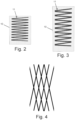
- the exemplary expanding pattern is a zigzag pattern (see Fig. 2 and 3 ) that is utilized to attach each conducting layer to the surface of the corresponding electro-active polymer layer.
- the exemplary expanding pattern is any other expanding pattern (e.g., an expanding diamond pattern shown in Fig. 4 ).
- the expanding mechanism that each conducting layer is attached to the surface of the electro-active polymer layer is applied by a stretchable conductor (e.g., the stretchable conductor created out of networks of gold and/or carbon nano-particles embedded in elastic polyurethane; any other suitable stretchable conductor).
- the electro-active polymer film layer has thickness between 10 um - 5 mm. In some embodiments, the electro-active polymer film layer has thickness between 100 um - 5 mm. In some embodiments, the electro-active polymer film layer has thickness between 1000 um - 5 mm. In some embodiments, the electro-active polymer film layer has thickness between 10 um - 1 mm. In some embodiments, the electro-active polymer film layer has thickness between 100 um - 1 mm. In some embodiments, the electro-active polymer film layer has thickness between 500 um - 1 mm.
- each conducting layer is attached to the electro-active polymer layer by, for example but not limited to, at least one of printing (e.g., utilizing conductive ink), etching (e.g., using a solution of electrolyte), brushing (e.g., using carbon graphite powder with silicon oil), water dispersion (e.g., using PAni based solution), gluing (e.g., gluing a laser cut or molded into an expanding pattern such as zigzag, rigid conducting sheet), and any other suitable applicable method(s).
- printing e.g., utilizing conductive ink
- etching e.g., using a solution of electrolyte
- brushing e.g., using carbon graphite powder with silicon oil
- water dispersion e.g., using PAni based solution
- gluing e.g., gluing a laser cut or molded into an expanding pattern such as zigzag, rigid conducting sheet
- electro-active polymers that are pre-stretched improve conversion between electrical and mechanical energy.
- the pre-stretch state/condition stabilizes the actuation of the electro-active polymer due to at least one of:
- Fig. 1 is a flow chart generally illustrating an exemplary procedure for maintaining an electro-active polymer in the pre-stretch state/condition, according to some embodiments of the present invention.
- this procedure can include at least the steps of:
- the method(s) of the present invention allows the electro-active polymer to expand linearly while keeping the pre-stretch state.
- Fig. 2 shows an exemplary electro-active polymer that can be used in accordance with some embodiments of the present invention.
- the electro-active polymer can be used as a linear actuator.
- the electro-active polymer generally indicated by numeral 10 in the figure 2 , includes at least: a layer of semi-stiff conductor 11 printed on both sides of its surfaces.
- the semi-stiff conductor layer 11 is printed or etched in a zigzag form, such that the deployment form of the semi-stiff conductor 11 keeps the electro-active polymer in a pre-stretched state while allowing it to expand in a linear direction.
- Fig. 3 schematically illustrates the exemplary electro-active polymer 10 in an expanded state.
- Fig. 4 schematically illustrates an example of a lattice work form, according to some embodiments of the present invention.
- the arrangement of the exemplary electro-active polymer with the exemplary conductor results in a flat and flexible linear actuator which can fold.
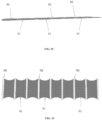
- Fig. 5A is a perspective view, showing an exemplary pre-stretched electro-active polymer 10 folded in order to improve capabilities of the actuator, according to some embodiments of the invention.
- Fig. 5A shows the exemplary electro-active polymer 10 to be folded in an alternating folding pattern.
- Fig. 5B is a perspective view, showing the linear expansion of the exemplary folded electro-active polymer 10, having a pair of mechanical connectors (12 and 13) at each end of an active region of the electro-active polymer 10.
- Figs. 6A and 6B schematically illustrate a top perspective view of an exemplary electro-active polymer transducer 60 before ( Fig. 6A ) and after ( Fig. 6B ) application of a voltage, in accordance with some embodiments of the present invention.
- the transducer (60) includes an exemplary EAP (61) with a conductive coating that is activated by electrostatic forces between two compliant electrodes (62), which are fundamentally capacitors that change their capacitance when a voltage is applied by allowing the polymer to compress in thickness and expand in area due to the electric field (the expansion is indicated by the black arrows in Fig. 6B ).
- Figs. 7A-7C shows an example of a stretching device intended to biaxially or single axially pre-stretch a transparent electro-active polymer film.
- the EAP film is fixed by 8 connectors to the stretching device, which expands the film in the desired directions (e.g., biaxial).
- the stretching device can be used in step 1 of Fig. 1 for mechanically biaxially pre-stretching an electro-active polymer film in the exemplary procedure for maintaining an electro-active polymer in the pre-stretch state/condition.
- Fig. 7A shows a biaxially stretched EAP film, which is further stretched in Figs. 7B and 7C , until the film reaches its desired pre-stretched state of 500% of its original size on Fig 7C .
- semi-stiff conductor is being used to describe a stretchable conductor or a rigid conductor in an expanding pattern that once attached to the EAP is rigid enough to hold the EAP in a pre-stretched state, while allowing the EAP to expand.
- a stretchable conductor or a rigid conductor in an expanding pattern that once attached to the EAP is rigid enough to hold the EAP in a pre-stretched state, while allowing the EAP to expand.
- the conductor won't compress by more than 10%, due to a mechanical compression force of at least 500N on the X axis and on the Y axis, on a 1x1 cm2 surface. Meanwhile, the conductor allows the EAP film to mechanically expand by at least 7% on a single or both axis, while maintaining at least 5% of its conductivity for every 7% of expansion.
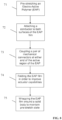
- Fig. 8 is a flow chart generally illustrating an exemplary procedure for maintaining an electro-active polymer in the pre-stretch state/condition, according to some embodiments of the present invention.
- this procedure can include at least the steps of:
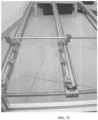
- Fig. 10 schematically illustrates an example of a solid mechanism for fixing the EAP film in a pre-stretch state in a single axis, while allowing the film to expand in the other axis.
- the electro-active polymer film might be fixed in a pre-stretched state on a single axis, by a solid mechanism, for example but not limited to, parallel solid plastic straps attached to the EAP film (such as in Fig. 10 ), allowing the EAP film to expand and be wrapped around a solid body on the other axis.
- the attachment of the solid mechanism can be made, for example but not limited to, gluing and/or any other similarly method(s) of attachment. Fig.
- the solid plastic straps might be 1mm - 80cm wide. In some embodiment, the solid plastic straps might be 1mm-20cm wide. In some embodiment, the solid plastic straps might be 1cm-80cm wide. In some embodiment, the solid plastic straps might be 1cm-20cm wide. In some embodiment, the solid plastic straps might be 1cm-60cm wide. In some embodiment, the solid plastic straps might be placed in distance of 1mm-50cm apart.
- the solid plastic straps might be placed in distance of 1cm-50cm apart. In some embodiment, the solid plastic straps might be placed in distance of 1cm-30cm apart. In some embodiment, the solid plastic straps might be placed in distance of 1cm-20cm apart. In some embodiment, the solid plastic strap might be placed in parallel or any angle between 180o to 90o from each other. In some embodiment, the plastic straps can be made from polypropylene, polystyrene, polyethylene or any other similar type plastic.
- the plastic straps used to fix the pre-stretched film is a single axis, can also be used to prevent the film from contracting in the other axis, by attaching holders that keep the plastic straps at a minimal distance, while allowing them to expand.
- the holder can be made by using an elastic wire, with a rigid cover, in the space between the plastic straps (such as in Figs. 13A-13B ).
- the precise pre-stretch of the electro-active polymer film can be determined by visual indicator, e.g. a hills and valleys pattern with a solid strap (such as in Fig. 9A-9C ) or by pre-arranged guide lines or any other kind of visual indicator.
- visual indicator e.g. a hills and valleys pattern with a solid strap (such as in Fig. 9A-9C ) or by pre-arranged guide lines or any other kind of visual indicator.
- Figs. 9A-9C schematically illustrate a hills and valley pattern that can be used as a visual indicator for wrapping the EAP film with the precise amount of stretch.
- Fig. 9A shows an EAP film (81) attached to a strap (80) (for example polypropylene, flat nylon, polyester, seatbelt strap or any other strap), on multiple joints, when the strap's length is longer than the EAP film's length, causing a hills and valleys pattern on the strap.
- Fig. 9B shows that the EAP film (81), can be linearly stretched while the strap (80) remains loose.
- Fig. 9A shows an EAP film (81) attached to a strap (80) (for example polypropylene, flat nylon, polyester, seatbelt strap or any other strap), on multiple joints, when the strap's length is longer than the EAP film's length, causing a hills and valleys pattern on the strap.
- Fig. 9B shows that the EAP film (81), can be linearly stretched while the strap (80) remains loose
- 9C shows that the strap limits the linear stretch of the EAP film, due to the strap firmness, thus preventing tear in the EAP film, and giving a visual indicator for when the EAP film is precisely pre-stretched, which happens when the strap and the EAP film are in the same length.
- the present invention is directed to a method for maintain an electro-active polymer film in a pre-stretched state, where the method at least includes the steps of:
- the EAP actuator can be used for the construction of an active compression bandage, including of: a bandage, which is placed on a body part, for example, but not limited to, a leg, a calf, a foot, a hand or an arm; for example, the bandage is fixed on the body part, by using, for example, between 1 to 20 elastic straps (can be in another similarly suitable attaching mechanism), which are, for example, wrapped around the body part, and are connected to the bandage by Velcro, clip-on buttons, buttons, zipper, sewing or any other similar fixation device and method.
- the elastic straps are stretched when wrapped around the body part.
- the bandage and the elastic straps are threaded with EAP actuators.
- the EAP actuators are pre-stretched, and, then, are fixed in a pre-stretch state.
- the bandage is connected to a control box, which activates and controls the EAP actuators activation.
- the control box at least includes: a battery and an electrical circuit, which transforms the battery output voltage to the required voltage for the EAP and activates and de-activates the EAP actuators, by applying voltage on each actuator, separately or simultaneously, according to a pre-determined sequence.
- control box can include a feedback mechanism configured to measure the pressure applied by the EAP actuator, and/or configured to adjust the voltage applied on the EAP actuator so as to result in achieving the required pressure.
- control box can include a feedback mechanism configured to monitor heart rate and/or a blood flow, so as to synchronize the EAP actuators activation timing accordingly.
- the electrical charge being applied on the EAP is between 10-20,000 volts. In some embodiments, the electrical charge being applied on the EAP is between 100-20,000 volts. In some embodiments, the electrical charge being applied on the EAP is between 1,000-20,000 volts. In some embodiments, the electrical charge being applied on the EAP is between 10-1,000 volts. In some embodiments, the electrical charge being applied on the EAP is between 10-10,000 volts. In some embodiments, the electrical charge being applied on the EAP is between 10,000-20,000 volts.
- the bandage is fixed on the body part by using between 1-15 straps. In some embodiments, the bandage is fixed on the body part by using between 1-10 straps. In some embodiments, the bandage is fixed on the body part by using between 1-5 straps. In some embodiments, the bandage is fixed on the body part by using between 5-20 straps. In some embodiments, the bandage is fixed on the body part by using between 10-20 straps. In some embodiments, the bandage is fixed on the body part by using between 15-20 stra ps.
- the required stretch of the strap can be determined by a visual indicator, e.g. a hills and valley pattern with a solid strap or by pre-arranged guide lines or any other kind of visual indicator.
- a visual indicator e.g. a hills and valley pattern with a solid strap or by pre-arranged guide lines or any other kind of visual indicator.
- activating the EAP actuator provides pressure of between 10 mmHg and 200 mmHg on the body part.
- the activation of the EAP actuators can be made to apply static compression, sequential compression, segmental compression, intermittent compression, or any other type of compression.
- the active compression bandage can be used for the prevention and ⁇ or treatment for various vascular or lymphatic diseases, for example, but not limited to, DVT (Deep Vein Thrombosis), lymphedema, varicose veins, spider veins, CVI (Chronic Venous Insufficiency), ulcers, superficial venous thrombosis or phlebitis and diabetic wounds.
- the active compression bandage can be used for the prevention and ⁇ or treatment and ⁇ or reduction of, for example, but not limited to, scar tissue, swelling, sore muscles, burn wounds, cellulitis, chronic edema, eczema, infected wounds and epidermolysis bullosa.
- the active compression bandage can be used to reduce the recovery time of orthopedic surgeries, swelling, infections and sport injuries.
- the active compression bandage might include feedback mechanism, which measures the pressure applied by the EAP actuator.
- the feedback mechanism can be made by a pressure sensor.
- the active compression bandage might include a heart rate monitor or a blood flow monitor. In some embodiments, said monitor is used to synchronize the timing of the activation of the EAP actuators.
- the active compression bandage is controlled by a control unit.
- the control unit might be battery operated.
- the control signal from said control unit is a voltage.
- the control unit controls the applied pressure and the timing of the EAP actuators.
- the active compression bandage can be formed as a stocking or legging to be put on the leg.
- wrapping the elastic strap will stretch the EAP strap by between 20% and 1000%. In some embodiments, wrapping the elastic strap will stretch the EAP strap by between 20% and 500%. In some embodiments, wrapping the elastic strap will stretch the EAP strap by between 50% and 1000%. In some embodiments, wrapping the elastic strap will stretch the EAP strap by between 100% and 1000%. In some embodiments, wrapping the elastic strap will stretch the EAP strap by between 100% and 500%. In some embodiments, wrapping the elastic strap will stretch the EAP strap by between 50% and 800%.
- the active compression bandage can be formed as a stocking to be put on the leg. In some embodiments, the active compression bandage can be formed to use on various body parts, for example, the leg, the calf, the hip, the hand, the arm, the shoulder, the foot or any other body part.
- activating the EAP actuator is used to describe a process of discharging the electric charge from the EAP actuator by at least 8%, causing the EAP actuator to contract by at least 5%.
- the exact amount of contraction will be determined by the amount of pre-stretch, the type of conductor used, the method of attachment for said conductor, the number of layers of EAP film the EAP actuator is comprised from and the amount of the electric charge being released.
- active compression bandage refers to a device, which applies different compression on a body part.
- the pressure is higher when the bandage's actuator is activated (e.g., but not limited to, between 10mmHg and 200 mmHG), and lower when the bandage's actuator is de-activated/not active (e.g., but not limited to, between 0 mmHg and 80 mmHg).
- the active compression bandage applies pressure of between 0 mmHg and 80 mmHg. In some embodiments, while the EAP actuator is not active, the active compression bandage applies pressure of between 5 mmHg and 80 mmHg. In some embodiments, while the EAP actuator is not active, the active compression bandage applies pressure of between 0 mmHg and 30 mmHg. In some embodiments, while the EAP actuator is not active, the active compression bandage applies pressure of between 5 mmHg and 40 mmHg.
- activating the EAP actuator provides pressure of between 10 mmHg and 200 mmHg on the body part. In some embodiments, activating the EAP actuator provides pressure of between 10 mmHg and 100 mmHg on the body part. In some embodiments, activating the EAP actuator provides pressure of between 20 mmHg and 200 mmHg on the body part. In some embodiments, activating the EAP actuator provides pressure of between 20 mmHg and 100 mmHg on the body part. In some embodiments, activating EAP actuator provides pressure of between 30 mmHg and 130 mmHg on the body part.
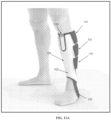
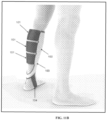
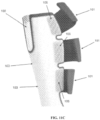
- Figs. 11A-11C schematically illustrate an example for an external design of an active compression bandage for the leg.
- Fig. 11A show a front view of the active compression bandage on a leg.
- Three elastic straps (101) are wrapped and stretched around the leg, and are fixed to the bandage (103) by Velcro.
- the active compression bandage is controlled by a control box (102).
- An additional strap (104) is used to indicate the correct location for the placement of the active compression bandage on the leg.
- Fig. 11B show a rear view of the active compression bandage on a leg.
- Fig. 11C shows a side view of the active compression bandage, unworn, showing the Velcro connectors (105).
- Figs. 12A-12B schematically illustrate an example for an internal mechanism that activates a compression bandage for the leg, built from EAP actuators.
- Fig. 12A shows a front view of the internal construction of the active compression bandage on a leg.
- Three elastic straps (101) are wrapped and stretched around the leg, pre-stretching the EAP actuator (116) and fixing it around the leg.
- the active compression bandage is controlled by a control box (112).
- An additional strap (114) is used to indicate the correct location for the placement of the active compression bandage on the leg.
- Fig. 12C shows a side view of the internal construction of the active compression bandage, worn but without the leg, showing that the EAP actuator (116) is fully wrapped around the leg, giving a full peripheral compression when activated.
- Figs. 13A-13B schematically illustrate an example of an addition to the solid mechanism for fixing the EAP film in a pre-stretch state in a single axis, by using an elastic wire (101) which is threaded through holes in the plastic holders (100 & 110).
- the wire has a rigid cover (111) in space between the holders, which prevents the film from contracting in the other axis, while allowing it to expand.
- Figs. 14A-14D show an example of a stretching machine intended to biaxially or single axially pre-stretch an electro-active polymer film.
- a roll of EAP film tape is held on a bar (151).
- Two rolling bars (152) pull the EAP film from the roll, and separate it from its protecting liner.
- the film is later attached to a moving rail (153).
- the speed difference between the two rolling bars (152) and the moving rail (153) stretches the EAP film in the axis of the moving rail.
- the moving rail later expands (154) until it gets to its final width (155).
- the rails expansion stretches the EAP film perpendicularly to the axis of the moving rail.
- a method comprising:
- the printed conductor is made from at least one of: a conducting silver ink, a conducting carbon ink, and any combination thereof.
- the pre-stretched state is a state in which the fixed pre-stretched electro-active polymer film has a first size which is 3%-1000% larger than a second size of the electro-active polymer film from which the fixed pre-stretched electro-active polymer film has been formed.
- the method when the fixed pre-stretched electro-active polymer comprises the at least one first and the at least one second semi-stiff conductors, the method further comprising:
Landscapes
- Engineering & Computer Science (AREA)
- Manufacturing & Machinery (AREA)
- Health & Medical Sciences (AREA)
- Mechanical Engineering (AREA)
- Microelectronics & Electronic Packaging (AREA)
- General Health & Medical Sciences (AREA)
- Veterinary Medicine (AREA)
- Vascular Medicine (AREA)
- Life Sciences & Earth Sciences (AREA)
- Animal Behavior & Ethology (AREA)
- Biomedical Technology (AREA)
- Public Health (AREA)
- Heart & Thoracic Surgery (AREA)
- Physics & Mathematics (AREA)
- Spectroscopy & Molecular Physics (AREA)
- Laminated Bodies (AREA)
- Manufacture Of Macromolecular Shaped Articles (AREA)
- Materials For Medical Uses (AREA)
- Compositions Of Macromolecular Compounds (AREA)
- Shaping By String And By Release Of Stress In Plastics And The Like (AREA)
Applications Claiming Priority (5)
| Application Number | Priority Date | Filing Date | Title |
|---|---|---|---|
| US201462097372P | 2014-12-29 | 2014-12-29 | |
| US201562112509P | 2015-02-05 | 2015-02-05 | |
| US201562112498P | 2015-02-05 | 2015-02-05 | |
| EP15875312.9A EP3240519B1 (de) | 2014-12-29 | 2015-12-29 | Verfahren und mechanismen zur aufrechterhaltung eines elektroaktiven polymers in einem vorstreckzustand und verwendungen davon |
| PCT/IB2015/002539 WO2016108082A1 (en) | 2014-12-29 | 2015-12-29 | Methods and mechanisms for maintaining an electro-active polymer in a pre-stretch state and uses thereof |
Related Parent Applications (1)
| Application Number | Title | Priority Date | Filing Date |
|---|---|---|---|
| EP15875312.9A Division EP3240519B1 (de) | 2014-12-29 | 2015-12-29 | Verfahren und mechanismen zur aufrechterhaltung eines elektroaktiven polymers in einem vorstreckzustand und verwendungen davon |
Publications (2)
| Publication Number | Publication Date |
|---|---|
| EP4284149A2 true EP4284149A2 (de) | 2023-11-29 |
| EP4284149A3 EP4284149A3 (de) | 2024-03-06 |
Family
ID=56162951
Family Applications (2)
| Application Number | Title | Priority Date | Filing Date |
|---|---|---|---|
| EP15875312.9A Active EP3240519B1 (de) | 2014-12-29 | 2015-12-29 | Verfahren und mechanismen zur aufrechterhaltung eines elektroaktiven polymers in einem vorstreckzustand und verwendungen davon |
| EP23195546.9A Pending EP4284149A3 (de) | 2014-12-29 | 2015-12-29 | Verfahren und mechanismen zur aufrechterhaltung eines elektroaktiven polymers in einem vorstreckzustand und verwendungen davon |
Family Applications Before (1)
| Application Number | Title | Priority Date | Filing Date |
|---|---|---|---|
| EP15875312.9A Active EP3240519B1 (de) | 2014-12-29 | 2015-12-29 | Verfahren und mechanismen zur aufrechterhaltung eines elektroaktiven polymers in einem vorstreckzustand und verwendungen davon |
Country Status (4)
| Country | Link |
|---|---|
| US (6) | US9433537B2 (de) |
| EP (2) | EP3240519B1 (de) |
| CN (2) | CN107530220A (de) |
| WO (2) | WO2016108082A1 (de) |
Families Citing this family (18)
| Publication number | Priority date | Publication date | Assignee | Title |
|---|---|---|---|---|
| US11278455B2 (en) * | 2014-12-29 | 2022-03-22 | ElastiMed Ltd. | Methods for maintaining an electro-active polymer in a pre-stretch state |
| US20220241118A1 (en) * | 2014-12-29 | 2022-08-04 | ElastiMed Ltd. | Methods and mechanisms for maintaining an electro-active polymer in a pre-stretch state and uses thereof |
| US10543907B2 (en) * | 2015-07-06 | 2020-01-28 | California Institute Of Technology | Flow control technique by dielectric materials |
| WO2017189926A1 (en) | 2016-04-27 | 2017-11-02 | Radial Medical, Inc. | Adaptive compression therapy systems and methods |
| US10837131B2 (en) | 2016-11-17 | 2020-11-17 | Drexel University | Method to produce micro and nanofibers with controlled diameter and large yield |
| US11223006B2 (en) * | 2017-08-01 | 2022-01-11 | ElastiMed Ltd. | Mechanisms for pre-stretching electro-active polymers by a pre-determined amount and methods of use thereof |
| US20200297569A1 (en) | 2017-09-22 | 2020-09-24 | Mas Innovation (Private) Limited | Compression devices |
| USD892752S1 (en) * | 2017-09-29 | 2020-08-11 | Toyoda Gosei Co., Ltd. | Polymer actuator |
| CN108520795B (zh) * | 2018-03-26 | 2019-12-17 | 中国科学院上海硅酸盐研究所 | 一种超高弹性导线及其制备方法 |
| WO2019211666A2 (en) * | 2018-05-02 | 2019-11-07 | ElastiMed Ltd. | A strap having a portion of electro-active polymer, methods and mechanisms for making and using the same |
| JP2022511200A (ja) * | 2018-06-11 | 2022-01-31 | ジェイン,アブヒナフ | 勃起不全を診断および管理するためのシステムおよび装置 |
| WO2019241671A1 (en) * | 2018-06-14 | 2019-12-19 | Behboodi Ahad | Modular artificial skeletal muscle actuators and exoskeletons powered thereby |
| US12083067B2 (en) | 2018-06-14 | 2024-09-10 | University Of Delaware | Modular artificial skeletal muscle actuators and exoskeletons powered thereby |
| WO2021055158A1 (en) * | 2019-09-16 | 2021-03-25 | Ben Yaacov Ilan | Apparatus and method for applying compression |
| US20220416689A1 (en) * | 2019-10-21 | 2022-12-29 | ElastiMed Ltd. | Method of using a hydroelectric actuator to create a controllable pressure on a cylindrically shaped object |
| CN111469517B (zh) * | 2020-04-22 | 2021-10-15 | 浙江大学 | 一种叠层驱动结构及其制作方法 |
| CN113489366B (zh) * | 2021-06-30 | 2023-02-03 | 中国船舶重工集团公司第七一三研究所 | 基于极性薄膜材料的高定位精度长行程推进器 |
| US20230282991A1 (en) * | 2022-03-03 | 2023-09-07 | Toyota Motor Engineering & Manufacturing North America, Inc. | Artificial muscle assemblies comprising an electrical connection assembly for electrically coupling an electronic device to a power supply |
Family Cites Families (38)
| Publication number | Priority date | Publication date | Assignee | Title |
|---|---|---|---|---|
| US6376971B1 (en) | 1997-02-07 | 2002-04-23 | Sri International | Electroactive polymer electrodes |
| US6545384B1 (en) * | 1997-02-07 | 2003-04-08 | Sri International | Electroactive polymer devices |
| US6543110B1 (en) * | 1997-02-07 | 2003-04-08 | Sri International | Electroactive polymer fabrication |
| US6812624B1 (en) | 1999-07-20 | 2004-11-02 | Sri International | Electroactive polymers |
| ES2394160T3 (es) | 1999-07-20 | 2013-01-22 | Sri International | Polímeros electroactivos |
| US7548015B2 (en) * | 2000-11-02 | 2009-06-16 | Danfoss A/S | Multilayer composite and a method of making such |
| AU2003225075A1 (en) * | 2002-04-16 | 2003-11-03 | Sean K. Scorvo | An adjustable orthotic brace |
| ES2309502T3 (es) | 2003-02-24 | 2008-12-16 | Danfoss A/S | Vendaje de compresion elastico electroactivo. |
| DE602004029989D1 (de) | 2003-03-03 | 2010-12-23 | Stanford Res Inst Int | Eingerollte elektroaktive polymere |
| US7038357B2 (en) * | 2003-08-21 | 2006-05-02 | Engineering Services Inc. | Stretched rolled electroactive polymer transducers and method of producing same |
| US6876125B2 (en) | 2003-08-26 | 2005-04-05 | Delphi Technologies, Inc. | Elastomeric polyphosphazene transducers, methods of making, and methods of use thereof |
| AU2004316255B2 (en) * | 2003-08-29 | 2009-12-03 | Sri International | Electroactive polymer pre-strain |
| DK1665880T3 (da) | 2003-09-03 | 2013-02-25 | Stanford Res Inst Int | Elektroaktive overfladedeformations- polymertransducere |
| EP1645255A1 (de) * | 2004-10-11 | 2006-04-12 | SMM Medical AB | Elektroaktive Kompressionsbandage |
| DE602005007513D1 (de) * | 2004-10-11 | 2008-07-24 | Smm Medical Ab | Elektroaktive kompressionsbandage |
| US7834527B2 (en) * | 2005-05-05 | 2010-11-16 | SmartMotion Technologies, Inc. | Dielectric elastomer fiber transducers |
| WO2006123317A2 (en) | 2005-05-19 | 2006-11-23 | Ecole Polytechnique Federale De Lausanne (Epfl) | Dielectric electroactive polymer |
| PT1981459E (pt) * | 2006-01-13 | 2011-12-21 | Convatec Technologies Inc | Dispositivo, sistema e método para tratamento por compressão de uma parte do corpo |
| JP2007212959A (ja) * | 2006-02-13 | 2007-08-23 | Nippon Oil Corp | 透過型液晶表示装置 |
| JP4228004B2 (ja) * | 2006-05-24 | 2009-02-25 | 新日本石油株式会社 | 透過型液晶表示装置 |
| DE602007014165D1 (de) * | 2006-11-03 | 2011-06-09 | Danfoss As | Dielektrischer Verbundwerkstoff und Verfahren zur Herstellung eines dielektrischen Verbundwerkstoffs |
| EP2498311A3 (de) | 2006-11-03 | 2014-09-10 | Danfoss A/S | Kapazitiver Wandler mit Direktwirkung |
| JP5896591B2 (ja) | 2006-12-14 | 2016-03-30 | パーカー ハネフィン コーポレイションParker Hannifin Corporation | 容量性構造体、その製造方法およびその作動方法ならびに容量性構造体を備えたシステム |
| KR100957091B1 (ko) * | 2007-05-23 | 2010-05-13 | 현대자동차주식회사 | 차량용 카매트 모듈구조 |
| CN102067349A (zh) | 2008-06-09 | 2011-05-18 | 丹佛斯强力聚合公司 | 包括复合材料的换能器和制造这种复合材料的方法 |
| US8222799B2 (en) | 2008-11-05 | 2012-07-17 | Bayer Materialscience Ag | Surface deformation electroactive polymer transducers |
| US8237324B2 (en) * | 2008-12-10 | 2012-08-07 | The Regents Of The University Of California | Bistable electroactive polymers |
| EP2239793A1 (de) | 2009-04-11 | 2010-10-13 | Bayer MaterialScience AG | Elektrisch schaltbarer Polymerfilmaufbau und dessen Verwendung |
| JP2011083122A (ja) | 2009-10-07 | 2011-04-21 | Konica Minolta Holdings Inc | アクチュエータ |
| JP2011234529A (ja) | 2010-04-28 | 2011-11-17 | Konica Minolta Holdings Inc | 駆動装置 |
| WO2012032437A1 (en) | 2010-09-09 | 2012-03-15 | Koninklijke Philips Electronics N.V. | Electroactive polymer actuator |
| CN103119741B (zh) * | 2010-09-09 | 2015-05-20 | 皇家飞利浦电子股份有限公司 | 电活性聚合物致动器 |
| AU2012225355A1 (en) | 2011-03-09 | 2013-10-10 | Bayer Intellectual Property Gmbh | Electroactive polymer energy converter |
| WO2013120493A1 (en) | 2012-02-14 | 2013-08-22 | Danfoss Polypower A/S | A polymer transducer and a connector for a transducer |
| US8692442B2 (en) | 2012-02-14 | 2014-04-08 | Danfoss Polypower A/S | Polymer transducer and a connector for a transducer |
| JP2013230356A (ja) | 2012-04-04 | 2013-11-14 | Jvc Kenwood Corp | マッサージ装置、プログラム、及び駆動方法 |
| KR20150031285A (ko) * | 2012-06-18 | 2015-03-23 | 바이엘 인텔렉쳐 프로퍼티 게엠베하 | 연신 공정을 위한 연신 프레임 |
| GB201310578D0 (en) | 2013-06-13 | 2013-07-31 | Univ Nottingham Trent | Electroactive actuators |
-
2015
- 2015-12-29 CN CN201580077163.2A patent/CN107530220A/zh active Pending
- 2015-12-29 CN CN202310169932.8A patent/CN116570339A/zh active Pending
- 2015-12-29 US US14/982,645 patent/US9433537B2/en active Active
- 2015-12-29 EP EP15875312.9A patent/EP3240519B1/de active Active
- 2015-12-29 WO PCT/IB2015/002539 patent/WO2016108082A1/en not_active Ceased
- 2015-12-29 EP EP23195546.9A patent/EP4284149A3/de active Pending
-
2016
- 2016-06-30 WO PCT/IB2016/001046 patent/WO2017115118A1/en not_active Ceased
- 2016-07-28 US US15/222,015 patent/US11291121B2/en active Active
-
2022
- 2022-03-14 US US17/694,257 patent/US20220248539A1/en not_active Abandoned
-
2023
- 2023-06-20 US US18/338,118 patent/US20240130047A1/en not_active Abandoned
-
2024
- 2024-07-15 US US18/773,062 patent/US20250016932A1/en not_active Abandoned
-
2025
- 2025-06-30 US US19/255,110 patent/US20260047013A1/en active Pending
Non-Patent Citations (2)
| Title |
|---|
| "Pull-in and wrinkling instabilities of electroactive dielectric actuators", J. PHYS. D: APPL. PHYS, vol. 43, 2010, pages 325501 |
| LI ET AL.: "Effect of mechanical pre-stretch on the stabilization of dielectric elastomer actuation", J. PHYS. D: APPL. PHYS, vol. 44, 2011, pages 155301, XP020188353, DOI: 10.1088/0022-3727/44/15/155301 |
Also Published As
| Publication number | Publication date |
|---|---|
| EP3240519B1 (de) | 2023-09-06 |
| US20160184141A1 (en) | 2016-06-30 |
| US20160338207A1 (en) | 2016-11-17 |
| US20260047013A1 (en) | 2026-02-12 |
| US20220248539A1 (en) | 2022-08-04 |
| US20250016932A1 (en) | 2025-01-09 |
| WO2016108082A1 (en) | 2016-07-07 |
| EP3240519A4 (de) | 2018-08-15 |
| EP3240519A1 (de) | 2017-11-08 |
| CN107530220A (zh) | 2018-01-02 |
| CN116570339A (zh) | 2023-08-11 |
| US11291121B2 (en) | 2022-03-29 |
| US9433537B2 (en) | 2016-09-06 |
| US20240130047A1 (en) | 2024-04-18 |
| EP4284149A3 (de) | 2024-03-06 |
| WO2017115118A1 (en) | 2017-07-06 |
Similar Documents
| Publication | Publication Date | Title |
|---|---|---|
| US20220248539A1 (en) | Methods and mechanisms for maintaining an electro-active polymer in a pre-stretch state and uses thereof | |
| US7056297B2 (en) | Wearable human motion applicator | |
| US20240365672A1 (en) | Strap having a portion of electro-active polymer, methods and mechanisms for making and using the same | |
| Calabrese et al. | Active compression bandage made of electroactive elastomers | |
| US20220246829A1 (en) | Compositions for active compression devices and related methods | |
| JP6939819B2 (ja) | 触感提示装置 | |
| US20250325408A1 (en) | Methods and mechanisms for maintaining an electro-active polymer in a pre-stretch state and uses thereof | |
| Jordi et al. | Scaling of planar dielectric elastomer actuators in an agonist-antagonist configuration | |
| US11278455B2 (en) | Methods for maintaining an electro-active polymer in a pre-stretch state | |
| JP6630000B2 (ja) | 摩擦制御装置および方法 | |
| WO2010028504A1 (en) | Variable volume garments | |
| CA3071774C (en) | Mechanisms for pre-stretching electro-active polymers by a pre-determined amount and methods of use thereof | |
| US20220416689A1 (en) | Method of using a hydroelectric actuator to create a controllable pressure on a cylindrically shaped object | |
| WO2020066558A1 (ja) | 触感提示装置 |
Legal Events
| Date | Code | Title | Description |
|---|---|---|---|
| PUAI | Public reference made under article 153(3) epc to a published international application that has entered the european phase |
Free format text: ORIGINAL CODE: 0009012 |
|
| STAA | Information on the status of an ep patent application or granted ep patent |
Free format text: STATUS: THE APPLICATION HAS BEEN PUBLISHED |
|
| AC | Divisional application: reference to earlier application |
Ref document number: 3240519 Country of ref document: EP Kind code of ref document: P |
|
| AK | Designated contracting states |
Kind code of ref document: A2 Designated state(s): AL AT BE BG CH CY CZ DE DK EE ES FI FR GB GR HR HU IE IS IT LI LT LU LV MC MK MT NL NO PL PT RO RS SE SI SK SM TR |
|
| PUAL | Search report despatched |
Free format text: ORIGINAL CODE: 0009013 |
|
| AK | Designated contracting states |
Kind code of ref document: A3 Designated state(s): AL AT BE BG CH CY CZ DE DK EE ES FI FR GB GR HR HU IE IS IT LI LT LU LV MC MK MT NL NO PL PT RO RS SE SI SK SM TR |
|
| RIC1 | Information provided on ipc code assigned before grant |
Ipc: A61B 17/132 20060101ALI20240129BHEP Ipc: B29C 55/14 20060101ALI20240129BHEP Ipc: B29C 53/04 20060101ALI20240129BHEP Ipc: B32B 27/08 20060101ALI20240129BHEP Ipc: B32B 3/08 20060101ALI20240129BHEP Ipc: B32B 3/06 20060101ALI20240129BHEP Ipc: A61F 13/08 20060101ALI20240129BHEP Ipc: H10N 30/06 20230101AFI20240129BHEP |
|
| STAA | Information on the status of an ep patent application or granted ep patent |
Free format text: STATUS: REQUEST FOR EXAMINATION WAS MADE |
|
| 17P | Request for examination filed |
Effective date: 20240507 |
|
| RBV | Designated contracting states (corrected) |
Designated state(s): AL AT BE BG CH CY CZ DE DK EE ES FI FR GB GR HR HU IE IS IT LI LT LU LV MC MK MT NL NO PL PT RO RS SE SI SK SM TR |
|
| STAA | Information on the status of an ep patent application or granted ep patent |
Free format text: STATUS: EXAMINATION IS IN PROGRESS |