EP4286123A1 - Matériaux en bois à base de tige - Google Patents
Matériaux en bois à base de tige Download PDFInfo
- Publication number
- EP4286123A1 EP4286123A1 EP22176100.0A EP22176100A EP4286123A1 EP 4286123 A1 EP4286123 A1 EP 4286123A1 EP 22176100 A EP22176100 A EP 22176100A EP 4286123 A1 EP4286123 A1 EP 4286123A1
- Authority
- EP
- European Patent Office
- Prior art keywords
- wood
- split
- rods
- densified
- wood rods
- Prior art date
- Legal status (The legal status is an assumption and is not a legal conclusion. Google has not performed a legal analysis and makes no representation as to the accuracy of the status listed.)
- Withdrawn
Links
Images
Classifications
-
- B—PERFORMING OPERATIONS; TRANSPORTING
- B27—WORKING OR PRESERVING WOOD OR SIMILAR MATERIAL; NAILING OR STAPLING MACHINES IN GENERAL
- B27N—MANUFACTURE BY DRY PROCESSES OF ARTICLES, WITH OR WITHOUT ORGANIC BINDING AGENTS, MADE FROM PARTICLES OR FIBRES CONSISTING OF WOOD OR OTHER LIGNOCELLULOSIC OR LIKE ORGANIC MATERIAL
- B27N3/00—Manufacture of substantially flat articles, e.g. boards, from particles or fibres
- B27N3/08—Moulding or pressing
- B27N3/18—Auxiliary operations, e.g. preheating, humidifying, cutting-off
-
- B—PERFORMING OPERATIONS; TRANSPORTING
- B27—WORKING OR PRESERVING WOOD OR SIMILAR MATERIAL; NAILING OR STAPLING MACHINES IN GENERAL
- B27M—WORKING OF WOOD NOT PROVIDED FOR IN SUBCLASSES B27B - B27L; MANUFACTURE OF SPECIFIC WOODEN ARTICLES
- B27M3/00—Manufacture or reconditioning of specific semi-finished or finished articles
- B27M3/0013—Manufacture or reconditioning of specific semi-finished or finished articles of composite or compound articles
- B27M3/0026—Manufacture or reconditioning of specific semi-finished or finished articles of composite or compound articles characterised by oblong elements connected laterally
-
- B—PERFORMING OPERATIONS; TRANSPORTING
- B27—WORKING OR PRESERVING WOOD OR SIMILAR MATERIAL; NAILING OR STAPLING MACHINES IN GENERAL
- B27N—MANUFACTURE BY DRY PROCESSES OF ARTICLES, WITH OR WITHOUT ORGANIC BINDING AGENTS, MADE FROM PARTICLES OR FIBRES CONSISTING OF WOOD OR OTHER LIGNOCELLULOSIC OR LIKE ORGANIC MATERIAL
- B27N1/00—Pretreatment of moulding material
-
- B—PERFORMING OPERATIONS; TRANSPORTING
- B27—WORKING OR PRESERVING WOOD OR SIMILAR MATERIAL; NAILING OR STAPLING MACHINES IN GENERAL
- B27N—MANUFACTURE BY DRY PROCESSES OF ARTICLES, WITH OR WITHOUT ORGANIC BINDING AGENTS, MADE FROM PARTICLES OR FIBRES CONSISTING OF WOOD OR OTHER LIGNOCELLULOSIC OR LIKE ORGANIC MATERIAL
- B27N3/00—Manufacture of substantially flat articles, e.g. boards, from particles or fibres
- B27N3/02—Manufacture of substantially flat articles, e.g. boards, from particles or fibres from particles
-
- B—PERFORMING OPERATIONS; TRANSPORTING
- B27—WORKING OR PRESERVING WOOD OR SIMILAR MATERIAL; NAILING OR STAPLING MACHINES IN GENERAL
- B27N—MANUFACTURE BY DRY PROCESSES OF ARTICLES, WITH OR WITHOUT ORGANIC BINDING AGENTS, MADE FROM PARTICLES OR FIBRES CONSISTING OF WOOD OR OTHER LIGNOCELLULOSIC OR LIKE ORGANIC MATERIAL
- B27N5/00—Manufacture of non-flat articles
-
- B—PERFORMING OPERATIONS; TRANSPORTING
- B27—WORKING OR PRESERVING WOOD OR SIMILAR MATERIAL; NAILING OR STAPLING MACHINES IN GENERAL
- B27L—REMOVING BARK OR VESTIGES OF BRANCHES; SPLITTING WOOD; MANUFACTURE OF VENEER, WOODEN STICKS, WOOD SHAVINGS, WOOD FIBRES OR WOOD POWDER
- B27L7/00—Arrangements for splitting wood
Definitions
- the present invention relates to a method for the production of wood rods for the fabrication of high performance wood-based products.
- Wood is becoming an increasingly important building material due to its renewability and CO 2 storage capacity. This results in high demand of the dominantly used wood species (e.g. spruce, pine (in Europe).
- the share of hardwood species which are far less utilized in the construction sector, is continuously increasing in central European forests and in particular spruce monocultures are destroyed by draught and bark beetles, due to impacts of climate change.
- spruce pine
- spruce monocultures are destroyed by draught and bark beetles, due to impacts of climate change.
- common products like Glulam and cross-laminated timber are predominantly based on the softwood species currently under pressure.
- the problem of efficient use of the wood material calls for new inventions.
- the prior art (WO 2012042027 A1 ) describes a method for the production of a wood composite with reduced density and lower weight but without loss in rigidity and strength.
- the method for the production of the wood composites includes the production of macro fibres which are aligned in a mould, covered with a glue and pressed together in a press giving the wood composite product.
- the glue is foamed up and surrounds the macro fibres.
- the macro fibres are produced through a cutting process of the tree.
- the objective of the present invention is to provide means and methods to produce a high performance wood product, based on a more efficient use of the wood material and more diverse use of wood species.
- a first aspect of the invention relates to a method for the production of a densified wood product comprising
- a second aspect of the invention relates to a densified wood comprising split wood rods, wherein the split wood rods are characterised in that they are raw and exactly aligned with the fibre direction (no cut fibres).
- references to "about” a value or parameter herein includes (and describes) variations that are directed to that value or parameter per se. For example, description referring to "about X” includes description of "X.”
- hardwood species in the context of the present specification relates to wood from angiosperm trees, including ash, hornbeam, poplar, willow, basswood, birch, beech, buckeye, chestnut, hazel, walnut, elm, oak, maple, alder, plane tree, balsa, eucalyptus, paulownia.
- softwood species in the context of the present specification relates to wood from gymnosperm trees, including cypress, Douglas-fir, fir, hemlock, larch, pine, spruce, yew, and cedar.
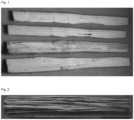
- radial board in the context of the present specification relates to the product of the initial splitting step, wherein these boards are irregularly shaped, elongated boards, which were split off the tree trunk segment along its grain.
- wood rod in the context of the present specification relates to the product of additional splitting steps, wherein these wood rods are elongated rods of certain dimensions, which were split off the radial boards along its grain.
- ply assembly in the context of the present specification relates to two or more layers of wood rods added on top of each other, wherein each additional ply is rotated through 90° compared to the previous layer.
- aspect ratio in the context of the present specification relates to the ratio of length/width of a wood rod element.
- raw in the context of the present specification relates to any wood material, including wood rods, not being sawn and processed so that no cutting surface and no truncated fibres are present.
- a first aspect of the invention relates to a method for the production of a densified wood product comprising
- the wood material is split into radial boards in an initial splitting step.
- the radial boards are split off a mostly debarked tree trunk segment along the grain of the tree similar to the traditional production of wood shingles.
- the way of splitting the radial boards off the tree trunk results in obtaining clean and raw radial boards.
- the radial boards are split into wood rods in further splitting steps.
- Each radial board is split along the grain into several wood rods. Equally to the radial boards, the splitting processes result in raw, clean wood rods. Furthermore, the rod's fibre are exactly aligned with the fibre direction (no cut fibres) as they are split along the grain, which results in better properties of the product.
- the splitting technique allows for an efficient use of the full tree trunk without losing potential wood product e.g. in sawdust and side products.
- the split wood rods are characterised in that the width is 3 mm to 25 mm, particularly 5 mm to 20 mm, more particularly 8 mm to 15 mm.
- a thicker wood rod is more stable towards breakings than a thinner rod, so that longer wood rods can be produced if their width is between 5 mm to 25 mm.
- the split wood rods are characterised in that the height is 3 mm to 25 mm, particularly 5 mm to 20 mm, more particularly 8 mm to 15 mm.
- the split wood rods are characterised in that the length is 50 cm to 100 cm.
- Wood rods with a length of around 100 cm have better mechanical performance in the pressed wood product due to a higher length and a higher aspect ratio.
- the split wood rods are processed straight or curved.
- the tree trunks contains tight knots inside the trunk resulting in irregular growing of the wood and thus curved wood rods when split.
- the aspect ratio of the wood rods is around 80 to 1.
- the rods are dried.
- the split wood rods are dried in advance to the pressing step, wherein the drying is performed according to common procedures known by the person skilled in the art (see a).
- the densified wood product is produced in the production step, wherein the wood rods are placed in a mould, contacted with a binder and pressed against the mould in a pressing step, or are continuously processed as known for fibre- or particle board production.
- the production and pressing step are performed according to common procedures known by the person skilled in the art (see b).
- the binder, contacting the split wood rods is polymer based and/or and/or mineral based.
- the binder is selected from starch, tannins, micro fibrillated cellulose (MFC), nanocrystalline cellulose (NCC), methylcellulose, polyethylene polymers (PE), polypropylene polymers (PP), polymethylmethacrylate polymers (PMMA), polylactic acid polymers (PLA), epoxy polymers, melamine urea formaldehyde polymers (MUF), phenol-resorcinol-formaldehyde (PRF), polyurethanes (PUR), urea formaldehyde polymers (UF), cement, ceramic or gypsum.
- MFC micro fibrillated cellulose
- NCC nanocrystalline cellulose
- methylcellulose methylcellulose
- PE polyethylene polymers
- PP polypropylene polymers
- PMMA polymethylmethacrylate polymers
- PLA polylactic acid polymers
- epoxy polymers melamine urea formaldehyde polymers
- PRF phenol-resorcinol-formaldehyde
- PUR polyurethanes
- the binder is selected from melamine urea formaldehyde polymers (MUF), phenol resorcinol formaldehyde (PRF), polyurethane (PUR), or cement.
- MAF melamine urea formaldehyde polymers
- PRF phenol resorcinol formaldehyde
- PUR polyurethane
- the binder is bio-based and recyclable.
- the split wood rods are ordered in said mould in the same direction or in ply assemblies.
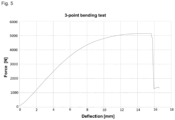
- a uniform alignment of the wood rods leads to a densified wood product with higher mechanical properties in the direction of alignment ( Fig. 5 ).
- the densified wood product is a wood board or a wood beam, wherein the wood board or beam is straight or curved.
- the wood roads can be shaped into curved wood boards.
- a second aspect of the invention relates to a densified wood product comprising split wood rods, wherein the split wood rods are characterised in that they are raw and exactly aligned with the fibre direction (no cut fibres).
- the densified wood product comprising split wood rods, wherein the split wood rods are characterised in that the width is 8 mm to 15 mm and the height is 8 mm to 15 mm.
- the densified wood product comprising split wood rods, wherein the split wood rods are characterised in that the length is 50 to 100 cm
- the densified wood product is characterised in that the content of split wood rods from one or more hardwood species is 51% to 100%, particularly 70 % to 100%.
- wood hardwood species make the densified product be more aligned with healthy and more sustainable forests of the future. Some hardwood species are not as endangered by climate change and draught as commonly used softwood species so that they provide a high quality alternative for wood products used in construction.
- Wood rods are split in a two-step process from stem segments.
- the length of the stem segment determines the length of the rods.
- radial boards are split along the radial direction (along the rays).
- rods are produced by splitting the radial boards in the tangential direction. Hydraulic splitting devices, as used for the industrial shingle production, can be applied for the splitting.
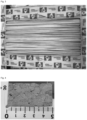
- Rods with a moisture content of -8-12 % are aligned in parallel and layered in a mould and MUF resin is added to each layer.
- the composite is pressed at ambient temperature until the resin has cured. Density of the composites can be adjusted by the applied pressure.
- Example 3 Three-point bending test to measure mechanical properties of the densified wood product
- Such produced wood-based products can be used as beams (such as Parallam) or as panel elements in flat or curved shape.
Landscapes
- Life Sciences & Earth Sciences (AREA)
- Engineering & Computer Science (AREA)
- Manufacturing & Machinery (AREA)
- Wood Science & Technology (AREA)
- Forests & Forestry (AREA)
Priority Applications (3)
| Application Number | Priority Date | Filing Date | Title |
|---|---|---|---|
| EP22176100.0A EP4286123A1 (fr) | 2022-05-30 | 2022-05-30 | Matériaux en bois à base de tige |
| EP23728351.0A EP4532156A1 (fr) | 2022-05-30 | 2023-05-24 | Matériaux en bois à base de tiges |
| PCT/EP2023/063869 WO2023232572A1 (fr) | 2022-05-30 | 2023-05-24 | Matériaux en bois à base de tiges |
Applications Claiming Priority (1)
| Application Number | Priority Date | Filing Date | Title |
|---|---|---|---|
| EP22176100.0A EP4286123A1 (fr) | 2022-05-30 | 2022-05-30 | Matériaux en bois à base de tige |
Publications (1)
| Publication Number | Publication Date |
|---|---|
| EP4286123A1 true EP4286123A1 (fr) | 2023-12-06 |
Family
ID=82156610
Family Applications (2)
| Application Number | Title | Priority Date | Filing Date |
|---|---|---|---|
| EP22176100.0A Withdrawn EP4286123A1 (fr) | 2022-05-30 | 2022-05-30 | Matériaux en bois à base de tige |
| EP23728351.0A Pending EP4532156A1 (fr) | 2022-05-30 | 2023-05-24 | Matériaux en bois à base de tiges |
Family Applications After (1)
| Application Number | Title | Priority Date | Filing Date |
|---|---|---|---|
| EP23728351.0A Pending EP4532156A1 (fr) | 2022-05-30 | 2023-05-24 | Matériaux en bois à base de tiges |
Country Status (2)
| Country | Link |
|---|---|
| EP (2) | EP4286123A1 (fr) |
| WO (1) | WO2023232572A1 (fr) |
Citations (4)
| Publication number | Priority date | Publication date | Assignee | Title |
|---|---|---|---|---|
| US4711689A (en) * | 1983-11-23 | 1987-12-08 | Commonwealth Scientific And Industrial Research Organization | Process for reconsolidated wood production |
| EP0259069A2 (fr) * | 1986-09-03 | 1988-03-09 | Macmillan Bloedel Limited | Bois de charpente de fibres de bois |
| WO2012042027A1 (fr) | 2010-10-01 | 2012-04-05 | Doka Industrie Gmbh | Matériau composite en bois renforcé |
| EP3543000A1 (fr) * | 2018-03-21 | 2019-09-25 | EMPA Eidgenössische Materialprüfungs- und Forschungsanstalt | Procédé de fabrication de composants façonnés multicouches à base de fibres végétales |
-
2022
- 2022-05-30 EP EP22176100.0A patent/EP4286123A1/fr not_active Withdrawn
-
2023
- 2023-05-24 EP EP23728351.0A patent/EP4532156A1/fr active Pending
- 2023-05-24 WO PCT/EP2023/063869 patent/WO2023232572A1/fr not_active Ceased
Patent Citations (4)
| Publication number | Priority date | Publication date | Assignee | Title |
|---|---|---|---|---|
| US4711689A (en) * | 1983-11-23 | 1987-12-08 | Commonwealth Scientific And Industrial Research Organization | Process for reconsolidated wood production |
| EP0259069A2 (fr) * | 1986-09-03 | 1988-03-09 | Macmillan Bloedel Limited | Bois de charpente de fibres de bois |
| WO2012042027A1 (fr) | 2010-10-01 | 2012-04-05 | Doka Industrie Gmbh | Matériau composite en bois renforcé |
| EP3543000A1 (fr) * | 2018-03-21 | 2019-09-25 | EMPA Eidgenössische Materialprüfungs- und Forschungsanstalt | Procédé de fabrication de composants façonnés multicouches à base de fibres végétales |
Non-Patent Citations (2)
| Title |
|---|
| PAULITSCH M.BARBU, M.C.: "Holzwerkstoffe der Moderne", 2015, DRW VERLAG WEINBRENNER |
| TRUBSWETTER T.: "Holztrocknung", 2006, HANSER FACHBUCHVERLAG |
Also Published As
| Publication number | Publication date |
|---|---|
| EP4532156A1 (fr) | 2025-04-09 |
| WO2023232572A1 (fr) | 2023-12-07 |
Similar Documents
| Publication | Publication Date | Title |
|---|---|---|
| Ansell | Wood composites | |
| EP1325083B1 (fr) | Articles composites fibreux | |
| US4361612A (en) | Medium density mixed hardwood flake lamina | |
| Chaowana et al. | Bamboo: Potential material for biocomposites | |
| Nurhazwani et al. | Hybrid particleboard made from bamboo (Dendrocalamus asper) veneer waste and rubberwood (Hevea brasilienses) | |
| RU2766676C2 (ru) | Плита осп (ориентированно-стружечная плита) на основе древесного материала с улучшенными характеристиками и способ ее изготовления | |
| EP3129199B1 (fr) | Produits dérivés du bois et non dérivés du bois chimiquement modifiés et leurs procédés de production | |
| Hughes | Plywood and other veneer-based products | |
| JPH02214603A (ja) | セルロース繊維質凝結体およびその製造方法 | |
| EP1370400A1 (fr) | Produit en bois modifie et procede de preparation de celui-ci | |
| Wei et al. | Structure, mechanical performance, and dimensional stability of radiata pine (Pinus radiata D. Don) scrimbers | |
| ZA200304103B (en) | Wood products and processes for the preparation thereof. | |
| Awang et al. | Medium density fibreboard (MDF) from oil palm fibre: a review | |
| Percin et al. | Physical and Mechanical Properties of Laminated Wood Made from Heat-Treated Scotch Pine Reinforced with Carbon Fiber. | |
| EP4532156A1 (fr) | Matériaux en bois à base de tiges | |
| CA3157506C (fr) | Procédé de préparation d'article en bois compressé | |
| AU2004314464A1 (en) | Hard wood strand products | |
| Çavuş et al. | Determination of some physical and mechanical properties of parallel-strand lumber manufactured with bamboo (Phyllostachys bambusoides) | |
| CA2491638A1 (fr) | Panneau a copeaux orientes | |
| Ranjan et al. | Comparative Study on Physical-Mechanical Properties of Plywood Produced from Eucalyptus Grandis and Populus Deltoids Veneers | |
| AU2019342435B2 (en) | Method of manufacturing moulded articles | |
| Surmiński | Wood properties and uses | |
| Ohagwu et al. | Status of wood processing and storage in Nigeria | |
| Teischinger et al. | Glossary of Wood Science and Technology Terms | |
| Chai et al. | Production of oil palm trunk core board with wood veneer lamination |
Legal Events
| Date | Code | Title | Description |
|---|---|---|---|
| PUAI | Public reference made under article 153(3) epc to a published international application that has entered the european phase |
Free format text: ORIGINAL CODE: 0009012 |
|
| STAA | Information on the status of an ep patent application or granted ep patent |
Free format text: STATUS: THE APPLICATION HAS BEEN PUBLISHED |
|
| AK | Designated contracting states |
Kind code of ref document: A1 Designated state(s): AL AT BE BG CH CY CZ DE DK EE ES FI FR GB GR HR HU IE IS IT LI LT LU LV MC MK MT NL NO PL PT RO RS SE SI SK SM TR |
|
| STAA | Information on the status of an ep patent application or granted ep patent |
Free format text: STATUS: THE APPLICATION IS DEEMED TO BE WITHDRAWN |
|
| 18D | Application deemed to be withdrawn |
Effective date: 20240607 |