EP4287198A1 - Procédé et système de détermination à quelle étape appartient une performance utilisateur - Google Patents
Procédé et système de détermination à quelle étape appartient une performance utilisateur Download PDFInfo
- Publication number
- EP4287198A1 EP4287198A1 EP22177285.8A EP22177285A EP4287198A1 EP 4287198 A1 EP4287198 A1 EP 4287198A1 EP 22177285 A EP22177285 A EP 22177285A EP 4287198 A1 EP4287198 A1 EP 4287198A1
- Authority
- EP
- European Patent Office
- Prior art keywords
- user
- stage
- user performance
- improvement
- performance
- Prior art date
- Legal status (The legal status is an assumption and is not a legal conclusion. Google has not performed a legal analysis and makes no representation as to the accuracy of the status listed.)
- Withdrawn
Links
Images

Classifications
-
- G—PHYSICS
- G16—INFORMATION AND COMMUNICATION TECHNOLOGY [ICT] SPECIALLY ADAPTED FOR SPECIFIC APPLICATION FIELDS
- G16H—HEALTHCARE INFORMATICS, i.e. INFORMATION AND COMMUNICATION TECHNOLOGY [ICT] SPECIALLY ADAPTED FOR THE HANDLING OR PROCESSING OF MEDICAL OR HEALTHCARE DATA
- G16H20/00—ICT specially adapted for therapies or health-improving plans, e.g. for handling prescriptions, for steering therapy or for monitoring patient compliance
- G16H20/70—ICT specially adapted for therapies or health-improving plans, e.g. for handling prescriptions, for steering therapy or for monitoring patient compliance relating to mental therapies, e.g. psychological therapy or autogenous training
-
- G—PHYSICS
- G16—INFORMATION AND COMMUNICATION TECHNOLOGY [ICT] SPECIALLY ADAPTED FOR SPECIFIC APPLICATION FIELDS
- G16H—HEALTHCARE INFORMATICS, i.e. INFORMATION AND COMMUNICATION TECHNOLOGY [ICT] SPECIALLY ADAPTED FOR THE HANDLING OR PROCESSING OF MEDICAL OR HEALTHCARE DATA
- G16H50/00—ICT specially adapted for medical diagnosis, medical simulation or medical data mining; ICT specially adapted for detecting, monitoring or modelling epidemics or pandemics
- G16H50/30—ICT specially adapted for medical diagnosis, medical simulation or medical data mining; ICT specially adapted for detecting, monitoring or modelling epidemics or pandemics for calculating health indices; for individual health risk assessment
Definitions
- the present disclosure relates generally to a computer training system and a method performed by the computer training system. More particularly, the present disclosure relates to determining which stage a user performance belongs to.
- a focus of cognitive training research has been to understand if training can lead to an enhancement of general cognitive abilities, or if improvements are merely generated by task specific strategy development.
- An important but often overlooked aspect of this research is the temporal dynamics of the performance gains during training. Such dynamics could help to separate different types of cognitive improvements, providing a more nuanced description of the process which extends beyond the binary question "did the training lead to transfer?". Therefore, it is of interest to identify and separate cognitive training processes.
- a fast, task specific improvement usually takes place within the first few days of training while the effect on general cognitive capacities evolves slowly but constantly throughout the training period. This highlights the fact that important improvements could still occur late in the training process even though the typically logarithmic learning curves would suggest that the first days of training are the most eventful.
- Near transfer In an attempt to bring clarity to the debate, transfer has often been categorized as either "near” or "far". Near transfer often refers to improvement on the trained task or tasks very similar to it. Such improvement could be the result of implicit leaming, such as perceptual learning. Near transfer could also be the result of explicit strategies, such as associating numbers in working memory (WM) to long-term memories, which leads to large and quick improvement on the trained task but do not transfer, for example to improvement on WM for letters.
- Far transfer refers to an improvement on a more general capacity, such as WM capacity, verbal or spatial ability, general fluid intelligence (gF) or g, which would be useful for a wider range of non-trained tasks.
- a weakness of the near/far categorization is that it is at best imprecise and often arbitrary.
- the near/far terminology infers a dichotomy, which is at odds with models of mental abilities that suggest multiple levels of gradual generality from task specific skills to general intelligence (g) or multiple dimensions.
- This false dichotomy is also reflected in many meta-analyses, where widely heterogeneous tasks are grouped into a "far" transfer category. This can result in a lack of significant effect, leading to the false conclusion that there was only near transfer.
- Factor analysis of transfer task could possibly be a better way to characterize and quantify transfer, and it has previously been used in cognitive training studies training studies.
- An object is to obviate at least one of the above disadvantages and to improve the detection of which stage a user performance belongs to.
- the object is achieved by a computer training system of claim 1.
- the computer training system is for determining which stage a user performance belongs to.
- the computer training system is arranged to present multiple trials on a display.
- the multiple trials are presented in a time consecutive order and comprising varying difficulty levels.
- the difficulty level for each trial is defined by an amount of data to be retained in a working memory of a user when handling the trial and adapted to gradual improvement in user performance.
- the computer training system is arranged to receive user input to each trial at a respective time instant.
- the user input is associated with a first type of user improvement and a second type of user improvement.
- the computer training system is arranged to determine, based on the user input a user performance at each time instant.
- the user performance comprises a first stage of user performance or a second stage of user performance.
- the first stage comprises the first type of user improvement and the second type of user improvement.
- the second stage comprises the second type of user improvement but not the first type of user improvement.
- the computer training system is arranged to determine an indication of whether the user performance at each time instant belongs to the first stage of user performance or the second stage of user performance.
- the object is achieved by a method of claim 10.
- the method is performed by a computer training system for determining which stage a user performance belongs to.
- the computer training system presents multiple trials on a display.
- the multiple trials are presented in a time consecutive order and comprising varying difficulty levels.
- the difficulty level for each trial is defined by an amount of data to be retained in a working memory of a user when handling the trial and adapted to gradual improvement in user performance.
- the computer training system receives user input to each trial at a respective time instant.
- the user input is associated with a first type of user improvement and a second type of user improvement.
- the computer training system determines, based on the user input a user performance at each time instant.
- the user performance comprises a first stage of user performance or a second stage of user performance.
- the first stage comprises the first type of user improvement and the second type of user improvement
- the second stage comprises the second type of user improvement but not the first type of user improvement.
- the computer training system determines an indication of whether the user performance at each time instant belongs to the first stage of user performance or the second stage of user performance.
- the object is achieved by a computer program of claim 13.
- the computer program comprises program code means for performing the method of the second aspect when the computer program is run on a computer
- the object is achieved by a computer readable medium of claim 14.
- the computer readable medium carries a computer program comprising program code means for performing the method of the second aspect when the computer program is run on a computer.
- An advantage of the present disclosure may be that it makes it possible to determine whether a user performance belongs to a first stage or second stage in a fast and reliable way.
- Another advantage of present disclosure may be that it may give a measure of the amount of improvement in the second stage, without administering psychological tests before, during and after training.
- Another advantage may be that the analysis of improvement in the second stage may be used to suggest if further training is necessary for a particular individual.
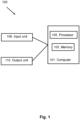
- Fig. 1 is a schematic block diagram illustrating a computer training system 100.
- the computer training system 100 comprises a computer 101.
- the computer 101 may be a personal computer (PC), a workstation computer, a mobile phone, a tablet computer or some other type of computer, to be used by a user for training and improving his/her working memory capacity.
- the user may have various reasons for the need to train and improve his/her working memory capacity such as for example, that he/she has a working memory deficit, e.g. ADHD, a brain damage etc.
- the user may be an elderly person having an impaired capacity due to age or it may be any other person wanting to train and improve his/her working memory capacity.
- the computer training system 100 is arranged to determine which stage a user performance belongs to.
- the computer 101 is arranged to comprise a computer program for determining which stage a user performance belongs to.
- the computer 101 is arranged to comprise a computer program for training the working memory of the user, e.g. by presenting trials that a user should handle or answer.
- the computer program(s) is/are arranged to be executed on the computer 101.
- the computer program(s) is/are stored in a memory 103 associated with the computer 101.
- the memory 103 may comprise one or more memory units.
- the memory 103 is arranged to be used to store obtained information, store data, configurations, schedulings, and applications etc. to perform the methods herein when being executed in the computer 101.
- the memory 103 may be completely comprised in the computer 101, it may be partly comprised in the computer 101 and partly comprised in another location, e.g. a cloud memory, or it may be completely comprised in a cloud memory.
- the computer 101 comprises one or more processors 110, or the computer 101 may be a processor.
- the processor may be for example a Digital Signal Processor (DSP), Application Specific Integrated Circuit (ASIC) processor, Field-programmable gate array (FPGA) processor or microprocessor.
- DSP Digital Signal Processor
- ASIC Application Specific Integrated Circuit
- FPGA Field-programmable gate array
- the program code mentioned above may also be provided as a computer program product, for instance in the form of a data carrier carrying computer program code for performing the present disclosure herein when being loaded into the computer 101.
- One such carrier may be in the form of a CD ROM disc. It is however feasible with other data carriers such as a memory stick.
- the computer program code can be provided as pure program code on a server and downloaded to the computer 101.
- the computer 101 is arranged to be connected to one or more input units 108.
- the one or more input units 108 is arranged to receive input into the computer, for example input in response to trials performed by a user.
- the one or more input units 108 may be a keyboard, a touch display, a pointing device, a microphone etc.
- the computer 101 is arranged to be connected to one or more output units 110.
- the one or more output units 110 is arranged to output, e.g. present or display, trials, information etc. to the user.
- the one or more output units 108 is arranged to present answers to the trials when handled by the user.
- the one or more output units 110 may be a display, a touch display, a speaker etc.
- the input units 108 and the output units 110 may be referred to as communication interface units.
- the communication links in the computer training system 100 may be of any suitable kind comprising either a wired or wireless link.
- the link may use any suitable protocol depending on type and level of layer, e.g. as indicated by the Open Systems Interconnection (OSI) model, as understood by the person skilled in the art.
- OSI Open Systems Interconnection
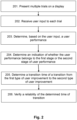
- the method for determining which stage a user performance belongs to will now be described with reference to the flowchart depicted in fig. 2 .
- the method comprises the following steps, which steps may as well be carried out in another suitable order than described below.
- the computer training system 100 presents multiple trials on a display.
- the multiple trials are presented in a time consecutive order and comprising varying difficulty levels.
- the difficulty level for each trial is defined by an amount of data to be retained in a working memory of a user when handling the trial and adapted to gradual improvement in user performance.
- a trial may be referred to as a task, a job, information to be handled by the user.
- the computer training system 100 may present the multiple trials via voice outputted from a speaker or by means of a tactile output.
- An amount of data to be retained in the working memory of the user may correspond to a difficulty level of the trial.
- the trial is arranged to be handled by a user by any suitable means, for example by typing an answer using a keyboard, by answering using voice, by touching a touch display etc.
- the trials may have increased difficulty level, or a mix of one or more of: decreasing, constant and increased difficulty level.
- One trial may be presented to the user every day in a period of for example 10 days, or 10 trials may be presented to the user three days a week for a period of 5 weeks etc.
- a purpose of the trials may be to improve the working memory of the user.
- the computer training system 100 receives user input to each trial at a respective time instant t.
- the user input is associated with a first type of user improvement and a second type of user improvement.
- the user input may be an answer to a trial.
- the first type of user improvement may be related to user strategy in handling the trial, e.g. a specific trial
- the second type of user improvement may be related to user capacity in handling the trial, e.g. a more general user cognitive capacity in handling the trial.
- the computer training system 100 may create training data comprising the user input for each trial at each time and the corresponding difficulty level for each trial.
- the computer training system 100 may determine if the user input is a correct or incorrect answer to the trial.
- the computer training system 100 determines, based on the user input a user performance at each time instant.
- the user performance comprises a first stage of user performance or a second stage of user performance.
- the first stage comprises the first type of user improvement and the second type of user improvement.
- the second stage comprises the second type of user improvement but not the first type of user improvement.
- the computer training system 100 determines an indication of whether the user performance at each time instant belongs to the first stage of user performance or the second stage of user performance.
- the computer training system 100 may determine the indication of whether the user performance at each time instant belongs to the first stage of user performance or the second stage of user performance by applying a Hidden Markov Model, HMM.
- HMM Hidden Markov Model
- the indication of whether the user performance at each time instant belongs to the first stage of user performance or the second stage of user performance may be determined by the computer training system 100 by:
- a probability of a transition from the first stage of user performance to the second stage of user performance may be p ( x t
- x t -1 ) ⁇ ,
- y t may be described as the user performance, e.g. a correct or incorrect answer to the trial, or an average level during a time period, e.g. a day, or an average correctness during a day.
- the computer training system 100 may determine a transition time of a transition from the first type of user improvement to the second type of user improvement for the user performance at each time instant.
- the computer training system 100 may verify a reliability of the determined time of transition.
- the reliability may be verified by determining if the determined time of transition comprises a bias and by assessing a size of prediction errors.
- the computer training system 100 may, when the user performance belongs to the second stage and is above a threshold, determine that one or more further trials should be presented on the display.
- the threshold may be predetermined or dynamically determined during execution of the method.
- the step may comprise to determine how many further trials that should be presented on the display.
- the computer training system 100 may therefore suggest if further training is necessary for a particular user.
- the computer training system 100 may present one or more further trials on the display.
- the computer training system 100 may select which one or more further trials from a plurality of available further trials that should be presented on the display.
- the available further trials have varying difficulty level.
- the selected one or more further trials may be of a difficulty level that corresponds a level of the user performance belonging to the second stage. For example if the user performance belonging to the second stage is of a level 1, then the selected one or more further trials may be of a difficulty level 1. If the user performance belonging to the second stage is of a level 2, then the selected one or more further trials may be of a difficulty level 2. Thus, the higher the user performance is, the higher the difficulty level may be.
- the computer training system 100 for determining which stage a user performance belongs to is arranged to perform the method in fig. 2 .
- the computer training system 100 may determine that training improvement is comprised of two different factors - task specific strategy improvements and a common cognitive capacity improvement. Cognitive capacity improvements were present throughout the training period while the strategy improvements happened between the first and the second transfer test occasions.
- the computer training system 100 may assume that these processes may be reflected in the learning curve of the trial and evaluated using a mathematical model, fitted to the daily performance data, which may: 1) reflect this dual-process improvement, 2) correlate with the CFA measures, and 3) provide more detailed information about the temporal dynamics of these processes.
- CFA confirmatory factor analysis
- the computer training system 100 may not only suggest a two-factor model, but also two different stages, where the first stage comprised both a strategy improvement and an improvement of the cognitive factor while the second stage only included a linear cognitive increase.
- ⁇ strat is the total strategy improvement up until the timepoint when the model switches from stage 1 to stage 2 times, and y is the performance.
- the computer training system 100 may use an HMM.
- An HMM is a probabilistic graphical model of a system, where the true state of the system is hidden but a variable related to the hidden state can be measured. If the relationship between the true states and the measured variables as well as the likelihood of moving from one state to another are known, the most probable state at each timepoint may be calculated using a series of observable measurements. In this case, the observable measurements may be the performances y on each day. Whether a training day belongs to the first or second stage, may be the hidden information that cannot be directly observed. By optimizing the parameters of the model, the most likely day for transitioning from stage 1 to stage 2 may be determined. Optimization of the HMMs may be done by the computer training system 100 using an algorithm called expectation maximization.
- One learning curve may be fitted for each of the user that the trials are presented to.
- the estimates may differ from user to user and fig. 3 shows examples of fitted learning curves for two users.
- the dotted lines indicate a time of transition from stage 1 to stage 2.
- the x-axis represents training day, and the y-axis represents level.
- the parameters ⁇ cog and ⁇ strat may be correlated with the two parameters extracted from the latent factor model.
- the computer training system 100 may suggest that a ceiling for the strategy was on average reached after 2.92 days of training comprising one or more trials.
- the computer training system 100 may fit them to simulated data where the true parameters for each subject were known.
- the computer training system 100 may determine if there was bias is the estimations and assess the size of the prediction errors.
- the computer training system 100 may add gaussian noise to the performance y , where the noise level on each day may be the average noise level for the real data on that day.
- the bias for the three parameters ⁇ cap , ⁇ strat and ⁇ may be -0.00039, 0.092 and -0.14.
- the respective root mean square errors (RMSE) may be 0.0069, 0.22 and 0.39.
- the bias in transition day may be -0.37 days with an RMSE of 0.58, see fig. 3 .
- the computer training system 100 may predict a transition day which was within a one-day span of the true transition day.
- the computer training system 100 may fit the PL learning curve using an HMM.
- the probability of observing a certain performance yon day t may be p y t
- x t N ⁇ cog t + ⁇ strat t + ⁇ , ⁇ if t is in state 1 and p y t
- x t N ⁇ cog t + ⁇ strat + ⁇ , ⁇ if t is in state 2.
- x t is the state on the given day.
- the probability of transitioning from state 1 to state 2 may be p x t
- x t ⁇ 1 ⁇ .
- x 1 ⁇ ⁇ ⁇ p y t + 1 , ... , y N
- x 2 .
- the computer training system 100 may calculate the probability of a day being in a certain state p ( x t
- These expected states may thereafter be used in an algorithm called Expectation Maximization, where the parameters may be optimized in an iterative process. In each iteration, the expected states may first be calculated. Then, the parameters may be optimized such that the probability of observing a sequence of performances y are maximized for the expected states. The iterations may continue until the algorithm has converged.
- the maximization step may be optimized using any suitable function.
- the computer training system 100 may assume that the strategy could not be negative as it is unusual to adopt a successively worse strategy during training.
- the capacity factor may be allowed to take on negative values since for example a lack of motivation at the user may be something that is transferable to other exercises.
- the transition day may be constrained by the findings from the CFA, which may suggest that the transition day occurred somewhere between day one and nine.
- the present disclosure enables to identify and separate cognitive training processes for users when being faced with a training program comprising multiple trials.
- a fast, task specific improvement arose within the first few days of training while the effects on general cognitive capacities evolved slowly but constantly throughout the training period. This highlights the fact that important improvements could still occur late in the training process even though the typically logarithmic learning curves would suggest that the first days of training are the most eventful.
- first”, “second”, “third”, “fourth”, and/or “fifth” herein may be understood to be an arbitrary way to denote different elements or entities and may be understood to not confer a cumulative or chronological character to the nouns they modify, unless otherwise noted, based on context.
- a and B should be understood to mean “only A, only B, or both A and B.”, where A and B are any parameter, number, indication used herein etc.
Landscapes
- Health & Medical Sciences (AREA)
- Engineering & Computer Science (AREA)
- Public Health (AREA)
- Medical Informatics (AREA)
- Epidemiology (AREA)
- General Health & Medical Sciences (AREA)
- Primary Health Care (AREA)
- Hospice & Palliative Care (AREA)
- Psychology (AREA)
- Psychiatry (AREA)
- Developmental Disabilities (AREA)
- Social Psychology (AREA)
- Child & Adolescent Psychology (AREA)
- Biomedical Technology (AREA)
- Data Mining & Analysis (AREA)
- Databases & Information Systems (AREA)
- Pathology (AREA)
- Management, Administration, Business Operations System, And Electronic Commerce (AREA)
- Electrically Operated Instructional Devices (AREA)
Priority Applications (2)
| Application Number | Priority Date | Filing Date | Title |
|---|---|---|---|
| EP22177285.8A EP4287198A1 (fr) | 2022-06-03 | 2022-06-03 | Procédé et système de détermination à quelle étape appartient une performance utilisateur |
| PCT/EP2023/061227 WO2023232358A1 (fr) | 2022-06-03 | 2023-04-28 | Procédé et système pour déterminer le niveau stade auquel appartiennent les performances d'un utilisateur |
Applications Claiming Priority (1)
| Application Number | Priority Date | Filing Date | Title |
|---|---|---|---|
| EP22177285.8A EP4287198A1 (fr) | 2022-06-03 | 2022-06-03 | Procédé et système de détermination à quelle étape appartient une performance utilisateur |
Publications (1)
| Publication Number | Publication Date |
|---|---|
| EP4287198A1 true EP4287198A1 (fr) | 2023-12-06 |
Family
ID=82458493
Family Applications (1)
| Application Number | Title | Priority Date | Filing Date |
|---|---|---|---|
| EP22177285.8A Withdrawn EP4287198A1 (fr) | 2022-06-03 | 2022-06-03 | Procédé et système de détermination à quelle étape appartient une performance utilisateur |
Country Status (2)
| Country | Link |
|---|---|
| EP (1) | EP4287198A1 (fr) |
| WO (1) | WO2023232358A1 (fr) |
Citations (2)
| Publication number | Priority date | Publication date | Assignee | Title |
|---|---|---|---|---|
| US20060210955A1 (en) * | 2003-09-17 | 2006-09-21 | David Skoglund | Method and arrangement in a computer training system |
| US20150031009A1 (en) * | 2013-07-24 | 2015-01-29 | Aspen Performance Technologies | Neuroperformance |
-
2022
- 2022-06-03 EP EP22177285.8A patent/EP4287198A1/fr not_active Withdrawn
-
2023
- 2023-04-28 WO PCT/EP2023/061227 patent/WO2023232358A1/fr not_active Ceased
Patent Citations (2)
| Publication number | Priority date | Publication date | Assignee | Title |
|---|---|---|---|---|
| US20060210955A1 (en) * | 2003-09-17 | 2006-09-21 | David Skoglund | Method and arrangement in a computer training system |
| US20150031009A1 (en) * | 2013-07-24 | 2015-01-29 | Aspen Performance Technologies | Neuroperformance |
Non-Patent Citations (3)
| Title |
|---|
| DONNER YONI ET AL: "Piecewise power laws in individual learning curves", PSYCHONOMIC BULLETIN, SPRINGER US, NEW YORK, vol. 22, no. 5, 25 February 2015 (2015-02-25), pages 1308 - 1319, XP035549106, ISSN: 1069-9384, [retrieved on 20150225], DOI: 10.3758/S13423-015-0811-X * |
| JUDD NICHOLAS ET AL: "Training spatial cognition enhances mathematical learning in a randomized study of 17,000 children", NATURE HUMAN BEHAVIOUR, NATURE PUBLISHING GROUP UK, LONDON, vol. 5, no. 11, 20 May 2021 (2021-05-20), pages 1548 - 1554, XP037622805, DOI: 10.1038/S41562-021-01118-4 * |
| MINEAR MEREDITH ET AL: "A simultaneous examination of two forms of working memory training: Evidence for near transfer only", MEMORY, SPRINGER US, NEW YORK, vol. 44, no. 7, 29 April 2016 (2016-04-29), pages 1014 - 1037, XP036150203, ISSN: 0090-502X, [retrieved on 20160429], DOI: 10.3758/S13421-016-0616-9 * |
Also Published As
| Publication number | Publication date |
|---|---|
| WO2023232358A1 (fr) | 2023-12-07 |
Similar Documents
| Publication | Publication Date | Title |
|---|---|---|
| KR102104660B1 (ko) | 사용자 맞춤형 학습 컨텐츠 제공 시스템 및 방법 | |
| US10354544B1 (en) | Predicting student proficiencies in knowledge components | |
| CN111651677B (zh) | 课程内容推荐方法、装置、计算机设备和存储介质 | |
| US20190019111A1 (en) | Benchmark test method and device for supervised learning algorithm in distributed environment | |
| US20190130511A1 (en) | Systems and methods for interactive dynamic learning diagnostics and feedback | |
| CN111651676B (zh) | 基于能力模型进行职业推荐的方法、装置、设备和介质 | |
| JPH07325802A (ja) | ユーザビリティ測定方法 | |
| CN117829294B (zh) | 模型测评方法、装置、电子设备及存储介质 | |
| CN112231373B (zh) | 知识点数据的处理方法、装置、设备和计算机可读介质 | |
| WO2023279692A1 (fr) | Procédé et appareil de traitement de données basés sur une plateforme questions-réponses, et dispositif associé | |
| CN109508429B (zh) | 基于教育平台大数据分析的个性化自适应学习推荐方法 | |
| CN118467709A (zh) | 视觉问答任务的评价方法、设备、介质及计算机程序产品 | |
| US20220398496A1 (en) | Learning effect estimation apparatus, learning effect estimation method, and program | |
| CN110399279B (zh) | 一种用于非人智能体的智能度量方法 | |
| CN114357297B (zh) | 学生画像构建及学习资源分发方法、计算机设备及存储介质 | |
| EP4287198A1 (fr) | Procédé et système de détermination à quelle étape appartient une performance utilisateur | |
| CN108932289B (zh) | 一种基于信息抽取和深度学习的问题回答处理方法及系统 | |
| CN111862707A (zh) | 一种语言互译学习中评估用户记忆水平的方法及设备 | |
| CN115545580B (zh) | 一种医疗培训流程规范化校验方法及系统 | |
| CN117095578A (zh) | 音乐基础知识自适应测评方法、装置、设备及存储介质 | |
| Gowda et al. | Improving Models of Slipping, Guessing, and Moment-By-Moment Learning with Estimates of Skill Difficulty. | |
| CN109614328B (zh) | 用于处理测试数据的方法和装置 | |
| CN117114495B (zh) | 一种能力生成分析的职业本科教育质量评估方法 | |
| CN117670269B (zh) | 用于多维迫选测验的选题实现方法、装置及电子设备 | |
| CN119831794B (zh) | 学习曲线生成方法、装置、设备及存储介质 |
Legal Events
| Date | Code | Title | Description |
|---|---|---|---|
| PUAI | Public reference made under article 153(3) epc to a published international application that has entered the european phase |
Free format text: ORIGINAL CODE: 0009012 |
|
| STAA | Information on the status of an ep patent application or granted ep patent |
Free format text: STATUS: THE APPLICATION HAS BEEN PUBLISHED |
|
| AK | Designated contracting states |
Kind code of ref document: A1 Designated state(s): AL AT BE BG CH CY CZ DE DK EE ES FI FR GB GR HR HU IE IS IT LI LT LU LV MC MK MT NL NO PL PT RO RS SE SI SK SM TR |
|
| STAA | Information on the status of an ep patent application or granted ep patent |
Free format text: STATUS: THE APPLICATION IS DEEMED TO BE WITHDRAWN |
|
| 18D | Application deemed to be withdrawn |
Effective date: 20240607 |