EP4287334A1 - Électrolyte solide et son procédé de préparation, et batterie secondaire - Google Patents
Électrolyte solide et son procédé de préparation, et batterie secondaire Download PDFInfo
- Publication number
- EP4287334A1 EP4287334A1 EP22758923.1A EP22758923A EP4287334A1 EP 4287334 A1 EP4287334 A1 EP 4287334A1 EP 22758923 A EP22758923 A EP 22758923A EP 4287334 A1 EP4287334 A1 EP 4287334A1
- Authority
- EP
- European Patent Office
- Prior art keywords
- group
- solid
- state electrolyte
- halogenated
- electrolyte
- Prior art date
- Legal status (The legal status is an assumption and is not a legal conclusion. Google has not performed a legal analysis and makes no representation as to the accuracy of the status listed.)
- Pending
Links
Images


Classifications
-
- H—ELECTRICITY
- H01—ELECTRIC ELEMENTS
- H01M—PROCESSES OR MEANS, e.g. BATTERIES, FOR THE DIRECT CONVERSION OF CHEMICAL ENERGY INTO ELECTRICAL ENERGY
- H01M10/00—Secondary cells; Manufacture thereof
- H01M10/05—Accumulators with non-aqueous electrolyte
- H01M10/056—Accumulators with non-aqueous electrolyte characterised by the materials used as electrolytes, e.g. mixed inorganic/organic electrolytes
- H01M10/0564—Accumulators with non-aqueous electrolyte characterised by the materials used as electrolytes, e.g. mixed inorganic/organic electrolytes the electrolyte being constituted of organic materials only
- H01M10/0565—Polymeric materials, e.g. gel-type or solid-type
-
- H—ELECTRICITY
- H01—ELECTRIC ELEMENTS
- H01B—CABLES; CONDUCTORS; INSULATORS; SELECTION OF MATERIALS FOR THEIR CONDUCTIVE, INSULATING OR DIELECTRIC PROPERTIES
- H01B1/00—Conductors or conductive bodies characterised by the conductive materials; Selection of materials as conductors
- H01B1/06—Conductors or conductive bodies characterised by the conductive materials; Selection of materials as conductors mainly consisting of other non-metallic substances
- H01B1/12—Conductors or conductive bodies characterised by the conductive materials; Selection of materials as conductors mainly consisting of other non-metallic substances organic substances
- H01B1/122—Ionic conductors
-
- H—ELECTRICITY
- H01—ELECTRIC ELEMENTS
- H01M—PROCESSES OR MEANS, e.g. BATTERIES, FOR THE DIRECT CONVERSION OF CHEMICAL ENERGY INTO ELECTRICAL ENERGY
- H01M10/00—Secondary cells; Manufacture thereof
- H01M10/05—Accumulators with non-aqueous electrolyte
- H01M10/052—Li-accumulators
-
- H—ELECTRICITY
- H01—ELECTRIC ELEMENTS
- H01M—PROCESSES OR MEANS, e.g. BATTERIES, FOR THE DIRECT CONVERSION OF CHEMICAL ENERGY INTO ELECTRICAL ENERGY
- H01M10/00—Secondary cells; Manufacture thereof
- H01M10/05—Accumulators with non-aqueous electrolyte
- H01M10/052—Li-accumulators
- H01M10/0525—Rocking-chair batteries, i.e. batteries with lithium insertion or intercalation in both electrodes; Lithium-ion batteries
-
- H—ELECTRICITY
- H01—ELECTRIC ELEMENTS
- H01M—PROCESSES OR MEANS, e.g. BATTERIES, FOR THE DIRECT CONVERSION OF CHEMICAL ENERGY INTO ELECTRICAL ENERGY
- H01M2300/00—Electrolytes
- H01M2300/0017—Non-aqueous electrolytes
- H01M2300/0065—Solid electrolytes
- H01M2300/0082—Organic polymers
-
- H—ELECTRICITY
- H01—ELECTRIC ELEMENTS
- H01M—PROCESSES OR MEANS, e.g. BATTERIES, FOR THE DIRECT CONVERSION OF CHEMICAL ENERGY INTO ELECTRICAL ENERGY
- H01M2300/00—Electrolytes
- H01M2300/0085—Immobilising or gelification of electrolyte
-
- H—ELECTRICITY
- H01—ELECTRIC ELEMENTS
- H01M—PROCESSES OR MEANS, e.g. BATTERIES, FOR THE DIRECT CONVERSION OF CHEMICAL ENERGY INTO ELECTRICAL ENERGY
- H01M2300/00—Electrolytes
- H01M2300/0088—Composites
- H01M2300/0091—Composites in the form of mixtures
-
- Y—GENERAL TAGGING OF NEW TECHNOLOGICAL DEVELOPMENTS; GENERAL TAGGING OF CROSS-SECTIONAL TECHNOLOGIES SPANNING OVER SEVERAL SECTIONS OF THE IPC; TECHNICAL SUBJECTS COVERED BY FORMER USPC CROSS-REFERENCE ART COLLECTIONS [XRACs] AND DIGESTS
- Y02—TECHNOLOGIES OR APPLICATIONS FOR MITIGATION OR ADAPTATION AGAINST CLIMATE CHANGE
- Y02E—REDUCTION OF GREENHOUSE GAS [GHG] EMISSIONS, RELATED TO ENERGY GENERATION, TRANSMISSION OR DISTRIBUTION
- Y02E60/00—Enabling technologies; Technologies with a potential or indirect contribution to GHG emissions mitigation
- Y02E60/10—Energy storage using batteries
Definitions
- Embodiments of this application relate to the field of secondary battery technologies, and in particular, to a solid-state electrolyte and a preparation method thereof, and a secondary battery.
- a current lithium-ion battery based on a graphite negative electrode is close to an upper limit of energy density, and cannot meet an endurance requirement and a standby requirement of a user for the foregoing device.
- a metal negative electrode such as lithium, sodium, or potassium has a high theoretical specific capacity and a low electrochemical potential, to greatly improve energy density of a secondary battery and significantly improve user experience.
- the metal negative electrode has problems such as high chemical activity (which causes low coulombic efficiency), dendrite growth (which causes a side reaction and a safety risk), and large volume expansion (continuous cracking and reconstruction of a SEI membrane).
- high chemical activity which causes low coulombic efficiency
- dendrite growth which causes a side reaction and a safety risk
- large volume expansion continuous cracking and reconstruction of a SEI membrane.
- the solid-state electrolyte mainly includes a polymer electrolyte, an inorganic electrolyte (such as a sulfur compound electrolyte or an oxide electrolyte), and an organic-inorganic composite electrolyte.
- the polymer electrolyte has good processing performance, but has a low conductivity at a room temperature, a low quantity of transported cations, and low resistance to oxidation.
- the inorganic electrolyte has high ion conductivity, but has poor processing performance and poor electrode interface contact.
- the organic-inorganic composite electrolyte can make up their deficiencies to some extent. However, the existing organic-inorganic composite electrolyte still has problems such as a low quantity of transported cations, low ion conductivity, and poor composite uniformity, and cannot well facilitate improvement of comprehensive performance of the battery based on the metal negative electrode.
- an embodiment of this application provides a solid-state electrolyte.
- the solid-state electrolyte presents a conduction characteristic of a single cation, so that concentration polarization in a battery system can be effectively avoided and growth of a metal negative electrode dendrite can be suppressed, thereby improving electrochemical performance and safety performance of a battery.
- a first aspect of an embodiment of this application provides a solid-state electrolyte.
- the solid-state electrolyte includes a porous coordination polymer having an unsaturated metal site, an anionic group coordinated with and grafted on the unsaturated metal site, and a cation bound with the anionic group.
- the anionic group includes one or more substituted carboxylate anionic groups and/or one or more substituted sulfonate anionic groups.
- the cation includes one or more of a lithium ion, a sodium ion, a potassium ion, a magnesium ion, a zinc ion, and an aluminum ion.
- the anionic group is coordinated with and fastened to the unsaturated metal site of the porous coordination polymer.
- the solid-state electrolyte can implement fast transmission of a single cation under a poor solvent or even no solvent condition, and has a high quantity of transported cations, thereby avoiding concentration polarization caused due to anion movement in an electrochemical system and reducing internal impedance.
- growth of a metal negative electrode dendrite can also be effectively suppressed, thereby significantly improving electrochemical performance and safety performance of the battery.
- a structural formula of the anionic group is - Y-R 2 -Z.
- Y represents an oxygen atom (O), a sulfur atom (S), or an imine group (-NH-)
- R 2 is a divalent hydrocarbyl group, a divalent substituted hydrocarbyl group, a divalent oxyl group, or a divalent substituted oxyl group
- Z is a carboxylate anion or a sulfonate anion.
- the anionic group is coordinated with the unsaturated metal site through Y
- An M-O, M-S, or M-N coordination bond may be formed between Y and a metal atom of the unsaturated metal site, so that the anionic group is firmly bonded to the porous coordination polymer.
- R 2 is a hydrocarbyl group, a substituted hydrocarbyl group, an oxyl group, or a substituted oxyl group in which a quantity of carbon atoms ranges from 1 to 20.
- R 2 is any one of an alkylene group, a halogenated alkylene group, an alkoxylene group, a halogenated alkoxylene group, an alkenylene group, a halogenated alkenylene group, an enoxylene group, a halogenated enoxylene group, an arylene group, a halogenated arylene group, an aryloxylene group, and a halogenated aryloxylene group.
- the porous coordination polymer uses M as a metal center and R-Xn as an organic ligand.
- M includes one or more metal elements of titanium, zirconium, hafnium, chromium, iron, cobalt, nickel, copper, and aluminum, and the metal element includes one or more valence states.
- R is an n-valent hydrocarbyl group, an n-valent substituted hydrocarbyl group, an n-valent oxyl group, or an n-valent substituted oxyl group
- n is an integer from 1 to 4
- X is an oxygen-containing functional group that forms a metal-oxygen chemical bond with the unsaturated metal site.
- the porous coordination polymer has good membrane forming performance, so that processing difficulty of a solid-state electrolyte can be reduced. In addition, after a membrane is formed, the membrane has a relatively strong mechanical property, thereby improving safety performance of the battery.
- the porous coordination polymer has a uniform porous structure that facilitates ion transmission.
- X is a carboxyl group or a sulfo group.
- An M-O bond can be formed between the unsaturated metal site of the porous coordination polymer and each of the carboxyl group and the sulfo group.
- R is a hydrocarbyl group, a substituted hydrocarbyl group, an oxyl group, or a substituted oxyl group in which a quantity of carbon atoms ranges from 1 to 20.
- R is any one of an alkyl group, an alkylene group, a halogenated alkyl group, a halogenated alkylene group, an alkoxyl group, an alkoxylene group, a halogenated alkoxyl group, a halogenated alkoxylene group, an alkenyl group, an alkenylene group, a halogenated alkenyl group, a halogenated alkenylene group, an enoxyl group, an enoxylene group, a halogenated enoxyl group, a halogenated enoxylene group, an aryl group, an arylene group, a halogenated aryl group, a halogenated arylene group, an aryloxyl group, an aryloxylene group, a halogenated aryloxyl group, and a halogenated aryloxylene group.
- the organic ligand includes one or more of terephthalic acid, trimesic acid, biphenyldicarboxylic acid, biphenyltricarboxylic acid, and 1,3,5-tri(4-carboxyphenyl)benzene.
- a thickness of the solid-state electrolyte ranges from 1 ⁇ m to 100 ⁇ m. By using an appropriate thickness, surface resistance and mechanical strength of an electrolyte layer can be controlled to an appropriate level, thereby improving battery performance.
- the solid-state electrolyte further includes a liquid electrolyte solvent.
- a mass percentage of the liquid electrolyte solvent in the solid-state electrolyte is less than or equal to 20%.
- a small amount of the liquid electrolyte solvent is added, to further improve an ion conductivity and improve contact between the solid-state electrolyte and an electrode.
- the liquid electrolyte solvent may be filled in a porous structure of a coordination polymer electrolyte.
- the solid-state electrolyte further includes a binding agent.
- a mass ratio of the coordination polymer electrolyte to the binding agent is between 1: 1 and 100:1.
- An appropriate amount of the binding agent is added, to facilitate membrane forming of the coordination polymer electrolyte.
- closer binding is implemented for the coordination polymer electrolyte, thereby improving structural stability of the solid-state electrolyte membrane.
- the binding agent includes one or more of polyvinylidene fluoride, poly(methyl methacrylate), polytetrafluoroethylene, poly(vinylidene fluoride-co-hexafluoropropylene), polyacrylonitrile, polyimide, polybenzimidazole, polyethylene glycol, polyethylene oxide, polydopamine, sodium carboxymethyl cellulose, styrene-butadiene rubber, polyvinyl alcohol, polyacrylic acid, lithium polyacrylate, polyvinylpyrrolidon, polylactic acid, sodium alginate, polystyrene sulfonate, lithium polystyrene sulfonate, and gelatin.
- a second aspect of an embodiment of this application provides a preparation method of a solid-state electrolyte, including: making a mixed slurry by using a coordination polymer electrolyte, performing coating by using the mixed slurry to form a membrane, and performing drying to obtain a solid-state electrolyte, where the coordination polymer electrolyte includes a porous coordination polymer having an unsaturated metal site, an anionic group coordinated with and grafted on the unsaturated metal site, and a cation bound with the anionic group; the anionic group includes one or more substituted carboxylate anionic groups and/or one or more substituted sulfonate anionic groups; and the cation includes one or more of a lithium ion, a sodium ion, a potassium ion, a magnesium ion, a zinc ion, and an aluminum ion.
- preparation of the coordination polymer electrolyte includes:
- an activation operation is further included before the dispersing the porous coordination polymer having the unsaturated metal site in a solution of a compound having the anionic group.
- the activation operation may be specifically: heating the porous coordination polymer for 1 hour to 12 hours at 80°C to 350°C in vacuum for activation. The activation facilitates a subsequent coordination grafting reaction.
- the salt containing the cation includes one or more of hexafluorophosphate, hexafluoroarsenate, perchlorate, tetrafluoroborate, bisoxalatoborate, difluoro(oxalato)borate, bisfluorosulfonimide, and bis(fluorosulfonyl)imide that contain the cation.
- the mixed slurry includes an organic solvent and/or a binding agent.
- the preparation method of the solid-state electrolyte provided in this embodiment of this application has a simple process, low preparation costs, and low processing difficulty, and facilitates large-scale production.
- An embodiment of this application further provides a secondary battery, including a positive electrode plate, a metal negative electrode plate, and an electrolyte.
- the electrolyte includes the solid-state electrolyte according to the first aspect of embodiments of the present invention.
- the metal negative electrode plate may be a lithium negative electrode, a sodium negative electrode, a potassium negative electrode, a magnesium negative electrode, a zinc negative electrode, or an aluminum negative electrode.
- the secondary battery may be a lithium secondary battery, a sodium secondary battery, a potassium secondary battery, a magnesium secondary battery, a zinc secondary battery, or an aluminum secondary battery.
- the secondary battery has high cycle performance and high safety.
- An embodiment of this application further provides an electronic device.
- the electronic device includes a housing, and an electronic component and a battery that are accommodated in the housing.
- the battery supplies power to the electronic component.
- the battery includes the secondary battery provided in the foregoing embodiment of this application.
- the secondary battery is configured to supply power to the electronic device.
- the electronic device may be but is not limited to a mobile phone, or may be an electronic product such as a tablet computer, an intelligent wearable product, an uncrewed aerial vehicle, or an electric vehicle.
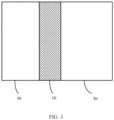
- an embodiment of this application provides a solid-state electrolyte 10.
- the solid-state electrolyte 10 may be used in a secondary battery.
- the secondary battery includes a positive electrode plate 20, a metal negative electrode plate 30, and a solid-state electrolyte 10 disposed between the positive electrode plate 20 and the metal negative electrode plate 30.
- the solid-state electrolyte 10 includes a coordination polymer electrolyte.
- the coordination polymer electrolyte includes a porous coordination polymer having an unsaturated metal site, an anionic group coordinated with and grafted on the unsaturated metal site, and a cation bound with the anionic group.
- the anionic group may include one or more of a substituted carboxylate anionic group and a substituted sulfonate anionic group.
- the cation is an electrolyte salt cation, and may specifically include one or more of a lithium ion, a sodium ion, a potassium ion, a magnesium ion, a zinc ion, and an aluminum ion.
- the metal negative electrode plate 30 may be a lithium negative electrode, a sodium negative electrode, a potassium negative electrode, a magnesium negative electrode, a zinc negative electrode, or an aluminum negative electrode.
- the secondary battery may be a lithium secondary battery, a sodium secondary battery, a potassium secondary battery, a magnesium secondary battery, a zinc secondary battery, or an aluminum secondary battery.
- the secondary battery has high electrochemical performance and safety performance.
- the anionic group is coordinated with and grafted on the unsaturated metal site of the porous coordination polymer.
- the solid-state electrolyte 10 can implement fast transmission of a single cation under a poor solvent or even no solvent condition, and has a high quantity of transported cations (greater than 0.85), thereby avoiding concentration polarization caused due to anion movement in an electrochemical system and reducing internal impedance.
- growth of a metal negative electrode dendrite can also be effectively suppressed, thereby significantly improving electrochemical performance and safety performance of the battery.
- the solid-state electrolyte in this embodiment of this application use of a liquid electrolyte can be reduced or avoided, to reduce direct contact between the liquid electrolyte and a metal negative electrode, thereby reducing side reactions and improving coulombic efficiency of the metal negative electrode.
- the solid-state electrolyte 10 in this embodiment of this application has good interface contact with the electrode, and can load a small amount of a solvent, thereby further improving an ion conductivity and improving contact between the solid-state electrolyte and the electrode.
- the anionic group may include the one or more of the substituted carboxylate anionic group and the substituted sulfonate anionic group.
- the substituted carboxylate anionic group may be an azyl-substituted, a hydroxyl-substituted, or a thiol-substituted carboxylate anionic group.
- the substituted sulfonate anionic group may be an azyl-substituted, a hydroxyl-substituted, or a thiol-substituted sulfonate anionic group.
- a structural formula of the anionic group may be represented as -Y-R 2 -Z.
- Y represents an oxygen atom (O), a sulfur atom (S), or an imine group (-NH-)
- R 2 is a divalent hydrocarbyl group, a divalent substituted hydrocarbyl group, a divalent oxyl group, or a divalent substituted oxyl group
- Z is a carboxylate anion (COO - ) or a sulfonate anion (SO 3 - ).
- the anionic group is coordinated with the unsaturated metal site of the porous coordination polymer through Y
- a structural formula of the substituted carboxylate anionic group is -Y-R 2 -COO - .
- a structural formula of the substituted sulfonate anionic group is -Y-R 2 -SO 3 - .
- Z is a sulfonate anion
- a degree of dissociation is higher, thereby helping improve a free cation concentration.
- the anionic group may be -O-R 2 -COO - , -S-R 2 -COO - , -NH-R 2 -COO - , -O-R 2 -SO 3 - , -S-R 2 -SO 3 - , or -NH-R 2 -SO 3 - .
- structures of the plurality of anionic groups may be the same or may be different.
- R 2 is a divalent hydrocarbyl group, a divalent substituted hydrocarbyl group, a divalent oxyl group, or a divalent substituted oxyl group in which a quantity of carbon atoms ranges from 1 to 20.
- the quantity of carbon atoms of R 2 may be 1, 2, 3, 4, 5, 6, 7, 8, 9, 10, 11, 12, 13, 14, 15, 16, 17, 18, 19, or 20.
- R 2 may be any group selected from an alkylene group, a halogenated alkylene group, an alkoxylene group, a halogenated alkoxylene group, an alkenylene group, a halogenated alkenylene group, an enoxylene group, a halogenated enoxylene group, an arylene group, a halogenated arylene group, an aryloxylene group, and a halogenated aryloxylene group.
- a quantity of carbon atoms of each of the alkylene group, the halogenated alkylene group, the alkoxylene group, and the halogenated alkoxylene group may range from 1 to 20. Further, the quantity of carbon atoms may range from 1 to 8.
- a quantity of carbon atoms of each of the alkenylene group, the halogenated alkenylene group, the enoxylene group, and the halogenated enoxylene group may range from 2 to 20. Further, the quantity of carbon atoms may range from 2 to 8.
- a quantity of carbon atoms of each of the arylene group, the halogenated arylene group, the aryloxylene group, and the halogenated aryloxylene group may range from 6 to 20. Further, the quantity of carbon atoms may range from 6 to 10.
- a small quantity of carbon atoms indicates a small molecular volume. In this case, it is easy for the group to be coordinated with and grafted on a metal atom.
- a large quantity of carbon atoms indicates a large molecular volume. In this case, it is not easy for the group to be coordinated with and grafted on a metal atom.
- a halogen in each of the halogenated alkylene group, the halogenated alkoxylene group, the halogenated alkenylene group, the halogenated enoxylene group, the halogenated arylene group, and the halogenated aryloxylene group includes fluorine, chlorine, bromine, and iodine. Halogenation may be full halogenation or partial halogenation.
- R 2 may be a linear-chain or branched-chain hydrocarbyl group, substituted hydrocarbyl group, or oxyl group.
- the anionic group may be specifically, for example, -NH-CH 2 -CH 2 -SO 3 - , -NH-CH 2 -CH 2 -CH 2 -SO 3 - , -S-CH 2 -CH 2 -SO 3 - , -S-CH 2 -CH 2 -CH 2 -SO 3 - , -O-CH 2 -CH 2 -SO 3 - , -O-CH 2 -CH 2 -CH 2 -SO 3 - , -NH-CF 2 -CF 2 -COO - , -NH-CF 2 -CF 2 -CF 2 -SO 3 - , -S-CF 2 -CF 2 -CF 2 -COO - , -S-CF 2 -CF 2 -SO 3 - , -O-CF 2 -CF 2 -SO 3 - , or -O-CF 2 -CF 2 -CF 2 -CF 2 -COO -
- the coordination polymer electrolyte is a metal-organic coordination polymer single-ion solid-state electrolyte.
- the porous coordination polymer (Porous Coordination Polymer, PCP) uses M as a metal center and R-X n as an organic ligand.
- the porous coordination polymer has a uniform porous structure.
- M may be one or more of metal titanium (Ti), zirconium (Zr), hafnium (Hf), chromium (Cr), iron (Fe), cobalt (Co), nickel (Ni), copper (Cu), or aluminum (Al).
- R is an n-valent hydrocarbyl group, an n-valent substituted hydrocarbyl group, an n-valent oxyl group, or an n-valent substituted oxyl group
- n may be 1, 2, 3, or 4
- X is an oxygen-containing functional group that forms a metal-oxygen chemical bond with the unsaturated metal site of the porous coordination polymer.
- X may be a carboxyl group or a sulfo group.
- the porous coordination polymer has the unsaturated metal site, and the unsaturated metal site is a metal center whose valence is unsaturated and has a coordination capability.
- the porous coordination polymer may have one or more unsaturated metal sites.
- the porous coordination polymer may include one or more organic ligands.
- the plurality of organic ligands may be the same organic ligand, or may be different organic ligands.
- the porous coordination polymer may include only a carboxyl group or a sulfo group, or may include both a carboxyl group and a sulfo group.
- R is a hydrocarbyl group, a substituted hydrocarbyl group, an oxyl group, or a substituted oxyl group in which a quantity of carbon atoms ranges from 1 to 20.
- R may be any one of an alkyl group, an alkylene group, a halogenated alkyl group, a halogenated alkylene group, an alkoxyl group, an alkoxylene group, a halogenated alkoxyl group, a halogenated alkoxylene group, an alkenyl group, an alkenylene group, a halogenated alkenyl group, a halogenated alkenylene group, an enoxyl group, an enoxylene group, a halogenated enoxyl group, a halogenated enoxylene group, an aryl group, an arylene group, a halogenated aryl group, a halogenated arylene group, an aryl group, an arylene group,
- a quantity of carbon atoms of each of the alkyl group, the alkylene group, the halogenated alkyl group, the halogenated alkylene group, the alkoxyl group, the alkoxylene group, the halogenated alkoxyl group, and the halogenated alkoxylene group ranges from 1 to 20. Further, the quantity of carbon atoms ranges from 1 to 8.
- a quantity of carbon atoms of each of the alkenyl group, the alkenylene group, the halogenated alkenyl group, the halogenated alkenylene group, the enoxyl group, the enoxylene group, the halogenated enoxyl group, and the halogenated enoxylene group ranges from 2 to 20.
- the quantity of carbon atoms ranges from 2 to 8.
- a quantity of carbon atoms of each of the aryl group, the arylene group, the halogenated aryl group, the halogenated arylene group, the aryloxyl group, the aryloxylene group, the halogenated aryloxyl group, and the halogenated aryloxylene group ranges from 6 to 20. Further, the quantity of carbon atoms ranges from 6 to 10.
- a halogen in each of the halogenated alkyl group, the halogenated alkylene group, the halogenated alkoxyl group, the halogenated alkoxylene group, the halogenated alkenyl group, the halogenated alkenylene group, the halogenated enoxyl group, the halogenated enoxylene group, the halogenated aryl group, the halogenated arylene group, the halogenated aryloxyl group, and the halogenated aryloxylene group includes fluorine, chlorine, bromine, or iodine.
- Halogenation may be full halogenation or partial halogenation.
- R may be a linear-chain or branched-chain hydrocarbyl group, substituted hydrocarbyl group, oxyl group, or substituted oxyl group.
- the organic ligand includes one or more of terephthalic acid, trimesic acid, biphenyldicarboxylic acid, biphenyltricarboxylic acid, and 1,3,5-tri(4-carboxyphenyl)benzene.
- M is a metal center
- R may be a divalent hydrocarbyl group, a divalent substituted hydrocarbyl group, a divalent oxyl group, or a divalent substituted oxyl group; and may be specifically any one of an alkylene group, a halogenated alkylene group, an alkoxylene group, a halogenated alkoxylene group, an alkenylene group, a halogenated alkenylene group, an enoxylene group, a halogenated enoxylene group, an arylene group, a halogenated arylene group, an aryloxylene group, and a halogenated aryloxylene group.
- X 1 is -COO - or -SO 3 - .
- Y is selected from O, S, or NH
- R 2 is a divalent hydrocarbyl group, a divalent substituted hydrocarbyl group, a divalent oxyl group, or a divalent substituted oxyl group.
- Z is a carboxylate anion (COO - ) or a sulfonate anion (SO 3 - ).
- A is a cation, and may be specifically one or more of a lithium ion, a sodium ion, a potassium ion, a magnesium ion, a zinc ion, and an aluminum ion.
- n represents a degree of polymerization, and may be specifically an integer greater than or equal to 1.
- a thickness of the solid-state electrolyte 10 may be designed according to an actual requirement.
- the thickness of the solid-state electrolyte 10 may range from 1 ⁇ m to 100 ⁇ m.
- the thickness of the solid-state electrolyte 10 may range from 5 ⁇ m to 60 ⁇ m, and may be specifically, for example, 5 ⁇ m, 10 ⁇ m, 15 ⁇ m, 20 ⁇ m, 25 ⁇ m, 30 ⁇ m, 35 ⁇ m, 40 ⁇ m, 45 ⁇ m, 50 ⁇ m, or 60 ⁇ m.
- An excessively large thickness of the solid-state electrolyte 10 indicates excessively large surface resistance of an electrolyte layer, thereby affecting battery performance.
- An excessively small thickness indicates poor mechanical strength, thereby causing a short circuit.
- the solid-state electrolyte 10 may further include a liquid electrolyte solvent.
- the liquid electrolyte solvent is filled in a micropore of the coordination polymer electrolyte.
- a mass percentage of the liquid electrolyte solvent in the solid-state electrolyte is less than or equal to 20%. In some implementations, the mass percentage of the liquid electrolyte solvent in the solid-state electrolyte ranges from 1% to 15%. In some other implementations, the mass percentage of the liquid electrolyte solvent in the solid-state electrolyte ranges from 3% to 10%.
- the mass percentage of the liquid electrolyte solvent in the solid-state electrolyte ranges from 5% to 8%.
- the liquid electrolyte solvent may be one or more of a carbonate solvent, an ether solvent, and a carboxylate solvent.
- the liquid electrolyte solvent may be obtained by mixing the foregoing three solvents according to any ratio.
- the carbonate solvent includes cyclic carbonate or chain carbonate.
- the cyclic carbonate may be specifically one or more of ethylene carbonate (EC), propylene carbonate (PC), ⁇ -butyrolactone (GBL), butylene carbonate (BC), fluoroethylene carbonate (FEC), and vinylene carbonate (VC).
- the chain carbonate may be specifically one or more of dimethyl carbonate (DMC), ethyl methyl carbonate (EMC), diethyl carbonate (DEC), and dipropyl carbonate (DPC).
- the ether solvent includes cyclic ether or chain ether.
- the cyclic ether may be specifically one or more of 1,3-dioxolane (DOL), 1,4-dioxane (DX), crown ether, tetrahydrofuran (THF), 2-methyl tetrahydrofuran (2-CH 3 -THF), and 2-trifluoromethyl tetrahydrofuran (2-CF 3 -THF).
- the chain ether may be specifically one or more of dimethoxymethane (DMM), 1,2-dimethoxyethane (DME), and diethylene glycol dimethyl ether (TEGDME).
- the carboxylate solvent may be specifically one or more of methyl acetate (MA), ethyl acetate (EA), propyl acetate (EP), butyl acetate, propyl propionate (PP), and butyl propionate.
- the solid-state electrolyte further includes a binding agent.
- the coordination polymer electrolyte in the solid-state electrolyte is mostly a powder sample. Therefore, the binding agent is added, to facilitate membrane forming of the coordination polymer electrolyte. In addition, closer binding is implemented for the coordination polymer electrolyte, thereby improving structural stability of a solid-state electrolyte membrane.
- the binding agent may include one or more of polyvinylidene fluoride (PVDF), poly(methyl methacrylate) (PMMA), polytetrafluoroethylene (PTFE), poly(vinylidene fluoride-co-hexafluoropropylene) (PVDF-HFP), polyacrylonitrile (PAN), polyimide (PI), polybenzimidazole (PBI), polyethylene glycol (PEG), polyethylene oxide (PEO), polydopamine (PDA), sodium carboxymethyl cellulose (CMC), styrene-butadiene rubber (SBR), polyvinyl alcohol (PVA), polyacrylic acid (PAA), lithium polyacrylate (LiPAA), polyvinylpyrrolidon (PVP), polylactic acid (PLA), sodium alginate (SA), polystyrene sulfonate (PSS), lithium polystyrene sulfonate (LiPSS), and gelatin.
- PVDF polyvinyliden
- a mass ratio of the coordination polymer electrolyte to the binding agent may be (1-100):1. Further, the mass ratio may be (5-90): 1, or may be (10-80): 1, (20-60): 1, or (30-50): 1.
- An excessive content of the binding agent indicates reduction of ion conductivity, thereby affecting ion transmission of the electrolyte.
- the content of the binding agent is controlled to a relatively small level, to help improve ion transmission performance of the solid-state electrolyte.
- the solid-state electrolyte 10 in this embodiment of this application has a high quantity of transported cations (such as lithium ions), and can implement fast transmission of a single cation.
- the quantity of transported cations is greater than 0.85. In some implementations, a quantity of transported cations is greater than or equal to 0.9.
- a room-temperature conductivity of the solid-state electrolyte 10 containing no liquid electrolyte solvent ranges from 0.5 mS/cm to 5 mS/cm, and a room-temperature conductivity of the solid-state electrolyte 10 containing the liquid electrolyte solvent ranges from 3 mS/cm to 8 mS/cm.
- the metal negative electrode plate 30 may be a lithium negative electrode, a sodium negative electrode, a potassium negative electrode, a magnesium negative electrode, a zinc negative electrode, or an aluminum negative electrode.
- the lithium negative electrode, the sodium negative electrode, the potassium negative electrode, the magnesium negative electrode, the zinc negative electrode, and the aluminum negative electrode may be metal elements of lithium, sodium, potassium, magnesium, zinc, and aluminum, or an alloy thereof; or may be the foregoing metal having a current collector or an alloy thereof.
- the lithium negative electrode is used as an example.
- the lithium negative electrode may be pure metal lithium or a lithium alloy, or may be lithium metal or a lithium alloy that is included in a current collector and that is disposed on the current collector.
- the lithium alloy may include at least one of a lithium silicon alloy, a lithium aluminum alloy, a lithium tin alloy, and a lithium indium alloy.
- This embodiment of this application further provides a preparation method of the solid-state electrolyte, including: making a mixed slurry by using the coordination polymer electrolyte, performing coating by using the mixed slurry to form a membrane, performing drying, and then performing rolling to a specific thickness to obtain the solid-state electrolyte.
- the mixed slurry may include a binding agent, and may further include an organic solvent.
- a preparation process of the mixed slurry may be: dispersing the binding agent in the organic solvent to obtain a mixed liquor, and dispersing a coordination polymer in the mixed liquor to obtain the mixed slurry.
- the organic solvent may be N-methyl pyrrolidone (NMP), acetone, acetonitrile, methanol, ethanol, dimethyl carbonate, ethyl methyl carbonate, diethyl carbonate, tetrahydrofuran, N,N-dimethylformamide (DMF), dimethyl ether, dimethyl sulfide, 1,3-dioxolane, 1,4-dioxane, 1,2-dimethoxyethane, dimethoxyethane, di-trifluoroethyl ether, hexafluoroisopropyl methyl ether, hexafluoroisopropyl ethyl ether, methyl perfluorobutyl ether, ethyl perfluorobutyl ether, tetrafluoroethyl tetrafluoropropyl ether, and tetrafluoroethyl octafluoroamylether
- a preparation process of the coordination polymer electrolyte may include:
- an operation of activating the porous coordination polymer may be specifically: heating the porous coordination polymer for 1 hour to 12 hours at 80°C to 350°C in vacuum for activation.
- the activation facilitates a subsequent coordination grafting reaction.
- the compound having the anionic group may be HO-R 2 -COOH, HS-R 2 -COOH, NH 2 -R 2 -COOH, HO-R 2 -SO 3 H, HS-R 2 -SO 3 H, or NH 2 -R 2 -SO 3 H.
- a time period of the stirring for the reaction may be 6 hours to 48 hours.
- the solvent may be N-methyl pyrrolidone, acetone, acetonitrile, methanol, ethanol, dimethyl carbonate, ethyl methyl carbonate, diethyl carbonate, tetrahydrofuran, N,N-dimethylformamide, dimethyl ether, dimethyl sulfide, 1,3-dioxolane, 1,4-dioxane, 1,2-dimethoxyethane, dimethoxyethane, di-trifluoroethylether, hexafluoroisopropyl methyl ether, hexafluoroisopropyl ethyl ether, methyl perfluorobutyl ether, ethyl perfluorobutyl ether, tetrafluoroethyl tetrafluoropropyl ether, and tetrafluoroethyl octafluoroafluoroafluoroafluoro
- the porous coordination polymer having the unsaturated metal site in step (1) may be prepared by using a solvothermal method.
- the porous coordination polymer may be obtained by specifically dispersing an organic ligand and a metal salt at a molar ratio of 1:(1-4) in a solvent, performing ultrasonic dispersion and performing stirring for 10 minutes to 60 minutes to obtain a mixed liquor, and placing the mixed liquor into a reaction kettle at 80°C to 350°C for a solvothermal reaction.
- the metal salt is a salt including a metal center.
- the solvent in the solvothermal reaction system includes but is not limited to deionized water, N-methyl pyrrolidone, acetone, acetonitrile, methanol, ethanol, dimethyl carbonate, ethyl methyl carbonate, diethyl carbonate, tetrahydrofuran, N,N-dimethylformamide, dimethyl ether, dimethyl sulfide, 1,3-dioxolane, 1,4-dioxane, 1,2-dimethoxyethane, dimethoxyethane, di-trifluoroethyl ether, hexafluoroisopropyl methyl ether, hexafluoroisopropyl ethyl ether, methyl perfluorobutyl ether, ethyl perfluorobutyl ether, tetrafluoroethyl tetrafluoropropyl ether, and tetrafluoroethyl
- the salt containing the cation may include one or more of hexafluorophosphate, hexafluoroarsenate, perchlorate, tetrafluoroborate, bisoxalatoborate, difluoro(oxalato)borate, bisfluorosulfonimide, and bis(fluorosulfonyl)imide that contain the cation.
- the salt containing the cation may be lithium hexafluorophosphate, lithium hexafluorarsenate, lithium perchlorate, lithium tetrafluoroborate, lithium bisoxalatoborate, lithium difluoro(oxalato)borate, lithium bis(fluorosulfonyl)imide, or lithium bis(trifluoromethanesulfonyl)imide.
- the organic solvent may be the foregoing liquid electrolyte solvent, for example, a carbonate solvent, an ether solvent, or a carboxylate solvent; or may be another organic solvent in the solvent in step (1), such as acetonitrile.
- a time period of the stirring for the reaction may be 6 hours to 48 hours.
- ion exchange is implemented between the cation in the salt containing the cation and the anionic group.
- a powder sample of the coordination polymer electrolyte may be obtained by performing drying at 60°C to 100°C.
- the solvent used in the liquid electrolyte of the salt containing the cation is a commonly used liquid electrolyte solvent
- the electrolyte may be not completely dried, so that only a part of the liquid electrolyte solvent is reserved.
- the solvent used in the liquid electrolyte of the salt containing the cation is not a commonly used liquid electrolyte solvent but another organic solvent, if the final solid-state electrolyte needs to include a specific amount of the liquid electrolyte solvent, the electrolyte needs to be fully dried, and then an appropriate amount of the liquid electrolyte solvent is added.
- a preparation process of the solid-state electrolyte includes: dispersing an organic ligand and a metal salt at a molar ratio of 1 :(1-4) in a solvent, performing ultrasonic dispersion and performing stirring for 10 minutes to 60 minutes, placing a mixed liquor into a reaction kettle at 80°C to 350°C for a solvothermal reaction, washing a product obtained through the reaction, and heating the product for 1 hour to 12 hours at 80°C to 350°C in vacuum for activation to obtain the powder sample. Then, the powder sample activated through heating is dispersed in the solution of the compound having the anionic group, and stirring is performed for 6 hours to 48 hours.
- the compound having the anionic group is coordinated with and grafted on the unsaturated metal site. After the reaction is completed, a sample obtained after the grafting is collected. Afterwards, the sample obtained after the grafting is dried and placed in the liquid electrolyte of the salt containing the cation. Stirring is performed for 6 hours to 48 hours for ion exchange. Drying is performed at 60°C to 100°C to obtain the powder sample of the coordination polymer electrolyte. Then, the powder sample of the coordination polymer electrolyte is dispersed in an organic solvent containing a binding agent. Blade coating is performed to obtain an electrolyte membrane. Finally, the electrolyte membrane is rolled to a target thickness.
- the preparation method of the solid-state electrolyte in this embodiment of this application is simple. In addition, it is easy to obtain raw materials, thereby facilitating large-scale preparation.
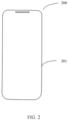
- an embodiment of this application further provides an electronic device 200.
- the electronic device 200 may be a mobile phone; or may be an electronic product such as a tablet computer, an intelligent wearable product, an uncrewed aerial vehicle, or an electric vehicle.
- the electronic device 200 includes a housing 201, and an electronic component and a battery (not shown in the figure) located inside the housing 201.
- the battery is the secondary battery provided in the foregoing embodiment of this application.
- the housing 201 may include a display assembled on a front side of the electronic device and a rear cover assembled on a rear side. The battery may be fastened on an inner side of the rear cover, and supplies power to the electronic component in the electronic device 200.
- a solid-state electrolyte including an organic-inorganic coordination polymer (as shown in Formula A) having an unsaturated aluminum site MIL-100(Al)-2-lithium sulfoethylamine and application thereof in a lithium metal battery are provided.
- LiCoO 2 /Li lithium metal battery Polyvinylidene fluoride (PVDF) with a mass percentage of 2%, a conductive agent super P with a mass percentage of 2%, and lithium cobalt oxide (LiCoO 2 ) with a mass percentage of 96% were weighed and successively added to N-methyl pyrrolidone (NMP). Stirring was fully performed for uniform mixing. A slurry was applied on an aluminum foil current collector, and was dried, cold-pressed, and cut to obtain a positive electrode plate.
- PVDF Polyvinylidene fluoride
- NMP N-methyl pyrrolidone
- the prepared positive electrode plate, a metal lithium negative electrode, and the solid-state electrolyte prepared in Example 1 was assembled into a buckle battery.
- a solid-state electrolyte including an organic-inorganic coordination polymer (as shown in Formula B) having an unsaturated aluminum site MIL-100(Al)-3-lithium sulfopropylamine and application thereof in a lithium metal battery are provided.
- the activated sample was added to a 0.5 mol/L 3-sulfopropylamine aqueous solution. Stirring was performed for 12 h. A product was collected in a centrifugal manner, and then washed by using water and anhydrous ethanol. Obtained powder was dried (at 150°C) for 3 h in vacuum. The dried powder was immersed in a 1 mol/L lithium bistrifluoromethanesulfonimide (LiTFSI) acetonitrile solution for one day. After ion exchange was fully implemented, drying was performed at 80°C for 12 h in vacuum, to obtain a coordination polymer electrolyte. The sample was compounded by using a binding agent of polybenzimidazole (PBI).
- PBI polybenzimidazole
- NMP N-methyl pyrrolidone
- a solid-state electrolyte including an organic-inorganic coordination polymer (as shown in Formula C) having an unsaturated zirconium site MOF-808(Zr)-2-lithium sulfoethylamine and application thereof in a lithium metal battery are provided.
- the activated sample was added to a 0.5 mol/L 2-sulfoethylamine aqueous solution. Stirring was performed for 12 h. A product was collected in a centrifugal manner, and then washed by using water and anhydrous ethanol. Obtained powder was dried (at 150°C) for 3 h in vacuum. The dried powder was immersed in a 1 mol/L lithium bistrifluoromethanesulfonimide (LiTFSI) acetonitrile solution for one day. After ion exchange was fully implemented, drying was performed at 80°C for 12 h in vacuum, to obtain a coordination polymer electrolyte.
- LiTFSI lithium bistrifluoromethanesulfonimide
- the sample was compounded by using a binding agent, such as polybenzimidazole (PBI).
- PBI polybenzimidazole
- NMP N-methyl pyrrolidone
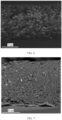
- Stirring was performed at 50°C for 24 h. 2 g of the sample was added to the solution. Stirring was performed for 12 h. Then, a mixed liquor was applied on a quartz board, and was dried at 80°C in vacuum overnight. An obtained product was taken out, and was rolled to a specific thickness, to obtain a solid-state electrolyte with a thickness of 15 ⁇ m shown in FIG. 5 .
- a solid-state electrolyte including an organic-inorganic coordination polymer (as shown in Formula D) having an unsaturated zirconium site MOF-808(Zr)-3-lithium sulfopropylamine and application thereof in a lithium metal battery are provided.
- the activated sample was added to a 0.5 mol/L 3-sulfopropylamine aqueous solution. Stirring was performed for 12 h. A product was collected in a centrifugal manner, and then washed by using water and anhydrous ethanol. Obtained powder was dried (at 150°C) for 3 h in vacuum. The dried powder was immersed in a 1 mol/L lithium bistrifluoromethanesulfonimide (LiTFSI) acetonitrile solution for one day. After ion exchange was fully implemented, drying was performed at 80°C for 12 h in vacuum, to obtain a coordination polymer electrolyte.
- LiTFSI lithium bistrifluoromethanesulfonimide
- the sample was compounded by using a binding agent, such as polybenzimidazole (PBI).
- PBI polybenzimidazole
- NMP 5 mLN-methyl pyrrolidone
- Stirring was performed at 50°C for 24 h.
- 2 g of the sample was added to the solution.
- Stirring was performed for 12 h.
- a mixed liquor was applied on a quartz board, and was dried at 80°C in vacuum overnight.
- An obtained product was taken out, and was rolled to a specific thickness, to obtain a solid-state electrolyte with a thickness of 20 ⁇ m shown in FIG. 6 .
- a solid-state electrolyte including an organic-inorganic coordination polymer (as shown in Formula E) having an unsaturated zirconium site MOF-808(Zr)-3-lithium mercaptosulfopropyl and application thereof in a lithium metal battery are provided.
- the activated sample was added to a 0.5 mol/L 3-mercaptosulfopropyl aqueous solution. Stirring was performed for 12 h. A product was collected in a centrifugal manner, and then washed by using water and anhydrous ethanol. Obtained powder was dried (at 150°C) for 3 h in vacuum. The dried powder was immersed in a 1 mol/L lithium bistrifluoromethanesulfonimide (LiTFSI) acetonitrile solution for one day. After ion exchange was fully implemented, drying was performed at 80°C for 12 h in vacuum, to obtain a coordination polymer electrolyte.
- LiTFSI lithium bistrifluoromethanesulfonimide
- the sample was compounded by using a binding agent, such as polybenzimidazole (PBI).
- PBI polybenzimidazole
- 1 g PBI was dissolved in 10 mLN-methyl pyrrolidone (NMP). Stirring was performed at 50°C for 24 h. 4 g of the sample was added to the solution. Stirring was performed for 12 h. Then, a mixed liquor was applied on a quartz board, and was dried at 80°C in vacuum overnight. An obtained product was taken out, and was rolled to a specific thickness, to obtain a solid-state electrolyte with a thickness of 25 ⁇ m shown in FIG. 7 .
- PBI polybenzimidazole
- a solid-state electrolyte including an organic-inorganic coordination polymer (as shown in Formula F) having an unsaturated zirconium site MOF-808(Zr)-2-lithium hydroxyethanesulphonate and application thereof in a lithium metal battery are provided.
- the activated sample was added to a 0.5 mol/L 2-hydroxyethanesulphonate aqueous solution. Stirring was performed for 12 h. A product was collected in a centrifugal manner, and then washed by using water and anhydrous ethanol. Obtained powder was dried (at 150°C) for 3 h in vacuum. The dried powder was immersed in a 1 mol/L lithium bistrifluoromethanesulfonimide (LiTFSI) acetonitrile solution for one day. After ion exchange was fully implemented, drying was performed at 80°C for 12 h in vacuum, to obtain a coordination polymer electrolyte.
- LiTFSI lithium bistrifluoromethanesulfonimide
- the sample was compounded by using a binding agent, such as polybenzimidazole (PBI).
- PBI polybenzimidazole
- 1 g PBI was dissolved in 10 mLN-methyl pyrrolidone (NMP). Stirring was performed at 50°C for 24 h. 4 g of the sample was added to the solution. Stirring was performed for 12 h. Then, a mixed liquor was applied on a quartz board, and was dried at 80°C in vacuum overnight. An obtained product was taken out, and was rolled to obtain a solid-state electrolyte with a thickness of 25 ⁇ m.
- NMP mLN-methyl pyrrolidone
- Example 7 A solid-state electrolyte including an organic-inorganic coordination polymer (as shown in Formula G) having an unsaturated zirconium site MOF-808(Zr)-3-lithium mercaptopropionate and application thereof in a lithium metal battery are provided.
- the activated sample was added to a 0.5 mol/L 3-mercaptopropionate aqueous solution. Stirring was performed for 12 h. A product was collected in a centrifugal manner, and then washed by using water and anhydrous ethanol. Obtained powder was dried (at 150°C) for 3 h in vacuum. The dried powder was immersed in a 1 mol/L lithium bistrifluoromethanesulfonimide (LiTFSI) acetonitrile solution for one day. After ion exchange was fully implemented, drying was performed at 80°C for 12 h in vacuum, to obtain a coordination polymer electrolyte. The sample was compounded by using a binding agent, such as polybenzimidazole (PBI).
- PBI polybenzimidazole
- LiCoO 2 /Li battery The metal lithium negative electrode, the positive electrode plate prepared in Example 1, and a PE separator were assembled into a buckle battery. A 50 ⁇ L 1.0 mol/L LiPF 6 liquid electrolyte (a weight ratio of EC, DEC, and FEC is 47:47:6) was added.
- LiCoO 2 /Li battery The metal lithium negative electrode, the positive electrode plate prepared in Example 1, and a 50 ⁇ m oxide ceramic electrolyte (Li 7 La 3 Zr 2 O 12 , LLZO) were assembled into a buckle battery.
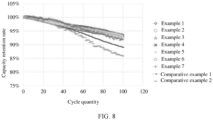
- Cycle performance test for the LiCoO 2 /Li battery A charge and discharge test was performed on the batteries prepared in Examples 1 to 7 and Comparative examples 1 and 2 according to a charge and discharge rule of 0.2 C/0.5 C. A voltage range was 3.0 V to 4.5 V Test results are shown in Table 1 and FIG. 8 .
- Rate performance test for the LiCoO 2 /Li battery A charge and discharge test was performed on the batteries prepared in Examples 1 to 7 and Comparative examples 1 and 2 at charge and discharge rates of 0.2/0.2 C, 0.2/0.5 C, 0.2/1.0 C, 0.2/1.5 C, and 0.2/2.0 C. A voltage range was 3.0 V to 4.5 V. Capacity retention rates for 2.0 C relative to 0.2 C were recorded. Test results are shown in Table 1.
- Table 1 Different battery performance test results Sequence number Quantity of transported lithium ions in an electrolyte Capacity retention rate at 2.0 C Capacity retention rate after 50 cycles Capacity retention rate after 100 cycles
- Example 1 0.92 85.1% 96.1% 92.5%
- Example 2 0.93 85.3% 96.5%
- Example 3 0.92 84.9% 97.1% 93.5%
- Example 4 0.94 85.1% 96.9% 93.4%
- Example 5 0.93 85.0% 96.8% 93.2%
- Example 6 0.92 84.8% 96.7% 92.3%
- Example 7 0.90 83.3% 96.6% 91.9% Comparative example 1 0.33 85.2% 95.3% 89.0% Comparative example 2 1.00 72.3% 94.7% 85.9%
- the lithium cobalt oxide/lithium batteries in Examples 1 to 7 of this application present better cycle performance. It is mainly because the solid-state electrolytes in Examples 1 to 7 of this application have good interface contact with the electrodes, so that interface impedance can be reduced and cycle stability performance of the battery can be improved.
- rate performance of the lithium cobalt oxide/lithium batteries in Examples 1 to 7 of this application is similar to that of the battery with the liquid-state electrolyte in Comparative example 1, and is better than that of the battery with the oxide ceramic solid-state electrolyte in Comparative example 2.
Landscapes
- Chemical & Material Sciences (AREA)
- Engineering & Computer Science (AREA)
- Electrochemistry (AREA)
- Manufacturing & Machinery (AREA)
- Chemical Kinetics & Catalysis (AREA)
- General Chemical & Material Sciences (AREA)
- Physics & Mathematics (AREA)
- Dispersion Chemistry (AREA)
- General Physics & Mathematics (AREA)
- Inorganic Chemistry (AREA)
- Condensed Matter Physics & Semiconductors (AREA)
- Materials Engineering (AREA)
- Spectroscopy & Molecular Physics (AREA)
- Secondary Cells (AREA)
- Conductive Materials (AREA)
Applications Claiming Priority (2)
| Application Number | Priority Date | Filing Date | Title |
|---|---|---|---|
| CN202110222938.8A CN114976227B (zh) | 2021-02-27 | 2021-02-27 | 固态电解质及其制备方法和二次电池 |
| PCT/CN2022/077655 WO2022179559A1 (fr) | 2021-02-27 | 2022-02-24 | Électrolyte solide et son procédé de préparation, et batterie secondaire |
Publications (2)
| Publication Number | Publication Date |
|---|---|
| EP4287334A1 true EP4287334A1 (fr) | 2023-12-06 |
| EP4287334A4 EP4287334A4 (fr) | 2025-08-13 |
Family
ID=82972653
Family Applications (1)
| Application Number | Title | Priority Date | Filing Date |
|---|---|---|---|
| EP22758923.1A Pending EP4287334A4 (fr) | 2021-02-27 | 2022-02-24 | Électrolyte solide et son procédé de préparation, et batterie secondaire |
Country Status (4)
| Country | Link |
|---|---|
| US (1) | US20230402648A1 (fr) |
| EP (1) | EP4287334A4 (fr) |
| CN (1) | CN114976227B (fr) |
| WO (1) | WO2022179559A1 (fr) |
Families Citing this family (3)
| Publication number | Priority date | Publication date | Assignee | Title |
|---|---|---|---|---|
| CN118359780B (zh) * | 2024-06-19 | 2024-08-16 | 广东工业大学 | 一种金属掺杂共价有机框架材料及其制备方法与应用 |
| CN118712471B (zh) * | 2024-08-30 | 2024-10-25 | 贵州省材料产业技术研究院 | 一种空气稳定型硫化物全固态电解质膜材料及其制备方法 |
| CN119601586B (zh) * | 2025-02-10 | 2025-11-28 | 浙江大学 | 一种高性能生物质基硬碳负极材料的制备方法 |
Family Cites Families (9)
| Publication number | Priority date | Publication date | Assignee | Title |
|---|---|---|---|---|
| US9300010B2 (en) * | 2012-08-10 | 2016-03-29 | The Regents Of The University Of California | Solid lithium electrolyte via addition of lithium salts to metal-organic frameworks |
| US9929435B2 (en) * | 2015-02-27 | 2018-03-27 | GM Global Technology Operations LLC | Electrolyte structure for metal batteries |
| CN105070946B (zh) * | 2015-09-15 | 2018-01-09 | 中南大学 | 一种用于锂离子电池或锂硫电池的纳米结构准固体电解质及其制备方法和应用 |
| KR102601602B1 (ko) * | 2016-04-11 | 2023-11-14 | 삼성전자주식회사 | 복합 고체전해질, 이를 포함하는 보호음극 및 리튬 전지, 및 상기 복합 고체 전해질의 제조방법 |
| US20200185788A1 (en) * | 2017-02-07 | 2020-06-11 | Ford Cheer International Limited | Electrodes having electrode additive for high performance batteries and applications of same |
| AU2018219164A1 (en) * | 2017-02-07 | 2019-08-29 | Ford Cheer International Limited | Electrolyte modulator, fabrication methods and applications of same |
| US20190288331A1 (en) * | 2017-02-07 | 2019-09-19 | Ford Cheer International Limited | Solid-state electrolytes with biomimetic ionic channels for batteries and methods of making same |
| CN112216817A (zh) * | 2019-07-12 | 2021-01-12 | 华为技术有限公司 | 金属负极及其制备方法和二次电池 |
| CN112397772B (zh) * | 2020-11-30 | 2022-04-01 | 宁德国泰华荣新材料有限公司 | 一种固态电解质及其制备方法和应用 |
-
2021
- 2021-02-27 CN CN202110222938.8A patent/CN114976227B/zh active Active
-
2022
- 2022-02-24 WO PCT/CN2022/077655 patent/WO2022179559A1/fr not_active Ceased
- 2022-02-24 EP EP22758923.1A patent/EP4287334A4/fr active Pending
-
2023
- 2023-08-25 US US18/456,066 patent/US20230402648A1/en active Pending
Also Published As
| Publication number | Publication date |
|---|---|
| US20230402648A1 (en) | 2023-12-14 |
| CN114976227B (zh) | 2025-03-21 |
| CN114976227A (zh) | 2022-08-30 |
| EP4287334A4 (fr) | 2025-08-13 |
| WO2022179559A1 (fr) | 2022-09-01 |
Similar Documents
| Publication | Publication Date | Title |
|---|---|---|
| CN117317153B (zh) | 一种界面修饰的钠离子电池硬碳负极材料/负极、制备方法和应用 | |
| Erickson et al. | Development of advanced rechargeable batteries: a continuous challenge in the choice of suitable electrolyte solutions | |
| US20230402648A1 (en) | Solid-state electrolyte and preparation method thereof, and secondary battery | |
| US12394789B2 (en) | Metal anode, method for preparing the metal anode, and secondary battery | |
| TW200805735A (en) | Lithium secondary cell using ionic liquid | |
| CN101740754B (zh) | 一种锂单质硫二次电池用复合正极材料的制备方法 | |
| CN111033835A (zh) | 锂二次电池聚合物材料及其制造方法 | |
| Getie et al. | Development of electrolytes for rechargeable zinc-air batteries: current progress, challenges, and future outlooks | |
| Han et al. | Metal organic frameworks enabled multifunctional poly (ethylene oxide)-based solid polymer electrolytes with high lithium-ion conductivity and excellent stability | |
| CN116666747A (zh) | 一种基于金属有机框架阵列复合固态电解质及其制备方法与应用 | |
| CN116417665B (zh) | 非水电解液及锂离子电池 | |
| CN113328144A (zh) | 一种锂离子电池电解液及使用该电解液的锂离子电池 | |
| CN115939508A (zh) | Mof改性聚醚固液混合电解质及其制备方法与应用 | |
| JP7564740B2 (ja) | 非水電解液二次電池の回復方法及び非水電解液二次電池の製造方法 | |
| CN115441067A (zh) | 一种多组分混合态电解质及其制备方法和应用 | |
| CN114566700B (zh) | 一种阻燃的聚合物电解质隔膜及其制备方法和应用 | |
| JP7569719B2 (ja) | 回復剤、非水電解液二次電池の回復方法及び非水電解液二次電池の製造方法 | |
| JP2004146071A (ja) | 電気化学ディバイス用電解質、その電解液または固体電解質並びに電池 | |
| CN113871698B (zh) | 一种电解液及包含该电解液的锂电池 | |
| CN104247095A (zh) | 蓄电装置、其中使用的正极和多孔片、以及提高掺杂率的方法 | |
| Vineeth et al. | Metal-Air Batteries: Future of Hybrid or Electric Vehicles (HEV or EV) | |
| US20260024876A1 (en) | Hybrid membrane, preparation methods and applications thereof, and electrochemical device comprising the same | |
| CN118763177B (zh) | 一种补钠添加剂及其在钠离子电池中的用途 | |
| EP4432414B1 (fr) | Électrolyte polymère solide et son procédé de production | |
| CN118198496B (zh) | 一种锂离子电池电解液及其制备方法和锂离子电池 |
Legal Events
| Date | Code | Title | Description |
|---|---|---|---|
| STAA | Information on the status of an ep patent application or granted ep patent |
Free format text: STATUS: THE INTERNATIONAL PUBLICATION HAS BEEN MADE |
|
| PUAI | Public reference made under article 153(3) epc to a published international application that has entered the european phase |
Free format text: ORIGINAL CODE: 0009012 |
|
| STAA | Information on the status of an ep patent application or granted ep patent |
Free format text: STATUS: REQUEST FOR EXAMINATION WAS MADE |
|
| 17P | Request for examination filed |
Effective date: 20230901 |
|
| AK | Designated contracting states |
Kind code of ref document: A1 Designated state(s): AL AT BE BG CH CY CZ DE DK EE ES FI FR GB GR HR HU IE IS IT LI LT LU LV MC MK MT NL NO PL PT RO RS SE SI SK SM TR |
|
| DAV | Request for validation of the european patent (deleted) | ||
| DAX | Request for extension of the european patent (deleted) | ||
| REG | Reference to a national code |
Ref country code: DE Ref legal event code: R079 Free format text: PREVIOUS MAIN CLASS: H01M0010056000 Ipc: H01M0010056500 |
|
| A4 | Supplementary search report drawn up and despatched |
Effective date: 20250710 |
|
| RIC1 | Information provided on ipc code assigned before grant |
Ipc: H01M 10/0565 20100101AFI20250704BHEP Ipc: H01M 10/0525 20100101ALI20250704BHEP Ipc: H01B 1/12 20060101ALI20250704BHEP |