EP4290513A2 - Codage par transformation modifiée à déformation temporelle de signaux audio - Google Patents
Codage par transformation modifiée à déformation temporelle de signaux audio Download PDFInfo
- Publication number
- EP4290513A2 EP4290513A2 EP23205479.1A EP23205479A EP4290513A2 EP 4290513 A2 EP4290513 A2 EP 4290513A2 EP 23205479 A EP23205479 A EP 23205479A EP 4290513 A2 EP4290513 A2 EP 4290513A2
- Authority
- EP
- European Patent Office
- Prior art keywords
- frame
- warp
- parameter sequence
- spectral coefficients
- warp parameter
- Prior art date
- Legal status (The legal status is an assumption and is not a legal conclusion. Google has not performed a legal analysis and makes no representation as to the accuracy of the status listed.)
- Granted
Links
Images





Classifications
-
- G—PHYSICS
- G10—MUSICAL INSTRUMENTS; ACOUSTICS
- G10L—SPEECH ANALYSIS TECHNIQUES OR SPEECH SYNTHESIS; SPEECH RECOGNITION; SPEECH OR VOICE PROCESSING TECHNIQUES; SPEECH OR AUDIO CODING OR DECODING
- G10L19/00—Speech or audio signals analysis-synthesis techniques for redundancy reduction, e.g. in vocoders; Coding or decoding of speech or audio signals, using source filter models or psychoacoustic analysis
- G10L19/002—Dynamic bit allocation
-
- G—PHYSICS
- G10—MUSICAL INSTRUMENTS; ACOUSTICS
- G10L—SPEECH ANALYSIS TECHNIQUES OR SPEECH SYNTHESIS; SPEECH RECOGNITION; SPEECH OR VOICE PROCESSING TECHNIQUES; SPEECH OR AUDIO CODING OR DECODING
- G10L19/00—Speech or audio signals analysis-synthesis techniques for redundancy reduction, e.g. in vocoders; Coding or decoding of speech or audio signals, using source filter models or psychoacoustic analysis
- G10L19/02—Speech or audio signals analysis-synthesis techniques for redundancy reduction, e.g. in vocoders; Coding or decoding of speech or audio signals, using source filter models or psychoacoustic analysis using spectral analysis, e.g. transform vocoders or subband vocoders
-
- G—PHYSICS
- G10—MUSICAL INSTRUMENTS; ACOUSTICS
- G10L—SPEECH ANALYSIS TECHNIQUES OR SPEECH SYNTHESIS; SPEECH RECOGNITION; SPEECH OR VOICE PROCESSING TECHNIQUES; SPEECH OR AUDIO CODING OR DECODING
- G10L19/00—Speech or audio signals analysis-synthesis techniques for redundancy reduction, e.g. in vocoders; Coding or decoding of speech or audio signals, using source filter models or psychoacoustic analysis
- G10L19/02—Speech or audio signals analysis-synthesis techniques for redundancy reduction, e.g. in vocoders; Coding or decoding of speech or audio signals, using source filter models or psychoacoustic analysis using spectral analysis, e.g. transform vocoders or subband vocoders
- G10L19/022—Blocking, i.e. grouping of samples in time; Choice of analysis windows; Overlap factoring
-
- G—PHYSICS
- G10—MUSICAL INSTRUMENTS; ACOUSTICS
- G10L—SPEECH ANALYSIS TECHNIQUES OR SPEECH SYNTHESIS; SPEECH RECOGNITION; SPEECH OR VOICE PROCESSING TECHNIQUES; SPEECH OR AUDIO CODING OR DECODING
- G10L19/00—Speech or audio signals analysis-synthesis techniques for redundancy reduction, e.g. in vocoders; Coding or decoding of speech or audio signals, using source filter models or psychoacoustic analysis
- G10L19/04—Speech or audio signals analysis-synthesis techniques for redundancy reduction, e.g. in vocoders; Coding or decoding of speech or audio signals, using source filter models or psychoacoustic analysis using predictive techniques
- G10L19/06—Determination or coding of the spectral characteristics, e.g. of the short-term prediction coefficients
-
- H—ELECTRICITY
- H03—ELECTRONIC CIRCUITRY
- H03M—CODING; DECODING; CODE CONVERSION IN GENERAL
- H03M7/00—Conversion of a code where information is represented by a given sequence or number of digits to a code where the same, similar or subset of information is represented by a different sequence or number of digits
- H03M7/30—Compression; Expansion; Suppression of unnecessary data, e.g. redundancy reduction
-
- G—PHYSICS
- G10—MUSICAL INSTRUMENTS; ACOUSTICS
- G10L—SPEECH ANALYSIS TECHNIQUES OR SPEECH SYNTHESIS; SPEECH RECOGNITION; SPEECH OR VOICE PROCESSING TECHNIQUES; SPEECH OR AUDIO CODING OR DECODING
- G10L19/00—Speech or audio signals analysis-synthesis techniques for redundancy reduction, e.g. in vocoders; Coding or decoding of speech or audio signals, using source filter models or psychoacoustic analysis
- G10L19/02—Speech or audio signals analysis-synthesis techniques for redundancy reduction, e.g. in vocoders; Coding or decoding of speech or audio signals, using source filter models or psychoacoustic analysis using spectral analysis, e.g. transform vocoders or subband vocoders
- G10L19/0212—Speech or audio signals analysis-synthesis techniques for redundancy reduction, e.g. in vocoders; Coding or decoding of speech or audio signals, using source filter models or psychoacoustic analysis using spectral analysis, e.g. transform vocoders or subband vocoders using orthogonal transformation
Definitions
- the present invention relates to audio source coding systems and in particular to audio coding schemes using block-based transforms.
- transform size switching can be applied without significantly increasing the mean coding cost. That is, when a transient event is detected, the block size (frame size) of the samples to be encoded together is decreased. For more persistently transient signals, the bit rate will of course increase dramatically.
- pitch variation is the pitch variation of locally harmonic signals, which is encountered mainly in the voiced parts of speech and singing, but can also originate from the vibratos and glissandos of some musical instruments.
- a harmonic signal i.e. a signal having signal peaks distributed with equal spacing along the time axis
- pitch describes the inverse of the time between adjacent peaks of the signal.
- Such a signal therefore has a per-feet harmonic spectrum, consisting of a base frequency equal to the pitch and higher order harmonics.
- pitch can be defined as the inverse of the time between two neighbouring corresponding signal portions within a locally harmonic signal.
- the pitch and thus the base frequency varies with time, as it is the case in voiced sounds, the spectrum will become more and more complex and thus more inefficient to encode.
- warp For a harmonic signal, this definition of warp is insensitive to the particular choice of the harmonic component and systematic errors in terms of multiples or fractions of the pitch.
- the warp measures a change of frequency in the logarithmic domain.
- Speech signals exhibit warps of up to 10 oct/s and mean warp around 2 oct/s.
- time warping One possible technique to overcome this problem is time warping.
- the concept of time-warped coding is best explained by imagining a tape recorder with variable speed. When recording the audio signal, the speed is adjusted dynamically so as to achieve constant pitch over all voiced segments. The resulting locally stationary audio signal is encoded together with the applied tape speed changes. In the decoder, playback is then performed with the opposite speed changes.
- applying the simple time warping as described above has some significant drawbacks.
- the absolute tape speed ends up being uncontrollable, leading to a violation of duration of the entire encoded signal and bandwidth limitations.
- additional side information on the tape speed (or equivalently on the signal pitch) has to be transmitted, introducing a substantial bit-rate overhead, especially at low bit-rates.
- Time warping is also implemented in several other coding schemes.
- US-2002/0120445 describes a scheme, in which signal segments are subject to slight modifications in duration prior to block-based transform coding. This is to avoid large signal components at the boundary of the blocks, accepting slight variations in duration of the single segments.
- an encoder for deriving a representation of an audio signal having a first frame, a second frame following the first frame, and a third frame following the second frame
- the encoder comprising: a warp estimator for estimating first warp information for the first and the second frame and for estimating second warp information for the second frame and the third frame, the warp information describing a pitch information of the audio signal; a spectral analyzer for deriving first spectral coefficients for the first and the second frame using the first warp information and for deriving second spectral coefficients for the second and the third frame using the second warp information; and an output interface for outputting the representation of the audio signal including the first and the second spectral coefficients.
- the warp estimator may be operative to estimate the warp information using information on the variation of the pitch within the frames.
- the warp estimator may be operative to estimate the warp information such that the information on the variation of the pitch is used only when the pitch variation is lower than a predetermined maximum pitch variation.
- the warp estimator may be operative to estimate the warp information such that a warped representation of frames, the warped representation derived from frames transforming the time axis of the audio signal within the frames as indicated by the warp information, describes the same length of the audio signal as the corresponding frames.
- the warp estimator may be operative to estimate the warp information such that the warp information comprises a sequence of warp parameters, wherein each warp parameter describes a finite length interval of the audio signal.
- the spectral analyzer may be adapted to derive the spectral coefficients using a resampled representation of the frames.
- this object is achieved by a decoder for reconstructing an audio signal having a first frame, a second frame following the first frame and a third frame following the second frame, using first warp information, the first warp information describing a pitch information of the audio signal for the first and the second frame, second warp information, the second warp information describing a pitch information of the audio signal for the second and the third frame, first spectral coefficients for the first and the second frame and second spectral coefficients for the second and the third frame, the decoder comprising: a spectral value processor for deriving a first combined frame using the first spectral coefficients and the first warp information, the first combined frame having information on the first and on the second frame; and for deriving a second combined frame using the second spectral coefficients and the second warp information, the second combined frame having information on the second and the third frame; and a synthesizer for reconstructing the second frame using the first combined frame and the second combined frame.
- the spectral value processor may be operative to use cosine base functions for deriving the combined frames, the cosine base functions depending on the warp information.
- this object is achieved by method of deriving a representation of an audio signal having a first frame, a second frame following the first frame, and a third frame following the second frame, the method comprising: estimating first warp information for the first and the second frame and for estimating second warp information for the second frame and the third frame, the warp information describing a pitch of the audio signal; deriving first spectral coefficients for the first and the second frame using the first warp information and for deriving second spectral coefficients for the second and the third frame using the second warp information; and outputting the representation of the audio signal including the first and the second spectral coefficients.
- this is achieved by a computer program having a program code for performing, when running on a computer, any of the above methods.
- the present invention is based on the finding that a spectral representation of an audio signal having consecutive audio frames can be derived more efficiently when a common time warp is estimated for any two neighbouring frames, such that a following block transform can additionally use the warp information.
- window functions required for successful application of an overlap and add procedure during reconstruction can be derived and applied, already anticipating the re-sampling of the signal due to the time warping. Therefore, the increased efficiency of block-based transform coding of time-warped signals can be used without introducing audible discontinuities.
- the present invention thus offers an attractive solution to the prior art problems.
- the problem related to the segmentation of the audio signal is overcome by a particular overlap and add technique, that integrates the time-warp operations with the window operation and introduces a time offset of the block transform.
- the resulting continuous time transforms have perfect reconstruction capability and their discrete time counterparts are only limited by the quality of the applied resampling technique of the decoder during reconstruction. This property results in a high bit rate convergence of the resulting audio coding scheme. It is principally possible to achieve lossless transmission of the signal by decreasing the coarseness of the quantization, that is by increasing the transmission bit rate. This can, for example, not be achieved with purely parametric coding methods.
- the warp parameter sequence is derived using well-known pitch-tracking algorithms, enabling the use of those well-known algorithms and thus an easy implementation of the present invention into already existing coding schemes.
- the warping is implemented such that the pitch of the audio signal within the frames is as constant as possible, when the audio signal is time warped as indicated by the warp parameters.
- bit rate is even further decreased at the cost of higher computational complexity during encoding when the warp parameter sequence is chosen such that the size of an encoded representation of the spectral coefficients is minimized.
- additional spectral weighting is applied to the spectral coefficients of the signal prior to transformation into the time domain. Doing so has the advantage of further decreasing the computational complexity on the decoder side, as the computational complexity of the resampling of the signal can thus be decreased.
- the warp estimator is operative to estimate the warp information such that a spectral representation of a warped representation of a frame, the warped representation derived from frames transforming the time axis of the audio signal within the frames as indicated by the warp information, is more sparsely populated than a spectral representation of the frame.
- the warp estimator is operative to estimate the warp information such that a number of bits consumed by an encoded representation of spectral coefficients of a warped representation of frames, the warped representation derived from frames transforming the time axis of the audio signal within the frames as indicated by the warp information, is lower than an encoded representation of spectral coefficients of the frames when both representations are derived using the same encoding rule.
- the warp estimator is operative to estimate the warp information such that the warp information comprises an increasing sequence of warp parameters.
- the warp estimator is operative to estimate the warp information such that the warp information describes a continuously differentiable resampling rule mapping the interval [0,2] onto itself.
- the spectral analyzer is adapted to derive the spectral coefficients using cosine basis depending on the warp information.
- the warp information derived describes a pitch variation of the audio signal normalized to the pitch of the audio signal.
- the output interface is operative to further include a quantized representation of the warp information.
- the audio decoder is adapted to reconstruct an audio signal represented by a sequence of discrete sample values.
- the audio decoder further comprises a warp estimator for deriving the first and the second warp information from the first and the second spectral coefficients.
- the synthesizer is operative to reconstruct the second frame adding the first combined frame and the second combined frame.
- ⁇ (t) is therefore a function that can be used to transform the time-axis of a time-dependent quantity, which is equivalent to a resampling in the time discrete case.
- the t-axis interval I is an interval in the normal time-domain and the x-axis interval J is an interval in the warped time domain.
- MDCT modified discrete cosine transforms
- gluing together two independently derived warp functions is not necessarily the only way of deriving a suitable combined warp function ⁇ (18, 22) as ⁇ may very well be also derived by directly fitting a suitable warp function to two consecutive frames. It is preferred to have affine consistence of the two warp functions on the overlap of their definition domains.
- equation 12 can be decomposed into a sequence of consecutive individual process steps.
- a particularly attractive way of doing so is to first perform a windowing of the signal, followed by a resampling of the windowed signal and finally by a transformation.
- the time-warped modified discrete cosine transform can be obtained from a time-warped local cosine basis by discretizing analysis integrals and synthesis waveforms.
- the following description is based on the biorthogonal basis (see equ. 12).
- the changes required to deal with the orthogonal case (8) consist of an additional time domain weighting by the Jacobian factor ⁇ k ′ t ⁇ k .
- both constructions reduce to the ordinary MDCT.
- L be the transform size and assume that the signal x ( t ) to be analyzed is band limited by q ⁇ L (rad/s) for some q ⁇ 1. This allows the signal to be described by its samples at sampling period 1/ L .
- Equation 15 can be computed by elementary folding operations followed by a DCT of type IV, it may be appropriate to decompose the operations of equation 15 into a series of subsequent operations and transformations to make use of already existing efficient hardware and software implementations, particularly of DCT (discrete cosine transform).
- DCT discrete cosine transform
- a given discrete time signal can be interpreted as the equidistant samples at sampling periods 1/L of x(t).
- the resampling operation can be performed by any suitable method for non-equidistant resampling.
- the inventive time-warped MDCD can be decomposed into a windowing operation, a resampling and a block-transform.
- Figs. 2 to 3b show the steps of time warped MDCT encoding considering only two windowed signal blocks of a synthetically generated pitched signal.
- Each individual frame comprises 1024 samples such that each of two considered combined frames 24 and 26(original frames 30 and 32 and original frames 32 and 34) consists of 2048 samples such that the two windowed combined frames have an overlap of 1024 samples.
- Figs. 2 to 2b show at the x-axis the normalized time of 3 frames to be processed.
- First frame 30 ranges from 0 to 1
- second frame 32 ranges from 1 to 2
- 3 frame ranges from 2 to 3 on the time axis.
- Figs. 2a and 2b illustrate the result of the inventive windowing, applying the windows of Fig. 2 to the individual signal segments.
- Figs. 3a and 3b illustrate the result of the warp parameter dependent resampling of the windowed signal blocks of Figs. 2a and 2b , the resampling performed as indicated by the warp maps given by the solid curves of Fig. 1 .
- Normalized time interval [0,1] is mapped to the warped time interval [0,a], being equivalent to a compression of the left half of the windowed signal block. Consequently, an expansion of the right half of the windowed signal block is performed, mapping the internal [1,2] to [a,2].
- the warp map is derived from the signal with the aim of deriving the warped signal with constant pitch
- the result of the warping is a windowed signal block having constant pitch. It should be noted that a mismatch between the warped map and the signal would lead to a signal block with still varying pitch at this point, which would not disturb the final reconstruction.
- the time-warped transform domain samples of the signals of Figs. 3a and 3b are then quantized and coded and may be transmitted together with warp side information describing normalized warp maps ⁇ k to a decoder.
- quantization is a commonly known technique, quantization using a specific quantization rule is not illustrated in the following figures, focusing on the reconstruction of the signal on the decoder side.
- Equation (19) is the usual overlap and ad procedure of a windowed transform synthesis.
- n cos ⁇ L n + 1 2 ⁇ + 1 2 which is easily computed by the following steps: First, a DCT of type IV followed by extension in 2 L into samples depending on the offset parameter m k according to the rule 0 ⁇ r v ⁇ 2 .
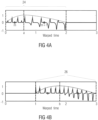
- the synthesis function has even symmetry with respect to m and odd symmetry with respect to m+1. Therefore, in the interval [0,a], positive signal components are added in the reverse block transform whereas in the interval [a,2], negative signal components are added. Additionally, the inventive window function used for the synthesis windowing operation is superimposed as a dotted curve in Figs. 4a and 4b .
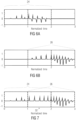
- Figs. 5a and 5b show the signal, still in the warped time domain, after application of the inventive windowing.
- Figs. 6a and 6b finally show the result of the warp parameter-dependent resampling of the signals of Figs. 5a and 5b .
- Fig. 7 shows the result of the overlap-and-add operation, being the final step in the synthesis of the signal. (see equation 19).
- the overlap-and-add operation is a superposition of the waveforms of Figs. 6a and 6b .
- the only frame to be fully reconstructed is the middle frame32, and, a comparison with the original situation of Fig. 2 shows that the middle frame 32 is reconstructed with high fidelity.
- the precise cancellation of the disturbing addition signal components introduced during the inverse block transform is only possible since it is a crucial property of the present invention that the two combined warped maps 14 and 22 in Fig. 1 differ only by an affine map within the overlapping normalized time interval [1,2].
- additional reduction of computational complexity can be achieved by application of a pre-filtering step in the frequency domain.
- This can be implemented by simple pre-weighting of the transmitted sample values dkn.
- Such a pre-filtering is for example described in M. Republic, A. Aldroubi, and M. Eden, "B-spline signal processing part II-efficient design and applications".
- a implementation requires B-spline resampling to be applied to the output of the inverse block transform prior to the windowing operation.
- the resampling operates on a signal as derived by equation 22 having modified d k,n .
- the application of the window function b k ( r v ) is also not performed.
- the resampling must take care of the edge conditions in terms of periodicities and symmetries induced by the choice of the block transform.
- the required windowing is then performed after the resampling using the window b k ⁇ k p + 1 2 / L .
- the multiplexer 106 receives the encoded warp parameter sequence from the warp coder 104 and an encoded time-warped spectral representation of the digital audio input signal 100 to multiplex both data into the bit stream output by the encoder.
- Warp decoder 202 derives a reconstruction of the warp parameter sequence and decoder 203 derives a time-warped spectral representation of the original audio signal.
- the representation of the warp parameter sequence as well as the time-warped spectral representation are input into the inverse warp transformer 204 that derives a digital audio output signal implementing the inventive concept of time-warped overlapped transform coding of audio signals.
- Fig. 10 shows a further embodiment of a time-warped transform decoder in which the warp parameter sequence is derived in the decoder itself.
- the alternative embodiment shown in Fig. 10 comprises a decoder 203, a warp estimator 301, and an inverse warp transformer 204.
- the decoder 203 and the inverse warp transformer 204 share the same functionalities as the corresponding devices of the previous embodiment and therefore the description of these devices within different embodiments is fully interchangeable.
- Warp estimator 301 derives the actual warp of the time-warped spectral representation output by decoder 203 by combining earlier frequency domain pitch estimates with a current frequency domain pitch estimate.
- Fig. 11 illustrates the backwards compatibility of the inventive concept, when prior art decoders not capable of the inventive concept of time-warped decoding are used. Such a decoder would neglect the additional warp parameter information, thus decoding the bit stream into a frequency domain signal fed into an inverse transformer 401 not implementing any warping. Since the frequency analysis performed by time-warped transformation in inventive encoders is well aligned with the transform that does not include any time warping, a decoder ignoring warp data will still produce a meaningful audio output. This is done at the cost of degraded audio quality due to the time warping, which is not reversed within prior art decoders.
- resampling is now to be performed in a signal domain with periodicities and symmetries induced by the choice of the block transform. Therefore, a modified windowing step 703 is performed after resampling 702. Finally, in overlapping and adding 604 the windowed and resampled segment is added to the previously inverse- transformed segment in an usual overlap and add procedure giving the reconstructed time domain output signal.
- Figs. 15a and 15b show the strength of the inventive concept of time-warped coding, showing spectral representations of the same signal with and without time warping applied.
- Fig. 15a illustrates a frame of spectral lines originating from a modified discrete cosine transform of transform size 1024 of a male speech signal segment sampled at 16 kHz. The resulting frequency resolution is 7.8 Hz and only the first 600 lines are plotted for this illustration, corresponding a bandwidth of 4.7 kHz.
- the segment is a voiced sound with a mean pitch of approximately, 155 Hz.
- Fig. 15a illustrates a frame of spectral lines originating from a modified discrete cosine transform of transform size 1024 of a male speech signal segment sampled at 16 kHz.
- the resulting frequency resolution is 7.8 Hz and only the first 600 lines are plotted for this illustration, corresponding a bandwidth of 4.7 kHz.
- the segment is a voiced sound with a mean pitch of approximately,
- the few first harmonics of the pitch-frequency are clearly distinguishable, but towards high frequencies, the analysis becomes increasingly dense and scrambled. This is due to the variation of the pitch within the length of the signal segment to be analyzed. Therefore, the coding of the mid to high frequency ranges requires a substantial amount of bits in order to not introduce audible artefacts upon decoding. Conversely, when fixing the bit rate, substantial amount of distortion will inevitably result from the demand of increasing the coarseness of quantization.
- Fig. 15b illustrates a frame of spectral lines originating from a time-warped modified discrete cosine transform according to the present invention.
- the transform parameters are the same as for Fig. 15a , but the use of a time-warped transform adapted to the signal has the visible dramatic effect on the spectral representation.
- the sparse and organized character of the signal in the time-warped transform domain yields a coding with much better rate distortion performance, even when the cost of coding the additional warp data is taken into account.
- the exponential map has constant warp in the whole interval 0 ⁇ t ⁇ 1, and for small values of a, the other two maps exhibit very small deviation from this constant value.
- a principal part of the effort for inversion originates from the inversion of the normalized warp maps.
- the inversion of a quadratic map requires square root operations, the inversion of an exponential map requires a logarithm, and the inverse of the rational Moebius map is a Moebius map with negated warp parameter. Since exponential functions and divisions are comparably expensive, a focus on maximum ease of computation in the decoder leads to the preferred choice of a piecewise quadratic warp map sequence ⁇ k .
- the normalized warp map ⁇ k is then fully defined by N warp parameters a k (0), a k (1),K , a k ( N -1) by the requirements that it
- the warp parameters can be linearly quantized, typically to a step size of around 0.5 Hz.
- the resulting integer values are then coded.
- the resulting integer values are further difference coded, sequentially or in a hierarchical manner.
- the resulting side information bitrate is typically a few hundred bits per second which is only a fraction of the rate required to describe pitch data in a speech codec.
- An encoder with large computational resources can determine the warp data sequence that optimally reduces the coding cost or maximizes a measure of sparsity of spectral lines.
- a less expensive procedure is to use well known methods for pitch tracking resulting in a measured pitch function p ( t ) and approximating the pitch curve with a piecewise linear function p 0 ( t ) in those intervals where the pitch track exist and does not exhibit large jumps in the pitch values.
- the warped parameter sequence may be derived from the decoded transform domain data by a warp estimator .
- the principle is to compute a frequency domain pitch estimate for each frame of transform data or from pitches of subsequent decoded signal blocks.
- the warp information is then derived from a formula similar to formula 28.
- inventive concept has mainly been described by applying the inventive time warping in a single audio channel scenario.
- inventive concept is of course by no way limited to the use within such a monophonic scenario. It may be furthermore extremely advantageous to use the high coding gain achievable by the inventive concept within multi-channel coding applications, where the single or the multiple channel has to be transmitted may be coded using the inventive concept.
- inventive concept can also be advantageously applied to signals that are segmented with arbitrary segment length and not with equal length as described in the preceding paragraphs.
Landscapes
- Engineering & Computer Science (AREA)
- Physics & Mathematics (AREA)
- Health & Medical Sciences (AREA)
- Signal Processing (AREA)
- Audiology, Speech & Language Pathology (AREA)
- Human Computer Interaction (AREA)
- Computational Linguistics (AREA)
- Acoustics & Sound (AREA)
- Multimedia (AREA)
- Spectroscopy & Molecular Physics (AREA)
- Theoretical Computer Science (AREA)
- Compression, Expansion, Code Conversion, And Decoders (AREA)
- Reduction Or Emphasis Of Bandwidth Of Signals (AREA)
Applications Claiming Priority (8)
| Application Number | Priority Date | Filing Date | Title |
|---|---|---|---|
| US73351205P | 2005-11-03 | 2005-11-03 | |
| US11/464,176 US7720677B2 (en) | 2005-11-03 | 2006-08-11 | Time warped modified transform coding of audio signals |
| EP08008361.1A EP1953738B1 (fr) | 2005-11-03 | 2006-10-24 | Codage de transformation modifiée à déformation temporelle des signaux audio |
| EP21156798.7A EP3852103B1 (fr) | 2005-11-03 | 2006-10-24 | Codage de transformation modifiée à déformation temporelle des signaux audio |
| EP10183308.5A EP2306455B1 (fr) | 2005-11-03 | 2006-10-24 | Codage de transformation modifiée à déformation temporelle des signaux audio |
| EP17193127.2A EP3319086B1 (fr) | 2005-11-03 | 2006-10-24 | Codage de transformation modifiée à déformation temporelle des signaux audio |
| EP06792443A EP1807825B1 (fr) | 2005-11-03 | 2006-10-24 | Codage de signaux audio a deformation temporelle par transformee modifiee |
| PCT/EP2006/010246 WO2007051548A1 (fr) | 2005-11-03 | 2006-10-24 | Codage de signaux audio a deformation temporelle par transformee modifiee |
Related Parent Applications (6)
| Application Number | Title | Priority Date | Filing Date |
|---|---|---|---|
| EP21156798.7A Division EP3852103B1 (fr) | 2005-11-03 | 2006-10-24 | Codage de transformation modifiée à déformation temporelle des signaux audio |
| EP21156798.7A Division-Into EP3852103B1 (fr) | 2005-11-03 | 2006-10-24 | Codage de transformation modifiée à déformation temporelle des signaux audio |
| EP08008361.1A Division EP1953738B1 (fr) | 2005-11-03 | 2006-10-24 | Codage de transformation modifiée à déformation temporelle des signaux audio |
| EP10183308.5A Division EP2306455B1 (fr) | 2005-11-03 | 2006-10-24 | Codage de transformation modifiée à déformation temporelle des signaux audio |
| EP06792443A Division EP1807825B1 (fr) | 2005-11-03 | 2006-10-24 | Codage de signaux audio a deformation temporelle par transformee modifiee |
| EP17193127.2A Division EP3319086B1 (fr) | 2005-11-03 | 2006-10-24 | Codage de transformation modifiée à déformation temporelle des signaux audio |
Publications (3)
| Publication Number | Publication Date |
|---|---|
| EP4290513A2 true EP4290513A2 (fr) | 2023-12-13 |
| EP4290513A3 EP4290513A3 (fr) | 2024-02-14 |
| EP4290513B1 EP4290513B1 (fr) | 2024-12-25 |
Family
ID=37507461
Family Applications (9)
| Application Number | Title | Priority Date | Filing Date |
|---|---|---|---|
| EP08008361.1A Active EP1953738B1 (fr) | 2005-11-03 | 2006-10-24 | Codage de transformation modifiée à déformation temporelle des signaux audio |
| EP06792443A Active EP1807825B1 (fr) | 2005-11-03 | 2006-10-24 | Codage de signaux audio a deformation temporelle par transformee modifiee |
| EP24220474.1A Active EP4503022B1 (fr) | 2005-11-03 | 2006-10-24 | Codage par transformation modifiée à déformation temporelle de signaux audio |
| EP23205462.7A Active EP4290512B1 (fr) | 2005-11-03 | 2006-10-24 | Codage par transformation modifiée à déformation temporelle de signaux audio |
| EP10183308.5A Active EP2306455B1 (fr) | 2005-11-03 | 2006-10-24 | Codage de transformation modifiée à déformation temporelle des signaux audio |
| EP24220473.3A Active EP4550319B1 (fr) | 2005-11-03 | 2006-10-24 | Codage par transformation modifiée à déformation temporelle de signaux audio |
| EP17193127.2A Active EP3319086B1 (fr) | 2005-11-03 | 2006-10-24 | Codage de transformation modifiée à déformation temporelle des signaux audio |
| EP21156798.7A Active EP3852103B1 (fr) | 2005-11-03 | 2006-10-24 | Codage de transformation modifiée à déformation temporelle des signaux audio |
| EP23205479.1A Active EP4290513B1 (fr) | 2005-11-03 | 2006-10-24 | Codage par transformation modifiée à déformation temporelle de signaux audio |
Family Applications Before (8)
| Application Number | Title | Priority Date | Filing Date |
|---|---|---|---|
| EP08008361.1A Active EP1953738B1 (fr) | 2005-11-03 | 2006-10-24 | Codage de transformation modifiée à déformation temporelle des signaux audio |
| EP06792443A Active EP1807825B1 (fr) | 2005-11-03 | 2006-10-24 | Codage de signaux audio a deformation temporelle par transformee modifiee |
| EP24220474.1A Active EP4503022B1 (fr) | 2005-11-03 | 2006-10-24 | Codage par transformation modifiée à déformation temporelle de signaux audio |
| EP23205462.7A Active EP4290512B1 (fr) | 2005-11-03 | 2006-10-24 | Codage par transformation modifiée à déformation temporelle de signaux audio |
| EP10183308.5A Active EP2306455B1 (fr) | 2005-11-03 | 2006-10-24 | Codage de transformation modifiée à déformation temporelle des signaux audio |
| EP24220473.3A Active EP4550319B1 (fr) | 2005-11-03 | 2006-10-24 | Codage par transformation modifiée à déformation temporelle de signaux audio |
| EP17193127.2A Active EP3319086B1 (fr) | 2005-11-03 | 2006-10-24 | Codage de transformation modifiée à déformation temporelle des signaux audio |
| EP21156798.7A Active EP3852103B1 (fr) | 2005-11-03 | 2006-10-24 | Codage de transformation modifiée à déformation temporelle des signaux audio |
Country Status (13)
| Country | Link |
|---|---|
| US (3) | US7720677B2 (fr) |
| EP (9) | EP1953738B1 (fr) |
| JP (4) | JP4927088B2 (fr) |
| KR (1) | KR100959701B1 (fr) |
| CN (2) | CN102592602B (fr) |
| AT (1) | ATE395687T1 (fr) |
| DE (1) | DE602006001194D1 (fr) |
| DK (1) | DK1807825T3 (fr) |
| ES (7) | ES2604758T3 (fr) |
| MY (1) | MY141264A (fr) |
| PL (1) | PL1807825T3 (fr) |
| TW (1) | TWI320172B (fr) |
| WO (1) | WO2007051548A1 (fr) |
Families Citing this family (44)
| Publication number | Priority date | Publication date | Assignee | Title |
|---|---|---|---|---|
| US7720677B2 (en) * | 2005-11-03 | 2010-05-18 | Coding Technologies Ab | Time warped modified transform coding of audio signals |
| US7873511B2 (en) * | 2006-06-30 | 2011-01-18 | Fraunhofer-Gesellschaft Zur Foerderung Der Angewandten Forschung E.V. | Audio encoder, audio decoder and audio processor having a dynamically variable warping characteristic |
| US8682652B2 (en) * | 2006-06-30 | 2014-03-25 | Fraunhofer-Gesellschaft Zur Foerderung Der Angewandten Forschung E.V. | Audio encoder, audio decoder and audio processor having a dynamically variable warping characteristic |
| US8239190B2 (en) * | 2006-08-22 | 2012-08-07 | Qualcomm Incorporated | Time-warping frames of wideband vocoder |
| US9653088B2 (en) | 2007-06-13 | 2017-05-16 | Qualcomm Incorporated | Systems, methods, and apparatus for signal encoding using pitch-regularizing and non-pitch-regularizing coding |
| KR101380170B1 (ko) * | 2007-08-31 | 2014-04-02 | 삼성전자주식회사 | 미디어 신호 인코딩/디코딩 방법 및 장치 |
| TWI455064B (zh) * | 2007-12-20 | 2014-10-01 | Thomson Licensing | 聲影文件突起映圖之決定方法和裝置 |
| DE602008005250D1 (de) | 2008-01-04 | 2011-04-14 | Dolby Sweden Ab | Audiokodierer und -dekodierer |
| EP2107556A1 (fr) | 2008-04-04 | 2009-10-07 | Fraunhofer-Gesellschaft zur Förderung der angewandten Forschung e.V. | Codage audio par transformée utilisant une correction de la fréquence fondamentale |
| AU2013206266B2 (en) * | 2008-07-11 | 2015-05-28 | Fraunhofer-Gesellschaft Zur Foerderung Der Angewandten Forschung E.V. | Providing a time warp activation signal and encoding an audio signal therewith |
| RU2536679C2 (ru) * | 2008-07-11 | 2014-12-27 | Фраунхофер-Гезелльшафт цур Фёрдерунг дер ангевандтен | Передатчик сигнала активации с деформацией по времени, кодер звукового сигнала, способ преобразования сигнала активации с деформацией по времени, способ кодирования звукового сигнала и компьютерные программы |
| MY154452A (en) * | 2008-07-11 | 2015-06-15 | Fraunhofer Ges Forschung | An apparatus and a method for decoding an encoded audio signal |
| EP2144231A1 (fr) | 2008-07-11 | 2010-01-13 | Fraunhofer-Gesellschaft zur Förderung der angewandten Forschung e.V. | Schéma de codage/décodage audio à taux bas de bits avec du prétraitement commun |
| EP2211335A1 (fr) * | 2009-01-21 | 2010-07-28 | Fraunhofer-Gesellschaft zur Förderung der angewandten Forschung e.V. | Appareil, procédé et programme informatique pour obtenir un paramètre décrivant une variation de caractéristique de signal |
| ES2639716T3 (es) * | 2009-01-28 | 2017-10-30 | Dolby International Ab | Transposición armónica mejorada |
| PL4503029T3 (pl) | 2009-01-28 | 2026-03-16 | Dolby International Ab | Ulepszona transpozycja harmonicznych |
| KR101701759B1 (ko) | 2009-09-18 | 2017-02-03 | 돌비 인터네셔널 에이비 | 입력 신호를 전위시키기 위한 시스템 및 방법, 및 상기 방법을 수행하기 위한 컴퓨터 프로그램이 기록된 컴퓨터 판독가능 저장 매체 |
| WO2011048815A1 (fr) * | 2009-10-21 | 2011-04-28 | パナソニック株式会社 | Appareil d'encodage audio, appareil de décodage, procédé, circuit et programme |
| US9338523B2 (en) * | 2009-12-21 | 2016-05-10 | Echostar Technologies L.L.C. | Audio splitting with codec-enforced frame sizes |
| RU2586848C2 (ru) | 2010-03-10 | 2016-06-10 | Долби Интернейшнл АБ | Декодер звукового сигнала, кодирующее устройство звукового сигнала, способы и компьютерная программа, использующие зависящее от частоты выборки кодирование контура деформации времени |
| EP2372704A1 (fr) | 2010-03-11 | 2011-10-05 | Fraunhofer-Gesellschaft zur Förderung der Angewandten Forschung e.V. | Processeur de signal et procédé de traitement d'un signal |
| CN103098130B (zh) * | 2010-10-06 | 2014-11-26 | 松下电器产业株式会社 | 编码装置、解码装置、编码方法以及解码方法 |
| JP5914527B2 (ja) | 2011-02-14 | 2016-05-11 | フラウンホーファー−ゲゼルシャフト・ツール・フェルデルング・デル・アンゲヴァンテン・フォルシュング・アインゲトラーゲネル・フェライン | 過渡検出及び品質結果を使用してオーディオ信号の一部分を符号化する装置及び方法 |
| AU2012217162B2 (en) | 2011-02-14 | 2015-11-26 | Fraunhofer-Gesellschaft Zur Foerderung Der Angewandten Forschung E.V. | Noise generation in audio codecs |
| TR201903388T4 (tr) | 2011-02-14 | 2019-04-22 | Fraunhofer Ges Forschung | Bir ses sinyalinin parçalarının darbe konumlarının şifrelenmesi ve çözülmesi. |
| WO2012110447A1 (fr) | 2011-02-14 | 2012-08-23 | Fraunhofer-Gesellschaft zur Förderung der angewandten Forschung e.V. | Dispositif et procédé de masquage d'erreurs dans le codage de la parole et audio unifié (usac) à faible retard |
| PL2550653T3 (pl) * | 2011-02-14 | 2014-09-30 | Fraunhofer Ges Forschung | Reprezentacja sygnału informacyjnego z użyciem transformacji zakładkowej |
| SG192718A1 (en) | 2011-02-14 | 2013-09-30 | Fraunhofer Ges Forschung | Audio codec using noise synthesis during inactive phases |
| WO2012110473A1 (fr) * | 2011-02-14 | 2012-08-23 | Fraunhofer-Gesellschaft zur Förderung der angewandten Forschung e.V. | Dispositif et procédé de codage et de décodage d'un signal audio en utilisant une partie d'anticipation alignée |
| EP2676268B1 (fr) | 2011-02-14 | 2014-12-03 | Fraunhofer-Gesellschaft zur Förderung der angewandten Forschung e.V. | Appareil et procédé permettant de traiter un signal audio décodé dans un domaine spectral |
| WO2012110476A1 (fr) | 2011-02-14 | 2012-08-23 | Fraunhofer-Gesellschaft zur Förderung der angewandten Forschung e.V. | Système de codage basé sur la prédiction linéaire utilisant la mise en forme du bruit dans le domaine spectral |
| TWI488176B (zh) | 2011-02-14 | 2015-06-11 | Fraunhofer Ges Forschung | 音訊信號音軌脈衝位置之編碼與解碼技術 |
| CA3054712C (fr) | 2013-01-08 | 2020-06-09 | Lars Villemoes | Prediction basee sur un modele dans un bloc de filtres echantillonnes de maniere critique |
| PL3011692T3 (pl) * | 2013-06-21 | 2017-11-30 | Fraunhofer-Gesellschaft zur Förderung der angewandten Forschung e.V. | Sterowanie buforem rozsynchronizowania, dekoder sygnału audio, sposób i program komputerowy |
| CN105474313B (zh) * | 2013-06-21 | 2019-09-06 | 弗劳恩霍夫应用研究促进协会 | 时间缩放器、音频解码器、方法和计算机可读存储介质 |
| EP2830054A1 (fr) | 2013-07-22 | 2015-01-28 | Fraunhofer Gesellschaft zur Förderung der angewandten Forschung e.V. | Encodeur audio, décodeur audio et procédés correspondants mettant en oeuvre un traitement à deux canaux à l'intérieur d'une structure de remplissage d'espace intelligent |
| EP2830055A1 (fr) * | 2013-07-22 | 2015-01-28 | Fraunhofer-Gesellschaft zur Förderung der angewandten Forschung e.V. | Codage entropique basé sur le contexte de valeurs d'échantillon d'une enveloppe spectrale |
| FR3020732A1 (fr) * | 2014-04-30 | 2015-11-06 | Orange | Correction de perte de trame perfectionnee avec information de voisement |
| EP3000110B1 (fr) | 2014-07-28 | 2016-12-07 | Fraunhofer-Gesellschaft zur Förderung der angewandten Forschung e.V. | Sélection d'un premier algorithme d'encodage ou d'un deuxième algorithme d'encodage au moyen d'une réduction des harmoniques |
| WO2016142002A1 (fr) | 2015-03-09 | 2016-09-15 | Fraunhofer-Gesellschaft Zur Foerderung Der Angewandten Forschung E.V. | Codeur audio, décodeur audio, procédé de codage de signal audio et procédé de décodage de signal audio codé |
| EP3107096A1 (fr) | 2015-06-16 | 2016-12-21 | Fraunhofer-Gesellschaft zur Förderung der angewandten Forschung e.V. | Décodage à échelle réduite |
| MY196436A (en) | 2016-01-22 | 2023-04-11 | Fraunhofer Ges Forschung | Apparatus and Method for Encoding or Decoding a Multi-Channel Signal Using Frame Control Synchronization |
| CN110998722B (zh) * | 2017-07-03 | 2023-11-10 | 杜比国际公司 | 低复杂性密集瞬态事件检测和译码 |
| EP3483879A1 (fr) | 2017-11-10 | 2019-05-15 | Fraunhofer-Gesellschaft zur Förderung der angewandten Forschung e.V. | Fonction de fenêtrage d'analyse/de synthèse pour une transformation chevauchante modulée |
Citations (3)
| Publication number | Priority date | Publication date | Assignee | Title |
|---|---|---|---|---|
| US6169970B1 (en) | 1998-01-08 | 2001-01-02 | Lucent Technologies Inc. | Generalized analysis-by-synthesis speech coding method and apparatus |
| US20020120445A1 (en) | 2000-11-03 | 2002-08-29 | Renat Vafin | Coding signals |
| US20050131681A1 (en) | 2001-06-29 | 2005-06-16 | Microsoft Corporation | Continuous time warping for low bit-rate celp coding |
Family Cites Families (36)
| Publication number | Priority date | Publication date | Assignee | Title |
|---|---|---|---|---|
| DE3519830A1 (de) * | 1985-06-03 | 1986-12-18 | Ruhrkohle Ag, 4300 Essen | Verfahren zur kohlehydrierung mit integrierten raffinationsstufen |
| JPH01233835A (ja) * | 1988-03-14 | 1989-09-19 | Mitsubishi Electric Corp | 音声時間軸圧縮符号化装置 |
| JPH0546199A (ja) * | 1991-08-21 | 1993-02-26 | Matsushita Electric Ind Co Ltd | 音声符号化装置 |
| JPH0784597A (ja) * | 1993-09-20 | 1995-03-31 | Fujitsu Ltd | 音声符号化装置および音声復号化装置 |
| WO1998006090A1 (fr) | 1996-08-02 | 1998-02-12 | Universite De Sherbrooke | Codage parole/audio a l'aide d'une transformee non lineaire a amplitude spectrale |
| DE69834993T2 (de) * | 1997-04-07 | 2007-02-15 | Koninklijke Philips Electronics N.V. | Sprachübertragungssystem |
| US6182042B1 (en) * | 1998-07-07 | 2001-01-30 | Creative Technology Ltd. | Sound modification employing spectral warping techniques |
| US6330533B2 (en) | 1998-08-24 | 2001-12-11 | Conexant Systems, Inc. | Speech encoder adaptively applying pitch preprocessing with warping of target signal |
| US6502066B2 (en) * | 1998-11-24 | 2002-12-31 | Microsoft Corporation | System for generating formant tracks by modifying formants synthesized from speech units |
| KR20010072035A (ko) | 1999-05-26 | 2001-07-31 | 요트.게.아. 롤페즈 | 오디오 신호 송신 시스템 |
| US6782360B1 (en) * | 1999-09-22 | 2004-08-24 | Mindspeed Technologies, Inc. | Gain quantization for a CELP speech coder |
| US6959274B1 (en) * | 1999-09-22 | 2005-10-25 | Mindspeed Technologies, Inc. | Fixed rate speech compression system and method |
| KR20030019572A (ko) | 2000-07-13 | 2003-03-06 | 콸콤 인코포레이티드 | 최대거리 블록 코딩 방법 |
| ATE336774T1 (de) * | 2001-05-28 | 2006-09-15 | Texas Instruments Inc | Programmierbarer melodienerzeuger |
| US6941263B2 (en) * | 2001-06-29 | 2005-09-06 | Microsoft Corporation | Frequency domain postfiltering for quality enhancement of coded speech |
| EP1793370B1 (fr) | 2001-08-31 | 2009-06-03 | Kabushiki Kaisha Kenwood | Appareil et procédé pour la création de signaux de fréquence fondamentale constante et appareil et procédé pour synthétiser des signaux de parole utilisant ces signaux de fréquence fondamentale constante |
| JP3994332B2 (ja) * | 2001-09-27 | 2007-10-17 | 株式会社ケンウッド | 音声信号圧縮装置、音声信号圧縮方法、及び、プログラム |
| BRPI0311601B8 (pt) | 2002-07-19 | 2018-02-14 | Matsushita Electric Industrial Co Ltd | "aparelho e método decodificador de áudio" |
| CN1290036C (zh) | 2002-12-30 | 2006-12-13 | 国际商业机器公司 | 根据机器可读词典建立概念知识的计算机系统及方法 |
| WO2004084182A1 (fr) * | 2003-03-15 | 2004-09-30 | Mindspeed Technologies, Inc. | Decomposition de la voix parlee destinee au codage de la parole celp |
| US7587254B2 (en) * | 2004-04-23 | 2009-09-08 | Nokia Corporation | Dynamic range control and equalization of digital audio using warped processing |
| US7433463B2 (en) | 2004-08-10 | 2008-10-07 | Clarity Technologies, Inc. | Echo cancellation and noise reduction method |
| US7676362B2 (en) * | 2004-12-31 | 2010-03-09 | Motorola, Inc. | Method and apparatus for enhancing loudness of a speech signal |
| US8355907B2 (en) * | 2005-03-11 | 2013-01-15 | Qualcomm Incorporated | Method and apparatus for phase matching frames in vocoders |
| US8155965B2 (en) * | 2005-03-11 | 2012-04-10 | Qualcomm Incorporated | Time warping frames inside the vocoder by modifying the residual |
| US7917561B2 (en) | 2005-09-16 | 2011-03-29 | Coding Technologies Ab | Partially complex modulated filter bank |
| US7720677B2 (en) * | 2005-11-03 | 2010-05-18 | Coding Technologies Ab | Time warped modified transform coding of audio signals |
| US7873511B2 (en) * | 2006-06-30 | 2011-01-18 | Fraunhofer-Gesellschaft Zur Foerderung Der Angewandten Forschung E.V. | Audio encoder, audio decoder and audio processor having a dynamically variable warping characteristic |
| US8010350B2 (en) * | 2006-08-03 | 2011-08-30 | Broadcom Corporation | Decimated bisectional pitch refinement |
| US20080046233A1 (en) * | 2006-08-15 | 2008-02-21 | Broadcom Corporation | Packet Loss Concealment for Sub-band Predictive Coding Based on Extrapolation of Full-band Audio Waveform |
| US8239190B2 (en) * | 2006-08-22 | 2012-08-07 | Qualcomm Incorporated | Time-warping frames of wideband vocoder |
| EP2165328B1 (fr) * | 2007-06-11 | 2018-01-17 | Fraunhofer-Gesellschaft zur Förderung der angewandten Forschung e.V. | Codeur et décodeur d'un signal audio ayant une partie de type impulsion et une partie stationnaire |
| DE602008005250D1 (de) * | 2008-01-04 | 2011-04-14 | Dolby Sweden Ab | Audiokodierer und -dekodierer |
| MY154452A (en) * | 2008-07-11 | 2015-06-15 | Fraunhofer Ges Forschung | An apparatus and a method for decoding an encoded audio signal |
| RU2536679C2 (ru) * | 2008-07-11 | 2014-12-27 | Фраунхофер-Гезелльшафт цур Фёрдерунг дер ангевандтен | Передатчик сигнала активации с деформацией по времени, кодер звукового сигнала, способ преобразования сигнала активации с деформацией по времени, способ кодирования звукового сигнала и компьютерные программы |
| WO2011048815A1 (fr) * | 2009-10-21 | 2011-04-28 | パナソニック株式会社 | Appareil d'encodage audio, appareil de décodage, procédé, circuit et programme |
-
2006
- 2006-08-11 US US11/464,176 patent/US7720677B2/en active Active
- 2006-10-24 EP EP08008361.1A patent/EP1953738B1/fr active Active
- 2006-10-24 PL PL06792443T patent/PL1807825T3/pl unknown
- 2006-10-24 EP EP06792443A patent/EP1807825B1/fr active Active
- 2006-10-24 ES ES08008361.1T patent/ES2604758T3/es active Active
- 2006-10-24 KR KR1020087010642A patent/KR100959701B1/ko active Active
- 2006-10-24 DE DE602006001194T patent/DE602006001194D1/de active Active
- 2006-10-24 WO PCT/EP2006/010246 patent/WO2007051548A1/fr not_active Ceased
- 2006-10-24 EP EP24220474.1A patent/EP4503022B1/fr active Active
- 2006-10-24 ES ES17193127T patent/ES2863667T3/es active Active
- 2006-10-24 EP EP23205462.7A patent/EP4290512B1/fr active Active
- 2006-10-24 DK DK06792443T patent/DK1807825T3/da active
- 2006-10-24 CN CN201210037454.7A patent/CN102592602B/zh active Active
- 2006-10-24 ES ES23205479T patent/ES3007995T3/es active Active
- 2006-10-24 ES ES06792443T patent/ES2307287T3/es active Active
- 2006-10-24 AT AT06792443T patent/ATE395687T1/de active
- 2006-10-24 ES ES23205462T patent/ES3007390T3/es active Active
- 2006-10-24 ES ES10183308.5T patent/ES2646814T3/es active Active
- 2006-10-24 EP EP10183308.5A patent/EP2306455B1/fr active Active
- 2006-10-24 EP EP24220473.3A patent/EP4550319B1/fr active Active
- 2006-10-24 ES ES21156798T patent/ES2967257T3/es active Active
- 2006-10-24 JP JP2008538284A patent/JP4927088B2/ja active Active
- 2006-10-24 EP EP17193127.2A patent/EP3319086B1/fr active Active
- 2006-10-24 CN CN200680049867XA patent/CN101351840B/zh active Active
- 2006-10-24 EP EP21156798.7A patent/EP3852103B1/fr active Active
- 2006-10-24 EP EP23205479.1A patent/EP4290513B1/fr active Active
- 2006-10-25 TW TW095139384A patent/TWI320172B/zh active
-
2008
- 2008-04-29 MY MYPI20081350A patent/MY141264A/en unknown
-
2010
- 2010-01-29 US US12/697,137 patent/US8412518B2/en active Active
-
2011
- 2011-11-02 JP JP2011240716A patent/JP5323164B2/ja active Active
-
2013
- 2013-02-14 US US13/766,945 patent/US8838441B2/en active Active
- 2013-05-20 JP JP2013106030A patent/JP6125324B2/ja active Active
-
2014
- 2014-09-08 JP JP2014182138A patent/JP6084595B2/ja active Active
Patent Citations (3)
| Publication number | Priority date | Publication date | Assignee | Title |
|---|---|---|---|---|
| US6169970B1 (en) | 1998-01-08 | 2001-01-02 | Lucent Technologies Inc. | Generalized analysis-by-synthesis speech coding method and apparatus |
| US20020120445A1 (en) | 2000-11-03 | 2002-08-29 | Renat Vafin | Coding signals |
| US20050131681A1 (en) | 2001-06-29 | 2005-06-16 | Microsoft Corporation | Continuous time warping for low bit-rate celp coding |
Non-Patent Citations (3)
| Title |
|---|
| R.J. SLUIJTERA.J.E.M. JANSSEN: "A time warper for speech signals", IEEE WORKSHOP ON SPEECH CODING'99, June 1999 (1999-06-01), pages 150 - 152 |
| T. PAINTERA. SPANIAS: "Perceptual coding of digital audio", PROCEEDINGS OF THE IEEE, vol. 88, no. 4, April 2000 (2000-04-01), pages 451 - 513 |
| YANG: "Pitch synchronous modulated lapped transform of the linear prediction residual of speech", PROCEEDINGS OF ICSP '98, pages 591 - 594 |
Also Published As
Similar Documents
| Publication | Publication Date | Title |
|---|---|---|
| EP3852103B1 (fr) | Codage de transformation modifiée à déformation temporelle des signaux audio | |
| HK40098509A (en) | Time warped modified transform coding of audio signals | |
| HK40098509B (en) | Time warped modified transform coding of audio signals | |
| HK40124816A (en) | Time warped modified transform coding of audio signals | |
| HK40124816B (en) | Time warped modified transform coding of audio signals | |
| HK40098510B (en) | Time warped modified transform coding of audio signals | |
| HK40098510A (en) | Time warped modified transform coding of audio signals | |
| HK40114912B (en) | Time warped modified transform coding of audio signals | |
| HK40114912A (en) | Time warped modified transform coding of audio signals | |
| HK40051324A (en) | Time warped modified transform coding of audio signals | |
| HK40051324B (en) | Time warped modified transform coding of audio signals | |
| HK1254427B (en) | Time warped modified transform coding of audio signals | |
| HK1156434A (en) | Time warped modified transform coding of audio signals | |
| HK1105159B (en) | Time warped modified transform coding of audio signals | |
| HK1156434B (en) | Time warped modified transform coding of audio signals |
Legal Events
| Date | Code | Title | Description |
|---|---|---|---|
| PUAI | Public reference made under article 153(3) epc to a published international application that has entered the european phase |
Free format text: ORIGINAL CODE: 0009012 |
|
| STAA | Information on the status of an ep patent application or granted ep patent |
Free format text: STATUS: THE APPLICATION HAS BEEN PUBLISHED |
|
| AC | Divisional application: reference to earlier application |
Ref document number: 1807825 Country of ref document: EP Kind code of ref document: P Ref document number: 1953738 Country of ref document: EP Kind code of ref document: P Ref document number: 2306455 Country of ref document: EP Kind code of ref document: P Ref document number: 3319086 Country of ref document: EP Kind code of ref document: P Ref document number: 3852103 Country of ref document: EP Kind code of ref document: P |
|
| AK | Designated contracting states |
Kind code of ref document: A2 Designated state(s): AT BE BG CH CY CZ DE DK EE ES FI FR GB GR HU IE IS IT LI LT LU LV MC NL PL PT RO SE SI SK TR |
|
| REG | Reference to a national code |
Ref country code: DE Ref legal event code: R079 Ref document number: 602006060641 Country of ref document: DE Free format text: PREVIOUS MAIN CLASS: G10L0019020000 Ipc: G10L0019022000 Ref country code: DE Ref legal event code: R079 Free format text: PREVIOUS MAIN CLASS: G10L0019020000 Ipc: G10L0019022000 |
|
| PUAL | Search report despatched |
Free format text: ORIGINAL CODE: 0009013 |
|
| AK | Designated contracting states |
Kind code of ref document: A3 Designated state(s): AT BE BG CH CY CZ DE DK EE ES FI FR GB GR HU IE IS IT LI LT LU LV MC NL PL PT RO SE SI SK TR |
|
| RIC1 | Information provided on ipc code assigned before grant |
Ipc: G10L 19/02 20130101ALN20240110BHEP Ipc: G10L 19/022 20130101AFI20240110BHEP |
|
| P01 | Opt-out of the competence of the unified patent court (upc) registered |
Effective date: 20240112 |
|
| REG | Reference to a national code |
Ref country code: HK Ref legal event code: DE Ref document number: 40098509 Country of ref document: HK |
|
| STAA | Information on the status of an ep patent application or granted ep patent |
Free format text: STATUS: REQUEST FOR EXAMINATION WAS MADE |
|
| 17P | Request for examination filed |
Effective date: 20240814 |
|
| RBV | Designated contracting states (corrected) |
Designated state(s): AT BE BG CH CY CZ DE DK EE ES FI FR GB GR HU IE IS IT LI LT LU LV MC NL PL PT RO SE SI SK TR |
|
| GRAP | Despatch of communication of intention to grant a patent |
Free format text: ORIGINAL CODE: EPIDOSNIGR1 |
|
| STAA | Information on the status of an ep patent application or granted ep patent |
Free format text: STATUS: GRANT OF PATENT IS INTENDED |
|
| RIC1 | Information provided on ipc code assigned before grant |
Ipc: G10L 19/02 20130101ALN20241001BHEP Ipc: G10L 19/022 20130101AFI20241001BHEP |
|
| GRAS | Grant fee paid |
Free format text: ORIGINAL CODE: EPIDOSNIGR3 |
|
| INTG | Intention to grant announced |
Effective date: 20241021 |
|
| GRAA | (expected) grant |
Free format text: ORIGINAL CODE: 0009210 |
|
| STAA | Information on the status of an ep patent application or granted ep patent |
Free format text: STATUS: THE PATENT HAS BEEN GRANTED |
|
| AC | Divisional application: reference to earlier application |
Ref document number: 1807825 Country of ref document: EP Kind code of ref document: P Ref document number: 1953738 Country of ref document: EP Kind code of ref document: P Ref document number: 2306455 Country of ref document: EP Kind code of ref document: P Ref document number: 3319086 Country of ref document: EP Kind code of ref document: P Ref document number: 3852103 Country of ref document: EP Kind code of ref document: P |
|
| AK | Designated contracting states |
Kind code of ref document: B1 Designated state(s): AT BE BG CH CY CZ DE DK EE ES FI FR GB GR HU IE IS IT LI LT LU LV MC NL PL PT RO SE SI SK TR |
|
| REG | Reference to a national code |
Ref country code: GB Ref legal event code: FG4D |
|
| REG | Reference to a national code |
Ref country code: CH Ref legal event code: EP |
|
| REG | Reference to a national code |
Ref country code: DE Ref legal event code: R096 Ref document number: 602006060641 Country of ref document: DE |
|
| REG | Reference to a national code |
Ref country code: IE Ref legal event code: FG4D |
|
| REG | Reference to a national code |
Ref country code: NL Ref legal event code: FP |
|
| REG | Reference to a national code |
Ref country code: ES Ref legal event code: FG2A Ref document number: 3007995 Country of ref document: ES Kind code of ref document: T3 Effective date: 20250321 |
|
| REG | Reference to a national code |
Ref country code: LT Ref legal event code: MG9D |
|
| PG25 | Lapsed in a contracting state [announced via postgrant information from national office to epo] |
Ref country code: FI Free format text: LAPSE BECAUSE OF FAILURE TO SUBMIT A TRANSLATION OF THE DESCRIPTION OR TO PAY THE FEE WITHIN THE PRESCRIBED TIME-LIMIT Effective date: 20241225 |
|
| PG25 | Lapsed in a contracting state [announced via postgrant information from national office to epo] |
Ref country code: BG Free format text: LAPSE BECAUSE OF FAILURE TO SUBMIT A TRANSLATION OF THE DESCRIPTION OR TO PAY THE FEE WITHIN THE PRESCRIBED TIME-LIMIT Effective date: 20241225 |
|
| PG25 | Lapsed in a contracting state [announced via postgrant information from national office to epo] |
Ref country code: GR Free format text: LAPSE BECAUSE OF FAILURE TO SUBMIT A TRANSLATION OF THE DESCRIPTION OR TO PAY THE FEE WITHIN THE PRESCRIBED TIME-LIMIT Effective date: 20250326 Ref country code: LV Free format text: LAPSE BECAUSE OF FAILURE TO SUBMIT A TRANSLATION OF THE DESCRIPTION OR TO PAY THE FEE WITHIN THE PRESCRIBED TIME-LIMIT Effective date: 20241225 |
|
| REG | Reference to a national code |
Ref country code: AT Ref legal event code: MK05 Ref document number: 1754892 Country of ref document: AT Kind code of ref document: T Effective date: 20241225 |
|
| PG25 | Lapsed in a contracting state [announced via postgrant information from national office to epo] |
Ref country code: PL Free format text: LAPSE BECAUSE OF FAILURE TO SUBMIT A TRANSLATION OF THE DESCRIPTION OR TO PAY THE FEE WITHIN THE PRESCRIBED TIME-LIMIT Effective date: 20241225 |
|
| PG25 | Lapsed in a contracting state [announced via postgrant information from national office to epo] |
Ref country code: IS Free format text: LAPSE BECAUSE OF FAILURE TO SUBMIT A TRANSLATION OF THE DESCRIPTION OR TO PAY THE FEE WITHIN THE PRESCRIBED TIME-LIMIT Effective date: 20250425 |
|
| PG25 | Lapsed in a contracting state [announced via postgrant information from national office to epo] |
Ref country code: PT Free format text: LAPSE BECAUSE OF FAILURE TO SUBMIT A TRANSLATION OF THE DESCRIPTION OR TO PAY THE FEE WITHIN THE PRESCRIBED TIME-LIMIT Effective date: 20250428 |
|
| PG25 | Lapsed in a contracting state [announced via postgrant information from national office to epo] |
Ref country code: EE Free format text: LAPSE BECAUSE OF FAILURE TO SUBMIT A TRANSLATION OF THE DESCRIPTION OR TO PAY THE FEE WITHIN THE PRESCRIBED TIME-LIMIT Effective date: 20241225 |
|
| PG25 | Lapsed in a contracting state [announced via postgrant information from national office to epo] |
Ref country code: RO Free format text: LAPSE BECAUSE OF FAILURE TO SUBMIT A TRANSLATION OF THE DESCRIPTION OR TO PAY THE FEE WITHIN THE PRESCRIBED TIME-LIMIT Effective date: 20241225 Ref country code: AT Free format text: LAPSE BECAUSE OF FAILURE TO SUBMIT A TRANSLATION OF THE DESCRIPTION OR TO PAY THE FEE WITHIN THE PRESCRIBED TIME-LIMIT Effective date: 20241225 |
|
| PG25 | Lapsed in a contracting state [announced via postgrant information from national office to epo] |
Ref country code: SK Free format text: LAPSE BECAUSE OF FAILURE TO SUBMIT A TRANSLATION OF THE DESCRIPTION OR TO PAY THE FEE WITHIN THE PRESCRIBED TIME-LIMIT Effective date: 20241225 |
|
| PG25 | Lapsed in a contracting state [announced via postgrant information from national office to epo] |
Ref country code: CZ Free format text: LAPSE BECAUSE OF FAILURE TO SUBMIT A TRANSLATION OF THE DESCRIPTION OR TO PAY THE FEE WITHIN THE PRESCRIBED TIME-LIMIT Effective date: 20241225 |
|
| PG25 | Lapsed in a contracting state [announced via postgrant information from national office to epo] |
Ref country code: SE Free format text: LAPSE BECAUSE OF FAILURE TO SUBMIT A TRANSLATION OF THE DESCRIPTION OR TO PAY THE FEE WITHIN THE PRESCRIBED TIME-LIMIT Effective date: 20241225 |
|
| REG | Reference to a national code |
Ref country code: DE Ref legal event code: R097 Ref document number: 602006060641 Country of ref document: DE |
|
| PG25 | Lapsed in a contracting state [announced via postgrant information from national office to epo] |
Ref country code: DK Free format text: LAPSE BECAUSE OF FAILURE TO SUBMIT A TRANSLATION OF THE DESCRIPTION OR TO PAY THE FEE WITHIN THE PRESCRIBED TIME-LIMIT Effective date: 20241225 |
|
| PGFP | Annual fee paid to national office [announced via postgrant information from national office to epo] |
Ref country code: IT Payment date: 20250923 Year of fee payment: 20 Ref country code: NL Payment date: 20250923 Year of fee payment: 20 |
|
| PGFP | Annual fee paid to national office [announced via postgrant information from national office to epo] |
Ref country code: GB Payment date: 20250923 Year of fee payment: 20 |
|
| PGFP | Annual fee paid to national office [announced via postgrant information from national office to epo] |
Ref country code: FR Payment date: 20250924 Year of fee payment: 20 |
|
| PLBE | No opposition filed within time limit |
Free format text: ORIGINAL CODE: 0009261 |
|
| STAA | Information on the status of an ep patent application or granted ep patent |
Free format text: STATUS: NO OPPOSITION FILED WITHIN TIME LIMIT |
|
| 26N | No opposition filed |
Effective date: 20250926 |
|
| PGFP | Annual fee paid to national office [announced via postgrant information from national office to epo] |
Ref country code: DE Payment date: 20250923 Year of fee payment: 20 |
|
| PGFP | Annual fee paid to national office [announced via postgrant information from national office to epo] |
Ref country code: ES Payment date: 20251103 Year of fee payment: 20 |