EP4292978A1 - Procédé de dissociation de molécules d'eau pour l'obtention d'hydrogène et d'oxygène gazeux et appareil de dissociation de molécules d'eau - Google Patents
Procédé de dissociation de molécules d'eau pour l'obtention d'hydrogène et d'oxygène gazeux et appareil de dissociation de molécules d'eau Download PDFInfo
- Publication number
- EP4292978A1 EP4292978A1 EP23176753.4A EP23176753A EP4292978A1 EP 4292978 A1 EP4292978 A1 EP 4292978A1 EP 23176753 A EP23176753 A EP 23176753A EP 4292978 A1 EP4292978 A1 EP 4292978A1
- Authority
- EP
- European Patent Office
- Prior art keywords
- reactor
- electrodes
- aqueous solution
- dissociation
- aqueous solutions
- Prior art date
- Legal status (The legal status is an assumption and is not a legal conclusion. Google has not performed a legal analysis and makes no representation as to the accuracy of the status listed.)
- Pending
Links
Images
Classifications
-
- C—CHEMISTRY; METALLURGY
- C01—INORGANIC CHEMISTRY
- C01B—NON-METALLIC ELEMENTS; COMPOUNDS THEREOF; METALLOIDS OR COMPOUNDS THEREOF NOT COVERED BY SUBCLASS C01C
- C01B3/00—Hydrogen; Gaseous mixtures containing hydrogen; Separation of hydrogen from mixtures containing it; Purification of hydrogen; Reversible storage of hydrogen
- C01B3/02—Production of hydrogen; Production of gaseous mixtures containing hydrogen
- C01B3/04—Production of hydrogen; Production of gaseous mixtures containing hydrogen by decomposition of inorganic compounds
- C01B3/042—Decomposition of water
-
- G—PHYSICS
- G01—MEASURING; TESTING
- G01N—INVESTIGATING OR ANALYSING MATERIALS BY DETERMINING THEIR CHEMICAL OR PHYSICAL PROPERTIES
- G01N27/00—Investigating or analysing materials by the use of electric, electrochemical, or magnetic means
- G01N27/02—Investigating or analysing materials by the use of electric, electrochemical, or magnetic means by investigating impedance
- G01N27/22—Investigating or analysing materials by the use of electric, electrochemical, or magnetic means by investigating impedance by investigating capacitance
-
- C—CHEMISTRY; METALLURGY
- C01—INORGANIC CHEMISTRY
- C01B—NON-METALLIC ELEMENTS; COMPOUNDS THEREOF; METALLOIDS OR COMPOUNDS THEREOF NOT COVERED BY SUBCLASS C01C
- C01B13/00—Oxygen; Ozone; Oxides or hydroxides in general
- C01B13/02—Preparation of oxygen
- C01B13/0203—Preparation of oxygen from inorganic compounds
- C01B13/0207—Water
-
- G—PHYSICS
- G01—MEASURING; TESTING
- G01N—INVESTIGATING OR ANALYSING MATERIALS BY DETERMINING THEIR CHEMICAL OR PHYSICAL PROPERTIES
- G01N27/00—Investigating or analysing materials by the use of electric, electrochemical, or magnetic means
- G01N27/02—Investigating or analysing materials by the use of electric, electrochemical, or magnetic means by investigating impedance
- G01N27/04—Investigating or analysing materials by the use of electric, electrochemical, or magnetic means by investigating impedance by investigating resistance
-
- G—PHYSICS
- G01—MEASURING; TESTING
- G01N—INVESTIGATING OR ANALYSING MATERIALS BY DETERMINING THEIR CHEMICAL OR PHYSICAL PROPERTIES
- G01N27/00—Investigating or analysing materials by the use of electric, electrochemical, or magnetic means
- G01N27/02—Investigating or analysing materials by the use of electric, electrochemical, or magnetic means by investigating impedance
- G01N27/04—Investigating or analysing materials by the use of electric, electrochemical, or magnetic means by investigating impedance by investigating resistance
- G01N27/06—Investigating or analysing materials by the use of electric, electrochemical, or magnetic means by investigating impedance by investigating resistance of a liquid
-
- G—PHYSICS
- G01—MEASURING; TESTING
- G01N—INVESTIGATING OR ANALYSING MATERIALS BY DETERMINING THEIR CHEMICAL OR PHYSICAL PROPERTIES
- G01N27/00—Investigating or analysing materials by the use of electric, electrochemical, or magnetic means
- G01N27/26—Investigating or analysing materials by the use of electric, electrochemical, or magnetic means by investigating electrochemical variables; by using electrolysis or electrophoresis
-
- G—PHYSICS
- G01—MEASURING; TESTING
- G01N—INVESTIGATING OR ANALYSING MATERIALS BY DETERMINING THEIR CHEMICAL OR PHYSICAL PROPERTIES
- G01N33/00—Investigating or analysing materials by specific methods not covered by groups G01N1/00 - G01N31/00
- G01N33/18—Water
Definitions
- the inventive device and method are used to dissociate aqueous solution molecules using an electric field.
- the products of the dissociation of aqueous solutions can serve as fuel in the energy industry or be subjected to measurements to analyse the composition of the aqueous solution.
- the products of the dissociation of aqueous solutions can be used as fuel, as oxygen and hydrogen are among the products of the dissociation of aqueous solutions. It is a well-known fact that ways are currently being sought to address the energy crisis caused by the exclusion of fossil fuels from the energy industry. And one of the possible substitutes for fossil fuels is hydrogen gas, which appears to be a suitable candidate for replacing the burning of fossil fuels.
- Hydrogen gas has the advantage of being widespread in the environment in the form of water. Each molecule of water contains two hydrogen atoms and one oxygen atom. When hydrogen burns, a large amount of energy is released and the product of combustion with oxygen is water vapour. This is a big advantage over fossil fuels, which release greenhouse gases, toxins and dust when they burn.
- Chemical analysis requires a laboratory and a worker with a high level of expertise. In addition, performing chemical analysis is dangerous and time-consuming.
- compositional analysis is spectrometry, which uses electromagnetic radiation.
- the atoms of each element present in the sample being analysed absorb electromagnetic radiation, or emit electromagnetic radiation, of a specific wavelength spectrum. By knowing this behaviour of the atoms, it is possible to determine the chemical composition of the sample being analysed.
- Spectrometric methods are very accurate but require very well calibrated instruments, including properly prepared samples.
- optical spectrometric instruments can be operated by trained personnel without a chemistry background.
- the disadvantage of spectrometric analysis is that it cannot analyse the composition in the optically opaque sample to be analysed.
- compositional analysis is thermal compositional analysis, in which the sample is exposed to increasing temperatures. By knowing the behaviour of the chemical substances, it is possible to determine the composition of the analysed sample by the temperature at which changes occur in the sample (evaporation, chemical reactions with the atmosphere, etc.).
- composition analysis is not very suitable for mass deployment. Firstly, it requires a controlled environment with the possibility of controlled heating, including the capture of products released with increasing temperature of the sample being analysed. In addition, this analysis must be carried out by a trained person.
- the reactor comprises a hermetically sealed container made of an electrically inert material, and further comprising at least two electrodes inverted to each other, which are inserted into the hermetically sealed container of the reactor.
- This arrangement yields a hermetically and electrically sealed electrode capacitor whose dielectric will be an aqueous solution.
- the reactor exhibits at least one light source for irradiating the space inside the reactor with photons.
- the cleavage products of the aqueous solution are highly reactive with a tendency to form new chemical bonds. By supplying energy with photons, their tendency to form chemical bonds is partially suppressed and the fission products can therefore be diverted for further processing.
- the reactor is provided with at least one opening for venting the gaseous fission products.
- magnetic fields are used to reduce the tendency of fission products to form chemical bonds, so it is advantageous if the reactor is equipped with at least one source of electromagnetic radiation to stabilize the ions in the reactor space.
- the fission products gain energy from the incident photons, thereby reducing their reactivity, which would otherwise cause a high rate of recombination into new molecules.
- the magnetic field source helps to stabilize the fission product ions by arranging their spatial orientation within the sample through magnetic interaction between the magnetic field and the magnetic dipole of the fission products.
- a gas analyser is included behind the reactor opening for analysing the composition of the fission products. Data is obtained from the gas analyser to refine the results of the analysis by comparing the electrical characteristics of the cleavage process of an aqueous solution of unknown composition with empirically obtained cleavage results of known aqueous solutions.
- the electrodes placed in the reactor are in the form of concentrically arranged and interposed cylinders.
- the behaviour of the electric field between cylindrical electrodes embedded in each other has a positive effect on the dissociation of molecular bonds.
- the electrodes are plate-shaped, wherein they are provided with a means for changing the width of the gap between the electrodes.
- the electrode spacing By changing the electrode spacing, the thickness of the dielectric lying between the electrodes is substantially changed, which affects the electric field generated between the electrodes. If the distance between the electrodes is varied during the periodic generation of a non-uniformly increasing electric field, an additional variable is introduced into the aqueous solution system, thereby reducing the probability that the aqueous solution molecules will assume an equilibrium state and will not build up the energy required to dissociate their molecular bonds.
- the invention also includes a method for dissociation aqueous solutions in a reactor according to the invention.
- the essence of the invented method of dissociation aqueous solutions in a reactor is that a) the aqueous solution is poured between electrodes, where it takes the role of the dielectric of the capacitor. The aqueous solution as dielectric is exposed to an electric field when the electrodes are charged.
- the essence of the inventive method is that (b) a nonlinearly increasing electric field is generated between the electrodes by including the reactor electrodes in a series-connected tuned LC circuit, until some molecules of the aqueous solution are decomposed into fission products, wherein the ions of the fission products of the aqueous solution are stabilized by irradiation with photons or a magnetic field.
- a variable and increasingly intense electric field will excite the aqueous solution molecules so intensely that they break down to form fission products.
- the essence of the inventive method is that, after c), the fission products are discharged through an opening outside the reactor, whereupon method steps b) and c) are repeated as long as the aqueous solution is present between the electrodes.
- method step (b) the parameters of the non-uniformly increasing electric field are adjusted according to the current electrical capacitance of the capacitor formed by the electrodes and the current amount of aqueous solution, while the frequency of charging of the electrodes is varied from 50 kHz to 1 MHz.
- the electrical properties of the electrodes and the dielectric (capacitor) change, so the applied electric field gradually adapts to this change.
- the molecules of the aqueous solution are electrically decomposed without the need for the input of additional raw materials.
- the decomposition of aqueous solution molecules by means of an electric field is a cheap, efficient and almost maintenance-free method, which cannot be said, for example, of methods based on electrolysis, which need massive electrodes.
- the electrical charging and discharging characteristics of the electrodes with the aqueous solution dielectric are measured, and the electrical charging and discharging characteristics of the electrodes with the aqueous solution are compared with an empirically obtained database of electrical charging and discharging characteristics of electrodes with aqueous solutions of known composition to determine the composition of the currently grafted aqueous solution.
- the dissociation of aqueous solution molecules is achieved by repeatedly exposing the aqueous solution molecules to an extreme electric field of varying tendency that can supply the molecule atoms with the necessary excitation energy to overcome their mutual bonding.
- the electric field must increase nonlinearly in its value in order for the molecules to be energetically stressed by the increase and decrease of the field.
- the molecules of the aqueous solution must be vibrated with increasing intensity until the atoms bounce off each other.
- the electric field is generated between the electrodes 3 of the so-called capacitor, the dielectric of which is the aqueous solution.
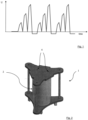
- the non-linear increase in the electric voltage, which directly proportional to the electric charge on electrodes 3 is shown in Figure 1 .
- the electric voltage reaches a certain limit, then decreases, then reaches a slightly higher limit, and this repeats until the molecules of the aqueous solution release electrons during their dissociation, which momentarily causes the electric voltage to drop below the horizontal axis of Figure 1 .
- Charging takes place only in the positive half-plane.
- This process is repeated continuously as long as aqueous solution is present between the electrodes 2 of the capacitor and as long as fission products need to be produced.
- the frequency of the rise and fall of the electrical voltage is modified in Figure 1 to help understand the method, but in reality, the operating frequency ranges from 50 kHz to 1 MHz, which means up to 1 000 000 repetitions of the phenomenon in one second. This extreme stress on the bonds in the aqueous solution molecules causes them to break down. In addition, it has been verified that the conductivity of the aqueous solution between the electrodes decreases with increasing frequency. This is important as it is possible to process any aqueous solution. Due to the higher frequencies, the electrical charge is concentrated at electrodes 3 and an inactive region is formed in the gap between electrodes 3 in terms of electrical conductivity.
- the amplitudes of the working electrical voltage this depends on several factors. Firstly, it depends on the electrical properties of the aqueous solution to be treated, then on the surface area of the electrodes 3 and the distance of the electrode surfaces 3 from each other, then on the amount and temperature of the water, then on the degree of dissociation of the molecules, etc.
- the electrodes 3 of reactor 1 are connected to a tuned LC circuit which, through tuning, responds to the instantaneous demand of the electrical system to generate the desired extreme electric field.
- the advantage of the LC circuit is that when it goes into resonance, it can discharge and charge the electric charge in the electrodes 3 with the desired frequency, and the magnitude of the electric charge can be increased according to the tendency depicted in FIG. 1 .
- the power source of the LC circuit is so-called feedback, which means that it responds to changes by itself.
- a feedback coil is used in the source, which when charged, closes the source tube, causing an oscillation - frequency.
- the use of a controlled power supply cannot be ruled out, but such a solution appears at first sight to be unnecessarily complex.
- the dissociation of the aqueous solution molecules releases an electric charge in the form of electrons that are drawn to one of the electrodes 3 , it is necessary to stabilize the product ions to prevent recombination into other new molecules.
- the electric charge is supplied to the fission product ions by irradiation with photons, ideally UV light, whose photons have sufficient energy to stabilize them, and all that has to happen is that the fission product ion is struck by the UV photon. It is also possible to use photons of light from the visible spectrum, or energetic particles from sources other than light.
- the fission products are spatially arranged in the sample volume, which is achieved by applying an artificial magnetic field to their magnetic dipole.
- the means for the magnetic action may be a permanent magnet, such as a neodymium magnet, or a coil for emitting an induced magnetic field.
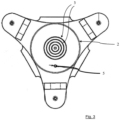
- FIG. 2 shows reactor 1 for dissociation aqueous solutions.
- the reactor 1 exhibits a hermetically sealable Plexiglas container 2 , which is cylindrical in shape and closed by two flanges. Inside the hermetically sealed container 2 there are electrodes 3 of tubular shape, which are concentrically arranged and spaced apart for flooding with water. There are five tubular electrodes 3 in total, as shown in Figure 3 .
- the invention can be used to analyse the composition of an unknown aqueous solution.
- an electric field which increases unevenly and repeats periodically acts on the molecules and atoms forming a sample of the aqueous solution to impart energy to them which, in critical amounts, leads to the breaking of molecular bonds to form ions from the molecules or to the ionization of the atoms.
- the addition of ions in the sample changes the electrical parameters of the electrode array 3 and its dielectric formed by the sample under test. These actual electrical parameters are compared with empirically collected values, thereby identifying the components of the unknown aqueous solution sample.
- the present invention can prepare ions of atoms originally forming the sample easily and safely with respect to the operator and the environment. Moreover, the invention can also be operated by a trained person who is only tasked with loading the sample into reactor 1 , starting the automated analysis and allowing it to run to completion, whereupon the trained person only processes the results obtained.
- Wastewater from a septic tank containing solids was collected.
- the wastewater was mixed for 15 minutes in a blender.
- the mixture of water and solids was sieved through a 500 micrometre mesh sieve.
- the sieved effluent was poured into reactor 1 where it was exposed to an electric field.
- the gaseous components were discharged to a gaseous analyser.
- the gas analyser detected the presence of hydrogen, oxygen, methane, chlorine and hydrogen sulphide.
Landscapes
- Chemical & Material Sciences (AREA)
- Health & Medical Sciences (AREA)
- Life Sciences & Earth Sciences (AREA)
- General Health & Medical Sciences (AREA)
- Biochemistry (AREA)
- Pathology (AREA)
- Immunology (AREA)
- General Physics & Mathematics (AREA)
- Physics & Mathematics (AREA)
- Analytical Chemistry (AREA)
- Chemical Kinetics & Catalysis (AREA)
- Organic Chemistry (AREA)
- Electrochemistry (AREA)
- Engineering & Computer Science (AREA)
- Inorganic Chemistry (AREA)
- Medicinal Chemistry (AREA)
- Food Science & Technology (AREA)
- Molecular Biology (AREA)
- Combustion & Propulsion (AREA)
- Investigating Or Analyzing Non-Biological Materials By The Use Of Chemical Means (AREA)
- Investigating Or Analyzing Materials By The Use Of Electric Means (AREA)
- Sampling And Sample Adjustment (AREA)
Applications Claiming Priority (2)
| Application Number | Priority Date | Filing Date | Title |
|---|---|---|---|
| CZ2022-237A CZ310555B6 (cs) | 2022-06-03 | 2022-06-03 | Způsob analýzy chemického složení kapalné látky nebo kapalné směsi a analyzátor k provádění způsobu analýzy |
| PCT/CZ2022/050130 WO2023109989A2 (fr) | 2021-12-14 | 2022-12-13 | Procédé de dissociation de molécules d'eau pour l'obtention d'hydrogène et d'oxygène gazeux et appareil de dissociation de molécules d'eau |
Publications (1)
| Publication Number | Publication Date |
|---|---|
| EP4292978A1 true EP4292978A1 (fr) | 2023-12-20 |
Family
ID=88758575
Family Applications (1)
| Application Number | Title | Priority Date | Filing Date |
|---|---|---|---|
| EP23176753.4A Pending EP4292978A1 (fr) | 2022-06-03 | 2023-06-01 | Procédé de dissociation de molécules d'eau pour l'obtention d'hydrogène et d'oxygène gazeux et appareil de dissociation de molécules d'eau |
Country Status (2)
| Country | Link |
|---|---|
| EP (1) | EP4292978A1 (fr) |
| CZ (1) | CZ310555B6 (fr) |
Citations (4)
| Publication number | Priority date | Publication date | Assignee | Title |
|---|---|---|---|---|
| US4936961A (en) * | 1987-08-05 | 1990-06-26 | Meyer Stanley A | Method for the production of a fuel gas |
| GB2329711A (en) * | 1997-09-27 | 1999-03-31 | Univ Wales Aberystwyth The | Capacitance measurement of a dielectric medium |
| EP2433902A1 (fr) * | 2009-05-19 | 2012-03-28 | Energy Innovation Company B.V. | Procédé et dispositif de production de gaz combustible, d'énergie thermique, d'hydrogène et d'oxygène |
| US20210156037A1 (en) * | 2019-11-21 | 2021-05-27 | McKane B. Lee | Quantum kinetic fusor |
Family Cites Families (4)
| Publication number | Priority date | Publication date | Assignee | Title |
|---|---|---|---|---|
| US3031616A (en) * | 1957-07-18 | 1962-04-24 | Hummel Heinz | Apparatus for analyzing gaseous or liquid mixtures |
| GB1423314A (en) * | 1973-02-26 | 1976-02-04 | Halogen Controls Inc | Monitoring and controlling the halogen content of a liquid |
| GB2215846B (en) * | 1988-03-23 | 1992-04-22 | Nat Res Dev | Method and apparatus for measuring the type and concentration of ion species in liquids |
| DE10002595A1 (de) * | 2000-01-21 | 2001-08-09 | Infineon Technologies Ag | Messverfahren und Sensorvorrichtung für die chemische und pharmazeutische Analytik und Synthese |
-
2022
- 2022-06-03 CZ CZ2022-237A patent/CZ310555B6/cs unknown
-
2023
- 2023-06-01 EP EP23176753.4A patent/EP4292978A1/fr active Pending
Patent Citations (4)
| Publication number | Priority date | Publication date | Assignee | Title |
|---|---|---|---|---|
| US4936961A (en) * | 1987-08-05 | 1990-06-26 | Meyer Stanley A | Method for the production of a fuel gas |
| GB2329711A (en) * | 1997-09-27 | 1999-03-31 | Univ Wales Aberystwyth The | Capacitance measurement of a dielectric medium |
| EP2433902A1 (fr) * | 2009-05-19 | 2012-03-28 | Energy Innovation Company B.V. | Procédé et dispositif de production de gaz combustible, d'énergie thermique, d'hydrogène et d'oxygène |
| US20210156037A1 (en) * | 2019-11-21 | 2021-05-27 | McKane B. Lee | Quantum kinetic fusor |
Non-Patent Citations (4)
| Title |
|---|
| FAJRINA NUR ET AL: "A critical review in strategies to improve photocatalytic water splitting towards hydrogen production", INTERNATIONAL JOURNAL OF HYDROGEN ENERGY, vol. 44, no. 2, 1 January 2019 (2019-01-01), AMSTERDAM, NL, pages 540 - 577, XP093082244, ISSN: 0360-3199, DOI: 10.1016/j.ijhydene.2018.10.200 * |
| SPANU DAVIDE ET AL: "Site-selective Pt dewetting on WO3-coated TiO2nanotube arrays: An electron transfer cascade-based H2evolution photocatalyst", APPLIED CATALYSIS B. ENVIRONMENTAL, ELSEVIER, AMSTERDAM, NL, vol. 237, 22 May 2018 (2018-05-22), pages 198 - 205, XP085441527, ISSN: 0926-3373, DOI: 10.1016/J.APCATB.2018.05.061 * |
| WIKIPEDIA: "File:Dielectric responses.svg - Wikipedia", 29 April 2008 (2008-04-29), XP093303092, Retrieved from the Internet <URL:https://en.wikipedia.org/wiki/File:Dielectric_responses.svg> [retrieved on 20250807] * |
| WIKIPEDIA: "File:Morse-potential.svg - Wikipedia", 11 December 2024 (2024-12-11), XP093303098, Retrieved from the Internet <URL:https://en.wikipedia.org/wiki/File:Morse-potential.svg> [retrieved on 20250807] * |


Also Published As
| Publication number | Publication date |
|---|---|
| CZ310555B6 (cs) | 2025-11-26 |
| CZ2022237A3 (cs) | 2023-12-13 |
Similar Documents
| Publication | Publication Date | Title |
|---|---|---|
| Verreycken et al. | Spectroscopic study of an atmospheric pressure dc glow discharge with a water electrode in atomic and molecular gases | |
| Bol'Shakov et al. | Radio-frequency oxygen plasma as a sterilization source | |
| Lebedev et al. | Spectroscopy of microwave discharge in liquid C7–C16 hydrocarbons | |
| Zhang et al. | Generation of reactive species in atmospheric pressure dielectric barrier discharge with liquid water | |
| Franck et al. | An efficient procedure to identify and quantify new molecules for insulating gas mixtures | |
| Falahat et al. | Optical characteristics of a RF DBD plasma jet in various Ar/O 2 mixtures | |
| Jaworek et al. | Back-corona generated plasma for decomposition of hydrocarbon gaseous contaminants | |
| US5896196A (en) | Plasma mixing glow discharge device for analytical applications | |
| Bajon et al. | Homogeneous dielectric barrier discharge in CO2 | |
| De Urquijo et al. | Two-and three-body attachment, electron transport and ionisation in water-air mixtures | |
| EP4292978A1 (fr) | Procédé de dissociation de molécules d'eau pour l'obtention d'hydrogène et d'oxygène gazeux et appareil de dissociation de molécules d'eau | |
| Jiang et al. | Spatially resolved absolute densities of reactive species and positive ion flux in He-O2 RF-driven atmospheric pressure plasma jet: touching and non-touching with dielectric substrate | |
| Bouza et al. | A flowing atmospheric pressure afterglow as an ion source coupled to a differential mobility analyzer for volatile organic compound detection | |
| US20250034722A1 (en) | Method for dissociating water molecules to obtain hydrogen and oxygen gas and apparatus for dissociating water molecules | |
| Mujahid et al. | Deposition of oxygenated hydrocarbons in a packed-bed plasma reactor during the oxidation of toluene: influence of applied voltage | |
| Hong et al. | Miniaturized corona discharge-atomic emission spectrometer for determination of trace mercury | |
| CZ36074U1 (cs) | Zařízení k disociaci molekul vody pro zisk plynného vodíku a kyslíku | |
| Ramazanov et al. | Analysis of the water composition using emission spectra of a gas discharge | |
| Suzuki et al. | Determination of collisional quenching rate coefficient of N 2 (A 3 Σ u+) by H2O | |
| Karimian et al. | Role of the atomic argon on the plasma characteristics of O2/N2 gas mixture | |
| Kapustin et al. | New physical methods of organic compound identification using a surface ionization drift spectrometer | |
| Diatczyk et al. | Diagnostic of temperature distribution in the chamber of GA plasma reactor | |
| Kakegawa et al. | Development of a high-density microplasma emission source for a micro total analysis system | |
| Sitanov et al. | Metal content monitoring in the biological structures | |
| Sillerud et al. | Characterization of chemical contaminants and their spectral properties from an atmospheric pressure ns-pulsed microdischarge in neon |
Legal Events
| Date | Code | Title | Description |
|---|---|---|---|
| PUAI | Public reference made under article 153(3) epc to a published international application that has entered the european phase |
Free format text: ORIGINAL CODE: 0009012 |
|
| STAA | Information on the status of an ep patent application or granted ep patent |
Free format text: STATUS: THE APPLICATION HAS BEEN PUBLISHED |
|
| AK | Designated contracting states |
Kind code of ref document: A1 Designated state(s): AL AT BE BG CH CY CZ DE DK EE ES FI FR GB GR HR HU IE IS IT LI LT LU LV MC ME MK MT NL NO PL PT RO RS SE SI SK SM TR |
|
| STAA | Information on the status of an ep patent application or granted ep patent |
Free format text: STATUS: REQUEST FOR EXAMINATION WAS MADE |
|
| 17P | Request for examination filed |
Effective date: 20240507 |
|
| RBV | Designated contracting states (corrected) |
Designated state(s): AL AT BE BG CH CY CZ DE DK EE ES FI FR GB GR HR HU IE IS IT LI LT LU LV MC ME MK MT NL NO PL PT RO RS SE SI SK SM TR |
|
| STAA | Information on the status of an ep patent application or granted ep patent |
Free format text: STATUS: EXAMINATION IS IN PROGRESS |
|
| 17Q | First examination report despatched |
Effective date: 20250813 |
|
| STAA | Information on the status of an ep patent application or granted ep patent |
Free format text: STATUS: THE APPLICATION IS DEEMED TO BE WITHDRAWN |