EP4293013A1 - Neuartige verbindung, herstellungsverfahren dafür und pharmazeutische zusammensetzung - Google Patents
Neuartige verbindung, herstellungsverfahren dafür und pharmazeutische zusammensetzung Download PDFInfo
- Publication number
- EP4293013A1 EP4293013A1 EP22752615.9A EP22752615A EP4293013A1 EP 4293013 A1 EP4293013 A1 EP 4293013A1 EP 22752615 A EP22752615 A EP 22752615A EP 4293013 A1 EP4293013 A1 EP 4293013A1
- Authority
- EP
- European Patent Office
- Prior art keywords
- group
- compound
- formula
- compound represented
- reaction
- Prior art date
- Legal status (The legal status is an assumption and is not a legal conclusion. Google has not performed a legal analysis and makes no representation as to the accuracy of the status listed.)
- Granted
Links
Images
Classifications
-
- C—CHEMISTRY; METALLURGY
- C07—ORGANIC CHEMISTRY
- C07F—ACYCLIC, CARBOCYCLIC OR HETEROCYCLIC COMPOUNDS CONTAINING ELEMENTS OTHER THAN CARBON, HYDROGEN, HALOGEN, OXYGEN, NITROGEN, SULFUR, SELENIUM OR TELLURIUM
- C07F7/00—Compounds containing elements of Groups 4 or 14 of the Periodic Table
- C07F7/02—Silicon compounds
- C07F7/08—Compounds having one or more C—Si linkages
- C07F7/18—Compounds having one or more C—Si linkages as well as one or more C—O—Si linkages
- C07F7/1804—Compounds having Si-O-C linkages
- C07F7/1872—Preparation; Treatments not provided for in C07F7/20
- C07F7/1892—Preparation; Treatments not provided for in C07F7/20 by reactions not provided for in C07F7/1876 - C07F7/1888
-
- A—HUMAN NECESSITIES
- A61—MEDICAL OR VETERINARY SCIENCE; HYGIENE
- A61P—SPECIFIC THERAPEUTIC ACTIVITY OF CHEMICAL COMPOUNDS OR MEDICINAL PREPARATIONS
- A61P35/00—Antineoplastic agents
-
- C—CHEMISTRY; METALLURGY
- C07—ORGANIC CHEMISTRY
- C07D—HETEROCYCLIC COMPOUNDS
- C07D213/00—Heterocyclic compounds containing six-membered rings, not condensed with other rings, with one nitrogen atom as the only ring hetero atom and three or more double bonds between ring members or between ring members and non-ring members
- C07D213/02—Heterocyclic compounds containing six-membered rings, not condensed with other rings, with one nitrogen atom as the only ring hetero atom and three or more double bonds between ring members or between ring members and non-ring members having three double bonds between ring members or between ring members and non-ring members
- C07D213/04—Heterocyclic compounds containing six-membered rings, not condensed with other rings, with one nitrogen atom as the only ring hetero atom and three or more double bonds between ring members or between ring members and non-ring members having three double bonds between ring members or between ring members and non-ring members having no bond between the ring nitrogen atom and a non-ring member or having only hydrogen or carbon atoms directly attached to the ring nitrogen atom
- C07D213/24—Heterocyclic compounds containing six-membered rings, not condensed with other rings, with one nitrogen atom as the only ring hetero atom and three or more double bonds between ring members or between ring members and non-ring members having three double bonds between ring members or between ring members and non-ring members having no bond between the ring nitrogen atom and a non-ring member or having only hydrogen or carbon atoms directly attached to the ring nitrogen atom with substituted hydrocarbon radicals attached to ring carbon atoms
- C07D213/28—Radicals substituted by singly-bound oxygen or sulphur atoms
- C07D213/30—Oxygen atoms
-
- C—CHEMISTRY; METALLURGY
- C07—ORGANIC CHEMISTRY
- C07D—HETEROCYCLIC COMPOUNDS
- C07D213/00—Heterocyclic compounds containing six-membered rings, not condensed with other rings, with one nitrogen atom as the only ring hetero atom and three or more double bonds between ring members or between ring members and non-ring members
- C07D213/02—Heterocyclic compounds containing six-membered rings, not condensed with other rings, with one nitrogen atom as the only ring hetero atom and three or more double bonds between ring members or between ring members and non-ring members having three double bonds between ring members or between ring members and non-ring members
- C07D213/04—Heterocyclic compounds containing six-membered rings, not condensed with other rings, with one nitrogen atom as the only ring hetero atom and three or more double bonds between ring members or between ring members and non-ring members having three double bonds between ring members or between ring members and non-ring members having no bond between the ring nitrogen atom and a non-ring member or having only hydrogen or carbon atoms directly attached to the ring nitrogen atom
- C07D213/24—Heterocyclic compounds containing six-membered rings, not condensed with other rings, with one nitrogen atom as the only ring hetero atom and three or more double bonds between ring members or between ring members and non-ring members having three double bonds between ring members or between ring members and non-ring members having no bond between the ring nitrogen atom and a non-ring member or having only hydrogen or carbon atoms directly attached to the ring nitrogen atom with substituted hydrocarbon radicals attached to ring carbon atoms
- C07D213/36—Radicals substituted by singly-bound nitrogen atoms
- C07D213/40—Acylated substituent nitrogen atom
-
- C—CHEMISTRY; METALLURGY
- C07—ORGANIC CHEMISTRY
- C07D—HETEROCYCLIC COMPOUNDS
- C07D213/00—Heterocyclic compounds containing six-membered rings, not condensed with other rings, with one nitrogen atom as the only ring hetero atom and three or more double bonds between ring members or between ring members and non-ring members
- C07D213/02—Heterocyclic compounds containing six-membered rings, not condensed with other rings, with one nitrogen atom as the only ring hetero atom and three or more double bonds between ring members or between ring members and non-ring members having three double bonds between ring members or between ring members and non-ring members
- C07D213/04—Heterocyclic compounds containing six-membered rings, not condensed with other rings, with one nitrogen atom as the only ring hetero atom and three or more double bonds between ring members or between ring members and non-ring members having three double bonds between ring members or between ring members and non-ring members having no bond between the ring nitrogen atom and a non-ring member or having only hydrogen or carbon atoms directly attached to the ring nitrogen atom
- C07D213/24—Heterocyclic compounds containing six-membered rings, not condensed with other rings, with one nitrogen atom as the only ring hetero atom and three or more double bonds between ring members or between ring members and non-ring members having three double bonds between ring members or between ring members and non-ring members having no bond between the ring nitrogen atom and a non-ring member or having only hydrogen or carbon atoms directly attached to the ring nitrogen atom with substituted hydrocarbon radicals attached to ring carbon atoms
- C07D213/54—Radicals substituted by carbon atoms having three bonds to hetero atoms with at the most one bond to halogen, e.g. ester or nitrile radicals
- C07D213/56—Amides
-
- C—CHEMISTRY; METALLURGY
- C07—ORGANIC CHEMISTRY
- C07D—HETEROCYCLIC COMPOUNDS
- C07D263/00—Heterocyclic compounds containing 1,3-oxazole or hydrogenated 1,3-oxazole rings
- C07D263/02—Heterocyclic compounds containing 1,3-oxazole or hydrogenated 1,3-oxazole rings not condensed with other rings
- C07D263/30—Heterocyclic compounds containing 1,3-oxazole or hydrogenated 1,3-oxazole rings not condensed with other rings having two or three double bonds between ring members or between ring members and non-ring members
- C07D263/32—Heterocyclic compounds containing 1,3-oxazole or hydrogenated 1,3-oxazole rings not condensed with other rings having two or three double bonds between ring members or between ring members and non-ring members with only hydrogen atoms, hydrocarbon or substituted hydrocarbon radicals, directly attached to ring carbon atoms
-
- C—CHEMISTRY; METALLURGY
- C07—ORGANIC CHEMISTRY
- C07D—HETEROCYCLIC COMPOUNDS
- C07D277/00—Heterocyclic compounds containing 1,3-thiazole or hydrogenated 1,3-thiazole rings
- C07D277/02—Heterocyclic compounds containing 1,3-thiazole or hydrogenated 1,3-thiazole rings not condensed with other rings
- C07D277/20—Heterocyclic compounds containing 1,3-thiazole or hydrogenated 1,3-thiazole rings not condensed with other rings having two or three double bonds between ring members or between ring members and non-ring members
- C07D277/22—Heterocyclic compounds containing 1,3-thiazole or hydrogenated 1,3-thiazole rings not condensed with other rings having two or three double bonds between ring members or between ring members and non-ring members with only hydrogen atoms, hydrocarbon or substituted hydrocarbon radicals, directly attached to ring carbon atoms
- C07D277/28—Radicals substituted by nitrogen atoms
-
- C—CHEMISTRY; METALLURGY
- C07—ORGANIC CHEMISTRY
- C07D—HETEROCYCLIC COMPOUNDS
- C07D277/00—Heterocyclic compounds containing 1,3-thiazole or hydrogenated 1,3-thiazole rings
- C07D277/02—Heterocyclic compounds containing 1,3-thiazole or hydrogenated 1,3-thiazole rings not condensed with other rings
- C07D277/20—Heterocyclic compounds containing 1,3-thiazole or hydrogenated 1,3-thiazole rings not condensed with other rings having two or three double bonds between ring members or between ring members and non-ring members
- C07D277/22—Heterocyclic compounds containing 1,3-thiazole or hydrogenated 1,3-thiazole rings not condensed with other rings having two or three double bonds between ring members or between ring members and non-ring members with only hydrogen atoms, hydrocarbon or substituted hydrocarbon radicals, directly attached to ring carbon atoms
- C07D277/30—Radicals substituted by carbon atoms having three bonds to hetero atoms with at the most one bond to halogen, e.g. ester or nitrile radicals
-
- C—CHEMISTRY; METALLURGY
- C07—ORGANIC CHEMISTRY
- C07F—ACYCLIC, CARBOCYCLIC OR HETEROCYCLIC COMPOUNDS CONTAINING ELEMENTS OTHER THAN CARBON, HYDROGEN, HALOGEN, OXYGEN, NITROGEN, SULFUR, SELENIUM OR TELLURIUM
- C07F7/00—Compounds containing elements of Groups 4 or 14 of the Periodic Table
- C07F7/02—Silicon compounds
- C07F7/08—Compounds having one or more C—Si linkages
- C07F7/18—Compounds having one or more C—Si linkages as well as one or more C—O—Si linkages
- C07F7/1804—Compounds having Si-O-C linkages
- C07F7/1872—Preparation; Treatments not provided for in C07F7/20
- C07F7/188—Preparation; Treatments not provided for in C07F7/20 by reactions involving the formation of Si-O linkages
Definitions
- the present invention relates to a novel compound, a production method therefor, and a pharmaceutical composition.
- M-COPA (2- methylcoprophilinamide [AMF-26]) is a compound having a structure shown below, and is known to exhibit anticancer action.
- M-COPA has been recently revealed to exhibit anticancer action by inhibiting, for example, the translocation of receptor tyrosine kinases (such as MET, EGFR, KIT) to a Golgi apparatus or a cellular membrane via suppression of transport of them between the endoplasmic reticulum and Golgi apparatus (e.g., see Non-Patent Documents 1 to 5), and is expected to be promising for use as a next-generation molecular target anticancer agent targeting Golgi apparatus.
- receptor tyrosine kinases such as MET, EGFR, KIT
- Patent Document 1 has proposed a method for synthesizing M-COPA and an analog thereof without use of a natural product.
- Patent Document 1 PCT International Publication No. WO 2013/151161
- M-COPA is expected to be promising for use as a next-generation molecular target anticancer agent
- development of new analogs derived from M-COPA as a lead compound is also desired.
- the present invention has been proposed in view of such circumstances, and an object of the present invention is to provide: a novel compound useful for cancer treatment or the like; a production method that enables the novel compound to be produced with high efficiency; and a pharmaceutical composition containing the novel compound as an active ingredient.
- the present invention can provide: a novel compound useful for cancer treatment or the like; a production method that enables the novel compound to be produced with high efficiency; and a pharmaceutical composition containing the novel compound as an active ingredient.
- the compound according to the present embodiment is represented by formula (1) below.
- R 1 and R 3 to R 8 each independently represent a hydrogen atom or an alkyl group.
- R 2 represents a hydrogen atom, or a group represented by -OR a or -NR b R c .
- R 9 represents a group represented by -CH 2 OR d , -C(O)OR d , -C(O)R d , - CH 2 NR e R f , or -C(O)NR e R f .
- R a to R f each independently represent a hydrogen atom, an alkyl group, an aryl group optionally having a substituent, a heteroaryl group optionally having a substituent, an arylalkyl group optionally having a substituent, or a heteroarylalkyl group optionally having a substituent.
- the alkyl group for R 1 and R 3 to R 8 is preferably an alkyl group having 1 to 20 carbon atoms, and more preferably an alkyl group having one to six carbon atoms.
- the alkyl group may be linear, branched, or cyclic. Specific examples of the alkyl group include a methyl group, an ethyl group, a propyl group, an isopropyl group, a butyl group, a sec-butyl group, an isobutyl group, a tert-butyl group, a pentyl group, an isopentyl group, a cyclopentyl group, a hexyl group, and a cyclohexyl group.
- R 1 and R 6 are preferably each independently an alkyl group (in particular, an alkyl group having one to six carbon atoms), R 3 is preferably a hydrogen atom or an alkyl group (in particular, an alkyl group having one to six carbon atoms), and R 4 , R 5 , R 7 , and R 8 are preferably each a hydrogen atom.
- the alkyl group for R a to R f is preferably an alkyl group having 1 to 20 carbon atoms, and more preferably an alkyl group having one to six carbon atoms.
- the alkyl group may be linear, branched, or cyclic. Specific examples of the alkyl group include a methyl group, an ethyl group, a propyl group, an isopropyl group, a butyl group, a sec-butyl group, an isobutyl group, a tert -butyl group, a pentyl group, an isopentyl group, a cyclopentyl group, a hexyl group, and a cyclohexyl group.
- the aryl group for R a to R f is preferably a monocyclic or polycyclic aromatic hydrocarbon group having 6 to 20 carbon atoms, and more preferably a monocyclic or polycyclic aromatic hydrocarbon group having 6 to 12 carbon atoms.
- Specific examples of the aryl group include a phenyl group, a naphthyl group, an anthryl group, a phenanthryl group, and a pyrenyl group.
- the heteroaryl group for R a to R f is preferably a monocyclic or polycyclic aromatic heterocyclic group having two to nine ring-constituting carbon atoms, and more preferably a monocyclic aromatic heterocyclic group having three to five ring-constituting carbon atoms, each group containing one to four heteroatoms selected from an oxygen atom, a sulfur atom, and a nitrogen atom.
- heteroaryl group examples include a pyrrolyl group, a pyridyl group, an imidazolyl group, a pyrazolyl group, a pyrazinyl group, a pyridazinyl group, a pyrimidinyl group, a triazolyl group, a tetrazolyl group, a furanyl group, a thienyl group, an oxazolyl group, an isoxazolyl group, an oxadiazolyl group, a thiazolyl group, an isothiazolyl group, a thiadiazolyl group, an indolyl group, an isoindolyl group, a benzimidazolyl group, an indazolyl group, a benzotriazolyl group, a tetrahydroquinolyl group, a quinolyl group, a tetrahydroisoquinolyl group, an isoquino
- the arylalkyl group for R a to R f is preferably an alkyl group having one to six carbon atoms and substituted with any of those aryl groups, and more preferably an alkyl group having one to four carbon atoms and substituted with any of those aryl groups.
- Specific examples of the arylalkyl group include a benzyl group, a phenethyl group, a 3-phenylpropyl group, a 4-phenylbutyl group, a 1-phenylethyl group, and a 2-phenylpropan-2-yl group.
- the heteroarylalkyl group for R a to R f is preferably an alkyl group having one to six carbon atoms and substituted with any of those heteroaryl groups, and more preferably an alkyl group having one to four carbon atoms and substituted with any of those heteroaryl groups.
- heteroarylalkyl group examples include a pyridylmethyl group, a pyridylethyl group, an imidazolylmethyl group, an imidazolylethyl group, a pyrazolylmethyl group, a pyrazolylethyl group, a pyrazinylmethyl group, a pyrazinylethyl group, a pyridazinylmethyl group, a pyridazinylethyl group, a pyrimidinylmethyl group, a pyrimidinylethyl group, an oxazolylmethyl group, an oxazolylethyl group, a thiazolylmethyl group, and a thiazolylethyl group.
- Examples of the substituent optionally possessed by the aryl group, heteroaryl group, arylalkyl group, and heteroarylalkyl group include a hydroxy group, an alkoxy group having one to four carbon atoms, a hydroxyalkyl group having one to four carbon atoms, an amino group, a mono- or dialkylamino group having an alkyl group having one to four carbon atoms, an alkoxycarbonyl group having an alkoxy group having one to four carbon atoms, and a halogen atom.
- substituents include a hydroxy group, a methoxy group, an ethoxy group, a hydroxymethyl group, a hydroxyethyl group, an amino group, a monomethylamino group, a dimethylamino group, a methoxycarbonyl group, an ethoxycarbonyl group, a chlorine atom, and a fluorine atom.
- R 2 is preferably a group represented by -OR a , and R a in this case is preferably a hydrogen atom or an alkyl group having one to six carbon atoms. Preferred examples of R 2 include a hydroxy group, a methoxy group, and an ethoxy group.
- R 9 is preferably a group represented by -CH 2 OR d , -C(O)OR d , or -C(O)NR e R f , and more preferably a group represented by - C(O)OR d or -C(O)NR e R f .
- R 9 is a group represented by -CH 2 OR d
- R d is preferably a hydrogen atom or an alkyl group having one to six carbon atoms. Specific examples of R d in this case include a hydrogen atom and a methyl group.
- R 9 is a group represented by -C(O)OR d
- R d is preferably a hydrogen atom, an alkyl group having one to six carbon atoms, an arylalkyl group, or a heteroarylalkyl group.
- R d in this case include a hydrogen atom, a methyl group, a pyridin-3-ylmethyl group, a pyridin-4-ylmethyl group, an oxazol-4-ylmethyl group, an oxazol-5-ylmethyl group, a thiazol-2-ylmethyl group, and a thiazol-5-ylmethyl group.
- R 9 is a group represented by -C(O)NR e R f
- R e is preferably a hydrogen atom
- R f is preferably an arylalkyl group or a heteroarylalkyl group.
- Specific examples of R f in this case include a pyridin-3-ylmethyl group, a pyridin-4-ylmethyl group, an oxazol-4-ylmethyl group, an oxazol-5-ylmethyl group, a thiazol-2-ylmethyl group, and a thiazol-5-ylmethyl group.
- Preferred examples of the compound represented by formula (1) above include a compound in which R 1 and R 6 are each independently an alkyl group, R 2 is a hydroxy group, R 4 , R 5 , R 7 , and R 8 are each a hydrogen atom, R 9 is a group represented by - C(O)OR d or -C(O)NR e R f , R d is an arylalkyl group or a heteroarylalkyl group, R e is a hydrogen atom, and R f is an arylalkyl group or a heteroarylalkyl group.
- Preferred examples of the alkyl group, arylalkyl group, and heteroarylalkyl group are as described above.
- the compound represented by formula (1) may be in the form of a salt.
- the compound represented by formula (1) may be in the form of an alkali metal salt (such as a sodium salt, a potassium salt), an alkaline earth metal (such as a calcium salt, a magnesium salt), or an ammonium salt.
- the compound represented by formula (1) has a basic functional group
- the compound may be in the form of a salt with an inorganic acid such as hydrochloric acid and phosphoric acid, or in the form of a salt with an organic acid such as acetic acid, fumaric acid, and methanesulfonic acid.
- the compound represented by formula (1) can be produced, for example, through steps (A) to (L) in the following.
- R 12 represents an alkyl group, an aryl group, or an arylalkyl group.
- the alkyl group for R 12 is preferably an alkyl group having one to six carbon atoms, and more preferably an alkyl group having one to four carbon atoms.
- the alkyl group may be linear, branched, or cyclic. Specific examples of the alkyl group include a methyl group, an ethyl group, an isopropyl group, an isobutyl group, and a cyclohexyl group.
- the aryl group for R 12 is preferably a monocyclic or polycyclic aromatic hydrocarbon group having 6 to 20 carbon atoms, and more preferably a monocyclic or polycyclic aromatic hydrocarbon group having 6 to 12 carbon atoms.
- Specific examples of the aryl group include a phenyl group, a naphthyl group, an anthryl group, phenanthryl group, and a pyrenyl group.
- the arylalkyl group for R 12 is preferably an alkyl group having one to six carbon atoms and substituted with any of those aryl groups, and more preferably an alkyl group having one to four carbon atoms and substituted with any of those aryl groups.
- arylalkyl group examples include a benzyl group, a phenethyl group, a 3-phenylpropyl group, a 4-phenylbutyl group, a 1-phenylethyl group, and a 2-phenylpropan-2-yl group.
- R 12 is particularly preferably a benzyl group, a phenyl group, or an isopropyl group.
- X represents a halogen atom (such as a fluorine atom, a chlorine atom, a bromine atom, an iodine atom).
- the compound represented by formula (20) (optically active isoxazolidine derivative) can be produced by allowing a base to act on the compound represented by formula (22) to generate an enolate, and reacting this with the compound represented by formula (21) (halogenated product) as an alkylating agent.
- a base lithium diisopropylamide, lithium bis(trimethylsilyl)amide, sodium bis(trimethylsilyl)amide, potassium bis(trimethylsilyl)amide, and the like can be used.
- tetrabutylammonium iodide may be added as a catalyst.
- the reaction is performed in an organic solvent such as tetrahydrofuran and ether.
- the reaction temperature is preferably about -78°C to room temperature. After the reaction, the target product is collected, and purified by column chromatography or the like.
- R 3 in the compound represented by formula (20) is determined by the configuration of R 12 in the compound represented by formula (22).
- the compound represented by formula (20) (optically active isoxazolidine derivative) can be converted, without deteriorating the optical purity, into the compound represented by formula (19) (alcohol) by treating with a reducing agent.
- a reducing agent LiAlH 4 , LiBH 4- EtOH, NaH 2 Al(OCH 2 CH 2 OMe) 2 , and the like can be used.
- the reaction is performed in an organic solvent such as tetrahydrofuran and ether.
- the reaction temperature is preferably about 0°C to room temperature. After the reaction, the target product is collected, and purified by column chromatography or the like.
- the compound represented by formula (19) (alcohol) is oxidized to produce a compound represented by formula (18) (aldehyde).
- a weak oxidizing agent such as dimethyl sulfoxide, tetrapropylammonium perruthenate, and Dess-Martin periodinane can be used.
- the reaction is performed in an organic solvent such as methylene chloride.
- the reaction temperature is preferably about 0°C to room temperature.
- the resulting compound represented by formula (18) may be directly used for the subsequent reaction without being isolated.
- the compound represented by formula (16) can be produced by subjecting the compound represented by formula (18) and the compound represented by formula (17) to Mukaiyama Aldol reaction in the presence of boron triflate and an amine.
- R 12 is as described in formula (22).
- amine triethylamine, 2,6-lutidine, and the like can be used.
- the reaction is performed in an organic solvent such as methylene chloride, tetrahydrofuran, and 1,2-dimethoxyethane.
- the reaction temperature is preferably about -78°C to 0°C.
- the target product is collected, and purified by column chromatography or the like.
- the compound represented by formula (16) can be converted into the compound represented by formula (15) (Weinreb amide) with ease by reacting with N,O-dimethylhydroxylamine.
- Me represents a methyl group.
- the reaction is performed in an organic solvent such as tetrahydrofuran.
- the reaction temperature is preferably about 0°C. After the reaction, the target product is collected, and purified by column chromatography or the like.
- Z represents a protecting group for a hydroxy group.
- Z is preferably a protecting group that is capable of protecting hydroxy groups under temperate conditions and stable under alkaline conditions.
- Preferred examples of the protecting group include trialkylsilyl groups such as a trimethylsilyl group, a triethylsilyl group, and a tert-butyldimethylsilyl group.
- the protection of a hydroxy group is preferably performed by reacting with trialkylsilyl triflate or the like in an organic solvent such as methylene chloride with use of the weak base 2,6-lutidine or the like as a catalyst.
- the reaction temperature is preferably about 0°C. After the reaction, the target product is collected, and purified by column chromatography or the like.
- the compound represented by formula (14) (amide) is reduced to produce the compound represented by formula (13) (aldehyde).
- use of diisobutylaluminum hydride as a reducing agent is preferred because the reduction can be stopped at the stage of aldehyde formation.
- the reaction is performed in an organic solvent such as tetrahydrofuran, toluene, hexane, and methylene chloride.
- the reaction temperature is preferably about -78°C to 0°C. After the reaction, the target product is collected.
- the compound represented by formula (11) can be produced by subjecting the compound represented by formula (13) (aldehyde) and the compound represented by formula (12) (Wittig reagent) to Wittig reaction.
- the reaction is performed in an organic solvent such as methylene chloride.
- the reaction temperature is preferably about 35°C.
- the target product is collected, and purified by column chromatography or the like.
- the compound represented by formula (10) (aldehyde) can be produced by reducing the compound represented by formula (11) (amide) in the same manner as in step (F).
- the reaction conditions and others may be the same as those in step (F).
- the compound represented by formula (8) can be produced by subjecting the compound represented by formula (10) (aldehyde) and the compound represented by formula (9) (Wittig reagent) to Wittig reaction in the same manner as in step (F).
- the reaction conditions and others may be the same as those in step (F).
- the compound represented by formula (7) (aldehyde) can be produced by reducing the compound represented by formula (8) (amide) in the same manner as in step (F).
- the reaction conditions and others may be the same as those in step (F).
- Intramolecular Diels-Alder reaction is promoted by a driving force generated by conversion of an 8n system in a molecule with open chain structure into a more stable 4 ⁇ +4 ⁇ system in a molecule with cyclic structure. It is preferable to use a catalyst such as diethylaluminum chloride for the reaction.
- the reaction is performed in an organic solvent such as methylene chloride.
- the reaction temperature is preferably about -78°C to room temperature.
- the crude product contains compounds having different conformations in addition to the compound represented by formula (6), and hence the crude product is purified by thin-layer chromatography or the like and the target product is collected.
- R 10 and R 11 each independently represent an alkyl group.
- the alkyl group for R 10 and R 11 is preferably an alkyl group having one to six carbon atoms, and more preferably an alkyl group having one to four carbon atoms.
- the alkyl group may be linear, branched, or cyclic. Specific examples of the alkyl group include a methyl group, an ethyl group, an isopropyl group, an isobutyl group, and a cyclohexyl group, and a methyl group and an ethyl group are preferred.
- the compound represented by formula (4) is produced by subjecting the compound represented by formula (6) and the compound represented by formula (5) to Horner-Wadsworth-Emmons reaction. Specifically, a base is allowed to act on the compound represented by formula (5) (alkylphosphonate) to generate a carboanion, which is reacted with the compound represented by formula (6) (aldehyde) to produce the compound represented by formula (4) (alkene). It is preferable to use lithium bis(trimethylsilyl)amide, lithium diisopropylamide, or the like for the base.
- the reaction is performed in an organic solvent such as tetrahydrofuran and methylene chloride.
- the reaction temperature is preferably about -78°C to room temperature.
- the crude product contains compounds having different conformations in addition to the compound represented by formula (4), and hence the crude product is purified by thin-layer chromatography or the like and the target product is collected.
- the compound represented by formula (3) can be produced by hydrolyzing the compound represented by formula (4).
- Hydrolysis with a hydroxy group kept protected can be achieved by performing hydrolysis with a base catalyst such as sodium hydroxide and lithium hydroxide as appropriate.
- the compound represented by formula (1) can be produced by converting -OZ of the compound represented by formula (2) into R 2 .
- the conversion of the compound represented by formula (3) into the compound represented by formula (2) can be performed with a method used in common organic synthesis, and esterification, amidation, halogenation, acid anhydride formation, etherification, amination, oxidation, reduction, coupling reaction, protection, deprotection, and others can be variously combined therefor as appropriate.
- a reaction example is shown in the following.
- a compound in which R 9 is -CH 2 OR d can be obtained by reducing the carboxy group of the compound represented by formula (3) with a reducing agent such as lithium aluminium hydride and performing Williamson synthesis to react with a halogenated alkyl represented by R d X.
- a compound in which R 9 is -C(O)NR e R f can be obtained by subjecting the carboxy group of the compound represented by formula (3) to dehydration condensation reaction with an amine represented by NHR e R f .
- a compound in which R 9 is -CH 2 NR e R f can be obtained by reducing the compound in which R 9 is -C(O)NR e R f with a reducing agent such as lithium aluminium hydride.
- a compound in which R 9 is - C(O)OR d can be obtained by subjecting the carboxy group of the compound represented by formula (3) to dehydration condensation reaction with an alcohol represented by R d OH.
- a compound in which R 9 is -CH(OH)R d can be obtained by reducing the carboxy group of the compound represented by formula (3) into a hydroxymethyl group, then oxidizing it into a formyl group, and reacting it with a Grignard reagent represented by R d MgX. Thereafter, a compound in which R 9 is -COR d can be obtained by oxidizing the compound in which R 9 is -CH(OH)R d .
- the conversion of the compound represented by formula (2) into the compound represented by formula (1) can be performed with a method used in common organic synthesis, and esterification, etherification, halogenation, amination, oxidation, reduction, protection, deprotection, and others can be variously combined therefor as appropriate. If a hydroxy group, a carboxy group, an amino group, or another group is introduced to R 9 to form an intermediate to be converted, protection and deprotection of such a group can be performed as appropriate, if necessary for the subsequent reaction.
- a reaction example is shown in the following.
- protecting group Z is eliminated from -OZ of the compound represented by formula (2) to form a hydroxy group, which is then converted into various groups.
- a compound in which R 2 is -OR a can be obtained by performing Williamson synthesis to react the hydroxy group with a halogenated alkyl represented by R a X.
- a compound in which R 2 is -O(CO)R a can be obtained by subjecting the hydroxy group to dehydration condensation reaction with a carboxylic acid represented by R a COOH.
- the hydride attack proceeds from the opposite side of the substituents R 1 and R 3 , as a result giving a sterically inverted alcohol.
- Activation of the hydroxy group of this alcohol with diethyl azodicarboxylate and triphenylphosphine and subsequent Mitsunobu reaction to react with R b R c NH allow a sterically re-inverted amino group to be introduced, giving a compound in which R 2 is -NR c R d .
- a compound in which R 2 is a hydrogen atom can be obtained by reacting the hydroxy group with 1,1'-thiocarbonyldiimidazol to convert it into thiocarbamate and then performing radical reduction with tributyltin hydride and azobisisobutyronitrile.
- the pharmaceutical composition according to the present embodiment contains the compound represented by formula (1) above and a pharmaceutically acceptable carrier.
- the compound represented by formula (1) exhibits cell proliferation inhibitory action against various cancers. Accordingly, the pharmaceutical composition according to the present embodiment is applicable as a pharmaceutical composition for treating various cancers.
- the term “treat” encompasses not only abolishing or alleviating a symptom of a disease but also reducing the degree of progression of a symptom.
- the compound represented by formula (1) is capable of inhibiting, for example, the translocation of receptor tyrosine kinases (such as KIT, FLT3, FGFR3, EGFR, MET) to a Golgi apparatus or a cellular membrane via reducing the endoplasmic reticulum-Golgi apparatus transport of them.
- receptor tyrosine kinases such as KIT, FLT3, FGFR3, EGFR, MET
- the pharmaceutical composition according to the present embodiment is effective also for treatment of cancers with activation mutation of KIT (e.g., gastrointestinal stromal tumor, mast cell leukemia, acute myelogenous leukemia); cancers with high tyrosine kinase receptor expression that are highly expressing FLT3, FGFR3, EGFR, MET, or the like (e.g., acute myelogenous leukemia, multiple myeloma, lung adenocarcinoma, gastric cancer); cancers with tyrosine kinase receptor inhibitor resistance (e.g., imatinib-resistant acute myelogenous leukemia, imatinib-resistant gastrointestinal stromal tumor, multiple myeloma, gefitinib-resistant and osimertinib-resistant non-small cell lung adenocarcinomas); and others.
- KIT e.g., gastrointestinal stromal tumor, mast cell leukemia, acute myelogenous le
- the pharmaceutically acceptable carrier examples include organic or inorganic carriers conventionally used as formulation materials.
- the carrier is added as a diluent, a lubricant, a binder, a disintegrator, or the like for solid formulations, and as a solvent, a solubilizer, a suspending agent, an isotonic agent, a buffer, or the like for liquid formulations.
- the pharmaceutical composition may contain a formulation excipient such as a preservative, an antioxidant, and a coloring agent.
- the pharmaceutical composition may be in any dosage form without limitation.
- Examples of the dosage form of the pharmaceutical composition include oral preparations such as tablets, capsules, emulsions, and suspensions; and parenteral preparations such as injections, infusions, and topical agents.
- the dose of the pharmaceutical composition is appropriately determined depending on the subject of administration, the route of administration, the target disease, symptoms, and others.
- reaction mixture solution containing a crude product of compound 1-6 was added by cannulation, stirring was performed for 30 minutes, the temperature was increased to 0°C, and stirring was further performed for 1 hour.
- Phosphate buffer solution pH 7
- methylene chloride was added to separate an organic layer, and extraction with methylene chloride was then performed for the aqueous layer.
- the organic layers were combined and the resultant was dried over anhydrous sodium sulfate, and then filtered and concentrated under reduced pressure to afford a crude product.
- Compound RS3 was synthesized in the same manner as in Synthesis Example 1, except that, in amidation of compound 2-3, 4-aminomethyl-1,3-oxazole was used in place of 5-aminomethyl-1,3-oxazole.
- the physical property values of compound RS3 are as follows.
- Compound RS4 was synthesized in the same manner as in Synthesis Example 1, except that, in amidation of compound 2-3, 2-aminomethyl-1,3-thiazole was used in place of 5-aminomethyl-1,3-oxazole.
- the physical property values of compound RS4 are as follows.
- Compound RS5 was synthesized in the same manner as in Synthesis Example 1, except that, in amidation of compound 2-3, 3-aminomethylpyridine was used in place of 5-aminomethyl-1,3-oxazole.
- the physical property values of compound RS5 are as follows.
- Compound RS6 was synthesized in the same manner as in Synthesis Example 2, in oxidation and Mukaiyama Aldol reaction with an Evans asymmetric auxiliary group, (4E,6E)-octa-4,6-dien-1-ol was used in place of compound 1-5.
- the physical property values of compound RS6 are as follows.
- Compound RS8 was synthesized in the same manner as in Synthesis Example 1, except that, in amidation of compound 2-3, 2-aminomethylpyridine was used in place of 5-aminomethyl-1,3-oxazole.
- the physical property values of compound RS8 are as follows.
- Compound RS9 was synthesized in the same manner as in Synthesis Example 1, except that, in dehydration condensation reaction of compound 2-3, 3-pyridinemethanol was used in place of 5-aminomethyl-1,3-oxazole.
- the physical property values of compound RS9 are as follows.
- Compound RS10 was synthesized in the same manner as in Synthesis Example 1, except that, in dehydration condensation reaction of compound 2-3, 2-pyridinemethanol was used in place of 5-aminomethyl-1,3-oxazole.
- the physical property values of compound RS10 are as follows.
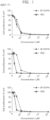
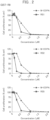
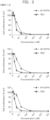
- Compounds RS1, RS2, and RS5 obtained in Synthesis Examples 1, 2, and 5, and M-COPA synthesized in the same manner as in Synthesis Example 1 in Patent Document 1 were examined for cell proliferation inhibitory activity against human cultured cancer cells with KIT tyrosine kinase mutation.
- the human cultured cancer cells used were GIST-T1 cells ( KIT ⁇ 560 - 578 , imatinib-sensitive) and GIST-R9 cells ( KIT ⁇ 560 -5 78 / D820V , imatinib-resistant) as gastrointestinal stromal tumor cell lines, and HMC-1.2 cells ( KIT S560G / D816V , imatinib-resistant) as a mast cell leukemia cell line.
- FIG. 1 to FIG. 3 show the cell proliferation curves for the GIST-T1 cells, GIST-R9 cells, and HMC-1.2 cells.
- Table 1 shows IC 50 values of the compounds. [Table 1] IC 50 (nM) M-COPA RS1 RS2 RS5 GIST-T1 347 ⁇ 21 268 128 169 GIST-R9 528 ⁇ 59 363 169 292 HMC-1.2 86 ⁇ 9 50 37 42
- compounds RS1, RS2, and RS5 inhibited the cell proliferation of the GIST-T1 cells, GIST-R9 cells, and HMC-1.2 cells in a concentration-dependent manner, and the IC 50 values of them were lower than that of M-COPA.
- substitution of the methyl group in the structure of M-COPA with a bromine atom results in significantly improved anticancer activity.
- Compounds RS1 to RS7 obtained in Synthesis Examples 1 to 7, and M-COPA synthesized in the same manner as in Synthesis Example 1 in Patent Document 1 were examined for cell proliferation inhibitory activity against human cultured cancer cells.
- the cancer cells used were eight human cancer cell lines (one skin cancer cell line, one ovarian cancer cell line, one prostate cancer cell line, two lung adenocarcinoma cell lines, one colorectal cancer cell line, two breast adenocarcinoma cell lines).
- the cancer cells of each type were seeded on a 96-well plate and cultured for 2 days, and cultured for 2 days with addition of serially diluted products of the compounds, and the cell proliferation was then measured by colorimetry with a water-soluble tetrazolium salt (WST-8). Thereafter, 50% cell proliferation inhibitory concentrations (GI 50 ) were calculated from the cell proliferation curves. Table 2 shows GI 50 values of the compounds.
- Compounds RS8 to RS10 obtained in Synthesis Examples 8 to 10 were examined for cell proliferation inhibitory activity against human cultured cancer cells.
- the cancer cells used were three human lung adenocarcinoma cell lines.
- the cancer cells of each type were seeded on a 96-well plate and cultured for 2 days, and cultured for 2 days with addition of serially diluted products of the compounds, and the cell proliferation was then measured by colorimetry with a water-soluble tetrazolium salt (WST-8). Thereafter, 50% cell proliferation inhibitory concentrations (GI 50 ) were calculated from the cell proliferation curves. Table 3 shows GI 50 values of the compounds.
- compounds RS8 to RS10 exhibited superior cell proliferation inhibitory activity against various cancer cell lines, in particular, against the lung adenocarcinoma cell line H226.
Landscapes
- Chemical & Material Sciences (AREA)
- Organic Chemistry (AREA)
- Chemical Kinetics & Catalysis (AREA)
- Health & Medical Sciences (AREA)
- Life Sciences & Earth Sciences (AREA)
- Medicinal Chemistry (AREA)
- Nuclear Medicine, Radiotherapy & Molecular Imaging (AREA)
- Pharmacology & Pharmacy (AREA)
- General Chemical & Material Sciences (AREA)
- Animal Behavior & Ethology (AREA)
- General Health & Medical Sciences (AREA)
- Public Health (AREA)
- Veterinary Medicine (AREA)
- Pharmaceuticals Containing Other Organic And Inorganic Compounds (AREA)
- Organic Low-Molecular-Weight Compounds And Preparation Thereof (AREA)
- Heterocyclic Carbon Compounds Containing A Hetero Ring Having Nitrogen And Oxygen As The Only Ring Hetero Atoms (AREA)
Applications Claiming Priority (2)
| Application Number | Priority Date | Filing Date | Title |
|---|---|---|---|
| JP2021020207 | 2021-02-10 | ||
| PCT/JP2022/003317 WO2022172786A1 (ja) | 2021-02-10 | 2022-01-28 | 新規化合物及びその製造方法、並びに医薬組成物 |
Publications (3)
| Publication Number | Publication Date |
|---|---|
| EP4293013A1 true EP4293013A1 (de) | 2023-12-20 |
| EP4293013A4 EP4293013A4 (de) | 2024-08-07 |
| EP4293013B1 EP4293013B1 (de) | 2025-08-20 |
Family
ID=82838791
Family Applications (1)
| Application Number | Title | Priority Date | Filing Date |
|---|---|---|---|
| EP22752615.9A Active EP4293013B1 (de) | 2021-02-10 | 2022-01-28 | Neuartige verbindung, herstellungsverfahren dafür und pharmazeutische zusammensetzung |
Country Status (6)
| Country | Link |
|---|---|
| US (1) | US12570618B2 (de) |
| EP (1) | EP4293013B1 (de) |
| JP (1) | JP7636738B2 (de) |
| CN (1) | CN116829538A (de) |
| ES (1) | ES3044057T3 (de) |
| WO (1) | WO2022172786A1 (de) |
Family Cites Families (3)
| Publication number | Priority date | Publication date | Assignee | Title |
|---|---|---|---|---|
| JP4710612B2 (ja) * | 2003-12-26 | 2011-06-29 | 日本新薬株式会社 | オクタヒドロナフタレン誘導体及び医薬 |
| WO2013151161A1 (ja) * | 2012-04-06 | 2013-10-10 | 学校法人東京理科大学 | 新規化合物及びその製造方法並びに抗がん剤 |
| KR101749132B1 (ko) * | 2015-05-26 | 2017-06-21 | 한국해양과학기술원 | 탄자와익산(tanzawaic acid) 유도체를 유효성분으로 함유하는 염증성 질환 예방 또는 치료용 조성물 |
-
2022
- 2022-01-28 ES ES22752615T patent/ES3044057T3/es active Active
- 2022-01-28 JP JP2022580557A patent/JP7636738B2/ja active Active
- 2022-01-28 WO PCT/JP2022/003317 patent/WO2022172786A1/ja not_active Ceased
- 2022-01-28 US US18/263,513 patent/US12570618B2/en active Active
- 2022-01-28 CN CN202280013900.2A patent/CN116829538A/zh active Pending
- 2022-01-28 EP EP22752615.9A patent/EP4293013B1/de active Active
Also Published As
| Publication number | Publication date |
|---|---|
| US12570618B2 (en) | 2026-03-10 |
| ES3044057T3 (en) | 2025-11-26 |
| EP4293013A4 (de) | 2024-08-07 |
| WO2022172786A1 (ja) | 2022-08-18 |
| CN116829538A (zh) | 2023-09-29 |
| EP4293013B1 (de) | 2025-08-20 |
| JPWO2022172786A1 (de) | 2022-08-18 |
| US20240140918A1 (en) | 2024-05-02 |
| JP7636738B2 (ja) | 2025-02-27 |
Similar Documents
| Publication | Publication Date | Title |
|---|---|---|
| US11046697B2 (en) | Compounds and compositions useful for treating disorders related to NTRK | |
| EA017411B1 (ru) | Способы и соединения, предназначенные для получения ингибиторов котранспортера натрий-глюкозы 2 типа | |
| TW201514159A (zh) | 3-((2s,5s)-4-亞甲基-5-(3-氧代丙基)四氫呋喃-2-基)丙醇衍生物、其製備及對其有用的中間體 | |
| KR20200086385A (ko) | 캡 의존성 엔도뉴클레아제 억제제 | |
| BR112021006710A2 (pt) | composto análogos de iludina, usos dos mesmos e métodos para sintetizar os mesmos | |
| EP4293013A1 (de) | Neuartige verbindung, herstellungsverfahren dafür und pharmazeutische zusammensetzung | |
| CN119998291A (zh) | 吡唑类衍生物、药物组合物及应用 | |
| CN112739705A (zh) | 螺环类化合物及其医药用途 | |
| CN119192096A (zh) | 苯并恶嗪酮类衍生物 | |
| CA2253912C (en) | Taxane derivatives, the preparation thereof and formulations containing them | |
| KR900006235B1 (ko) | 4'-데스히드록시에피포도필로톡신 배당체 및 그 합성방법 및 그 용도 | |
| WO2025153047A1 (zh) | 喜树碱衍生物及其制备方法和应用 | |
| CN121219271A (zh) | 作为DGKζ抑制剂的化合物 | |
| JP6143266B2 (ja) | 新規化合物及びその製造方法並びに抗がん剤 | |
| US5442065A (en) | Synthesis of tetrahydroquinoline enediyne core analogs of dynemicin | |
| WO2022257047A1 (en) | Diazaspirobicylic compounds as protein-protein interaction inhibitors and applications thereof | |
| CN105801591B (zh) | 一种五环吡咯类生物碱及其制备方法 | |
| JP2024022496A (ja) | 抗菌組成物 | |
| EP4725946A1 (de) | Irak4-abbaumittel und verwendung davon | |
| JP2004307420A (ja) | 細胞死抑制作用を有する化合物、およびその製造方法 | |
| US8580975B2 (en) | Synthesis of macrocyclic cancer chemotherapy agents and methods of use | |
| CN119698417A (zh) | 用作泛素-特异性蛋白酶抑制剂的取代嘌呤酮衍生物 | |
| JP4523761B2 (ja) | 抗腫瘍活性を有する新規化合物、およびその製造方法 | |
| CN117800944A (zh) | 吡啶酰胺类衍生物、包含其的药物组合物及其医药用途 | |
| JP2004315373A (ja) | 抗腫瘍活性および血管新生阻害活性を有する化合物、ならびにその製造方法 |
Legal Events
| Date | Code | Title | Description |
|---|---|---|---|
| STAA | Information on the status of an ep patent application or granted ep patent |
Free format text: STATUS: THE INTERNATIONAL PUBLICATION HAS BEEN MADE |
|
| PUAI | Public reference made under article 153(3) epc to a published international application that has entered the european phase |
Free format text: ORIGINAL CODE: 0009012 |
|
| STAA | Information on the status of an ep patent application or granted ep patent |
Free format text: STATUS: REQUEST FOR EXAMINATION WAS MADE |
|
| 17P | Request for examination filed |
Effective date: 20230804 |
|
| AK | Designated contracting states |
Kind code of ref document: A1 Designated state(s): AL AT BE BG CH CY CZ DE DK EE ES FI FR GB GR HR HU IE IS IT LI LT LU LV MC MK MT NL NO PL PT RO RS SE SI SK SM TR |
|
| DAV | Request for validation of the european patent (deleted) | ||
| DAX | Request for extension of the european patent (deleted) | ||
| REG | Reference to a national code |
Ref country code: DE Ref legal event code: R079 Free format text: PREVIOUS MAIN CLASS: C07D0213400000 Ipc: C07D0213300000 Ref country code: DE Ref legal event code: R079 Ref document number: 602022019883 Country of ref document: DE Free format text: PREVIOUS MAIN CLASS: C07D0213400000 Ipc: C07D0213300000 |
|
| A4 | Supplementary search report drawn up and despatched |
Effective date: 20240704 |
|
| RIC1 | Information provided on ipc code assigned before grant |
Ipc: A61K 31/4406 20060101ALI20240628BHEP Ipc: A61K 31/426 20060101ALI20240628BHEP Ipc: A61K 31/421 20060101ALI20240628BHEP Ipc: A61P 35/00 20060101ALI20240628BHEP Ipc: C07F 7/18 20060101ALI20240628BHEP Ipc: C07D 277/28 20060101ALI20240628BHEP Ipc: C07D 263/32 20060101ALI20240628BHEP Ipc: C07D 213/40 20060101ALI20240628BHEP Ipc: C07D 213/30 20060101AFI20240628BHEP |
|
| STAA | Information on the status of an ep patent application or granted ep patent |
Free format text: STATUS: EXAMINATION IS IN PROGRESS |
|
| 17Q | First examination report despatched |
Effective date: 20241108 |
|
| GRAP | Despatch of communication of intention to grant a patent |
Free format text: ORIGINAL CODE: EPIDOSNIGR1 |
|
| STAA | Information on the status of an ep patent application or granted ep patent |
Free format text: STATUS: GRANT OF PATENT IS INTENDED |
|
| INTG | Intention to grant announced |
Effective date: 20250417 |
|
| GRAS | Grant fee paid |
Free format text: ORIGINAL CODE: EPIDOSNIGR3 |
|
| GRAA | (expected) grant |
Free format text: ORIGINAL CODE: 0009210 |
|
| STAA | Information on the status of an ep patent application or granted ep patent |
Free format text: STATUS: THE PATENT HAS BEEN GRANTED |
|
| P01 | Opt-out of the competence of the unified patent court (upc) registered |
Free format text: CASE NUMBER: APP_31425/2025 Effective date: 20250630 |
|
| AK | Designated contracting states |
Kind code of ref document: B1 Designated state(s): AL AT BE BG CH CY CZ DE DK EE ES FI FR GB GR HR HU IE IS IT LI LT LU LV MC MK MT NL NO PL PT RO RS SE SI SK SM TR |
|
| REG | Reference to a national code |
Ref country code: GB Ref legal event code: FG4D |
|
| REG | Reference to a national code |
Ref country code: CH Ref legal event code: EP |
|
| REG | Reference to a national code |
Ref country code: IE Ref legal event code: FG4D |
|
| REG | Reference to a national code |
Ref country code: DE Ref legal event code: R096 Ref document number: 602022019883 Country of ref document: DE |
|
| REG | Reference to a national code |
Ref country code: ES Ref legal event code: FG2A Ref document number: 3044057 Country of ref document: ES Kind code of ref document: T3 Effective date: 20251126 |
|
| REG | Reference to a national code |
Ref country code: NL Ref legal event code: MP Effective date: 20250820 |
|
| PG25 | Lapsed in a contracting state [announced via postgrant information from national office to epo] |
Ref country code: IS Free format text: LAPSE BECAUSE OF FAILURE TO SUBMIT A TRANSLATION OF THE DESCRIPTION OR TO PAY THE FEE WITHIN THE PRESCRIBED TIME-LIMIT Effective date: 20251220 |
|
| PG25 | Lapsed in a contracting state [announced via postgrant information from national office to epo] |
Ref country code: NO Free format text: LAPSE BECAUSE OF FAILURE TO SUBMIT A TRANSLATION OF THE DESCRIPTION OR TO PAY THE FEE WITHIN THE PRESCRIBED TIME-LIMIT Effective date: 20251120 |
|
| REG | Reference to a national code |
Ref country code: LT Ref legal event code: MG9D |
|
| PG25 | Lapsed in a contracting state [announced via postgrant information from national office to epo] |
Ref country code: PT Free format text: LAPSE BECAUSE OF FAILURE TO SUBMIT A TRANSLATION OF THE DESCRIPTION OR TO PAY THE FEE WITHIN THE PRESCRIBED TIME-LIMIT Effective date: 20251222 |
|
| PG25 | Lapsed in a contracting state [announced via postgrant information from national office to epo] |
Ref country code: FI Free format text: LAPSE BECAUSE OF FAILURE TO SUBMIT A TRANSLATION OF THE DESCRIPTION OR TO PAY THE FEE WITHIN THE PRESCRIBED TIME-LIMIT Effective date: 20250820 |
|
| PG25 | Lapsed in a contracting state [announced via postgrant information from national office to epo] |
Ref country code: HR Free format text: LAPSE BECAUSE OF FAILURE TO SUBMIT A TRANSLATION OF THE DESCRIPTION OR TO PAY THE FEE WITHIN THE PRESCRIBED TIME-LIMIT Effective date: 20250820 Ref country code: NL Free format text: LAPSE BECAUSE OF FAILURE TO SUBMIT A TRANSLATION OF THE DESCRIPTION OR TO PAY THE FEE WITHIN THE PRESCRIBED TIME-LIMIT Effective date: 20250820 |
|
| PG25 | Lapsed in a contracting state [announced via postgrant information from national office to epo] |
Ref country code: GR Free format text: LAPSE BECAUSE OF FAILURE TO SUBMIT A TRANSLATION OF THE DESCRIPTION OR TO PAY THE FEE WITHIN THE PRESCRIBED TIME-LIMIT Effective date: 20251121 |
|
| PG25 | Lapsed in a contracting state [announced via postgrant information from national office to epo] |
Ref country code: SE Free format text: LAPSE BECAUSE OF FAILURE TO SUBMIT A TRANSLATION OF THE DESCRIPTION OR TO PAY THE FEE WITHIN THE PRESCRIBED TIME-LIMIT Effective date: 20250820 |
|
| PG25 | Lapsed in a contracting state [announced via postgrant information from national office to epo] |
Ref country code: LV Free format text: LAPSE BECAUSE OF FAILURE TO SUBMIT A TRANSLATION OF THE DESCRIPTION OR TO PAY THE FEE WITHIN THE PRESCRIBED TIME-LIMIT Effective date: 20250820 |
|
| PG25 | Lapsed in a contracting state [announced via postgrant information from national office to epo] |
Ref country code: BG Free format text: LAPSE BECAUSE OF FAILURE TO SUBMIT A TRANSLATION OF THE DESCRIPTION OR TO PAY THE FEE WITHIN THE PRESCRIBED TIME-LIMIT Effective date: 20250820 Ref country code: PL Free format text: LAPSE BECAUSE OF FAILURE TO SUBMIT A TRANSLATION OF THE DESCRIPTION OR TO PAY THE FEE WITHIN THE PRESCRIBED TIME-LIMIT Effective date: 20250820 |
|
| PG25 | Lapsed in a contracting state [announced via postgrant information from national office to epo] |
Ref country code: RS Free format text: LAPSE BECAUSE OF FAILURE TO SUBMIT A TRANSLATION OF THE DESCRIPTION OR TO PAY THE FEE WITHIN THE PRESCRIBED TIME-LIMIT Effective date: 20251120 |
|
| REG | Reference to a national code |
Ref country code: AT Ref legal event code: MK05 Ref document number: 1827189 Country of ref document: AT Kind code of ref document: T Effective date: 20250820 |
|
| PG25 | Lapsed in a contracting state [announced via postgrant information from national office to epo] |
Ref country code: SM Free format text: LAPSE BECAUSE OF FAILURE TO SUBMIT A TRANSLATION OF THE DESCRIPTION OR TO PAY THE FEE WITHIN THE PRESCRIBED TIME-LIMIT Effective date: 20250820 |
|
| PGFP | Annual fee paid to national office [announced via postgrant information from national office to epo] |
Ref country code: GB Payment date: 20260123 Year of fee payment: 5 |
|
| PGFP | Annual fee paid to national office [announced via postgrant information from national office to epo] |
Ref country code: ES Payment date: 20260227 Year of fee payment: 5 |
|
| PG25 | Lapsed in a contracting state [announced via postgrant information from national office to epo] |
Ref country code: DK Free format text: LAPSE BECAUSE OF FAILURE TO SUBMIT A TRANSLATION OF THE DESCRIPTION OR TO PAY THE FEE WITHIN THE PRESCRIBED TIME-LIMIT Effective date: 20250820 |
|
| PGFP | Annual fee paid to national office [announced via postgrant information from national office to epo] |
Ref country code: DE Payment date: 20260130 Year of fee payment: 5 |
|
| PG25 | Lapsed in a contracting state [announced via postgrant information from national office to epo] |
Ref country code: AT Free format text: LAPSE BECAUSE OF FAILURE TO SUBMIT A TRANSLATION OF THE DESCRIPTION OR TO PAY THE FEE WITHIN THE PRESCRIBED TIME-LIMIT Effective date: 20250820 |
|
| PGFP | Annual fee paid to national office [announced via postgrant information from national office to epo] |
Ref country code: IT Payment date: 20260126 Year of fee payment: 5 |
|
| PGFP | Annual fee paid to national office [announced via postgrant information from national office to epo] |
Ref country code: FR Payment date: 20260123 Year of fee payment: 5 |
|
| PG25 | Lapsed in a contracting state [announced via postgrant information from national office to epo] |
Ref country code: CZ Free format text: LAPSE BECAUSE OF FAILURE TO SUBMIT A TRANSLATION OF THE DESCRIPTION OR TO PAY THE FEE WITHIN THE PRESCRIBED TIME-LIMIT Effective date: 20250820 |
|
| PG25 | Lapsed in a contracting state [announced via postgrant information from national office to epo] |
Ref country code: SK Free format text: LAPSE BECAUSE OF FAILURE TO SUBMIT A TRANSLATION OF THE DESCRIPTION OR TO PAY THE FEE WITHIN THE PRESCRIBED TIME-LIMIT Effective date: 20250820 Ref country code: EE Free format text: LAPSE BECAUSE OF FAILURE TO SUBMIT A TRANSLATION OF THE DESCRIPTION OR TO PAY THE FEE WITHIN THE PRESCRIBED TIME-LIMIT Effective date: 20250820 |