EP4293679A1 - System und verfahren zur vorhersage von postoperativen betttypen - Google Patents
System und verfahren zur vorhersage von postoperativen betttypen Download PDFInfo
- Publication number
- EP4293679A1 EP4293679A1 EP22179693.1A EP22179693A EP4293679A1 EP 4293679 A1 EP4293679 A1 EP 4293679A1 EP 22179693 A EP22179693 A EP 22179693A EP 4293679 A1 EP4293679 A1 EP 4293679A1
- Authority
- EP
- European Patent Office
- Prior art keywords
- predictive model
- bed
- prediction
- bed type
- surgery
- Prior art date
- Legal status (The legal status is an assumption and is not a legal conclusion. Google has not performed a legal analysis and makes no representation as to the accuracy of the status listed.)
- Withdrawn
Links
- 230000002980 postoperative effect Effects 0.000 title claims abstract description 99
- 238000000034 method Methods 0.000 title claims abstract description 32
- 238000001356 surgical procedure Methods 0.000 claims abstract description 132
- 238000012549 training Methods 0.000 claims abstract description 27
- 238000004590 computer program Methods 0.000 claims description 6
- 206010002091 Anaesthesia Diseases 0.000 claims description 3
- 238000001949 anaesthesia Methods 0.000 claims description 3
- 238000000605 extraction Methods 0.000 claims description 2
- 238000013500 data storage Methods 0.000 description 17
- 239000011159 matrix material Substances 0.000 description 15
- 230000036541 health Effects 0.000 description 10
- 238000013132 cardiothoracic surgery Methods 0.000 description 6
- 238000010801 machine learning Methods 0.000 description 5
- 238000005457 optimization Methods 0.000 description 5
- 238000004891 communication Methods 0.000 description 4
- 230000006872 improvement Effects 0.000 description 4
- 238000004458 analytical method Methods 0.000 description 3
- 229940079593 drug Drugs 0.000 description 3
- 239000003814 drug Substances 0.000 description 3
- 238000002283 elective surgery Methods 0.000 description 3
- 230000035945 sensitivity Effects 0.000 description 3
- 230000001154 acute effect Effects 0.000 description 2
- 230000008901 benefit Effects 0.000 description 2
- 238000012512 characterization method Methods 0.000 description 2
- 238000013145 classification model Methods 0.000 description 2
- CVSVTCORWBXHQV-UHFFFAOYSA-N creatine Chemical compound NC(=[NH2+])N(C)CC([O-])=O CVSVTCORWBXHQV-UHFFFAOYSA-N 0.000 description 2
- DDRJAANPRJIHGJ-UHFFFAOYSA-N creatinine Chemical compound CN1CC(=O)NC1=N DDRJAANPRJIHGJ-UHFFFAOYSA-N 0.000 description 2
- 230000001186 cumulative effect Effects 0.000 description 2
- 238000013461 design Methods 0.000 description 2
- 238000009826 distribution Methods 0.000 description 2
- 230000006870 function Effects 0.000 description 2
- 230000014509 gene expression Effects 0.000 description 2
- 238000002483 medication Methods 0.000 description 2
- 238000012986 modification Methods 0.000 description 2
- 230000004048 modification Effects 0.000 description 2
- 230000003287 optical effect Effects 0.000 description 2
- 238000012360 testing method Methods 0.000 description 2
- 238000012800 visualization Methods 0.000 description 2
- 208000001647 Renal Insufficiency Diseases 0.000 description 1
- 208000037063 Thinness Diseases 0.000 description 1
- 230000009471 action Effects 0.000 description 1
- 210000001765 aortic valve Anatomy 0.000 description 1
- 230000021615 conjugation Effects 0.000 description 1
- 210000004351 coronary vessel Anatomy 0.000 description 1
- 229960003624 creatine Drugs 0.000 description 1
- 239000006046 creatine Substances 0.000 description 1
- 229940109239 creatinine Drugs 0.000 description 1
- 230000001419 dependent effect Effects 0.000 description 1
- 230000001627 detrimental effect Effects 0.000 description 1
- 238000002474 experimental method Methods 0.000 description 1
- 238000001914 filtration Methods 0.000 description 1
- 230000024924 glomerular filtration Effects 0.000 description 1
- 201000006370 kidney failure Diseases 0.000 description 1
- 230000007774 longterm Effects 0.000 description 1
- 230000008439 repair process Effects 0.000 description 1
- 230000009897 systematic effect Effects 0.000 description 1
- 238000013519 translation Methods 0.000 description 1
- 206010048828 underweight Diseases 0.000 description 1
Images



Classifications
-
- G—PHYSICS
- G16—INFORMATION AND COMMUNICATION TECHNOLOGY [ICT] SPECIALLY ADAPTED FOR SPECIFIC APPLICATION FIELDS
- G16H—HEALTHCARE INFORMATICS, i.e. INFORMATION AND COMMUNICATION TECHNOLOGY [ICT] SPECIALLY ADAPTED FOR THE HANDLING OR PROCESSING OF MEDICAL OR HEALTHCARE DATA
- G16H50/00—ICT specially adapted for medical diagnosis, medical simulation or medical data mining; ICT specially adapted for detecting, monitoring or modelling epidemics or pandemics
- G16H50/20—ICT specially adapted for medical diagnosis, medical simulation or medical data mining; ICT specially adapted for detecting, monitoring or modelling epidemics or pandemics for computer-aided diagnosis, e.g. based on medical expert systems
-
- G—PHYSICS
- G16—INFORMATION AND COMMUNICATION TECHNOLOGY [ICT] SPECIALLY ADAPTED FOR SPECIFIC APPLICATION FIELDS
- G16H—HEALTHCARE INFORMATICS, i.e. INFORMATION AND COMMUNICATION TECHNOLOGY [ICT] SPECIALLY ADAPTED FOR THE HANDLING OR PROCESSING OF MEDICAL OR HEALTHCARE DATA
- G16H40/00—ICT specially adapted for the management or administration of healthcare resources or facilities; ICT specially adapted for the management or operation of medical equipment or devices
- G16H40/20—ICT specially adapted for the management or administration of healthcare resources or facilities; ICT specially adapted for the management or operation of medical equipment or devices for the management or administration of healthcare resources or facilities, e.g. managing hospital staff or surgery rooms
-
- G—PHYSICS
- G16—INFORMATION AND COMMUNICATION TECHNOLOGY [ICT] SPECIALLY ADAPTED FOR SPECIFIC APPLICATION FIELDS
- G16H—HEALTHCARE INFORMATICS, i.e. INFORMATION AND COMMUNICATION TECHNOLOGY [ICT] SPECIALLY ADAPTED FOR THE HANDLING OR PROCESSING OF MEDICAL OR HEALTHCARE DATA
- G16H50/00—ICT specially adapted for medical diagnosis, medical simulation or medical data mining; ICT specially adapted for detecting, monitoring or modelling epidemics or pandemics
- G16H50/70—ICT specially adapted for medical diagnosis, medical simulation or medical data mining; ICT specially adapted for detecting, monitoring or modelling epidemics or pandemics for mining of medical data, e.g. analysing previous cases of other patients
-
- G—PHYSICS
- G16—INFORMATION AND COMMUNICATION TECHNOLOGY [ICT] SPECIALLY ADAPTED FOR SPECIFIC APPLICATION FIELDS
- G16H—HEALTHCARE INFORMATICS, i.e. INFORMATION AND COMMUNICATION TECHNOLOGY [ICT] SPECIALLY ADAPTED FOR THE HANDLING OR PROCESSING OF MEDICAL OR HEALTHCARE DATA
- G16H40/00—ICT specially adapted for the management or administration of healthcare resources or facilities; ICT specially adapted for the management or operation of medical equipment or devices
Definitions
- the type of bed to be used by a patient after surgery may be predicted to determine which type of bed will be allocated at which time.
- a bed is also referred to as a postoperative bed.
- Different types of postoperative beds indicate that different level of care is provided to the patient. For example, a higher level of care may be provided to a patient in an intensive care unit (ICU) bed than in a post-anaesthesia care unit (PACU) bed.
- ICU intensive care unit
- PACU post-anaesthesia care unit
- GW general ward
- a system for generating a predictive model for predicting a postoperative bed type for use by a patient after surgery.
- the system comprises:
- a system for using a predictive model for predicting a postoperative bed type for use by a patient after surgery.
- the system comprises:
- a transitory or non-transitory computer-readable medium comprising data representing a computer program comprising instructions for causing a processor system to perform one or more of the methods described in this specification.
- the above aspects of the invention involve generating and using a predictive model for predicting a postoperative bed type for use by a patient.
- the predictive model may be generated and used by one and the same system and/or method, while in other aspects of the invention, the predictive model may be generated by a system and/or method which is different from the system and/or method which subsequently uses the predictive model for prediction purposes.
- a machine learning (ML) predictive model is provided and trained to predict the postoperative bed type.
- the postoperative bed type as indicated in the medical data may be used as prediction target while the characterization of the surgery and/or the patient may be used as feature input(s).
- Such features may be manually selected from the medical data or may be automatically selected, for example using a univariate and/or multivariate inferential analysis.
- the predictive model itself may be trained using known machine learning techniques. For example, a gradient boosting model such as CatBoost may be used.
- a classification predictive model is obtained which is capable of predicting the postoperative bed type which will be needed for a patient.
- the input data may characterize the patient and the planned surgery.
- the prediction obtained by the predictive model may be interpreted as a recommendation for the postoperative bed type to be used for the patient.
- the output of the predictive model be a probability score, which may assume a value on a probability scale, for example having a range of [0,1] or 0%-100%.
- One end of the scale may represent a prediction of one type of postoperative bed and at the other end of the scale a prediction of another type of postoperative bed.
- a prediction score of 0.0 may represent a prediction of an ICU bed while a prediction score of 1.0 may represent a prediction of a PACU bed while a score in-between 0.0 and 1.0 may represent an intermediate probability (e.g., a prediction score of 0.5 representing an even chance between the patient needing an ICU or PACU bed).
- a hybrid model which combines the output of the predictive model and an expert's recommendation as follows. It is noted that this hybrid model is also a predictive model and may also be referred to as such.
- An upper threshold and a lower threshold are established within or at an endpoint of the scale. If the probability is below the lower threshold, the hybrid model may output as the prediction the bed type which corresponds with the lower endpoint of the scale, if the probability is above the upper threshold, the hybrid model may output as the prediction the bed type which corresponds with the upper endpoint of the scale, and if the probability is in between the lower threshold and the upper threshold, the hybrid model may recommend or refer to an expert selection of the bed type.
- the hybrid model may then be output, e.g., in the form of model data defining the predictive model and threshold data defining the thresholds, to be used to predict the postoperative bed type.
- the hybrid model may be used in a surgical planning department to plan allocation of beds to be used after surgery in a hospital.
- a system using the hybrid model may for example display either "ICU bed recommended” or "PACU bed recommended” or "Consult clinician's recommendation” for a new patient.
- the expert selection may be available to the system and/or the hybrid model itself and may be output accordingly when the probability generated by the predictive model falls between the lower threshold and the upper threshold.
- the system may indicate whether a particular bed type is predicted by the predictive model or is an expert selection.
- more accurate surgery planning may safeguard the health of patients, for example by ensuring that there are sufficient resources available for acute surgeries, or by avoiding that elective surgeries have to be postponed due to a presumed lack of resources.
- the at least two postoperative bed types differ in level of care provided to the patient.
- the at least two bed types may comprise an ICU bed type and a PACU bed type, with the former providing a higher level of care than the latter.
- the at least two bed types may comprise an ICU bed type and a general ward (GW) type, with the former providing a higher level of care than the latter.
- the at least two bed types may comprise a PACU bed type and a GW bed type, with the former providing a higher level of care than the latter.
- the following optional aspect may refer to the system for generating the predictive model, but may, unless otherwise precluded for technical reasons, also represent optional aspects of the corresponding computer-implemented method in which the system's functionality is a method step, and optional aspects of a system and/or a computer-implemented method for using the predictive model for prediction purposes.
- the performance metric penalizes a first type of erroneous prediction by which a lower level of care bed type is predicted more than a second type of erroneous prediction by which a higher level of care bed type is predicted.
- the impact of erroneous predictions may differ between the different types of bed predictions. Namely, if a patient is erroneously predicted to require a higher level of care, e.g., ICU, while in actuality a lower level of care suffices, e.g., PACU, the main impact of this erroneous prediction is suboptimal use of resources and additional financial cost (as a higher level of care may be more costly).
- a higher level of care e.g., ICU
- PACU the main impact of this erroneous prediction is suboptimal use of resources and additional financial cost (as a higher level of care may be more costly).
- the performance metric rewards minimization of occurrences of the first type of erroneous prediction while maintaining occurrences of the second type of erroneous prediction below an acceptability threshold.
- it may be desirable to minimize erroneous predictions of a lower level of care bed type e.g., for the aforementioned health-related reasons.
- this may cause the hybrid model to systematically predict a higher level of care bed type, e.g., to tend towards always predicting an ICU bed, which is also disadvantageous as higher level of care bed types may be scarce and costly resources.
- selecting the upper threshold and the lower threshold comprises one of:
- processor subsystem is further configured to:
- processor subsystem is further configured to:
- the training of the predictive model may nevertheless use the records of such surgeries, but these records may be excluded from the optimization of the thresholds. This way, it may be ensured that thresholds are optimized on a set of surgeries where the influence of the external factors is minimized, leading to a more reliable assessment of the performance.
- the records of surgeries affected by external factors may still be suitable for training the predictive model as the predictive model may learn to predict the impact of those external factors input features are provided to the model which are predictive of the presence and/or type of such factors. For example, as also elucidated below, the time at which a surgery took place may be provided to the predictive model as input feature during training.
- the processor subsystem is configured to receive the identification of the subset of records in form of a time range in which, or a time after or before which, a respective surgery is performed.
- a time range in which, or a time after or before which, a respective surgery is performed.
- surgeries which take place in a specific time range or at a specific time and in which the selection of postoperative bed type may be at least partially determined by external factors may be identified to the system. For example, afternoon surgeries may be identified to the system so that they can be included in the training of the predictive model if otherwise insufficient training data would be available, yet excluded in the optimization of the thresholds.
- the performance metric is a user-definable metric.
- Fig. 1 shows a system 100 which may in some embodiments represent a system for generating a predictive model for predicting a postoperative bed type for use by a patient after surgery, in other embodiments a system for using the predictive model to predict the postoperative bed type for a patient for which a surgery is scheduled, and in yet other embodiments a system for both generating and using the predictive model.
- the user input interface 184 may be of a type which corresponds to the type of user input device(s) 80, i.e., it may be a thereto corresponding type of user device interface.
- the user interface subsystem 180 is further shown to comprise a display output interface 182 configured to provide display data 62 to a display 60 to visualize output of the system 100.
- the display is an external display 60.
- the display may be an internal display of the system 100.
- the processor subsystem 140 may be further configured to use the predictive model with the values for the upper threshold and the lower threshold to predict a postoperative bed type for use by the patient after surgery by using the input data as input to the predictive model to obtain a probability, and if the probability is below the lower threshold, output as the prediction the first one of the at least two possible bed types, if the probability is above the upper threshold, output as the prediction the second one of the at least two possible bed types, and if the probability is in between the lower threshold and the upper threshold, recommend or refer to an expert selection of the bed type.
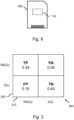
- Fig. 2 shows an error/confusion matrix 200 for the recommendation of a postoperative bed type by a clinician, with the postoperative bed type being either an ICU or a PACU bed, which shows along the horizontal axis 210 the predicted bed type and on the vertical axis the actual bed type.
- This error matrix was generated based on actual medical data of cardiothoracic surgeries, in which both the recommendation of the clinician before the surgery and the actual bed type in which the patient ended up in after surgery were identified and depicted as columns and rows of the confusion matrix, respectively.
- the features used as input during the training included patient features, such as the ASA score, the number of medications taken by a patient at home, the creatine level, the gender, the BMI, the age group to which the patient belonged, the number of procedures that the patient will undergo, etc., as well as surgery-related features, such as the type of surgery, which for example included aortic valve repairs and coronary artery bypass grafts.
- This performance metric may be considered as a 'one-in' metric which expresses one in how many patients were recommended for PACU but ended up in ICU, which is a prediction error which poses more health risks than the other way around and therefore is more relevant in the assessment of the performance of the prediction.
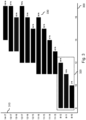
- Fig. 5 shows a probability scale 400 associated with the predictive model.
- the lower endpoint of the scale which corresponds to a prediction score of 0.0
- the higher endpoint of the scale which corresponds to a prediction score of 1.0
- a hybrid predictive model may be generated by establishing an upper threshold 420 and a lower threshold 410 each within or at an endpoint of the scale 400, with the thresholds being used to select whether the prediction of the predictive model is to be followed or whether an expert selection is recommended.
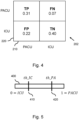
- Fig. 6 illustrates the selection of thresholds, showing a graph 500 in which along one axis a value of the lower threshold ( th_IC ) is set out, along another axis a value of the upper threshold ( th_PA ), and along yet another axis a percentage of false negative predictions ( fn ) (i.e., a type 2 error).
- a surface is shown which, for different combinations of thresholds, indicates the percentage of false negative predictions, with the surface being color-coded using the value of the 'one-in' performance metric ( one_in ) for the combination of th_IC and th_PA.
- a system and method for generating a predictive model for predicting a postoperative bed type to be used by a patient after surgery.
- the predictive model is trained on features extracted from medical data and using a postoperative bed type as prediction target in the training.
- the predictive model is configured to output a probability on a scale which corresponds to, at its lower end, a prediction of a first postoperative bed type and, at its upper end, a prediction of a second postoperative bed.
- a hybrid model is generated which applies a lower threshold and an upper threshold to the probability scale. If the output probability of the predictive model is in between both thresholds, an expert selection of the bed type is recommended, while otherwise, the prediction of the predictive model is output.
- the values of the thresholds are optimized using a performance metric.
Landscapes
- Engineering & Computer Science (AREA)
- Health & Medical Sciences (AREA)
- Public Health (AREA)
- Medical Informatics (AREA)
- Biomedical Technology (AREA)
- Epidemiology (AREA)
- General Health & Medical Sciences (AREA)
- Primary Health Care (AREA)
- Data Mining & Analysis (AREA)
- General Business, Economics & Management (AREA)
- Business, Economics & Management (AREA)
- Databases & Information Systems (AREA)
- Pathology (AREA)
- Medical Treatment And Welfare Office Work (AREA)
Priority Applications (3)
| Application Number | Priority Date | Filing Date | Title |
|---|---|---|---|
| EP22179693.1A EP4293679A1 (de) | 2022-06-17 | 2022-06-17 | System und verfahren zur vorhersage von postoperativen betttypen |
| US18/209,517 US20230411004A1 (en) | 2022-06-17 | 2023-06-14 | System and method for predicting postoperative bed type |
| DE102023115629.2A DE102023115629A1 (de) | 2022-06-17 | 2023-06-15 | System und verfahren zum vorhersagen eines postoperativen betttyps |
Applications Claiming Priority (1)
| Application Number | Priority Date | Filing Date | Title |
|---|---|---|---|
| EP22179693.1A EP4293679A1 (de) | 2022-06-17 | 2022-06-17 | System und verfahren zur vorhersage von postoperativen betttypen |
Publications (1)
| Publication Number | Publication Date |
|---|---|
| EP4293679A1 true EP4293679A1 (de) | 2023-12-20 |
Family
ID=82115966
Family Applications (1)
| Application Number | Title | Priority Date | Filing Date |
|---|---|---|---|
| EP22179693.1A Withdrawn EP4293679A1 (de) | 2022-06-17 | 2022-06-17 | System und verfahren zur vorhersage von postoperativen betttypen |
Country Status (3)
| Country | Link |
|---|---|
| US (1) | US20230411004A1 (de) |
| EP (1) | EP4293679A1 (de) |
| DE (1) | DE102023115629A1 (de) |
Citations (1)
| Publication number | Priority date | Publication date | Assignee | Title |
|---|---|---|---|---|
| WO2022016293A1 (en) * | 2020-07-23 | 2022-01-27 | Ottawa Heart Institute Research Corporation | Health care resources management |
-
2022
- 2022-06-17 EP EP22179693.1A patent/EP4293679A1/de not_active Withdrawn
-
2023
- 2023-06-14 US US18/209,517 patent/US20230411004A1/en active Pending
- 2023-06-15 DE DE102023115629.2A patent/DE102023115629A1/de active Pending
Patent Citations (1)
| Publication number | Priority date | Publication date | Assignee | Title |
|---|---|---|---|---|
| WO2022016293A1 (en) * | 2020-07-23 | 2022-01-27 | Ottawa Heart Institute Research Corporation | Health care resources management |
Non-Patent Citations (3)
| Title |
|---|
| KUMAR A ET AL: "Predicting bed requirement for a hospital using regression models", INDUSTRIAL ENGINEERING AND ENGINEERING MANAGEMENT, 2008. IEEM 2008. IEEE INTERNATIONAL CONFERENCE ON, IEEE, PISCATAWAY, NJ, USA, 8 December 2008 (2008-12-08), pages 665 - 669, XP031400782, ISBN: 978-1-4244-2629-4 * |
| PEREIRA CARLOS ALEXANDRE ET AL: "Optimizing operating room planning a data mining and optimization approach", 1 January 2014 (2014-01-01), XP055848042, Retrieved from the Internet <URL:https://repositorio-aberto.up.pt/bitstream/10216/78152/2/34078.pdf> [retrieved on 20211005] * |
| SHAHABIKARGAR ZAHRA ET AL: "Predicting Procedure Duration to Improve Scheduling of Elective Surgery", 1 December 2014, SAT 2015 18TH INTERNATIONAL CONFERENCE, AUSTIN, TX, USA, SEPTEMBER 24-27, 2015; [LECTURE NOTES IN COMPUTER SCIENCE; LECT.NOTES COMPUTER], SPRINGER, BERLIN, HEIDELBERG, PAGE(S) 998 - 1009, ISBN: 978-3-540-74549-5, XP047311045 * |
Also Published As
| Publication number | Publication date |
|---|---|
| DE102023115629A1 (de) | 2023-12-28 |
| US20230411004A1 (en) | 2023-12-21 |
Similar Documents
| Publication | Publication Date | Title |
|---|---|---|
| US20210090695A1 (en) | Healthcare Information Technology System for Predicting or Preventing Readmissions | |
| US8190451B2 (en) | Method and computer program product for predicting and minimizing future behavioral health-related hospital admissions | |
| US20120271612A1 (en) | Predictive modeling | |
| US20230097114A1 (en) | Clinical risk model | |
| US20210391079A1 (en) | Method and apparatus for monitoring a patient | |
| US20140279754A1 (en) | Self-evolving predictive model | |
| CN106793957B (zh) | 用于预测患者护理未来结果的医疗系统和方法 | |
| US20120265549A1 (en) | System and Computer Readable Medium for Predicting Patient Outcomes | |
| US20220044809A1 (en) | Systems and methods for using deep learning to generate acuity scores for critically ill or injured patients | |
| US20130191158A1 (en) | Patient readmission prediction tool | |
| US20130325515A1 (en) | Clinical decision support system for predictive discharge planning | |
| US20220115144A1 (en) | Monitoring predictive models | |
| US20230008936A1 (en) | System and method for adaptive learning for hospital census simulation | |
| US20230411005A1 (en) | Predicting surgery duration | |
| US20240331813A1 (en) | Computer-implemented method and device for carrying out a medical laboratory value analysis | |
| US20190051411A1 (en) | Decision making platform | |
| US11783262B2 (en) | Automatic detection and generation of medical imaging data analytics | |
| EP4293679A1 (de) | System und verfahren zur vorhersage von postoperativen betttypen | |
| CN121306522A (zh) | 基于机器学习的预测乳腺癌相对生存风险系统 | |
| US20220180446A1 (en) | Method and System for Medical Malpractice Insurance Underwriting Using Value-Based Care Data | |
| US20200349652A1 (en) | System to simulate outcomes of a new contract with a financier of care | |
| EP3975200A1 (de) | Verminderung von variationen in der gesundheitsversorgung | |
| Rosamilia | Applying nonlinear mixed-effects modeling to model patient flow in the Emergency department | |
| JP2026008302A (ja) | リスク分析支援システム及びリスク分析支援方法 | |
| Rosamilia | Applying Nonlinear Mixed-Effects Modeling to Model Patient Flow in the Emergency Department: Evaluation of the Impact of Patient Characteristics on Emergency Department Logistics |
Legal Events
| Date | Code | Title | Description |
|---|---|---|---|
| PUAI | Public reference made under article 153(3) epc to a published international application that has entered the european phase |
Free format text: ORIGINAL CODE: 0009012 |
|
| STAA | Information on the status of an ep patent application or granted ep patent |
Free format text: STATUS: THE APPLICATION HAS BEEN PUBLISHED |
|
| AK | Designated contracting states |
Kind code of ref document: A1 Designated state(s): AL AT BE BG CH CY CZ DE DK EE ES FI FR GB GR HR HU IE IS IT LI LT LU LV MC MK MT NL NO PL PT RO RS SE SI SK SM TR |
|
| STAA | Information on the status of an ep patent application or granted ep patent |
Free format text: STATUS: THE APPLICATION IS DEEMED TO BE WITHDRAWN |
|
| 18D | Application deemed to be withdrawn |
Effective date: 20240621 |