EP4294158A2 - Utilisation d'un ligand auxiliaire dans un composé complexe métallique phosphorescent - Google Patents
Utilisation d'un ligand auxiliaire dans un composé complexe métallique phosphorescent Download PDFInfo
- Publication number
- EP4294158A2 EP4294158A2 EP23207101.9A EP23207101A EP4294158A2 EP 4294158 A2 EP4294158 A2 EP 4294158A2 EP 23207101 A EP23207101 A EP 23207101A EP 4294158 A2 EP4294158 A2 EP 4294158A2
- Authority
- EP
- European Patent Office
- Prior art keywords
- compound
- group
- oled
- mmol
- ligand
- Prior art date
- Legal status (The legal status is an assumption and is not a legal conclusion. Google has not performed a legal analysis and makes no representation as to the accuracy of the status listed.)
- Pending
Links
Images


Classifications
-
- C—CHEMISTRY; METALLURGY
- C07—ORGANIC CHEMISTRY
- C07F—ACYCLIC, CARBOCYCLIC OR HETEROCYCLIC COMPOUNDS CONTAINING ELEMENTS OTHER THAN CARBON, HYDROGEN, HALOGEN, OXYGEN, NITROGEN, SULFUR, SELENIUM OR TELLURIUM
- C07F15/00—Compounds containing elements of Groups 8, 9, 10 or 18 of the Periodic Table
- C07F15/0006—Compounds containing elements of Groups 8, 9, 10 or 18 of the Periodic Table compounds of the platinum group
- C07F15/0033—Iridium compounds
-
- C—CHEMISTRY; METALLURGY
- C09—DYES; PAINTS; POLISHES; NATURAL RESINS; ADHESIVES; COMPOSITIONS NOT OTHERWISE PROVIDED FOR; APPLICATIONS OF MATERIALS NOT OTHERWISE PROVIDED FOR
- C09K—MATERIALS FOR MISCELLANEOUS APPLICATIONS, NOT PROVIDED FOR ELSEWHERE
- C09K11/00—Luminescent materials, e.g. electroluminescent or chemiluminescent
- C09K11/06—Luminescent materials, e.g. electroluminescent or chemiluminescent containing organic luminescent materials
-
- H—ELECTRICITY
- H10—SEMICONDUCTOR DEVICES; ELECTRIC SOLID-STATE DEVICES NOT OTHERWISE PROVIDED FOR
- H10K—ORGANIC ELECTRIC SOLID-STATE DEVICES
- H10K50/00—Organic light-emitting devices
- H10K50/10—OLEDs or polymer light-emitting diodes [PLED]
- H10K50/11—OLEDs or polymer light-emitting diodes [PLED] characterised by the electroluminescent [EL] layers
-
- H—ELECTRICITY
- H10—SEMICONDUCTOR DEVICES; ELECTRIC SOLID-STATE DEVICES NOT OTHERWISE PROVIDED FOR
- H10K—ORGANIC ELECTRIC SOLID-STATE DEVICES
- H10K50/00—Organic light-emitting devices
- H10K50/10—OLEDs or polymer light-emitting diodes [PLED]
- H10K50/11—OLEDs or polymer light-emitting diodes [PLED] characterised by the electroluminescent [EL] layers
- H10K50/12—OLEDs or polymer light-emitting diodes [PLED] characterised by the electroluminescent [EL] layers comprising dopants
-
- H—ELECTRICITY
- H10—SEMICONDUCTOR DEVICES; ELECTRIC SOLID-STATE DEVICES NOT OTHERWISE PROVIDED FOR
- H10K—ORGANIC ELECTRIC SOLID-STATE DEVICES
- H10K85/00—Organic materials used in the body or electrodes of devices covered by this subclass
- H10K85/30—Coordination compounds
- H10K85/341—Transition metal complexes, e.g. Ru(II)polypyridine complexes
- H10K85/342—Transition metal complexes, e.g. Ru(II)polypyridine complexes comprising iridium
-
- H—ELECTRICITY
- H10—SEMICONDUCTOR DEVICES; ELECTRIC SOLID-STATE DEVICES NOT OTHERWISE PROVIDED FOR
- H10K—ORGANIC ELECTRIC SOLID-STATE DEVICES
- H10K85/00—Organic materials used in the body or electrodes of devices covered by this subclass
- H10K85/60—Organic compounds having low molecular weight
- H10K85/615—Polycyclic condensed aromatic hydrocarbons, e.g. anthracene
-
- H—ELECTRICITY
- H10—SEMICONDUCTOR DEVICES; ELECTRIC SOLID-STATE DEVICES NOT OTHERWISE PROVIDED FOR
- H10K—ORGANIC ELECTRIC SOLID-STATE DEVICES
- H10K85/00—Organic materials used in the body or electrodes of devices covered by this subclass
- H10K85/60—Organic compounds having low molecular weight
- H10K85/615—Polycyclic condensed aromatic hydrocarbons, e.g. anthracene
- H10K85/622—Polycyclic condensed aromatic hydrocarbons, e.g. anthracene containing four rings, e.g. pyrene
-
- H—ELECTRICITY
- H10—SEMICONDUCTOR DEVICES; ELECTRIC SOLID-STATE DEVICES NOT OTHERWISE PROVIDED FOR
- H10K—ORGANIC ELECTRIC SOLID-STATE DEVICES
- H10K85/00—Organic materials used in the body or electrodes of devices covered by this subclass
- H10K85/60—Organic compounds having low molecular weight
- H10K85/615—Polycyclic condensed aromatic hydrocarbons, e.g. anthracene
- H10K85/626—Polycyclic condensed aromatic hydrocarbons, e.g. anthracene containing more than one polycyclic condensed aromatic rings, e.g. bis-anthracene
-
- H—ELECTRICITY
- H10—SEMICONDUCTOR DEVICES; ELECTRIC SOLID-STATE DEVICES NOT OTHERWISE PROVIDED FOR
- H10K—ORGANIC ELECTRIC SOLID-STATE DEVICES
- H10K85/00—Organic materials used in the body or electrodes of devices covered by this subclass
- H10K85/60—Organic compounds having low molecular weight
- H10K85/649—Aromatic compounds comprising a hetero atom
- H10K85/654—Aromatic compounds comprising a hetero atom comprising only nitrogen as heteroatom
-
- H—ELECTRICITY
- H10—SEMICONDUCTOR DEVICES; ELECTRIC SOLID-STATE DEVICES NOT OTHERWISE PROVIDED FOR
- H10K—ORGANIC ELECTRIC SOLID-STATE DEVICES
- H10K85/00—Organic materials used in the body or electrodes of devices covered by this subclass
- H10K85/60—Organic compounds having low molecular weight
- H10K85/649—Aromatic compounds comprising a hetero atom
- H10K85/657—Polycyclic condensed heteroaromatic hydrocarbons
- H10K85/6572—Polycyclic condensed heteroaromatic hydrocarbons comprising only nitrogen in the heteroaromatic polycondensed ring system, e.g. phenanthroline or carbazole
-
- H—ELECTRICITY
- H10—SEMICONDUCTOR DEVICES; ELECTRIC SOLID-STATE DEVICES NOT OTHERWISE PROVIDED FOR
- H10K—ORGANIC ELECTRIC SOLID-STATE DEVICES
- H10K85/00—Organic materials used in the body or electrodes of devices covered by this subclass
- H10K85/60—Organic compounds having low molecular weight
- H10K85/649—Aromatic compounds comprising a hetero atom
- H10K85/657—Polycyclic condensed heteroaromatic hydrocarbons
- H10K85/6576—Polycyclic condensed heteroaromatic hydrocarbons comprising only sulfur in the heteroaromatic polycondensed ring system, e.g. benzothiophene
-
- C—CHEMISTRY; METALLURGY
- C09—DYES; PAINTS; POLISHES; NATURAL RESINS; ADHESIVES; COMPOSITIONS NOT OTHERWISE PROVIDED FOR; APPLICATIONS OF MATERIALS NOT OTHERWISE PROVIDED FOR
- C09K—MATERIALS FOR MISCELLANEOUS APPLICATIONS, NOT PROVIDED FOR ELSEWHERE
- C09K2211/00—Chemical nature of organic luminescent or tenebrescent compounds
- C09K2211/10—Non-macromolecular compounds
- C09K2211/1003—Carbocyclic compounds
- C09K2211/1007—Non-condensed systems
-
- C—CHEMISTRY; METALLURGY
- C09—DYES; PAINTS; POLISHES; NATURAL RESINS; ADHESIVES; COMPOSITIONS NOT OTHERWISE PROVIDED FOR; APPLICATIONS OF MATERIALS NOT OTHERWISE PROVIDED FOR
- C09K—MATERIALS FOR MISCELLANEOUS APPLICATIONS, NOT PROVIDED FOR ELSEWHERE
- C09K2211/00—Chemical nature of organic luminescent or tenebrescent compounds
- C09K2211/10—Non-macromolecular compounds
- C09K2211/1018—Heterocyclic compounds
- C09K2211/1025—Heterocyclic compounds characterised by ligands
- C09K2211/1029—Heterocyclic compounds characterised by ligands containing one nitrogen atom as the heteroatom
-
- C—CHEMISTRY; METALLURGY
- C09—DYES; PAINTS; POLISHES; NATURAL RESINS; ADHESIVES; COMPOSITIONS NOT OTHERWISE PROVIDED FOR; APPLICATIONS OF MATERIALS NOT OTHERWISE PROVIDED FOR
- C09K—MATERIALS FOR MISCELLANEOUS APPLICATIONS, NOT PROVIDED FOR ELSEWHERE
- C09K2211/00—Chemical nature of organic luminescent or tenebrescent compounds
- C09K2211/18—Metal complexes
- C09K2211/185—Metal complexes of the platinum group, i.e. Os, Ir, Pt, Ru, Rh or Pd
-
- H—ELECTRICITY
- H10—SEMICONDUCTOR DEVICES; ELECTRIC SOLID-STATE DEVICES NOT OTHERWISE PROVIDED FOR
- H10K—ORGANIC ELECTRIC SOLID-STATE DEVICES
- H10K2101/00—Properties of the organic materials covered by group H10K85/00
- H10K2101/10—Triplet emission
-
- H—ELECTRICITY
- H10—SEMICONDUCTOR DEVICES; ELECTRIC SOLID-STATE DEVICES NOT OTHERWISE PROVIDED FOR
- H10K—ORGANIC ELECTRIC SOLID-STATE DEVICES
- H10K50/00—Organic light-emitting devices
- H10K50/10—OLEDs or polymer light-emitting diodes [PLED]
- H10K50/14—Carrier transporting layers
- H10K50/15—Hole transporting layers
-
- H—ELECTRICITY
- H10—SEMICONDUCTOR DEVICES; ELECTRIC SOLID-STATE DEVICES NOT OTHERWISE PROVIDED FOR
- H10K—ORGANIC ELECTRIC SOLID-STATE DEVICES
- H10K50/00—Organic light-emitting devices
- H10K50/10—OLEDs or polymer light-emitting diodes [PLED]
- H10K50/14—Carrier transporting layers
- H10K50/16—Electron transporting layers
-
- H—ELECTRICITY
- H10—SEMICONDUCTOR DEVICES; ELECTRIC SOLID-STATE DEVICES NOT OTHERWISE PROVIDED FOR
- H10K—ORGANIC ELECTRIC SOLID-STATE DEVICES
- H10K50/00—Organic light-emitting devices
- H10K50/10—OLEDs or polymer light-emitting diodes [PLED]
- H10K50/17—Carrier injection layers
-
- H—ELECTRICITY
- H10—SEMICONDUCTOR DEVICES; ELECTRIC SOLID-STATE DEVICES NOT OTHERWISE PROVIDED FOR
- H10K—ORGANIC ELECTRIC SOLID-STATE DEVICES
- H10K50/00—Organic light-emitting devices
- H10K50/10—OLEDs or polymer light-emitting diodes [PLED]
- H10K50/18—Carrier blocking layers
-
- H—ELECTRICITY
- H10—SEMICONDUCTOR DEVICES; ELECTRIC SOLID-STATE DEVICES NOT OTHERWISE PROVIDED FOR
- H10K—ORGANIC ELECTRIC SOLID-STATE DEVICES
- H10K50/00—Organic light-emitting devices
- H10K50/80—Constructional details
- H10K50/805—Electrodes
- H10K50/81—Anodes
-
- H—ELECTRICITY
- H10—SEMICONDUCTOR DEVICES; ELECTRIC SOLID-STATE DEVICES NOT OTHERWISE PROVIDED FOR
- H10K—ORGANIC ELECTRIC SOLID-STATE DEVICES
- H10K50/00—Organic light-emitting devices
- H10K50/80—Constructional details
- H10K50/805—Electrodes
- H10K50/82—Cathodes
-
- Y—GENERAL TAGGING OF NEW TECHNOLOGICAL DEVELOPMENTS; GENERAL TAGGING OF CROSS-SECTIONAL TECHNOLOGIES SPANNING OVER SEVERAL SECTIONS OF THE IPC; TECHNICAL SUBJECTS COVERED BY FORMER USPC CROSS-REFERENCE ART COLLECTIONS [XRACs] AND DIGESTS
- Y02—TECHNOLOGIES OR APPLICATIONS FOR MITIGATION OR ADAPTATION AGAINST CLIMATE CHANGE
- Y02E—REDUCTION OF GREENHOUSE GAS [GHG] EMISSIONS, RELATED TO ENERGY GENERATION, TRANSMISSION OR DISTRIBUTION
- Y02E10/00—Energy generation through renewable energy sources
- Y02E10/50—Photovoltaic [PV] energy
- Y02E10/549—Organic PV cells
Definitions
- the claimed invention was made by, on behalf of, and/or in connection with one or more of the following parties to a joint university corporation research agreement: Regents of the University of Michigan, Princeton University, University of Southern California, and the Universal Display Corporation. The agreement was in effect on and before the date the claimed invention was made, and the claimed invention was made as a result of activities undertaken within the scope of the agreement.
- the present invention relates to compounds for use as emitters and devices, such as organic light emitting diodes, including the same. More particularly, the compounds disclosed herein are novel ancillary ligands for metal complexes.
- Opto-electronic devices that make use of organic materials are becoming increasingly desirable for a number of reasons. Many of the materials used to make such devices are relatively inexpensive, so organic opto-electronic devices have the potential for cost advantages over inorganic devices. In addition, the inherent properties of organic materials, such as their flexibility, may make them well suited for particular applications such as fabrication on a flexible substrate. Examples of organic opto-electronic devices include organic light emitting devices (OLEDs), organic phototransistors, organic photovoltaic cells, and organic photodetectors. For OLEDs, the organic materials may have performance advantages over conventional materials. For example, the wavelength at which an organic emissive layer emits light may generally be readily tuned with appropriate dopants.
- OLEDs organic light emitting devices
- the wavelength at which an organic emissive layer emits light may generally be readily tuned with appropriate dopants.
- OLEDs make use of thin organic films that emit light when voltage is applied across the device. OLEDs are becoming an increasingly interesting technology for use in applications such as flat panel displays, illumination, and backlighting. Several OLED materials and configurations are described in U.S. Pat. Nos. 5,844,363 , 6,303,238 , and 5,707,745 , which are incorporated herein by reference in their entirety.
- phosphorescent emissive molecules is a full color display.
- Industry standards for such a display call for pixels adapted to emit particular colors, referred to as "saturated" colors.
- these standards call for saturated red, green, and blue pixels. Color may be measured using CIE coordinates, which are well known to the art.
- a green emissive molecule is tris(2-phenylpyridine) iridium, denoted Ir(ppy) 3 , which has the following structure:
- organic includes polymeric materials as well as small molecule organic materials that may be used to fabricate organic opto-electronic devices.
- Small molecule refers to any organic material that is not a polymer, and "small molecules” may actually be quite large. Small molecules may include repeat units in some circumstances. For example, using a long chain alkyl group as a substituent does not remove a molecule from the "small molecule” class. Small molecules may also be incorporated into polymers, for example as a pendent group on a polymer backbone or as a part of the backbone. Small molecules may also serve as the core moiety of a dendrimer, which consists of a series of chemical shells built on the core moiety.
- the core moiety of a dendrimer may be a fluorescent or phosphorescent small molecule emitter.
- a dendrimer may be a "small molecule,” and it is believed that all dendrimers currently used in the field of OLEDs are small molecules.
- top means furthest away from the substrate, while “bottom” means closest to the substrate.
- first layer is described as “disposed over” a second layer, the first layer is disposed further away from substrate. There may be other layers between the first and second layer, unless it is specified that the first layer is "in contact with” the second layer.
- a cathode may be described as “disposed over” an anode, even though there are various organic layers in between.
- solution processible means capable of being dissolved, dispersed, or transported in and/or deposited from a liquid medium, either in solution or suspension form.
- a ligand may be referred to as "photoactive” when it is believed that the ligand directly contributes to the photoactive properties of an emissive material.
- a ligand may be referred to as "ancillary” when it is believed that the ligand does not contribute to the photoactive properties of an emissive material, although an ancillary ligand may alter the properties of a photoactive ligand.
- a first "Highest Occupied Molecular Orbital” (HOMO) or “Lowest Unoccupied Molecular Orbital” (LUMO) energy level is “greater than” or "higher than” a second HOMO or LUMO energy level if the first energy level is closer to the vacuum energy level.
- IP ionization potentials
- a higher HOMO energy level corresponds to an IP having a smaller absolute value (an IP that is less negative).
- a higher LUMO energy level corresponds to an electron affinity (EA) having a smaller absolute value (an EA that is less negative).
- the LUMO energy level of a material is higher than the HOMO energy level of the same material.
- a "higher” HOMO or LUMO energy level appears closer to the top of such a diagram than a "lower” HOMO or LUMO energy level.
- a first work function is "greater than” or “higher than” a second work function if the first work function has a higher absolute value. Because work functions are generally measured as negative numbers relative to vacuum level, this means that a "higher” work function is more negative. On a conventional energy level diagram, with the vacuum level at the top, a “higher” work function is illustrated as further away from the vacuum level in the downward direction. Thus, the definitions of HOMO and LUMO energy levels follow a different convention than work functions.
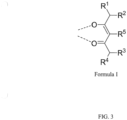
- a compound that comprises a first ligand L 1 having the formula: Formula I; wherein R 1 , R 2 , R 3 , and R 4 are independently selected from group consisting of alkyl, cycloalkyl, aryl, and heteroaryl; wherein at least one of R 1 , R 2 , R 3 , and R 4 has at least two C; wherein R 5 is selected from group consisting of hydrogen, deuterium, halide, alkyl, cycloalkyl, heteroalkyl, arylalkyl, alkoxy, aryloxy, amino, silyl, alkenyl, cycloalkenyl, heteroalkenyl, alkynyl, aryl, heteroaryl, acyl, carbonyl, carboxylic acids, ester, nitrile, isonitrile, sulfanyl, sulfinyl, sulfonyl, phosphino, and combinations thereof; wherein the first ligand L 1 having the
- a first device comprising a first organic light emitting device.
- the first organic light emitting device can comprise an anode, a cathode, and an organic layer, disposed between the anode and the cathode.
- the organic layer can include a compound comprising the first ligand L 1 having Formula I.
- the first device can be a consumer product, an organic light-emitting device, and/or a lighting panel.
- the compounds disclosed herein are novel ancillary ligands for metal complexes.
- the incorporation of these ligands can narrow the emission spectrum, decrease evaporation temperature, and improve device efficiency.
- the inventors have discovered that incorporating these novel ancillary ligands in iridium complexes improved sublimation of the resulting iridium complexes, color spectrum of phosphorescence by these iridium complexes, and their EQE.
- an OLED comprises at least one organic layer disposed between and electrically connected to an anode and a cathode.
- the anode injects holes and the cathode injects electrons into the organic layer(s).
- the injected holes and electrons each migrate toward the oppositely charged electrode.
- an "exciton” which is a localized electron-hole pair having an excited energy state, is formed.
- Light is emitted when the exciton relaxes via a photoemissive mechanism.
- the exciton may be localized on an excimer or an exciplex. Non-radiative mechanisms, such as thermal relaxation, may also occur, but are generally considered undesirable.
- the initial OLEDs used emissive molecules that emitted light from their singlet states ("fluorescence") as disclosed, for example, in U.S. Pat. No. 4,769,292 , which is incorporated by reference in its entirety. Fluorescent emission generally occurs in a time frame of less than 10 nanoseconds.
- FIG. 1 shows an organic light emitting device 100.
- Device 100 may include a substrate 110, an anode 115, a hole injection layer 120, a hole transport layer 125, an electron blocking layer 130, an emissive layer 135, a hole blocking layer 140, an electron transport layer 145, an electron injection layer 150, a protective layer 155, a cathode 160, and a barrier layer 170.
- Cathode 160 is a compound cathode having a first conductive layer 162 and a second conductive layer 164.
- Device 100 may be fabricated by depositing the layers described, in order. The properties and functions of these various layers, as well as example materials, are described in more detail in US 7,279,704 at cols. 6-10, which are incorporated by reference.
- each of these layers are available.
- a flexible and transparent substrate-anode combination is disclosed in U.S. Pat. No. 5,844,363 , which is incorporated by reference in its entirety.
- An example of a p-doped hole transport layer is m-MTDATA doped with F 4 -TCNQ at a molar ratio of 50:1, as disclosed in U.S. Patent Application Publication No. 2003/0230980 , which is incorporated by reference in its entirety.
- Examples of emissive and host materials are disclosed in U.S. Pat. No. 6,303,238 to Thompson et al. , which is incorporated by reference in its entirety.
- An example of an n-doped electron transport layer is BPhen doped with Li at a molar ratio of 1:1, as disclosed in U.S. Patent Application Publication No. 2003/0230980 , which is incorporated by reference in its entirety.
- U.S. Pat. Nos. 5,703,436 and 5,707,745 which are incorporated by reference in their entireties, disclose examples of cathodes including compound cathodes having a thin layer of metal such as Mg:Ag with an overlying transparent, electrically-conductive, sputter-deposited ITO layer.
- the theory and use of blocking layers is described in more detail in U.S. Pat. No. 6,097,147 and U.S. Patent Application Publication No.
- FIG. 2 shows an inverted OLED 200.
- the device includes a substrate 210, a cathode 215, an emissive layer 220, a hole transport layer 225, and an anode 230.
- Device 200 may be fabricated by depositing the layers described, in order. Because the most common OLED configuration has a cathode disposed over the anode, and device 200 has cathode 215 disposed under anode 230, device 200 may be referred to as an "inverted" OLED. Materials similar to those described with respect to device 100 may be used in the corresponding layers of device 200.
- FIG. 2 provides one example of how some layers may be omitted from the structure of device 100.
- FIGS. 1 and 2 The simple layered structure illustrated in FIGS. 1 and 2 is provided by way of non-limiting example, and it is understood that embodiments of the invention may be used in connection with a wide variety of other structures.
- the specific materials and structures described are exemplary in nature, and other materials and structures may be used.
- Functional OLEDs may be achieved by combining the various layers described in different ways, or layers may be omitted entirely, based on design, performance, and cost factors. Other layers not specifically described may also be included. Materials other than those specifically described may be used. Although many of the examples provided herein describe various layers as comprising a single material, it is understood that combinations of materials, such as a mixture of host and dopant, or more generally a mixture, may be used. Also, the layers may have various sublayers.
- hole transport layer 225 transports holes and injects holes into emissive layer 220, and may be described as a hole transport layer or a hole injection layer.
- an OLED may be described as having an "organic layer" disposed between a cathode and an anode. This organic layer may comprise a single layer, or may further comprise multiple layers of different organic materials as described, for example, with respect to FIGS. 1 and 2 .
- OLEDs comprised of polymeric materials (PLEDs) such as disclosed in U.S. Pat. No. 5,247,190 to Friend et al. , which is incorporated by reference in its entirety.
- PLEDs polymeric materials
- OLEDs having a single organic layer may be used.
- OLEDs may be stacked, for example as described in U.S. Pat. No. 5,707,745 to Forrest et al , which is incorporated by reference in its entirety.
- the OLED structure may deviate from the simple layered structure illustrated in FIGS. 1 and 2 .
- the substrate may include an angled reflective surface to improve out-coupling, such as a mesa structure as described in U.S. Pat. No. 6,091,195 to Forrest et al. , and/or a pit structure as described in U.S. Pat. No. 5,834,893 to Bulovic et al. , which are incorporated by reference in their entireties.
- any of the layers of the various embodiments may be deposited by any suitable method.
- preferred methods include thermal evaporation, ink-jet, such as described in U.S. Pat. Nos. 6,013,982 and 6,087,196 , which are incorporated by reference in their entireties, organic vapor phase deposition (OVPD), such as described in U.S. Pat. No. 6,337,102 to Forrest et al., which is incorporated by reference in its entirety, and deposition by organic vapor jet printing (OVJP), such as described in U.S. Pat. No. 7,431,968 , which is incorporated by reference in its entirety.
- OVPD organic vapor phase deposition
- OJP organic vapor jet printing
- Other suitable deposition methods include spin coating and other solution based processes.
- Solution based processes are preferably carried out in nitrogen or an inert atmosphere.
- preferred methods include thermal evaporation.
- Preferred patterning methods include deposition through a mask, cold welding such as described in U.S. Pat. Nos. 6,294,398 and 6,468,819 , which are incorporated by reference in their entireties, and patterning associated with some of the deposition methods such as ink-jet and OVJD. Other methods may also be used.
- the materials to be deposited may be modified to make them compatible with a particular deposition method. For example, substituents such as alkyl and aryl groups, branched or unbranched, and preferably containing at least 3 carbons, may be used in small molecules to enhance their ability to undergo solution processing.
- Substituents having 20 carbons or more may be used, and 3-20 carbons is a preferred range. Materials with asymmetric structures may have better solution processibility than those having symmetric structures, because asymmetric materials may have a lower tendency to recrystallize. Dendrimer substituents may be used to enhance the ability of small molecules to undergo solution processing.
- Devices fabricated in accordance with embodiments of the present invention may further optionally comprise a barrier layer.
- a barrier layer One purpose of the barrier layer is to protect the electrodes and organic layers from damaging exposure to harmful species in the environment including moisture, vapor and/or gases, etc.
- the barrier layer may be deposited over, under or next to a substrate, an electrode, or over any other parts of a device including an edge.
- the barrier layer may comprise a single layer, or multiple layers.
- the barrier layer may be formed by various known chemical vapor deposition techniques and may include compositions having a single phase as well as compositions having multiple phases. Any suitable material or combination of materials may be used for the barrier layer.
- the barrier layer may incorporate an inorganic or an organic compound or both.
- the preferred barrier layer comprises a mixture of a polymeric material and a non-polymeric material as described in U.S. Pat. No. 7,968,146 , PCT Pat. Application Nos. PCT/US2007/023098 and PCT/US2009/042829 , which are herein incorporated by reference in their entireties.
- the aforesaid polymeric and non-polymeric materials comprising the barrier layer should be deposited under the same reaction conditions and/or at the same time.
- the weight ratio of polymeric to non-polymeric material may be in the range of 95:5 to 5:95.
- the polymeric material and the non-polymeric material may be created from the same precursor material.
- the mixture of a polymeric material and a non-polymeric material consists essentially of polymeric silicon and inorganic silicon.
- Devices fabricated in accordance with embodiments of the invention may be incorporated into a wide variety of consumer products, including flat panel displays, computer monitors, medical monitors, televisions, billboards, lights for interior or exterior illumination and/or signaling, heads up displays, fully transparent displays, flexible displays, laser printers, telephones, cell phones, personal digital assistants (PDAs), laptop computers, digital cameras, camcorders, viewfinders, micro-displays, 3-D displays, vehicles, a large area wall, theater or stadium screen, or a sign.
- PDAs personal digital assistants
- Various control mechanisms may be used to control devices fabricated in accordance with the present invention, including passive matrix and active matrix. Many of the devices are intended for use in a temperature range comfortable to humans, such as 18 degrees C. to 30 degrees C., and more preferably at room temperature (20-25 degrees C), but could be used outside this temperature range, for example, from -40 degree C to + 80 degree C.
- the materials and structures described herein may have applications in devices other than OLEDs.
- other optoelectronic devices such as organic solar cells and organic photodetectors may employ the materials and structures.
- organic devices such as organic transistors, may employ the materials and structures.
- halo, halogen, alkyl, cycloalkyl, alkenyl, alkynyl, aralkyl, heterocyclic group, aryl, aromatic group, and heteroaryl are known to the art, and are defined in US 7,279,704 at cols. 31-32, which are incorporated herein by reference.
- substituted indicates that a substituent other than H is bonded to the relevant carbon.
- R 2 is monosubstituted, then one R 2 must be other than H.
- R 3 is disubstituted, then two of R 3 must be other than H.
- R 2 is unsubstituted R 2 is hydrogen for all available positions.
- novel ancillary ligands for metal complexes are disclosed.
- the inventors have discovered that incorporation of these ligands unexpectedly narrow the emission spectrum, decrease evaporation temperature, and improve device efficiency.
- a compound that comprises a first ligand L 1 having the formula: Formula I; wherein R 1 , R 2 , R 3 , and R 4 are independently selected from group consisting of alkyl, cycloalkyl, aryl, and heteroaryl; wherein at least one of R 1 , R 2 , R 3 , and R 4 has at least two C; wherein R 5 is selected from group consisting of hydrogen, deuterium, halide, alkyl, cycloalkyl, heteroalkyl, arylalkyl, alkoxy, aryloxy, amino, silyl, alkenyl, cycloalkenyl, heteroalkenyl, alkynyl, aryl, heteroaryl, acyl, carbonyl, carboxylic acids, ester, nitrile, isonitrile, sulfanyl, sulfinyl, sulfonyl, phosphino, and combinations thereof; wherein the first ligand L 1 having the
- the metal M is Ir.
- R 5 is selected from group consisting of hydrogen, deuterium, alkyl, cycloalkyl, and combinations thereof. In one embodiment, R 5 is hydrogen.
- R 1 , R 2 , R 3 , and R 4 are alkyl or cycloalkyl. In one embodiment, R 1 , R 2 , R 3 , and R 4 are selected from the group consisting of methyl, ethyl, propyl, 1-methylethyl, butyl, 1-methylpropyl, 2-methylpropyl, pentyl, 1-methylbutyl, 2-methylbutyl, 3-methylbutyl, 1,1-dimethylpropyl, 1,2-dimethylpropyl, 2,2-dimethylpropyl, cyclopentyl, cyclohexyl, partially or fully deuterated variants thereof, and combinations thereof.
- the compound has the formula of M(L 1 ) x (L 2 ) y (L 3 ) z ; wherein L 2 is a second ligand and L 3 is a third ligand and L 2 and L 3 can be the same or different; x is 1, 2, or 3; y is 0, 1, or 2; z is 0, 1, or 2; and x+y+z is the oxidation state of the metal M.
- L 2 and L 3 are independently selected from the group consisting of: and wherein R a , R b , R c , and R d can represent mono, di, tri, or tetra substitution, or no substitution; and R a , R b , R c , and R d are independently selected from the group consisting of hydrogen, deuterium, halide, alkyl, cycloalkyl, heteroalkyl, arylalkyl, alkoxy, aryloxy, amino, silyl, alkenyl, cycloalkenyl, heteroalkenyl, alkynyl, aryl, heteroaryl, acyl, carbonyl, carboxylic acids, ester, nitrile, isonitrile, sulfanyl, sulfinyl, sulfonyl, phosphino, and combinations thereof; and wherein two adjacent substituents of R a , R b , R c , and R
- the first ligand L 1 is selected from group consisting of:
- the second ligand L 2 is selected from group consisting of:
- the compound having the formula of M(L 1 )(L 2 ) 2 can be selected from the group consisting of Compound 1 to Compound 1729 defined in Table 1 below: TABLE 1 Compound number L 1 L 2 Compound number L 1 L 2 Compound number L 1 L 2 1. L A1 L Q1 578. L A5 L Q46 1155. L A9 L Q91 2. L A1 L Q2 579. L A5 L Q47 1156. L A9 L Q92 3, L A1 L Q3 580. L A5 L Q48 1157. L A9 L Q93 4. L A1 L Q4 581. L A5 L Q49 1158. L A9 L Q94 5. L A1 L Q5 582. L A5 L Q50 1159.
- L A9 L Q95 6. L A1 L Q6 583. L A5 L Q51 1160. L A9 L Q96 7. L A1 L Q7 584. L A5 L Q52 1161. L A9 L Q97 8. L A1 L Q8 585. L A5 L Q53 1162. L A9 L Q98 9. L A1 L Q9 586. L A5 L Q54 1163. L A9 L Q99 10. L A1 L Q10 587. L A5 L Q55 1164. L A9 L Q100 11. L A1 L Q11 588. L A5 L Q56 1165. L A9 L Q101 12. L A1 L Q12 589. L A5 L Q57 1166. L A9 L Q102 13. L A1 L Q13 590.
- L A5 L Q58 1167. L A9 L Q103 14. L A1 L Q14 591. L A5 L Q59 1168. L A9 L Q104 15. L A1 L Q15 592. L A5 L Q60 1169. L A9 L Q105 16. L A1 L Q16 593. L A5 L Q61 1170. L A9 L Q106 17. L A1 L Q17 594. L A5 L Q62 1171. L A9 L Q107 18. L A1 L Q18 595. L A5 L Q63 1172. L A9 L Q108 19. L A1 L Q19 596. L A5 L Q64 1173. L A9 L Q109 20. L A1 L Q20 597. L A5 L Q65 1174.
- L A6 L Q18 1260 L A10 L Q63 107. L A1 L Q107 684. L A6 L Q19 1261. L A10 L Q64 108. L A1 L Q108 685. L A6 L Q20 1262. L A10 L Q65 109. L A1 L Q109 686. L A6 L Q21 1263. L A10 L Q66 110. L A1 L Q110 687. L A6 L Q22 1264. L A10 L Q67 111. L A1 L Q111 688. L A6 L Q23 1265. L A10 L Q68 112. L A1 L Q112 689. L A6 L Q24 1266. L A10 L Q69 113. L A1 L Q113 690.
- L A10 L Q70 114.
- L A6 L Q26 1268 14.
- L A10 L Q71 115.
- L A10 L Q72 116.
- L A6 L Q28 1270 L
- L A10 L Q73 117.
- L A10 L Q74 118.
- L A10 L Q75 119.
- L A6 L Q82 1324 L A10 L Q127 171. L A2 L Q38 748. L A6 L Q83 1325. L A10 L Q128 172. L A2 L Q39 749, L A6 L Q84 1326. L A10 L Q129 173. L A2 L Q40 750. L A6 L Q85 1327. L A10 L Q130 174. L A2 L Q41 751. L A6 L Q86 1328. L A10 L Q131 175. L A2 L Q42 752. L A6 L Q87 1329. L A10 L Q132 176. L A2 L Q43 753. L A6 L Q88 1330. L A10 L Q133 177. L A2 L Q44 754. L A6 L Q89 1331.
- L A11 L Q15 192. L A2 L Q59 769. L A6 L Q104 1346. L A11 L Q16 193. L A2 L Q60 770. L A6 L Q105 1347. L A11 L Q17 194. L A2 L Q61 771. L A6 L Q106 1348. L A11 L Q18 195. L A2 L Q62 772. L A6 L Q107 1349. L A11 L Q19 196. L A2 L Q63 773. L A6 L Q108 1350. L A11 L Q20 197. L A2 L Q64 774. L A6 L Q109 1351. L A11 L Q21 198. L A2 L Q65 775. L A6 L Q110 1352.
- L A4 L Q84 1060 L A8 L Q129 1637. L A13 L Q41 484. L A4 L Q85 1061. L A8 L Q130 1638. L A13 L Q42 485. L A4 L Q86 1062. L A8 L Q131 1639. L A13 L Q43 486. L A4 L Q87 1063. L A8 L Q132 1640. L A13 L Q44 487. L A4 L Q88 1064. L A8 L Q133 1641. L A13 L Q45 488. L A4 L Q89 1065. L A9 L Q1 1642. L A13 L Q46 489. L A4 L Q90 1066. L A9 L Q2 1643. L A13 L Q47 490.
- L A4 L Q98 1074 L A9 L Q10 1651. L A13 L Q55 498. L A4 L Q99 1075. L A9 L Q11 1652. L A13 L Q56 499. L A4 L Q100 1076. L A9 L Q12 1653. L A13 L Q57 500. L A4 L Q101 1077. L A9 L Q13 1654. L A13 L Q58 501. L A4 L Q102 1078. L A9 L Q14 1655. L A13 L Q59 502. L A4 L Q103 1079. L A9 L Q15 1656. L A13 L Q60 503. L A4 L Q104 1080. L A9 L Q16 1657. L A13 L Q61 504.
- L A9 L Q59 1700.
- the compound comprising the first ligand L 1 having Formula I as defined herein can be selected from the group consisting of: and
- a first device comprising a first organic light emitting device.
- the first organic light emitting device can comprise an anode, a cathode, and an organic layer, disposed between the anode and the cathode.
- the organic layer can include a compound comprising the first ligand L 1 having Formula I, as defined herein.
- the compound can be selected from the group consisting of Compound 8, Compound 9, Compound 12, Compound 32, Compound 43, Compound 54, Compound 55, Compound 62, Compound 83, Compound 93, Compound 118, Compound 141, Compound 142, Compound 176, Compound 278, and Compound 320.
- the first device can be one or more of a consumer product, an organic light-emitting device, and/or a lighting panel.
- the organic layer can be an emissive layer and the compound can be an emissive dopant in some embodiments, while the compound can be a non-emissive dopant in other embodiments.
- the organic layer can also include a host.
- the host can include a metal complex.
- the host can be a metal 8-hydroxyquinolate.
- the host can be a triphenylene containing benzo-fused thiophene or benzo-fused furan.
- n can range from 1 to 10; and Ar 1 and Ar 2 can be independently selected from the group consisting of benzene, biphenyl, naphthalene, triphenylene, carbazole, and heteroaromatic analogs thereof.
- the host can be a compound selected from the group consisting of carbazole, dibenzothiphene, dibenzofuran, dibenzoselenophene, azacarbazole, aza-dibenzothiophene, aza-dibenzofuran, and aza-dibenzoselenophene.
- the "aza" designation in the fragments described above i.e., aza-dibenzofuran, aza-dibenzonethiophene, etc., means that one or more of the C-H groups in the respective fragment can be replaced by a nitrogen atom, for example, and without any limitation, azatriphenylene encompasses both dibenzo[ f , h ]quinoxaline and dibenzo[ f , h ]quinoline.
- the host can include a metal complex.
- the host can be a specific compound selected from the group consisting of: and combinations thereof.
- a formulation comprising the first ligand L 1 having Formula I, as defined herein, is also within the scope of the invention disclosed herein.
- the formulation can include one or more components selected from the group consisting of a solvent, a host, a hole injection material, hole transport material, and an electron transport layer material, disclosed herein.
- the materials described herein as useful for a particular layer in an organic light emitting device may be used in combination with a wide variety of other materials present in the device.
- emissive dopants disclosed herein may be used in conjunction with a wide variety of hosts, transport layers, blocking layers, injection layers, electrodes and other layers that may be present.
- the materials described or referred to below are non-limiting examples of materials that may be useful in combination with the compounds disclosed herein, and one of skill in the art can readily consult the literature to identify other materials that may be useful in combination.
- a hole injecting/transporting material to be used in the present invention is not particularly limited, and any compound may be used as long as the compound is typically used as a hole injecting/transporting material.
- the material include, but not limit to: a phthalocyanine or porphryin derivative; an aromatic amine derivative; an indolocarbazole derivative; a polymer containing fluorohydrocarbon; a polymer with conductivity dopants; a conducting polymer, such as PEDOT/PSS; a self-assembly monomer derived from compounds such as phosphonic acid and sliane derivatives; a metal oxide derivative, such as MoO x ; a p-type semiconducting organic compound, such as 1,4,5,8,9,12-Hexaazatriphenylenehexacarbonitrile; a metal complex, and a cross-linkable compounds.
- aromatic amine derivatives used in HIL or HTL include, but not limit to the following general structures:
- Each of Ar 1 to Ar 9 is selected from the group consisting aromatic hydrocarbon cyclic compounds such as benzene, biphenyl, triphenyl, triphenylene, naphthalene, anthracene, phenalene, phenanthrene, fluorene, pyrene, chrysene, perylene, azulene; group consisting aromatic heterocyclic compounds such as dibenzothiophene, dibenzofuran, dibenzoselenophene, furan, thiophene, benzofuran, benzothiophene, benzoselenophene, carbazole, indolocarbazole, pyridylindole, pyrrolodipyridine, pyrazole, imidazole, triazole, oxazole, thiazole, oxadiazole, oxatriazole, dioxazole, thiadiazole, pyridine, pyridazine, pyrim
- each Ar is further substituted by a substituent selected from the group consisting of hydrogen, deuterium, halide, alkyl, cycloalkyl, heteroalkyl, arylalkyl, alkoxy, aryloxy, amino, silyl, alkenyl, cycloalkenyl, heteroalkenyl, alkynyl, aryl, heteroaryl, acyl, carbonyl, carboxylic acids, ester, nitrile, isonitrile, sulfanyl, sulfinyl, sulfonyl, phosphino, and combinations thereof.
- a substituent selected from the group consisting of hydrogen, deuterium, halide, alkyl, cycloalkyl, heteroalkyl, arylalkyl, alkoxy, aryloxy, amino, silyl, alkenyl, cycloalkenyl, heteroalkenyl, alkynyl, aryl, heteroaryl, acy
- Ar 1 to Ar 9 is independently selected from the group consisting of: wherein k is an integer from 1 to 20; X 101 to X 108 is C (including CH) or N; Z 101 is NAr 1 , O, or S; Ar 1 has the same group defined above.
- metal complexes used in HIL or HTL include, but not limit to the following general formula: wherein Met is a metal, which can have an atomic weight greater than 40; (Y 101 -Y 102 ) is a bidentate ligand, Y 101 and Y 102 are independently selected from C, N, O, P, and S; L 101 is an ancillary ligand; k' is an integer value from 1 to the maximum number of ligands that may be attached to the metal; and k'+k" is the maximum number of ligands that may be attached to the metal.
- (Y 101 -Y 102 ) is a 2-phenylpyridine derivative. In another aspect, (Y 101 -Y 102 ) is a carbene ligand. In another aspect, Met is selected from Ir, Pt, Os, and Zn. In a further aspect, the metal complex has a smallest oxidation potential in solution vs. Fc + /Fc couple less than about 0.6 V.
- the light emitting layer of the organic EL device of the present invention preferably contains at least a metal complex as light emitting material, and may contain a host material using the metal complex as a dopant material.
- the host material are not particularly limited, and any metal complexes or organic compounds may be used as long as the triplet energy of the host is larger than that of the dopant. While the Table below categorizes host materials as preferred for devices that emit various colors, any host material may be used with any dopant so long as the triplet criteria is satisfied.
- Examples of metal complexes used as host are preferred to have the following general formula: wherein Met is a metal; (Y 103 -Y 104 ) is a bidentate ligand, Y 103 and Y 104 are independently selected from C, N, O, P, and S; L 101 is an another ligand; k' is an integer value from 1 to the maximum number of ligands that may be attached to the metal; and k'+k" is the maximum number of ligands that may be attached to the metal.
- the metal complexes are: wherein (O-N) is a bidentate ligand, having metal coordinated to atoms O and N.
- Met is selected from Ir and Pt.
- (Y 103 -Y 104 ) is a carbene ligand.
- organic compounds used as host are selected from the group consisting aromatic hydrocarbon cyclic compounds such as benzene, biphenyl, triphenyl, triphenylene, naphthalene, anthracene, phenalene, phenanthrene, fluorene, pyrene, chrysene, perylene, azulene; group consisting aromatic heterocyclic compounds such as dibenzothiophene, dibenzofuran, dibenzoselenophene, furan, thiophene, benzofuran, benzothiophene, benzoselenophene, carbazole, indolocarbazole, pyridylindole, pyrrolodipyridine, pyrazole, imidazole, triazole, oxazole, thiazole, oxadiazole, oxatriazole, dioxazole, thiadiazole, pyridine, pyridazine, pyrimidine
- each group is further substituted by a substituent selected from the group consisting of hydrogen, deuterium, halide, alkyl, cycloalkyl, heteroalkyl, arylalkyl, alkoxy, aryloxy, amino, silyl, alkenyl, cycloalkenyl, heteroalkenyl, alkynyl, aryl, heteroaryl, acyl, carbonyl, carboxylic acids, ester, nitrile, isonitrile, sulfanyl, sulfinyl, sulfonyl, phosphino, and combinations thereof.
- a substituent selected from the group consisting of hydrogen, deuterium, halide, alkyl, cycloalkyl, heteroalkyl, arylalkyl, alkoxy, aryloxy, amino, silyl, alkenyl, cycloalkenyl, heteroalkenyl, alkynyl, aryl, heteroaryl, acy
- host compound contains at least one of the following groups in the molecule: wherein R 101 to R 107 is independently selected from the group consisting of hydrogen, deuterium, halide, alkyl, cycloalkyl, heteroalkyl, arylalkyl, alkoxy, aryloxy, amino, silyl, alkenyl, cycloalkenyl, heteroalkenyl, alkynyl, aryl, heteroaryl, acyl, carbonyl, carboxylic acids, ester, nitrile, isonitrile, sulfanyl, sulfinyl, sulfonyl, phosphino, and combinations thereof, when it is aryl or heteroaryl, it has the similar definition as Ar's mentioned above.
- X 101 to X 108 is selected from C (including CH) or N.
- Z 101 and Z 102 is selected from NR 101 , O, or S.
- a hole blocking layer may be used to reduce the number of holes and/or excitons that leave the emissive layer.
- the presence of such a blocking layer in a device may result in substantially higher efficiencies as compared to a similar device lacking a blocking layer.
- a blocking layer may be used to confine emission to a desired region of an OLED.
- compound used in HBL contains the same molecule or the same functional groups used as host described above.
- compound used in HBL contains at least one of the following groups in the molecule: wherein k is an integer from 1 to 20; L 101 is an another ligand, k' is an integer from 1 to 3.
- Electron transport layer may include a material capable of transporting electrons. Electron transport layer may be intrinsic (undoped), or doped. Doping may be used to enhance conductivity. Examples of the ETL material are not particularly limited, and any metal complexes or organic compounds may be used as long as they are typically used to transport electrons.
- compound used in ETL contains at least one of the following groups in the molecule: wherein R 101 is selected from the group consisting of hydrogen, deuterium, halide, alkyl, cycloalkyl, heteroalkyl, arylalkyl, alkoxy, aryloxy, amino, silyl, alkenyl, cycloalkenyl, heteroalkenyl, alkynyl, aryl, heteroaryl, acyl, carbonyl, carboxylic acids, ester, nitrile, isonitrile, sulfanyl, sulfinyl, sulfonyl, phosphino, and combinations thereof, when it is aryl or heteroaryl, it has the similar definition as Ar's mentioned above.
- Ar 1 to Ar 3 has the similar definition as Ar's mentioned above.
- k is an integer from 1 to 20.
- X 101 to X 108 is selected from C (including CH) or N.
- the metal complexes used in ETL contains, but not limit to the following general formula: wherein (O-N) or (N-N) is a bidentate ligand, having metal coordinated to atoms O, N or N, N; L 101 is another ligand; k' is an integer value from 1 to the maximum number of ligands that may be attached to the metal.
- the hydrogen atoms can be partially or fully deuterated.
- any specifically listed substituent such as, without limitation, methyl, phenyl, pyridyl, etc. encompasses undeuterated, partially deuterated, and fully deuterated versions thereof.
- classes of substituents such as, without limitation, alkyl, aryl, cycloalkyl, heteroaryl, etc. also encompass undeuterated, partially deuterated, and fully deuterated versions thereof.
- hole injection materials In addition to and / or in combination with the materials disclosed herein, many hole injection materials, hole transporting materials, host materials, dopant materials, exiton/hole blocking layer materials, electron transporting and electron injecting materials may be used in an OLED.
- Non-limiting examples of the materials that may be used in an OLED in combination with materials disclosed herein are listed in Table 2 below. Table 2 lists non-limiting classes of materials, non-limiting examples of compounds for each class, and references that disclose the materials. TABLE 2 MATERIAL EXAMPLES OF MATERIAL PUBLICATIONS Hole injection materials Phthalocyanine and porphryin compounds Appl. Phys. Lett. 69, 2160 (1996 ) Starburst triarylamines J. Lumin.
- All example devices were fabricated by high vacuum ( ⁇ 10 -7 Torr) thermal evaporation.
- the anode electrode is 1200 ⁇ of indium tin oxide (ITO).
- the cathode consisted of 10 ⁇ of LiF followed by 1,000 ⁇ of A1. All devices are encapsulated with a glass lid sealed with an epoxy resin in a nitrogen glove box ( ⁇ 1 ppm of H 2 O and O 2 ) immediately after fabrication, and a moisture getter was incorporated inside the package.
- the organic stack of the example devices consisted of sequentially from the ITO surface, 100 ⁇ of HAT-CN as the hole injection layer (HIL), 400 ⁇ of NPD as the hole transporting layer (HTL), 400 ⁇ of the emissive layer (EML) which contains the compound of Formula 1, Compound SD, and Host (BAlQ), 40 ⁇ of BAlQ as the blocking layer (BL), 450 ⁇ of AlQ 3 as the electron transporting layer (ETL) and 10 ⁇ of LiF as the electron injection layer (EIL).
- the comparative examples were fabricated similarly to the device examples except that the Comparative Compounds 1-4 were used as the emitter in the EML. Table 3.
- Table 4 is a summary of the device data.
- the luminous efficiency (LE), external quantum efficiency (EQE) and power efficiency (PE) were measured at 1000 nits.
- the inventive Compound 8 shows similar CIE to the comparative compounds since the emission color of these compounds are dominated by the Phenylquinoline ligand. However, the emission spectrum of Compound 8 is narrower than that of the comparative compounds as can be seen from the full width at the half maximum (FWHM) values in table 2. A smaller FWHM value means narrower emission spectrum.
- the device measurements show that all characteristics are better when a new ancillary ligand as disclosed here is used. For example, a relative driving voltage of 1.00 was obtained for Compound 8 whereas that voltage was between 1.03 and 1.09 for the comparative examples.
- Table 5 shows the unexpected performance improvement exhibited by an example of the inventive compounds, Compound 12, over Comparative Compounds 5 and 6 by way of each compounds' photoluminescence quantum yield (PLQY): TABLE 5 Compound Structure PLQY in 5% PMMA film 34% 57% 59% Inventive Compound 12 showed higher PLQY than the comparative compounds. Higher PLQY is desirable for emitters in OLEDs for high EQE.
- the Ir(III) Dimer (1.70 g, 1.18 mmol) and 3,7-diethylnonane-4,6-dione (2.51 g, 11.8 mmol) were dissolved in ethoxyethanol (50 mL), sodium carbonate (0.63 g, 5.90 mmol) was added followed with degassing by bubbling nitrogen through the mixture.
- the reaction mixture was stirred overnight at room temperature. The temperature was then increased to 45°C for 2 hours.
- the precipitate was filtered through Celite ® , washed with MeOH and heptanes.
- the filtrate with Celite ® was suspended in DCM (containing 5% of Et 3 N), filtered and evaporated.
- the red solid obtained (0.6 g) had a purity of 99.6% by HPLC.
- the Iridium (III) dimer (1.75 g, 1.09 mmol) and 3,7-diethylnonane-4,6-dione (2.31 g, 10.9 mmol) was diluted with 2-ethoxyethanol (40 mL), degassed by bubbling nitrogen for 30 minutes and potassium carbonate (1.50 g, 10.9 mmol) was added. The mixture was stirred at room temperature overnight. Dichloromethane (100 mL) was added; the reaction mixture was filtered through a pad of Celite ® and the pad was washed with dichloromethane.
- the mixture was diluted in EA, washed with brine, dried with sodium sulfate, and concentrated under reduced pressure.
- the crude material was purified by column chromatography on silica, eluted with heptanes/EA 4/1 (v/v). The yellow powder was then recrystallized from heptanes to afford the title compound as colorless crystals (3.5 g, 72% yield) .
- Iridium complex dimer (1.60 g, 1.00 mmol), 3,7-diethylnonane-4,6-dione (2.12 g, 9.98 mmol) and sodium carbonate (0.53 g, 4.99 mmol) were suspended in 50 mL of ethoxyethanol, and stirred overnight under N 2 at room temperature. The reaction mixture was then filtered through a pad of Celite ® , washed with MeOH. Most of the red material was solubilized and passed through the Celite ® . The Celite ® was suspended in DCM, containing 10% of triethylamine and this suspension was combined with filtrate and evaporated.
- Oxalyl chloride (6.93 ml, 79 mmol) was added dropwise to a solution of 4-fluoro-3,5-dimethylbenzoic acid (12.1 g, 72.0 mmol) in dichloromethane (360 mL) and DMF (0.06 mL, 0.720 mmol) under nitrogen at room temperature. The mixture was then stirred at room temperature and monitored by TLC. Complete solubilization of the mixture occurred within 3 hours. The reaction was complete after an additional hour. Solvent was removed under reduced pressure and the crude mixture was dried in high vacuum and used without further purification.
- the product was coated on Celite ® and purified by column chromatography using 10% EA in heptanes to let first impurities come out the EA volume was slowly increased to 15% to let the target come out.
- the product contains a 2% impurity which comes 10 minutes after the target on HPLC.
- Iridium(III) chloride trihydrate (1.64 g, 4.65 mmol) and 1-(4-fluoro-3,5-dimethylphenyl)-7-isopropylisoquinoline (4.09 g, 13.95 mmol) were suspended in ethoxyethanol (50 mL) and water (12 mL), degassed by bubbling nitrogen and immersed in the oil bath at 105°C overnight. After cooling down to room temperature, the solid was filtered, washed with MeOH and dried under vacuum to afford 1.8 g (74% yield) of red solid.
- Trifluoroacetic anhydride (61.8 ml, 437 mmol) was added to a 0 °C, stirred solution of 5-isobutylquinoline 1-oxide (11 g, 54.7 mmol) in DMF (70 mL) under N 2 . The mixture was then stirred at room temperature overnight. Upon completion, the trifluoroacetic anhydride was removed under reduced pressure. The residue was quenched with aqueous NaHCO 3 and further diluted with water. The crude was recrystallized from aqueous DMF to give a white solid (8.2 g, 75 % yield).
- Phosphorus oxychloride (7.60 ml, 81 mmol) was added dropwise to a solution of 5-isobutylquinolin-2(1H)-one (8.2 g, 40.7 mmol) in DMF (160 mL) over 30 minutes under N 2 . The reaction mixture was then heated at 80°C. After the reaction was complete, the remaining POCl 3 was evaporated under reduced pressure and aqueous Na 2 CO 3 was carefully added. The solid was isolated to give an off-white solid (8.1 g, 91 % yield).
- Nitrogen gas was bubbled into a mixture of (3,5-dichlorophenyl)boronic acid (10.6 g, 55.5 mmol), 2-chloro-5-isobutylquinoline (8.13 g, 37 mmol) and Na 2 CO 3 (7.84 g, 74.0 mmol) in THF (250 mL) and water (50 mL) for 30 min. Tetrakis(triphenylphosphine)palladium (0) (1.71 g, 1.48 mmol) was added and the mixture was heated to reflux overnight. Upon completion (monitored by GCMS) the reaction was worked up by diluting in ethyl acetate and washing with brine and water.
- CD 3 MgI (61 mL, 61 mmol) in diethyl ether (1.0 M) was added into a stirred mixture of 2-(3,5-dichlorophenyl)-5-isobutylquinoline (8.0 g, 24.2 mmol) and dichloro(1,3-bis(diphenylphosphino)propane)nickel (Ni(dppp)Cl 2 ) (0.39 g, 0.73 mmol) in diethyl ether (120 mL) over a period of 30 min. The mixture was stirred at room temperature overnight. Upon completion, the reaction was cooled with an ice bath and quenched carefully with water.
- the mixture was extracted with EA, washed with water (3 times) and brine.
- the crude product was purified by silica gel column chromatography using heptanes/DCM/EA 89/10/1 to 84/15/1 (v/v/v) gradient mixture as eluent to yield an oil (6.5 g, 91 % yield).
- the Ir(III) dimer (0.80 g, 0.58 mmol) and 6-ethyl-2-methyloctane-3,5-dione (0.75 g, 4.06 mmol) were inserted in a round-bottom flask.
- the mixture was diluted in 2-ethoxyethanol (40 mL), degassed with nitrogen for 30 minutes and K 2 CO 3 (0.60 g, 4.33 mmol) was inserted.
- the mixture was stirred at room temperature overnight.
- the precipitate was filtered through a pad of Celite .
- the solvent was evaporated and the crude material was purified with column chromatography on silica gel by using a mixture of heptanes/DCM 95/5 (v/v). The pure material (0.65 g, 67% yield) was obtained.
- the Iridium (III) dimer (0.80 g, 0.56 mmol) and 6-ethyl-2-methyloctane-3,5-dione (0.77 g, 4.16 mmol) were diluted in ethoxyethanol (19 mL).
- the mixture was degassed by bubbling nitrogen for 15 minutes followed by the addition of K 2 CO 3 (0.576 g, 4.16 mmol) and the mixture was stirred at room temperature overnight.
- Dichloromethane was added followed by filtration of the solution through a pad of Celite ® and washed with dichloromethane until the filtrate is clear.
- the crude product was purified by column chromatography by using a triethylamine-treated silica gel column and eluting with a mixture of heptanes/dichloromethane 95/5 (v/v).
- the pure product was collected (0.35 g, 67% yield) as a red powder.
- the crude product was purified by column chromatography by using a triethylamine-treated column and eluting with a mixture of heptanes/dichloromethane (95/5, v/v).
- the pure product was collected (0.600 g, 70% yield) as a red powder.
Landscapes
- Chemical & Material Sciences (AREA)
- Engineering & Computer Science (AREA)
- Materials Engineering (AREA)
- Organic Chemistry (AREA)
- Physics & Mathematics (AREA)
- Spectroscopy & Molecular Physics (AREA)
- Crystallography & Structural Chemistry (AREA)
- Inorganic Chemistry (AREA)
- Optics & Photonics (AREA)
- Electroluminescent Light Sources (AREA)
- Ultra Sonic Daignosis Equipment (AREA)
- Organic Low-Molecular-Weight Compounds And Preparation Thereof (AREA)
- Peptides Or Proteins (AREA)
- Transition And Organic Metals Composition Catalysts For Addition Polymerization (AREA)
- Steering-Linkage Mechanisms And Four-Wheel Steering (AREA)
- Microscoopes, Condenser (AREA)
Applications Claiming Priority (5)
| Application Number | Priority Date | Filing Date | Title |
|---|---|---|---|
| US13/932,508 US10199581B2 (en) | 2013-07-01 | 2013-07-01 | Organic electroluminescent materials and devices |
| EP19209745.9A EP3632921B1 (fr) | 2013-07-01 | 2014-06-26 | Utilisation d'un ligand auxiliaire dans un complexe metallique phosphorescent |
| EP14174024.1A EP2821410B1 (fr) | 2013-07-01 | 2014-06-26 | Ligands auxiliaires de complexes organométalliques |
| EP18153847.1A EP3333174B1 (fr) | 2013-07-01 | 2014-06-26 | Ligands auxiliaires de complexes organométalliques |
| EP21212591.8A EP3981776B1 (fr) | 2013-07-01 | 2014-06-26 | Utilisation d'un ligand auxiliaire dans un composé complexe métallique phosphorescent |
Related Parent Applications (4)
| Application Number | Title | Priority Date | Filing Date |
|---|---|---|---|
| EP14174024.1A Division EP2821410B1 (fr) | 2013-07-01 | 2014-06-26 | Ligands auxiliaires de complexes organométalliques |
| EP19209745.9A Division EP3632921B1 (fr) | 2013-07-01 | 2014-06-26 | Utilisation d'un ligand auxiliaire dans un complexe metallique phosphorescent |
| EP21212591.8A Division EP3981776B1 (fr) | 2013-07-01 | 2014-06-26 | Utilisation d'un ligand auxiliaire dans un composé complexe métallique phosphorescent |
| EP18153847.1A Division EP3333174B1 (fr) | 2013-07-01 | 2014-06-26 | Ligands auxiliaires de complexes organométalliques |
Publications (2)
| Publication Number | Publication Date |
|---|---|
| EP4294158A2 true EP4294158A2 (fr) | 2023-12-20 |
| EP4294158A3 EP4294158A3 (fr) | 2024-03-20 |
Family
ID=51205167
Family Applications (5)
| Application Number | Title | Priority Date | Filing Date |
|---|---|---|---|
| EP21212591.8A Active EP3981776B1 (fr) | 2013-07-01 | 2014-06-26 | Utilisation d'un ligand auxiliaire dans un composé complexe métallique phosphorescent |
| EP23207101.9A Pending EP4294158A3 (fr) | 2013-07-01 | 2014-06-26 | Utilisation d'un ligand auxiliaire dans un composé complexe métallique phosphorescent |
| EP18153847.1A Active EP3333174B1 (fr) | 2013-07-01 | 2014-06-26 | Ligands auxiliaires de complexes organométalliques |
| EP19209745.9A Active EP3632921B1 (fr) | 2013-07-01 | 2014-06-26 | Utilisation d'un ligand auxiliaire dans un complexe metallique phosphorescent |
| EP14174024.1A Active EP2821410B1 (fr) | 2013-07-01 | 2014-06-26 | Ligands auxiliaires de complexes organométalliques |
Family Applications Before (1)
| Application Number | Title | Priority Date | Filing Date |
|---|---|---|---|
| EP21212591.8A Active EP3981776B1 (fr) | 2013-07-01 | 2014-06-26 | Utilisation d'un ligand auxiliaire dans un composé complexe métallique phosphorescent |
Family Applications After (3)
| Application Number | Title | Priority Date | Filing Date |
|---|---|---|---|
| EP18153847.1A Active EP3333174B1 (fr) | 2013-07-01 | 2014-06-26 | Ligands auxiliaires de complexes organométalliques |
| EP19209745.9A Active EP3632921B1 (fr) | 2013-07-01 | 2014-06-26 | Utilisation d'un ligand auxiliaire dans un complexe metallique phosphorescent |
| EP14174024.1A Active EP2821410B1 (fr) | 2013-07-01 | 2014-06-26 | Ligands auxiliaires de complexes organométalliques |
Country Status (6)
| Country | Link |
|---|---|
| US (4) | US10199581B2 (fr) |
| EP (5) | EP3981776B1 (fr) |
| JP (5) | JP6544892B2 (fr) |
| KR (5) | KR102172307B1 (fr) |
| CN (2) | CN111560039A (fr) |
| TW (1) | TWI586671B (fr) |
Families Citing this family (67)
| Publication number | Priority date | Publication date | Assignee | Title |
|---|---|---|---|---|
| US10199581B2 (en) * | 2013-07-01 | 2019-02-05 | Universal Display Corporation | Organic electroluminescent materials and devices |
| US10003033B2 (en) * | 2014-02-18 | 2018-06-19 | Universal Display Corporation | Organic electroluminescent materials and devices |
| US20150333227A1 (en) * | 2014-05-14 | 2015-11-19 | Genesis Photonics Inc. | Light emitting device package structure and manufacturing method thereof |
| US10411201B2 (en) | 2014-11-12 | 2019-09-10 | Universal Display Corporation | Organic electroluminescent materials and devices |
| CN106883270B (zh) | 2015-11-26 | 2019-03-26 | 财团法人工业技术研究院 | 有机金属化合物、包含其的有机发光装置 |
| US20170155063A1 (en) * | 2015-11-26 | 2017-06-01 | Industrial Technology Research Institute | Organic metal compound, organic light-emitting devices employing the same |
| US20180370981A1 (en) | 2015-12-21 | 2018-12-27 | Idemitsu Kosan Co., Ltd. | Hetero-condensed phenylquinazolines and their use in electronic devices |
| US10840458B2 (en) | 2016-05-25 | 2020-11-17 | Universal Display Corporation | Organic electroluminescent materials and devices |
| US11081658B2 (en) * | 2016-10-03 | 2021-08-03 | Universal Display Corporation | Organic electroluminescent materials and devices |
| KR102809315B1 (ko) | 2016-12-07 | 2025-05-21 | 듀폰스페셜티머터리얼스코리아 유한회사 | 유기 전계 발광 재료 및 이를 포함하는 유기 전계 발광 소자 |
| KR102359412B1 (ko) * | 2016-12-27 | 2022-02-09 | 롬엔드하스전자재료코리아유한회사 | 유기 전계 발광 화합물 및 이를 포함하는 유기 전계 발광 소자 |
| US10686146B2 (en) | 2017-02-13 | 2020-06-16 | Feng-wen Yen | Paracyclophane-based iridium complexes for organic electroluminescence device |
| EP3418285B1 (fr) | 2017-06-20 | 2020-05-06 | Idemitsu Kosan Co., Ltd. | Composition comprenant un complexe d'ir substitué et une phenylquinazoline pontée avec un hétéroatome |
| US11462697B2 (en) * | 2017-08-22 | 2022-10-04 | Universal Display Corporation | Organic electroluminescent materials and devices |
| US20190077818A1 (en) * | 2017-09-08 | 2019-03-14 | Chuanjun Xia | Organic luminescent materials containing fluorine ancillary ligands |
| CN121181616A (zh) * | 2017-09-29 | 2025-12-23 | 北京夏禾科技股份有限公司 | 含环烷基辅助配体的有机发光材料 |
| US10400002B2 (en) * | 2017-10-02 | 2019-09-03 | Feng-wen Yen | Iridium complex and organic electroluminescence device using the same |
| EP3466954A1 (fr) | 2017-10-04 | 2019-04-10 | Idemitsu Kosan Co., Ltd. | Phénylquinazolines condensées et pontées avec un hétéroatome |
| US11404651B2 (en) | 2017-12-14 | 2022-08-02 | Guangzhou Chinaray Optoelectronic Materials Ltd. | Transition metal complex material and application thereof in electronic devices |
| CN111247658B (zh) * | 2017-12-14 | 2023-04-04 | 广州华睿光电材料有限公司 | 过渡金属配合物、聚合物、混合物、组合物及其应用 |
| KR102625860B1 (ko) | 2018-02-23 | 2024-02-08 | 삼성디스플레이 주식회사 | 유기금속 화합물, 이를 포함한 유기 발광 소자 및 상기 유기 발광 소자를 포함한 유기 발광 장치 |
| CN110343136B (zh) | 2018-04-02 | 2023-08-11 | 三星电子株式会社 | 有机金属化合物、以及包括其的有机发光器件和诊断组合物 |
| JP7336865B2 (ja) | 2018-04-02 | 2023-09-01 | 三星電子株式会社 | 有機金属化合物とそれを含む有機発光素子及び診断用組成物 |
| EP3604477A1 (fr) | 2018-07-30 | 2020-02-05 | Idemitsu Kosan Co., Ltd. | Composé polycyclique, dispositif électroluminescent organique et dispositif électronique |
| EP3604321B1 (fr) | 2018-07-31 | 2022-02-09 | Samsung Electronics Co., Ltd. | Composé organométallique, dispositif électroluminescent organique le comprenant et composition de diagnostic comprenant le composé organométallique |
| CN108997437B (zh) * | 2018-08-01 | 2023-10-20 | 浙江华显光电科技有限公司 | 红色磷光化合物以及使用该化合物的有机发光二极管器件 |
| CN108997438B (zh) * | 2018-08-06 | 2023-10-27 | 浙江华显光电科技有限公司 | 红色磷光化合物和使用该化合物的有机发光二极管器件 |
| EP3608319A1 (fr) | 2018-08-07 | 2020-02-12 | Idemitsu Kosan Co., Ltd. | Azacycles condensés comme dispositif électroluminescent organique et matériaux à utiliser en son sein |
| EP3617216B1 (fr) * | 2018-08-31 | 2021-12-01 | Samsung Electronics Co., Ltd. | Composé organométallique, dispositif électroluminescent organique le comprenant et composition de diagnostic comprenant le composé organométallique |
| US12286446B2 (en) | 2018-09-05 | 2025-04-29 | Samsung Electronics Co., Ltd. | Organometallic compound, organic light- emitting device including the same, and diagnostic composition including the organometallic compound |
| CN110922429B (zh) * | 2018-09-20 | 2023-11-03 | 北京夏禾科技有限公司 | 含有辅助配体的有机发光材料 |
| CN109988192A (zh) * | 2019-01-16 | 2019-07-09 | 浙江华显光电科技有限公司 | 绿色磷光化合物和使用该化合物的有机电致发光器件 |
| KR102851582B1 (ko) | 2019-01-17 | 2025-08-28 | 삼성디스플레이 주식회사 | 근적외선광-발광 소자 및 이를 포함한 장치 |
| US12391713B2 (en) * | 2019-03-29 | 2025-08-19 | Samsung Electronics Co., Ltd. | Organometallic compound, organic light-emitting device including the same, and electronic apparatus including the organic light-emitting device |
| KR102787165B1 (ko) | 2019-04-17 | 2025-03-26 | 삼성전자주식회사 | 유기금속 화합물, 이를 포함한 유기 발광 소자 및 이를 포함한 진단용 조성물 |
| CN111909214B (zh) * | 2019-05-09 | 2024-03-29 | 北京夏禾科技有限公司 | 一种含有3-氘取代异喹啉配体的有机发光材料 |
| CN111909212B (zh) | 2019-05-09 | 2023-12-26 | 北京夏禾科技有限公司 | 一种含有6-硅基取代异喹啉配体的有机发光材料 |
| CN111909213B (zh) * | 2019-05-09 | 2024-02-27 | 北京夏禾科技有限公司 | 一种含有三个不同配体的金属配合物 |
| CN111943986B (zh) * | 2019-05-17 | 2023-08-15 | 夏禾科技(江苏)有限公司 | 一种含有多个稠合杂环结构配体的金属配合物 |
| CN110452271A (zh) * | 2019-07-26 | 2019-11-15 | 浙江华显光电科技有限公司 | 红色磷光化合物和使用该化合物的有机电致发光器件 |
| CN110467642A (zh) * | 2019-07-26 | 2019-11-19 | 浙江华显光电科技有限公司 | 红色磷光化合物和使用该化合物的有机电致发光器件 |
| CN110922430A (zh) * | 2019-08-12 | 2020-03-27 | 宇瑞(上海)化学有限公司 | 一种绿色磷光化合物及使用绿色磷光化合物的有机电致发光器 |
| CN110590851A (zh) * | 2019-08-29 | 2019-12-20 | 浙江华显光电科技有限公司 | 红色磷光化合物和使用该化合物的有机电致发光器件 |
| CN110627836A (zh) * | 2019-08-29 | 2019-12-31 | 浙江华显光电科技有限公司 | 红色磷光化合物和使用该化合物的有机电致发光器件 |
| CN110746464A (zh) * | 2019-09-09 | 2020-02-04 | 浙江华显光电科技有限公司 | 红色磷光化合物和使用该化合物的有机电致发光器件 |
| US20210094978A1 (en) * | 2019-09-26 | 2021-04-01 | Universal Display Corporation | Organic electroluminescent materials and devices |
| US12486296B2 (en) * | 2019-10-02 | 2025-12-02 | Universal Display Corporation | Organic electroluminescent materials and devices |
| CN112679548B (zh) | 2019-10-18 | 2023-07-28 | 北京夏禾科技有限公司 | 具有部分氟取代的取代基的辅助配体的有机发光材料 |
| TWI887325B (zh) | 2020-01-10 | 2025-06-21 | 日商半導體能源研究所股份有限公司 | 有機金屬錯合物、頂部發射用發光材料、發光器件、發光裝置、電子裝置以及照明設備 |
| CN118084980A (zh) | 2020-01-10 | 2024-05-28 | 北京夏禾科技有限公司 | 有机发光材料 |
| CN113121609B (zh) * | 2020-01-16 | 2024-03-29 | 北京夏禾科技有限公司 | 一种金属配合物、包含其的电致发光器件及其用途 |
| CN113321685A (zh) * | 2020-02-28 | 2021-08-31 | 北京夏禾科技有限公司 | 一种金属配合物、有机电致发光材料及其应用 |
| CN113493482A (zh) * | 2020-04-01 | 2021-10-12 | 北京夏禾科技有限公司 | 含氰基取代的辅助配体的有机发光材料 |
| US12486236B2 (en) * | 2020-06-05 | 2025-12-02 | Beijing Summer Sprout Technology Co., Ltd. | Electroluminescent device |
| CN112680218A (zh) * | 2020-12-27 | 2021-04-20 | 浙江华显光电科技有限公司 | 一种组合物及包含其的有机电致发光元件 |
| CN112608737A (zh) * | 2020-12-27 | 2021-04-06 | 浙江华显光电科技有限公司 | 一种组合物及包含其的有机电致发光元件 |
| CN112645988A (zh) * | 2020-12-27 | 2021-04-13 | 浙江华显光电科技有限公司 | 一种铱金属配合物和使用该化合物的有机光电元件 |
| CN112679553A (zh) * | 2020-12-27 | 2021-04-20 | 浙江华显光电科技有限公司 | 一种铱金属配合物和使用该化合物的有机光电元件 |
| CN112608342A (zh) * | 2020-12-27 | 2021-04-06 | 浙江华显光电科技有限公司 | 一种铱金属配合物和使用该化合物的有机光电元件 |
| US20220285631A1 (en) * | 2021-02-22 | 2022-09-08 | Universal Display Corporation | Organic electroluminescent materials and devices |
| US20220298190A1 (en) * | 2021-03-12 | 2022-09-22 | Universal Display Corporation | Organic electroluminescent materials and devices |
| US20220324892A1 (en) * | 2021-03-23 | 2022-10-13 | Universal Display Corporation | Organic electroluminescent materials and devices |
| KR102645094B1 (ko) * | 2021-07-20 | 2024-03-07 | 삼성전자주식회사 | 유기금속 화합물, 이를 포함한 유기 발광 소자 및 유기 발광 소자를 포함한 전자 장치 |
| CN115677779B (zh) * | 2021-07-23 | 2024-11-22 | 北京夏禾科技有限公司 | 一种具有多取代苯基的配体的发光材料 |
| KR102733298B1 (ko) * | 2021-07-29 | 2024-11-21 | 엘지디스플레이 주식회사 | 유기금속 화합물 및 이를 포함하는 유기발광소자 |
| US20230118106A1 (en) * | 2021-08-26 | 2023-04-20 | Universal Display Corporation | Organic electroluminescent materials and devices |
| KR102958899B1 (ko) | 2024-03-05 | 2026-04-29 | 주식회사 파세코 | 열풍 순환기를 구비한 난로 |
Citations (18)
| Publication number | Priority date | Publication date | Assignee | Title |
|---|---|---|---|---|
| US4769292A (en) | 1987-03-02 | 1988-09-06 | Eastman Kodak Company | Electroluminescent device with modified thin film luminescent zone |
| US5247190A (en) | 1989-04-20 | 1993-09-21 | Cambridge Research And Innovation Limited | Electroluminescent devices |
| US5703436A (en) | 1994-12-13 | 1997-12-30 | The Trustees Of Princeton University | Transparent contacts for organic devices |
| US5707745A (en) | 1994-12-13 | 1998-01-13 | The Trustees Of Princeton University | Multicolor organic light emitting devices |
| US5834893A (en) | 1996-12-23 | 1998-11-10 | The Trustees Of Princeton University | High efficiency organic light emitting devices with light directing structures |
| US5844363A (en) | 1997-01-23 | 1998-12-01 | The Trustees Of Princeton Univ. | Vacuum deposited, non-polymeric flexible organic light emitting devices |
| US6013982A (en) | 1996-12-23 | 2000-01-11 | The Trustees Of Princeton University | Multicolor display devices |
| US6087196A (en) | 1998-01-30 | 2000-07-11 | The Trustees Of Princeton University | Fabrication of organic semiconductor devices using ink jet printing |
| US6091195A (en) | 1997-02-03 | 2000-07-18 | The Trustees Of Princeton University | Displays having mesa pixel configuration |
| US6097147A (en) | 1998-09-14 | 2000-08-01 | The Trustees Of Princeton University | Structure for high efficiency electroluminescent device |
| US6294398B1 (en) | 1999-11-23 | 2001-09-25 | The Trustees Of Princeton University | Method for patterning devices |
| US6303238B1 (en) | 1997-12-01 | 2001-10-16 | The Trustees Of Princeton University | OLEDs doped with phosphorescent compounds |
| US6337102B1 (en) | 1997-11-17 | 2002-01-08 | The Trustees Of Princeton University | Low pressure vapor phase deposition of organic thin films |
| US20030230980A1 (en) | 2002-06-18 | 2003-12-18 | Forrest Stephen R | Very low voltage, high efficiency phosphorescent oled in a p-i-n structure |
| US20040174116A1 (en) | 2001-08-20 | 2004-09-09 | Lu Min-Hao Michael | Transparent electrodes |
| US7279704B2 (en) | 2004-05-18 | 2007-10-09 | The University Of Southern California | Complexes with tridentate ligands |
| US7431968B1 (en) | 2001-09-04 | 2008-10-07 | The Trustees Of Princeton University | Process and apparatus for organic vapor jet deposition |
| US7968146B2 (en) | 2006-11-01 | 2011-06-28 | The Trustees Of Princeton University | Hybrid layers for use in coatings on electronic devices or other articles |
Family Cites Families (175)
| Publication number | Priority date | Publication date | Assignee | Title |
|---|---|---|---|---|
| US1803624A (en) * | 1926-06-29 | 1931-05-05 | Fed Bill Counter Company | Machine for sorting and counting paper money |
| US3561324A (en) * | 1968-05-10 | 1971-02-09 | Fastener Corp | Fastener driving tool |
| US3950135A (en) * | 1974-07-24 | 1976-04-13 | Massachusetts Institute Of Technology | Method of sepctral analysis using nmr shift reagents |
| JPH02145536A (ja) * | 1988-11-28 | 1990-06-05 | Mitsui Petrochem Ind Ltd | β‐ジカルボニル化合物のコバルト錯体 |
| US5061569A (en) | 1990-07-26 | 1991-10-29 | Eastman Kodak Company | Electroluminescent device with organic electroluminescent medium |
| US5707746A (en) | 1992-09-25 | 1998-01-13 | Sharp Kabushiki Kaisha | Thin film transistor device with advanced characteristics by improved matching between a glass substrate and a silicon nitride layer |
| DE69412567T2 (de) | 1993-11-01 | 1999-02-04 | Hodogaya Chemical Co., Ltd., Tokio/Tokyo | Aminverbindung und sie enthaltende Elektrolumineszenzvorrichtung |
| JP3584089B2 (ja) * | 1995-07-27 | 2004-11-04 | 同和鉱業株式会社 | 希土類元素のcvd用原料物質およびこれを用いた成膜法 |
| US6939625B2 (en) | 1996-06-25 | 2005-09-06 | Nôrthwestern University | Organic light-emitting diodes and methods for assembly and enhanced charge injection |
| US6528187B1 (en) | 1998-09-08 | 2003-03-04 | Fuji Photo Film Co., Ltd. | Material for luminescence element and luminescence element using the same |
| US6830828B2 (en) | 1998-09-14 | 2004-12-14 | The Trustees Of Princeton University | Organometallic complexes as phosphorescent emitters in organic LEDs |
| JP4152028B2 (ja) | 1999-01-25 | 2008-09-17 | 株式会社Adeka | ルテニウム系薄膜の製造方法 |
| US7190251B2 (en) | 1999-05-25 | 2007-03-13 | Varatouch Technology Incorporated | Variable resistance devices and methods |
| US6458475B1 (en) | 1999-11-24 | 2002-10-01 | The Trustee Of Princeton University | Organic light emitting diode having a blue phosphorescent molecule as an emitter |
| WO2001043328A1 (fr) | 1999-12-10 | 2001-06-14 | Qlogic Switch Products, Inc. | Prolongateur et repetiteur de credits de canal a fibre |
| KR100377321B1 (ko) | 1999-12-31 | 2003-03-26 | 주식회사 엘지화학 | 피-형 반도체 성질을 갖는 유기 화합물을 포함하는 전기소자 |
| US20020121638A1 (en) | 2000-06-30 | 2002-09-05 | Vladimir Grushin | Electroluminescent iridium compounds with fluorinated phenylpyridines, phenylpyrimidines, and phenylquinolines and devices made with such compounds |
| JP2002050860A (ja) | 2000-08-04 | 2002-02-15 | Toray Eng Co Ltd | 実装方法および実装装置 |
| CN101924190B (zh) | 2000-08-11 | 2012-07-04 | 普林斯顿大学理事会 | 有机金属化合物和发射转换有机电致磷光 |
| WO2002016654A1 (fr) | 2000-08-25 | 2002-02-28 | Genaissance Pharmaceuticals, Inc. | Haplotypes du gene sell |
| US6579630B2 (en) | 2000-12-07 | 2003-06-17 | Canon Kabushiki Kaisha | Deuterated semiconducting organic compounds used for opto-electronic devices |
| JP3812730B2 (ja) | 2001-02-01 | 2006-08-23 | 富士写真フイルム株式会社 | 遷移金属錯体及び発光素子 |
| JP4307000B2 (ja) | 2001-03-08 | 2009-08-05 | キヤノン株式会社 | 金属配位化合物、電界発光素子及び表示装置 |
| JP4618927B2 (ja) * | 2001-04-13 | 2011-01-26 | 株式会社Adeka | 化学気相成長用原料及び金属化合物 |
| JP4310077B2 (ja) | 2001-06-19 | 2009-08-05 | キヤノン株式会社 | 金属配位化合物及び有機発光素子 |
| AU2002345362A1 (en) | 2001-06-20 | 2003-01-08 | Showa Denko K.K. | Light emitting material and organic light-emitting device |
| US7250226B2 (en) | 2001-08-31 | 2007-07-31 | Nippon Hoso Kyokai | Phosphorescent compound, a phosphorescent composition and an organic light-emitting device |
| US6835469B2 (en) * | 2001-10-17 | 2004-12-28 | The University Of Southern California | Phosphorescent compounds and devices comprising the same |
| US7166368B2 (en) | 2001-11-07 | 2007-01-23 | E. I. Du Pont De Nemours And Company | Electroluminescent platinum compounds and devices made with such compounds |
| US6863997B2 (en) | 2001-12-28 | 2005-03-08 | The Trustees Of Princeton University | White light emitting OLEDs from combined monomer and aggregate emission |
| DE10201178A1 (de) | 2002-01-15 | 2003-06-26 | Infineon Technologies Ag | Verfahren zur Maskierung einer Ausnehmung einer Struktur mit einem großen Aspektverhältnis |
| KR100691543B1 (ko) | 2002-01-18 | 2007-03-09 | 주식회사 엘지화학 | 새로운 전자 수송용 물질 및 이를 이용한 유기 발광 소자 |
| US6878975B2 (en) | 2002-02-08 | 2005-04-12 | Agilent Technologies, Inc. | Polarization field enhanced tunnel structures |
| US7252507B2 (en) | 2002-03-15 | 2007-08-07 | Tesini David A | Thermoplastic wafer for a dental impression for identification purposes |
| US7189989B2 (en) | 2002-08-22 | 2007-03-13 | Fuji Photo Film Co., Ltd. | Light emitting element |
| JP4313308B2 (ja) | 2002-08-27 | 2009-08-12 | 富士フイルム株式会社 | 有機金属錯体、有機el素子及び有機elディスプレイ |
| US6687266B1 (en) | 2002-11-08 | 2004-02-03 | Universal Display Corporation | Organic light emitting materials and devices |
| JP4365199B2 (ja) | 2002-12-27 | 2009-11-18 | 富士フイルム株式会社 | 有機電界発光素子 |
| JP4365196B2 (ja) | 2002-12-27 | 2009-11-18 | 富士フイルム株式会社 | 有機電界発光素子 |
| EP3109238B1 (fr) | 2003-03-24 | 2019-09-18 | University of Southern California | Complexes de phenyl-pyrazole de iridium |
| US7090928B2 (en) | 2003-04-01 | 2006-08-15 | The University Of Southern California | Binuclear compounds |
| US7345301B2 (en) | 2003-04-15 | 2008-03-18 | Merck Patent Gmbh | Mixtures of matrix materials and organic semiconductors capable of emission, use of the same and electronic components containing said mixtures |
| US7029765B2 (en) | 2003-04-22 | 2006-04-18 | Universal Display Corporation | Organic light emitting devices having reduced pixel shrinkage |
| CN100483779C (zh) | 2003-05-29 | 2009-04-29 | 新日铁化学株式会社 | 有机电致发光元件 |
| JP2005011610A (ja) | 2003-06-18 | 2005-01-13 | Nippon Steel Chem Co Ltd | 有機電界発光素子 |
| US20050025993A1 (en) | 2003-07-25 | 2005-02-03 | Thompson Mark E. | Materials and structures for enhancing the performance of organic light emitting devices |
| US20070142627A1 (en) | 2003-08-01 | 2007-06-21 | Chugai Seiyaku Kabushiki Kaisha | Sugar-chain-altered anti-hm1.24 antibody |
| TWI390006B (zh) | 2003-08-07 | 2013-03-21 | Nippon Steel Chemical Co | Organic EL materials with aluminum clamps |
| DE10338550A1 (de) | 2003-08-19 | 2005-03-31 | Basf Ag | Übergangsmetallkomplexe mit Carbenliganden als Emitter für organische Licht-emittierende Dioden (OLEDs) |
| US20060269780A1 (en) | 2003-09-25 | 2006-11-30 | Takayuki Fukumatsu | Organic electroluminescent device |
| JP4822687B2 (ja) | 2003-11-21 | 2011-11-24 | 富士フイルム株式会社 | 有機電界発光素子 |
| US7332232B2 (en) | 2004-02-03 | 2008-02-19 | Universal Display Corporation | OLEDs utilizing multidentate ligand systems |
| KR100882172B1 (ko) | 2004-03-11 | 2009-02-06 | 미쓰비시 가가꾸 가부시키가이샤 | 전하 수송막용 조성물 및 이온 화합물, 이를 이용한 전하수송막 및 유기 전계 발광 장치, 및 유기 전계 발광 장치의제조 방법 및 전하 수송막의 제조 방법 |
| TW200531592A (en) | 2004-03-15 | 2005-09-16 | Nippon Steel Chemical Co | Organic electroluminescent device |
| JP4869565B2 (ja) | 2004-04-23 | 2012-02-08 | 富士フイルム株式会社 | 有機電界発光素子 |
| US7491823B2 (en) | 2004-05-18 | 2009-02-17 | The University Of Southern California | Luminescent compounds with carbene ligands |
| US7154114B2 (en) | 2004-05-18 | 2006-12-26 | Universal Display Corporation | Cyclometallated iridium carbene complexes for use as hosts |
| US7393599B2 (en) | 2004-05-18 | 2008-07-01 | The University Of Southern California | Luminescent compounds with carbene ligands |
| US7445855B2 (en) | 2004-05-18 | 2008-11-04 | The University Of Southern California | Cationic metal-carbene complexes |
| US7534505B2 (en) | 2004-05-18 | 2009-05-19 | The University Of Southern California | Organometallic compounds for use in electroluminescent devices |
| TWI249947B (en) | 2004-06-04 | 2006-02-21 | Via Tech Inc | Digital pixel sensor and operating method thereof |
| EP1754267A1 (fr) | 2004-06-09 | 2007-02-21 | E.I.Du pont de nemours and company | Composés organométalliques et dispositifs faits de ces composés |
| WO2005123873A1 (fr) | 2004-06-17 | 2005-12-29 | Konica Minolta Holdings, Inc. | Mat)riau de dispositif )lectroluminescent organique, dispositif )lectroluminescent organique, )cran et dispositif d')clairage |
| WO2006000544A2 (fr) | 2004-06-28 | 2006-01-05 | Ciba Specialty Chemicals Holding Inc. | Complexes metalliques electroluminescents avec des triazoles et des benzotriazoles |
| US20060008670A1 (en) | 2004-07-06 | 2006-01-12 | Chun Lin | Organic light emitting materials and devices |
| EP2178348B1 (fr) | 2004-07-23 | 2012-11-21 | Konica Minolta Holdings, Inc. | Élément électroluminescente organique, écran, illuminateur |
| DE102004057072A1 (de) | 2004-11-25 | 2006-06-01 | Basf Ag | Verwendung von Übergangsmetall-Carbenkomplexen in organischen Licht-emittierenden Dioden (OLEDs) |
| US8362463B2 (en) | 2004-12-30 | 2013-01-29 | E. I. Du Pont De Nemours And Company | Organometallic complexes |
| JPWO2006082742A1 (ja) | 2005-02-04 | 2008-06-26 | コニカミノルタホールディングス株式会社 | 有機エレクトロルミネッセンス素子材料、有機エレクトロルミネッセンス素子、表示装置及び照明装置 |
| KR100803125B1 (ko) | 2005-03-08 | 2008-02-14 | 엘지전자 주식회사 | 적색 인광 화합물 및 이를 사용한 유기전계발광소자 |
| KR100797469B1 (ko) | 2005-03-08 | 2008-01-24 | 엘지전자 주식회사 | 적색 인광 화합물 및 이를 사용한 유기전계발광소자 |
| JP5125502B2 (ja) | 2005-03-16 | 2013-01-23 | コニカミノルタホールディングス株式会社 | 有機エレクトロルミネッセンス素子材料、有機エレクトロルミネッセンス素子 |
| DE102005014284A1 (de) | 2005-03-24 | 2006-09-28 | Basf Ag | Verwendung von Verbindungen, welche aromatische oder heteroaromatische über Carbonyl-Gruppen enthaltende Gruppen verbundene Ringe enthalten, als Matrixmaterialien in organischen Leuchtdioden |
| WO2006103874A1 (fr) | 2005-03-29 | 2006-10-05 | Konica Minolta Holdings, Inc. | Materiau de dispositif electroluminescent organique, dispositif electroluminescent organique, ecran et dispositif d’eclairage |
| GB2439030B (en) | 2005-04-18 | 2011-03-02 | Konica Minolta Holdings Inc | Organic electroluminescent device, display and illuminating device |
| US7807275B2 (en) | 2005-04-21 | 2010-10-05 | Universal Display Corporation | Non-blocked phosphorescent OLEDs |
| US9051344B2 (en) | 2005-05-06 | 2015-06-09 | Universal Display Corporation | Stability OLED materials and devices |
| US8007927B2 (en) | 2007-12-28 | 2011-08-30 | Universal Display Corporation | Dibenzothiophene-containing materials in phosphorescent light emitting diodes |
| JP4533796B2 (ja) | 2005-05-06 | 2010-09-01 | 富士フイルム株式会社 | 有機電界発光素子 |
| CN101203583A (zh) | 2005-05-31 | 2008-06-18 | 通用显示公司 | 发射磷光的二极管中的苯并[9,10]菲基质 |
| CN101193875B (zh) | 2005-06-07 | 2011-05-11 | 新日铁化学株式会社 | 有机金属络合物和使用了其的有机电致发光元件 |
| EP1899993B1 (fr) | 2005-06-27 | 2012-06-27 | E.I. Du Pont De Nemours And Company | Compositions polymeres electriquement conductrices |
| US20090039771A1 (en) | 2005-07-01 | 2009-02-12 | Konica Minolta Holdings, Inc. | Organic electroluminescent element material, organic electroluminescent element, display device and lighting device |
| WO2007028417A1 (fr) | 2005-09-07 | 2007-03-15 | Technische Universität Braunschweig | Émetteur triple comportant des anneaux à cinq éléments condensés |
| JP4887731B2 (ja) | 2005-10-26 | 2012-02-29 | コニカミノルタホールディングス株式会社 | 有機エレクトロルミネッセンス素子、表示装置及び照明装置 |
| KR100662378B1 (ko) | 2005-11-07 | 2007-01-02 | 엘지전자 주식회사 | 적색 인광 화합물 및 이를 사용한 유기전계발광소자 |
| US9023489B2 (en) | 2005-11-07 | 2015-05-05 | Lg Display Co., Ltd. | Red phosphorescent compounds and organic electroluminescent devices using the same |
| EP1956022B1 (fr) | 2005-12-01 | 2012-07-25 | Nippon Steel Chemical Co., Ltd. | Compose pour element electroluminescent organique et element electroluminescent organique |
| WO2007063796A1 (fr) | 2005-12-01 | 2007-06-07 | Nippon Steel Chemical Co., Ltd. | Dispositif electroluminescent organique |
| US8142909B2 (en) | 2006-02-10 | 2012-03-27 | Universal Display Corporation | Blue phosphorescent imidazophenanthridine materials |
| CN101415718B (zh) | 2006-02-10 | 2013-05-29 | 通用显示公司 | 环金属化的咪唑并[1,2-f]菲啶和二咪唑并[1,2-a:1',2'-c]喹唑啉配位体和其等电子和苯并环化类似物的金属络合物 |
| JP4823730B2 (ja) | 2006-03-20 | 2011-11-24 | 新日鐵化学株式会社 | 発光層化合物及び有機電界発光素子 |
| KR20070097139A (ko) | 2006-03-23 | 2007-10-04 | 엘지전자 주식회사 | 적색 인광 화합물 및 이를 사용한 유기전계발광소자 |
| US20070247061A1 (en) * | 2006-04-20 | 2007-10-25 | Vadim Adamovich | Multiple dopant emissive layer OLEDs |
| KR101453109B1 (ko) | 2006-04-26 | 2014-10-27 | 이데미쓰 고산 가부시키가이샤 | 방향족 아민 유도체 및 그들을 이용한 유기 전기 발광 소자 |
| US8076839B2 (en) | 2006-05-11 | 2011-12-13 | Idemitsu Kosan Co., Ltd. | Organic electroluminescence device |
| US7566100B2 (en) | 2006-05-30 | 2009-07-28 | Austem Co., Ltd. | Seat recliner for vehicles |
| EP2034538B1 (fr) | 2006-06-02 | 2013-10-09 | Idemitsu Kosan Co., Ltd. | Matériau pour élément organique électroluminescent et élément organique électroluminescent utilisant le matériau |
| US20070278936A1 (en) * | 2006-06-02 | 2007-12-06 | Norman Herron | Red emitter complexes of IR(III) and devices made with such compounds |
| US7675228B2 (en) | 2006-06-14 | 2010-03-09 | E.I. Du Pont De Nemours And Company | Electroluminescent iridium compounds with silylated, germanylated, and stannylated ligands, and devices made with such compounds |
| KR20090040895A (ko) | 2006-08-23 | 2009-04-27 | 이데미쓰 고산 가부시키가이샤 | 방향족 아민 유도체 및 이들을 이용한 유기 전기발광 소자 |
| JP5589251B2 (ja) | 2006-09-21 | 2014-09-17 | コニカミノルタ株式会社 | 有機エレクトロルミネッセンス素子材料 |
| EP2080762B1 (fr) | 2006-11-09 | 2016-09-14 | Nippon Steel & Sumikin Chemical Co., Ltd. | Composé pour un dispositif électroluminescent organique et dispositif électroluminescent organique |
| CN101535256B (zh) | 2006-11-24 | 2013-05-22 | 出光兴产株式会社 | 芳香族胺衍生物及使用其的有机电致发光元件 |
| US8119255B2 (en) | 2006-12-08 | 2012-02-21 | Universal Display Corporation | Cross-linkable iridium complexes and organic light-emitting devices using the same |
| US8778508B2 (en) | 2006-12-08 | 2014-07-15 | Universal Display Corporation | Light-emitting organometallic complexes |
| WO2008101842A1 (fr) | 2007-02-23 | 2008-08-28 | Basf Se | Complexes métalliques électroluminescents contenant des benzotriazoles |
| JP4519869B2 (ja) | 2007-03-05 | 2010-08-04 | 株式会社東芝 | 半導体装置 |
| TWI510598B (zh) * | 2007-03-08 | 2015-12-01 | Universal Display Corp | 磷光材料 |
| US9130177B2 (en) | 2011-01-13 | 2015-09-08 | Universal Display Corporation | 5-substituted 2 phenylquinoline complexes materials for light emitting diode |
| KR101502187B1 (ko) | 2007-04-26 | 2015-03-16 | 바스프 에스이 | 페노티아진-s-옥시드 또는 페노티아진-s,s-디옥시드 기를 함유하는 실란 및 이의 oled에서의 용도 |
| DE102007019796A1 (de) | 2007-04-26 | 2008-10-30 | CCS Technology, Inc., Wilmington | Spleißgerät für Lichtleitfasern und Verfahren zum Betreiben eines Spleißgerätes für Lichtleitfasern |
| WO2008143113A1 (fr) * | 2007-05-18 | 2008-11-27 | Semiconductor Energy Laboratory Co., Ltd. | Complexe organométallique, composition et élément émettant de la lumière comprenant le complexe organométallique |
| CN101720330B (zh) | 2007-06-22 | 2017-06-09 | Udc爱尔兰有限责任公司 | 发光Cu(I)络合物 |
| US8831675B2 (en) | 2007-06-30 | 2014-09-09 | Motorola Mobility Llc | Method for operating a wide area network modem and a personal area network modem in a mobile communication device |
| US8373159B2 (en) | 2007-07-05 | 2013-02-12 | Basf Se | Organic light-emitting diodes comprising carbene-transition metal complex emitter, and at least one compound selected from disilylcarbazoles, disilyldibenzofurans, disilyldibenzothiophenes, disilyldibenzophospholes, disilyldibenzothiophene s-oxides and disilyldibe |
| WO2009008311A1 (fr) | 2007-07-07 | 2009-01-15 | Idemitsu Kosan Co., Ltd. | Dérivé de chrysène et dispositif électroluminescent organique utilisant celui-ci |
| WO2009008205A1 (fr) | 2007-07-07 | 2009-01-15 | Idemitsu Kosan Co., Ltd. | Dispositif électroluminescent organique et matériau pour un dispositif électroluminescent organique |
| JPWO2009008198A1 (ja) | 2007-07-07 | 2010-09-02 | 出光興産株式会社 | ナフタレン誘導体、有機el素子用材料及びそれを用いた有機el素子 |
| US20090045731A1 (en) | 2007-07-07 | 2009-02-19 | Idemitsu Kosan Co., Ltd. | Organic electroluminescence device and material for organic electroluminescence device |
| US8779655B2 (en) | 2007-07-07 | 2014-07-15 | Idemitsu Kosan Co., Ltd. | Organic electroluminescence device and material for organic electroluminescence device |
| US8080658B2 (en) | 2007-07-10 | 2011-12-20 | Idemitsu Kosan Co., Ltd. | Material for organic electroluminescent element and organic electroluminescent element employing the same |
| TW200903877A (en) | 2007-07-10 | 2009-01-16 | Idemitsu Kosan Co | Material for organic electroluminescence device and organic electroluminescence device utilizing the same |
| KR20100065302A (ko) | 2007-07-27 | 2010-06-16 | 이 아이 듀폰 디 네모아 앤드 캄파니 | 무기 나노입자를 포함하는 전기 전도성 중합체의 수성 분산물 |
| KR20160086983A (ko) * | 2007-08-08 | 2016-07-20 | 유니버셜 디스플레이 코포레이션 | 트리페닐렌기를 포함하는 벤조 융합 티오펜 또는 벤조 융합 푸란 화합물 |
| JP2009040728A (ja) | 2007-08-09 | 2009-02-26 | Canon Inc | 有機金属錯体及びこれを用いた有機発光素子 |
| US8956737B2 (en) | 2007-09-27 | 2015-02-17 | Lg Display Co., Ltd. | Red phosphorescent compound and organic electroluminescent device using the same |
| KR101741778B1 (ko) | 2007-10-17 | 2017-05-31 | 유디씨 아일랜드 리미티드 | 가교된 카르벤 리간드를 포함하는 전이 금속 착물 및 이의 용도 |
| US20090101870A1 (en) | 2007-10-22 | 2009-04-23 | E. I. Du Pont De Nemours And Company | Electron transport bi-layers and devices made with such bi-layers |
| US7914908B2 (en) | 2007-11-02 | 2011-03-29 | Global Oled Technology Llc | Organic electroluminescent device having an azatriphenylene derivative |
| KR100894489B1 (ko) | 2007-11-02 | 2009-04-22 | 주식회사 하이닉스반도체 | 반도체 장치 및 반도체 메모리장치 |
| DE102007053771A1 (de) | 2007-11-12 | 2009-05-14 | Merck Patent Gmbh | Organische Elektrolumineszenzvorrichtungen |
| JPWO2009063833A1 (ja) | 2007-11-15 | 2011-03-31 | 出光興産株式会社 | ベンゾクリセン誘導体及びそれを用いた有機エレクトロルミネッセンス素子 |
| JP5270571B2 (ja) | 2007-11-22 | 2013-08-21 | 出光興産株式会社 | 有機el素子 |
| US8574725B2 (en) | 2007-11-22 | 2013-11-05 | Idemitsu Kosan Co., Ltd. | Organic el element and solution containing organic el material |
| US8221905B2 (en) | 2007-12-28 | 2012-07-17 | Universal Display Corporation | Carbazole-containing materials in phosphorescent light emitting diodes |
| CN101970448B (zh) | 2008-02-12 | 2016-05-11 | 巴斯夫欧洲公司 | 具有二苯并[f,h]喹*啉的电致发光金属络合物 |
| US9034483B2 (en) | 2008-09-16 | 2015-05-19 | Universal Display Corporation | Phosphorescent materials |
| US8770306B2 (en) * | 2010-05-25 | 2014-07-08 | The Board Of Trustees Of The Leland Stanford Junior University | Inert gas injection to help control or extinguish coal fires |
| JP5884333B2 (ja) * | 2010-08-10 | 2016-03-15 | 宇部興産株式会社 | イットリウム化合物およびそれを用いた共役ジエン重合触媒 |
| US8269317B2 (en) | 2010-11-11 | 2012-09-18 | Universal Display Corporation | Phosphorescent materials |
| US10008677B2 (en) * | 2011-01-13 | 2018-06-26 | Universal Display Corporation | Materials for organic light emitting diode |
| JP5656658B2 (ja) | 2011-01-14 | 2015-01-21 | セミコンダクター・コンポーネンツ・インダストリーズ・リミテッド・ライアビリティ・カンパニー | 半導体装置 |
| US8492006B2 (en) | 2011-02-24 | 2013-07-23 | Universal Display Corporation | Germanium-containing red emitter materials for organic light emitting diode |
| US20120267280A1 (en) | 2011-04-25 | 2012-10-25 | Glen Bennett Cook | Vessel for molten semiconducting materials and methods of making the same |
| JP6034676B2 (ja) * | 2011-11-30 | 2016-11-30 | 株式会社半導体エネルギー研究所 | 有機金属錯体、発光素子、発光装置、電子機器、照明装置 |
| US9512355B2 (en) * | 2011-12-09 | 2016-12-06 | Universal Display Corporation | Organic light emitting materials |
| US9163174B2 (en) * | 2012-01-04 | 2015-10-20 | Universal Display Corporation | Highly efficient phosphorescent materials |
| JP6190595B2 (ja) | 2012-11-27 | 2017-08-30 | 東京応化工業株式会社 | レジストパターン形成方法 |
| TWI612051B (zh) * | 2013-03-01 | 2018-01-21 | 半導體能源研究所股份有限公司 | 有機金屬錯合物、發光元件、發光裝置、電子裝置、照明設備 |
| JP6116030B2 (ja) * | 2013-03-18 | 2017-04-19 | 国立研究開発法人産業技術総合研究所 | 光パワー監視装置、光パワー監視方法および光パワー監視装置を用いたレーザ発生装置 |
| US10199581B2 (en) * | 2013-07-01 | 2019-02-05 | Universal Display Corporation | Organic electroluminescent materials and devices |
| US10074806B2 (en) * | 2013-08-20 | 2018-09-11 | Universal Display Corporation | Organic electroluminescent materials and devices |
| GB201316815D0 (en) | 2013-09-23 | 2013-11-06 | Renishaw Plc | Additive manufacturing apparatus and method |
| US9847496B2 (en) * | 2013-12-23 | 2017-12-19 | Universal Display Corporation | Organic electroluminescent materials and devices |
| US9935277B2 (en) * | 2014-01-30 | 2018-04-03 | Universal Display Corporation | Organic electroluminescent materials and devices |
| US9590194B2 (en) * | 2014-02-14 | 2017-03-07 | Universal Display Corporation | Organic electroluminescent materials and devices |
| US9847497B2 (en) * | 2014-02-18 | 2017-12-19 | Universal Display Corporation | Organic electroluminescent materials and devices |
| US10003033B2 (en) * | 2014-02-18 | 2018-06-19 | Universal Display Corporation | Organic electroluminescent materials and devices |
| US9929353B2 (en) * | 2014-04-02 | 2018-03-27 | Universal Display Corporation | Organic electroluminescent materials and devices |
| US9691993B2 (en) * | 2014-04-09 | 2017-06-27 | Universal Display Corporation | Organic electroluminescent materials and devices |
| US10457699B2 (en) * | 2014-05-02 | 2019-10-29 | Universal Display Corporation | Organic electroluminescent materials and devices |
| US9929357B2 (en) * | 2014-07-22 | 2018-03-27 | Universal Display Corporation | Organic electroluminescent materials and devices |
| US10749113B2 (en) * | 2014-09-29 | 2020-08-18 | Universal Display Corporation | Organic electroluminescent materials and devices |
| US9397302B2 (en) * | 2014-10-08 | 2016-07-19 | Universal Display Corporation | Organic electroluminescent materials and devices |
| CN104698662A (zh) | 2015-03-26 | 2015-06-10 | 京东方科技集团股份有限公司 | 显示装置及其制作方法 |
| ES1158665Y (es) * | 2016-02-29 | 2016-09-09 | Saez César Juan Munoz | Volante de inercia. |
| US10608186B2 (en) * | 2016-09-14 | 2020-03-31 | Universal Display Corporation | Organic electroluminescent materials and devices |
| US11081658B2 (en) * | 2016-10-03 | 2021-08-03 | Universal Display Corporation | Organic electroluminescent materials and devices |
| US10862046B2 (en) * | 2017-03-30 | 2020-12-08 | Universal Display Corporation | Organic electroluminescent materials and devices |
| WO2020061002A1 (fr) | 2018-09-18 | 2020-03-26 | Map/Path Llc | Méthodes et composition pour lutter contre une infection et une contamination par map |
| US11623936B2 (en) * | 2018-12-11 | 2023-04-11 | Universal Display Corporation | Organic electroluminescent materials and devices |
| US11685754B2 (en) * | 2019-07-22 | 2023-06-27 | Universal Display Corporation | Heteroleptic organic electroluminescent materials |
| US11999886B2 (en) * | 2019-09-26 | 2024-06-04 | Universal Display Corporation | Organic electroluminescent materials and devices |
| US12035613B2 (en) * | 2020-05-26 | 2024-07-09 | Universal Display Corporation | Organic electroluminescent materials and devices |
-
2013
- 2013-07-01 US US13/932,508 patent/US10199581B2/en active Active
-
2014
- 2014-06-10 TW TW103120097A patent/TWI586671B/zh active
- 2014-06-23 KR KR1020140076363A patent/KR102172307B1/ko active Active
- 2014-06-25 CN CN202010472654.XA patent/CN111560039A/zh active Pending
- 2014-06-25 CN CN201410289759.6A patent/CN104277075B/zh active Active
- 2014-06-26 EP EP21212591.8A patent/EP3981776B1/fr active Active
- 2014-06-26 EP EP23207101.9A patent/EP4294158A3/fr active Pending
- 2014-06-26 EP EP18153847.1A patent/EP3333174B1/fr active Active
- 2014-06-26 EP EP19209745.9A patent/EP3632921B1/fr active Active
- 2014-06-26 EP EP14174024.1A patent/EP2821410B1/fr active Active
- 2014-06-30 JP JP2014133449A patent/JP6544892B2/ja active Active
-
2018
- 2018-09-12 US US16/129,152 patent/US10991896B2/en active Active
-
2019
- 2019-06-18 JP JP2019112579A patent/JP6718544B2/ja active Active
-
2020
- 2020-06-12 JP JP2020101997A patent/JP7101723B2/ja active Active
- 2020-10-16 KR KR1020200134387A patent/KR20200124188A/ko not_active Ceased
-
2021
- 2021-03-23 US US17/210,087 patent/US12262630B2/en active Active
- 2021-07-20 KR KR1020210094789A patent/KR102507220B1/ko active Active
-
2022
- 2022-05-11 JP JP2022078014A patent/JP7355883B2/ja active Active
-
2023
- 2023-03-02 KR KR1020230027623A patent/KR102813061B1/ko active Active
- 2023-09-21 JP JP2023154037A patent/JP7732140B2/ja active Active
-
2024
- 2024-12-12 US US18/978,831 patent/US20250133952A1/en active Pending
-
2025
- 2025-05-20 KR KR1020250065604A patent/KR20250076503A/ko active Pending
Patent Citations (19)
| Publication number | Priority date | Publication date | Assignee | Title |
|---|---|---|---|---|
| US4769292A (en) | 1987-03-02 | 1988-09-06 | Eastman Kodak Company | Electroluminescent device with modified thin film luminescent zone |
| US5247190A (en) | 1989-04-20 | 1993-09-21 | Cambridge Research And Innovation Limited | Electroluminescent devices |
| US5703436A (en) | 1994-12-13 | 1997-12-30 | The Trustees Of Princeton University | Transparent contacts for organic devices |
| US5707745A (en) | 1994-12-13 | 1998-01-13 | The Trustees Of Princeton University | Multicolor organic light emitting devices |
| US5834893A (en) | 1996-12-23 | 1998-11-10 | The Trustees Of Princeton University | High efficiency organic light emitting devices with light directing structures |
| US6013982A (en) | 1996-12-23 | 2000-01-11 | The Trustees Of Princeton University | Multicolor display devices |
| US5844363A (en) | 1997-01-23 | 1998-12-01 | The Trustees Of Princeton Univ. | Vacuum deposited, non-polymeric flexible organic light emitting devices |
| US6091195A (en) | 1997-02-03 | 2000-07-18 | The Trustees Of Princeton University | Displays having mesa pixel configuration |
| US6337102B1 (en) | 1997-11-17 | 2002-01-08 | The Trustees Of Princeton University | Low pressure vapor phase deposition of organic thin films |
| US6303238B1 (en) | 1997-12-01 | 2001-10-16 | The Trustees Of Princeton University | OLEDs doped with phosphorescent compounds |
| US6087196A (en) | 1998-01-30 | 2000-07-11 | The Trustees Of Princeton University | Fabrication of organic semiconductor devices using ink jet printing |
| US6097147A (en) | 1998-09-14 | 2000-08-01 | The Trustees Of Princeton University | Structure for high efficiency electroluminescent device |
| US6294398B1 (en) | 1999-11-23 | 2001-09-25 | The Trustees Of Princeton University | Method for patterning devices |
| US6468819B1 (en) | 1999-11-23 | 2002-10-22 | The Trustees Of Princeton University | Method for patterning organic thin film devices using a die |
| US20040174116A1 (en) | 2001-08-20 | 2004-09-09 | Lu Min-Hao Michael | Transparent electrodes |
| US7431968B1 (en) | 2001-09-04 | 2008-10-07 | The Trustees Of Princeton University | Process and apparatus for organic vapor jet deposition |
| US20030230980A1 (en) | 2002-06-18 | 2003-12-18 | Forrest Stephen R | Very low voltage, high efficiency phosphorescent oled in a p-i-n structure |
| US7279704B2 (en) | 2004-05-18 | 2007-10-09 | The University Of Southern California | Complexes with tridentate ligands |
| US7968146B2 (en) | 2006-11-01 | 2011-06-28 | The Trustees Of Princeton University | Hybrid layers for use in coatings on electronic devices or other articles |
Non-Patent Citations (2)
| Title |
|---|
| BALDO ET AL.: "Highly Efficient Phosphorescent Emission from Organic Electroluminescent Devices", NATURE, vol. 395, 1998, pages 151 - 154, XP001002103, DOI: 10.1038/25954 |
| BALDO ET AL.: "Very high-efficiency green organic light-emitting devices based on electrophosphorescence", APPL. PHYS. LETT., vol. 75, no. 3, 1999, pages 4 - 6, XP012023409, DOI: 10.1063/1.124258 |
Also Published As
Similar Documents
| Publication | Publication Date | Title |
|---|---|---|
| US20250133952A1 (en) | Organic electroluminescent materials and devices | |
| EP2927234B1 (fr) | Matériaux et dispositifs organiques électroluminescents | |
| EP2982729B1 (fr) | Matériaux et dispositifs électroluminescents organiques | |
| EP3968404B1 (fr) | Matériaux et dispositifs électroluminescents organiques | |
| EP3473634A1 (fr) | Complexes hétéroleptiques de carbène d'iridium et diode électroluminescente les utilisant | |
| EP3470494A1 (fr) | Delo comprenant des composés organiques contenant des hétérocycles b-n | |
| EP3301099B1 (fr) | Complexes phosphorescents homoleptiques tris- [déuterés-2-(2-pyridinyl) phényl]-iridium destinés à être utilisés dans des dispositifs électroluminescents | |
| EP2874192B1 (fr) | Matériaux et dispositifs électroluminescents organiques | |
| EP3626719A1 (fr) | Matériaux et dispositifs électroluminescents organiques | |
| EP2830109A1 (fr) | Complexes d'osmium hétéroleptiques et son procédé de préparation |
Legal Events
| Date | Code | Title | Description |
|---|---|---|---|
| PUAI | Public reference made under article 153(3) epc to a published international application that has entered the european phase |
Free format text: ORIGINAL CODE: 0009012 |
|
| STAA | Information on the status of an ep patent application or granted ep patent |
Free format text: STATUS: REQUEST FOR EXAMINATION WAS MADE |
|
| 17P | Request for examination filed |
Effective date: 20231031 |
|
| AC | Divisional application: reference to earlier application |
Ref document number: 2821410 Country of ref document: EP Kind code of ref document: P Ref document number: 3333174 Country of ref document: EP Kind code of ref document: P Ref document number: 3632921 Country of ref document: EP Kind code of ref document: P Ref document number: 3981776 Country of ref document: EP Kind code of ref document: P |
|
| AK | Designated contracting states |
Kind code of ref document: A2 Designated state(s): AL AT BE BG CH CY CZ DE DK EE ES FI FR GB GR HR HU IE IS IT LI LT LU LV MC MK MT NL NO PL PT RO RS SE SI SK SM TR |
|
| REG | Reference to a national code |
Ref country code: DE Ref legal event code: R079 Free format text: PREVIOUS MAIN CLASS: H10K0101100000 Ipc: C07F0015000000 |
|
| PUAL | Search report despatched |
Free format text: ORIGINAL CODE: 0009013 |
|
| AK | Designated contracting states |
Kind code of ref document: A3 Designated state(s): AL AT BE BG CH CY CZ DE DK EE ES FI FR GB GR HR HU IE IS IT LI LT LU LV MC MK MT NL NO PL PT RO RS SE SI SK SM TR |
|
| RIC1 | Information provided on ipc code assigned before grant |
Ipc: C09K 11/06 20060101ALI20240213BHEP Ipc: H05B 33/14 20060101ALI20240213BHEP Ipc: H10K 85/30 20230101ALI20240213BHEP Ipc: C09K 11/87 20060101ALI20240213BHEP Ipc: C07F 15/00 20060101AFI20240213BHEP |
|
| STAA | Information on the status of an ep patent application or granted ep patent |
Free format text: STATUS: EXAMINATION IS IN PROGRESS |
|
| 17Q | First examination report despatched |
Effective date: 20250331 |
|
| GRAP | Despatch of communication of intention to grant a patent |
Free format text: ORIGINAL CODE: EPIDOSNIGR1 |
|
| STAA | Information on the status of an ep patent application or granted ep patent |
Free format text: STATUS: GRANT OF PATENT IS INTENDED |
|
| RIC1 | Information provided on ipc code assigned before grant |
Ipc: C07F 15/00 20060101AFI20260130BHEP Ipc: H10K 85/30 20230101ALI20260130BHEP Ipc: C09K 11/06 20060101ALI20260130BHEP |
|
| INTG | Intention to grant announced |
Effective date: 20260216 |