EP4295656A1 - Procédé de configuration optimisée d'un système de caméra pour la détection de rangée dans un actif de terrain - Google Patents
Procédé de configuration optimisée d'un système de caméra pour la détection de rangée dans un actif de terrain Download PDFInfo
- Publication number
- EP4295656A1 EP4295656A1 EP23168752.6A EP23168752A EP4295656A1 EP 4295656 A1 EP4295656 A1 EP 4295656A1 EP 23168752 A EP23168752 A EP 23168752A EP 4295656 A1 EP4295656 A1 EP 4295656A1
- Authority
- EP
- European Patent Office
- Prior art keywords
- configuration parameters
- routine
- field
- control unit
- analysis routine
- Prior art date
- Legal status (The legal status is an assumption and is not a legal conclusion. Google has not performed a legal analysis and makes no representation as to the accuracy of the status listed.)
- Pending
Links
Images

Classifications
-
- A—HUMAN NECESSITIES
- A01—AGRICULTURE; FORESTRY; ANIMAL HUSBANDRY; HUNTING; TRAPPING; FISHING
- A01B—SOIL WORKING IN AGRICULTURE OR FORESTRY; PARTS, DETAILS, OR ACCESSORIES OF AGRICULTURAL MACHINES OR IMPLEMENTS, IN GENERAL
- A01B69/00—Steering of agricultural machines or implements; Guiding agricultural machines or implements on a desired track
- A01B69/001—Steering by means of optical assistance, e.g. television cameras
-
- G—PHYSICS
- G06—COMPUTING OR CALCULATING; COUNTING
- G06V—IMAGE OR VIDEO RECOGNITION OR UNDERSTANDING
- G06V10/00—Arrangements for image or video recognition or understanding
- G06V10/70—Arrangements for image or video recognition or understanding using pattern recognition or machine learning
- G06V10/82—Arrangements for image or video recognition or understanding using pattern recognition or machine learning using neural networks
-
- G—PHYSICS
- G06—COMPUTING OR CALCULATING; COUNTING
- G06V—IMAGE OR VIDEO RECOGNITION OR UNDERSTANDING
- G06V20/00—Scenes; Scene-specific elements
- G06V20/10—Terrestrial scenes
- G06V20/188—Vegetation
-
- G—PHYSICS
- G06—COMPUTING OR CALCULATING; COUNTING
- G06V—IMAGE OR VIDEO RECOGNITION OR UNDERSTANDING
- G06V20/00—Scenes; Scene-specific elements
- G06V20/60—Type of objects
- G06V20/64—Three-dimensional [3D] objects
Definitions
- the present invention relates to a method for the optimized configuration of a camera system for row recognition in a field according to the preamble of claim 1 as well as a camera system according to claim 13 and an agricultural machine according to claim 14.
- agricultural machines become increasingly automated, they are now often equipped with camera arrangements and other sensor arrangements to support the operator when driving and carrying out agricultural work.
- agricultural work units of the agricultural machine i.e. H.
- Components and devices, in particular attachments that are used to carry out or support agricultural work, are monitored and controlled in this way.
- the camera arrangement scans a field, usually in the direction of travel of the agricultural machine, and generates information about the width, height and depth of objects and between objects. For precise control, it is necessary to record rows of plants, the distance between rows of plants and the distinction between crops and weeds as accurately as possible, especially if they have approximately the same height. In order to optimize or maximize the accuracy of the capture, the position of the camera should, on the one hand, be sufficiently close to the crop, and on the other hand, as many plants and rows of plants as possible should be captured by the camera in order to be able to robustly detect the individual rows of plants despite any missing spots.
- Camera arrangements for guiding agricultural machines in row crops are now widely used in mechanical weed hoes.
- Such systems identify the rows of a row crop and control agricultural machines and/or attachments and/or work units, for example mechanical weed hoes or field sprayers, exactly above or between the rows.
- Image data from such camera arrangements can be used for colorimetric and three-dimensional analyses.
- the camera arrangement records image data including the pixels.
- the recorded pixel images are processed using image processing software and compared, for example, with a template.
- the template defines the geometric search structure of the crop using known or measurable parameters of the crop, such as row spacing, width of the plant row, height of the plants, number of rows in the camera's field of view, etc.
- the camera height and the camera angle which determine the observation area and thus the visible number of rows in the image
- the accuracy of the template which is usually adjusted by hand to the actual conditions in the field, are important, among other things the accuracy of defining the colorimetric separation between crop, weed and soil.
- row detection is based on the height differences between the generally taller crops in the rows and the generally lower weeds between the rows. This makes it easier to work in heavily weedy stands where the colorimetric approach reaches its limits.
- EP 3 932 162 A1 The known state of the art ( EP 3 932 162 A1 ) from which the invention is based relates to a method according to the preamble of claim 1.
- the invention is based on the problem of designing and developing the known method in such a way that further optimization is achieved with regard to the stated challenge.
- the driver of the agricultural machine is relieved of the need to set configuration parameters of the three-dimensional and/or colorimetric analyzes (colorimetry configuration parameters and 3D configuration parameters) himself because these are automatically trained.
- results of the colorimetric analysis routine and the 3D analysis routine are combined for row recognition and that the colorimetry configuration parameters and/or the 3D configuration parameters are optimized during field processing and/or across different field treatments using a learning method.
- control unit carries out a learning routine in the learning method, in which the control unit optimizes the colorimetry configuration parameters and/or the 3D configuration parameters.
- the possibility of optimizing the respective configuration parameters based on the results of the other analysis routine is particularly advantageous. For example, if the row detection via the 3D analysis routine works particularly well at one point in the field or overall, the colorimetry can be improved until the results are similarly good. Two robust analysis routines are then available. For example, if the agricultural machine drives into a section of the field where the weeds have grown significantly taller, the colorimetry analysis routine may still work, even if the 3D analysis routine fails or produces worse results.
- control unit uses a trained machine learning model in the learning routine and/or in the colorimetric analysis routine and/or the 3D analysis routine.
- the use of artificial intelligence is particularly advantageous when there is a well-defined problem for which sufficient data exists and whose input and output parameters are within certain limits. That is exactly the case here.
- numerous different combinations of plants, plant properties, soils, soil properties, weather conditions, lighting conditions and the like can occur in nature. Expert systems can reach their limits with such diverse variations.
- the machine learning model is retrained. Every time you edit the field, new data can be collected become. This data is more relevant for further use of the camera system with the same user or in the same environment than general training data. Retraining the machine learning model is a good way to cover field-specific or, more generally, environment-specific variations with comparatively little data and thus create an individual machine learning model.
- Claim 6 specifies some preferred configuration parameters that can be set in an initialization routine. These configuration parameters can remain constant or essentially constant, particularly during field processing. It is also worth mentioning that a row structure of the field can be determined in the initialization routine. For example, a camera height can be combined with a camera angle, which allows a further overview of the field in order to enable first row detection with as much data as possible. This first row detection can be used as a basis for further analysis of the image data. In particular, the 3D configuration parameters and/or the colorimetry configuration parameters can be determined or optimized based on this first row recognition. For example, a start configuration can be determined.
- Claims 7 to 9 relate to the configuration and/or selection of a separation function for the colorimetric analysis routine.
- colorimetry works by distinguishing between plant pixels and soil pixels. This distinction can be made on the basis of statistical evaluations and/or using a machine learning model. Either way, the colorimetric distinction between rows of plants and soil and weeds is based on the formation of groups of pixels with similar ones Spectral properties. For this purpose, very different separation functions can be used, which deliver different results in different contexts.
- the configuration and/or selection of the separation function is optimized with regard to a quality indicator of the row recognition. For example, if the row detection using the 3D analysis routine is particularly good at a time, this time can be used to select and configure a separation function that delivers good results even under adverse conditions, for example when there are a lot of weeds or rarer soil types. Compared to the conventionally often used evaluation of separation functions via internal parameters without external evaluation, for example via a standard deviation, a broader range of applications can be covered according to the proposal.
- the proposed method fundamentally enables improved consideration of local conditions such as dominant soil colors, leaf colors, typical regional weeds and other field-specific features.
- the possibility of reusing the selection and/or configuration of the separation function, as proposed in claim 8, is now particularly advantageous.
- the separation function can be improved bit by bit over several field edits. Different field regions can also be delineated and taken into account step by step.
- control unit performs the separation function in the learning routine in a fruit type-specific and/or variety-specific and/or soil type-specific manner. For example, a good starting point for further learning can be found using expert knowledge or differently trained machine learning models.
- Claim 10 relates to the possibility that some of the configuration parameters of the camera system affect the colorimetric analysis routine and the 3D analysis routine. Others may affect only one or only the other analysis routine.
- the configuration parameters can each include hardware-side and/or software-side configuration parameters.
- Claim 11 names preferred configuration parameters.
- claim 12 concerns a particularly interesting way to address exposure problems in the colorimetric analysis routine.
- Conventional bracketing takes time and reduces the frame rate. This can lead to problems if, for example, moving shadows appear in the camera system's field of view.
- One solution to this is to provide different exposure settings on the optics. These can be provided for in the short or long term during field cultivation, in particular over essentially the entire field cultivation. By combining different exposure settings on the optics, significantly more meaningful image data is captured for colorimetry.
- a camera system is set up for use in the proposed method.
- an agricultural machine is set up for use in the proposed method.
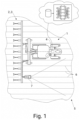
- FIG. 1 shows a schematic top view of an agricultural working machine 1 with an agricultural working unit 2 in an operating situation, here during field cultivation.
- the proposed solution can be applied to a wide range of agricultural machines 1, in particular self-propelled agricultural machines 1.
- the agricultural working machine 1 is a tractor which is equipped in the usual manner with an agricultural working unit 2 in the form of an attachment 3.
- the agricultural working unit 2 is, for example, a mechanical hoe or a cultivator.
- the statements regarding a tractor or such an agricultural working unit 2 apply accordingly to all other types of agricultural working machines 1 or agricultural working units 2.
- the agricultural working machine 1 and the agricultural working unit 2 are operated by an operator, the driver, with a control unit 4 with a computing unit and a storage unit being provided as operator support, which, for example, determines the speed and/or the steering angle of the agricultural working machine 1 and/or can control the working height of the agricultural working unit 2, in particular fully automatically.
- the control of agricultural working machine 1 and/or agricultural working unit 2 by the control unit 4 enables particularly precise processing of a field crop 5 comprising a large number of crops.
- the agricultural working unit 2 shown here in the form of a mechanical hoe or a cultivator the soil between the crops can be processed particularly precisely and comprehensively, for example broken up, without damaging the crops.
- the area between the Crops are detected particularly precisely, even if they are overgrown with undesirable wild herbs (harmful plants).
- rows 6 of plants with several crops can be recognized particularly precisely.
- Fig. 2a is a side view of the agricultural work unit 2 Fig. 1 shown.
- the agricultural machine 1 has a camera system 7 with at least one camera, in particular with a 3D camera, which here and preferably is a stereo camera with two optics 8.
- the camera is mounted on the agricultural working unit 2, but can in principle also be arranged on the agricultural working machine 1 on which the working unit 2 is mounted.
- the camera is arranged on the work unit 2 by means of a fastening element 9.
- the fastening elements 9 are designed as rigid rods or struts on which the at least one camera is arranged, in particular in a height-adjustable manner.
- a linear actuator 10 can be provided for height adjustment.
- the linear actuator 10 can be designed, for example, as a hydraulic cylinder, as a pneumatic cylinder or as an electromechanical linear drive.
- the linear actuator 10 can be controlled by the control unit 4.
- the respective camera system 7 is configured to use the camera to record the field crop 5, i.e. the crop plants or rows of crop plants, in particular in the direction of travel in front of the agricultural work unit 2, and to generate corresponding 3D information of the crop crop 5 by using the camera stereoscopically Pairs of images are recorded along two different viewing axes.
- the exemplary embodiment shown in the figures and preferred in this respect relates to a method for the optimized configuration of a camera system 7 for row recognition in a field 5 during field processing.
- Fig. 2c shows schematically such rows 6.
- Field cultivation can involve, for example, hoeing or cultivating.
- the field cultivation is carried out using an agricultural machine 1.
- the agricultural machine 1 has an attached working unit 2 for row-dependent field cultivation and/or is connected to an agricultural attachment 3 for row-dependent field cultivation.
- a camera system 7 for recording image data, which comprises at least two optics 8, which are arranged on the agricultural machine 1 or the attachment 3 or the work unit 2 and are preferably mounted in a defined position relative to one another.
- the camera system 7 has the two optics 8 for 3D capture of the field 5.
- a control unit 4 is provided, which is arranged here and preferably locally on the agricultural machine 1.
- the control unit 4 analyzes the image data of the camera system 7 in a row detection routine, the row detection routine comprising a colorimetric analysis routine 11, the analysis routine comprising a 3D analysis routine 12, the colorimetric analysis routine 11 being adaptable to local field conditions by colorimetry configuration parameters and the 3D -Analysis routine 12 can be adapted to local field conditions using 3D configuration parameters.
- results of the colorimetric analysis routine 11 and the 3D analysis routine 12 are combined for row recognition and that the colorimetry configuration parameters and/or the 3D configuration parameters are optimized during field processing and/or across different field treatments using a learning method .
- the combination of the results of the colorimetric analysis routine 11 and the 3D analysis routine 12 for row recognition can be done in very different ways.
- the results can be merged, for example using the result with a better quality indicator, but more complex selection algorithms, for example for individual pixels, are also possible.
- the analysis routines can also be used alternately, whereby here and preferably at least temporarily, preferably used for a significant part of the field cultivation at the same time.
- the analysis routines can also build on one another.
- the analysis routines are at least partially carried out independently of one another and their results are then preferably combined.
- the learning procedure is carried out here and preferably by the control unit 4.
- the term “optimized” refers to the activity of optimizing. The optimal result does not necessarily have to be achieved; it is sufficient if a quality indicator or the like is maximized according to an optimization rule or if an optimization is sought in some other way.
- control unit 4 controls the agricultural machine 1 and/or the work unit 2 and/or the attachment 3 based on a result of the row recognition routine.
- the agricultural machine 1 can be controlled better along the rows 6 or the field cultivation can be carried out more precisely, in particular by controlling the working unit 2 in a manner tailored to the rows.
- the proposed method can be used to achieve permanently better local results for specific field properties such as soil properties and/or crop types. It can also be used to automatically achieve optimizations during field processing.
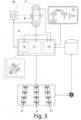
- Fig. 3 clarified, in which it is shown by way of example how a template 13 and the image data of the optics 8 find their way into the 3-D analysis routine and the colorimetric analysis routine 11 with a separation function 14 to be explained and thus a row recognition is carried out and configuration parameters for an adjustment of the The height and angle of the camera arrangement can be determined.
- the 3D analysis routine 12 already achieves very good results that can be quantified and verified by a quality indicator.
- One goal can now be to improve the overall robustness of row detection even with higher weed infestation, i.e. when the weed height approaches to improve the usable stock height. In this case, the 3D analysis routine 12 works less well.
- the control unit 4 can now carry out an analysis of the spectral signature of pixels in the rows 6. It can use a template 13 that has already been recorded automatically or by a user and which has been matched to the rows 6 to determine the position of the crops, so that the spectral signature of the crops can also be recorded. This means that a locally adapted colorimetric spectrum can be recorded for the crops.
- the colorimetric analysis routine 11 can be configured using statistical methods.
- the 3D analysis routine 12 can be configured.
- control unit 4 carries out a learning routine in which the control unit 4 optimizes the colorimetry configuration parameters and/or the 3D configuration parameters.
- the control unit 4 is here and preferably at least partially, in particular completely, arranged on the agricultural machine 1 and carries out the learning routine on local hardware.
- control unit 4 uses a trained machine learning model in the learning routine to optimize the colorimetry configuration parameters and/or the 3D configuration parameters, and/or that the control unit 4 uses the colorimetric analysis routine 11 and/or the 3D analysis routine 12 uses a trained machine learning model to determine the results.
- a trained machine learning model is a machine learning model that has already been trained for the application in a training process and, in the simplest case, no longer learns during the application.
- the trained machine learning model has a training data set, for example weights of neuron connections, and an application specification.
- the application specification generally describes the arithmetic operations to be used and the training data set includes the parameters of the machine learning model determined in the training process, such as the weights and, if necessary, learned hyperparameters.
- a deep learning process is used to create the trained machine learning model.
- the training data set therefore contains configuration parameters for the application rule that is executed as part of the respective routine.
- the machine learning model used in the colorimetric analysis routine 11 and/or the 3D analysis routine 12 is during field processing for current field processing and/or future field processing and/or after field processing for future field processing based on the image data and/or the results the colorimetric analysis routine 11 and/or the 3D analysis routine 12 configured and/or retrained.
- field processing data is recorded and the machine learning model is retrained subsequently or in parallel, for example in a cloud environment. This means that adaptation to local conditions can be carried out over several field treatments.
- the learning routine includes an initialization routine in which the control unit 4 adapts the colorimetry configuration parameters and/or the 3D configuration parameters to a new field or new field conditions, and/or that the learning routine is a routine that is carried out continuously includes, which is carried out in particular cyclically and/or trigger-based.
- the components of the learning routine described here for the learning routine can, within the framework of the proposed teaching, be assigned either to the initialization routine and/or the continuously executed routine.
- a possible trigger is, for example, a quality indicator falling below a certain threshold.
- control unit 4 carries out a determination of a row structure of the field inventory 5, in particular based on a template, in the initialization routine and/or determines an actual camera height and/or an actual camera angle, and/or that Control unit 4 determines configuration parameters of a template 13 for row recognition in the initialization routine.
- control unit 4 can determine a target camera height and a target camera angle from the actual camera height and/or the actual camera angle as part of the learning routine and preferably set them automatically.
- control unit 4 can configure and/or select a separation function 14 in the learning routine for distinguishing between at least plant pixels and soil pixels. Shows as an example Fig. 3 , look like a separation using a separation function 14 into three groups can.
- the control unit 4 can optimize the configuration and/or selection of the separation function 14 with regard to a quality indicator of the row recognition, in particular the 3D analysis routine 12.
- the separation function 14 can be based on a trained machine learning model that is retrained automatically or via user feedback after field processing.
- Separation functions 14 are usually evaluated with respect to an inherent error measure, for example a root-mean-square value. In the present case, in many cases, three-dimensional row detection can instead be used as the gold standard to select or configure the separation function 14.
- One way to select or configure the separation function 14 is that pixels with a clear classification “in the row” and “ground” are statistically evaluated with regard to their spectral characteristics. If there is a sufficient amount of data, the separation function 14 can be adjusted or the most suitable one is selected from several robust separation functions 14.
- the classification between, for example, “in the row” and “ground” can be done by a combination of unique colors and three-dimensional row recognition.
- control unit 4 in the learning routine retrieves a selection and/or configuration of a separation function 14 from a previous field processing, in particular GPS-based, and selects and/or the separation function 14 based on the retrieved selection and/or configuration configured.
- Color spaces of crops, weeds and soil depend on the sowing time, the season, the location and the like. It can be provided that the learning procedure is carried out depending on the time, in particular the season. It can also be provided that the learning method, in particular the learning routine, is carried out on a field depending on field regions and/or that the field regions are learned during the learning routine and preferably refined over several field treatments. After some field work Robust row detection can then be made possible even under difficult conditions, for example when there are tall weeds or poor light. The field regions can be determined and/or saved and/or accessed based on GPS.
- control unit 4 selects the separation function 14 in the learning routine in a crop-specific and/or variety-specific and/or soil-specific and/or weed-specific manner.
- configuration parameters that are colorimetry configuration parameters and 3D configuration parameters and/or configuration parameters that are only colorimetry configuration parameters or only 3D configuration parameters are optimized in the learning method.
- the colorimetry configuration parameters and/or the 3D configuration parameters include hardware-side and/or software-side configuration parameters, preferably that the colorimetry configuration parameters include an exposure of one and/or both optics 8 and/or a separation function 14 and/or configuration parameters a separation function 14, and/or that the 3D configuration parameters include a height and/or an angle of one or both optics 8 of the camera system 7.
- At least temporarily different exposure settings are set on the two optics 8, preferably that the control unit 4 varies the exposure settings of the optics 8 in the learning routine in order to optimize the colorimetry configuration parameters.
- exposure series are advantageous for improving colorimetry, but are complex. Due to the different exposure of the two optics 8, more color data is obtained during field processing than with the same exposure settings. Exposure series can also be carried out twice as quickly.
- a camera system 7 is also proposed for use in the proposed method.
- an agricultural machine 1 be set up for use in the proposed method.
Landscapes
- Engineering & Computer Science (AREA)
- Theoretical Computer Science (AREA)
- Multimedia (AREA)
- Physics & Mathematics (AREA)
- General Physics & Mathematics (AREA)
- Evolutionary Computation (AREA)
- Life Sciences & Earth Sciences (AREA)
- Health & Medical Sciences (AREA)
- General Health & Medical Sciences (AREA)
- Environmental Sciences (AREA)
- Soil Sciences (AREA)
- Mechanical Engineering (AREA)
- Artificial Intelligence (AREA)
- Computer Vision & Pattern Recognition (AREA)
- Computing Systems (AREA)
- Databases & Information Systems (AREA)
- Medical Informatics (AREA)
- Software Systems (AREA)
- Investigating Or Analysing Materials By Optical Means (AREA)
Applications Claiming Priority (1)
| Application Number | Priority Date | Filing Date | Title |
|---|---|---|---|
| DE102022115549.8A DE102022115549A1 (de) | 2022-06-22 | 2022-06-22 | Verfahren zur optimierten Konfiguration eines Kamerasystems zur Reihenerkennung in einem Feldbestand |
Publications (1)
| Publication Number | Publication Date |
|---|---|
| EP4295656A1 true EP4295656A1 (fr) | 2023-12-27 |
Family
ID=86095892
Family Applications (1)
| Application Number | Title | Priority Date | Filing Date |
|---|---|---|---|
| EP23168752.6A Pending EP4295656A1 (fr) | 2022-06-22 | 2023-04-19 | Procédé de configuration optimisée d'un système de caméra pour la détection de rangée dans un actif de terrain |
Country Status (2)
| Country | Link |
|---|---|
| EP (1) | EP4295656A1 (fr) |
| DE (1) | DE102022115549A1 (fr) |
Cited By (1)
| Publication number | Priority date | Publication date | Assignee | Title |
|---|---|---|---|---|
| CN119131461A (zh) * | 2024-08-14 | 2024-12-13 | 中化现代农业有限公司 | 基于图像识别技术的农机作业田间图像处理方法 |
Citations (3)
| Publication number | Priority date | Publication date | Assignee | Title |
|---|---|---|---|---|
| US20200021716A1 (en) * | 2018-07-11 | 2020-01-16 | Raven Industries, Inc. | Adaptive color transformation to aid computer vision |
| EP3932162A1 (fr) | 2020-07-02 | 2022-01-05 | CLAAS E-Systems GmbH | Système de détermination de la position d'une caméra dans un dispositif caméra par rapport à un niveau de plancher |
| EP3417686B1 (fr) * | 2017-06-21 | 2022-01-26 | CLAAS E-Systems GmbH | Engin agricole |
-
2022
- 2022-06-22 DE DE102022115549.8A patent/DE102022115549A1/de active Pending
-
2023
- 2023-04-19 EP EP23168752.6A patent/EP4295656A1/fr active Pending
Patent Citations (3)
| Publication number | Priority date | Publication date | Assignee | Title |
|---|---|---|---|---|
| EP3417686B1 (fr) * | 2017-06-21 | 2022-01-26 | CLAAS E-Systems GmbH | Engin agricole |
| US20200021716A1 (en) * | 2018-07-11 | 2020-01-16 | Raven Industries, Inc. | Adaptive color transformation to aid computer vision |
| EP3932162A1 (fr) | 2020-07-02 | 2022-01-05 | CLAAS E-Systems GmbH | Système de détermination de la position d'une caméra dans un dispositif caméra par rapport à un niveau de plancher |
Cited By (2)
| Publication number | Priority date | Publication date | Assignee | Title |
|---|---|---|---|---|
| CN119131461A (zh) * | 2024-08-14 | 2024-12-13 | 中化现代农业有限公司 | 基于图像识别技术的农机作业田间图像处理方法 |
| CN119131461B (zh) * | 2024-08-14 | 2025-07-25 | 中化现代农业有限公司 | 基于图像识别技术的农机作业田间图像处理方法 |
Also Published As
| Publication number | Publication date |
|---|---|
| DE102022115549A1 (de) | 2023-12-28 |
Similar Documents
| Publication | Publication Date | Title |
|---|---|---|
| EP3417686B1 (fr) | Engin agricole | |
| EP3866593B1 (fr) | Procédé d'épandage d'un produit de pulvérisation sur un champ | |
| EP3782467B1 (fr) | Procédé d'identification des mauvaises herbes dans un rang défini de plantes d'une surface agricole | |
| EP3932162B1 (fr) | Système de détermination de la position d'une caméra dans un dispositif caméra par rapport à un niveau de plancher | |
| DE102016209437B4 (de) | Selbsttätiges Lenksystem zur Führung eines landwirtschaftlichen Fahrzeugs über ein Feld und entsprechendes Verfahren | |
| EP4064818B1 (fr) | Procédé de traitement de plantes dans un champ | |
| WO2021105017A1 (fr) | Procédé de traitement de plantes dans un champ | |
| EP4064819B1 (fr) | Procédé de traitement de plantes dans un champ, de génération de données d'apprentissage et d'entraînement d'un réseau de neurones | |
| DE102018200411A1 (de) | Verfahren zum Bearbeiten eines Bodens sowie Bodenbearbeitungsvorrichtung | |
| WO2021105006A1 (fr) | Procédé d'estimation d'une trajectoire de rangées de plantes | |
| EP4295656A1 (fr) | Procédé de configuration optimisée d'un système de caméra pour la détection de rangée dans un actif de terrain | |
| DE102019218189A1 (de) | Verfahren zum Generieren einer Vielzahl von annotierten Bildern | |
| WO2023110207A1 (fr) | Procédé d'identification de mauvaises herbes dans une rangée de plantes d'une zone agricole | |
| EP4681516A1 (fr) | Dispositif mobile d'analyse et de traitement | |
| EP4268558B1 (fr) | Système d'assistance pour générer des plans de route pour des machines agricoles autonomes | |
| EP3841444A1 (fr) | Système de support pourvu d'un support et d'un dispositif mobile pour le traitement du sol et/ou pour la manipulation de la flore et de la faune et procédé associé | |
| AT521779A4 (de) | Verfahren und Bodenbearbeitungsgerät zum Striegeln | |
| EP4133928A1 (fr) | Procédé d'automatisation d'une tâche de travail agricole | |
| DE102019201977A1 (de) | Verfahren zum Ermitteln eines Zustandes einer Feldfrucht-Bepflanzung und landwirtschaftliches Fahrzeug | |
| EP4292412B1 (fr) | Système d'assistance pour une combinaison de véhicules agricoles | |
| EP3626040B1 (fr) | Système de travail agricole | |
| DE102024105157A1 (de) | Landwirtschaftliches Arbeitsgerät zum Bearbeiten einer landwirtschaftlichen Fläche und Verfahren zum Bearbeiten einer landwirtschaftlichen Fläche | |
| DE102022212161A1 (de) | Verfahren zum Ermitteln einer Breitenkennzahl von Pflanzen einer Pflanzenreihe einer landwirtschaftlichen Fläche | |
| EP4241543A1 (fr) | Machine de travail dotée d'un dispositif de hachage | |
| DE102022212162A1 (de) | Verfahren zum Ermitteln einer Pflanzenkennzahl von Pflanzen einer Pflanzenreihe einer landwirtschaftlichen Fläche |
Legal Events
| Date | Code | Title | Description |
|---|---|---|---|
| PUAI | Public reference made under article 153(3) epc to a published international application that has entered the european phase |
Free format text: ORIGINAL CODE: 0009012 |
|
| STAA | Information on the status of an ep patent application or granted ep patent |
Free format text: STATUS: THE APPLICATION HAS BEEN PUBLISHED |
|
| AK | Designated contracting states |
Kind code of ref document: A1 Designated state(s): AL AT BE BG CH CY CZ DE DK EE ES FI FR GB GR HR HU IE IS IT LI LT LU LV MC ME MK MT NL NO PL PT RO RS SE SI SK SM TR |
|
| P01 | Opt-out of the competence of the unified patent court (upc) registered |
Effective date: 20240102 |
|
| STAA | Information on the status of an ep patent application or granted ep patent |
Free format text: STATUS: REQUEST FOR EXAMINATION WAS MADE |
|
| 17P | Request for examination filed |
Effective date: 20240627 |
|
| RBV | Designated contracting states (corrected) |
Designated state(s): AL AT BE BG CH CY CZ DE DK EE ES FI FR GB GR HR HU IE IS IT LI LT LU LV MC ME MK MT NL NO PL PT RO RS SE SI SK SM TR |