EP4295700A2 - Procédé de production d'analogue de viande et appareil associé - Google Patents
Procédé de production d'analogue de viande et appareil associé Download PDFInfo
- Publication number
- EP4295700A2 EP4295700A2 EP23201714.5A EP23201714A EP4295700A2 EP 4295700 A2 EP4295700 A2 EP 4295700A2 EP 23201714 A EP23201714 A EP 23201714A EP 4295700 A2 EP4295700 A2 EP 4295700A2
- Authority
- EP
- European Patent Office
- Prior art keywords
- cooling
- meat
- unit
- heat
- heating
- Prior art date
- Legal status (The legal status is an assumption and is not a legal conclusion. Google has not performed a legal analysis and makes no representation as to the accuracy of the status listed.)
- Pending
Links
Images






Classifications
-
- A—HUMAN NECESSITIES
- A23—FOODS OR FOODSTUFFS; TREATMENT THEREOF, NOT COVERED BY OTHER CLASSES
- A23L—FOODS, FOODSTUFFS OR NON-ALCOHOLIC BEVERAGES, NOT OTHERWISE PROVIDED FOR; PREPARATION OR TREATMENT THEREOF
- A23L13/00—Meat products; Meat meal; Preparation or treatment thereof
- A23L13/60—Comminuted or emulsified meat products, e.g. sausages; Reformed meat from comminuted meat product
- A23L13/67—Reformed meat products other than sausages
-
- A—HUMAN NECESSITIES
- A23—FOODS OR FOODSTUFFS; TREATMENT THEREOF, NOT COVERED BY OTHER CLASSES
- A23J—PROTEIN COMPOSITIONS FOR FOODSTUFFS; WORKING-UP PROTEINS FOR FOODSTUFFS; PHOSPHATIDE COMPOSITIONS FOR FOODSTUFFS
- A23J3/00—Working-up of proteins for foodstuffs
- A23J3/04—Animal proteins
-
- A—HUMAN NECESSITIES
- A23—FOODS OR FOODSTUFFS; TREATMENT THEREOF, NOT COVERED BY OTHER CLASSES
- A23J—PROTEIN COMPOSITIONS FOR FOODSTUFFS; WORKING-UP PROTEINS FOR FOODSTUFFS; PHOSPHATIDE COMPOSITIONS FOR FOODSTUFFS
- A23J3/00—Working-up of proteins for foodstuffs
- A23J3/14—Vegetable proteins
-
- A—HUMAN NECESSITIES
- A23—FOODS OR FOODSTUFFS; TREATMENT THEREOF, NOT COVERED BY OTHER CLASSES
- A23J—PROTEIN COMPOSITIONS FOR FOODSTUFFS; WORKING-UP PROTEINS FOR FOODSTUFFS; PHOSPHATIDE COMPOSITIONS FOR FOODSTUFFS
- A23J3/00—Working-up of proteins for foodstuffs
- A23J3/22—Working-up of proteins for foodstuffs by texturising
- A23J3/225—Texturised simulated foods with high protein content
- A23J3/227—Meat-like textured foods
-
- A—HUMAN NECESSITIES
- A23—FOODS OR FOODSTUFFS; TREATMENT THEREOF, NOT COVERED BY OTHER CLASSES
- A23K—FODDER
- A23K20/00—Accessory food factors for animal feeding-stuffs
- A23K20/10—Organic substances
- A23K20/142—Amino acids; Derivatives thereof
- A23K20/147—Polymeric derivatives, e.g. peptides or proteins
-
- A—HUMAN NECESSITIES
- A23—FOODS OR FOODSTUFFS; TREATMENT THEREOF, NOT COVERED BY OTHER CLASSES
- A23K—FODDER
- A23K50/00—Feeding-stuffs specially adapted for particular animals
- A23K50/40—Feeding-stuffs specially adapted for particular animals for carnivorous animals, e.g. cats or dogs
- A23K50/48—Moist feed
-
- A—HUMAN NECESSITIES
- A23—FOODS OR FOODSTUFFS; TREATMENT THEREOF, NOT COVERED BY OTHER CLASSES
- A23L—FOODS, FOODSTUFFS OR NON-ALCOHOLIC BEVERAGES, NOT OTHERWISE PROVIDED FOR; PREPARATION OR TREATMENT THEREOF
- A23L5/00—Preparation or treatment of foods or foodstuffs, in general; Food or foodstuffs obtained thereby; Materials therefor
- A23L5/10—General methods of cooking foods, e.g. by roasting or frying
- A23L5/15—General methods of cooking foods, e.g. by roasting or frying using wave energy, irradiation, electrical means or magnetic fields, e.g. oven cooking or roasting using radiant dry heat
Definitions
- the present invention relates to a process and an apparatus for producing a meat analogue.
- Meat analogues are typically prepared by mixing, chopping and emulsifying a mixture of raw meat ingredients such as beef, pork, lamb and chicken obtained from the muscle tissue and meat by-products. These raw meat ingredients are then mixed with various dry ingredients, for example vegetable by-products, starches, vitamins, minerals, gums, and glutens, to make a meat emulsion. The resulting meat emulsion is then extruded into a continuous slab or sheet that is further transferred into a steam tunnel where the slab/sheet is cooked by exposing it to heat. The cooked slab/sheet is then chopped into pieces, a sauce preparation or the like may be optionally added and the meat analogues packed and processed for sterilization.
- raw meat ingredients such as beef, pork, lamb and chicken obtained from the muscle tissue and meat by-products.
- various dry ingredients for example vegetable by-products, starches, vitamins, minerals, gums, and glutens
- WO 2015/172002 A2 discloses a method for producing meat-like chunks, wherein a meat slurry is introduced to a first scraped heat exchanger at a pressure of at least 1241 kPa and heat is applied to the first scraped heat exchanger to produce a first heat-treated meat product having a temperature of 38-66°C, and the first heat-treated meat product is then transferred to a second scraped heat exchanger and heat is applied to the second scraped heat exchanger to produce a second heat-treated meat product having a temperature of 60-85°C. The second heat-treated meat product is then transferred to a steam tunnel for further processing. This process does not provide a sufficient meat-like fibrous structure of the chunks.
- DE 10 2016 125 870 discloses a process for the production of meat analogues, wherein meat batter comprising protein is heated above the melting temperature of the protein by means of scraped surface heat exchangers (SSHE).
- SSHE scraped surface heat exchangers
- Such a process is operated using SSHEs in which a shaft equipped with metal blades is rotated on a hard chromed surface to remove the hottest product phase from the hard chromed surface and replace it with colder product.
- a risk has been identified due to the metal to metal contact at high rotation speeds that metal slivers can be created through the wear of the blades on the outer surface, due to mechanical forces. It has been also found that the heat-up of the meat batter may be further improved, with avoidance of any shear, to result in better product performance, for example with regard to color, smell or taste.
- time-temperature profile could be further improved, start and stop of the system can be improved.
- a risk has been identified that there could be areas in the process where material flow is low or stalled, so that buildup of product can occur, especially when the material flow is stopped for a period of time.
- Jaeger, H., et al: Food Science and Technology, Vol. 55, 2016 describes the use of ohmic heating in the treatment of foods using high energy density from 0.5 to 2 A/m 2 .
- the heating unit suitably comprises at least two sections, wherein the sections are connected in series and each comprises at least one module, which modules are operable by Ohmic heating.
- the heating unit may comprises two sections, wherein the first section into which the meat batter is firstly introduced comprises from 1 to10 modules, and the second section, to which the meat batter is transferred from the first section, comprises from 1 to 7 modules, wherein the modules in the sections are connected in series.
- at least one holding pipe is provided between the first and the second section and/or after the second section, and wherein no electrical energy is applied to this holding pipe.
- step a) is suitably carried out with electrodes applying an electrical current density of 100-5,000 A/m 2 , current/surface area of the electrodes, as an average electrical current density over the heating unit.
- the invention also provides apparatus for the production of a meat analogue comprising:
- each roll (2, 4) is derivably connected to a separate motor (6, 8), each motor (6, 8) being operable to drive the rolls (2, 4) to rotate at equal or different.
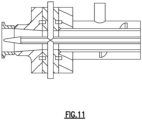
- the cooling lance (40) comprises a coolant supply passage (43) and a coolant return passage (45) that are in fluid communication and a coolant inlet (42) in fluid communication with the coolant supply passage (43) and a coolant outlet (44) in fluid communication with the coolant return passage (45).
- the cooling lance (40) suitably comprises a coolant supply passage (43) and a coolant return passage (45) that are in fluid communication and a coolant inlet (42) in fluid communication with the coolant supply passage (43) and a coolant outlet (44) in fluid communication with the coolant return passage (45).
- the process for producing a meat analogue according to the invention may therefore additionally comprise the steps of mixing ingredients of the meat batter and feeding the prepared meat batter into the heating unit by means of, for examples, infeed pumps.
- the process preferably operates in a closed system under a minimum pressure of about 7-8 bar. This avoids steam formation during heating a moist meat emulsion up to about 170°C. Steam formation within the process may negatively influence texture formation.
- the critical heating process in the heating unit as well as the cooling process and the cooling unit are both separated from the infeed by respective pumps, for example, rotating lobe pumps.
- the apparatus may further comprise a process pump between the heating unit and the cooling unit to further support conveying the heat-treated meat batter to the cooling unit.
- the pumps may ensure, if required, delivering the higher pressures required for conveying the heat-treated meat batter through the cooling unit where it turns into a solid. These pumps are preferably used to manage starts after short line stops.
- the meat batter may be heated to a temperature above the melting point of the protein in just one single and continuous heating unit.
- these modules may be adjusted to the desired power distribution per heating step to create an optimum profile.
- the heating unit may suitably comprise a temperature control system to constantly monitor the temperature at infeed, outfeed and within the heating unit, i.e. also at the individual sections and modules. Additionally, the flow rate may be monitored, and the specific heat of the meat batter to calculate the electrical power needed for the system.
- Ohmic heating step The design of an Ohmic heating unit may consist of electrodes that contact the meat batter, whereby electricity is passed through the meat batter using a variety of voltage and current combinations.
- a power supply generator
- Electrodes connected to the power supply have to be in physical contact with the meat batter in order to pass the electric current through.
- operable by Ohmic heating When used herein the term "operable by Ohmic heating” is to be understood in that the heating unit is provided with equipment, so that Ohmic heating may be carried out. For example, a power generator for generating sufficient electricity (electrical current density) is provided and connected with the electrodes. Further, there is a physical contact of the meat batter and the electrodes.
- the term “operable by Ohmic heating” may suitably be considered to mean “operated by Ohmic heating” when used to describe process steps or "comprising an Ohmic
- the meat batter is as homogenous as possible in order to apply electrical power throughout the meat batter in an easy and homogeneous manner.
- the electrical current density to be applied to the meat batter may be adjusted as desired to achieve the effect required.
- the electrical current density to be applied in the heating unit may be from about 100 to about 5,000 Ampere per square meter of the electrode surface (100-5,000 A/m 2 ), suitably from about 100 to about 4,000; from about 100 to about 3,000; from about 100 to about 2,000; from about 100 to about 1,000; from about 100 to about 900; from about 100 to about 800; from about 200 to about 5000; from about 200 to about 4000; from about 200 to about 3000; from about 200 to about 2000; from about 200 to about 1000; from about 200 to about 900; from about 200 to about 800; from about 300 to about 5000; from about 300 to about 4000; from about 300 to about 4000; from about 300 to about 4000; from about 300 to about 3000; from about 300 to about 2000; from about 300 to about 1000; from about
- the electrical current densities as given above define a mean current density when measuring the electrical current densities over the heating unit including, optionally, sections and modules.
- the meat batter may be heated to a temperature above the melting point of the protein in just one single and continuous heating unit.
- these modules may be adjusted to the desired power distribution per heating step to create an optimum profile.
- the heating unit may comprise a temperature control system to constantly monitor the temperature at infeed, outfeed and within the heating unit, i.e. also at the individual sections and modules. Additionally, the flow rate may be monitored, and the specific heat of the meat batter to calculate the electrical power needed for the system.
- the term "meat analogue” refers to a meat substitute suitable for use in pet or animal food as a meat replacement, which may suitably be a "chunk”.
- the meat analogue may have sensory attributes similar to cooked meat.
- Meat analogues may be incorporated into pet or human food products. They are particularly suitable for inclusion in wet pet food products of all types, e.g. they can be incorporated into pates, loaves and chunk in sauce formats. They are particularly suitable for inclusion in "chunk in sauce” products, e.g. "chunk and gravy", "chunk and jelly” or ⁇ chunk and mousse' products.
- the meat analogues are typically between about 13 mm and about 20 mm in length along the longest dimension. They may suitably have a nutrient composition of about 45 to about 65% moisture, preferably about 50% to about 61% moisture, about 25% to about 36% protein, about 4% to about 13% fat, and about 1% to about 3% ash.
- meat batter comprises both meat containing batters and batters being free of meat and being based on other proteins.
- meat analogue refers to a meat substitute suitable for use in pet or animal food as a meat replacement, which may suitably be a "chunk”.
- the meat analogue may have sensory attributes similar to cooked meat.
- Meat analogues may be incorporated into pet or human food products. They are particularly suitable for inclusion in wet pet food products of all types, e.g. they can be incorporated into pates, loaves and chunk in sauce formats. They are particularly suitable for inclusion in "chunk in sauce” products, e.g.
- the meat analogues are typically between about 13 mm and about 20 mm in length along the longest dimension. They may suitably have a nutrient composition of about 45 to about 65% moisture, preferably about 50% to about 61% moisture, about 25% to about 36% protein, about 4% to about 13% fat, and about 1% to about 3% ash.
- the term "meat batter” refers to a thick mixture of water and other substances derived from raw materials, such as meat or meat by products. They are not emulsions such as mayonnaise or milk, but are dispersions of fat particles and air bubbles in a complex phase composed of water, solubilized meat protein, cellular components and other ingredients.They may also be referred to as a meat emulsion or a meat slurry. These terms are well understood in the art and are used interchangeably. Typically they comprise a continuous phase which is an aqueous medium containing soluble proteins, soluble muscle constituents, segments of muscle fibers, connective tissue fibers, bones etc.
- Meat batters/emulsions/slurries may also contain further additives as is common in the art.
- Meat batters can be obtained by known methods, e.g. by fragmenting frozen meat obtained from animal skeletal muscle to generate meat fragments which may be blended with water, one or more binding agent(s), and optionally other ingredients.
- Frozen meat is suitably chopped, crushed and ground to create a meat batter/slurry/emulsion.
- the ground meat slurry will be size-reduced by use of a system comprising rotating and static elements, for example by means of rotating knives on die plates, and finally passes through a hole of characteristic diameter.
- the maximum diameter of the hole is about 0.5 mm, about 1 mm, about 2 mm, about 3 mm, about 4 mm, about 5 mm, about 6 mm, about 7 mm, about 8 mm, about 9 mm, and/or about 10 mm.
- the resulting finer ground meat emulsion can suitably be transferred to a mixer where water, dry ingredients (e.g. protein powder of vegetable origin) and liquid ingredients (e.g. colourants) can be optionally added to provide a meat batter.
- the term ' protein' refers to one or more proteins suitably provided by one or more of the raw materials.
- the protein may suitably be animal proteins, vegetable proteins or any combination thereof.
- Animal proteins include any protein of animal origin (including vertebrate and invertebrate proteins), e.g. proteins derived from mammals, fowl, fish and insects. Examples of suitable animal proteins include those derived from chicken, turkey, beef, lamb, pork, venison, buffalo, duck, kangaroo, shell fish, crustaceans, salmon, tuna, whitefish etc. They may suitably be derived from muscle meat, organs, tendons, bone etc. Further suitable animal proteins include milk or egg derived proteins.
- Suitable vegetable proteins include proteins derived from wheat gluten, soy protein isolate, maize, pea, rice, peanuts, hemp, cotton seed, lupine, potato etc. or blends thereof. Also proteins based on bacteria funghi, yeast and algae may be used. The proteins may be in any suitable form, e.g. isolated or partially isolated; concentrated; ground etc. In one embodiment, the meat analogue may be on a fully vegetarian basis.
- the meat batter is heated in the first section to a temperature of about 90°C to about 120°C; about 100°C to about 120°C; about 90°C to about 115°C; about 100°C to about 115°C; about 90°C to about 110°C; or about 100°C to about 110°C.
- the heat-treated product is heated in the second section to a temperature of about 140°C to about 170°C; about 145°C to about 170°C; about 150°C to about 170°C; about 155°C to about 170°C; about 160°C to about 170°C; about 140°C to about 165°C; about 145°C to about 165°C; about 150°C to about 165°C; 155°C to about 165°C or about 160°C to about 165°C.
- the residence time of the meat batter in the first section may be below 180 seconds, the residence time of the meat batter in the second section of the heating unit maybe below 110 seconds.
- the meat batter maybe heated above the denaturation temperature of the protein, while the meat batter may be heated above the melting temperature of the protein in the second section.
- the first section may be followed by a holding pipe for temperature homogenization.
- a second holding pipe may be provided after the second section to, again, improve temperature homogenization in the heat-treated product.
- the split into two distinctive heating steps within the first and second sections may improve the process stability.
- the number of modules in the first and section sections may be the same or different.
- the pressure in the heating unit, the pressure in the first section and the pressure in the second section exceeds the water vapor pressure at the respective local temperature.
- the pressure in the heating unit may be in the range between 800 to about 4,000 kPa.
- the pressure in the first section and the pressure in the second section are substantially equal and are preferably in a range between about 800 to about 2000 kPa; about 800 to about 1,800 kPa; about 1,000 to about 1,800 kPa; about 1,000 to about 1,500 kPa; more preferably between about 1000 kPa to about 1250 kPa.
- This pressure range allows efficiency of energy transfer.
- the heat-treated product may suitably be divided into pieces at a temperature of about 40°C to about 100°C in the center of the product; about 40°C to about 70°C; about 50°C to about 80°C; about 50°C to about 70°C.
- the meat batter utilized in the inventive process typically comprises a mixture of proteins having differing denaturation temperatures and melting temperatures.
- at least 35wt-%, 40wt-%, 50 wt-%, 60 wt-%, 70 wt-%, 80 wt-% or 90 wt-% of protein, based on the total amount of protein in the meat batter, is melted.
- Most preferably substantially all the protein is melted. In one embodiment, it is only necessary that enough protein is melted to form a cohesive and continuous outer phase of the heat-treated product that may carry nonmelted other proteins, fibers, bone particles, etc.
- the term "denaturation" related to proteins means that denatured proteins have lost their three-dimensional structure. Denatured proteins may exhibit a wide range of characteristics, from loss of solubility to protein aggregation. Someone skilled in the art is well aware what is to be understood under a denatured protein.
- the melting point of a protein is the temperature at which it changes state from solid to liquid at the pressure selected. The denaturation temperature of a protein may be measured by methods well known in the art, for example by use of a rubber process analyzer.
- a respective analyzer from TA Instruments, Wetzlar, Germany, Model RPA Elite, may be used, measuring viscoelastic properties of protein/moisture samples pursuing a temperature sweep analysis delivering a protein melting range.
- Concerning the melting range for the proteins used rheological measurements maybe utilized, wherein the melting range is the temperature range, where after an increase in viscosity due to the denaturing (unfolding) of the proteins a drop of viscosity is observed indicating a change from a suspension of solids into a homogeneous liquid phase.
- the melting point of a protein may be measured by methods well known in the art, for example by differential scanning calorimetry (DSC) or rheology.
- viscosity measurement can be done in a closed and pressurized cell to avoid steam formation at temperatures exceeding 100°C.
- Suitable rheometer is Anton Paar Rheometer MCR 301 equiped with pressurized and magnetically coupled cell CC25/PR150/SS equipped with a measuring bob, B-CC25/PR/Ti and performing a temperature sweep at a constant shear rate.
- respective data of denaturation temperature and melting point can be also obtained from scientific literature.
- the heat treated product is suitably a layered and/or aligned product formed as the material cools in step (b).
- a layered fibrous meat analogue structure is formed.
- Steps (b) and/or step (c) is optionally performed under pressure of about 800-4000 kPa, so that the protein solidifies step by step in layers which create a fibrous structure.
- the aggregate of the protein changes from a liquid melt to a solid phase.
- the tearing step was used to be done using a hammer mill which, however, leads to a relatively high percentage of small particles (“fines”), i.e. particles being smaller than 5 ⁇ 5mm, being produced.
- the apparatus and in particular the tearing unit of the invention leads to a significantly reduced percentage of fines and to an improved visibility of the inner texture of the pieces which i.a. can be explained by the harsh treatment in a hammer mill, in particular high speeds of the pieces and impacts on hard surfaces. Also, it is considered that fine particles are at least partly re-integrated into the pieces when being passed through the roll nip.
- the heated material is further conveyed and pressurised, i.g. above 8 bar, towards a cooling unit.
- the heat treated material texturizes and solidifies.
- the material is cooled down below 100°C and is divided into pieces, e.g. by cutting.
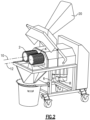
- the pieces or chunks of material are torn in a tearing unit in order to clearly display the inner (fibrous) texture, and to make the individual pieces less regular, i.e. so as not to have regular geometries of the pieces like cubes, cylindrical elements and so on.
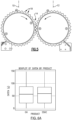
- Figs. 3 to 5 show further views and details of the pair of rolls 2, 4.
- Axes of rotation 10, 12 of the rolls 2, 4 are parallel to each other and arranged at a distance d from each other which is adjustable by a mechanism not shown in detail.
- the distance d is at least 0.1 mm, 0.2 mm, 0.5 mm or 1 mm more than a minimum distance.
- the minimum distance is a distance where both rolls are in touch with each other i.e. cannot be moved further towards each other, and where the width w of a roll nip 14 is a minimum, in particular zero.
- the distance d is 0.2 mm more than the minimum distance, leaving a gap or a width w of the roll nip 14 of 0.2 mm.
- each circumferential line or circle of projections 16 of one roll is positioned, in an axial direction, between two adjacent circumferential lines of projections of the opposing roll so that when rotating, a meshing or interlocking rotation of the projections occurs.
- rollers When used herein, the terms “roller” and “roll” are interchangable.
- the rollers can be controlled to rotate at equal or different speeds. Preferably the rollers rotate at different speeds.
- the ratio of the revolutions per minute of the rolls can be at least 0.01, e.g. at least 0.03, 0.1, 0.5, 0.7, 0.8, 0.9, 0.95, 0.98 or 0.99 thereby leading to a combined effect of compression and tearing (creation of shear forces).
- the ratio of the revolutions per minute of the rolls is suitably from about 1:1 to about 1:91; from about 1:1 to about 1:75; from about 1:1 to about 1:50; from about 1:1 to about 1:25; from about 1:1 to about 1:10; from about 1:1 to about 1:9; from about 1:1 to about 1:8; from about 1:1 to about 1:7; from about 1:1 to about 1:6; from about 1:1 to about 1:5; from about 1:1 to about 1:4; from about 1:1 to about 1:3; from about 1:1 to about 1:2; from about 1:1 to about 1:1.5.
- Suitable ratios are about 1:10; 1:20; 1:30; 1:40; 1:50; 1:60; 1:70; 1:80 and 1:90.
- rollers operate at different speeds
- rollers operate at the above ratios.
- Apparatus in which the rollers can be set to operate at different speeds is also provided, preferably the rollers can be set to operate at the above ratios.
- FIG. 7 shows the flow diagram of a process for the production of a meat analogue according to a special embodiment of the invention.
- Said process comprises several steps in the order from left to right. The number and/the sequence of said steps can vary dependent on the tasks to be achieved.
- said process comprises mixing of recipe ingredients like powders and fluids. Thereafter the mixed recipe ingredients are conveyed and pressurized by pumping. Then by way of heating proteins are melted. By way of pumping the hot product melt is conveyed and pressurized. Thereafter the hot melt products cooled for texturization and solidification. Then the cooled-down heat-treated product is divided into pieces by cutting. The pieces are torn to provide or improve the visibility of the inner fibrous texture and to irregularize individual pieces.
- the cooling lance 40 does not extend over the whole length of the cooling pipe 34.
- the cooling lance 40 (see also Fig. 13 ) is mounted co-centrically within the cooling pipe 34 by way of at least one mount or support 41.
- the cooling pipe 34 is segmented into several coolant segments with respective coolant inlets 50 and coolant outlets 52.
- the cooling lance 40 is divided in length direction in two passages for coolant supply and coolant return.
- Fig. 11 for example there is an upper coolant inlet 42 in fluid connection with the coolant supply passage 43 and a lower coolant outlet 44 in fluid connection with the coolant return passage 45.
- Fig. 12 there might by at least one temperature and/or pressure sensor 46 for measuring the temperature and/or the pressure of the hot product melt in the cooling pipe 34.
- the frame 32 is like the embodiment shown in the figures 7 to 13 also provided with wheels 34 for movement of the whole cooling unit 30, but the frame is divided into three subframes 36.
- the cooling pipe 34 is segmented into cooling pipe segments 35. Said cooling pipe segments 35 are held together by way of holding plates 38.
- the cooling lance 40 is constructed in a different way than the cooling lance of the embodiment shown in figures 7 to 13 .
- the coolant supply passage 43 and the coolant return passage 45 are realised by way of a pipe-in-pipe assembly.
- the viscosity of the hot product melt at the inlet of the cooling pipe is 10 to 15 Pas (for example the viscosity of the melt is 12 Pas at 160°C) and at the outlet of the cooling pipe the viscosity of the product is > 50 Pas or > 150 Pas or > 1000 Pas or > 5000 Pas or > 100000 Pas at temperature ⁇ 100°C.
- the material may be nearly solid.
- the velocity of the movement of the hot product melt is in a range of 2.95 m/sec to 3.25 m/sec and more preferably 3 m/sec.
- the hot product melt at the inlet of the cooling pipe has a temperature in a range between 150°C and 170°C, e.g. 157°C.
- the cooling pipe suitably has an outer pipe diameter of about 40 to 70mm, about 40 to 65mm, about 40 to 60mm, about 40 to 55mm, about 40 to 50mm, about 40 to 45mm, about 45 to 70mm, about 45 to 65mm, about 45 to 60mm, about 45 to 55mm, about 45 to 50mm, about 50 to 70mm, about 50 to 65mm, about 50 to 60mm, about 50 to 55mm.
- the cooling pipe suitably has an inner pipe diameter of less than about 100mm, less than about 90mm, less than about 80mm or less than about 70mm, e.g. suitably about about 60mm, about 55mm, about 55mm, about 50mm, about 45mm, about 40mm, about 35mm or about 30mm e.g.
- the length of the cooling pipe is suitably about 2 to 10m, about 3 to 9m, about 4 to 8m or about 5 to 7m, e.g. about 3m, about 4m, about 5m, about 6m, about 7m or about 8m.
- the cooling lance diameter is suitably 10 to 30mm, 10 to 25mm, 10 to 20mm, 15 to 30mm, 25 to 25mm 15 to 20mm, e.g. about 15mm, about 20mm or about 25mm.
- the length of the cooling lance in suitably about 2 to 4m, about 2.5 to 4m, about 3 to 4m, about 3.5 to 4m, about 2 to 3.5m, about 2.5 to 3.5m, about 3 to 3.5m, about 3 to 4m, about 3.5 to 4m, e.g. about 2.5m, about 2.6m, about 2.7m, about 2.8m, about 2.9m, about 3m, about 3.1m, about 3.2m, about 3.3m, about 3.4m or about 3.5m, preferably about 3,1m.
- a tearing apparatus was constructed with two rollers arranged as shown in Figures 3 to 5 .
- the axes of rotation 10, 12 of the rolls 2, 4 being parallel to each other and adjustably arranged to touch each other and to provide a roll nip of about 0.5 mm.
- the rollers 2, 4 having a plurality of projections 16 arranged on an outer surface of each roller, shaped as a pyramid having a square base area and four triangular sides converging in a pointed tip 18.
- the projections 16 being arranged in rows parallel to the axis of rotation, and along circumferential lines, i.e. circles, perpendicularly to the direction of the rows.
- rollers 2,4 were arranged as shown in Figure 4 so that each circumferential line or circle of projections 16 of one roll was positioned, in an axial direction, between two adjacent circumferential lines of projections of the opposing roll so that when rotating, a meshing or interlocking rotation of the projections occurred.
- the rollers were set to rotate at different speeds.
- the ratio of the revolutions per minute of the rolls was set at about 1:60.
- a tearing apparatus as described in Example 1 was constructed having rollers arranged to provide a gap (roll nip) of about 0.7 mm.
- Example 4 A process for preparing improved meat analogues using the tearing
- Example 3 A process for preparing improved meat analogues using the tearing
- Three parts of a batter containing 90.8% meat and animal derivatives substantially based on chicken, 4.7% water, and 4.5% of at least one of vitamins, minerals, palatants, colorants, etc. (all percentages are weight percentages based on the total weight of te slurry) as to achieve a nutritionally complete cat food finished product were mixed with one part vegetable protein powder containing min. 75% protein (vital wheat gluten) to form a single solid mixture containing 30.5% crude protein, 59% moisture and 4.5% fat (all percentages of the semi-solid mixture are based on the total weight of the semi-solid mixture).
- Three parts of a batter containing 90.8% meat and animal derivatives substantially based on tuna, 4.7% water, and 4.5% of at least one of vitamins, minerals, palatants, colorants, etc. (all percentages are weight percentages based on the total weight of the slurry) as to achieve a nutritionally complete cat food finished product were mixed with one part vegetable protein powder containing min. 75% protein (vital wheat gluten) to form a single solid mixture containing 30.5% crude protein, 59% moisture and 4.5% fat (all percentages of the semi-solid mixture are based on the total weight of the semi-solid mixture).
- the SSHE unit was continuously supplied with steam at a temperature between 166-168°C and the shaft operated at 200 rpm-300 rpm.
- the outlet temperature of the material from this heating unit was between 158-160°C.
- the material was then directed to a cooling area by a second positive displacement pump through which its temperature was brought down to below 80°C.
- the solid material obtained was cut to produce meat analogues/fish analogues with internal fibrosity.
Landscapes
- Life Sciences & Earth Sciences (AREA)
- Chemical & Material Sciences (AREA)
- Polymers & Plastics (AREA)
- Engineering & Computer Science (AREA)
- Food Science & Technology (AREA)
- Health & Medical Sciences (AREA)
- Nutrition Science (AREA)
- Biochemistry (AREA)
- Zoology (AREA)
- Animal Husbandry (AREA)
- Birds (AREA)
- Molecular Biology (AREA)
- Proteomics, Peptides & Aminoacids (AREA)
- Meat, Egg Or Seafood Products (AREA)
- Fodder In General (AREA)
- General Preparation And Processing Of Foods (AREA)
- Apparatuses For Bulk Treatment Of Fruits And Vegetables And Apparatuses For Preparing Feeds (AREA)
- Glanulating (AREA)
- Feed For Specific Animals (AREA)
Applications Claiming Priority (5)
| Application Number | Priority Date | Filing Date | Title |
|---|---|---|---|
| DE102020109068 | 2020-04-01 | ||
| DE102020109083 | 2020-04-01 | ||
| DE102020109076 | 2020-04-01 | ||
| PCT/EP2021/058778 WO2021198501A1 (fr) | 2020-04-01 | 2021-04-01 | Procédé de production d'analogue de viande et appareil associé |
| EP21717027.3A EP4125410A1 (fr) | 2020-04-01 | 2021-04-01 | Procédé de production d'analogue de viande et appareil associé |
Related Parent Applications (1)
| Application Number | Title | Priority Date | Filing Date |
|---|---|---|---|
| EP21717027.3A Division EP4125410A1 (fr) | 2020-04-01 | 2021-04-01 | Procédé de production d'analogue de viande et appareil associé |
Publications (2)
| Publication Number | Publication Date |
|---|---|
| EP4295700A2 true EP4295700A2 (fr) | 2023-12-27 |
| EP4295700A3 EP4295700A3 (fr) | 2024-03-20 |
Family
ID=75426601
Family Applications (2)
| Application Number | Title | Priority Date | Filing Date |
|---|---|---|---|
| EP23201714.5A Pending EP4295700A3 (fr) | 2020-04-01 | 2021-04-01 | Procédé de production d'analogue de viande et appareil associé |
| EP21717027.3A Pending EP4125410A1 (fr) | 2020-04-01 | 2021-04-01 | Procédé de production d'analogue de viande et appareil associé |
Family Applications After (1)
| Application Number | Title | Priority Date | Filing Date |
|---|---|---|---|
| EP21717027.3A Pending EP4125410A1 (fr) | 2020-04-01 | 2021-04-01 | Procédé de production d'analogue de viande et appareil associé |
Country Status (9)
| Country | Link |
|---|---|
| US (1) | US20230172240A1 (fr) |
| EP (2) | EP4295700A3 (fr) |
| JP (2) | JP2023520321A (fr) |
| CN (1) | CN115867143B (fr) |
| AU (1) | AU2021250653A1 (fr) |
| BR (1) | BR112022019668A2 (fr) |
| CA (1) | CA3171765A1 (fr) |
| MX (1) | MX2022012150A (fr) |
| WO (1) | WO2021198501A1 (fr) |
Families Citing this family (3)
| Publication number | Priority date | Publication date | Assignee | Title |
|---|---|---|---|---|
| CH721526A1 (de) * | 2024-01-22 | 2025-07-31 | Buehler Ag | Vorrichtung und Verfahren zum Formen eines alternativen Fleischprodukts |
| JP7684475B1 (ja) * | 2024-05-20 | 2025-05-27 | 株式会社ソディック | 加工装置および食品の製造方法 |
| JP7818254B1 (ja) * | 2025-09-22 | 2026-02-20 | 株式会社 思考館 | 食料の剪断・粉砕及び殺菌による粉状化装置 |
Citations (6)
| Publication number | Priority date | Publication date | Assignee | Title |
|---|---|---|---|---|
| EP1231846B2 (fr) | 1999-11-16 | 2013-02-13 | Societe Des Produits Nestle S.A. | Procédé de production d'un produit d'émulsion de viande |
| WO2015020873A1 (fr) | 2013-08-08 | 2015-02-12 | General Mills, Inc. | Système et procédé de production d'un produit protéique extrudé |
| WO2015172002A2 (fr) | 2014-05-09 | 2015-11-12 | USPET Nutrition, LLC | Fragments d'aliment semblables à de la viande pour animaux de compagnie |
| WO2016055940A1 (fr) | 2014-10-10 | 2016-04-14 | Nestec Sa | Produits alimentaires non carnés ayant l'aspect et la texture de la viande cuite |
| DE102016125870A1 (de) | 2016-12-29 | 2018-07-05 | Mars Inc. | Verfahren und Vorrichtung zur Herstellung einer Fleischnachbildung |
| EP2252159B1 (fr) * | 2008-02-28 | 2018-12-26 | Fromageries Bel | Procédé de fabrication d'un fromage frais thermisé et fromage obtenu |
Family Cites Families (27)
| Publication number | Priority date | Publication date | Assignee | Title |
|---|---|---|---|---|
| US446485A (en) * | 1891-02-17 | Beef-steak tenderer | ||
| US1376585A (en) * | 1918-04-02 | 1921-05-03 | Robbins Charles | Gear-housing for meat-crushers |
| DE3311331C2 (de) * | 1983-03-29 | 1986-10-23 | Hermann 7777 Salem Schwelling | Abstreifersystem für die Schneid- oder Reißwalzen von Aktenvernichtern |
| US5340354A (en) * | 1993-02-24 | 1994-08-23 | Thomas Anderson | Meat tenderizing apparatus and process for tenderizing meat |
| DE19503394C2 (de) * | 1995-02-02 | 1998-03-19 | Linus Maeder | Reiß- oder Hackwerk zur Zerkleinerung von Produkten |
| JP2805195B2 (ja) * | 1996-05-27 | 1998-09-30 | 日食商事株式会社 | ペットフードの製造方法 |
| US6716470B2 (en) * | 2000-08-17 | 2004-04-06 | Purina Mills, Inc. | Method and apparatus for making an animal feed gel using a cooled pipe |
| DE10105150C2 (de) * | 2001-01-30 | 2003-10-02 | Hurnaus Stahl Und Maschb Gmbh | Zerkleinerer |
| JP4065768B2 (ja) * | 2002-11-28 | 2008-03-26 | 株式会社フロンティアエンジニアリング | 飲食物の加熱装置 |
| JP2005073501A (ja) * | 2003-08-29 | 2005-03-24 | Izumi Food Machinery Co Ltd | 流動性を有する食品原料の連続通電加熱装置 |
| CN2734329Y (zh) * | 2003-11-21 | 2005-10-19 | 张亚平 | 一种医疗废物粉碎装置 |
| ES2445665T3 (es) * | 2005-02-25 | 2014-03-04 | Barilla G. E R. Fratelli S.P.A. | Aparato y método para la producción de productos de pastelería con masa quebrada, en particular galletas, que tienen partículas comestibles |
| AU2008203407A1 (en) * | 2007-07-30 | 2009-02-19 | Sava Gruescu | Meat tenderiser |
| MX2012006161A (es) * | 2009-12-08 | 2012-07-03 | Kellog Co | Proceso para producir productos basados en grano formados con precision. |
| WO2012050603A1 (fr) * | 2010-10-15 | 2012-04-19 | Nestec S.A. | Procédés de fabrication de produits à base d'émulsion de viande ayant un aspect et une texture réalistes ressemblant à de la viande |
| US8287268B1 (en) * | 2011-04-15 | 2012-10-16 | Thomas Michael R | Distiller grain pellet production devices |
| CA3065598C (fr) * | 2011-07-28 | 2022-06-07 | Societe Des Produits Nestle S.A. | Procedes et dispositifs pour chauffer ou refroidir des materiaux visqueux |
| RU2621016C2 (ru) * | 2011-12-16 | 2017-05-30 | Нестек С.А. | Способы и устройства для нанесения частиц на поверхность формованных продуктов |
| GB2504486A (en) * | 2012-07-30 | 2014-02-05 | Meltech Eng | Continuous Extrusion Apparatus |
| CN204180849U (zh) * | 2014-10-28 | 2015-03-04 | 吉林曙光农牧有限公司 | 一种鸡肉拉丝机 |
| CN107205436A (zh) * | 2015-01-29 | 2017-09-26 | 雀巢产品技术援助有限公司 | 肉糜产品、制造此类产品的方法、以及含有此类产品的宠物食品 |
| CN106563523A (zh) * | 2016-10-30 | 2017-04-19 | 华北理工大学 | 一种两段破碎筛分辊式破碎机 |
| EP3618642B1 (fr) * | 2017-05-03 | 2024-09-11 | Mars Incorporated | Alliage de titane-tantale et son procédé de formation |
| GB201713155D0 (en) * | 2017-08-16 | 2017-09-27 | Mars Inc | Pet food product |
| EP3817570A4 (fr) * | 2018-07-02 | 2022-04-20 | Mars Incorporated | Procédé et appareil de production d'un succédané de viande |
| US20200323237A1 (en) * | 2019-04-10 | 2020-10-15 | Université De Montpellier | Texturized food products containing insoluble particles and methods for making such food products |
| US20200329735A1 (en) * | 2019-04-18 | 2020-10-22 | Société des Produits Nestlé S.A. | Emulsion heating devices and methods |
-
2021
- 2021-04-01 EP EP23201714.5A patent/EP4295700A3/fr active Pending
- 2021-04-01 US US17/995,302 patent/US20230172240A1/en active Pending
- 2021-04-01 CA CA3171765A patent/CA3171765A1/fr active Pending
- 2021-04-01 BR BR112022019668A patent/BR112022019668A2/pt unknown
- 2021-04-01 WO PCT/EP2021/058778 patent/WO2021198501A1/fr not_active Ceased
- 2021-04-01 JP JP2022557125A patent/JP2023520321A/ja active Pending
- 2021-04-01 AU AU2021250653A patent/AU2021250653A1/en active Pending
- 2021-04-01 CN CN202180024445.1A patent/CN115867143B/zh active Active
- 2021-04-01 EP EP21717027.3A patent/EP4125410A1/fr active Pending
- 2021-04-01 MX MX2022012150A patent/MX2022012150A/es unknown
-
2024
- 2024-12-09 JP JP2024214399A patent/JP7741954B2/ja active Active
Patent Citations (6)
| Publication number | Priority date | Publication date | Assignee | Title |
|---|---|---|---|---|
| EP1231846B2 (fr) | 1999-11-16 | 2013-02-13 | Societe Des Produits Nestle S.A. | Procédé de production d'un produit d'émulsion de viande |
| EP2252159B1 (fr) * | 2008-02-28 | 2018-12-26 | Fromageries Bel | Procédé de fabrication d'un fromage frais thermisé et fromage obtenu |
| WO2015020873A1 (fr) | 2013-08-08 | 2015-02-12 | General Mills, Inc. | Système et procédé de production d'un produit protéique extrudé |
| WO2015172002A2 (fr) | 2014-05-09 | 2015-11-12 | USPET Nutrition, LLC | Fragments d'aliment semblables à de la viande pour animaux de compagnie |
| WO2016055940A1 (fr) | 2014-10-10 | 2016-04-14 | Nestec Sa | Produits alimentaires non carnés ayant l'aspect et la texture de la viande cuite |
| DE102016125870A1 (de) | 2016-12-29 | 2018-07-05 | Mars Inc. | Verfahren und Vorrichtung zur Herstellung einer Fleischnachbildung |
Non-Patent Citations (1)
| Title |
|---|
| JAEGER, H. ET AL., FOOD SCIENCE AND TECHNOLOGY, vol. 55, 2016 |
Also Published As
| Publication number | Publication date |
|---|---|
| MX2022012150A (es) | 2023-01-18 |
| JP2025032253A (ja) | 2025-03-11 |
| BR112022019668A2 (pt) | 2022-11-29 |
| CA3171765A1 (fr) | 2021-10-07 |
| WO2021198501A1 (fr) | 2021-10-07 |
| JP7741954B2 (ja) | 2025-09-18 |
| US20230172240A1 (en) | 2023-06-08 |
| EP4125410A1 (fr) | 2023-02-08 |
| CN115867143B (zh) | 2025-03-28 |
| AU2021250653A1 (en) | 2022-10-13 |
| CN115867143A (zh) | 2023-03-28 |
| JP2023520321A (ja) | 2023-05-17 |
| EP4295700A3 (fr) | 2024-03-20 |
Similar Documents
| Publication | Publication Date | Title |
|---|---|---|
| EP3562320B1 (fr) | Procédé pour la production d'un succédané de viande | |
| JP7741954B2 (ja) | 食肉類似品の製造プロセス及び製造装置 | |
| AU2019299248B2 (en) | Process and apparatus for the production of a meat analogue | |
| JP7441324B2 (ja) | 肉類似物を製造する方法、並びにそれによって調製された肉類似物 | |
| EP4021199A1 (fr) | Procédé de production d'un analogue de viande et analogue de viande ainsi préparé | |
| AU2019299245B2 (en) | Process and apparatus for the production of a meat analogue | |
| AU2019299243B2 (en) | Process and apparatus for the production of a meat analogue | |
| HK40015416B (en) | Process for the production of a meat analogue | |
| HK40015416A (en) | Process for the production of a meat analogue | |
| RU2805555C2 (ru) | Способ и устройство для получения аналога мяса |
Legal Events
| Date | Code | Title | Description |
|---|---|---|---|
| PUAI | Public reference made under article 153(3) epc to a published international application that has entered the european phase |
Free format text: ORIGINAL CODE: 0009012 |
|
| STAA | Information on the status of an ep patent application or granted ep patent |
Free format text: STATUS: THE APPLICATION HAS BEEN PUBLISHED |
|
| AC | Divisional application: reference to earlier application |
Ref document number: 4125410 Country of ref document: EP Kind code of ref document: P |
|
| AK | Designated contracting states |
Kind code of ref document: A2 Designated state(s): AL AT BE BG CH CY CZ DE DK EE ES FI FR GB GR HR HU IE IS IT LI LT LU LV MC MK MT NL NO PL PT RO RS SE SI SK SM TR |
|
| REG | Reference to a national code |
Ref country code: DE Ref legal event code: R079 Free format text: PREVIOUS MAIN CLASS: A23L0013600000 Ipc: A23J0003040000 |
|
| PUAL | Search report despatched |
Free format text: ORIGINAL CODE: 0009013 |
|
| AK | Designated contracting states |
Kind code of ref document: A3 Designated state(s): AL AT BE BG CH CY CZ DE DK EE ES FI FR GB GR HR HU IE IS IT LI LT LU LV MC MK MT NL NO PL PT RO RS SE SI SK SM TR |
|
| RIC1 | Information provided on ipc code assigned before grant |
Ipc: A23L 13/60 20160101ALI20240213BHEP Ipc: A23L 5/10 20160101ALI20240213BHEP Ipc: A23K 50/48 20160101ALI20240213BHEP Ipc: A23K 20/147 20160101ALI20240213BHEP Ipc: A23J 3/22 20060101ALI20240213BHEP Ipc: A23J 3/14 20060101ALI20240213BHEP Ipc: A23J 3/04 20060101AFI20240213BHEP |
|
| STAA | Information on the status of an ep patent application or granted ep patent |
Free format text: STATUS: REQUEST FOR EXAMINATION WAS MADE |
|
| 17P | Request for examination filed |
Effective date: 20240918 |
|
| RBV | Designated contracting states (corrected) |
Designated state(s): AL AT BE BG CH CY CZ DE DK EE ES FI FR GB GR HR HU IE IS IT LI LT LU LV MC MK MT NL NO PL PT RO RS SE SI SK SM TR |
|
| STAA | Information on the status of an ep patent application or granted ep patent |
Free format text: STATUS: EXAMINATION IS IN PROGRESS |
|
| 17Q | First examination report despatched |
Effective date: 20260508 |