EP4297316A1 - Amélioration de transmission continue de transmission coopérative - Google Patents
Amélioration de transmission continue de transmission coopérative Download PDFInfo
- Publication number
- EP4297316A1 EP4297316A1 EP23179550.1A EP23179550A EP4297316A1 EP 4297316 A1 EP4297316 A1 EP 4297316A1 EP 23179550 A EP23179550 A EP 23179550A EP 4297316 A1 EP4297316 A1 EP 4297316A1
- Authority
- EP
- European Patent Office
- Prior art keywords
- signal
- message
- subslot
- retransmission
- node
- Prior art date
- Legal status (The legal status is an assumption and is not a legal conclusion. Google has not performed a legal analysis and makes no representation as to the accuracy of the status listed.)
- Pending
Links
Images







Classifications
-
- H—ELECTRICITY
- H04—ELECTRIC COMMUNICATION TECHNIQUE
- H04L—TRANSMISSION OF DIGITAL INFORMATION, e.g. TELEGRAPHIC COMMUNICATION
- H04L1/00—Arrangements for detecting or preventing errors in the information received
- H04L1/08—Arrangements for detecting or preventing errors in the information received by repeating transmission, e.g. Verdan system
-
- H—ELECTRICITY
- H04—ELECTRIC COMMUNICATION TECHNIQUE
- H04L—TRANSMISSION OF DIGITAL INFORMATION, e.g. TELEGRAPHIC COMMUNICATION
- H04L1/00—Arrangements for detecting or preventing errors in the information received
- H04L1/12—Arrangements for detecting or preventing errors in the information received by using return channel
- H04L1/16—Arrangements for detecting or preventing errors in the information received by using return channel in which the return channel carries supervisory signals, e.g. repetition request signals
- H04L1/18—Automatic repetition systems, e.g. Van Duuren systems
- H04L1/1812—Hybrid protocols; Hybrid automatic repeat request [HARQ]
-
- H—ELECTRICITY
- H04—ELECTRIC COMMUNICATION TECHNIQUE
- H04L—TRANSMISSION OF DIGITAL INFORMATION, e.g. TELEGRAPHIC COMMUNICATION
- H04L1/00—Arrangements for detecting or preventing errors in the information received
- H04L1/12—Arrangements for detecting or preventing errors in the information received by using return channel
- H04L1/16—Arrangements for detecting or preventing errors in the information received by using return channel in which the return channel carries supervisory signals, e.g. repetition request signals
- H04L1/18—Automatic repetition systems, e.g. Van Duuren systems
- H04L1/1829—Arrangements specially adapted for the receiver end
- H04L1/1835—Buffer management
- H04L1/1845—Combining techniques, e.g. code combining
-
- H—ELECTRICITY
- H04—ELECTRIC COMMUNICATION TECHNIQUE
- H04L—TRANSMISSION OF DIGITAL INFORMATION, e.g. TELEGRAPHIC COMMUNICATION
- H04L1/00—Arrangements for detecting or preventing errors in the information received
- H04L1/12—Arrangements for detecting or preventing errors in the information received by using return channel
- H04L1/16—Arrangements for detecting or preventing errors in the information received by using return channel in which the return channel carries supervisory signals, e.g. repetition request signals
- H04L1/18—Automatic repetition systems, e.g. Van Duuren systems
- H04L1/1829—Arrangements specially adapted for the receiver end
- H04L1/1848—Time-out mechanisms
-
- H—ELECTRICITY
- H04—ELECTRIC COMMUNICATION TECHNIQUE
- H04L—TRANSMISSION OF DIGITAL INFORMATION, e.g. TELEGRAPHIC COMMUNICATION
- H04L1/00—Arrangements for detecting or preventing errors in the information received
- H04L2001/0092—Error control systems characterised by the topology of the transmission link
- H04L2001/0097—Relays
Definitions
- a method includes establishing a multiple access communication scheme among a plurality of network nodes, wherein the multiple access communication scheme utilizes subslots. In one or more embodiments, the method further includes transmitting an initial transmission from an originating node or a retransmitting node in a first subslot to at least one relay node, wherein the initial transmission includes a first signal that is sufficient to convey a message.
- the method further continuing to transmit, by the originating node to the at least one relay node, additional signal including at least one of a retransmitted portion of the first signal, a transmission of an algorithmically related signal based on the first signal, or a transmission of the algorithmically related signal based on the message, within the first subslot or a beginning of a subsequent subslot, wherein the additional signal is transmitted by the originating node or retransmitting node past a decision point is used by the at least one relay node to determine whether to transmit a retransmission of the first signal to convey the message in the subsequent subslot or a next subsequent subslot.
- the method further includes determining by the at least one relay node that it has received the message. In one or more embodiments, the method further includes preparing the retransmission of the first signal, the algorithmically related signal based on the first signal, or the algorithmically related signal conveying the message by the at least one relay node within a future subslot based upon a determination at the decision point that the at least one relay has received the message, wherein preparing the retransmission includes determining the first signal, the algorithmically related signal based on the first signal, or the algorithmically related signal based on the message, that is coordinated in content between the originating node and the relay nodes transmitting the message.
- the method further includes transmitting the retransmission of the first signal, the algorithmically related signal based on the first signal, or the algorithmically related signal based on the message, in the future subslot, wherein the retransmission is coordinated in time between all the relay nodes transmitting the message.
- transmitting the first signal with the additional signal increases a likelihood of correct reception of the first signal by another node in the subsequent subslot.
- the algorithmically related signal based on the first signal or the algorithmically related signal based on the message includes error correcting code.
- the retransmitted portion of the first signal is transmitted into the first subslot.
- the retransmitted portion of the first signal is transmitted into the beginning of the subsequent subslot.
- the wherein the algorithmically related signal based on the first signal or the algorithmically related signal based on the message is transmitted into the first subslot.
- the algorithmically related signal is transmitted into the subsequent subslot.
- a section of the first subslot receiving the retransmitted portion of the first signal, or the algorithmically related signal corresponds to a guard interval.
- a section of the first subslot receiving the retransmitted portion of the first signal, the algorithmically related signal based on the first signal, or the algorithmically related signal based on the message corresponds to a guard interval.
- the algorithmically related signal based on the first signal, or the algorithmically related signal based on the message corresponds to a preamble interval.
- the plurality of network nodes is configured to perform an avalanche relay protocol.
- the method further includes partitioning an available communication resource into slots, and the subslots
- the method further includes preparing the retransmission of the first signal by the at least one relay node within the future subslot, based on the determination at the decision point that the at least one relay has not received the message, wherein the at least one relay node does not retransmit the retransmission of the first signal in the subsequent subslot, wherein the at least one relay node retransmits the first signal conveying the message as the retransmission in the first subslot after a successful reception of the message prior to the decision point, wherein the retransmission of the first signal is based on data transmitted past the decision point by the originating node and/or retransmitting nodes.
- preparing the retransmission includes continuing to receive additional signal until a next decision point. In some embodiments, preparing the retransmission further includes combining the first signal with at least one of the retransmitted portion of the first signal, the algorithmically related signal based on the first signal, or the algorithmically related signal based on the message. In some embodiments, preparing the retransmission further includes detecting if the message conveyed by the first signal has been correctly received based on a combination of the first signal and the retransmitted portion of the first signal, the algorithmically related signal based on the first signal, or the algorithmically related signal based on the message in prior subslots and up to the decision point.
- preparing the retransmission further includes generating the retransmission of the first signal conveying the message by the at least one relay node within the future subslot based upon the determination at the next decision point that the at least one relay has received the message, wherein generating the retransmission includes determining the first signal, the algorithmically related signal based on the first signal, or the algorithmically related signal based on the message, that is coordinated in content between the originating nodes and the relay nodes transmitting the message.
- the method further includes transmitting the retransmission of the first signal, the algorithmically related signal based on the first signal, or the algorithmically related signal based on the message, in the future subslot, wherein the retransmission is coordinated in time between all relays transmitting the message.
- the method further includes preparing the retransmission further includes continuing to receive additional signal until one or more subsequent decisions points after the next decision point.
- the additional signal is transmitted by all transmitting nodes continuing to transmit during a preamble interval during which at least one node transmits a preamble
- the retransmission of the first signal, the algorithmically related signal based on the first signal, or the algorithmically related signal based on the message further includes additional data that is transmitted past the decision point.
- a system in one or more embodiments, includes a plurality of network nodes. In one or more embodiments of the system, two or more network nodes includes an antenna, a transmitter, and a receiver. In one or more embodiments of the system, the two or more network nodes further include one or more processors. In one or more embodiments of the system, the two or more network nodes further include a memory with instructions stored upon that are executed by the one or more processors. In one or more embodiments, the instructions include establishing a multiple access communication scheme among the plurality of network nodes, wherein the multiple access communication scheme utilizes subslots.
- the instructions further include transmitting an initial transmission from an originating node or a retransmitting node in a first subslot to at least one relay node, wherein the initial transmission comprises a first signal that is sufficient to convey a message.
- the instructions further include continuing to transmit to transmit, by the originating node to the at least one relay node, additional signal comprising at least one of a retransmitted portion of the first signal, a transmission of an algorithmically related signal based on the first signal or a transmission of the algorithmically related signal based on the message, within the first subslot or a beginning of a subsequent subslot, wherein the additional signal is transmitted by the originating node or retransmitting node past a decision point used by the at least one relay node to determine whether to transmit a retransmission of the first signal to convey the message in the subsequent subslot.
- the system further includes determining by the at least one relay node that the at least one relay node has received the message. In one or more embodiments, the system further includes the retransmission of the first signal conveying the message by the at least one relay node within a future subslot based upon a determination at the decision point that the at least one relay has received the message, wherein preparing the retransmission comprises determining the first signal, the algorithmically related signal based on the first signal, or the algorithmically related signal based on the message, that is coordinated in content between all originating nodes and all relay nodes transmitting the message.
- the instructions further include transmitting the retransmission of the first signal, the algorithmically related signal based on the first signal, or the algorithmically related signal based on the message, in the future subslot, wherein the retransmission is coordinated in time between all relays transmitting the message.
- a combination of the first signal with the retransmitted portion of the first signal, the algorithmically related signal based on the first signal, or the algorithmically related first signal based on the message increases a likelihood of a reception of the first signal by another node.
- the instructions further cause the one or more processor to prepare the retransmission of the first signal by the at least one relay node within the future subslot, based on the determination at the decision point that the at least one relay node has not received the message, wherein the at least one relay node does not retransmit the retransmission of the first signal in the subsequent subslot, wherein the at least one relay node retransmits the first signal conveying the message as the retransmission in the first subslot after a successful reception of the message prior to the decision point, wherein the retransmission is based on data transmitted past the decision point by the originating node and/or retransmitting nodes.
- preparing the retransmission comprises continuing to receive additional signal until a next decision point. In some embodiments, preparing the retransmission further comprises combining the first signal with at least one of the retransmitted portion of the first signal, the algorithmically related signal based on the first signal, or the algorithmically related signal based on the message. In some embodiments, preparing the retransmission further comprises detecting if the message conveyed by the first signal has been correctly received based on a combination of the first signal and the retransmitted portion of the first signal, the algorithmically related signal based on the first signal, or the algorithmically related signal based on the message, in prior subslots and up to the decision point.
- preparing the retransmission further comprises generating the retransmission of the first signal conveying the message by the at least one relay node within the future subslot based upon the determination at the next decision point that the at least one relay has received the message, wherein generating the retransmission comprises determining the first signal, the algorithmically related signal based on the first signal, or the algorithmically related signal based on the message, that is coordinated in content between all originating nodes and all relay nodes transmitting the message.
- the instructions further cause the one or more processor to transmit the retransmission of the first signal, the algorithmically related signal based on the first signal, or the algorithmically related signal based on the message, in the future subslot, wherein the retransmission is coordinated in time between all relays transmitting the message.
- the method includes establishing a multiple access communication scheme among a plurality of network nodes, wherein the multiple access communication scheme utilizes subslots. In one or more embodiments, the method further includes transmitting an initial transmission from an originating node or a retransmitting node in a first subslot to at least one relay node, wherein the initial transmission comprises a first signal that is sufficient to convey a message.
- the method further includes continuing to transmit, by the originating node to the at least one relay node, additional signal comprising at least one of a retransmitted portion of the first signal, a transmission of an algorithmically related signal based on the first signal, or the algorithmically related signal based on the message, within the first subslot or a beginning of a subsequent subslot, wherein the additional signal is transmitted by the originating node or retransmitting node past a decision point used by the at least one relay node to determine whether to transmit a retransmission of the first signal to convey the message in the subsequent subslot.
- the method further includes determining by the at least one relay node that the at least one relay node has received the message.
- the method further includes preparing the retransmission of the first signal by the at least one relay node within a future subslot, based on a determination at the decision point that the at least one relay has not received the message, wherein the at least one relay node does not retransmit the retransmission of the first signal in the subsequent subslot, wherein the at least one relay node retransmits the first signal conveying the message as a retransmission in the first subslot after a successful reception of the message prior to the decision point, wherein the retransmission of the first signal is based on data transmitted past the decision point by the originating node and/or retransmitting nodes.
- preparing the retransmission includes continuing to receive additional signal until a next decision point. In one or more embodiments, preparing the retransmission further includes combining the first signal with at least one of the retransmitted portion of the first signal, the algorithmically related signal based on the first signal, or the algorithmically related signal based on the message. In one or more embodiments, preparing the retransmission further includes detecting if the message conveyed by the first signal has been correctly received based on a combination of the first signal and the retransmitted portion of the first signal, the algorithmically related signal based on the first signal, or the algorithmically related signal based on the message, in prior subslots and up to the decision point.
- preparing the retransmission further includes generating a retransmission of the first signal conveying the message by the at least one relay node within the future subslot based upon the determination at the next decision point that the at least one relay has received the message, wherein generating the retransmission of the first signal comprises determining the first signal, the algorithmically related signal based on the first signal, or the algorithmically related signal based on the message, that is coordinated in content between the originating nodes and relay nodes transmitting the message.
- the method further includes transmitting the retransmission of the first signal, the algorithmically related signal based on the first signal, of the algorithmically related signal based on the message, in the future subslot, wherein the retransmission is coordinated in time between all relays transmitting the message.
- nodes transmitting in the first subslot transmits additional signal in a preamble interval in the subsequent subslot, wherein at least one node that does not transmit in the subsequent subslot transmits a preamble in a preamble interval of a next subslot after the subsequent subslot and retransmits the first signal in the next subslot after the subsequent subslot.
- a letter following a reference numeral is intended to reference an embodiment of the feature or element that may be similar, but not necessarily identical, to a previously described element or feature bearing the same reference numeral (e.g., 1, 1a, 1b).
- reference numeral e.g. 1, 1a, 1b
- Such shorthand notations are used for purposes of convenience only and should not be construed to limit the disclosure in any way unless expressly stated to the contrary.
- any reference to “one embodiment” or “some embodiments” means that a particular element, feature, structure, or characteristic described in connection with the embodiment is included in at least one embodiment disclosed herein.
- the appearances of the phrase “in some embodiments” in various places in the specification are not necessarily all referring to the same embodiment, and embodiments may include one or more of the features expressly described or inherently present herein, or any combination of sub-combination of two or more such features, along with any other features which may not necessarily be expressly described or inherently present in the instant disclosure.
- a system and method for performing relaying transmissions utilize a time-diverse, multiple access relay scheme (e.g., a TDMA method using slots, with one or more slots containing subslots), wherein an initial transmission, which includes a first signal conveying a message, is transmitted in a first subslot (e.g., of a first slot) and received by a relay node, which retransmits the first signal, or an algorithmically related signal based on the first signal (e.g., conveying the same message as the first signal and/or including error correcting code) in a subsequent subslot.
- a first subslot e.g., of a first slot
- a relay node which retransmits the first signal, or an algorithmically related signal based on the first signal (e.g., conveying the same message as the first signal and/or including error correcting code) in a subsequent subslot.
- Each transmission may be received by several relay nodes and subsequently retransmitted in later sub
- the first signal, or algorithmically related signal based on the first signal is sufficient to convey a message from one node to another.
- the message may be conveyed via an algorithmically related signal that is based on the message.
- Additional signals are also transmitted that may be combined with the first signal and/or algorithmically related signal based on the first signal to increase the probability of reception of the message.
- the additional signals may include signals that convey the message on its own, or may include signals that augment elements of the first signal and/or algorithmically related signal based on the first signal.
- the system and method utilize an avalanche relay protocol, as described in United States patent No. 4,639,937, entitled "HF avalanche relay communication technique" filed by McRae on December 7th, 1983 , which is incorporated by reference in its entirety.
- the system and method of the current disclosure describe nodes that, having transmitted a first signal within a subslot, may continue to transmit data, such as a portion of already-transmitted first signal, or the algorithmically related signal, which may include error correcting code corresponding to the already-transmitted transmission, within the same subslot, or the beginning of the subsequent subslot.
- processors within nodes receiving the transmission make a decision on whether to be silent or retransmit the message. This decision is based on error detection codes ((e.g., CRC) or other methods which are used to indicate whether the data that the node has detected has been correctly received.
- error detection codes (e.g., CRC) or other methods which are used to indicate whether the data that the node has detected has been correctly received
- the receiving node may then prepare a retransmission, and transmit the retransmission in a subsequent, or future, subslot.
- subslotcomprising e.g., avalanche
- the current system and method reduces the number of guard intervals and/or preambles, within each slot, decreasing transmit inactive time and decreasing the probability of a faulty reception by increasing the proportion of time and therefor signal energy devoted to the information bits.
- FIG. 1 is a diagram illustrating a system 90 that includes multiple nodes 100a-g (e.g., network nodes) of a network 104, in accordance with one or more embodiments of the disclosure.
- the network 104 may be configured as any type of mobile or non-mobile network, any type of wireless or wireline network, and any type of centralized or decentralized (e.g., ad hoc) network.
- the network 104 may be configured as a wireless mobile ad hoc network (MANET).
- MANET wireless mobile ad hoc network
- the network 104 may be configured with any type of topography including but not limited to mesh, star, ring, line, tree, bus, and fully connected topologies.
- the network 104 may be configured as a MANET with a mesh topology.
- each node 100a-g represent lines of communication that are capable between each node, where each node 100a-g can receive and transmit data with at least one other node 100 a-g.
- This arrangement allows all nodes 100a-g to eventually receive the same data.
- each node 100a-g is capable of receiving data conveying a message within a subslot of a TMDA slot (e.g., the first signal) and transmitting the same message in the next available subslot, with all nodes 100a-g receiving the message by the end of the slot (e.g., resulting in a fully connected topology).
- the network 104 includes at least one node 100a-g configured to transmit a first signal and at least one node 100 a-g configured to relay the first signal.
- a block diagram of a node 100 a-g is shown in FIG. 2 , in accordance with one or more embodiments of the disclosure.
- One or more nodes 100a-g of the network 104 may contain a transmitter 204, a receiver 205 (e.g., or a transceiver) and an antenna 208.
- the transmitter 204, receiver 205 and the antenna 208 may be configured to send and receive a diversity signal.
- the transmitter 204 and/or receiver 205 may be configured to perform time-division multiple access (TDMA) based communication.
- TDMA time-division multiple access
- One or more nodes 100a-g may also be configured to utilize spread-spectrum/frequency hopping techniques, and may be configured to operate under other channel access methods including but not limited to frequency-division multiple access (FDMA), code-division multiple access (CDMA), spread spectrum multiple access, space-division multiple access, powerdivision multiple access (PDMA), packet mode methods, and the like.
- FDMA frequency-division multiple access
- CDMA code-division multiple access
- PDMA powerdivision multiple access
- packet mode methods and the like.
- the node 100a-g may include a controller 240 configured to provide processing functionality for the node 100a-g.
- the controller 240 comprises one or more processors 244, a memory 248, and a computer interface 252.
- the one or more processors 244 may include any processor or processing element known in the art.
- the term "processor” or "processing element” may be broadly defined to encompass any device having one or more processing or logic elements (e.g., one or more micro-processor devices, one or more application specific integrated circuit (ASIC) devices, one or more field programmable gate arrays (FPGAs), or one or more digital signal processors (DSPs)).
- ASIC application specific integrated circuit
- FPGAs field programmable gate arrays
- DSPs digital signal processors
- the one or more processors 244 may include any device configured to execute algorithms and/or instructions (e.g., program instructions stored in memory 248).
- the one or more processors 244 may be embodied as a desktop computer, a flight computer, mainframe computer system, workstation, image computer, parallel processor, networked computer, or any other computer system configured to execute a program configured to operate the node 100a-g, as described throughout the present disclosure.
- different subsystems of the node 100a-g may include a processor or logic elements suitable for carrying out at least a portion of the steps described in the present disclosure. Therefore, the above description should not be interpreted as a limitation on the embodiments of the present disclosure but merely as an illustration.
- the node 100a-g is configured to detect signal quality and/or alter a transmission profile of the communication scheme based on signal quality.
- Signal quality may include an ability of the node 100a-g to transmit/receive a signal and may include the environment for signal transmission.
- the node 100a-g may be configured to alter the transformation profile of the communication scheme due to interference caused by a lightning storm.
- Signal quality may also be used in determining whether correct reception has been made by a node 100a-g
- the memory 248 can be an example of tangible, computer-readable storage medium that provides storage functionality to store various data and/or program code associated with operation of the controller 240 and/or other components of the node 100a-g, such as software programs and/or code segments, or other data to instruct the controller 240 and/or other components to perform the functionality described herein.
- the memory 248 can store data, such as a program of instructions for operating the node 100a-g or other components.
- the memory 248 can be integral with the controller, can comprise stand-alone memory, or can be a combination of both.
- the memory 248 can include removable and non-removable memory components, such as a programmable logic device, random-access memory (RAM), read-only memory (ROM), flash memory (e.g., a secure digital (SD) memory card, a mini-SD memory card, and/or a micro-SD memory card), solid-state drive (SSD) memory, magnetic memory, optical memory, universal serial bus (USB) memory devices, hard disk memory, external memory, and so forth.
- RAM random-access memory
- ROM read-only memory
- flash memory e.g., a secure digital (SD) memory card, a mini-SD memory card, and/or a micro-SD memory card
- SSD solid-state drive
- magnetic memory magnetic memory
- optical memory optical memory
- USB universal serial bus
- the communication interface 252 can be operatively configured to communicate with components of the controller 240 and other components of the node 100a-g.
- the communication interface 252 can be configured to retrieve data from the controller 240 or other components, transmit data for storage in the memory 248, retrieve data from storage in the memory 248, and so forth.
- the communication interface 252 can also be communicatively coupled with controller 240 and/or system elements to facilitate data transfer between system components.
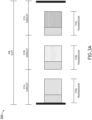
- the network 104 may be configured to operate in a TDMA scheme 300, as illustrated in FIGS. 3A-5B , in accordance with one or more embodiments of the disclosure.
- the TDMA scheme 300 may be synchronized, with multiple nodes transmitting within an available communication resource (e.g., a time period).
- the TDMA scheme 300 may include one or more slots 308 partitioned into two or more subslots 312a-c. Messages, or portions of messages, may be transmitted over the slots 308 and subslots 312a-c in a time orderly fashion, with the messaging repeated (transmissions 316 a-c) within the different subslots 312a-c.
- a transmission may be transmitted by a node 100a in a first subslot 312a, then received by another node 100b and retransmitted in a subsequent subslot 312b.
- the transmission and retransmission of a signals within subslots 312a-b of a single slot 308 is a hallmark of an avalanche relay, which is disclosed in United States patent No. 4,639,937, entitled "HF avalanche relay communication technique" filed by McRae .
- the TDMA scheme 300 does not necessarily have rigid slots 308.
- an asynchronous initial transmission can form a first subslot 312 of a slot 308 with subsequent retransmissions timed relative to received transmissions in previous subslots 312.
- the slot can appear asynchronously (e.g., can appear at any time) and is not required to be embedded in a rigid TDMA structure.
- an initial transmission 316 transmitting a first signal 318 within a traditional single subslot 312 is demonstrated in FIG. 3B , in accordance with one or more embodiments of the disclosure.
- the initial transmission 316a includes a first signal 318 (e.g., transmitted during a block of transmission time within the subslot 312 which includes the message to be sent.
- the initial transmission 316a further includes a preamble (e.g., transmitted during a preamble interval 322) usually organized at the beginning of the subslot 312.
- Data transmitted during the preamble interval 322 includes timing and synchronizing information that ensures that the TADA receiver can ascertain the presence of the signal and the timing of the first signal 318 as it is transmitted and/or retransmitted at specific times.
- the traditional subslot 312 further makes use of a guard interval 324 (e.g., or guard time) after the end of the first signal that prevents the transmission 216 a-c from overlapping and allows time for receivers to detect the data contained in the first signal and make a decision (e.g., at a decision point 326) on whether to continue to receive or to retransmit the first signal 318 or algorithmically related signal (e.g., based on the first signal 318 or the message) in the next subslot.
- a guard interval 324 e.g., or guard time
- the first signal 318 may be used by the node 100a-g in determining if the transmitter 204 of the node can retransmit the first signal 318 in the next subslot 312b. For example, once the first signal 318 is received by the receiver 205, the node 100a-g may decide 1) whether the first signal 318 has been correctly received, and 2) whether the first signal 318 can be retransmitted into a future subslot 312.
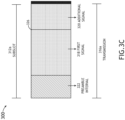
- the initial transmission 316 may include additional signals 320 including at least one of a retransmitted portion of the first signal 218 or an algorithmically related signal (e.g., based on the first signal 318 or the message) as shown in FIG. 3C , in accordance with one or more embodiments of the disclosure.
- the additional signals 320 may be transmitted after the first signal 318 is transmitted.
- the additional signals may be transmitted at the end, to the end, or near the end, of the subslot 312 (e.g., essentially replacing the guard interval 324 of a traditional subslot 312).
- the additional signals 320 are used by the receiver 205 of the node 100a-g to improve the likelihood of correctly detecting the information in the next subslot.
- additional signals 320 transmitted by a node 100a-g in the first subslot 312a may be combined with to the first signal 318 during the period of the second subslot.
- processors 244 within the node 100a-g determine whether the message conveyed by the first signal 318 has been correctly received and should be retransmitted, the node 100a-g can retransmit the first signal 318 or an algorithmically related first signal in a third or later subslot 312c-n.
- the steps of receiving additional signals 320, combining the signals, and determining that the message has been received are time sensitive. For example, a receiving node 100 will receive additional signals 320 up to the decision point 326, at which time the received signals will need to be combined and processed so that a determination can be made on whether to prepare to retransmit the message in the next subslot 312.
- the combining of signals in this disclosure may refer to either the combination of signals directly (e.g., the combination of a first signal 318 and with additional signals 320 that contain a retransmitted portion of the first signal 318) or to the combination of information derived from the signals.
- the bits may be detected and the combining step may occur after the detection and be undertaken with bits, rather than signal.
- the bits may also be represented as soft-decisions and the combination may employ soft decisions.
- a transmission may also include error detection and correction code. For example, if an error detection and correction code is transmitted and received, the received signal may be combined and detected (e.g., as bits or soft decisions) prior to running the error correction and detection code.
- the error correction and detection decoder may operate with bits that are output from independent detections of each of the first signals and additional signals.
- the modulated bits in the first signal and any retransmitted first signal, or the modulated bits in the additional signal or any retransmitted additional signal need to be the same as they may be different bits derived from parity equations from a low-rate error detection and correction code operating on the same message.
- the combining of signals may be performed by various circuitry within the controller 240 (e.g., via the one or more processors 244), or other node componentry.
- the combining of signals may be performed by an equalizer integrated within, or separated from, the one or more processors 244. Once the equalizer has combined the signal, the node may then determine whether the message has been correctly received based on the combined signal, and the combined signal may be retransmitted in a subsequent subslot 312 based on whether the determination of a correctly received combined signal comes before or after a specific decision point 326.
- the retransmitted portion of the first signal 318 included within the additional signal 320 may include any portion, or any size of portion, of the first signal 318.
- the retransmitted portion of the first signal may include roughly the first third of the first signal 318.
- the algorithmically related signal, based on the first signal 318 or the message, may include any data related to the first signal including but not limited to error correcting code, as detailed herein.
- FIG. 3D demonstrates a subslot 312b, configured with a transmission 316a that continues from subslot 312a into subslot 312b, and a transmission 316b that initiates and ends in subslot 312b, in accordance with one or more embodiments of the disclosure.
- the transmission 316 includes an extended additional signal 320 that is transmitted through the boundary of the two subslots.
- the preamble interval 322 is reduced and/or omitted from subslot 312b.
- the additional signal 320 may be transmitted by the transmitter 204 after a short delay after transmitting the first signal 318 (e.g., the subslot 312 retaining a small guard interval 324 or preamble interval 322), or may be transmitted without break from the transmitter 204.
- Transmitting a transmission 316a into the beginning of a subsequent subslot 312b is possible for all subslots 312 within the slot 308 with the exception of the first subslot 312a, as an initial preamble interval 322 is required at the beginning of any transmission, either by an originating node, or a retransmitting node.
- the end of the subslot may be reserved for a guard interval 342 (e.g., as shown in FIG. 3D ), or may have additional signal 320 transmitted as shown in FIG. 3E .
- nodes 100a-g that continue to transmit additional signal 320 must ensure that the same signal is transmitted by all with the additional signal 320 essentially an extension of the first signal, that replaces the guard interval 324 and/or preamble interval 322 and may serve to increase the likelihood of the first signal 318 being correctly detected by another node 100a-g in a subsequent slot.
- FIG. 3F A traditional transmission profile 328 of the TDMA scheme 300 showing three slots 308a-c, each with three subslots 312a-c, is shown in FIG. 3F in accordance with one or more embodiments of the disclosure.
- Each node 100a-g is capable of originating and relaying a transmission 316a-c, and each slot 308a-c is used to send a signal (e.g., the first signal 318 in the first slot 308a, a second signal 332 in the second slot 308b, and a third signal 336 in the third slot 308c) that is transmitted or retransmitted via the three subslots 312a-c, which act to ensure that each targeted nodes 308a-g have correctly received the first signal 318, the second signal 332, and the third signal 336.
- a signal e.g., the first signal 318 in the first slot 308a, a second signal 332 in the second slot 308b, and a third signal 336 in the third slot 30
- a node 100a transmits the transmission 316a for the first time (e.g., the initial transmission).
- the transmission 316a is received by three nodes 100b-d and retransmitted (e.g., transmission 316b) in the second subslot 312b of the first slot 308a.
- the node 100a may also retransmit the transmission 316b as well.
- the first signal 318 once transmitted by the initiating node 100a, retains the status as the first signal 318 after retransmission through another node 100a-g within the same slot 308a, as the message encoded by the first signal 318a does not change.
- a first signal that may be encoded (e.g., to produce an algorithmically related signal) by a node 100a-e and transmitted and may still referred to as a first signal 318 or may be referred to as an algorithmically related signal (i.e., the first signal retains the same message, whether or not a retransmission of the first signal has been encoded).
- the algorithmically related signal may also include, or may only include, error correcting code that corresponds to the first signal.
- the first signal 318 and all retransmitted signals and algorithmically related signals in slot 308a may contain the same message.
- a subsequent signal transmitted by an initiating node that contains a message different that the first signal is referred to as a second signal 332 or third signal 336.
- the original transmission and subsequent retransmissions shown in slot 308a is similarly performed in slot 308b, 308c, and may include messages and signals derived from those messages that are identical to, or different than, first signals 318 transmitted in slot 308a.
- node 100d is acting as the originating node and transmits the transmission 316a, in the first subslot 312a of slot 308b.
- Nodes 100a-e receive the transmission and transmit or retransmit into the second subslot 312b of the second slot 308b.
- Nodes 100a-f receive the transmission 316b and transmit or retransmit into the third subslot 312c of the second slot.
- node 100g initiates the transmission 316a in subslot 312a, which is then transmitted and retransmitted in subslots 312b-c. Retransmitting transmissions 316a-c into subslots 312a-c creates time-diverse signals that increase the ability of a single node 100 to competently receive the transmission 316a-c.
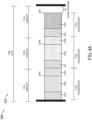
- FIG. 4A discloses a transmission profile 402 for the TDMA scheme 300 with transmissions 316a-b that extend to the end of the subslot 312a-b as shown in FIG. 3C , in accordance with one or more embodiments of the disclosure.
- the subslots 312a-c include first signals 318a-c which may or may not be the same signal, but all convey the same message (e.g., first signal 318c is a retransmission of the message and algorithmically related to first signal 318b, which is a retransmission of the message and algorithmically related to first signal 318a), additional signals 320a-b transmitted in the first two subslots 312a-b, with subslot 312c retaining a guard interval.
- first signals 318a-c which may or may not be the same signal, but all convey the same message (e.g., first signal 318c is a retransmission of the message and algorithmically related to first signal 318b, which is a retrans
- Guard intervals 324 represents a substantial overhead relative to the portion of the subslot 312 dedicated to transmitting data (e.g., the first signal 318).
- the additional signals 320a-b containing the retransmitted portions of the first signal 318 or an algorithmically related signal, which may include error correction code (e.g., parity bits) permit each node 100a-e to perform a quality check on each transmission 316a-c as carrying additional data or parity bits in these intervals may improve the likelihood of success in subsequent decoding cycles.
- error correction code e.g., parity bits
- CRC cyclic redundancy check
- Data for error checking may further include any type of data for any type of error correction or error correction schemes including but not limited to minimum distance coding, repetition codes, checksums, hash functions, and forward error correction and may include signal quality indications in the determination of whether errors are present.
- FIG. 4B demonstrates an expanded transmission profile 404 of a TDMA scheme 300 where transmissions 316a-b are transmitted as shown in FIG. 4A , in accordance with one or more embodiments of the disclosure.
- the first subslot 312a and the second subslot 312b transmit additional signal 320, while the last subslot may retain a guard interval 324.
- the data replacing the guard interval 324 in subslots 312a-b can substantially increase transmission efficiencies. For example, where a guard interval 324 occupies approximately half the duration in a subslot 312 as the original data carrying signal, 50% more data carrying signal becomes available, which may be used to reduce code rate and improve the likelihood of correct reception. This approach is valid for both equalized signals requiring positive signal-to-noise ratios for detection and for spread spectrum signals in negative signal-to-noise schemes.
- each subslot comprises a decision point 326a-c wherein a node 100 a-g must make a decision on whether the node 100 a-g has a valid reception of the first signal 318 and can retransmit the first signal 318 into a subsequent, or future, subslot 312. For example, if a node 100a-g decides that the received first signal 318 is valid (e.g., at decision point 326a), the node 100a-g may then transmit the first signal 318 in the subsequent subslot 312.
- a node 100a may decide at decision point 326a not to retransmit the first signal 318 in the next subslot 312b and may instead continue to receive and use both the addition signal 320a and the next subslot 312b for gathering additional information to improve the detection of the first signal 318, wherein the node 1003 receives additional signal 320a from subslot 312a together with a retransmitted first signal 318b to perform the detection..
- the node 100a then combines the received first signals 318a and 318b with the additional signal 320a to make a decision at the next decision point 326b.
- the node 100a-g may then decide (e.g., at the next decision point 326b) to transmit the first signal 318 at the next available subslot 312c. It should be understood that a node 100a-g receiving a first transmission 316a within a first subslot 312a of a slot 308 cannot combine the received signal with additional signal 320, as there is no previously transmitted additional signal 320 that can be combined with the received signal.
- first signals 318a and additional signals 320a to influence the reception of the first signal 318 by a downstream node 100 can be shown by the originating node 100d and relay node 100e transmitting the second signal 332 within slot 308b in FIG. 4B .
- originating node 100d initially transmits a (first) second signal 332a that is not successfully detected by node 100e, and particularly node 100e cannot discern second signal 332a as valid at decision point 326d. For this reason, node 100e is silent during the second subslot 312b of the slot 308b. Instead, node 100e keeps listening for signal, and receives additional signal 320a and the (second) second signal 332b.
- node 100e has combined the signals from the second signals 332a-b and the additional signals 320a (e.g., as indicated by arrows 408, has determined that the second signal received is valid, and transmits the second signal 332.
- a node 100e not successfully receiving a signal in a first subslot 312a may be silent in the second subslot 312b, may combine data received in the first subslot 312a and the second subslot 312b, and may transmit a retransmission based on the combination of data received in the first subslot 312a and the second subslot 312b in the third subslot 312c.
- the first subslot 312a may be configured as the initial subslot 312(e.g., the first subslot 312 in the slot 308), or may be configured as the first subslot 312 that a retransmission is transmitted by a node 100.
- the originating node may also be considered to be either the first transmitting node 100a in the slot 308, or as a node 100 that transmits a first signal 318 that is received by another slot 308.
- node 100f is successful in receiving the second signal 332a in the first subslot 312a of the second slot 308b, as shown by node 100f retransmitting the second signal 332a as second signal 332b in subslot 312b.
- retransmission of the second signal 332a requires that the node make the decision to retransmit by decision point 326d.
- Node 100f then retransmits into subslot 312c the second signal 332c.
- both nodes 100e and nodes 100f have the same potential to receive the second signal 332a from node 100d.
- node 100e is not as successful as node 100f in immediately picking up the second signal 332a and retransmitting in subslot 312b, node 100e is capable of eventually retransmitting in subslot 312c due to the combining of received second signal 332b with additional signal 320a.
- first signal 318 and additional signal 320 transmitted at the same time or nearly the same time by nodes 100a-g within the network 104 must be common to each node. For example, if all nodes 100a-e are transmitting, then all nodes 100a-e must transmit the same first signal 318 and/or the same additional signal in the subsequent subslot.
- the retransmission of the first signal 318 is coordinated between transmitting nodes 100.
- the retransmission of the first signal 318 by retransmitting nodes 100 is coordinated in time and content (e.g., all nodes retransmit the same data at the same time).
- FIG. 5A discloses a transmission profile 502 for the TDMA scheme 300 with transmissions 316a-b that extend through the end of the subslots 312a-b into the beginning of subslots b-c, as shown in FIG. 3D , in accordance with one or more embodiments of the disclosure.
- additional signal 320a from the first transmission 316a extends from the end of the first subslot 312a into the beginning of the second subslot 312b, with the second subslot configured with a reduced or omitted preamble interval 322.
- additional signal 320b from the second transmission extends from the end of the second subslot 312b into the beginning of the third subslot 312c, with the third subslot configured with a reduced or omitted preamble.
- the first subslot 312a still retains a preamble.
- the addition of additional signal 320 into the space normally given to the preamble interval 322 may also increase the performance of the transmission 316, with each node sending and receiving additional signals (e.g., retransmitted portions of the first signal or algorithmically related signals) that can be used to detect and/or repair invalid first signals 318.
- FIG. 5B demonstrates an expanded transmission profile 508 of a TDMA scheme 300 where transmissions 316a-b are transmitted as shown in FIG. 5A , in accordance with one or more embodiments of the disclosure.
- the preamble interval 322 of the subslots 312b-c of the transmission profile 508 are reduced or omitted for nodes that are continuing to transmit the same message from a previous subslot, as well the guard intervals 324 of subslots 312a-b, with additional signal 320 transmitted during these times in many of the nodes 100a-g.
- nodes transmitting for the first time will not be sending the same signal as nodes that have transmitted in a previous subslot and are continuing to transmit during the interval that new transmitters begin a transmission with a preamble.
- the reduced/omitted preamble interval 322 and/or guard interval can substantially increase transmission efficiencies, as the preamble interval 322 may represent a substantial overhead relative to the first signal 318.
- a signal that can be detected in the presence of strong noise and interferers is used to transmit data (e.g., such as a Walsh coded modulation detected with a rake receiver) better performance can be obtained by having each node 100a-g that is in possession of the information being sent in the current subslot 312 continue to transmit during the period normally reserved for the guard interval 324 and preamble interval 322. For example, and as indicated in FIG.
- the use of the preamble interval 322 and guard interval 324 for transmitting data has the effect of doubling the data carrying signal available in all subslots 312 after the initial transmission, thereby improving the likelihood of the first signal 318 being received correctly.
- a node 100 begins transmitting in the next subslot after the subsequent subslot 312 (e.g., that was not transmitting in the subsequent subslot 312) that node 100 will transmit a preamble in the preamble interval 322, as all nodes 100 initiating a transmission are expected to transmit a preamble.
- a preamble interval 322 may include both nodes 100 transmitting additional signal 320 and nodes 100 transmitting preamble data at the same time.
- the simultaneous transmission of differing signals may not be problematic.
- a node 100a-g that had been synchronized on the initial transmission 316 can continue detecting data from that transmission as it continues into the second subslot 312b. Additional retransmitting devices using the same spreading code for that data, for which the transmissions 316 are synchronized to within the multipath delay spread capability of the receiver, can be detected by the receiver, with additional tines added to the rake receiver to take advantage of the additional multipath signals.
- nodes 100a-g may include a preamble in their first retransmission, employing a spreading code other than the code used by the data, which facilitates detection and synchronization by nodes 100 that did not receive the initial transmission 316a.
- the preamble interval 322 encoded with a different spreading code would effectively be an additional source of noise in the rake receiver.
- the receiver 205 will continue to track and receive the ongoing transmission 316 in the presence of the preamble, and will benefit from additional signal components once the new signal transitions to a common signal and spreading code for data.
- the preamble interval 322 is received by an already synchronized node 100a-g is sufficiently strong as to disrupt the ongoing reception, it is likely that the data to follow would also likely be received at a high enough signal-to-noise ratio as to successfully complete the data transmission.
- FIG. 6 is a block diagram illustrating a method 600 for creating a multiple access communication scheme that utilizes additional signal 320 for increasing the robustness of transmitting a first signal 318, in accordance with one or more embodiments of the disclosure.
- the method 600 may be utilized during any network communication event and such as in high signal-to-noise environments, including during adversarial jamming episodes or the presence of other interfering signals.
- the method 600 includes a step 604 of establishing a multiple access communication scheme (e.g., a TDMA scheme 300) among the plurality of network nodes 100a-g.
- a multiple access communication scheme e.g., a TDMA scheme 300
- the network 104 may be created from a plurality of nodes 100a-g capable of receiving a diversity signal as described herein.
- the method 600 further includes a step 608 of partitioning an available communication resource into slots 308 and subslots 312.
- the communication resource e.g., time
- the transmission profile 328, 402, 502 may represent an avalanche relay scheme as described herein.
- the method 600 further includes a step 612 of transmitting an initial transmission 316a from an originating node 100a in an initial subslot 312a to a relay node 100b-g, wherein the initial transmission includes a first signal.
- the initial transmission 316a may include a preamble transmitted in the preamble interval 322 followed by the first signal 318.
- the method 600 further includes a step 616 of continuing to transmit by the originating node to the relay node additional signal 320 that includes at least one of a retransmitted portion of the first signal, or a transmission of the algorithmically related signal based on the first signal, within the first subslot 312a (e.g., or initial subslot) or a beginning of the subsequent subslot 312b.
- This continuation of the transmission 316a may include transmitting at the end, to the end, or toward the end, of the initial subslot 312a.
- the transmission 316a may transmit to the end of the subslot 312a, omitting the guard interval.
- the continuation of the transmission 316a that includes the additional signal 320 may also continue into to the subsequent subslot 312b.
- the additional signal 320 extending into the subsequent subslot 312b may occupy the time usually taken up by the preamble, with the subsequent transmission 316b having the preamble reduced or omitted.
- a transmission 316 may pass-through any number of subslots 312.
- the transmission 316a may pass-though the initial subslot 312a to subslot 312c.
- the transmission 316 may pass through two subslots 312, may pass through three subslots 312, or pass through four or more subslots 312.
- the transmission 316 may also begin at any subslot 312 within the slot 308.
- the transmission 316 may initiate at the second subslot 312b or at the third subslot 312c.
- the originating node 100 may be configured as any node 100 that initiates a transmission 316 that is received by a relay node 100. For example, and as shown in FIG.
- the originating node may be the initial transmitting node in each slot 308a-c (e.g., nodes 100a, 100d, and 100g, respectively).
- the nodes may also include other nodes 100 that initiate transmission after the first subslot, and are capable of relaying the transmission 316 to another relay node 100 (e.g., nodes 100b, 100c, and 100d in slot 308a of FIG. 4B .).
- a node 100 may both act as a relay node, receiving a transmission 316 from an originating node, and act as an originating node 100 transmitting to a relay node.
- the configuration of the TDMA scheme 300 to include time for additional signal 320 that occupies time traditionally used for preamble intervals 322 and/or guard intervals 324 may be a default configuration that is set up when the TDMA scheme 300 is established.
- the TDMA scheme 300 is set up as a traditional transmission profile 328, and then changes to reduced or omitted preamble intervals 322 and/or guard intervals 324.
- the TDMA scheme 300 may be altered to have both omitted preamble intervals 322 and guard intervals 322 in the middle subslots (e.g., not including the first subslot or last subslot), allowing the transmitter 204 to remain keyed-on for long periods.
- the setup and changing of transmission profiles may be performed locally or globally via the one or more nodes 100a-g, and may involve node componentry including but not limited to the controller 240.
- the method 600 includes a step 620 of preparing a retransmission (e.g., transmission 316b) of the first signal 318 by the relay node 100b-g within a future subslot 312b, wherein preparing the retransmission comprises combining the first signal 318 with at least one of the retransmitted portion of the first signal 318 or the algorithmically related signal (e.g., additional signal 320), detecting if the first signal has been received based on the combination of the first signal and the retransmitted portion of the first signal or the algorithmically related signal; and including a signal conveying the same message as the detected first signal in the retransmission.
- a retransmission e.g., transmission 316b
- the combination of the first signal 318 with the retransmitted portion of the first signal 318 or the algorithmically related signal may be performed by the controller 240 or other processing componentry within the node. If the comparison or combination indicates that a valid received first signal 318 has been detected, the node 100a, having received the initial transmission 316a will include the signal conveying the same message as the detected first signal in the retransmission, and transmit this into a future subslot 312 (e.g., the next available subslot 312) as noted in step 624 of the method 600.
- the decision of which subslot 312 the receiving node 100 is to retransmit the first signal 318 depends on the ability of the node 100 to detect a valid first signal 318 and/or repair an invalid reception of a first signal 318. For example, and as shown in FIG. 4B , if the node 100a receives a first signal 318 and confirms that the first signal 318 is valid early enough (e.g., at decision point 326a), the received first signal 318 may be transmitted in the next subslot 312b.
- the node 100a will not transmit in the next subslot 312b and will instead use that time to carry out the comparison/error correction of the first signal 318 through use of the received additional signal 320. If the comparison/error correction is able to correctly detect the message quickly enough in the next subslot 312 (e.g., at or before the next decision point 326b, the node 100a will then transmit the first signal 318 in the next available subslot 312c.
- embodiments of the methods disclosed herein may include one or more of the steps described herein. Further, such steps may be carried out in any desired order and two or more of the steps may be carried out simultaneously with one another. Two or more of the steps disclosed herein may be combined in a single step, and in some embodiments, one or more of the steps may be carried out as two or more sub-steps. Further, other steps or sub-steps may be carried in addition to, or as substitutes to one or more of the steps disclosed herein.
Landscapes
- Engineering & Computer Science (AREA)
- Computer Networks & Wireless Communication (AREA)
- Signal Processing (AREA)
- Detection And Prevention Of Errors In Transmission (AREA)
Applications Claiming Priority (1)
| Application Number | Priority Date | Filing Date | Title |
|---|---|---|---|
| US17/844,382 US12375208B2 (en) | 2022-06-20 | 2022-06-20 | Cooperative transmission continuous transmission enhancement |
Publications (1)
| Publication Number | Publication Date |
|---|---|
| EP4297316A1 true EP4297316A1 (fr) | 2023-12-27 |
Family
ID=86851875
Family Applications (1)
| Application Number | Title | Priority Date | Filing Date |
|---|---|---|---|
| EP23179550.1A Pending EP4297316A1 (fr) | 2022-06-20 | 2023-06-15 | Amélioration de transmission continue de transmission coopérative |
Country Status (2)
| Country | Link |
|---|---|
| US (1) | US12375208B2 (fr) |
| EP (1) | EP4297316A1 (fr) |
Citations (4)
| Publication number | Priority date | Publication date | Assignee | Title |
|---|---|---|---|---|
| US4639937A (en) | 1983-12-07 | 1987-01-27 | Harris Corporation | HF avalanche relay communication technique |
| EP2119086A1 (fr) * | 2007-03-06 | 2009-11-18 | Telefonaktiebolaget LM Ericsson (PUBL) | Retransmissions améliorées dans un système de communication sans fil |
| US20100190433A1 (en) * | 2009-01-23 | 2010-07-29 | Fujitsu Limited | Relay device and wireless communication method thereof |
| EP3876455A1 (fr) * | 2020-03-05 | 2021-09-08 | Rockwell Collins, Inc. | Relais dans des réseaux ad hoc structurés |
Family Cites Families (13)
| Publication number | Priority date | Publication date | Assignee | Title |
|---|---|---|---|---|
| GB2440981A (en) * | 2006-08-18 | 2008-02-20 | Fujitsu Ltd | Wireless multi-hop communication system |
| US20110167326A1 (en) * | 2008-09-12 | 2011-07-07 | Panasonic Corporation | Relay apparatus and wireless communication system |
| CN101820642A (zh) * | 2009-02-27 | 2010-09-01 | 富士通株式会社 | 无线通信系统及用于其中的数据传输方法 |
| KR20160004950A (ko) | 2014-07-04 | 2016-01-13 | 뉴라컴 인코포레이티드 | 프레임 송신 방법 및 프레임 수신 방법 |
| US11627639B2 (en) | 2015-01-26 | 2023-04-11 | Ievgen Verzun | Methods and apparatus for HyperSecure last mile communication |
| WO2018077395A1 (fr) | 2016-10-26 | 2018-05-03 | Huawei Technologies Co., Ltd. | Dispositif de commande, nœud de réseau et procédés associés |
| RU2726873C1 (ru) | 2016-11-03 | 2020-07-16 | Фраунхофер-Гезелльшафт Цур Фердерунг Дер Ангевандтен Форшунг Е.Ф. | Оборудование пользователя, базовая станция и система беспроводной связи |
| US11197324B2 (en) | 2018-02-23 | 2021-12-07 | Qualcomm Incorporated | NR RACH MSG3 and MSG4 resource configuration for CV2X |
| US20190349972A1 (en) | 2018-05-10 | 2019-11-14 | Qualcomm Incorporated | Guard period optimization for multi-antenna user equipments |
| US20190356412A1 (en) | 2018-05-16 | 2019-11-21 | Qualcomm Incorporated | Fast termination of multilane double data rate transactions |
| KR20220144832A (ko) * | 2020-02-21 | 2022-10-27 | 엘지전자 주식회사 | 무선통신시스템에서 재전송에 관련된 릴레이 ue의 동작 방법 |
| US11190862B1 (en) | 2020-11-16 | 2021-11-30 | Rockwell Collins, Inc. | Enhanced high frequency avalanche relay protocol |
| EP4406304A4 (fr) * | 2021-09-20 | 2025-08-13 | Intel Corp | Procédés et appareil de configuration efficace de bande passante de services de synchronisation temporelle dans des systèmes 5g |
-
2022
- 2022-06-20 US US17/844,382 patent/US12375208B2/en active Active
-
2023
- 2023-06-15 EP EP23179550.1A patent/EP4297316A1/fr active Pending
Patent Citations (5)
| Publication number | Priority date | Publication date | Assignee | Title |
|---|---|---|---|---|
| US4639937A (en) | 1983-12-07 | 1987-01-27 | Harris Corporation | HF avalanche relay communication technique |
| EP2119086A1 (fr) * | 2007-03-06 | 2009-11-18 | Telefonaktiebolaget LM Ericsson (PUBL) | Retransmissions améliorées dans un système de communication sans fil |
| EP2119086B1 (fr) * | 2007-03-06 | 2017-12-06 | Telefonaktiebolaget LM Ericsson (publ) | Retransmissions améliorées dans un système de communication sans fil |
| US20100190433A1 (en) * | 2009-01-23 | 2010-07-29 | Fujitsu Limited | Relay device and wireless communication method thereof |
| EP3876455A1 (fr) * | 2020-03-05 | 2021-09-08 | Rockwell Collins, Inc. | Relais dans des réseaux ad hoc structurés |
Also Published As
| Publication number | Publication date |
|---|---|
| US20230412306A1 (en) | 2023-12-21 |
| US12375208B2 (en) | 2025-07-29 |
Similar Documents
| Publication | Publication Date | Title |
|---|---|---|
| US11070247B2 (en) | Optimized hopping patterns for different sensor nodes and variable data lengths on the basis of the telegram splitting transmission method | |
| Chase | Code combining-a maximum-likelihood decoding approach for combining an arbitrary number of noisy packets | |
| EP3876455B1 (fr) | Relais dans des réseaux ad hoc structurés | |
| EP1722506B1 (fr) | Méthode et réseau pour la transmission de données en multicast | |
| Clazzer et al. | Enhanced contention resolution ALOHA-ECRA | |
| JP7189212B2 (ja) | マルチチャネル送信を受信するための1チャネル受信機の効率的な使用 | |
| KR20010043472A (ko) | 송수신 장치 및 오류 제어 방법 | |
| CN108521316B (zh) | 一种混合自动重传请求方法及装置 | |
| KR102397852B1 (ko) | 인증된 확인 및 활성화 메시지 | |
| CN109565371B (zh) | 针对marc/mamrc系统利用全双工中继器和有限反馈对数字信号的动态和选择性fd-dsdf传输 | |
| CN105119633B (zh) | 窄带高速跳频数据发送和接收方法 | |
| CN110943810A (zh) | 面向深空通信的可变滑动窗口长度的回退n帧自动重传方法及系统 | |
| US12375208B2 (en) | Cooperative transmission continuous transmission enhancement | |
| US20200374227A1 (en) | Network communication system with node energy reduction packet protocol | |
| Oliveira et al. | An enhanced cooperative MAC protocol for hybrid PLC/wireless systems | |
| ParandehGheibi et al. | Collision helps-algebraic collision recovery for wireless erasure networks | |
| EP1065807B1 (fr) | Procédé et récepteur pour la résolution de collisions dans la couche physique avec un protocole à accès multiple | |
| CN111935776A (zh) | 一种基于超帧的无线中继方法、节点和网络 | |
| Bui et al. | Multi-slot coded ALOHA with irregular degree distribution | |
| EP1075744B1 (fr) | Systeme de transmission de donnees avec demande de repetition automatique | |
| US12328149B1 (en) | Notification system and apparatus | |
| US20250266963A1 (en) | Minimal control overhead avalanche relay | |
| Wicaksana et al. | Spectral efficient half duplex relaying for fountain code with wireless network coding | |
| Khosravirad et al. | Rate-adaptive HARQ in relay-based cooperative transmission | |
| US8467372B2 (en) | Wireless communication system with reordering of data symbols and related methods |
Legal Events
| Date | Code | Title | Description |
|---|---|---|---|
| PUAI | Public reference made under article 153(3) epc to a published international application that has entered the european phase |
Free format text: ORIGINAL CODE: 0009012 |
|
| STAA | Information on the status of an ep patent application or granted ep patent |
Free format text: STATUS: THE APPLICATION HAS BEEN PUBLISHED |
|
| AK | Designated contracting states |
Kind code of ref document: A1 Designated state(s): AL AT BE BG CH CY CZ DE DK EE ES FI FR GB GR HR HU IE IS IT LI LT LU LV MC ME MK MT NL NO PL PT RO RS SE SI SK SM TR |
|
| STAA | Information on the status of an ep patent application or granted ep patent |
Free format text: STATUS: REQUEST FOR EXAMINATION WAS MADE |
|
| 17P | Request for examination filed |
Effective date: 20240626 |
|
| RBV | Designated contracting states (corrected) |
Designated state(s): AL AT BE BG CH CY CZ DE DK EE ES FI FR GB GR HR HU IE IS IT LI LT LU LV MC ME MK MT NL NO PL PT RO RS SE SI SK SM TR |
|
| STAA | Information on the status of an ep patent application or granted ep patent |
Free format text: STATUS: EXAMINATION IS IN PROGRESS |
|
| 17Q | First examination report despatched |
Effective date: 20251112 |