EP4297407A1 - Procédé de codage vidéo à l'aide d'un arbre de codage séparé pour la luminance et la chrominance - Google Patents
Procédé de codage vidéo à l'aide d'un arbre de codage séparé pour la luminance et la chrominance Download PDFInfo
- Publication number
- EP4297407A1 EP4297407A1 EP23195721.8A EP23195721A EP4297407A1 EP 4297407 A1 EP4297407 A1 EP 4297407A1 EP 23195721 A EP23195721 A EP 23195721A EP 4297407 A1 EP4297407 A1 EP 4297407A1
- Authority
- EP
- European Patent Office
- Prior art keywords
- chroma
- luma
- coding
- ctu
- tree
- Prior art date
- Legal status (The legal status is an assumption and is not a legal conclusion. Google has not performed a legal analysis and makes no representation as to the accuracy of the status listed.)
- Pending
Links
Images



Classifications
-
- H—ELECTRICITY
- H04—ELECTRIC COMMUNICATION TECHNIQUE
- H04N—PICTORIAL COMMUNICATION, e.g. TELEVISION
- H04N19/00—Methods or arrangements for coding, decoding, compressing or decompressing digital video signals
- H04N19/90—Methods or arrangements for coding, decoding, compressing or decompressing digital video signals using coding techniques not provided for in groups H04N19/10-H04N19/85, e.g. fractals
- H04N19/96—Tree coding, e.g. quad-tree coding
-
- G—PHYSICS
- G06—COMPUTING OR CALCULATING; COUNTING
- G06T—IMAGE DATA PROCESSING OR GENERATION, IN GENERAL
- G06T7/00—Image analysis
- G06T7/90—Determination of colour characteristics
-
- G—PHYSICS
- G06—COMPUTING OR CALCULATING; COUNTING
- G06T—IMAGE DATA PROCESSING OR GENERATION, IN GENERAL
- G06T9/00—Image coding
- G06T9/40—Tree coding, e.g. quadtree, octree
-
- H—ELECTRICITY
- H04—ELECTRIC COMMUNICATION TECHNIQUE
- H04N—PICTORIAL COMMUNICATION, e.g. TELEVISION
- H04N19/00—Methods or arrangements for coding, decoding, compressing or decompressing digital video signals
- H04N19/10—Methods or arrangements for coding, decoding, compressing or decompressing digital video signals using adaptive coding
- H04N19/102—Methods or arrangements for coding, decoding, compressing or decompressing digital video signals using adaptive coding characterised by the element, parameter or selection affected or controlled by the adaptive coding
- H04N19/119—Adaptive subdivision aspects, e.g. subdivision of a picture into rectangular or non-rectangular coding blocks
-
- H—ELECTRICITY
- H04—ELECTRIC COMMUNICATION TECHNIQUE
- H04N—PICTORIAL COMMUNICATION, e.g. TELEVISION
- H04N19/00—Methods or arrangements for coding, decoding, compressing or decompressing digital video signals
- H04N19/10—Methods or arrangements for coding, decoding, compressing or decompressing digital video signals using adaptive coding
- H04N19/102—Methods or arrangements for coding, decoding, compressing or decompressing digital video signals using adaptive coding characterised by the element, parameter or selection affected or controlled by the adaptive coding
- H04N19/13—Adaptive entropy coding, e.g. adaptive variable length coding [AVLC] or context adaptive binary arithmetic coding [CABAC]
-
- H—ELECTRICITY
- H04—ELECTRIC COMMUNICATION TECHNIQUE
- H04N—PICTORIAL COMMUNICATION, e.g. TELEVISION
- H04N19/00—Methods or arrangements for coding, decoding, compressing or decompressing digital video signals
- H04N19/10—Methods or arrangements for coding, decoding, compressing or decompressing digital video signals using adaptive coding
- H04N19/134—Methods or arrangements for coding, decoding, compressing or decompressing digital video signals using adaptive coding characterised by the element, parameter or criterion affecting or controlling the adaptive coding
- H04N19/157—Assigned coding mode, i.e. the coding mode being predefined or preselected to be further used for selection of another element or parameter
-
- H—ELECTRICITY
- H04—ELECTRIC COMMUNICATION TECHNIQUE
- H04N—PICTORIAL COMMUNICATION, e.g. TELEVISION
- H04N19/00—Methods or arrangements for coding, decoding, compressing or decompressing digital video signals
- H04N19/10—Methods or arrangements for coding, decoding, compressing or decompressing digital video signals using adaptive coding
- H04N19/134—Methods or arrangements for coding, decoding, compressing or decompressing digital video signals using adaptive coding characterised by the element, parameter or criterion affecting or controlling the adaptive coding
- H04N19/157—Assigned coding mode, i.e. the coding mode being predefined or preselected to be further used for selection of another element or parameter
- H04N19/159—Prediction type, e.g. intra-frame, inter-frame or bidirectional frame prediction
-
- H—ELECTRICITY
- H04—ELECTRIC COMMUNICATION TECHNIQUE
- H04N—PICTORIAL COMMUNICATION, e.g. TELEVISION
- H04N19/00—Methods or arrangements for coding, decoding, compressing or decompressing digital video signals
- H04N19/10—Methods or arrangements for coding, decoding, compressing or decompressing digital video signals using adaptive coding
- H04N19/169—Methods or arrangements for coding, decoding, compressing or decompressing digital video signals using adaptive coding characterised by the coding unit, i.e. the structural portion or semantic portion of the video signal being the object or the subject of the adaptive coding
- H04N19/17—Methods or arrangements for coding, decoding, compressing or decompressing digital video signals using adaptive coding characterised by the coding unit, i.e. the structural portion or semantic portion of the video signal being the object or the subject of the adaptive coding the unit being an image region, e.g. an object
- H04N19/176—Methods or arrangements for coding, decoding, compressing or decompressing digital video signals using adaptive coding characterised by the coding unit, i.e. the structural portion or semantic portion of the video signal being the object or the subject of the adaptive coding the unit being an image region, e.g. an object the region being a block, e.g. a macroblock
-
- H—ELECTRICITY
- H04—ELECTRIC COMMUNICATION TECHNIQUE
- H04N—PICTORIAL COMMUNICATION, e.g. TELEVISION
- H04N19/00—Methods or arrangements for coding, decoding, compressing or decompressing digital video signals
- H04N19/10—Methods or arrangements for coding, decoding, compressing or decompressing digital video signals using adaptive coding
- H04N19/169—Methods or arrangements for coding, decoding, compressing or decompressing digital video signals using adaptive coding characterised by the coding unit, i.e. the structural portion or semantic portion of the video signal being the object or the subject of the adaptive coding
- H04N19/186—Methods or arrangements for coding, decoding, compressing or decompressing digital video signals using adaptive coding characterised by the coding unit, i.e. the structural portion or semantic portion of the video signal being the object or the subject of the adaptive coding the unit being a colour or a chrominance component
-
- H—ELECTRICITY
- H04—ELECTRIC COMMUNICATION TECHNIQUE
- H04N—PICTORIAL COMMUNICATION, e.g. TELEVISION
- H04N19/00—Methods or arrangements for coding, decoding, compressing or decompressing digital video signals
- H04N19/44—Decoders specially adapted therefor, e.g. video decoders which are asymmetric with respect to the encoder
-
- H—ELECTRICITY
- H04—ELECTRIC COMMUNICATION TECHNIQUE
- H04N—PICTORIAL COMMUNICATION, e.g. TELEVISION
- H04N19/00—Methods or arrangements for coding, decoding, compressing or decompressing digital video signals
- H04N19/46—Embedding additional information in the video signal during the compression process
- H04N19/463—Embedding additional information in the video signal during the compression process by compressing encoding parameters before transmission
-
- H—ELECTRICITY
- H04—ELECTRIC COMMUNICATION TECHNIQUE
- H04N—PICTORIAL COMMUNICATION, e.g. TELEVISION
- H04N19/00—Methods or arrangements for coding, decoding, compressing or decompressing digital video signals
- H04N19/50—Methods or arrangements for coding, decoding, compressing or decompressing digital video signals using predictive coding
-
- H—ELECTRICITY
- H04—ELECTRIC COMMUNICATION TECHNIQUE
- H04N—PICTORIAL COMMUNICATION, e.g. TELEVISION
- H04N19/00—Methods or arrangements for coding, decoding, compressing or decompressing digital video signals
- H04N19/50—Methods or arrangements for coding, decoding, compressing or decompressing digital video signals using predictive coding
- H04N19/593—Methods or arrangements for coding, decoding, compressing or decompressing digital video signals using predictive coding involving spatial prediction techniques
-
- H—ELECTRICITY
- H04—ELECTRIC COMMUNICATION TECHNIQUE
- H04N—PICTORIAL COMMUNICATION, e.g. TELEVISION
- H04N19/00—Methods or arrangements for coding, decoding, compressing or decompressing digital video signals
- H04N19/70—Methods or arrangements for coding, decoding, compressing or decompressing digital video signals characterised by syntax aspects related to video coding, e.g. related to compression standards
-
- H—ELECTRICITY
- H04—ELECTRIC COMMUNICATION TECHNIQUE
- H04N—PICTORIAL COMMUNICATION, e.g. TELEVISION
- H04N19/00—Methods or arrangements for coding, decoding, compressing or decompressing digital video signals
- H04N19/90—Methods or arrangements for coding, decoding, compressing or decompressing digital video signals using coding techniques not provided for in groups H04N19/10-H04N19/85, e.g. fractals
- H04N19/91—Entropy coding, e.g. variable length coding [VLC] or arithmetic coding
-
- H—ELECTRICITY
- H04—ELECTRIC COMMUNICATION TECHNIQUE
- H04N—PICTORIAL COMMUNICATION, e.g. TELEVISION
- H04N19/00—Methods or arrangements for coding, decoding, compressing or decompressing digital video signals
- H04N19/90—Methods or arrangements for coding, decoding, compressing or decompressing digital video signals using coding techniques not provided for in groups H04N19/10-H04N19/85, e.g. fractals
- H04N19/94—Vector quantisation
-
- H—ELECTRICITY
- H04—ELECTRIC COMMUNICATION TECHNIQUE
- H04N—PICTORIAL COMMUNICATION, e.g. TELEVISION
- H04N19/00—Methods or arrangements for coding, decoding, compressing or decompressing digital video signals
- H04N19/10—Methods or arrangements for coding, decoding, compressing or decompressing digital video signals using adaptive coding
- H04N19/102—Methods or arrangements for coding, decoding, compressing or decompressing digital video signals using adaptive coding characterised by the element, parameter or selection affected or controlled by the adaptive coding
- H04N19/103—Selection of coding mode or of prediction mode
- H04N19/105—Selection of the reference unit for prediction within a chosen coding or prediction mode, e.g. adaptive choice of position and number of pixels used for prediction
-
- H—ELECTRICITY
- H04—ELECTRIC COMMUNICATION TECHNIQUE
- H04N—PICTORIAL COMMUNICATION, e.g. TELEVISION
- H04N19/00—Methods or arrangements for coding, decoding, compressing or decompressing digital video signals
- H04N19/10—Methods or arrangements for coding, decoding, compressing or decompressing digital video signals using adaptive coding
- H04N19/102—Methods or arrangements for coding, decoding, compressing or decompressing digital video signals using adaptive coding characterised by the element, parameter or selection affected or controlled by the adaptive coding
- H04N19/103—Selection of coding mode or of prediction mode
- H04N19/11—Selection of coding mode or of prediction mode among a plurality of spatial predictive coding modes
Definitions
- the present invention relates to video coding.
- the present invention relates to coding techniques associated with coding tree design for luma and chroma components.
- HEVC is an advanced video coding system developed under the Joint Collaborative Team on Video Coding (JCT-VC) group of video coding experts from ITU-T Study Group (High Efficiency Video Coding, Recommendation ITU-T H.265, Series H: Audiovisual And Multimedia Systems, Infrastructure of Audiovisual Services - Coding of Moving Video, International Telecommunication Unit, April, 2013 ).
- JCT-VC Joint Collaborative Team on Video Coding
- ITU-T Study Group High Efficiency Video Coding, Recommendation ITU-T H.265, Series H: Audiovisual And Multimedia Systems, Infrastructure of Audiovisual Services - Coding of Moving Video, International Telecommunication Unit, April, 2013 ).
- CTU coding tree units
- Each CTU usually has size of 64x64 (i.e., 64x64 luma pixels and the same content region of chroma pixels).
- Each CTU is further split into multiple coding units (CU) using a quadtree split.
- the CU can be further partitioned into one or more prediction units (PUs) to apply prediction process such as Intra and Inter prediction.
- the prediction residues associated with each CU are partitioned into one or more transform units (TUs) to apply the transform process such as DCT (discrete cosine transform) or DST (discrete sine transform).
- DCT discrete cosine transform
- DST discrete sine transform
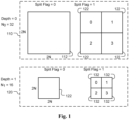
- Fig. 1 illustrates an exemplary coding unit partition based on a quadtree.
- the initial unit 112 consisting of 64 ⁇ 64 pixels corresponds to a CTU.
- the initial unit 112 is subject to quadtree split as shown in block 110.
- a split flag 0 indicates that the underlying unit is not split and, on the other hand a split flag 1 indicates the underlying unit is split into four smaller units 122 by the quadtree.
- the resulting four units are labeled as 0, 1, 2 and 3 and each resulting unit becomes a unit for further split in the next depth. Consequently, at depth 1, the unit 122 is subject to quadtree split as shown in block 120.
- a split flag 0 indicates the underlying unit is not split and, on the other hand a split flag 1 indicates the underlying unit is split into four smaller units 132 by the quadtree.
- Each final leaf unit is called a coding unit (CU).
- the partition map has to be conveyed to the decoder so that the decoding process can be performed accordingly.
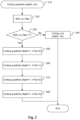
- Fig. 2 The corresponding coding quadtree syntax specified in the HEVC standard is illustrated by Fig. 2 .
- the quadtree splitting syntax according to the HEVC standard does not differentiate between luma and chroma components. In other words, the luma and chroma components share the same quadtree spitting syntax.
- the coding quadtree (210) includes split_cu_flag (220).
- step 230 whether split_cu_flag is equal to 1 is tested. If the result is "yes", it implies that the current intermediate unit is split into four smaller units. The four smaller units are subject to further quadtree splitting. Accordingly, four quadtree syntax structures (250, 260, 270 and 280) are included.
- Fig. 3A and Fig. 3B illustrate an example of CTU partitioning using quadtrees.
- the full-size CTU (310) corresponds to depth 0, which is partitioned into 4 depth-1 intermediate units, labeled as 0, 1, 2 and 3 in Fig. 3A .
- depth-1 units at positions 0 (320) and 3 (330) are further partitioned into depth-2 units using the quadtree as shown in Fig. 3A and Fig. 3B .
- the depth-2 at position 2 (340) is further partitioned into depth-3 units.
- the circles correspond to intermediate nodes of the tree and dots correspond to leaf nodes.
- Each leaf node represents a coding unit (CU) to be coded.
- Each CTU may be partitioned differently to optimize the coding performance. Therefore, the tree structure for each CTU has to be signaled to the decoder to recover the tree structure for each CTU.
- CU coding unit
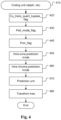
- CU coding (410) according to the HEVC standard is illustrated in Fig. 4 .
- various coding information including cu_trans_quant_ bypass_flag (420),part_mode_flag (430), pcm_flag (440), intra luma prediction mode (450), intra chroma prediction mode (460), prediction unit parameters (470), and transform tree (480) are included in CU syntax for both luma and chroma.
- Sequence Parameter Set RBSP SPS
- two syntax elements log2_min_luma_coding_block_size_minus3 and log2_diff_max_min_luma_coding_ block_size are included to specify the minimum luma CU size and the maximum luma CU quadtree splitting depth. Since the chroma quadtree splitting is tied to the corresponding luma region, the minimum chroma CU size and the maximum chroma CU quadtree splitting depth are implicitly according to these two syntax elements for the luma component.
- the current chroma prediction block can use the luma prediction mode of the corresponding luma region that covers the same content. Since the CU and prediction unit (PU) partition are shared for luma and chroma, the corresponding luma region (510) has only one luma Intra prediction mode, which can be used as the chroma prediction mode for the current chroma block (520) as shown in Fig. 5 .
- luma and chroma components are usually different.
- chroma component usually has smoother texture than the luma component. Therefore, forcing luma and chroma to share the same coding quadtree may degrade the coding performance. Accordingly, it is desirable to develop coding techniques to improve the coding efficiency for video data including both luma and chroma data.
- a method of video coding using separate coding trees for video data comprising one luma component and one or more chroma components is disclosed.
- the luma component and the chroma components are allowed to have its own coding trees to partition the corresponding video data.
- a first syntax element is used for each first node of the luma coding tree to indicate whether the first node is split and a separate second syntax element is used for each second node of the chroma coding tree to indicate whether the second node is split.
- the luma coding tree and the chroma coding tree are signaled using separate syntax elements.
- the syntax elements for the luma coding tree can be signaled before the syntax elements for the chroma coding tree.
- a maximum luma coding-tree splitting depth and a separate maximum chroma coding-tree splitting depth may be used for the separate luma and chroma coding trees. Furthermore, the maximum luma coding-tree splitting depth and the separate maximum chroma coding-tree splitting depth can be signaled in sequence parameter set (SPS), picture parameter set (PPS), or slice header. Additional syntax elements can be signaled in SPS to determine the maximum chroma coding-tree splitting depth.
- SPS sequence parameter set
- PPS picture parameter set
- Additional syntax elements can be signaled in SPS to determine the maximum chroma coding-tree splitting depth.
- coding information for the luma component can be signaled.
- the coding information may correspond to one or more elements selected from a group comprising luma 2Nx2N or NxN partition, one or more luma non-square partitions, one or more luma asymmetric partitions, luma Intra prediction mode, luma transform tree, transform split flag, coded block flag, and residuals.
- the coding information may further comprise luma delta quantization parameter (QP), luma Pulse Code Modulation (PCM) flag, and lumatrans_quant_bypass_flag, where the lumatrans_quant_bypass_flag indicates whether transform and quantization is bypassed for a corresponding luma CU.
- coding information for the chroma component can also be signaled.
- the coding information corresponds to one or more elements selected from a group comprising one or more chroma partition types, chroma intra prediction mode, and chroma transform tree.
- the chroma partition types can be restricted to 2Nx2N only and no chroma partition type needs to be signaled in this case.
- the coding information may further comprise chroma QP, chroma PCM flag, and chromatrans_quant bypass flag, where the chromatrans_quant_bypass_flag indicates whether transform and quantization is bypassed for a corresponding chroma CU.
- each chroma TU (transform unit) can use a chroma Intra prediction mode derived from one or more second Intra prediction modes of a second corresponding luma region covering a same second content as each chroma TU.
- the chroma Intra prediction mode for each chroma TU can be determined based on all second luma Intra prediction modes, or some selected luma Intra prediction modes from some selected positions of the second corresponding luma region.
- separate luma coding tree and chroma coding tree can be applied only for CTUs in the I-slice, and the same luma coding tree and chroma coding tree can be applied for CTUs in the B-slice and the P-slice.
- the use of separate luma coding tree and chroma coding tree can be applied for CTUs in the I-slice, B-slice and P-slice.
- the luma CU and the chroma CU are within one CTU in the B-slice or the P-slice, separate motion information is used for a luma CU (coding) and a chroma CU.
- embodiments of the present invention allow using separate coding trees for luma and chroma components.
- separate coding-unit split flags are used to indicate whether the current units of respective color components are further split into four sub-units for the luma and chroma component.
- two separate syntax elements split_luma _cu _flag and split_chroma _cu _flag instead of one shared split_cu_flag, can be used to indicate the coding quadtree splitting for luma and chroma components respectively.
- An example of the coding quadtree for luma and chroma components isshown in Fig. 6 and Fig. 7 respectively. In Fig.
- the CU quadtree splitting syntax for the luma component is similar to the CU quadtree splitting for shared luma/chroma components in Fig. 2 .
- the luma coding quadtree (610) includes split_luma_cu_flag (620).
- split_lumacu_flag (620)
- step 630 whether split_lumacu_flag is equal to 1 is tested. If the result is "yes", it implies that the current luma intermediate unit is split into four smaller luma units. The four smaller luma units are subject to further quadtree splitting. Accordingly, four quadtree syntax structures (650, 660, 670 and 680) are included.
- the chroma coding quadtree (710) includes split_chroma_cu_flag (720). In step 730, whether split_chroma_cu_flag is equal to 1 is tested. If the result is "yes”, it implies that the current chroma intermediate unit is split into four smaller chroma units. The four smaller chroma units are subject to further quadtree splitting. Accordingly, four quadtree syntax structures (750, 760, 770 and 780) are included.
- this chroma unit is namely chroma CU. Accordingly, this chroma CU is ready for CU coding and syntax for CU level coding (740) is included. While an example of separate coding quadtrees is shown in Fig. 6 and Fig. 7 , other separate coding trees (such as binary tree) may also be used to practice the present invention.
- the coding quadtree for the luma and chroma components are signaled separately in each CTU. Furthermore, the luma coding quadtree can be signaled before the chroma coding quadtree.
- An example of the luma CU coding and syntax structure and chroma CU coding and syntax structure are shown in Fig. 8 and Fig. 9 respectively.
- Fig. 8 illustrates the luma CU syntax (810), which is similar to the joint luma/chroma CU syntax in Fig. 4 for both the luma and chroma components except that Fig. 8 does not includes any syntax element for the chroma component (i.e., without Intra chroma prediction mode). As shown in Fig.
- coding information includingcu_luma_trans_quant_bypass_flag (820),lumapart_mode_flag (830), lumapcm_flag (840), intra luma prediction mode (850), luma prediction unit parameters (860), and luma transform tree (870) are included in CU syntax for the luma component.
- Fig. 9 illustrates an example of chroma CU syntax that does not include any syntax related to the luma component. As shown in Fig.
- various coding information includingcu_chroma_trans_ quant_bypass_flag (920),chromapart_mode_flag (930), chromapcm_flag (940), intra chroma prediction mode (950), chroma prediction unit parameters (960), and chroma transform tree (970) are included in CU syntax for the chroma component. While an example of separate CU syntax is shown in Fig. 8 and Fig. 9 , other separate CU syntax may also be used to practice the present invention.
- the maximum coding quadtree splitting depth is signaled and shared by both the luma and chroma components.
- the maximum coding quadtree splitting depth for the luma and chroma components can be separate.
- the maximum coding quadtree splitting depth can be defined in high-level syntax such as SPS (sequence parameter set), PPS (picture parameter set), or slice header.
- the luma component can use the original syntax for the maximum luma coding quadtree splitting depth while two additional syntax elements,log2_min_chroma_ coding_block_size_minus2 and log2_diff_max_min_chroma_coding_block_size can be signaled in SPS for the chroma component.
- syntax element, log2_min_chroma_coding_block_size_minus2 specifies the minimum chroma CU size minus 2 and syntax element
- log2_diff_max_min_chroma_coding_block_size specifies the difference between the maximum chroma CU size and the minimum chroma CU size. Therefore, the maximum chroma coding quadtree splitting depth can be determined from these two additional syntax elements.
- coding information for the luma component can be signaled in the luma CU, where the luma coding information may include luma partition type (e.g. 2Nx2N, NxN, non-square partitions, or asymmetric partitions), luma Intra prediction mode, and luma transform tree (transform split flag, coded block flag, and residuals).
- luma partition type e.g. 2Nx2N, NxN, non-square partitions, or asymmetric partitions
- luma Intra prediction mode e.g. 2Nx2N, NxN, non-square partitions, or asymmetric partitions
- luma Intra prediction mode e.g. 2Nx2N, NxN, non-square partitions, or asymmetric partitions
- luma Intra prediction mode e.g. 2Nx2N, NxN, non-square partitions, or asymmetric partitions
- luma Intra prediction mode e.g. 2Nx2
- coding information for the chroma component can be signaled in the chroma CU, where the chroma coding information may include chroma partition type, chroma Intra prediction mode, and chroma transform tree. Since the chroma texture is usually simpler than luma, only one partition type such as 2Nx2N can be used for chroma according to one embodiment. Therefore, there is no need to signal the chroma partition type in this case.
- the delta QP (quantization parameter) can also be separate for the luma and chroma components according to one embodiment. Therefore, the delta QP for the luma component is signaled in the luma CU and the delta QP for the chroma component is signaled in the chroma CU.
- the Pulse Code Modulation (PCM) mode and the syntax element, trans_quant_bypass_flag can also be separate for the luma and chroma components according to one embodiment of the present invention. Therefore, the luma PCM flag can be signaled in the luma CU to indicate whether the luma PCM samples are present, and the syntax element, cu_luma_trans_quant_bypass _flag can be signaled in the luma CU to indicate whether the transform and quantization processes are bypassed for the luma component.
- the chroma PCM flag can be signaled in the chroma CU to indicate whether the chroma PCM samples are present, and the syntax element, cu_chroma_trans_quant_bypass_flag can be signaled in the chroma CU to indicate whether the transform and quantization processes are bypassed for chroma.
- each chroma TU uses the Intra prediction mode of its corresponding luma region. Since the corresponding luma region may have more than one luma Intra prediction modes, all the modes or the mode in one or more specific positions can be used as candidate(s) for the current chroma TU. For example, the Intra prediction mode in top-left position and center positions can be used as candidates for the current chroma TU as shown in Fig. 10 and Fig. 11. Fig.
- FIG. 10 illustrates a case where the chroma PU has only one chroma TU (1020).
- the corresponding luma region (1010) covering the same content of the chroma PU may have one or more Intra prediction modes.
- the luma Intra prediction mode for the top-left position (1030) and the center position (1040) can be used as candidates to determine the chroma Intra prediction mode (1050) for the current chroma TU.
- Fig. 11 illustrates a case where the chroma PU has four chroma TUs (1120) and the corresponding luma region (1110) covering the same content of the chroma PU may have one or more Intra prediction modes.
- the luma Intra prediction mode for the top-left position and the center position of a corresponding luma region covering the same content can be used as candidates to determine the chroma Intra prediction mode for each chroma TU. Accordingly, 4 chroma Intra prediction modes (1130, 1140, 1150 and 1160) are derived for the 4 chroma TUs.
- the center position in the above examples refers to the upper-left block of the center point of the PU. However, other center position, such as lower-right block may also be used as the center position.
- the separate coding quadtrees for the luma and chroma components can be applied to I slices only. For the P and B slices, a unified coding quadtree is still shared by the luma and chroma components.
- the separate coding quadtrees for the luma and chroma components may also be applied to all types of slices (i.e., I, P, and B).
- the motion information for CUs can be separate for the luma and chroma components according to another embodiment of the present invention.
- separate chroma coding quadtrees can be used for different chroma components (e. g. U and V).
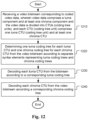
- Fig. 12 illustrates an exemplary flowchart for a decoding system using separate luma and chroma coding trees incorporating an embodiment of the present invention.
- the system receives a video bitstream corresponding to coded video data, where the video data comprises a luma component and one or more chroma components and the video data is divided into CTUs (coding tree units), and each CTU (coding tree unit) comprises both luma and chroma components as shown in step 1210.
- the video bitstream may be retrieved from storage such as a computer memory of buffer (RAM or DRAM).
- the video bitstream may also be received from a processor such as a processing unit or a digital signal.
- One luma coding tree for each luma CTU and one chroma coding tree for each chroma CTU are determined from the video bitstream according to separate syntax elements representing luma coding trees and chroma coding trees respectively as shown in step 1220.
- Each luma CTU is decoded from the bitstream according to a corresponding luma coding tree in step 1230.
- Each chroma CTU is decoded from the video bitstream according a corresponding chroma coding tree in step 1240.
- Embodiment of the present invention as described above may be implemented in various hardware, software codes, or a combination of both.
- an embodiment of the present invention can be one or more electronic circuits integrated into a video compression chip or program code integrated into video compression software to perform the processing described herein.
- An embodiment of the present invention may also be program code to be executed on a Digital Signal Processor (DSP) to perform the processing described herein.
- DSP Digital Signal Processor
- the invention may also involve a number of functions to be performed by a computer processor, a digital signal processor, a microprocessor, or field programmable gate array (FPGA). These processors can be configured to perform particular tasks according to the invention, by executing machine-readable software code or firmware code that defines the particular methods embodied by the invention.
- the software code or firmware code may be developed in different programming languages and different formats or styles.
- the software code may also be compiled for different target platforms.
- different code formats, styles and languages of software codes and other means of configuring code to perform the tasks in accordance with the invention will not depart from the spirit and scope of the invention.
Landscapes
- Engineering & Computer Science (AREA)
- Multimedia (AREA)
- Signal Processing (AREA)
- Physics & Mathematics (AREA)
- General Physics & Mathematics (AREA)
- Theoretical Computer Science (AREA)
- Computer Vision & Pattern Recognition (AREA)
- Compression Or Coding Systems Of Tv Signals (AREA)
Applications Claiming Priority (3)
| Application Number | Priority Date | Filing Date | Title |
|---|---|---|---|
| PCT/CN2014/090792 WO2016074147A1 (fr) | 2014-11-11 | 2014-11-11 | Arbre de codage séparé pour la luminance et la chrominance |
| PCT/CN2015/093156 WO2016074567A1 (fr) | 2014-11-11 | 2015-10-29 | Procédé de codage vidéo à l'aide d'un arbre de codage séparé pour la luminance et la chrominance |
| EP15859430.9A EP3205100A4 (fr) | 2014-11-11 | 2015-10-29 | Procédé de codage vidéo à l'aide d'un arbre de codage séparé pour la luminance et la chrominance |
Related Parent Applications (1)
| Application Number | Title | Priority Date | Filing Date |
|---|---|---|---|
| EP15859430.9A Division EP3205100A4 (fr) | 2014-11-11 | 2015-10-29 | Procédé de codage vidéo à l'aide d'un arbre de codage séparé pour la luminance et la chrominance |
Publications (1)
| Publication Number | Publication Date |
|---|---|
| EP4297407A1 true EP4297407A1 (fr) | 2023-12-27 |
Family
ID=55953553
Family Applications (2)
| Application Number | Title | Priority Date | Filing Date |
|---|---|---|---|
| EP15859430.9A Ceased EP3205100A4 (fr) | 2014-11-11 | 2015-10-29 | Procédé de codage vidéo à l'aide d'un arbre de codage séparé pour la luminance et la chrominance |
| EP23195721.8A Pending EP4297407A1 (fr) | 2014-11-11 | 2015-10-29 | Procédé de codage vidéo à l'aide d'un arbre de codage séparé pour la luminance et la chrominance |
Family Applications Before (1)
| Application Number | Title | Priority Date | Filing Date |
|---|---|---|---|
| EP15859430.9A Ceased EP3205100A4 (fr) | 2014-11-11 | 2015-10-29 | Procédé de codage vidéo à l'aide d'un arbre de codage séparé pour la luminance et la chrominance |
Country Status (5)
| Country | Link |
|---|---|
| US (1) | US10390050B2 (fr) |
| EP (2) | EP3205100A4 (fr) |
| CN (1) | CN107079160B (fr) |
| RU (1) | RU2674332C2 (fr) |
| WO (2) | WO2016074147A1 (fr) |
Families Citing this family (103)
| Publication number | Priority date | Publication date | Assignee | Title |
|---|---|---|---|---|
| WO2013109026A1 (fr) | 2012-01-18 | 2013-07-25 | 엘지전자 주식회사 | Procédé et dispositif destinés au codage/décodage entropique |
| US10567759B2 (en) | 2016-03-21 | 2020-02-18 | Qualcomm Incorporated | Using luma information for chroma prediction with separate luma-chroma framework in video coding |
| US10944963B2 (en) * | 2016-05-25 | 2021-03-09 | Arris Enterprises Llc | Coding weighted angular prediction for intra coding |
| US10440391B2 (en) * | 2016-08-05 | 2019-10-08 | Mediatek Inc. | Method and apparatus of video coding |
| US10368107B2 (en) * | 2016-08-15 | 2019-07-30 | Qualcomm Incorporated | Intra video coding using a decoupled tree structure |
| CN109716775B (zh) * | 2016-09-20 | 2023-08-22 | 株式会社Kt | 用于处理视频信号的方法和装置 |
| US20190260992A1 (en) * | 2016-10-10 | 2019-08-22 | Samsung Electronics Co., Ltd. | Method and device for encoding or decoding luma block and chroma block |
| CN116248874B (zh) | 2016-10-10 | 2026-03-20 | 三星电子株式会社 | 通过块映射来对图像进行编码或解码的方法和装置 |
| EP4604517A3 (fr) * | 2016-12-23 | 2025-11-12 | Huawei Technologies Co., Ltd. | Appareil d'intra-prédiction pour étendre un ensemble de modes d'intra-prédiction directionnels prédéterminés |
| WO2018120230A1 (fr) * | 2016-12-30 | 2018-07-05 | 华为技术有限公司 | Procédé, appareil et dispositif de filtrage d'image |
| JP7122838B2 (ja) * | 2017-03-10 | 2022-08-22 | 日本放送協会 | 符号化装置、復号装置及びプログラム |
| US10820017B2 (en) * | 2017-03-15 | 2020-10-27 | Mediatek Inc. | Method and apparatus of video coding |
| CN107222751B (zh) * | 2017-06-23 | 2019-05-10 | 宁波大学科学技术学院 | 基于多视点视频特征的3d-hevc深度视频信息隐藏方法 |
| US10567772B2 (en) * | 2017-07-11 | 2020-02-18 | Google Llc | Sub8×8 block processing |
| JP2021010046A (ja) | 2017-10-06 | 2021-01-28 | シャープ株式会社 | 画像符号化装置及び画像復号装置 |
| KR102918360B1 (ko) * | 2018-01-05 | 2026-01-27 | 에스케이텔레콤 주식회사 | 크로마 블록의 복원 방법 및 이를 이용한 영상 복호화 장치 |
| CN118101935B (zh) * | 2018-04-19 | 2026-04-07 | Oppo广东移动通信有限公司 | 用于处理图像的方法及其设备 |
| KR102410200B1 (ko) * | 2018-04-19 | 2022-06-16 | 후아웨이 테크놀러지 컴퍼니 리미티드 | 루마 및 크로마 블록 파티셔닝 |
| EP3785433A4 (fr) | 2018-04-30 | 2022-02-23 | MediaTek Inc. | Procédé et appareil d'entrelacement de syntaxe pour un arbre de codage séparé dans un système de codage vidéo |
| JP2021523627A (ja) | 2018-05-10 | 2021-09-02 | サムスン エレクトロニクス カンパニー リミテッド | 映像の符号化及び復号のための映像の分割方法及びその装置 |
| PL3804314T3 (pl) * | 2018-05-29 | 2024-05-20 | Interdigital Vc Holdings, Inc. | Sposób i urządzenie do kodowania i dekodowania wideo z częściowo współdzielonymi drzewami kodowania luma i chroma |
| WO2019234604A1 (fr) | 2018-06-05 | 2019-12-12 | Beijing Bytedance Network Technology Co., Ltd. | Arbre quaternaire étendu à sous-blocs asymétriques |
| EP3804309A1 (fr) | 2018-06-07 | 2021-04-14 | InterDigital VC Holdings, Inc. | Éléments de syntaxe pour codage ou décodage vidéo |
| US11197006B2 (en) * | 2018-06-29 | 2021-12-07 | Interdigital Vc Holdings, Inc. | Wavefront parallel processing of luma and chroma components |
| TWI820168B (zh) * | 2018-07-15 | 2023-11-01 | 大陸商北京字節跳動網絡技術有限公司 | 跨分量編碼資訊導出 |
| CN119363978A (zh) * | 2018-08-24 | 2025-01-24 | 三星电子株式会社 | 视频解码方法和设备、以及视频编码方法和设备 |
| IL281144B2 (en) | 2018-08-28 | 2025-01-01 | Huawei Tech Co Ltd | Image and accessory distribution method |
| WO2020043136A1 (fr) * | 2018-08-28 | 2020-03-05 | 华为技术有限公司 | Procédé et dispositif de partition d'image |
| JP7225375B2 (ja) * | 2018-08-30 | 2023-02-20 | 華為技術有限公司 | パレット符号化を使用するエンコード装置、デコード装置および対応する方法 |
| KR102699033B1 (ko) * | 2018-09-03 | 2024-08-23 | 후아웨이 테크놀러지 컴퍼니 리미티드 | 파티션 제한 요소들 간의 관계 |
| AU2018233042B2 (en) * | 2018-09-21 | 2024-06-13 | Canon Kabushiki Kaisha | Method, apparatus and system for encoding and decoding a tree of blocks of video samples |
| CN116962691A (zh) | 2018-09-21 | 2023-10-27 | Lg电子株式会社 | 解码和编码设备、存储介质及发送用于图像的数据的设备 |
| CN112740683A (zh) * | 2018-09-24 | 2021-04-30 | 交互数字Vc控股公司 | 用于在为亮度和色度使用单独的译码树时确定色度量化参数的方法及装置 |
| US11140404B2 (en) | 2018-10-11 | 2021-10-05 | Tencent America LLC | Method and apparatus for video coding |
| KR20210074388A (ko) * | 2018-10-25 | 2021-06-21 | 인터디지털 브이씨 홀딩스 인코포레이티드 | 코딩 유형 또는 코딩 트리 유형의 시그널링을 이용한 비디오 인코딩 및 디코딩을 위한 방법 및 장치 |
| US11785236B2 (en) | 2018-11-06 | 2023-10-10 | InterDigital Madision Patent Holdings, SAS | Parameter grouping among plural coding units for video encoding and decoding |
| WO2020098786A1 (fr) * | 2018-11-16 | 2020-05-22 | Mediatek Inc. | Procédé et appareil de codage d'arbre de codage séparé de luminance-chrominance à contraintes |
| WO2020106653A1 (fr) | 2018-11-20 | 2020-05-28 | Interdigital Vc Holdings, Inc. | Initialisation de vecteur de bloc de référencement d'image courante à arbre double |
| PL3903484T3 (pl) * | 2018-12-30 | 2025-11-17 | Hfi Innovation Inc. | Urządzenie i sposób kodowania za pomocą oddzielnych drzew kodowania luminacji i chrominancji z ograniczeniami |
| CN111416975B (zh) | 2019-01-08 | 2022-09-16 | 华为技术有限公司 | 预测模式确定方法和装置 |
| KR20240005108A (ko) | 2019-01-08 | 2024-01-11 | 후아웨이 테크놀러지 컴퍼니 리미티드 | 이미지 예측 방법, 장치 및 시스템, 디바이스 및 저장 매체 |
| KR102859877B1 (ko) * | 2019-01-16 | 2025-09-16 | 샤프 가부시키가이샤 | 비디오 코딩에서 비디오 블록들에 대한 양자화 파라미터들을 도출하기 위한 시스템들 및 방법들 |
| JP7199552B2 (ja) | 2019-02-01 | 2023-01-05 | 北京字節跳動網絡技術有限公司 | ビデオコーディングのためのルーマ依存クロマ残差スケーリングの設定 |
| WO2020156572A1 (fr) * | 2019-02-03 | 2020-08-06 | Beijing Bytedance Network Technology Co., Ltd. | Partitionnement d'arbre quaternaire asymétrique |
| WO2020164479A1 (fr) | 2019-02-11 | 2020-08-20 | Beijing Bytedance Network Technology Co., Ltd. | Partition de bloc vidéo basée sur un arbre quinaire |
| CN109889831B (zh) * | 2019-02-18 | 2022-08-09 | 北方工业大学 | 基于cu尺寸的360度视频帧内模式选择的方法、编码器和设备 |
| SG11202109517RA (en) * | 2019-03-12 | 2021-09-29 | Tencent America LLC | Method and apparatus for color transform in vvc |
| CN113574889B (zh) | 2019-03-14 | 2024-01-12 | 北京字节跳动网络技术有限公司 | 环路整形信息的信令和语法 |
| CN113632462B (zh) | 2019-03-23 | 2023-08-22 | 北京字节跳动网络技术有限公司 | 默认的环内整形参数 |
| WO2020191575A1 (fr) * | 2019-03-25 | 2020-10-01 | 富士通株式会社 | Procédé de codage et de décodage d'image, appareil de codage et de décodage d'image et dispositif électronique |
| MX2021012229A (es) | 2019-04-12 | 2021-11-03 | Beijing Bytedance Network Tech Co Ltd | Determinacion de modo de codificacion de croma basada en intraprediccion basada en matriz. |
| CN117499656A (zh) | 2019-04-16 | 2024-02-02 | 北京字节跳动网络技术有限公司 | 帧内编解码模式下的矩阵推导 |
| KR102743406B1 (ko) | 2019-04-23 | 2024-12-16 | 광동 오포 모바일 텔레커뮤니케이션즈 코포레이션 리미티드 | 이미지 디코딩 방법, 디코더 및 저장 매체 |
| CA3137163C (fr) | 2019-04-24 | 2024-05-14 | Bytedance Inc. | Contraintes sur la representation d'une modulation differentielle par impulsions codees de residu quantifie pour une video codee |
| CN111866510A (zh) | 2019-04-30 | 2020-10-30 | 华为技术有限公司 | 视频序列的帧内预测方法及装置 |
| EP3949391A4 (fr) | 2019-05-01 | 2022-05-25 | Beijing Bytedance Network Technology Co., Ltd. | Prédiction intra basée sur une matrice, utilisant un filtrage |
| KR102707777B1 (ko) | 2019-05-01 | 2024-09-20 | 바이트댄스 아이엔씨 | 양자화된 잔차 차동 펄스 코드 변조 코딩을 사용하는 인트라 코딩된 비디오 |
| WO2020221372A1 (fr) | 2019-05-01 | 2020-11-05 | Beijing Bytedance Network Technology Co., Ltd. | Codage de contexte pour prédiction intra basée sur une matrice |
| CN113785306B (zh) | 2019-05-02 | 2024-06-14 | 字节跳动有限公司 | 基于编解码树结构类型的编解码模式 |
| JP7288084B2 (ja) | 2019-05-02 | 2023-06-06 | バイトダンス インコーポレイテッド | 変換スキップモードにおける信号通知 |
| KR102698314B1 (ko) | 2019-05-22 | 2024-08-26 | 베이징 바이트댄스 네트워크 테크놀로지 컴퍼니, 리미티드 | 업샘플링을 이용한 행렬 기반 인트라 예측 |
| WO2020239017A1 (fr) | 2019-05-31 | 2020-12-03 | Beijing Bytedance Network Technology Co., Ltd. | Processus de sous-échantillonnage en une étape lors d'une prédiction intra basée sur une matrice |
| JP2022534320A (ja) | 2019-06-05 | 2022-07-28 | 北京字節跳動網絡技術有限公司 | マトリクスベースイントラ予測のためのコンテキスト決定 |
| WO2020256512A1 (fr) * | 2019-06-20 | 2020-12-24 | 엘지전자 주식회사 | Codage vidéo ou d'image à base de mappage de luminance |
| CN112135128B (zh) * | 2019-06-24 | 2024-07-05 | 华为技术有限公司 | 图像预测方法、编码树节点划分方法及其装置 |
| KR20250142938A (ko) * | 2019-06-24 | 2025-09-30 | 엘지전자 주식회사 | 루마 맵핑 기반 비디오 또는 영상 코딩 |
| AU2020318306B2 (en) | 2019-07-21 | 2024-02-22 | Lg Electronics Inc. | Image encoding/decoding method and device for signaling chroma component prediction information according to whether palette mode is applicable, and method for transmitting bitstream |
| CN114175632B (zh) | 2019-07-26 | 2024-07-05 | 北京字节跳动网络技术有限公司 | 对视频编解码模式的块尺寸相关使用 |
| WO2021018081A1 (fr) * | 2019-07-26 | 2021-02-04 | Beijing Bytedance Network Technology Co., Ltd. | Taille d'unité d'arbre de codage configurable dans une technique de codage vidéo |
| JP7350988B2 (ja) * | 2019-08-15 | 2023-09-26 | ベイジン・ダジア・インターネット・インフォメーション・テクノロジー・カンパニー,リミテッド | ビデオコーディングにおける小さい色差ブロックサイズ制限 |
| JP7309046B2 (ja) | 2019-09-02 | 2023-07-14 | 北京字節跳動網絡技術有限公司 | カラーフォーマットに基づいたビデオ領域のパーティション |
| JP7332795B2 (ja) | 2019-09-21 | 2023-08-23 | 北京字節跳動網絡技術有限公司 | クロマ・イントラモードのベースとなるサイズ制約 |
| US11412264B2 (en) * | 2019-09-24 | 2022-08-09 | Qualcomm Incorporated | Parameter set signaling for video coding |
| US20220368951A1 (en) * | 2019-09-24 | 2022-11-17 | Hfi Innovation Inc. | Method and Apparatus of Separated Coding Tree Coding with Constraints on Minimum CU Size |
| WO2021056211A1 (fr) * | 2019-09-24 | 2021-04-01 | 富士通株式会社 | Procédés et appareils de codage et de décodage vidéo et dispositif électronique |
| US11606563B2 (en) * | 2019-09-24 | 2023-03-14 | Tencent America LLC | CTU size signaling |
| KR20260003392A (ko) | 2019-10-28 | 2026-01-06 | 두인 비전 컴퍼니 리미티드 | 색상 성분에 기초한 신택스 시그널링 및 파싱 |
| US11399195B2 (en) | 2019-10-30 | 2022-07-26 | Tencent America LLC | Range of minimum coding block size in video coding |
| CN110868593B (zh) * | 2019-11-18 | 2022-01-28 | 北方工业大学 | 基于区域决策树的视频cu快速划分 |
| WO2021108788A1 (fr) * | 2019-11-30 | 2021-06-03 | Bytedance Inc. | Mode de codage palette |
| CN118972555A (zh) | 2019-12-03 | 2024-11-15 | 阿里巴巴(中国)有限公司 | 使用调色板模式的视频处理方法和装置 |
| WO2021115235A1 (fr) * | 2019-12-08 | 2021-06-17 | Beijing Bytedance Network Technology Co., Ltd. | Prédiction entre composantes au moyen de composantes multiples |
| CN120201190B (zh) * | 2019-12-17 | 2026-03-31 | 阿里巴巴(中国)有限公司 | 视频处理方法及装置、非暂时性计算机可读存储介质 |
| CN113875256B (zh) * | 2019-12-23 | 2024-05-31 | 腾讯美国有限责任公司 | 进行视频解码的方法、装置及存储介质 |
| US11368715B2 (en) * | 2019-12-27 | 2022-06-21 | Qualcomm Incorporated | Block-based delta pulse code modulation for video coding |
| CN116405677B (zh) * | 2019-12-30 | 2023-10-31 | 阿里巴巴(中国)有限公司 | 用于在调色板模式下对视频数据进行编码的方法和装置 |
| US11303914B2 (en) * | 2020-01-08 | 2022-04-12 | Tencent America LLC | Method and apparatus for video coding |
| US11546592B2 (en) | 2020-01-08 | 2023-01-03 | Tencent America LLC | Flexible block partitioning for chroma component |
| KR102862286B1 (ko) * | 2020-01-10 | 2025-09-18 | 엘지전자 주식회사 | 영상 디코딩 방법 및 그 장치 |
| CN115362681B (zh) | 2020-04-10 | 2025-02-25 | 抖音视界有限公司 | 视频编解码中的变换跳过块的最小允许量化 |
| US11432018B2 (en) | 2020-05-11 | 2022-08-30 | Tencent America LLC | Semi-decoupled partitioning for video coding |
| US11432006B2 (en) * | 2020-08-14 | 2022-08-30 | Tencent America LLC | Chroma mode video coding |
| US12382037B2 (en) * | 2021-03-05 | 2025-08-05 | Tencent America LLC | Decoupled transform partitioning |
| WO2022194197A1 (fr) | 2021-03-17 | 2022-09-22 | Beijing Bytedance Network Technology Co., Ltd. | Restrictions de codage par arbre séparé |
| US11800102B2 (en) * | 2021-08-27 | 2023-10-24 | Mediatek Inc. | Low-latency video coding methods and apparatuses for chroma separated tree |
| US12200204B2 (en) * | 2021-10-11 | 2025-01-14 | Tencent America LLC | On intra mode propagation |
| CN116074531B (zh) | 2021-11-11 | 2025-01-24 | 杭州海康威视数字技术股份有限公司 | 解码方法、编码方法及装置 |
| CN120569964A (zh) * | 2023-01-12 | 2025-08-29 | 联发科技股份有限公司 | 用于根据帧内色度跨元件预测模型在视频编解码中改进变换信息编解码方法和设备 |
| US12556732B2 (en) | 2023-11-27 | 2026-02-17 | Tencent America LLC | Systems and methods for transform partitioning in a recursive intra region |
| US12445630B2 (en) | 2023-11-29 | 2025-10-14 | Tencent America LLC | Systems and methods for implicit derivation in a recursive intra region |
| US12610041B2 (en) * | 2023-11-29 | 2026-04-21 | Tencent America LLC | Systems and methods for chroma mode coding in recursive intra/inter region |
| TW202602119A (zh) * | 2024-04-16 | 2026-01-01 | 聯發科技股份有限公司 | 影片解碼器與解碼方法以及信號化影片位元流以執行雙樹分割技術的方法 |
| CN119420938A (zh) * | 2024-10-31 | 2025-02-11 | 湖南国科微电子股份有限公司 | 一种图像编码方法、装置、终端设备及解码方法 |
Citations (7)
| Publication number | Priority date | Publication date | Assignee | Title |
|---|---|---|---|---|
| EP2230849A1 (fr) * | 2009-03-20 | 2010-09-22 | Mitsubishi Electric R&D Centre Europe B.V. | Codage et décodage de données vidéo en utilisant des vecteurs de mouvement |
| US20120140830A1 (en) * | 2009-08-12 | 2012-06-07 | Thomson Licensing | Methods and apparatus for improved intra chroma encoding and decoding |
| EP2575366A2 (fr) * | 2011-09-27 | 2013-04-03 | Broadcom Corporation | Signalisation de la prédiction d'unité de codage et du mode de partition de l'unité de prédiction pour le codage vidéo |
| US20130114700A1 (en) * | 2010-07-15 | 2013-05-09 | Mitsubishi Electric Corporation | Moving image encoding device, moving image decoding device, moving image coding method, and moving image decoding method |
| WO2013102299A1 (fr) * | 2012-01-04 | 2013-07-11 | Mediatek Singapore Pte. Ltd. | Profondeur d'arbre quaternaire résiduel pour composantes de chrominance |
| WO2013143103A1 (fr) * | 2012-03-29 | 2013-10-03 | Mediatek Singapore Pte. Ltd. | Procédés et appareils de codage en mode intra pour une extension scalable d'un codage vidéo à haute efficacité (hevc) |
| WO2015169207A1 (fr) * | 2014-05-05 | 2015-11-12 | Mediatek Singapore Pte. Ltd. | Procédé et appareil de détermination de représentation d'arbre de transformée de résidus |
Family Cites Families (14)
| Publication number | Priority date | Publication date | Assignee | Title |
|---|---|---|---|---|
| US7573407B2 (en) | 2006-11-14 | 2009-08-11 | Qualcomm Incorporated | Memory efficient adaptive block coding |
| RU2426227C2 (ru) | 2006-11-14 | 2011-08-10 | Квэлкомм Инкорпорейтед | Кодирование кодов переменной длины с эффективным использованием памяти |
| US9848197B2 (en) * | 2011-03-10 | 2017-12-19 | Qualcomm Incorporated | Transforms in video coding |
| WO2013011659A1 (fr) | 2011-07-19 | 2013-01-24 | パナソニック株式会社 | Procédé de filtrage, procédé de décodage d'image animée, procédé de codage d'image animée, appareil de décodage d'image animée, appareil de codage d'image animée et appareil de codage/décodage d'image animée |
| EP2988511A1 (fr) * | 2011-08-04 | 2016-02-24 | MediaTek Inc. | Procédé et appareil pour binarisation réordonnée d'éléments de syntaxe en cabac |
| PL3754982T3 (pl) * | 2011-09-29 | 2024-09-02 | Sharp Kabushiki Kaisha | Urządzenie do dekodowania obrazu, sposób dekodowania obrazu, sposób kodowania obrazu i urządzenie kodowania obrazu do realizowania konwersji bipredykcyjnej na unipredykcyjną |
| US9807401B2 (en) | 2011-11-01 | 2017-10-31 | Qualcomm Incorporated | Transform unit partitioning for chroma components in video coding |
| WO2013067687A1 (fr) * | 2011-11-08 | 2013-05-16 | Mediatek Singapore Pte. Ltd. | Profondeur d'arbre quaternaire résiduel pour composantes de chrominance |
| WO2013107027A1 (fr) * | 2012-01-19 | 2013-07-25 | Mediatek Singapore Pte. Ltd. | Procédés et appareils de codage cbf en hevc |
| US9462275B2 (en) * | 2012-01-30 | 2016-10-04 | Qualcomm Incorporated | Residual quad tree (RQT) coding for video coding |
| US9185405B2 (en) | 2012-03-23 | 2015-11-10 | Qualcomm Incorporated | Coded block flag inference in video coding |
| US9467701B2 (en) * | 2012-04-05 | 2016-10-11 | Qualcomm Incorporated | Coded block flag coding |
| PL2942958T3 (pl) | 2013-01-07 | 2018-08-31 | Nec Corporation | Sygnalizowanie podziału jednostki kodowania dla bloków kodowanych PCM |
| CN104023241B (zh) | 2014-05-29 | 2017-08-04 | 华为技术有限公司 | 帧内预测编码的视频编码方法及视频编码装置 |
-
2014
- 2014-11-11 WO PCT/CN2014/090792 patent/WO2016074147A1/fr not_active Ceased
-
2015
- 2015-10-29 EP EP15859430.9A patent/EP3205100A4/fr not_active Ceased
- 2015-10-29 RU RU2017114947A patent/RU2674332C2/ru active
- 2015-10-29 WO PCT/CN2015/093156 patent/WO2016074567A1/fr not_active Ceased
- 2015-10-29 CN CN201580060380.0A patent/CN107079160B/zh active Active
- 2015-10-29 US US15/524,384 patent/US10390050B2/en active Active
- 2015-10-29 EP EP23195721.8A patent/EP4297407A1/fr active Pending
Patent Citations (7)
| Publication number | Priority date | Publication date | Assignee | Title |
|---|---|---|---|---|
| EP2230849A1 (fr) * | 2009-03-20 | 2010-09-22 | Mitsubishi Electric R&D Centre Europe B.V. | Codage et décodage de données vidéo en utilisant des vecteurs de mouvement |
| US20120140830A1 (en) * | 2009-08-12 | 2012-06-07 | Thomson Licensing | Methods and apparatus for improved intra chroma encoding and decoding |
| US20130114700A1 (en) * | 2010-07-15 | 2013-05-09 | Mitsubishi Electric Corporation | Moving image encoding device, moving image decoding device, moving image coding method, and moving image decoding method |
| EP2575366A2 (fr) * | 2011-09-27 | 2013-04-03 | Broadcom Corporation | Signalisation de la prédiction d'unité de codage et du mode de partition de l'unité de prédiction pour le codage vidéo |
| WO2013102299A1 (fr) * | 2012-01-04 | 2013-07-11 | Mediatek Singapore Pte. Ltd. | Profondeur d'arbre quaternaire résiduel pour composantes de chrominance |
| WO2013143103A1 (fr) * | 2012-03-29 | 2013-10-03 | Mediatek Singapore Pte. Ltd. | Procédés et appareils de codage en mode intra pour une extension scalable d'un codage vidéo à haute efficacité (hevc) |
| WO2015169207A1 (fr) * | 2014-05-05 | 2015-11-12 | Mediatek Singapore Pte. Ltd. | Procédé et appareil de détermination de représentation d'arbre de transformée de résidus |
Non-Patent Citations (4)
| Title |
|---|
| FLYNN D ET AL: "High Efficiency Video Coding (HEVC) Range Extensions text specification: Draft 7", no. JCTVC-Q1005, 19 June 2014 (2014-06-19), XP030239961, Retrieved from the Internet <URL:http://phenix.int-evry.fr/jct/doc_end_user/documents/17_Valencia/wg11/JCTVC-Q1005-v9.zip JCTVC-Q1005_v9.doc> [retrieved on 20140619] * |
| GAO W ET AL: "Near Lossless Coding for Screen Content", 6. JCT-VC MEETING; 97. MPEG MEETING; 14-7-2011 - 22-7-2011; TORINO; (JOINT COLLABORATIVE TEAM ON VIDEO CODING OF ISO/IEC JTC1/SC29/WG11 AND ITU-T SG.16 ); URL: HTTP://WFTP3.ITU.INT/AV-ARCH/JCTVC-SITE/,, no. JCTVC-F564, 2 July 2011 (2011-07-02), XP030009587 * |
| HM7: HIGH EFFICIENCY VIDEO CODING (HEVC) TEST MODEL 7 ENCODER DESCRIPTION: "High Efficiency Video Coding (HEVC) Test Model 7 (HM 7) Encoder Description", 9. JCT-VC MEETING; 100. MPEG MEETING; 27-4-2012 - 7-5-2012; GENEVA; (JOINT COLLABORATIVE TEAM ON VIDEO CODING OF ISO/IEC JTC1/SC29/WG11 AND ITU-T SG.16 ); URL: HTTP://WFTP3.ITU.INT/AV-ARCH/JCTVC-SITE/,, no. JCTVC-I1002, 9 July 2012 (2012-07-09), XP030112372 * |
| MEDIATEK INC: "Block partitioning structure for next generation video coding", ITU-T SG16 MEETING; 12-10-2015 - 23-10-2015; GENEVA,, no. T13-SG16-C-0966, 28 September 2015 (2015-09-28), XP030100738 * |
Also Published As
| Publication number | Publication date |
|---|---|
| RU2017114947A3 (fr) | 2018-10-29 |
| RU2674332C2 (ru) | 2018-12-06 |
| CN107079160B (zh) | 2019-12-27 |
| EP3205100A4 (fr) | 2018-05-16 |
| WO2016074147A1 (fr) | 2016-05-19 |
| US20180288446A1 (en) | 2018-10-04 |
| US10390050B2 (en) | 2019-08-20 |
| WO2016074567A1 (fr) | 2016-05-19 |
| CN107079160A (zh) | 2017-08-18 |
| RU2017114947A (ru) | 2018-10-29 |
| EP3205100A1 (fr) | 2017-08-16 |
Similar Documents
| Publication | Publication Date | Title |
|---|---|---|
| US10390050B2 (en) | Method of video coding using separate coding tree for luma and chroma | |
| US12382038B2 (en) | Method and apparatus of luma-chroma separated coding tree coding with constraints | |
| US10812806B2 (en) | Method and apparatus of localized luma prediction mode inheritance for chroma prediction in video coding | |
| CN108322760B (zh) | 一种视频编解码的方法及装置 | |
| US10375393B2 (en) | Method of video coding using binary tree block partitioning | |
| CN107836117B (zh) | 一种块分割的方法及装置 | |
| EP3202150B1 (fr) | Règles pour modes de prédiction intra-image lorsqu'un traitement parallèle de fronts d'onde est activé | |
| US11039147B2 (en) | Method and apparatus of palette mode coding for colour video data | |
| EP3731527A1 (fr) | Procédé et appareil de codage de mode à palettes pour données vidéo en couleurs | |
| US20190387222A1 (en) | Method and apparatus for intra chroma coding in image and video coding | |
| US12143581B2 (en) | Method and apparatus of luma-chroma separated coding tree coding and constraints | |
| US20180359494A1 (en) | Method and apparatus of prediction binary tree structure for video and image coding | |
| CN115486071A (zh) | 视频编解码中施加比特流约束的方法和装置 | |
| TWI796654B (zh) | 圖片和視訊編解碼中以信號通知片和切片分區資訊的方法和裝置 |
Legal Events
| Date | Code | Title | Description |
|---|---|---|---|
| PUAI | Public reference made under article 153(3) epc to a published international application that has entered the european phase |
Free format text: ORIGINAL CODE: 0009012 |
|
| STAA | Information on the status of an ep patent application or granted ep patent |
Free format text: STATUS: THE APPLICATION HAS BEEN PUBLISHED |
|
| AC | Divisional application: reference to earlier application |
Ref document number: 3205100 Country of ref document: EP Kind code of ref document: P |
|
| AK | Designated contracting states |
Kind code of ref document: A1 Designated state(s): AL AT BE BG CH CY CZ DE DK EE ES FI FR GB GR HR HU IE IS IT LI LT LU LV MC MK MT NL NO PL PT RO RS SE SI SK SM TR |
|
| STAA | Information on the status of an ep patent application or granted ep patent |
Free format text: STATUS: REQUEST FOR EXAMINATION WAS MADE |
|
| 17P | Request for examination filed |
Effective date: 20240528 |
|
| RBV | Designated contracting states (corrected) |
Designated state(s): AL AT BE BG CH CY CZ DE DK EE ES FI FR GB GR HR HU IE IS IT LI LT LU LV MC MK MT NL NO PL PT RO RS SE SI SK SM TR |
|
| STAA | Information on the status of an ep patent application or granted ep patent |
Free format text: STATUS: EXAMINATION IS IN PROGRESS |