EP4299497A1 - Système et procédé de commande d'ascenseur à verrouillage robotique - Google Patents
Système et procédé de commande d'ascenseur à verrouillage robotique Download PDFInfo
- Publication number
- EP4299497A1 EP4299497A1 EP23169995.0A EP23169995A EP4299497A1 EP 4299497 A1 EP4299497 A1 EP 4299497A1 EP 23169995 A EP23169995 A EP 23169995A EP 4299497 A1 EP4299497 A1 EP 4299497A1
- Authority
- EP
- European Patent Office
- Prior art keywords
- elevator
- robot
- autonomous vehicle
- standby time
- door
- Prior art date
- Legal status (The legal status is an assumption and is not a legal conclusion. Google has not performed a legal analysis and makes no representation as to the accuracy of the status listed.)
- Granted
Links
Images


Classifications
-
- B—PERFORMING OPERATIONS; TRANSPORTING
- B66—HOISTING; LIFTING; HAULING
- B66B—ELEVATORS; ESCALATORS OR MOVING WALKWAYS
- B66B13/00—Doors, gates, or other apparatus controlling access to, or exit from, cages or lift well landings
- B66B13/02—Door or gate operation
- B66B13/06—Door or gate operation of sliding doors
-
- B—PERFORMING OPERATIONS; TRANSPORTING
- B66—HOISTING; LIFTING; HAULING
- B66B—ELEVATORS; ESCALATORS OR MOVING WALKWAYS
- B66B1/00—Control systems of elevators in general
- B66B1/02—Control systems without regulation, i.e. without retroactive action
- B66B1/06—Control systems without regulation, i.e. without retroactive action electric
- B66B1/14—Control systems without regulation, i.e. without retroactive action electric with devices, e.g. push-buttons, for indirect control of movements
- B66B1/18—Control systems without regulation, i.e. without retroactive action electric with devices, e.g. push-buttons, for indirect control of movements with means for storing pulses controlling the movements of several cars or cages
-
- B—PERFORMING OPERATIONS; TRANSPORTING
- B66—HOISTING; LIFTING; HAULING
- B66B—ELEVATORS; ESCALATORS OR MOVING WALKWAYS
- B66B1/00—Control systems of elevators in general
- B66B1/24—Control systems with regulation, i.e. with retroactive action, for influencing travelling speed, acceleration, or deceleration
- B66B1/2408—Control systems with regulation, i.e. with retroactive action, for influencing travelling speed, acceleration, or deceleration where the allocation of a call to an elevator car is of importance, i.e. by means of a supervisory or group controller
-
- B—PERFORMING OPERATIONS; TRANSPORTING
- B66—HOISTING; LIFTING; HAULING
- B66B—ELEVATORS; ESCALATORS OR MOVING WALKWAYS
- B66B13/00—Doors, gates, or other apparatus controlling access to, or exit from, cages or lift well landings
- B66B13/02—Door or gate operation
- B66B13/14—Control systems or devices
- B66B13/143—Control systems or devices electrical
- B66B13/146—Control systems or devices electrical method or algorithm for controlling doors
-
- B—PERFORMING OPERATIONS; TRANSPORTING
- B25—HAND TOOLS; PORTABLE POWER-DRIVEN TOOLS; MANIPULATORS
- B25J—MANIPULATORS; CHAMBERS PROVIDED WITH MANIPULATION DEVICES
- B25J13/00—Controls for manipulators
- B25J13/006—Controls for manipulators by means of a wireless system for controlling one or several manipulators
-
- B—PERFORMING OPERATIONS; TRANSPORTING
- B25—HAND TOOLS; PORTABLE POWER-DRIVEN TOOLS; MANIPULATORS
- B25J—MANIPULATORS; CHAMBERS PROVIDED WITH MANIPULATION DEVICES
- B25J5/00—Manipulators mounted on wheels or on carriages
-
- B—PERFORMING OPERATIONS; TRANSPORTING
- B25—HAND TOOLS; PORTABLE POWER-DRIVEN TOOLS; MANIPULATORS
- B25J—MANIPULATORS; CHAMBERS PROVIDED WITH MANIPULATION DEVICES
- B25J9/00—Program-controlled manipulators
- B25J9/16—Program controls
- B25J9/1656—Program controls characterised by programming, planning systems for manipulators
- B25J9/1664—Program controls characterised by programming, planning systems for manipulators characterised by motion, path, trajectory planning
-
- B—PERFORMING OPERATIONS; TRANSPORTING
- B66—HOISTING; LIFTING; HAULING
- B66B—ELEVATORS; ESCALATORS OR MOVING WALKWAYS
- B66B1/00—Control systems of elevators in general
- B66B1/34—Details, e.g. call counting devices, data transmission from car to control system, devices giving information to the control system
- B66B1/3415—Control system configuration and the data transmission or communication within the control system
-
- B—PERFORMING OPERATIONS; TRANSPORTING
- B66—HOISTING; LIFTING; HAULING
- B66B—ELEVATORS; ESCALATORS OR MOVING WALKWAYS
- B66B1/00—Control systems of elevators in general
- B66B1/34—Details, e.g. call counting devices, data transmission from car to control system, devices giving information to the control system
- B66B1/3415—Control system configuration and the data transmission or communication within the control system
- B66B1/3446—Data transmission or communication within the control system
-
- B—PERFORMING OPERATIONS; TRANSPORTING
- B66—HOISTING; LIFTING; HAULING
- B66B—ELEVATORS; ESCALATORS OR MOVING WALKWAYS
- B66B1/00—Control systems of elevators in general
- B66B1/34—Details, e.g. call counting devices, data transmission from car to control system, devices giving information to the control system
- B66B1/3415—Control system configuration and the data transmission or communication within the control system
- B66B1/3446—Data transmission or communication within the control system
- B66B1/3461—Data transmission or communication within the control system between the elevator control system and remote or mobile stations
-
- B—PERFORMING OPERATIONS; TRANSPORTING
- B66—HOISTING; LIFTING; HAULING
- B66B—ELEVATORS; ESCALATORS OR MOVING WALKWAYS
- B66B1/00—Control systems of elevators in general
- B66B1/34—Details, e.g. call counting devices, data transmission from car to control system, devices giving information to the control system
- B66B1/46—Adaptations of switches or switchgear
- B66B1/468—Call registering systems
-
- B—PERFORMING OPERATIONS; TRANSPORTING
- B66—HOISTING; LIFTING; HAULING
- B66B—ELEVATORS; ESCALATORS OR MOVING WALKWAYS
- B66B13/00—Doors, gates, or other apparatus controlling access to, or exit from, cages or lift well landings
- B66B13/02—Door or gate operation
- B66B13/14—Control systems or devices
- B66B13/143—Control systems or devices electrical
-
- B—PERFORMING OPERATIONS; TRANSPORTING
- B66—HOISTING; LIFTING; HAULING
- B66B—ELEVATORS; ESCALATORS OR MOVING WALKWAYS
- B66B13/00—Doors, gates, or other apparatus controlling access to, or exit from, cages or lift well landings
- B66B13/02—Door or gate operation
- B66B13/14—Control systems or devices
- B66B13/16—Door or gate locking devices controlled or primarily controlled by condition of cage, e.g. movement or position
- B66B13/165—Door or gate locking devices controlled or primarily controlled by condition of cage, e.g. movement or position electrical
-
- B—PERFORMING OPERATIONS; TRANSPORTING
- B66—HOISTING; LIFTING; HAULING
- B66B—ELEVATORS; ESCALATORS OR MOVING WALKWAYS
- B66B5/00—Applications of checking, fault-correcting, or safety devices in elevators
- B66B5/0006—Monitoring devices or performance analysers
- B66B5/0012—Devices monitoring the users of the elevator system
-
- B—PERFORMING OPERATIONS; TRANSPORTING
- B66—HOISTING; LIFTING; HAULING
- B66B—ELEVATORS; ESCALATORS OR MOVING WALKWAYS
- B66B5/00—Applications of checking, fault-correcting, or safety devices in elevators
- B66B5/02—Applications of checking, fault-correcting, or safety devices in elevators responsive to abnormal operating conditions
-
- B—PERFORMING OPERATIONS; TRANSPORTING
- B66—HOISTING; LIFTING; HAULING
- B66B—ELEVATORS; ESCALATORS OR MOVING WALKWAYS
- B66B2201/00—Aspects of control systems of elevators
- B66B2201/10—Details with respect to the type of call input
- B66B2201/104—Call input for a preferential elevator car or indicating a special request
-
- B—PERFORMING OPERATIONS; TRANSPORTING
- B66—HOISTING; LIFTING; HAULING
- B66B—ELEVATORS; ESCALATORS OR MOVING WALKWAYS
- B66B2201/00—Aspects of control systems of elevators
- B66B2201/20—Details of the evaluation method for the allocation of a call to an elevator car
- B66B2201/211—Waiting time, i.e. response time
-
- B—PERFORMING OPERATIONS; TRANSPORTING
- B66—HOISTING; LIFTING; HAULING
- B66B—ELEVATORS; ESCALATORS OR MOVING WALKWAYS
- B66B2201/00—Aspects of control systems of elevators
- B66B2201/20—Details of the evaluation method for the allocation of a call to an elevator car
- B66B2201/225—Taking into account a certain departure interval of elevator cars from a specific floor, e.g. the ground floor
-
- B—PERFORMING OPERATIONS; TRANSPORTING
- B66—HOISTING; LIFTING; HAULING
- B66B—ELEVATORS; ESCALATORS OR MOVING WALKWAYS
- B66B2201/00—Aspects of control systems of elevators
- B66B2201/40—Details of the change of control mode
- B66B2201/46—Switches or switchgear
- B66B2201/4607—Call registering systems
- B66B2201/4638—Wherein the call is registered without making physical contact with the elevator system
-
- B—PERFORMING OPERATIONS; TRANSPORTING
- B66—HOISTING; LIFTING; HAULING
- B66B—ELEVATORS; ESCALATORS OR MOVING WALKWAYS
- B66B2201/00—Aspects of control systems of elevators
- B66B2201/40—Details of the change of control mode
- B66B2201/46—Switches or switchgear
- B66B2201/4607—Call registering systems
- B66B2201/4661—Call registering systems for priority users
Definitions
- the present invention relates to an interlocking control system between an elevator system and a robot, which provides countermeasures against failure modes generated in each step in the course of performing an elevator boarding/alighting procedure of the robot in movement of the robot between floors using the elevator in a building.
- elevators are installed for smooth movement of passengers between floors in the buildings.
- the elevator includes an elevator car moving along a hoistway formed in a vertical direction inside a building, a mechanical part, which includes a motor for generating power for elevating the elevator car and a hoisting machine, a controller controlling operation of the elevator, and the like.
- the elevator is considered as the most desirable means for moving the robot between floors, and various interlocking control techniques between the robot and an elevator system are being developed in order to effectively move the robot to a destination floor.
- the robot is controlled not to board the same elevator with humans in order to secure human safety.
- Movement of a robot between floors in a building through an elevator is carried out as a series of processes including a process in which the robot calls an elevator car, a process in which the robot board the elevator car that arrives at a departure floor and then moves to a destination floor, and a process in which the robot alights from the elevator car.
- the boarding/alighting procedure of the robot is carried out step by step while communication between the robot and the elevator controller controlling operation of the elevator is carried out, and details of the procedure are as follows.
- the elevator controller allocates a specific elevator car in response to the elevator call and moves the allocated elevator car to a departure floor.
- the elevator controller opens the elevator door and sends a boarding permission signal to the robot to inform the robot that the robot can board the elevator car.
- the robot may start boarding operation with respect to the elevator car while informing the elevator controller that the robot is carrying out the boarding operation by continuously sending an under-boarding signal to the elevator controller until the robot completes the boarding operation.
- the robot sends a boarding completion signal to the elevator controller.
- the elevator controller closes the elevator door to move the elevator car to the destination floor of the robot.
- the alighting procedure of the robot with respect to the elevator car may be carried out in a similar way.
- the elevator controller opens the elevator door and sends an alighting permission signal to the robot to inform the robot that the robot can alight from the elevator car.
- the robot may start alighting operation with respect to the elevator car while informing that the robot is carrying out the alighting operation by continuously sending an under-alighting signal to the elevator controller until the robot completes the alighting operation.
- the robot sends an alighting completion signal to the elevator controller.
- the elevator controller closes the elevator door to allow the elevator car to provide another service.
- a failure mode can occur in each step. For example, upon arrival of the elevator car at the departure floor, there can be failure, such as absence of the robot on the platform or non-reception of a boarding/alighting signal from the robot. Conventionally, there are no specific countermeasures against such a failure mode and an elevator manager is allowed to take appropriate measures corresponding to situations upon occurrence of the failure mode.
- the elevator controller upon reception of an under-boarding or under-alighting signal, indicating that the robot performs boarding or alighting operation with respect to the elevator, from the robot, the elevator controller disables a door close button (DCB) of the elevator to perform door opening restriction until reception of a boarding completion or alighting completion from the robot.
- DCB door close button
- a robot interlocking elevator control method a robot interlocking elevator control system including: an autonomous vehicle autonomously moving in a building; and an elevator controller controlling operation of elevators installed in the building and an elevator door upon boarding/alighting of the autonomous vehicle with respect to the elevator through communication with the autonomous vehicle, the robot interlocking elevator control method including: remotely calling, by the autonomous vehicle, an elevator; allocating, by the elevator controller, an elevator to the autonomous vehicle; sending, by the autonomous vehicle, a platform standby signal to the elevator controller after arrival at a platform for the allocated elevator; opening, by the elevator controller, a door of the allocated elevator, followed by sending a boarding permission signal to the autonomous vehicle; starting, by the autonomous vehicle, boarding operation with respect to the allocated elevator in response to the boarding permission signal while sending an under-boarding signal to the elevator controller during the boarding operation; sending, by the autonomous vehicle, a boarding completion signal to the elevator controller upon completion of the boarding operation with respect to the allocated elevator; controlling, by the elevator
- the elevator controller may select the general opening standby time as the door opening standby time and may release disablement of the door close button, when the allocated elevator is set to the shared mode, and the elevator controller may select the robot opening standby time as the door opening standby time, may disable the door close button during the robot opening standby time and may release disablement of the door close button after the robot opening standby time has elapsed, when the allocated elevator is set to the robot exclusive mode.
- the elevator controller may select the robot opening standby time as the door opening standby time, may disable the door close button during the robot opening standby time and may release disablement of the door close button to close the elevator door after the robot opening standby time has elapsed, when the allocated elevator is set to the shared mode, and the elevator controller may select the robot opening standby time as the door opening standby time, may disable the door close button during the robot opening standby time, and may release disablement of the door close button after the robot opening standby time has elapsed, when the allocated elevator is set to the robot exclusive mode.
- the elevator controller may select the robot opening standby time as the door opening standby time, may disable the door close button during the robot opening standby time and may release disablement of the door close button after the robot opening standby time has elapsed, when the allocated elevator is set to the shared mode, and the elevator controller may select the robot opening standby time as the door opening standby time and may disable the door close button during the robot opening standby time, when the allocated elevator is set to the robot exclusive mode.
- the elevator controller may select the robot opening standby time as the door opening standby time, may disable the door close button during the robot opening standby time, and may release disablement of the door close button to close the elevator door after the robot opening standby time has elapsed, when the allocated elevator is set to the shared mode, and the elevator controller may select the robot opening standby time as the door opening standby time, may disable the door close button during the robot opening standby time and may release disablement of the door close button after the robot opening standby time has elapsed, when the allocated elevator is set to the robot exclusive mode.
- the elevator controller may select the robot opening standby time as the door opening standby time, may disable the door close button during the robot opening standby time and may release disablement of the door close button after the robot opening standby time has elapsed, when the allocated elevator is set to the shared mode, and the elevator controller may select the robot opening standby time as the door opening standby time and may disable the door close button during the robot opening standby time, when the allocated elevator is set to the robot exclusive mode.
- the elevator door may be closed through manipulation of the door close button or under conditions that an object is not detected in a door zone of the elevator, instead of being automatically closed, despite disablement of the door close button due to lapse of the robot opening standby time, and, when the allocated elevator is set to the robot exclusive mode, disablement of the door close button may be released only by a specific command from the robot management system adapted to manage the autonomous vehicle, even when the robot opening standby time has elapsed.
- the robot interlocking elevator control system provides detailed countermeasures against failure modes in each step in the course of performing an elevator boarding/alighting procedure of the robot, thereby achieving significant improvement in overall service quality and operation efficiency of an elevator system controlled in conjunction with the robot without delay of a passenger service.
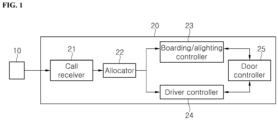
- FIG. 1 is a schematic block diagram of a robot interlocking elevator control system according to the present invention
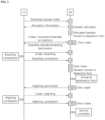
- FIG. 2 is a view illustrating a process in which an autonomous vehicle according to the present invention uses an elevator for movement between floors in a building.
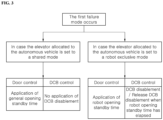
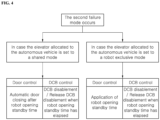
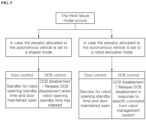
- FIG. 3 to 7 show elevator door and DCB control methods of a robot interlocking elevator control system of the present invention when a first to fifth failure mode occurs.
- the robot interlocking elevator control system includes an autonomous vehicle 10 autonomously moving in a building and an elevator controller 20 controlling operation of an elevator disposed inside the building through communication with the autonomous vehicle 10 to perform interlocking control of the autonomous vehicle 10 and the elevator.
- the autonomous vehicle 10 collectively refers to all kinds of mobile devices including robots and capable of autonomously moving without human manipulation in a building.
- the autonomous vehicle 10 may be a service robot that carries out tasks, such as transport including parcel delivery, cleaning, and customer guidance, and the like, and may be interlinked with a building management system (not shown) in a building to provide services for passengers in the building.
- the autonomous vehicle 10 may communicate with the elevator controller 20 that controls operation of the elevator and movement of the autonomous vehicle 10 between floors in the building may be implemented through interlocking control of the elevator controller 20.
- the autonomous vehicle 10 may send and receive signals, which relate to elevator call, destination floor registration, and boarding/alighting operations, to and from the elevator controller 20, and details of corresponding operations will be described below.
- Communication between the autonomous vehicle 10, the elevator controller 20 and the building management system may be implemented through wired or wireless communication, such as Bluetooth, Wi-Fi, CAN, WAN, and the like.
- the autonomous vehicle 10 may recognize a space within a building through simultaneous localization and mapping (SLAM) based on information collected using a Lidar, a short-distance sensor, an ultrasonic sensor and a camera, and may move autonomously therein.
- SLAM simultaneous localization and mapping
- the autonomous vehicle 10 may store information regarding an internal/external structure of the building and a location of the elevator in the building through a database thereof, and may calculate an optimal distance and a movement route from a current location to the elevator calculated in real time using an internal algorithm based on a self-location estimation technique.
- the elevator controller 20 controls overall operation and movement of the elevator.
- the elevator controller 20 may allocate an optimal elevator car in response to a call from each floor in the building, including button input by a passenger, a remote call, or a call received by the autonomous vehicle 10, and may control the allocated elevator car to move to the floor where the corresponding call is sent.
- the elevator controller 20 may include a call receiver 21 receiving an elevator call signal generated by a passenger or the autonomous vehicle 10; an allocator 22 selecting an optimal elevator among multiple elevator cars in the building to allocate the optimal elevator in response to the elevator call signal; a boarding/alighting controller 23 controlling boarding/alighting operation of the autonomous vehicle 10 with respect to the elevator car; and a drive controller 24 controlling operation of the elevator car.
- the elevator controller 20 may provide a service of allocating and moving an optimal elevator car in response to button input by a passenger or a remote call, this operation can be realized using a technique well-known in the art. Thus, the following description will focus on control related to the autonomous vehicle 10.
- the call receiver 21 may receive an elevator boarding request from the autonomous vehicle 10.
- Information included in the elevator boarding request may further include departure floor information regarding a current location of the autonomous vehicle 10, destination floor information regarding a destination floor of the autonomous vehicle 10, information regarding a movement time of the autonomous vehicle 10 for arrival at an elevator platform, information regarding the weight, volume and purpose of use of the elevator, and the like.
- the allocator 22 may determine and allocate the most efficient elevator car through correlation analysis of a traffic volume and information regarding the locations of multiple available elevator cars and the autonomous vehicle 10 within the building.
- the allocator 22 may detect status information regarding occupancy or remaining capacity of multiple elevator cars operating in the building, and may extract available elevator cars allowing the autonomous vehicle 10 to board based on the weight, volume and the like of the autonomous vehicle 10 included in the elevator boarding request information received from the autonomous vehicle 10.
- the allocator 22 may allocate an optimal elevator car in consideration of the locations of the extracted available elevator cars and the autonomous vehicle 10.
- information regarding a call floor on which the autonomous vehicle 10 requests elevator boarding but also information regarding a movement time of the autonomous vehicle 10 from a current location to the platform may also be considered in selection of the optimal elevator car.
- the elevator controller 20 may further include an autonomous vehicle location collector (not shown) that traces the location of the autonomous vehicle 10 in the building in real time to calculate a movement time of the autonomous vehicle 10 from the current location to the platform based on a signal sent from the autonomous vehicle 10, instead of allowing the autonomous vehicle 10 to calculate location information thereof.
- an autonomous vehicle location collector (not shown) that traces the location of the autonomous vehicle 10 in the building in real time to calculate a movement time of the autonomous vehicle 10 from the current location to the platform based on a signal sent from the autonomous vehicle 10, instead of allowing the autonomous vehicle 10 to calculate location information thereof.
- the boarding/alighting controller 23 may manage and control overall operation for the autonomous vehicle 10, which requests elevator boarding, to board or alight from the allocated elevator car.
- the boarding/alighting controller 23 may determine based on information sent from the autonomous vehicle 10 whether the autonomous vehicle 10 approaches an elevator platform and may send a boarding standby command or a boarding permission command to the autonomous vehicle 10 depending on arrival of the autonomous vehicle 10 and arrival of the allocated elevator car at the corresponding elevator platform.
- the autonomous vehicle 10 may send an under-movement signal to the boarding/alighting controller 23 in the course of moving towards the platform and may send an under-standby signal thereto to inform the boarding/alighting controller 23 of the autonomous vehicle 10 being in a standby state on the platform when the autonomous vehicle 10 has already reached the platform.
- the boarding/alighting controller 23 may instruct the autonomous vehicle 10 to alight from the elevator car when the autonomous vehicle 10 arrives at the destination floor after boarding of the autonomous vehicle 10 on the elevator car is completed.
- the boarding/alighting controller 23 may be interlinked with the door controller 25 that controls opening/closing of a door of the elevator car stopped on a service floor and a door of the corresponding platform.
- the drive controller 24 serves to control driving of the elevator car to move upwards or downwards in a hoistway formed in the building in the vertical direction and may control a hoist motor to start driving of the elevator car or a brake to stop the elevator car.
- the drive controller 24 may control operation of the elevator car by generating a command signal to control the allocated elevator car to move to a floor, on which the autonomous vehicle 10 is placed, or a command signal to control the elevator car receiving the autonomous vehicle 10 to move to the destination floor of the autonomous vehicle 10, in response to the elevator boarding request from the autonomous vehicle 10.
- the autonomous vehicle 10 may remotely call an elevator car through wired or wireless communication with the elevator controller 20.
- the autonomous vehicle 10 may send a boarding request signal, which requests a call of the elevator car, to the elevator controller 20.
- the allocator 22 allocates an optimal elevator car among multiple available elevator cars based on the information included in the boarding request signal and the information regarding the locations of available elevator cars in the building.
- the allocator 22 may provide the allocated elevator car and platform information corresponding thereto to the autonomous vehicle 10.
- the autonomous vehicle 10 may move to the corresponding platform while periodically reporting a movement situation to the elevator controller 20.
- the autonomous vehicle 10 may send a standby signal indicating that the autonomous vehicle 10 is in a standby state on the platform, upon arrival at the corresponding platform.
- the elevator controller 20 may detect whether the autonomous vehicle 10 arrives at the platform corresponding to the allocated elevator car.
- arrival of the autonomous vehicle 10 at the platform may be determined based on the location information obtained by the autonomous vehicle 10 through the self-location estimation technique or the location information of the autonomous vehicle 10 collected through a separate autonomous vehicle location collector (not shown), as described above.
- the autonomous vehicle 10 may arrive at the platform earlier than the allocated elevator car, or the allocated elevator car may arrive at the platform earlier than the autonomous vehicle 10.
- the boarding/alighting controller 23 of the elevator controller 20 may send a boarding standby signal and/or a boarding permission signal to the autonomous vehicle 10 depending on an arrival order of the autonomous vehicle 10 and the allocated elevator car.
- the boarding/alighting controller 23 may send the boarding standby signal to the autonomous vehicle 10 and then may send the boarding permission signal to the autonomous vehicle 10 upon completion of door opening after arrival of the allocated elevator car at a departure floor (call floor).
- the boarding/alighting controller 23 may send the boarding permission signal to the autonomous vehicle 10 after conversion of the elevator door into an open state in conjunction with the door controller 25.
- the doors of the elevator car and the platform may be controlled to be maintained in an open state until the autonomous vehicle 10 arrives at the platform.
- the elevator controller 20 may control the autonomous vehicle 10 to send a recall signal for reallocation of an optimal elevator by sending a call cancellation signal to cancel a current call of the autonomous vehicle 10.
- the autonomous vehicle 10 In response to the boarding permission signal from the boarding/alighting controller 23, the autonomous vehicle 10 performs boarding operation with respect to the allocated elevator car.
- the autonomous vehicle 10 may inform the boarding/alighting controller 23 of the autonomous vehicle 10 being under boarding operation by continuously sending the under-boarding signal to the boarding/alighting controller 23 from a start time of the boarding operation to a completion time thereof.
- the boarding/alighting controller 23 may control the elevator door not to be closed in cooperation with the door controller 25 while the autonomous vehicle 10 passes through the elevator door.
- the autonomous vehicle 10 may send a boarding completion signal to the boarding/alighting controller 23.
- the elevator controller 20 may close the elevator door and may automatically register the destination floor of the autonomous vehicle 10 to control the elevator car to move to destination floor of the autonomous vehicle 10.
- the elevator controller 20 may open the doors of the elevator car and the platform of the destination floor and may send an alighting permission signal to the autonomous vehicle 10 through the boarding/alighting controller 23 to instruct the autonomous vehicle 10 to alight from the elevator car.
- the autonomous vehicle 10 performs alighting operation with respect to the elevator car.
- the autonomous vehicle 10 may inform the boarding/alighting controller 23 of the autonomous vehicle 10 being under alighting operation by continuously sending the under-alighting signal to the boarding/alighting controller 23 from a start time of the alighting operation to a completion time thereof, and the boarding/alighting controller 23 may control the elevator door so as not to be closed in cooperation with the door controller 25 while the autonomous vehicle 10 passes through the elevator door.
- the autonomous vehicle 10 may send an alighting completion signal to the boarding/alighting controller 23.
- the elevator controller 20 may close the door of the elevator and may complete an inter-floor movement service for the autonomous vehicle 10.
- various failure modes relating to boarding and alighting of the autonomous vehicle 10 can occur as follows.
- the present invention defines the failure modes occurring in each step and provides countermeasures against these failure modes.
- Case 1 A case where a platform standby state of the autonomous vehicle 10 is not recognized, that is, a case where the elevator controller 20 does not receive a platform standby signal from the autonomous vehicle 10, when the elevator car arrives at a call floor in response to an elevator call from the autonomous vehicle 10.
- Case 2 A case where boarding operation of the autonomous vehicle 10 is not started for a predetermined period of time or more, that is, a case where the elevator controller 20 does not receive an under-boarding signal from the autonomous vehicle 10, after arrival of the elevator car at a call floor in response to an elevator call from the autonomous vehicle 10.
- Case 4 A case where alighting operation of the autonomous vehicle 10 is not started for a predetermined period of time or more, that is, a case where the elevator controller 20 does not receive an under-alighting signal from the autonomous vehicle 10, despite arrival of the elevator car receiving the autonomous vehicle 10 at a destination floor.
- Case 1 A case where the elevator controller 20 does not receive a platform standby signal from the autonomous vehicle 10, despite arrival of the elevator car at a departure floor in response to a boarding request (call) from the autonomous vehicle 10.
- Case 2 A case where the elevator controller 20 does not receive an under-boarding signal from the autonomous vehicle 10, despite reception of the platform standby signal from the autonomous vehicle 10 and transmission of a boarding permission signal to the autonomous vehicle 10.
- Case 3 A case where the elevator controller 20 does not receive a boarding completion signal from the autonomous vehicle 10, despite reception of the under-boarding signal therefrom.
- Case 4 A case where the elevator controller 20 does not receive an under-alighting signal from the autonomous vehicle 10, despite arrival of the elevator car receiving the autonomous vehicle 10 at the destination floor after reception of the boarding completion signal from the autonomous vehicle 10.
- Case 5 A case where the elevator controller 20 does not receive an alighting completion signal from the autonomous vehicle 10 despite reception of the under-alighting signal therefrom.
- the countermeasures against the failure modes in each step will be described in more detail.
- the following countermeasures may be changed depending upon whether an elevator to be used by the autonomous vehicle 10 is set to a shared mode allowing shared use of the elevator by both robots and humans or a robot exclusive mode allowing use of the elevator only by robots.
- the countermeasures against the failure modes in each step are separately established according to a setting mode of the elevator.
- control logics corresponding to the countermeasures upon occurrence of the failure modes in each case will be described according to the setting mode of the elevator.
- the robot interlocking elevator control system may set a predetermined time as an opening standby time of the elevator door.
- the opening standby time of the elevator door means a period of time for which the door stands by in an open state. That is, the opening standby time may mean a period of time from a time at which the elevator door is completely open to a time immediately before the elevator door starts to be closed excluding a time for operation of opening or closing the elevator door.
- the robot interlocking elevator control system may set the opening standby time of the elevator door selected from among two values, that is, a general opening standby time for boarding/alighting of general passengers (human passengers) and a robot opening standby time for boarding/alighting of the autonomous vehicle (robot).
- the robot opening standby time is a setting value applied to opening/closing of the elevator door upon boarding/alighting of the autonomous vehicle 10 through the elevator door and may be set to a longer time (for example, 40 seconds) than the general opening standby time.
- the general opening standby time and the opening standby time are arbitrary set values that can be changed depending upon entrance conditions of the elevator door and the like.
- the elevator door to which the general opening standby time and the robot opening standby time are applied may be understood as a concept including both an elevator car door and a platform door, and setting of the door opening time and the door closing time and opening/closing of the elevator door may be controlled by the door controller 25, as described above.
- the elevator controller 20 sets the opening time of the elevator door to the robot opening standby time and disables the door close button of the elevator for boarding operation of the autonomous vehicle 10 with respect to the allocated elevator car.
- the elevator controller can control the autonomous vehicle 10 to start the boarding procedure after standby for a predetermined time.
- the elevator controller may disable the door close button and may control the elevator door to stand by in an open state until arrival of the autonomous vehicle 10. In this case, the robot opening standby time is counted from an arrival time of the autonomous vehicle 10 at the platform.
- the elevator controller may set the opening time of the elevator door to the general opening standby time or may convert the robot opening standby time, if previously set, into the general opening standby time and may release disablement of the door close button. Accordingly, it is possible for a general passenger to start the elevator car to move from a stopped floor after closing the corresponding elevator door by pressing the door close button.
- the elevator car starting to move without the autonomous vehicle 10 therein does not move to the departure floor of the autonomous vehicle 10 due to cancellation of the service for the autonomous vehicle 10.
- the general opening standby time may be applied instead of the robot opening standby time upon opening/closing of the elevator door.
- the elevator door Since the elevator car does need to consider a service standby time for other human passengers in the robot exclusive mode, the elevator door is opened and maintained in an open state until the robot opening standby time elapses, upon arrival of the allocated elevator car at a call floor in response to an elevator call from the autonomous vehicle 10.
- the door close button may be disabled and the elevator door may be maintained open as long as the robot opening standby time even without recognition of a standby state of the autonomous vehicle 10 on the platform. After the robot opening standby time has elapsed, disablement of the door close button may be released and the elevator controller may wait for a call service from another autonomous vehicle.
- disablement of the door close button may be released while the elevator door is stood by in an open state until a service call is sent from the autonomous vehicle 10 on another floor.
- the elevator controller may cancel a current service for the autonomous vehicle 10 on a current floor (that is, a currently requested service) and may control the elevator car to move to the other floor for a service for the autonomous vehicle 10 on the other floor after closing the elevator door.
- the elevator controller 20 In a normal state in which the elevator controller 20 normally receives the under-boarding signal from the autonomous vehicle 10, the elevator controller 20 maintains the elevator door in an open state and disables the door close button during the robot opening standby time. Immediately after or as soon as the elevator door is opened, the elevator controller 20 may send a boarding permission signal to the autonomous vehicle 10 to induce boarding of the autonomous vehicle 10.
- the elevator controller 20 opens the elevator door and sends the boarding permission signal to the autonomous vehicle 10 due to detection of the autonomous vehicle 10 standing by on the platform, there can be a case where the elevator controller does not receive the under-boarding signal from the autonomous vehicle 10 for a predetermined period of time.
- the elevator controller 20 may open the elevator door to stand by and may control the elevator car to start to move to another floor for a service for the autonomous vehicle 10 on the other floor after closing the elevator door when the robot opening standby time has elapsed.
- This operation serves to prevent inconvenience caused by a service delay to other passengers and the elevator controller 20 may release disablement of the door close button as soon as the robot opening standby time elapses.
- the countermeasure in this mode may be carried in a similar way to that in Case 1. Since the elevator car does need to consider a service standby time for other human passengers in the robot exclusive mode, the elevator door may be maintained in an open state and the door close button may be disabled even without reception of the under-boarding signal from the autonomous vehicle 10 until the robot opening standby time elapses.
- the elevator controller may release disablement of the door close button and may wait for another service call from the autonomous vehicle 10.
- the elevator controller 20 may close the elevator door and may control the elevator car to move to a destination floor of the autonomous vehicle 10.
- the elevator controller 20 Upon reception of the under-boarding signal from the autonomous vehicle 10, the elevator controller 20 disables the door close button and maintains the elevator door in an open state. However, despite occurrence of a problem in boarding operation of the autonomous vehicle 10, when the elevator car is stood by in this state until the elevator controller receives the boarding completion signal from the autonomous vehicle 10, another passenger can be significantly inconvenienced.
- the elevator controller may release disablement of the door close button to allow the elevator door to be closed when the door close button is pressed by a general passenger.
- the elevator controller prevents the elevator door from being automatically closed for a predetermined period of time or even when the robot opening standby time has elapsed.
- the elevator controller may check whether another passenger using the corresponding elevator can close the elevator door and may control the elevator car to start to move to another floor by closing the elevator door through manipulation of the door close button upon determining that the other passenger can close the elevator door.
- the elevator controller 20 may directly close the elevator door.
- a detection unit for example, a camera or an object detection sensor
- the elevator controller 20 disables the door close button and maintains the elevator door in an open state in response to the under-boarding signal from the autonomous vehicle 10.
- the elevator controller may maintain the elevator door in an open state while maintaining disablement of the door close button, even without reception of the boarding completion signal from the autonomous vehicle 10 until a predetermined period of time elapses.
- breakdown handling of the autonomous vehicle 10 may be performed, as needed, and, after completion of breakdown handling of the autonomous vehicle 10, the elevator controller 20 may release disablement of the door close button and may close the elevator door to move the elevator car to another floor in response to a specific command from the robot management system that manages the autonomous vehicle 10.
- the elevator controller 20 opens the elevator door and sends an alighting permission signal after completion of elevator boarding of the autonomous vehicle 10 and arrival of the autonomous vehicle 10 at the departure floor, the autonomous vehicle 10 sends an under-alighting signal to the elevator controller 20 as soon as the alighting operation is started.
- the elevator controller 20 disables the door close button and maintains the elevator door in an open state for the robot opening standby time to allow the autonomous vehicle 10 to alight from the elevator car.
- the countermeasure in this mode may be carried in a similar way to that in Case 2.
- the elevator controller 20 opens the elevator door and sends the alighting permission signal to the autonomous vehicle 10 due to arrival of the elevator car receiving the autonomous vehicle 10 at the departure floor, there can be a case where the elevator controller does not receive the under-alighting signal from the autonomous vehicle 10 for a predetermined period of time.
- the elevator controller 20 may open the elevator door to stand by and may control the elevator car to start to move to another floor for a service for another floor after closing the elevator door when the robot opening standby time has elapsed.
- This operation serves to prevent inconvenience caused by a service delay to other passengers and the elevator controller 20 may release disablement of the door close button as soon as the robot opening standby time elapses.
- the countermeasure in this mode may be carried in a similar way to that in Case 2. Since the elevator car does need to consider service standby time for other human passengers in the robot exclusive mode, the elevator door may be maintained in an open state and the door close button may be disabled even without reception of the under-alighting signal from the autonomous vehicle 10 until the robot opening standby time elapses.
- the elevator controller may release disablement of the door close button and may wait for another service call from the autonomous vehicle 10.
- the elevator controller 20 may close the elevator door and may complete movement service of the autonomous vehicle 10 between floors.
- the countermeasure in this mode may be carried out in a similar way to that in Case 3.
- the elevator controller 20 Upon reception of the under-alighting signal from the autonomous vehicle 10, the elevator controller 20 disables the door close button and maintains the elevator door in an open state. In this case, however, despite occurrence of an alighting problem, when the elevator car is stood by until the elevator controller receives the alighting completion signal from the autonomous vehicle 10, another passenger can be significantly inconvenienced.
- the elevator controller releases disablement of the door close button to allow the elevator door to be closed when the door close button is pressed by a passenger.
- the elevator controller prevents the elevator door from being automatically closed for a predetermined period of time or even when the robot opening standby time has elapsed.
- the elevator controller may check whether another passenger using the corresponding elevator can close the elevator door, and may control the elevator car to start to move to another floor by closing the elevator door through manipulation of the door close button upon determining that the other passenger can close the elevator door.
- the elevator controller 20 may directly close the elevator door.
- the countermeasure in this mode may be carried out in a similar way to that in Case 3.
- the elevator controller 20 upon reception of the under-alighting signal from the autonomous vehicle 10, the elevator controller 20 disables the door close button and maintains the elevator door in an open state.
- the elevator controller may maintain the elevator door in an open state while maintaining disablement of the door close button, even without reception of the alighting completion signal from the autonomous vehicle 10 until a predetermined period of time elapses.
- breakdown handling of the autonomous vehicle 10 may be performed, as needed, and, after completion of breakdown handling of the autonomous vehicle 10, the elevator controller 20 may release disablement of the door close button and may close the elevator door to move the elevator car to another floor in response to a specific command from the robot management system that manages the autonomous vehicle 10.
- Table 1 Case Setting mode Door control DCB control 1.
- No reception of boarding standby signal Shared mode Application of general opening standby time
- No application of DCB disablement Robot exclusive mode
- Application of robot opening standby time DCB disablement for robot opening standby time Release DCB disablement when robot opening standby time has elapsed 2.
- No reception of under-boarc ing signal Shared mode Automatic door closing after robot opening standby time DCB disablement for robot opening standby time Release DCB disablement when robot opening standby time has elapsed
- Robot exclusive mode Application of robot opening standby time DCB disablement for robot opening standby time Release DCB disablement when robot opening standby time has elapsed 3.
- the robot interlocking elevator control system provides countermeasures of controlling the elevator door while releasing door opening restriction (releasing disablement of the door close button) under a predetermined condition upon occurrence of failure in the course of performing an elevator boarding/alighting procedure of the autonomous vehicle 10, thereby enabling efficient operation of the elevator without delay of an elevator passenger service.
- the robot interlocking elevator control system may be implemented by a server corresponding to a computer or a program that processes signals received from the autonomous vehicle 10 and the elevator controller 20 and generate and output commands corresponding to the signals.
- the robot interlocking elevator control system may include a recording medium in which data is stored and recorded during the process, and examples of the recording medium include ROM, RAM, CD-ROM, a magnetic tape, a floppy disk, an optical data storage device, and the like.
Landscapes
- Engineering & Computer Science (AREA)
- Automation & Control Theory (AREA)
- Computer Networks & Wireless Communication (AREA)
- Robotics (AREA)
- Mechanical Engineering (AREA)
- Elevator Control (AREA)
- Elevator Door Apparatuses (AREA)
Applications Claiming Priority (1)
| Application Number | Priority Date | Filing Date | Title |
|---|---|---|---|
| KR1020220080673A KR102583584B1 (ko) | 2022-06-30 | 2022-06-30 | 로봇 연동 엘리베이터 제어 방법 |
Publications (3)
| Publication Number | Publication Date |
|---|---|
| EP4299497A1 true EP4299497A1 (fr) | 2024-01-03 |
| EP4299497B1 EP4299497B1 (fr) | 2025-06-04 |
| EP4299497C0 EP4299497C0 (fr) | 2025-06-04 |
Family
ID=86226304
Family Applications (1)
| Application Number | Title | Priority Date | Filing Date |
|---|---|---|---|
| EP23169995.0A Active EP4299497B1 (fr) | 2022-06-30 | 2023-04-26 | Système et procédé de commande d'ascenseur à verrouillage robotique |
Country Status (5)
| Country | Link |
|---|---|
| US (1) | US20240002194A1 (fr) |
| EP (1) | EP4299497B1 (fr) |
| JP (1) | JP7550268B2 (fr) |
| KR (2) | KR102583584B1 (fr) |
| CN (1) | CN117326416A (fr) |
Families Citing this family (7)
| Publication number | Priority date | Publication date | Assignee | Title |
|---|---|---|---|---|
| KR102363944B1 (ko) * | 2020-07-15 | 2022-02-17 | 네이버랩스 주식회사 | 로봇 탑승을 위한 엘리베이터 제어 방법 및 시스템 |
| KR20250082351A (ko) * | 2023-11-30 | 2025-06-09 | 현대엘리베이터주식회사 | 엘리베이터 시스템 및 그의 제어 방법 |
| KR102927939B1 (ko) | 2024-02-20 | 2026-02-20 | (주)원익로보틱스 | 다중 승강기에 대한 다중 이동로봇의 탑승 방법 |
| JP7597257B1 (ja) | 2024-02-27 | 2024-12-10 | フジテック株式会社 | 異常通知システム、異常通知システムの制御方法 |
| JP7616452B1 (ja) * | 2024-03-25 | 2025-01-17 | フジテック株式会社 | ロボット管理装置、ロボット、及びプログラム |
| JP7616453B1 (ja) * | 2024-03-25 | 2025-01-17 | フジテック株式会社 | ロボット管理装置、ロボット、及びプログラム |
| JP7758086B2 (ja) * | 2024-03-25 | 2025-10-22 | フジテック株式会社 | ロボット管理装置、ロボット、及びプログラム |
Citations (3)
| Publication number | Priority date | Publication date | Assignee | Title |
|---|---|---|---|---|
| JP2007210801A (ja) * | 2007-03-14 | 2007-08-23 | Matsushita Electric Works Ltd | 自律移動ロボット及び自律移動ロボット用のエレベータ乗降システム |
| US20210284485A1 (en) * | 2020-03-16 | 2021-09-16 | Otis Elevator Company | Elevator calling coordination for robots and individuals |
| US20220005303A1 (en) * | 2019-06-21 | 2022-01-06 | Lg Electronics Inc. | Building management robot and method of providing service using the same |
Family Cites Families (17)
| Publication number | Priority date | Publication date | Assignee | Title |
|---|---|---|---|---|
| JP2674849B2 (ja) * | 1989-12-29 | 1997-11-12 | 株式会社竹中工務店 | エレベータ装置 |
| JP4165847B2 (ja) * | 1999-05-26 | 2008-10-15 | 富士重工業株式会社 | エレベータに乗降する自律走行車 |
| JP5031371B2 (ja) * | 2005-12-07 | 2012-09-19 | 三菱電機株式会社 | エレベータの制御システム |
| JP5473477B2 (ja) * | 2009-08-20 | 2014-04-16 | 東芝エレベータ株式会社 | 無人搬送車対応エレベータ装置及び該エレベータ装置の異常検出方法 |
| WO2011067848A1 (fr) * | 2009-12-03 | 2011-06-09 | 三菱電機株式会社 | Système d'ascenseur |
| JP5572018B2 (ja) * | 2010-07-08 | 2014-08-13 | 株式会社日立製作所 | 自律移動装置同乗エレベータシステム |
| CN107979410B (zh) * | 2016-10-21 | 2020-09-04 | 菜鸟智能物流控股有限公司 | 一种自动进入、离开乘坐设备的方法及相关装置 |
| CN108975101B (zh) * | 2018-07-18 | 2020-11-06 | 日立楼宇技术(广州)有限公司 | 电梯控制方法、装置、系统、设备和存储介质 |
| JP7177488B2 (ja) * | 2019-06-06 | 2022-11-24 | 株式会社日立製作所 | エレベーターの運行制御システム、エレベーターシステム及びエレベーターの運行制御方法 |
| WO2020250409A1 (fr) * | 2019-06-14 | 2020-12-17 | 三菱電機株式会社 | Dispositif de liaison d'ascenseur |
| KR102321999B1 (ko) * | 2019-10-25 | 2021-11-04 | 네이버랩스 주식회사 | 로봇 탑승을 위한 엘리베이터 제어 방법 및 시스템 |
| CN211034776U (zh) * | 2019-11-15 | 2020-07-17 | 江西高深智能系统有限公司 | 一种智能楼宇机器人乘梯系统 |
| KR102363944B1 (ko) * | 2020-07-15 | 2022-02-17 | 네이버랩스 주식회사 | 로봇 탑승을 위한 엘리베이터 제어 방법 및 시스템 |
| JP7412316B2 (ja) * | 2020-10-30 | 2024-01-12 | 株式会社日立ビルシステム | エレベーター呼び登録方法及びエレベーターシステム |
| JP7407101B2 (ja) | 2020-11-24 | 2023-12-28 | 株式会社日立ビルシステム | エレベーターシステム |
| CN113844964B (zh) * | 2021-10-11 | 2023-08-22 | 上海擎朗智能科技有限公司 | 机器人乘梯的控制方法、装置、电子设备和存储介质 |
| CN114314217B (zh) * | 2021-11-27 | 2024-08-16 | 深圳市普渡科技有限公司 | 乘梯控制方法、装置、计算机设备和存储介质 |
-
2022
- 2022-06-30 KR KR1020220080673A patent/KR102583584B1/ko active Active
-
2023
- 2023-04-25 US US18/139,281 patent/US20240002194A1/en active Pending
- 2023-04-26 EP EP23169995.0A patent/EP4299497B1/fr active Active
- 2023-04-28 CN CN202310481859.8A patent/CN117326416A/zh active Pending
- 2023-05-02 JP JP2023076283A patent/JP7550268B2/ja active Active
- 2023-09-20 KR KR1020230125370A patent/KR102687915B1/ko active Active
Patent Citations (3)
| Publication number | Priority date | Publication date | Assignee | Title |
|---|---|---|---|---|
| JP2007210801A (ja) * | 2007-03-14 | 2007-08-23 | Matsushita Electric Works Ltd | 自律移動ロボット及び自律移動ロボット用のエレベータ乗降システム |
| US20220005303A1 (en) * | 2019-06-21 | 2022-01-06 | Lg Electronics Inc. | Building management robot and method of providing service using the same |
| US20210284485A1 (en) * | 2020-03-16 | 2021-09-16 | Otis Elevator Company | Elevator calling coordination for robots and individuals |
Also Published As
| Publication number | Publication date |
|---|---|
| EP4299497B1 (fr) | 2025-06-04 |
| CN117326416A (zh) | 2024-01-02 |
| JP2024006974A (ja) | 2024-01-17 |
| EP4299497C0 (fr) | 2025-06-04 |
| KR20240002972A (ko) | 2024-01-08 |
| KR102687915B1 (ko) | 2024-07-25 |
| KR102583584B1 (ko) | 2023-10-06 |
| US20240002194A1 (en) | 2024-01-04 |
| JP7550268B2 (ja) | 2024-09-12 |
Similar Documents
| Publication | Publication Date | Title |
|---|---|---|
| EP4299497B1 (fr) | Système et procédé de commande d'ascenseur à verrouillage robotique | |
| EP4296209A1 (fr) | Système et procédé de commande d'ascenseur à verrouillage robotique | |
| CN115279678B (zh) | 具有用于机器人交通的排队功能的电梯系统 | |
| JP6619760B2 (ja) | エレベーター装置、エレベーターシステム、および、自律ロボットの制御方法 | |
| CN103261068B (zh) | 响应于发起的各轿厢呼叫定位服务电梯的电梯系统及方法 | |
| US20130048436A1 (en) | Automated elevator car call prompting | |
| JP2023517984A5 (fr) | ||
| EP4335803B1 (fr) | Système de commande d'ascenseur à verrouillage de robot | |
| KR102046829B1 (ko) | 승강기 연동 제어 장치 | |
| JP7063405B1 (ja) | 移動体の管理システムおよびエレベーター | |
| CN115744512B (zh) | 一种机器人乘梯方法、装置及计算机可读存储介质 | |
| KR102318839B1 (ko) | 승강기 연동 agv 충전 제어 장치 | |
| KR102630551B1 (ko) | 로봇 연동 엘리베이터 제어 시스템 | |
| KR102701767B1 (ko) | 로봇 연동 엘리베이터 제어 시스템 및 방법 | |
| KR102745310B1 (ko) | 로봇 연동 엘리베이터 시스템 | |
| JP7771314B1 (ja) | エレベータ制御装置、エレベータ制御システムおよびエレベータ制御方法 | |
| HK40074704B (zh) | 具有用於机器人交通的排队功能的电梯系统 | |
| HK40074704A (en) | Elevator system with queueing function for robot traffic | |
| HK1192742B (en) | Elevator system and method for locating serving elevators in response to each prompted car call |
Legal Events
| Date | Code | Title | Description |
|---|---|---|---|
| STAA | Information on the status of an ep patent application or granted ep patent |
Free format text: STATUS: UNKNOWN |
|
| PUAI | Public reference made under article 153(3) epc to a published international application that has entered the european phase |
Free format text: ORIGINAL CODE: 0009012 |
|
| STAA | Information on the status of an ep patent application or granted ep patent |
Free format text: STATUS: REQUEST FOR EXAMINATION WAS MADE |
|
| 17P | Request for examination filed |
Effective date: 20230426 |
|
| AK | Designated contracting states |
Kind code of ref document: A1 Designated state(s): AL AT BE BG CH CY CZ DE DK EE ES FI FR GB GR HR HU IE IS IT LI LT LU LV MC ME MK MT NL NO PL PT RO RS SE SI SK SM TR |
|
| GRAP | Despatch of communication of intention to grant a patent |
Free format text: ORIGINAL CODE: EPIDOSNIGR1 |
|
| STAA | Information on the status of an ep patent application or granted ep patent |
Free format text: STATUS: GRANT OF PATENT IS INTENDED |
|
| INTG | Intention to grant announced |
Effective date: 20241204 |
|
| GRAS | Grant fee paid |
Free format text: ORIGINAL CODE: EPIDOSNIGR3 |
|
| GRAA | (expected) grant |
Free format text: ORIGINAL CODE: 0009210 |
|
| STAA | Information on the status of an ep patent application or granted ep patent |
Free format text: STATUS: THE PATENT HAS BEEN GRANTED |
|
| AK | Designated contracting states |
Kind code of ref document: B1 Designated state(s): AL AT BE BG CH CY CZ DE DK EE ES FI FR GB GR HR HU IE IS IT LI LT LU LV MC ME MK MT NL NO PL PT RO RS SE SI SK SM TR |
|
| REG | Reference to a national code |
Ref country code: GB Ref legal event code: FG4D |
|
| REG | Reference to a national code |
Ref country code: CH Ref legal event code: EP |
|
| REG | Reference to a national code |
Ref country code: DE Ref legal event code: R096 Ref document number: 602023003788 Country of ref document: DE |
|
| REG | Reference to a national code |
Ref country code: IE Ref legal event code: FG4D |
|
| U01 | Request for unitary effect filed |
Effective date: 20250703 |
|
| U07 | Unitary effect registered |
Designated state(s): AT BE BG DE DK EE FI FR IT LT LU LV MT NL PT RO SE SI Effective date: 20250710 |
|
| PG25 | Lapsed in a contracting state [announced via postgrant information from national office to epo] |
Ref country code: ES Free format text: LAPSE BECAUSE OF FAILURE TO SUBMIT A TRANSLATION OF THE DESCRIPTION OR TO PAY THE FEE WITHIN THE PRESCRIBED TIME-LIMIT Effective date: 20250604 |
|
| PG25 | Lapsed in a contracting state [announced via postgrant information from national office to epo] |
Ref country code: NO Free format text: LAPSE BECAUSE OF FAILURE TO SUBMIT A TRANSLATION OF THE DESCRIPTION OR TO PAY THE FEE WITHIN THE PRESCRIBED TIME-LIMIT Effective date: 20250904 Ref country code: GR Free format text: LAPSE BECAUSE OF FAILURE TO SUBMIT A TRANSLATION OF THE DESCRIPTION OR TO PAY THE FEE WITHIN THE PRESCRIBED TIME-LIMIT Effective date: 20250905 |
|
| PG25 | Lapsed in a contracting state [announced via postgrant information from national office to epo] |
Ref country code: PL Free format text: LAPSE BECAUSE OF FAILURE TO SUBMIT A TRANSLATION OF THE DESCRIPTION OR TO PAY THE FEE WITHIN THE PRESCRIBED TIME-LIMIT Effective date: 20250604 |
|
| PG25 | Lapsed in a contracting state [announced via postgrant information from national office to epo] |
Ref country code: HR Free format text: LAPSE BECAUSE OF FAILURE TO SUBMIT A TRANSLATION OF THE DESCRIPTION OR TO PAY THE FEE WITHIN THE PRESCRIBED TIME-LIMIT Effective date: 20250604 |
|
| PG25 | Lapsed in a contracting state [announced via postgrant information from national office to epo] |
Ref country code: RS Free format text: LAPSE BECAUSE OF FAILURE TO SUBMIT A TRANSLATION OF THE DESCRIPTION OR TO PAY THE FEE WITHIN THE PRESCRIBED TIME-LIMIT Effective date: 20250904 |
|
| PG25 | Lapsed in a contracting state [announced via postgrant information from national office to epo] |
Ref country code: IS Free format text: LAPSE BECAUSE OF FAILURE TO SUBMIT A TRANSLATION OF THE DESCRIPTION OR TO PAY THE FEE WITHIN THE PRESCRIBED TIME-LIMIT Effective date: 20251004 |
|
| PG25 | Lapsed in a contracting state [announced via postgrant information from national office to epo] |
Ref country code: SM Free format text: LAPSE BECAUSE OF FAILURE TO SUBMIT A TRANSLATION OF THE DESCRIPTION OR TO PAY THE FEE WITHIN THE PRESCRIBED TIME-LIMIT Effective date: 20250604 |
|
| PG25 | Lapsed in a contracting state [announced via postgrant information from national office to epo] |
Ref country code: CZ Free format text: LAPSE BECAUSE OF FAILURE TO SUBMIT A TRANSLATION OF THE DESCRIPTION OR TO PAY THE FEE WITHIN THE PRESCRIBED TIME-LIMIT Effective date: 20250604 |
|
| PG25 | Lapsed in a contracting state [announced via postgrant information from national office to epo] |
Ref country code: SK Free format text: LAPSE BECAUSE OF FAILURE TO SUBMIT A TRANSLATION OF THE DESCRIPTION OR TO PAY THE FEE WITHIN THE PRESCRIBED TIME-LIMIT Effective date: 20250604 |
|
| PLBE | No opposition filed within time limit |
Free format text: ORIGINAL CODE: 0009261 |
|
| STAA | Information on the status of an ep patent application or granted ep patent |
Free format text: STATUS: NO OPPOSITION FILED WITHIN TIME LIMIT |
|
| REG | Reference to a national code |
Ref country code: CH Ref legal event code: L10 Free format text: ST27 STATUS EVENT CODE: U-0-0-L10-L00 (AS PROVIDED BY THE NATIONAL OFFICE) Effective date: 20260416 |
|
| PGFP | Annual fee paid to national office [announced via postgrant information from national office to epo] |
Ref country code: TR Payment date: 20260331 Year of fee payment: 4 |