EP4300226A1 - Gateway und verfahren zur umwandlung eines datenmodells einer fertigungsprozessanlage - Google Patents
Gateway und verfahren zur umwandlung eines datenmodells einer fertigungsprozessanlage Download PDFInfo
- Publication number
- EP4300226A1 EP4300226A1 EP22182139.0A EP22182139A EP4300226A1 EP 4300226 A1 EP4300226 A1 EP 4300226A1 EP 22182139 A EP22182139 A EP 22182139A EP 4300226 A1 EP4300226 A1 EP 4300226A1
- Authority
- EP
- European Patent Office
- Prior art keywords
- mapping
- knowledge
- declarative
- gateway
- transforming
- Prior art date
- Legal status (The legal status is an assumption and is not a legal conclusion. Google has not performed a legal analysis and makes no representation as to the accuracy of the status listed.)
- Pending
Links
Images

Classifications
-
- G—PHYSICS
- G05—CONTROLLING; REGULATING
- G05B—CONTROL OR REGULATING SYSTEMS IN GENERAL; FUNCTIONAL ELEMENTS OF SUCH SYSTEMS; MONITORING OR TESTING ARRANGEMENTS FOR SUCH SYSTEMS OR ELEMENTS
- G05B19/00—Program-control systems
- G05B19/02—Program-control systems electric
- G05B19/418—Total factory control, i.e. centrally controlling a plurality of machines, e.g. direct or distributed numerical control [DNC], flexible manufacturing systems [FMS], integrated manufacturing systems [IMS] or computer integrated manufacturing [CIM]
- G05B19/41885—Total factory control, i.e. centrally controlling a plurality of machines, e.g. direct or distributed numerical control [DNC], flexible manufacturing systems [FMS], integrated manufacturing systems [IMS] or computer integrated manufacturing [CIM] characterised by modeling, simulation of the manufacturing system
-
- G—PHYSICS
- G05—CONTROLLING; REGULATING
- G05B—CONTROL OR REGULATING SYSTEMS IN GENERAL; FUNCTIONAL ELEMENTS OF SUCH SYSTEMS; MONITORING OR TESTING ARRANGEMENTS FOR SUCH SYSTEMS OR ELEMENTS
- G05B19/00—Program-control systems
- G05B19/02—Program-control systems electric
- G05B19/418—Total factory control, i.e. centrally controlling a plurality of machines, e.g. direct or distributed numerical control [DNC], flexible manufacturing systems [FMS], integrated manufacturing systems [IMS] or computer integrated manufacturing [CIM]
- G05B19/4185—Total factory control, i.e. centrally controlling a plurality of machines, e.g. direct or distributed numerical control [DNC], flexible manufacturing systems [FMS], integrated manufacturing systems [IMS] or computer integrated manufacturing [CIM] characterised by the network communication
-
- G—PHYSICS
- G06—COMPUTING OR CALCULATING; COUNTING
- G06F—ELECTRIC DIGITAL DATA PROCESSING
- G06F16/00—Information retrieval; Database structures therefor; File system structures therefor
- G06F16/30—Information retrieval; Database structures therefor; File system structures therefor of unstructured textual data
- G06F16/36—Creation of semantic tools, e.g. ontology or thesauri
- G06F16/367—Ontology
-
- H—ELECTRICITY
- H04—ELECTRIC COMMUNICATION TECHNIQUE
- H04L—TRANSMISSION OF DIGITAL INFORMATION, e.g. TELEGRAPHIC COMMUNICATION
- H04L12/00—Data switching networks
- H04L12/66—Arrangements for connecting between networks having differing types of switching systems, e.g. gateways
-
- H—ELECTRICITY
- H04—ELECTRIC COMMUNICATION TECHNIQUE
- H04L—TRANSMISSION OF DIGITAL INFORMATION, e.g. TELEGRAPHIC COMMUNICATION
- H04L67/00—Network arrangements or protocols for supporting network services or applications
- H04L67/01—Protocols
- H04L67/12—Protocols specially adapted for proprietary or special-purpose networking environments, e.g. medical networks, sensor networks, networks in vehicles or remote metering networks
-
- G—PHYSICS
- G05—CONTROLLING; REGULATING
- G05B—CONTROL OR REGULATING SYSTEMS IN GENERAL; FUNCTIONAL ELEMENTS OF SUCH SYSTEMS; MONITORING OR TESTING ARRANGEMENTS FOR SUCH SYSTEMS OR ELEMENTS
- G05B2219/00—Program-control systems
- G05B2219/30—Nc systems
- G05B2219/31—From computer integrated manufacturing till monitoring
- G05B2219/31369—Translation, conversion of protocol between two layers, networks
-
- G—PHYSICS
- G05—CONTROLLING; REGULATING
- G05B—CONTROL OR REGULATING SYSTEMS IN GENERAL; FUNCTIONAL ELEMENTS OF SUCH SYSTEMS; MONITORING OR TESTING ARRANGEMENTS FOR SUCH SYSTEMS OR ELEMENTS
- G05B2219/00—Program-control systems
- G05B2219/30—Nc systems
- G05B2219/33—Director till display
- G05B2219/33002—Artificial intelligence AI, expert, knowledge, rule based system KBS
Definitions
- the present embodiments relate to a transformation of a data model of a manufacturing process equipment into an industrial information model for automation purposes. More specifically, the present embodiments relate to a gateway for transforming a data model of a manufacturing process equipment into an industrial information model for automation purposes.
- brownfield devices Many manufacturing process equipment of today, however, are still described or controlled by a proprietary or legacy data model and are therefore also referred to as brownfield devices.
- Embodiments herein generally involve a gateway for transforming a data model of a manufacturing process equipment into an industrial information model for automation purposes.
- the gateway includes:
- a method for transforming a data model of a manufacturing process equipment into an industrial information model for automation purposes is disclosed.
- the proposed embodiments enable mapping of an existing and/or propriety data model of a machine vendor into a standardized industrial information model for automation purposes. Although there may be many ways to implement a mapping of data models, the proposed embodiments are particularly suited for an implementation on hardware with limited resources, for example a gateway being located on an edge layer. This is due to the semantic mapping engine using a runtime environment.
- the runtime environment allows for an execution of knowledge-based mapping rules instead of interpreting declarative mapping rules, thereby saving processing time and resources due to the executable character of the knowledge-based mapping rules. Interpreting the non-executable declarative mapping rules instead would require more overhead, lowering operational efficiency
- the proposed embodiments strive for universality to be adaptable to any data model, including propriety data models, legacy data models, machine-specific data models and vendor-specific data models.
- This universality is accomplished by a declarative semantic mapping.
- the proposed gateway may also perform an interpretation of declarative semantic mapping.
- the gateway can be adapted to any machine model and does not have to be changed as a result of an exchanged machine. It is sufficient to update its semantic mapping.
- Such a mapping can be generated offline either by humans or/and with methods provided by Artificial Intelligence.
- the gateway may be adapted to a multiplicity of machines or process equipment in general and may serve this multiplicity of machines or process equipment at the same time, preferably on an edge level. For this reason, the proposed gateway is not limited to one machine.
- a gateway may provide an integration of brownfield devices and other legacy manufacturing process equipment into an industrial automation system.
- the gateway may be preferably located on an edge layer being part of an industrial automation system.
- FIG. 1 shows a high-level overview of an exemplary industrial automation system.
- the system may be organized in layered control planes including a shopfloor layer FLO, an edge layer EDG and a cloud layer CLD.
- the shopfloor layer FLO may include a number of industrial devices such as machines MCH, field devices FLD or, more general, automation devices APC.
- machines MCH may include batch control systems, e.g., mixing systems, continuous control systems, e.g., PID control systems, or discrete control systems.
- Exemplary automation devices APC may include industrial controllers, e.g., programmable logic controllers or other types of programmable automation controllers.
- Exemplary field devices may include sensors and meters, motor drives, operator interfaces (e.g., human-machine interfaces, industrial monitors, graphic terminals, message displays, etc.), industrial robots, barcode markers and readers, vision system devices or vision cameras, smart welders, systems for assembly manufacturing, etc.
- edge devices located on-premise provide a hybrid data collection and analysis infrastructure on the edge level EDG.
- Edge devices such as gateways GTW may collect data from multiple industrial devices MCH, FLD, APC on the shopfloor level FLO.
- edge devices may maintain a communication channel to a cloud platform or cloud level CLD executing cloud-level data collection and analytic services. As necessary, the edge devices may pass selected sets of data to the cloud platform CLD, where the cloud-level analytic services perform higher level or closed loop analytics ANL and/or Monitoring and Optimization MON on the industrial data.
- the hybrid architecture operates in a bi-directional manner, allowing a Manufacturing Execution System MES to control the industrial devices MCH, FLD, APC on the shopfloor level FLO and allowing the cloud-level analytic services ANL to send instructions or data values (e.g., setpoint values) to the edge devices based on results of the high-level cloud analytics.
- the edge devices can modify aspects of the controlled industrial processes in accordance with the instructions or new data values sent by the cloud platform services.
- a current challenge in industrial automation systems such as in the electronics manufacturing industry involves a standardized communication protocol for the exchange of information between the manufacturing processes and the software systems used in a printed circuit board or PCB assembly.
- IPC International Circuit Processing
- IPC founded in 1957 as »Institute of Printed Circuits «, nowadays entitled Institute for Interconnecting and Packaging Electronic Circuits is a trade and standardization organization based in Bannockburn, Illinois, USA.
- IPC-CFX is an industry-developed open international standard forming the foundation/backbone of Factory of the Future or Industry 4.0 applications. IPC-CFX is a plug-and-play solution that simplifies and standardizes machine-to-machine communication while also facilitating machine-to-business and business-to-machine applications. IPC-CFX is based on IPC-2591, Connected Factory Exchange (CFX), and both are managed by the IPC 2-17 Connected Factory Initiative Subcommittee.
- the proposed gateway GTW or Knowledge-Based IoT Gateway GTW may be attached to several brown-field machines MCH, devices FLD, and/or automation processes APC in order to map their information to information compliant, e.g., with the IPC-CFX standard.
- the proposed gateway GTW and the proposed embodiments are, however, not limited to IPC-CFX standard. Rather, they may be used for other industrial standards, e.g., OPC UA standard.
- the gateway GTW may automatically map messages from proprietary machine vendor models into messages that are compliant with the IPC-CFX standard.
- an embodiment of the proposed gateway consists of two functional areas or units in the following.
- a first unit or mapping knowledge unit MKU (shown on the left side of FIG. 2 ) is used to generate the mapping knowledge
- a second gateway unit GWC (shown on the right side of FIG. 2 ) interprets that mapping knowledge in order to realize the gateway functionality, i.e., translates artifacts or messages from one information model into another one.
- a core of this gateway unit GWC is a semantic mapping engine ENG, which is using or providing a - not shown - runtime environment for executing knowledge-based mapping rules in order to transform information entities in the data model of the manufacturing process equipment into the industrial information model.
- the mapping knowledge unit MKU includes a generation module GNM for the generation of mapping knowledge.
- the process of mapping knowledge may be generated or assisted by artificial intelligence or AI and/or by human operators.
- the mapping knowledge unit MKU may enable a user to define the mapping knowledge. The user may be supported with AI-based tools in this task.
- Data of a log database LOG of the machine MCH may be fed-back via an optional data transformation unit DTR into the generation module GNM.
- mapping knowledge may be transformed into understandable and interpretable mapping rules.
- the generation module GNM transfers the specified mapping knowledge to a mapping knowledge transformation module TRM, where the mapping knowledge is transformed into understandable and interpretable mapping rules.
- the mapping knowledge transformation module TRM transfers the mapping rules to a mapping rule base MKB which may comprise a reservoir for declarative mapping rules, e.g., mapping rules based on Datalog as detailed further down below.
- the mapping rule base MKB may feed declarative mapping rules to a mapping knowledge compiler MPC being a part of the gateway unit GWC.
- the mapping knowledge compiler MPC may actively fetch declarative mapping rules from the mapping rule base MKB.
- the mapping knowledge compiler MPC may include a code generator for translating a Datalog program into an executable and/or procedural code. Generated and optionally optimized code may be designed to run on resource-limited and low-cost hardware.
- the mapping knowledge unit MKU and/or the mapping rule base MKB may be operated to deductively map information entities in the data model of the manufacturing process equipment within the knowledge base KNB with a structure to allow them to be later extracted as objects of the industrial information model for automation purposes, e.g., IPC-CFX objects.
- the mapping rules may be asserted before any mappings occur, such that they are able to be applied to input information throughout the transformation or mapping process.
- the gateway unit GWC as depicted on the right side of FIG. 2 constitutes the second part of the gateway according to the embodiments.
- the gateway unit GWC may comprise an interface module IFM, the mapping compiler MPC, a semantic mapping engine ENG and a parsing module PAM.
- the parsing module PAM may interface a machine MCH or any other entity on a shop floor level.
- the parsing module PAM may be arranged for retrieving information entities in the data model of the manufacturing process equipment by applying a communication protocol of the data model. It may be adapted to any vendor specific information model of a machine. For any new machine information model, it is sufficient to update the mapping knowledge in the gateway.
- One or more parsing modules PAM may be provided for each distinguished serialization format.
- the parsing modules PAM may be accompanied with a declarative language for selecting and navigating nodes in an input document or input message.
- the gateway While embodiments of the gateway are based on declarative mapping rules, engines for these declarative mapping rules may not efficiently run on resource-limited or constrained hardware.
- the gateway according to the present embodiments aims to achieve low hardware requirements including resource-limited hardware.
- the proposed gateway features a mapping compiler MPC.
- This mapping compiler MPC may translate a multiplicity of Datalog rules or a Datalog program into an executable and/or procedural code being executed in the semantic mapping engine ENG.
- the generated and optimized code may be designed to run on resource-limited and low-cost hardware being part or being assigned to the semantic mapping engine ENG.
- the interface module IFM is bidirectionally connecting the semantic mapping engine ENG and interfacing the gateway with a standardized industrial communication in a »northbound « direction, e.g., with a manufacturing execution system MES or other entities on a cloud level CLD according to FIG. 1 .
- Both units - i.e., the mapping knowledge unit MKU of the proposed gateway as shown on the left side of FIG. 2 and the gateway unit GWC of the proposed gateway as shown on the right side of FIG. 2 - are not necessarily realized in one single device. Instead, said units may be designed structurally or factually separate and possibly distributed on a plurality of devices such as field devices, edge devices, gateway devices etc. In fact, all functional units assigned by a reference sign as depicted in FIG. 2 may be realized as separate parts connected via a common communication network.
- the proposed gateway is, from an efficiency point of view, equivalent to a machine-level implementation based on execution of a procedural or fix mapping program, e.g., a C++ implementation.
- the proposed gateway is, however, more flexible than a hard-coded solution.
- the rules that enable mapping may be learnt with AI techniques or may be defined or improved by humans in a low-code fashion using a low-code development platform.
- a low-code development platform in general may provide a development environment used to create application software through a graphical user interface.
- a low-coded platform may produce entirely operational applications or require additional coding for specific situations.
- Low-code development platforms may reduce the amount of traditional time spent, enabling accelerated delivery of business applications.
- a common benefit is that a wider range of people can contribute to the application's development - not only those with coding skills but require a good governance to be able adhere to common rules and regulations.
- Low-code development platform may also lower the initial cost of setup, training, deployment and maintenance.
- a low-code approach according to the present embodiments not only enables an easy creation of declarative mapping knowledge but also eases to discover, modify, validate, and distribute the declarative mapping knowledge. Summing up, the gateway unites advantages of a low-code or Cloud approach with a flexibility and efficiency of a resource-limited low-cost or edge approach.
- the gateway features bidirectional protocol bindings for mapping a communication protocol from the parsing modules PAM, e.g., a machine or device specific protocol, into a standard communication protocol at the interface module IFM and vice versa.
- a communication protocol from the parsing modules PAM, e.g., a machine or device specific protocol
- this is IPC-CFX Communication Protocol at the northbound direction.
- the proposed embodiments are not limited to this IPC-CFX Communication Protocol.
- the interface module IFM may be adapted to provide many other protocols such as OPC UA.
- protocol bindings may be implemented once and may be used for multiple connected machines.
- protocol bindings according to the embodiments may be implemented with procedural programing languages.
- the two-fold nature of the gateway as shown in FIG. 2 is not mandatory for all possible gateways according to the embodiments, the concurrent operation of a mapping knowledge functionality and a gateway functionality including an execution of knowledge-based mapping rules may be regarded as a preferred embodiment.
- Gateways in formerly known designs had to be upgraded in order to handle new protocols or data models by updating the code or firmware. This updating involved an implementation of new parsers each time a new input model was to be adapted to. Moreover, the code for mapping and serialization in desired output models needed to be changed or amended.
- the gateway mitigates these intricacies in that the execution side of the gateway - the right-hand side of FIG. 2 - does not need to be changed.
- Implementing a new vendor-specific model merely involves adding a mapping knowledge.
- a mapping knowledge functionality - according to the left-hand side of FIG. 2 - may generate mapping knowledge offline or concurrently with the regular operation of the gateway.
- the mapping knowledge may be generated either by humans or/and with automated methods using by artificial intelligence.
- a low-code platform may be used, whereby the low-code platform may be made accessible by a server on a cloud level.
- This approach grants wider options for easing a creation or modification of existing mapping knowledge.
- the low-code platform particularly allows developers to concentrate on a high-level mapping performed with a graphic user interface and, at the same time, freeing the developer from the presently necessary practice of coding embedded software for a hardware-constrained IoT gateway. Although more complex cases may still require particular transformation functions, developing these functions in a low-code environment is more time-effective than in an embedded software environment.
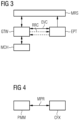
- FIG. 3 illustrating an exemplary industrial communication environment, in which the gateway GTW or knowledge-Based IoT Gateway GTW according to the present embodiments may act in a »plug-and-play « fashion.
- This may include the gateway GTW being connected to a machine MCH on a shopfloor, reading its data, and mapping the data to an industrial information model for automation purposes such as a IPC-CFX information model.
- Mapped data including exchanged messages, may be accessed in a standard way, e.g., via a message routing system MRS.
- the gateway GTW may publish messages or events or generally exchange messages or events with the message routing system MRS - see the vertical double arrow in the drawing.
- the gateway GTW may exchange messages or events with an endpoint EPT.
- the endpoint may be a field device or any other machine or device.
- the exchange of messages or events may be transported over a dedicated event channel EVC or a request/response channel RRC.
- the gateway GTW may publish messages or events over the event channel EVC to the message routing system MRS and subscribe to events from other IPC-CFX Endpoints EPT.
- the IPC-CFX endpoint EPT may be an IPC-CFX compliant machine or another knowledge-based IoT Gateway GTW connected to a brownfield machine.
- the bidirectional exchange or communication may, in the case of the IPC-CFX standard, be realized by an Advanced Message Queuing Protocol or AMQP protocol.
- the gateway GTW may also communicate with other IPC-CFX Endpoints over the Request/Response channel RRC using a Request/Response paradigm.
- mapping rules - illustrated as a double arrow - provide a mapping between a communication protocol of a manufacturing process equipment - which may be proprietary machine Model PMM - into a standardized industrial information model for automation purposes - which may be an IPC-CFX information Model CFX.
- Mapping Rules achieve the task of mapping each term from the input model PMM into a specific term or a series of specific terms of the output model CFX.
- a Mapping Rule Base MKB is used, the details of which will be described further down below.
- a mapping of information models according to the present embodiments is based on one or more declarative logic rules or facts for applying a deductive inference mechanism.
- a deductive inference method is described using Datalog as one exemplary programming language for expressing said declarative logic rules.
- a Datalog language section - also referred to as a Datalog program - consists of declarative rules.
- a Datalog system can proof that body is TRUE - as a Boolean TRUE - then it can infer that the head is TRUE as well. This is a mechanism how a Datalog system can derive new knowledge from existing knowledge.
- Datalog programs and Datalog rules are built up from atomic formulas of a type: p(t1,t2,...,tn) wherein p is a predicate symbol and t1,t2,...,tn denote terms.
- Some predicates have predefined meaning in a Datalog system. They denote a built-in operation, and thus are called built-in predicates.
- built-in predicates and compound terms may be used to handle external calls or functions, which may be used to map methods and commands of the proprietary communication protocol of the manufacturing process equipment into IPC-CFX methods or may be used for mathematical operations, e.g., for data mapping. Further on, built-in predicates and compound terms may be used to call or execute methods and commands specified in the communication protocol.
- an atomic formula - or short an atom - is a formula that cannot be divided into strict sub-formulas.
- Literals are positive or negative atoms.
- Terms are constants, variables, or compound terms. Variables are denoted with strings consisting of capital letters or beginning with a capital letter - e.g., VAR or Var - and constants are quoted, e.g., »constant_unit «.
- Compound terms implement functions.
- a function is an expression of a type:
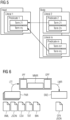
- FIG. 5 shows a graphical representation of a declarative logic rule applied to declarative logic facts with the aim of mapping data from one information model to another one. It can be seen that terms in the Body literal - right side of FIG. 5 - are related to terms in the head atom - left side of FIG. 5 . In this case, upon input of a single fact matching the structure of the body literal, a Datalog fact will be deduced using the inputted fact and the existing Datalog rule.
- Datalog rules can be constructed in such a way that they recursively work with each other to populate complete mapping rules using many individuals, and smaller Datalog rules that define information relationships. As such, in the example, a new Datalog fact with the format of the rule head will be asserted into the database if there are literals matching the body literals' constant terms with the terms also being satisfied as wildcards.
- FIG. 6 illustrates a transformation of a data model of a manufacturing process equipment into executable knowledge-based mapping rules.
- FIG. 6 depicts a concept for mapping a data model of a manufacturing process equipment as shown in the lower left of FIG. 6 into a standardized industrial information model for automation purposes on the lower right of FIG. 6 .
- the data model of the manufacturing process equipment may be specified by a plurality of possible different model data - in the drawing respectively symbolized by a respective paper document with a folded corner - which may be specified in different serialization formats, e.g., XML (Extensible Markup Language), JSON (JSON or JavaScript Object Notation), CSV (Comma-separated Values Format), TXT (Text Format), BIN (Binary Format), etc.
- XML Extensible Markup Language
- JSON JSON or JavaScript Object Notation
- CSV Common-separated Values Format
- TXT Text Format
- BIN Binary Format
- a parser or a parsing process PAR may be provided for one or more of said distinguished serialization formats XML, JSON, CSV, TXT, BIN or binary etc.
- the parsing process PAR may provide a declarative language for selecting and navigating nodes in an input document or message. For example, if XML is used as an input, an expression language XPath may be used for navigating nodes in the serialization format and for extracting the content which has to be mapped. Alternatively, if an input model data is written in JSON, an expression language JSONPath may be used.
- the declarative mapping rules MMR may be specific IPC-CFX declarative mapping rules MMR as described above which means that these declarative mapping rules MMR are defined with respect to a IPC-CFX Model. Since this IPC-CFX Model or any other Model in general is standardized, it does not need to be changed when the input changes, e.g., for the case that another machine vendor is considered.
- the declarative mapping rules MMR may be, however, specific with respect to the Input Facts IPF.
- the parsing process PAR may also expect names of files in which the content may be extracted to (e.g., channel.facts, trace.facts, received-time.facts etc.). This procedure will generate Input Facts IPF.
- Input Facts IPF may to be mapped into Output Facts OPF.
- the declarative mapping rules MMR may be defined with respect to a IPC-CFX Model. Since the IPC-CFX Model is standardized, it may not need to be changed when the input changes.
- the declarative mapping rules MMR may be, however, specifically chosen with respect to the Input Facts IPF.
- An example of declarative mapping rules MMR is shown below:
- the declarative mapping rules MMR may be understood as a mapping table.
- a table header is declared.
- the rest of the lines of the declarative mapping rules MMR as shown above define table rows.
- these table rows may be denoted as Literals as depicted in FIG. 5 and described above in connection with FIG. 5 .
- the meaning of each row is as follows: Whenever a tag »HtBottomZ01 « is detected, it will be mapped to »Z01 «. Further, whenever such a mapping is required, a predicate »detectTag « will be used in a rule.
- mapping tables While usually as many mapping tables are needed as there are XPath expressions in the input message, the present embodiments, achieve significantly less expenditure. This is due to the usage of a graphical interface, implemented by a low-code approach, in order to easily define these mapping tables. It is worth noting, that a user does not need to write the code or embedded code. A simple mapping in a form of statements: map »HtBottomZ01 « into »Z01 « may be sufficient.
- mapping tables are used further with Mapping Rules and IPC-CFX Model that are implemented in Datalog.
- a rule example is shown below:
- This rule may produce a Predicate »SetPoints « with Terms »tag_identifier«, »SubZone «, »SetpointType «, »n_setValue «.
- Said predicates and terms are all defined by the IPC-CFX standard.
- the rule body the part stated after the sign »:- « - Literals may have to be provided for feeding the input content.
- the predicate »detectTag« with Terms »channel_tag_name « and »tag_identifier « may have been provided.
- the Output Facts OPF are fed in a serialized executable code SRZ such as JSON template for IPC-CFX as shown below:
- the IPC-CFX template may be fixed. Thus, the procedure may be implemented once in a procedural way.
- the output is a valid IPC-CFX snippet as shown below:
- a code snippet below - in the description also referred to as »Appendix 1 « - shows an example input message according to a data model of a manufacturing process equipment:
- a code snippet below - in the description also referred to as »Appendix 2 « - shows an example of an output message according to the IPC-CFX information model being an example of an industrial information model for automation purposes:
- the present embodiments enable a transformation of an existing and/or proprietary data model of a machine vendor into a standardized IPC-CFX information model or any other standardized industrial information model for automation purposes.
- the present embodiments are particularly advantageous for implementations on low-cost hardware or gateways with limited resources.
- the proposed embodiments are flexible and general in that they work for any (proprietary) data model of a machine vendor.
- a declarative semantic mapping - which may be generated either by humans or/and with methods provided by artificial Intelligence - their simple deployment surpasses the known machine-level implementations while the proposed embodiments, at the same time, accomplish the processing speed of known machine-level implementations due to the benefits of the proposed transformation of the declarative mapping rules into executable knowledge-based mapping rules executed in a runtime environment of the gateway.
- the proposed embodiments are cheaper in terms of realization and maintenance not least because the mapping rules may be easily sent to potentially many gateways. In the same vein, they may be effortlessly deleted, thereby enabling an easy management of such declarative gateways as proposed.
- the proposed embodiments are characterized by a two-fold approach according to Figure 2 . While a first unit of the proposed gateway as shown on the left side of FIG. 2 is used to generate mapping knowledge, a second unit shown on the right side of FIG. 2 implements the actual gateway functionality.
- a design is driven by the objective underlying the present embodiments of realizing a universal gateway in a sense that its code does not need to be updated when a new vendor specific model is to be handled.
- the gateway functionality as shown on the right side of FIG. 2 may be implemented by constrained hardware, thereby advantageously avoiding a need for changing software or embedded software driving the gateway functionality. Such changes or amendments to the software may be processed in the first unit of the proposed gateway as shown on the left side of FIG. 2 used to generate mapping knowledge. This part may be implemented on a non-constrained hardware, e.g., in the cloud.
- mapping statements are declared.
- a low-code platform may also provide a concurrent validation of mapped statements, configuration options, a monitoring service for input and output message streams, scheduling etc.
Landscapes
- Engineering & Computer Science (AREA)
- Manufacturing & Machinery (AREA)
- General Engineering & Computer Science (AREA)
- Physics & Mathematics (AREA)
- General Physics & Mathematics (AREA)
- Quality & Reliability (AREA)
- Automation & Control Theory (AREA)
- Computer Networks & Wireless Communication (AREA)
- Signal Processing (AREA)
- Theoretical Computer Science (AREA)
- Computing Systems (AREA)
- General Health & Medical Sciences (AREA)
- Medical Informatics (AREA)
- Life Sciences & Earth Sciences (AREA)
- Animal Behavior & Ethology (AREA)
- Computational Linguistics (AREA)
- Data Mining & Analysis (AREA)
- Databases & Information Systems (AREA)
- Health & Medical Sciences (AREA)
- Devices For Executing Special Programs (AREA)
Priority Applications (3)
| Application Number | Priority Date | Filing Date | Title |
|---|---|---|---|
| EP22182139.0A EP4300226A1 (de) | 2022-06-30 | 2022-06-30 | Gateway und verfahren zur umwandlung eines datenmodells einer fertigungsprozessanlage |
| US18/341,595 US12578714B2 (en) | 2022-06-30 | 2023-06-26 | Gateway and method for transforming a data model of a manufacturing process equipment |
| CN202310798710.2A CN117336116A (zh) | 2022-06-30 | 2023-06-30 | 用于变换制造过程装备的数据模型的网关和方法 |
Applications Claiming Priority (1)
| Application Number | Priority Date | Filing Date | Title |
|---|---|---|---|
| EP22182139.0A EP4300226A1 (de) | 2022-06-30 | 2022-06-30 | Gateway und verfahren zur umwandlung eines datenmodells einer fertigungsprozessanlage |
Publications (1)
| Publication Number | Publication Date |
|---|---|
| EP4300226A1 true EP4300226A1 (de) | 2024-01-03 |
Family
ID=82742837
Family Applications (1)
| Application Number | Title | Priority Date | Filing Date |
|---|---|---|---|
| EP22182139.0A Pending EP4300226A1 (de) | 2022-06-30 | 2022-06-30 | Gateway und verfahren zur umwandlung eines datenmodells einer fertigungsprozessanlage |
Country Status (3)
| Country | Link |
|---|---|
| US (1) | US12578714B2 (de) |
| EP (1) | EP4300226A1 (de) |
| CN (1) | CN117336116A (de) |
Citations (2)
| Publication number | Priority date | Publication date | Assignee | Title |
|---|---|---|---|---|
| KR20110054370A (ko) * | 2009-11-17 | 2011-05-25 | 울산대학교 산학협력단 | Fdt/dtm과 eddl 기반의 디바이스 통합을 위한 opc ua 서버 |
| US20200210869A1 (en) * | 2018-12-28 | 2020-07-02 | Siemens Aktiengesellschaft | Gateway and method for transforming a description of an industrial process equipment into a data information model |
Family Cites Families (5)
| Publication number | Priority date | Publication date | Assignee | Title |
|---|---|---|---|---|
| KR101293909B1 (ko) | 2009-11-24 | 2013-08-06 | 한국전자통신연구원 | 멀티미디어 컨텐트 전송 시스템 및 방법 |
| EP2772877A1 (de) * | 2013-02-28 | 2014-09-03 | Siemens Aktiengesellschaft | Verfahren und Vorrichtung zur automatischen Erfassung von Abweichungen in einem Anlagenmodell |
| ES2779313T3 (es) * | 2014-09-25 | 2020-08-14 | Siemens Ag | Método y sistema para proporcionar resultados de analítica de datos |
| CN108701257B (zh) * | 2016-08-22 | 2023-01-06 | 甲骨文国际公司 | 用于实时可视模拟内的动态、增量推荐的系统和方法 |
| CN110390020A (zh) * | 2018-04-19 | 2019-10-29 | 株式会社日立制作所 | 语义网关的建模方法和语义网关 |
-
2022
- 2022-06-30 EP EP22182139.0A patent/EP4300226A1/de active Pending
-
2023
- 2023-06-26 US US18/341,595 patent/US12578714B2/en active Active
- 2023-06-30 CN CN202310798710.2A patent/CN117336116A/zh active Pending
Patent Citations (2)
| Publication number | Priority date | Publication date | Assignee | Title |
|---|---|---|---|---|
| KR20110054370A (ko) * | 2009-11-17 | 2011-05-25 | 울산대학교 산학협력단 | Fdt/dtm과 eddl 기반의 디바이스 통합을 위한 opc ua 서버 |
| US20200210869A1 (en) * | 2018-12-28 | 2020-07-02 | Siemens Aktiengesellschaft | Gateway and method for transforming a description of an industrial process equipment into a data information model |
Non-Patent Citations (2)
| Title |
|---|
| REBOREDO PEDRO ET AL: "Integration of discrete manufacturing field devices data and services based on OPC UA", IECON 2013 - 39TH ANNUAL CONFERENCE OF THE IEEE INDUSTRIAL ELECTRONICS SOCIETY, IEEE, 10 November 2013 (2013-11-10), pages 4476 - 4481, XP032539799, ISSN: 1553-572X, [retrieved on 20131230], DOI: 10.1109/IECON.2013.6699856 * |
| VU VAN TAN ET AL: "Device Integration Approach to OPC UA-Based Process Automation Systems with FDT/DTM and EDDL", 16 September 2009, EMERGING INTELLIGENT COMPUTING TECHNOLOGY AND APPLICATIONS. WITH ASPECTS OF ARTIFICIAL INTELLIGENCE, SPRINGER BERLIN HEIDELBERG, BERLIN, HEIDELBERG, PAGE(S) 1001 - 1012, ISBN: 978-3-642-04019-1, XP019154970 * |
Also Published As
| Publication number | Publication date |
|---|---|
| US12578714B2 (en) | 2026-03-17 |
| CN117336116A (zh) | 2024-01-02 |
| US20240012403A1 (en) | 2024-01-11 |
Similar Documents
| Publication | Publication Date | Title |
|---|---|---|
| US12443660B2 (en) | Gateway and method for transforming a description of an industrial process equipment into a data information model | |
| CN102640068B (zh) | 配置基于soa的自动化设备和开发编制机的方法、在具有嵌入式服务编制引擎的面向服务的架构中的制造方法和制造系统 | |
| Wang et al. | An interoperable and flat Industrial Internet of Things architecture for low latency data collection in manufacturing systems | |
| US20050010931A1 (en) | System and method for communicating between software applications, particularly mes (manufacturing execution system) applications | |
| CN112106024A (zh) | 用于在机床的边缘计算设备上部署工业应用的方法和平台 | |
| André et al. | Heterogeneous communication middleware for digital twin based cyber manufacturing systems | |
| Wolf et al. | Device integration concepts in laboratory automation | |
| US20050022171A1 (en) | Transformation of object trees, especially in mes systems | |
| Zhang et al. | Real-time work-in-progress management for ubiquitous manufacturing environment | |
| US11294356B2 (en) | Production control system | |
| Katti | Ontology-based approach to decentralized production control in the context of cloud manufacturing execution systems | |
| Zielstorff et al. | Harmonizing heterogeneity: A novel architecture for legacy system integration with digital twins in industry 4.0 | |
| EP4300226A1 (de) | Gateway und verfahren zur umwandlung eines datenmodells einer fertigungsprozessanlage | |
| US9134725B2 (en) | Method of configuring manufacturing execution systems | |
| Olbort et al. | Integration of Communication using OPC UA in MBSE for the Development of Cyber-Physical Systems | |
| EP2091211A1 (de) | Verfahren für generische Umwandlung zwischen Server- und Clientdaten | |
| Wollschlaeger et al. | Integration of fieldbus systems into on-line asset management solutions based on fieldbus profile descriptions | |
| US20230273601A1 (en) | An engineering system and method of orchestrating engineering software for a factory automation environment | |
| Thijssen et al. | MQTT based communication framework for AGVs in a digital twin | |
| Katti et al. | A jumpstart framework for semantically enhanced opc-ua | |
| Mizutani et al. | Towards Provenance Integration for Field Devices in Industrial IoT Systems | |
| Kang et al. | Scan-Do Attitude: Towards Autonomous CT Protocol Management Using a Large Language Model Agent | |
| Voinov et al. | Service-Oriented Architecture for Block-Base Construction Building | |
| EP4641368A1 (de) | Entwicklung einer automatisierten steuerungsanwendung mit iec61499-architektur | |
| EP4730750A1 (de) | Aktivierung von industriellen automatisierungsanlagen mit web-der-dinge-beschreibungen für industrielle konnektivität |
Legal Events
| Date | Code | Title | Description |
|---|---|---|---|
| PUAI | Public reference made under article 153(3) epc to a published international application that has entered the european phase |
Free format text: ORIGINAL CODE: 0009012 |
|
| STAA | Information on the status of an ep patent application or granted ep patent |
Free format text: STATUS: THE APPLICATION HAS BEEN PUBLISHED |
|
| AK | Designated contracting states |
Kind code of ref document: A1 Designated state(s): AL AT BE BG CH CY CZ DE DK EE ES FI FR GB GR HR HU IE IS IT LI LT LU LV MC MK MT NL NO PL PT RO RS SE SI SK SM TR |
|
| STAA | Information on the status of an ep patent application or granted ep patent |
Free format text: STATUS: REQUEST FOR EXAMINATION WAS MADE |
|
| 17P | Request for examination filed |
Effective date: 20240517 |
|
| RBV | Designated contracting states (corrected) |
Designated state(s): AL AT BE BG CH CY CZ DE DK EE ES FI FR GB GR HR HU IE IS IT LI LT LU LV MC MK MT NL NO PL PT RO RS SE SI SK SM TR |