EP4300363A1 - Verfahren und vorrichtung zur verarbeitung eines bedieners für tiefenlernrahmen sowie vorrichtung und speichermedium - Google Patents
Verfahren und vorrichtung zur verarbeitung eines bedieners für tiefenlernrahmen sowie vorrichtung und speichermedium Download PDFInfo
- Publication number
- EP4300363A1 EP4300363A1 EP22925241.6A EP22925241A EP4300363A1 EP 4300363 A1 EP4300363 A1 EP 4300363A1 EP 22925241 A EP22925241 A EP 22925241A EP 4300363 A1 EP4300363 A1 EP 4300363A1
- Authority
- EP
- European Patent Office
- Prior art keywords
- operator
- template
- function
- parameter
- deep learning
- Prior art date
- Legal status (The legal status is an assumption and is not a legal conclusion. Google has not performed a legal analysis and makes no representation as to the accuracy of the status listed.)
- Pending
Links
Images


Classifications
-
- G—PHYSICS
- G06—COMPUTING OR CALCULATING; COUNTING
- G06N—COMPUTING ARRANGEMENTS BASED ON SPECIFIC COMPUTATIONAL MODELS
- G06N3/00—Computing arrangements based on biological models
- G06N3/02—Neural networks
- G06N3/08—Learning methods
- G06N3/096—Transfer learning
-
- G—PHYSICS
- G06—COMPUTING OR CALCULATING; COUNTING
- G06N—COMPUTING ARRANGEMENTS BASED ON SPECIFIC COMPUTATIONAL MODELS
- G06N3/00—Computing arrangements based on biological models
- G06N3/02—Neural networks
- G06N3/04—Architecture, e.g. interconnection topology
-
- G—PHYSICS
- G06—COMPUTING OR CALCULATING; COUNTING
- G06F—ELECTRIC DIGITAL DATA PROCESSING
- G06F8/00—Arrangements for software engineering
- G06F8/30—Creation or generation of source code
- G06F8/36—Software reuse
-
- G—PHYSICS
- G06—COMPUTING OR CALCULATING; COUNTING
- G06N—COMPUTING ARRANGEMENTS BASED ON SPECIFIC COMPUTATIONAL MODELS
- G06N20/00—Machine learning
-
- G—PHYSICS
- G06—COMPUTING OR CALCULATING; COUNTING
- G06F—ELECTRIC DIGITAL DATA PROCESSING
- G06F8/00—Arrangements for software engineering
- G06F8/40—Transformation of program code
- G06F8/41—Compilation
-
- G—PHYSICS
- G06—COMPUTING OR CALCULATING; COUNTING
- G06N—COMPUTING ARRANGEMENTS BASED ON SPECIFIC COMPUTATIONAL MODELS
- G06N3/00—Computing arrangements based on biological models
- G06N3/02—Neural networks
- G06N3/08—Learning methods
-
- G—PHYSICS
- G06—COMPUTING OR CALCULATING; COUNTING
- G06N—COMPUTING ARRANGEMENTS BASED ON SPECIFIC COMPUTATIONAL MODELS
- G06N3/00—Computing arrangements based on biological models
- G06N3/02—Neural networks
- G06N3/10—Interfaces, programming languages or software development kits, e.g. for simulating neural networks
Definitions
- the present disclosure relates to a field of computer technology, in particular to artificial intelligence technologies such as deep learning. More specifically, the present disclosure provides an operator processing method and an operator processing apparatus of a deep learning framework, an electronic device and a storage medium.
- An evaluation indicator of the deep learning framework includes a scalability of the framework.
- the present disclosure provides an operator processing method and an operator processing apparatus of a deep learning framework, a device and a storage medium.
- an operator processing method of a deep learning framework including: acquiring an operator to be processed, where the operator to be processed includes a template parameter independent of the deep learning framework and an operator kernel function; parsing, in response to receiving an input information for the operator to be processed, the template parameter by using the input information to obtain a plurality of complete template parameters related to the deep learning framework; and processing the operator kernel function according to the plurality of complete template parameters, to obtain an available operator for the deep learning framework.
- an operator processing apparatus of a deep learning framework including: an acquisition module configured to acquire an operator to be processed, where the operator to be processed includes a template parameter independent of the deep learning framework and an operator kernel function; a parsing module configured to parse, in response to receiving an input information for the operator to be processed, the template parameter by using the input information to obtain a plurality of complete template parameters related to the deep learning framework; and a processing module configured to process the operator kernel function according to the plurality of complete template parameters, to obtain an available operator for the deep learning framework.
- an electronic device including: at least one processor; and a memory communicatively coupled with the at least one processor; where the memory stores instructions executable by the at least one processor, and the instructions, when executed by the at least one processor, cause the at least one processor to implement the method provided by the present disclosure.
- a non-transitory computer readable storage medium storing computer instructions, where the computer instructions are configured to cause a computer to implement the method provided by the present disclosure.
- a computer program product including a computer program, where the computer program, when executed by a processer, implements the method provided by the present disclosure.
- the deep learning framework is an infrastructure in a field of artificial intelligence and has entered a relatively mature stage of development.
- An ability to support upper level expansion and secondary development more efficiently and conveniently is an important indicator for evaluating whether a deep learning framework product may serve as an "infrastructure", whether a landing of the artificial intelligence industry may be achieved and whether the field may be expanded.
- the deep learning framework includes PaddlePaddle framework, PyTorch framework, TensorFlow framework, MindSpot framework, and other multiple niche frameworks. These frameworks may provide similar functionality. However, as a "cornerstone" of ecological construction in an era of artificial intelligence, the deep learning framework needs to attract more upstream developers to join, so that the framework may be further processed and transformed. For this reason, the deep learning framework needs to have characteristics such as clear design, easy maintenance, easy understanding, and easy customization and extension development, in order to reduce a cost of upstream developers to co-build a framework ecology.
- the operator system may occupy more than half of codes in a framework and serve as a main body of the deep learning framework. A critical part of reducing the cost of co-building the framework ecology is whether the operator system may be expanded and added at a low cost.
- Operators are tensor computing units in the deep learning framework. Operators may combine specific tensors as input, complete specific computational logic, and return computational results. The process of building a model using the deep learning framework may be a combination of different operators to meet specific computational logic.
- the diversity and richness of operators may serve as important indicators for measuring the deep learning framework.
- Operators in the deep learning framework may be continuously and dynamically added. There are both connections and differences between different operators. Complex operators may often be achieved through simple operator combination. If the deep learning framework supports this pattern of operator combination implementation, it may help reduce a cost and improve an efficiency, and it may also help attract external developers to carry out secondary development of the framework.
- Functions are fundamental paradigms in programming languages. Functions may be called to each other. In order to enable the deep learning framework to have a convenient operator combination development capability, a deep learning framework may be built based on a functional operator system.
- Some deep learning framework products may encapsulate top-level operator functions to shield operator diversity. These deep learning framework products may utilize distribution selection within functions to realize a multiplexing between operators. When multiplexing between operators, these deep learning framework products will generate scheduling overhead for distribution selection, and performances will be suffered. Although these deep learning framework products retain conveniences of multiplexing operator combinations, some performances are sacrificed. If the performances may be improved without performing an operator combination, the method of multiplexing an operator may be abandoned and codes of multiple operator kernels may be directly put together, so as to improve the performance.
- the functional operator paradigm design uses a writing method of functions to implement a computational kernel of operator.
- a core calculation logic of operators is generally written using C++ programming language in functions.
- the functional operator naturally supports mutual multiplexing between operators.
- the functional operator parsing and registration is to design key components, automatically package functions with simple and flexible forms into operators with unified forms and descriptive features, so as to provide a unified scheduling for the framework.
- a new operator is implemented based on the Operator A and the Operator B.
- One implementation method is:
- This implementation method has many redundant codes and high maintenance cost, which is not a reasonable functional operator system.
- the operators should be multiplexed by devices, and it is easy to find that implementation codes of operator C for each device kernel is almost the same.
- the functional operator system is to improve operator multiplexing efficiency, reduce the maintenance cost, and facilitate expansion and development.
- this implementation method in which almost every device kernel requires a copy of the kernel is not a strict functional operator system.
- different deep learning frameworks may include, for example, Pytorch framework, TensorFlow framework and MindSpore framework.
- operators are still structural operators, not functional operators.
- the implementation of the operator kernel in a structural form is not intuitive enough, additional concepts are added, and it is needed to introduce more complex writing methods and greater scheduling overhead for multiplexing between operators. Therefore, the design naturally belongs to a form that is not conducive for the development of new operator combinations.
- the operator may be the functional operator.
- the tensorflow/runtime framework is only an experimental product with a small number of operators and is not yet systematic.
- an operator parameter list is relatively chaotic, a standardization is poor, and it is impossible to achieve the high-performance multiplexing.
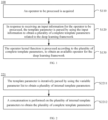
- FIG. 1 is a flowchart of an operator processing method of a deep learning framework according to an embodiment of the present disclosure.
- the method 100 may include operation S110 to operation S130.
- the operator to be processed includes a template parameter independent of the deep learning framework and an operator kernel function.
- the acquired operator to be processed may be a Scale operator.
- the Scale operator may include an operator kernel function scale_kernel (kernel function of the Scale operator) and a template parameter T.
- the scale_kernel may perform a scale operation.
- the template parameter independent of the deep learning framework may include a template parameter independent of an implementation device of the deep learning framework, and may also include a template parameter independent of a data type of the deep learning framework.
- the implementation device may be a CPU or a GPU.
- the data type may be Float (floating point) or Int (integer).
- the operator to be processed may be represented as ScaleKernel ⁇ T, Context>().
- the template parameter is parsed by using the input information to obtain a plurality of complete template parameters related to the deep learning framework.
- a complete template parameter may be ⁇ Float, CPUContext>.
- Float is the data type
- CPUContext is the device type.
- the operator kernel function is processed according to the plurality of complete template parameters, to obtain an available operator for the deep learning framework.
- the available operator of a specific deep learning framework is obtained through parsing, and the available operator is registered in the deep learning framework, so that other routines or tasks in the deep learning framework may call the available operator to execute a corresponding algorithm or a function, such as scaling, convolution, etc., according to an actual deep learning application.
- the operator kernel function scale_kernel is processed to obtain the available operator.
- the available operator may be represented as ScaleKernel ⁇ Float, CPUContext>().
- the method 100 may also include: calling the available operator in response to a calling instruction for the available operator; and performing a functionality of a function corresponding to the available operator by compiling the called available operator.
- the available operator ScaleKernel ⁇ float, CPUContext>() is called; and a functionality of a scale function is executed by compiling the called available operator ScaleKernel ⁇ float, CPUContext>().
- a declaration of the operator kernel function independent of the implementation device of the deep learning framework may be, for example:
- the Temlate is a template.
- the typename T is a template parameter independent of the data type of the deep learning framework.
- the typename Context is a template parameter independent of the implementation device of the deep learning framework. The typename T and typename Context may not be bound to specific implementation devices.
- the operator Calc multiplexing basic operations may be:
- An operator called by the operator Calc is the operator ScaleKernel ⁇ T, Context>().
- the operator ScaleKernel ⁇ T, Context>() is an operator independent of the implementation device.
- the template parameters T and Context are obtained and converted to specific data type and implementation device by the compiler.
- the operator ScaleKernel ⁇ T, Context>() may be converted to ScaleKernel ⁇ float, CPUContext>().
- the operator Calc may call the float type of the scale operation and an instruction set based on a CPU device, without other logic to make a determination and choices. It is possible to multiplex with non-scheduling overhead and achieve high-performance multiplexing.
- the parsing in response to receiving an input information for the operator to be processed, the template parameter by using the input information to obtain the plurality of complete template parameters related to the deep learning framework, includes: creating a variable parameter list by using a macro; and iteratively parsing the template parameter based on the variable parameter list, where the input information is used as a macro parameter for the macro.
- the macro is a mechanism in C language that may be used to simplify repetitive codes. During compilation pre-processing, the macro is replaced with a corresponding code segment for execution.
- variable parameter list may be determined based on the input information.
- the macro iteratively parses based on the variable parameter list.
- a macro PD_REGISTER_KERNEL may parse the variable parameter list:
- variable parameter list includes: a name of the operator to be processed; a name of the operator kernel function; a data layout of the operator kernel function; a device type for implementing the deep learning framework; and a data type for implementing the deep learning framework.
- scale is the operator name
- CPU is the device type for implementing the deep learning framework
- ALL_LAYOUT represents that the operator kernel function ScaleKernel may adapt to all data layouts
- ScaleKernel represents the name of the operator kernel function to be registered and parsed
- float, double, bfloat16, uint8_t, int16_t, int and int64_t represent the data types supported by the deep learning framework.
- iteratively parsing the template parameter based on the variable parameter list includes: determining a number of parameters included in the macro; determining an end position of an iteration according to the number of the parameters; and iteratively processing the input information according to the end position of the iteration by using the variable parameter list.
- the number of the parameters may be used as a suffix of the macro, so as to concatenate a macro method in a lower level, and call the macro method for parsing.
- the macro PD_NARGS may be, for example:
- the "" may be the variable parameter list mentioned above.
- the macro PD_NARGS may be nested outside a variable parameter macro _VA ARGS, so as to perform a relevant processing by the macro PD NARGS.
- the macro PD_NARGS may be nested outside the variable parameter macro_VA_ARGS by:
- the template parameter may be iteratively parsed based on the variable parameter list.
- iterative parsing the template parameter based on the variable parameter list may also include: iteratively parsing the template parameter based on the input information by using the variable parameter list to obtain a plurality of internal template parameters; and performing a concatenation on the plurality of internal template parameters to obtain the plurality of complete template parameters. The following will be explained in detail with reference to FIG. 2 .
- FIG. 2 is a flowchart of an operator processing method of a deep learning framework according to another embodiment of the present disclosure.
- a method 221 iteratively parses a template parameter based on a variable parameter list. The following will provide a detailed explanation in conjunction with operation S2211 and operation S2212.
- the template parameter is iteratively parsed by using the variable parameter list to obtain a plurality of internal template parameters.
- the iteration may be performed by using a macro VA ARGS on the macro parameters, so as to iteratively parse the template parameter based on the variable parameter list.
- the template parameter may be obtained by iteratively parsing using the variable parameter list:
- the macro parameter "" is the variable parameter list mentioned above.
- the macro parameters include: float, double, bfloat16, uint8_t, int8_t, int16_t, int, or int64_t.
- the macro PD_KERNEL_REGISTRAR_INIT_3 may be called in the macro PD_KERNEL_REGISTRAR_INIT_4.
- the macro PD_KERNEL_REGISTRAR_INIT_3 may be nested outside the macro VA_ARGS for iterating the variable parameter list as a whole.
- the macro PD_KERNEL_REGISTRAR_INIT_3 may parse a first parameter in the variable parameter list, such as parsing the float.
- cpp_dtype may be float
- the macro parameter "" of the macro PD_KERNEL_REGISTRAR_INIT_4 may include double, bfloat16, uint8_t, int8_t, int16_t, int, or int64_t. In a next iteration, the double is the first parameter in the variable parameter list.
- a concatenation is performed on the plurality of internal template parameters to obtain the plurality of complete template parameters.
- the plurality of internal template parameters include a plurality of strings.
- performing the concatenation on the plurality of internal template parameters to obtain the plurality of complete template parameters includes: performing the concatenation on the plurality of strings according to the input information, to obtain the plurality of complete template parameters for the operator to be processed.
- the parsed internal template parameter is a string.
- the plurality of strings may include a string Float and a string CPUContext, for example.
- a complete template parameter ⁇ Float, CPUContext> may be obtained.
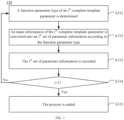
- processing the operator kernel function according to the plurality of complete template parameters, to obtain an available operator for the deep learning framework includes: for each complete template parameter among the plurality of complete template parameters, determining a function parameter type for the complete template parameter; converting an input information of the complete template parameter into a corresponding parameter information according to the function parameter type; and recording the corresponding parameter information.
- FIG. 3 is a flowchart of an operator processing method of a deep learning framework according to an embodiment of the present disclosure.
- the method 330 may, for example, traverse I complete template parameters, and operation S331 to operation S335 may be performed for an i th complete template parameter, in order to convert an input information of the complete template parameter into a corresponding parameter information.
- I is an integer greater than or equal to 1
- i is an integer less than or equal to I.
- types of some function parameters may be determined as the function parameter type.
- an input information of the i th complete template parameter is converted into an i th set of parameter information according to the function parameter type.
- different function parameter types may correspond to different conversion methods.
- a correspondence between the function parameter types and the conversion methods may be preset.
- the input information for the operator to be processed mentioned above may include an i th input information corresponding to the i th complete template parameter.
- the i th input information may include a plurality of function parameters.
- the input information may be converted into a corresponding i th set of parameter information.
- the i th set of parameter information may be recorded in a memory.
- operation S335 is executed to end the process.
- 16 sets of parameter information may be obtained to support combinations of different device types and different data types.
- the function parameter type of the i th function may be determined, and the type and a related necessary information of the i th function may be recorded.
- a C++ template meta-programming technology may be used to realize functions such as calculation, determination, conversion, query, etc. during the compiling.
- the method 300 described above may also include: creating an operator to be registered based on the deep learning framework according to the plurality of complete template parameters; and registering the operator to be registered into a global operator table in the deep learning framework.
- the function corresponding to the operators within the deep learning framework may be written in a normalized manner, and there is a significant difference between the normalized writing manner and a writing manner of a calculation function of the operator defined by a user.
- the calculation functions written by different users may be different from each other.
- the function is written as follows: name of an operator calculation function returning a Tensor list (input Tensor1) ⁇ ... ⁇ .
- a function form of a custom calculation function is: name of an operator calculation function returning a tensor list (input Tensor1) ⁇ ... ⁇ .
- a function form of another custom calculation function is: name of an operator calculation function returning a tensor list (input Tensor1, input Tensor2) ⁇ ... ⁇ .
- the function forms of the above two custom calculation functions are not unified.
- the different custom calculation functions are normalized, so as to facilitate a unified scheduling within the deep learning framework.
- the operator to be registered includes a description information of the operator to be registered and a kernel function of the operator to be registered, the kernel function of the operator to be registered includes a normalized input information and a normalized function pointer.
- Creating the operator to be registered based on the deep learning framework according to the plurality of complete internal template functions includes: for each complete template parameter among the plurality of complete template parameters, determining a structure corresponding to the complete template parameter, where the structure contains a static function, and the static function has a normalized form; determining an input information of the static function as the normalized input information; and determining a function pointer of the static function as the normalized function pointer.
- various operators within the deep learning framework may inherit an OpKernel class and fill in their own computational functions (Compute).
- the corresponding input and output tensors of the operator may be stored in an execution context (ExecutionContext) and obtained through the input and output functions of the execution context.
- ExecuteContext execution context
- the kernel function of the operator to be registered when the kernel function of the operator to be registered is constructed, the kernel function of the operator to be registered may be constructed based on the function in the normalized form.
- the normalized function may be a static function in the structure corresponding to the complete template parameters.
- the method may include: creating the input information of the above static function, creating the function pointer of the above static function, and creating some other standard processing, such as acquiring an input information from context and putting the input information into an inputs variable.
- the custom calculation functions may be unified, so as to facilitate the unified scheduling of the deep learning framework.
- the input information of the static function forms an input information list
- the input information list includes an input tensor list.
- the structure includes at least one specialization sub-structure, and the at least one specialization sub-structure respectively has a corresponding data type, where the data type includes a tensor and a non-tensor.
- the input of a static function in the normalized form may be an input information list.
- the input information list may include an input tensor list and a property list.
- the property list is used to store input variables of other data types.
- the data types of input variables include tensor (tensor), integer (int), and floating-point (float), which are represented as tensor1, tensor2, int, and float.
- the input information list of the static function may include a tensor list (tensor1, tensor2) and a property list (int, float).
- the input information list may be obtained using the C++ template parameter derivation mechanism.
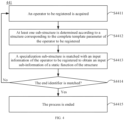
- FIG. 4 is a flowchart of an operator processing method of a deep learning framework according to an embodiment of the present disclosure.
- a method 441 may normalize input information and a function pointer for an operator kernel function. The following will provide a detailed explanation in conjunction with operation S4411 to operation S4415.
- the operator to be registered includes a description information of the operator to be registered and a kernel function of the operator to be registered.
- the description information of the operator to be registered includes an input information of the operator to be registered and an output information of the operator to be registered.
- the kernel function of the operator to be registered may be used to describe a main computational logic of the operator.
- At least one sub-structure is determined according to a structure corresponding to the complete template parameter of the operator to be registered.
- the operator to be registered may be created according to the plurality of complete template parameters.
- Each complete template parameter may correspond to one structure.
- the structure may be preset.
- the structure may take a function return value, a variable function parameter list and a function pointer as the template parameter.
- a type of the return value of the function pointer is consistent with the type in the parameter list and the template parameter.
- the structure contains a static function for calculation.
- the static function has a normalized form.
- the structure may include at least one specialization sub-structure.
- the specialization sub-structure is used for template parameter derivation.
- a specialization sub-structure is matched with an input information of the operator to be registered to obtain an input sub-information of a static function of the structure.
- each specialization sub-structure may be preset to match with the structure of the specific data type.
- the specialization implementation of each sub-structure takes the data type matched with the structure as a first template parameter, and others as remaining template parameter list.
- At least one specialization sub-structure includes a specialization sub-structure with an end identifier.
- the specialization sub-structure with the end identifier may use the end identifier as the template parameter.
- the specialization sub-structure may contain a static sub-function.
- the static sub-function takes a parameter index as the template parameter, which may be used to identify which parameter is currently matched to.
- operation S4415 is performed to end the process.
- a compiler will parse the input information of the operator kernel function one by one. If the input information currently parsed matches with the first template parameter of the specialization implementation of the defined sub-structure mentioned above, the specialization implementation of the specialization sub-structure will be called to complete a parsing of the current parameter. Next, the remaining input information is continued to be matched with other specialization sub-structures to parse the following input information. When encountering a matching with a specialization sub-structure using the end identifier as the template parameter, the matching is completed.
- a function form with a normalized form may be: name of an operator calculation function returning a Tensor list (input Tensor list) ⁇ ... ⁇ .
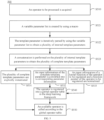
- FIG. 5 is a flowchart of an operator processing method of a deep learning framework according to another embodiment of the present disclosure.
- the operator to be processed includes an operator kernel function and a template parameter.
- the template function is independent of the deep learning framework and may be used to distribute the operator to be processed.
- the method 500 may parse, in response to receiving an input information for the operator to be processed, the template parameter by using the input information to obtain a plurality of complete template parameters related to the deep learning framework.
- the template parameter by using the input information to obtain a plurality of complete template parameters related to the deep learning framework.
- a variable parameter list is created by using a macro.
- the template parameter is iteratively parsed by using the variable parameter list to obtain a plurality of internal template parameters.
- the method 500 may process the operator kernel function according to the plurality of complete template parameters, to obtain an available operator for the deep learning framework.
- the following will provide a detailed explanation in conjunction with operations S531, S532 and operation S533.
- the plurality of complete template parameters may be explicitly instantiated.
- the plurality of complete template parameters respectively include a template function description information and a template function information.
- the template function description information is instantiated into a header file.
- the template function description information may be a declaration for the template function.
- the header file may be, for example, an ".h" file.
- the template function information is instantiated into a source code file.
- the template function information may be implemented as the template function.
- the source code file may be, for example, a ".cc" file.
- the template function In the C++ programming language, there are some limitations to the kernel form of applying the template function.
- the template function In the compilation, the template function needs to be instantiated according to an actual template parameter type, and the implementation of the template function will also be expanded to a corresponding calling position.
- the template function description information is instantiated to the header file, and the source code file is instantiated to the source code file, so as to avoid introducing a large number of template function code expansions during compilation and affecting compilation efficiency.
- an input information of the complete template parameter is converted into a corresponding parameter information.
- information about registering the operator into the global operator table may be acquired.
- These information may include, for example, a corresponding parameter information of the operator kernel function and/or a normalized function pointer.
- the template function may be explicitly instantiated.
- the template function description information may be:
- the explicitly instantiated function ScaleKernel ⁇ float, CPUContext> may be:
- a plurality of instantiation declaration statements may be generated according to the plurality of complete template parameters, as follows:
- decltype is a method used to automatically parse the function type. In this way, it is possible to improve compilation efficiency and enhance an indirectness of the writing method, thereby automatically completing the explicit instantiation process.
- the global operator table includes: an operator kernel factory class; an operator kernel name class and a kernel key value class; and an operator kernel class.
- the operator kernel class includes at least one of: a pointer of the operator kernel function; a description information of an input parameter of the operator kernel function; and a description information of an output parameter of the operator kernel function.
- FIG. 6 is an exemplary schematic diagram of a global operator table according to an embodiment of the present disclosure.
- a data structure of a global operator table 600 may include an operator kernel factory class 610 in a first level, an operator kernel name class 620, a kernel key value class 630, and an operator kernel class 640 in a second level.
- the operator kernel class 640 may include a pointer 641 of an operator kernel function and a description information 642 of the operator kernel function parameter in a third level.
- the description information 642 of the operator kernel function parameter may include, for example, a description information of an input parameter of the operator kernel function and a description information of an output function of the operator kernel function.
- processing the operator kernel function according to the plurality of complete template parameters, to obtain an available operator for the deep learning framework includes: processing the operator kernel function by explicitly instantiating the plurality of complete template parameters, to obtain the available operator for the deep learning framework.
- the plurality of complete template parameters respectively include a template function description information and a template function information; and processing the operator kernel function by explicitly instantiating the plurality of complete template parameters, to obtain the available operator for the deep learning framework includes: instantiating the template function description information into a header file, and instantiating the template function information into a source code file.
- FIG. 7 is a block diagram of an operator processing apparatus of a deep learning framework according to an embodiment of the present disclosure.
- the apparatus 700 may include an acquisition module 710, a parsing module 720 and a processing module 730.
- the acquisition module 710 is used to acquire an operator to be processed.
- the operator to be processed includes a template parameter independent of the deep learning framework and an operator kernel function.
- the parsing module 720 is used to parse, in response to receiving an input information for the operator to be processed, the template parameter by using the input information to obtain a plurality of complete template parameters related to the deep learning framework.
- the processing module 730 is used to process the operator kernel function according to the plurality of complete template parameters, to obtain an available operator for the deep learning framework.
- the parsing module includes: a creation sub-module used to create a variable parameter list by using a macro; and a parsing sub-module used to iteratively parse the template parameter based on the variable parameter list, where the input information is implemented as a macro parameter of the macro.
- variable parameter list includes: a name of the operator to be processed; a name of the operator kernel function; a data layout of the operator kernel function; a device type for implementing the deep learning framework; and a data type for implementing the deep learning framework.
- the parsing sub-module includes: a first determination unit used to determine a number of parameters included in the macro; a second determination unit used to determine an end position of an iteration according to the number of the parameters; and a processing unit used to iteratively process the input information according to the end position of the iteration by using the variable parameter list.
- the parsing sub-module also includes: a parsing unit used to iteratively parse the template parameter by using the variable parameter list to obtain a plurality of internal template parameters; and a concatenation unit used to perform a concatenation on the plurality of internal template parameters to obtain the plurality of complete template parameters.
- the plurality of internal template parameters include a plurality of strings; and the concatenation unit includes: a concatenation sub-unit used to perform the concatenation on the plurality of strings according to the input information, to obtain the plurality of complete template parameters for the operator to be processed.
- the processing module includes an explicit instantiation sub-module used to process the operator kernel function by explicitly instantiating the plurality of complete template parameters, to obtain the available operator for the deep learning framework.
- the plurality of complete template parameters respectively include a template function description information and a template function information
- the explicit instantiation sub-module includes: a first instantiation unit used to instantiate the template function description information into a header file; and a second instantiation unit used to instantiate the template function information into a source code file.
- the processing module includes: a first determination sub-module used to determine a function parameter type for the complete template parameter for each complete template parameter among the plurality of complete template parameters; a conversion sub-module used to convert an input information of the complete template parameter into a corresponding parameter information according to the function parameter type; and a recording sub-module used to record the corresponding parameter information.
- the device 700 also includes: a creation module used to create an operator to be registered based on the deep learning framework according to the plurality of complete template parameters; and a registration module used to register the operator to be registered into a global operator table in the deep learning framework.
- the operator to be registered includes a description information of the operator to be registered and a kernel function of the operator to be registered.
- the kernel function of the operator to be registered includes a normalized input information and a normalized function pointer; and the creation module includes: a second determination sub-module used to determine, for each complete template parameter among the plurality of complete template parameters, a structure corresponding to the complete template parameter, where the structure contains a static function, and the static function has a normalized form; a first normalization sub-module used to determine an input information of the static function as the normalized input information; and a second normalization module used to determine a function pointer of the static function as the normalized function pointer.
- the input information of the static function forms an input information list
- the input information list includes an input tensor list
- the structure includes at least one specialization sub-structure, each of the at least one specialization sub-structure has a respective corresponding data type, and the data type includes a tensor and a non-tensor.
- the global operator table includes: an operator kernel factory class; an operator kernel name class and a kernel key value class; and an operator kernel class.
- the operator kernel class includes at least one of: a pointer of the operator kernel function; a description information of an input parameter of the operator kernel function; and a description information of an output parameter of the operator kernel function.
- the template parameter independent of the deep learning framework is implemented to distribute the operator to be processed; and the template parameter independent of the deep learning framework includes a template parameter which is independent of an implementation device of the deep learning framework and a data type of the deep learning framework.
- the device 700 also includes: a calling module used to call the available operator in response to a calling instruction for the available operator; and a performing module used to perform a functionality of a function corresponding to the available operator by compiling the called available operator.
- the present disclosure also provides an electronic device, a readable storage medium, and a computer program product.
- FIG. 8 shows a schematic block diagram of an example electronic device 800 that may be used to implement the embodiments of the present disclosure.
- the electronic device is intended to represent various forms of digital computers, such as a laptop computer, a desktop computer, a workstation, a personal digital assistant, a server, a blade server, a mainframe computer, and other suitable computers.
- the electronic device may further represent various forms of mobile devices, such as a personal digital assistant, a cellular phone, a smart phone, a wearable device, and other similar computing devices.
- the components as illustrated herein, and connections, relationships, and functions thereof are merely examples, and are not intended to limit the implementation of the present disclosure described and/or required herein.
- the electronic device 800 may include computing unit 801, which may perform various appropriate actions and processing based on a computer program stored in a read-only memory (ROM) 802 or a computer program loaded from a storage unit 808 into a random access memory (RAM) 803.
- Various programs and data required for the operation of the electronic device 800 may be stored in the RAM 803.
- the computing unit 801, the ROM 802 and the RAM 803 are connected to each other through a bus 804.
- An input/output (I/O) interface 805 is further connected to the bus 804.
- I/O interface 805 Various components in the electronic device 800 are connected with I/O interface 805, including an input unit 806, such as a keyboard, a mouse, etc.; an output unit 807, such as various types of displays, speakers, etc.; a storage unit 808, such as a magnetic disk, an optical disk, etc.; and a communication unit 809, such as a network card, a modem, a wireless communication transceiver, etc..
- the communication unit 809 allows the electronic device 800 to exchange information/data with other devices through a computer network such as the Internet and/or various telecommunication networks.
- the computing unit 801 may be various general-purpose and/or special-purpose processing components with processing and computing capabilities. Some examples of the computing unit 801 include but are not limited to a central processing unit (CPU), a graphics processing unit (GPU), various dedicated artificial intelligence (AI) computing chips, various computing units running machine learning model algorithms, a digital signal processor (DSP), and any appropriate processor, controller, microcontroller, and so on.
- the computing unit 801 may perform the various methods and processes described above, such as the operator processing method of the deep learning framework.
- the operator processing method of the deep learning framework may be implemented as a computer software program that is tangibly contained on a machine-readable medium, such as a storage unit 808.
- part or all of a computer program may be loaded and/or installed on the electronic device 800 via the ROM 802 and/or the communication unit 809.
- the computer program When the computer program is loaded into the RAM 803 and executed by the computing unit 801, one or more steps of the operator processing method of the deep learning framework described above may be performed.
- the computing unit 801 may be configured to perform the operator processing method of the deep learning framework in any other appropriate way (for example, by means of firmware).
- Various embodiments of the systems and technologies described herein may be implemented in a digital electronic circuit system, an integrated circuit system, a field programmable gate array (FPGA), an application specific integrated circuit (ASIC), an application specific standard product (ASSP), a system on chip (SOC), a complex programmable logic device (CPLD), a computer hardware, firmware, software, and/or combinations thereof.
- FPGA field programmable gate array
- ASIC application specific integrated circuit
- ASSP application specific standard product
- SOC system on chip
- CPLD complex programmable logic device
- the programmable processor may be a dedicated or general-purpose programmable processor, which may receive data and instructions from the storage system, the at least one input device and the at least one output device, and may transmit the data and instructions to the storage system, the at least one input device, and the at least one output device.
- Program codes for implementing the method of the present disclosure may be written in any combination of one or more programming languages. These program codes may be provided to a processor or a controller of a general-purpose computer, a special-purpose computer, or other programmable data processing devices, so that when the program codes are executed by the processor or the controller, the functions/operations specified in the flowchart and/or block diagram may be implemented.
- the program codes may be executed completely on the machine, partly on the machine, partly on the machine and partly on the remote machine as an independent software package, or completely on the remote machine or the server.
- the machine readable medium may be a tangible medium that may contain or store programs for use by or in combination with an instruction execution system, device or apparatus.
- the machine readable medium may be a machine-readable signal medium or a machine-readable storage medium.
- the machine readable medium may include, but not be limited to, electronic, magnetic, optical, electromagnetic, infrared or semiconductor systems, devices or apparatuses, or any suitable combination of the above.
- machine readable storage medium may include electrical connections based on one or more wires, portable computer disks, hard disks, random access memory (RAM), read-only memory (ROM), erasable programmable read-only memory (EPROM or flash memory), optical fiber, convenient compact disk read-only memory (CD-ROM), optical storage device, magnetic storage device, or any suitable combination of the above.
- RAM random access memory
- ROM read-only memory
- EPROM or flash memory erasable programmable read-only memory
- CD-ROM compact disk read-only memory
- magnetic storage device magnetic storage device, or any suitable combination of the above.
- a computer including a display device (for example, a CRT (cathode ray tube) or LCD (liquid crystal display) monitor) for displaying information to the user, and a keyboard and a pointing device (for example, a mouse or a trackball) through which the user may provide the input to the computer.
- a display device for example, a CRT (cathode ray tube) or LCD (liquid crystal display) monitor
- a keyboard and a pointing device for example, a mouse or a trackball
- Other types of devices may also be used to provide interaction with users.
- a feedback provided to the user may be any form of sensory feedback (for example, visual feedback, auditory feedback, or tactile feedback), and the input from the user may be received in any form (including acoustic input, voice input or tactile input).
- the systems and technologies described herein may be implemented in a computing system including back-end components (for example, a data server), or a computing system including middleware components (for example, an application server), or a computing system including front-end components (for example, a user computer having a graphical user interface or web browser through which the user may interact with the implementation of the system and technology described herein), or a computing system including any combination of such back-end components, middleware components or front-end components.
- the components of the system may be connected to each other by digital data communication (for example, a communication network) in any form or through any medium. Examples of the communication network include a local area network (LAN), a wide area network (WAN), and Internet.
- LAN local area network
- WAN wide area network
- Internet Internet
- the computer system may include a client and a server.
- the client and the server are generally far away from each other and usually interact through a communication network.
- the relationship between the client and the server is generated through computer programs running on the corresponding computers and having a client-server relationship with each other.
- the server may be a cloud server.
- the server may also be a server of a distributed system, or a server combined with a block-chain.
- steps of the processes illustrated above may be reordered, added or deleted in various manners.
- the steps described in the present disclosure may be performed in parallel, sequentially, or in a different order, as long as a desired result of the technical solution of the present disclosure may be achieved. This is not limited in the present disclosure.
Landscapes
- Engineering & Computer Science (AREA)
- Theoretical Computer Science (AREA)
- Software Systems (AREA)
- Physics & Mathematics (AREA)
- General Engineering & Computer Science (AREA)
- General Physics & Mathematics (AREA)
- Computing Systems (AREA)
- Mathematical Physics (AREA)
- Artificial Intelligence (AREA)
- Data Mining & Analysis (AREA)
- Evolutionary Computation (AREA)
- Biomedical Technology (AREA)
- Health & Medical Sciences (AREA)
- Life Sciences & Earth Sciences (AREA)
- Biophysics (AREA)
- Computational Linguistics (AREA)
- General Health & Medical Sciences (AREA)
- Molecular Biology (AREA)
- Medical Informatics (AREA)
- Computer Vision & Pattern Recognition (AREA)
- Machine Translation (AREA)
- Devices For Executing Special Programs (AREA)
- Stored Programmes (AREA)
Applications Claiming Priority (2)
| Application Number | Priority Date | Filing Date | Title |
|---|---|---|---|
| CN202210560831.9A CN114841326B (zh) | 2022-05-19 | 2022-05-19 | 深度学习框架的算子处理方法、装置、设备和存储介质 |
| PCT/CN2022/129228 WO2023221408A1 (zh) | 2022-05-19 | 2022-11-02 | 深度学习框架的算子处理方法、装置、设备和存储介质 |
Publications (2)
| Publication Number | Publication Date |
|---|---|
| EP4300363A1 true EP4300363A1 (de) | 2024-01-03 |
| EP4300363A4 EP4300363A4 (de) | 2024-08-14 |
Family
ID=87975949
Family Applications (1)
| Application Number | Title | Priority Date | Filing Date |
|---|---|---|---|
| EP22925241.6A Pending EP4300363A4 (de) | 2022-05-19 | 2022-11-02 | Verfahren und vorrichtung zur verarbeitung eines bedieners für tiefenlernrahmen sowie vorrichtung und speichermedium |
Country Status (4)
| Country | Link |
|---|---|
| US (1) | US20250005446A1 (de) |
| EP (1) | EP4300363A4 (de) |
| JP (1) | JP7549153B2 (de) |
| KR (1) | KR20230128567A (de) |
Families Citing this family (4)
| Publication number | Priority date | Publication date | Assignee | Title |
|---|---|---|---|---|
| CN118586477B (zh) * | 2024-06-30 | 2025-11-28 | 浪潮电子信息产业股份有限公司 | 多元异构算力适配方法、装置、设备、介质及产品 |
| CN119783833B (zh) * | 2025-03-13 | 2025-08-01 | 苏州元脑智能科技有限公司 | 模型推理优化方法、装置、设备、介质和程序产品 |
| CN120994247B (zh) * | 2025-10-23 | 2026-03-20 | 中昊芯英(杭州)科技有限公司 | Ai加速器构建方法以及相关装置 |
| CN121614282B (zh) * | 2026-02-02 | 2026-04-24 | 苏州元脑智能科技有限公司 | 算子调用请求处理方法和电子设备 |
Family Cites Families (8)
| Publication number | Priority date | Publication date | Assignee | Title |
|---|---|---|---|---|
| US10157045B2 (en) * | 2016-11-17 | 2018-12-18 | The Mathworks, Inc. | Systems and methods for automatically generating code for deep learning systems |
| US10956132B1 (en) | 2018-06-11 | 2021-03-23 | Amazon Technologies, Inc. | Unified code and data management for model development |
| US20190392296A1 (en) | 2019-06-28 | 2019-12-26 | John Brady | Hardware agnostic deep neural network compiler |
| CN119883236A (zh) | 2019-06-28 | 2025-04-25 | 微软技术许可有限责任公司 | 用于深度学习的可视化编程 |
| CN111310934B (zh) | 2020-02-14 | 2023-10-17 | 北京百度网讯科技有限公司 | 一种模型生成方法、装置、电子设备和存储介质 |
| CN113705798B (zh) | 2020-05-21 | 2025-08-08 | 平头哥(上海)半导体技术有限公司 | 处理单元、计算装置及深度学习模型的计算图优化方法 |
| CN113342346B (zh) | 2021-05-18 | 2022-03-25 | 北京百度网讯科技有限公司 | 深度学习框架的算子注册方法、装置、设备和存储介质 |
| CN113031966B (zh) | 2021-05-20 | 2021-09-21 | 之江实验室 | 一种智能选择编译加速库的深度学习编译优化方法 |
-
2022
- 2022-11-02 EP EP22925241.6A patent/EP4300363A4/de active Pending
- 2022-11-02 JP JP2023549884A patent/JP7549153B2/ja active Active
- 2022-11-02 US US18/547,090 patent/US20250005446A1/en active Pending
- 2022-11-02 KR KR1020237028022A patent/KR20230128567A/ko active Pending
Also Published As
| Publication number | Publication date |
|---|---|
| US20250005446A1 (en) | 2025-01-02 |
| EP4300363A4 (de) | 2024-08-14 |
| KR20230128567A (ko) | 2023-09-05 |
| JP2024527451A (ja) | 2024-07-25 |
| JP7549153B2 (ja) | 2024-09-10 |
Similar Documents
| Publication | Publication Date | Title |
|---|---|---|
| CN114841326B (zh) | 深度学习框架的算子处理方法、装置、设备和存储介质 | |
| EP4300363A1 (de) | Verfahren und vorrichtung zur verarbeitung eines bedieners für tiefenlernrahmen sowie vorrichtung und speichermedium | |
| EP3971706B1 (de) | Verfahren, einrichtung und elektronische vorrichtung zum einsetzen eines operators in einem tiefenlernrahmen | |
| JP7350923B2 (ja) | ディープラーニングフレームワークのオペレータ登録方法、装置、デバイス及び記憶媒体 | |
| CN109271403A (zh) | 一种数据查询的操作方法、装置、介质及电子设备 | |
| CN103902286A (zh) | 基于soa的层级式多源数据融合方法 | |
| CN109597611B (zh) | 前端数据流控制组件开发系统、方法、设备及存储介质 | |
| JP7488322B2 (ja) | アクセス方法、装置、電子機器及びコンピュータ記憶媒体 | |
| CN114064601A (zh) | 存储过程转换方法、装置、设备和存储介质 | |
| EP3996009A1 (de) | Verfahren und vorrichtung zur umwandlung eines schemas im rahmen von tiefenlernen und computerspeichermedium | |
| CN102664952B (zh) | 一种对嵌入式设备集群管理及监控的方法 | |
| CN119311277A (zh) | 代码生成方法、装置、设备及存储介质 | |
| CN114064685A (zh) | 数据标准化访问方法及其装置、设备、介质、产品 | |
| CN102520963A (zh) | 基于强类型关系映射实现业务逻辑处理的方法及系统 | |
| CN100561476C (zh) | 一种基于asn类型对象的代码生成方法 | |
| CN108664238A (zh) | 一种解释型脚本语言c-sub的执行方法及装置 | |
| CN105242913A (zh) | Yyuc-php框架 | |
| CN117608581A (zh) | 一种广域环境中异构数据库的代码生成拓展方法 | |
| CN113791775B (zh) | 元数据的流程编排方法与装置、存储介质和电子设备 | |
| Vajk et al. | Runtime model validation with parallel object constraint language | |
| CN101944120A (zh) | 一种无线标记语言脚本的执行方法及装置 | |
| CN118520013B (zh) | 一种数据库的查询方法、装置、电子设备及介质 | |
| CN117472990A (zh) | 一种大屏动态对接数据源的实现方法及系统 | |
| CN121008986A (zh) | 高层次综合的性能预测方法及装置、电子设备和存储介质 | |
| CN120068804A (zh) | 一种基于元模型的语言转换方法 |
Legal Events
| Date | Code | Title | Description |
|---|---|---|---|
| STAA | Information on the status of an ep patent application or granted ep patent |
Free format text: STATUS: UNKNOWN |
|
| STAA | Information on the status of an ep patent application or granted ep patent |
Free format text: STATUS: THE INTERNATIONAL PUBLICATION HAS BEEN MADE |
|
| PUAI | Public reference made under article 153(3) epc to a published international application that has entered the european phase |
Free format text: ORIGINAL CODE: 0009012 |
|
| STAA | Information on the status of an ep patent application or granted ep patent |
Free format text: STATUS: REQUEST FOR EXAMINATION WAS MADE |
|
| 17P | Request for examination filed |
Effective date: 20230817 |
|
| AK | Designated contracting states |
Kind code of ref document: A1 Designated state(s): AL AT BE BG CH CY CZ DE DK EE ES FI FR GB GR HR HU IE IS IT LI LT LU LV MC ME MK MT NL NO PL PT RO RS SE SI SK SM TR |
|
| A4 | Supplementary search report drawn up and despatched |
Effective date: 20240715 |
|
| RIC1 | Information provided on ipc code assigned before grant |
Ipc: G06N 3/08 20230101ALI20240709BHEP Ipc: G06F 8/41 20180101ALI20240709BHEP Ipc: G06N 3/10 20060101ALI20240709BHEP Ipc: G06N 3/063 20230101ALI20240709BHEP Ipc: G06N 3/04 20230101AFI20240709BHEP |
|
| STAA | Information on the status of an ep patent application or granted ep patent |
Free format text: STATUS: EXAMINATION IS IN PROGRESS |
|
| 17Q | First examination report despatched |
Effective date: 20250314 |
|
| DAV | Request for validation of the european patent (deleted) | ||
| DAX | Request for extension of the european patent (deleted) |